Drugs, Health Technologies, Health Systems
Health Technology Review
CT and MRI Services in Urban, Rural, and Remote Settings: 24-Hour and Weekend Operations
Key Messages
What Is the Issue
Canada’s Drug Agency received a request to identify facilities that provide 24-hour and weekend CT and MRI services across Canada.
Access to imaging services with extended-hours differs across regions, reflecting the variations in local capacity and resource availability.
CT and MRI services offered 24 hours and on weekends may help reduce diagnostic wait times, improve emergency department patient flow, maximize use of imaging equipment, and enhance access for patients in rural and remote communities.
What Did We Do
In response to the request, Canada’s Drug Agency leveraged data from the Canadian Medical Imaging Inventory (CMII) 2022–2023 National Survey. This comprehensive survey gathered detailed, site-level data, including information on 24-hour and weekend operations from sites with CT and MRI units.
The aim was to assess the availability of these services in urban, rural, and remote settings in each province and territory with capacity.
What Did We Find
The analysis revealed the following key findings:
Urban facilities reported the highest availability of 24-hour CT and MRI services, while rural and remote sites had more limited access.
Weekend availability was generally greater than 24-hour availability, with urban facilities leading in weekend CT and MRI services, and rural and remote sites offering fewer weekend operations.
Compared with CT, far fewer sites with MRI — even in urban centres — offered 24-hour or weekend services.
Across Canada, 24-hour and weekend CT and MRI services vary considerably by jurisdiction and facility.
Facilities offering 24-hour services are also likely to provide weekend services, suggesting that once extended-hour infrastructure is in place, it can support broader service availability.
What Does This Mean
These findings provide valuable insights into the availability of 24-hour and weekend CT and MRI services across Canada, which can guide decision-making in several ways:
The data can support evidence-based policies to extend imaging hours — particularly for urgent and emergency care — by identifying where increased access could have the greatest impact. While expanding service availability within existing infrastructure may improve patient outcomes, such efforts must be balanced against practical constraints, including funding, equipment, and staffing.
Sites that do not have after-hours imaging access may signal opportunities where investments in staffing and infrastructure may be most beneficial. Rather than expanding services uniformly, decision-makers may prioritize high-need regions to support equitable, efficient use of limited resources.
Expanding 24-hour and weekend services in rural and remote locations may reduce travel burden and help ease pressure on urban imaging centres, ultimately shortening wait times and improving access to timely care.
Understanding where continuous coverage is limited can guide recruitment and retention efforts.
Context
CT and MRI are among the most commonly used advanced imaging modalities in Canada, and are pivotal for diagnosing a wide range of conditions, from life-threatening trauma to complex disease.1,2 In recent years, technological advancements, such as improved equipment performance, remote diagnostics, hybrid imaging, and better workflow management tools, have increased efficiency in the delivery of imaging services.3,4 Some of these improvements have contributed to extending imaging operation hours and facilitating continuous access, especially for urgent and emergency cases.3,4
However, despite these advancements, there are inherent challenges in expanding after-hour imaging services. Limited resources — such as qualified staff, funding, and access to supportive technologies — can constrain the capacity to extend service hours or increase the number of facilities offering these services.5 Additionally, regional differences in resource allocation may result in differential access to after-hour imaging services, complicating efforts to meet the needs of all people living in Canada.1,2
This report provides an overview of the landscape of after-hour imaging services throughout Canada, offering insights for managing wait times, providing equitable access across different regions, identifying opportunities to enhance service offerings, and optimizing resource allocation for emergency and urgent care.
By presenting evidence-based observations on regional trends and service delivery patterns in after-hour CT and MRI operations, this report offers insights that may inform strategic planning for imaging services. The findings can support decision-makers as they consider resource allocation, workforce planning, and targeted service expansion. When integrated with an understanding of the operational realities of health care systems, these insights may contribute to improving accessibility, equity, and effectiveness of care across Canada.
Objective
This report aims to summarize information on the availability of 24-hour and weekend CT and MRI services at health care facilities across Canada. The key objectives include:
Identify the number of health care facilities that offer 24-hour and weekend CT and MRI services.
Provide a provincial and territorial breakdown of service availability.
Examine how service availability varies across geographic settings, including urban, rural, and remote areas.
About This Document
This document summarizes national and jurisdictional-level findings from the Canadian Medical Imaging Inventory (CMII) 2022–2023 National Survey. According to the survey, there are 560 CT units across 394 sites and 432 MRI units across 296 sites in Canada.1,2 To assess the number of sites offering 24-hour and weekend services, data were drawn from survey responses from all CT and MRI sites. Survey questions were in 3 key areas:
The location of the facility (urban, rural, or remote): Response rates were 73% of all 394 CT sites and 44% of all 432 MRI sites.
The availability of units operating 24 hours a day: Response rates were 69% of urban, 77% of rural, and 63% of remote CT sites, and 67% of urban, 73% of rural, and 50% of remote MRI sites.
The availability of units operating on weekends: Weekend hours varied by site (from limited hours to full-day service). Response rates were 69% of urban, 78% of rural, and 63% of remote CT sites, and 66% of urban, 73% of rural, and 50% of remote MRI sites.
Results
The following sections summarize information on the availability of 24-hour and weekend CT and MRI services in Canada. Participants who responded provided information on facility location (urban, rural, or remote) and service availability. Classifications of urban, rural, and remote were not formally defined; instead, participants of the CMII survey self-identified the setting that best described their facility's location. Data are first presented at the national level, followed by breakdowns by province and territory, referred to throughout as jurisdictions. Summaries of the number of responding sites for CT and MRI are provided in Table 1 and Table 2, Appendix 1.
Availability in Canada of 24-Hour and Weekend CT and MRI Services
Survey responses indicate that CT services are more widely available on a 24-hour and weekend basis compared to MRI services across Canada. Data from responding sites provide details on service availability by facility setting — urban, rural, and remote. Figures 1 to 6 and Table 1 and Table 2, Appendix 1 summarize these findings nationally, showing the availability of CT and MRI services and the number of responding sites across these settings.
CT Facilities
Among CT facilities across Canada, more than one-half of all sites responded to the 24-hour and weekend service questions:
Of these, 91 sites reported providing 24-hour CT services, most of which were in urban settings, with fewer in rural and remote areas (refer to Figure 1 and Table 1, Appendix 1).
A total of 160 sites reported offering weekend CT services, most of which were in urban settings, with fewer in rural and remote areas (refer to Figure 1 and Table 1, Appendix 1).
MRI Facilities
Among MRI facilities across Canada, less than one-half of all sites responded to the 24-hour and weekend service questions:
Of these, 23 sites reported providing 24-hour MRI services, almost all of which were in urban settings, with 1 site in a rural area and none in remote areas (refer to Figure 1 and Table 2, Appendix 1).
A total of 97 sites reported offering weekend MRI services, most of which were in urban settings, with fewer in rural areas and none in remote areas (refer to Figure 1 and Table 2, Appendix 1).
The data show that 24-hour and weekend CT services are more widely available than MRI services across Canada, particularly in rural and remote areas. Most extended-hour services are concentrated in urban settings and facilities that offer 24-hour services are also able to offer weekend services more.
Figure 1: Number of Sites Across Canada Providing 24-Hour and Weekend CT and MRI Services in Urban, Rural, and Remote Settings
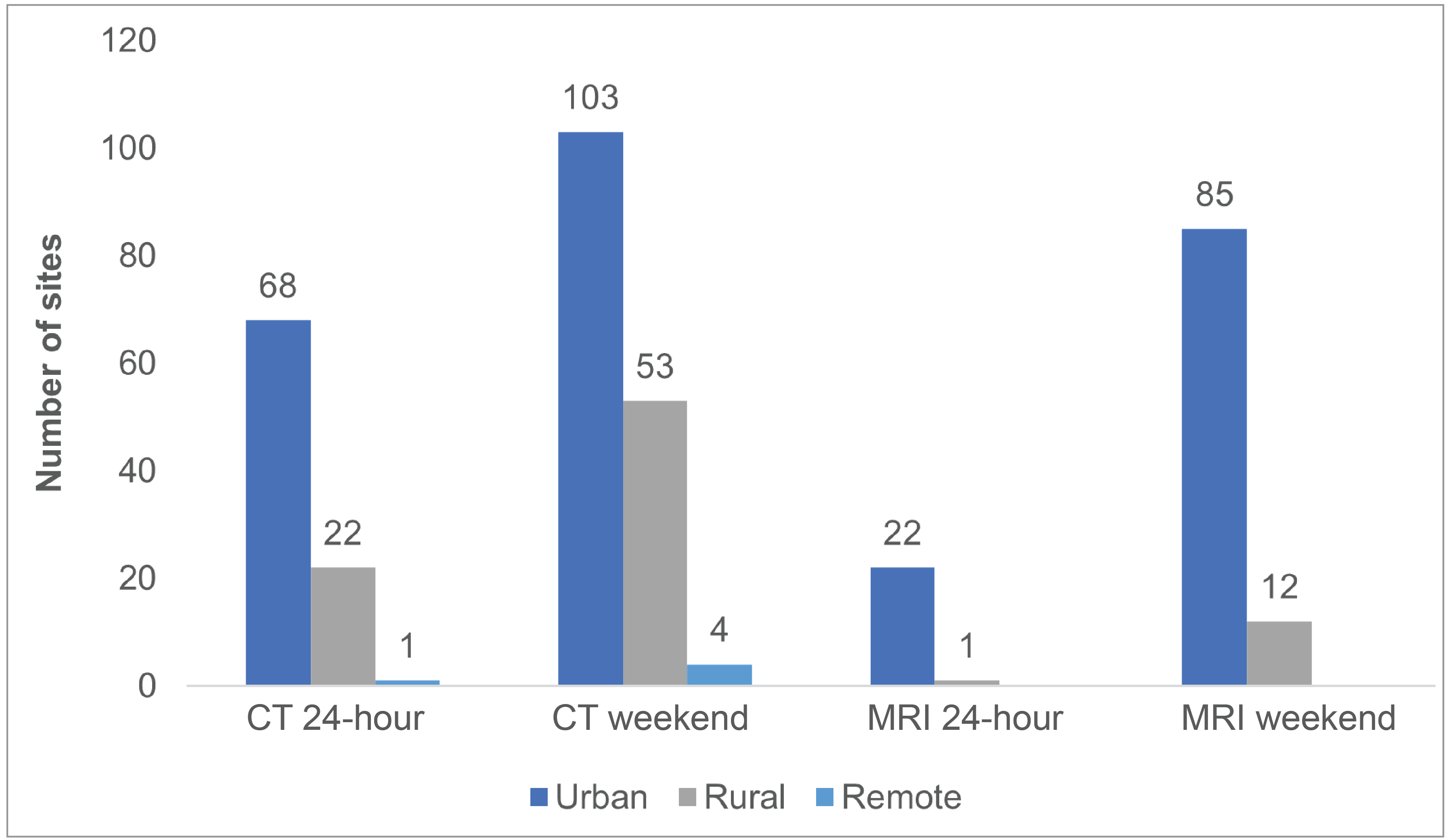
Notes: Among 394 total CT sites, data on CT facility settings (urban, rural, or remote) were available for 206 sites (52% response rate), including 121 urban, 80 rural, and 5 remote sites, that responded to the question about 24-hour operations. For the weekend operations question, 208 sites (53% response rate) responded, including 122 urban, 81 rural, and 5 remote sites (Table 1, Appendix 1).
Among 296 total MRI sites, data on MRI facility settings (urban, rural, or remote) were available for 130 sites (44% response rate), including 102 urban, 27 rural, and 1 remote site, that responded to the question about 24-hour operations. For the weekend operations question, 129 sites (44% response rate) responded, including 102 urban, 27 rural, and 1 remote site (Table 2, Appendix 1).
Figure 2: Sites Across Canada Providing 24-Hour CT Services From 2022 to 2023
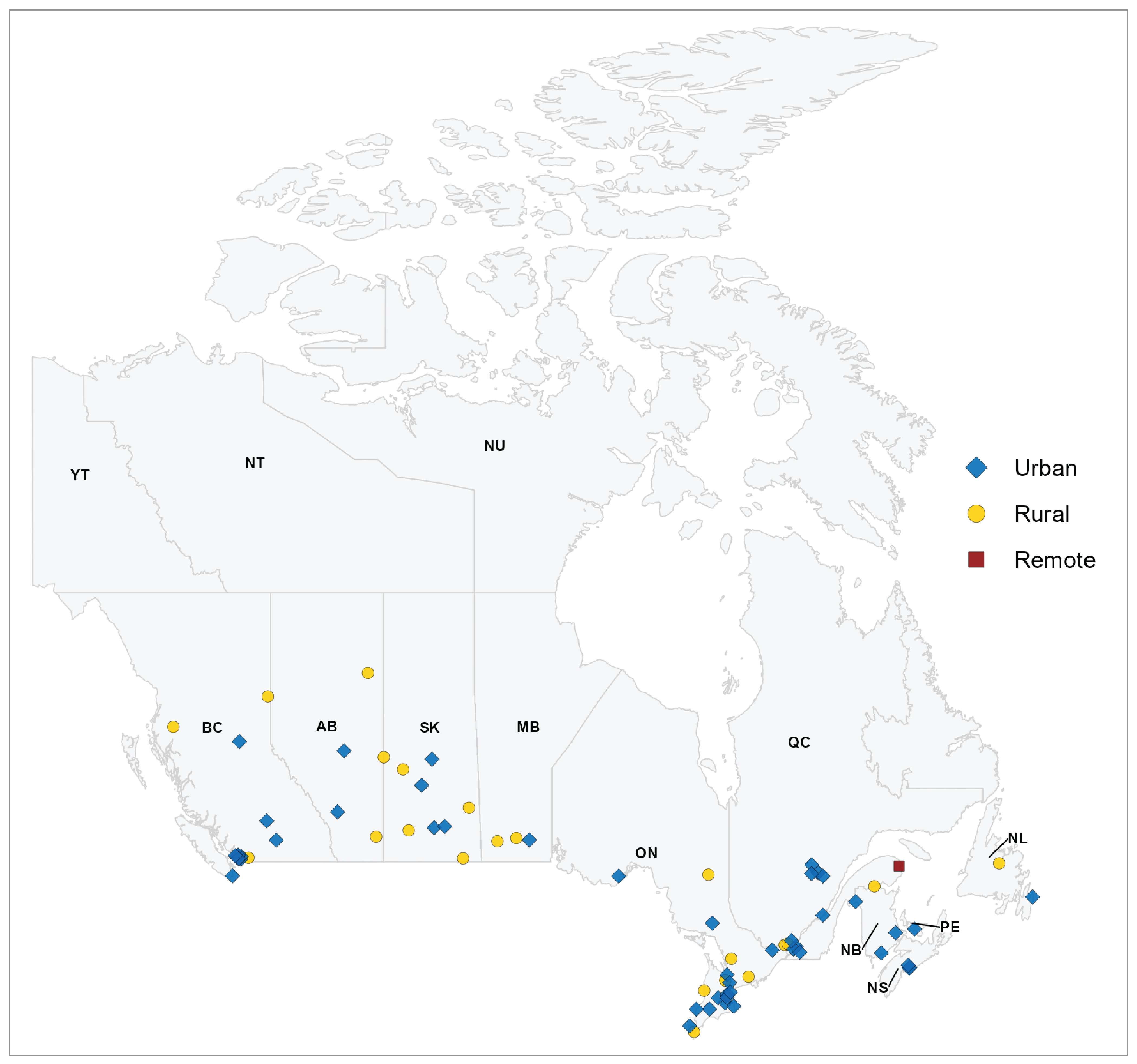
AB = Alberta; BC = British Columbia; MB = Manitoba; NB = New Brunswick; NL = Newfoundland and Labrador; NT = Northwest Territories; NS = Nova Scotia; NU = Nunavut; ON = Ontario; PE = Prince Edward Island; QC = Quebec; SK = Saskatchewan; YT = Yukon.
Figure 3: Sites Across Canada Providing Weekend CT Services From 2022 to 2023
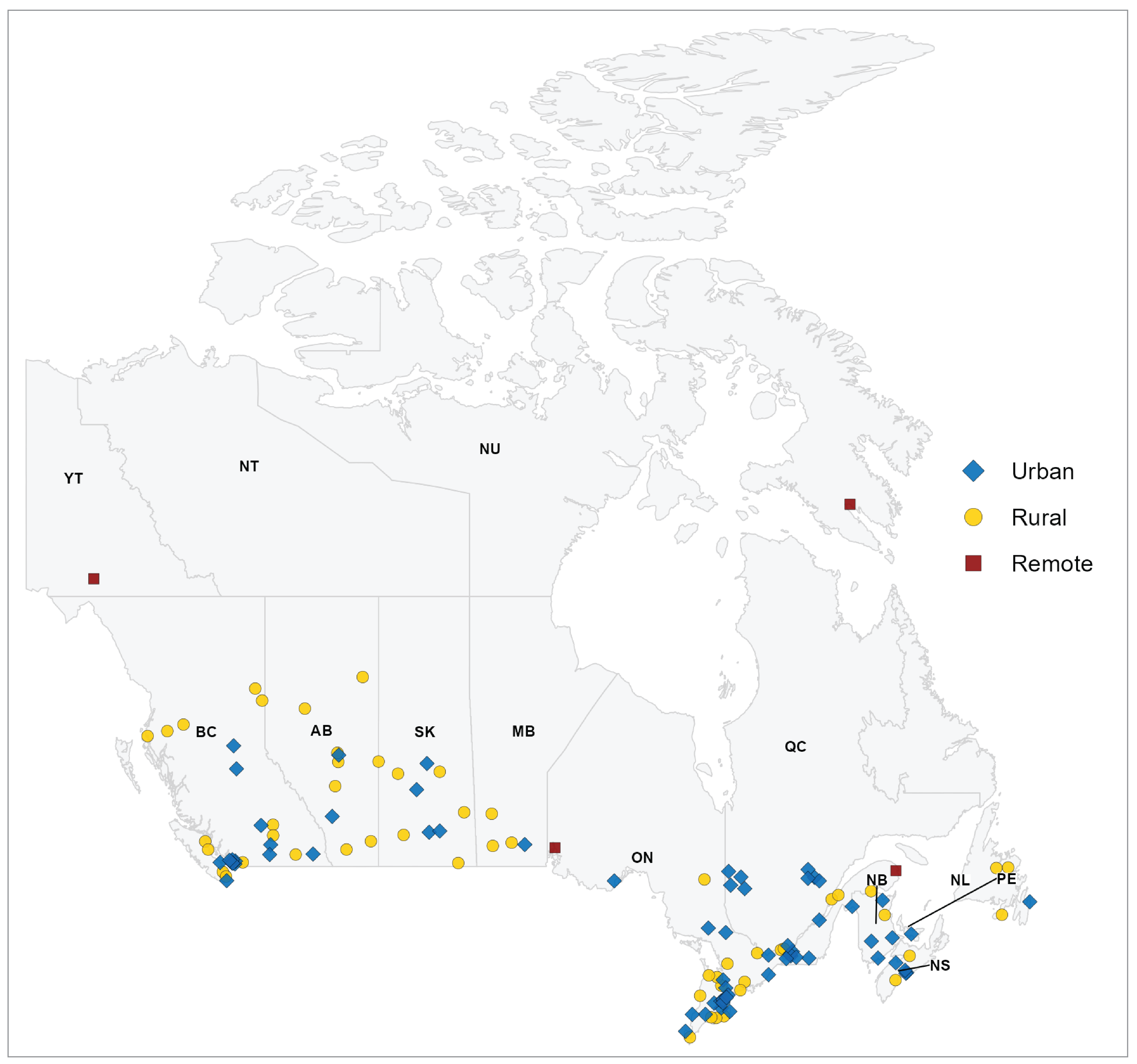
AB = Alberta; BC = British Columbia; MB = Manitoba; NB = New Brunswick; NL = Newfoundland and Labrador; NT = Northwest Territories; NS = Nova Scotia; NU = Nunavut; ON = Ontario; PE = Prince Edward Island; QC = Quebec; SK = Saskatchewan; YT = Yukon.
Figure 4: Sites Across Canada Providing 24-Hour MRI Services From 2022 to 2023
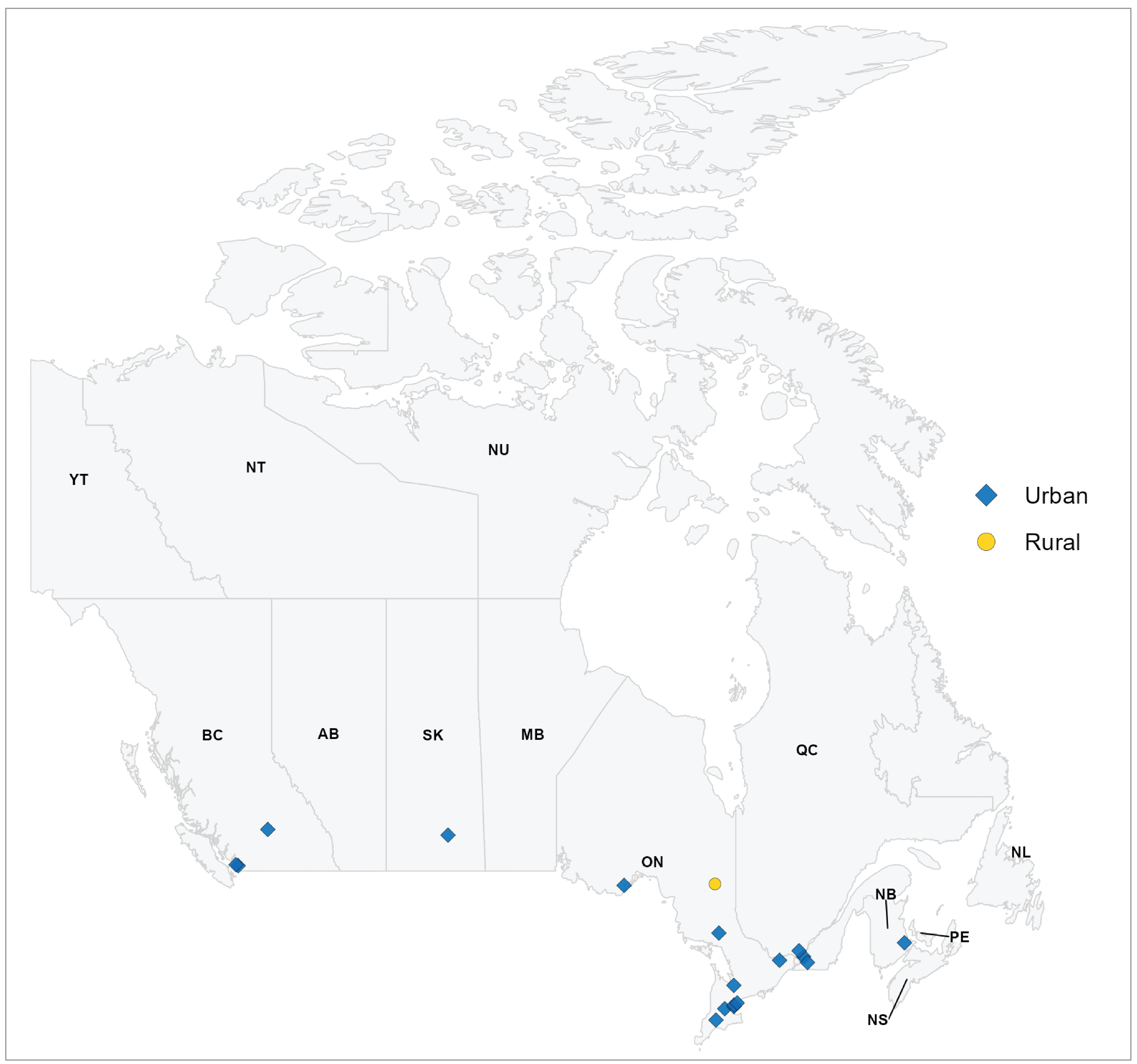
AB = Alberta; BC = British Columbia; MB = Manitoba; NB = New Brunswick; NL = Newfoundland and Labrador; NT = Northwest Territories; NS = Nova Scotia; NU = Nunavut; ON = Ontario; PE = Prince Edward Island; QC = Quebec; SK = Saskatchewan; YT = Yukon.
Figure 5: Sites Across Canada Providing Weekend MRI Services From 2022 to 2023
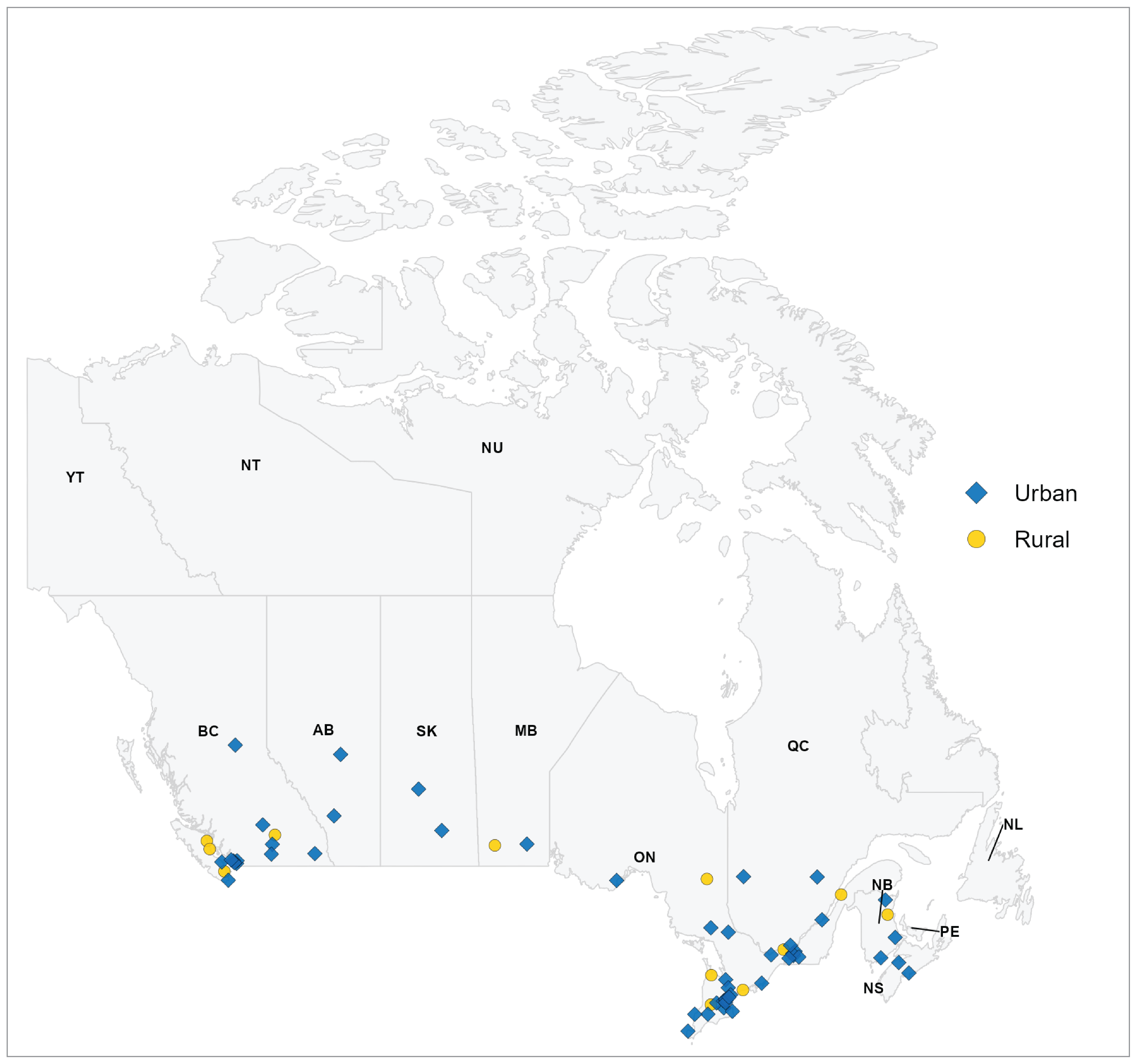
AB = Alberta; BC = British Columbia; MB = Manitoba; NB = New Brunswick; NL = Newfoundland and Labrador; NT = Northwest Territories; NS = Nova Scotia; NU = Nunavut; ON = Ontario; PE = Prince Edward Island; QC = Quebec; SK = Saskatchewan; YT = Yukon.
Availability of Both 24-Hour and Weekend CT and MRI Services
Some facilities offer both 24-hour and weekend services for CT and MRI — meaning these are not separate groups of sites but overlapping service offerings within the same facilities.
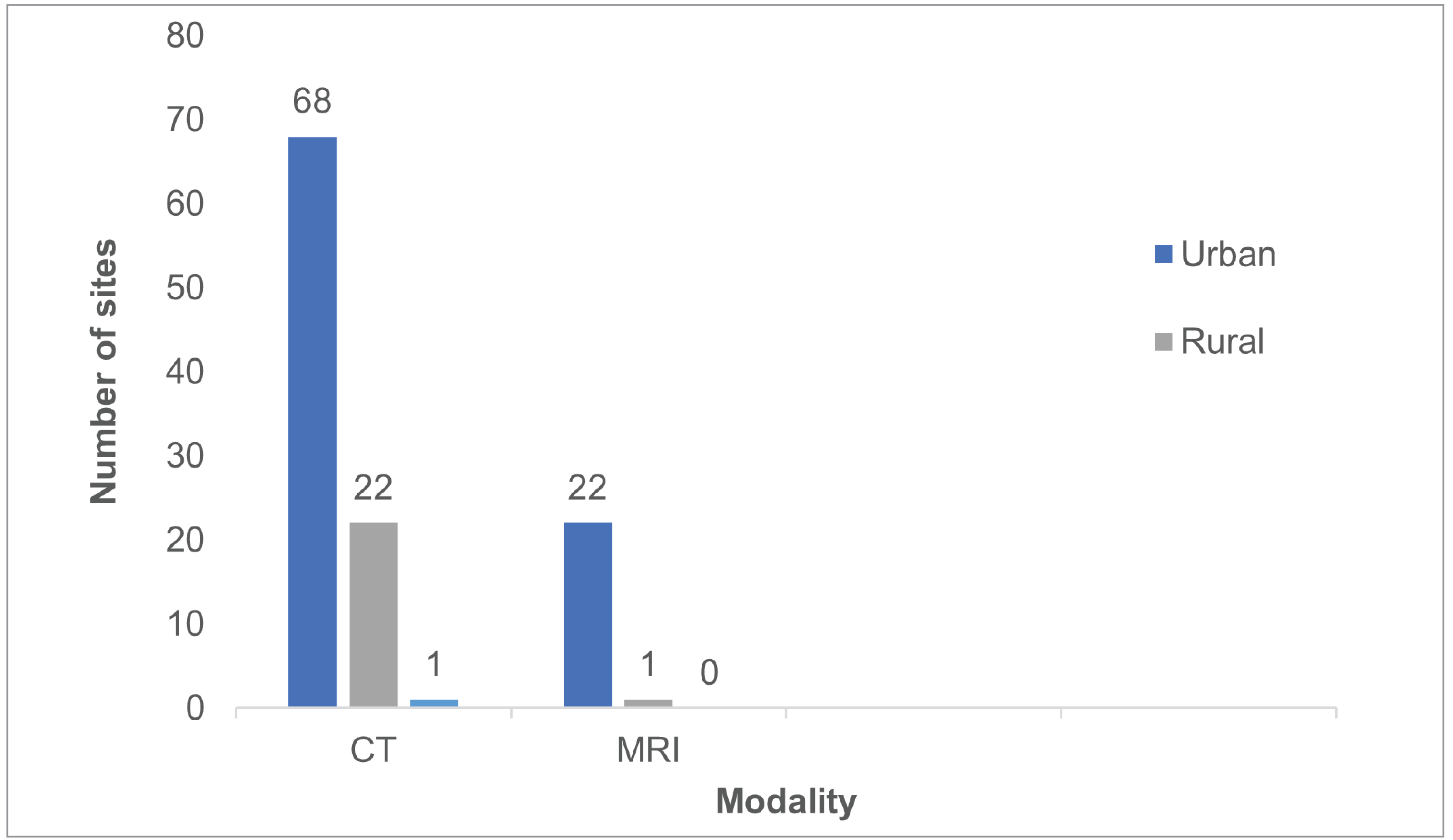
Across Canada, for CT, 91 of the responding sites reported providing both 24-hour and weekend services; 68 of them are in urban settings, 22 are in rural settings, and 1 in a remote setting (191 of the 394 sites responding to both 24-hour and weekend questions; Figure 6 and Table 3, Appendix 1).
Across Canada, for MRI, 23 sites reported providing both 24-hour and weekend services; 22 of them are in urban settings, 1 is in a rural setting, and none were in remote settings (130 of the 191 sites responding to both 24-hour and weekend questions; Figure 6 and Table 3, Appendix 1).
This summary reflects sites that responded to both the 24-hour and weekend service availability questions. Therefore, they represent a subset of total sites — not additional or independent facilities.
The data show that the number of facilities delivering 24-hour CT and MRI services also tend to provide weekend services for both modalities, potentially indicating that once a site allocates the necessary resources for 24-hour operations, it might be well-resourced to extend these capabilities to both CT and MRI on weekends as extended hours. Most of these sites offering both 24-hour and weekend services for CT and MRI are located in urban areas.
Figure 6: Number of Sites Across Canada Providing Both 24-Hour and Weekend CT and MRI Services in Urban, Rural, and Remote Settings
Availability of 24-Hour and Weekend CT and MRI Services Across Jurisdictions
Survey responses show variation in the availability of 24-hour and weekend CT and MRI services across jurisdictions in Canada. Jurisdictional-level data are reported here, providing details on service availability by facility location (urban, rural, and remote). The number of sites providing 24-hour and weekend CT and MRI services, as well as the number of sites that responded to each question for CT and MRI, is summarized for each jurisdiction in Table 1 and Table 2, Appendix 1.
Newfoundland and Labrador
In Newfoundland and Labrador, access to extended CT and MRI services is limited, with some variation between urban and rural areas. No remote CT or MRI facilities were reported to be available in this jurisdiction from 2022 to 2023. The number of responding sites are summarized in Table 1 and Table 2, Appendix 1.
CT Services
Based on responses from 12 sites (92% of all 13 CT sites) to the 24-hour and weekend CT services questions in Newfoundland and Labrador (refer to Table 1, Appendix 1 for more details):
24-hour services: 2 sites
Urban: 1
Rural: 1
Remote: 0
Weekend services: 4 sites
Urban: 1
Rural: 3
Remote: 0
MRI Services
Based on responses from 5 sites (100% of all 5 MRI sites) to the 24-hour and weekend MRI services questions in Newfoundland and Labrador (refer to Table 2, Appendix 1 for more details):
24-hour services: 0 sites
Weekend services: 0 sites
Prince Edward Island
In Prince Edward Island, CT and MRI service availability is centralized, with extended hours limited to a single urban site. No rural or remote CT or MRI facilities were reported to be available in this jurisdiction from 2022 to 2023.The number of responding sites are summarized in Table 1 and Table 2, Appendix 1.
CT Services
Based on responses from 2 urban sites (100% of all 2 CT sites) to the 24-hour and weekend CT services questions in Prince Edward Island (refer to Table 1, Appendix 1 for more details):
24-hour services: 1 site
Urban: 1
Rural: 0
Remote: 0
Weekend services: 1 site
Urban: 1
Rural: 0
Remote: 0
MRI Services
Based on responses from 1 urban site (100% of the 1 MRI site) to the 24-hour and weekend MRI services questions in Prince Edward Island (refer to Table 2, Appendix 1 for more details):
24-hour services: 0 sites
Weekend services: 0 sites
Nova Scotia
In Nova Scotia, CT and MRI service availability varies across the province, with extended hours and weekend access more commonly available in urban areas. No remote CT or MRI facilities were reported to be available in this jurisdiction from 2022 to 2023. The number of responding sites are summarized in Table 1 and Table 2, Appendix 1.
CT Services
Based on responses from 7 sites (54% of all 13 CT sites) to the 24-hour and weekend CT services questions in Nova Scotia (refer to Table 1, Appendix 1 for more details):
24-hour services: 3 sites
Urban: 3
Rural: 0
Remote: 0
Weekend services: 6 sites
Urban: 4
Rural: 2
Remote: 0
MRI Services
Based on responses from 5 sites (50% of all 10 MRI sites) to the 24-hour and weekend MRI services questions in Nova Scotia (refer to Table 2, Appendix 1 for more details):
24-hour services: 0 sites
Weekend services: 2 sites
Urban: 2
Rural: 0
Remote: 0
New Brunswick
In New Brunswick, a portion of CT and MRI sites reported 24-hour services, with more sites reporting weekend service availability, with most services offered at urban locations. No remote CT or MRI facilities were reported to be available in this jurisdiction from 2022 to 2023. The number of responding sites are summarized in Table 1 and Table 2, Appendix 1.
CT Services
Based on responses from 8 sites (73% of all 11 CT sites) to the 24-hour and weekend CT services questions in New Brunswick (refer to Table 1, Appendix 1 for more details):
24-hour services: 4 sites
Urban: 3
Rural: 1
Remote: 0
Weekend services: 7 sites
Urban: 5
Rural: 2
Remote: 0
MRI Services
Based on responses from 7 sites (78% of all 9 MRI sites) to the 24-hour and weekend MRI services questions in New Brunswick (refer to Table 2, Appendix 1 for more details):
24-hour services: 1 site
Urban: 1
Rural: 0
Remote: 0
Weekend services: 4 sites
Urban: 3
Rural: 1
Remote: 0
Quebec
In Quebec, many sites reported some level of 24-hour or weekend service, with most of this availability concentrated in urban settings. The number of responding sites are summarized in Table 1 and Table 2, Appendix 1.
CT Services
Based on responses from 26 sites (70% of all 37 CT sites) to the 24-hour and weekend CT services questions in Quebec (refer to Table 1, Appendix 1 for more details):
24-hour services: 13 sites
Urban: 11
Rural: 1
Remote: 1
Weekend services: 24 sites
Urban: 20
Rural: 3
Remote: 1
MRI Services
Based on responses from 15 sites (56% of all 27 MRI sites) to the 24-hour and weekend MRI services questions in Quebec (refer to Table 2, Appendix 1 for more details):
24-hour services: 3 sites
Urban: 3
Rural: 0
Remote: 0
Weekend services: 14 sites
Urban: 13
Rural: 1
Remote: 0
Ontario
In Ontario, several CT and MRI sites reported offering 24-hour and weekend services, with availability spanning urban, rural, and 1 remote location. The number of responding sites are summarized in Table 1 and Table 2, Appendix 1.
CT Services
Based on responses from 53 sites (55% of all 96 CT sites) to the 24-hour CT services question and 54 sites (56%) to the weekend CT services question in Ontario (refer to Table 1, Appendix 1 for more details):
24-hour services: 27 sites
Urban: 20
Rural: 7
Remote: 0
Weekend services: 45 sites
Urban: 30
Rural: 14
Remote: 1
MRI Services
Based on responses from 39 sites (57% of all 69 MRI sites) to the 24-hour MRI services question and 38 sites (55%) to the weekend MRI services question in Ontario (refer to Table 2, Appendix 1 for more details):
24-hour services: 14 sites
Urban: 13
Rural: 1
Remote: 0
Weekend services: 35 sites
Urban: 30
Rural: 5
Remote: 0
Manitoba
In Manitoba, several CT sites reported 24-hour and weekend service availability, while MRI services were limited to weekend hours only. No remote CT or MRI facilities were reported to be available in this jurisdiction from 2022 to 2023.The number of responding sites are summarized in Table 1 and Table 2, Appendix 1.
CT Services
Based on responses from 8 sites (50% of all 16 CT sites) to the 24-hour CT services question and 9 sites (56%) to the weekend CT services question in Manitoba (refer to Table 1, Appendix 1 for more details):
24-hour services: 7 sites
Urban: 5
Rural: 2
Remote: 0
Weekend services: 9 sites
Urban: 6
Rural: 3
Remote: 0
MRI Services
Based on responses from 4 sites (50% of all 8 MRI sites) to the 24-hour and weekend MRI services questions in Manitoba (refer to Table 2, Appendix 1 for more details):
24-hour services: 0 sites
Weekend services: 4 sites
Urban: 3
Rural: 1
Remote: 0
Saskatchewan
In Saskatchewan, more than one-half of the responding CT sites reported offering both 24-hour and weekend services, while MRI availability was more limited, with services concentrated in urban areas. No remote CT facilities and no rural or remote MRI facilities were reported to be available in this jurisdiction from 2022 to 2023. The number of responding sites are summarized in Table 1 and Table 2, Appendix 1.
CT Services
Based on responses from 13 sites (93% of all 14 CT sites) to the 24-hour and weekend CT services questions in Saskatchewan (refer to Table 1, Appendix 1 for more details):
24-hour services: 12 sites
Urban: 7
Rural: 5
Remote: 0
Weekend services: 13 sites
Urban: 7
Rural: 6
Remote: 0
MRI Services
Based on responses from 5 urban sites (83% of all 6 MRI sites) to the 24-hour and weekend MRI services questions in Saskatchewan (refer to Table 2, Appendix 1 for more details):
24-hour services: 1 site
Urban: 1
Rural: 0
Remote: 0
Weekend services: 4 sites
Urban: 4
Rural: 0
Remote: 0
Alberta
In Alberta, all responding CT and MRI sites reported on service availability, with a portion of CT sites offering 24-hour and weekend services, while MRI availability was limited to weekend hours and primarily in urban areas. No remote CT or MRI facilities were reported to be available in this jurisdiction from 2022 to 2023. The number of responding sites are summarized in Table 1 and Table 2, Appendix 1.
CT Services
Based on responses from 37 sites (100% of all 37 CT sites) to the 24-hour and weekend CT services questions in Alberta (refer to Table 1, Appendix 1 for more details):
24-hour services: 6 sites
Urban: 4
Rural: 2
Remote: 0
Weekend services: 15 sites
Urban: 8
Rural: 7
Remote: 0
MRI Services
Based on responses from 22 sites (100% of all 22 MRI sites) to the 24-hour and weekend MRI services questions in Alberta (refer to Table 2, Appendix 1 for more details):
24-hour services: 0 site
Weekend services: 10 sites
Urban: 10
Rural: 0
Remote: 0
British Columbia
In British Columbia, most responding CT and MRI sites reported offering weekend services, while 24-hour services were less common and primarily available at urban locations. No remote MRI facilities were reported to be available in this jurisdiction from 2022 to 2023. The number of responding sites are summarized in Table 1 and Table 2, Appendix 1.
CT Services
Based on responses from 37 sites (80% of all 46 CT sites) to the 24-hour and weekend CT services questions in British Columbia (refer to Table 1, Appendix 1 for more details):
24-hour services: 16 sites
Urban: 13
Rural: 3
Remote: 0
Weekend services: 34 sites
Urban: 21
Rural: 13
Remote: 0
MRI Services
Based on responses from 26 sites (79% of all 33 MRI sites) to the 24-hour and weekend MRI services questions in British Columbia (refer to Table 2, Appendix 1 for more details):
24-hour services: 4 sites
Urban: 4
Rural: 0
Remote: 0
Weekend services: 24 sites
Urban: 20
Rural: 4
Remote: 0
Yukon
In Yukon, after-hour CT services are limited to weekend availability, and no after-hour service is available for the single remote MRI site. The number of responding sites are summarized in Table 1 and Table 2, Appendix 1.
CT Services
Based on responses from 1 site (100% of all CT and MRI sites) to the 24-hour and weekend service questions in Yukon (refer to Table 1 and Table 2, Appendix 1 for more details):
24-hour services: 0 sites
Weekend services: 1 site
Urban: 0
Rural: 0
Remote: 1
MRI Services
It is not known if the remote site with a single MRI provides 24-hour or weekend services.
Northwest Territories
In the Northwest Territories, there are no after-hour imaging services for its single CT unit. From 2022 to 2023, no MRI facilities were reported in Northwest Territories.
Nunavut
In Nunavut, there are no after-hour imaging services for its single CT unit. From 2022 to 2023, no MRI facilities were reported in Nunavut.
Limitations
This report aims to provide a comprehensive overview of 24-hour and weekend services for CT and MRI imaging across Canada. However, several limitations should be considered when interpreting the findings.
First, the data are self-reported by facilities, which introduces the possibility of errors, misinterpretations, or inconsistencies that may bias results. Additionally, the report is limited by the proportion of sites that responded to key survey questions. Nationally, 52% of CT sites (206 of 394) and 44% of MRI sites (130 of 296) responded to the 24-hour service question. For weekend services, 53% of CT sites (208 of 394) and 44% of MRI sites (129 of 296) provided responses. Response rates varied significantly across jurisdictions, ranging from 50% to 100%. In some regions — particularly for MRI services in rural and remote areas — fewer than 5 sites responded, limiting the statistical reliability of those findings.
Although response rates are reported in the results and Appendix 1 tables to support interpretation, the potential for nonresponse bias and overgeneralization remains. Facilities with more resources or extended-hour capacity may have been more likely to respond, which could overestimate overall service availability.
Additionally, the facilities included in this report differ in key aspects such as population served, geographic location, patient access, and administrative capacity. These variations may influence a facility’s ability to provide extended service hours. Limited staffing and operational resources can make after-hours or weekend coverage difficult, meaning results may overrepresent the capabilities of better-resourced sites.
Moreover, underlying factors like operational constraints are not fully captured in the report, despite their likely impact on the availability of 24-hour and weekend services. Differences in regional health care infrastructure, staff availability, and health policies may also contribute to variations in after-hours services across jurisdictions.
Implications for Decision-Making
The findings of this report highlight several considerations for health system planners, policy-makers, and administrators seeking to increase capacity and improve access to after-hours CT and MRI services across Canada. There are multiple factors that influence after-hours imaging service delivery, and these vary based on the specific capacity, infrastructure, and operational conditions of each facility. As well, urban, rural, and remote settings face different challenges, which contribute to differences in access to extended imaging services. Some key considerations may include:
Differences in service availability across settings show some potential for inequities in access:
Facilities located in urban areas are more likely to offer 24-hour and weekend CT and MRI services.
Some rural and remote facilities have been reported to face limitations in staffing, equipment, and infrastructure, which may restrict their ability to expand service hours.6,7 The limited availability of after-hours MRI services is notable and may be attributed to several key factors:
There are fewer MRI units across Canada compared to CT units.
MRI is a more resource-intensive modality, requiring longer scan times, highly trained personnel, and greater operational costs.8
These demands may make it more difficult for many facilities, especially in less well-resourced areas, to offer MRI services during evenings, weekends, or overnight.8
These observed patterns have strategic implications for system-level planning and resource allocation:
They can help identify which facilities are currently best positioned to expand their service hours.
They may highlight where investments in infrastructure, staffing, and equipment may help improve overall access to imaging services.
Understanding the geographic and operational distribution of imaging services can help support health system efforts to:
Allocate resources equitably across regions, by considering both availability of imaging services and needs in specific regions.
Improve patient care by reducing diagnostic wait times and travel for urgent imaging needs.9,10
Enhance the capacity of facilities to meet growing or unmet demand for after-hours and emergency imaging services.11
The implications for workforce planning in the imaging sector:
Recruiting and retaining qualified medical radiation technologists and radiologists has been reported to be especially challenging in rural and remote areas.12
Targeted strategies, such as supporting specialized training pathways and incentivizing professionals to work in underserved regions, may help to reduce service gaps and strengthen regional service capacity over the long term.8
Conclusion
Across Canada, 24-hour and weekend CT and MRI services vary considerably by jurisdiction and facility setting. Among reporting CT sites, 39% of urban, 21% of rural, and 13% of remote sites offer 24-hour coverage. For weekend CT operations, availability is 59% in urban, 51% in rural, and 50% in remote sites. MRI services have lower extended hours, with 14% of urban and 3% of rural sites providing 24-hour coverage, and no remote sites offering continuous MRI operations. For weekend MRI operations, among reporting sites, 56% of urban, 32% of rural, and none of the remote sites offer weekend coverage.
These differences may depend on factors like staffing capacity, infrastructure, and local patient demand. While rural and remote facilities may have fewer resources, they are crucial for delivering diagnostic imaging, especially for patients facing geographic barriers and emergencies. Expanding 24-hour and weekend imaging services could reduce wait times and improve access. However, the report finds that facilities offering 24-hour CT and MRI services are likely to provide weekend coverage for both modalities, indicating that once resources are allocated for extended operations, these capabilities may be effectively extended to weekends as well.
By documenting the summary of available sites with out-of-hour capacity, this report aims to ensure that Canada's medical imaging infrastructure remains responsive to evolving health care demands. It seeks to provide timely and equitable access to essential diagnostic services for all people living in Canada, considering available resources, workforce availability, and community needs to ensure sustainable and effective service enhancements.
References
1.CADTH Health Technology Review. Canadian Medical Imaging Inventory 2022–2023: CT: CMII Report. Canadian Agency for Drugs and Technologies in Health; 2024.
2.CADTH Health Technology Review. Canadian Medical Imaging Inventory 2022–2023: MRI: CMII Report. Canadian Agency for Drugs and Technologies in Health; 2024.
3.Alexander A, McGill M, Tarasova A, Ferreira C, Zurkiya D. Scanning the Future of Medical Imaging. Journal of the American College of Radiology. 2019;16(4):501-507. doi: 10.1016/j.jacr.2018.09.050 PubMed
4.Rong J, Liu Y. Advances in medical imaging techniques. BMC Methods. 2024;1(1):10. doi: 10.1186/s44330-024-00010-7
5.Canadian Association of Radiologists. Addressing the Medical Imaging Dilemma in Canada: Restoring Timely Access for Patients Post-Pandemic. 2021. Accessed April 11, 2025. https://car.ca/wp-content/uploads/2021/07/CAR-PreBudgetSubmission-2022-e-web-FINAL.pdf
6.Canada’s Drug Agency Health Technology Review. Planning for the Introduction of New CT Services in Rural and Remote Communities in Canada: Health Technologies. Canadian Agency for Drugs and Technologies in Health; 2025.
7.Davidson M, Kielar A, Tonseth RP, Seland K, Harvie S, Hanneman K. The Landscape of Rural and Remote Radiology in Canada: Opportunities and Challenges. Can Assoc Radiol J. 2024;75(2):304-312. doi: 10.1177/08465371231197953 PubMed
8.Garrahy D, Doran S, O'Neill H, Dennan S, Beddy P. Towards 24/7 MRI: the effect of routine weekend inpatient MRI scanning on patient waiting times. Ir J Med Sci. 2024;193(4):1697-1701. doi: 10.1007/s11845-024-03647-z PubMed
9.Rohatgi S, Hanna TN, Sliker CW, Abbott RM, Nicola R. After-Hours Radiology: Challenges and Strategies for the Radiologist. American Journal of Roentgenology. 2015;205(5):956-961. doi: 10.2214/AJR.15.14605 PubMed
10.CADTH Health Technology Review. Canadian Medical Imaging Inventory 2022–2023: Provincial and Territorial Overview: CMII Report. Canadian Agency for Drugs and Technologies in Health; 2024.
11.CADTH. Wait List Strategies for CT and MRI Scans. Canadian Journal of Health Technologies 2023. doi: https://doi.org/10.51731/cjht.2023.557
12.Scholte CHSHR. Implementation of remote MRI scanning. Open Journal of Clinical and Medical Images. 2024.
Appendix 1: Summary Tables
Please note that this appendix has not been copy-edited.
Table 1: Summary of 24-Hour and Weekend Use of CT by Jurisdictions From 2022 to 2023
Jurisdictions | CT facility setting (total sites) | Number of sites responding to 24-hour CT service question (percentage of responding sites) | Operates 24 hours a day | Number of sites responding to weekend CT service question (percentage of responding sites) | Operates on the weekend |
|---|---|---|---|---|---|
Newfoundland and Labrador | Urban (5) | 4 (80%) | 1 | 4 (80%) | 1 |
Rural (8) | 8 (100%) | 1 | 8 (100%) | 3 | |
Remote (0) | NA | NA | NA | NA | |
Prince Edward Island | Urban (2) | 2 (100%) | 1 | 2 (100%) | 1 |
Rural (0) | NA | NA | NA | NA | |
Remote (0) | NA | NA | NA | NA | |
Nova Scotia | Urban (7) | 4 (57%) | 3 | 4 (57%) | 4 |
Rural (6) | 3 (50%) | 0 | 3 (50%) | 2 | |
Remote (0) | NA | NA | NA | NA | |
New Brunswick | Urban (8) | 6 (75%) | 3 | 6 (75%) | 5 |
Rural (3) | 2 (67%) | 1 | 2 (67%) | 2 | |
Remote (0) | NA | NA | NA | NA | |
Quebec | Urban (33) | 22 (67%) | 11 | 22 (67%) | 20 |
Rural (3) | 3 (100%) | 1 | 3 (100%) | 3 | |
Remote (1) | 1 (100%) | 1 | 1 (100%) | 1 | |
Ontario | Urban (63) | 34 (54%) | 20 | 35 (56%) | 30 |
Rural (30) | 18 (60%) | 7 | 18 (60%) | 14 | |
Remote (3) | 1 (33%) | 0 | 1 (33%) | 1 | |
Manitoba | Urban (8) | 6 (75%) | 5 | 6 (75%) | 6 |
Rural (8) | 2 (25%) | 2 | 3 (38%) | 3 | |
Remote (0) | NA | NA | NA | NA | |
Saskatchewan | Urban (8) | 7 (88%) | 7 | 7 (88%) | 7 |
Rural (6) | 6 (100%) | 5 | 6 (100%) | 6 | |
Remote (0) | NA | NA | NA | NA | |
Alberta | Urban (14) | 14 (100%) | 4 | 14 (100%) | 8 |
Rural (23) | 23 (100%) | 2 | 23 (100%) | 7 | |
Remote (0) | NA | NA | NA | NA | |
British Columbia | Urban (28) | 22 (79%) | 13 | 22 (79%) | 21 |
Rural (17) | 15 (88%) | 3 | 15 (88%) | 13 | |
Remote (1) | 0 (0%) | NR | 0 (0%) | NR | |
Yukon | Urban (0) | NA | NA | NA | NA |
Rural (0) | NA | NA | NA | NA | |
Remote (1) | 1 (100%) | 0 | 1 (100%) | 1 | |
Northwest Territories | Urban (0) | NA | NA | NA | NA |
Rural (0) | NA | NA | NA | NA | |
Remote (1) | 1 (100%) | 0 | 1 (100%) | 0 | |
Nunavut | Urban (0) | NA | NA | NA | NA |
Rural (0) | NA | NA | NA | NA | |
Remote (1) | 1 (100%) | 0 | 1 (100%) | 1 | |
Canada | Urban (176) | 121 (69%) | 68 | 122 (69%) | 103 |
Rural (104) | 80 (77%) | 22 | 81 (78%) | 53 | |
Remote (8) | 5 (63%) | 1 | 5 (63%) | 4 |
NA = not applicable; NR = not reported.
Notes: Settings with CT facilities that do not offer 24-hour and/or weekend services were assigned a value of 0. For settings without any CT facilities, NA was used. Sites with CT facilities that did not respond to the questions were presented as NR.
Table 2: Summary of 24-Hour and Weekend Use of MRI by Jurisdictions From 2022 to 2023
Jurisdictions | MRI facility setting (total sites) | Number of sites responding to 24-hour MRI service question (percentage of responding sites) | Operates 24 hours a day | Number of sites responding to weekend MRI service question (percentage of responding sites) | Operates on weekend |
|---|---|---|---|---|---|
Newfoundland and Labrador | Urban (4) | 4 (100%) | 0 | 4 (100%) | 0 |
Rural (1) | 1 (100%) | 0 | 1 (100%) | 0 | |
Remote (0) | NA | NA | NA | NA | |
Prince Edward Island | Urban (1) | 1 (100%) | 0 | 0 (0%) | NR |
Rural (0) | NA | NA | NA | NA | |
Remote (0) | NA | NA | NA | NA | |
Nova Scotia | Urban (6) | 2 (33%) | 0 | 2 (33%) | 2 |
Rural (4) | 3 (75%) | 0 | 3 (75%) | 0 | |
Remote (0) | NA | NA | NA | NA | |
New Brunswick | Urban (6) | 5 (83%) | 1 | 5 (83%) | 3 |
Rural (3) | 2 (67%) | 0 | 2 (67%) | 1 | |
Remote (0) | NA | NA | NA | NA | |
Quebec | Urban (26) | 14 (54%) | 3 | 14 (54%) | 13 |
Rural (1) | 1 (100%) | 0 | 1 (100%) | 1 | |
Remote (0) | NA | NA | NA | NA | |
Ontario | Urban (59) | 34 (58%) | 13 | 33 (56%) | 30 |
Rural (9) | 5 (56%) | 1 | 5 (56%) | 5 | |
Remote (1) | 0 (0%) | NR | 0 (0%) | NR | |
Manitoba | Urban (4) | 3 (75%) | 0 | 3 (75%) | 3 |
Rural (4) | 1 (25%) | 0 | 1 (25%) | 1 | |
Remote (0) | NA | NA | NA | NA | |
Saskatchewan | Urban (6) | 5 (83%) | 1 | 5 (83%) | 4 |
Rural (0) | NA | NA | NA | NA | |
Remote (0) | NA | NA | NA | NA | |
Alberta | Urban (14) | 14 (100%) | 0 | 14 (100%) | 10 |
Rural (8) | 8 (100%) | 0 | 8 (100%) | 0 | |
Remote (0) | NA | NA | NA | NA | |
British Columbia | Urban (26) | 20 (77%) | 4 | 21 (81%) | 20 |
Rural (7) | 6 (86%) | 0 | 6 (86%) | 4 | |
Remote (0) | NA | NA | NA | NA | |
Yukon | Urban (0) | NA | NA | NA | NA |
Rural (0) | NA | NA | NA | NA | |
Remote (1) | 1 (100%) | 0 | 1 (100%) | 0 | |
Northwest Territories | Urban (0) | NA | NA | NA | NA |
Rural (0) | NA | NA | NA | NA | |
Remote (0) | NA | NA | NA | NA | |
Nunavut | Urban (0) | NA | NA | NA | NA |
Rural (0) | NA | NA | NA | NA | |
Remote (0) | NA | NA | NA | NA | |
Canada | Urban (152) | 102 (67%) | 22 | 101 (66%) | 85 |
Rural (37) | 27 (73%) | 1 | 27 (73%) | 12 | |
Remote (2) | 1 (50%) | 0 | 1 (50%) | 0 |
NA = not applicable; NR = not reported.
Notes: Settings with MRI facilities that do not offer 24-hour and/or weekend services were assigned a value of 0. For settings without any MRI facilities, NA was used. Sites with MRI facilities that did not respond to the questions were presented as NR.
Table 3: Availability of Both 24-Hour and Weekend CT and MRI Services in Canada
Setting | CT | MRI |
|---|---|---|
Urban | 68 of 152 (45%) (152 of 176 sites responded) | 22 of 102 (22%) (102 of 152 sites responded) |
Rural | 22 of 37 (60%) (37 of 104 sites responded) | 1 of 27 (4%) (27 of 37 sites responded) |
Remote | 1 of 2 (50%) (2 of 8 sites responded) | 0 of 1 (0%) (1 of 2 sites responded) |
ISSN: 2563-6596
Canada’s Drug Agency (CDA-AMC) is a pan-Canadian health organization. Created and funded by Canada’s federal, provincial, and territorial governments, we’re responsible for driving better coordination, alignment, and public value within Canada’s drug and health technology landscape. We provide Canada’s health system leaders with independent evidence and advice so they can make informed drug, health technology, and health system decisions, and we collaborate with national and international partners to enhance our collective impact.
Disclaimer: CDA-AMC has taken care to ensure that the information in this document was accurate, complete, and up to date when it was published, but does not make any guarantee to that effect. Your use of this information is subject to this disclaimer and the Terms of Use at cda-amc.ca.
The information in this document is made available for informational and educational purposes only and should not be used as a substitute for professional medical advice, the application of clinical judgment in respect of the care of a particular patient, or other professional judgments in any decision-making process. You assume full responsibility for the use of the information and rely on it at your own risk.
CDA-AMC does not endorse any information, drugs, therapies, treatments, products, processes, or services. The views and opinions of third parties published in this document do not necessarily reflect those of CDA-AMC. The copyright and other intellectual property rights in this document are owned by the Canadian Agency for Drugs and Technologies in Health (operating as CDA-AMC) and its licensors.
Questions or requests for information about this report can be directed to Requests@CDA-AMC.ca.