Drugs, Health Technologies, Health Systems
Health Technology Review
Trends in MRI Exam Volumes Between 2007 and 2022–2023 in Canada
Key Messages
What Is the Issue?
Canada’s Drug Agency (CDA-AMC) received a request to analyze MRI exam trends over 16 years to inform policy decisions related to diagnostic imaging capacity and access. Because MRI scans play a key role in diagnostics, growing demand may impact imaging services, wait times, and access.
With the number of MRI units growing from 222 in 2007 to 432 in 2022–2023, analysis is needed to better understand how growth aligns with demand.
Demand may be influenced by emerging clinical applications of MRI — such as MRI-guided biopsies and surgeries, and other detailed cardiac assessments — along with changing population needs, health care resources, and medical advancements.
Analyzing overall and per capita exam trends will provide insights to guide strategic decisions regarding resource allocation, workforce development, and potential diagnostic imaging capacity expansion.
What Did We Do?
We examined trends in both total (absolute) and per capita (relative) MRI exams using data from the Canadian Institute for Health Information and the Canadian Medical Imaging Inventory — collected at 7 intervals between 2007 and 2022–2023. We also reviewed MRI unit counts and units per capita.
The analysis focused on 10 jurisdictions with consistent MRI capacity throughout the entire period, showing how MRI use evolved nationwide.
What Did We Find?
Between 2007 and 2022–2023, there was growth in MRI exam volumes across Canada, although this growth was not consistent annually:
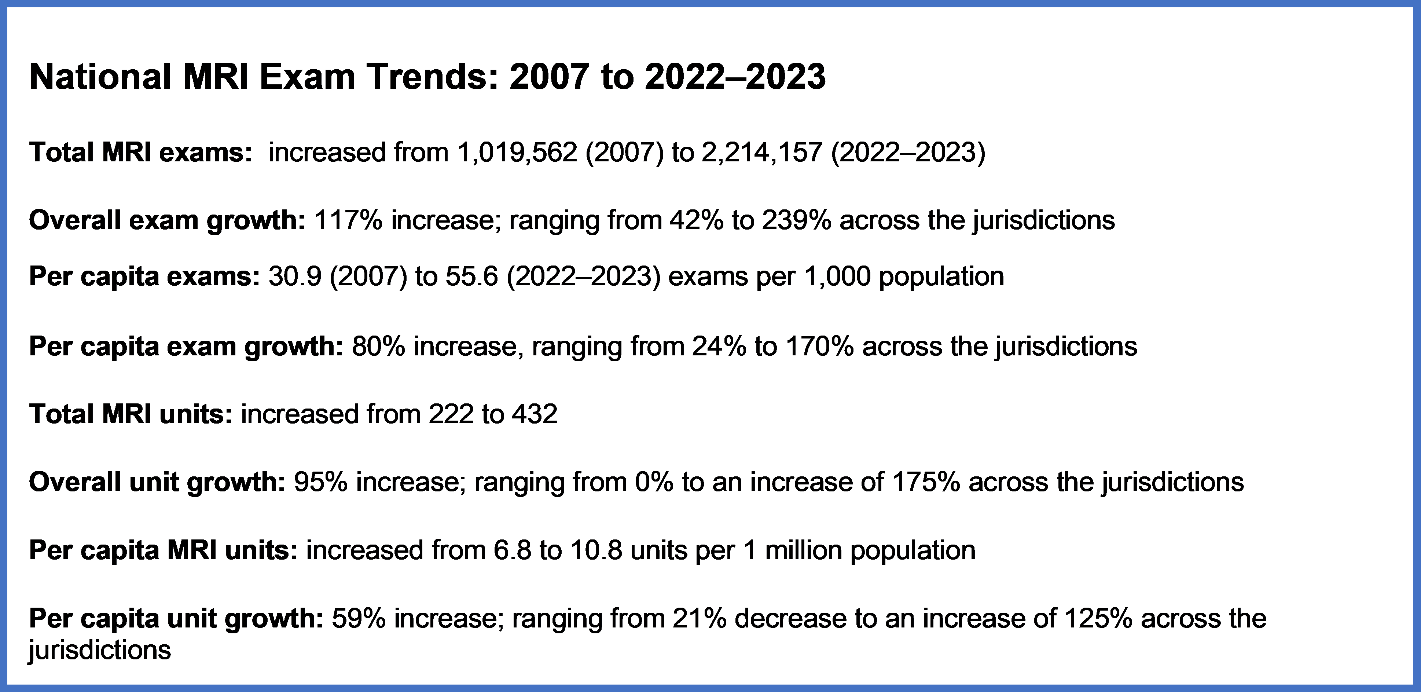
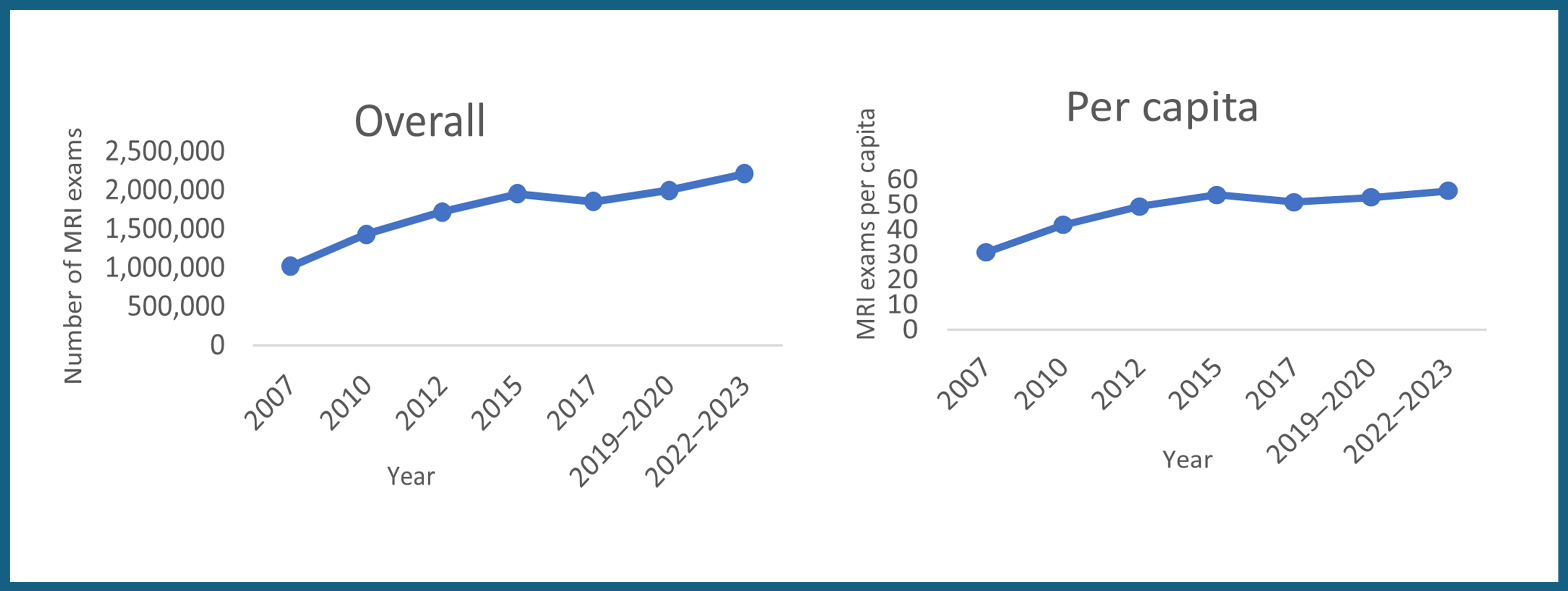
Total MRI exam volumes increased from 1.02 million to 2.21 million, reflecting a national growth of 117%.
Total MRI exam volumes per 1,000 people increased from 30.9 to 55.6, representing a national growth rate of 80%.
MRI exam growth varied across jurisdictions, with total exam increases ranging from 42% to 239% and per capita volumes experiencing an increase ranging from 24% to 170%. No jurisdiction experienced a decrease in either total or per capita MRI exam volume.
When comparing growth to the national average, half the jurisdictions were below average in both total and per capita exams, while the other half exceeded the national average in overall or per capita exam volume, or both.
What Does This Mean?
This suggests that MRI is being used more, and the role of MRI continues to evolve.
Given the increasing use, decision-makers may wish to consider capacity challenges, ensuring efficient use of existing MRI and supporting technologies, workflows, and processes.
Addressing these areas may help reduce wait times, support recruitment and retention efforts, and ensure sufficient capacity to meet future demand. The variation across jurisdictions highlights the importance of tailoring solutions to local needs and contexts.
The insights gained from this report can inform strategic decisions related to resource allocation, workforce development, and aligning diagnostic imaging capacity with evolving health care needs.
Context
MRI is a widely used noninvasive imaging technology used for producing detailed images of internal body structures to identify and assess conditions such as brain and spinal cord anomalies, joint injuries, tumours, and diseases affecting organs and soft tissues.1,2 Over the past 16 years, the demand for MRI exams has steadily increased, highlighting its growing importance in modern health care. This trend is driven by advancements in medical technology, a greater reliance on imaging for accurate and timely diagnoses,3 and the rising use of imaging services by an aging population with greater health care needs.4
This report examines both absolute (overall) and relative (per capita) growth in MRI exam volumes. Absolute values represent the total number of exams performed, while relative values show how usage is changing, after adjusting for population size and other variables. Both absolute and relative values change in relation to various influencing factors. These may include:
population changes
shifts in health care use
technological advances
equitable resource distribution across jurisdictions
policy changes.
In this report, exams are reported per 1,000 population and units per 1,000,000 population, both standardized on a per capita basis to account for population size differences across jurisdictions. However, caution is needed when interpreting per capita figures in Canada. The country's vast geography and uneven population distribution mean that access to health care can vary greatly between rural, urban, and remote areas.5 As a result, per capita numbers may not fully capture regional differences in service availability or demand.6 As well, this report relies on self-reported data from sites, which may contain errors, misinterpretations, or other issues that could introduce bias. The analysis is further limited by the number of sites that submitted complete data. In some cases, small sample sizes may have affected the reliability of the results.
This analysis reports on the trends in MRI exam volumes across jurisdictions in Canada over a 16-year period. As of 2022–2023, Canada had a total of 432 MRI units, an increase from 222 units in 2007.3,7 Historically, MRI technology has been used in traditional imaging such as for high-resolution scans of the brain, spinal cord, musculoskeletal system, heart, and pelvis, especially in cases requiring superior soft tissue contrast and no radiation exposure.8 However, it is now also being used in advanced applications such as cardiac MRI for detailed heart assessments and prostate biopsies, highlighting its growing role in both diagnostic precision and therapeutic planning.9 Therefore, expanding imaging capacity in areas where it most improves patient outcomes can help meet growing demand while preserving efficient care.
Objective
The purpose of this report is to summarize information on MRI exam volume trends (overall and per capita) at a national and a provincial and territorial level between 2007 and 2022–2023.
About This Document
This document summarizes information gathered through the Canadian Medical Imaging Inventory (CMII), a national survey on advanced medical imaging equipment. Between 2007 and 2012, the Canadian Institute for Health Information (CIHI) conducted this national survey.10,11 Since 2015, Canada’s Drug Agency (formerly the Canadian Agency for Drugs and Technologies in Health) has continued to conduct the CMII national survey approximately once every 2 years.7,12-16
This report analyzes the trends in MRI exam numbers in Canada from 2007 to 2022–2023, focusing on both absolute (i.e., overall exam volumes) and relative metrics (i.e., per capita) to provide insights into the evolving health care landscape.17
Exams are reported per 1,000 population and units are reported per 1,000,000 population, both standardized on a per capita basis to account for population size differences across jurisdictions. However, per capita figures in Canada can be misleading due to the country’s uneven population distribution, which may cause regional differences in health care access.
Statistics Canada’s population estimates7 were used to calculate the number of exams per 1,000 population (per capita) and units per 1,000,000 population (per capita).
The overall average growth was calculated using the mean, which helps identify general trends of the MRI exams, whereas median growth was calculated to better represent the data and maintain consistency if there were a few very high or very low values.
An imaging exam refers to a single medical imaging session using an imaging modality to study 1 (or more than 1) body structure, body system, or anatomic area that yields 1 or more views for diagnostic and/or therapeutic purposes.18
Results
MRI Exam Growth in Canada (2007 to 2022–2023)
This report documents the growth trends of MRI exams in Canada from 2007 to 2022–2023, both overall and per capita, at national and jurisdictional levels. Figures 1 through 22 and Tables 1 and 2 (in Appendix 1) summarize the number of overall and per capita MRI exams in Canada and its jurisdictions, capturing only those with capacity throughout the entire period. Tables 3 and 4 (in Appendix 1) show the total number of MRI units for each jurisdiction and the MRI units per 1,000,000 population.
National Growth Trends
Between 2007 and 2022–2023, the volume of MRI exams experienced substantial growth, likely driven by broader access, rising demand, and the evolving role of MRI across Canada.
Over the 16-year period, Canada’s total MRI exam volume increased by 117%, while there was a slower increase in the average per capita growth at 80%.
The median growth in overall MRI exam volume was 110%, indicating that half of the jurisdictions more than doubled their exam volume, with increases ranging from 116% to 239%, while the other half saw increases below the median, ranging from 42% to 104%.
Similarly, the median growth of per capita exams was 80%, meaning half of the jurisdictions experienced growth at or above this level, with increases ranging from 81% to 170%, while the other half experienced growth below the median, ranging from 24% to 78%.
During this period, the total number of MRI units grew from 222 to 432 (95% increase), while the units per capita increased from 6.8 to 10.8 (59% increase) (Appendix 1, Table 4).
Canada experienced overall and per capita exam growth throughout the 16-year period. For both, MRI exam growth was gradual between 2007 and 2015, followed by a small decline in 2017. There was a subsequent increase through to 2022–2023 (Figure 2). During this period, the number of MRI units grew from 222 to 432, while the units per capita increased from 6.8 to 10.8 per 1,000,000 population in Canada (Figure 2 and Appendix 1, Tables 3 and 4).
Provincial and Territorial Growth Trends
Across Canada’s 10 jurisdictions with MRI capacity, throughout the period from 2007 to 2022–2023, there were variations in growth trends for both overall and per capita exams (Figures 3 and 4 and Appendix 1, Tables 1 and 2):
All jurisdictions saw increases in both overall and per capita exams over the 16-year period.
Four out of 10 jurisdictions surpassed the national average percentage increase for both overall (117%) and per capita (80%) exams.
Five out of 10 jurisdictions were below the national average percentage for both overall (117%) and per capita (80%) exams.
One out of 10 jurisdictions was below the national average percentage for overall (117%), but above the national average percentage for per capita (80%), exams.
Per capita MRI exams in this report refer to the average number of exams performed per 1,000 people each year. In all jurisdictions, the total number of MRI exams has increased more quickly than the per capita figures. This suggests that, while overall usage is rising, the number of exams available to each individual may not be increasing at the same pace. This pattern may highlight ongoing challenges in distributing MRI resources equitably, contributing to regional differences in access across Canada’s large and unevenly populated geography.
Newfoundland and Labrador Growth Trends
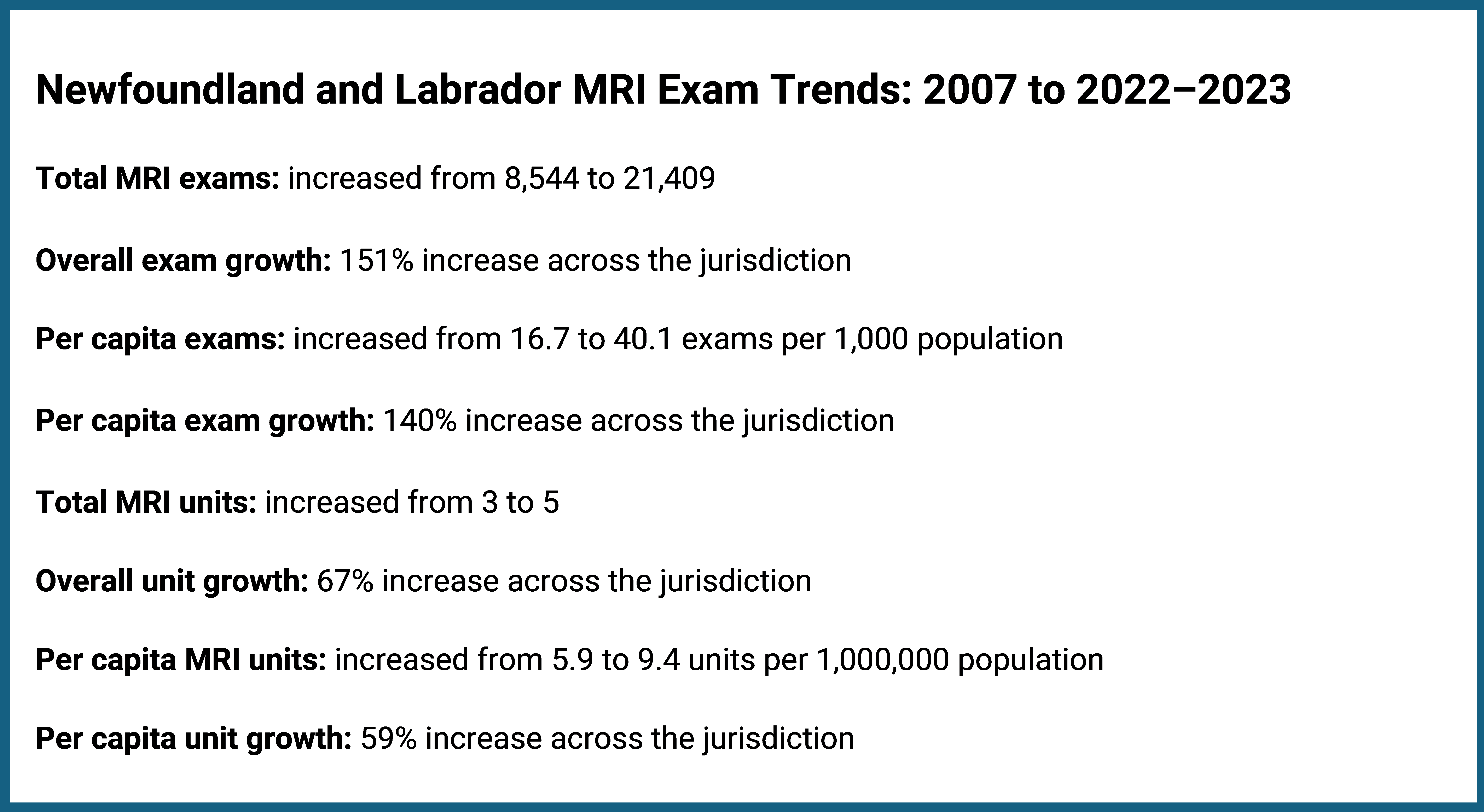
Newfoundland and Labrador’s total MRI exam volume rose by 151%, while per capita growth was 140% (Figure 3 and Appendix 1, Tables 1 and 2). During this period, the number of MRI units grew from 3 to 5, representing a 67% increase, while units per capita increased from 5.9 to 9.4, representing a 59% increase (Figure 3 and Appendix 1, Tables 3 and 4). Both the growth in overall exam volume and per capita exam volume were above the national average of 117% and 80%, respectively.
These figures positioned Newfoundland and Labrador among the top 3 jurisdictions for total and per capita percentage MRI exam growth over the time period. However, it is noted that its overall share of total MRI exam volumes remained 1% of the national total for each reporting year.
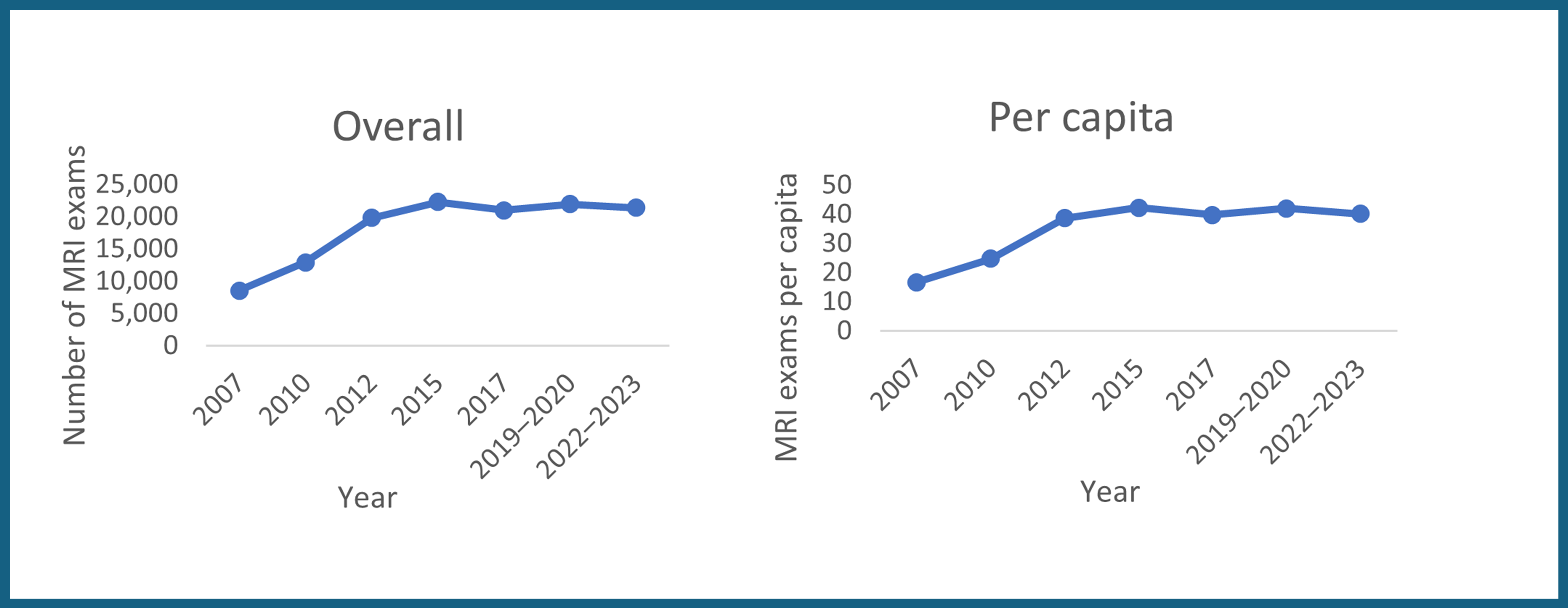
Newfoundland and Labrador experienced overall and per capita growth during the 16-year period, with continual growth between 2007 and 2015, when exam volumes reached their peak. The peak may be attributed to the use of imputed data for that year, rather than actual numbers. It is likely that, had actual numbers been used, the trajectory may have been more linear. Between 2015 and 2022–2023, exam volumes mostly plateaued, with 2022–2023 levels dropping slightly below those of 2019–2020 (Figure 4).
Prince Edward Island Growth Trends
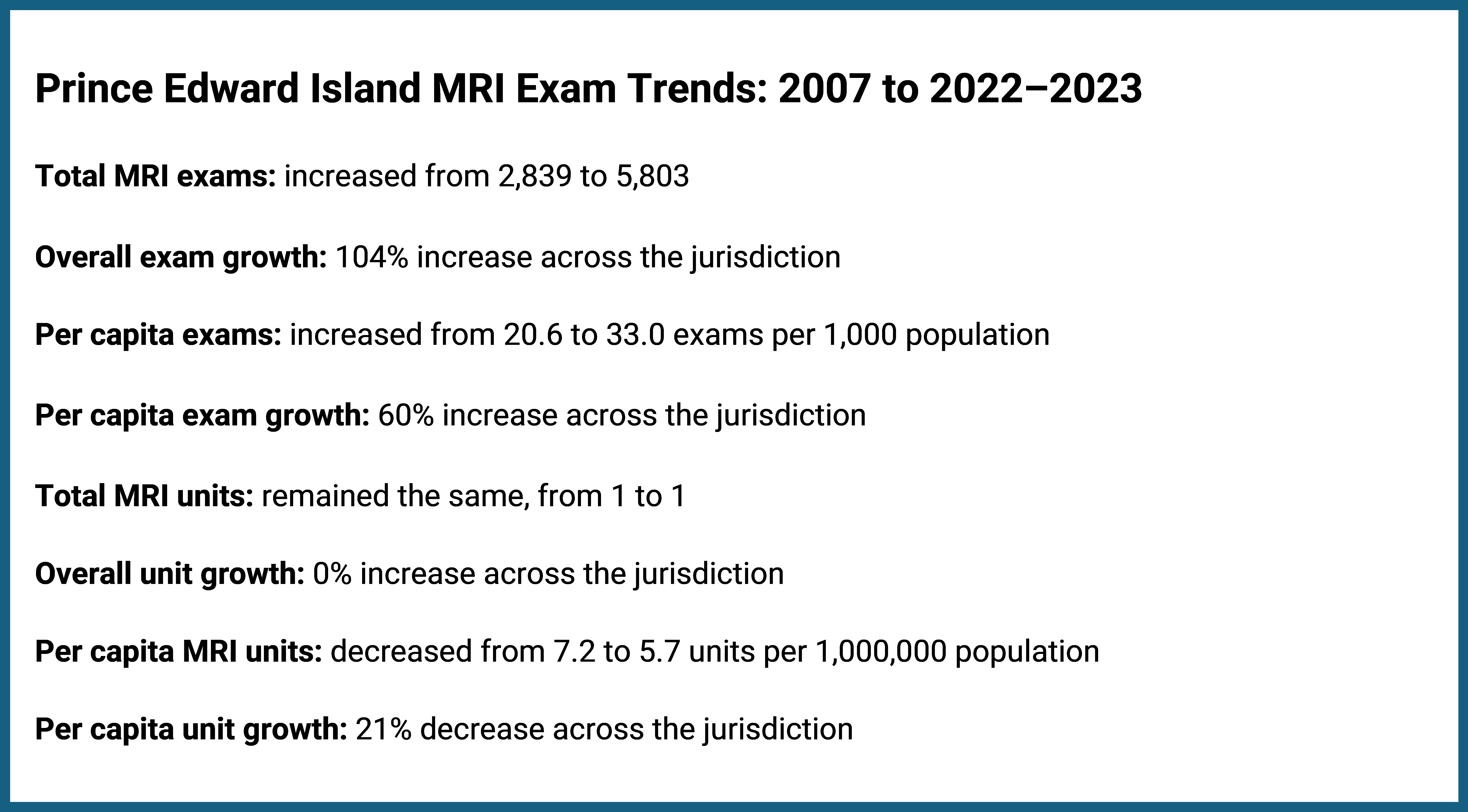
Prince Edward Island’s total MRI exam volume increased by 104%, while per capita growth was 60% (Figure 5 and Appendix 1, Tables 1 and 2). During this period, the number of MRI units remained constant at 1, while units per capita decreased from 7.2 to 5.7, representing a decline of 21% (Figure 5 and Appendix 1, Tables 3 and 4). Both the growth in overall exam volume and per capita exam volume were below the national average of 117% and 80%, respectively.
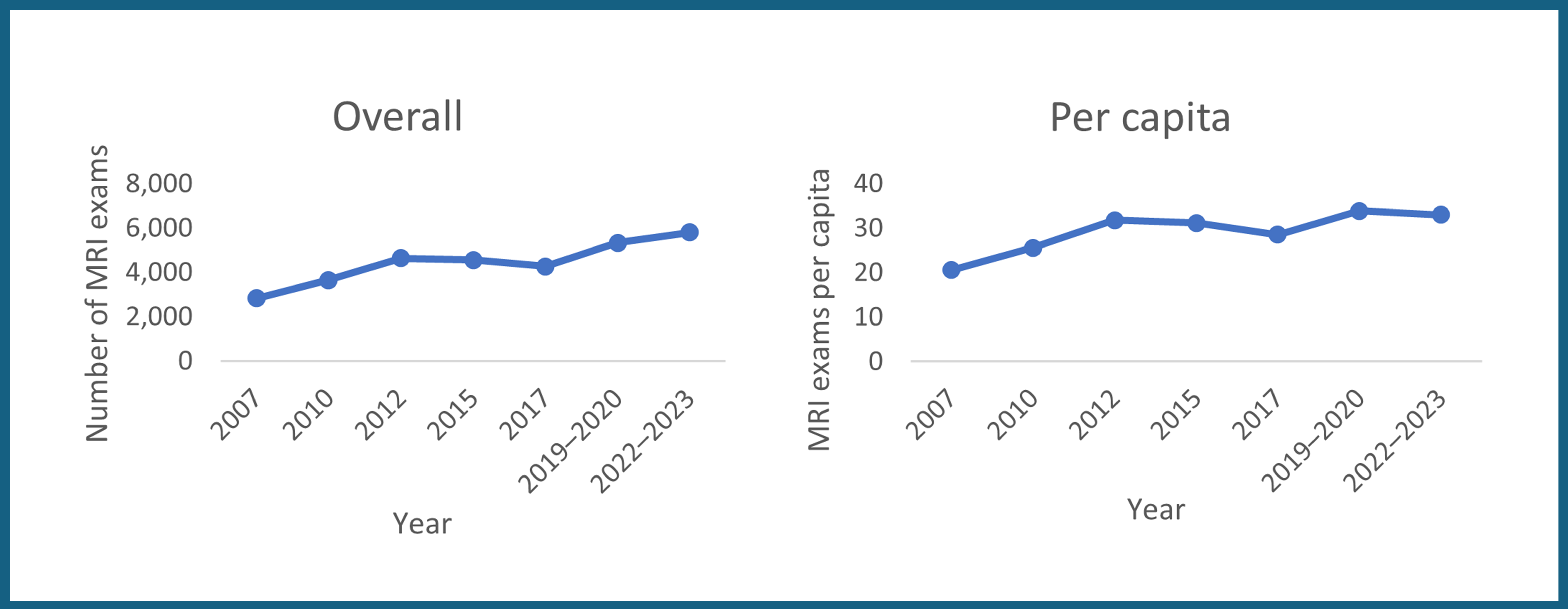
Prince Edward Island experienced overall and per capita growth during the 16-year period. The greatest period of growth for both was between 2007 and 2012, when exam volumes reached a high that was not surpassed again until 2019–2020. Upward growth continued after that, and by 2022–2023, total exams had exceeded their previous peak. Per capita volumes remained slightly below 2019–2020 levels (Figure 6).
Nova Scotia Growth Trends
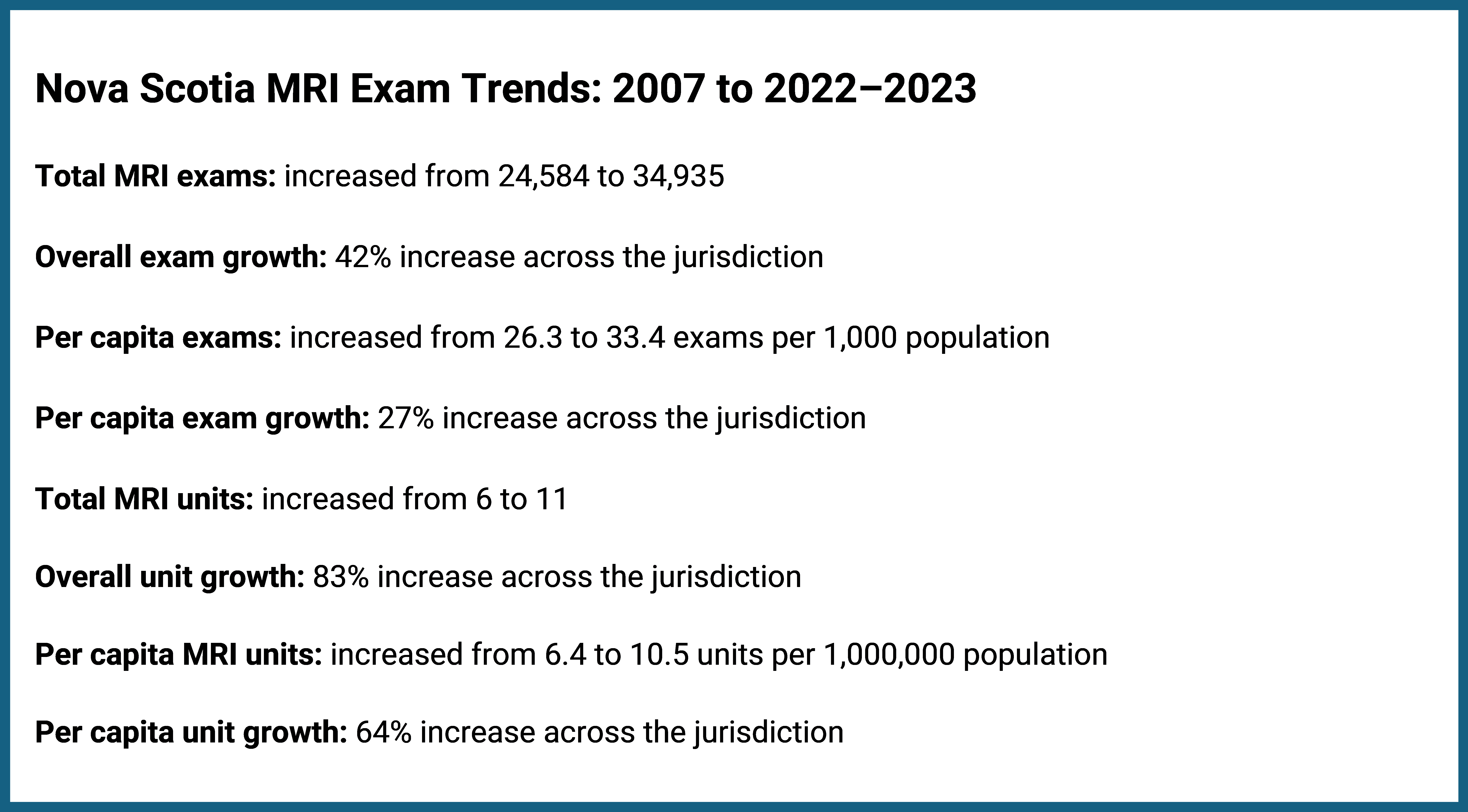
Nova Scotia’s total MRI exam volume increased by 42%, while per capita growth was 27% (Figure 7 and Appendix 1, Tables 1 and 2). During this period, the number of MRI units increased from 6 to 11, representing an 83% increase, while units per capita grew from 6.4 to 10.5, representing a 64% increase (Figure 7 and Appendix 1, Tables 3 and 4). Both the growth in overall exam volume and per capita exam volume were below the national averages of 117% and 80%, respectively.
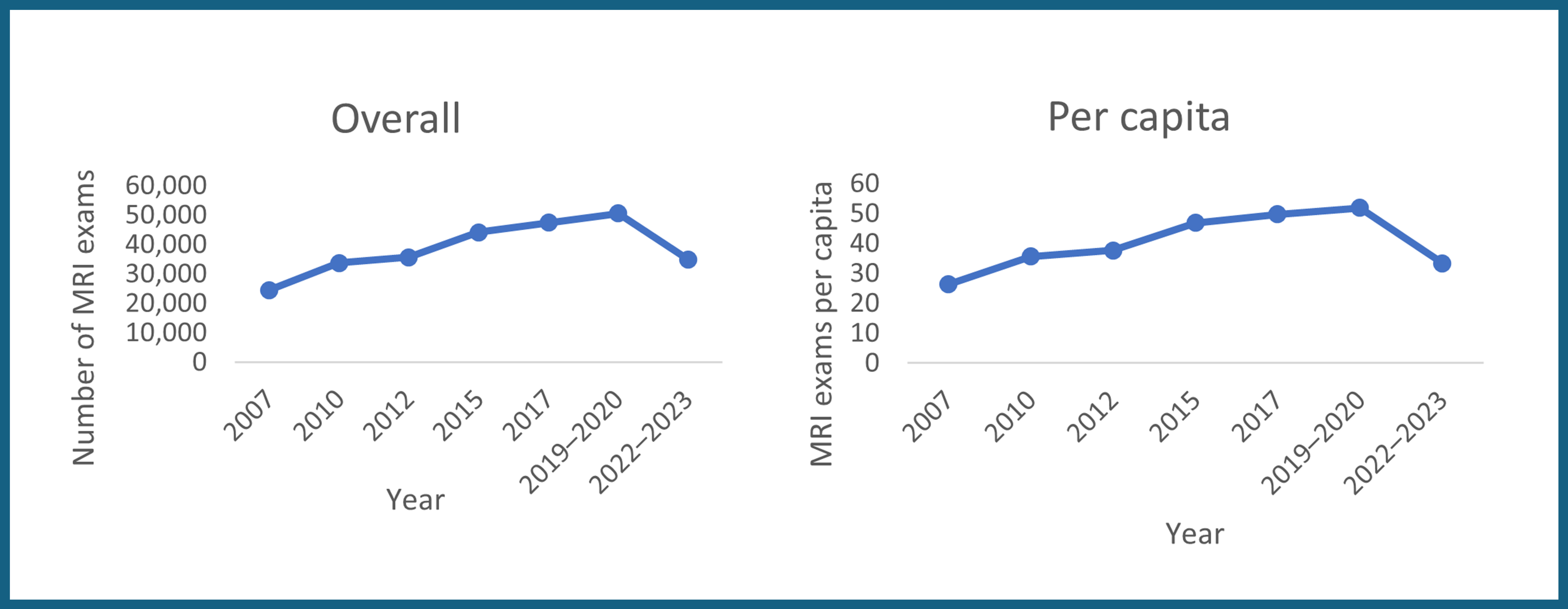
Nova Scotia experienced overall and per capita growth during the 16-year period. The greatest period of growth for both was between 2007 and 2019–2020, when exam volumes reached a peak. This was followed by a decline, and by 2022–2023, volumes were slightly below those observed in 2012 (Figure 8).
New Brunswick Growth Trends
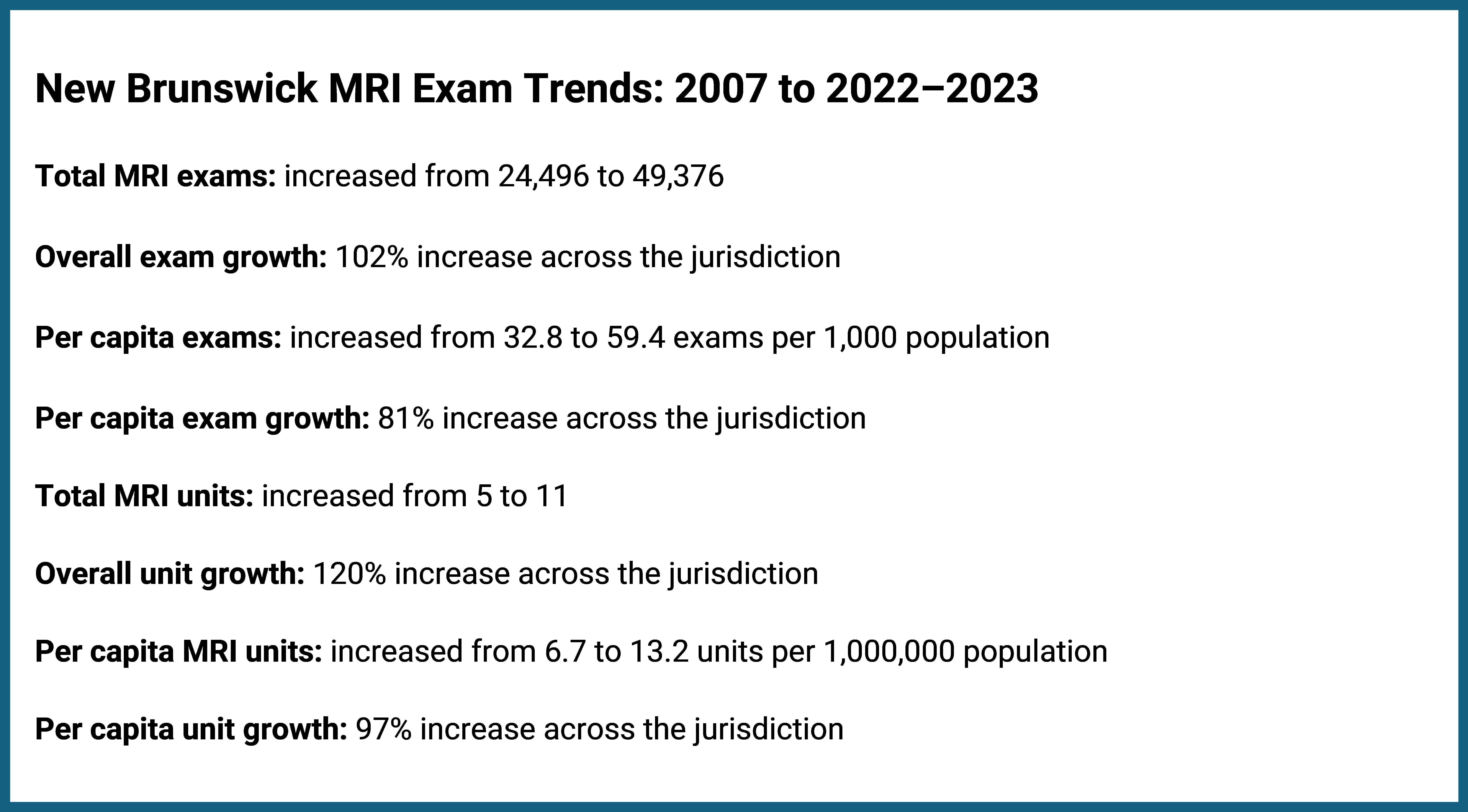
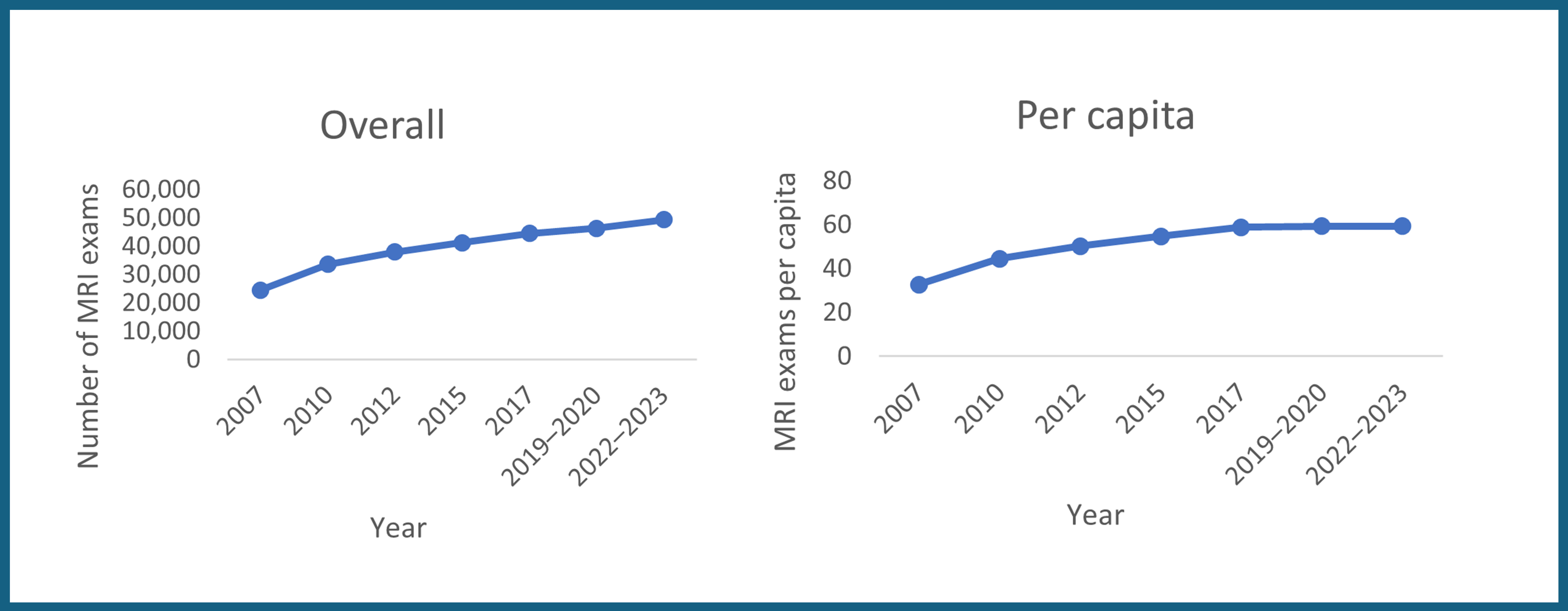
New Brunswick’s total MRI exam volume increased by 102%, while per capita growth was 81% (Figure 9 and Appendix 1, Tables 1 and 2). During this period, the number of MRI units increased from 5 to 11, representing a 120% rise, while MRI units per capita grew from 6.7 to 13.2, representing a 97% increase (Figure 9 and Appendix 1, Tables 3 and 4). The growth in total exam volume was below the national average of 117%, whereas the growth in per capita exam volume was above the national average of 80%.
New Brunswick experienced overall and per capita growth during the 16-year period. The greatest period of growth for both was between 2007 and 2019–2020, with exam volumes rising steadily throughout that time. After 2019–2020, overall exams continued to increase, while per capita rates plateaued (Figure 10).
Quebec Growth Trends
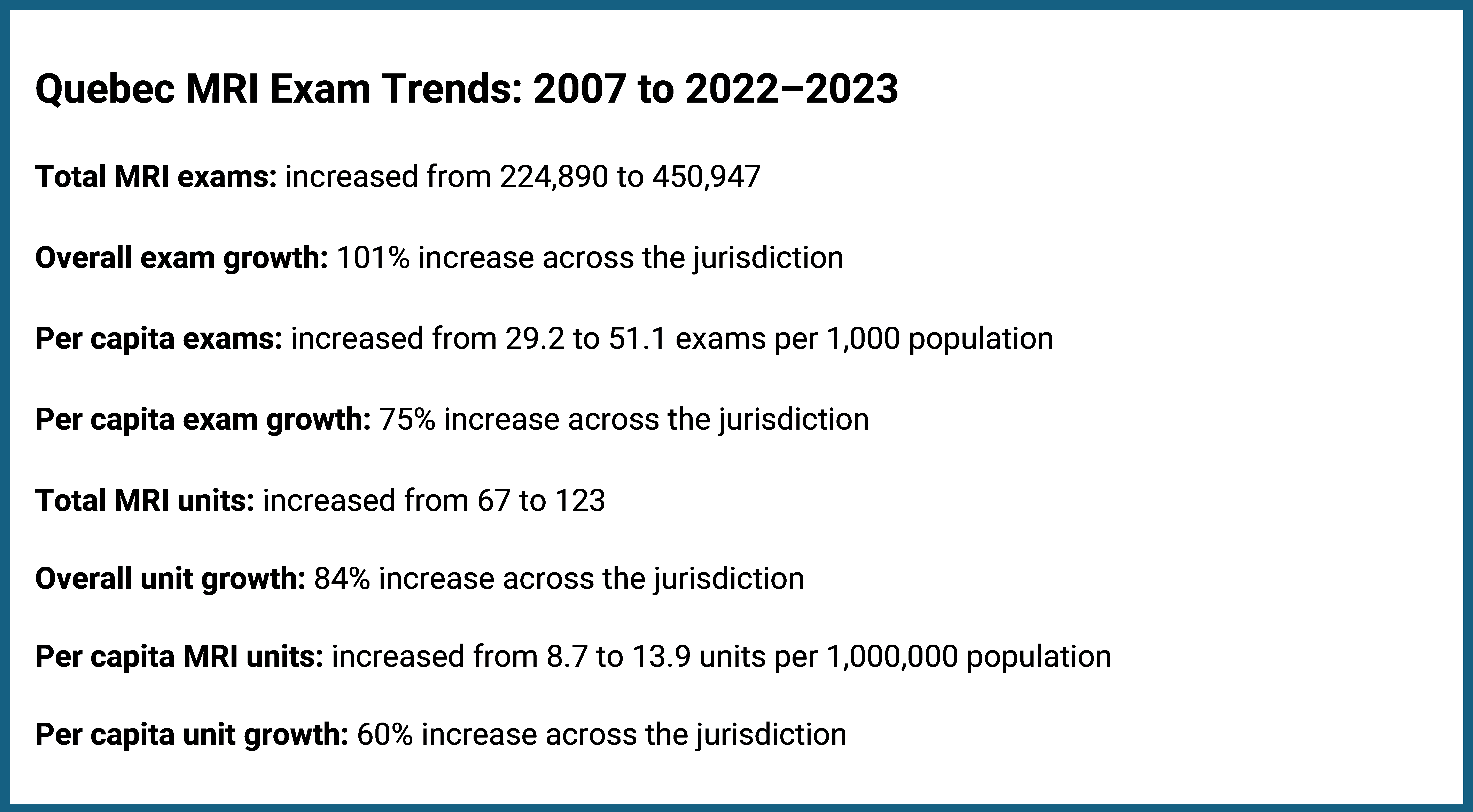
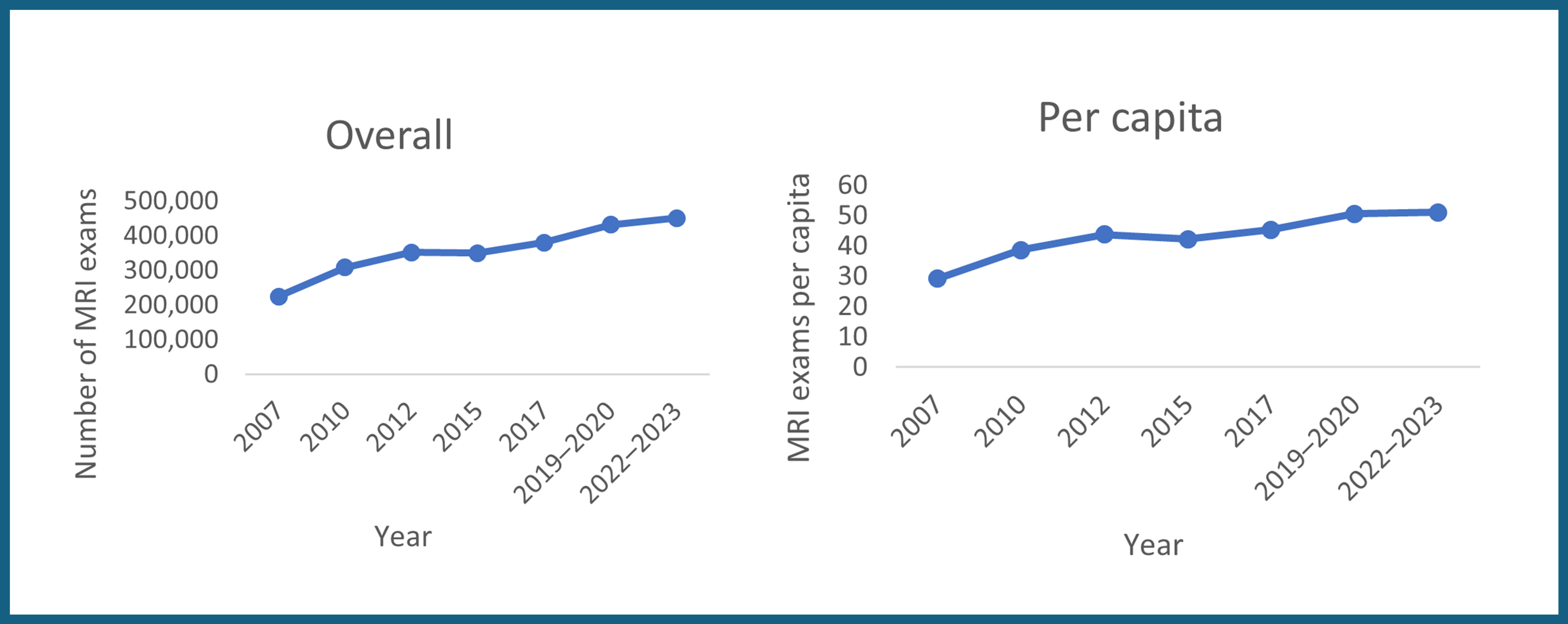
Quebec’s total MRI exam volume increased by 101%, while per capita growth was 75% (Figure 11 and Appendix 1, Tables 1 and 2). During this period, the number of MRI units grew from 67 to 123, representing an increase of 84%, while MRI units per capita grew from 8.7 to 13.9, representing a 60% increase (Figure 11 and Appendix 1, Tables 3 and 4). Both the growth in overall exam volume and per capita exam volume were below the national averages of 117% and 80%, respectively.
Quebec experienced overall and per capita growth during the 16-year period. For both, MRI exam growth showed a gradual upward trend with a slight decline around 2015, followed by a steady increase leading up to 2022–2023. The 2015 dip may reflect the use of imputed data instead of actual numbers for that year. If actual numbers had been used, the growth trajectory may have been more linear (Figure 12).
Ontario Growth Trends
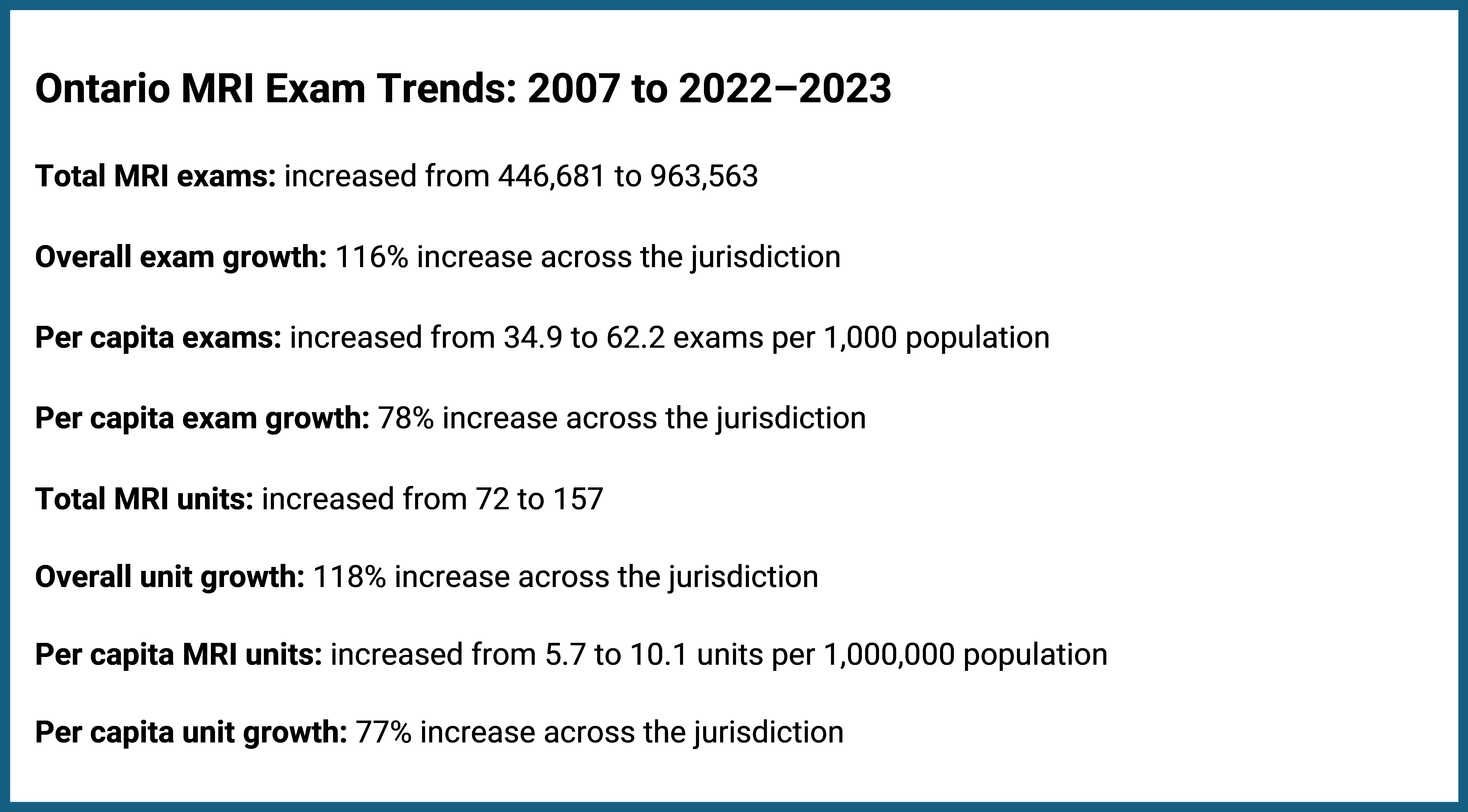
Ontario’s total MRI exam volume increased by 116%, while per capita growth was 78% (Figure 13 and Appendix 1, Tables 1 and 2). During this period, the number of MRI units grew from 72 to 157, representing a 118% increase, while MRI units per capita grew from 5.7 to 10.1, representing a 77% increase (Figure 13 and Appendix 1, Tables 3 and 4). Both the growth in overall exam volume and per capita exam volume were below the national averages of 117% and 80%, respectively.
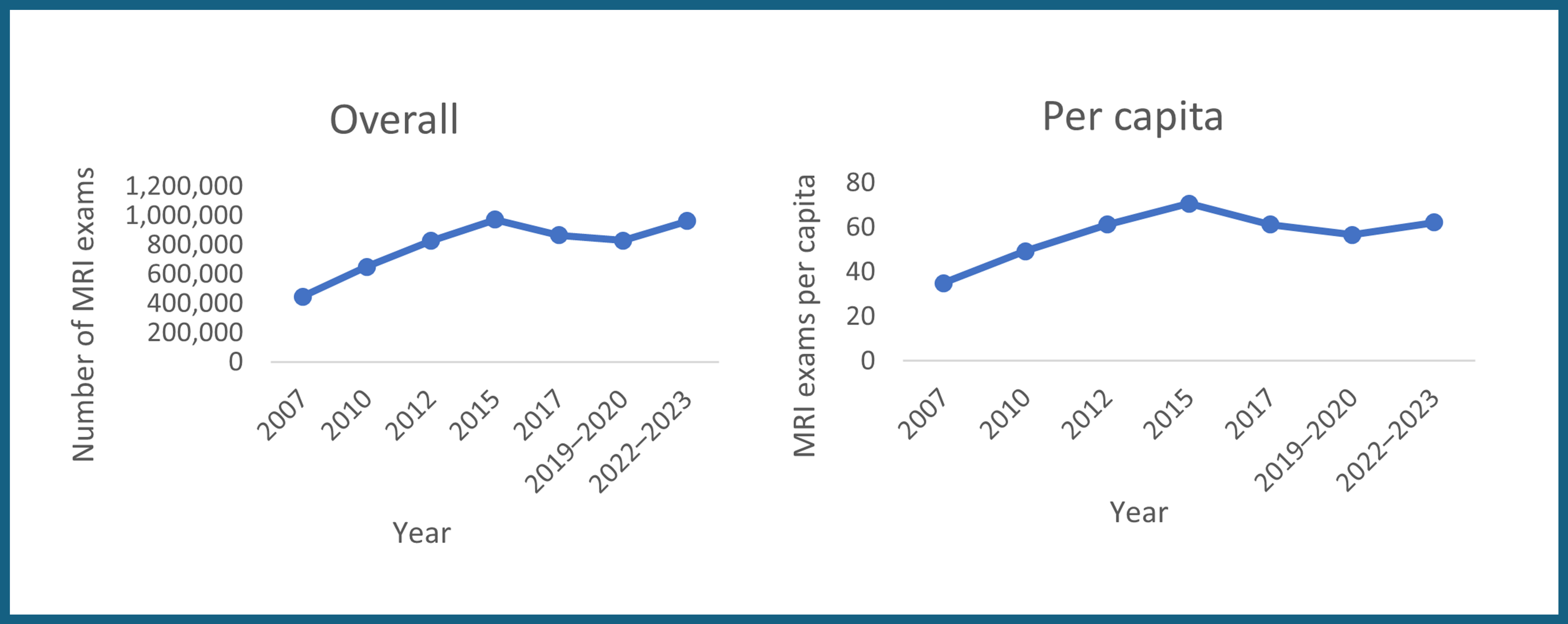
Ontario experienced overall and per capita growth during the 16-year period. The greatest period of growth for both was between 2007 and 2015, with volumes peaking in 2015. This was followed by a decline through 2019–2020, then an increase by 2022–2023, though exam numbers remained below the 2015 peak (Figure 14).
The slight drop after 2015 may be related to imputed data rather than actual exam counts; if actual data had been used, the trend may have been more linear.
Manitoba Growth Trends
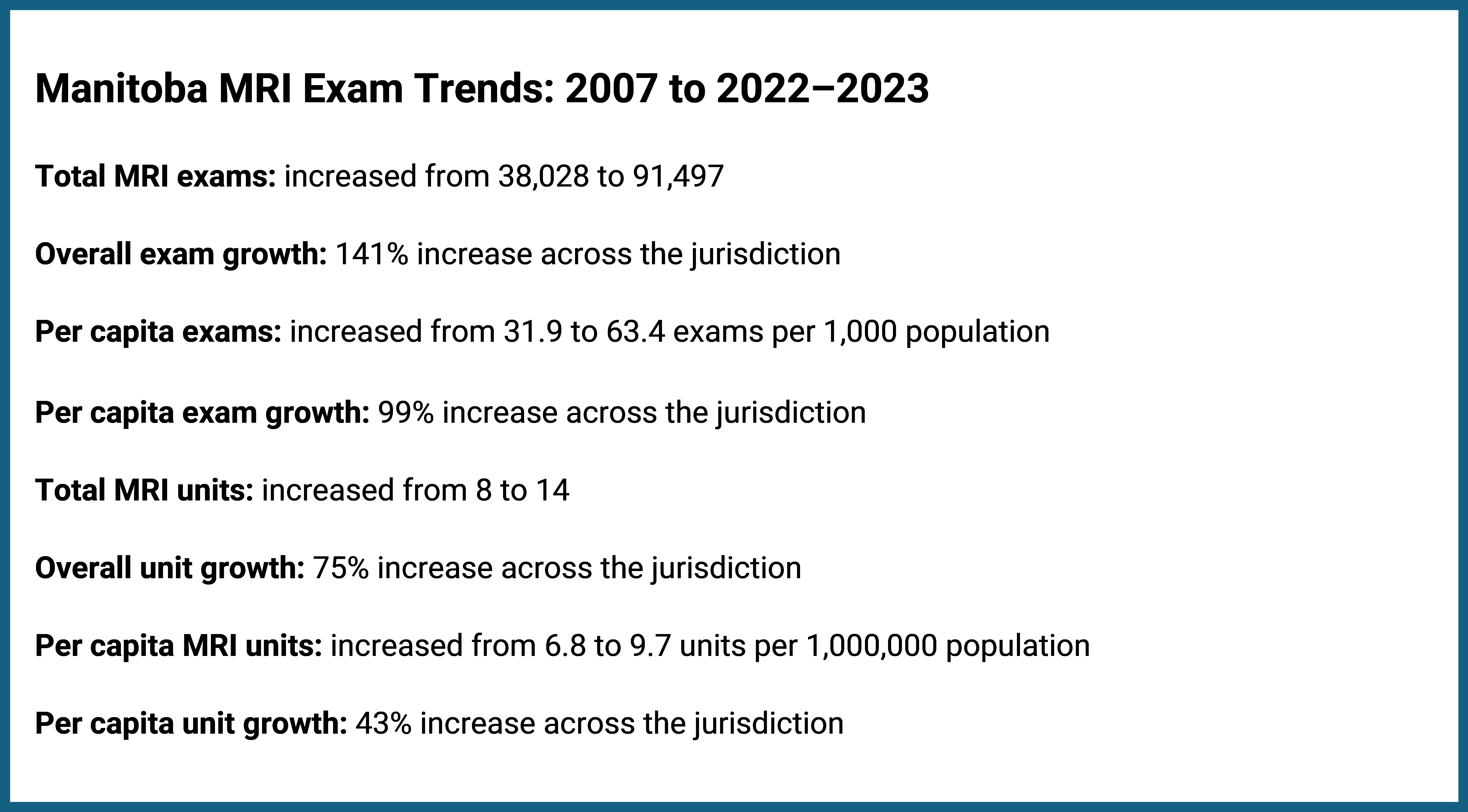
Manitoba’s total MRI exam volume rose by 141%, while per capita growth was 99% (Figure 15 and Appendix 1, Tables 1 and 2). During this period, the number of MRI units grew from 8 to 14, representing a 75% increase, while MRI units per capita grew from 6.8 to 9.7, representing a 43% increase (Figure 15 and Appendix 1, Tables 3 and 4). Both the growth in total exam volume and per capita exam volume were above the national averages of 117% and 80%, respectively.
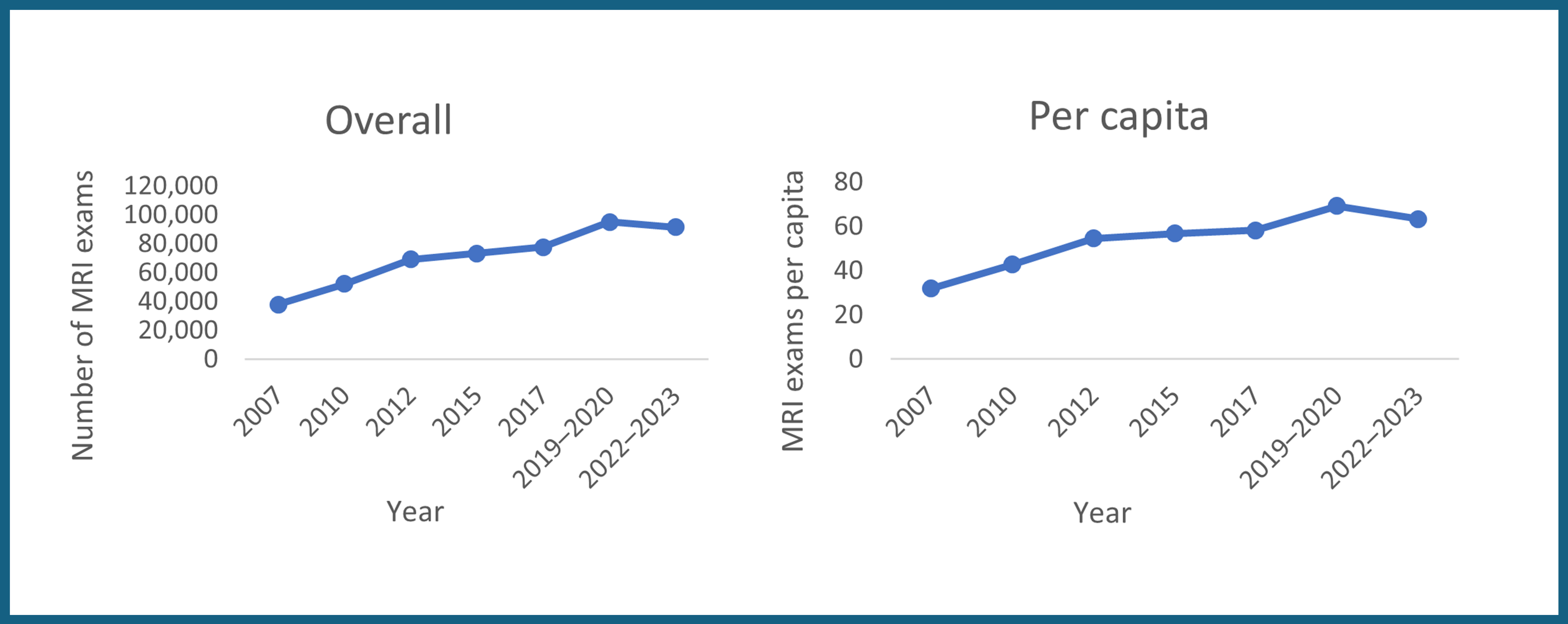
Manitoba experienced overall and per capita growth during the 16-year period. The greatest period of growth for both was between 2007 and 2012, followed by a brief plateau through 2017. Growth resumed leading up to 2019–2020, after which there was a slight decline (Figure 16).
Saskatchewan Growth Trends
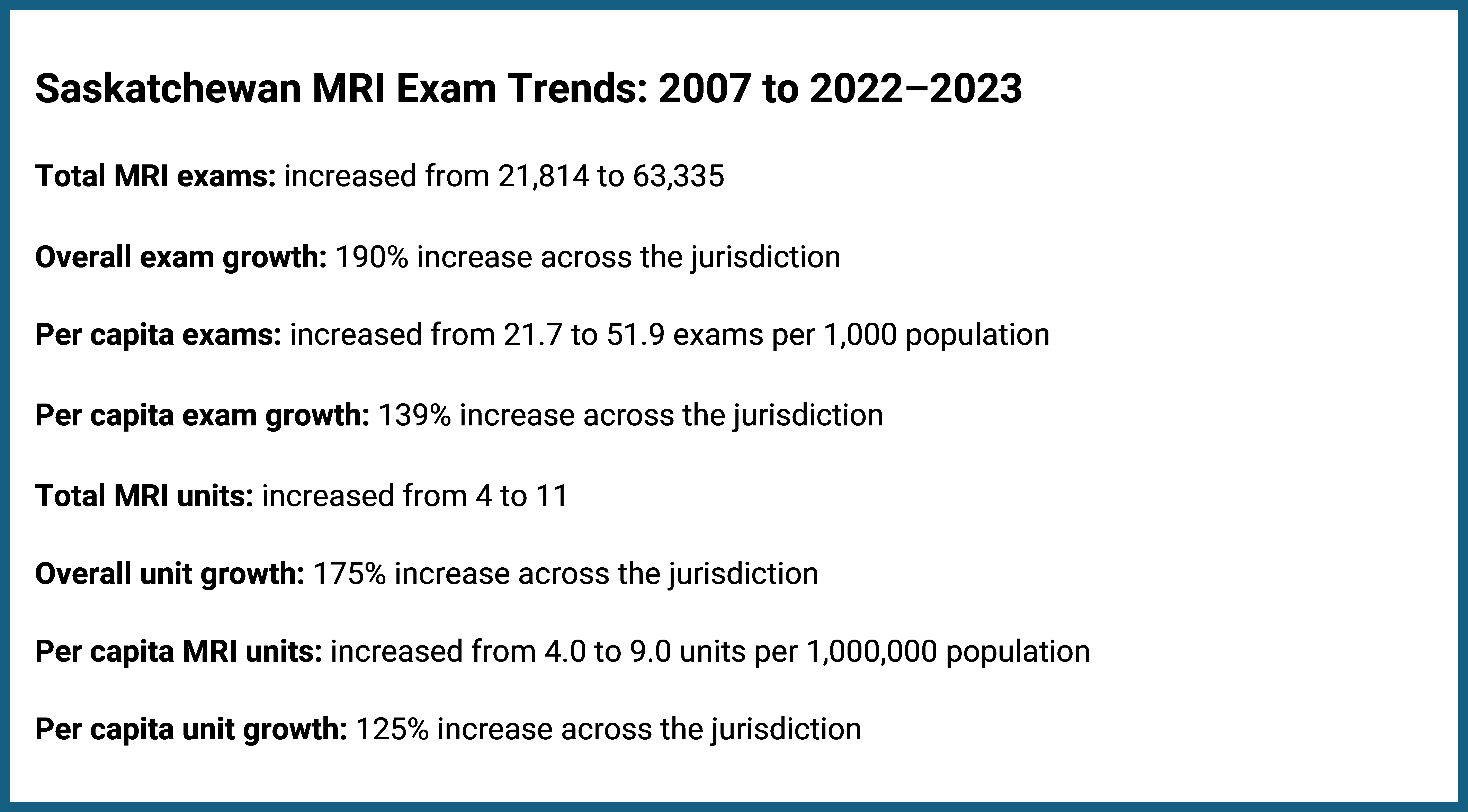
Saskatchewan’s total MRI exam volume rose by 190%, while per capita growth was 139% (Figure 17 and Appendix 1, Tables 1 and 2). During this period, the number of MRI units increased from 4 to 11, representing a 175% increase, while MRI units per capita grew from 4.0 to 9.0, representing a 125% increase (Figure 17 and Appendix 1, Tables 3 and 4). Both the growth in overall exam volume and per capita exam volume were above the national averages of 117% and 80%, respectively.
These figures positioned Saskatchewan among the top 3 jurisdictions for total and per capita percentage MRI exam growth over the time period. However, it is noted that its overall share of total MRI exam volumes remained 2% of the national total for each reporting year.
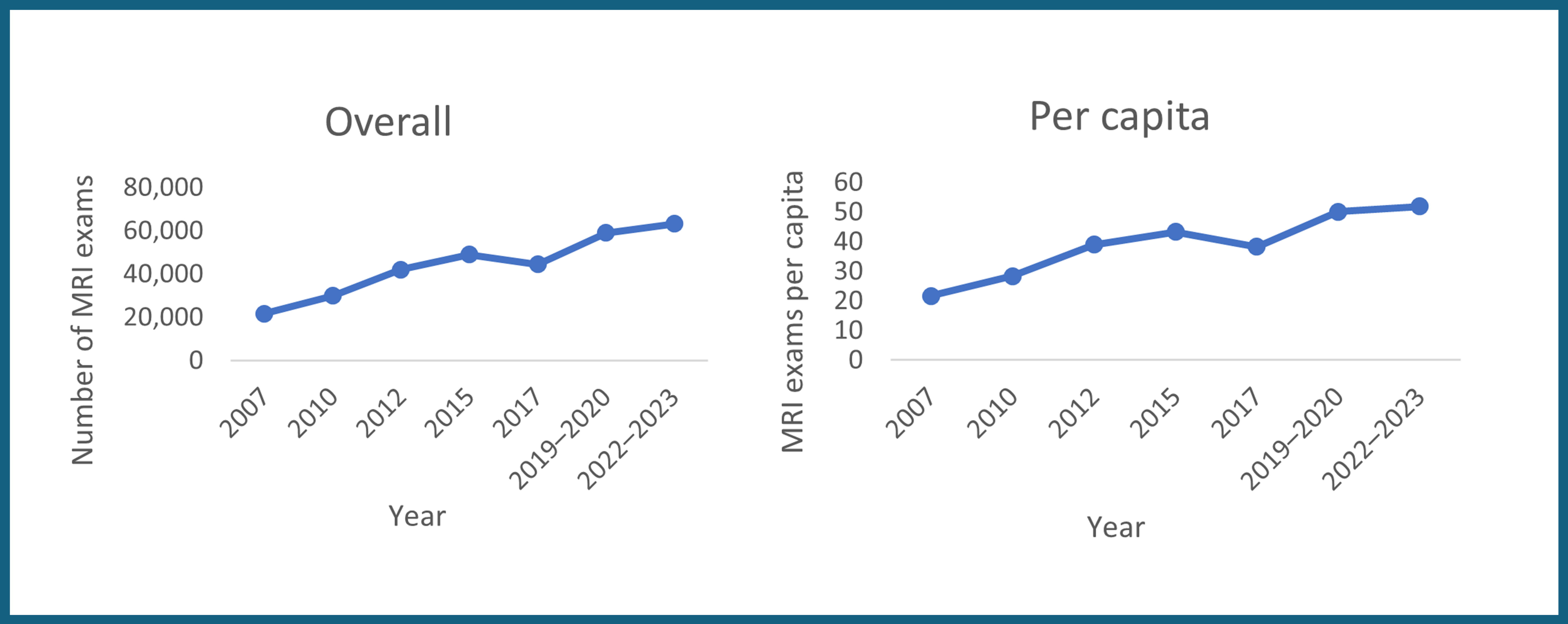
Saskatchewan experienced overall and per capita growth during the 16-year period. The greatest period of growth for both was between 2007 and 2015, when exam volumes rose steadily. This was followed by a slight decline, then a rapid increase starting in 2017 and continuing thereafter (Figure 18).
Alberta Growth Trends
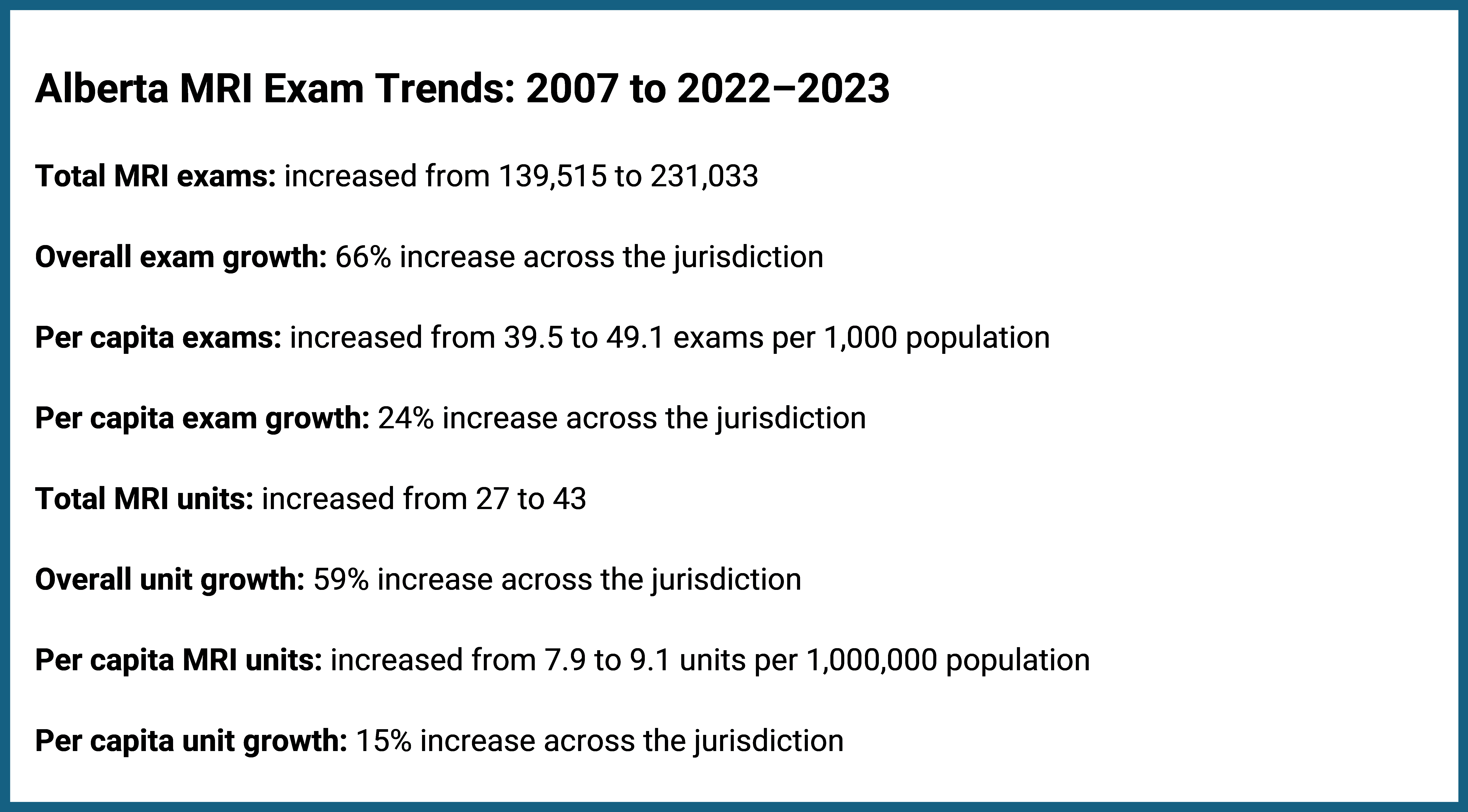
Alberta’s total MRI exam volume rose by 66%, while per capita growth was 24% (Figure 19 and Appendix 1, Tables 1 and 2). During this period, the number of MRI units increased from 27 to 43, representing a 59% increase, while MRI units per capita grew from 7.9 to 9.1, representing a 15% increase (Figure 19 and Appendix 1, Tables 3 and 4). Both the growth in overall exam volume and per capita exam volume were below the national averages of 117% and 80%, respectively.
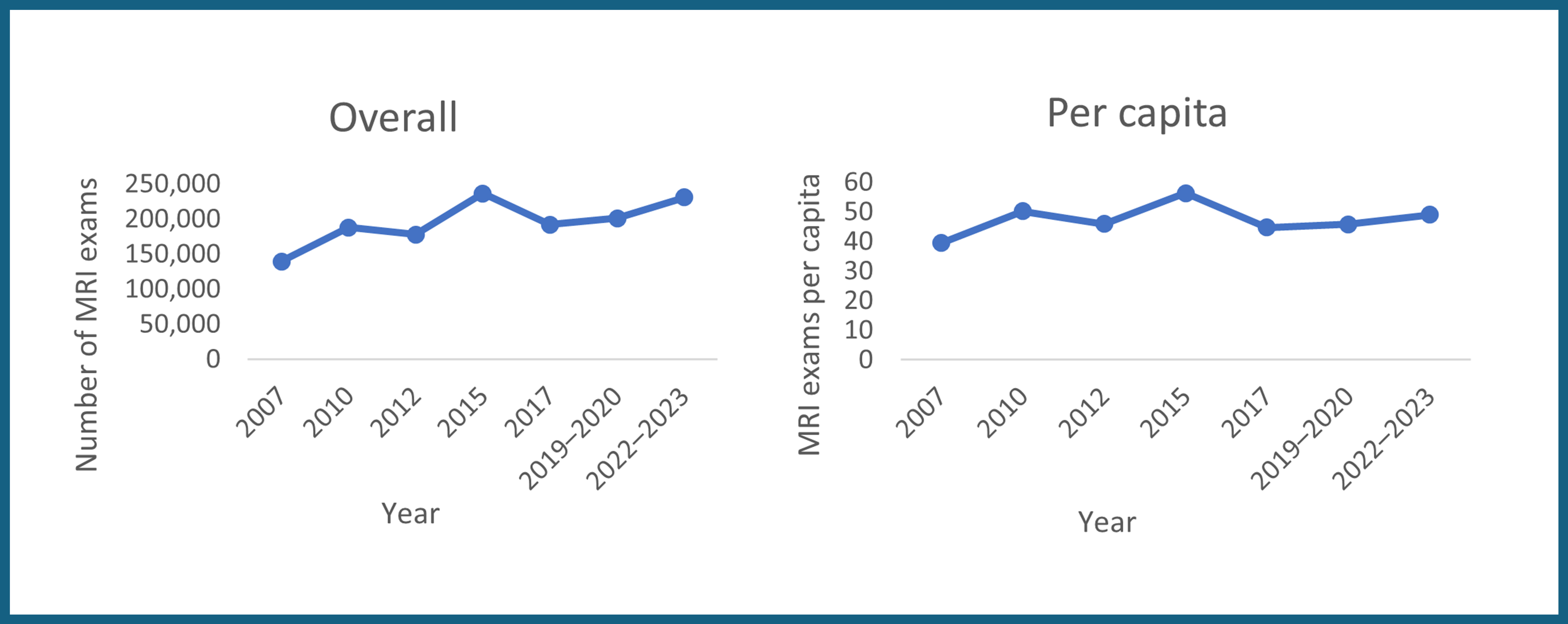
Alberta experienced overall and per capita growth during the 16-year period. The greatest period of growth for both was between 2012 and 2015, followed by a decline through 2017 and then a gradual increase leading up to 2022–2023. The slight dip after 2015 may be related to imputed data rather than actual exam numbers being used in the calculations; if actual data had been used, the decline may have been less pronounced (Figure 20).
British Columbia Growth Trends
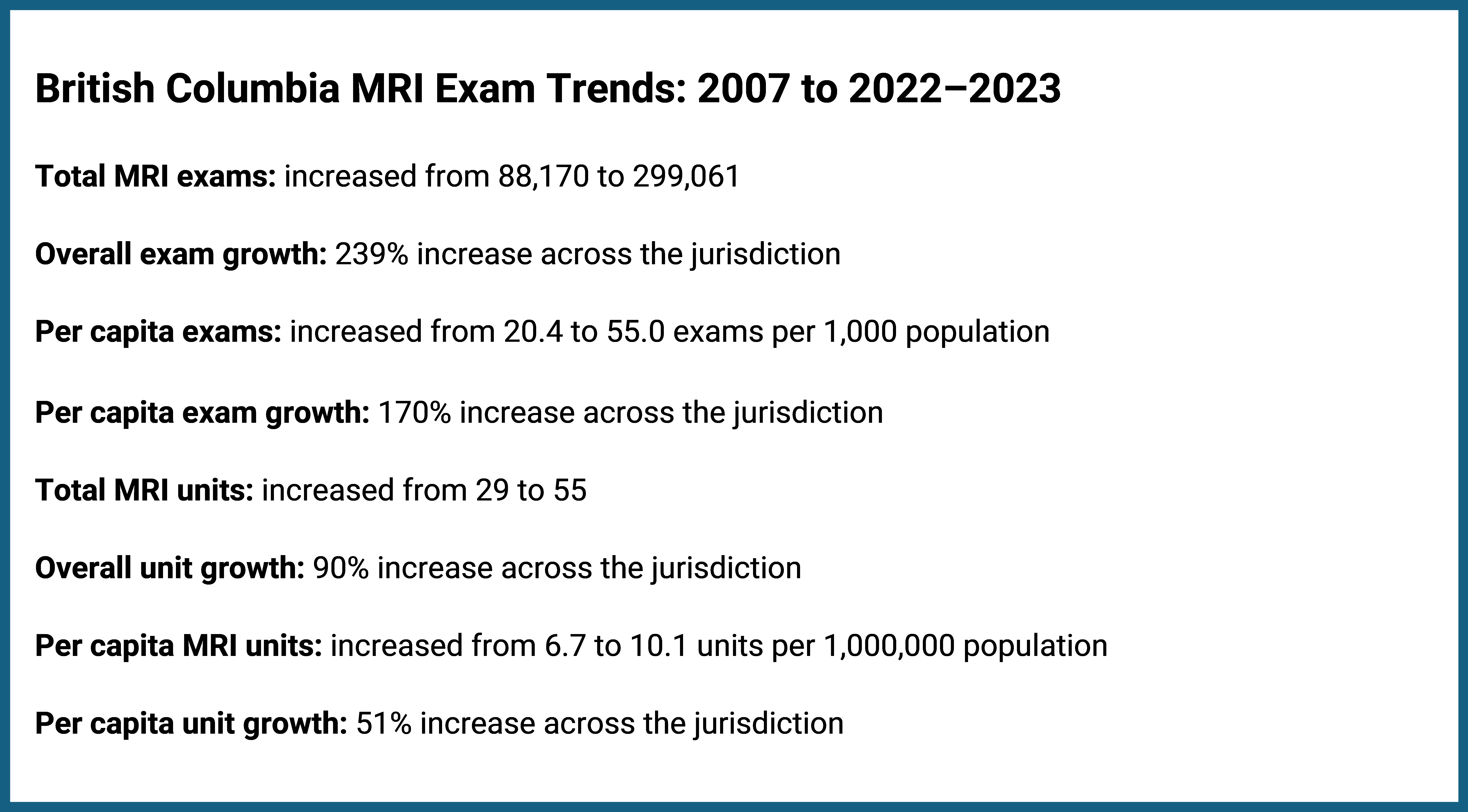
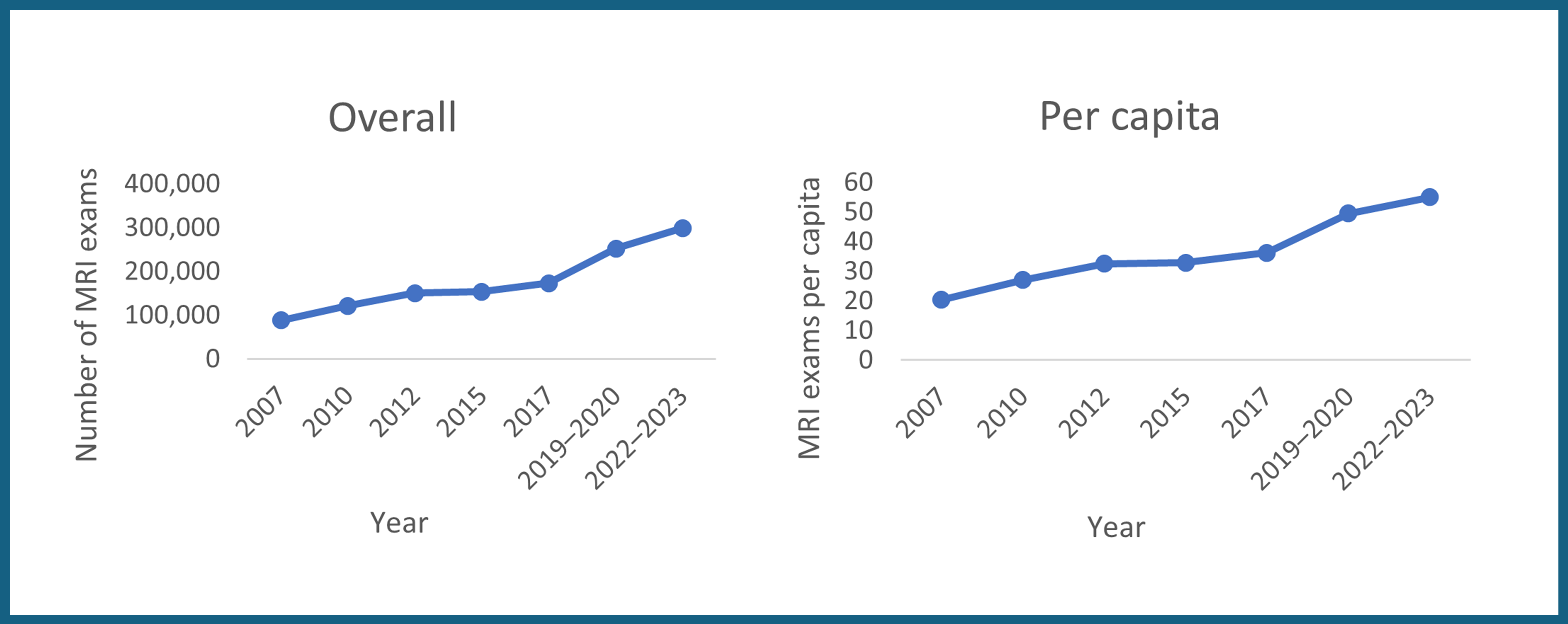
British Columbia’s total MRI exam volume rose by 239%, while per capita growth was 170% (Figure 21 and Appendix 1, Tables 1 and 2). During this period, the number of MRI units increased from 29 to 55, representing a 90% increase, while MRI units per capita grew from 6.7 to 10.1, representing a 51% increase (Figure 21 and Appendix 1, Tables 3 and 4). Both the growth in overall exam volume and per capita exam volume were above the national averages of 117% and 80%, respectively.
These figures positioned British Columbia among the top 3 jurisdictions for total and per capita percentage MRI exam growth over the time period. However, it is noted that its overall share of total MRI exam volumes remained between 9% and 14% of the national total for each reporting year.
British Columbia experienced consistent year-over-year increases in MRI exam growth throughout the 16-year period. The greatest period of growth for both was between 2017 and 2019–2020, following a steady upward trajectory that continued through 2022–2023 (Figure 22).
Yukon started MRI services in 2015 and operated 1 MRI unit through to 2022–2023. The total number of MRI exams in Yukon grew from 2,200 in 2015 to 3,198 in 2022–2023 (Appendix 1, Table 1), representing a 45% increase. On a per capita basis, MRI exams increased from 58.8 per 1,000 people in 2015 to 72 per 1,000 people in 2022–2023, representing a 23% increase (Appendix, Table 2). As of 2022–2023, the Northwest Territories and Nunavut did not have any MRI units.
Limitations
This report is reliant on self-reported data that may include errors, misinterpretations, or other data issues, leading to potential biases in the report. Additionally, this report is limited by the number of sites that reported the necessary information required for this analysis. Sometimes, limited sample sizes may have been unable to provide a reliably accurate result.
Also, the results of this report are based on the data collected over more than a decade. Over this time period, the organizations responsible for data collection changed, and there were differences in the data collection methods, validation procedures, and reporting compliance. The data collection changed — CIHI conducted the survey between 2007 and 201210,11,19 and CDA-AMC took over from 2015 onward.16,20-22 Data from 2015 were partially imputed due to incomplete submissions from some jurisdictions for this year. While this approach ensured a more comprehensive baseline for analysis, it introduced variability that may affect trend interpretation for that year. Imputation of missing data was primarily done through proportional scaling, assuming that nonreporting sites had exam volumes similar to those that reported. This assumption, if incorrect, may have led to overestimation — especially in jurisdictions where the imputed values represented a large portion of the total. These methodological choices influenced the quality of the data and might contribute to the differences in the number of exams performed during that year.
Furthermore, using per capita values can be misleading in a country like Canada, which has the second-largest landmass in the world. These measurements do not account for the disparities in population distribution, where many people live along the southern border and vast and remote areas remain sparsely populated.6 Additionally, Canada's geographic size means that providing services and infrastructure over such a large area comes with challenges that per capita figures cannot portray. As a result, per capita measures do not reflect the true complexities of the geographic distribution of populations across the country.
Another limitation of this report is that it did not consider jurisdictions that did not have MRI capacity for the entire period from 2007 to 2022–2023. This report focuses only on those jurisdictions that have data for the entire period from 2007 to 2022–2023. As a result, jurisdictions like the Northwest Territories and Nunavut (which did not offer MRI services as of 2022–2023) and Yukon (where MRI services began only in 2015) are excluded from the national trend analysis, despite ongoing efforts to expand MRI capacity in the territories. Moreover, variations in regional health care infrastructures, such as access to MRI facilities and health care policies, could have contributed to regional disparities. The evolution of MRI technology, including improvements in imaging quality and machine efficiency, may also have impacted the comparability of data across different time points.
There were a few contextual factors that influenced the use of imaging modalities over time, such as the COIVD-19 pandemic,23 population growth,7 changing standard of care, and population aging, but the impact of these factors could not be assessed with the available data.
Implications for Decision-Making
The demand for MRI exams is shaped by various factors, including population growth, health care resources, and evolving medical practices. Understanding trends in exam volumes is essential for planning imaging capacity and ensuring timely access to diagnostic services.
Despite the increase in both overall and per capita exam volumes, the rising number of MRI exams may pose potential challenges, underscoring key points for health care decision-makers to consider, such as the following:
Extended wait times for imaging may delay diagnoses and treatment, potentially affecting patient outcomes.24,25
Extending operating hours can help reduce wait times and allow exam volumes to be managed more effectively.26 However, challenges in resourcing may make it difficult to extend the hours of operation of the equipment.27
Longer wait times can also lead to increased health care costs and reduced productivity, with imaging delays estimated to cost the economy $3.54 billion in 2018.25,28
Limited imaging availability may result in patients seeking private diagnostic services, increasing out-of-pocket health care expenses.4
Variations in exam trends suggest that regions may face unique health care challenges and requirements. Decision-makers may consider tailored strategies —such as optimizing existing imaging infrastructure, refining workforce planning, and aligning resource allocation— that could help support timely and equitable MRI access across all regions.
Conclusion
The analysis of MRI exam growth across Canada's 10 jurisdictions with MRI capacity from 2007 to 2022–2023 shows distinct patterns in both overall and per capita exam volumes. All jurisdictions experienced increases in overall and per capita exam volumes.
The wide variation in both overall and per capita exam growth across jurisdictions suggests that resource allocation and access to MRI services may not be uniform across Canada's vast geography, and the low population density in certain regions likely contributes to these disparities. Furthermore, comparing urban, rural, and remote areas is challenging due to differences in population density and local conditions. Disparities in access to MRI services — driven by factors such as travel time, distance, and population size — may result in lower per capita exam volumes in some jurisdictions or local regions, highlighting potential inequities in access. These patterns underscore the need for region-specific health care planning to address the unique challenges each area faces.
The growing demand for MRI exams, in relation to imaging capacity, may lead to longer wait times, which can delay diagnoses and treatment, affecting patient outcomes. Additionally, these delays may increase health care costs and out-of-pocket expenses for patients seeking private services.
This analysis underscores the importance of strategic health care planning, which includes targeted strategies to optimize imaging infrastructures, resource allocation, and continuously monitoring capacity and demand. Decision-makers may want to consider local contextual factors when interpreting these trends and making decisions about future diagnostic imaging services.
References
1.Lam P. What to know about MRI scans. Medical News Today. 2023. Accessed April, 11. https://www.medicalnewstoday.com/articles/146309
2.(NIBIB) NIoBIaB. Magnetic Resonance Imaging (MRI). Accessed April, 11. https://www.nibib.nih.gov/science-education/science-topics/magnetic-resonance-imaging-mri#pid-956
3.Canadian Medical Imaging Inventory 2022–2023: MRI. Can J Health Technol. 2024;4(8). Accessed Jan 16, 2025. https://www.cda-amc.ca/sites/default/files/hta-he/HC0024-006-CMII4-MRI.pdf
4.Elin Kjelle IØB, Eivind Richter Andersen & Bjørn Morten Hofmann Cost of Low-Value Imaging Worldwide: A Systematic Review. Applied Health Economics and Health Policy. 2024;22. doi: 10.1007/s40258-024-00876-2
5.Blair N. Health Care System Statistics in Canada. Accessed March 25, 2025. https://madeinca.ca/health-care-system-statistics-canada/
6.Canada S. Population and demography statistics. 2024. Accessed Feb 26, 2025. https://www.statcan.gc.ca/en/subjects-start/population_and_demography
7.Canadian Medical Imaging Inventory 2022–2023: Provincial and Territorial Overview. Can J Health Technol.2024; 4(8). Accessed Jan 16, 2025. https://www.cda-amc.ca/sites/default/files/hta-he/HC0024_Overview.pdf
8.Cammoun D, Hendee WR, Davis KA. Clinical applications of magnetic resonance imaging--current status. West J Med. 1985;143(6):793-803. PubMed
9.O'Sullivan JW, Albasri A, Nicholson BD, et al. Overtesting and undertesting in primary care: a systematic review and meta-analysis. BMJ Open. 2018;8(2):e018557. doi: 10.1136/bmjopen-2017-018557 PubMed
10.Canadian Institute for Health Information. Medical Imaging in Canada, 2007. Canadian Institute for Health Information; 2008. Accessed Oct 30, 2024. https://publications.gc.ca/collections/collection_2008/cihi-icis/H118-13-2007E.pdf
11.Canadian Institute for Health Information. Medical imaging in Canada 2012 (executive summary). 2013.
12.Alison Sinclair TQ, Lisa Pyke, Andra Morrison The Canadian Medical Imaging Inventory, 2015. 2016. CADTH OPTIMAL USE REPORT. Accessed Jan 20, 2025. https://www.cda-amc.ca/sites/default/files/pdf/canadian_medical_imaging_inventory_2015_e.pdf
13.Chao YS, Sinclair A, Morrison A, Hafizi D, Pyke L. CADTH Health Technology Review: The Canadian Medical Imaging Inventory 2019–2020. Can J Health Technol. 2021;1(1). Accessed January 20, 2025. https://www.cda-amc.ca/sites/default/files/ou-tr/op0546-cmii3-final-report.pdf
14.Alison Sinclair AM, Calvin Young, Lisa Pyke. The Canadian Medical Imaging Inventory, 2017. 2018. CADTH OPTIMAL USE REPORT. Accessed Jan 20, 2025. https://www.cda-amc.ca/sites/default/files/pdf/canadian_medical_imaging_inventory_2017.pdf
15.Chao YS, Sinclair A, Morrison A, Hafizi D, Pyke L. CADTH Health Technology Review: The Canadian Medical Imaging Inventory 2019–2020. Can J Health Technol. 2021;1(1). Accessed March 25, 2025. https://www.cda-amc.ca/sites/default/files/ou-tr/op0546-cmii3-final-report.pdf
16.CADTH. CADTH Health Technology Review: Canadian Medical Imaging Inventory 2022–2023: MRI. Can J Health Technol. 2024;4(8). Accessed Jan 20, 2025. https://www.cda-amc.ca/sites/default/files/hta-he/HC0024_cmii_2022_2023_evidence_preview.pdf
17.Weisstanner D. Income growth and preferences for redistribution: The role of absolute and relative economic experiences. 2020.
18.Canadian Agency for D, Technologies in Health. CADTH Health Technology Review-CADTH: Canadian Medical Imaging Inventory Service Report Average Volume of MRI Exams Conducted per Hour Across Canada. Canadian Agency for Drugs and Technologies in Health; 2024. Accessed Oct 30, 2024. https://www.cda-amc.ca/sites/default/files/attachments/2024-01/cm0008-average-mri-exams-per-equipment.pdf
19.Canadian Institute for Health Information. Medical Imaging in Canada, 2010. Canadian Institute for Health Information; 2011.
20.Sinclair A, Quay T, Pyke L, Morrison A. CADTH Optimal Use Report: The Canadian Medical Imaging Inventory, 2015. CADTH; 2016. Accessed January 20, 2025. https://www.cda-amc.ca/sites/default/files/pdf/canadian_medical_imaging_inventory_2015_e.pdf
21.Sinclair A, Morrison A, Young C, Pyke L. The Canadian Medical Imaging Inventory, 2017. CADTH; 2018. Accessed January 20, 2025. https://www.cda-amc.ca/sites/default/files/pdf/canadian_medical_imaging_inventory_2017.pdf
22.Chao YS, Sinclair A, Morrison A, Hafizi D, Pyke L. CADTH Health Technology Review: The Canadian Medical Imaging Inventory 2019–2020. Can J Health Technol. 2021;1(1). Accessed January 20, 2025. https://www.cda-amc.ca/sites/default/files/ou-tr/op0546-cmii3-final-report.pdf
23.Chao Y-S, Vu T, McGill SC, Gates M. CADTH Health Technology Review: Clinical Classification and Interventions for Post–COVID-19 Condition: A Scoping Review. Can J Health Technol. 2022;2(5). Accessed February 25, 2025. https://www.cda-amc.ca/sites/default/files/pdf/htis/2022/RE0040-Post-COVID-19-Scoping-Review.pdf
24.Bartsch E, Shin S, Roberts S, MacMillan TE, Fralick M, Liu JJ, Tang T, Kwan JL, Weinerman A, Verma AA, Razak F, Lapointe-Shaw L. Imaging delays among medical inpatients in Toronto, Ontario: A cohort study. PLOS ONE. 2023 . 10.1371/journal.pone.0281327 PubMed
25.Wait List Strategies for CT and MRI Scans. Can J Health Technol. 2023;3(1).
26.Rohatgi S, Hanna TN, Sliker CW, Abbott RM, Nicola R. After-hours radiology: challenges and strategies for the radiologist. American Journal of Roentgenology. 2015;205(5):956-961. PubMed
27.CADTH Health Technology Review: Medical Imaging Inventory 2022–2023: The Medical Imaging Team. Can J Health Technol. 2024;4(8). Accessed January 16, 2025. https://www.cda-amc.ca/sites/default/files/hta-he/HC0024-08-Medical-Imaging-Team.pdf
28.Greg Sutherland NR, Robyn Gibbard, and Alexandru Dobrescu. The Value of Radiology, Part II. 2019. Accessed Jan 17, 2025. https://car.ca/wp-content/uploads/2019/07/value-of-radiology-part-2-en.pdf
Appendix 1: Summary Tables
Table 1: Number of MRI Exams Nationally and by Jurisdiction Between 2007 and 2022–2023
Year | NL | PE | NS | NB | QC | ON | MB | SK | AB | BC | YT | NT | NU | Canada |
|---|---|---|---|---|---|---|---|---|---|---|---|---|---|---|
2007 | 8,544 | 2,839 | 24,584 | 24,496 | 224,890 | 446,681 | 38,028 | 21,814 | 139,516 | 88,170 | 0 | 0 | 0 | 1,019,562 |
2010 | 12,934 | 3,658 | 33,736 | 33,625 | 308,153 | 650,295 | 52,369 | 29,942 | 188,132 | 121,655 | 0 | 0 | 0 | 1,434,500 |
2012 | 19,820 | 4,641 | 35,755 | 38,051 | 352,489 | 827,787 | 69,142 | 42,069 | 177,986 | 150,893 | 0 | 0 | 0 | 1,718,633 |
2015 | 22,265 | 4,567 | 44,187 | 41,310 | 349,945 | 974,500 | 73,460 | 49,122 | 236,406 | 154,098 | 2,200 | NA | NA | 1,952,060 |
2017 | 20,990 | 4,279 | 47,490 | 44,592 | 380,357 | 866,953 | 77,735 | 44,461 | 192,375 | 173,678 | 2,200 | NA | NA | 1,855,110 |
2019–2020 | 21,929 | 5,348 | 50,664 | 46,309 | 431,655 | 831,038 | 95,250 | 59,109 | 201,208 | 252,527 | 2,350 | 0 | 0 | 1,997,387 |
2022–2023 | 21,409 | 5,803 | 34,935 | 49,376 | 450,947 | 963,563 | 91,497 | 63,335 | 231,033 | 299,061 | 3,198 | 0 | 0 | 2,214,157 |
AB = Alberta; BC = British Columbia; MB = Manitoba; NA = not applicable; NB = New Brunswick; NL = Newfoundland and Labrador; NS = Nova Scotia; NT = Northwest Territories; NU = Nunavut; ON = Ontario; PE = Prince Edward Island; QC = Quebec; SK = Saskatchewan; YT = Yukon.
Note: This table has not been copy-edited.
Table 2: Number of MRI Exams per 1,000 Population Nationally and by Jurisdiction Between 2007 and 2022–2023
Year | NL | PE | NS | NB | QC | ON | MB | SK | AB | BC | YT | NT | NU | Canada |
|---|---|---|---|---|---|---|---|---|---|---|---|---|---|---|
2007 | 16.7 | 20.6 | 26.3 | 32.8 | 29.2 | 34.9 | 31.9 | 21.7 | 39.5 | 20.4 | 0 | 0 | 0 | 30.9 |
2010 | 24.7 | 25.6 | 35.7 | 44.6 | 38.7 | 49.3 | 42.8 | 28.4 | 50.2 | 27.1 | 0 | 0 | 0 | 42 |
2012 | 38.7 | 31.8 | 37.7 | 50.3 | 43.8 | 61.3 | 54.6 | 39 | 45.9 | 32.6 | 0 | 0 | 0 | 49.3 |
2015 | 42.2 | 31.2 | 46.9 | 54.8 | 42.3 | 70.7 | 56.8 | 43.3 | 56.3 | 32.9 | 58.8 | NA | NA | 54 |
2017 | 39.7 | 28.6 | 49.8 | 58.9 | 45.4 | 61.3 | 58.3 | 38.3 | 44.8 | 36.3 | 58.2 | NA | NA | 51 |
2019–2020 | 42 | 33.9 | 51.9 | 59.4 | 50.6 | 56.7 | 69.3 | 50.1 | 45.8 | 49.5 | 57.3 | 0 | 0 | 52.9 |
2022–2023 | 40.1 | 33 | 33.4 | 59.4 | 51.1 | 62.2 | 63.4 | 51.9 | 49.1 | 55 | 72 | 0 | 0 | 55.6 |
AB = Alberta; BC = British Columbia; MB = Manitoba; NA = not applicable; NB = New Brunswick; NL = Newfoundland and Labrador; NS = Nova Scotia; NT = Northwest Territories; NU = Nunavut; ON = Ontario; PE = Prince Edward Island; QC = Quebec; SK = Saskatchewan; YT = Yukon.
Note: This table has not been copy-edited.
Table 3: Number of MRI Units by Jurisdiction, 2007 to 2022–2023
Year | NL | PE | NS | NB | QC | ON | MB | SK | AB | BC | YT | NT | NU | Canada |
|---|---|---|---|---|---|---|---|---|---|---|---|---|---|---|
2007 | 3 | 1 | 6 | 5 | 67 | 72 | 8 | 4 | 27 | 29 | — | — | — | 222 |
2010 | 3 | 1 | 9 | 6 | 81 | 93 | 8 | 5 | 36 | 39 | — | — | — | 281 |
2012 | 5 | 1 | 9 | 6 | 90 | 104 | 8 | 6 | 39 | 40 | — | — | — | 308 |
2015 | 5 | 1 | 11 | 10 | 85 | 125 | 10 | 9 | 41 | 42 | 1 | — | — | 340 |
2017 | 5 | 1 | 12 | 11 | 107 | 120 | 12 | 10 | 41 | 46 | 1 | — | — | 366 |
2019–2020 | 5 | 1 | 11 | 14 | 102 | 124 | 14 | 10 | 44 | 52 | 1 | — | — | 378 |
2022–2023 | 5 | 1 | 11 | 11 | 123 | 157 | 14 | 11 | 43 | 55 | 1 | — | — | 432 |
AB = Alberta; BC = British Columbia; MB = Manitoba; NB = New Brunswick; NL = Newfoundland and Labrador; NS = Nova Scotia; NT = Northwest Territories; NU = Nunavut; ON = Ontario; PE = Prince Edward Island; QC = Quebec; SK = Saskatchewan; YT = Yukon.
Note: This table has not been copy-edited.
Table 4: MRI Units per Capita by Jurisdiction, 2007 to 2022–2023
Year | NL | PE | NS | NB | QC | ON | MB | SK | AB | BC | YT | NT | NU | Canada |
|---|---|---|---|---|---|---|---|---|---|---|---|---|---|---|
2007 | 5.9 | 7.2 | 6.4 | 6.7 | 8.7 | 5.7 | 6.8 | 4.0 | 7.9 | 6.7 | — | — | — | 6.8 |
2010 | 5.9 | 7.1 | 9.6 | 8.0 | 10.3 | 7.1 | 6.5 | 4.8 | 9.7 | 8.7 | — | — | — | 8.3 |
2012 | 9.7 | 6.9 | 9.5 | 7.9 | 11.2 | 7.7 | 6.4 | 5.6 | 10.2 | 8.7 | — | — | — | 8.9 |
2015 | 9.5 | 13.7 | 11.7 | 13.3 | 17.7 | 13.5 | 7.7 | 7.9 | 9.8 | 9.0 | 27.0 | — | — | 9.5 |
2017 | 9.5 | 6.7 | 12.6 | 14.5 | 12.8 | 8.5 | 9.0 | 8.6 | 9.6 | 9.6 | 26.5 | — | — | 10.0 |
2019–2020 | 9.6 | 6.3 | 11.3 | 17.9 | 12.0 | 8.5 | 10.2 | 8.5 | 10.1 | 10.2 | 24.4 | — | — | 10.0 |
2022–2023 | 9.4 | 5.7 | 10.5 | 13.2 | 13.9 | 10.1 | 9.7 | 9.0 | 9.1 | 10.1 | 22.5 | — | — | 10.8 |
AB = Alberta; BC = British Columbia; MB = Manitoba; NB = New Brunswick; NL = Newfoundland and Labrador; NS = Nova Scotia; NT = Northwest Territories; NU = Nunavut; ON = Ontario; PE = Prince Edward Island; QC = Quebec; SK = Saskatchewan; YT = Yukon.
Note: This table has not been copy-edited.
ISSN: 2563-6596
Canada’s Drug Agency (CDA-AMC) is a pan-Canadian health organization. Created and funded by Canada’s federal, provincial, and territorial governments, we’re responsible for driving better coordination, alignment, and public value within Canada’s drug and health technology landscape. We provide Canada’s health system leaders with independent evidence and advice so they can make informed drug, health technology, and health system decisions, and we collaborate with national and international partners to enhance our collective impact.
Disclaimer: CDA-AMC has taken care to ensure that the information in this document was accurate, complete, and up to date when it was published, but does not make any guarantee to that effect. Your use of this information is subject to this disclaimer and the Terms of Use at cda-amc.ca.
The information in this document is made available for informational and educational purposes only and should not be used as a substitute for professional medical advice, the application of clinical judgment in respect of the care of a particular patient, or other professional judgments in any decision-making process. You assume full responsibility for the use of the information and rely on it at your own risk.
CDA-AMC does not endorse any information, drugs, therapies, treatments, products, processes, or services. The views and opinions of third parties published in this document do not necessarily reflect those of CDA-AMC. The copyright and other intellectual property rights in this document are owned by the Canadian Agency for Drugs and Technologies in Health (operating as CDA-AMC) and its licensors.
Questions or requests for information about this report can be directed to Requests@CDA-AMC.ca.