Drugs, Health Technologies, Health Systems
Reimbursement Review
Avapritinib (Ayvakyt)
Sponsor: Medison Pharma Canada Inc.
Therapeutic area: Indolent systemic mastocytosis
Summary
What Is Indolent Systemic Mastocytosis?
Indolent systemic mastocytosis (ISM) is a condition in which abnormal immune cells, called mast cells, build up in the body. It can cause long-lasting and often severe symptoms that affect the skin, stomach and intestines, brain function, muscles and bones, and entire body. In some cases, it can lead to anaphylaxis, a mast cell mediator–related symptom that is life-threatening. Data regarding how many people in Canada have ISM are scarce. The incidence of ISM was estimated to be 0.4 cases per 100,000 people per year in a population-based match cohort of 1,275 patients with mastocytosis identified between 1977 and 2014 in the Danish National Health Registries.
What Are the Treatment Goals and Current Treatment Options for Patients With ISM?
Treatment goals for patients with ISM include the prevention of life-threatening mast cell mediator–related symptoms (e.g., anaphylaxis), adequate symptom relief, and improved quality of life. Outcomes identified as important in the submitted evidence, based on input from patient and clinicians, included fewer anaphylactic reactions, alleviation of symptom burden, minimal adverse effects, and the preservation or restoration of health-related quality of life.
Current treatment options for patients with ISM focus on symptom management. Drugs used to treat mast cell release symptoms mainly include H1 blockers, H2 blockers, mast cell stabilizers, antileukotrienes, anti–immunoglobulin E monoclonal antibodies, and immunotherapies.
What Is Avapritinib and Why Did Canada’s Drug Agency Conduct This Review?
Ayvakyt is a tyrosine kinase inhibitor that is available as an oral tablet. Health Canada has approved Ayvakyt for “the treatment of adult patients with indolent systemic mastocytosis (ISM) with moderate to severe symptoms inadequately controlled on symptomatic treatment.”
Canada’s Drug Agency (CDA-AMC) reviewed Ayvakyt to inform a recommendation to participating public drug programs on whether it should be reimbursed for “the treatment of adult patients with indolent systemic mastocytosis (ISM) with moderate to severe symptoms inadequately controlled on symptomatic treatment.”
How Did CDA-AMC Evaluate Avapritinib?
CDA-AMC reviewed the clinical evidence on the beneficial and harmful effects, as well as the economic evidence, of Ayvakyt versus other treatments used in Canada for “the treatment of adult patients with indolent systemic mastocytosis (ISM) with moderate to severe symptoms inadequately controlled on symptomatic treatment.” Best supportive care (BSC) was considered a relevant treatment against which to compare Ayvakyt when reviewing the clinical evidence.
The review was informed by materials submitted by the sponsor, which included clinical and economic evidence.
CDA-AMC identified equity and ethical considerations relevant to Ayvakyt and ISM.
The review was also informed by 1 patient group submission and 2 clinician group submissions in response to our call for input and by input from the participating public drug programs with respect to issues that may affect their ability to implement a recommendation.
Two hematologists and 1 allergist from Ontario were consulted as part of the review process.
What Were the Findings?
Clinical Evidence
CDA-AMC reviewed the following clinical evidence:
1 phase II, randomized controlled trial (the PIONEER study, part 2) comparing Ayvakyt in combination with BSC versus placebo in combination with BSC in 212 adults with ISM who had moderate to severe symptoms and had not achieved adequate symptom control for 1 or more baseline symptoms with at least 2 of the symptom-directed therapies in BSC
1 long-term, single-arm, open-label extension study (the PIONEER study, part 3) for patients who had participated in part 1 or part 2 of the PIONEER study.
For the comparison of Ayvakyt in combination with BSC versus placebo in combination with BSC:
The evidence is uncertain about the effect of Ayvakyt in combination with BSC on the proportion of patients who had anaphylaxis treated with epinephrine postbaseline versus placebo in combination with BSC. There was imprecision due to the very small number of events that occurred in either group.
Ayvakyt in combination with BSC may result in a clinically meaningful improvement in least squares mean change in Indolent Systemic Mastocytosis Symptom Assessment Form (ISM-SAF) total symptom score (TSS) from baseline to 24 weeks posttreatment (i.e., cycle 7, day 1) compared to placebo in combination with BSC. The improvement might be clinically meaningful; however, the certainty of the evidence was reduced due to risk of bias and imprecision.
Ayvakyt in combination with BSC likely results in a clinically meaningful increase in the proportion of patients with a greater than or equal to 50% reduction in ISM-SAF TSS from baseline to 24 weeks posttreatment compared to placebo in combination with BSC. The increase might be clinically meaningful; however, the certainty of the evidence was reduced due to risk of bias.
Ayvakyt in combination with BSC may result in a clinically meaningful increase in the proportion of patients with a greater than or equal to 30% reduction in ISM-SAF TSS from baseline to 24 weeks posttreatment compared to placebo in combination with BSC. The increase might be clinically meaningful; however, the certainty of evidence was reduced due to risk of bias and imprecision.
Ayvakyt in combination with BSC may result in a clinically meaningful improvement in mean change in Mastocytosis Quality of Life Questionnaire total score from baseline to 24 weeks posttreatment compared to placebo in combination with BSC. The uncertainty mainly arises from risk of bias or study limitations.
Ayvakyt in combination with BSC likely results in an increase in the occurrence of edema at 24 weeks posttreatment compared to placebo in combination with BSC. The clinical importance of the increase is uncertain.
Ayvakyt in combination with BSC may result in little to no difference in the occurrence of serious adverse events at 24 weeks posttreatment compared to placebo in combination with BSC. The certainty of the evidence is reduced due to imprecision (i.e., few events).
Due to the single-arm nature of part 3 of the PIONEER long-term extension study, no inferences regarding the contribution of Ayvakyt to the observed effects (as opposed to other influences, such as natural history or knowledge of the treatment received) could be drawn. The study also does not inform on the long-term benefits or harms of Ayvakyt compared with current standards of care.
The clinical experts consulted by the review team noted that the safety profile of Ayvakyt, based on a 25 mg daily dose and 24 weeks of use, as shown in part 2 of the PIONEER study, was acceptable.
No additional safety concerns were identified in the long-term extension study (i.e., part 2 of the PIONEER study), which had a treatment duration of approximately 35 months (data cut-off date: September 20, 2024).
Economic Evidence
Ayvakyt is available as a 25 mg tablet. At the submitted price of $1,343.36 per tablet, the 28-day cost of Ayvakyt is expected to be $37,614 per patient, based on the Health Canada–recommended dosage.
Clinical efficacy in the economic analysis was derived from part 2 of the PIONEER phase II trial, which compared Ayvakyt in combination with BSC with BSC alone. Evidence submitted by the sponsor indicates that Ayvakyt in combination with BSC may result in an increase in the proportion of patients with a greater than or equal to 30% reduction in TSS between baseline and 24 weeks compared with BSC among patients with ISM who have moderate to severe symptoms that are inadequately controlled using symptomatic treatments.
Based on the results of the CDA-AMC base case:
Ayvakyt in combination with BSC is predicted to be associated with higher costs to the health care system than BSC alone (incremental cost = $1,324,561). The increase is driven primarily by the increased cost associated with drug acquisition.
Ayvakyt in combination with BSC is predicted to be associated with a gain of 0.05 life-years compared to BSC alone and may result in a gain of 0.71 quality-adjusted life-years compared to BSC alone.
The incremental cost-effectiveness ratio of Ayvakyt in combination with BSC compared to BSC alone was $1,871,956 per quality-adjusted life-year gained in the CDA-AMC base case. The estimated incremental cost-effectiveness ratio was highly sensitive to assumptions about treatment efficacy following discontinuation of Ayvakyt.
CDA-AMC estimates that the budget impact of reimbursing Ayvakyt in combination with BSC for the treatment of the indicated population will be approximately $407 million over the first 3 years of reimbursement compared to the amount currently spent on BSC alone. The total budget impact reflects the estimated expenditure on Ayvakyt during this period, given that it is included as an add-on to BSC. The actual budget impact of reimbursing Ayvakyt will depend on the number of people eligible for treatment. At the submitted price, the incremental budget impact of Ayvakyt is predicted to be greater than $40 million in year 1, year 2, and year 3 of reimbursement. The economic feasibility of adoption must be addressed.
Abbreviations
AdvSM
advanced systemic mastocytosis
AE
adverse event
ASM
aggressive systemic mastocytosis
BSC
best supportive care
CDA-AMC
Canada’s Drug Agency
CI
confidence interval
DAC
Drug Advisory Committee
GRADE
Grading of Recommendations Assessment, Development and Evaluation
HRQoL
health-related quality of life
ICC
International Consensus Classification
ICER
incremental cost-effectiveness ratio
ISM
indolent systemic mastocytosis
ISM-SAF
Indolent Systemic Mastocytosis Symptom Assessment Form
LLSC
Leukemia & Lymphoma Society of Canada
LS
least squares
MC-QoL
Mastocytosis Quality of Life Questionnaire
MCL
mast cell leukemia
MID
minimal important difference
NR
not reported
OH (CCO)
Ontario Health (Cancer Care Ontario)
OR
odds ratio
QALY
quality-adjusted life-year
QoL
quality of life
RCT
randomized controlled trial
SAE
serious adverse event
SD
standard deviation
SF-12
Short Form (12) Health Survey
SM
systemic mastocytosis
SM-AHN
systemic mastocytosis with an associated hematological neoplasm
TSS
total symptom score
Background
Introduction
This report has 2 objectives:
One objective is to review and critically appraise the evidence submitted by the sponsor on the beneficial and harmful effects of avapritinib (Ayvakyt) 25 mg oral tablets for “the treatment of adult patients with indolent systemic mastocytosis (ISM) with moderate to severe symptoms inadequately controlled on symptomatic treatment.” The focus will be on comparing avapritinib to relevant comparators in clinical practice in Canada and identifying gaps in the current evidence. This focus is outlined in Table 1.
The other objective is to review and critically appraise the economic information submitted by the sponsor, including a cost-effectiveness analysis and budget impact analysis. The focus of the economic review is aligned with the scope of the clinical review, unless otherwise stated. For most reviews, a Canada’s Drug Agency (CDA-AMC) base case is developed; the case is informed by clinical expert input, the available clinical evidence, and the best interpretation of the economic evidence based on the information provided by the sponsor.
Table 1: Information on the Application Submitted for Review and on the CDA-AMC Review
Item | Description |
|---|---|
Information on the application submitted for review | |
Drug | Avapritinib (Ayvakyt), 25 mga tablets, oral administration |
Sponsor | Medison Pharma Canada Inc. |
Health Canada indication | Ayvakyt (avapritinib tablets) is indicated for the treatment of adult patients with indolent systemic mastocytosis (ISM) with moderate to severe symptoms inadequately controlled on symptomatic treatment. Ayvakyt is not recommended for the treatment of patients with platelet counts of less than 50 × 109/L. |
Health Canada approval status | NOC |
Health Canada review pathway | Priority review |
NOC date | April 20, 2026 |
Mechanism of action | Avapritinib is a tyrosine kinase inhibitor that targets KIT D816V, PDGFRA, and PDGFRA D842 mutants as well as multiple KIT exon 11, KIT exon 11/17, and KIT exon 17 mutants. |
Recommended dosage | The recommended dose is 25 mg orally once daily, with treatment continued until disease progression or unacceptable toxicity. |
Submission type | Initial submissionb |
Sponsor’s reimbursement request | Per indication |
Submitted price | $1,343.36 per 25 mg tablet |
Information on the CDA-AMC review | |
Review type | Complex review |
Clinical review focusc | Population: As defined in the Health Canada indication Intervention: Avapritinib administered at a dose of 25 mg orally once daily Comparators: BSC basket used in the PIONEER trial, including the following drug classes:
EpiPens may be used to treat life-threatening mast cell mediator–related symptoms. Outcomes: Proportion of patients who had anaphylaxis treated with epinephrine postbaseline; ISM-SAF TSS; proportion of patients with a ≥ 50% reduction in ISM-SAF TSS from baseline to cycle 7, day 1; proportion of patients with a ≥ 30% reduction in ISM-SAF TSS from baseline to cycle 7, day 1; MC-QoL total score; harms outcomes. |
BSC = best supportive care; CDA-AMC = Canada’s Drug Agency; IgE = immunoglobulin E; ISM = indolent systemic mastocytosis; ISM-SAF = Indolent Systemic Mastocytosis Symptom Assessment Form; MC-QoL = Mastocytosis Quality of Life Questionnaire; NOC = Notice of Compliance; TSS = total symptom score.
aOther doses of avapritinib are listed on the product monograph, including 50 mg, 100 mg, and 200 mg. According to the sponsor, the only dose relevant to the indication for ISM is 25 mg.
bCDA-AMC has previously issued a reimbursement recommendation for this drug for the same or a similar indication.
cThe economic review aligns with the scope of the clinical review unless otherwise stated.
Submission History for the Drug Under Review
CDA-AMC previously reviewed avapritinib through the reimbursement review process for the treatment of adult patients with advanced systemic mastocytosis (AdvSM). Patients with AdvSM include those with aggressive systemic mastocytosis (ASM), systemic mastocytosis with an associated hematological neoplasm (SM-AHN), and mast cell leukemia (MCL). In October 2024, CDA-AMC issued a conditional positive final recommendation.
Sources of Information
The contents of the Reimbursement Review report are informed by materials submitted by the sponsor, input received from interested parties (patient groups, clinician groups, and drug programs), and input from clinical experts consulted for this review.
Calls for patient and clinician group inputs are issued for each reimbursement review. For this review, 1 patient group submission from the Leukemia & Lymphoma Society of Canada (LLSC) was received. Further, 2 clinician group submissions were received: 1 joint submission from the LLSC Clinician Network and the Canadian MPN Group, and 1 separate submission from the Ontario Health (Cancer Care Ontario) (OH [CCO]) Hematology Cancer Drug Advisory Committee (DAC). The LLSC conducted qualitative interviews with 7 patients affected by ISM and 1 caregiver. The LLSC Clinician Network and Canadian MPN Group gathered information from 10 clinicians through interviews and discussions, while the OH (CCO) Hematology Cancer DAC collected input from 2 clinicians through emails. The full submissions received are available on the project landing page. The drug programs provide input on each drug being reviewed through the reimbursement review process by identifying issues that may affect their ability to implement a recommendation.
Input from patient and clinician groups is considered throughout the review, including in the selection of outcomes to include in the clinical review and in the interpretation of the clinical and economic evidence. Relevant patient and clinician group input is summarized in the Disease Background, Current Management, and Unmet Needs and Existing Challenges sections.
Each review team includes at least 1 clinical expert with expertise regarding the diagnosis and management of the condition for which the drug is indicated. Clinical experts are a critical part of the review team and are involved in all phases of the review process. Three clinical experts with expertise in the diagnosis and management of ISM participated as part of the review team.
Disease Background
ISM is the most common subtype of systemic mastocytosis (SM). It is characterized by clonal proliferation and the accumulation of abnormal mast cells that infiltrate into and form aggregates in various organs, such as the skin, bone marrow, spleen, liver, gastrointestinal tract, and others.1-4 The KIT D816V mutation is present in most ISM cases (i.e., 95% to 97%).5-8 Patients with ISM often experience a range of debilitating and persistent skin, gastrointestinal, neurocognitive, musculoskeletal, and systemic symptoms, including anaphylaxis.9,10 According to the sponsor, there are limited data on the incidence and prevalence of ISM in Canada. The incidence of ISM was estimated to be 0.4 cases per 100,000 people per year in a population-based match cohort, including 1,275 patients with mastocytosis, identified between 1977 and 2014 in the Danish National Health Registries.11 The prevalence of ISM was estimated to be 8.24 (95% confidence interval [CI], 7.44 to 9.10) per 100,000 persons in a Danish retrospective cohort study of 548 adults between 1997 and 2010.3 One study that analyzed dataset of 1,993 patients from the registry of the European Competence Network on Mastocytosis estimated a median overall survival of 28.4 years (95% CI, 24.1 years to 32.7 years) in patients with ISM.12 The diagnosis of ISM can be established based on the 2022 WHO classification (fifth edition) or the 2022 International Consensus Classification (ICC).1,2,13-15 Both classifications were updates to the 2016 WHO criteria4 and are summarized in the Supplemental Material document, Appendix 1.
Patient input from the LLSC noted that ISM significantly affects every aspect of a patient’s daily life due to highly unpredictable occurrences of mast cell mediator–related symptoms (including life-threatening anaphylactic reactions) as well as the fear of this unpredictability.
ISM disproportionately affects systemically marginalized [from original source] or equity-deserving populations. According to the clinical experts consulted by the CDA-AMC review team, these individuals are more likely to have jobs in workplaces that expose them to environmental allergens and to be unable to avoid triggers at work. Furthermore, the clinical experts noted that many of these individuals cannot afford the costs of treatments, such as antihistamines and EpiPens. A study suggested that, compared to white patients, all other races and ethnicities may experience a greater ISM disease burden, including a longer diagnostic journey, more frequent and severe symptoms, and less ability to work.16
Current Management
Treatment Goals
According to the patient input from LLSC, treatment goals for patients with ISM include adequate symptom relief, fewer side effects from medications, and improved quality of life (QoL). The patient input from LLSC noted several outcomes that patients value most, including fewer anaphylactic reactions (with reduced need for emergency care); improved energy levels and reduced fatigue; relief from chronic pain, itching, and gastrointestinal symptoms; greater dietary freedom and reduced fear of eating; improved sleep and cognitive clarity; ability to return to work, parenting, and social activities; and reduced anxiety and emotional burden.
All 3 clinical experts consulted by the CDA-AMC review team agreed that important goals of treatment for ISM include the prevention of life-threatening mast cell mediator–related symptoms (e.g., anaphylaxis), improvement in cutaneous involvement, and improvement in QoL. Treatment of active skin lesions was also viewed by 1 clinical expert as a treatment goal. Based on the input from the LLSC Clinician Network and Canadian MPN Group, the goals of treatment are to restore function, prevent complications, and improve QoL. Specifically, the key objectives for ISM treatment included the alleviation of symptom burden, particularly cutaneous, gastrointestinal, and anaphylactic symptoms; the prevention of life-threatening anaphylaxis; the preservation or restoration of health-related quality of life (HRQoL); the maintenance of functional independence, including return to work and social participation; the prevention of long-term complications, such as osteoporosis and fractures; reduction in health care utilization (e.g., emergency visits); the minimization of treatment-related adverse effects; and support for psychosocial well-being, including management of neuropsychiatric symptoms.
Current Treatment Options
Current ISM treatments focus mainly on symptom management.17 According to input from the LLSC Clinician Network and Canadian MPN Group, the therapeutic approach to managing ISM is dictated by the patient’s symptom profile, which may include cutaneous, gastrointestinal, respiratory, neuropsychiatric, musculoskeletal, and anaphylactic manifestations. The clinical experts consulted by the CDA-AMC review team noted that the current management paradigm for ISM may include avoidance of triggers; drugs to treat mast cell release symptoms; EpiPens to treat allergy and anaphylaxis; phototherapy for cutaneous mastocytosis; imaging to evaluate underlying bone disease (and analgesia to treat bone pain); and systemic therapies, such as cladribine, interferon alpha, hydroxyurea, and tyrosine kinase inhibitors.
The clinical experts noted that treatment options in the target patient population include a “package” of best supportive care (BSC) options that are used concurrently (i.e., H1 antihistamines, H2 antihistamines, proton pump inhibitors, leukotriene inhibitors, corticosteroids, anti–immunoglobulin E antibodies, cromolyn sodium, bisphosphonates for osteoporosis, and other drugs for osteoporosis). According to the experts, it would not be meaningful to compare avapritinib to a single BSC treatment. There are no other treatments readily available to patients with ISM, as per the experts. Therapies such as cladribine, interferon alpha, and/or hydroxyurea, midostaurin, and imatinib are not indicated and/or studied in patients with ISM; in addition, these are near impossible to obtain for the target patient population, according to the clinical experts. EpiPens may be used to treat life-threatening mast cell mediator–related symptoms. Key characteristics of avapritinib are summarized along with those of other relevant treatments for ISM in the Supplemental Material document, Appendix 1, Table 2.
Unmet Needs and Existing Challenges
The patient input from LLSC noted that current treatments often provide partial symptom relief. However, the input also noted an unmet need for accessible treatments that target the root cause of ISM, reduce the mast cell burden, restore a sense of safety and stability in patients’ daily lives, and have tolerable side effects. The patient input from LLSC identified several challenges associated with both ISM and currently available treatments for ISM symptoms. ISM affects patients’ sense of safety and autonomy as well as their ability to work, parent, and participate in everyday life. For instance, in the patient input from LLSC, individuals affected by ISM described fear of eating because they do not know which foods might trigger a reaction; they also mentioned symptoms like hives, swelling, and gastrointestinal distress, which make it difficult to maintain employment or care for children. Patients also experience challenges due to the cost of current treatments and face barriers with respect to accessing specialists, particularly hematologists and allergists with expertise in mast cell diseases.
According to the clinical experts consulted by the CDA-AMC review team, there is a need for effective treatments with fewer side effects that can prevent the life-threatening symptoms of ISM (e.g., recurrent anaphylaxis), treat patients with ISM who become refractory to current BSC options, and improve patients’ QoL. The clinical experts consulted by the review team noted that patients may need to go to specialized medical centres for access to certain treatments, such as psoralen plus UVA photochemotherapy. This treatment involves additional medical appointments, increases the burden to patients and caregivers in terms of time absent from work, and leads to significant travel expenditures. Many patients who live in remote or rural areas may have no specialists available to diagnose their condition, offer treatment, or monitor them. Those who live in communities where specialists are available often have to join a long waitlist to get an appointment with one.
Input from the OH (CCO) Hematology Cancer DAC, LLSC Clinician Network, and Canadian MPN Group noted an unmet need for effective, safe, accessible, and equitable treatments that can modify the disease course, reduce mast cell burden, and prevent the progression of the disease to more advanced subtypes. The LLSC Clinician Network and Canadian MPN Group noted that many patients experience either minimal benefit or intolerable side effects with currently available treatments, resulting in poor adherence and frequent medication changes. Some patients are unable to maintain employment or participate in daily activities due to persistent fatigue, pain, and unpredictable anaphylaxis associated with ISM. The clinician group also noted that certain nonpharmacologic interventions, such as phototherapy, offer only temporary relief and carry long-term risks, such as skin cancer.
Considerations for Using the Drug Under Review
The contents of this section have been informed by input from the clinical experts consulted for this review, by input from clinician groups, and by the reimbursement conditions proposed by the sponsor (refer to the Supplemental Material document, Appendix 1, Table 3). The implementation questions from the public drug programs and corresponding responses from the clinical experts consulted for this review are summarized in the Supplemental Material document, Appendix 1, Table 4). The following information has been summarized by the review team.
Place in Therapy
According to the clinical experts consulted by the CDA-AMC review team, avapritinib should be used along with BSC treatments in the indicated patient population as the first-choice therapy. Avapritinib will complement the use of existing treatments that are directed primarily at symptom control. The term “line of therapy” is typically not used in the management of ISM in clinical practice. Most patients treated by clinical experts in practice would have received multiple rounds of therapies (such as antihistamines and corticosteroids) by the time they are referred to a specialist. The clinical experts also noted that several types of BSC treatments can be used at the same time; therefore, 1 cycle or round of treatment could include 1 or more drugs (or therapies). The clinical experts consulted for this review expressed concerns about the sponsor’s proposed initiation criteria, which required “one or more baseline symptoms uncontrolled despite receiving at least 2 BSC treatments” (refer to the Supplemental Material document, Appendix 1). While these criteria align with those of the PIONEER trial, the clinicians agreed that anaphylaxis is a severe, life-threatening event that should warrant access to avapritinib without the need for multiple BSC therapies to fail first. They emphasized that in patients with recurrent or severe anaphylactic episodes, delaying treatment to formally demonstrate the failure of 2 BSC options could place patients at unnecessary risk. At the same time, they generally supported trialling BSC first, recognizing that outside of severe anaphylactic episodes, many symptoms may respond adequately to BSC therapies. Further, the clinical experts emphasized the need for greater flexibility and reliance on physician judgment, particularly because there is no standardized definition of inadequate control of ISM with symptomatic treatment. According to the experts, ISM symptoms are heterogeneous, with subjective severity; therefore, no standardized criteria exist to define or evaluate treatment response. BSC is highly individualized, varying in the type, number, and dose of therapies needed to result in symptom relief (e.g., BSC management may be intermittent or chronic; it may also be acute therapeutic or chronic preventive). One expert proposed that to initiate treatment, patients with ISM should have “experienced at least 1 BSC without clinical improvement as determined by their treating physician.”
Based on the input from the LLSC Clinician Network and Canadian MPN Group, avapritinib may represent a significant advancement in the treatment landscape of ISM. The OH (CCO) Hematology Cancer DAC, LLSC Clinician Network, and Canadian MPN Group noted that avapritinib would shift the current treatment for the indicated patient population. Furthermore, although it may be used in combination with current symptomatic therapies, the role of avapritinib is not additive in the traditional sense; rather, avapritinib is expected to reduce or eliminate the need for symptom treatments. While some patients may continue adjunctive therapies during the initial phase of treatment, the goal would be to taper these as symptom control improves.
Patient Population
According to the clinical experts consulted by the review team, the patients most in need and best suited for avapritinib are those who have ISM with moderate to severe symptoms, including but not limited to anaphylaxis, severe cutaneous symptoms, and severe impairment of QoL. Eligible patients should be identified based on current WHO or ICC diagnostic criteria. There are some differences between thee criteria (e.g., WHO classification requires at least 1 additional minor criterion to confirm the diagnosis of SM when a major diagnostic criterion is present, while the ICC classification does not). Both sets of criteria should be available to clinicians. The patients least suitable for treatment with avapritinib include those with low symptom burden or minor ISM symptoms and patients without the KIT D816V variant.
According to the clinical experts, bone marrow biopsy and KIT mutation testing are broadly available across Canada and are part of the diagnostic criteria for ISM; therefore, essentially all patients will have these results before being considered for avapritinib. In Canada, bone marrow biopsy and diagnosis of ISM come before KIT mutation analysis results in many centres. Although diagnosis of ISM according to WHO or ICC 2022 criteria is considered robust, the LLSC Clinician Network and Canadian MPN Group noted that misdiagnosis and underdiagnosis of ISM are common, particularly due to the heterogeneous and nonspecific nature of symptoms. Patients often cycle through multiple specialists (e.g., dermatology, allergy, gastrointestinal) before receiving a definitive diagnosis.
The clinical experts consulted agreed in general with the initiation criteria proposed by the sponsor (refer to the Supplemental Material document, Appendix 1) and considered the criteria to be aligned with the patient eligibility criteria of the PIONEER study. However, considering the real-world setting, the initiation criteria could be more flexible, according to the experts. As mentioned previously, the experts expressed concerns with wording such as “inadequately controlled on symptomatic treatment” due to the lack of a standardized definition in ISM for such a term. Furthermore, the clinical experts suggested that patients with ISM who have moderate to severe symptoms are, by definition, inadequately controlled on BSC. Added wording such as “inadequately controlled on symptomatic treatment” may be redundant and delay the access to care that these patients urgently need.
Based on the input from the LLSC Clinician Network and Canadian MPN Group, patients best suited for treatment with avapritinib are those with moderate to severe ISM who experience persistent, debilitating symptoms despite optimized symptomatic therapy. Specifically, these symptoms include moderate to severe mast cell mediator–related symptoms (e.g., angioedema, flushing, itching, hives); extensive or cosmetically distressing cutaneous involvement, especially when lesions significantly impair QoL or social functioning; severe gastrointestinal symptoms (e.g., chronic diarrhea, abdominal pain) attributed to mast cell infiltration; neuropsychiatric symptoms (e.g., brain fog, anxiety) that are functionally limiting; and bone involvement, including osteoporosis or fragility fractures. Patients least suitable for avapritinib include those who have mild or well-controlled symptoms while receiving standard therapies, with no significant functional impairment or negative QoL impact; those who are at advanced age with frailty or multiple comorbidities, for whom the risk-benefit ratio may not favour treatment; and those who are planning pregnancy or have active fertility goals. Avapritinib selectively targets the KIT D816V mutation, which can be detected by next-generation sequencing; this sequencing is widely used in Canada and is sufficient to detect the mutation in most cases. The LLSC Clinician Network and Canadian MPN Group noted that, while digital droplet polymerase chain reaction testing offers greater sensitivity, it is not routinely accessible in most settings in Canada; in addition, due to limitations in next-generation sequencing test sensitivity, some patients with negative KIT results may still harbour the mutation and derive clinical benefit from avapritinib. Diagnosis of ISM typically involves the measurement of baseline serum tryptase (often > 20 ng/mL), KIT mutation testing (bone marrow aspirate and/or peripheral blood), and bone marrow biopsy to confirm systemic involvement. Altogether, accurate diagnosis and clinical judgment are essential to identifying appropriate candidates.
According to the clinician groups, treatment initiation is guided principally by symptom burden and associated functional impairment. Tryptase levels are used as a secondary, objective measure of mast cell burden, recognizing that these may not consistently correlate with clinical symptoms. Ongoing benefit is assessed through patient-reported outcomes, including symptom diaries and QoL instruments.
Assessing Response to Treatment
According to the clinical experts consulted by the CDA-AMC review team, HRQoL, symptom burden, and mast cell burden are assessed to determine whether a patient is responding to treatment in clinical practice. HRQoL is subjective; it may be assessed differently in clinical practice than in the clinical study setting. In a busy clinical practice, HRQoL is often assessed on a case-by-case basis; patients may provide subjective descriptions rather than being evaluated using measurement tools (e.g., the Mastocytosis Quality of Life Questionnaire [MC-QoL]). Further, despite formalized scores, patients may place high value on 1 or more specific symptoms that are more debilitating to them. For example, 1 patient may perceive a rash as particularly disfiguring, affecting QoL and work-related activities, while another may be primarily concerned about relentless pruritus, and yet a third may experience severe anxiety regarding the risk of anaphylaxis. Subjective concerns may weigh more on patient outcomes than objective markers. The clinical experts considered the Indolent Systemic Mastocytosis Symptom Assessment Form (ISM-SAF) total symptom score (TSS) — the tool used in the PIONEER trial — to be generally appropriate for assessing symptom severity. However, the experts considered it to have limitations for clinical use because it does not capture HRQoL and may not account for interpatient subjectivity, given that patients may vary in how they value different symptoms and their severity. The clinical experts noted that objective markers of mast cell burden can be assessed directly through bone marrow biopsies or commonly through testing for biomarkers, such as serum tryptase levels and KIT D816V variant allele frequency mutation levels. Objective improvement in cutaneous involvement is also monitored to assess response. Objective markers are not always reliable, given that patients may still experience meaningful clinical benefit without measurable changes in these markers.
According to the clinical experts consulted, the main clinically meaningful response to treatment is improvement of patients’ moderate to severe symptoms (e.g., a reduction in disfiguring skin rashes or pruritus) and reduction of any breakthrough severe mast cell mediator–related symptoms. Further clinically meaningful response would be a return to normal functioning for patients in terms of work and social activities as well as reduced visits to outpatient clinics. All 3 clinical experts agreed that the frequency at which treatment response is assessed varies across different clinics due to patients’ varying disease courses and situations. One clinical expert noted that patients with active disease will likely require monthly in-person assessments with primary or specialist clinicians along with bloodwork investigations. Once the disease is better controlled, the frequency of visits may be extended to every 3 to 6 months. One clinical expert suggested that follow-up is monthly at the beginning (probably for the first 6 to 9 months), then extended to every 4 months for patients who remain clinically stable. Another clinical expert would follow-up with patients at weeks 2, 4, and 6, then monthly for 6 months, then every 3 to 4 months for patients whose condition remains clinically stable. The clinical experts noted that frequent assessments would mean frequent travel, possibly overnight accommodation, and additional time off work for patients and caregivers.
The clinical experts noted that the renewal conditions proposed by the sponsor are reasonable, providing flexibility to account for patient preferences concerning which symptoms are most important to control in their daily lives. The conditions also make it easier for the clinicians to assess improvement without the undue burden of completing questionnaires, monitoring spleen volumes, or requesting repeat bone marrow biopsies.
Similarly, the LLSC Clinician Network and Canadian MPN Group noted that in clinical practice, treatment response is assessed primarily through improvements in symptom burden and QoL. While objective biomarkers, such as serum tryptase levels, may be monitored, these are considered secondary to patient-reported outcomes. The LLSC Clinician Network and Canadian MPN Group noted several meaningful indicators of response, including improvements in allergy-based symptoms, such as angioedema, flushing, itching, and hives; improvement in cutaneous symptoms, such as visible reduction in lesion burden, decreased pruritus, and improved comfort in social settings; improvement in gastrointestinal symptoms, including reduced frequency of diarrhea, abdominal pain, and nausea; improved ability to perform daily activities, return to work, or reduction in disability status; and reduction in polypharmacy, with decreased reliance on multiple medications to treat symptoms. The LLSC Clinician Network and Canadian MPN Group noted that, where feasible, tools such as symptom diaries or ISM-SAF TSS may be used to support assessment. However, these tools are used inconsistently — and often informally — in routine care. Moreover, the ISM-SAF TSS may not fully capture the complexity of ISM, given that many symptoms are multifactorial and not attributable solely to mast cell activity.
Assessment frequency typically varies by phase of treatment. Patients are often followed every 2 to 4 weeks during treatment initiation, with follow-up intervals extending to every 3 to 6 months once their condition has stabilized. Clinically meaningful response is not defined according to a specific numerical threshold, but rather by tangible patient-centred improvements, such as the ability to return to work, resume social activities, or reduce emergency department visits. While the degree of improvement considered meaningful may vary somewhat between clinicians, generally any sustained functional improvement in a patient whose symptoms previously did not respond to treatment is significant.
Discontinuing Treatment
The clinical experts agreed that avapritinib has not proven to be curative. The main objective of the PIONEER trial was to assess the severity of patients’ ISM symptoms. The clinical experts consulted by the CDA-AMC review team generally agreed with the discontinuation conditions proposed by the sponsor. That is, patients should discontinue in the event of lack of clinical benefit (i.e., lack of improvement in symptoms and/or HRQoL); unacceptable side effects, based on physician’s judgment; not fulfilling appropriate follow-up requirements; deciding to discontinue; or pregnancy or plans to conceive.
The clinical experts consulted by CDA-AMC agreed that there are no fixed rules for determining a specific duration of therapy after which avapritinib should be discontinued due to lack of clinical benefit. To determine lack of clinical benefit (e.g., patients continuing to experience moderate to severe ISM symptoms), 1 clinical expert suggested treating patients for at least 24 weeks at the maximum tolerated dose to assess treatment response. Response to treatment refers to observed clinical benefits, as determined by the treating clinician. The clinical expert further noted that if a patient did not respond well to avapritinib within 12 weeks, clinicians would continue avapritinib while ensuring that the patient’s BSC treatments are optimized, if this has not already been done. Another clinical expert was uncertain about what would constitute a reasonable length of therapy before treatment failure is determined. Presumably, BSC therapy would have already been optimized; patients who do not respond to avapritinib should discontinue the drug and consider more aggressive, less widely available treatments, such as cladribine, phototherapy, and others. According to the clinical experts, optimized BSC is highly individualized. Doses and drugs are adjusted based on symptom control, tolerability, and effectiveness, with treatment tailored to each patient’s needs and symptom severity.
There is currently no evidence to demonstrate that avapritinib delays progression to advanced SM. The clinical experts added that disease progression to a more advanced form of SM (i.e., ASM, SM-AHN, or MCL) is rare; an estimated 2% to 5% of patients would experience disease progression to advanced SM over several years, based on expert opinion. Furthermore, disease progression would not necessarily warrant discontinuation of avapritinib, given that avapritinib at a higher dose (i.e., 200 mg daily) has been approved by Health Canada18 for patients with these advanced forms of SM. In this scenario, decisions should be made on a case-by-case basis.
Patients may or may not be rechallenged with avapritinib; it would depend on the reason for discontinuation. For instance, if a patient discontinued avapritinib due to intracranial bleeding, they would not be retreated with avapritinib. However, avapritinib may be discontinued temporarily for mild side effects, cognitive changes, blood count abnormalities, or drug interactions, and reintroduced after the resolution of these issues.
The clinical experts noted that treating clinicians determine patients’ symptom severity on a case-by-case basis using clinician judgment and patient feedback during discussions. Given the heterogeneous and nonspecific nature of ISM symptoms and interpatient subjectivity in symptom assessment, there are no standardized criteria for defining treatment response. The ISM-SAF is a sponsor-developed questionnaire focused on the severity of ISM symptoms designed for clinical trials; it is not freely available for routine clinical use. The clinical experts considered the ISM-SAF TSS to be generally appropriate for assessing symptom severity and treatment effect in part 2 of the PIONEER study. However, they considered that it has limitations for clinical use in that it does not capture HRQoL and may not account for interpatient subjectivity, given that patients may vary in how they value different symptoms and the severities of these. Furthermore, in a busy clinical practice, HRQoL is often assessed on a case-by-case basis, with subjective descriptions given by patients, rather than being evaluated using measurement tools (e.g., the MC-QoL).
Input from the OH (CCO) Hematology Cancer DAC, the LLSC Clinician Network, and Canadian MPN Group noted that avapritinib should be discontinued upon lack of clinical benefit or intolerable side effects (e.g., neurocognitive effects, cytopenias, liver enzyme elevations, or other organ dysfunctions). Lack of clinical benefit was defined as no meaningful improvement in symptom burden or QoL after a 12-week period, particularly in the context of ongoing side effects. Pregnancy, plans to conceive, or patient preference (provided that the risks and benefits have been adequately discussed) can also justify the discontinuation of avapritinib.
Prescribing Considerations
The clinical experts consulted by the review team noted that avapritinib can be prescribed and monitored by a specialist, such as a hematologist, oncologist, allergist, immunologist, or internal medicine specialist with expertise in the diagnosis, treatment, and response evaluation of patients with ISM. One clinical expert noted that for patients who live in remote areas, diagnosis and monitoring may be carried out by internal medicine specialists. However, not all internal medicine specialists will be aware of newer treatment options (such as avapritinib); this may limit patients’ access to the drug.
The clinical experts consulted by the review team noted that the prescribing conditions proposed by the sponsor are reasonable and readily implemented. One clinical expert noted that some patients, particularly those living in rural or remote communities, may encounter challenges when it comes to accessing a specialist.
The LLSC Clinician Network and Canadian MPN Group noted that avapritinib can be prescribed and monitored in a variety of settings, including specialty clinics (e.g., allergy, immunology, or hematology clinics); hospital outpatient clinics; and community settings, when supported by shared-care models and virtual follow-up. While the medication is administered orally and does not require infusion or hospital-based delivery, specialist oversight is essential, particularly during treatment initiation and monitoring for adverse effects. Specialists involved may include hematologists, who are typically responsible for diagnosis (e.g., bone marrow biopsy, KIT mutation testing) and long-term monitoring; allergists or immunologists, who often manage patients with high symptom burdens or recurrent anaphylaxis; dermatologists, who may be involved in cases with prominent cutaneous symptoms; gastroenterologists, who may be responsible for the diagnosis (e.g., through gastrointestinal tissue biopsy) and for long-term monitoring of gastrointestinal symptoms; and primary care providers, who may participate in shared-care models — particularly for patients in rural or remote areas — with support from specialists.
Clinical Review
Methods
The review team considered studies in the sponsor’s systematic review (i.e., pivotal studies and randomized controlled trials [RCTs]) and sponsor-submitted long-term extension studies. The sponsor did not submit indirect treatment comparisons or studies addressing gaps in the evidence for inclusion. Studies eligible for the systematic review included published and unpublished pivotal studies and phase III and IV RCTs. Relevant patients and interventions were defined by the indication request and the recommended dosage in the product monograph. Relevant comparators were drugs used in clinical practice in Canada to treat patients described in the indication under review. These included a basket of BSC treatments, including H1 antihistamines, H2 antihistamines, proton pump inhibitors, leukotriene inhibitors, corticosteroids, anti–immunoglobulin E antibodies, cromolyn sodium, bisphosphonates for osteoporosis, and other drugs for osteoporosis. EpiPens may be used to treat life-threatening mast cell mediator–related symptoms. Long-term extension studies of the included pivotal studies were included, regardless of whether there was a comparison group.
The review team selected outcomes (and follow-up times) for review considering the sponsor’s Summary of Clinical Evidence, clinical expert input, and patient and clinician group input. The included outcomes are those considered relevant to the expert committee’s deliberations; these were selected in consultation with committee members. Evidence from the systematic review for the most important outcomes was assessed using the Grading of Recommendations Assessment, Development and Evaluation (GRADE) approach. The following outcomes were assessed using GRADE because these are efficacy or safety measures that address the main treatment goals for ISM and were considered important to patients, according to patient and clinician group inputs:
the proportion of patients who had anaphylaxis (a life-threatening mast cell mediator–related symptom) treated with epinephrine postbaseline
mean change in ISM-SAF TSS (a measure that can be used to assess improvement in ISM symptoms) from baseline to cycle 7, day 1
the proportion of patients with a greater than or equal to 50% reduction in ISM-SAF TSS from baseline to cycle 7, day 1 and the proportion of patients with a greater than or equal to 30% reduction in ISM-SAF TSS from baseline to cycle 7, day 1, both of which can be used to assess the proportion of patient with improvement in ISM symptoms (the latter provides the source for a key input in the sponsor’s pharmacoeconomic model)
mean change in MC-QoL total score (an HRQoL outcome considered important by patients and clinicians) from baseline to cycle 7, day 1
adverse events (AEs) of edema and serious adverse events (SAEs) (important harms outcomes to assess the safety of avapritinib).
The following outcomes are included in the review to provide further context, but were not included in the GRADE assessment because these were not considered among the most critical outcomes to routinely guide treatment selection in clinical practice or to inform the reimbursement recommendation: the proportion of patients with a 50% or greater reduction in serum tryptase; the proportion of patients achieving a 50% or greater reduction in the KIT D816V mutant allele fraction (or reaching undetectable levels [i.e., < 0.02%], for patients with a baseline detectable mutation); the proportion of patients with a 50% or greater reduction in bone marrow mast cells or no aggregate; and the Short Form (12) Health Survey (SF-12) Physical Component Summary and Mental Component Summary. All relevant harms (i.e., AEs, AEs of grade 3 or higher, SAEs, treatment discontinuations due to AEs, and deaths due to AEs) were also summarized.
The methods used for data extraction, the risk of bias appraisal, and the certainty of evidence assessment are in the Supplemental Material document, Appendix 2.
Clinical Evidence
In this report, the following sources of evidence submitted by the sponsor are reviewed and appraised:
1 phase II RCT (the PIONEER study, part 2) included in the systematic review
1 long-term, open-label extension study (the PIONEER study, part 3).
Of note, part 1 of the PIONEER study identified the optimal dose of avapritinib (i.e., the recommended phase II dose) in patients with ISM, which was not a focus of this reimbursement review. Therefore, the findings from part 1 are not presented or appraised in this review.
Systematic Review
Description of Studies
Study Characteristics
Characteristics of the included study (the PIONEER study, part 2) are summarized in Table 2. Details pertaining to the eligibility criteria, interventions and comparators, and relevant outcome measures are in the Supplemental Material document, Appendix 3.
The PIONEER study, part 2 was a phase II, double-blind, randomized, placebo-controlled trial investigating the use of avapritinib in combination with BSC in adult patients with ISM who had moderate to severe symptoms and had not achieved adequate symptom control for 1 or more baseline symptoms with at least 2 of the symptom-directed therapies in BSC. In total, 212 patients from 42 study sites around the world (including 3 sites in Canada) were randomized in a 2:1 ratio to the avapritinib in combination with BSC group and the placebo in combination with BSC group, respectively. The randomization was implemented using an interactive web response system and stratified based on baseline serum tryptase level (i.e., < 20 ng/mL versus ≥ 20 ng/mL). According to the sponsor, the enrolment of patients with less than 20 ng/mL serum tryptase was capped at approximately 20% of the study population to ensure that the key secondary end point of serum tryptase reduction would have a sufficient number of patients with high enough dynamic range to demonstrate response. The primary objective of the PIONEER study, part 2 was to assess the efficacy of avapritinib in combination with BSC compared to placebo in combination with BSC, as measured by mean change in ISM-SAF TSS from baseline to cycle 7, day 1 (i.e., approximately 24 weeks of treatment). The PIONEER study, part 2 is now complete; the data cut-off date for the results for this review was June 23, 2022.
Table 2: Characteristics of the PIONEER Study, Part 2 Included in the Systematic Review
Study name, design, and sample size | Key inclusion criteria | Key exclusion criteria | Intervention and comparator | Relevant end points |
|---|---|---|---|---|
PIONEER study, part 2 Phase II, double-blind RCT Total N = 212 |
|
| Intervention: Avapritinib in combination with BSC; avapritinib 25 mg was administered orally once a day in 28-day cycles for 6 cycles (i.e., 24 weeks). BSC medications included H1 and H2 blockers, H1 antihistamines, H2 antihistamines, proton pump inhibitors, leukotriene inhibitors, corticosteroids, cromolyn sodium, anti-IgE antibody (omalizumab), bisphosphonates for osteoporosis, other drugs for osteoporosis (denosumab, raloxifene, teriparatide), and epinephrine. Comparator: Placebo in combination with BSC | Primary end points:
Key secondary end points:
Additional secondary end points:
Exploratory end points:
Safety:
|
AE = adverse event; ASM = aggressive systemic mastocytosis; BSC = best supportive care; ECOG PS = Eastern Cooperative Oncology Group Performance Status; IgE = immunoglobulin E; ISM-SAF = Indolent Systemic Mastocytosis Symptom Assessment Form; MCL = mast cell leukemia; MC-QoL = Mastocytosis Quality of Life Questionnaire; RCT = randomized controlled trial; SAE = serious adverse event; SM = systemic mastocytosis; SM-AHN = systemic mastocytosis with an associated hematologic neoplasm; SSM = smouldering systemic mastocytosis; TSS = total symptom score.
Sources: PIONEER Clinical Study Report (data cut-off date: June 23, 2022);19 PIONEER study protocol (Amendment 9).20 Details included in the table are from the sponsor’s Summary of Clinical Evidence.21
Statistical Testing and Analysis Populations
With a 2:1 randomization ratio (avapritinib versus placebo), the sample size calculation assumed mean changes in ISM-SAF TSS of −10 in the placebo group (null hypothesis) and −19.7 in the avapritinib group (alternative hypothesis); a standard deviation (SD) of 20 for mean change in ISM-SAF TSS; and 1-sided type I error rate of 0.025. Based on these assumptions, a sample size of 204 patients was required for the PIONEER study, part 2 to achieve a statistical power of greater than 90% using a 2-sample t test.22 Details pertaining to statistical testing of relevant outcomes are in the Supplemental Material document, Appendix 3.
A gatekeeping procedure was used to test the primary end point of the PIONEER study, part 2 and all 5 key secondary end points to ensure the family-wise type I error was controlled for both the primary end point and key secondary end points at a 1-sided alpha of 0.025. The testing order was as follows:
mean change in ISM-SAF TSS from baseline to cycle 7, day 1
proportion of patients with a 50% or greater reduction in serum tryptase from baseline to cycle 7, day 1
proportion of patients with a 50% or greater reduction in peripheral blood KIT D816V allele fraction from baseline to cycle 7, day 1 (or undetectable levels [i.e., < 0.02%], for patients with a detectable mutation at baseline)
proportion of patients with a 50% or greater reduction in ISM-SAF TSS from baseline to cycle 7, day 1
proportion of patients with a 30% or greater reduction in ISM-SAF TSS from baseline to cycle 7, day 1
proportion of patients with a 50% or greater reduction in bone marrow mast cells from baseline to cycle 7, day 1.
All primary efficacy analyses were conducted in the intention-to-treat population, which consisted of all patients who were randomized regardless of whether they had received the study drug or not. Harms outcomes were examined in the safety population, including all patients who had received at least 1 dose of either avapritinib or placebo.
Patient Disposition
Patient disposition for the PIONEER trial, part 2 is summarized in the Supplemental Material document, Appendix 4.
In part 2 of the PIONEER study, 212 patients were randomized: 141 to the avapritinib group and 71 to the placebo group. At the data cut-off date of June 23, 2022, 3.5% of the patients (n = 5) in the avapritinib group discontinued from the study for the following reasons: withdrawal of consent (1.4%; n = 2), SM clinical progression (0.7%; n = 1), AEs (0.7%; n = 1), and investigator’s decision (0.7%; n = 1). Approximately 7.0% of the patients (n = 5) in the placebo group discontinued from the study due to withdrawal of consent (4.2%; n = 3) or other reasons (2.8%; n = 2). Of note, the date on which a patient discontinued study treatment was the date on which they discontinued from the study. No deaths occurred in either group.
Baseline Characteristics
Most patients in both treatment groups were aged younger than 65 years (i.e., 93.6% in the avapritinib in combination with BSC group and 84.5% in the placebo in combination with BSC group). There were more female patients (70.9% in the avapritinib in combination with BSC group and 76.1% in the placebo in combination with BSC group) than male patients (29.1% patients in avapritinib in combination with BSC group and 23.9% in placebo in combination with BSC group). Detailed baseline characteristics are in the Supplemental Material document, Appendix 4.
Table 3: Summary of Baseline Characteristics in the PIONEER Study, Part 2 (Intention-to-Treat Population)
Characteristics | Avapritinib in combination with BSC N = 141 | Placebo in combination with BSC N = 71 |
|---|---|---|
Age (years) | ||
Mean (SD) | 48.7 (11.70) | 52.2 (12.52) |
Median (range) | 50.0 (18, 77) | 54.0 (26, 79) |
Age group, n (%) | ||
< 65 years | 132 (93.6) | 60 (84.5) |
≥ 65 years | 9 (6.4) | 11 (15.5) |
Sex, n (%) | ||
Female | 100 (70.9) | 54 (76.1) |
Male | 41 (29.1) | 17 (23.9) |
Ethnicity, n (%) | ||
Hispanic or Latino | 6 (4.3) | 1 (1.4) |
Not Hispanic or Latino | 99 (70.2) | 58 (81.7) |
Not reported | 22 (15.6) | 10 (14.1) |
Unknown | 14 (9.9) | 2 (2.8) |
Race, n (%) | ||
Asian | 1 (0.7) | 0 |
White | 109 (77.3) | 61 (85.9) |
Unknown | 27 (19.1) | 8 (11.3) |
Other | 4 (2.8) | 2 (2.8) |
Prior history of cutaneous mastocytosis, n (%) | ||
Yes | 41 (29.1) | 27 (38.0) |
No | 100 (70.9) | 44 (62.0) |
Baseline ISM-SAF TSSa (range, 0 to 110) | ||
n | 139 | 71 |
Mean (SD) | 50.17 (19.145) | 52.43 (19.823) |
Median (range) | 47.86 (12.1 to 102.7) | 47.79 (18.0 to 104.4) |
Baseline ISM severity based on ISM-SAF TSS,a n (%) | ||
≥ 42 (severe) | 87 (61.7) | 45 (63.4) |
< 42 (moderate) | 52 (36.9) | 26 (36.6) |
Baseline serum tryptase (ng/mL)b | ||
n | 141 | 71 |
Mean (SD) | 57.57 (54.371) | 67.57 (74.248) |
Median (range) | 38.40 (3.6 to 256.0) | 43.70 (5.7 to 501.6) |
Baseline concomitant BSC usec | ||
n | 141 | 71 |
Mean (SD) | 3.7 (1.94) | 3.8 (1.83) |
Median (range) | 3.0 (0 to 11) | 4.0 (1 to 8) |
BSC = best supportive care; ISM = indolent systemic mastocytosis; ISM-SAF = Indolent Systemic Mastocytosis Symptom Assessment Form; SD = standard deviation; TSS = total symptom score.
aBaseline TSS score is defined as the 14-day average of TSS from cycle 1, day 14 to cycle 1, day 1. If a patient is missing more than 7 days of scores from cycle 1, day 14 to cycle 1, day 1, the baseline score is considered to be missing for the patient.
bBaseline refers to the last assessment value before cycle 1, day 1 dosing in part 2 of the study.
cBaseline BSC is the number of BSC medications taken on cycle 1, day 1.
Source: PIONEER Clinical Study Report (data cut-off date: June 23, 2022).19
Treatment Exposure, Prior Therapy, and Concomitant Medications
In the PIONEER study, part 2, the median treatment durations were 5.55 months (range, 0.7 months to 6.5 months) in patients who received avapritinib and 5.55 months (range, 0.8 months to 6.4 months) in patients who received placebo. The median (range) relative dose intensity of avapritinib, calculated as the total dose administered relative to the initially planned dose, was 100% (range, 83% to 101%).
As per the study inclusion criteria, all patients in the avapritinib and placebo groups were treated with at least 2 current or prior BSC medications, as determined by the investigator.
Before the first dose of study drug, doses and schedules of BSC for SM symptom management needed to be stable for at least 14 days. At the investigator’s discretion, these could have been optimized before the initiation of the ISM-SAF TSS eligibility screening period. Upon a request to the sponsor, it was clarified that most patients were considered by the investigator to be receiving stable and optimized BSC treatments before informed consent and went directly to the ISM-SAF TSS eligibility screening period after providing their informed consent.23 Definitions for stable BSC and optimized BSC were not provided in the study’s protocol.
Concomitant BSC treatments were based on investigator’s discretion and could be changed over the course of the study. The study did not specify any requirements for the types, numbers, treatment durations, or doses of concomitant medications.
Prior Treatments
Prior medications were defined as those that were both initiated and discontinued before the first exposure to the study drug.23 In the part 2 safety population, 19.1% of patients in the avapritinib in combination with BSC group and 18.3% in the placebo in combination with BSC group had a history of treatment with mastocytosis therapies (e.g., interferon alpha, midostaurin, cladribine, imatinib). Approximately 31.9% of patients in the avapritinib in combination with BSC group and 25.4% of the patients in the avapritinib in combination with BSC group had a history of receiving at least 1 BSC medication or therapy. Of note, the data on the history of mastocytosis therapies and the history of prior BSC medications were incomplete. According to the sponsor:
“Patients may have been treated with several different BSC medications over the years between diagnosis and signing the informed consent. In addition, a patient may have been diagnosed at another clinical site and by a physician other than the study investigator. Therefore, we could only collect as much information as was available in the study investigator’s clinical records, which were sometimes incomplete and often relied on patient memory. (…) a patient could have been taking one or more BSC medications for many years before signing informed consent and they may not have remembered or have record of the exact date the BSC medication was started.”24
Concomitant Treatments
Concomitant medications were defined as all medications (i.e., BSC medications or other) that patients used to manage ISM symptoms at any time from the first dose date of avapritinib to:
1 day before the first dose date in part 3 of the PIONEER study, if the patient rolled over to part 3 of the PIONEER study
up to 30 days after the last dose of avapritinib in part 2 of the PIONEER study, if the patient did not roll over to part 3 of the PIONEER study.
Almost all patients in the safety population of the PIONEER study, part 2 were receiving at least 1 concomitant BSC medication over the course of the study (i.e., 99.3% and 100% of patients in the avapritinib and placebo groups, respectively). The sponsor presented concomitant BSC medications taken at any time from the first dose date of the study drug to the last dose date of the study drug plus 30 days. Some commonly used BSC medications (i.e., used by at least 10% of patients in either group) included famotidine (58.2% in the avapritinib in combination with BSC group versus 53.5% in the placebo in combination with BSC group), cetirizine (16.3% versus 22.5%), and loratadine (9.2% versus 14.1%). At baseline, the median numbers of concomitant BSC medications were 3.0 (range, 0 to 11) in the avapritinib in combination with BSC group and 4.0 (range, 1 to 8) in the placebo in combination with BSC group. At cycle 7, the median numbers of concomitant BSC medications were 3.0 (range, 0 to 12) in the avapritinib in combination with BSC group and 4.0 (range, 1 to 9) in the placebo in combination with BSC group. The within-group changes in the median number of concomitant BSC medications from baseline at cycle 7 were 0.0 (range, −2 to 2) and 0.0 (range, −1 to 1).
The sponsor also provided BSC medications at baseline (defined as treatment taken on the date of the first administration of the study drug, regardless of whether the medication was started, ended, or ongoing on that date). The most common medications were antihistamines for systemic use (used by 97.2% of patients in the avapritinib in combination with BSC group and 100.0% of patients in the placebo in combination with BSC group). Concomitant BSC medication use at cycle 7, day 1 (i.e., any BSC treatment taken on cycle 7, day 1, regardless of whether the medication was started, ended, or ongoing on that date) compared to baseline remained unchanged for 64.5%, decreased for 21.3%, and increased for 7.8% of patients in the avapritinib in combination with BSC group; in the placebo in combination with BSC group, use remained unchanged for 73.2%, decreased for 12.7%, and increased for 11.3% of patients.
Almost all patients in the PIONEER study, part 2 received concomitant medications other than BSC (i.e., medications not considered as BSC medications) (i.e., 97.9% in the avapritinib in combination with BSC group and 100.0% in the placebo in combination with BSC group). The most common concomitant medications used other than BSC were viral vaccines (43.3% in the avapritinib in combination with BSC group and 43.7% in the placebo in combination with BSC group) and other analgesics and antipyretics (36.2% in the avapritinib in combination with BSC group and 35.2% in the placebo in combination with BSC group). Antidepressants and anxiolytic medications were also used often (19.1% and 16.3% in the avapritinib in combination with BSC group and 21.1% and 22.5% in the placebo in combination with BSC group, respectively).
Details of patients’ treatment exposure and use of concomitant medications in the PIONEER study, part 2 are in the Supplemental Material document, Appendix 4.
Critical Appraisal
Internal Validity
Randomization in the PIONEER study, part 2 was implemented by an interactive web response system and stratified based on baseline serum tryptase levels (i.e., < 20 ng/mL versus ≥ 20 ng/mL). After randomization, imbalances were observed between the avapritinib and comparison groups in several patient and disease baseline characteristics, such as the proportion of patients who had anaphylaxis treated with epinephrine (5% versus 0%), the proportion of patients who were aged younger than 65 years (93.6% versus 84.5%), the proportion of patients identifying as white (77.3% versus 85.9%), the time since diagnosis (84.05 months versus 90.69 months), prior experience with cutaneous mastocytosis (29.1% versus 38.0%), and baseline serum tryptase (57.57 ng/mL versus 67.57 ng/mL). The CDA-AMC review team determined that, although the methods used were appropriate for minimizing the risk of bias in the randomization process, there was an increased risk that prognostic balance was not achieved, probably due to the small sample size. As a result, it is possible that the estimated treatment effects were influenced, at least in part, by prognostic differences between groups rather than solely by treatment effects; the direction and magnitude of this potential bias cannot be predicted. The CDA-AMC review team also recognized the challenges associated with enrolling eligible patients with a disease as uncommon as ISM and that clinical trials with a larger sample size might not be feasible.
Several changes have been made in the patient eligibility criteria of the PIONEER study, part 2.20 For instance, the corrected QT exclusion threshold was raised to 480 from 450 in Protocol Amendment 2. In Protocol Amendment 4, an inclusion criterion was revised by removing a 28-day treatment requirement for BSC medications before enrolment.
In a correspondence,23 the sponsor confirmed that any patient eligibility changes made in or before Protocol Amendment 4 were made before any patients were enrolled in the PIONEER study, part 2. Consequently, the risk of bias associated with such changes was considered low by the CDA-AMC review team.
A large difference in the proportions of patients with at least 1 major protocol deviation was observed between the avapritinib in combination with BSC and placebo in combination with BSC groups (29.1% versus 9.9%). Common major protocol deviations included ISM-SAF compliance (i.e., less than 50% of patients completed in a cycle) (7.1% of patients in the avapritinib group versus 4.2% of patients in the placebo group); missed central bone marrow biopsy at cycle 7, day 1 (4.3% versus 0%); and dosing compliance (i.e., receipt of less than 75% of the prescribed dose in a cycle) (3.5% versus 0%). The investigators conducted a medical review of the major deviations and did not identify any deviation that would significantly affect the integrity of the trial data. The sponsor made several efforts to minimize any potential risk of bias associated with protocol deviations, such as using sensitivity analyses with Markov Chain Monte Carlo imputation to address patients with missing ISM-SAF TSSs and those who received high-dose steroids in cycle 7, day 1. Altogether, the CDA-AMC review team determined that the overall impact of this large difference in major protocol deviations on the internal validity of the trial treatment-effect estimates was likely low.
Several between-group differences were identified in the use of concomitant medications other than BSC. According to the clinical experts consulted, most of these differences would not suggest a potential risk of bias in the treatment-effect estimates. However, the difference in the proportion of patients who had concomitant antihistamines for systemic use between the avapritinib and placebo groups (10.6% versus 5.6%) might cause bias in the treatment-effect estimates favouring avapritinib.
Given the nature of the disease, the evaluated efficacy of avapritinib relied heavily on patient-reported end points. The primary end point of the PIONEER study, part 2 was ISM-SAF TSS, which was scored as a 14-day average based on patients’ self-assessment of the severity of 11 ISM signs and symptoms. The double-blind design was adopted in the PIONEER study, part 2 to prevent patients or outcome assessors from being aware of treatment assignment and to minimize the risk of performance and detection biases. However, a notable difference in the occurrence of AEs of edema was identified between the avapritinib in combination with BSC group and the placebo in combination with BSC group (25.5% versus 11.3%). As a result, patients, clinicians, and/or investigators might have been able to infer the treatment assignments. Whether patients, clinicians, and/or investigators may have inferred treatment assignments cannot be verified; therefore, the direction and magnitude of the potential bias remain unknown. Regardless, this risk introduced uncertainty with respect to the patient-reported end points (e.g., the proportion of patients with a ≥ 50% or ≥ 30% reduction in the ISM-SAF TSS), the HRQoL end points (e.g., the MC-QoL), and the subjective harms end points.
The ISM-SAF tool is a patient-reported questionnaire that was developed and validated by the sponsor.25 Overall, studies have shown it to be a reliable and construct-valid measurement instrument.25-27 The clinical experts consulted by the review team considered it generally appropriate to use the ISM-SAF TSS in the PIONEER study, part 2 to determine symptom severity for study participants and to assess the treatment effects of avapritinib. However, the clinical experts noted that the ISM-SAF TSS (which is calculated by totalling the 11 item scores) does not capture HRQoL and may not account for interpatient subjectivity. The clinical experts noted that there is high heterogeneity in the value that patients place on different disease symptoms and the severity of these. Accordingly, patients may consider 1 specific symptom as most burdensome and improvement in that symptom as most meaningful. An improvement in the total score may not necessarily translate into a similarly meaningful improvement in HRQoL in all patients. The sponsor estimated a between-group minimal important difference (MID) ranging from 6 points to 10 points using 2 distribution-based methods (i.e., a half-SD approach and standard error of measurement approach). This estimate was based on 2 studies, 1 of which was published and both of which were commissioned or funded by the sponsor.28 Distribution-based methods use the statistical characteristics of the scores to estimate MIDs. Thus, these MIDs may not have a clear relation to the importance of the between-group difference to patients. Anchor-based methods, in which an external criterion is used to estimate the between-group differences that are important to patients, are preferred by the CDA-AMC review team. In the absence of such an MID, the distribution-based estimate was leveraged in this review. It should be acknowledged that this MID is considered preliminary and may be an underestimate or overestimate of the true, clinically meaningful differences.29
In the analysis of the primary end point (i.e., change in ISM-SAF TSS from baseline to cycle 7, day 1), data were missing for 9% of patients in the avapritinib in combination with BSC group and 8% of patients in the placebo in combination with BSC group. A complete case analysis was used (i.e., a completers analysis in which missing data were not imputed). This method assumes that data are missing completely at random (i.e., that there is no relationship between the missingness and the true value); this is not verifiable and may not be reasonable. The sponsor undertook a sensitivity analysis that imputed data using the Markov Chain Monte Carlo imputation method. Although this analysis yielded similar results to those of the primary analysis, it assumes that the data are missing at random (i.e., that the missingness can be explained by observed values); this assumption may not be reasonable, either. The sponsor submitted additional sensitivity analyses (i.e., 2 worst-case scenario analyses and 1 pattern-mixture model with control-based pattern imputation) to other regulatory agencies (i.e., FDA and the European Medicines Agency). In the 2 different worst-case imputations, patients with missing baseline ISM-SAF TSSs (n = 2) were imputed using the lowest observed baseline ISM-SAF TSSs (i.e., 12.071) among the intention-to-treat population of part 2 of the PIONEER study. For patients with missing TSSs at cycle 7, day 1 (n = 17), 2 approaches were taken to determine the worst-case scenario. In the first, the worst ISM-SAF TSS observed for each patient was imputed as the ISM-SAF TSS at cycle 7, day 1 for that patient. In the second, a score of 110, the highest possible ISM-SAF TSS, was imputed as the ISM-SAF TSS at cycle 7, day 1. In the pattern-mixture model using control-based pattern imputation, it was assumed that after withdrawal from the study, patients in the avapritinib treatment group would exhibit the same future evolution of disease as patients in the control group. The unobserved values in the treatment group follow the path of observed values in the control group. The results of these sensitivity analyses were generally similar to those of the primary analysis of ISM-SAF. The missing data concerns are further mitigated, to a degree, by the balanced rates of missingness across the treatment groups; however, without knowledge of the specific reasons for missingness, the potential for bias remains. End points, such as the proportion of patients with a greater than or equal to 50% or greater than or equal to 30% reduction in ISM-SAF TSS from baseline to cycle 7, day 1, were calculated based on the primary end point. Although patients with missing data were counted as not achieving reduction — and several sensitivity analyses were conducted — these end points are still prone to risk of bias due to missing data, as discussed earlier, for the primary end point. There was also a risk of bias due to missing outcome data for HRQoL end points, such as the MC-QoL. Only 121 of 141 patients in the avapritinib group and 60 of 71 patients in the placebo group contributed to the analysis of MC-QoL; these missing patients were not accounted for by any additional analyses. The complete case analysis assumes that the data are missing completely at random (i.e., that the missingness is unrelated to the outcome); this assumption is likely unreasonable.
The PIONEER study, part 2 also examined objective biomarkers, such as the proportion of patients with a 50% or greater reduction in serum tryptase, the proportion of patients achieving a 50% or greater reduction in the KIT D816V mutant allele fraction (or reaching undetectable levels [i.e., < 0.02%], for patients with a baseline detectable mutation); and the proportion of patients with a 50% or greater reduction in bone marrow mast cells or no aggregates. The treatment response criteria for ISM proposed by the European Competence Network on Mastocytosis and the American Initiative in Mast Cell Diseases consortium considered biomarkers such as serum tryptase and KIT D816V allele burden as secondary outcome parameters, given that these biomarkers “do not reflect the severity of signs, symptoms, and related QoL impairment, but indirectly express MC [mast cell] burden.”30 Similarly, despite improvements in the mentioned biomarkers favouring the avapritinib in combination with BSC group, the clinical experts consulted by the review team noted that improvement in these objective markers (i.e., serum tryptase, KIT D816V mutant allele fraction, and bone marrow mast cells) may suggest that avapritinib has some influence on the underlying pathology of the disease; however, these objective measures do not always correlate with the clinical manifestations of the disease.31,32 Therefore, the clinical experts considered these biomarkers to be supplementary to patient-reported outcomes.
External Validity
According to the clinical experts consulted by the review team, BSC, as the comparator to avapritinib in the PIONEER study, part 2, was appropriate and generally reflective of the treatments commonly used in Canada. Optimized BSC, according to the clinical experts, is highly individualized and typically involves maximizing the effectiveness of each therapy before adding or switching drugs. For H1 blockers, clinicians may escalate doses to up to 4 times the standard level, if symptoms persist. If inadequate response continues, H2 blockers may be added, followed by leukotriene receptor antagonists; cromolyn may be tried as a last resort (due to its high cost). Optimization of BSC also includes adjusting doses or adding drugs based on symptom control, while reduction occurs when medications are ineffective or cause side effects. This approach is highly individualized, with therapies tailored to patient needs, symptom severity, and tolerability. Stable and optimized BSC treatment before the first dose of study drug, as well as concomitant BSC treatment over the course of the trial, was managed based on the investigator’s discretion, with no specified trial criteria. Given the heterogenous nature of symptoms and symptom severity, as well as interpatient subjectivity in symptom evaluation, the clinical experts consulted by CDA-AMC agreed that the trial’s reliance on clinician discretion to determine the optimal use of BSC on a case-by-case basis increases the trial’s pragmatic relevance and reflects clinical practice in Canada.
Patients and clinicians identified the prevention of life-threatening mast cell mediator–related symptoms (e.g., anaphylaxis), adequate symptom relief, and QoL improvement as important goals for the treatment of ISM. These goals were investigated in the PIONEER study, part 2. However, the end points regarding disease progression to a more advanced form of SM (e.g., ASM, SM-AHN, and MCL) were not investigated in the PIONEER study, part 2. The clinical experts consulted by the review team agreed that disease progression end points are less relevant, noting that it is uncommon for patients with ISM to experience disease progression; the clinical experts estimated that up to 5% of patients with ISM would be expected to experience disease progression over several years. This estimate was generally aligned with the findings of a natural history study of ISM that showed a disease progression rate of 4.9% in patients with ISM to a more advanced form of SM.12 In the PIONEER study, part 2, the length of follow-up was approximately 24 weeks, which might not be sufficiently long to detect uncommon events, such as anaphylaxis.
There were 3 study sites in Canada, and the clinical experts consulted by the review team generally agreed that the patient population in part 2 of the PIONEER study reflected the patient population in clinical practice in Canada. Nonetheless, some potential generalizability concerns exist. First, the Health Canada indication requires eligible patients to have moderate to severe ISM symptoms. The PIONEER study, part 2 defined moderate to severe ISM symptoms using a minimum mean ISM-SAF TSS of 28. However, in clinical practice in Canada, clinicians determine patients’ symptom severity on a case-by-case basis using clinical judgment rather than the ISM-SAF TSS. Still, acknowledging their limited experience with the ISM-SAF tool in clinical practice, the clinical experts consulted by CDA-AMC anticipated that the assessment of symptom severity based on the ISM-SAF TSS would generally align with clinicians’ evaluations. However, the clinical experts expressed concerns that some patients who may benefit from avapritinib (e.g., patients with ISM who have predominant and severe anaphylaxis or skin symptoms, but a low ISM-SAF TSS) may not be eligible for avapritinib if the ISM-SAF TSS is used to determine symptom severity.
Second, the Health Canada indication requires the symptoms of eligible patients to be “inadequately controlled on symptomatic treatment.” As per the trial criteria, patients had to have 1 or more baseline symptoms that were not adequately controlled, as determined by the investigator, with at least 2 current or prior BSC symptomatic therapies. Information identified from the PIONEER study protocol, along with the clarification received from the sponsor,23 clarified that adequate symptom control was evaluated according to the treating clinician’s judgment and the patient’s assessment of their symptoms, with no standardized trial criteria. Further, data on patients’ history of BSC treatment before signing the informed consent form for the PIONEER study, part 2 were incomplete. Given the heterogeneous clinical manifestation of ISM, the PIONEER trial did not predefine a list of symptoms that could be used to determine whether a patient did not achieve adequate symptom control. The CDA-AMC review team determined that relying on the investigator’s’ discretion to determine inadequate symptom control could lead to interclinician and patient-level variability in the assessments. It introduces the risk of enrolling patients in the trial who would not be considered to have inadequate symptom control in clinical practice in Canada, where clinicians use their discretion and discussions with patients to make this determination. At the same time, this discretionary approach mirrors real-world assessment and increases the trial’s pragmatic relevance.
Third, in the PIONEER study, part 2, enrolment of patients with a serum tryptase level of less than 20 ng/mL was capped at approximately 20% of the trial population. Thus, findings from this part of the study came mostly from patients with a serum tryptase level higher than 20 ng/mL. The clinical experts noted that almost all patients with ISM that they treat in clinical practice have a serum tryptase level higher than 20 ng/mL. Despite the small subgroup of patients with a serum tryptase level of less than 20 ng/mL in the PIONEER study, part 2, a clinical expert noted that some patients with a low level of serum tryptase at baseline could be very symptomatic and benefit from avapritinib. The experts agreed that reimbursement of avapritinib should not be limited to patients with a serum tryptase level higher than 20 ng/mL.
Fourth, the PIONEER study, part 2 excluded patients with a platelet count of less than 100,000/μL. According to the product monograph for avapritinib, patients with a platelet count of less than 50,000/μL are considered ineligible for avapritinib. According to the clinical experts, if a patient has a platelet count of less than 100,000/μL due to SM, they should be diagnosed with AdvSM, not with a nonadvanced form of SM (e.g., ISM). According to the 2016 WHO classification and diagnostic criteria,4 the diagnosis of ISM needs to have no C findings (1 of the C findings was platelet count of less than 100,000/μL). Patients with a platelet count of less than 100,000/μL should be treated with the AdvSM dosage of avapritinib, which is beyond the scope of this review.
Results
The key efficacy and harms results and findings from the GRADE assessment are presented in this section. Detailed efficacy and harms results can be found in the Supplemental Material document, Appendix 4.
Efficacy
At baseline, 7 patients (5.0%) in the avapritinib in combination with BSC group and 0 patients in the placebo in combination with BSC group had anaphylaxis treated with epinephrine. Postbaseline, 2 patients (1.4%) in the avapritinib in combination with BSC group and 3 patients (4.2%) in the placebo in combination with BSC group had anaphylaxis. The between-group difference was −0.03 (95% CI, −0.08 to 0.02).
At baseline in the PIONEER study, part 2, the mean ISM-SAF TSSs were 50.17 (SD = 19.145) for the avapritinib in combination with BSC group and 52.43 (SD = 19.823) for the placebo in combination with BSC group. At cycle 7, day 1, the least squares (LS) mean changes from baseline in ISM-SAF TSS were −15.58 (standard error = 1.536) for the avapritinib in combination with BSC group and −9.15 (standard error = 2.013) for the placebo in combination with BSC group, with a between-group difference of −6.43 (95% CI, −10.90 to −1.96; P = 0.003). The results of the sensitivity analysis using Markov Chain Monte Carlo simulation to impute the missing baseline or cycle 7, day 1 values were consistent with those of the primary analysis, with a between-group difference in ISM-SAF TSS of –5.69 (95% CI, −10.16 to −1.23; P = 0.006).
At cycle 7, day 1, the proportions of patients with a 50% or greater reduction in ISM-SAF TSS were 24.8% (95% CI, 17.9% to 32.8%) for the avapritinib in combination with BSC group and 9.9% (95% CI, 4.1% to 19.3%) for the placebo in combination with BSC group, with a between-group difference of 14.96 (95% CI, 5.02 to 24.91). The odds ratio (OR) was 3.10 (95% CI, 1.24 to 8.64; P = 0.005).
At cycle 7, day 1, the proportions of patients with a 30% or greater reduction in ISM-SAF TSS were 45.4% (95% CI, 37.0% to 54.0%) for the avapritinib in combination with BSC group and 29.6% (95% CI, 19.3% to 41.6%) for the placebo in combination with BSC group, with a between-group difference of 15.81 (95% CI, 2.39 to 29.24). The OR was 2.07 (95% CI, 1.08 to 3.99; P = 0.009).
At baseline in the PIONEER study part 2, the mean MC-QoL total scores were 57.5 (SD = 16.022) for the avapritinib in combination with BSC group and 57.47 (SD = 17.200) for the placebo in combination with BSC group. At cycle 7, day 1, the mean changes from baseline in MC-QoL total score were −19.2 (SD = 18.191) for the avapritinib in combination with BSC group and −9.55 (SD = 14.933) for the placebo in combination with BSC group, with a between-group difference of −9.65 (95% CI, −15.01 to −4.30).
At cycle 7, day 1, the proportions of patients with a 50% reduction or greater in serum tryptase were 53.9% (95% CI, 45.3% to 62.3%) for the avapritinib in combination with BSC group and 0% (95% CI, 0.0% to 5.1%) for the placebo in combination with BSC group, with a between-group difference of 53.9 (95% CI, not reported [NR] to NR). The OR was not estimable (95% CI, 30.59 to not estimable; P < 0.0001).
At cycle 7, day 1, the proportions of patients achieving a 50% or greater reduction in KIT D816V mutant allele fraction (or achieving undetectable levels [i.e., < 0.02%], for those with a detectable mutation at baseline) were 67.8% (95% CI, 58.6% to 76.1%) for the avapritinib in combination with BSC group and 6.3% (95% CI, 1.8% to 15.5%) for the placebo in combination with BSC group, with a between-group difference of 61.5 (95% CI, NR to NR). The OR was 39.34 (95% CI, 10.93 to 140.56; P < 0.0001).
At cycle 7, day 1, the proportions of patients with a 50% or greater reduction in bone marrow mast cells (or no aggregates, for patients with aggregates at baseline) were 52.8% (95% CI, 42.9% to 62.6%) for the avapritinib in combination with BSC group and 22.8% (95% CI, 12.7% to 35.8%) for the placebo in combination with BSC group, with a between-group difference of 30.0 (95% CI, NR to NR). The OR was 4.74 (95% CI, 2.06 to 11.45; P < 0.0001).
At baseline in the PIONEER study, part 2, the mean SF-12 Physical Component Summary scores were 33.83 (SD = 10.786) for the avapritinib in combination with BSC group and 34.07 (SD = 10.702) for the placebo in combination with BSC group. At cycle 7, day 1, the mean changes from baseline in the SF-12 Physical Component Summary score were 39.87 (SD = 12.248) for the avapritinib in combination with BSC group and 37.51 (SD = 10.954) for the placebo in combination with BSC group, with a between-group difference of 2.52 (95% CI, 0.01 to 5.03). At baseline in the PIONEER study, part 2, the mean SF-12 Mental Component Summary scores were 40.60 (SD = 10.511) for the avapritinib in combination with BSC group and 40.99 (SD = 10.665) for the placebo in combination with BSC group. At cycle 7, day 1, the mean changes from baseline in the SF-12 Mental Component Summary score were 3.92 (SD = 9.272) for the avapritinib in combination with BSC group and 1.62 (SD = 9.031) for the placebo in combination with BSC group, with a between-group difference of 2.31 (95% CI, −0.58 to 5.19).
Harms
The median durations of follow-up in the PIONEER study, part 2, which equal the durations of treatment, were 5.55 months (range, 0.7 months to 6.5 months) in the avapritinib in combination with BSC group and 5.55 months (range, 0.8 months to 6.4 months) in the placebo in combination with BSC group.
In the safety population of the PIONEER study, part 2, 90.8% of patients in the avapritinib in combination with BSC group and 93.0% of patients in the placebo in combination with BSC group had at least 1 AE. The most common AEs included headache (19.1% in the avapritinib in combination with BSC group versus 19.7% in the placebo in combination with BSC group), nausea (12.8% in the avapritinib in combination with BSC group versus 16.9% in the placebo in combination with BSC group), COVID-19 (12.1% in the avapritinib in combination with BSC group versus 11.3% in the placebo in combination with BSC group), and dizziness (11.3% in the avapritinib in combination with BSC group versus 8.5% in the placebo in combination with BSC group).
The proportions of patients who had AEs of grade 3 or higher were similar between the avapritinib in combination with BSC group and the placebo in combination with BSC group (21.3% versus 21.1). Common AEs of grade 3 and higher included anaphylactic reaction (2.8% in the avapritinib in combination with BSC group and 4.2% in the placebo in combination with BSC group), headache (0% versus 2.8%), and peripheral edema (1.4% versus 0).
Approximately 25.5% of patients in the avapritinib in combination with BSC group and 11.3% of patients in the placebo in combination with BSC group had at AEs of edema. The most common edema AEs included peripheral edema (8.5% in the avapritinib in combination with BSC group versus 4.2% in the placebo in combination with BSC group), facial edema (7.1% in the avapritinib in combination with BSC group versus 1.4% in the placebo in combination with BSC group), and periorbital edema (6.4% in the avapritinib in combination with BSC group versus 2.8% in the placebo in combination with BSC group). None of these AEs were grade 3 or higher.
Approximately 5.0% of patients in the avapritinib in combination with BSC group and 11.3% of patients in the placebo in combination with BSC group had at least 1 SAE; no specific SAE occurred in more than 1 patient in either group. A total of 2.1% of patients in the avapritinib in combination with BSC group and 1.4% of patients in the placebo in combination with BSC group discontinued treatment due to AEs; no patients died in either group.
No patients in either group had intracranial bleeding (including cerebral hematoma, cerebral hemorrhage, intracranial hemorrhage, or subdural hematoma). Four patients (2.8%) in the avapritinib in combination with BSC group and 3 patients (4.2%) in the placebo in combination with BSC group had 1 or more AEs of cognitive effect.
Summary of Findings and Certainty of the Evidence
Literature-based MID estimates were used as the thresholds for the following outcomes: LS mean change in ISM-SAF TSS from baseline to cycle 7, day 1 (MID for between-group difference: 6 to 10 points). Refer to the Supplemental Material document, Appendix 3, Table 7.
In the absence of literature-based MID estimates, thresholds suggested by the clinical experts were used for the following outcomes: proportion of patients with a greater than or equal to 50% reduction in ISM-SAF TSS from baseline to cycle 7, day 1 (threshold: 5%), proportion of patients with a greater than or equal to 30% reduction in ISM-SAF TSS from baseline to cycle 7, day 1 (threshold: 5%), and mean change in MC-QoL total score from baseline to cycle 7, day 1 (threshold: 5 points). Of note, all 3 clinical experts were consulted about clinically meaningful treatment-effect thresholds, and while 1 could not suggest thresholds, the other 2 provided threshold estimates, but did not reach a consensus. The smallest suggested differences were selected as thresholds. In the absence of a known threshold, the certainty in the presence of a non-null effect was rated for the proportion of patients who had anaphylaxis treated with epinephrine postbaseline and AEs of edema and SAEs.
Table 4: Summary of Findings for Adult Patients With ISM Who Had Moderate to Severe Symptoms and Inadequate Symptom Control and Were Treated With Avapritinib in Combination With BSC vs. Placebo in Combination With BSC
Outcome and follow-up | Patients (studies), N | Relative effect (95% CI) | Absolute effects (95% CI) | Certainty | What happens | ||
|---|---|---|---|---|---|---|---|
Placebo in combination with BSC | Avapritinib in combination with BSC | Difference | |||||
Anaphylaxis event | |||||||
Proportion of patients who had anaphylaxis treated with epinephrine postbaseline Follow-up: 24 weeks posttreatment | 212 (1 RCT) | NR | 14 per 1,000 | 42 per 1,000 (NR) | 30 fewer per 1,000 (80 fewer per 1,000 to 20 more per 1,000) | Very lowa | The evidence is uncertain about the effect of avapritinib in combination with BSC on the proportion of patients who had anaphylaxis treated with epinephrine postbaseline compared to the effect of placebo in combination with BSC. |
ISM-SAF TSS | |||||||
LS mean change in ISM-SAF TSS from baseline to cycle 7, day 1 (0 [best] to 110 [worst]), points Follow-up: 24 weeks posttreatment | 193 (1 RCT) | NA | −9.15 (−13.12 to −5.18) | −15.58 (−18.61 to −12.55) | −6.43 (−10.90 to −1.96) | Lowb | Avapritinib in combination with BSC may result in a clinically meaningful improvement in LS mean change in ISM-SAF TSS from baseline to 24 weeks posttreatment (i.e., cycle 7, day 1) compared to placebo in combination with BSC. |
Proportion of patients with a ≥ 50% reduction in ISM-SAF TSS from baseline to cycle 7, day 1 Follow-up: 24 weeks posttreatment | 212 (1 RCT) | OR = 3.10 (1.24 to 8.64) | 99 per 1,000 | 248 per 1,000 (179 per 1,000 to 328 per 1,000) | 149 more per 1,000 (50 more per 1,000 to 249 more per 1,000) | Moderatec | Avapritinib in combination with BSC likely results in a clinically meaningful increase in the proportion of patients with a ≥ 50% reduction in ISM-SAF TSS from baseline to 24 weeks posttreatment (i.e., cycle 7, day 1) compared to placebo in combination with BSC. |
Proportion of patients with a ≥ 30% reduction in ISM-SAF TSS from baseline to cycle 7, day 1 Follow-up: 24 weeks posttreatment | 212 (1 RCT) | OR = 2.07 (1.08 to 3.99) | 296 per 1,000 | 454 per 1,000 (370 per 1,000 to 540 per 1,000) | 158 more per 1,000 (24 more per 1,000 to 292 more per 1,000) | Lowd | Avapritinib in combination with BSC may result in a clinically meaningful increase in the proportion of patients with a ≥ 30% reduction in ISM-SAF TSS from baseline to 24 weeks posttreatment (i.e., cycle 7, day 1) compared to placebo in combination with BSC. |
HRQoL | |||||||
MC-QoL total score mean change from baseline to cycle 7, day 1 (0 [best] to 100 [worst]), points Follow-up: 24 weeks posttreatment | 181 (1 RCT) | NA | −19.20 (SD = 18.191) | −9.55 (SD = 14.933) | −9.65 (−15.01 to −4.30) | Lowe | Avapritinib in combination with BSC may result in a clinically meaningful increase in MC-QoL total score mean change in from baseline to 24 weeks posttreatment (i.e., cycle 7, day 1) compared to placebo in combination with BSC. |
Harms | |||||||
AEs of edema Follow-up: 24 weeks posttreatment | 212 (1 RCT) | NR | 113 per 1,000 | 255 per 1,000 (NR) | 143 more per 1,000 (40 more per 1,000 to 246 more per 1,000) | Moderatef | Avapritinib in combination with BSC likely results in an increase in the occurrence of edema at 24 weeks posttreatment (i.e., cycle 7, day 1) compared to placebo in combination with BSC. The clinical importance of the increase is uncertain. |
SAEs Follow-up: 24 weeks posttreatment | 212 (1 RCT) | NR | 113 per 1,000 | 50 per 1,000 (NR) | 63 fewer per 1,000 (145 fewer per 1,000 to 19 more per 1,000) | Lowg | Avapritinib in combination with BSC may result in little to no difference in the occurrence of SAEs at 24 weeks posttreatment (i.e., cycle 7, day 1) compared to placebo in combination with BSC. |
AE = adverse event; BSC = best supportive care; CDA-AMC = Canada’s Drug Agency; CI = confidence interval; HRQoL = health-related quality of life; ISM = indolent systemic mastocytosis; ISM-SAF = Indolent Systemic Mastocytosis Symptom Assessment Form; LS = least squares; MC-QoL = Mastocytosis Quality of Life Questionnaire; MID = minimal important difference; NA = not applicable; NR = not reported; OR = odds ratio; RCT = randomized controlled trial; SAE = serious adverse event; SD = standard deviation; TSS = total symptom score; vs. = versus.
Note: Study limitations (which refer to internal validity or risk of bias), inconsistency across studies, indirectness, imprecision of effects, and publication bias were considered when assessing the certainty of the evidence. All serious concerns in these domains that led to the rating down of the level of certainty are documented in the table footnotes.
aRated down 1 level for serious risk of bias: Prognostic balance between groups might not have been achieved, as was evidenced by multiple imbalances observed in demographic and disease characteristics at baseline. Rated down 2 levels for very serious imprecision: No between-group MIDs were identified for the end point in the literature or by the clinical experts. The 95% CI of the risk difference crossed null (i.e., 0). The absolute numbers of anaphylaxis events that occurred postbaseline were considered too small to yield stable estimates (i.e., 2 events in the avapritinib in combination with placebo group and 3 events in the placebo in combination with BSC group).
bRated down 1 level for serious risk of bias: Prognostic balance between groups might not have been achieved, as was evidenced by multiple imbalances observed in demographic and disease characteristics at baseline. A notable difference in the occurrence of AEs of edema was identified between the avapritinib in combination with BSC group and placebo in combination with BSC group (25.5% vs. 11.3%). As a result, patients, clinicians, and/or investigators might have been able to infer the treatment assignments, which might have biased the reporting or assessment of patient-reported outcomes, such as those evaluated by the ISM-SAF. Rated down 1 level for serious imprecision: The clinical experts consulted by the review team noted their limited experience with the ISM-SAF tool. One clinical expert considered that a 5% reduction in the total score of 110 (i.e., 5.5) would be clinically meaningful; the other 2 clinical experts could not provide a MID estimate. However, all 3 clinical experts considered the improvement favouring the avapritinib in combination with BSC group to be clinically meaningful, based on their clinical experience and understanding of the ISM-SAF tool. The sponsor provided a range of MIDs for the between-group differences in ISM-SAF TSS (i.e., 6 points to 10 points in the ISM-SAF TSS). Although the point estimate suggests a clinically meaningful effect based on an estimated MID of 6 points to 10 points, the lower and upper bounds of the 95% CI of the between-group difference (i.e., −10.90 to −1.96) suggest the possibilities of both a clinically meaningful difference and no clinically meaningful difference.
cRated down 1 level for serious risk of bias: Prognostic balance between groups might not have been achieved, as was evidenced by multiple imbalances observed in demographic and disease characteristics at baseline. This end point was calculated based on the ISM-SAF TSS; therefore, it inherited the same risk of bias whereby patients and trial investigators might have become aware of treatment assignments due to imbalance in the occurrence of edema. Not rated down for serious imprecision: No between-group MIDs were identified for the end point in the literature. Two clinical experts provided estimates of the between-group MID; however, they could not reach consensus on the MIDs. One clinical expert considered a 5% or 10% difference (i.e., 50 per 1,000 or 100 per 1,000) to be clinically meaningful, while another clinical expert considered a 15% to 20% difference (i.e., 150 per 1,000 to 200 per 1,000) to be clinically meaningful. Based on the smallest 5% difference (i.e., 50 per 1,000) as the MID, the lower bound of the 95% CI of the difference includes the MID, but does not appreciably cross it.
dRated down 1 level for serious risk of bias: Prognostic balance between groups might not have been achieved, as was evidenced by multiple imbalances observed in demographic and disease characteristics at baseline. This end point was calculated based on the ISM-SAF TSS; therefore, it inherited the same risk of bias whereby patients and investigators might have become aware of treatment assignments due to imbalance in the occurrence of edema. Rated down 1 level for serious imprecision: No between-group MIDs were identified for the end point in the literature. Two clinical experts provided estimates of the between-group MID; however, they could not reach consensus on the MIDs. One clinical expert considered a 5% or 10% difference (i.e., 50 per 1,000 or 100 per 1,000) to be clinically meaningful, while another considered a 15% to 20% difference (i.e., 150 per 1,000 to 200 per 1,000) to be clinically meaningful. Based on the smallest 5% difference (i.e., 50 per 1,000) as the MID, the lower bound of the 95% CI of the difference (i.e., 24 more per 1,000) in the proportion of patients with a ≥ 30% reduction in ISM-SAF TSS crosses the MID, suggesting imprecision.
eRated down 1 level for serious risk of bias: Prognostic balance between groups might not have been achieved, as was evidenced by multiple imbalances observed in demographic and disease characteristics at baseline. A notable difference in the occurrence of AEs of edema was identified between the avapritinib in combination with BSC group and the placebo in combination with BSC group (25.5% vs. 11.3%). As a result, patients, clinicians, and/or investigators might have been able to infer the treatment assignments, which might have biased the reporting or assessment of patient-reported outcomes, such as MC-QoL. Additionally, only 121 of 141 patients in the avapritinib group and 60 of 71 patients in the placebo group contributed to the analysis. Missing data were not imputed. Rated down 1 level for serious imprecision: No between-group MIDs were identified for the end point in the literature. Two clinical experts provided estimates of the between-group MID; however, they could not reach consensus on the MIDs. One clinical expert considered a 5-point or 10-point difference to be clinically meaningful, while another clinical expert considered a 15-point to 20-point difference to be clinically meaningful. Based on the smallest 5% difference (i.e., 5 points) as the MID, the upper bound of the 95% CI of the difference (i.e., −4.30 points) in MC-QoL total score crossed the MID, suggesting imprecision.
fRated down 1 level for serious imprecision: No MIDs were identified for this end point, either in literature or by clinical experts. The null was used as the threshold to inform the target of the certainty rating and the precision of the effect; hence, the clinical importance of the estimated effect is uncertain. Although the 95% CI for the between-group difference excluded the null, favouring the placebo group, both the sample size and total number of events were small.
gRated down 2 levels for very serious imprecision: The null was used as the threshold; however, the CDA-AMC review team considered that the small reduction was not clinically meaningful. The 95% CI crosses the null, and the effect estimate is informed by very few events, rendering it unstable.
Sources: PIONEER Clinical Study Report (data cut-off date: June 23, 2022);19 Drug Reimbursement Review sponsor submission.28
Long-Term Extension Studies
Description of Studies
One long-term extension study, the PIONEER study, part 3, is summarized here to provide evidence regarding the long-term efficacy and safety of avapritinib. The PIONEER study, part 3 is a single-arm, open-label extension phase of the PIONEER study. Patients who participated in the PIONEER study (part 1 or part 2) were eligible for part 3. In total, 235 patients rolled over from part 1 or part 2 to part 3. The intervention in the study was treatment with 25 mg avapritinib in combination with BSC, with a planned follow-up period of up to 5 years. Both efficacy (e.g., change from baseline in ISM-SAF TSS and change from baseline in MC-QoL total score) and harms outcomes (e.g., AEs, SAEs, discontinuation due to AEs, mortality) were reported for the safety population of the PIONEER study, part 3 (N = 246), which consisted of 2 analysis populations: patients who received the avapritinib starting dose of 25 mg (n = 226) (including those who initiated avapritinib in parts 1, 2, or 3 of the PIONEER study at a dose of 25 mg) and patients who received the avapritinib all starting dose (n = 246) (including 235 patients who initiated avapritinib during part 1 or 2 of the PIONEER study at a dose of 25 mg, 50 mg, or 100 mg and rolled over to part 3, as well as ██ patients who received avapritinib in part 1 or 2 of the PIONEER study but discontinued before rolling over to part 3). Part 3 of the PIONEER study is ongoing. The main results submitted by the sponsor for this review are based on data available at the cut-off date of September 20, 2024. Some results as of the data cut-off date of March 8, 2024, are also presented.
Patient Disposition
Patient disposition in the PIONEER study, part 3 is summarized in the Supplemental Material document, Appendix 5. Out of the 246 patients in the safety population, ██ patients completed part 1 of the PIONEER study; ███ patients completed part 2 of the PIONEER study; and the remaining ██ patients were those who discontinued PIONEER part 1 or part 2. Overall, in the safety population, as of the data cut-off date of September 20, 2024, █████ of the safety population were ongoing, █████ had discontinued, and ████ had completed part 3 of the PIONEER study. ██ patients who initiated avapritinib at any dose underwent a protocol-defined dose escalation to 50 mg in the PIONEER study, part 3 (due to worsening of symptoms based on levels of tryptase, mast cells in bone marrow, or mast cells in skin biopsy), including 57 patients who had started treatment with a 25 mg dose.
Baseline Characteristics
Baseline characteristics for patients the PIONEER study, part 3 are summarized in the Supplemental Material document, Appendix 5. No major differences in baseline characteristics, such as age and sex, were identified between patients in parts 2 and 3 of the PIONEER study.
Exposure to Study Treatments
Details of patients’ treatment exposure are in the Supplemental Material document, Appendix 5. As of the data cut-off date of September 20, 2024, the median durations of treatment with avapritinib were 35.3 months (range, 0.7 months to 63.6 months) for the analysis population of patients receiving the 25 mg starting dose of avapritinib and ████ ██████ ███████ ███ ██ █████ for the analysis population of patients receiving all starting doses of avapritinib. Information regarding concomitant medications was not available for part 3 of the PIONEER study.
Critical Appraisal
Internal Validity
Overall, the absence of a comparison group in the single-arm PIONEER study, part 3 is a key limitation. As is common in single-arm trials, the PIONEER study, part 3 lacks the design features that are instrumental to avoiding bias.33 The lack of a randomized comparator group makes it impossible to determine the extent to which the results can be characterized as true treatment effects, as opposed to other influences, such as natural history or knowledge of the treatment received. It also precludes the ability to draw any conclusions about the magnitude of long-term benefits and harms relative to current standards of care. In addition, the PIONEER study, part 3 adopted an open-label study design in which patients were aware of the treatment they received. Consequently, the assessments of patient-reported outcomes (such as ISM-SAF and MC-QoL) and subjective harms outcomes are at risk of bias. The risk of bias due to missing outcome data for all outcomes assessed is unclear, given that the handling of missing outcome data was not clearly described in the submitted documents.
External Validity
The findings of the PIONEER study, part 3, the long-term extension phase of the PIONEER study, shared the same external validity issues as the PIONEER study, part 2. The results are reflective of patients who tolerated the drug and continued with treatment rather than of all of those who started treatment with avapritinib.
Results
Efficacy
Detailed efficacy results from patients who received 25 mg of avapritinib are presented in the Supplemental Material document, Appendix 5. Key efficacy results of the PIONEER study part 3 include the following:
In the safety population of the PIONEER study, part 3, the mean ISM-SAF TSSs were 48.1 (SD = 19.5) for patients who received the avapritinib 25 mg starting dose in parts 1, 2, or 3 of the PIONEER study and ████ ███ █ █████ for patients who received avapritinib at all starting doses (i.e., those who initiated avapritinib in parts 1, 2, or 3 of the PIONEER study at a dose of 25 mg, 50 mg, or 100 mg.) At cycle 13, day 1 (approximately 1 year), the mean changes from baseline in ISM-SAF TSSs were █████ ███ █ █████ for patients who received the avapritinib 25 mg starting dose and █████ ███ █ █████ for patients who received avapritinib at all starting doses. At cycle 13, day 1, the percentage changes from baseline in ISM-SAF TSS were ██████ ███ █ █████ for patients who received the avapritinib 25 mg starting dose and ██████ ███ █ █████ for patients who received avapritinib at all starting doses. At cycle 31, day 1 (approximately 2.5 years), the mean changes from baseline in ISM-SAF TSS were █████ ███ █ █████ for patients who received the avapritinib 25 mg starting dose and █████ ███ █ █████ for patients who received avapritinib at all starting doses. At cycle 31, day 1, the percentage changes from baseline in ISM-SAF TSS were ██████ ███ █ █████ for patients who received the avapritinib 25 mg starting dose and ██████ ███ █ █████ for patients who received avapritinib at all starting doses.
By 1 year from baseline in the PIONEER study, part 3, the proportions of patients with a 50% or greater reduction in ISM-SAF TSS were █████ ████ ███ ████ ██ █████ for those who received the avapritinib 25 mg starting dose and █████ ████ ███ ████ ██ █████ for those who received avapritinib at all starting doses; the proportions of patients with a 30% reduction or greater in ISM-SAF TSS were █████ ████ ███ ████ ██ █████ for patients who received the avapritinib 25 mg starting dose and █████ ████ ███ ████ ██ █████ for patients who received avapritinib at all starting doses. No data beyond 1 year from baseline were available.
At cycle 13, day 1 (approximately 1 year), the mean changes from baseline in MC-QoL total score were █████ ███ █ █████ for patients who received the avapritinib 25 mg starting dose and █████ ███ █ █████ for patients who received avapritinib at all starting doses. At cycle 13, day 1, the percentage changes from baseline in MC-QoL total score were ██████ ███ █ █████ for patients who received the avapritinib 25 mg starting dose and ██████ ███ █ █████ for patients who received avapritinib at all starting doses. At cycle 31, day 1 (approximately 2.5 years), the mean changes from baseline in MC-QoL total score were █████ ███ █ █████ for patients who received the avapritinib 25 mg starting dose and patients who received avapritinib at all starting doses. At cycle 31, day 1, the percentage change from baseline in MC-QoL total score was ██████ ███ █ █████ for both analysis populations.
Harms
Detailed results for harms for patients who received 25 mg of avapritinib are presented in the Supplemental Material document, Appendix 5. Key harms results include the following:
As of the data cut-off date of September 20, 2024, the median durations of treatment were 35.3 months (range, 0.7 months to 63.6 months) for patients who received the avapritinib 25 mg starting dose and ████ ██████ ███████ ███ ██ █████ for patients who received avapritinib at all starting doses.
In the safety population of the PIONEER study, part 3, █████ of patients who received the avapritinib 25 mg starting dose and █████ of patients who received avapritinib at all starting doses had experienced at least 1 AE. Common AEs included COVID-19 (█████ in patients who received the avapritinib 25 mg starting dose and █████ in patients who received avapritinib at all starting doses), edema (█████ in patients who received the avapritinib 25 mg starting dose and █████ in patients who received avapritinib at all starting doses), diarrhea (█████ in patients who received the avapritinib 25 mg starting dose and █████ in patients who received avapritinib at all starting doses), headache ██████ in patients who received the avapritinib 25 mg starting dose and █████ in patients who received avapritinib at all starting doses), and nausea (█████ in patients who received the avapritinib 25 mg starting dose and █████ in patients who received avapritinib at all starting doses). Note: The sponsor provided data for AEs of edema only as of the data cut-off date of March 4, 2024.
Approximately █████ of patients who received the avapritinib 25 mg starting dose and █████ of patients who received avapritinib at all starting doses experienced at least 1 SAE; ████ of patients who received the avapritinib 25 mg starting dose and ████ of patients who received avapritinib at all starting doses discontinued treatment due to AEs. One patient in each treatment group died in the safety population of the PIONEER study, part 3; the cause of death was not specified.
The sponsor provided data on intracranial bleeding and AEs of cognitive effect as of the data cut-off date of March 4, 2024; no intracranial bleeding events had occurred. Approximately ████ of patients who received the avapritinib 25 mg starting dose and ████ of patients who received avapritinib at all starting doses experienced at least 1 AE of cognitive effect.
Indirect Evidence
No indirect evidence was identified for this review.
Studies Addressing Gaps in the Systematic Review Evidence
No studies addressing gaps in the systematic review evidence were identified for this review.
Discussion
Efficacy
Adequate symptom relief, improved HRQoL, and prevention of life-threatening mast cell mediator–related symptoms (e.g., anaphylaxis) were highlighted by both patients and clinicians as critical treatment goals in the management of ISM. In the PIONEER study, part 2, these needs were captured by the evaluation of efficacy outcomes, such as the occurrence of anaphylaxis treated with epinephrine, ISM-SAF TSS, and MC-QoL total score. Evidence on all the efficacy end points in the PIONEER study, part 2 (assessed using the GRADE approach) was considered to be of low certainty except for the proportion of patients with a greater than or equal to 50% reduction in ISM-SAF TSS from baseline to 24 weeks posttreatment, which was determined as moderate. A major source of uncertainty was the serious risk of bias at the study level, given that the estimated treatment effects may have been influenced, at least in part, by prognostic differences between groups. In addition, the treatment-effect estimates of patient-reported end points (e.g., ISM-SAF TSS, proportion of patients with a ≥ 30% or ≥ 50% reduction in ISM-SAF TSS) and HRQoL end points (e.g., MC-QoL) might have been biased because of imbalance in the AEs related to edema between the avapritinib in combination with BSC group and the placebo in combination with BSC group (i.e., 25.5% versus 11.3%); the imbalance might have caused patients, clinicians, and/or investigators to be able to infer the treatment assignments. There was risk of bias due to missing data for the primary end point (i.e., change in ISM-SAF TSS from baseline to cycle 7, day 1), secondary end points (such as the proportion of patients with a ≥ 50% or ≥ 30% reduction in ISM-SAF TSS from baseline to cycle 7, day 1), and HRQoL end points (e.g., MC-QoL). These are discussed in the Internal Validity section.
Among all the efficacy end points investigated in the PIONEER study, part 2, the clinical experts consulted by the review team considered the prevention of or reduction in the occurrence of life-threatening anaphylaxis to be the most clinically important. The evidence for the proportion of patients who had anaphylaxis treated with epinephrine, which was an exploratory end point, was considered to be of very low certainty. In addition to the potential for prognostic imbalances between the treatment groups, there was a concern regarding the very serious imprecision observed in the treatment-effect estimate due to the very small number of events that occurred. As such, the effect estimate was considered unstable (i.e., a few additional events in either group would have an important influence on the effect).
Findings related to the ISM-SAF TSS indicated with low certainty that avapritinib in combination with BSC may result in a clinically meaningful improvement in LS mean change in ISM-SAF TSS from baseline to approximately 24 weeks posttreatment compared to placebo in combination with BSC. According to the sponsor,21 ISM-SAF is “a proprietary tool developed for use in clinical trials only and licensing rights would be required for any prescribing physician.” The clinical expert consulted by the review team noted their limited experience with the ISM-SAF in clinical practice; as a result, they chose not to provide a threshold to determine the clinical meaningfulness of the treatment-effect estimates. An internal study provided by the sponsor,28 which used blinded, pooled data from patients enrolled in part 1 and part 2 of the PIONEER study, estimated the range of the MID for between-group difference in the ISM-SAF TSS to be 6 to 10 points. As discussed in the Internal Validity section, this MID range is considered preliminary and may underestimate or overestimate the true, clinically meaningful differences. The CDA-AMC review team adopted the smallest MID (i.e., 6 points) in the certainty of evidence assessment. The 95% CI of the between-group difference in ISM-SAF TSS (i.e., −10.90 to −1.96) crossed the MID, suggesting a serious imprecision issue.
Evidence suggested with low certainty that compared to placebo in combination with BSC, avapritinib in combination with BSC may result in a clinically meaningful increase in the proportion of patients with a greater than or equal to 30% reduction in ISM-SAF TSS from baseline to 24 weeks posttreatment. The evidence for the proportion of patients with a greater than or equal to 50% reduction in ISM-SAF TSS was of moderate certainty. Both end points were subject to the same risk of bias issue. However, the imprecision domain was rated down only for the proportion of patients with a greater than or equal to 30% reduction in ISM-SAF TSS, not for the proportion of patients with a greater than or equal to 50% reduction in ISM-SAF TSS, given that the lower bound of the 95% CI included the MID, but did not appreciably cross it.
In the PIONEER study, part 2, the use of concomitant BSC medication at cycle 7, day 1 decreased from baseline in 21.3% of patients and increased from baseline in 7.8% of patients in the avapritinib in combination with BSC group. In comparison, concomitant BSC medication decreased in 12.7% and increased in 11.3% of the patients in the placebo in combination with BSC group. However, in the PIONEER study, part 2, there were no prespecified criteria to explicitly define what would be considered a decrease or increase in BSC use from baseline. The CDA-AMC review team noted that, based on the available summary statistics, it is not possible to determine whether the classification (e.g., decreased use, increased use) made by the trial investigators was based on differential judgment between groups (especially given that the differential occurrence of edema might have caused patients, clinicians, and/or investigators be able to infer the treatment assignments). According to the clinical experts consulted for this review, the duration, type, and number of BSC treatments are highly individualized for each patient. Similarly, BSC management, with or without avapritinib, including optimization or tapering, would be tailored to individual needs, with substantial variation across patients. According to the clinical experts, the management of BSC during part 2 of the PIONEER trial across both treatment groups did not raise concerns about biasing the treatment effect of avapritinib. Managing BSC as per treating clinicians’ judgment is the most pragmatic and appropriate approach aligned with clinical practice, according to the clinical experts.
Compared to placebo in combination with BSC, avapritinib in combination with BSC might result in a clinically important increase in the mean change in MC-QoL total score from baseline to 24 weeks posttreatment. However, the certainty of the evidence for MC-QoL was low due to risk of bias and imprecision. As per the Clinical Study Report, other HRQoL end points, including the SF-12 Physical Component Summary score and Mental Component Summary score (not assessed using the GRADE approach), also suggested improvement in favour of the avapritinib in combination with BSC group. Of note, no MIDs for the SF-12 for patients with ISM were identified in the literature; given that this outcome was not included in the GRADE analysis, the clinical experts consulted for this review were not asked to provide MIDs.
The median treatment duration in the PIONEER study, part 2 was approximately 5.55 months. The sponsor also submitted evidence from the PIONEER, part 3 long-term extension study, with a median treatment duration of approximately 35 months (data cut-off date: September 20, 2024). Treatment with avapritinib also showed improvement in efficacy end points (such as ISM-SAF TSS), the proportion of patients with a 50% or greater reduction in ISM-SAF TSS, and the proportion of patients with a 30% or greater reduction in ISM-SAF TSS. However, the improvements observed were from a single-arm, open-label extension study; therefore, the CDA-AMC review team was unable to determine the extent to which the observed benefits can be attributed to avapritinib (as opposed to other factors, such as natural history and knowledge of the treatment received) or how the observed benefits and harms compare with current standards of care in Canada.
Harms
The clinical experts consulted by the review team noted that the safety profile of avapritinib shown in the PIONEER study, part 2 was acceptable. The proportions of patients who had at least 1 SAE were 5.0% in the avapritinib in combination with BSC group and 11.3% in the placebo in combination with BSC group. Three patients in the avapritinib in combination with BSC group and 1 patient in the placebo in combination with BSC group discontinued treatment due to AEs, respectively. No patients died in either group. Although a higher proportion of patients in the avapritinib in combination with BSC group had at least 1 edema AE than patients in the placebo in combination with BSC group (25.5% versus 11.3%), the clinical experts noted that none of the edema events constituted AEs of grade 3 or higher. The clinical experts considered intracranial bleeding and AEs of cognitive effects to be notable harms for patients with ISM. Intracranial bleeding is a known severe side effect associated with avapritinib in patients with AdvSM who are treated with avapritinib at a dose of 200 mg once daily.34 In the PIONEER study, part 2 — in which patients received avapritinib at a dose of 25 mg once daily for approximately 5.5 months — no intracranial bleeding events occurred. Four patients (2.8%) in the avapritinib in combination with BSC group and 3 patients (4.2%) in the placebo in combination with BSC group had 1 or more AEs of cognitive effect, none of which were grade 3 or higher.
In the PIONEER, part 3 long-term extension study with a treatment duration of approximately 35 months (data cut-off date: September 20, 2024), the clinical experts did not identify additional safety concerns in the 2 analysis populations: patients who initiated avapritinib in parts 1, 2, or 3 of the PIONEER study at a dose of 25 mg (n = 226) and patients who initiated avapritinib in part 1 of the PIONEER study at a dose of 25 mg, 50 mg, or 100 mg (n = 246). The sponsor provided data regarding intracranial bleeding, edema AEs, and AEs of cognitive effect as of the data cut-off date of March 4, 2024. No intracranial bleeding events occurred. However, longer-term use of avapritinib (i.e., approximately 29 months, as of the cut-off date of March 4, 2024) resulted in an increase in the occurrence of edema AEs and AEs of cognitive effects compared to 24-week use of avapritinib (in part 2 of the PIONEER study).
Ethics and Equity Considerations
The patient group consulted for this review perceived the ability to obtain an accurate diagnosis without delay as 1 of the most significant challenges for patients with ISM. Many patients surveyed described years of unexplained symptoms, misdiagnoses, and repeated visits to various specialists (e.g., dermatologists, allergists, rheumatologists, cardiologists, and even psychiatrists) before finally receiving a diagnosis. Delays in diagnosis (or receiving misdiagnoses) for years not only prevent patients from benefiting from appropriate treatments, but also causes harm if patients receive inappropriate treatments (without accurate diagnosis or based on inaccurate diagnosis). The PIONEER study focused on patients who had a confirmed diagnosis of ISM and was unable to provide any evidence to address this challenge.
The patient group input described ISM as an uncommon, chronic, highly unpredictable disease that profoundly affects every aspect of daily life and significantly affects patients’ QoL. Mast cell mediator–related symptoms, including life-threatening anaphylactic reactions, can occur at any time in any environment. The clinical experts consulted by the review team noted that current treatments are associated with significant patient and caregiver burden due to heightened anxiety about significant reactions, the need to avoid triggers, and the need to carry 2 epinephrine autoinjectors (EpiPens). To prevent a reaction (or when a reaction happens), patients and caregivers must take unexpected leaves of absence from work. Many travel to specialized urban treatment centres for further evaluation and management. Moreover, the clinical experts noted that SM disproportionately affects systemically marginalized [from original source] or equity-deserving populations. These individuals are already at a disadvantage and face many more challenges with respect to accessing treatment. For instance, they may not be able to avoid triggers at work and may have no choice but to remain in workplaces that have environmental allergens. They may also not be able to afford the costs of antihistamines or EpiPens. Furthermore, the clinical experts noted that current treatment options for the management of ISM are not easily accessed by all patients. A patient may need to visit different specialists or specialized centres for access to certain treatments, such as psoralen, UVA photochemotherapy, cladribine, interferon alpha, and midostaurin. This involves additional appointments and increases the burden to patients and caregivers in terms of time away from work and costs related to travel.
Other Considerations
Based on the available evidence, avapritinib — a tyrosine kinase inhibitor targeting the gain-of-function mutant KIT D816V — aims to improve symptoms and reduce the burden of disease in patients with ISM.
The sponsor suggested that avapritinib is a disease-modifying drug for patients with ISM.21 However, the clinical experts consulted for this review noted that it would be premature to characterize avapritinib as disease-modifying. While the experts agreed that avapritinib showed improvements in measures of mast cell burden, they noted that it is currently unclear whether, and to what extent, changes in these measures influence the natural history of ISM. The clinical experts further noted that the term disease-modifying is ambiguous. If it is defined as altering the natural history of the disease (specifically, delaying progression from ISM to advanced forms of SM), then there is currently no evidence demonstrating that avapritinib delays progression to advanced SM.
The CDA-AMC review team carefully evaluated the evidence and noted that the PIONEER study showed that avapritinib resulted in reduced disease symptom burden along with improved pathological markers. However, the trial did not provide any evidence that the underlying disease was cured or reversed or that disease progression was slowed by avapritinib. Avapritinib is expected to be used in patients with ISM continuously for symptom control until there is no clinical benefit or there are intolerable side effects.
Conclusion
The PIONEER study, part 2 was a phase II, double-blind RCT investigating the efficacy and safety of avapritinib in combination with BSC compared to placebo in combination with BSC in 212 adults with ISM who had moderate to severe symptoms and had not achieved adequate symptom control. Evidence from the PIONEER study, part 2 suggested that adding avapritinib to BSC, compared to BSC alone, may result in added clinical benefit — specifically, a greater reduction in disease symptom burden, such as improving ISM-SAF TSS and increasing the proportion of patients with a greater than or equal to 30% or greater than or equal to 50% reduction in ISM-SAF TSS from baseline to 24 weeks posttreatment. Avapritinib in combination with BSC may also improve patients’ HRQoL. The certainty of evidence was considered low for most of these efficacy end points due to several limitations identified in PIONEER study, part 2, particularly risks of bias and/or imprecision. The prevention of or reduction in the occurrence of life-threatening anaphylaxis was considered by the clinical experts to be among the most clinically important outcomes for patients with ISM. However, the evidence for this outcome is very uncertain in the PIONEER study, part 2, mainly due to the very small number of anaphylaxis events that occurred. Due to the single-arm nature of the PIONEER, part 3 long-term extension study, the CDA-AMC review team could not draw conclusions about the contribution of avapritinib to the observed effects nor about the long-term benefits and harms of avapritinib compared with current standards of care in Canada.
The safety profile of avapritinib at a dose of 25 mg daily for a duration of approximately 24 weeks in the PIONEER study, part 2 was acceptable, according to the clinical experts consulted by the CDA-AMC review team, although a higher proportion of patients in the avapritinib in combination with BSC group had edema AEs than did those in the placebo in combination with BSC group. Based on the available evidence from the PIONEER, part 3 long-term extension study, no additional safety concerns were identified with longer-term treatment with avapritinib.
Economic Review
The review team appraised the pharmacoeconomic evidence submitted by the sponsor on the cost-effectiveness and budget impact of avapritinib in combination with BSC compared to BSC alone for “the treatment of adult patients with indolent systemic mastocytosis (ISM) with moderate to severe symptoms inadequately controlled on symptomatic treatment.” Avapritinib is being reviewed by CDA-AMC through the complex review pathway; as such, CDA-AMC has appraised 2 cost-effectiveness analyses submitted by the sponsor: 1 adopting a publicly funded health care payer perspective and 1 adopting a societal perspective.
Summary of the Submitted Economic Evaluation
The sponsor submitted a cost-utility analysis to estimate the cost-effectiveness of avapritinib in combination with BSC from the perspective of a public health care payer in Canada and from a societal perspective over a lifetime horizon (i.e., 49 years). The modelled population comprised patients with ISM with moderate to severe symptoms that were inadequately controlled on symptomatic treatment; this aligned with the Health Canada indication and was based on the participants in the PIONEER trial. The sponsor’s base-case analysis included costs related to drug acquisition, administration, routine care and monitoring, hematopoietic stem cell transplant, and AEs. The sponsor’s societal perspective base case included additional costs associated with productivity loss, travel, and informal caregiving.
In the sponsor’s base case, which adopted a health care payer perspective, avapritinib in combination with BSC was associated with an incremental cost of $1,281,496 and 3.39 incremental quality-adjusted life-years (QALYs) relative to BSC alone. This resulted in an incremental cost-effectiveness ratio (ICER) of $377,873 per QALY gained. From a societal perspective, the ICER was $357,275 per QALY gained. Of the incremental benefit compared to BSC alone (i.e., 3.39 incremental QALYs), approximately 99.7% of the benefit was predicted to be accrued after the treatment duration of part 2 of the PIONEER trial (initial treatment period = 24 weeks). Additional information about the sponsor’s submission is summarized in the Supplemental Material document, Appendix 10.
CDA-AMC identified several key issues with the sponsor’s analysis (refer to Table 5; full details are provided in the Supplemental Material document, Appendix 11).
Table 5: Key Issues With the Sponsor’s Economic Submission
Issue | What evidence is there to inform this issue? | How was this issue addressed by CDA-AMC? | Did CDA-AMC explore uncertainty in a scenario analysis? |
|---|---|---|---|
Measured treatment response is not relevant to clinical practice. | A TSS score, which was developed for use in clinical trials, was used to quantify treatment response. This score is not used in clinical practice and does not align with the criteria that are likely to be used in clinical practice. | CDA-AMC could not address this issue because comparative efficacy in the PIONEER trial and economic model was based on TSS score. | In a scenario analysis, response was defined as a ≥ 50% improvement in TSS score (compared to ≥ 30% in the CDA-AMC base case). |
The sponsor assumed that treatment response persists over the model’s 49-year lifetime horizon, even after treatment discontinuation. | No evidence was presented to suggest that patients who discontinue treatment with avapritinib sustain their treatment response indefinitely. | CDA-AMC assumed that treatment response waned to baseline after treatment discontinuation over 5 years. | No scenario analysis was conducted. |
The sponsor assumed that a higher TSS score was associated with an increased risk of disease progression. | The sponsor provided no empirical evidence to support this assumption. Clinical experts consulted by CDA-AMC asserted that TSS is not related to risk of progression to SSM or AdvSM. | CDA-AMC assumed that the risk of progression to SSM or AdvSM was independent of TSS. | No scenario analysis was conducted. |
The sponsor increased utilities among patients who responded to avapritinib in combination with BSC. | Applying utility increases asymmetrically biases the results in favour of avapritinib. All patients in a given health state are expected to have the same baseline utility value. | CDA-AMC applied baseline utility values to all patients in each health state. | No scenario analysis was conducted. |
The sponsor assumed that patients treated with avapritinib in combination with BSC had 50% of the BSC medication use and HCRU of patients treated with BSC alone. | The sponsor was unable to provide evidence on the impact of treatment with BSC medication use. Clinical experts noted that HCRU is related to disease severity and is treatment-agnostic. | CDA-AMC varied BSC medication use and medical resource use by health state only. | No scenario analysis was conducted. |
The impact on caregiver health-related quality of life is uncertain. | The sponsor estimated caregiver disutilities based on clinical expert opinion and included these in analyses from both the societal and health care payer perspectives. | CDA-AMC excluded the caregiver disutility from the analysis conducted from the health care payer perspective. | In the absence of any evidence to inform caregiver impact, no scenario analysis was conducted. |
Productivity losses are uncertain. | Inputs for costs associated with productivity loss, travel, and information care were based on assumption or clinical expert opinion, not empirical evidence. In addition, the human capital approach used to inform productivity losses may overestimate losses. | Due to these issues, CDA-AMC did not present a base case for the societal perspective. | In the absence of any evidence to inform productivity impact, no scenario analysis was conducted. |
Mortality is overestimated in the SSM and AdvSM health states. | Estimates of excess mortality in advanced disease stages in the sponsor’s economic model were confounded by age and systemic mastocytosis risk factors. | CDA-AMC used an alternative mortality risk from a study in which the confounding effect of age was minimized. | No scenario analysis was conducted. |
Baseline mortality was calculated incorrectly. | The sponsor incorrectly derived the per-cycle baseline mortality risk from the annual age-specific mortality risk. | CDA-AMC used the correctly calculated, per-cycle baseline mortality risk. | No scenario analysis was conducted. |
AdvSM = advanced systemic mastocytosis; BSC = best supportive care; CDA-AMC = Canada’s Drug Agency; HCRU = health care resource use; SSM = smouldering systemic mastocytosis; TSS = total symptom score.
Note: Full details of the issues identified by CDA-AMC are provided in the Supplemental Material document, Appendix 11.
CDA-AMC Assessment of Cost-Effectiveness
The CDA-AMC base case was derived by making changes to model parameter values and assumptions (refer to the Supplemental Material document, Appendix 11, Table 27) in consultation with clinical experts. Detailed information about the CDA-AMC base case is provided in the Supplemental Material document, Appendix 11.
Impact on Health Care Costs
Avapritinib in combination with BSC is predicted to be associated with additional health care costs compared to BSC alone (incremental cost = $1,324,561). This increase in health care spending results from drug acquisition costs associated with avapritinib (refer to Figure 1).
Figure 1: Impact of Avapritinib in Combination With BSC vs. BSC Alone on Health Care Costs
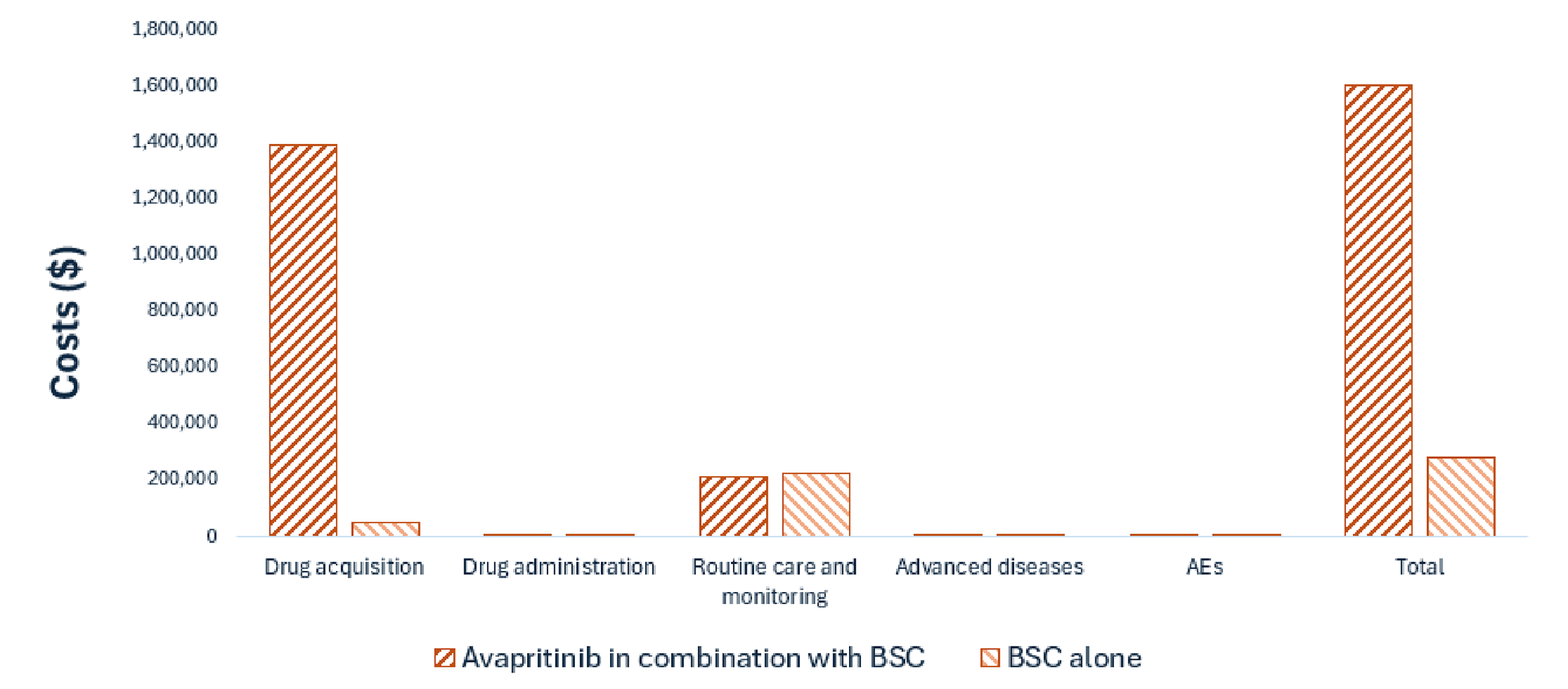
AE = adverse event; BSC = best supportive care; vs. = versus.
Impact on Health
Considering the impact of treatment on both quality and length of life, avapritinib in combination with BSC is predicted to result in 0.71 additional QALYs per patient compared to BSC alone (refer to Figure 2). Approximately 99.6% of the predicted incremental benefit was accrued on the basis of extrapolation.
Figure 2: Impact of Avapritinib in Combination With BSC vs. BSC Alone on Patient Health
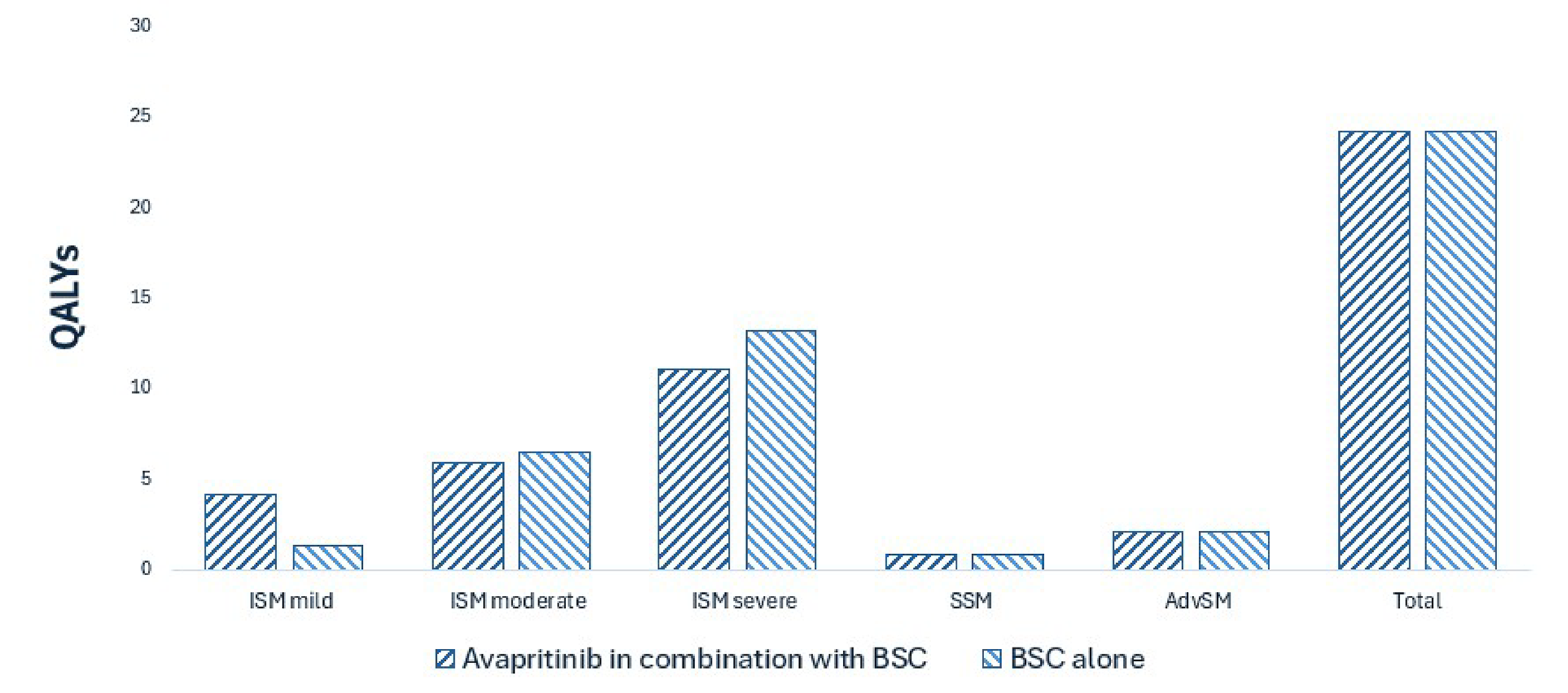
AdvSM = advanced systemic mastocytosis; BSC = best supportive care; ISM = indolent systemic mastocytosis; SSM = smouldering systemic mastocytosis; QALY = quality-adjusted life-year; vs. = versus.
Overall Results
The results of the CDA-AMC base case suggest an ICER of $1,871,956 per QALY gained for avapritinib in combination with BSC compared to BSC alone (refer to Table 6). Additional details on the CDA-AMC base case are available in the Supplemental Material document, Appendix 11.
Table 6: Summary of the CDA-AMC Economic Evaluation Results
Drug | Total costs ($) | Total QALYs | Total LYs | ICER vs. BSC alone ($/QALY) |
|---|---|---|---|---|
BSC alone | 278,802 | 13.58 | 24.13 | Reference |
Avapritinib in combination with BSC | 1,603,364 | 14.28 | 24.18 | 1,871,956 |
BSC = best supportive care; CDA-AMC = Canada’s Drug Agency; ICER = incremental cost-effectiveness ratio; LY = life-year; QALY = quality-adjusted life-year; vs. = versus.
Note: Publicly available list prices were used for all comparators.
Uncertainty and Sensitivity
Uncertainty was explored in the scenario analyses outlined in Table 5. Uncertainty around the modelling of treatment response had the largest impact on cost-effectiveness (refer to the Supplemental Material document, Appendix 11, Table 31).
Summary of the Budget Impact
The sponsor submitted a budget impact analysis to estimate the 3-year (2027 to 2029) budget impact of reimbursing avapritinib in combination with BSC for use in the Health Canada–indicated population. The sponsor assumed that the payer would be CDA-AMC–participating public drug plans and derived the size of the eligible population using an epidemiologic approach. The price of avapritinib was aligned with the price included in the sponsor’s economic evaluation, while the prices of comparators were based on the publicly available list prices. Additional information pertaining to the sponsor’s submission is provided in the Supplemental Material document, Appendix 12.
The sponsor estimated that by year 3 of reimbursement, 455 patients would be eligible for avapritinib in combination with BSC; of these, 387 would be expected to receive avapritinib in combination with BSC. The estimated incremental budget impact of reimbursing avapritinib in combination with BSC is predicted to be approximately $407 million over the first 3 years, all of which reflects the expected expenditure on avapritinib as an add-on treatment to BSC. The actual budget impact will depend on the number of people eligible for treatment.
Conclusion
Based on the CDA-AMC base case, avapritinib in combination with BSC would be considered cost-effective at the submitted price if the public health care system was willing to pay at least $1,871,956 for each additional QALY gained. If the public health care system is not willing to pay that amount, a price reduction should be considered (refer to Figure 3; full details of the impact of price reductions on cost-effectiveness are presented in the Supplemental Material document, Appendix 11, Table 30).
The budget impact of reimbursing avapritinib in combination with BSC to the public drug plans in the first 3 years is estimated to be approximately $407 million. The budget impact reflects the estimated expenditure on avapritinib during this period, given that it is included as an add-on to BSC.
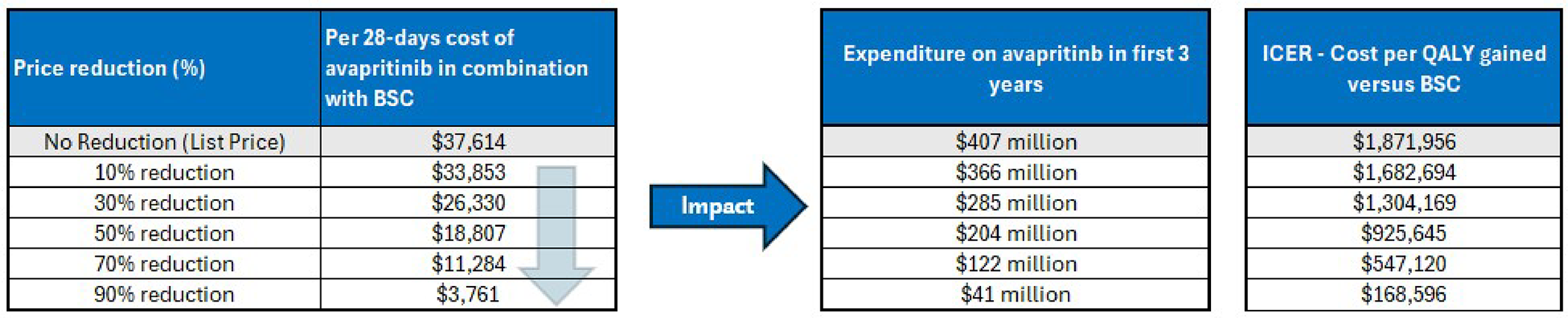
References
1.Horny H, Akin C, Metcalfe D, et al. Mastocytosis. In: Swerdlow S.H., editor. WHO Classification of Tumors of Hematopoietic and Lymphoid Tissues. International Agency for Research and Cancer (IARC) [sponsor supplied reference]. 2017.
2.Metcalfe DD. Mast cells and mastocytosis. Blood. Aug 15 2008;112(4):946-56. doi:10.1182/blood-2007-11-078097 PubMed
3.Cohen SS, Skovbo S, Vestergaard H, et al. Epidemiology of systemic mastocytosis in Denmark. Br J Haematol. Aug 2014;166(4):521-8. doi:10.1111/bjh.12916 PubMed
4.Pardanani A. Systemic mastocytosis in adults: 2023 update on diagnosis, risk stratification and management. Am J Hematol. Jul 2023;98(7):1097-1116. doi:10.1002/ajh.26962 PubMed
5.Garcia-Montero AC, Jara-Acevedo M, Teodosio C, et al. KIT mutation in mast cells and other bone marrow hematopoietic cell lineages in systemic mast cell disorders: a prospective study of the Spanish Network on Mastocytosis (REMA) in a series of 113 patients. Blood. Oct 1 2006;108(7):2366-72. doi:10.1182/blood-2006-04-015545 PubMed
6.George TI, Hoehn G, Lin H-M, Miller S, Akin C. Increased Detection of KIT D816V Mutation in Peripheral Blood Samples from Patients with Indolent Systemic Mastocytosis (ISM) in the Phase 2 Pioneer Study Using a High Sensitivity Droplet Digital (dd) PCR Assay Compared with Next Generation Sequencing (NGS). Blood. 2020;136(Supplement 1):7-8. doi:10.1182/blood-2020-136930
7.Munoz-Gonzalez JI, Alvarez-Twose I, Jara-Acevedo M, et al. Frequency and prognostic impact of KIT and other genetic variants in indolent systemic mastocytosis. Blood. Aug 1 2019;134(5):456-468. doi:10.1182/blood.2018886507 PubMed
8.Kristensen T, Vestergaard H, Møller MB. Improved detection of the KIT D816V mutation in patients with systemic mastocytosis using a quantitative and highly sensitive real-time qPCR assay. J Mol Diagn. Mar 2011;13(2):180-8. doi:10.1016/j.jmoldx.2010.10.004 PubMed
9.Jennings SV, Slee VM, Zack RM, et al. Patient Perceptions in Mast Cell Disorders. Immunol Allergy Clin North Am. Aug 2018;38(3):505-525. doi:10.1016/j.iac.2018.04.006 PubMed
10.van Anrooij B, Kluin-Nelemans JC, Safy M, Flokstra-de Blok BM, Oude Elberink JN. Patient-reported disease-specific quality-of-life and symptom severity in systemic mastocytosis. Allergy. Nov 2016;71(11):1585-1593. doi:10.1111/all.12920 PubMed
11.Kibsgaard L, Deleuran M, Flohr C, Langan S, Braae Olesen A, Vestergaard C. How “benign” is cutaneous mastocytosis? A Danish registry-based matched cohort study. Int J Womens Dermatol. Sep 2020;6(4):294-300. doi:10.1016/j.ijwd.2020.05.013 PubMed
12.Trizuljak J, Sperr WR, Nekvindová L, et al. Clinical features and survival of patients with indolent systemic mastocytosis defined by the updated WHO classification. Allergy. Aug 2020;75(8):1927-1938. doi:10.1111/all.14248 PubMed
13.Valent P, Akin C, Metcalfe DD. Mastocytosis: 2016 updated WHO classification and novel emerging treatment concepts. Blood. Mar 16 2017;129(11):1420-1427. doi:10.1182/blood-2016-09-731893 PubMed
14.Arber DA, Orazi A, Hasserjian RP, et al. International Consensus Classification of Myeloid Neoplasms and Acute Leukemias: integrating morphologic, clinical, and genomic data. Blood. Sep 15 2022;140(11):1200-1228. doi:10.1182/blood.2022015850 PubMed
15.Khoury JD, Solary E, Abla O, et al. The 5th edition of the World Health Organization Classification of Haematolymphoid Tumours: Myeloid and Histiocytic/Dendritic Neoplasms. Leukemia. Jul 2022;36(7):1703-1719. doi:10.1038/s41375-022-01613-1 PubMed
16.Chen W, Tse K, Li Z, et al. Patient Reported Burden of Indolent Systemic Mastocytosis in White vs. Non-White Patients. J Allergy Clin Immunol. 2025/02/01/ 2025;155(2, Supplement):AB70. doi:10.1016/j.jaci.2024.12.225
17.Buonomo A, Nucera E, Criscuolo M. Treatment of Indolent and Advanced Systemic Mastocytosis. Mediterr J Hematol Infect Dis. 2022;14(1):e2022040. doi:10.4084/MJHID.2022.040 PubMed
18.Medison Pharma Canada Inc. AYVAKYT® (Avapritinib): tablets, 25 mg, 50 mg, 100 mg and 200 mg, for oral use [product monograph]. September 18, 2024.
19.Medison Pharma Canada Inc. Clinical Study Report (Data cut-off date: June 23, 2022): BLU-285-2203. A 3-part, randomized, double-blind, placebo-controlled phase 2 study to evaluate safety and efficacy of avapritinib (blu-285), a selective kit mutation-targeted tyrosine kinase inhibitor, in indolent and smoldering systemic mastocytosis with symptoms inadequately controlled with standard therapy [internal sponsor's report]. October 20, 2022.
20.Medison Pharma Canada Inc. Clinical Study Protocol (Amendment 9): BLU-285-2203. A 3-part, randomized, double-blind, placebo-controlled phase 2 study to evaluate safety and efficacy of avapritinib (blu-285), a selective kit mutation-targeted tyrosine kinase inhibitor, in indolent and smoldering systemic mastocytosis with symptoms inadequately controlled with standard therapy [internal sponsor's report]. June 7, 2022.
21.Medison Pharma Canada Inc. Sponsor Summary of Clinical Evidence [internal sponsor's report]. In: Drug Reimbursement Review sponsor submission: AYVAKYT® (Avapritinib), tablets, 25 mg, 50 mg, 100 mg and 200 mg, for oral use. July 10, 2025.
22.Medison Pharma Canada Inc. Statistical Analysis Plan (final version 1): BLU-285-2203. A 3-part, randomized, double-blind, placebo-controlled phase 2 study to evaluate safety and efficacy of avapritinib (blu-285), a selective kit mutation-targeted tyrosine kinase inhibitor, in indolent and smoldering systemic mastocytosis with symptoms inadequately controlled with standard therapy [internal sponsor's report]. June 7, 2022.
23.Medison Pharma Canada Inc. Medison Pharma Canada Inc. response to Canada's Drug Agency request for additional information regarding Avapritinib (Ayvakyt) review on Oct 17, 2025 [internal additional sponsor's information]. Oct 24, 2025.
24.Medison Pharma Canada Inc. Medison Pharma Canada Inc. response to Canada's Drug Agency request for additional information regarding Avapritinib (Ayvakyt) review on Nov 10, 2025 [internal additional sponsor's information]. November 5, 2025.
25.Taylor F, Akin C, Lamoureux RE, et al. Development of symptom-focused outcome measures for advanced and indolent systemic mastocytosis: the AdvSM-SAF and ISM-SAF((c)). Orphanet J Rare Dis. Oct 9 2021;16(1):414. doi:10.1186/s13023-021-02035-5 PubMed
26.Shields AL, Taylor F, Lamoureux RE, et al. Psychometric evaluation of the Indolent Systemic Mastocytosis Symptom Assessment Form (ISM-SAF((c))) and determination of a threshold score for moderate symptoms. Orphanet J Rare Dis. Mar 25 2023;18(1):69. doi:10.1186/s13023-023-02661-1 PubMed
27.Padilla B, Shields AL, Taylor F, et al. Psychometric evaluation of the Indolent Systemic Mastocytosis Symptom Assessment Form (ISM-SAF) in a phase 2 clinical study. Orphanet J Rare Dis. Oct 18 2021;16(1):434. doi:10.1186/s13023-021-02037-3 PubMed
28.Medison Pharma Canada Inc. Drug Reimbursement Review sponsor submission: AYVAKYT® (Avapritinib), tablets, 25 mg, 50 mg, 100 mg and 200 mg, for oral use [internal sponsor's package]. July 10, 2025.
29.Turner D, Schünemann HJ, Griffith LE, et al. The minimal detectable change cannot reliably replace the minimal important difference. J Clin Epidemiol. Jan 2010;63(1):28-36. doi:10.1016/j.jclinepi.2009.01.024 PubMed
30.Pyatilova P, Akin C, Alvarez-Twose I, et al. Refined Treatment Response Criteria for Indolent Systemic Mastocytosis Proposed by the ECNM-AIM Consortium. J Allergy Clin Immunol Pract. Aug 2022;10(8):2015-2024. doi:10.1016/j.jaip.2022.05.037 PubMed
31.Broesby-Olsen S, Kristensen T, Vestergaard H, Brixen K, Møller MB, Bindslev-Jensen C. KIT D816V mutation burden does not correlate to clinical manifestations of indolent systemic mastocytosis. J Allergy Clin Immunol. 2013;132(3):723-728. doi:10.1016/j.jaci.2013.02.019 PubMed
32.Crupi F, Caroprese J, Mannelli F. Defining “Normal” basal serum tryptase levels: a context-dependent approach to improve diagnostics in systemic mastocytosis. Front Allergy. 2025;6:1592001. doi:10.3389/falgy.2025.1592001 PubMed
33.European Medicines Agency. Reflection paper on establishing efficacy based on single arm trials submitted as pivotal evidence in a marketing authorisation application: Considerations on evidence from single-arm trials September 24, 2024. Accessed December 3, 2025. https://www.ema.europa.eu/en/documents/scientific-guideline/reflection-paper-establishing-efficacy-based-single-arm-trials-submitted-pivotal-evidence-marketing-authorisation-application_en.pdf
34.Medison Pharma Canada Inc. AYVAKYT® (Avapritinib): tablets, 25 mg, 50 mg, 100 mg and 200 mg, for oral use [product monograph].
ISSN: 2563-6596
Canada’s Drug Agency (CDA-AMC) is a pan-Canadian health organization. Created and funded by Canada’s federal, provincial, and territorial governments, we’re responsible for driving better coordination, alignment, and public value within Canada’s drug and health technology landscape. We provide Canada’s health system leaders with independent evidence and advice so they can make informed drug, health technology, and health system decisions, and we collaborate with national and international partners to enhance our collective impact.
Disclaimer: CDA-AMC has taken care to ensure that the information in this document was accurate, complete, and up to date when it was published, but does not make any guarantee to that effect. Your use of this information is subject to this disclaimer and the Terms of Use at cda-amc.ca.
The information in this document is made available for informational and educational purposes only and should not be used as a substitute for professional medical advice, the application of clinical judgment in respect of the care of a particular patient, or other professional judgments in any decision-making process. You assume full responsibility for the use of the information and rely on it at your own risk.
CDA-AMC does not endorse any information, drugs, therapies, treatments, products, processes, or services. The views and opinions of third parties published in this document do not necessarily reflect those of CDA-AMC. The copyright and other intellectual property rights in this document are owned by the Canadian Agency for Drugs and Technologies in Health (operating as CDA-AMC) and its licensors.
Questions or requests for information about this report can be directed to Requests@CDA-AMC.ca.