Drugs, Health Technologies, Health Systems
Reimbursement Review
Gilteritinib (Xospata)
Sponsor: The Leukemia/Bone Marrow Transplant (BMT) Program of British Columbia, on behalf of the British Columbia Cancer Agency (BCCA)
Therapeutic area: Acute myeloid leukemia (AML)
Summary
What Is AML?
Acute myeloid leukemia (AML) is a heterogeneous blood cancer caused by the uncontrolled multiplication of myeloid blast cells in the bone marrow, peripheral blood, and/or other tissues. Normal hematopoiesis is disrupted by the proliferation of AML cells, leading to cytopenias caused by reduced production of functional red blood cells, neutrophils, and platelets.
In Canada, 1,165 people were diagnosed with AML in 2022, and in 2023, a total of 1,362 people died from the disease. FLT3 mutations occur in approximately 30% of patients with newly diagnosed AML.
What Are the Treatment Goals and Current Treatment Options for AML?
Treatment goals include improving overall survival, decreasing the risk of relapse, reducing treatment-related toxicities (graft-versus-host disease [GVHD], myelosuppression, and infections), and improving quality of life.
There are currently no approved treatments in Canada specific for patients who have AML with FLT3 internal tandem duplication (FLT3-ITD) mutations and positive measurable residual disease (MRD) status following allogeneic hematopoietic cell transplantation (allo-HCT). Induction chemotherapy (cytarabine and anthracycline [daunorubicin or idarubicin]) with or without an FLT3 inhibitor (midostaurin or quizartinib) is available for patients newly diagnosed with AML.
What Is Xospata and Why Did Canada’s Drug Agency Conduct This Review?
Xospata (gilteritinib) is a drug that is available as a 40 mg oral tablet. Health Canada has approved Xospata “for the treatment of adult patients who have relapsed or refractory acute myeloid leukemia (r/r AML) with a FMS-like tyrosine kinase 3 (FLT3) mutation.” Canada’s Drug Agency (CDA-AMC) previously reviewed Xospata for this indication and issued a recommendation to reimburse.
There is no Health Canada–approved indication relevant to the current review. The sponsor is seeking reimbursement for an unlabelled indication. CDA-AMC reviewed Xospata to inform a recommendation to the participating public drug programs on whether it should be reimbursed “as maintenance therapy for patients with FLT3-ITD mutated AML who have undergone allo-HCT and who are MRD-positive.”
How Did CDA-AMC Evaluate Xospata?
CDA-AMC reviewed the clinical evidence on the beneficial and harmful effects, as well as the economic evidence, of Xospata versus other treatments used in Canada as maintenance therapy following allo-HCT for patients who have AML with FLT3-ITD mutation and positive MRD status. Best supportive care (placebo or surveillance [watch and wait]) was considered the relevant treatment to compare with Xospata when reviewing the clinical evidence.
CDA-AMC identified equity and ethical considerations relevant to Xospata and AML.
CDA-AMC considered the potential impacts of FLT3-ITD MRD testing to ascertain eligibility for Xospata, including those related to health systems, patients (including families and caregivers), and costs.
The review was informed by materials submitted by the sponsor, which included clinical and economic evidence as well as literature searches.
The review was also informed by 1 patient group submission and 2 clinician group submissions received in response to our call for input and by input from the participating public drug programs on issues that may affect their ability to implement a recommendation.
Two clinicians with expertise in hematology based in Ontario and Manitoba were consulted as part of the review process.
What Were the Findings?
Clinical Evidence
CDA-AMC reviewed the following clinical evidence:
1 randomized placebo-controlled phase III trial (the MORPHO study) comparing Xospata 120 mg daily and placebo as maintenance treatment for adult patients diagnosed with AML with FLT3-ITD mutation who received allo-HCT after experiencing a first morphologic complete disease remission; only the subgroup of patients who had AML with FLT3-ITD mutation and positive MRD status before or after HCT in the MORPHO study was of interest to this review.
For the comparison of Xospata versus placebo:
The MORPHO trial failed to reach its primary end point (related to relapse-free survival in the overall population). Although subgroup analyses (including the subgroup with positive MRD status) were prespecified in the primary analysis in the overall population, the trial was not adequately powered to inform credible effect modification (i.e., differences in effects across subgroups). As such, the results in the subgroup with positive MRD status were considered hypothesis generating. Acknowledging this limitation, evidence from the subgroup with positive MRD status suggested that:
Xospata as maintenance treatment following allo-HCT for adult patients who have AML with FLT3-ITD mutation and positive MRD status may have resulted in a clinically meaningful increase in the probability of being alive and relapse-free after 24 months compared to placebo (difference, 15% [95% confidence interval [CI] not reported]); however, there was uncertainty due to study limitations and imprecision.
Xospata as maintenance treatment following allo-HCT for adult patients diagnosed with AML with FLT3-ITD mutation and positive MRD status may have resulted in a clinically meaningful increase in the probability of being alive after 24 months compared to placebo (difference, 10.9% [95% CI not reported]); however, there was uncertainty due to study limitations and imprecision.
The impact of Xospata on health-related quality of life for patients who have AML with FLT3-ITD mutation and positive MRD status following allo-HCT is unknown due to a lack of evidence in this subgroup. Evidence from the overall population suggested there may have been little to no difference in the change from baseline at 24 months between treatment groups, but there was uncertainty due to risk of bias related to missing outcome data.
The harms associated with Xospata in the subgroup with positive MRD status were consistent with those noted in the overall MORPHO study as well as in the relapsed or refractory AML setting, for which gilteritinib is already funded and available. Xospata may have resulted in little to no difference in the incidence of acute GVHD and chronic GVHD, although there was uncertainty due to imprecision.
Testing Procedure Considerations
FLT3-ITD MRD status can be assessed using bone marrow aspirates, preferably using ultrahigh-sensitivity next-generation sequencing assays.
MRD testing for FLT3-ITD is not routinely available or funded in clinical practice in Canada. If gilteritinib were to be reimbursed in the current testing landscape, there would be several anticipated health system impacts related to FLT3-ITD MRD testing.
An ultrahigh-sensitivity next-generation sequencing test is being validated at several centres in Canada. There are considerations regarding implementation of this assay — including those related to training personnel, funding, and navigating the reimbursement process across jurisdictions in Canada.
Economic Evidence
Xospata is available as a 40 mg tablet. At the submitted price of $276.69 per tablet, the annual cost of Xospata is expected to be $303,171 per patient, based on the Health Canada–recommended dosage of 3 tablets per day.
Clinical efficacy in the economic analysis was derived from the MORPHO trial, which compared Xospata with placebo. Evidence submitted by the sponsor indicated that Xospata may have improved relapse-free survival (hazard ratio = 0.52 [95% CI, 0.32 to 0.84]; P = 0.0065; risk difference = 18% [95% CI, not reported]) and overall survival (hazard ratio = 0.61 [95% CI, 0.36 to 1.05]; P = 0.0731; risk difference = ████% [95% CI, ███ █████████]) compared with placebo in patients with positive MRD status.
The results of the CDA-AMC base case suggested that Xospata would be associated with higher costs to the health care system than best supportive care (incremental costs = $490,297), primarily driven by higher drug acquisition costs associated with Xospata.
The results of the CDA-AMC base case suggested that Xospata would be associated with a gain of 1.89 life-years compared to best supportive care. When the impact on health-related quality of life is also considered, Xospata may result in a gain of 1.77 quality-adjusted life-years compared to best supportive care.
The incremental cost-effectiveness ratio of Xospata compared to best supportive care was $277,163 per quality-adjusted life-year gained in the CDA-AMC base case. This finding was uncertain because of the lack of long-term survival data.
CDA-AMC estimated that the budget impact of reimbursing Xospata for the indicated population would be approximately $76.2 million over the first 3 years of reimbursement compared to the amount currently spent on best supportive care, with an estimated expenditure of $77.5 million on Xospata over this period. The actual budget impact of reimbursing Xospata will depend on market share assumptions and the estimated population of eligible patients, both of which were highly uncertain. The magnitude of uncertainty in the budget impact must be addressed to ensure the feasibility of adoption, given the difference between the sponsor’s estimate and the CDA-AMC estimate.
FLT3-ITD MRD testing needs to be in place to identify patients who are eligible for Xospata. While FLT3-ITD MRD testing is currently under development at several sites in Canada, the testing is not readily accessible across jurisdictions, which may delay access to Xospata. This adds considerable uncertainty to the budget impact analysis, especially in early years.
Abbreviations
AE
adverse event
aGVHD
acute graft-versus-host disease
allo-HCT
allogeneic hematopoietic cell transplantation
AML
acute myeloid leukemia
ANC
absolute neutrophil count
CCO
Cancer Care Ontario
CDA-AMC
Canada’s Drug Agency
cGVHD
chronic graft-versus-host disease
CI
confidence interval
CLSG
Canadian Leukemia Study Group
DAC
Drug Advisory Committee
ELN
European LeukemiaNet
FACT-BMT
Functional Assessment of Cancer Therapy–Bone Marrow Transplant
FACT-Leu
Functional Assessment of Cancer Therapy–Leukemia
FLT3-ITD
FLT3 internal tandem duplication
GVHD
graft-versus-host disease
HR
hazard ratio
HRQoL
health-related quality of life
HTA
health technology assessment
ICER
incremental cost-effectiveness ratio
ITC
indirect treatment comparison
LTE
long-term extension
MFC
multiparameter flow cytometry
MRD
measurable residual disease
NGS
next-generation sequencing
OH
Ontario Health
OS
overall survival
PCR
polymerase chain reaction
QALY
quality-adjusted life-year
RCT
randomized controlled trial
RFS
relapse-free survival
r/r
relapsed or refractory
RT-PCR
reverse transcription polymerase chain reaction
SAE
serious adverse event
TEAE
treatment-emergent adverse event
UHS
ultrahigh sensitivity
Background
Introduction
The objectives of this report are as follows:
Review and critically appraise the evidence submitted by the sponsor on the beneficial and harmful effects of gilteritinib (Xospata), a 40 mg oral tablet, for the treatment of adult patients who have acute myeloid leukemia (AML) with FLT3 internal tandem duplication (FLT3-ITD) mutation who have undergone allogeneic hematopoietic cell transplantation (allo-HCT) for measurable residual disease (MRD). The focus will be placed on comparing gilteritinib to relevant comparators in clinical practice in Canada and identifying gaps in the current evidence, and this focus is outlined in Table 1.
Consider the potential impacts of FLT3-ITD mutation and FLT3-ITD MRD testing to ascertain eligibility, including the impacts on health systems, patients (including families and caregivers), and costs.
Review and critically appraise the economic information submitted by the sponsor, including a cost-effectiveness analysis and budget impact analysis. The focus of the Economic Review is aligned with the scope of the Clinical Review, unless otherwise stated. For most reviews, a Canada’s Drug Agency (CDA-AMC) base case is developed, informed by clinical expert input, the available clinical evidence, and the best interpretation of the economic evidence based on the information provided by the sponsor.
Table 1: Information on the Application Submitted for Review and on the CDA-AMC Review
Item | Description |
|---|---|
Information on the application submitted for review | |
Drug | gilteritinib (Xospata), 40 mg, tablet, oral |
Sponsor | British Columbia Cancer Agency |
Health Canada indicationa | The treatment of adult patients who have relapsed or refractory acute myeloid leukemia (AML) with a FMS-like tyrosine kinase 3 (FLT3) mutation |
Health Canada approval status | Not applicable; unlabelled indication |
Health Canada review pathway | Not applicable; unlabelled indication |
NOC date | Not applicable; unlabelled indication |
Mechanism of action | Gilteritinib is a selective inhibitor of FLT3, a common and recurrent gene mutation in AML. Gilteritinib inhibits FLT3 receptor signalling and proliferation both in vivo and ex vivo for cells expressing mutant FLT3, including FLT3-ITDs and TKD mutations (e.g., FLT3-D835Y). This induces apoptosis in malignant cells that carry mutant FLT3. |
Recommended dosage | 120 mg orally per day for 24 months as maintenance therapy after allogeneic hematopoietic cell transplantation (allo-HCT) |
Submission type | Initial |
Sponsor’s reimbursement request | Unlabelled indication: Maintenance therapy following allo-HCT for measurable residual disease positive FLT3-ITD mutated AML patients |
Submitted price | $276.69 per 40 mg tablet |
Information on the CDA-AMC review | |
Review type | Standard |
Clinical review focusb | Population: As defined in the reimbursement request. Subgroups: MRD status at randomization Intervention: Per dosage in the MORPHO study Comparators: Best supportive care (placebo, surveillance, or watch and wait) Outcomes:
|
aGVHD = acute graft-versus-host disease; allo-HCT = allogeneic hematopoietic cell transplantation; AML = acute myeloid leukemia; CDA-AMC = Canada’s Drug Agency; cGVHD = chronic graft-versus-host disease; FLT3-ITD = FLT3 internal tandem duplication; MRD = measurable residual disease; NOC = Notice of Compliance; TKD = tyrosine kinase domain.
aCDA-AMC has previously issued a reimbursement recommendation for this drug for the Health Canada–approved indication. The current review is being conducted on an unlabelled indication, reflected in the reimbursement request.
bThe Economic Review aligns with the scope of the Clinical Review, unless otherwise stated.
Submission History for the Drug Under Review
CDA-AMC has previously reviewed gilteritinib through the reimbursement review process “for the treatment of adult patients who have relapsed or refractory AML with an FLT3 mutation as detected by a validated test” and issued a recommendation to reimburse with clinical criteria and/or conditions.
Sources of Information
The contents of the Reimbursement Review report are informed by materials submitted by the sponsor, input received from interested parties (patient groups, clinician groups, and drug programs), input from clinical experts consulted for this review, and a literature search to inform the Testing Procedure Assessment component of the review.
Calls for patient group and clinician group input are issued for each Reimbursement Review. One patient group submission from the Leukemia & Lymphoma Society of Canada and 2 clinician group submissions from the Canadian Leukemia Study Group (CLSG) and the Ontario Health (Cancer Care Ontario) (OH [CCO]) Hematology Cancer Drug Advisory Committee (DAC) were received. Information in the patient group submission was gathered through 2 surveys of patients diagnosed with AML and caregivers: Survey 1 included 245 respondents (including 24 patients who had received allo-HCT for AML with FLT3-ITD mutations or caregivers with relevant experience), and survey 2 included 226 respondents (including 101 patients or caregivers who had experience with allo-HCT), in addition to 2 previously conducted one-on-one interviews with patients who had been diagnosed with AML and caregivers of people with AML. In the clinician group input provided by the CLSG, information had been gathered from publicly available documents, conference abstracts, and published literature (primarily the MORPHO trial). Additionally, input from CLSG board members and from the OH (CCO) Hematology Cancer DAC reflecting clinical experience in Canada and standard of care practice were included. The full submissions received are available in the Patient and Clinician Group Input document on the project landing page. The drug programs provide input on each drug being reviewed through the reimbursement review process by identifying issues that may impact their ability to implement a recommendation.
Input from patient and clinician groups was considered throughout the review, including during the selection of outcomes to include in the Clinical Review and in the interpretation of the clinical and economic evidence. Relevant patient and clinician group input is summarized in the Disease Background, Current Management, and Unmet Needs and Existing Challenges sections.
Each review team includes at least 1 clinical expert with expertise in the diagnosis and management of the condition for which the drug is indicated. Clinical experts are a critical part of the review team and are involved in all phases of the review process. Two clinical experts with expertise in the diagnosis and management of AML participated as part of the review team.
Disease Background
AML is a malignancy of proliferative, clonal, abnormally differentiated, or poorly differentiated cells of the hematopoietic system, characterized by clonal evolution and genetic heterogeneity.1 FLT3-ITD has been identified as a driver of mutation that presents with a high leukemic burden, confers a poor prognosis, and has a substantial negative impact on the management of patients with AML.2 Patients with AML typically present with symptoms related to bone marrow failure (including fatigue, anemia, infections due to neutropenia, and bleeding or bruising from thrombocytopenia), with some patients also experiencing systemic or organ-related complications such as leukostasis, organomegaly, or metabolic emergencies requiring urgent management.1
Currently, allo-HCT represents the most effective consolidation strategy to prevent disease relapse for most patients with AML who achieve disease remission.3 However, potential relapsed AML following allo-HCT presents a particularly vexing clinical challenge because transplant-related toxicities, such as graft-versus-host disease (GVHD) and infections, increase the risk of treatment-related morbidity and mortality. In general, the prognosis of patients with relapsed AML following allo-HCT is poor, with most patients unable to achieve a subsequent remission and 2-year survival consistently less than 15%.3
Population-based registry data have estimated the incidence of AML in Canada to be approximately 30.61 cases per million individuals per year, based on data collected between 1992 and 2010.4 Geographic variation in incidence was observed, with Prince Edward Island and Ontario reporting rates significantly higher than the national average. Over the same period, the mean AML mortality rate was estimated at 20.53 deaths per million individuals per year.4 FLT3 mutations occur in approximately 30% of patients with newly diagnosed AML, and many of these patients will require allo-HCT to achieve durable remission. An estimated 25% of patients who have AML with FLT3-ITD mutations with initial morphologic complete response after a first induction phase have positive MRD status.5-8
Patient group input: The patient group input highlighted that AML negatively affects patients’ mental health and disrupts their personal and social life. AML also poses a substantial burden for caregivers given that many patients diagnosed with AML require a great amount of caregiver support for day-to-day tasks. The group noted that treatment experience and tolerability vary across patients depending on factors such as disease subtype, genetic status, prior therapies, and whether the patient has received a stem cell transplant. Respondents to the surveys noted that treatment-related side effects, such as fatigue, neutropenia, thrombocytopenia, and anemia, also pose a substantial burden.
Current Management
Treatment Goals
Patient group input: Patients who responded to the surveys who had AML with FLT3-ITD mutations and had undergone stem cell transplant indicated they would prefer treatments that provide longer (and sustained) remission and minimize relapse. Respondents also indicated a desire for treatments that improve quality of life and reduce the frequency and severity of side effects. The patient group emphasized the importance of extended remission for patients who have AML with FLT3-ITD mutations following transplant because it offers the opportunity for patients to return to their usual activities and daily functioning.
Clinician input: Both clinician groups and clinical experts consulted by CDA-AMC highlighted similar treatment goals, which included improving overall survival (OS), prolonging relapse-free survival (RFS), and minimizing the risk of relapse via ongoing MRD monitoring. The most important safety concerns requiring monitoring in the posttransplant setting included the monitoring of cytopenias, GVHD, and QTc prolongation.
Current Treatment Options
The current standard of care for patients with newly diagnosed AML with FLT3-ITD mutations consists of intensive induction chemotherapy (cytarabine plus anthracycline) combined with an FLT3 inhibitor, most commonly midostaurin. There are currently 2 FLT3 inhibitors approved in Canada: midostaurin and quizartinib.9 In August 2025, CDA-AMC published a recommendation to reimburse quizartinib with conditions for use in combination with standard cytarabine and anthracycline induction and standard cytarabine consolidation chemotherapy, followed by quizartinib as maintenance monotherapy, for adult patients with newly diagnosed AML. However, at the time of this review, quizartinib was still under review for public funding. Further, the product monograph for quizartinib notes that improvement in OS has not been demonstrated with maintenance monotherapy following allo-HCT.
The clinical experts consulted by CDA-AMC noted that most patients with AML achieve complete remission (defined as bone marrow blast cell counts < 5%, no circulating blast cells, and the absence of extramedullary disease, along with absolute neutrophil counts [ANCs] ≥ 1.0 × 10⁹/L and platelet counts ≥ 100 × 109/L)10 after induction chemotherapy; however, relapse rates remain high without additional therapy.6,10 Postremission therapy aims to deepen remission by eliminating residual disease, as these maintenance treatments target residual leukemic FLT3-driven signalling, thereby preventing disease relapse and improving long-term disease control rather than just controlling symptoms.6
Treatment choice for patients with AML is guided by disease relapse risk, FLT3 mutation status, MRD results, treatment-related toxicity considerations, patient-specific clinical factors (e.g., age, comorbid conditions, performance status), and donor availability.11 MRD is a sensitive marker of persistent leukemia and an important prognostic indicator for relapse.10,12 National Comprehensive Cancer Network guidelines recommend FLT3 inhibitors as maintenance therapy for patients with AML who have FLT3 mutation whose disease is in complete remission, and they specifically recommend gilteritinib for patients who have AML with FLT3-ITD mutation who have positive MRD status before or after allo-HCT.10
Currently, there are no approved maintenance therapies in Canada for patients who have AML with FLT3-ITD mutations whose disease is in complete remission with detectable MRD following allo-HCT. Midostaurin is neither indicated nor funded for maintenance in this setting.13,14 According to the clinical experts, standard of care for these patients consists of close posttransplant monitoring, optimization of graft-versus-leukemia effects (e.g., immunosuppression taper, selective donor lymphocyte infusion), and clinical trial participation, when available. The clinical experts consulted for this review noted that for patients who are at high risk for disease relapse, some centres offer off-label treatments with FLT3 inhibitors (e.g., sorafenib or midostaurin) through nonfunded or compassionate access programs. One clinician group input noted that prior experience with the use of sorafenib after transplant demonstrated that relapse reduction is achievable for this subpopulation of patients with AML. For patients achieving complete disease remission after 1 to 2 induction cycles, postremission options include allo-HCT and/or up to 3 cycles of consolidation chemotherapy with intermediate- or high-dose cytarabine plus an FLT3 inhibitor (midostaurin or quizartinib).
Gilteritinib is a small-molecule FLT3 inhibitor with activity against FLT3-ITD and FLT3 tyrosine kinase domain mutations. It is indicated for adult patients with relapsed or refractory AML with a confirmed FLT3 mutation and has received a reimbursement recommendation with conditions in this setting. However, there is no Health Canada indication for gilteritinib relevant to the current review. In this review, the sponsor is requesting reimbursement for “post allo-HCT maintenance for patients with MRD positive FLT3-ITD mutated AML in first complete remission” based on the MORPHO trial. Respondents who contributed to the patient input who had received gilteritinib after allo-HCT as maintenance therapy for AML with FLT3-ITD mutations reported that they had experienced sustained remission with continuous treatment for 1.5 years to 6 years, with improvements in quality of life and daily functioning.
Unmet Needs and Existing Challenges
Patient group input: The patient group noted that there are currently few treatment options available for patients with AML. The group highlighted that these treatments are often associated with adverse events (AEs) due to toxicity and can lead to unstable blood counts for patients, requiring transfusions. Furthermore, when these treatments fail and patients are not eligible for stem cell transplant, treatment is palliative and only best supportive care is an option. Concerns highlighted by patients related to current AML therapies included AEs, the demanding number of treatment cycles, lack of independence during treatment, and challenges in accessing treatments requiring patients to travel to specialized centres given that these are often not available in community cancer centres.
Clinician input: Both clinician group inputs received highlighted similar unmet needs and concerns with current options for AML. Delaying or preventing relapse following allo-HCT was echoed as a major unmet need for patients diagnosed with AML with FLT3-ITD mutations because of a lack of treatment options. Quizartinib, although recently approved for reimbursement, is still under active negotiation, and gilteritinib is currently only available in the relapsed or refractory setting. They noted that despite transplant being a key component of curative intent therapy, about 30% to 45% of patients experience disease relapse after transplant, representing a substantial cause of posttransplant mortality. Both groups noted that there are no funded standard posttransplant maintenance options in Canada for these patients, as midostaurin is not approved for maintenance. One group underscored the need for effective and well-tolerated maintenance therapy that can be safely administered after transplant to eradicate small amounts of residual disease that may lead to relapse. The same group also noted the need for the ability to accurately identify patients who are at highest risk for disease relapse who would most likely benefit from such therapy, given that a substantial proportion of patients (about 60%) will not require maintenance therapy to avoid disease relapse. One clinician group (the OH [CCO] Hematology Cancer DAC) encouraged the establishment of standard response assessments and continued MRD monitoring using next-generation sequencing (NGS) or polymerase chain reaction (PCR)–based testing. This group noted that treatment implementation in current practice would require equitable access to MRD testing across leukemia and transplant centres, given that this procedure is not currently available across all jurisdictions in Canada.
Considerations for Using the Drug Under Review
Contents within this section have been informed by input from the clinical experts consulted for the purpose of this review and from clinician groups, as well as by the reimbursement conditions proposed by the sponsor (refer to the Supplemental Material document, Appendix 1, Table 1). The implementation questions from the public drug programs and corresponding responses from the clinical experts consulted for this review are summarized in the Supplemental Material document, Appendix 1, Table 2. The following has been summarized by the review team.
Place in Therapy
The clinical experts emphasized that no approved maintenance therapies currently exist in Canada for this population apart from best supportive care, which includes close surveillance after transplant accompanied by serial MRD testing (where available), marrow assessments, optimization of graft-versus-leukemia effects (e.g., cautious immunosuppression tapering, selective donor lymphocyte infusion), and clinical trial participation. One clinical expert noted that the feasibility of using an FLT3-ITD inhibitor after HCT depends on which inhibitor was used during induction with chemotherapy for new patients or at the time of relapse, irrespective of FLT3-ITD MRD status. The expert noted that patients who received midostaurin during induction chemotherapy and/or consolidation chemotherapy, other frontline intensive chemotherapy regimens (e.g., cytarabine and daunorubicin [CPX-351]; fludarabine, cytarabine, G-CSF, and idarubicin [FLAG-IDA] plus venetoclax; mitoxantrone, etoposide, and cytarabine [MEC]), or lower-intensity venetoclax-based therapies followed by allo-HCT in first disease remission are not eligible for maintenance treatments with FLT3 inhibitors.
As previously described, the clinical experts and clinician groups noted that quizartinib is available to some patients as maintenance therapy after HCT based on the QuANTUM-First study, which evaluated quizartinib in combination with standard chemotherapy in the induction and consolidation phases of treatment, followed by maintenance monotherapy in patients with newly diagnosed AML with FLT3-ITD mutation. The clinical experts noted that midostaurin and quizartinib are only approved to be used in combination with daunorubicin or idarubicin and cytarabine during frontline induction chemotherapy and with single-agent cytarabine during consolidation chemotherapy.
The clinical experts anticipate a shift in the treatment paradigm with the reimbursement of gilteritinib, as it would provide a maintenance treatment option following HCT. Given the lack of available therapies, the experts do not recommend that patients try alternative treatments before being eligible for gilteritinib.
Patient Population
According to the clinical experts consulted by CDA-AMC, patients described in the reimbursement request — specifically, those who have AML with FLT3-ITD mutations who achieve a first complete disease remission with induction therapy and have positive MRD status after undergoing allo-HCT — would be eligible to receive gilteritinib. The experts also indicated that they may consider prescribing gilteritinib to patients previously treated with frontline midostaurin during chemotherapy induction (daunorubicin or idarubicin plus cytarabine) and/or consolidation chemotherapy; those who received other frontline intensive chemotherapy regimens (e.g., CPX-351, FLAG-IDA plus venetoclax, MEC) and/or consolidation chemotherapy; and those who received frontline venetoclax and a hypomethylating agent (azacitidine or decitabine) or venetoclax and low-dose cytarabine during complete first disease remission and then proceeded to receive allo-HCT. This would include patients who had previously received quizartinib during chemotherapy induction (daunorubicin or idarubicin plus cytarabine) and/or consolidation chemotherapy and subsequently developed cardiac complications while receiving quizartinib. The clinical experts noted that patients with ANCs less than 500 cells/mm3, platelet counts less than 20,000 cells/mm3, ongoing need for platelet transfusion, active phase II to IV GVHD, or substantial organ dysfunction would not be eligible to receive gilteritinib.
When considering the sponsor’s proposed reimbursement conditions, the clinical experts agreed that initiation criteria should align with those of the MORPHO study, but they highlighted that the MORPHO trial eligibility criteria required “confirmed, morphologically documented AML in [first complete remission],” whereas the sponsor also considered AML secondary to myelodysplastic syndrome or a myeloproliferative neoplasm as eligibility criteria.
The clinical experts noted that eligible patients would be identified using standard diagnostic criteria for AML. The experts and the clinician groups highlighted ongoing challenges with accessing FLT3-ITD MRD testing across jurisdictions in Canada that may limit access to treatment for some patients, particularly for patients in remote regions who must travel to centres with testing and transplant capabilities.
Assessing the Response to Treatment
According to the clinical experts, patient response to gilteritinib will be monitored by assessing OS, the incidence of acute GVHD (aGVHD) and chronic GVHD (cGVHD), infections, myelosuppression, treatment-related toxicities, and, ideally, serially testing for MRD alongside routine complete blood counts. The absence of disease relapse would be considered clinically meaningful, according to the experts. One clinical expert noted that 10% to 15% differences in RFS and OS at 24 months or in GVHD incidence after 100 days would also be considered clinically meaningful, though this threshold may vary among physicians.
The experts indicated that assessments would ideally be expected every 3 months during the first 2 years after initiating gilteritinib (when the risk of relapse is highest), and subsequently at longer intervals depending on clinical status and treatment-related complications. The experts indicated that complete blood counts and bone marrow evaluations are central to monitoring for disease relapse, and patients will require closer monitoring for GVHD following allo-HCT. Both experts agreed that the sponsor’s monitoring criteria are consistent with current practice guidelines.
Discontinuing Treatment
According to the clinical experts consulted by CDA-AMC, gilteritinib would only be discontinued in clinical practice if patients were to develop intolerable toxicities, if patients were to experience disease relapse, at the request of patient, upon death, or after 2 to 3 years of maintenance treatment based on the duration of treatment with gilteritinib in the MORPHO study and the duration of quizartinib from the QuANTUM-First study, which was administered for a total of 3 years. Both clinical experts supported the sponsor’s proposed discontinuation criteria, with 1 emphasizing that patients’ disease should remain in ongoing remission (i.e., no AML relapse).
Prescribing Considerations
The clinical experts consulted by CDA-AMC recommend that gilteritinib be prescribed by a specialist (transplant physician), as not all clinicians who treat AML are transplant clinicians, and in a centre with appropriate resources to optimize treatment response. The experts did not anticipate that the approval of gilteritinib following HCT would substantially affect current health care infrastructure, as access to treatment is dependent on the availability of centres offering allo-HCT.
Clinical Review
Methods
The review team considered studies in the sponsor’s systematic review (pivotal studies and randomized controlled trials [RCTs]), sponsor-submitted long-term extension (LTE) studies, indirect treatment comparisons (ITCs), and studies addressing gaps in the evidence for inclusion. Eligible studies for the systematic review included published and unpublished pivotal studies and phase III and IV RCTs. Relevant patients and interventions were defined by the reimbursement request and the recommended dosage in the product monograph. The subgroup of patients for whom MRD status was known was considered as potentially important for informing the reimbursement recommendation. Relevant comparators were drugs used in clinical practice in Canada to treat patients described in the indication under review. These included best supportive care, including active surveillance. LTEs of included pivotal studies and RCTs were included, regardless of whether there was a comparison group. ITCs and studies addressing gaps submitted by the sponsor were included when they filled an identified gap in the systematic review evidence (e.g., missing comparator, longer follow-up time).
The review team selected outcomes (and follow-up times) for review considering the sponsor’s Summary of Clinical Evidence, clinical expert input, and patient and clinician group input. Included outcomes are those considered relevant to expert committee deliberations, which were selected in consultation with committee members. Evidence from the systematic review for the most important outcomes was assessed using the Grading of Recommendations Assessment, Development and Evaluation (GRADE) approach.
RFS and OS were important outcomes highlighted by the clinical experts and clinician groups for clinical decision-making. RFS also addresses a key treatment goal for AML in the posttransplant setting and is commonly used in clinical practice to assess response to treatment.
Health-related quality of life (HRQoL) was included because patients identified the need for treatments that improve quality of life with fewer side effects following treatment.
aGVHD and cGVHD were considered important notable harms by the clinical experts consulted by CDA-AMC and the clinician group contributing to the review.
Methods for data extraction, risk of bias appraisal, and certainty of evidence assessment are described in the Supplemental Material document, Appendix 2.
Clinical Evidence
In this report, the following sources of evidence submitted by the sponsor are reviewed and appraised:
Systematic Review
Description of Study
Study Characteristics
Characteristics of the MORPHO study are summarized in Table 2. Details pertaining to the eligibility criteria, interventions and comparators, and relevant outcome measures are presented in the Supplemental Material document, Appendix 3.
The MORPHO study was a multicentre, double-blind, placebo-controlled, phase III RCT evaluating the safety and efficacy of gilteritinib versus placebo as maintenance treatment following allo-HCT for adult patients diagnosed with AML with FLT3-ITD mutations. The primary end point was RFS, assessed by a blinded end point review committee. Other end points included OS, event-free survival, time to nonrelapse-related mortality, time to relapse, HRQoL, and safety. The MORPHO study was a multinational trial conducted in 122 centres in Australia, Canada (2 sites), Europe, Japan, New Zealand, South Korea, Taiwan, and the US.9
Eligible patients were required to have AML with FLT3-ITD mutations and to have experienced a first morphologic complete remission (< 5% blast cells in the bone marrow with no morphologic characteristics of acute leukemia [e.g., Auer rods] or extramedullary leukemia) after no more than 2 cycles of intensive therapy and were to undergo allo-HCT within 1 year of achieving remission. First remission was confirmed by bone marrow aspirate, and patients were expected to initiate preparative chemotherapy for allogeneic transplant as consolidation therapy within 30 days. Patients were also required to have achieved engraftment (defined as an ANC of ≥ 500 cells/μL and a nontransfused platelet count of ≥ 20,000 cells/μL) with no evidence of, and free of grade II to IV, GVHD [requiring no more than 0.5 mg/kg prednisone per day]) before randomization, at which time a second bone marrow aspirate was obtained to confirm ongoing remission (no evidence of AML) and for MRD analysis by NGS. The lower limit of detection was estimated to be the FLT3-ITD variant allele frequency of 5 × 10⁻⁵. However, any level of FLT3-ITD mutation (minimum of 3 variant reads) above 1 × 10⁻⁶ was considered detectable MRD. The level of FLT3-ITD mutation before allo-HCT that was used for stratification was 1 × 10⁻⁴ or higher. Investigators were blinded to the results of MRD analyses.
In total, 356 patients were randomized 1:1 between days 30 and 90 after HCT to receive gilteritinib (n = 178) or placebo (n = 178) for up to 24 months. Randomization was stratified by conditioning regimen intensity (myeloablative versus reduced-intensity or nonmyeloablative conditioning), time from first day of hematopoietic cell infusion to randomization (30 to 60 days versus 61 to 90 days), and the presence versus absence of (or unknown) MRD from a pretransplant bone marrow aspirate.
Gilteritinib or placebo was administered for a maximum of 24 months from randomization, or until disease relapse, unacceptable AE, patient withdrawal, or other stopping criteria applied.18
Findings from the subgroup of patients with positive MRD status from a preregistration bone marrow aspirate were aligned with the reimbursement request. This subgroup of patients was considered the most relevant population for this review.
Table 2: Characteristics of the Study Included in the Systematic Review
Study name, design, and sample size | Key inclusion criteria | Key exclusion criteria | Intervention and comparator | Relevant end points |
|---|---|---|---|---|
MORPHO (Double-blind, placebo-controlled, randomized, multicentre phase III trial) Total N = 356 |
|
|
|
|
aGVHD = acute graft-versus-host disease; allo-HCT = allogeneic hematopoietic cell transplantation; AML = acute myeloid leukemia; ANC = absolute neutrophil count; BERC = blinded end point review committee; cGVHD = chronic graft-versus-host disease; CR = complete remission; CR1 = first complete remission; CRi = incomplete blood count recovery; CRp = incomplete platelet recovery; DLCO = diffusing capacity of the lung for carbon monoxide; FEV1 = forced expiratory volume in the first second; FLT3-ITD = FLT3 internal tandem duplication; HCT = hematopoietic cell transplantation; KPS = Karnofsky Performance Status; MI = myocardial infarction; MRD = measurable residual disease; NYHA = New York Heart Association; QTcF = Fridericia-corrected QT interval.
aAllo-HCT for any donor source (matched sibling, unrelated donor, mismatched unrelated donor, related haploidentical, or umbilical cord blood) and any graft source (umbilical cord, bone marrow, peripheral blood), and any conditioning (myeloablative conditioning, reduced-intensity conditioning, or nonmyeloablative conditioning) was permitted.
bCR1 was defined as < 5% blast cells in the bone marrow with no morphologic characteristics of acute leukemia (e.g., Auer rods) in the bone marrow with no evidence of extramedullary disease such as central nervous system involvement or granulocytic sarcoma.
cRefers to serum creatinine levels within normal range, or if serum creatinine levels were outside normal range, then glomerular filtration rate > 40 mL/min/1.73 m2 as calculated with the Cockcroft-Gault equation with adjustment if total body weight was ≥ 125% of ideal body weight; total bilirubin ≤ 2.5 mg/dL, except for participants with Gilbert syndrome; and serum AST and/or ALT levels < 3 times the institutional upper limit of normal.
Sources: Levis (2024)16 (Reprinted in accordance with Creative Commons Attribution-NonCommercial-NoDerivatives 4.0 International License (CC BY-NC-ND 4.0): https://creativecommons.org/licenses/by-nc-nd/4.0/) and Statistical Analysis Plan.18 Details included in the table are from the sponsor’s Summary of Clinical Evidence.9
Statistical Testing and Analysis Populations
A sample size of 346 patients was needed to ensure a likelihood of achieving 122 RFS events (primary outcome) in the overall study. A total of 122 RFS events was determined to provide 85% power to detect a hazard ratio (HR) of 0.57 (corresponding to a 15% difference in 2-year RFS) at a 2-sided significance level of 0.05 for the overall study population, assuming approximately 2 years of accrual and a patient dropout rate of 5% per year.18 There was no sample size or power calculation for the subgroup of patients with positive MRD status of interest to this review.
All efficacy analyses were conducted using the intention-to-treat population, composed of all randomized patients, including those who did not receive a study treatment. Analysis of RFS was planned with a 2-sided alpha of 0.05, and if differences were statistically significant, analysis of OS was planned for the primary and final analyses. In a scenario in which differences in RFS were not statistically significant or differences in both RFS and OS were statistically significant in the primary analysis, the study (including follow-up), would have been terminated. If differences in RFS were statistically significant but differences in OS were not statistically significant in the primary analysis, patients were to be followed for disease relapse and survival for a total of 5 years after the final patient had been randomized. Other secondary end points in the study were not adjusted for multiplicity.18 Further, there were no multiplicity adjustments for the preplanned subgroup analyses investigating treatment by subgroup interactions by MRD status (positive versus negative) for RFS or OS (or any other preplanned subgroups). The primary analysis was planned to take place 2.5 years after the final patient was randomized (based on a January 3, 2023, data cut-off) or after approximately 122 events occurred for RFS, whichever came first. No interim or futility analyses were planned.
Patient Disposition
Patient disposition for the overall population is summarized in the Supplemental Material document, Appendix 4. A total of 620 patients were screened for eligibility and 488 were registered; reasons for exclusion were not meeting random assignment criteria (including GVHD and not achieving engraftment) (n = 68), patient or physician decision (n = 26), early death (n = 16), disease relapse (n = 10), and other reasons (n = 12). In total, 356 patients were randomized 1:1 to receive gilteritinib (n = 178) or placebo (n = 178). Bone marrow aspirates were available for 350 patients (98%) before HCT and for 347 (97.5%) after HCT (before randomization). MRD (as defined by the stratification factor 1 × 10⁻⁴ or higher) was reported in 75 of 356 patients (21.1%) and at levels of 1 × 10⁻⁶ or higher in 164 of 356 patients (46.1%) before HCT. For samples of aspirates obtained after HCT, MRD was reported at a concentration of 1 × 10⁻⁶ or higher in 71 of 356 patients (19.9%) and in 16 (4.5%) patients who had detectable MRD after HCT but not before HCT.16
In the subgroup of patients with positive MRD status before or after transplant, █████ patients were registered, and █████ (█████) were included in the randomization (████ in the gilteritinib arm and ████ in the placebo arm). ███ ████ ██████ ███████ ███ █████████ █████ ██ █████████████ ███ ███████ ██ ████ █████████████ ████████ ████████ ███████ ███████ ███ █████ ██████. Of those randomized, ████ patients (████%) and ████ patients (████%) in the gilteritinib and placebo arms completed treatment, while ██ patients (████%) in gilteritinib arm and ████ patients (████%) in the placebo arm discontinued treatment early. ███ ████ ██████ ███████ ███ █████████ ███████████████ ████ ███ ██ ███ ██████ ███ ██████ ███████ ██████ ███ ███████ ███ ███████ ██████████ ██████ ███ █████ ██ ███ ████████████ ███ ███████ █████ █████████████.19
Baseline Characteristics
Baseline characteristics in the subgroup of patients with detectable MRD (1 × 10⁻⁶ sensitivity level) before or after transplant in the MORPHO study are summarized in Table 3. Baseline characteristics and demographic characteristics for the entire population of the MORPHO study are summarized in the Supplemental Material document, Appendix 4.
In the population with positive MRD status, the median age was ████ years in the gilteritinib arm and ████ years in the placebo arm; ████ ████ ████ ██ ███ ████████ ████ ████ (████% vs ████%), were white (████% versus ████%), had a KPS score of less than 90 (████% versus ████%), had an absent or unknown MRD status before transplant (████% versus ████%), and had received myeloablative conditioning (████% versus ████%).
Table 3: Baseline Characteristics of Subgroups With Positive or Negative MRD Status (10–6) Before or After Transplant in the MORPHO Study
Characteristic | Positive MRD status (10–6) (detectable) before or after transplant | Negative MRD status (10–6) (not detectable) before or after transplant | ||
|---|---|---|---|---|
Gilteritinib (N = 89) | Placebo (N = 91) | Gilteritinib (N = 89) | Placebo (N = 87) | |
Age (years) | ||||
Median (range) | ██ ██████ | ██ ██████ | ██ ██████ | ██ ██████ |
Sex, n (%) | ||||
Female | ██ ██████ | ██ ██████ | ██ ██████ | ██ ██████ |
Male | ██ ██████ | ██ ██████ | ██ ██████ | ██ ██████ |
Race, n (%)a | ||||
African American | ██ ██████ | ██ ██████ | ██ ██████ | ██ ██████ |
Asian | ██ ██████ | ██ ██████ | ██ ██████ | ██ ██████ |
White | ██ ██████ | ██ ██████ | ██ ██████ | ██ ██████ |
Other | ██ ██████ | ██ ██████ | ██ ██████ | ██ ██████ |
BMI (kg/m2) | ||||
Mean (SD) | ██ ██████ | ██ ██████ | ██ ██████ | ██ ██████ |
Karnofsky Performance Score | ||||
< 90 | ██ ██████ | ██ ██████ | ██ ██████ | ██ ██████ |
≥ 90 | ██ ██████ | ██ ██████ | ██ ██████ | ██ ██████ |
Missing | ██ ██████ | ██ ██████ | ██ ██████ | ██ ██████ |
Cytogenetic risk status at AML diagnosis, n (%) | ||||
Favourable karyotype | ██ ██████ | ██ ██████ | ██ ██████ | ██ ██████ |
Intermediate karyotype | ██ ██████ | ██ ██████ | ██ ██████ | ██ ██████ |
Adverse karyotype | ██ ██████ | ██ ██████ | ██ ██████ | ██ ██████ |
Unknown | ██ ██████ | ██ ██████ | ██ ██████ | ██ ██████ |
Other | ██ ██████ | ██ ██████ | ██ ██████ | ██ ██████ |
Time from complete response 1 to randomization (days) | ||||
Mean (SD) | ██ ██████ | ██ ██████ | ██ ██████ | ██ ██████ |
Median (range) | ██ ██████ | ██ ██████ | ██ ██████ | ██ ██████ |
Time to ANC recovery (days) | ||||
Mean (SD) | ██ ██████ | ██ ██████ | ██ ██████ | ██ ██████ |
Median (range) | ██ ██████ | ██ ██████ | ██ ██████ | ██ ██████ |
Time from diagnosis to transplant (days) | ||||
Mean (SD) | ██ ██████ | ██ ██████ | ██ ██████ | ██ ██████ |
Median (range) | ██ ██████ | ██ ██████ | ██ ██████ | ██ ██████ |
HCT-specific comorbidity index, n (%) | ||||
0 | ██ ██████ | ██ ██████ | ██ ██████ | ██ ██████ |
1 to 2 | ██ ██████ | ██ ██████ | ██ ██████ | ██ ██████ |
3+ | ██ ██████ | ██ ██████ | ██ ██████ | ██ ██████ |
Missing | ██ ██████ | ██ ██████ | ██ ██████ | ██ ██████ |
Conditioning regimen intensity, n (%) | ||||
MAC | ██ ██████ | ██ ██████ | ██ ██████ | ██ ██████ |
RIC or nonmyeloablative | ██ ██████ | ██ ██████ | ██ ██████ | ██ ██████ |
Pretransplant MRD status from case report form | ||||
Present | ██ ██████ | ██ ██████ | ██ ██████ | ██ ██████ |
Absent or unknown | ██ ██████ | ██ ██████ | ██ ██████ | ██ ██████ |
Missing | ██ ██████ | ██ ██████ | ██ ██████ | ██ ██████ |
GVHD prophylaxis, n (%) | ||||
Calcineurin inhibitor 1 methotrexate | ██ ██████ | ██ ██████ | ██ ██████ | ██ ██████ |
Calcineurin inhibitor 1 mycophenolate mofetil | ██ ██████ | ██ ██████ | ██ ██████ | ██ ██████ |
Other | ██ ██████ | ██ ██████ | ██ ██████ | ██ ██████ |
Missing | ██ ██████ | ██ ██████ | ██ ██████ | ██ ██████ |
Latest grade of acute GVHD before randomization | ||||
0 | ██ ██████ | ██ ██████ | ██ ██████ | ██ ██████ |
1 | ██ ██████ | ██ ██████ | ██ ██████ | ██ ██████ |
2 | ██ ██████ | ██ ██████ | ██ ██████ | ██ ██████ |
Latest grade of chronic GVHD before randomization | ||||
None | ██ ██████ | ██ ██████ | ██ ██████ | ██ ██████ |
Mild | ██ ██████ | ██ ██████ | ██ ██████ | ██ ██████ |
Moderate | ██ ██████ | ██ ██████ | ██ ██████ | ██ ██████ |
Severe | ██ ██████ | ██ ██████ | ██ ██████ | ██ ██████ |
Time from HCT to random assignment, n (%) | ||||
30 to 60 days | ██ ██████ | ██ ██████ | ██ ██████ | ██ ██████ |
61 to 90 days | ██ ██████ | ██ ██████ | ██ ██████ | ██ ██████ |
Duration of disease from initial diagnosis of AML to randomization (months) | ||||
Mean (SD) | ██ ██████ | ██ ██████ | ██ ██████ | ██ ██████ |
Median (range) | ██ ██████ | ██ ██████ | ██ ██████ | ██ ██████ |
FLT3 point mutation status | ||||
Negative | ██ ██████ | ██ ██████ | ██ ██████ | ██ ██████ |
Positive | ██ ██████ | ██ ██████ | ██ ██████ | ██ ██████ |
Unknown | ██ ██████ | ██ ██████ | ██ ██████ | ██ ██████ |
Missing | ██ ██████ | ██ ██████ | ██ ██████ | ██ ██████ |
AML = acute myeloid leukemia; ANC = absolute neutrophil count; BMI = body mass index; GHVD = graft-versus-host disease; HCT = hematopoietic cell transplantation; FLT3-ITD = FLT3 internal tandem duplication; MAC = myeloablative conditioning; MRD = measurable residual disease; RIC = reduced-intensity conditioning; SD = standard deviation.
aRacial categories used in the table are as reported in the source and may not align with Canada's Drug Agency inclusive language guidelines.
Source: Astellas Pharma19
Treatment Exposure and Prior and Concomitant Medications
Details of treatment exposure and use of concomitant medications are presented in the Supplemental Material document, Appendix 4. The median duration of exposure in the subgroup of patients with positive MRD status was █████ months (range, ███ months to ████ months) in the gilteritinib arm versus █████ months (range, ███ ██ ████ months) in the placebo arm.
In the subgroup of patients with positive MRD status, all patients had received prior therapy for AML. The most common treatment regimens included █████████████ ██████████ █ ██████████ ██████ ██ ███ ████████████ ███ ███ █████ ██ ███ ███████ █████ █████████████ ██████████ █ ████████████ ██████ ███ ███████ ███ █████████ ██████████ ██████ ███ ██████. A ███████ proportion of patients in the gilteritinib group had received an FLT3 inhibitor before their allo-HCT ██████ ███ ██████. The most common FLT3 inhibitors included ███████████ ██████ ███ ███████ █████ ███████████ ████████████ ██ ████████ ██ ███ ████████████ ████████ ██ ███ ██████ █████ ████ ███████ ██ ███ ████████████ █████████. Information about concomitant medication use was not reported for the subgroup with positive MRD status.
Critical Appraisal
Internal Validity
The MORPHO trial was a randomized, double-blind, placebo-controlled, phase III study evaluating the efficacy and safety of gilteritinib as maintenance therapy following allo-HCT in patients who have AML with FLT3-ITD mutations. The MORPHO study used appropriate techniques for randomization and stratified participants by key prognostic factors to support balance in patient characteristics at baseline. Apart from a higher proportion of patients with intermediate or unknown karyotypes in the placebo group, baseline characteristics were generally balanced between the gilteritinib and placebo arms, suggesting effective randomization in the overall population. No listing of important protocol deviations was reported in the submitted publications; thus, a complete appraisal of risk of bias due to deviations from the intended interventions could not be completed.
The most critical internal validity concern of the MORPHO study was that the trial narrowly did not achieve its primary end point (RFS) for the entire study population (HR = 0.68 [95% CI, 0.46 to 1.0]; P = 0.0518) as the result was not statistically significant. The study was also not powered to detect differences across subgroups (e.g., based on MRD status). Statistically, further confirmatory conclusions are not possible in clinical trials that do not meet their primary end point. Ideally, additional trials would be conducted to confirm the effect of gilteritinib relative to placebo as a maintenance therapy after allo-HCT among patients with positive MRD status.20 However, results of prespecified subgroup analyses were suggestive of a benefit in the population of patients with positive MRD status around the time of transplant. As such, the primary publication for the MORPHO study of interest to this review16 was based on this subgroup analysis that was prespecified but not statistically powered and was aligned with the reimbursement request. However, as the original MORPHO trial narrowly did not meet its primary end point in the overall population, the reliability of any subgroup analyses is also limited.
Although participants in the MORPHO study were stratified by MRD status at randomization, the subgroup analyses were not prespecified in the hypothesis testing procedure, and the direction of effect modification was not hypothesized in the protocol. Although tests for treatment by subgroup interactions for RFS and OS were preplanned, statistical testing within each subpopulation was not controlled for type I error. Thus, these findings were not considered confirmatory of efficacy. Because the results were exclusive to a selected subgroup based on favourable results, the results described in this report are subject to selective reporting bias. The subgroup analysis was also unlikely powered to detect statistically significant between-group differences for any outcomes. Although a statistically significant effect was observed in the subgroup with positive MRD status, there is an increased risk that this finding is a false-positive (type I error) due to lack of control for multiple testing. In totality, the credibility of the proposed effect modification is very low21 and the findings in the subpopulation of patients with positive MRD status remain hypothesis generating. Nevertheless, MRD is a prognostic biomarker of disease relapse in patients who have AML with FLT3-ITD mutations who have completed induction chemotherapy, have achieved a first morphologic complete remission, and are candidates for allo-HCT.22 The clinical experts also highlighted a biological plausibility for the efficacy in this population given that it is a known prognostic factor for relapse. However, the clinical experts did not provide an explanation for how MRD status could modify the treatment effect.
In the subgroup with positive MRD status, there were imbalances in some baseline characteristics (i.e., cytogenetic risk status at AML diagnosis, allo-HCT–specific comorbidity index, and FLT3 point mutations). These imbalances, while consistent with the entire population of the MORPHO study, may be attributable to the smaller sample size of the subgroup, which increases the risk that true prognostic balance is not achieved. There is the potential that the treatment effect in the subgroup may have been driven, at least in part, by differences in prognosis rather than solely treatment effects.
In the overall MORPHO study population, there were more patients who discontinued treatment due to AEs in the gilteritinib group than in the placebo group (36.9% versus 12.2%, respectively). This result was consistent in the subgroup with positive MRD status ██████ ███ ██████ however, the imbalances in treatment discontinuation in the subgroup with positive MRD status ██████ ███ ██████ were more attributed to the greater proportion of patients in the placebo group discontinuing due to disease relapse ██████ ███ ██████, which is expected and does not introduce bias. Of those who completed end-of-study assessments, ██ ██ ████████ ███████ and ██ ██ ████████ ██████ in the gilteritinib and placebo arms were lost to follow-up. No methods for addressing missing data were described apart from missing date imputation, introducing uncertainty about the direction and magnitude of bias for missing data related to early study discontinuation or those who were lost to follow-up for the subgroup. The completeness of the outcomes data for all randomized patients within the subgroup analysis was not reported, including the proportions of patients censored for each censoring reason for relevant survival end points (RFS and OS). Coupled with the discontinuations due to AEs and frequency of dose reduction or interruption, it could not be ascertained whether the results were at risk of bias due to informative censoring. HRQoL measures in the overall population were also subject to risk of bias due to substantial missing data.
Given that only 103 of 122 planned RFS events in the overall MORPHO trial (information fraction: 84%) had occurred at the time of the analysis, the study may not have been powered to detect a statistical difference between the 2 study treatments (78.6% versus the planned 85%). OS estimates in the subgroup population with positive MRD status were imprecise (i.e., the 95% CI for OS included the possibility of little to no difference between gilteritinib and placebo), which may have been influenced, at least in part, by the smaller number of events reported by the data cut-off. The 95% CIs for absolute between-group effect estimates (i.e., differences in the probability of remaining event-free) in the subgroup with positive MRD status were not reported, limiting a comprehensive assessment of the precision of the estimates. Outcomes assessed in the MORPHO trial were considered important by the clinical experts and by the clinician and the patient groups consulted. However, not all outcomes outlined in the protocol were reported in the submitted publications (e.g., results for nonrelapse-related mortality and event-free survival were not reported), raising concerns that the reported results were selected based on the direction, magnitude, or statistical significance of the observed effects. HRQoL data specific to the patient population outlined in the reimbursement request are not available, so the effect of gilteritinib versus placebo on HRQoL in this population is unknown.
External Validity
The MORPHO study was a multicentre trial that included 2 sites in Canada. The clinical experts considered the inclusion and exclusion criteria appropriate and inclusive for the trial setting. Although patients with a Karnofsky Performance Status score less than 70 before allo-HCT were excluded, the clinical experts noted they would still consider prescribing gilteritinib for these patients if they met the inclusion criteria following transplant. They also noted they would consider prescribing gilteritinib to patients who have undergone 2 allo-HCT procedures (although this group represents a small subset of patients in practice) and those at risk for QTc prolongation, provided they are monitored closely.
FLT3-ITD MRD testing was used in the MORPHO trial to determine MRD status before and after HCT. While FLT3-ITD MRD testing is under development at some centres in Canada, it is not routinely available in clinical practice. Therefore, MRD status reported following allo-HCT may not be available for patients in Canada. Baseline characteristics were generally considered representative of real-world populations.
Across the clinician and patient group input and clinical expert input, key outcomes relevant to clinical decision-making included RFS, OS, HRQoL, and GVHD-related harms (grades II to IV aGVHD and cGVHD). The clinical experts emphasized that preventing disease relapse in the posttransplant period is a primary clinical goal given its substantial morbidity and the need for more intensive salvage therapy to manage the disease, which substantially diminishes quality of life. While allo-HCT is potentially curative, maintenance therapy may help reduce the risk of disease relapse for patients who have AML with FLT3-ITD mutation and positive MRD status, according to the clinical experts consulted for this review. Follow-up duration (24 months) and the timing of assessments for RFS, OS, and HRQoL were deemed adequate for capturing early posttransplant relapse risk, which typically manifests within 2 years. While results for HRQoL in the entire MORPHO trial population suggested little to no between-group difference in the change from baseline with gilteritinib relative to placebo after 24 months in Functional Assessment of Cancer Therapy–Bone Marrow Transplant (FACT-BMT) and Functional Assessment of Cancer Therapy–Leukemia (FACT-Leu) scores, the results are at risk of bias due to attrition, which limited the number of patients available for the analysis (66 of 178 patients contributed to the FACT-BMT total score assessment in the gilteritinib arm versus 73 of 178 in the placebo arm; and 68 of 178 patients contributed to the FACT-Leu total scores assessment versus 73 of 178 in the placebo arm at 24 months). There was no detriment to quality of life reported in either of the 2 groups. Quality of life data for patients with positive MRD status were unavailable; thus, no conclusions could be drawn for the population under review.
Pretransplant treatments (induction, consolidation, and maintenance therapy) for AML administered in the MORPHO study population were generally aligned with current Canadian practice guidelines. However, the clinical experts noted that gilteritinib is not currently approved with induction regimens, meaning fewer patients in real-world practice would have prior exposure to gilteritinib during induction. Although GVHD prophylaxis regimens administered in the MORPHO study differed from current practice in Canada, the experts did not consider it a major limitation that would affect generalizability. Concomitant medications administered after HCT were not reported for the subgroup with positive MRD status; however, antibacterial, antiviral, and antifungal prophylaxis were allowed during and after allo-HCT according to the study protocol. The experts noted that MRD testing in the trial differed from current practice in Canada due to lack of availability of a funded clinical laboratory test in Canada. Furthermore, the clinical experts noted that no patients in clinical practice in Canada receive pretransplant MRD testing. However, other routine assessments such as laboratory monitoring and bone marrow evaluations were consistent with current care.
Results
The key efficacy and harms results and findings from the GRADE assessment are presented in this section. Detailed efficacy and harms results can be found in the Supplemental Material document, Appendix 4.
Efficacy
Key results include the following (based on the January 7, 2023, data cut-off; median follow-up for 43.8 months in the overall population).
RFS:
Overall population: The probability of RFS at 24 months was 77.2% (95% CI, 70.1% to 82.8%) in the gilteritinib arm and 69.9% (95% CI, 62.4% to 76.2%) in the placebo arm (difference, ████ [95% CI ███ ████████]). The HR was 0.679 (95% CI, 0.459 to 1.005; P = 0.0518).
Subgroup with positive MRD status: The probability of RFS at 24 months was █████ ████ ███ █████ ██ ██████ in the gilteritinib arm and █████ ████ ███ █████ ██ ██████ in the placebo arm (difference, █████ [95% CI ███ ████████]). The HR was 0.515 (95% CI, 0.316 to 0.838), favouring gilteritinib.
Subgroup with negative MRD status: Probabilities of RFS at 24 months and the between-group difference were not reported. The HR was 1.21 (95% CI, 0.62 to 2.39).
OS:
Overall population: Probabilities of OS at 24 months and the between-group difference were not reported. The HR was 0.85 (95% CI, 0.554 to 1.293; P = 0.4394).
Subgroup with positive MRD status: The probability of OS at 24 months was █████ ████ ███ █████ ██ ██████ in the gilteritinib arm and █████ ████ ███ █████ ██ ██████ in the placebo arm (difference, 10.9% [95% CI not reported]). The HR was 0.61 (95% CI, 0.36 to 1.05).
Subgroup with negative MRD status: The probability of OS at 24 months and the between-group difference were not reported. The HR was 1.53 (95% CI, 0.74 to 3.14).
HRQoL: Changes from baseline for FACT-BMT total scores and FACT-Leu total scores were assessed in the overall population with no quantitative data in the MRD subgroups (refer to the Supplemental Material document, Appendix 4). Mean changes from baseline scores were overall similar in each treatment arm in the overall population. In the overall population, the mean (standard error) change from baseline in the FACT-BMT total score was 10.86 points (1.23) in the gilteritinib arm versus 9.97 points (1.27) in the placebo arm (mean difference, 0.89 points [95% CI, −2.11 points to 3.89 points]). For the FACT-Leu total score, the mean (standard error) change from baseline was 11.40 points (1.36) in the gilteritinib arm versus 11.34 points (1.42) in the placebo arm (mean difference, 0.06 points [95% CI, −3.29 points to 3.40 points]).
Harms
Key results include the following:
Overall population:
Detailed listings of any grade of treatment-emergent AEs (TEAEs), serious AEs (SAEs), TEAEs leading to treatment withdrawal, or TEAEs leading to death by system organ class or preferred term were not reported.
TEAEs were reported in 175 patients (98.3%) in the gilteritinib arm compared to 162 patients (91.5%) in the placebo arm. Events of grade 3 or higher were reported in 146 (82%) patients in the gilteritinib arm versus 94 (53.1%) in the placebo arm. The most frequently reported grade 3 or higher TEAEs included decreased neutrophil count (36.0% in the gilteritinib arm versus 13.0% in the placebo arm), decreased platelet count (21.3% versus 11.3%, respectively), decreased white blood cell count (10.0% versus 1.7%, respectively), and anemia (9.6% versus 7.9%, respectively).
The proportion of patients who reported at least 1 SAE was 69 (38.8%) in the gilteritinib arm versus 59 (33.3%) in the placebo arm.
TEAEs leading to patient withdrawal from treatment were reported in 35 patients (19.7%) in the gilteritinib arm compared to 19 patients (10.7%) in the placebo arm.
TEAEs leading to death were reported in 12 patients (6.7%) in the gilteritinib arm versus 9 patients (5.1%) in the placebo arm.
MRD subgroups:
Detailed listings of specific TEAEs, SAEs, TEAEs leading to treatment withdrawal, and TEAEs resulting in death by system organ class or preferred term for these subgroups were not reported.
In the subgroup of patients with positive MRD status, ██ ████████ ███████ in the gilteritinib arm and ██ ████████ ███████ in the placebo arm reported at least 1 TEAE. More patients in the gilteritinib group reported 1 or more grade 3 or higher events (██ ███████ versus ██ ███████).
TEAEs leading to withdrawal from treatment were reported in ████ patients in each treatment arm (█████ ███ █████).
Specific to the subgroup with positive MRD status, SAEs were reported in ████ patients (█████) in the gilteritinib arm and ████ patients (█████) in the placebo arm.
AEs leading to death were reported for █████ patients (████) in the gilteritinib arm compared to █████ patients (████) in the placebo arm.
Summary of Findings and Certainty of the Evidence
Table 4: Summary of Findings for Gilteritinib vs. Placebo as Maintenance Treatment Following Allo-HCT for Patients Who Have AML With FLT3-ITD Mutation and Positive MRD Status
Outcome and follow-up | Patients, N (studies) | Relative effect (95% CI) | Absolute effects (95% CI) | Certainty | What happens | ||
|---|---|---|---|---|---|---|---|
Gilteritinib | Placebo | Difference | |||||
Time-to-event outcomes | |||||||
Probability of being alive at 24 months Median follow-up: 43.8 months | 180 (1 RCT) | HR = 0.61 (0.36 to 1.05) | 797 per 1,000 (693 to 868 per 1,000) | 688 per 1,000 (579 to 775 per 1,000) | 109 more per 1,000 (95% CI, NR) | Lowa | Gilteritinib as maintenance treatment following allo-HCT may result in a clinically important increase in the probability of being alive at 24 months compared to placebo. |
Probability of being alive and relapse-free at 24 months Median follow-up: 43.8 months | 180 (1 RCT) | HR = 0.52 (0.32 to 0.84) | 724 per 1,000 (614 to 807 per 1,000) | 574 per 1,000 (465 to 669 per 1,000) | 150 more per 1,000 (95% CI, NR) | Lowb | Gilteritinib as maintenance treatment following allo-HCT may result in a clinically important increase in the probability of being alive and relapse free at 24 months compared to placebo. |
Health-related quality of life | |||||||
Change from baseline in FACT-Leu total scores (176 [best] to 0 [worst]) at 24 months Median follow-up: 43.8 months | NR | NR | NR | NR | NR | NAc | There is no evidence for the effect of gilteritinib as maintenance treatment following allo-HCT on FACT-Leu total scores at 24 months when compared to placebo. |
Change from baseline in FACT-BMT total scores at 24 months Median follow-up: 43.8 months | NR | NR | NR | NR | NR | NAc | There is no evidence for the effect of gilteritinib as maintenance treatment following allo-HCT on FACT-BMT total scores at 24 months when compared to placebo. |
Harms | |||||||
Acute GVHD grades II–IV Follow-up: NR | ███ (1 RCT) | NR | 157 per 1,000 (95% CI, NR) | 233 per 1,000 (95% CI, NR) | 76 fewer per 1,000 (95% CI, NR) | Lowd | Gilteritinib as maintenance treatment following allo-HCT may result in little to no difference in acute GVHD grades II–IV when compared with placebo. |
Chronic GVHD Follow-up: NR | ███ (1 RCT) | NR | 438 per 1,000 (95% CI, NR) | 389 per 1,000 (95% CI, NR) | 49 more per 1,000 (95% CI, NR) | Lowd | Gilteritinib as maintenance treatment following allo-HCT may result in little to no difference in chronic GVHD when compared with placebo. |
allo-HCT = allogeneic hematopoietic cell transplantation; CI = confidence interval; FACT-BMT = Functional Assessment of Cancer Therapy–Bone Marrow Transplant; FACT-Leu = Functional Assessment of Cancer Therapy–Leukemia; GVHD = graft-versus-host disease; HR = hazard ratio; HRQoL = health-related quality of life; MRD = measurable residual disease; NA = not applicable; NR = not reported; RCT = randomized controlled trial; vs. = versus.
Note: Study limitations (which refer to internal validity or risk of bias), inconsistency across studies, indirectness, imprecision of effects, and publication bias were considered when assessing the certainty of the evidence. All serious concerns in these domains that led to the rating down of the level of certainty are documented in the table footnotes.
aIn the absence of the 95% CI of the absolute between-group difference, the relative effect was used to judge imprecision, with the null as the threshold. The clinical importance of the estimated effect was judged based on the point estimate of the absolute between-group difference in event-free probabilities, as informed by the threshold suggested by the clinical experts (10% to 15%). It was rated down 1 level for serious imprecision because the 95% CI included the null. It was rated down 1 level for serious study limitations. The results are for a subgroup of the overall trial population. The MORPHO trial failed to reach its primary end point and credible effect modification was not demonstrated, so the subgroup results are hypothesis generating.
bIn the absence of the 95% CI for the absolute between-group difference, the relative effect was used to judge imprecision, with the null as the threshold. The clinical importance of the estimated effect was judged based on the point estimate of the absolute between-group difference in event-free probabilities, as informed by the threshold suggested by the clinical experts (10% to 15%). It was rated down 1 level for serious study limitations. The results are for a subgroup of the overall trial population. The trial failed to reach its primary end point and credible effect modification was not demonstrated, so the subgroup results are hypothesis generating. It was rated down 1 level for serious imprecision based on the optimal information size. The effect size was relatively large, the sample size and number of events were relatively small, and the study was not powered to detect statistically significant effects in the subgroup. The 95% CI of the absolute between-group difference is unknown, but the 95% CI could plausibly include effects that are not clinically meaningful.
cNo numeric data were reported for the change from baseline or for the between-group difference in the change from baseline among patients in the subgroup with positive MRD status. As such, the effect of gilteritinib relative to placebo on HRQoL in this subgroup of patients is not known.
dIn the absence of the 95% CI for the between-group difference, the relative effect was used to judge imprecision. The clinical importance of the estimated effect was judged based on the point estimate of the absolute between-group difference, as informed by the threshold suggested by the clinical experts (10% to 15%). It was rated down 2 levels for very serious imprecision. The effect estimate was based on few events and may be unstable.
Source: Astellas Pharma19
Long-Term Extension Studies
The submission did not include any LTEs.
Indirect Evidence
The submission did not include any indirect evidence.
Studies Addressing Gaps in the Systematic Review Evidence
The submission did not include any studies addressing gaps in the systematic review evidence.
Discussion
One RCT (the MORPHO study) was included in the sponsor-submitted systematic review to support the reimbursement request. The MORPHO study was a randomized, double-blind, multicentre, phase III trial with 2 participating sites in Canada. The primary objective of the MORPHO trial was to determine whether posttransplant maintenance therapy with gilteritinib improves RFS in adult patients who have AML with FLT3-ITD mutations who are experiencing their first morphologic complete remission with 1 or 2 cycles of intensive chemotherapy (with or without an FLT3 inhibitor) and after allo-HCT. Patients enrolled into the study were also expected to have achieved engraftment (i.e., achieved an ANC ≥ 500 cells/mm3, a platelet count ≥ 20,000 cells/mm3, and no need for platelet transfusion) with no active grade II to IV GVHD before randomization. A second bone marrow aspiration was conducted to ensure patients’ disease remained in remission (no evidence of AML), and patients were randomized to receive gilteritinib or placebo within 30 to 90 days after allo-HCT. The primary end point of the MORPHO study was RFS and secondary end points of interest to this review were OS and HRQoL.
The MORPHO study did not meet the predetermined threshold for statistical significance for RFS in the overall population. The primary publication for the MORPHO study of interest to this review and informing the reimbursement request was based on a subgroup analysis in patients with positive MRD status (approximately 50% of patients in the MORPHO trial had positive MRD status before or after allo-HCT).
Baseline characteristics were generally similar across the overall population and the subgroup of interest and were well balanced between the gilteritinib and placebo groups. However, some baseline imbalances across patient groups were noted in the subgroup with positive MRD status, which was likely attributable to the small sample size. As such, there is the potential that the results observed in this subgroup were driven, at least in part, by prognostic differences between groups, rather than solely by treatment effects. ███ ████████ ██ ████████ ████████ ████ █████ ██████ ████ ██████ ███ █████ ████ █████ ██ ████████ ███ ███ ██████ █████ ██ ██ ███ █████████.
Efficacy
Currently, there are no approved maintenance therapies in Canada to prevent relapse in patients diagnosed with AML with FLT3-ITD mutations and positive MRD status following allo-HCT. Oral azacitidine is approved in Canada only to patients with AML who are experiencing their first complete remission, have intermediate risk for disease relapse or an adverse karyotype, and are not scheduled for or have not received allo-HCT.13 The clinical experts noted that although some centres use FLT3 inhibitors (e.g., sorafenib or midostaurin) as posttransplant maintenance therapy, these treatments can only be accessed through nonfunded or compassionate programs. Quizartinib was recently approved for patients with newly diagnosed AML in combination with standard cytarabine and anthracycline induction and standard cytarabine consolidation chemotherapy, and as maintenance monotherapy. At the time of this review, quizartinib was under review for public drug funding and was granted a deviation from pharmacoeconomic requirements as a potential comparator to gilteritinib. The product monograph for quizartinib notes that improvement in OS has not been demonstrated for maintenance monotherapy following allo-HCT. No direct or indirect evidence comparing gilteritinib and quizartinib was included as part of the sponsor’s submission. Additionally, no formal assessment evaluating the feasibility of conducting ITCs was included in the submission. The sponsor noted that the feasibility and validity of conducting a comparison between gilteritinib and quizartinib was limited due to differences in study design (QuANTUM-First was not designed to evaluate quizartinib in the post-HCT maintenance phase) and in data availability by treatment phase and misalignment of patient populations (QuANTUM-First study authors evaluated the induction and consolidation phases of treatment, followed by maintenance monotherapy in patients with newly diagnosed AML with FLT3-ITD mutations, and they did not use MRD status as a stratification factor). However, the lack of direct or indirect comparative evidence to quizartinib remains a limitation of the application. However, there remains a substantial unmet need for effective, approved maintenance therapies for this population to reduce the risk of disease relapse after allo-HCT.
The sponsor’s reimbursement request relates to an off-label use of gilteritinib for AML, and no notice of compliance is currently under review at Health Canada. The clinical experts noted that they would follow the dosing schedule as described in the MORPHO study. The clinical experts did not anticipate a need for dose modifications, including drug interruptions to manage treatment-related AEs, consistent with the trial protocol. Although relevant end points were assessed in the MORPHO trial, some outcomes of interest highlighted by the clinical experts and in clinician and patient input were not available for the subgroup of interest relevant to the reimbursement request (e.g., event-free survival, nonrelapse-related mortality, quality of life). In the MORPHO trial, FLT3-ITD testing was assessed from bone marrow aspirate at a lower limit of detection of 5 × 10⁻⁵ and any FLT3-ITD mutation (minimum of 3 variant reads) above 1 × 10⁻⁶ was considered detectable MRD. According to the clinical experts consulted, the FLT3-ITD PCR assay and sensitivity implemented in the MORPHO trial (an ultrahigh-sensitivity [UHS] NGS assay with a sensitivity threshold of at least 1 × 10⁻⁵) is not available at most centres in Canada, which may delay or limit access to treatment as patients must pay out of pocket for this assay. Additionally, the clinical experts noted that pre-HCT bone marrow aspiration before allo-HCT is not conducted in Canada as was done in the trial, and MRD testing before or after HCT is not funded.
Prolonging RFS was considered a top priority for patients who have AML with FLT3-ITD mutations following allo-HCT by the patient group, clinician group, and clinical experts consulted by CDA-AMC. As previously noted, the MORPHO trial narrowly failed to reach its primary end point (RFS) in the overall population. Although the trial was not powered to detect statistically significant differences for subgroups, the results of the subgroup analysis of patients with positive MRD status suggested a substantial effect in this patient population relative to patients with negative MRD status. Due to the limitations of the subgroup analyses (e.g., no predetermined hypothesis about the direction of the effect modification; no adjustment for multiple comparisons among many subgroups tested; no interaction P value reported), credible effect modification (i.e., differences in treatment effects across subgroups) cannot be inferred, and the results remain hypothesis generating. Nonetheless, results for the subgroup with positive MRD status were suggestive that compared with placebo, gilteritinib may result in clinically meaningful increases in RFS and OS in the maintenance setting after 24 months. The certainty in these results was reduced due to the aforementioned study limitations and due to imprecision (due to the small sample size, and for OS, the 95% CI of the effect estimate crossed the null, suggesting the potential for little to no difference).
Given the lack of maintenance therapies with regulatory approval for this population in Canada, the clinical experts considered the findings in the subgroup with positive MRD status to be promising. The clinical experts suggested that results in the overall population may have been diluted by the inclusion of patients with negative MRD status, who may be less likely to benefit from treatment based on the results of subgroup analyses. However, as previously noted, the trial was not designed in such a way that credible effect modification could be inferred. The clinical experts noted that there is a biological rationale supporting these findings in this population, which is consistent with the established prognostic importance of MRD positivity in identifying the risk for relapse among patients with AML. However, the clinical experts did not provide an explanation for how MRD status could modify the treatment effect specifically for gilteritinib. In this context, the ███ (95% CI, ███ ████████) absolute improvement in RFS, with the median RFS not yet reached, represents a clinically meaningful reduction in the risk for disease relapse in a population for whom posttransplant relapse is associated with poor survival outcomes. The clinical experts also noted that the trend toward improved OS (HR = 0.61; 95% CI, 0.36 to 1.05) further supports the potential clinical value of gilteritinib in this subgroup, although the OS data remain immature. Nevertheless, the clinical experts noted that patients whose disease relapses after transplant have limited opportunities to benefit from delayed treatment availability, and they emphasized the importance of early intervention for this population at high risk for disease relapse.
The patient group also emphasized the need for therapies that improve quality of life. Patients reported that induction chemotherapy and allo-HCT often lead to substantial toxicity, creating the need for blood transfusions and further affecting daily functioning. In the overall population of the MORPHO study, participants receiving either gilteritinib or placebo experienced no decline in quality of life, although there were concerns with missing data, introducing uncertainty. There was little to no difference in HRQoL between groups after 24 weeks of follow-up. Due to the absence of reported data in the MRD subgroups, the effect of gilteritinib on HRQoL in patients with positive MRD status is unknown. The clinical experts further emphasized that MRD positivity itself confers a substantial psychological burden that affects quality of life, which is often not captured in conventional quality of life assessments. However, given the limitations identified, it could not be concluded that gilteritinib results in improvements in quality of life relative to placebo.
Harms
In the MORPHO study, the frequencies of overall AEs, serious AEs, withdrawal due to AEs, and other notable harms were comparable between the gilteritinib and placebo arms. Though the full safety profile of gilteritinib in the MORPHO study was not reported or available for this review, the safety of gilteritinib in the overall MORPHO study population and in the subgroup with positive MRD status was mostly consistent with gilteritinib use in the relapsed or refractory setting in AML management, and AEs reported were generally considered manageable. Only grade 3 or higher drug-related AEs were available by system organ class and preferred term, which may underestimate the total frequency of unfavourable medical occurrences in patients. The product monograph for gilteritinib includes a warning regarding an increased risk of differentiation syndrome in patients treated with gilteritinib. The AE of differentiation syndrome was not reported in the MORPHO trial; however, based on grade 3 or higher drug-related AEs, the incidence of individual symptoms of differentiation syndrome (e.g., fever, dyspnea, pleural effusion) remained low in both treatment arms. It is unclear whether the frequency of TEAEs would differ based on MRD status in patients who have AML with FLT3-ITD mutations.
The patient group input included concerns about treatment-related toxicities and AEs (cytopenia, thrombocytopenia, neutropenia, and anemia) associated with induction chemotherapy that require blood transfusions for support. In the subgroup with positive MRD status, █████ █ ██ ███████ █████████ ███████ ███ ████████ ████ ██████████ ██ ███ ████████████ ███ ████████ ██ ███████ █████████████ ████ ███ █████ ███████ ████ ███ █████ █████████████████ ████ ███ █████ ██████████████ ██████████ █████████████ ██████████ █████ █ ██ ███████ ███ ███████████ █████████ ███ █████ █████ ████ ██████ ████ ████ ████ ██████ ████ ████████████ ███ ████████ ██ ███████ ██████ ██ █████ █████ ██ █████ ████ ██ ███ █████████████ which was consistent with the pivotal study for gilteritinib in the relapsed or refractory AML setting. There was limited information on whether these patients also required red blood cell or platelet transfusions; thus, no further conclusions could be drawn with respect to this outcome. In the subpopulation with positive MRD status in the MORPHO trial, ████████████ ███ ██████████ ████ ██████ █████ ██ ███████████████ ███ ██ ████ ███ ███ ███████ ██ ████ ████████████ ██ ████ █████████ ████████ ██ ███████, which may be reflective of the population under study (i.e., patients who have received a transplant and have greater frailty), and the results may be at risk of bias due to informative censoring. The clinical experts also indicated that the AE profile reported in the MORPHO study reflects posttransplant cytopenias rather than drug toxicity, and they highlighted that treatment withdrawal rates were similar, which is the more meaningful metric.
Historically, FLT3 inhibitors have been associated with increased incidence of GVHD after HCT. As such, aGVHD and cGVHD were identified as key notable harms by the clinical experts consulted by CDA-AMC and by the clinician group. Although the results suggested there was little to no difference between the gilteritinib and placebo groups in the cumulative incidence of acute GVHD grades II to IV and chronic GVHD, there is uncertainty due to imprecision.
Ethics and Equity Considerations
The clinical experts consulted for this review did not identify any major ethical or equity concerns regarding access to gilteritinib in Canada. One expert noted that the prevalence of FLT3 mutations may be lower in patients of Asian descent compared with those of European descent,23 while rates appear to be similar between Black and white patients.24 The evidence of the impact of AML with FLT3-ITD mutations on populations that have been systemically marginalized or are equity deserving remains limited. One study provided by the clinical experts reported no racial or ethnic differences in frontline use of cytarabine and daunorubicin or midostaurin.25 However, the study lacked reliable disease remission and relapse information, preventing the assessment of key outcomes such as RFS or subsequent treatment pathways, including allo-HCT.
The clinical experts indicated that the biggest potential challenge related to accessing gilteritinib is the lack of FLT3-ITD MRD testing in Canada. As noted, the FLT3-ITD PCR assay with the sensitivity used in the MORPHO study is not available at most centres in Canada. In the absence of a centralized reference laboratory, patients in many provinces would effectively be rendered ineligible for treatment. Otherwise, the experts did not anticipate substantial changes to health care system, as gilteritinib is intended for use after transplant and primarily within centres providing allo-HCT care for AML. Access will therefore depend on the capacity of transplant centres across Canada.
Conclusion
In Canada, there are currently no approved or funded treatment options available for maintenance therapy following allo-HCT for patients who have AML with FLT3-ITD mutations. Clinicians emphasized the need for maintenance therapies following HCT to eradicate any remaining residual disease that may lead to relapse.
Evidence from 1 phase III clinical trial (MORPHO) evaluating the safety and efficacy of gilteritinib as maintenance therapy in adult patients who have AML with FLT3-ITD mutations who underwent allo-HCT after attaining a first complete remission with 1 to 2 cycles of induction therapy was included in the review. The MORPHO trial narrowly failed to achieve its primary end point of demonstrating an improvement in RFS in the overall population, and the design did not allow for credible conclusions of treatment effect modification (i.e., differences in treatment effects across subgroups). As such, the results of a prespecified subgroup analysis in patients with positive MRD status following allo-HCT were considered as per the reimbursement request. The evidence from the subgroup analysis suggests there are clinically meaningful benefits in RFS and OS in patients with positive MRD status when treated with gilteritinib as compared to placebo after 24 months. However, given the limitations of this subgroup analysis, including a highly selected population and the lack of statistical power, the certainty of evidence is reduced; results of the analyses in the subgroup with positive MRD status should be considered hypothesis generating, and no causal conclusions can be drawn. Additionally, the relative impact of gilteritinib compared with placebo on other important outcomes such as HRQoL remains unknown due to a lack of comparative data specifically in the population with positive MRD status.
The available harms data for gilteritinib in the MORPHO study were consistent with gilteritinib in the relapsed or refractory AML setting, and AEs reported were generally considered manageable according to the clinical experts consulted for this review. Gilteritinib may result in little to no difference in the proportions of patients with aGVHD grades II to IV or cGVHD, although there is uncertainty due to very serious imprecision. There is uncertainty about the long-term impact beyond 24 months of efficacy and safety parameters due to lack of evidence.
Testing Procedure Assessment
Objective
The objective of this Testing Procedure Assessment is to identify and describe important health system implications of testing for MRD (also known as minimal residual disease or molecular residual disease) in patients who have AML with FLT3-ITD mutations following allo-HCT to determine eligibility for gilteritinib.
Methods
The contents within this section have been informed by materials submitted by the sponsor, a literature search, and clinical expert input as well as input from patient and clinician groups collected as part of the review.
Materials submitted by the sponsor related to the testing procedure were validated when possible and summarized by the review team.
An information specialist conducted a literature search on key resources — including MEDLINE and Embase via Ovid, the Cochrane Database of Systematic Reviews, the International HTA Database, and the websites of health technology assessment (HTA) agencies in Canada and of major international HTA agencies — as well as a focused internet search. The search approach was customized to retrieve a limited set of results, balancing comprehensiveness with relevancy. The search strategy comprised both controlled vocabularies, such as the National Library of Medicine’s MeSH (Medical Subject Headings), and keywords. The main search concept was FLT3-ITD MRD. Search filters were applied to limit retrieval to HTAs, systematic reviews, meta-analyses, ITCs, economic studies, guidelines, and citations specific to contexts in Canada. The search was completed on February 2, 2026, and was limited to English-language documents.
Clinical expert input was provided by 3 clinical specialists with expertise in the diagnosis and management of AML, including 1 laboratory medicine and pathology expert. Input from 1 patient group (the Leukemia & Lymphoma Society of Canada) and 2 clinician groups (the CLSG and the OH [CCO] Hematology Cancer DAC) was used to inform current practices and insights related to access to and utility of FLT3-ITD MRD testing.
Context
What Are FLT3-ITD Mutations?
Mutations to the FLT3 gene are commonly found in patients with AML, occurring in approximately 30% of patients with newly diagnosed AML.5,6 FLT3 mutations impair the autoinhibitory action of the FLT3 receptor and result in its continuous activation, stimulating the production of leukemic cells.5 There are 2 types of FLT3 mutations: FLT3-ITD and FLT3 tyrosine kinase domain. Most FLT3 mutations are FLT3-ITD, present in approximately 25% of all AML cases.5,26 AML with FLT3-ITD mutations is associated with proliferative disease, shorter remission duration, and poorer survival.2,26,27 It is well established as a biomarker of importance for risk stratification and as an actionable biomarker for clinical decision-making for patients with AML.6
How Is FLT3-ITD Mutation Status Identified?
FLT3-ITD mutation status is determined through genetic testing of tumour cells in peripheral blood or bone marrow when patients are diagnosed with AML. Samples are collected using venipuncture or bone marrow aspiration conducted as part of routine diagnostic care. Both NGS panels and reverse transcription PCR (RT-PCR) testing can be used to qualitatively identify the presence or absence of FLT3-ITD mutations.28 RT-PCR testing can detect some large mutations (e.g., long ITD insertions) that may not be detected with NGS. Based on published literature, RT-PCR testing has faster turnaround times (3 to 5 days) than NGS testing (2 to 3 weeks).6,28 However, the clinical experts noted that with newer technologies and improved workflows, a faster turnaround time of less than 7 days is consistently being achieved with NGS. The specific testing procedure used is dependent on the AML treatment centre. Timely FLT3-ITD mutation status results are critical for determining treatment eligibility before the initiation of FLT3 inhibitors as part of induction chemotherapy.
What Is FLT3-ITD MRD?
MRD refers to the quantity of residual cancer cells that remain in a patient at levels below the threshold of detection by conventional cytology.10,29 Complete remission in AML is typically defined as having less than 5% of leukemic cells in the bone marrow, based on morphologic assessments of 200 to 500 bone marrow cells.10 Patients with positive MRD status have a small number of detectable cancer cells at levels below the 5% bone marrow blast cell threshold despite meeting the criteria to be considered in complete remission.
MRD assessment in AML is genotype-dependent, with its detection and clinical utility varying by molecular subtype (e.g., NPM1 or FLT3-ITD). Historically, FLT3-ITD was considered an unreliable marker of MRD due to its instability between diagnosis, treatment, and disease relapse and due to low sensitivity of the testing methodologies.28,30 However, the clinical utility of FLT3‑ITD MRD testing has been established as of 2023.30 Patients who have AML with FLT3-ITD mutations who have positive MRD status either before or after transplant are more likely to have disease relapse, leading to poorer OS.7,30
Given that its prognostic value was only recently identified, there is no standard definition of MRD for patients with AML who have FLT3-ITD mutations. The incidence of FLT3-ITD MRD positivity in these patients is not well established.30
How Is FLT3-ITD MRD Status Identified?
FLT3-ITD MRD status can be assessed using bone marrow aspirates through several testing methods, most commonly multiparameter flow cytometry (MFC) and NGS.7,10, 31
MFC assesses the presence of tumour-specific antigens and abnormalities that are not found on normal bone marrow cells. This includes 2 assessments of the immunophenotypes: different from normal and leukemia-associated immunophenotypes.10 It requires subjective interpretation leading to possible interobserver variability between hematopathologists.6,10 While it is possible to assess FLT3-ITD MRD status using MFC, mutation-specific assays are more sensitive and selective for individual mutations such as FLT3-ITD and are therefore preferred to identify positive MRD status in patients who have AML with FLT3‑ITD mutations.6,32
NGS is a high-throughput platform capable of parallelized sequencing of millions of DNA or RNA fragments. NGS-based approaches are the preferred testing method for MRD assessments of AML with FLT3-ITD mutations because they are mutation specific, precise, and have increased sensitivity compared to MFC. However, standard NGS assays are not sensitive enough to determine MRD status in patients who have AML with FLT3-ITD mutations. Rather, specific UHS-NGS–based assays should be used. Generally, an assay must be able to detect 1 cancer cell in 10,000 bone marrow cells (1 × 10⁻⁴) to be considered a UHS‑NGS assay.31 International guidelines, including 1 from the National Comprehensive Cancer Network in the US and the 2025 European LeukemiaNet (ELN) update on MRD testing in AML, recommend that MRD testing for FLT3-ITD should be conducted using UHS-NGS assays with a sensitivity level of at least 1 × 10⁻⁵ (1 cancer cell in 100,000 bone marrow cells).10,31
According to the sponsor, the only validated and widely accepted UHS-NGS assay for MRD assessments of AML with FLT3‑ITD mutations is the commercially available Invivoscribe LeukoStrat FLT3-ITD MRD Assay. This was the testing method used in the sponsor-submitted MORPHO trial results.32,33 This assay uses a 2-step approach to detect FLT3-ITD MRD. DNA isolated from bone marrow samples is amplified using PCR, targeting the FLT3 gene.32 These products are then purified and prepared for sequencing.32 Following sequencing, the results are interpreted by the LeukoStrat FLT3-MRD Software.32,34
The limit of quantification for the Invivoscribe test is 5 × 10⁻⁵, which indicates the lowest concentration of mutated DNA that can be reliably detected.16,35 However, it is able to detect levels below this threshold (though not always)16,35 and has detected MRD at levels as low as 1 × 10⁻⁶.
In the sponsor-submitted MORPHO trial results, patients who had AML with FLT3-ITD mutations were considered to have positive MRD status if more than 1 cancer cell in 1,000,000 bone marrow cells (1 × 10⁻⁶) was detected either before allo-HCT or up to 90 days following transplant.16,17 MRD positivity levels of 1 × 10⁻⁶ were identified in approximately 46% of patients before transplant and 20% of patients following transplant.16,17 In total, 51% of patients had detectable MRD at a level of 1 × 10⁻⁶ before or after transplant.16 This is consistent with information from the ELN, which reported that across testing methods and laboratories, 16% to 58% of patients with FLT3-ITD MRD status before transplant and approximately 29% had positive MRD status 30 days following allo-HCT.31
What Is the Current FLT3-ITD Testing Practice for AML in Canada?
In Canada, testing for FLT3-ITD mutation status is currently performed as part of the standard of care for patients with newly diagnosed AML. While these tests do provide a quantitative assessment of FLT3-ITD mutations, they do not achieve the sensitivity levels required for the assessment of FLT3-ITD MRD.
MRD testing for FLT3-ITD is not routinely available or funded in clinical practice in Canada but is being validated at several centres in Canada. According to the sponsor and clinical experts, private commercial testing through laboratories in the US is an option for patients.
This Testing Procedure Assessment focuses on the considerations for implementing FLT3-ITD MRD testing for patients who have AML with FLT3-ITD mutations in Canada.
Testing Procedure Considerations
What Are Some Health System–Related Considerations?
Number of Individuals in Canada Expected to Require the Test
According to the information submitted by the sponsor, only those patients who have AML, have an identified FLT3-ITD mutation, and are eligible to receive an allo-HCT would be tested for MRD status to determine eligibility for gilteritinib. Therefore, according to the sponsor’s estimate,36 the number of individuals across Canada (excluding Quebec) who would require MRD testing per year is 172. The sponsor also estimated that 80% of these patients (138 individuals) would be tested both before and after transplant, while the remaining 20% (34 individuals) would only receive MRD testing at 1 of these time points.36 The clinical experts agreed with these estimates. Therefore, approximately 310 tests would be conducted per year to identify patients who would be eligible for gilteritinib maintenance, noting that these estimates could change based on the timing and frequency of MRD testing.
Availability and Reimbursement Status of FLT3-ITD MRD in Jurisdictions Across Canada
FLT3-ITD MRD testing is not currently performed as standard of care before or after transplant for patients with AML, and it is not publicly funded in Canada. According to information from the sponsor and the clinician group input, AML MRD testing using flow cytometry is available at many leukemia centres in Canada. The clinical experts indicated that given the instability of FLT3‑ITD mutations and the lower sensitivity of flow cytometry compared to UHS-NGS, it cannot confirm the presence of FLT3‑ITD MRD. Therefore, if gilteritinib were to be funded, flow cytometry assessments of MRD would be insufficient to guide treatment decisions. MRD testing using the recommended UHS-NGS method is not currently available in Canada. Clinicians can send bone marrow aspirate samples to commercial laboratories in the US for testing using the Invivoscribe assay (the test used in the MORPHO trial); however, according to the clinical experts, this is rarely done.
In 2023, the CLSG developed a consensus statement on FLT3-ITD testing that identified MRD testing as an emerging technology and recommended that laboratories in Canada should plan to offer it for patients with AML.28 According to information submitted by the sponsor and clinician group input, the CLSG is currently validating a UHS-NGS method for MRD testing for use in Canada against the Invivoscribe assay.37 The CLSG had expected this test would be available in Canada by June 2026; however, definite timelines remain unclear. The CLSG indicated that this work is being led by researchers in Toronto (at Sunnybrook Health Sciences Centre) and it plans to provide testing at a number of regional reference laboratories, although the specific locations are unclear.37 Hospitals and cancer centres across jurisdictions in Canada would be required to send bone marrow samples to 1 of these labs for FLT3-ITD MRD testing. According to the clinical experts, centralization of expertise and resources is beneficial, particularly if the number of patients being tested is limited. However, the CLSG has not indicated how this test would be funded or what steps are needed before FLT3-ITD testing is implemented and available at these centres in Canada.
Expected Timing and Frequency of FLT3-ITD MRD
The optimal timing and frequency of FLT3-ITD MRD assessments has not yet been established. The National Comprehensive Cancer Network recommends that MRD should be assessed upon achievement of morphologic remission, at the time of allo-HCT, and following allo-HCT, while the ELN recommends it after 2 treatment cycles and before allo-HCT.10,31 In the sponsor-submitted MORPHO trial results, MRD was assessed before allo-HCT and up to 90 days following allo-HCT.16,17 According to the clinical experts, the optimal timing for posttransplant MRD assessments would be between 30 and 90 days after transplant, as patients would likely not be well enough to begin maintenance treatment immediately following allo-HCT. They also highlighted that a third MRD test after 24 months of treatment with gilteritinib may be conducted, but they were unsure of its use as there are currently no treatment options following gilteritinib maintenance for patients with positive MRD status who do not have relapsed or refractory disease.
According to information submitted by the sponsor and by clinician groups, there may be a role for continued or repeated MRD testing (MRD monitoring) following transplant in patients who have AML with FLT3-ITD mutations. If gilteritinib were to be funded, MRD monitoring could be used to inform treatment response assessments in patients who would be treated with this drug.17 It could also be used to inform risk of disease relapse in patients with negative MRD status, as their AML has been shown to convert to positive MRD status within the first 2 years after transplant.17,31 However, the clinical experts stated that MRD monitoring would not inform clinical decision-making at this time, as there are no approved or available treatments for patients whose disease converts to FLT3‑ITD MRD positivity.
Expected Impacts of FLT3-ITD MRD Testing on Human and Other Health Care Resources
According to sponsor-submitted information, the test being validated for use in laboratories in Canada uses widely available and established genomic infrastructure that is likely available in molecular laboratories providing AML diagnostic services (i.e., Illumina MiSeq or NextSeq sequencing platforms).37 Therefore, the sponsor claimed that the assay can be implemented with minimal development of the existing infrastructure. They stated that following sequencing, the results would be interpreted by the LeukoStrat FLT3-MRD Software.32-34,37 According to the clinical expert, the capabilities for in-house interpretation are available and could be developed and validated against the Invivoscribe analysis. This approach could bypass the need for a proprietary algorithm.
Additional implementation considerations may be required related to personnel training, funding, and navigating the reimbursement process for the assay across jurisdictions in Canada. The clinical expert in laboratory medicine and pathology also indicated that there are existing capacity concerns around health and human resources for molecular and genomic testing and that consideration must be given to ensure such resources are adequate to support the introduction of a new test into existing workflows. The sponsor claimed that the addition of this test could improve workflows through simultaneous sequencing (e.g., FLT3-ITD MRD and LymphoTrack immunoglobulin heavy variable MRD for chronic lymphocytic leukemia). However, the clinical expert was not sure if the gains would be substantial. While both tests are based on similar core principles and technology, they concern different genes and clinical settings, with different test sensitivity and specificity.
According to information submitted by the CLSG as part of the clinician input for this review, establishing testing for FLT3-ITD MRD in Canada will also enable a repository of data for patients in Canada to inform comparisons and standardization of AML MRD methodologies and standards between laboratories across jurisdictions in Canada.37
What Are Some Patient-Related Considerations?
Accessibility of FLT3-ITD MRD Testing in Jurisdictions Across Canada
Currently, patients who have AML with FLT3-ITD mutations do not have access to publicly funded FLT3-ITD MRD testing. According to information submitted by the sponsor, these patients can access testing using the Invivoscribe assay available through commercial laboratories in the US, although they must pay out of pocket for this assay.
As outlined earlier, the sponsor stated that the CLSG is currently validating a UHS-NGS method for FLT3‑ITD MRD testing for use in Canada. The CLSG indicated it has plans to provide testing at a number of regional reference laboratories, although the specific locations are unclear.37 It claimed that patients located elsewhere in Canada would be able to access this testing by having their bone marrow samples sent to reference laboratories.
While the outlined approach to MRD testing is not expected to introduce or worsen inequities in access to testing, inequitable access to care is a consideration for AML treatment in general. According to patient group input, many patients, particularly patients in rural communities, face substantial barriers to treatment in their communities. Without local access to treatment, patients are required to travel long distances or relocate for AML care, which can have physical, mental, and financial impacts.
Expected Turnaround Times for FLT3-ITD MRD
According to the information submitted by the sponsor, current turnaround times for FLT3-ITD MRD testing in Canada (using the Invivoscribe assay) are approximately 7 to 10 business days.37 They also stated that the CLSG estimates that turnaround times for its test currently undergoing validation for use in Canada would be similar. According to the clinical experts, this timing is reasonable given the type of testing and current practices for similar tests. However, jurisdictions that would have to send patients’ samples to reference laboratories outside their jurisdictions may experience longer turnaround times compared to those in which testing is offered. If gilteritinib were to be funded, timing of MRD results is not expected to affect the ability to initiate treatment with gilteritinib for eligible patients. The clinical experts noted that given that patients who are eligible for gilteritinib are considered in complete remission despite having positive MRD status, it is acceptable to test for FLT3-ITD MRD around 90 days after transplant (i.e., the end of the testing window) and initiate treatment with gilteritinib for eligible patients when results become available.
Burden Associated With FLT3-ITD MRD for Patients, Families, and/or Caregivers
Fresh bone marrow samples are required to perform MRD testing before and after transplant. According to the clinical experts, bone marrow aspirations are part of routine care before transplant, but they are not routinely conducted following transplant. Therefore, there may be an added burden associated with testing for patients, families, and caregivers, as additional bone marrow aspirations may be required. Input from the patient group highlighted that AML treatment is not typically available in community cancer centres, creating a substantial burden related to accessing care for both patients and their carers. Many patients are required to relocate permanently or face hospital admissions during treatment if they are unable to travel to appointments regularly. However, the clinical experts indicated that additional visits for the purpose of MRD testing would likely not be required, as patients are actively being followed up either in inpatient or outpatient settings as part of routine posttransplant care and bone marrow aspirations could be included in these routine visits.
What Are Some Clinical Considerations?
Clinical Utility and Diagnostic Accuracy of FLT3-ITD MRD
Clinical Utility
FLT3-ITD MRD testing for patients who have AML with FLT3-ITD mutations is primarily focused on prognosis following allo-HCT, as patients with positive MRD status are more likely to have disease relapse and poorer OS.7,30 If gilteritinib were to be funded, FLT3-ITD MRD would also be an actionable biomarker used to inform treatment decisions for maintenance therapy following transplant.
Diagnostic Test Accuracy
According to the 2025 ELN update on MRD in AML, important considerations for UHS-NGS assays for the detection of FLT3‑ITD MRD include:31
limit of detection
ability to detect FLT3-ITD insertions up to 200 base pairs in length (small and large ITD insertions)
input DNA required (usually at least 500 ng to confidently determine MRD negativity)
bioinformatic pipeline
minimum number of identical reads for a positive test.
The clinical experts also indicated that the quality of the bone marrow sample and the extracted DNA is important to consider.
The diagnostic accuracy of the test that is anticipated to be used in Canada is not available, as it is currently undergoing clinical validation. However, it is being validated against the Invivoscribe FLT3-ITD MRD test,33,35 which had a reported sensitivity above 95% for both small and large ITD insertions (up to 126 base pairs) using a threshold of 10–4. Additionally, there were no false-positives in trials with negative samples (100% specificity).33,35 This test requires 700 ng of input DNA per sample.16,17,35
As discussed earlier, UHS-NGS tests for FLT3-ITD MRD should have a sensitivity threshold or lower limit of detection31 of at least 1 × 10⁻⁵. If tests with less sensitive thresholds (e.g., 1 × 10⁻⁴) are used, patients who would otherwise be eligible for gilteritinib could be missed. The Invivoscribe assay, which is considered the current gold standard test, reliably detects MRD levels at 5 × 10⁻⁵ but has detected levels as low as 1 × 10⁻⁶. According to information submitted by the CLSG as part of the clinician input for this review, it is expected that the UHS-NGS test currently undergoing validation will have similar technical requirements (MRD quantification to 1 × 10⁻⁴ and limit of detection to 1 × 10⁻⁶). However, CDA-AMC was not able to validate this information, as data on the technical specifications of this test were not available.
CDA-AMC has not evaluated or critically appraised the validity or reliability of the evidence related to diagnostic test accuracy.
Table 5: Invivoscribe Sensitivity and Specificity Across ITD Insertion Size and MRD Detection Thresholds
ITD size | Expected level of detection | Sensitivity (%) | Specificity (%) |
|---|---|---|---|
Small (30 base pairs) | 1 × 10⁻² | 100.00 | NA |
1 × 10⁻³ | 100.00 | NA | |
1 × 10⁻⁴ | 100.00 | NA | |
5 × 10⁻⁵ | 100.00 | NA | |
Large (126 base pairs) | 1 × 10⁻² | 100.00 | 100.00 |
1 × 10⁻³ | 100.00 | 100.00 | |
1 × 10⁻⁴ | 97.22 | 100.00 | |
5 × 10⁻⁵ | 72.06 | 100.00 | |
NA | 0 | NA | 100.00 |
ITD = internal tandem duplication; MRD = measurable residual disease; NA = not applicable.
Source: Invivoscribe35 and Levis et al.33
Risks of Harm Associated With FLT3-ITD MRD
While AEs tend to be rare, some patients may experience AEs associated with bone marrow aspiration including pain, excessive bleeding, infection at the aspiration site, or neurologic damage due to nerve injury.38,39 According to the clinical experts, bone marrow aspirations are part of routine care before transplant, but they are not routinely conducted following transplant. Therefore, there is a risk of harm associated with the addition of another bone marrow aspiration to establish treatment eligibility for gilteritinib, albeit small.
What Are Some Cost Considerations?
Projected Cost and Expected Health System Impacts of FLT3-ITD MRD Testing
According to the sponsor-submitted budget impact analysis, the cost of the MRD test undergoing validation for use in Canada is anticipated to be approximately CA$650 per test.36 The sponsor estimated that 3.6 tests would be needed to identify 1 patient with positive MRD status, for an estimated cost of MRD testing of CA$2,340 per patient eligible for gilteritinib.36 The sponsor indicated that the cost of testing is dependent on optimized batching of specimens as well as fluctuations in the pricing of commercial reagents.
Additionally, these cost estimates used expected prices of MRD testing planned to be offered in Canada. Currently, the only MRD test available to patients in Canada is the Invivoscribe assay, with reported out-of-pocket costs ranging from US$1,000 to US$2,000.
Testing costs had a trivial effect on the budget impact analysis, regardless of the cost of testing and testing frequency. The clinical experts agreed that the cost of testing would be “insignificant” compared to the cost of treatment if gilteritinib were to be funded; however, they highlighted that laboratory funding varies across jurisdictions, and the cost of testing may introduce more constraints or pressures if it is covered by individual laboratories or is not volume based. They also expressed concerns about the burden of out-of-pocket costs of testing for patients if testing were not reimbursed for individuals who may seek access to gilteritinib, which could introduce inequities in access to treatment.
Economic Review
Methods
The review team appraised the pharmacoeconomic evidence submitted by the sponsor on the cost-effectiveness and budget impact of gilteritinib compared to best supportive care as maintenance therapy following allo-HCT for patients with FLT3-ITD mutations and positive MRD status.
Summary of the Submitted Economic Evaluation
The sponsor submitted a cost-utility analysis to estimate the cost-effectiveness of gilteritinib from the perspective of a public drug plan payer in Canada over a lifetime horizon (40 years). The modelled population comprised adult patients with a mean age of ████ years, ████% of whom were female, which is aligned with the Health Canada indication and reimbursement request and was based on the participants with positive MRD status in the MORPHO trial.17
The sponsor’s base-case analysis included costs related to drug acquisition, administration, MRD testing, subsequent treatment, disease management, AEs, and terminal care. In the sponsor’s base-case analysis, gilteritinib was associated with incremental costs of $386,758 and 2.17 incremental quality-adjusted life-years (QALYs) gained relative to best supportive care. This resulted in an incremental cost-effectiveness ratio (ICER) of $178,196 per QALY gained. Additional information about the sponsor’s submission is summarized in in Supplemental Material document, Appendix 10.
CDA-AMC identified several key issues with the sponsor’s analysis (refer to Table 6; full details are provided in the Supplemental Material document, Appendix 11).
Table 6: Key Issues With the Sponsor’s Economic Submission
Issue | What evidence is there to inform this issue? | How was this issue addressed by CDA-AMC? | Did CDA-AMC explore uncertainty in a scenario analysis? |
|---|---|---|---|
Long-term effectiveness of gilteritinib is uncertain | The sponsor’s fitted models estimate 15% to 20% higher cured fractions for gilteritinib. Much of gilteritinib’s effectiveness comes from extrapolating those benefits over 40 years, based on 3 years of trial data with 2 years of patients receiving medication. The sponsor assumes medication is only provided for 2 years (as in the MORPHO trial), but benefits last a lifetime. | CDA-AMC could not address this issue in the base case due to structural limitations of the submitted model. | No scenario analysis was conducted because the submitted model did not allow for alternative approaches. |
Actual drug cost might be underestimated | The sponsor had assumed a relative dose of 77.89% in the submitted model based on observations in the MORPHO trial. However, pharmacies tend to fill oral medications based on the prescription, resulting in full cost regardless of how much of the drug is used by the patient. | CDA-AMC adopted an alternative relative dose intensity of 100% given the oral administration route. | No scenario analysis was conducted because the best evidence was used in the CDA-AMC base case. |
Increased mortality in the patient population compared to the general population is highly uncertain | The sponsor has assumed a standard mortality ratio of 2 for both cured and uncured populations, without providing any evidence to support this value. Evidence in the literature suggests higher values might also be feasible. | CDA-AMC adopted an alternative standard mortality ratio of 4. | To explore uncertainty around this issue, CDA‑AMC conducted a scenario analysis in which alternative standard mortality ratios were considered. |
CDA-AMC = Canada’s Drug Agency.
Note: Full details of the issues identified by CDA-AMC, including the definition and relevance of the term cured, are provided in Supplemental Material document, Appendix 11.
CDA-AMC Assessment of Cost-Effectiveness
The CDA-AMC base case was derived by making changes to model parameter values and assumptions, in consultation with clinical experts. Detailed information about the base case is provided in Supplemental Material document, Appendix 11.
Impact on Health Care Costs
Gilteritinib is expected to be associated with additional health care costs compared to best supportive care (incremental costs = $499,065). This increase in health care spending primarily results from drug acquisition costs associated with gilteritinib (refer to Figure 1).
Figure 1: Impact of Gilteritinib vs. Best Supportive Care on Health Care Costs
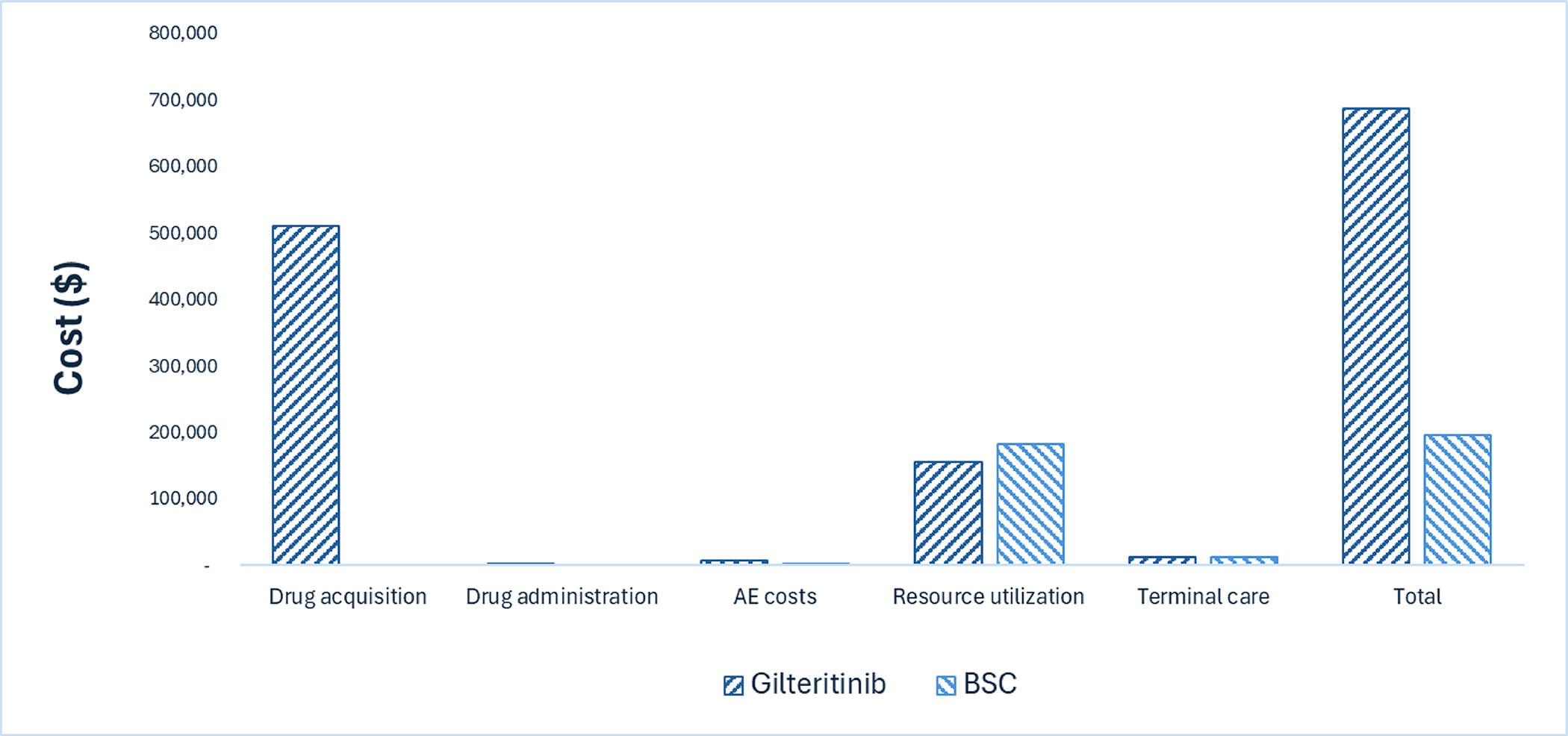
AE = adverse event; BSC = best supportive care; vs. = versus.
Note: Resource utilization includes costs associated with relapse events, uncured relapse-free medical costs, cured relapse-free medical costs, relapsed medical costs, and testing.
Impact on Health
Relative to best supportive care, gilteritinib is expected to increase the amount of time a patient remains in the relapse-free state by approximately 2.80 years and to extend OS by 1.89 years. Considering the impact of treatment on both quality and length of life, gilteritinib is expected to result in 1.77 additional QALYs per patient compared to best supportive care (refer to Figure 2).
Figure 2: Impact of Gilteritinib vs. Best Supportive Care on Patient Health
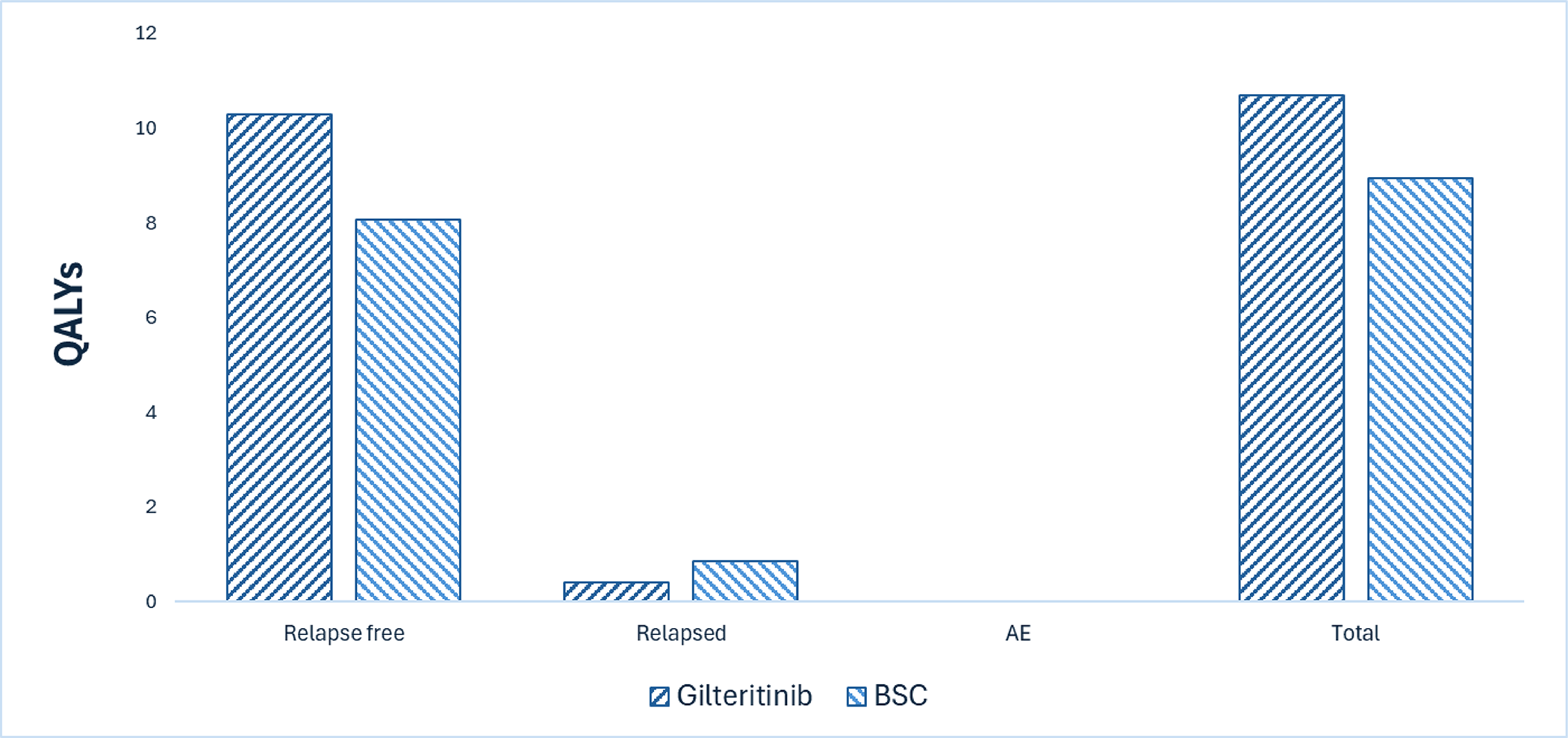
AE = adverse event; BSC = best supportive care; vs. = versus.
Overall Results
The results of the CDA-AMC base case suggest an ICER of $277,163 per QALY gained for gilteritinib compared to best supportive care (refer to Table 7). Additional details on the CDA-AMC base case are available in the Supplemental Material document, Appendix 11.
Table 7: Summary of CDA-AMC Economic Evaluation Results
Treatment | Total costs ($) | Total LYs | Total QALYs | ICER vs. best supportive care ($/QALY) |
|---|---|---|---|---|
Best supportive care | 196,206 | 10.46 | 8.94 | Reference |
Gilteritinib | 686,503 | 11.98 | 10.71 | 277,163 |
CDA-AMC = Canada’s Drug Agency; ICER = incremental cost-effectiveness ratio; LY = life-year; QALY = quality-adjusted life-year; vs. = versus.
Note: Publicly available list prices were used for all comparators.
Uncertainty and Sensitivity
Due to study limitations, imprecision, and the lack of long-term evidence, extrapolation of OS and RFS was uncertain. The impact of uncertainty on long-term OS and RFS for patients receiving gilteritinib could not be explored due to structural limitations of the submitted model.
Uncertainty related to increased long-term mortality rates in patients with AML with FLT3 mutation compared to the general population was explored in the scenario analysis. Based on the results of this analysis, the ICER for gilteritinib may range from $233,253 to $366,939 per QALY gained compared with best supportive care.
Summary of the Budget Impact
The sponsor submitted a budget impact analysis to estimate the 3-year (2025–2027) budget impact of reimbursing gilteritinib for use as the maintenance therapy for “post allo-HCT in AML patients with FLT3-ITD mutation and MRD positive in complete remission.” The sponsor assumed that the payer would be CDA-AMC–participating public drug plans and derived the size of the eligible population using an epidemiologic approach. The price of gilteritinib was aligned with the price included in the sponsor’s economic evaluation, while the prices of comparators were based on publicly available list prices. Additional information pertaining to the sponsor’s submission is provided in the Supplemental Material document, Appendix 12.
CDA-AMC identified a number of issues with the sponsor’s estimated budget impact and made changes to model parameters and assumptions in consultation with clinical experts to derive the CDA-AMC base case (refer to the Supplemental Material document, Appendix 12). CDA-AMC estimated that 199 patients would be eligible for treatment with gilteritinib over a 3-year period (year 1 = 67; year 2 = 68; year 3 = 69), of whom 173 would be expected to receive gilteritinib (year 1 = 50; year 2 = 58; year 3 = 65). The estimated incremental budget impact of reimbursing gilteritinib is expected to be approximately $76.2 million over the first 3 years, with an expected expenditure of $77.5 million on gilteritinib. The actual budget impact will depend on the number of people eligible for treatment, the reimbursement status of quizartinib, and the assumptions about treatment uptake. Additional uncertainty remains because of assumptions made about treatment duration and relapse patterns, real-world MRD testing practices and associated costs, and which payer is responsible for funding these components.
Conclusion
Based on the CDA-AMC base case, gilteritinib would be considered cost-effective at the submitted price if the public health care system were willing to pay at least $277,163 for each additional QALY gained. If the public health care system is not willing to pay that amount, a price reduction should be considered (refer to Figure 3; full details of the impact of price reductions on cost-effectiveness are presented in the Supplemental Material document, Appendix 11). The estimated cost-effectiveness of gilteritinib compared to best supportive care is uncertain due to uncertainty in the long-term survival estimates and the structure of the submitted economic analysis. Therefore, higher price reductions may be required.
The budget impact of reimbursing gilteritinib to the public drug plans in the first 3 years is estimated to be approximately $76.2 million. The 3-year expenditure on gilteritinib (i.e., not accounting for current expenditure on comparators) is estimated to be $77.5 million. The estimated budget impact is highly uncertain due to uncertainties in the size of the eligible population, assumptions about market share and treatment duration, variability in MRD testing practices and costs, and the lack of comparative evidence to inform key model parameters.
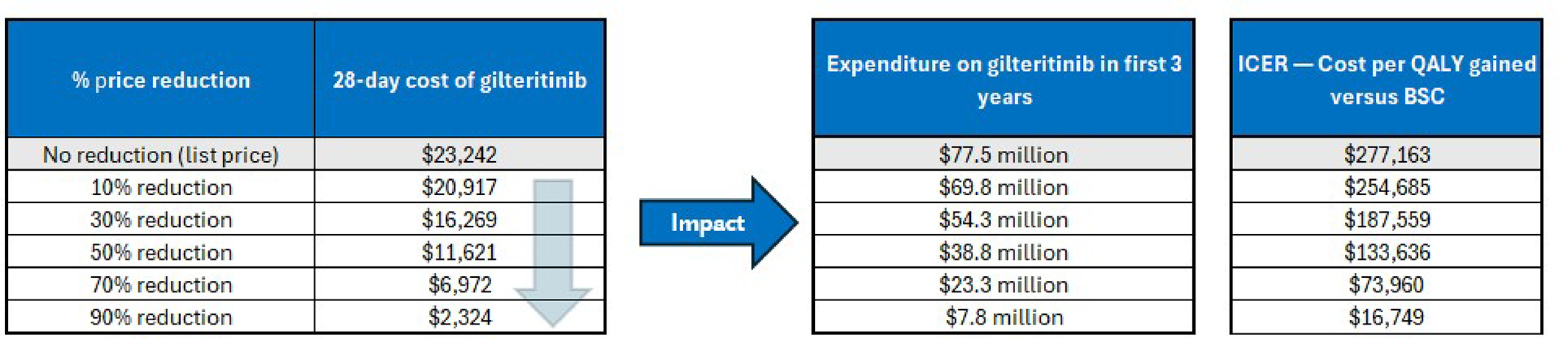
References
1.Khwaja A, Bjorkholm M, Gale RE, et al. Acute myeloid leukaemia. Nat Rev Dis Primers. 2016;2:16010. doi:10.1038/nrdp.2016.10 PubMed
2.Kiyoi H, Naoe T, Nakano Y, et al. Prognostic implication of FLT3 and N-RAS gene mutations in acute myeloid leukemia. Blood. 1999;93(9):3074-80. PubMed
3.Webster JA, Luznik L, Gojo I. Treatment of AML Relapse After Allo-HCT. Front Oncol. 2021;11:812207. doi:10.3389/fonc.2021.812207 PubMed
4.Ghazawi FM, Le M, Cyr J, Netchiporouk E, Rahme E, Alakel A, Zubarev A, Powell M, Moreau L, Roshdy O, Glassman SJ, Sasseville D, Popradi G, Litvinov IV. Analysis of acute myeloid leukemia incidence and geographic distribution in Canada from 1992 to 2010 reveals disease clusters in Sarnia and other industrial US border cities in Ontario. Cancer. 2019;125(11):1886-1897. doi:10.1002/cncr.32034 PubMed
5.Tecik M, Adan A. Therapeutic Targeting of FLT3 in Acute Myeloid Leukemia: Current Status and Novel Approaches. Onco Targets Ther. 2022;15:1449-1478. doi:10.2147/OTT.S384293 PubMed
6.Döhner H, Wei AH, Appelbaum FR, et al. Diagnosis and management of AML in adults: 2022 recommendations from an international expert panel on behalf of the ELN. Blood. 2022;140(12):1345-1377. doi:10.1182/blood.2022016867 PubMed
7.Short NJ, Zhou S, Fu C, et al. Association of Measurable Residual Disease With Survival Outcomes in Patients With Acute Myeloid Leukemia: A Systematic Review and Meta-analysis. JAMA Oncol. 2020;6(12):1890-1899. doi:10.1001/jamaoncol.2020.4600 PubMed
8.Hourigan CS, Karp JE. Minimal residual disease in acute myeloid leukaemia. Nat Rev Clin Oncol. 2013;10(8):460-71. doi:10.1038/nrclinonc.2013.100 PubMed
9.The Leukemia-Bone Marrow Transplant (BMT) Program of British Columbia BCCAB. Sponsor's summary of clinical evidence [internal sponsor's report]. In: Drug Reimbursement Review sponsor submission: Xospata (gilteritinib): 40 mg gilteritinib (as gilteritinib fumarate) [internal sponsor's package]. 2025. Accessed February 02, 2026.
10.National Comprehensive Cancer Network. NCCN Clinical Practice Guidelines in Oncology: Acute Myeloid Leukemia (Version 3.2026) [sponsor submitted reference]. 2025. Accessed November 24, 2025. https://www.nccn.org/professionals/physician_gls/pdf/aml.pdf
11.DeWolf S, Tallman MS, Rowe JM, Salman MY. What Influences the Decision to Proceed to Transplant for Patients With AML in First Remission? J Clin Oncol. 2023;41(29):4693-4703. doi:10.1200/JCO.22.02868 PubMed
12.DiNardo CD, Erba HP, Freeman SD, Wei AH. Acute myeloid leukaemia. Lancet. 2023;401(10393):2073-2086. doi:10.1016/S0140-6736(23)00108-3 PubMed
13.Canada's Drug Agency. Reimbursement Recommendation for Quizartinib (Vanflyta) [sponsor submitted reference]. Can J Health Technol. 2025;5(8).
14.Novartis Pharmaceuticals Canada Inc. Product Monograph: RYDAPT (midostaurin) [sponsor submitted reference]. 2023. https://pdf.hres.ca/dpd_pm/00070168.PDF
15.Hamilton BK, Pandya BJ, Ivanescu C, et al. Health-related quality of life with gilteritinib vs placebo post-transplant for FLT3-ITD + acute myeloid leukemia. Blood Adv. 2024;8(19):5091-5099.
16.Levis MJ, Hamadani M, Logan B, et al. Gilteritinib as Post-Transplant Maintenance for AML With Internal Tandem Duplication Mutation of FLT3. J Clin Oncol. 2024;42(15):1766-75. PubMed
17.Levis MJ, Hamadani M, Logan BR, et al. Measurable residual disease and posttransplantation gilteritinib maintenance for patients with FLT3-ITD-mutated AML. Blood. 2025;145(19):2138-2148. doi:10.1182/blood.2024025154 PubMed
18.Astellas Pharma Global Development Inc. Statistical Analysis Plan. Draft Version 2.0 [sponsor submitted reference]. July 18, 2022. https://ascopubs.org/action/downloadSupplement?doi=10.1200%2FJCO.23.02474&file=protocol2-sap_jco.23.02474.pdf
19.Astellas. MORPHO MRD+ post-hoc analysis data on file [sponsor submitted reference]. 2025.
20.European Medicines A. Guideline on the investigation of subgroups in confirmatory clinical trials 2019. Accessed March 18, 2026. https://www.ema.europa.eu/en/documents/scientific-guideline/guideline-investigation-subgroups-confirmatory-clinical-trials_en.pdf
21.Schandelmaier S, Briel M, Varadhan R, et al. Development of the Instrument to assess the Credibility of Effect Modification Analyses (ICEMAN) in randomized controlled trials and meta-analyses. CMAJ. 2020;192(32):E901. doi:10.1503/cmaj.200077 PubMed
22.Liersch R, Muller-Tidow C, Berdel WE, Krug U. Prognostic factors for acute myeloid leukaemia in adults--biological significance and clinical use. Br J Haematol. 2014;165(1):17-38. doi:10.1111/bjh.12750 PubMed
23.Lewis JFM, Daver NG, Robinson NJ, et al. Prevalence of Fms-Like Tyrosine Kinase 3 (FLT3) Mutations in Patients With Acute Myeloid Leukaemia: A Systematic Literature Review and Meta-Analysis. Cancer Med. 2025;14(18):e71205. doi:10.1002/cam4.71205 PubMed
24.Bierenbaum J, Davidoff AJ, Ning Y, Tidwell ML, Gojo I, Baer MR. Racial differences in presentation, referral and treatment patterns and survival in adult patients with acute myeloid leukemia: a single-institution experience. Leuk Res. 2012;36(2):140-5. doi:10.1016/j.leukres.2011.10.018 PubMed
25.Wang X, Gimotty PA, Matthews AH, et al. Evolving racial/ethnic disparities in AML survival in the novel therapy era. Blood Adv. 2025;9(3):533-544. doi:10.1182/bloodadvances.2024014127 PubMed
26.Daver N, Schlenk RF, Russell NH, Levis MJ. Targeting FLT3 mutations in AML: review of current knowledge and evidence. Leukemia. 2019;33(2):299-312. doi:10.1038/s41375-018-0357-9 PubMed
27.Kottaridis PD, Gale RE, Frew ME, et al. The presence of a FLT3 internal tandem duplication in patients with acute myeloid leukemia (AML) adds important prognostic information to cytogenetic risk group and response to the first cycle of chemotherapy: analysis of 854 patients from the United Kingdom Medical Research Council AML 10 and 12 trials. Blood. 2001;98(6):1752-9. doi:10.1182/blood.v98.6.1752 PubMed
28.Bergeron J, Capo-Chichi JM, Tsui H, et al. The Clinical Utility of FLT3 Mutation Testing in Acute Leukemia: A Canadian Consensus. Current Oncology. 2023;30(12):10410-10436. doi:10.3390/curroncol30120759 PubMed
29.Chea M, Rigolot L, Canali A, Vergez F. Minimal Residual Disease in Acute Myeloid Leukemia: Old and New Concepts. Int J Mol Sci. 2024;25(4):2150. doi:10.3390/ijms25042150 PubMed
30.Grob T, Sanders MA, Vonk CM, et al. Prognostic Value of FLT3-Internal Tandem Duplication Residual Disease in Acute Myeloid Leukemia. J Clin Oncol. 2023;41(4):756-765. doi:10.1200/JCO.22.00715 PubMed
31.Cloos J, Valk PJM, Thiede C, et al. 2025 Update on MRD in Acute Myeloid Leukemia: A Consensus Document from the ELN-DAVID MRD Working Party. Blood. 2026;147(11):1147-1167. doi:10.1182/blood.2025031480 PubMed
32.Dillon LW, Gui G, Ravindra N, et al. Measurable Residual FLT3 Internal Tandem Duplication Before Allogeneic Transplant for Acute Myeloid Leukemia. JAMA Oncol. 2024;10(8)(suppl 1):1104-1110. doi:10.1001/jamaoncol.2024.0985 PubMed
33.Levis MJ, Perl AE, Altman JK, et al. A next-generation sequencing–based assay for minimal residual disease assessment in AML patients with FLT3-ITD mutations. Blood Advances. 2018;2(8):825-831. doi:10.1182/bloodadvances.2018015925 PubMed
34.Invivoscribe. Instructions for Use LeukoStrat FLT3-ITD MRD Assay. 2025. Accessed February 25, 2026. https://invivoscribe.com/uploads/products/instructionsForUse/280569.pdf
35.Invivoscribe. FLT3 ITD MRD Brochure. 2025. Accessed February 25, 2026. https://catalog.invivoscribe.com/wp-content/uploads/2021/08/M-0181-FLT3-ITD-MRD-Brochure-Rev01-April-2025.pdf
36.British Columbia Cancer Agency. Budget Impact Analysis [internal sponsor's report]. In: Drug Reimbursement Review sponsor submission: Xospata (gilteritinib): 40 mg gilteritinib (as gilteritinib fumarate) [internal sponsor's package]. December 30, 2025.
37.British Columbia Cancer Agency. British Columbia Cancer Agency response to Canada's Drug Agency request for additional information regarding Gilteritinib review on January 26, 2026: Section 9: Eligibility Application for a Testing Procedure Assessment [internal additional sponsor's information]. 2026.
38.Bain BJ. Bone marrow biopsy morbidity and mortality. Br J Haematol. 2003;121(6):949-951. doi:10.1046/j.1365-2141.2003.04329.x PubMed
39.Tomasian A, Jennings JW. Bone marrow aspiration and biopsy: techniques and practice implications. Skeletal Radial. 2022;51(1):81-88. doi:10.1007/s00256-021-03882-w PubMed
ISSN: 2563-6596
Canada’s Drug Agency (CDA-AMC) is a pan-Canadian health organization. Created and funded by Canada’s federal, provincial, and territorial governments, we’re responsible for driving better coordination, alignment, and public value within Canada’s drug and health technology landscape. We provide Canada’s health system leaders with independent evidence and advice so they can make informed drug, health technology, and health system decisions, and we collaborate with national and international partners to enhance our collective impact.
Disclaimer: CDA-AMC has taken care to ensure that the information in this document was accurate, complete, and up to date when it was published, but does not make any guarantee to that effect. Your use of this information is subject to this disclaimer and the Terms of Use at cda-amc.ca.
The information in this document is made available for informational and educational purposes only and should not be used as a substitute for professional medical advice, the application of clinical judgment in respect of the care of a particular patient, or other professional judgments in any decision-making process. You assume full responsibility for the use of the information and rely on it at your own risk.
CDA-AMC does not endorse any information, drugs, therapies, treatments, products, processes, or services. The views and opinions of third parties published in this document do not necessarily reflect those of CDA-AMC. The copyright and other intellectual property rights in this document are owned by the Canadian Agency for Drugs and Technologies in Health (operating as CDA-AMC) and its licensors.
Questions or requests for information about this report can be directed to requests@cda-amc.ca.