Drugs, Health Technologies, Health Systems
Reimbursement Recommendation
Nivolumab
Reimbursement request: Nivolumab in combination with doxorubicin, vinblastine, and dacarbazine (AVD) for the first-line treatment of stage III and stage IV classic Hodgkin lymphoma in patients 12 years of age and older
Requester: Public drug programs
Final recommendation: Reimburse with conditions
Summary
What Is the Reimbursement Recommendation for Nivolumab in Combination With Doxorubicin (Adriamycin), Vinblastine, and Dacarbazine?
The Formulary Management Expert Committee (FMEC) recommends that nivolumab in combination with doxorubicin, vinblastine, and dacarbazine (N + AVD) be reimbursed for the first-line treatment of stage III and stage IV classic Hodgkin lymphoma in patients 12 years of age and older, provided certain conditions are met.
What Are the Conditions for Reimbursement?
N + AVD should only be reimbursed for the first-line treatment of stage III and stage IV classic Hodgkin lymphoma in patients 12 years of age and older who do not have significant active autoimmune disease.
When comparing N + AVD to brentuximab vedotin (BV) in combination with doxorubicin (Adriamycin), vinblastine, and dacarbazine (AVD), no price reduction is required to achieve cost-effectiveness, given that N + AVD has a lower drug cost and better clinical outcomes. Based on the Canada’s Drug Agency assessment of the clinical evidence, it was determined that there is not enough evidence to justify a greater cost for N + AVD compared with BV in combination with doxorubicin (Adriamycin), vincristine, etoposide, prednisone, and cyclophosphamide (BV + AVEPC).
Why Did CDA-AMC Make This Recommendation?
FMEC reviewed the Canada’s Drug Agency report, which included a review of the clinical evidence, specifically a phase III, multicentre, open-label, randomized trial (S1826) comparing the efficacy and safety of N + AVD with that of BV + AVD in adolescent and adult patients with newly diagnosed stage III or IV classic Hodgkin lymphoma and a cost comparison of N + AVD versus other treatments used in Canada. N + AVD was associated with a clinically important improvement in progression-free survival compared to BV + AVD, and event-free survival was also improved. FMEC also considered input received from a person with lived experience, patient and clinician groups, industry, and drug plans.
FMEC concluded that N + AVD demonstrates acceptable clinical value versus BV + AVD and addresses an unmet clinical need.
Therapeutic Landscape
What Is Classic Hodgkin Lymphoma?
Classic Hodgkin lymphoma (cHL) is a relatively rare cancer of the immune system that contains abnormal B lymphocytes, called Reed-Sternberg cells, in the lymph nodes. cHL is the most common type of Hodgkin lymphoma, accounting for 95% of all Hodgkin lymphoma cases. The other 5% of Hodgkin lymphoma cases are nodular lymphocyte-predominant Hodgkin lymphoma. In Canada, about 1,000 people are diagnosed with Hodgkin lymphoma each year, which occurs more frequently in males than females, primarily in younger patients (aged 15 to 39 years) and in older adults (aged 55 years and older). The 5-year survival rate for Hodgkin lymphoma in Canada is 85%.
What Are the Current Treatment Options?
Current treatment options for adults with advanced-stage cHL include combination chemotherapy such as doxorubicin (Adriamycin), bleomycin, vinblastine, and dacarbazine (ABVD) and bleomycin, etoposide, doxorubicin (Adriamycin), cyclophosphamide, vincristine (Oncovin), procarbazine, and prednisone (BEACOPP), as well as the combination of brentuximab vedotin plus doxorubicin (Adriamycin), vinblastine, and dacarbazine (BV + AVD).
The Canadian standard for the treatment of advanced-stage disease in the pediatric population has been brentuximab vedotin plus doxorubicin (Adriamycin), vincristine, etoposide, prednisone, and cyclophosphamide (BV + AVEPC) or doxorubicin (Adriamycin), bleomycin, vincristine, etoposide, prednisone, and cyclophosphamide (ABVE-PC).
What Is the Treatment Under Review?
Nivolumab in combination with doxorubicin (Adriamycin), vinblastine, and dacarbazine (N + AVD) is the treatment under review and is considered off-label for the treatment of advanced-stage cHL.
Nivolumab (monotherapy) is approved by Health Canada for the treatment of adult patients with cHL that has relapsed or progressed after autologous stem cell transplant and brentuximab vedotin (BV), or 3 or more lines of systemic therapy, including autologous stem cell transplant.
Why Did We Conduct This Review?
At the request of clinicians, the participating public drug programs requested that we review N + AVD to inform a recommendation on whether it should be reimbursed for the first-line treatment of stage III and stage IV cHL in patients 12 years of age and older. The data protection for nivolumab expired in March 2024 and, globally, there are several biosimilar products for this drug, although not in Canada at this time. Therefore, this treatment is eligible for a nonsponsored reimbursement review as per the Procedures for Reimbursement Reviews.
Input From Interested Parties
We received input from 1 patient group, Lymphoma Canada, about the experience of living with Hodgkin lymphoma and its impact on quality of life. While most patients were satisfied with their front-line treatment options, they expressed concerns about the side effects of treatment and their impact on quality of life. Patient input also highlighted variations in access to treatment and the financial impacts due to work absences and the costs related to drugs, travel, and medical supplies.
We also received input from 2 clinician groups, the Lymphoma Canada Scientific Advisory Board and the Ontario Health (Cancer Care Ontario) Hematology Cancer Drug Advisory Committee, both of which noted that the toxicity of N + AVD is low and that N + AVD will become the standard of care for first-line treatment of all patients with stage III and IV disease.
We received 1 submission of industry input, from Bristol Myers Squibb, who signalled cost-saving opportunities of N + AVD.
Public drug plans inquired about the evidence for N + AVD to inform a recommendation on whether it should be reimbursed for the first-line treatment of stage III and stage IV cHL in patients aged 12 years and older. The public drug plans outlined implementation questions related to treatment eligibility and potential care provisions.
Disclaimer: The perspectives shared by people with lived experience who present to the committee reflect their individual experiences and are not necessarily representative of all people with the same condition or course of treatment. Their insights provide valuable context about what a patient, support person, or caregiver might go through when facing this condition or treatment, helping to inform the committee’s deliberations. These narratives complement other forms of evidence and input and should be considered as part of a broader understanding of the condition and treatment under review.
Summary of Deliberation
The Formulary Management Expert Committee (FMEC) deliberated on all domains of value of the deliberative framework before developing their recommendation: clinical value, unmet clinical need, distinct social and ethical considerations, economic considerations, and impacts on health systems. For further information on the domains of value, please refer to the Expert Committee Deliberation at Canada’s Drug Agency document.
FMEC considered the following key discussion points, organized by the 5 domains of value.
Clinical Value
FMEC concluded that N + AVD demonstrates acceptable clinical value versus BV + AVD.
Through reflection on the input from patient groups or insights shared by people with lived experience, FMEC members noted the following important outcomes: cure, longer life span, longer remission, better quality of life, and fewer side effects. Patients underscored the importance of having access to available treatment options and reducing the need for radiation therapy.
FMEC members highlighted the following discussion points:
The committee agrees that the outcomes measured in the SWOG S1826 trial were appropriate and clinically meaningful. The study showed a clinically meaningful advantage in terms of progression-free survival as well as event-free survival for N + AVD versus BV + NVD.
FMEC heard from the guest specialists (clinical experts) that the 2-year follow-up is a reasonable time frame to evaluate relapse rates given that, as the clinical experts highlighted, the majority of patients relapse within the first 2 years. At the median follow-up of 2 years, there was no meaningful difference in overall survival. Due to the short duration of follow-up, OS data were immature. FMEC noted that the trial is ongoing and that longer follow-up is needed to determine the impact on overall survival and long-term toxicities, if any.
FMEC also heard from the guest specialists (clinical experts) that the availability of this treatment option allows less exposure to other chemotherapies and radiation therapies with downstream complications of infertility and risk of development of secondary malignancies.
FMEC noted that information on health-related quality of life was collected; however, there were no published data on health-related quality of life available at the time of the FMEC meeting.
FMEC also noted that N + AVD was better tolerated for all outcomes except for neutropenia. However, the difference in neutropenia rates was not clinically significant. FMEC noted that granulocyte colony-stimulating factor (G-CSF), used as primary prophylaxis to prevent neutropenia, was administered to 56.3% of patients in the N + AVD group and 96.7% of patients in the BV + AVD group. The use of G-CSF was required for patients receiving BV + AVD but was optional for patients receiving N + AVD.
There was no direct evidence comparing N + AVD to other relevant comparators. Therefore, it is uncertain whether N + AVD demonstrates acceptable clinical value versus ABVD and BEACOPP for adult patients and ABVE-PC for pediatric patients.
Unmet Clinical Need
FMEC concluded that there is a significant unmet clinical need arising from cHL despite available treatments and that N + AVD addresses this unmet clinical need.
Through reflection on the input from patient groups or insights shared by people with lived experience, FMEC members noted the following important patient values or perspectives: treatment choices with better long-term outcomes, fewer toxicities, and better quality of life.
FMEC members highlighted the following discussion points:
BV + AVD is an appropriate comparator in Canada and is currently the standard for stage IV cHL. FMEC also noted that similar regimens are used in pediatrics (BV + AVEPC) and that ABVD, BEACOPP, and ABVE-PC regimens are also available.
The committee agreed that, although cHL is a curable cancer, there remains a need to avoid relapse and later lines of therapies as well as toxicities.
FMEC heard from guest specialists (clinical experts) that there is no curative treatment for second-line cHL in the older population because older patients are not eligible for high-dose chemotherapy in the second-line setting, and that N + AVD is better tolerated in older patients than BV + AVD. FMEC agreed with the clinical experts in that N + AVD fulfills an unmet need in older patients who may not tolerate BV + AVD.
Distinct Social and Ethical Considerations
FMEC did not identify any important measures that should be implemented to ensure that the use of N + AVD addresses relevant social and ethical implications.
Through reflection on the input from patient groups or insights shared by people with lived experience, FMEC members noted that some patients experienced issues with access to funded treatments either because the drug was not available, not available at their cancer centre, or because they lived in a community without a cancer centre. The person with lived experience also underscored the importance of having access to PET scans locally as well as the importance of having a support system.
FMEC members highlighted the following discussion points:
Patient group input revealed concerns about the availability of treatments in geographic proximity to the patient. FMEC acknowledges that N + AVD is an IV therapy and will require visits to a treatment centre for patients living in remote locations. However, this is no different than the current standard of care.
FMEC also noted that 6 cycles of therapy involve 12 visits to a treatment centre and acknowledges that there is a high burden on patients and families. However, this is no different than the current standard of care.
Economic Considerations
FMEC concluded that there are economic considerations that are important to address when implementing N+AVD.
FMEC members highlighted the following discussion points:
Based on publicly available prices, the reimbursement of N + AVD for the treatment of patients with previously untreated stage III or IV cHL is expected to decrease overall drug acquisition costs compared with BV + AVD in adult patients and BV + AVEPC in pediatric patients. Drug plan input indicated that confidential pricing exists for BV.
FMEC noted that use of concurrent G-CSF is optional for N + AVD. However, G-CSF is expected to be used concurrently with BV + AVD. Not routinely requiring G-CSF administration for N + AVD would result in lower drug acquisition costs for N + AVD compared with BV + AVD.
FMEC concluded that N + AVD likely demonstrates a clinical benefit compared with BV + AVD and noted that N + AVD may represent a cost-effective option relative to BV + AVD, given the lower drug acquisition cost at publicly available prices. However, given that these conclusions are based on publicly available prices, FMEC noted that a price reduction may be required to ensure cost-effectiveness.
The reimbursement of N + AVD for the treatment of patients with previously untreated stage III or IV cHL is expected to increase overall drug acquisition costs compared with ABVD and BEACOPP in adult patients and ABVE-PC in pediatric patients at publicly available prices.
No evidence was identified regarding the comparative efficacy and safety of N + AVD versus other available comparators. The cost-effectiveness of N + AVD relative to these other regimens is unknown.
Impacts on Health Systems
FMEC did not identify any impacts on health systems that are important to address when implementing N + AVD.
FMEC members highlighted the following discussion points:
The committee agreed that there were no unique health system concerns regarding N + AVD that are any different from therapy already used in cHL.
FMEC also noted that N + AVD should not require any new resources or training because nivolumab is a therapy used in many tumour sites.
Figure 1: Recommendation Pathway
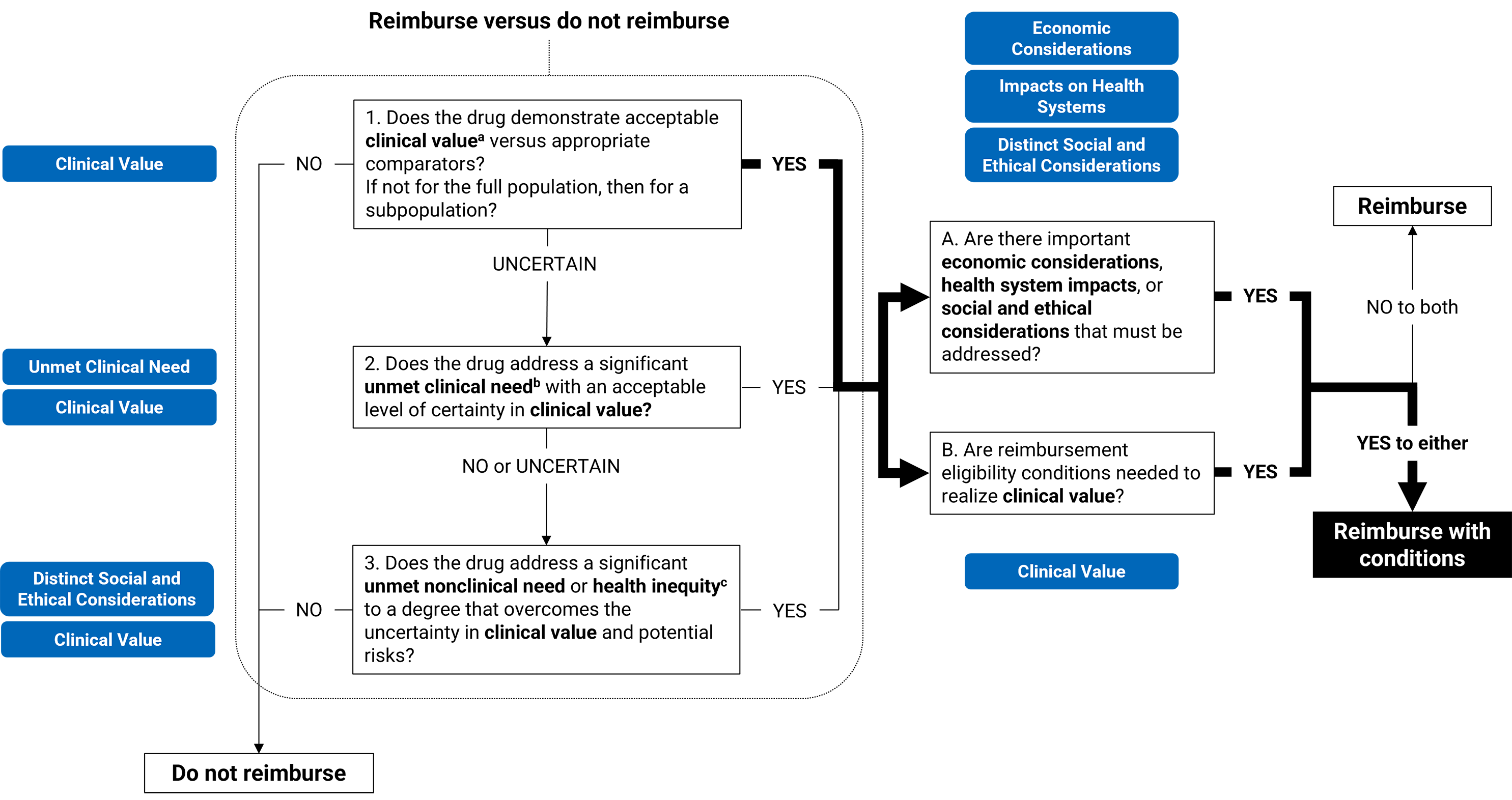
a Acceptable clinical value refers to at least comparable clinical value (if expected to be substitutive treatment) or added clinical value (if expected to be additive treatment) versus appropriate comparators.
b Significant unmet clinical need depends on all the following: severity of the condition, availability of effective treatments, and challenges in evidence generation due to rarity of the condition or ethical issues.
c Unmet nonclinical need and health inequity are key components within the Distinct Social and Ethical Considerations domain of value.
Full Recommendation
With a vote of 8 to 0, FMEC recommends that N + AVD for the first-line treatment of stage III and stage IV cHL in patients aged 12 years and older be reimbursed if the conditions presented in Table 1 are met.
Table 1: Conditions, Reasons, and Guidance
Reimbursement condition | Reason | Implementation guidance |
|---|---|---|
Initiation | ||
1. N + AVD may be initiated for the first-line treatment of stage III and stage IV cHL in patients 12 years of age and older who do not have significant active autoimmune disease. | There is evidence from the S1826 trial comparing N + AVD to BV + AVD in patients aged 12 years and older for the first-line treatment of stage III and stage IV cHL. In this trial, N + AVD was associated with a clinically important improvement in progression-free survival compared to BV + AVD, and event-free survival was also improved. | — |
Discontinuation | ||
2. N + AVD should be discontinued if there is disease progression or significant toxicity. | Consistent with clinical practice, patients in the S1826 trial discontinued treatment upon disease progression or significant toxicity. | Treatment with N + AVD should be for a maximum of 6 cycles. |
Prescribing | ||
3. Prescribing should be limited to clinicians with expertise in the diagnosis and management of Hodgkin lymphoma. | This will ensure that appropriate treatment is prescribed for patients and adverse events are optimally managed. | — |
Pricing | ||
4. A price reduction may be required. | Given that N + AVD is associated with lower drug acquisition costs compared with BV + AVD at publicly available prices and incremental benefit, N + AVD may represent a cost-effective treatment option compared with BV + AVD. If, based on confidential prices, N + AVD has a higher cost relative to BV + AVD, then a cost-effectiveness analysis would be required to determine whether a price premium is justified. In the comparison of N + AVD with BV + AVEPC, N + AVD is associated with lower drug acquisition costs and unknown clinical benefit. To ensure cost-effectiveness, N + AVD should be priced no more than BV + AVEPC. | — |
BV + AVD = brentuximab vedotin plus doxorubicin (Adriamycin), vinblastine, and dacarbazine; BV + AVEPC = brentuximab vedotin plus doxorubicin (Adriamycin), vincristine, etoposide, prednisone, and cyclophosphamide; cHL = classic Hodgkin lymphoma; N + AVD = nivolumab in combination with doxorubicin (Adriamycin), vinblastine, and dacarbazine.
Feedback on Draft Recommendation
We received feedback from the public drug programs, 1 clinician group from Ontario Health (Cancer Care Ontario), 1 industry group from Bristol Myers Squibb, and 2 patient groups — the Leukemia & Lymphoma Society and Lymphoma Canada.
The public drug programs requested a minor reconsideration as it relates to patients with stage IIB and stage II bulky disease and weight-based dosing of nivolumab. The clinician group has echoed similar feedback regarding patients with stage IIB and stage II bulky disease. The feedback provided by the industry group added clarity by pointing out that nivolumab biosimilars are not yet available in Canada. Overall, the feedback received by both patient groups supports the recommendation. A subcommittee panel met to discuss all the feedback and made a revision to the Responses to Questions from the Drug Programs document. Other editorial revisions were incorporated into the clinical and pharmacoeconomic combined report.
FMEC Information
Members of the committee: Dr. Emily Reynen (Chair), Dr. Zaina Albalawi, Dr. Hardit Khuman, Ms. Valerie McDonald, Dr. Bill Semchuk, Dr. Jim Silvius, Dr. Marianne Taylor, Dr. Maureen Trudeau, Dr. Dominika Wranik. Two guest specialists from Ontario and British Columbia participated in this review.
Meeting date: May 15, 2025
Reconsideration meeting date: July 17, 2025
Conflicts of interest: None
Special thanks: Canada’s Drug Agency (CDA-AMC) extends our special thanks to the individuals who presented directly to FMEC and to the patient organizations representing the community of those living with Hodgkin lymphoma, including Max Silverman, Sasha Frost, and the Canadian Cancer Society.
Note: CDA-AMC makes every attempt to engage with people with lived experience as closely to the indication and treatments under review as possible; however, at times, CDA-AMC is unable to do so and instead engages with individuals with similar treatment journeys or experience with comparators under review to ensure lived experience perspectives are included and considered in Reimbursement Reviews. CDA-AMC is fortunate to be able to engage with individuals who are willing to share their treatment journey with FMEC.
ISSN: 2563-6596
Canada’s Drug Agency (CDA-AMC) is a pan-Canadian health organization. Created and funded by Canada’s federal, provincial, and territorial governments, we’re responsible for driving better coordination, alignment, and public value within Canada’s drug and health technology landscape. We provide Canada’s health system leaders with independent evidence and advice so they can make informed drug, health technology, and health system decisions, and we collaborate with national and international partners to enhance our collective impact.
Disclaimer: CDA-AMC has taken care to ensure that the information in this document was accurate, complete, and up to date when it was published, but does not make any guarantee to that effect. Your use of this information is subject to this disclaimer and the Terms of Use at cda-amc.ca.
The information in this document is made available for informational and educational purposes only and should not be used as a substitute for professional medical advice, the application of clinical judgment in respect of the care of a particular patient, or other professional judgments in any decision-making process. You assume full responsibility for the use of the information and rely on it at your own risk.
CDA-AMC does not endorse any information, drugs, therapies, treatments, products, processes, or services. The views and opinions of third parties published in this document do not necessarily reflect those of CDA-AMC. The copyright and other intellectual property rights in this document are owned by the Canadian Agency for Drugs and Technologies in Health (operating as CDA-AMC) and its licensors.
Questions or requests for information about this report can be directed to Requests@CDA-AMC.ca