Drugs, Health Technologies, Health Systems
Health Technology Review
At-Home Use of Transcranial Direct Current Stimulation Devices
Key Messages
What Is the Issue?
Transcranial direct current stimulation (tDCS) involves passing a weak electrical current through nodes that are attached to the outside of the head during a treatment session. Treatment typically involved multiple sessions. In Canada, use of tDCS is authorized for use in clinics specifically for pain. Interest in the potential use of tDCS at home to supplement management of other conditions, such as difficult-to-treat mental health conditions and neurodevelopmental disorders, is growing with researchers and the public.
What Did We Do?
We conducted a Rapid Review to summarize evidence that compared the clinical effectiveness and safety of at-home use of tDCS to any comparators for adults with mental health conditions.
Conditions included depression (including major depressive disorder [MDD], perinatal depression, and bipolar depression), generalized anxiety disorder, posttraumatic stress disorder, schizophrenia, obsessive compulsive disorder, and substance use disorders (alcohol use disorder, tobacco use disorder, and nicotine use disorder). In addition, we included evidence on attention-deficit/hyperactivity disorder (ADHD). We also sought to identify evidence-based guidelines regarding the use of at-home tDCS for these patient populations.
We searched key resources, including journal citation databases, and conducted a focused internet search for relevant evidence published between January 1, 2015, and May 13, 2025.
What Did We Find?
We found 3 systematic reviews (SRs) and 4 primary randomized controlled trials (RCTs) that evaluated the clinical effectiveness and safety of at-home tDCS for supplementing the management of MDD, symptoms of anxiety in people with MDD, and ADHD. SR and RCT evidence for other prespecified conditions was not identified.
Evidence was limited and had methodological limitations that reduced confidence in our findings. These limitations should be considered when interpreting the clinical effectiveness and safety of at-home tDCS.
Three SRs, which included 6 RCTs, and 3 primary RCTs reported on at-home use tDCS to supplement treatment of MDD. Findings were mixed. Some evidence suggested modest improvements in depressive symptoms, while other evidence showed no benefit compared with sham stimulation.
One SR of 2 RCTs reported on at-home use of tDCS for anxiety in people with MDD. The authors reported that treatment may improve anxiety symptoms in adults with MDD.
One RCT reported on the at-home use of tDCS to treat ADHD. The authors reported that treatment may improve attention regulation in adults with ADHD.
At-home use of tDCS was generally associated with mild adverse events, including skin redness or irritation, burning or tingling sensations, headache, and dizziness. Serious adverse events were uncommon, although adverse event reporting varied across studies. There were reports of a suicide attempt and suicide ideation in patients with difficult-to-treat MDD, mild electric burns, and skin lesions.
We found no evidence-based guidelines on at-home use of tDCS for adults with mental health conditions. However, we identified and have summarized 13 guidelines on the use of tDCS for managing mental health conditions in any setting.
What Does This Mean?
Effectiveness and safety of at-home use of tDCS as a third-line treatment for mental health conditions remains uncertain.
Evidence is limited to a small number of studies for a limited number of patients with MDD and ADHD, Findings are inconsistent and quality of evidence is currently low.
More research is needed to determine who may benefit from at-home tDCS as a supplementary treatment for mental health conditions, whether benefits are sustained, and how to advise safe and effective unsupervised use of these devices.
Abbreviations
ADHD
attention-deficit/hyperactivity disorder
AE
adverse event
BDI
Beck Depression Inventory
CASRS
clinician-administered version of the Adult ADHD Self-report Scale
DLPFC
dorsolateral prefrontal cortex
GAD
generalized anxiety disorder
GRADE
Grading of Recommendations, Assessment, Development and Evaluation
HAM-A
Hamilton Anxiety Rating Scale
HAM-D
Hamilton Depression Rating Scale
HDRS
Hamilton Depression Rating Scale
MADRS
Montgomery-Åsberg Depression Rating Scale
MDD
major depressive disorder
OCD
obsessive-compulsive disorder
PTSD
posttraumatic stress disorder
RCT
randomized controlled trial
SR
systematic review
tDCS
transcranial direct current stimulation
Research Questions
What is the clinical effectiveness of at-home transcranial direct current stimulation (tDCS) devices for the management of mental health conditions in adults?
What is the safety of at-home tDCS devices for the management of mental health conditions in adults?
What are the evidence-based guidelines regarding the use of at-home tDCS devices for the management of mental health conditions in adults?
Context and Policy Issues
What Is Transcranial Direct Current Stimulation?
Transcranial direct current stimulation is a noninvasive form of brain stimulation that involves passing a weak electrical current of 1 mA to 2 mA through the brain.1 During a treatment session, electrodes are placed on the scalp to deliver the current and are held in place using headgear, such as a strap.2 The electrical current enters through a positive electrode (the anode), passes through the skull and brain tissue, and exits via a negative electrode (the cathode).3 Treatment usually involves multiple sessions for multiple weeks.1 The effects of tDCS depend on the area of the brain being targeted and whether a positive or negative electrode is placed over that area. tDCS influences communication between brain cells, making them more or less likely to fire as part of their normal activity.1
How Is tDCS Currently Being Used in Canada?
Health Canada has authorized some tDCS devices solely for the treatment of pain conditions in adults.4,5 Notably, in 2025, Health Canada recalled an unauthorized tDCS device sold online direct to consumers in Canada.6 The use of tDCS for mental health concerns is gaining interest with researchers and the public,7-9 and researchers in Canada are studying tDCS for mental health conditions.10,11 For example, 2 ongoing clinical trials in Toronto are assessing at-home tDCS for depression during pregnancy8 and as an adjunctive treatment for smoking cessation.12 Another study in Montreal is examining at-home tDCS for major depressive disorder (MDD) among people with borderline personality disorder.13 People with difficult-to-treat depression can also access tDCS through clinical trials at the Centre for Addiction and Mental Health in Toronto.8
Why Is It Important to Do This Review?
As interest and potential access to at-home tDCS devices grows, effectiveness of these devices for mental health conditions needs review. Understanding the safety of these devices is particularly important in settings where there is no health care provider supervision.
CADTH published a Rapid Review in 2015 on the clinical effectiveness of neurotrophic stimulation techniques, including tDCS, for generalized anxiety disorder (GAD) and MDD.14 At that time, limited evidence was identified supporting tDCS for depression and no evidence was identified on its clinical effectiveness for the treatment of anxiety disorders.14
Given growing researcher and public interest in the use of tDCS for supplementing treatment of mental health conditions, direct to consumer access, and the current regulatory approval for the use of tDCS devices, it is timely to evaluate evidence available regarding the at-home use of tDCS for any mental health condition.
Objectives
We conducted this Rapid Review to summarize and critically appraise evidence on the clinical effectiveness and safety of at-home tDCS for adults with mental health conditions. Conditions include depression (including MDD, perinatal depression, and bipolar depression), GAD, posttraumatic stress disorder (PTSD), schizophrenia, obsessive compulsive disorder (OCD), and substance use disorders (alcohol use disorder, tobacco use disorder, and nicotine use disorder). Additionally, we included ADHD. We also aimed to summarize evidence-based guideline recommendations on the use of at-home tDCS for these populations.
Methods
An information specialist conducted a literature search, balancing comprehensiveness with relevance, of multiple sources and grey literature on April 30, 2026. A second literature search expanding the population criteria was completed on May 13, 2026. One reviewer screened citations and selected studies based on the inclusion criteria presented in Table 1. Included studies were critically appraised by 1 reviewer with independent validation by a second using established critical appraisal tools. Appendix 1 presents a detailed description of methods and selection criteria for included studies.
Criteria | Description |
|---|---|
Population | Adults (aged 18 years or older) who are diagnosed with depression (including major depressive disorder, perinatal depression, or bipolar depression), generalized anxiety disorder, obsessive-compulsive disorder, posttraumatic stress disorder, attention-deficit/hyperactivity disorder, schizophrenia, alcohol use disorder, tobacco use disorder, and nicotine use disorder |
Intervention | In combination at-home use of transcranial direct current stimulation |
Comparator | Pharmacotherapy, other conventional psychotherapies, sham treatment, routine care |
Outcomes | Q1 (clinical effectiveness): Patient outcomes including improvements in mood and improvement in symptoms of mental health disorder as measured by clinical scales (e.g., BDI, HAM-D, and MADRS scales) Q2 (safety): Adverse events, side effects Q3 (guidelines): Best practices for use of at-home tDCS devices for the treatment of depression (including major depressive disorder, perinatal depression, or bipolar depression), generalized anxiety disorder, obsessive-compulsive disorder, posttraumatic stress disorder, attention-deficit/hyperactivity disorder, schizophrenia, alcohol use disorder, tobacco use disorder, and nicotine use disorder |
Study designs | Systematic reviews, randomized controlled trials, and evidence-based guidelines |
Publication date | January 2015 to May 2026 |
BDI = Beck Depression Inventory; HAM-D = Hamilton Depression Rating Scale; MADRS = Montgomery-Åsberg Depression Rating Scale.
Summary of Evidence
Quantity of Research Available
Seven publications met our inclusion criteria, including 3 systematic reviews (SRs) and 4 primary randomized controlled trials (RCTs).
Seven publications (3 SRs15-17 and 4 primary RCTs18-21) addressed question 1 on the clinical effectiveness of at-home tDCS devices for the management of mental health conditions in adults. Five publications (1 SR15,22 and 4 primary RCTs18-21) addressed question 2 on the safety of at-home tDCS devices for the management of mental health conditions for adults. We did not find any publications that addressed question 3 on guidelines for the use of tDCS. One SR16 that addressed questions 1 and 2 reviewed in all settings; for the purposes of this report, we have included results from the subset of studies relevant to at-home use.
All 3 SRs15-17 had overlap among their included primary studies. A citation matrix of primary studies is presented in Appendix 6. Appendix 2 presents the Preferred Reporting Items for Systematic Reviews and Meta-Analyses (PRISMA)23 flow chart of the study selection.
Summary of Study Characteristics
Summaries of study characteristics are organized by research question (Appendix 3). All studies included participants who were taking medication for their condition (e.g., antidepressants) throughout the study. One study of participants with ADHD was an exception because the participants were not taking a stimulant medication for ADHD, although some were taking other medications for depression or anxiety.20 Therefore, the reported outcomes reflect the clinical effectiveness and safety of tDCS when used in combination with medical therapy rather than as a stand-alone treatment.
Clinical Effectiveness and Safety of At-Home tDCS for Mental Health Conditions
We identified 7 publications that addressed the clinical effectiveness of tDCS for mental health conditions, including 3 SRs,15-17 which included 6 RCTs, and 4 primary RCTs,18-21 totalling 10 RCTs. We identified 5 publications that addressed the safety of tDCS for mental health conditions, including 1 SR,15 which included 5 RCTs, and 4 primary RCTs.18-21
Study locations of the primary RCTs and the RCTs included in the SRs were Brazil,15,17,20 Germany,15 Greece,21 South Korea,15,17-19 the UK,15,17 and the US.17 One SR16 searched from January 1, 2014, to July 1, 2024, and identified 21 studies (3 relevant to this Rapid Review); 1 SR17 searched up to November 2024 and identified 3 RCTs; and 1 SR15 searched up to November 2024 and identified 5 RCTs.
Primary RCTs and RCTs included in SRs focused on MDD,15-17,19,21,24 symptoms of anxiety in patients with MDD,15 and ADHD.20 No evidence assessing the effectiveness and safety of at-home use of tDCS for perinatal depression, bipolar depression, GAD, OCD, PTSD, schizophrenia, alcohol use disorder, tobacco use disorder, and nicotine use disorder was identified.
Sample sizes in the primary RCTs18-21 ranged from 40 to 197 participants. All primary RCTs18-21 focused on adults. The mean age of participants ranged from 29.7 to 76.1 years. Four studies reported the sex or gender of participants. The proportion of participants who were reported as women was 66.7% to 78.7%, participants who were reported as female ranged between 34.4% and 75%, and participants who were reported as male ranged between 32% and 65.6%. Other genders were not reported. Lee and colleagues18 reported additional participant characteristics including years at school, employment, and marital status. Other included studies did not report on these or other PROGRESS-Plus25 characteristics, such as place of residence, culture, language, religion, socioeconomic status, or social capital.
Intensity, duration, and electrode placement of at-home active tDCS sessions were consistent across included studies, while the weekly frequency of sessions and total duration of the intervention varied. In all the primary RCTs and all the RCTs included in the SRs15-19,21 except one,20 electrodes were placed on the front part of the head, with the anode positioned over the left side of the forehead and the cathode over the right side of the forehead. These locations correspond to the left dorsolateral prefrontal cortex (DLPFC) and the right DLPFC brain regions. In the RCT that was the exception, the opposite electrode configuration was used, with the anode on the right and the cathode on the left. In the RCTs included in the SRs15-17 and in 2 primary RCTs,20,21 tDCS was applied at an intensity of 2 mA for 30 minutes. The primary RCT by Lee and colleagues18 included 2 active tDCS groups, in which tDCS at was applied at either 1 mA or 2 mA intensities for 30 minutes; in the primary RCT by Park and colleagues,19 tDCS was applied at an intensity of 1.5 mA to 2 mA for 30 minutes. When reported, participants across all RCTs received tDCS sessions 3, 5, or 7 times per week, with a total of 21, 28, 30, 36, or 42 sessions across 6, 10, or 13 weeks.
Comparison groups varied across primary RCTs and RCTs included in the SRs. These included sham tDCS,15-18,20 placebo internet-based therapy,16 treatment as usual (psychotherapy),21 and active tDCS for 3 weeks followed by sham tDCS for 3 weeks.19
Relevant outcomes assessed across primary studies included:
symptoms of depression assessed using Beck Depression Inventory (BDI),19,21 Hamilton Depression Rating Scale 17-item version (HDRS-17),16 Hamilton Depression Rating Scale (HAM-D),13-16 Korean Beck Depression Inventory-II (BDI-II),18 and Montgomery–Åsberg Depression Rating Scale (MADRS)15,17,19
symptoms of anxiety assessed using Hamilton Anxiety Rating Scale (HAM-A)15,18
symptoms of ADHD assessed using the clinician-administered version of the Adult ADHD Self-report Scale version 1 (CASRS-I)20
side effects or adverse events (AEs)15,18,19,21 in broad categories, including skin-related (e.g., burning, itching), gastrointestinal (e.g., nausea, loss of appetite), neurologic (e.g., headache, dizziness), psychiatric (e.g., suicidal ideation, aggression), and musculoskeletal (e.g., neck pain, joint pain)
quality of life assessed using Quality of Life Enjoyment and Satisfaction Questionnaire (Q-LES-Q).18
Evidence-Based Guidelines on the Use of At-Home tDCS
We found no relevant guidelines for the use of at-home tDCS for the management of mental health conditions in adults.
Summary of Critical Appraisal
Appendix 4 provides additional details about the strengths and limitations of the included publications.
Methodological quality of the evidence varied. The SRs had differing methodological limitations, while 3 of the 4 primary RCTs had “probably low” overall risk of bias and 1 had “probably high” risk of bias. Key concerns included incomplete reporting, allocation concealment, participants being aware of their group allocation, and missing outcome data.
Systematic Reviews
Among the 3 SRs assessed using A Measurement Tool to Assess Systematic Reviews 2 (AMSTAR 2),26 the SR by Moshfeghinia and colleagues15 demonstrated the strongest methodology. The authors of the study used a prospectively registered protocol, duplicate study selection and data extraction, a comprehensive multidatabase search, Cochrane’s risk-of-bias tool for randomized trials (RoB 2), appropriate meta-analytic methods, and sensitivity analyses, and considered risk of bias when interpreting the findings. This study’s main limitations were the lack of a list of excluded studies, failure to report funding sources for the included studies, and limitations in the assessment of publication bias due to the small number of studies.
The SR by Kassar and colleagues17 had several methodological strengths, including clearly defined inclusion criteria, duplicate data extraction, use of RoB 2, appropriate separate meta-analyses for HAM-D and MADRS, and assessment of heterogeneity. However, important limitations included no reported prespecified protocol, an incompletely reported search strategy, no reported list of excluded studies, unclear duplicate study selection, and no assessment of the influence of risk of bias on the meta-analysis or interpretation of results. Publication bias was also not investigated.
The SR by Da Silva and colleagues16 had the greatest number of methodological limitations. The review did not clearly define eligibility criteria, report a prespecified protocol, justify study design restrictions, or report duplicate study selection and data extraction. The search was limited to PubMed, and the authors did not provide a list of excluded studies. Although risk of bias was assessed and a random-effects meta-analysis was performed, the authors did not adequately consider risk of bias in the synthesis or interpretation, satisfactorily address heterogeneity, or assess publication bias.
Randomized Controlled Trials
Among the 4 primary RCTs assessed using the Risk of Bias instrument for Use in Systematic reviews (ROBUST-RCT),27 the studies by Lee and colleagues,18 Park and colleagues,19 and Leffa and colleagues20 were judged to be at probably low overall risk of bias, whereas the study by Koutsomitros and colleagues21 was judged to be at probably high risk of bias.
Lee and colleagues,18 used computer-generated randomization. Participants, providers, and outcome assessors were masked to treatment allocation, although allocation concealment was not explicitly described. There was also evidence of partial participant awareness of treatment assignment by week 6. Two-back data from 1 participant in the sham group were unavailable because of equipment malfunction.
Park and colleagues19 was judged to have low risk of bias across all domains, with computerized randomization, participant masking, identical active and sham devices, and masked outcome assessors. The main uncertainties were related to allocation concealment and whether all health care providers or research personnel involved in participant care were masked to treatment allocation. Information required to determine the proportion of outcome data that were not analyzed was not reported.
Leffa and colleagues20 had particularly strong randomization and allocation concealment procedures, including independent sequence generation and opaque sealed envelopes. Active and sham devices were physically indistinguishable. However, participant masking may have been partially compromised, and whether clinicians administering the primary outcome were masked to treatment allocation was not explicitly stated. All randomized participants were included in the intention-to-treat analysis, although 7 participants in the active tDCS group and 2 in the sham group discontinued treatment before 4 weeks; mixed-effects models were used to address missing outcome data.
In contrast, the study by Koutsomitros and colleagues21 had important concerns related to allocation concealment and masking. The study was open label, participants and health care providers were not masked to treatment allocation, and depression was measured using the self-reported BDI. These limitations increased the potential for bias in subjective outcomes. In addition, 3 participants in the treatment-as-usual group dropped out and were replaced with newly recruited participants.
Summary of Findings
Appendix 5 presents additional details regarding the main study findings.
Findings should be interpreted with caution. Most primary RCTs were assessed to have “probably low” risk of bias; however, overall, the evidence base was small, and methodological limitations were identified in the SRs.
Question 1: Clinical Effectiveness of At-Home tDCS for Mental Health Conditions
The mental health conditions that were treated in the SRs and primary RCTs included MDD,15-19 symptoms of anxiety in patients with MDD,15 and ADHD.20 Overall, some evidence suggested modest improvements in depressive symptoms for patients with MDD, whereas other evidence found no benefit compared with sham stimulation. Limited evidence suggested that at-home tDCS may improve anxiety symptoms in people with MDD and attention regulation in adults with ADHD.
Use of tDCS for Patients With MDD
Seven reports included findings on MDD, including 3 SRs15-17 of 6 RCTs, and 3 primary RCTs.18,19,21
Evidence from the SRs is mixed, with some studies reporting improvements in depressive symptoms and others finding no benefit over sham stimulation. One SR by da Silva and colleagues,16 (including 3 RCTs) reported on use of at-home tDCS. The authors reported that there were no significant improvements in depressive symptoms observed in the active tDCS group compared to sham stimulation. In contrast, the meta-analyses by Kassar and colleagues17 (including 3 RCTs) and Moshfeghinia and colleagues15 (including 4 RCTs) found that at-home tDCS improved depressive symptoms compared to sham treatment. Kassar and colleagues17 reported a statistically significant difference, with the pooled mean difference exceeding the change that patients would perceive as beneficial (minimally clinically important difference)28 for the MADRS scale, but not for the HAM-D scale. Moshfeghinia and colleagues15 reported that weighted mean difference effect sizes were modest, as measured by HAM-D and MADRS scales.
Findings from 3 primary RCTs also varied. Lee and colleagues18 reported no significant differences between active and sham at-home tDCS for both cognitive symptoms and mood symptoms of MDD (measured by the N-Back test and HAM-D scores). The study by Park and colleagues19 included 2 groups that both underwent treatment with active tDCS. One group was assigned to 3 weeks of active tDCS followed by 3 weeks of sham stimulation, while the other group was assigned to 6 weeks of active tDCS. Similarly, there were no significant differences in symptom improvement between the groups at the end of treatment. Both groups had significant improvements in depressive symptoms measured by the BDI and MADRS scales and improvements in cognitive function as measured by the Digit Symbol Substitution Test. Finally, Koutsomitros and colleagues21 compared patients who underwent tDCS and psychotherapy with patients who underwent psychotherapy alone. This RCT found that patients treated with tDCS showed a greater improvement in depression symptoms when compared to patients receiving psychotherapy alone. Patients who underwent tDCS had a higher treatment response rate of 50% (compared to 5%) and a higher remission rate of 75% (compared to 30%).
Use of tDCS for Patients With MDD and Symptoms of Anxiety
One SR15 conducted an analysis of anxiety symptoms measured by the HAM-A scale. This analysis included 2 RCTs, with a total of 211 participants: those with MDD in 1 RCT and those with depressive symptoms and mild cognitive impairment in the second RCT. Participants were allocated to at-home tDCS for either 6 weeks or 10 weeks, depending on the RCT. Both RCTs administered at-home tDCS at 2 mA for 30-minute sessions. The analysis of anxiety outcomes measured by HAM-A scores found that active at-home tDCS modestly reduced anxiety symptoms in patients with MDD compared with sham stimulation (weighted mean difference = −1.97; 95% confidence interval, –3.37 to 0.58).
Use of tDCS for Patients With ADHD
One RCT20 included 64 adults with ADHD who were not taking stimulant or nonstimulant ADHD medication. This RCT found that 28 sessions of at-home tDCS at 2 mA for 30 minutes over 4 weeks led to improvements in attention regulation compared to sham tDCS. The mean inattention score, as measured with CASRS-I, was 18.88 (standard deviation = 5.79) in the active tDCS group and 23.63 (standard deviation = 3.97) in the sham tDCS group.
Question 2: Safety of At-Home tDCS for Mental Health Conditions
Adverse Events
Suicidal Attempt and Ideations
One RCT reported in an SR15 included 146 patients with MDD (73 in the active group and 73 in the sham group) who were experiencing an acute depressive episode of at least moderate severity. This RCT reported a nonfatal suicide attempt in the active tDCS group. Another RCT reported in an SR16 included a total of 64 participants with bipolar disorder who were experiencing a depressive episode. Two participants in the active group and 2 participants in the sham group experienced suicidal ideation. This RCT also reported 1 episode of aggressive behaviour in the active tDCS group.
Electrical Burns and Skin Lesions
Moshfeghinia and colleagues15 reported on 3 RCTs in which participants experienced burns and skin lesions. One RCT reported in this SR15 with 20 patients in the active group and 25 in the sham group found that 2 participants in the active tDCS group experienced burns at the electrode site. The burns required a break from the sessions. One participant healed fully after 4 days, while the second continued to experience dry skin until the end of the 10-week study. The timing of onset was not reported. Similarly, in another RCT reported in the SR,15 2 of 20 participants in the active tDCS group experienced mild electric burns that required treatment. A third RCT reported in this SR15 was terminated early after 4 of 5 patients in the active tDCS group developed skin lesions, with no clear evidence of user error that could explain the lesions.
Other Adverse Events
Other side effects reported across the SR15 and primary RCTs18-21 were considered by study authors to be mild.
One SR15 with 5 relevant primary RCTs reported on AEs.15 AEs reported included mild headaches, a light flash during stimulation described by 1 patient causing trouble concentrating, and skin-related AEs such as increased burning and pain, increased skin sensitivity, local skin redness, and heat or burning sensations.
Among the primary RCTs, the reported AEs were mostly mild. In the study by Leffa and colleagues, these mild AEs occurred in higher rates in the active tDCS group.20 Skin redness, headache, and scalp burn were particularly more common. Skin redness was reported by 19 of 32 participants in the active group versus 15 of 32 in the sham group, headache by 17 of 32 participants versus 11 of 32 participants, and scalp burn by 16 of 32 participants versus 10 of 32 participants, respectively. This RCT also reported withdrawals due to AEs. One participant in the sham group withdrew due to neck pain, while 2 participants in the active tDCS group withdrew due to dizziness and depressive symptoms. The study by Koutsomitros and colleagues21 included 20 participants in the active tDCS group and 20 participants in the sham group. Similarly, side effects reported were mostly mild to moderate, including headache, scalp pain, tingling, light flashes when eyes were closed (phosphene), and discomfort. Additionally, 2 instances of severe scalp pain out of 420 sessions were reported in this RCT. Lee and colleagues18 reported that the mean number of AEs in their study did not differ significantly between the active (96 participants) and sham (45 participants) groups. However, Lee and colleagues18 conducted an analysis by severity that showed a significantly higher mean number of mild AEs in the active tDCS group compared to the sham group. Participants in the high-intensity tDCS (2 mA) group had higher rates of burning and skin redness during the first 2 weeks of the intervention. In the study by Park and colleagues,19 most AEs were mild and transient. This RCT included 89 participants receiving active tDCS for 3 weeks and 108 participants receiving active tDCS for 6 weeks. The 3 categories of most commonly reported AEs in this study were skin-related (tingling and itching), followed by neurologic (headaches and dizziness) and psychiatric (agitation, insomnia, worsening depressive symptoms, and increased suicidal ideation).
Question 3: Evidence-Based Guidelines for the Use of Home-Based tDCS
We found no relevant guidelines for the use of at-home tDCS for the management of mental health conditions in adults.
Guidelines on the Use of tDCS in Other Settings
We identified 13 guidelines that provide recommendations on the use of tDCS in other settings. Although these guidelines did not meet our prespecified inclusion criteria with specific focus on home-based tDCS, they may help inform the use of tDCS for managing mental health conditions. These guidelines are summarized in this section.
Guideline Characteristics
A total of 13 guidelines were identified from 6 guideline publications29-34 and 2 publications35,36 that summarized multiple guidelines (including 7 that discussed tDCS). These guidelines provided recommendations on tDCS for various mental health conditions. These conditions included MDD;29,31,33,34,36 schizophrenia;29,32-34 perinatal mood, anxiety, and related disorders;28,30 OCD;35 and addiction (alcohol and nicotine).33,34 Additionally, 1 guideline29 provided recommendations on the use of tDCS in remotely supervised settings.
Guideline development groups were based in Canada,30,31,37 Germany,38 India,39 and the UK.38-40 Several guidelines were also developed through international collaboration.29,32-34,41,42 These guidelines were published between 2008 and 2026.
Guideline Quality
Overall, the methodological quality of the identified guidelines varied. Lam and colleagues31 and Vigod and colleagues34 used systematic evidence searches and explicit methods to grade the evidence and develop recommendations. Both guidelines included multidisciplinary expertise and input from patients or people with lived experience. Lam and colleagues31 also used an iterative consensus process, external peer review, conflict-of-interest procedures, and a planned update cycle. Vigod and colleagues34 searched multiple databases, used independent reviewers for study selection, and conducted quality appraisal. In contrast, Lefaucheur and colleagues34 and Fregni and colleagues33 relied more heavily on expert-led evidence review. Both used explicit evidence classifications, and Fregni and colleagues33 also conducted an SR and assessed risk of bias. However, they reported limited involvement of patients or people with lived experience in developing the recommendations. Vita and colleagues36 used a comprehensive meta-review but also relied mainly on expert synthesis to develop their recommendations. Antal and colleagues29 provided guidance on the safety and application of low-intensity transcranial electrical stimulation. However, the purpose and development approach of this guideline differed from those of a conventional clinical practice guideline.
Methodological differences affect the strength and applicability of the recommendations and should inform interpretation.
Summary of Guideline Findings
Use of tDCS for MDD
Three guidelines31,33,34 provided recommendations for the use of in-clinic tDCS for MDD:
A 2023 guideline by the Canadian Network for Mood and Anxiety Treatments (CANMAT)31 states:
“Current evidence also does not support the use of tDCS for those with severe depression or DTD [difficult-to-treat depression]” (p. 680).31
“Adjunctive use of tDCS for mild to moderate MDE [major depressive episode]” (p. 681).31 The meaning of this is that it should only be considered when first-line and second-line treatments are ineffective or unavailable. The recommendation is based on level 2 evidence for acute efficacy, defined as lower-quality meta-analyses with wide confidence intervals and/or 1 or more adequately powered RCTs, and level 3 evidence for maintenance efficacy, defined as small-sample RCTs, nonrandomized controlled prospective studies, or high-quality retrospective studies.
A guideline by Fregni and colleagues (2021)33 states, “Anodal left DLPFC tDCS is definitely effective for treatment of depression in MDD” (p. 298).33
A guideline by Lefaucheur and colleagues (2017)34 states, “Anodal tDCS of the left DLPFC with right orbitofrontal cathode is probably effective in non-drug-resistant major depression (Level B) and probably ineffective in drug-resistant major depression” (p. 82).34
Consistency is observed in earlier evidence, in which 1 summary report, published in 2018,36 compared guidelines for the treatment of unipolar depression. This publication found 5 guidelines that discussed tDCS, of which 3 made recommendations:
A 2016 guideline by CANMAT37 recommended tDCS as a third-line treatment for MDD due to a lack of evidence on whether it can be used as a stand-alone therapy or in combination with antidepressant medication.
A 2015 guideline by the National Institute for Health and Care Excellence (NICE)43 provided recommendations on tDCS for depression. This guideline advised that, although there are no safety concerns, it should be provided under appropriate clinical oversight and informed consent.
A 2015 guideline by the British Association of Psychopharmacology40 on treating depressive disorders found limited evidence on the effectiveness of tDCS for treating treatment-resistant depression and did not recommend routine use.
Use of tDCS for OCD
One guideline33 and 1 overview of guidelines35 provided recommendations for the use of tDCS for OCD:
Fregni and colleagues (2021)33 found that anodal tDCS applied to the presupplementary motor area of the brain is possibly effective for improving symptoms of OCD.
Wolf and colleagues (2025)35 reported on 4 guidelines,38,39,41,42 and provided an international overview of guidelines that discuss neurostimulation treatments, including tDCS, to manage treatment-resistant OCD. Across the 4 guidelines,38,39,41,42 the overall recommendation was that, due to insufficient evidence, tDCS for the treatment of OCD should only be used in experimental or research settings.
Use of tDCS for Schizophrenia
Three guidelines32-34 provided recommendations for the use of tDCS for schizophrenia:
A 2022 guideline by the European Psychiatric Association (EPA)32 stated that tDCS cannot currently be recommended as an evidence-based treatment for cognitive impairment in schizophrenia and should not be used as a stand-alone treatment.
Fregni and colleagues (2021)33 found that anodal tDCS applied to the left prefrontal cortex with cathodal tDCS applied to the left temporoparietal area of the brain is probably effective for auditory hallucinations and positive or negative symptoms of schizophrenia.
Lefaucheur and colleagues (2017)34 did not make a recommendation for auditory verbal hallucinations or negative symptoms of schizophrenia due to an absence of sufficient evidence.
Use of tDCS for Alcohol Use Disorder and Nicotine Use Disorder
Two guidelines33,34 provided recommendations for the use of tDCS for addiction and substance use disorders:
Fregni and colleagues (2021)33 concluded that anodal tDCS applied to the right DLPFC with cathodal tDCS applied to the left DLPFC is probably effective for craving or relapse symptoms of addiction to alcohol.
Lefaucheur and colleagues (2017)34 reported that bihemispheric DLPFC stimulation (right-sided anode, left-sided cathode) is probably effective for addiction and craving related to alcohol and smoking.
Use of tDCS During Pregnancy and the Postpartum Period
Two guidelines29,30 provided recommendations for the use of tDCS during pregnancy and the postpartum period:
Antal and colleagues (2026)29 stated that tDCS may be considered as a nonpharmacological treatment option during pregnancy and the postpartum period for people who prefer to avoid, cannot use, or do not respond to medication. The authors emphasized that this recommendation should be applied alongside informed consent that addresses the limited evidence base. This guideline also outlined specific safety precautions that should be taken when using tDCS during pregnancy.
CANMAT (2025)30 recommended adjunctive tDCS as a third-line treatment for mild to moderate postpartum depression, meaning it should only be considered when first-line and second-line treatments are ineffective or unavailable. The recommendation is based on level 3 evidence, defined as at least 1 small-sample RCT or high-quality, controlled observational study. However, this guideline also states that tDCS is not recommended as routine treatment for depression in pregnancy due to limited safety data.
CANMAT (2025)30 reported insufficient evidence to make recommendations regarding the use of tDCS perinatally for anxiety, OCD, PTSD, or bipolar disorder. This recommendation is based on level 3 evidence, defined as at least 1 small-sample RCT or high-quality, controlled observational study.
Recommendations on Safe Administration of tDCS in Remotely Supervised Settings
Antal and colleagues (2026)29 recommended the adoption of 8 guidelines for the safe use of transcranial electrical stimulation devices, including tDCS, in remotely supervised settings. These settings included research settings and at-home tDCS administered under medical prescription. Recommendations included:
staff training and certification on treatment-specific use of the transcranial electrical stimulation device
patient screening procedures to determine their capability to participate in the intervention
training procedures and materials for participants to ensure they understand how to correctly administer the intervention
techniques for electrode preparation and placement to minimize risk of user error
equipment and procedures for reliable control of the prescribed stimulation dosage
routine monitoring to ensure adherence to the treatment protocol
methods for detecting, recording, managing, and reporting any intervention-emergent AEs during or after sessions
criteria for when individual sessions are stopped, such as due to discomfort, technical issues, or personal request, and communication between patients, staff, and devices that are mindful of confidentiality and cybersecurity.
Limitations
Generalizability of Evidence
The studies were conducted across a variety of countries and health care settings, including Brazil, Germany, Greece, South Korea, the UK, and the US. None of the trials were conducted in Canada. However, some study settings and included populations share similarities with those in Canada, which may support the applicability of the findings to the Canadian context.
The primary RCTs identified generally included small groups, with sample sizes ranging from approximately 40 to 197 participants, with some outcomes and conditions represented by only 1 study. This is particularly important for trials assessing the use of tDCS for treatment for patients with ADHD or MDD experiencing anxiety. Limited sample sizes bring into question the generalizability of these findings.
The extent of generalizability of the evidence is limited by incomplete reporting of participant characteristics. Most studies provided little information on characteristics such as socioeconomic status, place of residence, language, culture, and other factors that may influence access to, feasibility of, and outcomes with at-home treatment.
Evidence Gaps
Important evidence gaps limit conclusions about the clinical effectiveness and safety of at-home tDCS. We did not find any evidence-based guidelines on the use of at-home tDCS. Similarly, we found no SRs or primary RCTs on at-home tDCS for perinatal depression, bipolar depression, GAD, PTSD, schizophrenia, OCD, and substance use disorders (alcohol use disorder, tobacco use disorder, and nicotine use disorder). As a result, the findings of this review cannot inform conclusions about the effectiveness or safety of at-home tDCS for these conditions.
Further, the interventions varied substantially in duration and frequency, with protocols that had different numbers of sessions and ranging across several weeks. The current evidence therefore tells us much more about outcomes during or shortly after treatment than about long-term durability or potential cumulative harms.
Heterogeneity of Evidence
Differences across the included studies limit direct comparison of their findings. Many study participants continued to receive other treatments alongside tDCS during the study period, including pharmacological therapies. Therefore, some observed effects may reflect the combined impact of at-home tDCS and other treatments rather than tDCS alone. Studies also differed in the tDCS devices used, treatment duration, and comparator groups.
The methodological quality of the included evidence also varied. The SRs had limitations related to protocol registration, comprehensiveness of the literature search, reporting of excluded studies, consideration of risk of bias in the synthesis, and assessment of publication bias. Although 3 of the 4 primary RCTs were judged to have probably low overall risk of bias, uncertainties remained regarding allocation concealment, masking of participants, and missing outcome data. One RCT was judged to have probably high risk of bias because of concerns related to allocation concealment, lack of masking, use of a subjective self-reported outcome, and replacement of participants who withdrew. These methodological limitations reduce confidence in the findings.
Methodology and Engagement Approach
As part of the CDA-AMC organizational commitment to reconciliation and inclusion, diversity, and equity, we recognize the importance of considering and learning from First Nations, Inuit, and Métis Peoples, and other diverse perspectives in our work.
This Rapid Review focused on published clinical evidence. We did not search for qualitative evidence or other sources describing the perspective and experiences of underserved groups, nor did we directly engage with patients, caregivers, or health care providers. As a result, this review may not identify perspectives and evidence relevant to people who may be disproportionately affected by mental health conditions in Canada.
We also recognize that the research team consists of settler researchers, and we come to this work with our individual privileges and biases. Understanding the perspectives and priorities of First Nations, Inuit, and Métis Peoples, and other groups that are underserved related to mental health may support more informed health care decision-making.
Conclusion
Summary of Evidence
Three SRs and 4 primary RCTs examined the clinical effectiveness and safety of at-home tDCS for MDD, ADHD, and anxiety symptoms in people with MDD. We found no SRs or primary RCTs on at-home tDCS for GAD, PTSD, schizophrenia, OCD, and substance use disorders (alcohol use disorder, tobacco use disorder, and nicotine use disorder). We found no evidence-based guidelines for at-home tDCS in adults with mental health conditions.
Evidence on the effectiveness of at-home tDCS for MDD was mixed, with some reviews reporting improvements in depressive symptoms, and others finding no benefit over sham stimulation. One SR of 3 RCTs found no improvement in depressive symptoms with at-home tDCS compared with sham stimulation. In contrast, 2 SRs found modest improvement in depressive symptoms compared with sham stimulation. Findings from primary RCTs were also mixed. 2 primary RCTs found no differences in depressive symptoms in at-home tDCS compared with sham stimulation. In contrast, 1 primary RCT found that, compared to participants receiving psychotherapy alone, those receiving at-home tDCS with psychotherapy had a greater improvement in depression symptoms, a higher treatment response rate, and a higher remission rate.
Evidence for other outcomes and conditions was limited. One SR found that active at-home tDCS reduced anxiety symptoms compared with sham stimulation in adults with MDD. One RCT found improved attention regulation with at-home tDCS compared with sham stimulation in adults with ADHD.
Overall, evidence is limited and that which is available does not provide a consistent conclusion about the effectiveness of at-home tDCS for mental health conditions. Evidence is most developed for MDD, although findings vary across studies and reviews.
Considerations for Future Research
Future research should address important gaps in the evidence on at-home tDCS. More research is needed to evaluate its clinical effectiveness and safety of at-home tDCS for GAD, PTSD, schizophrenia, OCD, and substance use disorders.
Future research should also use larger, adequately powered RCTs with longer follow-up periods. Studies should use more consistent treatment parameters and outcome measures, strengthen sham and masking methods, and clearly report concomitant treatments. Research should also examine adherence and treatment fidelity in the home, patient selection, and implementation outcomes.
The severity of reported AEs varied across primary RCTs. Although most studies reported mild AEs, some studies reported more serious harms, including skin lesions. We need additional research to better understand why harms differ across studies. Reporting of AEs also varied across the SRs. Some SRs provided incomplete information and required consultation of the original RCTs to obtain a more complete understanding of harms. Future SRs should use standardized and comprehensive reporting of AEs to improve the evidence on the safety of at-home tDCS.
Final Remarks
At this time, Health Canada has authorized at-home tDCS devices for limited pain conditions only.4,5,44,45 In the US, 1 at-home tDCS device has received US FDA approval for the treatment of moderate to severe MDD;46 this device will be available via prescription.47 Home-use tDCS devices for the treatment of depression are also available for rent or purchase from the manufacturer in all European Union countries, Hong Kong, Norway, and the UK.48
For certain populations, at-home treatment may have the potential to reduce some barriers associated with repeated clinic visits. tDCS typically requires multiple sessions, particularly early in treatment.49,50 Regular clinic visits may be challenging for people who live far from treatment centres, have mobility challenges, or face transportation barriers51 and may also be challenging for people whose mental health conditions makes daily activities difficult.52 However, the evidence included in this review does not establish whether the potential accessibility advantages with at-home tDCS translate into improved access or outcomes in practice.51
In conclusion, the effectiveness and safety of at-home tDCS to treat mental health conditions remain highly uncertain. Evidence is most developed for MDD, with inconsistent findings and several limitations. More research is needed to determine who may benefit from at-home tDCS, whether benefits are sustained, and how to use these devices safely and effectively at home.
References
1.Brunoni AA-O, Sampaio-Junior B, Moffa AH, et al. Noninvasive brain stimulation in psychiatric disorders: a primer. doi:10.1590/1516-4446-2017-0018
2.Neuromodec. What is transcranial Direct Current Stimulation? Accessed September 25, 2026. https://neuromodec.org/what-is-transcranial-direct-current-stimulation-tdcs/
3.George MS, Aston-Jones G. Noninvasive techniques for probing neurocircuitry and treating illness: vagus nerve stimulation (VNS), transcranial magnetic stimulation (TMS) and transcranial direct current stimulation (tDCS). Neuropsychopharmacology. 2010;35(1):301-316. doi:10.1038/npp.2009.87 PubMed
4.Medical S. Soterix Medical Launches PainX tDCS Treatment in Canada with Health Canada Approval. Accessed July 28, 2026. https://soterixmedical.com/research/newsroom/press/2016/09/soterix-medical-launches-painx-tdcs-treatment-in-canada/26
5.Government of Canada. Active device name search results. https://health-products.canada.ca/mdall-limh/information?deviceId=818949&deviceName=1X1%20TRANSCRANIAL%20DIRECT%20CURRENT%20(TDCS)%20LOW-INTENSITY%20STIMULATOR&licenceId=97570&type=active&lang=eng
6.Canada Go. Caputron Brain Premier tDCS and Brain Ultimate VNS. Accessed July 23, 2026. https://recalls-rappels.canada.ca/en/alert-recall/caputron-brain-premier-tdcs-and-brain-ultimate-vns
7.Radio C. Electrical brain stimulation moves from lab to home, experts wary. Accessed July 31, 2026. https://www.cbc.ca/radio/thecurrent/the-current-for-october-13-2015-1.3268141/electrical-brain-stimulation-moves-from-lab-to-home-experts-wary-1.3268160
8.Perreault M. Traiter la dépression avec un casque [Treating depression with a helmet]. La Presse. https://www.lapresse.ca/actualites/sciences/2025-12-31/stimulation-du-cerveau/traiter-la-depression-avec-un-casque.php
9.Saltzman A. Brain-zapping devices have shocking potential, but are they safe? CBC News Accessed July 28, 2026. https://www.cbc.ca/news/business/brain-zapping-devices-health-1.3562621
10.Hospital WsC. At-home Transcranial Direct Current Stimulation for Depression in Pregnancy. Accessed July 28, 2026. https://www.womensacademics.ca/active-studies/at-home-transcranial-direct-current-stimulation-for-depression-in-pregnancy/
11.CAMH. Therapeutic Brain Intervention Service. Accessed July 28, 2026. https://www.camh.ca/en/patients-and-families/programs-and-services/therapeutic-brain-intervention-service
12.Zawertailo L. NCT06798324: tDCS Plus Varenicline for Smoking Cessation. ClinicalTrials.gov. Accessed October 21, 2026. https://clinicaltrials.gov/study/NCT06798324?locStr=Canada&country=Canada&intr=transcranial%20direct%20current%20stimulation%20(tDCS)&viewType=Card&sort=StudyFirstPostDate&rank=6
13.Cailhol L. NCT06972368: Home-Based tDCS for Depression in BPD (TENTADIS). ClinicalTrials.gov. Accessed October 21, 2026. https://clinicaltrials.gov/study/NCT06972368?locStr=Canada&country=Canada&intr=transcranial%20direct%20current%20stimulation%20(tDCS)&viewType=Card&sort=StudyFirstPostDate&rank=3
14.Canadian Agency for Drugs and Technologies in Health (CADTH). Neurotrophic Stimulation Therapy for the Management of Generalized Anxiety Disorder and Depression: A Review of the Clinical Effectiveness. 2015. Accessed July 18, 2026. https://www.ncbi.nlm.nih.gov/books/NBK349942/pdf/Bookshelf_NBK349942.pdf
15.Moshfeghinia R, Bordbar S, Roointanpour Y, Arab Bafrani M, Shalbafan M. Efficacy and safety of home-based transcranial direct current stimulation (tDCS) on patients with depressive disorders: a systematic review and meta-analysis of randomized clinical trials. Sci Rep. 2025;15(1):43850. doi:10.1038/s41598-025-28648-5 PubMed
16.da Silva PHR, Vanderhasselt MA, Pilloni G, et al. Challenges and future directions of transcranial direct current stimulation for depression: insights from a systematic review and meta-analysis. Braz J Psychiatry. 2025;47:e20243989. doi:10.47626/1516-4446-2024-3989 PubMed
17.Kassar O, Abouelmagd ME, Elshahat A, Shoib S. Efficacy of Home-Based Transcranial Direct Current Stimulation for Major Depressive Disorder: A Meta-Analysis of Randomized Controlled Trials. Gen Hosp Psychiatry. 2025;92:48-49. doi:10.1016/j.genhosppsych.2024.12.015 PubMed
18.Lee CW, Park K, Ahn JE, et al. Efficacy and safety of home-based transcranial direct current stimulation as adjunct treatment for cognitive improvement in major depressive disorder: A double-blind, randomized, multi-site clinical trial. Eur Psychiatry. 2025;68(1):e15. doi:10.1192/j.eurpsy.2024.1811 PubMed
19.Park HY, Park J, Roh D, et al. Real-World Effects of Home-Based Transcranial Direct Current Stimulation in Depression: A Randomized Controlled Trial of 3-Week Versus 6-Week Protocols. Brain Behav. 2025;15(12):e71119. doi:10.1002/brb3.71119 PubMed
20.Leffa DT, Grevet EH, Bau CHD, et al. Transcranial Direct Current Stimulation vs Sham for the Treatment of Inattention in Adults With Attention-Deficit/Hyperactivity Disorder: The TUNED Randomized Clinical Trial. JAMA Psychiatry. 2022;79(9):847-856. doi:10.1001/jamapsychiatry.2022.2055 PubMed
21.Koutsomitros T, Schwarz SA, van der Zee KT, Schuhmann T, Sack AT. Home-administered transcranial direct current stimulation with asynchronous remote supervision in the treatment of depression: feasibility, tolerability, and clinical effectiveness. Front Psychiatry. 2023;14:1206805. doi:10.3389/fpsyt.2023.1206805 PubMed
22.Pathak H, Suhas S, Sreeraj VS, et al. Home-based Transcranial Electrical Stimulation (tES) for the Management of Psychiatric Disorders: A Scoping Review. Indian J Psychol Med. 2025:02537176251387028. doi:10.1177/02537176251387028 PubMed
23.Page MJ, Moher D, Bossuyt PM, et al. PRISMA 2020 explanation and elaboration: updated guidance and exemplars for reporting systematic reviews. BMJ. 2021;372:n160. doi:10.1136/bmj.n160 PubMed
24.Lee J, Lee CW, Jang Y, et al. Efficacy and safety of daily home-based transcranial direct current stimulation as adjunct treatment for bipolar depressive episodes: Double-blind sham-controlled randomized clinical trial. Front Psychiatry. 2022;13:969199. doi:10.3389/fpsyt.2022.969199 PubMed
25.O'Neill J, Tabish H, Welch V, et al. Applying an equity lens to interventions: using PROGRESS ensures consideration of socially stratifying factors to illuminate inequities in health. J Clin Epidemiol. 2014;67(1):56-64. doi:10.1016/j.jclinepi.2013.08.005 PubMed
26.Shea BJ, Reeves BC, Wells G, et al. AMSTAR 2: a critical appraisal tool for systematic reviews that include randomised or non-randomised studies of healthcare interventions, or both. (1756-1833 (Electronic))
27.Wang Y, Keitz S, Briel M, et al. Development of ROBUST-RCT: Risk Of Bias instrument for Use in SysTematic reviews-for Randomised Controlled Trials. BMJ. 2025;388:e081199. doi:10.1136/bmj-2024-081199 PubMed
28.Hengartner MP, Plöderl M. Estimates of the minimal important difference to evaluate the clinical significance of antidepressants in the acute treatment of moderate-to-severe depression. BMJ Evidence-Based Medicine. 2022;27(2):69. doi:10.1136/bmjebm-2020-111600 PubMed
29.Antal A, Bjekic J, Ganho-Avila A, et al. Low intensity transcranial electric stimulation: Safety, ethical, legal regulatory and application guidelines (2017-2025: An update) - endorsed by the European Society for Brain Stimulation (ESBS) and by the International Federation for Clinical Neurophysiology (IFCN). Clin Neurophysiol. 2026;184:2111436. doi:10.1016/j.clinph.2025.2111436 PubMed
30.Vigod SN, Frey BN, Clark CT, et al. Canadian Network for Mood and Anxiety Treatments 2024 Clinical Practice Guideline for the Management of Perinatal Mood, Anxiety, and Related Disorders: Guide de pratique 2024 du Canadian Network for Mood and Anxiety Treatments pour le traitement des troubles de l'humeur, des troubles anxieux et des troubles connexes perinatals. Can J Psychiatry. 2025;70(6):429-489. doi:10.1177/07067437241303031 PubMed
31.Lam RW, Kennedy SH, Adams C, et al. Canadian Network for Mood and Anxiety Treatments (CANMAT) 2023 Update on Clinical Guidelines for Management of Major Depressive Disorder in Adults: Reseau canadien pour les traitements de l'humeur et de l'anxiete (CANMAT) 2023: Mise a jour des lignes directrices cliniques pour la prise en charge du trouble depressif majeur chez les adultes. Can J Psychiatry. 2024;69(9):641-687. doi:10.1177/07067437241245384 PubMed
32.Vita A, Gaebel W, Mucci A, et al. European Psychiatric Association guidance on treatment of cognitive impairment in schizophrenia. Eur Psychiatry. 2022;65(1):e57. doi:10.1192/j.eurpsy.2022.2315 PubMed
33.Fregni F, El-Hagrassy MM, Pacheco-Barrios K, et al. Evidence-Based Guidelines and Secondary Meta-Analysis for the Use of Transcranial Direct Current Stimulation in Neurological and Psychiatric Disorders. Int J Neuropsychopharmacol. 2021;24(4):256-313. doi:10.1093/ijnp/pyaa051 PubMed
34.Lefaucheur JP, Antal A, Ayache SS, et al. Evidence-based guidelines on the therapeutic use of transcranial direct current stimulation (tDCS). Clin Neurophysiol. 2017;128(1):56-92. doi:10.1016/j.clinph.2016.10.087 PubMed
35.Wolf ND, Jakobs M, Wolf RC. A guideline-based perspective on neurostimulation in treatment-resistant obsessive-compulsive disorder: An international overview. Gen Hosp Psychiatry. 2025;97:196-202. doi:10.1016/j.genhosppsych.2025.10.014 PubMed
36.Bayes AJ, Parker GB. Comparison of guidelines for the treatment of unipolar depression: a focus on pharmacotherapy and neurostimulation. Acta Psychiatr Scand. 2018;137(6):459-471. doi:10.1111/acps.12878 PubMed
37.Milev RV, Giacobbe P, Kennedy SH, et al. Canadian Network for Mood and Anxiety Treatments (CANMAT) 2016 Clinical Guidelines for the Management of Adults with Major Depressive Disorder: Section 4. Neurostimulation Treatments. Can J Psychiatry. 2016;61(9):561-75. doi:10.1177/0706743716660033 PubMed
38.Hohagen F, Wahl-Kordon A, Lotz-Rambaldi W, Muche-Borowski C. S3 guideline Obsessive-compulsive disorder. Springer-Verlag; 2022.
39.Janardhan Reddy YC, Sundar A, Narayanaswamy J, Math S. Clinical practice guidelines for Obsessive-Compulsive Disorder. Indian J Psychiatry. 2017;59(5):S74-S90. doi:10.4103/0019-5545.196976 PubMed
40.Cleare A, Pariante CM, Young AH, et al. Evidence-based guidelines for treating depressive disorders with antidepressants: A revision of the 2008 British Association for Psychopharmacology guidelines. (1461-7285 (Electronic))
41.Fineberg NA, Hollander E, Pallanti S, et al. Clinical advances in obsessive-compulsive disorder: a position statement by the International College of Obsessive-Compulsive Spectrum Disorders. Int Clin Psychopharmacol. 2020;35(4):173-193. doi:10.1097/YIC.0000000000000314 PubMed
42.Bandelow B, Allgulander C, Baldwin DS, et al. World Federation of Societies of Biological Psychiatry (WFSBP) guidelines for treatment of anxiety, obsessive-compulsive and posttraumatic stress disorders – Version 3. Part I: Anxiety disorders. The World Journal of Biological Psychiatry. 2023;24(2):79-117. doi:10.1080/15622975.2022.2086295 PubMed
43.National institute for Health and Care Excellence. Transcranial direct current stimulation (tDCS) for depression. 2015. Accessed October 10, 2026. https://www.nice.org.uk/guidance/htg382
44.Government of Canada. Active device name search results. Accessed July 31, 2026. https://health-products.canada.ca/mdall-limh/information?deviceId=822088&deviceName=SOOMA%20TDCS%20STIMULATOR&licenceId=98137&type=active&lang=eng
45.Nuraleve. Health Canada Medical Device License. Accessed July 28, 2026. https://www.nuraleve.com/corporate/regulatory-affairs/
46.Bikson M, Brunoni AR, George MS. US FDA approves home-delivered tDCS for treating depression. Brain Stimul. 2026;19(1):103021. doi:10.1016/j.brs.2025.103021 PubMed
47.Flow Neuroscience. The first and only FDA approved tDCS at-home treatment for depression. Accessed July 23, 2026. https://www.flowneuroscience.us/
48.Neuroscience F. Shipping and delivery. Accessed July 23, 2026. https://www.flowneuroscience.com/shipping-delivery/
49.Alonzo A, Brassil J, Taylor JL, Martin D, Loo CK. Daily transcranial direct current stimulation (tDCS) leads to greater increases in cortical excitability than second daily transcranial direct current stimulation. Brain Stimul. 2012;5(3):208-213. doi:10.1016/j.brs.2011.04.006 PubMed
50.Hordacre B. The Role of Telehealth to Assist In-Home tDCS: Opportunities, Promising Results and Acceptability. LID - 10.3390/brainsci8060102 [doi] LID - 102. (2076-3425 (Print))
51.Ramasawmy P, Bikson M, Brunelin J, et al. Home use of low-intensity transcranial electrical stimulation in clinical practice: an IFCN handbook chapter. Clin Neurophysiol Pract. 2026;11:218-251. doi:10.1016/j.cnp.2026.03.006 PubMed
52.DiMatteo MR, Lepper HS, Croghan TW. Depression Is a Risk Factor for Noncompliance With Medical Treatment: Meta-analysis of the Effects of Anxiety and Depression on Patient Adherence. Arch Intern Med. 2000;160(14):2101-2107. doi:10.1001/archinte.160.14.2101 PubMed
53.Brouwers MC, Kho Me Fau - Browman GP, Browman Gp Fau - Burgers JS, et al. AGREE II: advancing guideline development, reporting and evaluation in health care. (1878-5921 (Electronic))
54.Canada’s Drug Agency. Canada's Drug Agency Style: A Guide for Authors and Editors. 2025. Accessed January 1, 1800. https://www.cda-amc.ca/sites/default/files/pdf/style_guide_2025_digital.pdf
Appendix 1: Detailed Methods and Selection of Included Studies
Please note that this appendix has not been copy-edited.
What Is a Rapid Review?
Rapid reviews are based on accelerated and abbreviated SR methods, balancing timeliness with rigour, to allow for timely decision-making. Due to these abbreviated methods, rapid reviews have some limitations. For example, only 1 reviewer conducted article selection and data extraction. Our rapid review intends to summarize the available evidence, rather than provide recommendations. These findings should not be interpreted as prescriptive guidance.
Literature Search Methods
An information specialist conducted a literature search on key resources including MEDLINE, PsycInfo, the Cochrane Database of Systematic Reviews, the International HTA Database, the websites of health technology assessment agencies in Canada and major international HTA agencies, as well as a focused internet search. The search approach was customized to retrieve a limited set of results, balancing comprehensiveness with relevance. The search strategy comprised both controlled vocabulary, such as the US National Library of Medicine’s MeSH (Medical Subject Headings), and keywords. Search concepts were developed based on the elements of the research questions and selection criteria. The main search concepts were home or remote use, transcranial direct current stimulation, and depression. An additional search was conducted using the search concepts transcranial direct current stimulation combined with either home use or depression; search filters were applied to this search to limit retrieval to guidelines. The searches were completed on April 30, 2026, and limited to English-language documents published since January 1, 2015.
As the project scope was later expanded, a second search, following the same approach, was later conducted using the same resources; for this search, the main search concepts were home or remote use, transcranial direct current stimulation, and anxiety disorders, obsessive-compulsive disorder, posttraumatic stress disorder, attention-deficit hyperactive disorder, schizophrenia, bipolar disorder, alcohol use disorder, or tobacco or nicotine use disorder. An additional search was conducted using the search concepts transcranial direct current stimulation and anxiety disorders, obsessive-compulsive disorder, posttraumatic stress disorder, attention-deficit hyperactive disorder, schizophrenia, bipolar disorder, alcohol use disorder, or tobacco or nicotine use disorder; search filters were applied to this search to limit retrieval to guidelines. These searches were completed on May 13, 2026 and limited to English-language documents published since January 1, 2015.
All search strategies are available on request.
Selection Criteria and Methods
One reviewer screened citations and selected studies using Covidence software (www.covidence.org). In the first level of screening, titles and abstracts were reviewed and potentially relevant articles were retrieved and assessed for inclusion. As an update to a previous CDA-AMC (previously CADTH) report,14 articles were included if they were made available since the previous search date and were not included in the 2015 report. The final selection of full-text articles was based on the inclusion criteria presented in Table 1. Figure 1 in Appendix 2 presents the PRISMA flow chart of the study selection.
Exclusion Criteria
Articles were excluded if they:
did not meet the selection criteria outlined in Table 1
were duplicate publications
were SRs in which all relevant studies were captured in other more recent or more comprehensive SRs
were primary studies captured in 1 or more included SRs
were case reports or case series
were guidelines with unclear methodology
were studies with ineligible study designs (e.g., single-arm studies, study protocols, review articles, editorials, conference abstracts, conference proceedings, presentations, and thesis documents)
were a secondary analysis of a primary study captured in an included SR
Critical Appraisal of Individual Studies
The included publications were critically appraised by 1 reviewer using the following tools as a guide: A MeaSurement Tool to Assess systematic Reviews 2 (AMSTAR 2)26 for SRs, Risk Of Bias instrument for Use in SysTematic reviews (ROBUST-RCT)27 for primary RCTs, and the AGREE II53 instrument for guidelines. Summary scores were not calculated for the included studies; rather, the strengths and limitations of each included publication were described narratively.
Data Extraction
One reviewer extracted data directly into standardized tables created in Microsoft Word, which were modified as necessary. The extracted information included study characteristics, methodology (e.g., study design), population, intervention, comparator, and results regarding the outcomes of interest.
One reviewer extracted information from the included studies using the PROGRESS-Plus25 tool to describe different population groups. Each included study was checked to determine if PROGRESS-Plus25 criteria were reported by study authors to describe the participants; detailed characteristics, if available, were then extracted and reported in tables in Appendix 2. The main PROGRESS-Plus25 criteria include place of residence; race, ethnicity, culture, and/or language; occupation; gender and/or sex; religion; education; socioeconomic status; and social capital. As part of report writing, we discuss these characteristics across the evidence, where available, when presenting results within the text.
When reporting on sex, gender, race, or ethnicity in this rapid review, we planned to retain the language used by the original study authors. Whenever possible, we referred to these groups based on guidance from Canada’s Drug Agency Style: A Guide for Authors and Editors54 at the time this rapid review was conducted, with an understanding that language is constantly evolving.
When extracting data on AEs, the SRs did not comprehensively report them from the included RCTs. In these cases, the original RCTs were consulted directly.
Appendix 2: Selection of Included Studies
Please note that this appendix has not been copy-edited.
Figure 1: Selection of Included Studies — PRISMA23 Flow Chart of Selected Reports
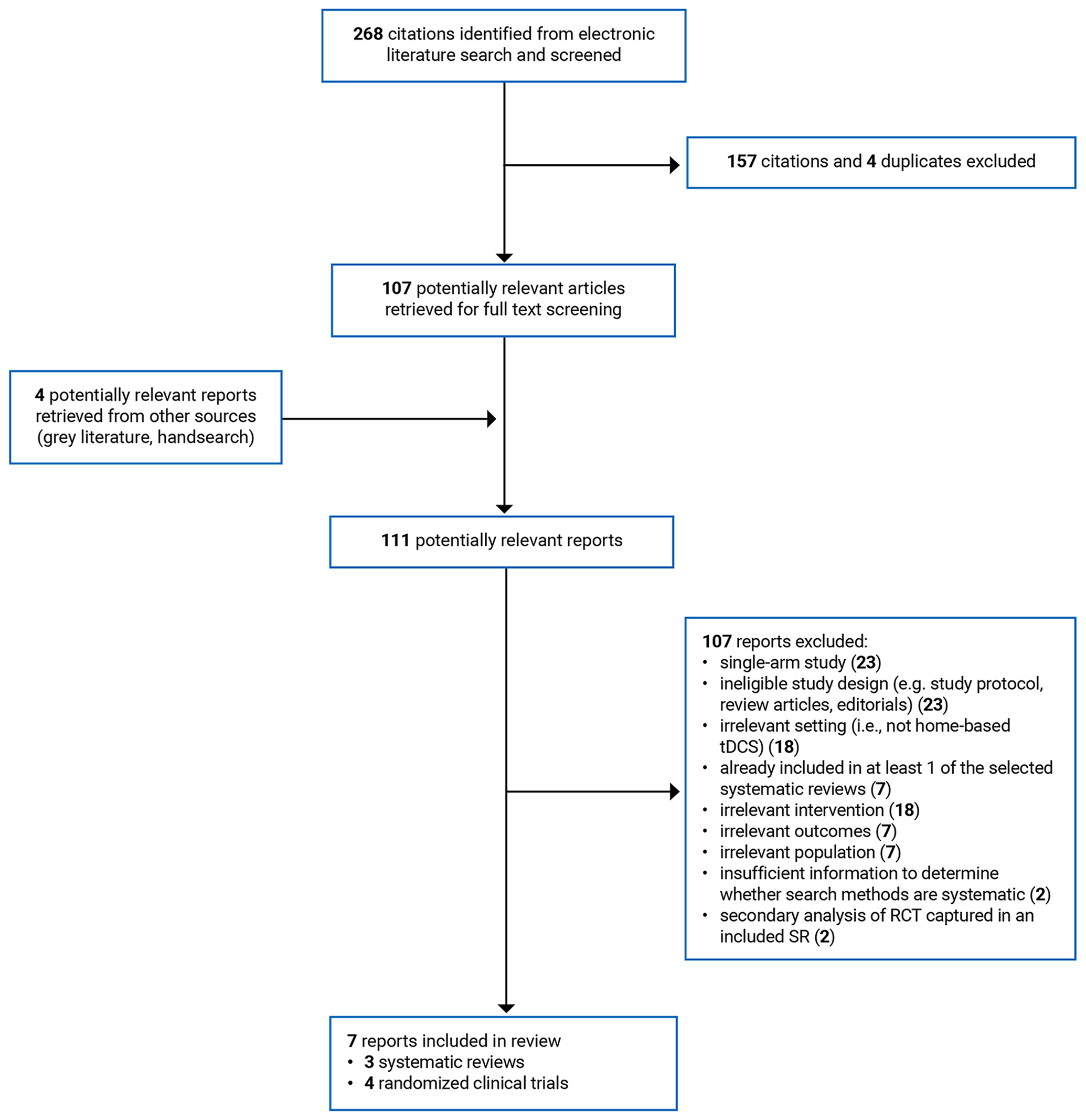
PRISMA = Preferred Reporting Items for Systematic Reviews and Meta-Analyses; RCT = randomized controlled trial; SR = systematic review; tDCS = transcranial direct current stimulation.
Appendix 3: Characteristics of Included Publications
Please note that this appendix has not been copy-edited.
Table 2: Characteristics of Included Systematic Reviews
Study citation, countries of eligible studies, funding source | Study designs and numbers of primary studies included | Population characteristics | Intervention and comparator(s) | Clinical outcomes, length of follow-up, treatment duration |
|---|---|---|---|---|
da Silva et al. (2025)16 Countries of included studies: The location in which included primary studies were conducted was NR. Funding source: The São Paulo Research Foundation (FAPESP), Research Foundation Flanders (FWO), Ghent University, and National Council for Scientific and Technological Development (CNPq). | Study designs included: Randomized clinical trials Number of primary studies included: 21 Number of primary studies relevant to this report: 3 | Eligibility: Adults experiencing an acute depressive episode. Number of participants: Relevant primary studies included between 64 and 174 participants (total of 384) Age: The mean age of participants from relevant primary studies ranged from 33.4 years to 39 years Sex or gender: The proportion of participants who are women in relevant primary studies ranged from 69% to 86.3%; other sexes or genders were NR Other PROGRESS-Plus Criteria: NRa | Intervention:
tDCS device(s): NR Comparators: Sham tDCS, (2 studies); placebo internet-based therapy or placebo tDCS (1 study) | Primary outcomes:
Follow-up: NR |
Kassar et al. (2025)17 Countries of included studies: Brazil, South Korea, UK, and the US Funding source: NR | Study designs included: Randomized clinical trials Number of primary studies included: 3 Number of primary studies relevant to this report: 3 | Eligibility: Patients who have moderate to severe major depressive disorder, with HAM-D scores of at least 14. Number of participants: Primary studies included between 58 and 174 participants (total of 378). Age: The mean age of participants from relevant primary studies ranged from 33.4 years to 39 years Sex or gender: The proportion of participants who are women in relevant primary studies ranged from 40% to 79% in the control groups and 50% to 93%; other sexes or genders were NR Other PROGRESS-Plus Criteria: NRa | Intervention:
tDCS device(s): NR Comparator: Sham tDCS | Primary outcomes:
Follow-up: NR |
Moshfeghinia et al. (2025)15 Countries of included studies: Brazil, Germany, South Korea, and UK. Funding source: Iran University of Medical Sciences | Study designs included: Randomized controlled trials Number of primary studies included: 5 Number of primary studies relevant to this report: 5 | Eligibility: People diagnosed with depressive disorders, ranging from mild depression to major depressive disorder Number of participants: Primary studies included between 11 and 174 participants (total of 413). Age:
Sex or gender:
Other PROGRESS-Plus Criteria: NRa | Intervention: At-home tDCS (2 mA intensity for 30 minute) for 6 weeks (4 studies) or 10 weeks (1 study) tDCS device(s): NR Comparator: Sham tDCS (2 mA intensity for 30 minute) for 6 weeks (4 studies) or 10 weeks (1 study) | Primary outcomes:
Follow-up: NR |
BDI-II = Beck II Depression Inventory; DSM-5 = Diagnostic and Statistical Manual of Mental Disorders Fifth Edition; HAM-A = Hamilton Anxiety Rating Scale; HAM-D = Hamilton Depression Rating Scale; HDRS-17 = Hamilton Depression Rating Scale 17-item version; ICD = International Classification of Diseases 11th revision; MADRS = Montgomery–Åsberg Depression Rating Scale; NR = not reported, tDCS = transcranial direct current stimulation;
aThe main PROGRESS-Plus criteria include place of residence, race, ethnicity, culture, language, occupation, gender, sex, religion, education, socioeconomic status, social capital, personal characteristics associated with discrimination (e.g., age, disability), features of relationships, and time-dependent relationships.25
Table 3: Characteristics of Included Primary Clinical Studies
Study citation, country, funding source | Study design | Population characteristics | Intervention and comparator(s) | Clinical outcomes, length of follow-up |
|---|---|---|---|---|
Leffa et al. (2022)20 Brazil Funding sources: National Council for Scientific and Technological Development (Brazilian federal government); Foundation for Research Support of the State of Rio Grande do Sul (FAPERGS); Brain and Behaviour Research Foundation (NARSAD); The São Paulo State Research Foundation (FAPESP); Brazilian Innovation Agency (FINEP) | Double-blind randomized sham- controlled trial | Eligibility: Adults who met the DSM-5 criteria for ADHD, with moderate or severe symptoms of inattention, who are not being treated with stimulants (or agreed to perform a 30-day stimulant washout), an IQ score of 80 or above, and self-reported as European. Number of participants: 32 participants in the active group and 32 in the sham group Age: Mean age of 38.2 (SD = 10.3) years in the intervention group and 38.4 (SD = 9.1) in the comparator group Sex or gender:
Years of education:
Brazilian criteria socioeconomic status:
Other PROGRESS-Plus Criteria: NRa | Intervention: Active tDCS (2 mA intensity for 30 minutes, once daily, for 4 weeks, for a total of 28 sessions) tDCS device: A home-based tDCS device developed at Hospital de Clínicas de Porto Alegre (the study site) Comparator: Sham tDCS (ramp up from 0 to 2 mA for 30 seconds, followed by a 30 second ramp down from 2 to 0 mA at the beginning, middle, and end of the sessions). | Primary outcomes:
Follow-up: at the end of treatment (4 weeks) |
Koutsomitros et al. (2023)21 Greece Funding source: The authors reported that while no external funding was received for the research, tDCS headsets were provided by the manufacturer for free. | Open-label randomized controlled trial | Eligibility: People experiencing a moderate to severe depressive episode, either single or recurrent, without psychotic symptoms, diagnosed using DSM-5 and ICD-10 criteria. Number of participants: 20 in the TAU group and 20 in the tDCS group Age: Ranged from 20 and 55 years, with an average age of 36 in the TAU group and 33 in the tDCS group Sex or gender:
Other PROGRESS-Plus Criteria: NRa | Intervention: Active tDCS (2mA intensity for 30 minutes, once daily, for 21 days) with psychotherapy tDCS device: PlatoWork 2.0 tDCS headset (PlatoScience ApS, Denmark). Comparator: Treatment as usual (psychotherapy) | Primary outcomes:
Follow-up: at the end of treatment (3 weeks) |
Lee et al. (2025)18 South Korea Funding source: Korea Medical Device Development Fund grant funded by the Korean government | Double-blind randomized sham- controlled trial | Eligibility: Patients diagnosed with major depressive disorder, who did not achieve remission following antidepressant treatment Number of participants: 47 in the low-intensity group, 49 in the high-intensity group, and 45 in the sham group. Age: Mean age of 35.7 (SD = 12.7) years Sex or gender:
Years at school
Employment
Marital status
Other PROGRESS-Plus Criteria: NRa | Intervention:
tDCS device: MINDD STIM (Ybrain Inc.) Comparator: Sham tDCS (0.1 mA for 30 seconds stimulation before the device is turned off) | Primary outcomes:
Follow-up: at the end of treatment (6 weeks) |
Park et al., (2025)19 South Korea Funding sources: Korea Health Industry Development Institute (KHIDI) funded by the Ministry of Health and Welfare, and the Republic of Korea National Research Foundation of Korea (NRF), funded by the Korean government. | Double-blind randomized sham- controlled trial | Eligibility: Patients with non-severe unipolar depression, without psychotic symptoms. Number of participants: 89 in the intervention group and 108 in the comparator group Age: Mean age of 36.9 (SD = 14.04) years in the intervention group and 36.3 (SD = 12.76) in the comparator group Sex or gender:
Other PROGRESS-Plus Criteria: NRa | Intervention:
tDCS device: MINDD STIM (Ybrain Inc.) Comparator: 3 weeks of active tDCS stimulation (1.5 to 2mA for 30 minutes) followed by 3 weeks of sham stimulation (1 minute of low intensity stimulation before device is turned off) | Primary outcomes:
Follow-up: 6 weeks after the end of treatment. |
ADHD = attention-deficit/hyperactivity disorder; BDI = Beck Depression Inventory; BAI = Beck Anxiety Inventory; BRIEF-A = Behaviour Rating Inventory of Executive Functions-Adult; CASRS-HI = clinician-administered version of the Adult ADHD Self-report Scale, hyperactivity-impulsivity section; CASRS-I; = clinician-administered version of the Adult ADHD Self-report Scale, inattention section; DSM-5 = Diagnostic and Statistical Manual of Mental Disorders Fifth Edition; GAS = Goal Attainment Scale; HAM-A = Hamilton Anxiety Rating Scale; HAM-D = Hamilton Depression Rating Scale; HDRS-17 = Hamilton Depression Rating Scale 17-item version; ICD = International Classification of Diseases 11th revision; MADRS = Montgomery–Åsberg Depression Rating Scale; MADRS-s = Montgomery–Åsberg Depression Rating Scale-self report; Montgomery–Åsberg Depression Rating Scale; NA = not applicable; NR = not reported; QLES = Quality of Life Enjoyment and Satisfaction Questionnaire; SD = standard deviation; TAU = treatment as usual; tDCS = transcranial direct current stimulation
aThe main PROGRESS-Plus criteria include place of residence, race, ethnicity, culture, language, occupation, gender, sex, religion, education, socioeconomic status, social capital, personal characteristics associated with discrimination (e.g., age, disability), features of relationships, and time-dependent relationships.25
Appendix 4: Critical Appraisal of Included Publications
Please note that this appendix has not been copy-edited.
Table 4: Strengths and Limitations of Systematic Review by da Silva et al. (2025)16 Using AMSTAR 226
AMSTAR 2 items | Domain type | Judgment | Support for judgment |
|---|---|---|---|
Did the research questions and inclusion criteria for the review include the components of PICO? | Noncritical | No | The research questions and eligibility criteria were not clearly described according to the population, intervention, comparator, and outcomes of interest. |
Did the report of the review contain an explicit statement that the review methods were established before the conduct of the review and did the report justify any significant deviations from the protocol? | Critical | No | The report did not state that the review methods were established before the review was conducted. |
Did the review authors explain their selection of the study designs for inclusion in the review? | Noncritical | No | The review authors did not explain why they limited inclusion to randomized controlled trials or justify the other publication restrictions. |
Did the review authors use a comprehensive literature search strategy? | Critical | No | The authors described the key search terms but searched only 1 database (PubMed). They did not report additional search methods, such as searching reference lists, trial or study registries, or grey literature, or contacting experts. |
Did the review authors perform study selection in duplicate? | Noncritical | No | The report did not state whether study selection was conducted in duplicate. |
Did the review authors perform data extraction in duplicate? | Noncritical | No | The report did not state whether data extraction was conducted in duplicate. |
Did the review authors provide a list of excluded studies and justify the exclusions? | Critical | No | The review authors did not provide a list of excluded studies. However, they provided a flow chart of the article selection process that reported the number of studies excluded for each reason. |
Did the review authors describe the included studies in adequate detail? | Noncritical | Partial yes | The authors extracted and presented key characteristics of the included studies, including study design, sample size, intervention characteristics, participants’ age and gender, diagnosis, and treatment-resistant status. |
Did the review authors use a satisfactory technique for assessing the RoB in individual studies that were included in the review? | Critical | Partial yes | The authors assessed risk of bias using the Cochrane Risk of Bias tool, including domains related to allocation, masking of participants, missing data, masking of outcome assessors, and selective reporting. |
Did the review authors report on the sources of funding for the studies included in the review? | Noncritical | No | The review authors did not report the sources of funding for the studies included in the review. |
If meta-analysis was performed did the review authors use appropriate methods for statistical combination of results? | Critical | No | The authors performed a meta-analysis using a random-effects model and conducted meta-regressions and subgroup analyses relevant to the current review. However, they did not justify combining the data in a meta-analysis. |
If meta-analysis was performed, did the review authors assess the potential impact of RoB in individual studies on the results of the meta-analysis or other evidence synthesis? | Noncritical | No | The authors did not assess the potential impact of risk of bias in the individual studies on the meta-analysis results. |
Did the review authors account for RoB in individual studies when interpreting/ discussing the results of the review? | Critical | No | The authors did not account for the risk of bias in the individual studies when interpreting or discussing the review findings. |
Did the review authors provide a satisfactory explanation for, and discussion of, any heterogeneity observed in the results of the review? | Noncritical | No | The authors did not provide a satisfactory explanation for or discussion of heterogeneity across the primary studies. |
If they performed quantitative synthesis did the review authors carry out an adequate investigation of publication bias (small study bias) and discuss its likely impact on the results of the review? | Critical | No | The authors did not investigate publication bias (small-study bias) or discuss its likely impact on the review results. |
Did the review authors report any potential sources of conflict-of-interest, including any funding they received for conducting the review? | Noncritical | Yes | The authors reported that 1 author held a small equity interest in a tDCS device manufacturer and noted that the manufacturer’s devices were not included in the review. They reported no other conflicts of interest, but did not describe how this conflict was mitigated. |
AMSTAR 2 = A MeaSurement Tool to Assess systematic Reviews 2; PICO = population, intervention, comparator, and outcome; RoB = risk of bias; tDCS = transcranial direct current stimulation.
Table 5: Strengths and Limitations of Systematic Review by Kassar et al. (2025)17 Using AMSTAR 226
AMSTAR 2 items | Domain type | Judgment | Support for judgment |
|---|---|---|---|
1. Did the research questions and inclusion criteria for the review include the components of PICO? | Noncritical | Yes | The eligibility criteria clearly specified the population (patients with moderate to severe major depressive disorder), intervention (home-based tDCS involving at least 20 sessions), comparator (sham stimulation), and outcomes (changes in HAM-D and MADRS scores). |
2. Did the report of the review contain an explicit statement that the review methods were established before the conduct of the review and did the report justify any significant deviations from the protocol? | Critical | No | The report did not state that the review methods were established before the review was conducted. |
3. Did the review authors explain their selection of the study designs for inclusion in the review? | Noncritical | Yes | The authors focused on efficacy and explained that mixed findings from recent randomized controlled trials created a need for meta-analysis, supporting their selection of randomized controlled trials. |
4. Did the review authors use a comprehensive literature search strategy? | Critical | No | The authors searched 4 relevant databases (PubMed, Scopus, Web of Science, and Cochrane CENTRAL) through November 2024. However, they did not report search terms or a reproducible search strategy, justify publication restrictions, or describe additional search methods. |
5. Did the review authors perform study selection in duplicate? | Noncritical | No | The authors described 2 phases of study screening but did not state that study selection was conducted independently by at least 2 reviewers. |
6. Did the review authors perform data extraction in duplicate? | Noncritical | Yes | Two independent authors extracted the data using an online data-extraction sheet. |
7. Did the review authors provide a list of excluded studies and justify the exclusions? | Critical | No | The authors did not provide a list of excluded studies with reasons for exclusion or a study selection flow chart. |
8. Did the review authors describe the included studies in adequate detail? | Noncritical | Partial yes | The authors reported the study designs, countries, sample sizes, intervention and comparator groups, outcomes, treatment duration, number and duration of sessions, stimulation amplitude, and participant characteristics. However, some population and intervention details were limited. |
9. Did the review authors use a satisfactory technique for assessing the RoB in individual studies that were included in the review? | Critical | Yes | The authors assessed risk of bias using the Cochrane Risk of Bias 2 tool for randomized trials and reported that detailed results were available in the supplementary material. |
10. Did the review authors report on the sources of funding for the studies included in the review? | Noncritical | No | The authors did not report the sources of funding for the studies included in the review. |
11. If meta-analysis was performed did the review authors use appropriate methods for statistical combination of results? | Critical | Yes | The authors pooled comparable continuous outcomes using mean differences with 95% confidence intervals and an inverse-variance fixed-effect model. Separate analyses were conducted for HAM-D and MADRS outcomes, and statistical heterogeneity was low or absent. |
12. If meta-analysis was performed, did the review authors assess the potential impact of RoB in individual studies on the results of the meta-analysis or other evidence synthesis? | Noncritical | No | The authors did not assess the potential impact of risk of bias in the individual studies on the meta-analysis results. |
13. Did the review authors account for RoB in individual studies when interpreting/ discussing the results of the review? | Critical | No | The authors did not account for risk of bias in the individual studies when interpreting or discussing the review findings. |
14. Did the review authors provide a satisfactory explanation for, and discussion of, any heterogeneity observed in the results of the review? | Noncritical | Yes | The authors assessed heterogeneity using the chi-square test and I2 statistic and reported low heterogeneity for HAM-D (I2 = 25%) and no heterogeneity for MADRS (I2 = 0%). They also noted differences in treatment duration and number of sessions as limitations. |
15. If they performed quantitative synthesis did the review authors carry out an adequate investigation of publication bias (small study bias) and discuss its likely impact on the results of the review? | Critical | No | The authors did not investigate publication bias (small-study bias) or discuss its likely impact on the review results. |
16. Did the review authors report any potential sources of conflict-of-interest, including any funding they received for conducting the review? | Noncritical | No | The report did not include a funding statement or a declaration of potential conflicts of interest for the review authors. |
AMSTAR 2 = A MeaSurement Tool to Assess systematic Reviews 2; CENTRAL = Cochrane Central Register of Controlled Trials; HAM-D = Hamilton Depression Rating Scale; MADRS = Montgomery–Åsberg Depression Rating Scale; PICO = population, intervention, comparator, and outcome; RoB = risk of bias; tDCS = transcranial direct current stimulation.
Table 6: Strengths and Limitations of Systematic Review by Moshfeghinia et al. (2025)15 Using AMSTAR 226
AMSTAR 2 items | Domain type | Judgment | Support for judgment |
|---|---|---|---|
1. Did the research questions and inclusion criteria for the review include the components of PICO? | Noncritical | Yes | The authors explicitly defined the eligibility criteria using PICO: patients with depressive disorders; home-based tDCS; sham tDCS; and depressive symptoms, anxiety symptoms, and adverse effects. |
2. Did the report of the review contain an explicit statement that the review methods were established before the conduct of the review and did the report justify any significant deviations from the protocol? | Critical | Yes | The authors stated that the research plan was registered in PROSPERO (CRD42024545174). No deviations from the registered methods were reported. |
3. Did the review authors explain their selection of the study designs for inclusion in the review? | Noncritical | Yes | The authors selected randomized controlled trials to evaluate intervention efficacy and safety and described RCTs as the gold standard for clinical research. |
4. Did the review authors use a comprehensive literature search strategy? | Critical | Partial yes | The authors searched 6 relevant databases from inception to November 2024 and provided full strategies in the supplementary material. They also searched reference lists, relevant reviews, and Google Scholar for grey literature. However, the English-language restriction was not justified. |
5. Did the review authors perform study selection in duplicate? | Noncritical | Yes | Two named researchers independently screened studies, disagreements were resolved by a senior researcher, and interrater agreement was reported (κ = 0.78). |
6. Did the review authors perform data extraction in duplicate? | Noncritical | Yes | Two named researchers independently extracted data, with disagreements resolved through discussion with a third author. |
7. Did the review authors provide a list of excluded studies and justify the exclusions? | Critical | No | The authors reported the number of records excluded at each stage and presented a PRISMA flow diagram, but did not provide a list of excluded full-text studies with individual reasons for exclusion. |
8. Did the review authors describe the included studies in adequate detail? | Noncritical | Yes | The authors reported the study design, country, condition, sample size, participants’ age and sex, intervention and comparator details, stimulation parameters, treatment duration, electrode placement, outcomes, and adverse events. |
9. Did the review authors use a satisfactory technique for assessing the RoB in individual studies that were included in the review? | Critical | Yes | The authors assessed the 5 domains of the Cochrane Risk of Bias 2 tool and presented study-level results. Three studies were rated as low risk and 2 as having some concerns. |
10. Did the review authors report on the sources of funding for the studies included in the review? | Noncritical | No | The authors did not report the sources of funding for the studies included in the review. |
11. If meta-analysis was performed did the review authors use appropriate methods for statistical combination of results? | Critical | Yes | The authors pooled comparable continuous outcomes as weighted mean differences using a random-effects restricted maximum-likelihood model. They assessed heterogeneity and conducted separate analyses by outcome measure. |
12. If meta-analysis was performed, did the review authors assess the potential impact of RoB in individual studies on the results of the meta-analysis or other evidence synthesis? | Noncritical | Yes | The authors conducted sensitivity analyses that excluded a study with concerns related to its population and examined whether the pooled results changed. GRADE assessments also considered risk of bias. |
13. Did the review authors account for RoB in individual studies when interpreting/ discussing the results of the review? | Critical | Yes | The authors considered risk of bias and indirectness when interpreting the evidence, downgraded the certainty of the depression outcomes to moderate, and used cautious conclusions and recommendations. |
14. Did the review authors provide a satisfactory explanation for, and discussion of, any heterogeneity observed in the results of the review? | Noncritical | Yes | The authors assessed heterogeneity using the chi-square test and I2 statistic and discussed clinical and methodological sources, including population differences, treatment protocols, outcome measures, session characteristics, and adverse-event reporting. |
15. If they performed quantitative synthesis did the review authors carry out an adequate investigation of publication bias (small study bias) and discuss its likely impact on the results of the review? | Critical | Partial yes | The authors examined funnel plots and conducted Egger’s and Begg’s tests. However, analyses included only 2 to 4 studies, and the authors did not discuss the limited reliability of publication bias assessments with so few studies or its likely impact on the findings. |
16. Did the review authors report any potential sources of conflict-of-interest, including any funding they received for conducting the review? | Noncritical | Yes | The authors reported funding from Iran University of Medical Sciences (grant 140-4-99-32632) and declared that they had no competing interests. |
AMSTAR 2 = A MeaSurement Tool to Assess systematic Reviews 2; GRADE = Grading of Recommendations Assessment, Development, and Evaluation; PICO = population, intervention, comparator, and outcome; PROSPERO = International Prospective Register of Systematic Reviews; RCT = randomized controlled trial; REML = restricted maximum likelihood; RoB = risk of bias; tDCS = transcranial direct current stimulation.
Table 7: Clinical Effectiveness of Study by Lee et al. (2025)18 — Strengths and Limitations Using ROBUST-RCT
Risk of bias domains | Step 1: Evaluation | Step 2: Risk of bias judgment | Support for judgment |
|---|---|---|---|
Random sequence generation | Definitely yes | Definitely low | Randomization used a computer-generated list with block sizes. |
Allocation concealment | Probably yes | Probably low | A designated administrator assigned the stimulation settings to the device according to group allocation, while the rater, operator, and participants remained blinded. However, the authors do not explicitly describe concealment of the allocation sequence before assignment. |
Blinding of participants | Probably yes | Probably low | Participants were blinded, and there was no significant difference in correct allocation guesses at week 2. However, partial unblinding occurred by week 6, when allocation guesses differed significantly between groups. |
Blinding of health care providers | Definitely yes | Definitely low | The study maintained a double-blind design in which the rater, operator, and participants did not know the tDCS settings. A designated administrator assigned the settings. |
Blinding of outcome assessors | Definitely yes | Definitely low | All assessments were conducted by trained researchers blinded to study conditions. |
Outcome data not included in analysis | |||
Intervention, n not analyzed of N total (% not analyzed) | — | — | 0 of 96 (0%) |
Control, n not analyzed of N total (% not analyzed) | — | — | 1 of 45 (2.2%) 1 participant in the sham group had raw 2-back data excluded because of an equipment malfunction |
Overall, n not analyzed of N total (% not analyzed) | — | — | 1 of 141 (0.7%)a |
ROBUST-RCT = Risk Of Bias instrument for Use in SysTematic reviews—for Randomized Controlled Trials; tDCS = transcranial direct current stimulation.
aCalculated by reviewers.
Table 8: Clinical Effectiveness of Study by Park et al. (2025)19 — Strengths and Limitations Using ROBUST-RCT
Risk of bias domains | Step 1: Evaluation | Step 2: Risk of bias judgment | Support for judgment |
|---|---|---|---|
Random sequence generation | Definitely yes | Definitely low | Participants were randomly assigned to the 3 weeks active or 6 weeks active group using a computerized sequence. |
Allocation concealment | Probably yes | Probably low | Devices were preprogrammed by an independent researcher who was not involved in assessments or data analysis, and participants and outcome assessors were blinded to group allocation. However, the method used to conceal the allocation sequence before assignment is not explicitly described. |
Blinding of participants | Definitely yes | Definitely low | Participants were blinded to group allocation. Devices had identical interfaces, sounds, and appearances, with no visual or operational cues distinguishing active from sham stimulation. |
Blinding of health care providers | Probably yes | Probably low | Treatment was self-administered at home using preprogrammed devices. An independent researcher programmed the devices and was not involved in assessment or analysis. However, blinding of all health care providers/research personnel involved in participant care is not explicitly reported. |
Blinding of outcome assessors | Definitely yes | Definitely low | The authors explicitly describe the study as double-blind and state that outcome assessors were blinded to group allocation. |
Outcome data not included in analysis | |||
Intervention, n not analyzed of N total (% not analyzed) | — | — | NR of 89 (NR) |
Control, n not analyzed of N total (% not analyzed) | — | — | NR of 108 (NR) |
Overall, n not analyzed of N total (% not analyzed) | — | — | NR of 197 (NR) |
NR = not reported; ROBUST-RCT = Risk Of Bias instrument for Use in SysTematic reviews—for Randomized Controlled Trials
Table 9: Clinical Effectiveness of Study by Koutsomitros et al. (2023)21 — Strengths and Limitations Using ROBUST-RCT
Risk of bias domains | Step 1: Evaluation | Step 2: Risk of bias judgment | Support for judgment |
|---|---|---|---|
Random sequence generation | Probably Yes | Probably low | Participants were assigned to the tDCS or TAU group using manual stratified randomization to balance age, sex, antidepressant medication use, and the psychologist providing psychotherapy. |
Allocation concealment | Probably no | Probably high | The study does not report a method for concealing group allocation before assignment. Because stratified allocation was performed manually and the study was open label, there is insufficient evidence that investigators enrolling or assigning participants could not foresee group assignment. |
Blinding of participants | Definitely no | Definitely high | Participants were not blinded. The study was explicitly open label, and the control group received psychotherapy alone without sham tDCS. |
Blinding of health care providers | Definitely no | Definitely high | The study was open label. Participants in both groups received in-person psychotherapy, while the tDCS group additionally received home-administered tDCS. No procedures for blinding health care providers to treatment allocation were reported. |
Blinding of outcome assessors | Definitely no | Definitely high | Depression was assessed using the self-reported BDI, administered 4 times during the study. Because participants were aware of their treatment allocation, the outcome assessment was not blinded. The authors also identify use of the self-reported BDI rather than expert ratings as a limitation. |
Outcome data not included in analysis | |||
Intervention group, n not analyzed of N total (% not analyzed) | — | — | 0 of 20 (0%)a The paper reports that there was no attrition in the tDCS group |
Control group (TAU), n not analyzed of N total (% not analyzed) | — | — | 0 of 20 (0%)a 3 participants (15%) in the TAU group dropped out because they could not comply with the inclusion and/or exclusion criteria, but the investigators replaced them with 3 newly recruited participants to maintain 2 groups of 20 |
Overall, n not analyzed of N total (% not analyzed) | — | — | 0 of 40 (0%)a |
BDI = Beck Depression Inventory; ROBUST-RCT = Risk Of Bias instrument for Use in SysTematic reviews—for Randomized Controlled Trials; TAU = treatment as usual; tDCS = transcranial direct current stimulation.
*Calculated by reviewers.
Table 10: Clinical Effectiveness of Study by Leffa et al. (2022)20 — Strengths and Limitations Using ROBUST-RCT
Risk of bias domains | Step 1: Evaluation | Step 2: Risk of bias judgment | Support for judgment |
|---|---|---|---|
Random sequence generation | Definitely yes | Definitely low | Participants were randomized 1:1 to active or sham tDCS. Two staff members with no contact with participants generated the allocation sequence using random blocks of 6 and 4 participants. |
Allocation concealment | Definitely yes | Definitely low | The allocation sequence was generated by 2 staff members who had no contact with participants and was kept in opaque, sealed envelopes. The same team programmed the devices according to treatment allocation. |
Blinding of participants | Probably yes | Probably low | Active and sham devices were physically indistinguishable, and sham stimulation was designed to mimic the tactile sensations of active tDCS. However, the blinding assessment indicated an excess of correct treatment guesses in the active group, particularly among treatment responders. |
Blinding of health care providers | Definitely yes | Definitely low | Two staff members with no participant contact generated the allocation sequence and programmed the devices. Active and sham devices were physically indistinguishable, supporting blinding of study personnel who interacted with participants. |
Blinding of outcome assessors | Probably yes | Probably low | The trial was described as double-blind, and the primary outcome was assessed using the clinician-administered Adult ADHD Self-report Scale (CASRS-I). However, the article does not explicitly state in the main report that the clinicians administering the outcome assessment were blinded to treatment allocation. |
Outcome data not included in analysis | |||
Intervention, n not analyzed of N total (% not analyzed) | — | — | 0 of 32 (0%)a |
Control, n not analyzed of N total (% not analyzed) | — | — | 0 of 32 (0%)a |
Overall, n not analyzed of N total (% not analyzed) | — | — | 0 of 64 (0%)a Although all randomized participants were included in the intention-to-treat analysis, 7 participants in the active tDCS group and 2 in the sham tDCS group discontinued the intervention before 4 weeks. Linear mixed-effects models were used to account for missing outcome data. |
ADHD = attention-deficit/hyperactivity disorder; CASRS-I = clinician-administered version of the Adult ADHD Self-report Scale version 1.1, inattention section; RCT = randomized controlled trial; ROBUST-RCT = Risk Of Bias instrument for Use in SysTematic reviews—for Randomized Controlled Trials; tDCS = transcranial direct current stimulation.
aCalculated by reviewers.
Appendix 5: Main Study Findings
Please note that this appendix has not been copy-edited.
Table 11: Summary of Findings by Outcome — Symptoms of Depression (SRs and RCTs Described in SRs)
Citation, study design | Outcome | Active | Control | Between group difference, (95% CI) | P value for between group difference | ||
|---|---|---|---|---|---|---|---|
n | Outcome result | n | Outcome result | ||||
da Silva et al. (2025),16 SR | Meta-regression analysis of home-based tDCS in comparison to sham tDCS, effect estimate (95% CI) | NR | NR | NR | NR | −0.11 (−0.69 to 0.48) | 0.72 |
Borrione et al. (2024), RCT described in a SR | Between group comparison of end point scores, mean (SD) | 73 | 13.10 (6.0) | 73 | 12.30 (5.10) | SMD = 0.14 (−0.18 to 0.47 | NR |
Lee et al. (2022), RCT described in a SR | Between group comparison of end point scores, mean (SD) | 32 | 12.86 (7.38) | 32 | 10.90 (6.00) | SMD = 0.29 (−0.20 to 0.78) | NR |
Woodham et al. (2024), RCT described in a SR | Between group comparison of end point scores, mean (SD) | 87 | 11.80 (3.50) | 87 | 9.80 (4.40) | SMD = 0.50 (0.20 to 0.80) | NR |
Kassar et al., (2025),17 SR | Change in HAM-D score, pooled mean difference (95% CI) | 189 | — | 188 | — | −1.71 (−2.98 to −0.43) | 0.009 |
Change in MADRS score, pooled mean difference (95% CI) | 189 | — | 188 | — | −3.3 (−5.03 to −1.23) | 0.001 | |
Borrione et al., (2024), RCT described in a SR | HAM-D score (SD) | 73 | −8.4 (5.57) | 73 | −7.8 (6.41) | — | — |
MADRS (SD) | 73 | −10.71 (9.99) | 73 | −8.79 (9.88) | — | — | |
Oh et al., (2022), RCT described in a SR | HAM-D score (SD) | 29 | −9.9 (6.69) | 29 | −6.0 (9.39) | — | — |
MADRS (SD) | 29 | −15.1 (9.86) | 29 | −10.3 (12.6) | — | — | |
Woodham et al., (2024), RCT described in a SR | HAM-D score (SD) | 87 | −10.41 (6.25) | 86 | −7.14 (6.1) | — | — |
MADRS (SD) | 87 | −11.31 (8.81) | 86 | −7.74 (8.47) | — | — | |
Moshfeghinia et al. (2025),15 SR | Decrease in MADRS scores (4 studies), weighted mean difference (95% CI) | 126 | — | 143 | — | −2.74 (−4.19 to −1.29) | NR |
Decrease in HAM-D scores (4 studies), weighted mean difference (95% CI) | 194 | — | 210 | — | −2.24 (−4.16 to −1.49) | NR | |
Borrione et al. (2024), RCT described in a SR | Decrease in HAM-D scores, mean (SD) | 73 | −8.4 (4.67) | 73 | −7.8 (5.52) | MD = −0.60 (−2.26 to 1.06) | — |
Kim et al. (2023), RCT described in a SR | Decrease in MADRS scores, mean (SD) | 14 | −6.7 (10.09) | 23 | −6.1 (9.41) | MD = −0.60 (−7.02 to 5.82) | — |
Decrease in HAM-D scores, mean (SD) | 14 | −3.5 (6.24) | 23 | −1.3 (5.72) | MD = −2.20 (−6.13 to 1.73) | — | |
Kumpf et al. (2023), RCT described in a SR | Decrease in MADRS scores, mean (SD) | 5 | −9 (2.5) | 6 | −5.2 (2.35) | MD = −3.80 (−6.67 to −0.93) | — |
Oh et al. (2022), RCT described in a SR | Decrease in MADRS scores, mean (SD) | 20 | −14.9 (8.27) | 25 | −10.2 (10.39) | MD = −4.70 (−10.29 to 0.89) | — |
Decrease in HAM-D scores, mean (SD) | 20 | −9.2 (5.58) | 25 | −6.1 (7.64) | MD = −3.10 (−7.10 to 0.90) | — | |
Woodham et al. (2024), RCT described in a SR | Decrease in MADRS scores, mean (SD) | 87 | −9.41 (6.25) | 87 | −7.14 (6.1) | MD = −2.27 (−4.11 to −0.43) | — |
Decrease in HAM-D scores, mean (SD) | 87 | −11.8 (8.81) | 87 | −7.74 (8.47) | MD = −4.06 (−6.63 to −1.49) | — | |
CI = confidence interval; HAM-D = Hamilton Depression Rating Scale; MADRS = Montgomery-Åsberg Depression Rating Scale; MD = mean difference; NR = not reported; RCT = randomized clinical trial; SD = standard deviation; SMD = standardized mean difference; SR = systematic review; tDCS = transcranial direct current stimulation
Table 12: Summary of Findings by Outcome — Symptoms of Depression (RCTs)
Outcome and time point | Group | n | Outcome result | 95% CI | P value |
|---|---|---|---|---|---|
Koutsomitros et al., (2023)21 | |||||
BDI scores pairwise comparisons | |||||
Baseline | tDCS vs. Treatment as usual | 20 vs. 20 | t (57.2) = 0.719 | NR | 0.475 |
After 1 week | tDCS vs. Treatment as usual | 20 vs. 20 | t (57.2) = 0.762 | NR | 0.449 |
After 2 weeks | tDCS vs. Treatment as usual | 20 vs. 20 | t (57.2) = 1.257 | NR | 0.214 |
After 3 weeks | tDCS vs. Treatment as usual | 20 vs. 20 | t (57.2) = 2.268 | NR | 0.027 |
Treatment response ≥ 50% decrease in BDI) | |||||
Study end | tDCS vs. Treatment as usual | 20 vs. 20 | 50% vs. 5% | NR | NR |
Remission rate (BDI < 13) | |||||
Study end | tDCS vs. Treatment as usual | 20 vs. 20 | 50% vs. 30% | NR | NR |
Lee et al., (2025)18 | |||||
HAM-D score, change from baseline to week 6, mean (SD) | Low active | 47 | −7.40 (8.51) | NR | 0.609 |
High active | 49 | −8.59 (9.18) | NR | — | |
Sham | 45 | −6.96 (6.82) | NR | — | |
BDI score change from baseline to week 6, mean (SD) | Low active | 47 | −10.7 (15.8) | NR | 0.321 |
High active | 49 | −14.9 (15.1) | NR | — | |
Sham | 45 | −11.2 (13.3) | NR | — | |
HAM-A score, change from baseline to week 6, mean (SD) | Low active | 47 | −9 (10.7) | NR | 0.849 |
High active | 49 | −9.96 (13.5) | NR | — | |
Sham | 45 | −8.67 (9.67) | NR | — | |
Park et al. (2025)19 | |||||
BDI score, mean (SD) | |||||
Visit 1 (baseline) | 3 weeks active | 89 | 28.91 (SD = 10.98) | NR | NR |
6 weeks active | 108 | 29.81 (SD = 12.88) | NR | NR | |
Visit 2 (week 3) | 3 weeks active | 65 | 23.98 (SD = 13.32) | NR | NR |
6 weeks active | 98 | 24.96 (SD = 13.01) | NR | NR | |
Visit 3 (week 6) | 3 weeks active | 57 | 22.09 (SD = 13.66) | NR | NR |
6 weeks active | 89 | 24.35 (SD = 13.85) | NR | NR | |
Visit 4 (week 12) | 3 weeks active | 55 | 20.49 (SD = 14.46) | NR | NR |
6 weeks active | 77 | 22.81 (SD = 14.91) | NR | NR | |
Effect of time on BDI scores | Baseline to week 12 | NR | f = 33.671 | — | < 0.001 |
Model-derived changes in BDI score, mean | |||||
Baseline to week 12 | All participants | NR | −7.53 | −9.85 to − 5.21 | NR |
MADRS scores, mean (SD) | |||||
Visit 1 (baseline) | 3 weeks active | 89 | 24.29 (SD = 7.71) | NR | NR |
6 weeks active | 108 | 25.63 (SD = 8.15) | NR | NR | |
Visit 2 (week 3) | 3 weeks active | 65 | 19.43 (SD = 8.79) | NR | NR |
6 weeks active | 98 | 19.76 (SD = 8.40) | NR | NR | |
Visit 3 (week 6) | 3 weeks active | 57 | 18.42 (SD = 10.91) | NR | NR |
6 weeks active | 89 | 19.15 (SD = 9.26) | NR | NR | |
Visit 4 (week 12) | 3 weeks active | 55 | 17.13 (SD = 12.95) | NR | NR |
6 weeks active | 77 | 19.30 (SD = 10.35) | NR | NR | |
Effect of time on MADRS scores | |||||
Baseline to week 12 | — | — | f = 34.499 | — | < 0.001 |
Model-derived changes in MADRS score, mean | |||||
Baseline to week 12 | All participants | NR | −6.61 | −8.73 to −4.49 | NR |
BDI = Beck Depression Inventory; CI = confidence interval; HAM-D = Hamilton Depression Rating Scale; HDRS = Hamilton Depression Rating Scale; MADRS = Montgomery-Åsberg Depression Rating Scale; NR = not reported; SD = standard deviation; tDCS = transcranial direct current stimulation
Table 13: Summary of Findings by Outcome — Adverse Events
Citation and study design | Group or comparison (time point) | Outcome | Outcome result |
|---|---|---|---|
Moshfeghinia (2025)15 RCT (Kim et al. [2023]) described in a SR | NR | Adverse events | None reported |
Moshfeghinia et al., (2025)15 RCT Kumpf et al. [2023]) described in a SR | NR | Increased burning and pain, n | 1 |
Light flashes during stimulation, n | 1 | ||
Heightened skin sensitivity, n | 1 | ||
Moshfeghinia et al., (2025)15 RCT (Borrione et al. [2024]) described in a SR | NR | Local skin redness, heat, or burning sensation | NR |
Active group | Nonfatal suicide attempt, n | 1 | |
Leffa et al. (2022) RCT | Active tDCS (n = 32; at least once during the study) | Tingling, n (%) | 24 (75%) |
Skin redness, n (%) | 19 (59.4%) | ||
Headache, n (%) | 17 (53.1%) | ||
Scalp burn, n (%) | 16 (50%) | ||
Scalp pain, n (%) | 9 (28.1%) | ||
Sleepiness, n (%) | 4 (12.5%) | ||
Mood change, n (%) | 5 (15.6%) | ||
Neck pain, n (%) | 7 (21.9%) | ||
Trouble sleeping, n (%) | 3 (9.4%) | ||
Difficulty concentrating, n (%) | 0 (0%) | ||
Flashes of light, n (%) | 2 (6.2%) | ||
Mental fatigue, n (%) | 0 (0%) | ||
Nausea, n (%) | 1 (3.1%) | ||
Stiff jaw, n (%) | 0 (0%) | ||
Tingling hands, n (%) | 0 (0%) | ||
Dizziness, n (%) | 1 (3.1%) | ||
Sham tDCS (n = 32; at least once during the study) | Tingling, n (%) | 26 (81.3%) | |
Skin redness, n (%) | 15 (46.9%) | ||
Headache, n (%) | 11 (34.4%) | ||
Scalp burn, n (%) | 10 (31.3%) | ||
Scalp pain, n (%) | 8 (25%) | ||
Sleepiness, n (%) | 10 (31.3%) | ||
Mood change, n (%) | 10 (31.3%) | ||
Neck pain, n (%) | 5 (15.6%) | ||
Trouble sleeping, n (%) | 1 (3.1%) | ||
Difficulty concentrating, n (%) | 2 (6.2%) | ||
Flashes of light, n (%) | 0 (0%) | ||
Mental fatigue, n (%) | 2 (6.2%) | ||
Nausea, n (%) | 0 (0%) | ||
Stiff jaw, n (%) | 1 (3.1%) | ||
Tingling hands, n (%) | 1 (3.1%) | ||
Dizziness, n (%) | 0 (0%) | ||
Koutsomitros et al., (2023) RCT | tDCS (420 assigned sessions) | Mild headache, n (%) | 2 (0.48%) |
Mild neck pain, n (%) | 0 (0%) | ||
Mild scalp pain, n (%) | 5 (1.19%) | ||
Mild tingling, n (%) | 1 (0.24%) | ||
Mild itching, n (%) | 0 (0%) | ||
Mild burning sensation, n (%) | 0 (0%) | ||
Mild skin redness, n (%) | 0 (0%) | ||
Mild sleepiness, n (%) | 0 (0%) | ||
Mild trouble concentrating, n (%) | 0 (0%) | ||
Mild acute mood change, n (%) | 0 (0%) | ||
Mild phosphene, n (%) | 1 (0.24%) | ||
Mild discomfort, n (%) | 1 (0.24%) | ||
Total mild side effects, n (%) | 10 (2.4%) | ||
tDCS (420 assigned sessions) | Moderate headache, n (%) | 0 (0%) | |
Moderate neck pain, n (%) | 0 (0%) | ||
Moderate scalp pain, n (%) | 4 (0.95%) | ||
Moderate tingling, n (%) | 0 (0%) | ||
Moderate itching, n (%) | 0 (0%) | ||
Moderate burning sensation, n (%) | 0 (0%) | ||
Moderate skin redness, n (%) | 0 (0%) | ||
Moderate sleepiness, n (%) | 0 (0%) | ||
Moderate trouble concentrating, n (%) | 0 (0%) | ||
Moderate acute mood change, n (%) | 0 (0%) | ||
Moderate phosphene, n (%) | 0 (0%) | ||
Moderate discomfort, n (%) | 0 (0%) | ||
Total moderate side effects, n (%) | 4 (0.95%) | ||
tDCS (420 assigned sessions) | Severe headache, n (%) | 0 (0%) | |
Severe neck pain, n (%) | 0 (0%) | ||
Severe scalp pain, n (%) | 2 (0.48%) | ||
Severe tingling, n (%) | 0 (0%) | ||
Severe itching, n (%) | 0 (0%) | ||
Severe burning sensation, n (%) | 0 (0%) | ||
Severe skin redness, n (%) | 0 (0%) | ||
Severe sleepiness, n (%) | 0 (0%) | ||
Severe trouble concentrating, n (%) | 0 (0%) | ||
Severe acute mood change, n (%) | 0 (0%) | ||
Severe phosphene, n (%) | 0 (0%) | ||
Severe discomfort, n (%) | 0 (0%) | ||
Total severe side effects, n (%) | 2 (0.48%) | ||
tDCS (420 assigned sessions) | Mild to moderate side effect (headache, scalp pain, phosphene, discomfort, or tingling), n (%) | 14 (3.33%) | |
Severe side effect (scalp pain), n (%) | 2 (0.48%) | ||
Serious adverse events, n (%) | 0 (0%) | ||
Lee et al., (2025)18 RCT | Low active (n = 47); (weeks 0 to 2) | Headache, n (%) | 7 (14.9%) |
Neck pain, n (%) | 0 (0%) | ||
Discomfort, n (%) | 8 (17.0%) | ||
Tingling, n (%) | 14 (29.8%) | ||
Itching, n (%) | 3 (6.4%) | ||
Burning, n (%) | 4 (8.5%) | ||
Skin redness, n (%) | 4 (8.5%) | ||
Sleepiness, n (%) | 4 (8.5%) | ||
Trouble concentrating, n (%) | 2 (4.3%) | ||
Fatigue, n (%) | 3 (6.4%) | ||
Nausea, n (%) | 0 (0%) | ||
Dizziness, n (%) | 3 (6.4%) | ||
High active (n = 49); (weeks 0 to 2) | Headache, n (%) | 8 (16.3%) | |
Neck pain, n (%) | 0 (0%) | ||
Discomfort, n (%) | 13 (26.5%) | ||
Tingling, n (%) | 18 (36.7%) | ||
Itching, n (%) | 4 (8.2%) | ||
Burning, n (%) | 11 (22.4%) | ||
Skin redness, n (%) | 12 (24.5%) | ||
Sleepiness, n (%) | 3 (6.1%) | ||
Trouble concentrating, n (%) | 0 (0%) | ||
Fatigue, n (%) | 0 (0%) | ||
Nausea, n (%) | 0 (0%) | ||
Dizziness, n (%) | 1 (2.0%) | ||
Sham (n = 45); (weeks 0 to 2) | Headache, n (%) | 3 (6.7%) | |
Neck pain, n (%) | 1 (2.2%) | ||
Discomfort, n (%) | 5 (11.1%) | ||
Tingling, n (%) | 8 (17.8%) | ||
Itching, n (%) | 2 (4.4%) | ||
Burning, n (%) | 2 (4.4%) | ||
Skin redness, n (%) | 1 (2.2%) | ||
Sleepiness, n (%) | 1 (2.2%) | ||
Trouble concentrating, n (%) | 0 (0%) | ||
Fatigue, n (%) | 3 (6.7%) | ||
Nausea, n (%) | 1 (2.2%) | ||
Dizziness, n (%) | 2 (4.4%) | ||
Lee et al., (2025)18 RCT | Low active (n = 47); weeks 2 to 4) | Headache, n (%) | 0 (0%) |
Neck pain, n (%) | 1 (2.1%) | ||
Discomfort, n (%) | 1 (2.1%) | ||
Tingling, n (%) | 1 (2.1%) | ||
Itching, n (%) | 3 (6.4%) | ||
Burning, n (%) | 2 (4.3%) | ||
Skin redness, n (%) | 2 (4.3%) | ||
Sleepiness, n (%) | 0 (0%) | ||
Trouble concentrating, n (%) | 0 (0%) | ||
Fatigue, n (%) | 1 (2.1%) | ||
Nausea, n (%) | 0 (0%) | ||
Dizziness, n (%) | 0 (0%) | ||
High active (n = 49); weeks 2 to 4) | Headache, n (%) | 1 (2.0%) | |
Neck pain, n (%) | 0 (0%) | ||
Discomfort, n (%) | 2 (4.1%) | ||
Tingling, n (%) | 2 (4.1%) | ||
Itching, n (%) | 2 (4.1%) | ||
Burning, n (%) | 0 (0%) | ||
Skin redness, n (%) | 3 (6.1%) | ||
Sleepiness, n (%) | 0 (0%) | ||
Trouble concentrating, n (%) | 0 (0%) | ||
Fatigue, n (%) | 1 (2.1%) | ||
Nausea, n (%) | 0 (0%) | ||
Dizziness, n (%) | 0 (0%) | ||
Sham (n = 45); weeks 2 to 4) | Headache, n (%) | 1 (2.2%) | |
Neck pain, n (%) | 1 (2.2%) | ||
Discomfort, n (%) | 1 (2.2%) | ||
Tingling, n (%) | 1 (2.2%) | ||
Itching, n (%) | 0 (0%) | ||
Burning, n (%) | 0 (0%) | ||
Skin redness, n (%) | 1 (2.2%) | ||
Sleepiness, n (%) | 1 (2.2%) | ||
Trouble concentrating, n (%) | 2 (4.4%) | ||
Fatigue, n (%) | 0 (0%) | ||
Nausea, n (%) | 1 (2.2%) | ||
Dizziness, n (%) | 0 (0%) | ||
Lee et al., (2025)18 RCT | Low active (n = 47); weeks 4 to 6) | Headache, n (%) | 1 (2.2%) |
Neck pain, n (%) | 1 (2.2%) | ||
Discomfort, n (%) | 2 (4.3%) | ||
Tingling, n (%) | 2 (4.3%) | ||
Itching, n (%) | 0 (0%) | ||
Burning, n (%) | 1 (2.2%) | ||
Skin redness, n (%) | 0 (0%) | ||
Sleepiness, n (%) | 1 (2.2%) | ||
Trouble concentrating, n (%) | 1 (2.2%) | ||
Fatigue, n (%) | 1 (2.2%) | ||
Nausea, n (%) | 0 (0%) | ||
Dizziness, n (%) | 1 (2.2%) | ||
High active (n = 49); weeks 4 to 6) | Headache, n (%) | 2 (4.1%) | |
Neck pain, n (%) | 0 (0%) | ||
Discomfort, n (%) | 0 (0%) | ||
Tingling, n (%) | 1 (2.0%) | ||
Itching, n (%) | 1 (2.0%) | ||
Burning, n (%) | 0 (0%) | ||
Skin redness, n (%) | 0 (0%) | ||
Sleepiness, n (%) | 0 (0%) | ||
Trouble concentrating, n (%) | 0 (0%) | ||
Fatigue, n (%) | 0 (0%) | ||
Nausea, n (%) | 0 (0%) | ||
Dizziness, n (%) | 1 (2.0%) | ||
Sham (n = 45); weeks 4 to 6) | Headache, n (%) | 0 (0%) | |
Neck pain, n (%) | 0 (0%) | ||
Discomfort, n (%) | 0 (0%) | ||
Tingling, n (%) | 1 (2.2%) | ||
Itching, n (%) | 1 (2.2%) | ||
Burning, n (%) | 0 (0%) | ||
Skin redness, n (%) | 0 (0%) | ||
Sleepiness, n (%) | 0 (0%) | ||
Trouble concentrating, n (%) | 0 (0%) | ||
Fatigue, n (%) | 0 (0%) | ||
Nausea, n (%) | 0 (0%) | ||
Dizziness, n (%) | 0 (0%) | ||
Park et al., (2025)19 RCT | Skin | Skin stinging, n | 40 |
Skin itching, n | 11 | ||
Rash, n | 4 | ||
Urticaria, n | 1 | ||
Gastrointestinal | Loss of appetite, n | 1 | |
Nausea, n | 1 | ||
Neurologic | Headaches, n | 6 | |
Dizziness, n | 2 | ||
Psychiatric | Agitation, n | 3 | |
Insomnia, n | 2 | ||
Depressive symptoms, n | 1 | ||
Increased suicidal tendency, n | 1 | ||
Cardiovascular | Palpitations, n | 1 | |
Musculoskeletal | Joint Pain, n | 2 | |
Muscle cramps, n | 1 | ||
Other | Fatigue, n | 5 |
NR = not reported; RCT = randomized clinical trial; SR = systematic review; tDCS = transcranial direct current stimulation
Table 14: Summary of Findings by Outcome — Quality of Life
Citation and study design | Outcome | Group | n | Outcome result | Between group difference, (95% CI) | P value |
|---|---|---|---|---|---|---|
Lee et al., (2025),18 RCT | QLES score change from baseline to week 6, mean (SD) | Low active | 47 | −3.70 (17.7) | NR | 0.508 |
High active | 49 | −7.71 (20.1) | NR | — | ||
Sham | 45 | −3.98 (18.5) | NR | — |
CI = confidence interval; NR = not reported; QLES = Quality of Life Enjoyment and Satisfaction Questionnaire; RCT = randomized controlled trial; SD = standard deviation
Table 15: Summary of Findings by Outcome — Cognitive Function
Citation, study design | Outcome | Time point | Group | n | Outcome result | 95% CI | P value |
|---|---|---|---|---|---|---|---|
Lee et al., (2025),18 RCT | 2-back test accuracy score change from baseline to week 6, mean (SD) | — | Low active | 47 | −0.009 (0.324) | NR | 0.058 |
— | High active | 49 | 0.022 (0.096) | NR | — | ||
— | Sham | 45 | 0.105 (0.229) | NR | — | ||
Park et al. (2025),19 RCT | DSST | Visit 1 (baseline) | 3 weeks active, mean (SD) | 89 | 42.47 (11.60) | NR | NR |
6 weeks active | 108 | 42.99 (10.93) | NR | NR | |||
Visit 2 (week 3) | 3 weeks active | 65 | 46.97 (10.08) | NR | NR | ||
6 weeks active | 98 | 46.64 (10.95) | NR | NR | |||
Visit 3 (week 6) | 3 weeks active | 57 | 49.11 (10.46) | NR | NR | ||
6 weeks active | 89 | 48.31 (11.64) | NR | NR | |||
Visit 4 (week 12) | 3 weeks active | 55 | 48.09 (10.54) | NR | NR | ||
6 weeks active | 77 | 49.51 (12.10) | NR | NR | |||
Effect of time on DSST scores | Baseline to week 12 | — | — | F = 55.754 | NR | < 0.001 | |
Group effect on DSST scores | Baseline to week 12 | 3 weeks active vs 6 weeks active | NR | F = 0.250 | NR | 0.617 |
CI = confidence interval; DSST = Digit Symbol Substitution Test; NR = not reported; RCT = randomized controlled trial; SD = standard deviation
Table 16: Summary of Findings by Outcome — Inattention Score
Citation, study design | Outcome | Outcome result | 95% CI | P value | |
|---|---|---|---|---|---|
Active tDCS | Sham tDCS | ||||
Leffa et al. (2022), RCT | Mean inattention score measured with CASRS-I, (SD) | 18.88 (5.79) | 23.63 (3.97) | NR | NR |
30% reduction in CASRS-I score, n (%) | 11 (34.3%) | 2 (6.2%) | NR | NR | |
CASRS-I = clinician-administered Adult ADHD Self-report Scale version 1.1; CI = confidence interval; NR = not reported; RCT = randomized controlled trial; SD = standard deviation, tDCS = transcranial direct current stimulation
Table 17: Summary of Findings by Outcome — Adverse Events, Group Comparisons
Citation, study design | Outcome | Low active | High active | Control | P value for between group difference | |||
|---|---|---|---|---|---|---|---|---|
n | Outcome result | n | Outcome result | n | Outcome result | |||
Lee et al. (2025),18 RCT | Any event, mean (SD) | 47 | 2.40 (2.64) | 49 | 2.18 (2.23) | 45 | 1.31 (2.14) | 0.07 |
Mild event, mean (SD) | 47 | 1.64 (1.82) | 49 | 1.55 (1.53) | 45 | 0.71 (1.20) | < 0.01 | |
Moderate event, mean (SD) | 47 | 0.68 (1.56) | 49 | 0.47 (1.00) | 45 | 0.36 (0.91) | 0.63 | |
Severe event, mean (SD) | 47 | 0.09 (0.41) | 49 | 0.16 (0.77) | 45 | 0.24 (0.91) | 0.37 | |
RCT = randomized controlled trial; SD = standard deviation
Table 18: Summary of Findings by Outcome — Feasibility and Tolerability
Citation, study design | Outcome | Group | Outcome result | P value for between group difference |
|---|---|---|---|---|
Koutsomitros et al. (2023), RCT | Good compliance, n (%) | tDCS | 18 (90%) | — |
Full compliance, n (%) | tDCS | 10 (50%) | — | |
Patient dropouts, n (%) | tDCS | 0 (0%) | NR | |
Treatment as usual | 3 (15%) | |||
“Good” or “very good” ratings of tDCS sessions, % | tDCS | 91% | — | |
Average rating of all sessions, 5-point scale | tDCS | 4.6 | — |
NR = not reported; tDCS = transcranial direct current stimulation
avalues estimated from graphical figure.
Appendix 6: Overlap Between Included Systematic Reviews
Please note that this appendix has not been copy-edited.
Table 19: Overlap in Relevant Primary Studies Between Included Systematic Reviews
Primary study citation | daSilva et al. (2025)16 | Kassar et al. (2025)17 | Moshfeghinia et al. (2025)15 |
|---|---|---|---|
Borrione L, et al. JAMA Psychiatry. 2024;81(4):329-337. | Yes | Yes | Yes |
Kim J, et al. Clin EEG Neurosci 2024;55(5):531-542. | — | — | Yes |
Kumpf U, et al. Eur Arch Psychiatry Clin Neurosci 2023;273(7):1403-1420. | — | — | Yes |
Lee J, et al. Front Psychiatr 2022;13():969199. | Yes | — | — |
Oh J, et al. Clin Psychopharmacol Neurosci 2022;20(1):87-96. | — | Yes | Yes |
Woodham RD, et al. Nat Med 2025;31(1):87-95. | Yes | Yes | Yes |
ISSN: 2563-6596
Canada’s Drug Agency (CDA-AMC) is a pan-Canadian health organization. Created and funded by Canada’s federal, provincial, and territorial governments, we’re responsible for driving better coordination, alignment, and public value within Canada’s drug and health technology landscape. We provide Canada’s health system leaders with independent evidence and advice so they can make informed drug, health technology, and health system decisions, and we collaborate with national and international partners to enhance our collective impact.
Disclaimer: CDA-AMC has taken care to ensure that the information in this document was accurate, complete, and up to date when it was published, but does not make any guarantee to that effect. Your use of this information is subject to this disclaimer and the Terms of Use at cda-amc.ca.
The information in this document is made available for informational and educational purposes only and should not be used as a substitute for professional medical advice, the application of clinical judgment in respect of the care of a particular patient, or other professional judgments in any decision-making process. You assume full responsibility for the use of the information and rely on it at your own risk.
CDA-AMC does not endorse any information, drugs, therapies, treatments, products, processes, or services. The views and opinions of third parties published in this document do not necessarily reflect those of CDA-AMC. The copyright and other intellectual property rights in this document are owned by the Canadian Agency for Drugs and Technologies in Health (operating as CDA-AMC) and its licensors.
Questions or requests for information about this report can be directed to Requests@CDA-AMC.ca.