Drugs, Health Technologies, Health Systems
Health Technology Review
Teleaudiology for Hearing Assessments
Key Messages
What Is the Issue?
Teleaudiology can offer hearing and ear care to people, including those living in areas where there are shortages of qualified audiologists and hearing instrument practitioners.
There is a need to evaluate the potential benefits and harms of teleaudiology to ensure that all people receive high-quality ear care, regardless of their place of residence. There is also a need to evaluate the diagnostic test accuracy of teleaudiology compared with in-person ear assessment across various ear conditions. Given the growing use of teleaudiology, it is also important to identify and critically assess the quality of evidence-based guidelines that provide recommendations on teleaudiology for hearing assessments.
Understanding the available evidence base is essential to support evidence-informed clinical practice, support equitable access to hearing care, and guide decisions regarding the implementation and use of remote assessment technologies.
What Did We Do?
Canada’s Drug Agency conducted a rapid review to identify and summarize evidence that compared the clinical effectiveness and diagnostic test accuracy of teleaudiology to in-person ear assessments.
We also sought to identify and summarize evidence-based guidelines for the use of teleaudiology.
We searched key resources, including journal citation databases, and conducted a focused internet search for relevant evidence published between January 1, 2016, and April 24, 2026.
Importantly, the purpose of this Rapid Review is to summarize and critically appraise the available evidence on the topic, but it does not provide formal recommendations.
What Did We Find?
We did not find any studies comparing comprehensive teleaudiology to comprehensive in-person ear assessments in children or adults, and we did not find any evidence-based guidelines for teleaudiology.
We identified 4 studies addressing diagnostic test accuracy or related measurement agreement outcomes of teleaudiology versus in-person audiological assessment for diagnosing medical conditions of the ear:
In children (1 study), teleaudiology results were similar to in-person assessment results, showing acceptable agreement for hearing tests, including air and bone conduction pure-tone audiometry, otoscopy, and tympanometry assessments.
In adults (3 studies), teleaudiology produced hearing assessment results that were comparable to those of in-person testing, with similar hearing thresholds, word recognition, and speech reception results.
In adults (1 study), teleaudiology showed high sensitivity and specificity for hearing loss (HL), defined as a hearing threshold of 30 dB or higher or 40 dB or higher. This means the tablet audiometer used in this study was good at correctly detecting people with HL and correctly classifying most people with normal hearing.
Two included studies used devices approved for use by Health Canada for teleaudiology assessments (3 devices in total). The effectiveness of these devices across diverse settings and populations in Canada is uncertain.
The included studies had important limitations, including incomplete hearing assessments, risk of bias, small sample sizes, and limited available participant characteristics. This limits the interpretation and generalizability of findings.
What Does This Mean?
Teleaudiology may be an accurate alternative for diagnosing HL in adults and children and for conducting otoscopy and tympanometry in some children, particularly those older than 4 years. However, due to the small number of studies, underpowered sample sizes, risk of bias, and in some cases applicability concerns, the confidence in the findings is low.
Implementation should be balanced against current evidence limitations, resource implications, equity considerations, and clinical practice in the context of Canada.
Abbreviations
CI
confidence interval
DTA
diagnostic test accuracy
HIP
hearing instrument practitioner
HL
hearing loss
HTA
health technology assessment
PTA
pure-tone audiometry
PTH
pure-tone hearing
SOC
standard of care
Research Questions
What is the clinical effectiveness of a comprehensive teleaudiology assessment versus an in-person comprehensive audiological assessment for a hearing assessment?
What is the diagnostic test accuracy (DTA) of a comprehensive teleaudiology assessment versus an in-person comprehensive audiological assessment for diagnosing medical conditions of the ear?
What is the clinical effectiveness of components of teleaudiology versus an in-person audiological assessment for a hearing assessment?
What is the DTA of components of teleaudiology versus an in-person audiological assessment for diagnosing medical conditions of the ear?
What is the clinical effectiveness of teleaudiology versus an in-person audiological reassessment for monitoring hearing loss (HL) or conditions of the ear?
What are the evidence-based guidelines regarding the use of teleaudiology for hearing assessments and reassessments?
What are the evidence-based guidelines regarding the use of teleaudiology for diagnosing and monitoring conditions of the ear?
Context and Policy Issues
HL and Ear Conditions
Hearing is the sense that allows us to recognize the sounds around us, facilitating communication, cognitive development, balance, spatial orientation, safety, and awareness of our surroundings.1,2 Our hearing capacity can deteriorate due to multiple factors causing HL. Causes of HL include aging, congenital-hereditary causes, disease, infections, trauma, or loud sound exposure.3 The WHO defines normal hearing as a hearing threshold of less than 20 dB or better in both ears and HL as 20 dB.4,5 HL is classified as mild, moderate, moderately severe, severe, profound, complete, or unilateral. Also, HL can be conductive (e.g., ear canal or middle ear issues), sensorineural (e.g., cochlea or hearing nerve issues, or both), or mixed conditions, including a conductive and a sensory component in the same ear.6
HL is a public health concern, with 1.6 billion people living with HL worldwide in 2019, and this number is projected to be nearly 2.5 billion by 2050.7 In Canada, as of 2022 an estimated 1.6 million people aged 15 years or older (5.6%)8 experienced HL. As of 2023, approximately 14,800 children and youth aged 5 to 17 years (0.3%) experienced HL.9 HL may negatively affect an individual’s performance of their activities of daily living. In children, HL may affect language, behaviour, social and emotional development, and academic performance.10 In adults, HL may negatively affect well-being, communication skills, and workforce participation, and it may increase isolation, loneliness, and depression.11-13
To diagnose and understand the type of HL and to prescribe the right treatment (e.g., appropriate type of hearing aid), a multidisciplinary approach is often involved. As standard of care (SOC), general practitioners or hearing instrument practitioners (HIPs) are often the first to identify HL at local clinics or hospitals and refer a patient to an audiologist for further evaluation.
In Canada, an audiologist can diagnose and treat HL in patients of all ages, and they can fit and adjust hearing aids. In contrast, a HIP can perform hearing tests in patients aged 19 years or older and recommend, dispense, and fit hearing aids, but they do not diagnose or treat hearing disorders.14
Different types of hearing tests comprise the SOC to evaluate a patient’s hearing level:
Otoscopic examination is a visual examination of the external auditory canal, tympanic membrane, and the middle ear using a hand-held medical device called an otoscope.15
Tympanometry assesses the presence of fluid, mobility, and ear canal volume of the middle ear.16
Pure-tone audiometry (PTA), such as air and bone conduction tests, assesses hearing sensitivity thresholds at specific frequencies.17
Speech audiometry assesses a person’s ability to detect and understand spoken language.18
A patient’s auditory capacities can be determined by conducting 1 or more of these tests’ components during an appointment. When conducted in tandem, the process is referred to as a comprehensive audiological assessment.19,20
Access to and level of care for audiological assessments may vary in Canada. In remote or rural areas, accessing a clinic with an onsite audiologist can be challenging. For some patients, access to a HIP or audiologist may require long commutes, costly transportation, and other financial implications if time off work is needed.21 In addition, hearing care professionals may travel to remote or rural communities with hearing test equipment, which can place a burden on practitioners and be costly for the public health care system.22
Telemedicine can be an alternative way to provide care for other chronic medical conditions when in-person appointments are not possible.23,24 There is evidence to suggest that telemedicine might reduce the aforementioned constraints by providing treatment in remote and rural areas with limited access to specialists.25
What Is Teleaudiology?
Teleaudiology is the delivery of remote hearing care services by a hearing care professional (e.g., an audiologist or HIP) to populations in need of hearing care, regardless of their geographic location.26,27 It requires a computer system or digital device (e.g., tablet, mobile phone) equipped with 2-way video stream and internet access. Clinical information exchanged within these systems can include PTA, speech audiometry, high-resolution images and videos captured with video-otoscopy, and tympanometry; however, certain procedures (e.g., fitting a hearing aid) might have limitations when conducted through teleaudiology.28-30
Teleaudiology can be conducted as a synchronous or asynchronous assessment. A synchronous assessment allows the hearing care professional, who is in a different geographical location, to assess the patient in real time during the online appointment. Alternatively, an asynchronous assessment allows a hearing care professional, such as a HIP, to conduct an automated test with the patient in person without an audiologist. The results are stored and sent to the audiologist for evaluation. Thus, an audiologist is not required to be present during the appointment.4,26,28
Audiology in Canada
According to a report on the health workforce in Canada from the Canadian Institute for Health Information,31 there were 2,412 registered audiologists in Canada in 2024. The average number of registered audiologists in the 10 provinces and 3 territories was 185, ranging from 0 in the Northwest Territories to 915 in Ontario. The number of audiologists per 100,000 population was highest in Nova Scotia (10.6) and New Brunswick (10.2) and lowest in the Northwest Territories (0.0).
Although teleaudiology is provided across all provinces and territories in Canada, the capacity in which it is being provided is unknown. Audiologists32 reported the following as key facilitators for the provision of teleaudiology:
technology and infrastructure (e.g., accessibility, ease of use, robust internet connection, customer support)
audiologist-centred considerations (e.g., comfort and accuracy of providing remote hearing assessment, time and motivation needed to work with emerging technologies)
hearing health care regulations (e.g., patient consent, privacy, security)
client-centred considerations (e.g., access to services, multilingual service, client’s preference, client’s perceived value)
clinical implications (e.g., best practice guidelines)
financial considerations (e.g., financial constraints, licensing costs, training costs).
In contrast, other studies have reported that limited equipment, technological infrastructure, reimbursement, licensure, and lack of policies and guidelines on the use of telehealth are major barriers in this field.30,33
Why Is It Important to Do This Review?
Teleaudiology has the potential to improve outcomes that are important to patients by providing access to hearing care across Canada, including in remote and rural areas. However, it is not clear whether a comprehensive teleaudiology assessment (e.g., with 2 or more components) offers similar benefits, including high-quality ear care, as SOC in-person assessment in children and adults. Therefore, there is a need to synthesize studies evaluating clinical effectiveness, DTA, and evidence-based guidelines of teleaudiology assessments in children and adults.
Objectives
To support decision-making on the use of teleaudiology, we prepared this Rapid Review to summarize and critically appraise available evidence regarding the clinical effectiveness and DTA of teleaudiology assessment compared to in-person audiology assessment in children and adults. This review also aimed to summarize the related guidelines recommendations available for these patient populations.
Methods
An information specialist conducted a customized literature search, balancing comprehensiveness with relevance, of multiple sources and grey literature on April 24, 2026. Two reviewers independently screened records and selected studies based on the inclusion criteria presented in Table 1. One reviewer critically appraised the included studies using 1 critical appraisal tool.34 Appendix 1 presents a detailed description of the methods and selection criteria used in the included studies.
Criteria | Description |
|---|---|
Target population or clinical specialty area | Q1 to Q4, Q6, and Q7:
Q5 to Q7:
|
Intervention or index test (Q2, Q4) (technology description) | Q1, Q2, and Q5 to Q7: Comprehensive teleaudiology assessment performed using equipment that has been approved by Health Canada and delivered by a health care professional with clinical oversight by a qualified audiologist (Q1, Q2, Q5) or HIP (Q1, Q5) Q3 and Q4: Teleaudiology assessment that includes 2 or more components of the comprehensive audiological assessment |
Comparator(s) or reference standard (Q2, Q4) | Q1: In-person comprehensive audiological assessment provided by an audiologist or HIP Q2: In-person comprehensive audiological assessment provided by an audiologist Q3: In-person audiological assessment that includes 2 or more components of the comprehensive audiological assessment Q4: In-person audiological assessment that includes 2 or more components of the comprehensive audiological assessment Q5: In-person audiological reassessment provided by an audiologist or HIP Q6 and Q7: Not applicable |
Outcomes | Q1, Q3, and Q5: Clinical benefits (e.g., patient satisfaction, referral to audiologist, reduced time to referral, reduced time to treatment, acceptability to professionals and patients) and harms (e.g., additional unnecessary tests, psychological distress) Q2: Diagnostic accuracy (e.g., sensitivity, specificity, positive predictive value, negative predictive value) for detecting external otitis media or middle ear disorders Q4: Diagnostic accuracy (e.g., sensitivity, specificity, positive predictive value, negative predictive value) for detecting medical conditions or disorders of the ear Q6: Recommendations regarding best practices for the use of teleaudiology for hearing assessments and reassessments (e.g., for which populations, clinical indications, and settings teleaudiology is clinically appropriate and which professionals are best suited to provide teleaudiology assessments) Q7: Recommendations regarding best practices for the use of teleaudiology for diagnosing and monitoring medical conditions of the ear (e.g., for which populations, clinical indications, and settings teleaudiology is clinically appropriate and which professionals are best suited to providing teleaudiology assessments) |
Study designs | Q1 to Q5: Systematic reviews, randomized controlled trials, nonrandomized studies Q6 to Q7: Evidence-based guidelines |
Publication date | January 1, 2016, to April 24, 2026 |
HIP = hearing instrument practitioner.
Summary of Evidence
Quantity of Research Available
This report includes 4 studies22,35-37 that met our inclusion criteria. All studies addressed research question 4, reporting on DTA or related measurement agreement outcomes. No other sources (e.g., systematic reviews, evidence-based guidelines) were found to answer research questions 1 to 3 or 5 to 7.
Figure 1 in Appendix 2 presents the Preferred Reporting Items for Systematic reviews and Meta-Analyses (PRISMA)38 flow chart of the study selection.
Summary of Study Characteristics
Summaries of study characteristics are organized by research question. Appendix 3 provides details of the characteristics of included publications.
Included Studies for Question 1: Clinical Effectiveness of a Comprehensive Teleaudiology Assessment Versus an In-Person Comprehensive Audiological Assessment for a Hearing Assessment
We did not identify any relevant studies that addressed research question 1. Therefore, we could not provide a summary.
Included Studies for Question 2: DTA of a Comprehensive Teleaudiology Assessment Versus an In-Person Comprehensive Audiological Assessment for Diagnosing Medical Conditions of the Ear
We did not identify any relevant studies that addressed research question 2. Therefore, we could not provide a summary.
Included Studies for Question 3: Clinical Effectiveness of Teleaudiology Assessment Versus an In-Person Audiological Assessment for a Hearing Assessment
We did not identify any relevant studies that addressed research question 3. Therefore, we could not provide a summary.
Included Studies for Question 4: DTA of Teleaudiology Versus an In-Person Audiological Assessment for Diagnosing Medical Conditions of the Ear
A total of 4 studies addressing DTA or related measurement agreement outcomes were identified; 4 were cross-sectional studies,22,35-37 with 1 study described by the study authors as a randomized single-centre pilot study.37 Table 2 provides details about the study characteristics.
Studies were conducted in Australia,22 Canada,36 Sweden,35 and the US.37
One study22 included children aged between 4 and 7 years. One study36 included adult participants aged older than 18 years, and 1 study35 focused on older adults (i.e., ≥ 70 years old). One study37 did not report the ages of participants. All 4 studies22,35-37 included people with or without HL.
The included studies varied in the level of detail reported for their study population characteristics. One study37 did not provide any information on the characteristics of their study population. Three included studies22,35,36 provided information on the age and the sex or gender of participants; however, the authors did not report how sex or gender were defined or reported. The study authors included the numbers or percentages of women and/or men or female and/or male participants; other sexes or genders were not reported. One study22 reported on place of residence and school location of participants. The authors of 1 study35 reported on the degree of cognitive status and education level. None of the included studies provided participant information for other PROGRESS-Plus characteristics,39 such as race, ethnicity, culture, language, occupation, religion, education, socioeconomic status, or social capital.
Index tests (interventions) and reference standards (comparators) included:
synchronous remote audiological assessment versus in-person audiological assessment (1 study)22
computerized automated PTA versus in-person PTA (1 study)35
telemedicine cochlear implant evaluation versus in-person cochlear implant evaluation (1 study)37
tablet audiometer versus in-person audiometer (1 study).36
Three studies22,35,36 reported the roles of the people who administered the index tests (teleaudiology assessment). These roles included:
a remote audiologist (1 study22)
trained research nurses (1 study35)
a clinical research coordinator with a nursing background to answer questions, observe behaviour, and record participant feedback, while the index test was self-administered by the participant (1 study).36
Audiologists administered the reference standards (in-person audiological assessment) for 3 studies.22,35,36 One study37 did not report on the professional role of the person who administered the index test or the reference standard.
For 3 studies,22,35,36 the authors reported on the timeline between administering the index tests (teleaudiology assessment) and reference standards (in-person audiological assessment), which ranged from the same day (consecutively) to 4 weeks after the in-person assessment. The other study37 did not report the timeline between the index test and the reference standard.
For all studies, the study authors reported on devices and equipment used in both teleaudiology and in-person audiological assessments.22,35-37 Two studies used devices approved for use by Health Canada; 1 study36 used a tablet audiometer device (ShoeBOX) and a 2-channel clinical audiometer (GSI 61 audiometer), and 1 study22 used a PC-based audiometer (Otometrics 1081 Madsen A450).
The 4 included studies22,35-37 reported the following outcomes:
agreement between remote and in-person modalities in terms of:
concordance for PTA threshold, classification of otoscopy, and classification of tympanometry (1 study)22
concordance for hearing thresholds and PTA averages (1 study)35
concordance for pure-tone hearing (PTH) thresholds, pure-tone average, and word recognition performance (1 study)36
comparability (mean difference) for speech recognition and speech perception ability (Arizona Biomedical Test and Consonant-Nucleus-Consonant scores), PTA averages, speech reception thresholds, and word recognition scores (1 study)37
diagnostic accuracy of the remote modality to detect HL in terms of:
Included Studies for Question 5: Clinical Effectiveness of Teleaudiology Versus an In-Person Audiological Reassessment for Monitoring HL or Conditions of the Ear
We did not identify any relevant studies that addressed research question 5. Therefore, we could not provide a summary.
Studies for Question 6: Guidelines Regarding the Use of Teleaudiology for Hearing Assessments and Reassessments
We did not identify any relevant studies that addressed research question 6. Therefore, we could not provide a summary.
Included Studies for Question 7: Guidelines Regarding the Use of Teleaudiology for Diagnosing and Monitoring Conditions of the Ear
We did not identify any relevant studies that addressed research question 7. Therefore, we could not provide a summary.
Summary of Critical Appraisal
Appendix 4 (Table 3, Table 4, Table 5, and Table 6) provides additional details about the strengths and limitations of the included publications.
Included Studies for Question 1: Clinical Effectiveness of a Comprehensive Teleaudiology Assessment Versus an In-Person Comprehensive Audiological Assessment for a Hearing Assessment
We did not identify any relevant studies that addressed research question 1. Therefore, we did not conduct a critical appraisal.
Included Studies for Question 2: DTA of a Comprehensive Teleaudiology Assessment Versus an In-Person Comprehensive Audiological Assessment for Diagnosing Medical Conditions of the Ear
We did not identify any relevant studies that addressed research question 2. Therefore, we did not conduct a critical appraisal.
Included Studies for Question 3: Clinical Effectiveness of Teleaudiology Versus an In-Person Audiological Assessment for a Hearing Assessment
We did not identify any relevant studies that addressed research question 3. Therefore, we did not conduct a critical appraisal.
Included Studies for Question 4: DTA of Teleaudiology Versus an In-Person Audiological Assessment for Diagnosing Medical Conditions of the Ear
Overall, the 4 included studies22,35-37 were each assessed as having an unclear22,35-37 or high22,35,37 risk of bias and applicability in at least 1 domain. Most concerns were related to participant selection and study flow and timing rather than the conduct of the index or reference tests themselves.
Risk of bias in the domain related to participant selection was assessed as unclear in 2 studies22,36 and high in 2 studies.35,37 Applicability concerns related to the participant selection domain was assessed as low in 2 studies,22,35 unclear in 1 study,36 and high in 1 study.37 Two studies36,37 used small or highly selected samples, including pilot or clinic-based populations, which limited generalizability to broader clinical populations. Two studies had additional concerns regarding representativeness, as participants were recruited using an opportunistic school sampling approach22 or because their exclusion criteria (e.g., language requirements or ability to use tablet devices)36 may have limited applicability to real-world populations.
The risk of bias in the domain related to index test results was assessed as low in 2 studies22,35 and unclear in 2 studies;36,37 it was not clear if the index test results were interpreted without knowledge of the results of the reference standard. The index test was consistently judged as having concerns about low applicability across the 4 studies.22,35-37 For all 4 studies,22,35-37 the authors provided clear descriptions of the index test — the automated or remote audiology technologies being evaluated.
For all 4 studies,22,35-37 the authors used appropriate reference standards (e.g., conventional in-person, manual PTA). The risk of bias domain related to the reference standard was assessed as low in 1 study22 and unclear in 3 studies35-37 because it was not clear if the index test results were interpreted without knowledge of the results of the reference standard. The reference standard was consistently judged as having concerns about low applicability across the 4 studies.22,35-37
Risk of bias in the domain related to flow and timing was assessed as unclear in 2 studies36,37 and high in 2 other studies.22,35 The use of sequential same-day testing without randomization of testing order may have introduced fatigue, recall, or learning effects.22,36,37 In addition, the exclusion of some data in 2 studies may have introduced bias.22,35
Included Studies for Question 5: Clinical Effectiveness of Teleaudiology Versus an In-Person Audiological Reassessment for Monitoring HL or Conditions of the Ear
We did not identify any relevant studies that addressed research question 5. Therefore, we did not conduct a critical appraisal.
Included Studies for Question 6: Guidelines Regarding the Use of Teleaudiology for Hearing Assessments and Reassessments
We did not identify any relevant studies that addressed research question 6. Therefore, we did not conduct a critical appraisal.
Included Studies for Question 7: Guidelines Regarding the Use of Teleaudiology for Diagnosing and Monitoring Conditions of the Ear
We did not identify any relevant studies that addressed research question 7. Therefore, we did not conduct a critical appraisal.
Summary of Findings
A detailed overview of the main study findings is presented in Table 7 and Table 8 of Appendix 5.
Included Studies for Question 1: Clinical Effectiveness of a Comprehensive Teleaudiology Assessment Versus an In-Person Comprehensive Audiological Assessment for a Hearing Assessment
We did not identify any relevant studies that addressed research question 1. Therefore, we did not provide a summary.
Included Studies for Question 2: DTA of a Comprehensive Teleaudiology Assessment Versus an In-Person Comprehensive Audiological Assessment for Diagnosing Medical Conditions of the Ear
We did not identify any relevant studies that addressed research question 2. Therefore, we did not provide a summary.
Included Studies for Question 3: Clinical Effectiveness of Teleaudiology Versus an In-Person Audiological Assessment for a Hearing Assessment
We did not identify any relevant studies that addressed research question 3. Therefore, we did not provide a summary.
Included Studies for Question 4: DTA of Teleaudiology Versus an In-Person Audiological Assessment for Diagnosing Medical Conditions of the Ear
One study36 reported on formal DTA outcomes (e.g., sensitivity and specificity for detecting HL) and 3 studies22,35,37 evaluated related measurement agreement outcomes, including agreement, concordance, and comparability between the index test (teleaudiology assessment) and the reference standard (in-person assessment). Appendix 5 (Table 7 and Table 8) includes additional details about the main study findings.
Agreement or Concordance Between Index Test (Teleaudiology Assessment) and Reference Standard (In-Person Assessment) Results in Children and Adults
Studies in Children
One study22 reported on agreement between teleaudiology (remote PC-based audiometer) and in-person hearing assessment results in children. There was acceptable and reliable concordance between remote assessment and in-person assessment results for children’s outer and middle ear function.
The authors found no statistically significant differences between air conduction PTA thresholds at 1 kHz or 4 kHz. These data suggested “similar agreement” across test conditions, with 98% (95% confidence interval [CI] not reported) of 1 kHz thresholds and 97.8% (95% CI not reported) of 4 kHz thresholds within 10 dB HL.
The authors found no statistically significant differences between bone conduction PTA thresholds at 1 kHz or 4 kHz. These data suggested “similar agreement” across test conditions, with 100% (95% CI not reported) of 1 kHz thresholds and 95.7% (95% CI not reported) of 4 kHz thresholds within 10 dB HL.
Remote otoscopy and tympanometry assessments had 78.6% (95% CI not reported) agreement and 92.2% (95% CI not reported) agreement with in-person assessments, respectively. The authors interpreted this as “moderate” agreement for otoscopy and “almost perfect” agreement for tympanometry based on previous studies.22
Studies in Adults
Three studies35-37 reported on agreement between teleaudiology and in-person hearing assessment results in adults:
One study35 indicated no statistically significant differences in the mean percentage agreement of various PTA averages (e.g., within ± 5 dB, ± 10 dB, and ± 15 dB) assessed using automated teleaudiometry versus in-person manual audiometry in adults aged 70 years or aged 85 years. One study36 reported a high percentage of agreement of PTH thresholds within ± 10 dB (92.9%; 95% CI, 88.8% to 97.6%) and word recognition (96.2%; 95% CI, 89.5% to 98.7%) between automatic audiological tablet and in-person audiological test results. The percentage of agreement of PTH thresholds within ± 5 dB was not as high (78.7%; 95% CI, 69.9% to 89.2%)
One study37 reported that Arizona Biological Test scores were similar between teleaudiology and in-person assessment. PTA, speech reception thresholds, and word recognition testing were similar, with a difference of 5% or less between methods. There was a greater mean percent difference in Consonant-Nucleus-Consonant scores between teleaudiology and in-person assessment. The study authors attributed this to the 3 outlier patients with HL.
Diagnostic Accuracy of the Index Test (Teleaudiology Assessment) in Adults
One study36 reported on the test accuracy of teleaudiology (tablet audiometry) versus in-person assessment (conventional audiometry) to detect HL:
When HL was defined as a hearing level of 40 dB or higher at any test frequency in either ear, sensitivity was 96% (95% CI, 81% to 99%). As a practical example, this means that out of every 100 people with HL, the tablet audiometer could correctly detect 96 people as having HL and miss 4 people with HL (i.e., there would be 4 false negatives). The 95% CI for this study suggests that the ability of the tablet audiometer to detect HL could be as low as 81 out of every 100 people with HL (i.e., it would miss 19 of 100 people). The upper limit of the 95% CI suggests that the tablet audiometer could correctly identify 99 out of 100 people with HL, meaning that 1 person may be missed.
When HL was defined as a hearing level of 40 dB or higher at any test frequency in either ear, specificity was 100% (95% CI, 77% to 100%). This means that, among 100 individuals without HL, the tablet audiometer could correctly identify all 100 as not having HL (i.e., there would be 0 false positives). The 95% CI for this study suggests that the true specificity could be as low as 77 out of every 100 people without HL being correctly identified as not having HL (i.e., there would be 23 false positives). The upper limit of the 95% CI suggests that all 100 out of 100 people without HL could be correctly identified, with no false positives.
When HL was defined as a hearing level of 30 dB or higher at any test frequency in either ear, sensitivity was 100% (95% CI, 88% to 100%). As a practical example, this means that out of every 100 people with HL, the tablet audiometer could correctly detect all 100 people as having HL and miss 0 people with HL (i.e., there would be 0 false negatives). The 95% CI for this study suggests that the ability of the tablet audiometer to detect HL could be as low as 88 out of every 100 people with HL (i.e., it would miss 12 people). Equally, the upper limit of the 95% CI suggests that the tablet could correctly identify all 100 out of 100 people with HL, meaning that no people with HL would be missed.
When HL was defined as a hearing level of 30 dB or higher at any test frequency in either ear, specificity was 91% (95% CI, 62% to 98%). This means that, among 100 individuals without HL, the tablet audiometer could correctly identify 91 as not having HL (i.e., there would be 9 false positives). The 95% CI for this study suggests that the true specificity could be as low as 62 out of every 100 people without HL being correctly identified as not having HL (i.e., there would be 38 false positives). Also, the upper limit of the 95% CI suggests that 98 out of 100 people without HL could be correctly identified, meaning that 2 out of 100 people may be incorrectly classified as having HL.
Included Studies for Question 5: Clinical Effectiveness of Teleaudiology Versus an In-Person Audiological Reassessment for Monitoring HL or Conditions of the Ear
We did not identify any relevant studies that addressed research question 5. Therefore, we did not provide a summary.
Included Studies for Question 6: Guidelines Regarding the Use of Teleaudiology for Hearing Assessments and Reassessments
We did not identify any relevant studies that addressed research question 6. Therefore, we did not provide a summary.
Included Studies for Question 7: Guidelines Regarding the Use of Teleaudiology for Diagnosing and Monitoring Conditions of the Ear
We did not identify any relevant studies that addressed research question 7. Therefore, we did not provide a summary.
Limitations
Evidence Gaps
There was no evidence on assessing the possible benefits and harms associated with comprehensive teleaudiology assessments and reassessments in children and adults. Likewise, we did not find evidence-based guidelines for the use of teleaudiology. Moreover, 3 of the included studies22,35,37 were not conducted as formal DTA studies aimed to identify a specified target condition with predefined diagnostic thresholds.
The literature reviewed in this report included 2 studies22,36 evaluating 3 audiological devices that Health Canada has approved for use, limiting the generalizability and applicability of the findings to other audiological devices commonly used in Canada. In addition, included studies assessed selected components of comprehensive audiological assessments (e.g., PTA, otoscopy, speech audiometry, tympanometry) rather than a complete assessment; the study authors did not report the rationales for the selection of these components.
We did not find evidence for asynchronous or hybrid teleaudiology assessment models, acoustic reflex thresholds, or evidence for speech awareness or detection assessments in younger children or populations with neurodivergent conditions. Also, for 3 studies,22,35,37 it was not clear if the teleaudiology assessments were conducted in a language other than English.
Reporting of the participants’ characteristics was limited across studies. Although some studies reported basic demographic information, including mean age and sex or gender distributions,22,35,36 none reported broader equity-related characteristics, clinical history, or medications used.
Altogether, these factors limit our ability to make strong conclusions.
Heterogeneity of the Evidence
There was substantial heterogeneity across the included studies in terms of the teleaudiology equipment used, professionals involved, settings, and assessment techniques.22,35-37 Studies employed a wide range of audiological devices and technologies, reflecting differences in local resources and clinical settings. In all 4 studies22,35-37 the authors defined HL and evaluated audiological components and outcomes differently. This limited comparison across studies and reduced the generalizability of findings.
Applicability to Clinical Practice in Health Care Context in Canada
Reporting of geographic and contextual factors was limited; 1 study22 indicated participants had been included from metropolitan, rural, and regional areas. From the included studies, there is a limited understanding of how teleaudiology may perform across diverse populations and regions in Canada.
One36 of the 4 included studies was conducted in Canada. This study used a prerecorded word list available in English and included participants who spoke English. Moreover, the remaining studies22,35,37 were conducted in countries that speak English or Swedish. However, language-related participant characteristics were not reported across all studies. Identifying studies using English instruction may have been influenced by our decision to limit our search to studies published in English, for feasibility. While English and French are the 2 official languages in Canada,40 the applicability of findings to multilingual populations in Canada is uncertain. Moreover, it is unclear whether findings from studies published in languages other than English might influence the conclusions of this report.
In 2 studies36 the authors included narrowly defined populations (e.g., candidates for cochlear implants or adults able to complete remote assessments), which may limit transferability to children, individuals with more severe communication or cognitive challenges, and populations with limited access to technology or health care support. In addition, 3 studies35 were conducted under controlled conditions or used specific equipment, software platforms, or facilitated testing procedures that may not represent remote hearing assessment in real-world conditions.
Two studies35,37 evaluated devices that Health Canada has approved for use, whereas the remaining studies assessed different devices.22,36 Other audiologic systems commonly used in Canada — including the Grason-Stadler AudioStar Pro; Interacoustics’ AA222, AC40, AD629, Affinity, Callisto, and Equinox models; and Signia Unity — were not evaluated. These factors may limit the generalizability of the findings from this Rapid Review to health care contexts in Canada and to the diverse people living in Canada. As a result, the applicability of findings from these devices to the clinical practice context in Canada remains uncertain.
Limitations of Our Engagement Approach
As part of the organizational commitment Canada’s Drug Agency has made to reconciliation, we know it is important to consider and learn from First Nations, Inuit, and Métis perspectives in our work. Given that the nature and scope of the request was focused on reviewing published clinical data, we did not search for or include additional sources of perspectives and experiences from the qualitative literature or other evidence that is relevant to underserved groups, and we did not directly engage with participants, caregivers, or health care professionals. We acknowledge this scope as a limitation of our work, and we acknowledge that this Rapid Review report may not highlight or identify perspectives or evidence of relevance to those who may be disproportionately affected by HL or ear conditions in Canada. We also recognize that the research team consists of settler researchers, and we come to this work with our individual privileges and biases. Understanding the perspectives and priorities of First Nations, Inuit, and Métis Peoples and other underserved groups as they relate to ear assessment and teleaudiology can support informed health care decision-making.
Conclusions and Implications for Decision- or Policy-Making
In our rapid review, we searched for evidence-based guidelines and evaluated the literature on the clinical effectiveness and DTA of teleaudiology assessment compared with in-person assessment for hearing assessments and medical conditions of the ear in children and adults. We identified 4 studies22,35-37 addressing research question 4. These studies reported on DTA or related measurement agreement outcomes. We did not find any eligible studies evaluating clinical effectiveness for research questions 1, 3, or 5; no DTA studies for research question 2; and no evidence-based guidelines for research questions 6 or 7.
Overall, the included studies evaluated single components of comprehensive audiological evaluations rather than full comprehensive assessment battery, limiting conclusions on the accuracy of comprehensive teleaudiology assessments.
The available evidence suggests that teleaudiology, including assessments of PTA, speech testing, otoscopy, and tympanometry, demonstrates agreement with standard in-person assessments in children and adults. However, most included studies were not designed as formal DTA studies, limiting conclusions about overall diagnostic accuracy. Moreover, the variability in findings across studies suggests that comparability with in-person assessment may not be consistent across all settings, populations, or technologies. The current evidence is limited by the heterogeneity in study protocols, including devices used, target diagnoses, and HL definitions.
Summary of Evidence
The findings from this Rapid Review add to emerging evidence on teleaudiology by synthesizing the available DTA and related measurement agreement evidence for PTA, speech testing, otoscopy, and tympanometry assessments in children and adults.
We sought to evaluate studies and evidence-based guidelines to understand the potential benefits and harms of teleaudiology. We did not find any studies evaluating a comprehensive teleaudiology assessment encompassing all major components of hearing and ear assessment (e.g., PTA, speech testing, otoscopy, and tympanometry). In addition, we did not find any evidence-based guidelines for teleaudiology. We identified 4 studies22,35-37 that compared teleaudiology with in-person audiological assessments for diagnosing hearing- and ear-related conditions. In children, teleaudiology produced results similar to those of in-person assessments, demonstrating acceptable agreement for air and bone conduction PTA as well as for otoscopy and tympanometry assessments. In adults, teleaudiology yielded hearing assessment results comparable to those of in-person testing, including similar hearing thresholds, speech recognition, and speech perception outcomes. Teleaudiology also showed high sensitivity and specificity for HL. This meant the tablet audiometer used in this study was good at correctly detecting people with HL and correctly classifying most adults with normal hearing. It is important to note that the thresholds used in the studies might not reflect those used in clinical practice across Canada.
This Rapid Review included 2 studies that evaluated 3 different teleaudiology devices approved for use by Health Canada.22,36 Although Health Canada approval indicates that these devices have met regulatory requirements for safety and intended use, no studies of effectiveness were identified for these devices.
Despite these findings, the available evidence is limited and should be interpreted cautiously. The included studies had important risk of bias and applicability concerns, particularly related to participant selection and study flow. Other limitations included unpowered samples, heterogeneous teleaudiology methods and devices, and inadequate participant characterization (e.g., demographic and baseline characteristics not fully reported, or comorbidities not reported), and formal DTA studies were scarce. Thus, we relied on related measurement agreement outcomes (e.g., concordance, agreement). These limitations reduce confidence in the findings and limit their generalizability.22,35-37
Overall, the findings suggest that teleaudiology has the potential to support hearing assessments in both children and adults and may provide results comparable to those obtained through in-person assessments. However, the current evidence remains limited (i.e., 1 DTA study for HL as target condition), and overall confidence in the findings is low. Additional well-designed studies evaluating comprehensive teleaudiology assessments in diverse populations and settings, as well as the development of evidence-based guidelines (e.g., based on expert consensus), are needed.
Given the limited quantity and quality of available evidence on teleaudiology for ear and hearing assessments in children and adults in Canada, Canada’s Drug Agency cannot draw any conclusions regarding effectiveness, although there is limited weak evidence for accuracy.
Additional Digital Health Technologies Considerations
Because teleaudiology operates through digital systems, there are certain digital health technology domains that health care decision-makers may review when considering its implementation. These domains include data privacy, equity of access, interoperability, usability and accessibility, and technical security. While these domains are not often described in DTA or related measurement agreement studies, we summarized the descriptive details for each domain from the included studies. The summaries of the available information are not intended to be comprehensive but may provide additional context on important considerations that may support decision-making related to the implementation of teleaudiology. It is possible that more information about study procedures related to these considerations is available by contacting the study authors or by obtaining device information from manufacturer websites or through manufacturer outreach.
Data Privacy
The use of teleaudiology requires the collection, storage, and sharing of end users’ (e.g., patients’ and clinicians’) information. Thus, the need to protect the confidentiality of this information is imperative to ensure compliance with applicable privacy laws. For 1 study22 from Australia that collected tympanograms (e.g., photographs, video), the authors did not report following any privacy laws, local regulations, or best practices (e.g., equivalents of the Personal Information Protection and Electronic Documents Act [PIPEDA] in Canada and the Health Insurance Portability and Accountability Act [HIPPA] in the US) to safeguard the collection, storage, or sharing of data from tympanograms.22 In 3 studies,22,35,36 consent processes were reported. However, it was unclear whether consent was obtained for participation in the study activities, to use participants’ personal health data, or both. The other included study37 reported obtaining Local Institutional Review Board approval to conduct the study, but the study authors did not provide details on whether a participant consent process was in place, although it may be implied. Across all 4 studies,22,35-37 the study authors did not report whether the collected data were de-identified; how their data would be protected, managed, or shared; or who has access to it.
Equity of Access
Identifying and addressing barriers that may limit access to remote hearing care may improve the potential for teleaudiology to increase equitable access to remote hearing care for diverse populations. In 3 studies,22,35,36 the authors provided limited information related to equity of access, whereas in 1 study,37 the authors did not provide sufficient methodological detail to summarize any equity of access considerations. In 1 study,22 participants from regional and rural communities (n = 13) and from metropolitan schools (n = 5) were included. The authors implemented technical measures to minimize disruption to the teleaudiology process caused by internet connectivity issues, including the use of a mobile broadband modem, smartphone, and laptop. However, these requirements may limit access to teleaudiology services outside research settings, particularly in rural areas with limited internet coverage. In another study,35 the authors reported that teleaudiology services were provided in participants’ homes, which will only support accessibility for patients who have at-home broadband internet connections and appropriately configured devices (e.g., a computer, tablet, or smartphone). In 1 study,36 the authors limited study participation to individuals who spoke English because the prerecorded word list used for speech audiometry (Northwestern University Auditory Test#6 [NU-6, Form A Lists 1 to 4, Auditec Inc.]) was available only in English. This could limit access for populations of patients who do not speak English.
Interoperability
Teleaudiology functions by exchanging information across various digital devices and health care systems. Specifically, several interconnected systems and services were required for the teleaudiology device to function, including mobile broadband internet, a laptop device, SharePoint access, local Wi-Fi modems, and video communication software. Thus, exchanging data effectively and efficiently among systems is crucial. For 3 studies,35-37 the authors provided insufficient information to assess the level of interoperability, as they did not specify the external systems, data exchanges, or integrations required for teleaudiology devices to function. In 1 study,22 the authors reported the interfacing of the teleaudiology device with medical records by uploading photographs to SharePoint for remote access and interpretation. However, the study authors did not describe the format in which photographs were stored.
Usability and Accessibility
Teleaudiology involves the interaction of end users and digital health systems. Therefore, these technologies must be designed to be user friendly, accessible, and responsive to end users’ needs to be able to provide an accessible service. Across all 4 studies,22,35-37 the authors provided insufficient information to assess the level of usability and accessibility of the teleaudiology systems. In 1 study, the authors reported calibration procedures for the tablet audiometer transducers.36 Otherwise, it was unclear whether the teleaudiology devices were compatible with different hardware configurations, such as screen sizes, camera qualities, or input devices (e.g., audiometers and transducers). The studies did not report whether the teleaudiology systems were available in multiple languages. Similarly, there was limited information on whether end users (e.g., patients, clinicians) were involved in the development of the teleaudiology systems or whether mechanisms or accessibility features were in place to support end users' access to the technology. For example, the authors of 1 study36 excluded patients who self-reported as being unable to use a tablet device for any reason and recruited only participants who spoke English. Authors of 1 study22 highlighted that in-person and remote assessments could not be completed for some children who experienced challenges in maintaining attention. This might imply that factors such as technology literacy, language, cognitive status, or physical disabilities might affect usability and accessibility.
Technical Security
The use of teleaudiology involves handling sensitive information from end users (e.g., patients and clinicians). Thus, it is essential that security measures are in place to manage and safeguard end users’ sensitive health data and to follow data protection legislation. The study authors did not report on technical security considerations in their publications22,35-37 in sufficient detail to provide a summary. Therefore, it is unclear whether key technical security considerations — such as safeguards to protect end users’ data, methods for security access verification, data encryption, and methods to detect, prevent, and respond to cyberattacks — were employed. A lack of these elements could compromise end users’ data (e.g., during the teleaudiology session, or when sharing data) when relying on vulnerable networks and systems or when involving staff without technical security training.
Considerations for Future Research
Additional studies and evidence-based guidelines are warranted to better understand the accuracy and applicability of teleaudiology for comprehensive ear and hearing assessments in children and adults. Given the limited published evidence, producing evidence-based guidelines using a consensus approach (e.g., the Delphi method) may be warranted.
To improve the precision and reliability of sensitivity and specificity estimates, future studies may consider efficacy outcomes and DTA designs that target diverse conditions in diverse populations and settings.
Also, future studies may consider the use of a robust study protocol, prespecified statistical analyses, standardized definitions for outcomes and interventions, adequately powered sample sizes, and broad inclusion criteria to maximize recruitment and improve diversity. When feasible, investigators should ensure evaluators are unaware of the study group allocations.
Most studies35-37 were conducted in well-resourced clinical settings and may not reflect real-world implementation in remote, rural, or underserved settings where internet connectivity may be limited and where assessments may be supported by facilitators who are not specialists. Future studies may therefore evaluate teleaudiology in a broader range of clinical and community settings and use diverse languages for assessment.
To improve reporting, future studies may also consider following a reporting guideline (e.g., EQUATOR Network reporting guidelines) and reporting more detailed participant characteristics across dimensions of diversity, to improve the generalizability and equity relevance of the evidence.
Considerations for Decision- or Policy-Making
Decision-makers can use the summarized information in this review, which includes limited evidence on accuracy and no efficacy studies, to inform their decisions regarding the use of teleaudiology for hearing assessments in children and adults across Canada. The limited available evidence might support access to hearing assessment services across geographic settings. However, these findings should be interpreted cautiously given the limitations of the evidence base. Key limitations include the small number of included studies, underpowered sample sizes, heterogeneity in equipment and assessment protocols, risk of bias, and concerns about applicability to diverse populations and settings. Also, variability in HL definitions and the limited range of audiological assessment components evaluated should be considered. Most studies focused on selected components of hearing assessments rather than comprehensive evaluations. Although some studies reported high agreement and favourable sensitivity and specificity estimates for detecting HL, these findings were often based on opportunistic or convenience samples, which may increase the risk of selection bias and affect the reliability of diagnostic accuracy estimates. In addition, most included studies did not provide DTA information relevant to any particular target condition, preventing conclusions from being drawn. Decision-makers may also note that certain digital health considerations — such as data privacy, equity of access, interoperability, usability and accessibility, and technical security — are important when considering the implementation of teleaudiology across various health care settings in Canada.
References
1.Avci NB, Cicek Cinar B. Does Hearing Impairment Impact Spatial Orientation, Navigation, and Rotation Abilities? Ann Otol Rhinol Laryngol. 2024;133(3):330-336. doi:10.1177/00034894231219127 PubMed
2.Chingath AL, Spoorthi GN, Kalaiah MK, Kumar K, Shastri U. Self-reported Communication Strategies Used by Individuals with Hearing Loss and its Influence on the Hearing Loss Related Quality of Life of their Communication Partners. Ageing International. 2026;51(1):8. doi:10.1007/s12126-025-09649-1
3.Anastasiadou S, Khalili YA. Hearing Loss. In: StatPearls [Internet] Treasure Island (FL): StatPearls Publishing. 2023. Accessed May 20, 2026. https://www.ncbi.nlm.nih.gov/books/NBK542323/
4.World Health Organization. The World Report on Hearing. 2021. https://www.who.int/publications/i/item/9789240020481
5.Humes LE. The World Health Organization's hearing-impairment grading system: an evaluation for unaided communication in age-related hearing loss. Int J Audiol. 2019;58(1):12-20. doi:10.1080/14992027.2018.1518598 PubMed
6.Burkard R. Hearing Disorders. In: Quah SR, ed. International Encyclopedia of Public Health (Second Edition). Academic Press; 2017:512-519.
7.Haile LM, Kamenov K, Briant PS, et al. Hearing loss prevalence and years lived with disability, 1990–2019: findings from the Global Burden of Disease Study 2019. The Lancet. 2021;397(10278):996-1009. doi:10.1016/S0140-6736(21)00516-X PubMed
8.Statistics Canada. Canadian Survey on Disability (CSD). 2022. Accessed June 15, 2026. https://www23.statcan.gc.ca/imdb/p2SV.pl?Function=getSurvey&SDDS=3251
9.Statistics Canada. Canadian Health Survey on Children and Youth (CHSCY). 2023. Accessed June 15, 2026. https://www150.statcan.gc.ca/n1/en/surveys/5233?text=hearing&sourcecode=5233
10.Fitzpatrick EM, McCurdy L, Whittingham J, et al. Hearing loss prevalence and hearing health among school-aged children in the Canadian Arctic. Int J Audiol. 2021;60(7):521-531. doi:10.1080/14992027.2020.1731616 PubMed
11.Chapman M, Dammeyer J. The Significance of Deaf Identity for Psychological Well-Being. J Deaf Stud Deaf Educ. 2017;22(2):187-194. doi:10.1093/deafed/enw073 PubMed
12.Jung D, Bhattacharyya N. Association of hearing loss with decreased employment and income among adults in the United States. Ann Otol Rhinol Laryngol. 2012;121(12):771-5. doi:10.1177/000348941212101201 PubMed
13.Punch R. Employment and Adults Who Are Deaf or Hard of Hearing: Current Status and Experiences of Barriers, Accommodations, and Stress in the Workplace. Am Ann Deaf. 2016;161(3):384-97. doi:10.1353/aad.2016.0028 PubMed
14.Bergman S. What is the Difference between Audiologist, Hearing Instrument Specialist, and Ear, Nose, and Throat Doctor? Accessed June 03, 2026. https://www.hearingontario.ca/what-is-the-difference-between-audiologist-hearing-instrument-specialist-and-ear-nose-and-throat-doctor/
15.Falkson SR, Sutton AE, Tadi P. Otoscopy. StatPearls. Treasure Island (FL): StatPearls Publishing; 2025. Accessed July 24, 2026. https://www.ncbi.nlm.nih.gov/books/NBK556090/
16.Onusko E. Tympanometry. Am Fam Physician. 2004;70(9):1713-20. PubMed
17.Carl AC, Hohman MH, Cornejo J. Audiology Pure Tone Evaluation. StatPearls Treasure Island (FL): StatPearls Publishing; 2026. Accessed June 08, 2026. https://www.ncbi.nlm.nih.gov/books/NBK580531/
18.Naqvi Y, Sutton AE. Speech Audiometry. StatPearls. Treasure Island (FL): StatPearls Publishing; 2026. Accessed June 08, 2026. https://www.ncbi.nlm.nih.gov/books/NBK613286/
19.Benson EA, Messersmith JJ. Audiologic assessment. Thieme Medical Publishers, Inc.; 2022:058-065.
20.Schmidt CM. Audiologist. Collaboration. Routledge; 2021:209-224.
21.Oosterveer TM, Young TK. Primary health care accessibility challenges in remote indigenous communities in Canada's North. Int J Circumpolar Health. 2015;74:29576. doi:10.3402/ijch.v74.29576 PubMed
22.Bowers P, Graydon K, Tomlin D, Rance G. The reliability of remote diagnostic hearing assessment in school-entry-aged children. Int J Audiol. 2025;64(3):261-270. doi:10.1080/14992027.2024.2333392PubMed
23.Sevean P, Dampier S, Spadoni M, Strickland S, Pilatzke S. Patients and families experiences with video telehealth in rural/remote communities in Northern Canada. J Clin Nurs. 2009;18(18):2573-9. doi:10.1111/j.1365-2702.2008.02427.x PubMed
24.Sierra NM, Hernández Rincón EH, Bejarano VN, Ghotme KA. Unlocking global neurosurgery: how telemedicine addresses unmet needs and future prospects - a scoping review. J Clin Neurosci. 2026;152:112121. doi:10.1016/j.jocn.2026.112121 PubMed
25.Kokesh J, Ferguson AS, Patricoski C, LeMaster B. Traveling an audiologist to provide otolaryngology care using store-and-forward telemedicine. Telemed J E Health. 2009;15(8):758-63. doi:10.1089/tmj.2009.0046 PubMed
26.Krumm M. Audiology telemedicine. J Telemed Telecare. 2007;13(5):224-9. doi:10.1258/135763307781458912 PubMed
27.D'Onofrio KL, Zeng F-G. Tele-Audiology: Current State and Future Directions. Frontiers in Digital Health. 2022;Volume 3 – 2021. doi:10.3389/fdgth.2021.788103
28.Parmar B, Beukes E, Rajasingam S. The impact of COVID-19 on provision of UK audiology services & on attitudes towards delivery of telehealth services. Int J Audiol. 2022;61(3):228-238. doi:10.1080/14992027.2021.1921292 PubMed
29.Ramkumar V, Shankar V, Kumar S. Implementation factors influencing the sustained provision of tele-audiology services: insights from a combined methodology of scoping review and qualitative semistructured interviews. BMJ Open. 2023;13(10):e075430. doi:10.1136/bmjopen-2023-075430 PubMed
30.Lin MJ, Chen CK. Breaking Sound Barriers: Exploring Tele-Audiology's Impact on Hearing Healthcare. Diagnostics (Basel). 2024;14(8):856. doi:10.3390/diagnostics14080856 PubMed
31.Canadian Institute for Health Information. Health Workforce in Canada, 2020 to 2024: Overview — Data Tables. Ottawa, ON: CIHI; 2026. 2026. Accessed 2026-05-20. https://www.cihi.ca/en/health-workforce-in-canada-overview
32.Glista D, O'Hagan R, Moodie S, Scollie S. An examination of clinical uptake factors for remote hearing aid support: a concept mapping study with audiologists. Int J Audiol. 2021;60(sup1):S13-S22. doi:10.1080/14992027.2020.1795281
33.Ravi R, Gunjawate DR, Yerraguntla K, Driscoll C. Knowledge and Perceptions of Teleaudiology Among Audiologists: A Systematic Review. J Audiol Otol. 2018;22(3):120-127. doi:10.7874/jao.2017.00353 PubMed
34.Whiting PF, Rutjes AW, Westwood ME, et al. QUADAS-2: a revised tool for the quality assessment of diagnostic accuracy studies. Ann Intern Med. 2011;155(8):529-36. doi:10.7326/0003-4819-155-8-201110180-00009 PubMed
35.Hoff M, Gothberg H, Tengstrand T, Rosenhall U, Skoog I, Sadeghi A. Accuracy of automated pure-tone audiometry in population-based samples of older adults. Int J Audiol. 2024;63(8):622-630. doi:10.1080/14992027.2023.222090PubMed
36.Bastianelli M, Mark AE, McAfee A, Schramm D, Lefrancois R, Bromwich M. Adult validation of a self-administered tablet audiometer. J Otolaryngol Head Neck Surg. 2019;48(1):59. doi:10.1186/s40463-019-0385-0 PubMed
37.Fletcher KT, Dicken FW, Adkins MM, et al. Audiology Telemedicine Evaluations: Potential Expanded Applications. Otolaryngol Head Neck Surg. 2019;161(1):63-66. doi:10.1177/019459981983554 PubMed
38.Brennan SE, Munn Z. PRISMA 2020: a reporting guideline for the next generation of systematic reviews. JBI Evidence Synthesis. 2021;19(5):906-908. PubMed
39.O'Neill J, Tabish H, Welch V, et al. Applying an equity lens to interventions: using PROGRESS ensures consideration of socially stratifying factors to illuminate inequities in health. J Clin Epidemiol. 2014;67(1):56-64. doi:10.1016/j.jclinepi.2013.08.005 PubMed
40.Commissioner of Official Languages of Canada. Official Languages in Canada. 2021. Accessed 2026-05-25. https://www.clo-ocol.gc.ca/en/tools-resources/snapshots-official-languages-canada
41.Hamel C, Michaud A, Thuku M, et al. Defining Rapid Reviews: a systematic scoping review and thematic analysis of definitions and defining characteristics of rapid reviews. J Clin Epidemiol. 2021;129:74-85. doi:10.1016/j.jclinepi.2020.09.041 PubMed
42.Canada’s Drug Agency style: A guide for Authors and Editors. Canada’s Drug Agency; 2025. Accessed 2026-05-24. https://www.cda-amc.ca/sites/default/files/pdf/style_guide_2025_digital.pdf
Appendix 1: Detailed Methods and Selection of Included Studies
Please note that this appendix has not been copy-edited.
What Is a Rapid Review?
Rapid Reviews are based on accelerated and abbreviated systematic review methods, balancing timeliness with rigour, to allow for timely decision-making.41 Due to these abbreviated methods, Rapid Reviews have some limitations. For example, we included studies published from 2016, excluding older studies. Focusing on more recently published articles may also be more reflective of current practices. Our Rapid Review intends to summarize the available evidence, rather than provide recommendations. These findings should not be interpreted as prescriptive guidance.
Literature Search Methods
An information specialist conducted a literature search on key resources including MEDLINE, the Cochrane Database of Systematic Reviews, the International HTA Database, the websites of health technology assessment (HTA) agencies in Canada and major international HTA agencies, as well as a focused internet search. The search approach was customized to retrieve a limited set of results, balancing comprehensiveness with relevance. The search strategy comprised both controlled vocabulary, such as the US National Library of Medicine’s MeSH (Medical Subject Headings), and keywords. Search concepts were developed based on the elements of the research questions and selection criteria. The main search concept was teleaudiology. The search was completed on April 24, 2026, and limited to English-language documents published since January 1, 2016. Comments, newspaper articles, editorials, and letters were excluded. The search strategy is available on request.
Selection Criteria and Methods
Two reviewers independently screened all records at the title and abstract screening stage. Potentially relevant articles and grey literature reports retrieved for full-text review were also screened in duplicate. The final selection of full-text articles was based on the inclusion criteria presented in Table 1.
Exclusion Criteria
Articles were excluded if they:
did not meet the selection criteria outlined in Table 1
were duplicate publications or were published before January 2016
included teleaudiology devices that were not approved by Health Canada (for research questions 1, 2, 5 to 7), or for use in health care settings such as web-based at-home tests, smartphone-based diagnostic tests, app-based tests, AI-based assessments, client-use devices
focused on teleaudiology for infant hearing testing
focused on teleaudiology used for hearing aid fitting
were for general population screening purposes (i.e., in individuals without suspected HL)
were published in languages other than English (for feasibility reasons)
Critical Appraisal of Individual Studies
The studies included on this report were critically appraised by 1 reviewer using the Quality Assessment of Diagnostic Accuracy Studies 2 (QUADAS-2) checklist34 for DTA studies. Summary scores were not calculated for the included studies; rather, the strengths and limitations (risk of bias and applicability concerns) of each included publication were described narratively.
This review included studies reporting both formal DTA outcomes (e.g., sensitivity, specificity) and related agreement or method comparison outcomes (e.g., concordance). Because QUADAS-2 checklist34 is designed for DTA studies, it is not directly applicable to studies assessing concordance or agreement. However, we considered that most questions in the tool remained relevant to these studies. Because prespecification of diagnostic positivity thresholds is not relevant when reporting on concordance or agreement, signalling question 2 in the index test domain (‘If a threshold was used, was it pre‐specified?’) was judged as 'not applicable' for these studies.
Data Extraction
One reviewer extracted data directly into standardized tables created in Microsoft Word, which were modified as necessary. The extracted information included study characteristics, methodology (e.g., study design), population, index test, reference standard, technical requirements, professionals, and results regarding the outcomes of interest.
As part of data extraction, for each included study, we screened the devices used for teleaudiology against the Medical Devices Active Licence Listing for licensed medical devices in Canada. This was to discern which devices were approved for use by Health Canada. In addition, 1 reviewer extracted available information from the included studies to inform discussion of several digital health technology considerations, including data privacy, technical security, interoperability, usability and accessibility, and equity of access.
One reviewer extracted information from the included studies using the PROGRESS-Plus39 tool to describe different population groups. Each included study was checked to determine if PROGRESS-Plus39 tool characteristics were reported by study authors to describe the participants; detailed characteristics, if available, were then extracted and reported in Appendix 3 (Table 2). The PROGRESS-Plus39 framework guided equity considerations and includes place of residence, race (or ethnicity, culture), occupation, gender or sex, religion, education, socioeconomic status, and social capital. These characteristics were extracted and are discussed across the evidence, when available.
When reporting on sex, gender, race, or ethnicity in this Rapid Review, we planned to retain the language used by the original study authors, and, whenever possible, we referred to these groups based on guidance from Canada’s Drug Agency Style: A Guide for Authors and Editors42 at the time this rapid review was conducted, with an understanding that language is constantly evolving.
Appendix 2: Selection of Included Studies
Please note that this appendix has not been copy-edited.
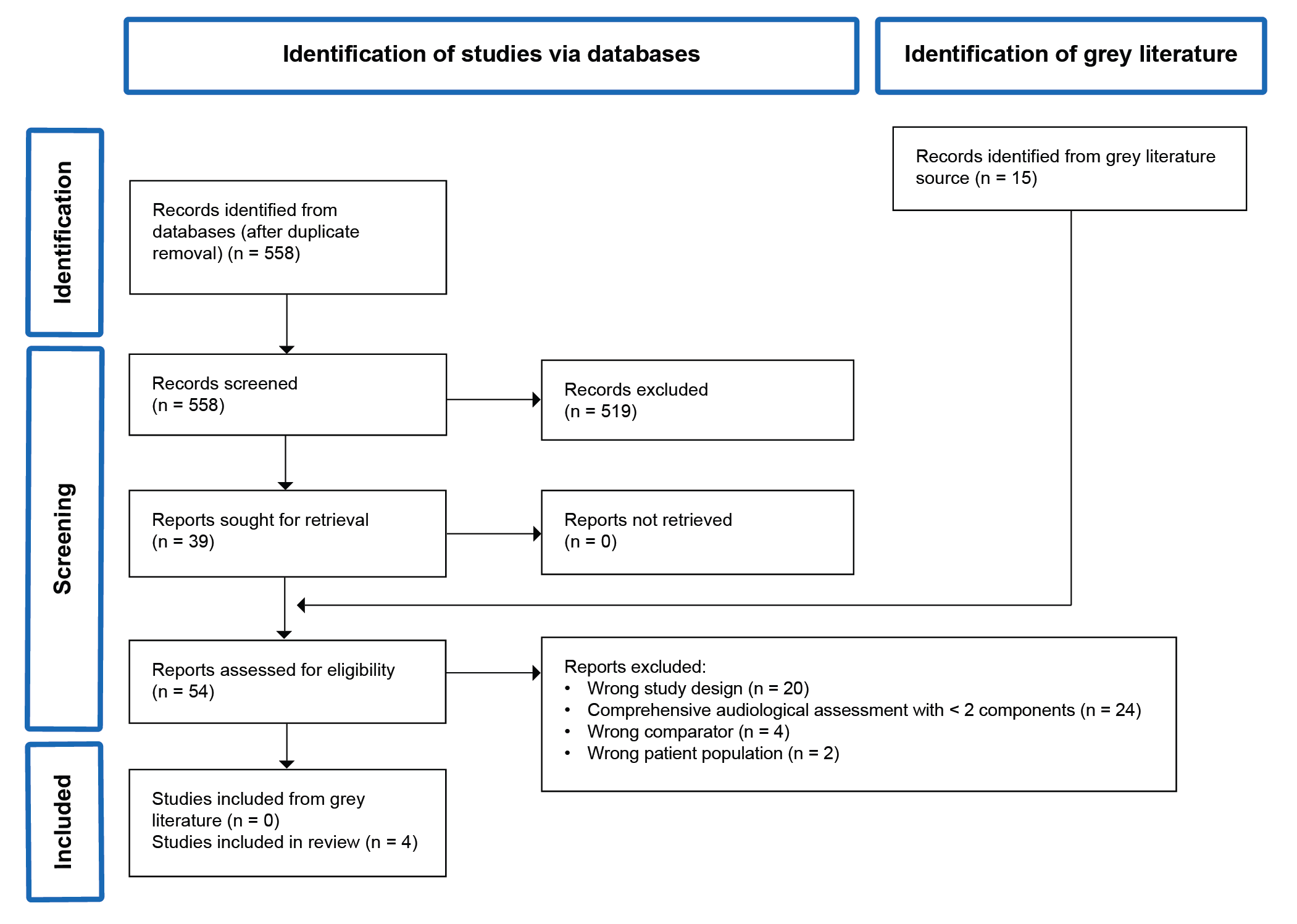
Appendix 3: Characteristics of Included Publications
Please note that this appendix has not been copy-edited.
Table 2: Characteristics of Included Test Accuracy Studies
Study citation, country, funding source | Study design | Population characteristics | Index test and reference standard, including audiological assessment components and timeline | Outcomes |
|---|---|---|---|---|
Bowers et al. (2025)22 Australia Funding source: Victorian Deaf Education Institute, Department of Education and Training | Cross-sectional | Eligibility: 376 school-entry year level children from 18 schools Age (years), mean (SD): 5.9 (0.5); range: 4 years 11 months to 7 years 1 month. Sex or gender: n = 233 (50.2%) females; other sexes or genders were NR. Hearing loss:
Place of residence: Children living in regional or rural areas: 272 (58.6%) School location: Metropolitan schools: 5 Regional or rural schools: 13 Other PROGRESS-Plus characteristics:a NR | Index test: synchronous remote audiological assessment via a hybrid telehealth model.
Reference standard: traditional face-to-face audiological assessment.
Audiological assessment components included for in-person and teleaudiology assessments:
Timeline between index test and reference standard: same day (i.e., directly after 1 another; on some occasions, 1 may have been conducted on a subsequent school day, with the longest difference between 2 assessments being 2 school days) |
|
Hoff et al. (2024)35 Sweden Funding source: Foundation Agneta Prytz-Folke and Gösta Folke; Göteborgs Läkaresällskap Hörselforskningsfonden; Region Västra Götaland; The Swedish Research Council; Swedish Research Council for Health, Working Life and Welfare; the Swedish state under the agreement between the Swedish government and the county councils, the ALF-agreement; Konung Gustaf V:s och Drottning Victorias Frimurarestiftelse; Swedish Alzheimer Foundation; Hjärnfonden, Eivind och Elsa K:son Sylvans stiftelse; Stiftelsen Söderströom-Königska Sjukhemmet; Stiftelsen för Gamla Tjänarinnor; Handlanden Hjalmar Svenssons Forskningsfond; Stiftelsen Professor Bror Gadelius Minnesfond. | Cross-sectional | 352 older adults from 2 birth cohorts with valid results from automated PTA and manual PTA:
Age (years), mean (SD): NR Sex or gender:
Hearing loss:
MMSE score:
|
Audiological assessment components included for teleaudiology assessment:
|
|
Bastianelli et al. (2019)36 Canada Funding source: None | Cross-sectional | Adults > 18 years (n = 84) with or without hearing loss. Group 1: Age (years), mean (SD): 54.7 (18.4) Sex or gender: 60% female; other sexes or genders were NR. Hearing loss:
Group 2: Age (years), mean (SD): 55.2 (14.8) Sex or gender: 68.2% female; other sexes or genders were NR. Hearing loss: NR Other PROGRESS-Plus characteristics:a NR | Index test: tablet audiometer Group 1:
Group 2:
Reference standard: conventional audiometry. Group 1:
Group 2:
Timeline between index test and reference standard: consecutively | Agreement or concordance between tablet audiometry and in-person audiometry for:
Diagnostic accuracy for HL:
|
Fletcher et al. (2019)37 US Funding source: National Institute of Deafness and Other Communication Disorders; National Institute of Health/National Center for Advancing Translational Sciences | Cross-sectional (report by study authors as randomized, single-centre, crossover pilot study) | 5 participants with hearing loss, and 8 with normal hearing. Age: NR Sex or gender: NR Hearing loss:
Other PROGRESS-Plus characteristics:a NR | Index test: telemedicine cochlear implant evaluation.
Reference standard: traditional in-person cochlear implant evaluation.
Audiological assessment components included for in-person and teleaudiology assessments:
Timeline between index test and reference standard: NR | Agreement or comparability for:
|
AzBio = Arizona Biomedical Test ; CNC = Consonant-Nucleus-Consonant; MMSE = Mini Mental State Examination; NR = not reported; PTA = pure-tone audiometry.
aThe main PROGRESS-Plus characteristics include place of residence, race, ethnicity, culture, language, occupation, gender, sex, religion, education, socioeconomic status, and social capital, personal characteristics associated with discrimination (e.g., age, disability), features of relationships, and time-dependent relationships.39
bApproved for use by Health Canada.
Appendix 4: Critical Appraisal of Included Publications
Please note that this appendix has not been copy-edited.
Table 3: Risk of Bias and Applicability Assessment of the Bowers et al. (2025) Study22 — QUADAS-234
Domain; question | Judgment | Comments |
|---|---|---|
Domain 1: Participanta selection | ||
A. Risk of Bias | ||
Was a consecutive or random participant enrolled? | No | Opportunistic sampling of schools was used. |
Was a case-control design avoided? | Yes | Children in “test” group received remote and face-to-face assessments. |
Did the study avoid inappropriate exclusions? | Yes | No inappropriate exclusion criteria were mentioned. |
Risk of bias: Could the selection of participants have introduced bias? | Unclear | Opportunistic school sampling may affect representativeness (i.e., selection bias). |
B. Concerns regarding applicability | ||
Applicability: Is there concern that the included participants do not match the review question? | Low | School-entry-aged children match the intended population for school-based remote hearing assessment. |
Domain 2: Index Test | ||
A. Risk of Bias | ||
Were the index test results interpreted without knowledge of the results of the reference standard? | Yes | Assessments were performed by different audiologists who were not aware of the other test results. |
If a threshold was used, was it pre-specified? | NA | No diagnostic threshold was used; agreement was assessed using percentage agreement and Cohen’s kappa. |
Risk of bias: Could the conduct or interpretation of the index test have introduced bias? | Low | Audiologists were not aware of the reference standard results. |
B. Concerns regarding Applicability | ||
Applicability: Is there concern that the index test, its conduct, or interpretation differ from the review question? | Low | Remote testing reflects the intended index test. |
Domain 3: Reference Standard | ||
A. Risk of Bias | ||
Is the reference standard likely to correctly classify the target condition? | Yes | Face-to-face PTA, otoscopy, and tympanometry are appropriate. |
Were the reference standard results interpreted without knowledge of the results of the index test? | Yes | Audiologists were not aware of the other assessment results. |
Risk of bias: Could the reference standard, its conduct, or its interpretation have introduced bias? | Low | Conventional assessment was appropriate and audiologists were not aware of the index test result. |
B. Concerns regarding Applicability | ||
Applicability: Is there concern that the target condition as defined by the reference standard does not match the review question? | Low | Reference standard matches the review question. |
Domain 4: Flow and Timing | ||
A. Risk of Bias | ||
Was there an appropriate interval between index test(s) and reference standard? | No | Most assessments were performed on the same day; maximum interval was 2 school days. This may have introduced fatigue effects. |
Did all participants receive a reference standard? | Yes | All children who completed testing received a reference standard. |
Did participants receive the same reference standard? | Yes | Same face-to-face approach was used. |
Were all participants included in the analysis? | No | Some participants were not included in full paired analyses due to incomplete testing, or they did not have results for either the reference standard or index test (15.4%). |
Risk of bias: Could the participant flow have introduced bias? | High | Incomplete paired testing and potential fatigue may have introduced bias. |
NA = not applicable; PTA = pure-tone audiometry.
aWe replaced the term patient with participant in the appraisal tool to reflect that the included studies enrolled and assessed both individuals with and without hearing loss.
Table 4: Risk of Bias and Applicability Assessment of the Hoff et al. (2024) Study35 — QUADAS-234
Domain; question | Judgment | Comments |
|---|---|---|
Domain 1: Participanta selection | ||
A. Risk of Bias | ||
Was a consecutive or random participant enrolled? | No | Participants came from population-based birth cohorts. |
Was a case-control design avoided? | Yes | Participants were investigated with AA as part of the main investigation, and with conventional MA in an extended audiological study performed on subgroups of participants. |
Did the study avoid inappropriate exclusions? | Yes | Exclusion criteria and its reasoning were clearly described. |
Risk of bias: Could the selection of participants have introduced bias? | High | Participants were healthier and more educated than the source cohorts, which may limit representativeness. |
B. Concerns regarding applicability | ||
Applicability: Is there concern that the included participants do not match the review question? | Low | Older adults match the intended population for automated audiometry. |
Domain 2: Index Test | ||
A. Risk of Bias | ||
Were the index test results interpreted without knowledge of the results of the reference standard? | Yes | Automated audiometry was computer-administered before manual audiometry. |
If a threshold was used, was it pre-specified? | NA | No diagnostic threshold was used; outcomes were continuous hearing measures and agreement ranges. |
Risk of bias: Could the conduct or interpretation of the index test have introduced bias? | Low | Automated testing procedures and analyses reflect the intended index test. |
B. Concerns regarding Applicability | ||
Applicability: Is there concern that the index test, its conduct, or interpretation differ from the review question? | Low | Automated audiometry matched the intended index test. |
Domain 3: Reference Standard | ||
A. Risk of Bias | ||
Is the reference standard likely to correctly classify the target condition? | Yes | Manual pure-tone audiometry was treated as the gold standard. |
Were the reference standard results interpreted without knowledge of the results of the index test? | Unclear | It was not clear if the index test results were interpreted without knowledge of the results of the reference standard. |
Risk of bias: Could the reference standard, its conduct, or its interpretation have introduced bias? | Unclear | Reference standard was clinically appropriate; however, it was not clear if the index test results were interpreted without knowledge of the results of the reference standard. |
B. Concerns regarding Applicability | ||
Applicability: Is there concern that the target condition as defined by the reference standard does not match the review question? | Low | Manual audiometry matches the intended reference standard. |
Domain 4: Flow and Timing | ||
A. Risk of Bias | ||
Was there an appropriate interval between index test(s) and reference standard? | Yes | Automated and manual audiometry were performed around 4 weeks apart. |
Did all participants receive a reference standard? | Yes | Included participants had both AA and MA results. |
Did participants receive the same reference standard? | Yes | Same manual audiometry reference standard was used. |
Were all participants included in the analysis? | No | Four percent of the data were invalid due to PTTs being unreached at the maximum presentation level for 1 or both test methods. These were excluded from analyses. |
Risk of bias: Could the participant flow have introduced bias? | High | The exclusion of invalid thresholds may have introduced some bias. |
AA = automated pure-tone audiometry; MA = manual pure-tone audiometry; NA = not applicable; PTA = pure-tone audiometry; PTT = pure-tone threshold.
aWe replaced the term patient with participant in the appraisal tool to reflect that the included studies enrolled and assessed both individuals with and without hearing loss.
Table 5: Risk of Bias and Applicability Assessment of the Bastianelli et al. (2019) Study36 — QUADAS-234
Domain; /question | Judgment | Comments |
|---|---|---|
Domain 1: Participanta selection | ||
A. Risk of Bias | ||
Was a consecutive or random participant enrolled? | Unclear | Adults attending an otolaryngology or audiology clinic were eligible, but consecutive or random sampling was not clearly stated. |
Was a case-control design avoided? | Yes | Participants underwent tablet and conventional audiometry comparison for hearing loss and word recognition testing in Group 1 and 2. |
Did the study avoid inappropriate exclusions? | Unclear | Exclusions were reasonable, though tablet usability and English-language requirements may affect representativeness. |
Risk of bias: Could the selection of participants have introduced bias? | Unclear | Clinic-based participants and exclusions may limit representativeness. |
B. Concerns regarding applicability | ||
Applicability: Is there concern that the included participants do not match the review question? | Unclear | Population may not fully reflect broader community or primary-care screening settings. |
Domain 2: Index Test | ||
A. Risk of Bias | ||
Were the index test results interpreted without knowledge of the results of the reference standard? | Unclear | It was not clear if the index test results were interpreted without knowledge of the results of the reference standard. |
If a threshold was used, was it pre-specified? | Yes | Hearing loss thresholds were pre-specified. |
Risk of bias: Could the conduct or interpretation of the index test have introduced bias? | Unclear | Tablet audiometry procedures, calibration, and protocols were clearly described, but it was not clear if the index test results were interpreted without knowledge of the results of the reference standard. |
B. Concerns regarding Applicability | ||
Applicability: Is there concern that the index test, its conduct, or interpretation differ from the review question? | Low | Tablet audiometer use matched the intended index test. |
Domain 3: Reference Standard | ||
A. Risk of Bias | ||
Is the reference standard likely to correctly classify the target condition? | Yes | Conventional audiometry in a sound booth by audiologists is appropriate. |
Were the reference standard results interpreted without knowledge of the results of the index test? | Unclear | It was not clear if the index test results were interpreted without knowledge of the results of the reference standard. |
Risk of bias: Could the reference standard, its conduct, or its interpretation have introduced bias? | Unclear | Reference standard was appropriate and clinically accepted. However, it was not clear if the index test results were interpreted without knowledge of the reference standard results. |
B. Concerns regarding Applicability | ||
Applicability: Is there concern that the target condition as defined by the reference standard does not match the review question? | Low | Conventional audiometry is an appropriate reference standard. |
Domain 4: Flow and Timing | ||
A. Risk of Bias | ||
Was there an appropriate interval between index test(s) and reference standard? | No | Tests were consecutively performed on the same day, which may have introduced learning effects. |
Did all participants receive a reference standard? | Yes | Conventional audiometry was used in Groups 1 and 2. |
Did participants receive the same reference standard? | Yes | Same reference standard used within relevant groups (Groups 1 and 2). |
Were all participants included in the analysis? | Unclear | Some exclusions occurred but the reporting was unclear. |
Risk of Bias: Could the participant flow have introduced bias? | Unclear | Sequential testing may have introduced learning effects. |
aWe replaced the term patient with participant in the appraisal tool to reflect that the included studies enrolled and assessed both individuals with and without hearing loss.
Table 6: Risk of Bias and Applicability Assessment of the Fletcher et al. (2019) Study37 — QUADAS-234
Domain; question | Judgment | Comments |
|---|---|---|
Domain 1: Participanta selection | ||
A. Risk of Bias | ||
Was a consecutive or random participant enrolled? | Unclear | Recruitment process was not clearly described; small number of participants with established patients in the clinic or healthy volunteers with normal hearing or hearing loss. |
Was a case-control design avoided? | Yes | Participants received both in-person and telemedicine assessments. |
Did the study avoid inappropriate exclusions? | Unclear | Exclusion criteria were not clearly described. |
Risk of bias: Could the selection of participants have introduced bias? | High | Nonrepresentative sample with unclear eligibility criteria. |
B. Concerns regarding applicability | ||
Applicability: Is there concern that the included participants do not match the review question? | High | Limited applicability if the review question focuses on cochlear implantation candidates or real-world remote assessment. |
Domain 2: Index Test | ||
A. Risk of Bias | ||
Were the index test results interpreted without knowledge of the results of the reference standard? | Unclear | It was not clear if the index test results were interpreted without knowledge of the results of the reference standard. |
If a threshold was used, was it pre-specified? | NA | No diagnostic threshold was used; analyses were based on mean differences between modalities. |
Risk of bias: Could the conduct or interpretation of the index test have introduced bias? | Unclear | Procedures were described, but it was not clear if the index test results were interpreted without knowledge of the results of the reference standard. |
B. Concerns regarding Applicability | ||
Applicability: Is there concern that the index test, its conduct, or interpretation differ from the review question? | Low | Telemedicine technology used was appropriate and the procedures. |
Domain 3: Reference Standard | ||
A. Risk of Bias | ||
Is the reference standard likely to correctly classify the target condition? | Yes | In-person audiology evaluation is an appropriate comparator. |
Were the reference standard results interpreted without knowledge of the results of the index test? | Unclear | It was not clear if the index test results were interpreted without knowledge of the results of the reference standard. |
Risk of bias: Could the reference standard, its conduct, or its interpretation have introduced bias? | Unclear | Reference standard was appropriate, but it was not clear if the index test results were interpreted without knowledge of the results of the reference standard. |
B. Concerns regarding Applicability | ||
Applicability: Is there concern that the target condition as defined by the reference standard does not match the review question? | Low | In-person testing matches the intended reference standard. |
Domain 4: Flow and Timing | ||
A. Risk of Bias | ||
Was there an appropriate interval between index test(s) and reference standard? | No | Both tests were performed consecutively, minimizing clinical change. This may have introduced fatigue, especially among participants with hearing loss. |
Did all participants receive a reference standard? | Yes | All participants underwent in-person evaluation. |
Did participants receive the same reference standard? | Yes | Same in-person reference standard was used. |
Were all participants included in the analysis? | Yes | Results reported for all included participants. |
Risk of Bias: Could the participant flow have introduced bias? | Unclear | Consecutive testing may have introduced fatigue, especially among participants with hearing loss. |
AzBio = Arizona Biological Test; NA = not applicable.
aWe replaced the term patient with participant in the appraisal tool to reflect that the included studies enrolled and assessed both individuals with and without hearing loss.
Appendix 5: Main Study Findings
Please note that this appendix has not been copy-edited.
Table 7: Summary of Findings by Outcome — Agreement or Concordance Between Index Test (Teleaudiology Assessment) and Reference Standard (In-Person Assessment)
Citation, number of participants | Index test and reference standard | Hearing outcomes assessed | Agreement or concordance measure(s) | Result | P value |
|---|---|---|---|---|---|
Studies in children | |||||
Bowers et al. (2025)22 N = 376 | Index test: synchronous remote audiological assessment via a hybrid telehealth model. Reference standard: traditional face-to-face audiological assessment. | PTA thresholds | AC Hearing threshold in dB 1 kHz; mean (SD) | Index test: 15.4 dB (6.5) vs. reference standard: 15.4 dB (6.8) | NR |
AC Hearing threshold in dB at 1 kHz; mean difference (SD) | 0.1 (5.9) | 0.64 | |||
AC Hearing threshold in dB 4 kHz; mean (SD) | Index test: 14.6 dB (7.5) vs. reference standard: 14.3 dB (7.6) | NR | |||
AC Hearing threshold in dB at 4 kHz; mean difference (SD) | 0.3 (4.7) | 0.08 | |||
BC Hearing threshold in dB 1 kHz; mean (SD) | Index test: 2.5 dB (8.7) vs. reference standard: 3.6 dB (7.9) | 0.36 | |||
BC proportion within ± 10 dB agreement at 1 kHz, % (95% CI) | 100 (NR) | NR | |||
BC Hearing threshold in dB 4 kHz; mean (SD) | Index test: 8.0 dB (8.6) vs. reference standard: 8.7 dB (7.6) | 0.67 | |||
BC proportion within ± 10 dB agreement at 4 kHz, % (95% CI) | 95.7 (NR) | NR | |||
Classification of otoscopy | Percentage agreement, % (95% CI); Cohen’s kappa | 78.6 (NR); 0.6 | < 0.001 | ||
Classification of tympanometry | Percentage agreement, % (95% CI); Cohen’s kappa | 92.2 (NR); 0.9 | < 0.001 | ||
Studies in adults | |||||
Hoff et al. (2024)35 N = 352 | Index test: computerized automated PTA Reference standard: In-person manual PTA | Hearing thresholds | Hearing threshold in dB; mean difference (SD) | – 0.7 (8.8) | < 0.001 |
PTA averages (PTA4)a | Percentage agreement within ± 5 dB, % | 80 | NR | ||
Percentage agreement within ± 10 dB, % | 95 | NR | |||
Percentage agreement within ± 15 dB, % | 98 | NR | |||
PTA4s in 70‑year-olds | mean absolute differences | 5.4 dB | NR | ||
PTA4s in 85‑year-olds | mean absolute differences | 5.2 dB | NR | ||
Bastianelli et al. (2019)36 N = 84 | Index test: tablet audiometer Reference standard: conventional audiometry. | PTH thresholds | Percentage agreement within ± 5 dB, mean % (95% CI) | 78.7 (69.9 to 89.2)b | NR |
PTH thresholds | Percentage agreement within ± 10 dB, mean % (95% CI) | 92.9 (88.8 to 97.6)c | NR | ||
Word recognition performance | Critical difference range agreement,d % (95% CI) | 96.2 (89.5 to 98.7) | NR | ||
Fletcher et al. (2019)37 N = 13 | Index test: telemedicine cochlear implant evaluation. Reference standard: traditional in-person cochlear implant evaluation. | AzBio score | Mean difference, % (SD) | 1.69 (2.06) | NR |
CNC score | Mean difference, % (SD) | 6.77 (10.25) | NR | ||
AC = air conduction; AzBio = Arizona Biological Test; BC = bone conduction; CI = confidence interval; CNC = Consonant-Nucleus-Consonant; NR = not reported; PTA = pure-tone average; PTH = pure-tone hearing; SD = standard deviation; vs. = versus.
aPTA4 = the 4-frequency pure-tone averages of 0.5, 1, 2, and 4 kHz.
bAt frequencies of 250 Hz, 500 Hz, 1,000 Hz, 2000 Hz, 4,000 Hz, and 8,000 Hz; 84.9% agreement when excluding 250 Hz and 8,000 Hz.
cAt frequencies of 250 Hz, 500 Hz, 1,000 Hz, 2000 Hz, 4,000 Hz, and 8,000 Hz; 95.7 agreement when excluding 250 Hz and 8,000 Hz.
dThe critical difference range is the range within which scores can be considered equivalent.
Table 8: Summary of Findings by Outcome — Diagnostic Accuracy of the Index Test (Teleaudiology Assessment) and Reference Standard (Conventional Audiometry) in Adults
Citation, number of participants | Index test and reference standard | Target condition | % (95% CI) |
|---|---|---|---|
Bastianelli et al. (2019)36 N = 84 | Index test: tablet audiometer Reference standard: conventional audiometry | Hearing loss ≥ 40 dB | Sensitivity: 96 (81 to 99) Specificity: 100 (77 to 100) |
Hearing loss ≥ 30 dB | Sensitivity: 100 (88 to 100) Specificity: 91 (62 to 98) |
CI = confidence interval.
ISSN: 2563-6596
Canada’s Drug Agency (CDA-AMC) is a pan-Canadian health organization. Created and funded by Canada’s federal, provincial, and territorial governments, we’re responsible for driving better coordination, alignment, and public value within Canada’s drug and health technology landscape. We provide Canada’s health system leaders with independent evidence and advice so they can make informed drug, health technology, and health system decisions, and we collaborate with national and international partners to enhance our collective impact.
Disclaimer: CDA-AMC has taken care to ensure that the information in this document was accurate, complete, and up to date when it was published, but does not make any guarantee to that effect. Your use of this information is subject to this disclaimer and the Terms of Use at cda-amc.ca.
The information in this document is made available for informational and educational purposes only and should not be used as a substitute for professional medical advice, the application of clinical judgment in respect of the care of a particular patient, or other professional judgments in any decision-making process. You assume full responsibility for the use of the information and rely on it at your own risk.
CDA-AMC does not endorse any information, drugs, therapies, treatments, products, processes, or services. The views and opinions of third parties published in this document do not necessarily reflect those of CDA-AMC. The copyright and other intellectual property rights in this document are owned by the Canadian Agency for Drugs and Technologies in Health (operating as CDA-AMC) and its licensors.
Questions or requests for information about this report can be directed to Requests@CDA-AMC.ca.