Drugs, Health Technologies, Health Systems
Health Technology Review
Longevity of Direct Dental Restorations
Key Messages
What Is the Issue?
Direct dental restorations are used to restore teeth affected by dental caries, trauma, wear, or other structural defects with the goal of preserving tooth function, structure, and aesthetics.
Evidence on the longevity of direct restorations was requested to inform decision-making on replacement intervals.
What Did We Do?
We conducted a rapid overview of reviews to summarize clinical evidence regarding the longevity of direct dental restorations in permanent and primary teeth using any materials and techniques. We summarized reported factors that affect restoration longevity.
What Did We Find?
We identified 2 umbrella reviews (URs) and 6 systematic reviews (SRs) that summarized evidence from 107 unique primary reports observing the longevity of direct dental restorations.
Overall, in permanent teeth, evidence from 1 UR and 5 SRs indicated that cumulative failure rates of restorations generally increased, and success rates decreased, with longer follow-up. Annual failure rates and survival rates of restorations showed no consistent trends over time. Success rates were generally high during the first 3 years after restoration (range, 84.8% to 96.4%) but became more variable from 4 years onward, ranging from 26.1% to 100% at 4 to 6 years, from 62% to 99.1% at 7 to 10 years, and from 43.4% to 95.4% at 11 to 20 years.
Overall, in primary teeth, evidence from 1 UR and 1 SR indicated that cumulative failure and annual failure rates of restorations generally increased with longer follow-up. Survival and success rates of restorations were not reported. Failure rates reported had wide ranges at 2 years (2% to 60.4%), 3 years (4.9% to 69.1%), and 4 years (13.2% to 26.1%).
Findings by clinical and restoration characteristics (restoration materials used, location of restorations in the mouth, and type of restorations) were mixed and did not support a consistent longevity associated with follow-up periods.
For permanent teeth, evidence on relevant factors associated with failure and longevity of direct restorations was available from 1 UR and 5 SRs. They reported:
restoration longevity is multifactorial, with important contributions from patient caries risk; tooth location and remaining tooth structure; cavity size and complexity; occlusal or mechanical loading; restorative material; adhesive protocol; and clinical technique.
The principal failure mechanisms were secondary caries, restoration fracture, tooth fracture, marginal degradation, and loss of retention.
For primary teeth, restoration longevity was mostly influenced by characteristics of the cavity, tooth, restorative material, and operative technique.
What Does This Mean?
There is no single expected lifespan that applies to all direct dental restorations.
The evidence base was heterogeneous with substantial variation across patient populations, based on which materials and restorative techniques were used, and how outcomes were measured.
Decision-makers may wish to consider restoration coverage based on restoration complexity, class, and technique; tooth permanency and location; and patient comorbidities and other associated risk factors related to a greater need for restorations.
Abbreviations
AFR
annual failure rate
AMSTAR 2
A MeaSurement Tool to Assess systematic Reviews, version 2
GIC
glass ionomer cement
HVGIC
high-viscosity glass ionomer cement
MRGIC
metal-reinforced glass ionomer cement
NCCL
noncarious cervical lesion
nRCT
nonrandomized controlled trial
RCT
randomized controlled trial
RMGIC
resin-modified glass ionomer cement
SR
systematic review
UR
umbrella review
Research Question
What is the clinical evidence on the longevity of direct dental restorations?
Context and Policy Issues
What Are Dental Restorations?
Direct dental restorations are restorative procedures in which dental materials are placed, shaped, and hardened directly in the patient’s mouth.1 These procedures are commonly used to restore teeth affected by dental caries, trauma, wear, or other structural defects with the goal of preserving tooth function, structure, and aesthetics. Direct restorations are widely used because they are generally less invasive, require fewer appointments than indirect restorations, and can preserve more natural tooth structure.
Several materials are used for direct restorations, such as resin composites, glass ionomer cement (GIC), resin-modified GIC (RMGIC), compomers, and, historically, dental amalgam.1 In addition to the material used, tooth location and cavity class also influence technical complexity, exposure to biting forces, and longevity of direct restorations.2,3 Anterior restorations involve incisors and canines, posterior restorations involve premolars and molars, and cervical restorations are located near the gumline.2,3 Class I restorations involve pits and fissures; class II restorations involve the proximal surfaces of posterior teeth; and classes IV and III involve the proximal surfaces of anterior teeth, with and without involvement of the incisal edge, respectively. Class V restorations involve the cervical third of anterior or posterior teeth.
Although direct dental restorations are intended to provide long-term function, they may require repair, replacement, or other clinical interventions over time.4,5 This can happen because of material degradation, recurrent caries, fracture, wear, or other complications.4,5 Direct restorations represent a substantial component of routine dental care. They may contribute considerably to oral health expenditures because of their high utilization and the need for repair or replacement over time.4
Longevity of Direct Dental Restoration
There is no single expected lifespan that applies to all direct restorations.6,7 Restoration longevity can be influenced by multiple factors, including restorative material, restoration type and location, tooth characteristics, patient-level factors, clinical techniques, operator experience, follow-up duration, and the outcome definitions used.6,7 Consequently, longevity estimates can vary substantially across studies and clinical settings.
Longevity should be interpreted separately for primary and permanent teeth.8 Restorations in primary teeth are generally expected to remain functional until the tooth naturally exfoliates; therefore, their clinically relevant lifespan and available follow-up are inherently limited by the remaining life of the tooth.9 Treatment selection may consequently consider the expected time to exfoliation, in addition to the child’s age, caries risk, cavity size, and ability to tolerate treatment.8,9 In contrast, permanent teeth are expected to remain functional throughout adulthood, making longer-term restoration survival, repeated re-interventions, preservation of remaining tooth structure, and the cumulative risk of more extensive treatment particularly important.8
Evidence on restoration longevity is commonly reported using cumulative failure, survival, or success rates at specified follow-up intervals, annual failure rates (AFRs), or time-to-event measures such as median survival time.10 Failure rate over a specified follow-up period represents the cumulative proportion of restorations that failed during that period. An AFR represents failure as an average rate per year.10 Survival generally refers to a restoration remaining in service until a predefined failure event, such as replacement or tooth loss, whereas success reflects the absence of clinically relevant deficiencies and may capture restorations requiring repair or other interventions before complete failure.11 Some studies also used terms such as minor failure, in which the restoration was either repaired or refurbished through polishing or adjustment, or major failure, in which the restoration required complete replacement.12
Direct Dental Restoration in Canada
In Canada, direct dental restorations are among the most performed dental procedures to restore affected teeth. Resin composites and dental amalgam have been the most frequently used restorative materials, although the use of amalgams has declined in recent years.13,14 GIC and RMGIC restorations are also used in selected clinical situations.15 Evidence on time to re-intervention in the context of Canada is limited but suggests that many restorations remain in service considerably longer than 2 years.16,17 However, the findings are not nationally representative, and comparable evidence for most restorative materials is lacking in the context of Canada.
Why Is It Important to Do This Review?
Re-interventions, including repair, refurbishment, replacement, or more extensive restorative treatment, represent a substantial proportion of routine dental care and contribute considerably to the long-term costs and burden of restorative treatment.4,11 decision-makers remain uncertain about the expected longevity of direct dental restorations. Evidence on the longevity of direct restorations will inform clinical decision-making, reimbursement policies, and program planning, particularly in contexts in which replacement intervals and eligibility criteria are considered. There is a need to synthesize evidence from studies evaluating the longevity of direct dental restorations for people undergoing these restorations.
Objective
In response to an external request to support decision-making about appropriate timelines for re-intervention after direct dental restorations, we prepared this rapid overview of reviews to summarize and critically appraise available evidence regarding the longevity of direct dental restorations. This review also summarizes the most relevant factors affecting restoration failure and longevity.
Methods
An information specialist conducted a customized literature search of multiple sources and grey literature, balancing comprehensiveness with relevance, on July 17, 2026.
One reviewer screened citations and selected studies based on the inclusion criteria presented in Table 1 and critically appraised included publications using 1 critical appraisal tool.18
Appendix 1 presents a detailed description of methods and selection criteria for included studies.
Criteria | Description |
|---|---|
Population | People undergoing direct dental restorations |
Intervention | Direct dental restoration using any materials in any teeth |
Comparator | No comparator |
Outcomes | Longevity (e.g., time to re-intervention [restoration survival and success], time to replacement, maximum and minimum longevity, average number of years a direct restoration is expected to last, median survival rate for direct restorations) |
Study designs | Systematic reviews |
Publication date | January 1, 2021, to July 17, 2026 |
Summary of Evidence
Quantity of Research Available
Eight publications12,19-25 met our inclusion criteria, including 6 systematic reviews (SRs) and 2 umbrella reviews (URs). A UR is an SR of SRs or meta-analyses. We reported on the characteristics and results from the subset of relevant studies. Appendix 2 presents the Preferred Reporting Items for Systematic reviews and Meta-Analyses (PRISMA)26 flow chart.
Summary of Study Characteristics
Appendix 3 provides details regarding the characteristics of included publications.
Clinical Evidence on the Longevity of Direct Dental Restorations
Study characteristics demonstrated substantial variation across a large evidence base, including differences in restoration materials and types, clinical techniques, outcome definitions, evaluation criteria, and follow-up duration. Information on outcomes across different population groups was limited.
General Characteristics
The 2 URs23,24 synthesized evidence from 22 SRs relevant to this report and the 6 SRs12,19-22,25 included data from 107 unique primary studies relevant to this report. Some overlap was identified among the primary studies included in the SRs, whereas no overlap was identified among the SRs included in the URs. There was no overlap in primary studies of SRs12,19,20 reporting pooled estimates or meta-analysis (refer to Appendix 6 for details regarding overlap).
Overall, 3 SRs12,22,25 and 2 URs23,24 reported no publication date restrictions, and the most recent search date reported among the included publications was March 2025.23 Studies included in the 6 SRs12,19-22,25 were conducted across 32 countries. The most frequently represented countries were Brazil (n = 17), the Netherlands (n = 12), the UK (n = 12), Türkiye (n = 11), Sweden (n = 8), and Germany (n = 6). One included primary study reported in 1 SR21 was conducted in Canada. Country information was not reported in the 2 URs.23,24
Population Characteristics and Study Settings
The included publications varied in the level of detail reported for study population characteristics. Two SRs12,20 and 2 URs23,24 reported age information. One UR23 included participants ranging from young adults to adults aged older than 80 years, whereas 2 SRs12,20 reported mean ages ranging from 26.7 to 81.5 years. Another UR24 focused on children aged up to 12 years. Participant numbers were reported in 4 SRs and ranged from 15 to approximately 3 million participants across included primary studies.20-22,25
Two SRs20,25 provided information on the sex of participants from their included primary studies; the authors did not report how sex had been defined or measured. Two SRs20,25 reported on the range of female and male participants; other sexes or genders were not reported. None of the included reviews12,19-25 reported information on other PROGRESS-Plus characteristics,27 such as place of residence, race, ethnicity, culture, language, occupation, religion, education, socioeconomic status, and social capital.
Settings were reported in 5 included reports12,20,21,23,25 and included university clinics (2 SRs12,21 and 1 UR23), controlled academic environments (1 UR),23 general and private dental practices (3 SRs12,21,25 and 1 UR23), clinics and outreach programs (1 SR),20 schools (1 SR),25 and special care or nursing home settings (1 UR).23
Clinical Indications and Interventions
The 8 reviews12,19-25 included populations receiving direct restorations in both permanent and primary teeth across a range of clinical indications. Permanent teeth populations included patients undergoing direct restorations (1 UR),23 adults with pathological tooth wear (1 SR),12 adults with root caries lesions (1 SR),20 patients receiving multisurface posterior restorations (1 SR),19 patients receiving anterior restorations (1 SR),22 and broader populations of children, teenagers, and adults receiving restorations (1 SR).21 Primary teeth populations included children with deep carious lesions in primary teeth (1 UR)24 and children with previously unrestored carious lesions in primary teeth (1 SR).25
The reviews evaluated a wide range of direct restorative interventions, including:
materials:
composite materials:
glass ionomer–based materials:
other restorative materials:
techniques and strategies:
restoration types and locations:
Outcomes and Follow-up
Commonly reported outcomes related to restoration performance in the reviews included restoration survival rates (4 SRs12,19,21,22 and 1 UR23); restoration success rates (3 SRs12,20,21 and 1 UR24); restoration failure rates, AFRs, or treatment failure (4 SRs12,21,22,25 and 2 URs23,24); reasons for restoration failure (5 SRs);19-22,25 and factors associated with restoration outcomes (1 UR).24 All reviews12,19-25 reported outcomes at follow-up, with follow-up durations ranging from 6 months to 30 years across the included reviews.
Summary of Critical Appraisal
Overall, the methodological quality of the included reviews was mixed. Three SRs12,19,25 and 2 URs23,24 adequately reported relevant details across most critical domains in A MeaSurement Tool to Assess systematic Reviews, version 2 (AMSTAR 2).18 In contrast, 3 SRs20-22 did not meet, or partially met, several critical AMSTAR 2 domains. 18 Appendix 4 provides additional details about the strengths and limitations of the included publications.
Approaches to review planning and the selection of eligible study designs differed across the included reviews. The authors of 2 URs17,18 and 4 SRs12,19,22,25 established their methods before conducting the review through prospective protocol registration, reducing the risk of selective reporting and post hoc methodological decisions. In contrast, 2 SRs20,21 did not report protocol registration or an a priori protocol. All reviews had explanations of the study designs selected for inclusion except for 1 SR,22 which identified included study designs but did not provide a justification for their selection.
Methods used to identify relevant literature varied across reviews and may have influenced the scope of studies included. All 8 reviews12,19-25 searched multiple bibliographic databases and reported search strategies or search terms. However, 6 SRs12,19-22,25 and 1 UR23 lacked 1 or more components of a comprehensive search strategy, such as grey literature searches, trial registry searches, or consultation with experts, which may have increased the risk of publication bias and omission of relevant evidence. In contrast, the authors of 1 UR24 conducted a more comprehensive search that included grey literature and clinical trial registries. The authors of 2 URs17,18 and 3 SRs12,22,25 did not apply publication date restrictions, whereas the authors of 3 SRs19-21 restricted inclusion by publication year; these restrictions were justified by the review authors and were intended to capture contemporary or clinically relevant evidence. The authors of 2 URs23,24 and 2 SRs12,25 reported no language restrictions, whereas 3 SRs19,20,22 included only English-language studies, which may have introduced selection bias and excluded relevant evidence published in other languages. Language restriction was not clearly reported in 1 SR.21
The conduct and transparency of key review processes varied across the included reviews. Study selection was conducted independently by at least 2 reviewers with disagreements resolved through discussion or involvement of an additional reviewer in 2 URs23,24 and 4 SRs.12,19,21,25 Data extraction was independently verified or conducted by at least 2 reviewers in 2 URs23,24 and 2 SRs.12,25 These practices may reduce the risk of reviewer bias and data extraction errors. One UR24 provided a comprehensive list of excluded studies with reasons for exclusion. The remaining reviews reported exclusions through PRISMA flow diagrams or general exclusion categories, limiting the transparency and reproducibility of the review process.
Approaches to risk of bias assessment differed across reviews. The authors of 2 URs23,24 and 4 SRs12,19,20,25 assessed study quality or risk of bias using structured appraisal tools and considered these findings when interpreting their results. In contrast, the authors of 2 SRs21,22 did not perform formal risk of bias assessments of included studies, limiting assessment of the internal validity of the evidence. Although 1 SR20 assessed study quality, it did not use a risk of bias tool specific to the appraisal of RCTs, evaluate the impact of study quality on pooled estimates, or formally assess publication bias despite conducting meta-analyses.
Evidence synthesis methods, assessment of heterogeneity, and evaluation of publication bias were generally appropriate when quantitative synthesis was performed. The authors of 2 SRs19,20 who conducted quantitative synthesis used appropriate statistical methods to pool data and assess heterogeneity. The authors of 1 SR19 assessed heterogeneity using I2 statistics, whereas the authors of another SR20 explored heterogeneity through meta-regression analyses. Two URs17,18 and 5 SRs12,19,20,22,25 included discussions of clinical and methodological heterogeneity arising from differences in restorative materials, interventions or restorative approaches, study designs, outcome definitions, evaluation criteria, follow-up duration, patient factors, and failure criteria. In contrast, the authors of 1 SR21 described variability among studies but did not formally investigate or explain heterogeneity. The substantial clinical and methodological heterogeneity reported across studies may limit the direct applicability of findings to specific clinical settings, including current dental practice in the context of Canada. Of the 2 SRs19,20 that included quantitative synthesis, publication bias was formally assessed in 1 SR.19 The absence of publication bias assessment in the other SR20 may limit confidence in the pooled findings.
Finally, reporting of study characteristics and funding varied across the evidence base. The authors of 4 SRs12,20,21,25 and 1 UR23 adequately described the characteristics of included studies, including populations, interventions, comparators, outcomes, study designs, settings, and follow-up periods. However, the authors of 1 UR24 and 2 SRs19,22 did not consistently report study-setting information. Information on equity-relevant population characteristics, such as socioeconomic status, ethnicity, geographic location, and other PROGRESS-Plus characteristics,27 was generally limited across all reviews,12,19-25 restricting assessment of the generalizability of findings to populations that may experience differences in oral health outcomes or access to dental care. Funding sources for included primary studies were reported in 1 SR25 and 1 UR,23 limiting assessment of the potential influence of funding bias on the evidence base.
Summary of Findings
Appendix 5 presents the main study findings.
Clinical Evidence on the Longevity of Direct Dental Restorations
Across the included evidence, restoration longevity varied substantially by restorative materials, tooth locations, cavity types, outcome definitions, and follow-up periods.
Clinical evidence regarding the longevity of direct dental restorations was available from 2 URs23,24 and 6 SRs.12,19-22,25 The authors of 3 SRs12,19,20 and 1 UR24 provided meta-analysis or pooled mean estimates of the outcomes relevant to our review. There was some overlap in the primary studies included in the 6 SRs12,19‑22,25 and no overlap in the SRs included in the 2 URs;23,24 there was no overlap in primary studies of SRs12,19,20 reporting pooled estimates or meta-analyses (Appendix 6). The authors of 1 UR23 and 5 SRs12,19-22 reported results on various types of direct restorations in permanent teeth, whereas the authors of 1 UR24 and 1 SR25 reported results on direct restorations in primary teeth.
Permanent Teeth
The authors of 1 UR23 and 5 SRs12,19-22 evaluated the clinical evidence on the longevity of direct dental restorations in permanent teeth. Table 2 summarizes the outcomes regarding the longevity of direct dental restorations in permanent teeth based on years of follow-up. The ranges reported in this table combine results across all materials, restoration classes, techniques, and tooth locations reported in the evidence related to permanent teeth. Considerable variation in restoration failure rates, AFRs, success, and survival rates reflects differences in materials, cavity classes, techniques, evaluation criteria, and study populations. The findings related to direct restorations using amalgams were excluded from this table.
Overall, outcomes varied widely across follow-up periods. Success rates were generally high during the first 3 years after restoration (range, 84.8% to 96.4%) but became more variable from 4 years onward, ranging from 26.1% to 100% at 4 to 6 years, from 62% to 99.1% at 7 to 10 years, and from 43.4% to 95.4% at 11 to 20 years. Restoration survival rates also varied substantially at longer follow-up, while AFRs ranged from near 0% to approximately 25%. Overall, the evidence suggests greater variability and some deterioration in outcomes with longer follow-up, although no consistent time-related trends were observed across all measures.12,19-21
Table 2: Summary of Findings for the Longevity of Direct Dental Restorations in Permanent Teeth Based on Years of Follow-up
Follow-up | Source | Restoration failure rate (%) | AFR (%) | Restoration survival rate (%) | Restoration success rate (%) |
|---|---|---|---|---|---|
1 year | 1 SR with 3 meta-analyses20 | NR | NR | NR | 86.9 to 96.3 |
2 years | 1 nRCT from 1 SR22 | NR | 3.6 | NR | 96.4 |
3 years | 2 SRs from 1 UR23 | 22.6 to 27.9 | 0 to 5 | NR | 84.8 |
4 years | NR | 0 to 23.8 | 83 to 100 | 26.1 to 96.3 | |
5 years | 3 to 12.1 | 0 to 25 | 28.6 to 100 | 36.54 to 96 | |
6 years | NR | 0 to 8.76 | 46.3 to 100 | 41 to 100 | |
7 years | 1 nRCT from 1 SR22 | NR | 2.3 | NR | 85 |
8 years | NR | 1.9 to 3.49 | NR | 85.7 | |
9 to 10 years | NR | 0.9 to 8.57 | 23 to 88.34 | 62 to 99.1 | |
11 to 20 years | 20 | 0.08 to 18.74 | 32 to 92.6 | 43.4 to 95.4 | |
21 to 30 years | 1 RCT and 1 nRCT from 1 SR21 | NR | 1.1 | 74.7 | 66.7 |
Findings reporting a range of intervals | |||||
1 to 5 years | 3 to 12.1 | 1.46 | NR | NR | |
1 to 12 years | 3.32 to 8 | 3.17 | NR | NR | |
6 to 10 years | SR19 with meta‑analysis | 14 | NR | NR | NR |
11 to 15 years | SR19 with meta‑analysis | 20 | NR | NR | NR |
AFR = annual failure rate; nRCT = nonrandomized controlled trial; NR = not reported; RCT = randomized controlled trial; SR = systematic review; UR = umbrella review.
Findings by Clinical and Restoration Characteristics
Resin Composites
The authors of 1 UR23 and 4 SRs12,19-21 evaluated the clinical evidence on the longevity of direct dental restorations using resin composites (Table 13). The overall restoration failure rates ranged from 3% to 43%, AFRs ranged from 0 to 25%, restoration survival rates ranged from 23% to 100%, and success rates ranged from 26.1% to 100% at follow-ups ranging from 1 to 30 years in permanent teeth. Longevity of direct dental restorations using resin composites varied based on location in the mouth:
Posterior teeth (1 UR23 with 6 relevant SRs, 1 SR21 with 14 relevant RCTs, and 1 SR19 with 4 relevant meta-analyses):
Restoration failure rates generally increased with longer follow-up, from approximately 3% to 5.2% within 3 to 5 years, to 14% at 6 to 10 years, 20% at 11 to 15 years, and 43% after at least 15 years.
AFRs did not increase consistently with follow-up; most estimates were approximately 1% to 5% per year, with a few higher estimates.
Restoration survival and success estimates varied considerably between studies, ranging from 23% to 100% and 26.1% to 100%, respectively.
Anterior teeth (1 SR22 with 13 relevant RCTs, 1 SR21 with 4 relevant RCTs, and 1 SR12 with 2 relevant pooled estimates):
AFRs based on individual RCTs ranged from 0% to 5% per year, although the pooled analyses showed wider ranges, particularly for minor restoration failures (i.e., 0% to 8.76%).
Major and minor restoration failures were reported in 1 SR;12 major AFRs were generally lower than minor AFRs, indicating that minor deterioration was more common than catastrophic restoration failure.
Restoration success rates were generally high during the first 5 years, but they tended to decrease with longer follow-up, reaching approximately 62% to 81.5% at 10 years and 66.5% to 74.4% at 14 to 15 years. This pattern was not consistent across all studies.
Cervical regions (1 UR23 with 2 relevant SRs and 1 SR23 with 5 relevant RCTs):
NCCL restorations had a cumulative failure rate of 22.8% to 27.9% at 3-year follow-up.
AFR estimates ranged from 1.82% to 4.6% per year over 6 to 10 years.
Restoration survival rates ranged from 72.4% to 88.2% at 6 years and 74.7% at 22-year follow-up.
Long-term success rates ranged from 74% to 88% at 13 to 15 years.
Root caries (1 SR20 with meta-analysis) reported a success rate of 96.3% at 1-year follow-up.
The longevities of direct dental restorations using resin composites for different restoration classes were reported from 11 relevant prospective and retrospective studies from 1 SR:22
For class III restorations, AFRs ranged from 0% to 3.6% and success rates ranged from 81.5% to 96.4% over 2 to 10 years.
For class IV restorations, AFRs ranged from 1.46% to 2.1% and success rates ranged from 74.4% to 87.69% over 5 to 14 years.
For class III and IV restorations, AFRs ranged from 0% to 5% and success rates ranged from 84.8% to 96% over 1 to 4 years.
Bulk-Fill Composites
The authors of 1 UR23 with 2 relevant SRs with meta-analyses reported a restoration failure rate ranging from 5.57% to 7.1% for bulk-fill composites in permanent posterior teeth at follow-ups ranging from 1 to 6 years (Table 14).
Flowable Composites
One UR23 with 1 relevant SR with meta-analysis showed a restoration failure rate of 22.6% for flowable composites in NCCLs during 3 years of follow-up in permanent teeth (Table 15).
Ormocer-Based Composites
One UR23 with 1 relevant SR with meta-analysis showed failure rate of 12.1% for ormocer-based composites in permanent posterior teeth at follow-ups ranging from 1 to 5 years (Table 16).
Glass Ionomer Cement
The authors of 1 relevant SR20 with 1 meta-analysis showed a success rate of 86.9% for restoration of root caries using GIC during 1-year follow-up in permanent teeth (Table 17).
Resin-Modified GICs
The authors of 1 relevant SR20 with 1 meta-analysis reported a success rate of 87.5% for restoration of root caries using RMGIC during 1-year follow-up in permanent teeth (Table 18).
Amalgams
The authors of 1 UR23 with 2 relevant SRs with meta-analyses and 1 SR19 with 3 relevant RCTs reported a restoration failure rate of 6%, an AFR of 1.71%, and restoration survival rates ranging from 69.5% to 91.5% using amalgam in permanent posterior teeth at follow-ups ranging from 1 to 10 years. Restoration success rates were not reported in any study (Table 23).
Primary Teeth
Overall, both restoration failure rates and AFRs increased with longer follow-up. However, both outcomes varied widely across follow-up periods. Survival and success rates were not reported for direct restorations of primary teeth.
The authors of 1 UR24 and 1 SR25 evaluated the clinical evidence on the longevity of direct dental restorations in primary teeth. Table 3 summarizes the outcomes regarding the longevity of direct dental restorations in primary teeth based on years of follow-up. The ranges reported in Table 3 combine results across all materials, restoration classes, techniques, and tooth locations reported in the evidence related to primary teeth. Considerable variation in failure rates and AFRs reflects differences in materials, cavity classes, techniques, evaluation criteria, and study populations. The findings related to direct restorations using amalgams were excluded from this table.
Table 3: Summary of Findings for the Longevity of Direct Dental Restorations in Primary Teeth Based on Years of Follow-up
Follow-up | Source | Restoration failure rate (%) | AFR (%) | Restoration survival rate (%) | Restoration success rate (%) |
|---|---|---|---|---|---|
1 year | 11 RCTs from 1 SR25 | 0 to 46.2 | 0 to 46.2 | NR | NR |
2 year | 2 to 60.4 | 1 to 30.2 | NR | NR | |
3 year | 4.9 to 69.1 | 1.6 to 23 | NR | NR | |
4 year | 3 RCTs from 1 SR25 | 13.2 to 26.1 | 3.3 to 6.5 | NR | NR |
5 year | 1 RCT from 1 SR25 | 32.8 | 6.6 | NR | NR |
AFR = annual failure rate; NR = not reported; RCT = randomized controlled trial; SR = systematic review; UR = umbrella review.
Findings by Clinical and Restoration Characteristics
Resin Composites
One UR24 with mean estimates from 10 relevant SRs and 1 SR25 with 10 relevant RCTs that evaluated the longevity of direct dental restorations using resin composites reported restoration failure rates ranging from 0 to 27.8% and AFRs ranging from 0 to 18.53% at follow-ups ranging from 1 to 4 years in primary teeth (Table 13).
The longevity of direct dental restorations using resin composites varied by location in the mouth:
Posterior teeth (1 UR24 with a mean estimate from 10 relevant SRs) restoration failure rates reported increased from 14% at 2 years to 20% at 3 years.
Molar teeth (1 SR25 with 10 relevant RCTs) restoration failure rates reported ranged from 0% to 27.8%, and AFRs ranged from 0% to 18.53% at follow-ups ranging from 1 to 4 years.
The longevities of direct dental restorations using resin composites for different restoration classes were reported from 9 relevant RCTs in 1 SR:25
For class I, restoration failure rates ranged from 2.63% to 9%, and AFRs ranged from 1.75% to 4.5% over 1.5 to 2 years.
For class II, restoration failure rates ranged from 0% to 18%, and AFRs ranged from 0 to 9% over 1 to 3 years.
For mixed-class restorations, failure rates ranged from 1.7% to 25%, and AFRs ranged from 1.7% to 6.3% over 1 to 4 years.
Bulk-Fill Composites
One SR25 with 2 relevant RCTs reported a restoration failure rate ranging from 0% to 24.3% and AFRs ranging from 0% to 16.9% using bulk-fill composites at follow-ups ranging from 1 to 1.5 years in molar teeth (Table 14).
Flowable Composites
One SR25 with 1 relevant RCT showed a restoration failure rate of 0% and an AFR of 0% using flowable composites during a 1-year follow-up in primary molar teeth (Table 15).
Glass Ionomer Cement
One UR24 with mean estimates from 13 relevant SRs and 1 SR25 with 5 relevant RCTs that evaluated the longevity of direct dental restorations using GIC reported restoration failure rates ranging 16% to 44% and AFRs ranging from 5.7% to 33% at follow-ups ranging from 1 to 5 years in primary posterior and molar teeth (Table 17).
The longevity of direct dental restorations using GIC varied based on location in the mouth:
Posterior teeth (1 UR24 with a mean estimate from 13 relevant SRs) restoration failure rates ranged from 16% to 21% at 2 years to 16% to 35% at 3 years.
Molar teeth (1 SR25 with 5 relevant RCTs) restoration failure rates ranged from 17% to 44% and AFRs ranged from 5.7% to 33% at follow-ups ranging from 1 to 5 years.
The longevities of direct dental restorations using GIC for different restoration classes were reported from 5 relevant RCTs in 1 SR:25
For class I, restoration failure rates ranged from 17% to 33% and AFRs ranged from 5.7% to 33% over 1 to 3 years.
For class II, restoration failure rates ranged from 23.9% to 44% and AFRs ranged from 14.7% to 15.9% over 1.5 to 3 years.
For mixed-class restorations, failure rates ranged from 26.6% to 32.8% and AFRs ranged from 6.6% to 26.6% over 1 to 5 years.
Resin-Modified GICs
One SR25 with 5 relevant RCTs reported failure rates ranging from 1.9% to 26.1% and AFRs ranging from 1.9% to 16.9% for restorations using RMGIC at follow-ups ranging from 1 to 4 years in primary molar teeth (Table 18).
The longevities of direct dental restorations using RMGIC for different restoration classes were reported from 5 relevant RCTs in 1 SR:25
For class I, the restoration failure rate and AFR were 2% at 1 year.
For class II, restoration failure rates ranged from 1.9% to 16.9% and AFRs ranged from 1.9% to 16.9% over 1 to 2 years.
For mixed-class restorations, the failure rate was 26.1% and the AFR was 6.5% at 4 years.
High-Viscosity GICs
One SR25 with 8 relevant RCTs reported restoration failure rates ranging from 2.3% to 69.1% and AFRs ranging from 1.2% to 30.2% for restorations using HVGIC at follow-ups ranging from 1 to 4 years in primary molar teeth (Table 19).
The longevities of direct dental restorations using HVGIC for different restoration classes were reported from 10 relevant RCTs in 1 SR:25
For class I, restoration failure rates ranged from 3% to 60.4% and AFRs ranged from 1.2% to 26.8% over 1 to 4 years.
For class II, restoration failure rates ranged from 2.9% to 36.1% and AFRs ranged from 2.9% to 25.6% over 1 to 3 years.
For mixed-class restorations, failure rates ranged from 9% to 21% and AFRs ranged from 5.8% to 10.5% over 1 to 2 years.
Metal-Reinforced GIC
One SR25 with 1 relevant RCT showed a failure rate of 41.3% and an AFR of 27.5% for restorations using MRGIC for class II restorations at 1.5 years of follow-up in primary molar teeth (Table 20).
Glass Carbomer
One SR25 with 1 relevant RCT showed failure rates and AFRs ranging from 5.8% to 46.2% for restorations using glass carbomer for class II restorations during 1 year of follow-up in primary molar teeth (Table 21).
Compomer
One UR24 with mean estimates from 6 relevant SRs and 1 SR25 with 8 relevant RCTs that evaluated the longevity of direct dental restorations using compomer reported restoration failure rates ranging from 0% to 44% and AFRs ranging from 0% to 14.7% at follow-ups ranging from 1 to 4 years in primary posterior and molar teeth (Table 22).
The longevity of direct dental restorations using compomer varied based on location in the mouth:
One UR24 with mean estimates from 6 relevant SRs reported the restoration failure rate decreased from 19% at 2 years to 13% at 3 years in primary posterior teeth. AFRs were not reported for posterior teeth.
One SR25 with 8 relevant RCTs reported restoration failure rates ranging from 0% to 44% and AFRs ranging from 0% to 14.7% at follow-ups ranging from 1 to 4 years in primary molar teeth.
The longevities of direct dental restorations using compomer for different restoration classes were reported from 8 relevant RCTs in 1 SR:25
For class II, restoration failure rates ranged from 0% to 44% and AFRs ranged from 0% to 14.7% over 1 to 3 years.
For mixed-class restorations, failure rates ranged from 1.7% to 43.8% and AFRs ranged from 1.7% to 14.6% over 1 to 4 years.
Amalgams
One UR24 with mean estimates from 9 relevant SRs and 1 SR25 with 4 relevant RCTs that evaluated the longevity of direct dental restorations using amalgams reported restoration failure rates ranging from 2% to 36% and AFRs ranging from 1% to 28% at follow-ups ranging from 1 to 5 years in primary posterior and molar teeth (Table 23).
The longevity of direct dental restorations using amalgams varied based on location in the mouth:
One UR24 with mean estimates from 9 relevant SRs reported the failure rate increased from 11% at 2 years to 21% at 3 years in primary posterior teeth. AFRs were not reported for posterior teeth.
One SR25 with 4 relevant RCTs reported restoration failure rates ranging from 2% to 32% and AFRs ranging from 1% to 28% at follow-ups ranging from 1 to 5 years in primary molar teeth.
The longevities of direct dental restorations using amalgam for different restoration classes were reported from 4 relevant RCTs in 1 SR:25
For class II, restoration failure rates ranged from 2% to 32% and AFRs ranged from 1% to 28% over 1 to 2 years.
For mixed-class restorations, the failure rate was reported as 20.2% and the AFR was 4% at 5 years.
Summary of Relevant Factors Affecting Restoration Failure and Longevity
The longevity of dental restorations is influenced by many factors, including whether teeth are permanent or primary; patient caries risk; tooth location and remaining tooth structure; cavity size and complexity; occlusal and mechanical loading; restorative material; adhesive protocol; and clinical technique.
Permanent Teeth
Evidence on relevant factors associated with failure and longevity of direct restorations in permanent teeth was available from 4 SRs19-22 (Table 24). Evidence from these 4 SRs19-22 indicated that restoration longevity is multifactorial, with important contributions from patient caries risk; tooth location and remaining tooth structure; cavity size and complexity; occlusal and mechanical loading; restorative material; adhesive protocol; and clinical technique. The principal failure mechanisms were secondary caries, restoration fracture, tooth fracture, marginal degradation, and loss of retention.19-22 However, the evidence remains heterogeneous, particularly for complex posterior restorations.
Restoration failure varied by tooth location and restoration type, with biological, mechanical, and aesthetic causes contributing to re-intervention.19,21 In posterior restorations, the most frequently reported reasons for restoration failure were secondary caries and fracture of the restoration or tooth, with endodontic treatment also reported as a reason for failure over longer follow-up periods.19,21 For root caries restorations, failure was mainly related to restoration loss, dislodgement or loss of retention, marginal defects, and secondary caries.20 In anterior restorations, restoration fracture, chipping, colour mismatch, and marginal discoloration were common reasons for failure.21,22 Younger age, larger restorations, adhesive technique, and composite type were also identified as potential factors associated with failure.21,22 Across anterior and posterior restorations, additional reasons for re-intervention included marginal breakdown, surface deterioration, aesthetic compromise, and endodontic treatment.21
Overall, the evidence suggests some variation in failure patterns by restoration location. Posterior restorations were predominantly affected by caries and mechanical failures,19,21 whereas anterior restorations more commonly involved fracture and aesthetic deterioration.21,22 Cervical or root restorations were particularly affected by loss of retention and marginal defects.20,21 These findings were observed over follow-up periods ranging from approximately 6 months to 30 years, although the contributing evidence and duration of follow-up varied considerably across outcomes.
Primary Teeth
Evidence on relevant factors associated with failure and longevity of direct restorations in permanent teeth was available from 1 UR24 and 1 SR25 (Table 25). Evidence from these reviews indicates that restoration longevity in primary teeth is influenced by characteristics of the cavity, tooth, restorative material, and operative technique.24,25
The main reported causes of restoration failure in primary teeth were secondary caries, restoration loss, and marginal ridge chipping or fracture with loss of proximal contact.24,25 Thus, both biological factors, particularly recurrent caries, and mechanical deterioration contribute to restoration failure. The reviews also identified tooth type, child age, caries lesion depth, affected tooth surfaces, and extent of caries removal as factors that may influence treatment outcomes, although the evidence for individual factors was not consistently established across studies.24,25
Moisture control and operative technique may also affect longevity. In particular, rubber dam isolation was associated with higher success than cotton roll isolation in the evidence summarized by 1 UR (93.6% versus 77.5%, respectively).24 Operator experience was also identified as a potentially relevant factor.25 However, there was substantial heterogeneity among studies with respect to restorative materials, cavity characteristics, isolation methods, techniques, follow-up, and outcome assessment, limiting conclusions about the independent effect of individual factors.25 It was also reported that single-surface restorations generally have better outcomes than multisurface restorations, with reported failure rates of approximately 4.8% to 7.6% for single-surface restorations compared with 9.5% to 14.7% for multisurface restorations.24 Larger and more extensive restorations may therefore have a greater risk of failure because of increased mechanical and functional demands.24
Overall, for primary teeth, the evidence suggests that restoration size or number of surfaces, caries risk and secondary caries, tooth characteristics, moisture control, and operative technique are important considerations when assessing restoration longevity.24,25 However, the evidence does not establish a consistent independent effect for all potential prognostic factors.
Limitations
Heterogeneity and Quality of Evidence
The body of evidence was highly heterogeneous with respect to tooth location, restorative materials, cavity characteristics, clinical techniques, follow-up duration, and definitions of restoration failure.12,19-25 Differences in outcome definitions were particularly relevant; some studies considered a repaired restoration to have survived, whereas others classified repair as a failure. Consequently, survival may overestimate the time to first re-intervention compared with success, which is particularly important when the outcome of interest is the need for repair or replacement.21 One UR23 identified heterogeneity in eligibility criteria, evaluation methods, and outcome definitions across its included SRs. There was also some overlap in the underlying evidence from SRs included in both URs.23,24 One UR24 reported moderate overlap among primary studies, and the other UR23 identified redundancy across included SRs. Thus, the included evidence12,19-25 should not be considered 8 completely independent bodies of evidence, and findings reported consistently across reviews may partly reflect repeated inclusion of the same primary studies.
The methodological quality and certainty of the available evidence were variable, reducing confidence in some findings.12 Several of the reviews had important methodological limitations, and many underlying primary studies had an unclear or high risk of bias.12,24 Patient characteristics such as age, sex, cause of tooth wear, caries risk, and bruxism were not reported in many studies, and the selection of cases with lower risk of restoration failure may have biased estimates of restoration performance.12,19-22,25
Evidence Gaps
Evidence quantity varied considerably by restoration type and material. Relatively extensive long-term evidence was available for conventional resin composite restorations, whereas evidence for newer materials and techniques was substantially more limited. For example, long-term performance of bulk-fill restorations and ormocer-based composites beyond 5 years remains underreported.21 In addition, evidence on the longer-term longevity of direct restorations in primary teeth was limited, with no data beyond 5 years and lack of evidence on restoration survival or success outcomes. These gaps limit conclusions about their longer-term longevity and time to re-intervention.
There were also important gaps for specific clinical populations and indications. For root caries, 9 studies with small numbers of participants were included, and most provided follow-up of approximately 12 months; very few contributed evidence at 24 months or longer.20 As a result, no factor could be clearly associated with long-term root caries restoration success.20 Similarly, evidence directly comparing complex posterior restorations was limited.19 Important characteristics such as remaining tooth walls, cusp coverage, subgingival margins, isolation technique, and patient risk factors were frequently missing.19 Evidence was also limited for monitoring versus restorative treatment for moderate tooth wear, and studies did not adequately evaluate whether delaying restoration affects subsequent tooth survival, treatment burden, costs, or quality of life.12
Generalizability to the Context of Canada
While only 1 primary study was conducted in Canada, the findings are likely generalizable to dental practice in Canada, particularly in well-resourced settings using materials and techniques similar to those evaluated in the studies.21,23 Generalizability is further limited by differences in outcome definitions and clinical settings. Restoration survival, success, repair, and replacement were not consistently defined, which is particularly important when the outcome of interest is time to re-intervention.
Applicability is limited by inconsistent reporting of patient characteristics such as caries risk, socioeconomic status, bruxism, comorbidities, medication use, and salivary dysfunction.21,23 Moreover, many studies were conducted in university or controlled clinical environments and may not fully reflect routine care in community, public, rural, or remote settings in Canada. Therefore, applicability is more uncertain for patients at increased risk for dental caries, equity-deserving populations, and newer restorative approaches with limited long-term evidence.21,23
Equity Considerations
Evidence related to equity was limited. Although socioeconomic status has been identified as a potential determinant of restoration longevity, no reviews reported outcomes stratified by socioeconomic or other equity-related characteristics.21 The included reviews did not provide separate estimates for equity-deserving populations, such as people living in rural or remote communities, people with limited access to dental care, or other populations experiencing barriers to oral health services. Therefore, it is uncertain whether the reported restoration longevity estimates apply equally across these populations.
Access to resources may also modify restoration outcomes. Moisture control, availability of particular materials, ability to attend follow-up visits, and access to preventive or restorative care may differ across settings. For example, the evidence on root caries restorations suggested that less resource-intensive approaches, such as atraumatic restorative treatment, may be relevant in outreach settings; however, some patients, such as older adults who depend on others for care and may have difficulty tolerating dental procedures, may require different material choices when moisture control is difficult.20 One UR23 similarly identified a need for research in equity-deserving populations, underrepresented regions, and public health systems.
No evidence on patient engagement was reported in the 8 reports.12,19-25 Future studies would benefit from examining whether outcomes considered important to patients, such as time to re-intervention, treatment burden, discomfort, aesthetics, costs, and oral health–related quality of life, differ across populations and care settings.
Conclusions and Implications for Decision- or Policy-Making
This rapid overview of reviews evaluated the literature on the clinical evidence regarding the longevity of direct dental restorations as well as the most relevant factors affecting restorative longevity. We identified 8 publications12,19-25 that met our inclusion criteria and addressed the research question.
The evidence summarized in this report is drawn from 6 SRs12,20-22,25 and 2 URs23,24 with some overlap in primary studies, meaning that data from the same participants were included in more than 1 SR or UR (refer to Appendix 6 for a citation matrix illustrating the degree of primary study overlap). As a result, some evidence may be disproportionately represented in the overall conclusions.
Summary of Evidence
No definitive or consistent conclusion regarding longevity of direct dental restorations can be drawn from the identified evidence. Across both permanent and primary teeth, restoration failure generally became more frequent with longer follow-up; however, substantial heterogeneity limited comparisons across follow-up periods and precluded establishing a standard replacement or re-intervention interval. Longevity outcomes varied substantially by restorative material, restoration class and locations, clinical technique, outcome definition, and follow-up duration. Consequently, the findings did not establish which materials, locations, or cavity type or class were associated with the longest or shortest longevity. In addition, the available evidence did not support a single expected replacement or re-intervention interval applicable to all direct dental restorations. Common causes of restoration failure included secondary caries, restoration or tooth fracture, loss of retention, marginal deterioration, and discoloration. For permanent teeth, evidence indicated that the longevity of direct dental restorations is influenced by multiple patient-, tooth-, restoration-, material-, and technique-related factors.19-22 Failure patterns varied by location in the mouth; posterior restorations were mainly affected by secondary caries and fracture of the restoration or tooth; anterior restorations by fracture and aesthetic deterioration; and cervical or root restorations by loss of retention and marginal defects. For primary teeth, the longevity of direct dental restorations was influenced by cavity and tooth characteristics, restorative material, moisture control, and operative technique. The main causes of failure were secondary caries, restoration loss, and marginal ridge chipping or fracture. However, substantial heterogeneity limited conclusions about the independent effects of individual factors.
Taken together, the available evidence provides a useful indication of the longevity and common failure patterns of direct dental restorations, but precise estimates should be interpreted cautiously. Heterogeneous definitions of failure, differences in follow-up, repeated inclusion of some primary studies, variable methodological quality, sparse evidence for newer materials and specific indications, and limited reporting of patient- and equity-related characteristics restrict both the validity and generalizability of the findings. There is a need for more recent, long-term, practice-based studies using standardized definitions of survival, success, repair, replacement, and time to first re-intervention with adequate representation of diverse patient groups and care settings in Canada.21
Summary of Related Recommendations for Direct Dental Restorations
This review did not identify recommendations on routine replacement of a direct dental restoration after a specified number of years. Across guidance documents, restoration age alone was not considered an indication for replacement. The available guidance generally supports a condition-based approach to re-intervention, with no universal replacement interval.5,28 Decisions were based on clinical and radiographic findings, symptoms, tooth prognosis, caries risk, restoration size and locations, and patient preferences.5,28 For example, the 2023 American Dental Association guideline considered restoration longevity and failure important outcomes but found that many material comparisons did not report time to repair or replacement. It therefore provides no expected longevity or replacement interval.29 Similarly, the 2024 German S3 guideline does not recommend scheduled replacement. It reported acceptable longevity for direct composite restorations, including observations of up to 15 years for anterior tooth-shape corrections and 13 years for class V restorations, although evidence certainty varied.30,31 These follow-up periods describe observed performance and are not recommended replacement times.
The revised FDI World Dental Federation criteria use the restoration’s current condition — not its age — to guide treatment.28 Acceptable restorations may be retained or corrected through minor measures, clinically unsatisfactory restorations generally require repair, and clinically poor restorations may require replacement.28 The FDI World Dental Federation policy recommends considering monitoring, refurbishment, sealing, or repair before complete replacement.5
Administrative dental benefit schedules take a different approach. These frequency limits, supported by most dental benefit plans, are reimbursement controls — not clinical standards, warranties, expected service lives, or recommendations to replace restorations at the end of the interval. A restoration that fails within a certain time period (e.g., 24 or 36 months) may still require clinically necessary treatment, while a serviceable restoration may remain in place well beyond this time period.
Considerations for Decision- or Policy-Making
This rapid overview of reviews summarizes the current clinical evidence on longevity of direct dental restorations. No definitive or consistent conclusion regarding longevity of direct dental restorations can be drawn from the identified evidence. Current evidence suggests that longevity of direct dental restorations is influenced by factors beyond material choice, including caries risk, restoration size and locations, mechanical loading, moisture control, adhesive technique, and operator-related factors.
Evidence is limited and less certain for newer materials, such as ion-releasing bioactive materials. A recent SR32 of 10 RCTs with follow-up periods of 1 to 8 years investigated the efficacy of bioactive composites compared to conventional resin composites based on the longevity of direct restorations. The meta-analysis indicated that bioactive resin materials — including ACTIVA BioACTIVE, giomers, and Cention N — did not differ significantly from conventional resin composites in preventing secondary caries or reducing retention loss, regardless of follow-up duration. The authors concluded that bioactive materials offer no additional benefit for improving the longevity of direct posterior restorations.32
Evidence was limited for populations who may experience barriers to dental care, including people living in rural or remote areas, people with lower socioeconomic status, older adults, and other equity-deserving groups. Socioeconomic status and access-related factors may influence restoration longevity, but they were inconsistently evaluated.21 It is also important to consider whether differences in access to preventive care, follow-up, moisture control equipment, restorative materials, or clinician expertise could affect outcomes across populations and settings. These considerations may help contextualize decision-making in Canada.
There is no single expected lifespan that applies to all direct dental restorations. Because survival, success, repair, and replacement were defined inconsistently, estimates of longevity may not fully capture when patients first require additional treatment.21 Although cumulative failure generally increased with longer follow-up, longevity outcomes varied substantially by material, restoration class and locations, cavity complexity, patient caries risk, and clinical technique. More long-term studies using standardized definitions of failure, survival, success, and time to first re-intervention are needed.
References
1.Kimmel M, Faggion CM Jr. Systematic Reviews Comparing Direct and Indirect Restorations: An Umbrella Review That Examines Restoration Type and Confidence in Results. Clin Exp Dent Res. 2025;11(3):e70149. doi:10.1002/cre2.70149 PubMed
2.Schwendicke F, Lamont T, Innes N. Removing or Controlling? How Caries Management Impacts on the Lifetime of Teeth. Monogr Oral Sci. 2018;27:32-41. doi:10.1159/000487829 PubMed
3.Mount GJ, Hume WR. A revised classification of carious lesions by site and size. Quintessence Int. 1997;28(5):301-3. PubMed
4.Ericson D, Kidd E, McComb D, Mjör I, Noack MJ. Minimally Invasive Dentistry--concepts and techniques in cariology. Oral Health Prev Dent. 2003;1(1):59-72. PubMed
5.FDI World Dental Federation. Repair of Restorations. FDI World Dental Federation. 2019. Accessed August 19, 2026. https://www.fdiworlddental.org/repair-restorations
6.van de Sande FH, Collares K, Correa MB, Cenci MS, Demarco FF, Opdam NJM. Restoration Survival: Revisiting Patients' Risk Factors Through a Systematic Literature Review. Oper Dent. 2016;41(S7):S7-S26. doi:10.2341/15-120-LIT PubMed
7.Santos MJMC, Zare E, McDermott P, Santos Junior GC. Multifactorial Contributors to the Longevity of Dental Restorations: An Integrated Review of Related Factors. Dent J (Basel). 2024;12(9):12. doi:10.3390/dj12090291 PubMed
8.Soncini JA, Maserejian NN, Trachtenberg F, Tavares M, Hayes C. The longevity of amalgam versus compomer/composite restorations in posterior primary and permanent teeth: findings From the New England Children's Amalgam Trial. J Am Dent Assoc. 2007;138(6):763-72. doi:10.14219/jada.archive.2007.0264 PubMed
9.Ortiz-Ruiz AJ, Pérez-Guzmán N, Rubio-Aparicio M, Sánchez-Meca J. Success rate of proximal tooth-coloured direct restorations in primary teeth at 24 months: a meta-analysis. Sci Rep. 2020;10(1):6409. doi:10.1038/s41598-020-63497-4 PubMed
10.Chisini LA, Collares K, Cademartori MG, et al. Restorations in primary teeth: a systematic review on survival and reasons for failures. Int J Paediatr Dent. 2018;28(2):123-139. doi:10.1111/ipd.12346 PubMed
11.Hickel R, Mesinger S, Opdam N, et al. Revised FDI criteria for evaluating direct and indirect dental restorations-recommendations for its clinical use, interpretation, and reporting. Clin Oral Investig. 2023;27(6):2573-2592. doi:10.1007/s00784-022-04814-1 PubMed
12.Alani A, Mehta S, Koning I, Loomans B, Pereira-Cenci T. Restorative options for moderate and severe tooth wear: A systematic review. J Dent. 2025;156:105711. doi:10.1016/j.jdent.2025.105711 PubMed
13.Adegbembo AO, Watson PA. Removal, replacement and placement of amalgam restorations by Ontario dentists in 2002. J Can Dent Assoc. 2005;71(8):565. PubMed
14.Alreshaid L, El-Badrawy W, Lawrence HP, Santos MJ, Prakki A. Composite versus Amalgam Restorations Placed in Canadian Dental Schools. Oper Dent. 2021;46(6):621-630. doi:10.2341/20-212-c PubMed
15.Durrant L, Mutahar M, Daghrery AA, et al. Clinical Performance of Glass Ionomer Cement in Load-Bearing Restorations: A Systematic Review. Med Sci Monit. 2024;30:e943489. doi:10.12659/msm.943489 PubMed
16.Naghipur S, Pesun I, Nowakowski A, Kim A. Twelve-year survival of 2-surface composite resin and amalgam premolar restorations placed by dental students. J Prosthet Dent. 2016;116(3):336-9. doi:10.1016/j.prosdent.2016.02.005 PubMed
17.Birch S, Price R, Andreou P, Jones G, Portolesi A. Variations in survival time for amalgam and resin composite restorations: a population based cohort analysis. Community Dent Health. 2016;33(3):208-212. doi:10.1922/CDH_3825Birch05 PubMed
18.Shea BJ, Reeves BC, Wells G, et al. AMSTAR 2: a critical appraisal tool for systematic reviews that include randomised or non-randomised studies of healthcare interventions, or both. BMJ. 2017;358:j4008. doi:10.1136/bmj.j4008 PubMed
19.Santos M, Saadaldin S, Rego H, Tayan N, Melo NM, El-Najar M. Clinical Longevity of Complex Direct Posterior Resin Composite and Amalgam Restorations: A Systematic Review and Meta-analysis. Oper Dent. 2025;50(4):E30-E46. doi:10.2341/24-007-lit PubMed
20.Wen Y, Zhao X, Li SKY, Lo ECM, Jiang CM. Factors associated with the success of restorative treatment for root caries: A systematic review with meta-analysis. J Dent. 2025;153:105539. doi:10.1016/j.jdent.2024.105539 PubMed
21.Demarco FF, Cenci MS, Montagner AF, et al. Longevity of composite restorations is definitely not only about materials. Dent Mater. 2023;39(1):1-12. doi:10.1016/j.dental.2022.11.009 PubMed
22.Shah YR, Shiraguppi VL, Deosarkar BA, Shelke UR. Long-term survival and reasons for failure in direct anterior composite restorations: A systematic review. J. 2021;24(5):415-420. doi:10.4103/jcd.jcd_527_21
23.Fernández E, Gil AC, Caviedes R, Diaz L, Bersezio C. Clinical Longevity of Direct Dental Restorations: An Umbrella Review of Systematic Reviews. J Esthet Restor Dent. 2026;38(2):307-324. doi:10.1111/jerd.70052 PubMed
24.Amend S, Seremidi K, Kloukos D, et al. Clinical Effectiveness of Restorative Materials for the Restoration of Carious Primary Teeth: An Umbrella Review. J. 2022;11(12):17. doi:10.3390/jcm11123490
25.Amend S, Boutsiouki C, Bekes K, et al. Clinical effectiveness of restorative materials for the restoration of carious primary teeth without pulp therapy: a systematic review. European Archives of Paediatric Dentistry: Official Journal of the European Academy of Paediatric Dentistry. 2022;23(5):727-759. doi:10.1007/s40368-022-00725-7 PubMed
26.Page MJ, Moher D, Bossuyt PM, et al. PRISMA 2020 explanation and elaboration: updated guidance and exemplars for reporting systematic reviews. BMJ. 2021;372:n160. doi:10.1136/bmj.n160 PubMed
27.O'Neill J, Tabish H, Welch V, et al. Applying an equity lens to interventions: using PROGRESS ensures consideration of socially stratifying factors to illuminate inequities in health. J Clin Epidemiol. 2014;67(1):56-64. doi:10.1016/j.jclinepi.2013.08.005 PubMed
28.Hickel R, Mesinger S, Opdam N, et al. Correction to: Revised FDI criteria for evaluating direct and indirect dental restorations-recommendations for its clinical use, interpretation, and reporting. Clin Oral Investig. 2023;27(6):2593. doi:10.1007/s00784-022-04851-w PubMed
29.Dhar V, Pilcher L, Fontana M, et al. Evidence-based clinical practice guideline on restorative treatments for caries lesions: A report from the American Dental Association. J Am Dent Assoc. 2023;154(7):551-566.e51. doi:10.1016/j.adaj.2023.04.011 PubMed
30.Wolff D, Frese C, Frankenberger R, et al. Direct Composite Restorations on Permanent Teeth in the Anterior and Posterior Region - An Evidence-Based Clinical Practice Guideline - Part 1: Indications for Composite Restorations. J Adhes Dent. 2024;26:185-200. doi:10.3290/j.jad.b5748881 PubMed
31.Sekundo C, Frese C, Frankenberger R, et al. Direct Composite Restorations on Permanent Teeth in the Anterior and Posterior Region - An Evidence-Based Clinical Practice Guideline - Part 2: Recommendations for Composite Processing. J Adhes Dent. 2024;26:201-212. doi:10.3290/j.jad.b5749192 PubMed
32.de Carvalho LF, Gimenes ESM, Barboza ADS, et al. Effectiveness of bioactive resin materials in preventing secondary caries and retention loss in direct posterior restorations: A systematic review and meta-analysis. J Dent. 2025;152:105460. doi:10.1016/j.jdent.2024.105460 PubMed
33.Canada’s Drug Agency. Canada's Drug Agency Style: A Guide for Authors and Editors. 2025. Accessed January 1, 1800. https://www.cda-amc.ca/sites/default/files/pdf/style_guide_2025_digital.pdf
34.Opdam NJ, van de Sande FH, Bronkhorst E, et al. Longevity of posterior composite restorations: a systematic review and meta-analysis. J Dent Res. 2014;93(10):943-9. doi:10.1177/0022034514544217 PubMed
Appendix 1: Detailed Methods and Selection of Included Studies
Please note that this appendix has not been copy-edited.
What Is a Rapid Review?
Rapid Reviews are based on accelerated and abbreviated SR methods, balancing timeliness with rigour, to allow for timely decision-making. Due to these abbreviated methods, Rapid Reviews have some limitations. For example, unlike in SRs, for which at least 2 independent reviewers are needed to screen studies to reduce selection bias, a single reviewer was required to include, extract the data, and appraise a study. In consultation with the external requester, we conducted a rapid overview of reviews; we set our search time frame from January 2021 onward and included and appraised SRs and URs (overview of SRs) published over the past 5 years. The included SRs and URs published in this time frame also include older studies. Our rapid overview of reviews intends to summarize the available evidence, rather than provide recommendations. These findings should not be interpreted as prescriptive guidance.
Literature Search Methods
An information specialist conducted a literature search on key resources including MEDLINE, the Cochrane Database of Systematic Reviews, the International HTA Database, the websites of health technology assessment agencies in Canada and major international HTA agencies, as well as a focused internet search. The search approach was customized to retrieve a limited set of results, balancing comprehensiveness with relevance. The search strategy comprised both controlled vocabulary, such as the US National Library of Medicine’s MeSH (Medical Subject Headings), and keywords. Search concepts were developed based on the elements of the research questions and selection criteria. The main search concepts were direct dental restorations and longevity. Search filters were applied to limit retrieval to health technology assessments, systematic reviews, meta-analyses, indirect treatment comparisons. An additional search was conducted using the search concept direct dental restorations; search filters were applied to this search to limit retrieval to guidelines. The searches were completed on July 17, 2026, and were limited to English-language documents published since January 1, 2021. The search strategies are available on request.
Selection Criteria and Methods
One reviewer screened citations and selected studies. In the first level of screening, titles and abstracts were reviewed and potentially relevant articles were retrieved and assessed for inclusion. The final selection of full-text articles was based on the inclusion criteria presented in Table 1.
Exclusion Criteria
Articles were excluded if they:
did not meet the selection criteria outlined in Table 1
were duplicate publications or were published before January 2021
were SRs in which all relevant studies were captured in other more recent or more comprehensive SRs
were SRs captured in an included UR
were published in languages other than English (for feasibility reasons).
Critical Appraisal of Individual Studies
The included publications were critically appraised by 1 reviewer using the following tool as a guide: A MeaSurement Tool to Assess systematic Reviews 2 (AMSTAR 2)18 for SRs. Summary scores were not calculated for the included studies; rather, the strengths and limitations of each included publication were described narratively.
Data Extraction
One reviewer extracted data directly into standardized tables created in Microsoft Word, which were modified as necessary. The extracted information included study characteristics, methodology (e.g., study design), population, intervention, and results regarding the outcomes of interest.
One reviewer extracted information from the included studies using the PROGRESS- Plus27 tool to describe different population groups. Each included study was checked to determine if PROGRESS- Plus27 criteria were reported by study authors to describe the participants; detailed characteristics, if available, were then extracted and reported in Appendix 3, Table 4. The main PROGRESS-Plus27 characteristics include place of residence; race, ethnicity, culture, and/or language; occupation; gender and/or sex; religion; education; socioeconomic status; and social capital. As part of report writing, we discuss these characteristics across the evidence, where available, when presenting results within the text.
When reporting on sex, gender, race, or ethnicity in this rapid overview of reviews, we planned to retain the language used by the original study authors, and, whenever possible, we referred to these groups based on guidance from Canada’s Drug Agency Style: A Guide for Authors and Editors33 at the time this rapid overview of reviews was conducted, with an understanding that language is constantly evolving.
Appendix 2: Selection of Included Studies
Please note that this appendix has not been copy-edited.
Figure 1: Selection of Included Studies — PRISMA26 Flow Chart of Selected Reports
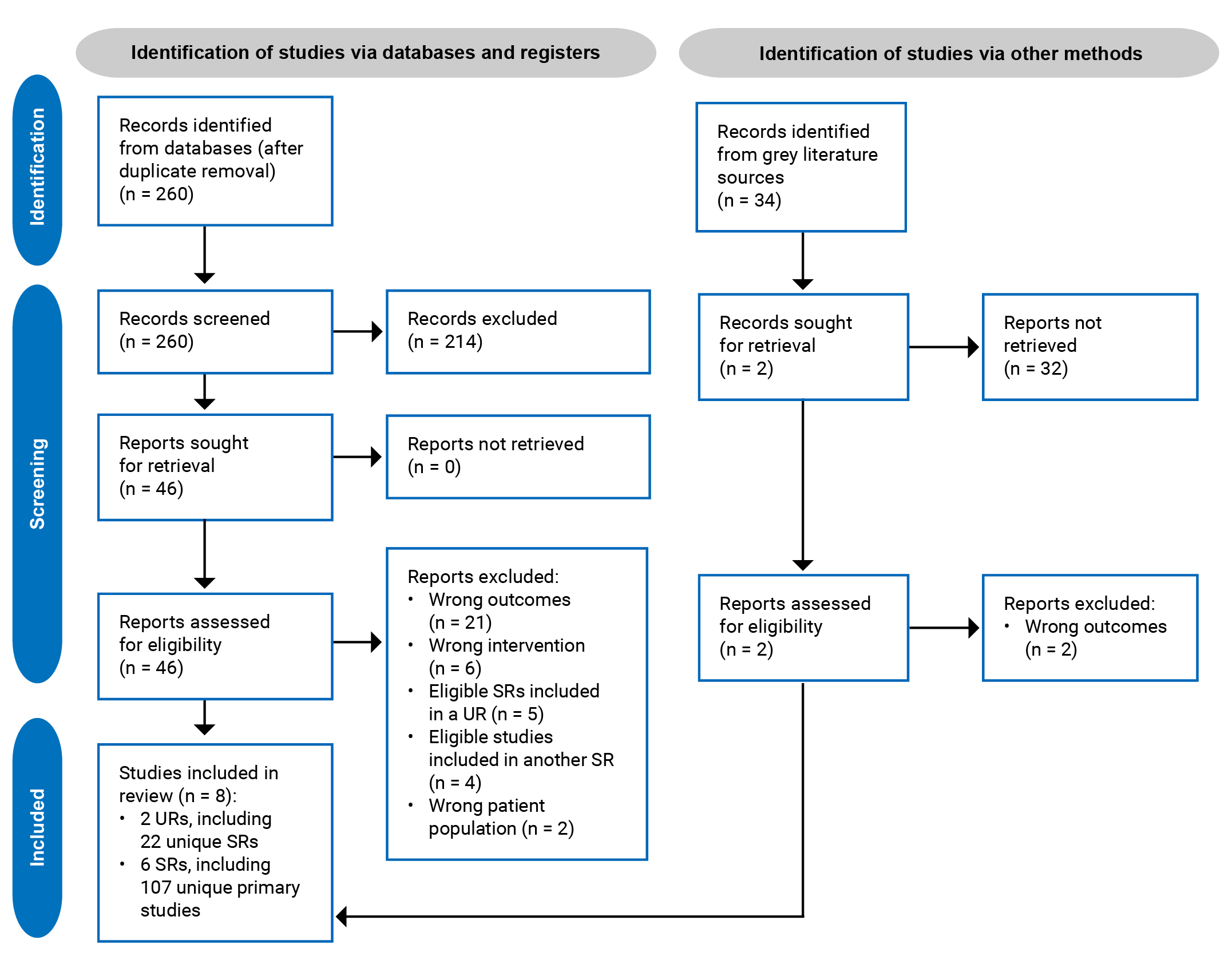
PRISMA = Preferred Reporting Items for Systematic Reviews and Meta-Analyses; SR = systematic review; UR = umbrella review.
Appendix 3: Characteristics of Included Publications
Please note that this appendix has not been copy-edited.
Table 4: Characteristics of Included Systematic Reviews and Umbrella Reviews
Study citation, countries of eligible studies, funding source | Study designs and numbers of primary studies included | Population characteristics | Intervention characteristics | Clinical outcomes, length of follow‑up |
|---|---|---|---|---|
Fernández et al. (2026)23 Countries of included SRs: NR Funding source: None | Study design: UR of SRs with or without meta-analyses Articles with no language restriction published from inception to March 2025 Number of included SRs: 15; 8 relevant to the present review | Population: patients undergoing direct dental restorations in permanent teeth Number of participants: NR Age (year): varied across studies, from young adults to older patients (aged > 80 years) PROGRESS-Plus criteria:a NR Setting:
| Intervention: A variety of direct restorative materials and techniques Materials:
Technique and strategies:
Restoration type or location:
| Outcomes:
Follow-up: 6 to 120 months |
Alani et al. (2025)12 Countries of included studies eligible for the current review:
Funding source: NR | Study design: SR of RCTs and nRCTs Articles with no language restriction published from inception to October 2023 Number of included studies: 43; 17 (4 RCTs and 13 nRCTs) relevant to the present review | Population: adult patients diagnosed with pathological moderate to severe tooth wear Number of participants: NR Age (year), mean: mean ages ranging from approximately 26.67 to 65.9 years PROGRESS-Plus criteria:a NR Setting:
| Intervention: restorative treatments with any type of dental material Materials: composites Technique and strategies: NR Restoration type or location:
| Outcomes:
Follow-up: 0.37 to 10.7 years |
Santos et al. (2025)19 Countries of included studies eligible for the current review:
Funding source: None | Study design: SR and meta-analysis of RCTs Articles published in English from 1980 to September 2021 Number of included studies: 15; all relevant to the present review | Population: Patients who received direct multisurface (2 or more surfaces) restorations on permanent posterior teeth Number of participants: NR Age (year), mean: NR PROGRESS-Plus criteria:a NR Setting: NR | Intervention: Multisurface direct restorations on permanent posterior teeth Materials:
Technique and strategies: NR Restoration type or location: posterior | Outcomes:
Follow-up: 3 to 30 years |
Wen et al. (2025)20 Countries of included studies eligible for the current review:
Funding source: None | Study design: SR and meta-analysis of RCTs and nRCTs Articles published in English from January 2004 to April 2024 Number of included studies: 9 (8 RCTs and 1 nRCT); all relevant to the present review | Population: adults with root caries lesions Number of participants: ranged between 15 and 103 Age (year), mean: ranged from 39.6 to 81.5 Sex or gender: ranged from 7 to 72 for females and 8 to 54 for male Other PROGRESS-Plus criteria:a NR Setting:
| Intervention: any restorative treatment for root caries lesion Materials:
Technique and strategies: ART Restoration type or location: root caries | Outcomes:
Follow-up: 6 to 60 months |
Demarco et al. (2023)21 Countries of included studies eligible for the current review:
Funding source: None | Study design: SR of RCTs, nRCTs, and retrospective observational studies Articles published from 2011 to September 2021; Language restriction NR Number of included studies: 33 (5 RCTs + 2 nRCTs + 26 retrospective observational studies); all relevant to the present review | Population: Children, teenagers, and adults Number of participants: ranged between 27 and 3 million Age (year), mean: NR PROGRESS-Plus criteria:a NR Setting:
| Intervention: restorations in permanent dentition Materials: resin composites Technique and strategies: NR Restoration type or location:
| Outcomes:
Follow-up: 5 to 30 years |
Amend et al. (2022)24 Countries of included SRs: NR Funding source: None | Study design: UR of SRs with or without meta-analyses Articles with no language restriction published from inception to 7 October 2021 Number of included SRs: 14; all relevant to the present review | Population: Children up to the age of 12 years with deep carious lesions in their primary dentition Number of participants: NR Age (year), mean: NR PROGRESS-Plus criteria:a NR Setting: NR | Intervention: restorations of carious primary teeth Materials:
Technique and strategies:
Restoration type or location:
| Outcomes:
Follow-up: 6 to 96 months |
Amend et al. (2022)25 Countries of included studies eligible for the current review:
Funding source: European Academy of Paediatric Dentistry (EAPD) | Study design: SR of RCTs Articles with no language restriction published from inception to December 28, 2020 Number of included studies: 29; 28 relevant to the present review | Population: Children (regardless of sex and age) with primary, previously unrestored carious lesions Number of participants: ranged between 25 and 568 Age (year), mean: NR Sex or gender:d the number of female participants from included primary studies ranged 13 from to 100; the number of female participants from included primary studies ranged from 12 to 108; other sexes or genders were NR. Other PROGRESS-Plus criteria:a NR Setting:
| Intervention: Restorative treatment in primary teeth with different restorative materials or techniques and degrees of caries removal (selective or complete removal of carious tissue) Materials:
Technique and strategies:
Restoration type or location:
| Outcomes:
Follow-up: 1 to 4 years |
Shah et al. (2021)22 Countries of included studies eligible for the current review:
Funding source: None | Study design: SR of longitudinal prospective or retrospective clinical trials Articles published in English from inception to 2018 Number of included studies: 25; 15 (9 prospective longitudinal and 6 retrospective longitudinal) relevant to the present review | Population: NR Number of participants: ranged between 15 and 29,855 Age (year), mean: NR PROGRESS-Plus criteria:a NR Setting: NR | Intervention: direct restorations in anterior permanent teeth Materials: resin composites Technique and strategies: adhesive technique Restoration type or location:
| Outcomes:
Follow-up: 3 to 17 years |
AFR = Annual failure rates; ART = atraumatic restorative treatment; GIC = glass ionomer cements; HVGIC = high-viscosity glass ionomer cements; MRGIC = metal-reinforced glass ionomer cement; NR = not reported; nRCTs = nonrandomized controlled trial; RCT = randomized controlled trial; RMGIC = resin- modified glass ionomer cements; SR = systematic review; UR = umbrella review.
aThe main PROGRESS-Plus characteristics include place of residence, race, ethnicity, culture, language, occupation, gender, sex, religion, education, socioeconomic status, and social capital, personal characteristics associated with discrimination (e.g., age, disability), features of relationships, and time-dependent relationships.27
bMinor AFR: AFR for restorations requiring repair, refurbishment, polishing, or adjustment without complete replacement.
cMajor AFR: AFR for restorations requiring complete replacement of the restoration.
dMany of the included primary studies in this SR did not report the gender of participants or reported conflicting information.
Appendix 4: Critical Appraisal of Included Publications
Please note that this appendix has not been copy-edited.
Table 5: Strengths and Limitations of the Fernández et al. (2026) Study23 Using AMSTAR 218
AMSTAR 2 item | Domain type | Judgment | Support for judgment |
|---|---|---|---|
1. Did the research questions and inclusion criteria for the review include the components of PICO? | Noncritical | Yes | Population, interventions, comparators, and outcomes were clearly prespecified. |
2. Did the report of the review contain an explicit statement that the review methods were established prior to the conduct of the review and did the report justify any significant deviations from the protocol? | Critical | Yes | Authors state that a protocol was developed a priori and registered in PROSPERO (CRD420251032280). |
3. Did the review authors explain their selection of the study designs for inclusion in the review? | Noncritical | Yes | Inclusion was limited to SRs with or without meta-analysis to synthesize and appraise the best available evidence regarding the clinical longevity of direct dental restorations, consistent with the objectives of an umbrella review. |
4. Did the review authors use a comprehensive literature search strategy? | Critical | Partial Yes | Five databases were searched without language and publication year restrictions, search strategies were reported, reference lists were hand searched, and search terms were provided. However, no grey literature, trial registry search, or expert consultation was reported. |
5. Did the review authors perform study selection in duplicate? | Noncritical | Yes | Two reviewers independently screened studies with arbitration by a third reviewer. |
6. Did the review authors perform data extraction in duplicate? | Noncritical | Yes | Data extraction was performed independently and in duplicate by 2 reviewers using a standardized form. |
7. Did the review authors provide a list of excluded studies and justify the exclusions? | Critical | No | The review does not provide a list of excluded full-text reviews or reasons for exclusion. A PRISMA flow diagram is referenced. |
8. Did the review authors describe the included studies in adequate detail? | Noncritical | Yes | The review provided detailed descriptions of the populations, interventions and comparators, outcomes, study designs, clinical settings, and follow-up periods of the included SRs. |
9. Did the review authors use a satisfactory technique for assessing the RoB in individual studies that were included in the review? | Critical | Yes | Methodological quality of each included SR was assessed using AMSTAR 2. The certainty of evidence was assessed using GRADE. |
10. Did the review authors report on the sources of funding for the studies included in the review? | Noncritical | Yes | Funding of the included SRs was reported as part of the AMSTAR 2 appraisal. |
11. If meta-analysis was performed did the review authors use appropriate methods for statistical combination of results? | Critical | NA | No new meta-analysis was performed. The authors appropriately synthesized published pooled estimates narratively and acknowledged overlapping reviews. |
12. If meta-analysis was performed, did the review authors assess the potential impact of RoB in individual studies on the results of the meta-analysis or other evidence synthesis? | Noncritical | NA | No meta-analysis was performed. The AMSTAR 2 ratings for each SR were presented. |
13. Did the review authors account for RoB in individual studies when interpreting/discussing the results of the review? | Critical | Yes | The discussion acknowledges methodological weaknesses and lower certainty of evidence and interprets findings accordingly. |
14. Did the review authors provide a satisfactory explanation for, and discussion of, any heterogeneity observed in the results of the review? | Noncritical | Yes | Heterogeneity across reviews was discussed, including differences in materials, outcome definitions, follow-up, and evaluation criteria. |
15. If they performed quantitative synthesis did the review authors carry out an adequate investigation of publication bias (small study bias) and discuss its likely impact on the results of the review? | Critical | NA | No meta-analysis was performed. The AMSTAR 2 ratings of publication bias for each SR were presented. In addition, publication bias is assessed using domain 5 of GRADE for each primary outcome reported in the UR. |
16. Did the review authors report any potential sources of conflict of interest, including any funding they received for conducting the review? | Noncritical | Yes | Funding and conflict of interests are reported; no apparent conflicts affecting interpretation are identified. |
AMSTAR 2 = A MeaSurement Tool to Assess systematic Reviews 2; GRADE = Grading of Recommendations Assessment, Development and Evaluation; NA = not applicable; SR = systematic review; UR = umbrella review.
Table 6: Strengths and Limitations of the Alani et al. (2025) Study12 Using AMSTAR 218
AMSTAR 2 item | Domain type | Judgment | Support for judgment |
|---|---|---|---|
1. Did the research questions and inclusion criteria for the review include the components of PICO? | Noncritical | Yes | Population, interventions, comparators, and outcomes were clearly defined. |
2. Did the report of the review contain an explicit statement that the review methods were established prior to the conduct of the review and did the report justify any significant deviations from the protocol? | Critical | Yes | Protocol was registered prospectively in PROSPERO (CRD42022358586). Authors reported a priori registration and described amendments. |
3. Did the review authors explain their selection of the study designs for inclusion in the review? | Noncritical | Yes | The review included randomized and nonrandomized clinical study designs to capture all available evidence on restorative treatment of moderate to severe tooth wear. |
4. Did the review authors use a comprehensive literature search strategy? | Critical | Partial Yes | Five databases were searched, handsearching was conducted without language or publication year restrictions, and search terms were reported. However, no grey literature, trial registry search, or expert consultation was reported. |
5. Did the review authors perform study selection in duplicate? | Noncritical | Yes | Three reviewers independently screened titles/abstracts and full texts, with disagreements resolved through discussion. |
6. Did the review authors perform data extraction in duplicate? | Noncritical | Yes | Data extraction was performed by 1 reviewer and checked independently by a second reviewer. |
7. Did the review authors provide a list of excluded studies and justify the exclusions? | Critical | No | Reasons for exclusion were reported in the PRISMA flow diagram; however, excluded studies were not listed individually and study-level reasons for exclusion were not provided. |
8. Did the review authors describe the included studies in adequate detail? | Noncritical | Yes | The review provided detailed descriptions of the included studies, including population characteristics (including age), interventions and comparator material groups, outcomes, study designs, study settings, and follow-up durations. |
9. Did the review authors use a satisfactory technique for assessing the RoB in individual studies that were included in the review? | Critical | Yes | The review used appropriate, validated RoB tools for both RCTs (RoB 2.0) and nonrandomized studies (ROBINS-I), covering randomization/allocation, blinding, confounding, selection bias, outcome measurement, and selective reporting. |
10. Did the review authors report on the sources of funding for the studies included in the review? | Noncritical | No | Funding sources for the included primary studies were not systematically reported. |
11. If meta-analysis was performed did the review authors use appropriate methods for statistical combination of results? | Critical | NA | Meta-analysis was not performed because of substantial heterogeneity. |
12. If meta-analysis was performed, did the review authors assess the potential impact of RoB in individual studies on the results of the meta-analysis or other evidence synthesis? | Noncritical | NA | No meta-analysis was conducted. |
13. Did the review authors account for RoB in individual studies when interpreting/discussing the results of the review? | Critical | Yes | The authors considered the risk of bias of both RCTs and nRCTs when interpreting findings and discussed how methodological limitations and certainty of evidence affected confidence in the results. |
14. Did the review authors provide a satisfactory explanation for, and discussion of, any heterogeneity observed in the results of the review? | Noncritical | Yes | The authors discussed heterogeneity across studies, including differences in restorative approaches, study designs, follow-up duration, outcome definitions, and failure criteria that may have contributed to variations in reported outcomes. |
15. If they performed quantitative synthesis did the review authors carry out an adequate investigation of publication bias (small study bias) and discuss its likely impact on the results of the review? | Critical | NA | No meta-analysis was conducted. |
16. Did the review authors report any potential sources of conflict of interest, including any funding they received for conducting the review? | Noncritical | Yes | Authors declared no conflicts of interest. |
AMSTAR 2 = A MeaSurement Tool to Assess systematic Reviews 2; NA = not applicable; n-RCT = nonrandomized controlled trial; RCT = randomized controlled trial; RoB = risk of bias; ROBINS-I = Risk Of Bias In Nonrandomized Studies of Interventions; SR = systematic review.
Table 7: Strengths and Limitations of the Santos et al. (2025) Study19 Using AMSTAR 218
AMSTAR 2 item | Domain type | Judgment | Support for judgment |
|---|---|---|---|
1. Did the research questions and inclusion criteria for the review include the components of PICO? | Noncritical | Yes | Population, intervention, comparator, and outcomes were explicitly prespecified. |
2. Did the report of the review contain an explicit statement that the review methods were established prior to the conduct of the review and did the report justify any significant deviations from the protocol? | Critical | Yes | The review was prospectively registered in PROSPERO (CRD42021239349) before conduct of the review. No deviations were reported. |
3. Did the review authors explain their selection of the study designs for inclusion in the review? | Noncritical | Yes | The review explicitly restricted inclusion to RCTs to minimize bias and ensure reliable data. |
4. Did the review authors use a comprehensive literature search strategy? | Critical | Partial Yes | Five databases were searched, complete search strategies were reported, and reference lists were searched. The restriction to studies published from 1980 onward was justified to capture resin composite restorative materials specifically developed for posterior teeth. However, no grey literature, trial registry search, or expert consultation was reported. |
5. Did the review authors perform study selection in duplicate? | Noncritical | Yes | Full-text articles were independently evaluated by 2 reviewers and disagreements were resolved through discussion with another reviewer. |
6. Did the review authors perform data extraction in duplicate? | Noncritical | No | The review reported study selection in duplicate but did not explicitly state that data extraction was independently performed by 2 reviewers. |
7. Did the review authors provide a list of excluded studies and justify the exclusions? | Critical | No | The review reported the number of excluded full-text studies and general reasons for exclusion but did not provide a list of individual excluded studies and corresponding reasons for exclusion. |
8. Did the review authors describe the included studies in adequate detail? | Noncritical | Partial Yes | The review adequately described populations, interventions, comparators, outcomes, research designs, and follow-up periods, but detailed study settings were not reported for the included studies. |
9. Did the review authors use a satisfactory technique for assessing the RoB in individual studies that were included in the review? | Critical | Yes | The review used the Cochrane RoB Tool and assessed random sequence generation, allocation concealment, blinding of outcome assessors, incomplete outcome data, selective outcome reporting, and other bias sources. |
10. Did the review authors report on the sources of funding for the studies included in the review? | Noncritical | No | Funding sources of the included primary studies were not reported. |
11. If meta-analysis was performed did the review authors use appropriate methods for statistical combination of results? | Critical | Yes | Appropriate random-effects meta-analysis methods were used, and heterogeneity was assessed statistically. |
12. If meta-analysis was performed, did the review authors assess the potential impact of RoB in individual studies on the results of the meta-analysis or other evidence synthesis? | Noncritical | No | The review did not evaluate the impact of study risk of bias on the meta-analysis results through sensitivity analyses, subgroup analyses, or other methods. |
13. Did the review authors account for RoB in individual studies when interpreting/discussing the results of the review? | Critical | Yes | The authors discussed identified RoB, focused their discussion and conclusions on findings from lower-risk studies, and cautioned interpretation of the results due to methodological limitations of the included trials. |
14. Did the review authors provide a satisfactory explanation for, and discussion of, any heterogeneity observed in the results of the review? | Noncritical | Yes | Heterogeneity was assessed using I2 statistics, and potential sources of clinical and methodological heterogeneity were discussed, including restoration characteristics, follow-up duration, patient factors, and study methods. |
15. If they performed quantitative synthesis did the review authors carry out an adequate investigation of publication bias (small study bias) and discuss its likely impact on the results of the review? | Critical | Yes | Publication bias was assessed using funnel plots and interpreted. |
16. Did the review authors report any potential sources of conflict of interest, including any funding they received for conducting the review? | Noncritical | Yes | The authors reported funding status and conflicts of interest. |
AMSTAR 2 = A MeaSurement Tool to Assess systematic Reviews 2; NA = not applicable; RCT = randomized controlled trial; RoB = Risk of Bias; SR = systematic review.
Table 8: Strengths and Limitations of the Wen et al. (2025) Study20 Using AMSTAR 218
AMSTAR 2 item | Domain type | Judgment | Support for judgment |
|---|---|---|---|
1. Did the research questions and inclusion criteria for the review include the components of PICO? | Noncritical | Yes | Population, intervention, comparator, and outcomes were explicitly defined. |
2. Did the report of the review contain an explicit statement that the review methods were established prior to the conduct of the review and did the report justify any significant deviations from the protocol? | Critical | No | No protocol registration or pre-established protocol was reported. |
3. Did the review authors explain their selection of the study designs for inclusion in the review? | Noncritical | Yes | Authors justified inclusion of both RCTs and NRSI to capture all available clinical evidence relevant to the review question. |
4. Did the review authors use a comprehensive literature search strategy? | Critical | Partial Yes | The review searched 3 relevant databases, reported keywords and search strategies, and justified the publication date restriction by limiting inclusion to recent evidence from January 2004 to April 2024. However, there was no report of searching reference lists, trial registries, grey literature, or consulting content experts. |
5. Did the review authors perform study selection in duplicate? | Noncritical | No | Two independent researchers conducted literature search, but the review did not explicitly report that title/abstract screening and full-text study selection were independently performed by 2 reviewers or that disagreements were resolved through consensus or a third reviewer. |
6. Did the review authors perform data extraction in duplicate? | Noncritical | No | Data extraction was described, but duplicate independent extraction was not explicitly reported. |
7. Did the review authors provide a list of excluded studies and justify the exclusions? | Critical | No | Reasons for exclusion were reported by category, but no study-level exclusion list was provided. |
8. Did the review authors describe the included studies in adequate detail? | Noncritical | Yes | The review provided detailed descriptions of the populations, interventions/comparators, outcomes, study designs, settings, country, and follow-up periods for the included studies. |
9. Did the review authors use a satisfactory technique for assessing the RoB in individual studies that were included in the review? | Critical | Partial Yes | The authors used the Newcastle-Ottawa Scale (NOS) because study groups from the included RCTs and NRSI were analyzed as cohort groups for indirect comparisons. NOS assessed key domains including selection bias, comparability/confounding, and outcome assessment, meeting the minimum requirements for NRSI. However, the review did not use an RCT-specific RoB tool to assess allocation concealment, random sequence generation, blinding, or selective reporting. |
10. Did the review authors report on the sources of funding for the studies included in the review? | Noncritical | No | Funding sources of primary studies not reported. |
11. If meta-analysis was performed did the review authors use appropriate methods for statistical combination of results? | Critical | Yes | Appropriate meta-analysis and meta-regression methods were described, including handling of proportions, heterogeneity assessment, and subgroup analyses. |
12. If meta-analysis was performed, did the review authors assess the potential impact of RoB in individual studies on the results of the meta-analysis or other evidence synthesis? | Noncritical | No | RoB was assessed, but no analysis of its impact on pooled estimates was reported. |
13. Did the review authors account for RoB in individual studies when interpreting/discussing the results of the review? | Critical | Yes | Although the review did not use an RCT-specific RoB tool, the authors accounted for methodological limitations of the included evidence when interpreting the findings by discussing the inclusion of NRSI, the limited strength of the evidence, and the constraints of indirect comparisons. |
14. Did the review authors provide a satisfactory explanation for, and discussion of, any heterogeneity observed in the results of the review? | Noncritical | Yes | Heterogeneity was quantified and meta-regression was conducted to explore possible explanatory factors. |
15. If they performed quantitative synthesis did the review authors carry out an adequate investigation of publication bias (small study bias) and discuss its likely impact on the results of the review? | Critical | No | No publication bias assessment identified. |
16. Did the review authors report any potential sources of conflict of interest, including any funding they received for conducting the review? | Noncritical | Yes | Both conflicts of interest and funding for the review itself were explicitly reported. |
AMSTAR 2 = A MeaSurement Tool to Assess systematic Reviews 2; NA = not applicable; NRSI = nonrandomized study of intervention; RCT = randomized controlled trial; RoB = Risk of Bias; SR = systematic review.
Table 9: Strengths and Limitations of the Demarco et al. (2023) Study21 Using AMSTAR 218
AMSTAR 2 item | Domain type | Judgment | Support for judgment |
|---|---|---|---|
1. Did the research questions and inclusion criteria for the review include the components of PICO? | Noncritical | Yes | Population, intervention/exposure, outcomes, and study design were clearly defined through the review question and eligibility criteria. |
2. Did the report of the review contain an explicit statement that the review methods were established prior to the conduct of the review and did the report justify any significant deviations from the protocol? | Critical | No | No protocol registration or a priori protocol was reported. |
3. Did the review authors explain their selection of the study designs for inclusion in the review? | Noncritical | Yes | Prospective and retrospective longitudinal clinical studies were included. Cross-sectional studies were excluded because they were considered unreliable for assessing longevity. |
4. Did the review authors use a comprehensive literature search strategy? | Critical | Partial Yes | A systematic search was conducted in 3 databases, a handsearch was performed, and the search strategies were provided in supplementary materials. The publication date restriction (2011 to 2021) was justified to include new findings. However, no grey literature, trial registry search, or expert consultation was reported. |
5. Did the review authors perform study selection in duplicate? | Noncritical | Yes | Two reviewers screened titles/abstracts and full texts, with disagreements resolved through discussion between the 2 reviewers with the help of a third reviewer. |
6. Did the review authors perform data extraction in duplicate? | Noncritical | No | Data were collected by 2 reviewers; however, duplicate independent data extraction was not explicitly reported. |
7. Did the review authors provide a list of excluded studies and justify the exclusions? | Critical | No | No list of excluded full-text studies and study-level reasons for exclusion was provided. |
8. Did the review authors describe the included studies in adequate detail? | Noncritical | Yes | The review provided detailed descriptions of the included studies, including patient characteristics, restoration type, interventions, outcomes, study designs, clinical settings, country, sample sizes, and follow-up periods. |
9. Did the review authors use a satisfactory technique for assessing the RoB in individual studies that were included in the review? | Critical | No | No formal RoB or methodological quality assessment tool was applied to the included studies. |
10. Did the review authors report on the sources of funding for the studies included in the review? | Noncritical | No | Funding sources of the included primary studies were not reported. |
11. If meta-analysis was performed did the review authors use appropriate methods for statistical combination of results? | Critical | NA | No meta-analysis was conducted; results were synthesized descriptively. |
12. If meta-analysis was performed, did the review authors assess the potential impact of RoB in individual studies on the results of the meta-analysis or other evidence synthesis? | Noncritical | NA | No meta-analysis was performed and no formal RoB assessment was undertaken. |
13. Did the review authors account for RoB in individual studies when interpreting/discussing the results of the review? | Critical | No | Interpretation of findings did not incorporate a formal assessment of study RoB. |
14. Did the review authors provide a satisfactory explanation for, and discussion of, any heterogeneity observed in the results of the review? | Noncritical | No | Differences among studies were described; however, heterogeneity was not explicitly investigated or explained. |
15. If they performed quantitative synthesis did the review authors carry out an adequate investigation of publication bias (small study bias) and discuss its likely impact on the results of the review? | Critical | NA | Because no meta-analysis was conducted, publication bias was not formally evaluated. Although the authors acknowledged the potential for publication bias, no formal assessment method was performed. |
16. Did the review authors report any potential sources of conflict of interest, including any funding they received for conducting the review? | Noncritical | Yes | Review funding and author support were reported. |
AMSTAR 2 = A MeaSurement Tool to Assess systematic Reviews 2; NA = not applicable; RoB = Risk of Bias; SR = systematic review.
Table 10: Strengths and Limitations of the Amend et al. (2022) Study24 Using AMSTAR 218
AMSTAR 2 item | Domain type | Judgment | Support for judgment |
|---|---|---|---|
1. Did the research questions and inclusion criteria for the review include the components of PICO? | Noncritical | Yes | Population, interventions, comparisons, outcomes, and study design were clearly prespecified. |
2. Did the report of the review contain an explicit statement that the review methods were established prior to the conduct of the review and did the report justify any significant deviations from the protocol? | Critical | Yes | The UR was prospectively registered in PROSPERO (CRD42021227889). No deviations from the protocol were reported. |
3. Did the review authors explain their selection of the study designs for inclusion in the review? | Noncritical | Yes | Inclusion was limited to SRs with or without meta-analysis, consistent with the objective of conducting a UR that synthesizes evidence from published SRs. |
4. Did the review authors use a comprehensive literature search strategy? | Critical | Yes | Seven databases were searched, search strategies were reported in supplementary materials, and reference lists were hand searched. Authors also checked grey literature, dissertations, National Institutes of Health, and the WHO International Clinical Trials Registry. |
5. Did the review authors perform study selection in duplicate? | Noncritical | Yes | Two reviewers independently screened studies with arbitration by a third reviewer. |
6. Did the review authors perform data extraction in duplicate? | Noncritical | Yes | Data were extracted independently and in duplicate by 2 review authors. |
7. Did the review authors provide a list of excluded studies and justify the exclusions? | Critical | Yes | The review provided a list of excluded studies with study-level reasons for exclusion in the supplementary material. |
8. Did the review authors describe the included studies in adequate detail? | Noncritical | Partial Yes | The review described populations, interventions, comparators, outcomes, research designs, and follow-up periods of the included reviews, but detailed study-setting information was not consistently reported. |
9. Did the review authors use a satisfactory technique for assessing the RoB in individual studies that were included in the review? | Critical | Yes | Quality assessment was conducted independently by 2 reviewers using the ROBIS tool, a validated instrument designed for assessing risk of bias in systematic reviews. |
10. Did the review authors report on the sources of funding for the studies included in the review? | Noncritical | No | The review did not report funding sources for the included SRs or their underlying primary studies. |
11. If meta-analysis was performed did the review authors use appropriate methods for statistical combination of results? | Critical | NA | No de novo meta-analysis was conducted. Although quantitative synthesis was planned, the review ultimately presented a narrative synthesis of the findings. |
12. If meta-analysis was performed, did the review authors assess the potential impact of RoB in individual studies on the results of the meta-analysis or other evidence synthesis? | Noncritical | NA | No de novo meta-analysis was conducted. |
13. Did the review authors account for RoB in individual studies when interpreting/discussing the results of the review? | Critical | Yes | The authors assessed review quality with ROBIS and acknowledged that most reviews had an unclear risk of bias, incorporating this limitation into interpretation of findings. |
14. Did the review authors provide a satisfactory explanation for, and discussion of, any heterogeneity observed in the results of the review? | Noncritical | Yes | The authors discussed differences in restorative materials, outcomes, and follow-up duration as potential sources of heterogeneity. |
15. If they performed quantitative synthesis did the review authors carry out an adequate investigation of publication bias (small study bias) and discuss its likely impact on the results of the review? | Critical | NA | Publication bias assessment was not applicable because the umbrella review did not perform a new quantitative meta-analysis. |
16. Did the review authors report any potential sources of conflict of interest, including any funding they received for conducting the review? | Noncritical | Yes | The article includes declarations regarding funding and conflicts of interest in the publication. |
AMSTAR 2 = A MeaSurement Tool to Assess systematic Reviews 2; NA = not applicable; RoB = risk of bias; ROBIS = Risk of Bias in Systematic Reviews; SR = systematic review; UR = umbrella review.
Table 11: Strengths and Limitations of the Amend et al. (2022) Study25 Using AMSTAR 218
AMSTAR 2 item | Domain type | Judgment | Support for judgment |
|---|---|---|---|
1. Did the research questions and inclusion criteria for the review include the components of PICO? | Noncritical | Yes | Population, interventions, comparisons, outcomes, and study design were clearly defined. |
2. Did the report of the review contain an explicit statement that the review methods were established prior to the conduct of the review and did the report justify any significant deviations from the protocol? | Critical | Yes | The review protocol was registered in PROSPERO before commencement (CRD42020221944). |
3. Did the review authors explain their selection of the study designs for inclusion in the review? | Noncritical | Yes | Inclusion was restricted to RCTs to reduce selection bias. |
4. Did the review authors use a comprehensive literature search strategy? | Critical | Partial Yes | Four databases were searched, handsearching was performed for additional studies, reference lists were screened, no language or publication year restrictions were applied, and search strategies were reported. However, no grey literature or trial registry search was reported. |
5. Did the review authors perform study selection in duplicate? | Noncritical | Yes | Two reviewers independently and in duplicate screened titles/abstracts and full texts, with disagreements resolved through discussion. |
6. Did the review authors perform data extraction in duplicate? | Noncritical | Yes | Data were extracted by 2 independent reviewers, with calibration training conducted on the first 10 studies to ensure consistency. |
7. Did the review authors provide a list of excluded studies and justify the exclusions? | Critical | No | Reasons for exclusion were summarized in the PRISMA flow diagram, but a detailed list of excluded full-text studies and individual justifications were not provided. |
8. Did the review authors describe the included studies in adequate detail? | Noncritical | Yes | The review provided detailed study characteristics, including participant demographics and eligibility criteria, intervention and comparator details (including restorative materials and techniques), study design, clinical setting, outcomes assessed, and follow-up duration for each included study. |
9. Did the review authors use a satisfactory technique for assessing the RoB in individual studies that were included in the review? | Critical | Yes | The Cochrane RoB 2 tool was applied independently by 2 reviewers to assess risk of bias across key domains, including the randomization process (including allocation concealment), deviations from intended interventions, measurement of outcomes, missing outcome data, and selection of reported results. |
10. Did the review authors report on the sources of funding for the studies included in the review? | Noncritical | Yes | Funding information was extracted as part of data collection and reported in the study characteristics tables. |
11. If meta-analysis was performed did the review authors use appropriate methods for statistical combination of results? | Critical | NA | No meta-analysis was performed due to heterogeneity and high RoB among studies. |
12. If meta-analysis was performed, did the review authors assess the potential impact of RoB in individual studies on the results of the meta-analysis or other evidence synthesis? | Noncritical | NA | No meta-analysis was performed. However, the authors evaluated RoB for all included studies and cited high RoB as a reason for not pooling results. |
13. Did the review authors account for RoB in individual studies when interpreting/discussing the results of the review? | Critical | Yes | The discussion and conclusions repeatedly acknowledge that findings are limited by the predominantly high RoB and low quality of evidence. |
14. Did the review authors provide a satisfactory explanation for, and discussion of, any heterogeneity observed in the results of the review? | Noncritical | Yes | Heterogeneity across studies was discussed, including differences in interventions, follow-up duration, and investigated outcomes, resulting from the lack of standardized protocols. |
15. If they performed quantitative synthesis did the review authors carry out an adequate investigation of publication bias (small study bias) and discuss its likely impact on the results of the review? | Critical | NA | Because no meta-analysis was conducted, publication bias was not evaluated. |
16. Did the review authors report any potential sources of conflict of interest, including any funding they received for conducting the review? | Noncritical | Yes | Review funding was reported, and authors declared no competing interests. |
AMSTAR 2 = A MeaSurement Tool to Assess systematic Reviews; NA = not applicable; RCT = randomized controlled trial; RoB = Risk of Bias.
Table 12: Strengths and Limitations of the Shah et al. (2021)22 Study Using AMSTAR 218
AMSTAR 2 item | Domain type | Judgment | Support for judgment |
|---|---|---|---|
1. Did the research questions and inclusion criteria for the review include the components of PICO? | Noncritical | Yes | Population, intervention, outcomes, and study design were clearly defined. |
2. Did the report of the review contain an explicit statement that the review methods were established prior to the conduct of the review and did the report justify any significant deviations from the protocol? | Critical | Yes | The review was prospectively registered in PROSPERO (CRD42020211176) before conduct of the review. No deviations were reported. |
3. Did the review authors explain their selection of the study designs for inclusion in the review? | Noncritical | No | The review identifies the included study designs (prospective and retrospective longitudinal clinical studies) but does not justify or explain why those designs were chosen. |
4. Did the review authors use a comprehensive literature search strategy? | Critical | Partial Yes | The review searched 5 databases, provided search keywords, searched reference lists of eligible studies, and applied no restriction on publication date; however, it did not report searching trial registries, consulting experts, or searching grey literature. |
5. Did the review authors perform study selection in duplicate? | Noncritical | No | Four reviewers screened titles and abstracts, and inclusion/exclusion decisions were made following discussion with an expert; however, independent duplicate screening was not explicitly reported. |
6. Did the review authors perform data extraction in duplicate? | Noncritical | No | Two reviewers extracted data; however, the review did not explicitly report independent duplicate data extraction. |
7. Did the review authors provide a list of excluded studies and justify the exclusions? | Critical | No | The review reported the number of excluded full-text studies and general reasons for exclusion but did not provide a list of individual excluded studies and corresponding reasons for exclusion. |
8. Did the review authors describe the included studies in adequate detail? | Noncritical | Partial Yes | The review reported populations, interventions/restoration types, outcomes, study designs, and follow-up periods for included studies; however, detailed population characteristics and study settings were not described. |
9. Did the review authors use a satisfactory technique for assessing the RoB in individual studies that were included in the review? | Critical | No | The review did not report using any formal RoB or methodological quality assessment tool for the included prospective and retrospective studies. |
10. Did the review authors report on the sources of funding for the studies included in the review? | Noncritical | No | Funding sources of the included primary studies were not reported. |
11. If meta-analysis was performed did the review authors use appropriate methods for statistical combination of results? | Critical | NA | A quantitative synthesis was not performed because of substantial heterogeneity. |
12. If meta-analysis was performed, did the review authors assess the potential impact of RoB in individual studies on the results of the meta-analysis or other evidence synthesis? | Noncritical | NA | No meta-analysis was conducted. |
13. Did the review authors account for RoB in individual studies when interpreting/discussing the results of the review? | Critical | No | Because no formal RoB assessment was performed, its impact could not be incorporated into interpretation. |
14. Did the review authors provide a satisfactory explanation for, and discussion of, any heterogeneity observed in the results of the review? | Noncritical | Yes | The authors explained heterogeneity across study design, methods, and outcomes and justified not performing meta-analysis. |
15. If they performed quantitative synthesis did the review authors carry out an adequate investigation of publication bias (small study bias) and discuss its likely impact on the results of the review? | Critical | NA | Publication bias assessment was not applicable because no quantitative synthesis was performed. |
16. Did the review authors report any potential sources of conflict of interest, including any funding they received for conducting the review? | Noncritical | Yes | The review reported funding and conflict-of-interest disclosures, stating self-funding and no conflicts of interest. |
AMSTAR 2 = A MeaSurement Tool to Assess systematic Reviews 2; NA = not applicable; RoB = Risk of Bias; SR = systematic review.
Appendix 5: Main Study Findings
Please note that this appendix has not been copy-edited.
Table 13: Summary of Findings by Materials Evaluated — Resin Composites
Citation | Evidence source, number of included studies or participants | Evaluation criteria, follow‑up (years) | Restoration type, total restorations | Failure rate (%) | AFR (%) | Survival rate (%) | Success rate (%) |
|---|---|---|---|---|---|---|---|
Permanent teeth | |||||||
Fernández et al. (2026)23 | 1 SR; Beck et al. (2015), 15 RCTs | USPHS criteria, 1 to 4 | Posterior, 7,765 | NR | Mean = 1.46 (SD ± 1.74) | NR | NR |
USPHS criteria, ≥ 5 | Posterior, 7,765 | NR | Mean = 1.97 (SD ± 1.53) | NR | NR | ||
1 SR with meta-analysis; Opdam et al. (2014), 12 RCTs and cohorts | Kaplan-Meier, 10 | Posterior, 2,816 | NR | High caries risk: Mean = 4.6 | NR | NR | |
NR | Medium caries risk: Mean = 4.1 | NR | NR | ||||
NR | Low caries risk: Mean = 1.6 | NR | NR | ||||
NR | With lining/base present: Mean = 2.7 | NR | NR | ||||
NR | Without lining/base present: Mean = 2.2 | NR | NR | ||||
1 SR with meta-analysis; Heintze and Rousson (2012), 37 RCTs | Modified USPHS criteria, 1 to 10a | Posterior, 9,174 | Mean = 8 | NR | NR | NR | |
1 SR with meta-analysis; Moraschini et al. (2015), 8 RCTs and cohorts | USPHS criteria, 1 to 12a | Posterior, 3,396 | NR | Mean = 3.17 | NR | NR | |
1 SR with meta-analysis; Szesz et al. (2017), 8 RCTs | USPHS criteria, 3 | NCCLs, 104 | Mean = 27.9 | NR | NR | NR | |
1 SR with meta-analysis; Veloso et al. (2019), 10 RCTs | USPHS criteria, 1 to 6a | Posterior, 941 | Mean = 3.32 | NR | NR | NR | |
1 SR with meta-analysis; Abreu et al. (2022), 13 RCTs and cohorts | USPHS criteria, 1 to 5a | Posterior, 812 | Mean = 5.2 | NR | NR | NR | |
1 SR; Pires et al. (2019), 5 RCTs | USPHS criteria, 3 | NCCLs, 429 | Mean = 22.8 | NR | NR | NR | |
Alani et al. (2025)12 | Pooled analysis of 4 RCTs, 72 participants | F1-F3 restoration failure classificationb Mean: 4.17 Range: 2.5 to 7 | Localized anterior and posterior (Maxillary/ Mandibular), Mean: 413 Range: 16 to 220 | NR | Minor AFR:c
Major AFR:d
| Mean = 87.5 Range = 75 to 100 | Mean = 75.14 Range = 36.54 to 95 |
Pooled analysis of 6 nRCTs prospective studies, 259 participants | F1-F3 restoration failure classificationb Mean: 5.3 Range: 1 to 10 | Generalized and localized anterior (Maxillary/Mandibular), Mean: 2947 Range: 56 to 1,269 | NR | Minor AFR:c
Major AFR:d
| Mean = 99 Range = 99 to 100 | Mean = 81.2 Range = 41 to 100 | |
Pooled analysis of 7 nRCTs retrospective studies, 156 participants | F1-F3 restoration failure classificationb Mean: 3.6 Range: 0.37 to 6 | Generalized and localized Anterior (Maxillary/Mandibular), Mean: 1642 Range: 18 to 332 | NR | Minor AFR:c
Major AFR:d
| Mean = 93.25 Range = 83 to 100 | Mean = 79.9 Range = 26.1 to 96 | |
Santos et al. (2025)19 | SR with meta-analysis (6 RCTs), Participants NR | Mix (Modified USPHS criteria, clinical/ radiograph), 3 to 5 | Posterior, 309 | ER = 3 (95% CI, 0, 9) | NR | NR | NR |
SR with meta-analysis (5 RCTs), Participants NR | Mix (Modified USPHS criteria, Clinical exam, radiograph), 6 to 10 | Posterior (premolars and molars), 879 | ER = 14 (95% CI, 8, 20) | NR | NR | NR | |
SR with meta-analysis (2 RCTs), Participants NR | Modified USPHS criteria, 11 to 15 | Posterior (premolars and molars), 145 | ER = 20 (95% CI, 12, 28) | NR | NR | NR | |
1 RCT; Pallesen and van Dijken (2015), Participants NR | ≥ 15 | Posterior (premolars and molars), 28 | ER = 43e (95% CI, 24 to 63) | NR | Mean = 57.1 | NR | |
Wen et al. (2025)20 | SR with meta-analysis (2 RCTs), 72 participants | Mix (modified USPHS criteria, Modified Havemann), 1a | Root caries, 210 | NR | NR | NR | ESR = 96.3 (95% CI, 93.3, 99.3) |
Demarco et al. (2023)21 | 1 nRCT prospective study; Mehta et al. (2021), 34 participants | NR, 5.5 | Anterior and posterior, 1,269 | NR | Range = 2.2 to 2.9 | Range = 88.6 to 97.7 | NR |
1 retrospective observational study; Wong et al. (2021), 1086 participants | NR, 11 | Posterior, 3,194 | NR | Mean = 18.74 | NR | NR | |
1 retrospective observational study; Kanzow et al. (2020), 3239 participants | NR, 15 | Anterior and posterior, 8,542 | NR | Range = 2.9 to 4.1 | Range = 65.7 to 74.8 | Mean = 43.4 | |
1 retrospective observational study; Wierichs et al. (2020), 7858 participants | NR, 18.5 | Anterior, posterior and cervical, 27,407 | NR | Range = 3.8 to 4.9 | NR | NR | |
1 retrospective observational study; Jirathanyanatt et al. (2019), 226 participants | NR, 5 | Posterior, 226 | NR | NR | Mean = 77.4 | NR | |
1 retrospective observational study; Lempel et al. (2019), 245 participants | NR, 13 | Posterior, 597 | NR | Range = 0.08 to 1.78 | NR | Range = 76.8 to 98.7 | |
1 retrospective observational study; Burke et al. (2018), 3,000,000 participants | NR, 15 | Anterior, posterior and cervical, 13,896,048 | NR | NR | Range = 32 to 42 | NR | |
1 retrospective observational study; Montagner et al. (2018), 100 participants | NR, 8 | Anterior and posterior, 333 | NR | Range = 1.95 to 3.49 | NR | NR | |
1 retrospective observational study; Suksaphar et al. (2018), Participants NR | NR, 5 | Posterior, 61 | NR | NR | Range = 28.6 to 88.5 | NR | |
1 retrospective observational study; Wierichs et al. (2018), 609 participants | NR, 10 | Cervical, 950 | NR | Range = 1.82 to 3.25 | NR | NR | |
1 retrospective observational study; van de Sande et al. (2018), 144 participants | NR, 15f | Anterior, 634, 226f | NR | Mean = 2.6f Range = 2.4 to 9.2) | Range = 38 to 69 | Mean = 66.5f | |
1 retrospective observational study; Alonso et al. (2017), 107 participants | NR, 18 | Posterior, 240 | NR | NR | Range = 82.4 to 92.6 | NR | |
1 retrospective observational study; Collares et al. (2017), 29,855 participants | NR, FDI criteria; 13 | Anterior, 72,196 | NR | Range = 2 to 11 | NR | NR | |
1 retrospective observational study; Kim et al. (2017), 45 participants | NR, 15 | Cervical, 186 | NR | NR | NR | Mean = 83.1 | |
1 retrospective observational study; Lempel et al. (2017), 65 participants | NR, 10 | Anterior, 163 | NR | Mean = 1.43 | Mean = 88.34 | NR | |
1 retrospective observational study; Palotie et al. (2017), 3051 participants | NR, 13 | Posterior, 5,169 | NR | Range = 2.9 to 5.2 | NR | NR | |
1 retrospective observational study; Aljawad and Rees (2016), 41 participants | NR, 5 | Anterior, 296 | NR | NR | Mean = 95.6 | Mean = 88.8 | |
1 RCT; Boushell et al. (2016), 39 participants | NR, 6 | Cervical, 120 | NR | Range = 2.0 to 4.6 | Range = 72.4 to 88.2 | NR | |
1 retrospective observational study; Laske et al. (2016b), 75,556 participants | NR, 10 | Anterior and posterior, 359,548 | NR | Mean = 4.3 | NR | NR | |
1 retrospective observational study; Laske et al. (2016a), 61,121 participants | NR, 10 | Posterior, 222,836 | NR | Mean = 4.6 | NR | NR | |
1 retrospective observational study; Naghipur et al. (2016), NR | NR, 12 | Posterior, 1,695 | NR | NR | Mean = 86.0 | NR | |
1 RCT; van Dijken and Pallesen (2016), 82 participants | NR, 5 | Posterior, 183 | NR | Range = 1.1 to 2.1 | NR | NR | |
1 retrospective observational study; Lempel et al. (2015), 225 participants | NR, 10 | Posterior, 701 | NR | Range = 0.9 to 8.57 | NR | Range = 91.2 to 99.1 | |
1 RCT; Pallesen and van Dijken (2015), 30 participants | NR, 30 | Posterior, 99 | NR | Mean = 1.1 | NR | Mean = 66.7 | |
1 RCT; van Dijken and Lindberg (2015), 50 participants | NR, 15 | Posterior, 106 | NR | Range = 1.5 to 1.6 | NR | Mean = 77.0 | |
1 retrospective observational study; Baldissera et al. (2013), 90 participants | NR, 20 | Anterior and posterior, 594 | NR | Range = 0.3 to 2.5 | NR | NR | |
1 retrospective observational study; Kim et al. (2013), 232 participants | NR, 10 | Anterior, posterior and cervical, 967 | NR | NR | Range = 23 to 55.4 | NR | |
1 retrospective observational study; Namgung et al. (2013), 131 participants | NR, 22 | Cervical, 479 | NR | NR | Mean = 74.7 | NR | |
1 retrospective observational study; van de Sande et al. (2013), 44 participants | NR, 15 | Posterior, 306 | NR | Range = 2.3 to 3.2 | NR | NR | |
1 RCT; Peumans et al. (2012), 71 participants | NR, 13 | Cervical, 142 | NR | NR | NR | Range = 74 to 88 | |
1 retrospective observational study; Ghavamnasiri et al. (2011), 38 participants | NR, 6 | Anterior and posterior, 43 | NR | NR | Mean = 46.3 | NR | |
1 nRCT prospective study; Maltz et al. (2011), 27 participants | NR, 10 | Posterior, 32 | NR | NR | Mean = 63.0 | NR | |
Shah et al. (2021)22 | 1 prospective longitudinal clinical trial; Al-Khayatt et al. (2013), 15 participants | Modified USPHS criteria, 7 | Anterior, build ups, 85 | NA | Mean = 2.3 | NA | Mean = 85 |
1 retrospective longitudinal clinical trial; Collares et al. (2017), 29,855 participants | NR, 10 | Anterior, 72,196 | NR | Mean = 4.6 | NR | Mean = 95.4 | |
1 retrospective longitudinal clinical trial; Smales and Berekally, (2007), Participants NR | Own criteria, 10 | Anterior, class IV and build ups, 164 | NA | NA | NA | Mean = 62 | |
1 prospective longitudinal clinical trial; Loomans et al. (2018), 34 participants | Own criteria, 3.5 | Anterior, build ups, 687 | NA | Mean = 1.1 | NA | Mean = 96.3 | |
1 prospective longitudinal clinical trial; Van Dijken et al. (1999), 52 participants | Modified USPHS criteria, 5 | Anterior, class III and IV, 149 | NA | Mean = 0.8 | NA | Mean = 96 | |
1 prospective longitudinal clinical trial; Demirci et al. (2008), 32 participants | Modified Ryge, 2 | Anterior, class III, 96 | NA | Mean = 3.6 | NA | Mean = 96.4 | |
1 prospective longitudinal clinical trial; Demirci et al. (2018), 34 participants | USPHS Criteria, 5 | Anterior, class IV, 84 | NA | Mean = 1.46 | NA | Mean = 87.69 | |
1 prospective longitudinal clinical trial; van Dijken and Pallesen (2010), Participants NR | Modified USPHS criteria, 14 | Anterior, class IV, 43 | NA | Mean = 2.1 | NA | Mean = 74.4 | |
1 retrospective longitudinal clinical trial; Moura et al. (2011), Participants NR | Modified USPHS criteria, 3 | Anterior, class III and IV, 170 | NA | Mean = 5 | NA | Mean = 84.8 | |
1 prospective longitudinal clinical trial; Millar et al. (1997), Participants NR | Modified USPHS criteria, 8 | Anterior, class III and IV, 28 | NA | Mean = 1.9 | NA | Mean = 85.7 | |
1 retrospective longitudinal clinical trial; Kubo et al. (2011), 58 participants | Modified USPHS criteria, 10 | Anterior, class III, 147 | NA | Mean = 2 | NA | Mean = 81.5 | |
1 prospective longitudinal clinical trial; Ermis et al. (2010), 30 participants | Modified USPHS criteria, 3 | Anterior, class III, 80 | NA | 0 | NA | NA | |
1 prospective longitudinal clinical trial; Deliperi et al. (2008), 20 participants | Modified USPHS criteria, 5 | Anterior, class III and IV, 25 | NA | 0 | NA | NA | |
1 retrospective longitudinal clinical trial; Baldissera et al., (2013), 55 participants | FDI Criteria, 17 | Anterior, class III and IV, 219 | NA | Mean = 0.6 | NA | Mean = 89.9 | |
Primary teeth | |||||||
Amend et al. (2022)24 | 1 UR with mean estimates from 10 SR | Mix (modified USPHS criteria, FDI, own criteria, ART, Roeleveld, Gemert–Schriks criteria, PUFA Index, visual and tactile characteristics of caries lesion arrestment, dentist’s assessment, criteria of other studies), 2a | Posterior, range: 8 to 7,392 | Mean = 14 | NR | NR | NR |
Mix (modified USPHS criteria, FDI, own criteria, ART, Roeleveld, Gemert–Schriks criteria, PUFA Index, visual and tactile characteristics of caries lesion arrestment, dentist’s assessment, criteria of other studies), 3a | Posterior, range: 8 to 7,392 | Mean = 20 | NR | NR | NR | ||
Amend et al. (2022)25 | 1 RCT; Akman and Tosun (2020), Participants NR | Modified USPHS criteria, 1 | Primary molars; class II, 32 | 0 | 0 | NR | NR |
1 RCT; Alves dos Santos et al. (2010), Participants NR | Modified USPHS criteria, 4 | Primary molars; class I and II, 33 | Mean = 25 | Mean = 6.3 | NR | NR | |
1 RCT; Barr-Agholme et al. (1991), Participants NR | USPHS criteria, 2 | Primary molars; class II, 34 | Mean = 12 | Mean = 6.0 | NR | NR | |
1 RCT; Dermata et al. (2018), Participants NR | Modified USPHS criteria, 2 | Primary molars; class II, 49 | Mean = 16 | Mean = 8.0 | NR | NR | |
1 RCT; El-Housseiny et al. (2019), Participants NR | Cvar and Ryge, 1 | Primary molars; class II, 47 | Mean = 2.1 | Mean = 2.1 | NR | NR | |
1 RCT; Ersin et al. (2006), Participants NR | Modified USPHS criteria, 2 | Primary molars; class I and II Class I: 95 Class II: 73 | Cumulative: Mean = 12.9 Class I: Mean = 9 Class II: Mean = 18 | Cumulative: Mean = 6.5 Class I: Mean = 4.5 Class II: Mean = 9 | NR | NR | |
1 RCT; Hse and Wei (1997), Participants NR | Modified USPHS criteria, 1 | Primary molars; class I, II and V, 60 | Mean = 1.7 | Mean = 1.7 | NR | NR | |
1 RCT; Kupietzky et al. (2019), Participants NR | Own criteria (Clinical/radiographic criteria), 3 | Primary molars; class II, 61 | Mean = 4.9 | Mean = 1.6 | NR | NR | |
1 RCT; Lenzi et al. (2017), 44 participants | Modified USPHS criteria, 1.5 | Primary molars, Etch-and-rinse (ER): 40 Self-etch (SE): 40 | ER = 27.8 SE = 10.3 | ER = 18.53 SE = 6.87 | NR | NR | |
1 RCT; Oliveira et al. (2008), 32 participants | Modified USPHS criteria, 1.5 | Primary molars; class I, Bevel: 38 No bevel: 38 | Bevel: Mean = 2.63 No bevel: Mean = 5.26 | Bevel: Mean = 1.75 No bevel: Mean = 3.51 | NR | NR | |
AFR = annual failure rate; ART = atraumatic restorative treatment; CI = confidence interval; ER: estimated rate; ESR = estimated success rate; FDI = World Dental Federation; NCCLs = noncarious cervical lesions; NR = not reported; nRCT = nonrandomized controlled trial; PUFA = pulp, ulceration, fistula, abscess; RCT = randomized controlled trial; SR = systematic review; USPHS = US Public Health Service.
aFor consistency, the authors of this review converted the number of months to number of years.
bF1-F3 restoration failure classification (F1 = replacement; F2 = repair; F3 = refurbishment/polishing), used to derive major failure, minor failure, survival, and success outcomes.
cMinor AFR: AFR for restorations requiring repair, refurbishment, polishing, or adjustment without complete replacement.
dMajor AFR: AFR for restorations requiring complete replacement of the restoration.
eThe meta-analysis figure of this SR reported failure rate as proportion (i.e., 0.43; 95% CI, 24 to 63). For consistency, the authors of this review converted the proportions to percentages.
fReported from Shah et al. (2021).22
Table 14: Summary of Findings by Materials Evaluated — Bulk-Fill Composites
Citation | Evidence source, number of included studies or participants | Evaluation criteria, follow‑up (years) | Restoration type, total restorations | Failure rate (%) | AFR (%) | Survival rate (%) | Success rate (%) |
|---|---|---|---|---|---|---|---|
Permanent teeth | |||||||
Fernández et al. (2026)23 | 1 SR with meta-analysis; Veloso et al. (2019), 10 RCTs | USPHS criteria, 1 to 6a | Posterior, 941 | Mean = 5.57 | NR | NR | NR |
1 SR with meta-analysis; Abreu et al. (2022), 13 RCTs and cohorts | USPHS criteria, 1 to 5a | Posterior, 812 | Mean = 7.1 | NR | NR | NR | |
Primary teeth | |||||||
Amend et al. (2022)25 | 1 RCT; Akman and Tosun (2020), Participants NR | Modified USPHS criteria, 1 | Primary molars; Class II, SonicFill: 34 X-tra fil: 34 | SonicFill: 0 X-tra fil: 0 | SonicFill: 0 X-tra fil: 0 | NR | NR |
1 RCT; Cavalheiro et al. (2020), 62 participants | FDI, 1.5 | Primary molars, 15-second dentin etching: 43 7-second dentin etching: 45 | 15-second: Mean = 24.3 7-second: Mean = 8.6 | 15-second: Mean = 16.9 7-second: Mean = 5.7 | NR | NR | |
CI = confidence interval; FDI = World Dental Federation; NR = not reported; RCT = randomized controlled trial; SR = systematic review, USPHS = US Public Health Service.
aFor consistency, the authors of this review converted the number of months to number of years.
Table 15: Summary of Findings by Materials Evaluated — Flowable Composites
Citation | Evidence source, number of included studies or participants | Evaluation criteria, follow-up (years) | Restoration type, total restorations | Failure rate (%) | AFR (%) | Survival rate (%) | Success rate (%) |
|---|---|---|---|---|---|---|---|
Permanent teeth | |||||||
Fernández et al. (2026)23 | 1 SR with meta-analysis; Szesz et al. (2017), 8 RCTs | USPHS, 3 | NCCLs, 1046 | mean = 22.6 | NR | NR | NR |
Primary teeth | |||||||
Amend et al. (2022)25 | 1 RCT; Ehlers et al. (2019), Participants NR | FDI, 1 | Primary molars; Class II, 49 | 0 | 0 | NR | NR |
CI = confidence interval; NR = not reported; RCT = randomized controlled trial; SR = systematic review.
Table 16: Summary of Findings by Materials Evaluated — Ormocer-Based Composites
Citation | Evidence source, number of included studies or participants | Evaluation criteria, follow-up (years) | Restoration type, total restorations | Failure rate (%) | AFR (%) | Survival rate (%) | Success rate (%) |
|---|---|---|---|---|---|---|---|
Permanent teeth | |||||||
Fernández et al. (2026)23 | 1 SR with meta-analysis; Abreu et al. (2022), 13 RCTs and cohorts | USPHS, 1 to 5a | Permanent posterior teeth, 812 | mean = 12.1 | NR | NR | NR |
CI = confidence interval; NR = not reported; RCT = randomized controlled trial; SR = systematic review.
aFor consistency, the authors of this review converted the number of months to number of years.
Table 17: Summary of Findings by Materials Evaluated — GIC
Citation | Evidence source, number of included studies or participants | Evaluation criteria, follow‑up (years) | Restoration type, total restorations | Failure rate (%) | AFR (%) | Survival rate (%) | Success rate (%) |
|---|---|---|---|---|---|---|---|
Permanent teeth | |||||||
Wen et al. (2025)20 | SR with meta-analysis (4 RCTs and 1 nRCT), 251 participants | Mix (ART criteria, Modified USPHS criteria), 1a | Root caries, 709 | NR | NR | NR | ESR = 86.9 (95% CI, 83.1, 90.7) |
Primary teeth | |||||||
Amend et al. (2022)24 | 1 UR with mean estimates from 13 SR | Mix (ART, DPDHS criteria, USPHS criteria, Modified USPHS criteria, FDI, own criteria, Roeleveld, Gemert–Schriks criteria, PUFA Index, visual and tactile characteristics of caries lesion arrestment, dentist’s assessment, criteria of other studies); 2a | Posterior, Range: 5 to 8,064 | Range = 16 to 21 | NR | NR | NR |
Mix (ART, DPDHS criteria, USPHS criteria, Modified USPHS criteria, FDI, own criteria, Roeleveld, Gemert–Schriks criteria, PUFA Index, visual and tactile characteristics of caries lesion arrestment, dentist’s assessment, criteria of other studies); 3a | Posterior, Range: 5 to 8,064 | Range = 16 to 35 | NR | NR | NR | ||
Amend et al. (2022)25 | 1 RCT; Kilpatrick et al. (1995), Participants NR | Modified USPHS criteria, 1.5 | Primary molars; Class II, 46 | Mean = 23.9 | Mean = 15.9 | NR | NR |
1 RCT; Moura et al. (2020), Participants NR | ART criteria, 1 | Anterior and posterior; class I, II, and III/V, 289 | Mean = 26.6 | Mean = 26.6 | NR | NR | |
1 RCT; Olegario et al. (2019), Participants NR | Retention, wear, marginal adaptation, secondary caries, pulp inflammation, tooth extraction, 3 | Primary molars:
| Cumulative: Mean = 43.8 Class I: Mean = 17 Class II: Mean = 44 | Cumulative: Mean = 14.6 Class I: Mean = 5.7 Class II: Mean = 14.7 | NR | NR | |
1 RCT; Welbury et al. (1991), Participants NR | Modified USPHS, 5 | Primary molar; class I and II, 119 | Mean = 32.8 | Mean = 6.6 | NR | NR | |
1 RCT; Yassen (2009), Participants NR | ART criteria, 1 | Primary molars; class I, 78 With conditioner: 39 Without conditioner: 39 | With conditioner: Mean = 26 Without conditioner: Mean = 33 | With conditioner: Mean = 26 Without conditioner: Mean = 33 | NR | NR | |
ART = atraumatic restorative treatment; CI = confidence interval; DPDHS = Danish Public Dental Health Service; ESR = estimated success rate; FDI = World Dental Federation; GIC = glass ionomer cement; NR = not reported; PUFA= pulp, ulceration, fistula, abscess; RCT = randomized controlled trial; SR = systematic review; USPHS = US Public Health Service.
aFor consistency, the authors of this review converted the number of months to number of years.
Table 18: Summary of Findings by Materials Evaluated — RMGIC
Citation | Evidence source, number of included studies or participants | Evaluation criteria, follow‑up (years) | Restoration type, total restorations | Failure rate (%) | AFR (%) | Survival rate (%) | Success rate (%) |
|---|---|---|---|---|---|---|---|
Permanent Teeth | |||||||
Wen et al. (2025)20 | SR with meta-analysis (5 RCTs), 313 participants | Mix (ART criteria, Modified USPHS, Modified criteria based on former studies), 1a | Root caries, 832 | NR | NR | NR | ESR = 87.5 (95% CI, 77.3 to 97.7) |
Primary Teeth | |||||||
Amend et al. (2022)25 | 1 RCT; Alves dos Santos et al. (2010), Participants NR | Modified USPHS, 4 | Primary molars; class I and II, 34 | Mean = 26.1 | Mean = 6.5 | NR | NR |
1 RCT; Dermata et al. (2018), Participants NR | Modified USPHS, 2 | Primary molars; class II, 55 | Mean = 16 | Mean = 8.0 | NR | NR | |
1 RCT; Dutta et al. (2001), Participants NR | Modified USPHS, 1 | Primary molars; class II, 290 | Mean = 16.9 | Mean = 16.9 | NR | NR | |
1 RCT; El-Housseiny et al. (2019), Participants NR | Cvar and Ryge, 1 | Primary molars; class II, 53 | Range = 1.9 to 7.5 | Range = 1.9 to 7.5 | NR | NR | |
1 RCT; Konde et al. (2012), Participants NR | USPHS, 1 | Primary molars; class I, 47 | Mean = 2 | Mean = 2 | NR | NR | |
CI = confidence interval; ESR = estimated success rate; NR = not reported; RCT = randomized controlled trial; RMGIC = resin-modified glass ionomer cement; SR = systematic review.
aFor consistency, the authors of this review converted the number of months to number of years.
Table 19: Summary of Findings by Materials Evaluated — HVGIC
Citation | Evidence source, number of included studies or participants | Evaluation criteria, follow-up (years) | Restoration type, total restorations | Failure rate (%) | AFR (%) | Survival rate (%) | Success rate (%) |
|---|---|---|---|---|---|---|---|
Primary Teeth | |||||||
Amend et al. (2022)25 | 1 RCT; Akman and Tosun (2020), Participants NR | Modified USPHS criteria, 1 | Primary molars; Class II, 34 | Mean = 2.9 | Mean = 2.9 | NR | NR |
1 RCT; Deepa and Shobha (2010), 100 participants | Frencken's, 1 | Primary molars, 200 Fuji IX: 100:
Amalgomer CR:
| Fuji IX:
Amalgomer CR:
| Fuji IX:
Amalgomer CR:
| NR | NR | |
1 RCT; Ersin et al. (2006), Participants NR | Modified USPHS criteria, 2 | Primary molars:
| Cumulative: Mean = 11.5
| Cumulative: Mean = 5.8
| NR | NR | |
1 RCT; Ersin et al. (2008), 126 participants | Modified USPHS criteria, 2 | Primary molars, 202 Without disinfectant: 109
With disinfectant: 93
| Without disinfectant:
With disinfectant:
| Without disinfectant:
With disinfectant:
| NR | NR | |
1 RCT; Faustino-Silva and Figueiredo (2019), 25 participants | ART criteria, 4 | Primary teeth; class I, 76 Vitro Molar: 38 Ketac Molar: 38 | Vitro Molar: Mean = 13.2 Ketac Molar: Mean = 21.1 | Vitro Molar: Mean = 3.3 Ketac Molar: Mean = 5.3 | NR | NR | |
1 RCT; Gok Baba et al. (2021), Participants NR | Modified USPHS criteria, 1 | Primary molars; Class II, 168 Equia Forte: 86 Chemfil Rock: 82 | Equia Forte: Mean = 25.6 Chemfil Rock: Mean = 13.4 | Equia Forte: Mean = 25.6 Chemfil Rock: Mean = 13.4 | NR | NR | |
1 RCT; Hesse et al. (2016), 208 participants | ART criteria, 3 | Primary molars, 190 HVGIC1 (Conventional insertion + petroleum jelly): 53 HVGIC2 (Bilayer technique + petroleum jelly): 50 HVGIC3 (Conventional insertion + GC G-Coat Plus): 37 HVGIC4 (Bilayer technique + GC G-Coat Plus): 50 | HVGIC1: Mean = 69.1 HVGIC2: Mean = 35.8 HVGIC3: Mean = 46.3 VGIC4: Mean = 35.1 | HVGIC1: Mean = 23.0 HVGIC2: Mean = 11.9 HVGIC3: Mean = 15.4 HVGIC4: Mean = 11.7 | NR | NR | |
1 RCT; Konde et al. (2012), Participants NR | USPHS, 1 | Primary molars; class I, 47 | Mean = 12.8 | Mean = 12.8 | NR | NR | |
1 RCT; Kupietzky et al. (2019), Participants NR | Own clinical/ radiographic criteria, 3 | Primary molars; Class II, 70 | Mean = 17.1 | Mean = 5.7 | NR | NR | |
1 RCT; Moura et al. (2020), Participants NR | ART criteria, 1 | Anterior and posterior, 270 | Mean = 17.8 | Mean = 17.8 | NR | NR | |
1 RCT; Olegario et al. (2020), 150 participants | Retention, wear, marginal adaptation, secondary caries, pulp inflammation, tooth extraction, 2 | Primary molars; class I, 135 Fuji IX Gold Label: 44 Vitro Molar: 50 Maxxion R: 41 | Fuji IX Gold Label: Mean = 27.3 Vitro Molar: Mean = 53.5 Maxxion R: Mean = 60.4 | Fuji IX Gold Label: Mean = 13.6 Vitro Molar: Mean = 26.8 Maxxion R: Mean = 30.2 | NR | NR | |
ART = atraumatic restorative treatment; HVGIC = high-viscosity glass ionomer cement; NR = not reported; USPHS = US Public Health Service.
Table 20: Summary of Findings by Materials Evaluated — MRGIC
Citation | Evidence source, number of included studies or participants | Evaluation criteria, follow‑up (years) | Restoration type, total restorations | Failure rate (%) | AFR (%) | Survival rate (%) | Success rate (%) |
|---|---|---|---|---|---|---|---|
Primary Teeth | |||||||
Amend et al. (2022)25 | 1 RCT; Kilpatrick et al. (1995), Participants NR | Modified USPHS criteria, 1.5 | Primary molars; class II, 46 | Mean = 41.3 | Mean = 27.5 | NR | NR |
MRGIC = metal-reinforced glass ionomer cement; NR = not reported; USPHS = US Public Health Service.
Table 21: Summary of Findings by Materials Evaluated — Glass Carbomer
Citation | Evidence source, number of included studies or participants | Evaluation criteria, follow‑up (years) | Restoration type, total restorations | Failure rate (%) | AFR (%) | Survival rate (%) | Success rate (%) |
|---|---|---|---|---|---|---|---|
Primary Teeth | |||||||
Amend et al. (2022)25 | 1 RCT; El-Housseiny et al. (2019), Participants NR | Cvar and Ryge, 1 | Primary molars; class II, 52 | Range = 5.8 to 46.2 | Range = 5.8 to 46.2 | NR | NR |
GC = glass carbomer; NR = not reported.
Table 22: Summary of Findings by Materials Evaluated — Compomer
Citation | Evidence source, number of included studies or participants | Evaluation criteria, follow‑up (years) | Restoration type, total restorations | Failure rate (%) | AFR (%) | Survival rate (%) | Success rate (%) |
|---|---|---|---|---|---|---|---|
Primary Teeth | |||||||
Amend et al. (2022)24 | 1 UR with mean estimates from 6 SRs | Mix (ART, DPDHS criteria, USPHS criteria, Modified USPHS criteria, FDI, own criteria, Roeleveld, Gemert–Schriks criteria, PUFA Index, visual and tactile characteristics of caries lesion arrestment, dentist’s assessment, criteria of other studies); 2a | Posterior, range: 9 to 8064 | Mean = 19 | NR | NR | NR |
Mix (ART, DPDHS criteria, USPHS criteria, Modified USPHS criteria, FDI, own criteria, Roeleveld, Gemert–Schriks criteria, PUFA Index, visual and tactile characteristics of caries lesion arrestment, dentist’s assessment, criteria of other studies); 3a | Posterior, range: 9 to 8064 | Mean = 13 | NR | NR | NR | ||
Amend et al. (2022)25 | 1 RCT; Alves dos Santos et al. (2010), Participants NR | Modified USPHS criteria, 4 | Primary molars; class I and II, 43 | Mean = 15.7 | Mean = 3.9 | NR | NR |
1 RCT; Ehlers et al. (2019), Participants NR | FDI, 1 | Primary molars; class II, 50 | 0 | 0 | NR | NR | |
1 RCT; Ertugrul et al. (2010), 98 participants | Modified USPHS criteria, 1 | Primary molars; class II
|
|
| NR | NR | |
1 RCT; Gok Baba et al. (2021), Participants NR | Modified USPHS criteria, 1 | Primary molars; class II, 83 | Mean = 3.6 | Mean = 3.6 | NR | NR | |
1 RCT; Hse and Wei (1997), Participants NR | Modified USPHS criteria, 1 | Primary molars; class I, II, and V, 60 | Mean = 1.7 | Mean = 1.7 | NR | NR | |
1 RCT; Kavvadia et al. (2004), Participants NR | Modified Ryge, 2 | Primary molars; class II, 57 | Mean = 2.0 | Mean = 1.0 | NR | NR | |
1 RCT; Olegario et al. (2019), Participants NR | Retention, wear, marginal adaptation, secondary caries, pulp inflammation, tooth extraction, 3 | Primary molars; class I and II:
|
|
| NR | NR | |
1 RCT; Santamaria et al. (2017), 169 participants | Success, major failure, minor failure, 2.5 | Primary molars; class II, 58 | Mean = 32.8 | Mean = 13.12 | NR | NR | |
ART = atraumatic restorative treatment; CI = confidence interval; DPDHS = Danish Public Dental Health Service; FDI = World Dental Federation; NR = not reported; PUFA = pulp, ulceration, fistula, abscess; RCT = randomized controlled trial; SR = systematic review; USPHS = US Public Health Service.
aFor consistency, the authors of this review converted the number of months to number of years.
Table 23: Summary of Findings by Materials Evaluated — Amalgam
Citation | Evidence source, number of included studies or participants | Evaluation criteria, follow‑up (years) | Restoration type, total restorations | Failure rate (%) | AFR (%) | Survival rate (%) | Success rate (%) |
|---|---|---|---|---|---|---|---|
Permanent Teeth | |||||||
Fernández et al. (2026)23 | 1 SR with meta-analysis; Heintze and Rousson (2012), 37 RCTs | Modified USPHS criteria, 1 to 10a | Posterior, 9.174 | Mean = 6 | NR | NR | NR |
1 SR with meta-analysis; Moraschini et al. (2015), 8 RCTs and cohorts | USPHS, 1 to 10a | Posterior, 3396 | NR | Mean = 1.71 | NR | NR | |
Santos et al. (2025)19 | 1 RCT; Bernardo et al. (2007), Participants NR | Clinical and radiograph, 7 | Posterior (Premolars and Molars), 427 | NR | NR | Mean = 86.9 | NR |
1 RCT; Mannocci et al. (2005), Participants NR | Clinical and radiograph, 5 | Posterior (Premolars), 109 | NR | NR | Mean = 69.5 | NR | |
1 RCT; Summitt et al. (2001), Participants NR | Modified USPHS criteria, 5 | Posterior (Premolars and Molars), 28 | NR | NR | Mean = 91.5 | NR | |
Primary Teeth | |||||||
Amend et al. (2022)24 | 1 UR with mean estimates from 9 SRs | Mix (ART, DPDHS criteria, USPHS criteria, Modified USPHS criteria, FDI, own criteria, Roeleveld, Gemert–Schriks criteria, PUFA Index, visual and tactile characteristics of caries lesion arrestment, dentist’s assessment, criteria of other studies); 2a | Posterior, range: 9 to 8064 | Mean = 11 Range = 7 to 17 | NR | NR | NR |
Mix (ART, DPDHS criteria, USPHS criteria, Modified USPHS criteria, FDI, own criteria, Roeleveld, Gemert–Schriks criteria, PUFA Index, visual and tactile characteristics of caries lesion arrestment, dentist’s assessment, criteria of other studies), 3a | Posterior, range: 9 to 8064 | Mean = 21 Range = 4 to 36 | NR | NR | NR | ||
Amend et al. (2022)25 | 1 RCT; Barr-Agholme et al. (1991), Participants NR | USPHS criteria, 2 | Primary molars; class II, 52 | Mean = 32 | Mean = 16 | NR | NR |
1 RCT; Dutta et al. (2001), Participants NR | Modified USPHS criteria, 1 | Primary molars; class II, 100 | Mean = 28 | Mean = 28 | NR | NR | |
1 RCT; Kavvadia et al. (2004), Participants NR | Modified Ryge, 2 | Primary molars; class II, 57 | Mean = 2 | Mean = 1 | NR | NR | |
1 RCT; Welbury et al. (1991), Participants NR | Modified USPHS criteria, 5 | Primary teeth; class I and II, 119 | Mean = 20.2 | Mean = 4 | NR | NR | |
ART = atraumatic restorative treatment; CI = confidence interval; DPDHS = Danish Public Dental Health Service; FDI = World Dental Federation; NR = not reported; PUFA = pulp, ulceration, fistula, abscess; RCT = randomized controlled trial; SR = systematic review; USPHS = US Public Health Service.
aFor consistency, the authors of this review converted the number of months to number of years.
Table 24: Summary of Restoration Failure Types in Permanent Teeth
Citation | Evidence source | Follow-up (years) | Restoration type; material | Reason for failure |
|---|---|---|---|---|
Santos et al. (2025)19 | 1 SR with 8 RCTs | 5 to 30 | Posterior; AM, RC | Caries |
1 SR with 10 RCTs | 3 to 30 | Posterior; AM, RC | Crack or fracture of restoration | |
1 SR with 9 RCTs | 3 to 30 | Posterior; AM, RC | Crack or fracture of tooth (e.g., remaining cusp, fracture of root) | |
1 SR with 4 RCTs | 3 to 8 | Posterior; AM, RC | Endodontic treatment | |
Wen et al. (2025)20 | 1 SR with 4 RCTs and 1 nRCT | 0.5 to 5a | Root caries; GIC, RMGIC, resin composite, | Restoration loss, dislodgement, or loss of retention |
1 SR with 4 RCTs and 1 nRCT | 0.5 to 2 | Root caries; GIC, RMGIC | Marginal defects | |
1 SR with 2 RCTs | 0.5 to 1 | Root caries; GIC, RMGIC | Secondary caries | |
1 SR with 2 RCTs | 3 to 5a | Root caries; Resin composite, RMGIC | Other reasons: replacement by crown restoration, debonding, and tooth extraction; severe marginal discoloration | |
Demarco et al. (2023)21 | 1 SR with 3 RCTs and 8 nRCTs | 5 to 30 | Posterior only; RC | Secondary (adjacent) caries and/or fractures |
1 SR with 2 nRCTs | 10 | Posterior only; RC | Endodontic treatment | |
1 SR with 2 nRCTs | 5 to 10 | Anterior alone, RC | Colour mismatch, marginal discoloration, and fracture | |
1 SR with 2 nRCTs | 8 to 20 | Anterior and posterior; RC | Fractures and aesthetic compromise | |
1 SR with 2 nRCTs | 5.5 | Anterior and posterior; RC | Reparable surface deteriorations | |
1 SR with 3 nRCTs | 6 to 20 | Anterior and posterior; RC | Secondary caries, marginal breakdown, and marginal discoloration | |
1 SR with 2 RCTs and 1 nRCT | 6 to 22 | Cervical; RC | Loss of retention, marginal discoloration, and secondary caries | |
1 SR with 1 nRCT | 10 | Anterior, posterior, and cervical; RC | secondary caries and marginal adaptation | |
Shah et al. (2021)22 | 1 SR with 3 prospective longitudinal and 3 retrospective longitudinal studies | 3.5 to 17 | Anterior; RC | Reasons listed in each study:
|
AM = amalgam; CI = confidence interval; GIC = glass ionomer cements; NR = not reported; nRCT = nonrandomized controlled trial; RC = resin composite; RCT = randomized controlled trial; RMGIC = resin-modified glass ionomer cements; SR = systematic review.
aFor consistency, the authors of this review converted the number of months to number of years.
Table 25: Summary of Restoration Failure Types in Primary Teeth
Citation | Evidence source | Follow-up (years) | Restoration type; material | Reason for failure |
|---|---|---|---|---|
Amend et al. (2022)24 | 1 UR with 4 SRs | 1 to 7a | Posterior, single-surface, or multisurface restorations; AM, GIC, CO, RC, RMGIC |
|
1 UR with 1 SR | 2 to 3a | Posterior, classes I and II; AM, RC | Main reasons listed:
| |
1 UR with 2 SRs | 0.5 to 4a | Posterior, tooth isolation; AM, GIC, CO, RC, RMGIC |
| |
Amend et al. (2022)25 | SR of 28 RCTs | 1 to 5 | Primarily posterior class I and II restorations; conventional and ART restorations; AM, GIC, MRGIC, RMGIC, HVGIC, glass carbomer, CO, RC, and bulk-fill RC |
|
AM = amalgam; ART = atraumatic restorative treatment; CI = confidence interval; CO = compomer; GIC = glass ionomer cements; HVGIC = high-viscosity glass ionomer cements; MRGIC = metal-reinforced glass ionomer cements; NR = not reported; nRCT = nonrandomized controlled trial; RC = resin composite; RCT = randomized controlled trial; RMGIC = resin-modified glass ionomer cements; SR = systematic review; UR = umbrella review.
aFor consistency, the authors of this review converted the number of months to number of years.
Appendix 6: Overlap Between Included Systematic Reviews
Please note that this appendix has not been copy-edited.
Table 26: Overlap in Relevant Primary Studies Between Included Systematic Reviews
Primary study citation | Fernández et al. (2026)23 | Alani et al. (2025)12 | Santos et al. (2025)19 | Wen et al. (2025)20 | Demarco et al. (2023)21 | Amend et al. (2022)24 | Amend et al. (2022)25 | Shah et al. (2021)22 |
|---|---|---|---|---|---|---|---|---|
Heintze SD and Rousson V. J Adhes Dent. 2012;14:407-431. | Yes | — | — | — | — | — | — | — |
Opdam N, et al. J Dent Res. 2014;93(10):943-949. | Yes | — | — | — | — | — | — | — |
Beck F, et al. Dent Mater. 2015;31(8):958-985. | Yes | — | — | — | — | — | — | — |
Moraschini V, et al. J Dent. 2015;43 (9):1043-1050. | Yes | — | — | — | — | — | — | — |
Szesz A, et al. J Dent. 2017;65:11-21. | Yes | — | — | — | — | — | — | — |
Veloso S, et al. Clin Oral Investig. 2019;23(1):221-233. | Yes | — | — | — | — | — | — | — |
Pires AM, et al. J Adhes Dent. 2019;21(6):497-508. | Yes | — | — | — | — | — | — | — |
Abreu NM, et al. Am J Dent. 2022;35(2):89-96. | Yes | — | — | — | — | — | — | — |
Al-khayatt AS, et al. J Oral Rehabil. 2013;40(5):389-401. | — | Yes | — | — | — | — | — | Yes |
Bartlett D and Sundaram G. J Prosthodont. 2006;19(6):613-617. | — | Yes | — | — | — | — | — | — |
Crins L, et al. Dent Mater. 2021;37(11):1645-1654. | — | Yes | — | — | — | — | — | — |
Hemmings KW, et al. J Prosthet Dent. 2000;83(3):287-293. | — | Yes | — | — | — | — | — | — |
Crins L, et al. J Adhes Dent. 2022;24(1):105-116. | — | Yes | — | — | — | — | — | — |
Mehta SB, et al. J Dent. 2021;112: 103743. | — | Yes | — | — | Yes | — | — | — |
Milosevic A and Burnside J. J Dent. 2016;44:13-19. | — | Yes | — | — | — | — | — | — |
Ramseyer ST, et al. J Adhes Dent. 2015;17(3):283-289. | — | Yes | — | — | — | — | — | — |
Taubock TT, et al. J Clin Med. 2021;10(8). | — | Yes | — | — | — | — | — | — |
Vailati L, et al. Eur J Esthet Dent. 2013;8(4):506-530. | — | Yes | — | — | — | — | — | — |
Aljawad A and Rees JS. Eur J Prosthodont Restor Dent. 2016;24(4):222-229. | — | Yes | — | — | Yes | — | — | — |
Bartlett D and Varma S. Br Dent J. 2017;223(1):33-36. | — | Yes | — | — | — | — | — | — |
Cascales AF, et al. J Clin Med. 2023;12(16). | — | Yes | — | — | — | — | — | — |
Hamburger JT, et al. J Adhes Dent. 2011;13(6):585-593. | — | Yes | — | — | — | — | — | — |
Smales RJ and Berekally TL. Eur J Prosthodont Restor Dent. 2007;15(1):2-6. | — | Yes | — | — | — | — | — | Yes |
Torosyan A, et al. Int J Prosthodont. 2022;35(2):139-151. | — | Yes | — | — | — | — | — | — |
Hoekstra-van Hout PMJ, et al. J Adhes Dent. 2023;25(1): 31-38. | — | Yes | — | — | — | — | — | — |
Bernardo M, et al. J Am Dent Assoc. 2007;138(6):775-783. | — | — | Yes | — | — | — | — | — |
Fennis WM et al. J Dent Res. 2014;93(1)36-41. | — | — | Yes | — | — | — | — | — |
Gurgan S, et al. Oper Dent. 2015;40(2)134-143. | — | — | Yes | — | — | — | — | — |
Karaman E, et al. Clin Oral Investig. 2017;21(2)709-716. | — | — | Yes | — | — | — | — | — |
Kramer N et al. J Adhes Dent. 2015;17(5):433-441. | — | — | Yes | — | — | — | — | — |
Mahmoud SH, et al. J Adhes Dent. 2014;16(3):285-292. | — | — | Yes | — | — | — | — | — |
Mannocci F, et al. Oper Dent. 2005;30(1):9-15. | — | — | Yes | — | — | — | — | — |
Pallesen U and Qvist V. Clin Oral Investig. 2003;7(2):71-79. | — | — | Yes | — | — | — | — | — |
Pallesen U and van Dijken JWV. Dent Mater. 2015;31(10):1232-1244. | — | — | Yes | — | Yes | — | — | — |
Summitt JB et al. J Am Dent Assoc. 2001;132(7):923-931. | — | — | Yes | — | — | — | — | — |
Tekçe N, et al. J Adhes Dent. 2020;22(2):127-137. | — | — | Yes | — | — | — | — | — |
van Dijken JWV, Lindberg A. Dent Mater. 2015;31(9):1150-1158. | — | — | Yes | — | Yes | — | — | — |
van Dijken JWV, Pallesen U. Clin Oral Investig. 2015;19(6):1371-1379. | — | — | Yes | — | — | — | — | — |
van Dijken JWV, Pallesen U. Dent Mater. 2017;33(8):944-953. | — | — | Yes | — | — | — | — | — |
Wucher M, et al. Am J Dent. 2002;15(4):274-278. | — | — | Yes | — | — | — | — | — |
Hu JY, et al. Aust Dent J. 2005;50(3):186-190. | — | — | — | Yes | — | — | — | — |
Lo ECM, et al. J Dent Res. 2006;85(10):929-932. | — | — | — | Yes | — | — | — | — |
Gil-Montoya JA, et al. Oral Investig. 2014;18(4):1089-1095. | — | — | — | Yes | — | — | — | — |
Hayes M, et al. JDR Clin Trans Res. 2016;1(1):51-58. | — | — | — | Yes | — | — | — | — |
Cruz Gonzalez AC and Marin Zuluaga DJ. Braz. Oral Res. 2016;30(1). | — | — | — | Yes | — | — | — | — |
Koc Vural U, et al. Clin Oral Investig. 2020;24(2):979-989. | — | — | — | Yes | — | — | — | — |
Koc Vural U, et al. Odontology. 2021;109(2):376-384. | — | — | — | Yes | — | — | — | — |
Mahmoud R, et al. J Inter Oral Health. 2022;14(2):118-127. | — | — | — | Yes | — | — | — | — |
Ratnayake J, et al. Materials. 2022;15(14):5044. | — | — | — | Yes | — | — | — | — |
Mehta SB, et al. J Dent. 2021;111:103712. | — | — | — | — | Yes | — | — | — |
Wong C, et al. J Dent. 2021;106:103586. | — | — | — | — | Yes | — | — | — |
Kanzow P, et al. Dent Mater. 2020;36:108-18. | — | — | — | — | Yes | — | — | — |
Wierichs RJ, et al. J Dent Res. 2020;99:1039-46. | — | — | — | — | Yes | — | — | — |
Jirathanyanatt T, et al. J Investig Clin Dent. 2019;10:e12426. | — | — | — | — | Yes | — | — | — |
Lempel E, et al. Dent Mater. 2019;35:1308-18. | — | — | — | — | Yes | — | — | — |
Burke FJT, et al. Br Dent J. 2018;225:1011-8. | — | — | — | — | Yes | — | — | — |
Montagner AF, et al. Braz Dent J. 2018;29:547-54. | — | — | — | — | Yes | — | — | — |
Suksaphar W, et al. J Endod. 2018;44:233-8. | — | — | — | — | Yes | — | — | — |
Wierichs RJ, et al. J Dent. 2018;77:87-92. | — | — | — | — | Yes | — | — | — |
van de Sande FH, et al. Clin Oral Investig. 2019;23(6):2795-2803. | — | — | — | — | Yes | — | — | Yes |
Alonso V, et al. Quintessence Int. 2017;48:93-101. | — | — | — | — | Yes | — | — | — |
Collares K, et al. J Dent Res. 2017;96:1092-9. | — | — | — | — | Yes | — | — | Yes |
Kim JH, et al. J Dent Res. 2017;96:1092-9. | — | — | — | — | Yes | — | — | — |
Lempel E, et al. Dent Mater. 2017;33:467-476. | — | — | — | — | Yes | — | — | — |
Palotie U, et al. J Dent. 2017;62:13-17. | — | — | — | — | Yes | — | — | — |
Boushell LW, et al. Dent Mater. 2016;32:1065-72. | — | — | — | — | Yes | — | — | — |
Laske M, et al. JDR Clin Trans Res. 2016a;1:292-9. | — | — | — | — | Yes | — | — | — |
Laske M, et al. J Dent. 2016;46:12-17. | — | — | — | — | Yes | — | — | — |
Naghipur S, et al. J Prosthet Dent. 2016;116:336-9. | — | — | — | — | Yes | — | — | — |
van Dijken JW, et al. J Dent. 2016;51:29-35. | — | — | — | — | Yes | — | — | — |
Lempel E, et al. Dent Mater. 2015;31:115-22. | — | — | — | — | Yes | — | — | — |
Baldissera RA, et al. J Dent. 2013;41:1027-35. | — | — | — | — | Yes | — | — | Yes |
Kim KL, et al. Restor Dent Endod. 2013;38:11-20. | — | — | — | — | Yes | — | — | — |
Namgung C, et al. Oper Dent. 2013;38:376-85. | — | — | — | — | Yes | — | — | — |
van de Sande FH, et al. J Dent Res. 2013;92:78S-83S. | — | — | — | — | Yes | — | — | — |
Peumans M, et al. Clin Oral Investig. 2012;16:129-37. | — | — | — | — | Yes | — | — | — |
Ghavamnasiri M, et al. J Conserv Dent. 2011;14:378-82. | — | — | — | — | Yes | — | — | — |
Maltz M, et al. Am J Dent. 2011;24:211-4. | — | — | — | — | Yes | — | — | — |
Siokis V, et al. Eur Arch Paediatr Dent. 2021;22,1003-1013. | — | — | — | — | — | Yes | — | — |
Chisini LA, et al. Int J Paediatr Dent. 2018;28,123-139. | — | — | — | — | — | Yes | — | — |
Delgado AHS, et al. BMC Oral Health. 2021;21(1):33. | — | — | — | — | — | Yes | — | — |
Dias AGA, et al. J Dent. 2018;73:1-13. | — | — | — | — | — | Yes | — | — |
Frencken JE, et al. Br Dent J. 2021. | — | — | — | — | — | Yes | — | — |
Innes NP, et al. Cochrane Database Syst Rev. 2015;CD005512. | — | — | — | — | — | Yes | — | — |
Kilpatrick NM, et al. Eur Arch Paediatr Dent. 2007;8:5-13. | — | — | — | — | — | Yes | — | — |
Mickenautsch S, et al. Clin Oral Investig. 2010;14:233-240. | — | — | — | — | — | Yes | — | — |
Mickenautsch S, et al. BMC Res Notes. 2011;4:58. | — | — | — | — | — | Yes | — | — |
Pires CW, et al. Braz Oral Res. 2018;32 :e10. | — | — | — | — | — | Yes | — | — |
Tedesco TK, et al. Int J Paediatr Dent. 2017;27:201-209. | — | — | — | — | — | Yes | — | — |
Tedesco TK, et al. PLoS ONE. 2018;13:e0206296. | — | — | — | — | — | Yes | — | — |
van’t Hof MA, et al. Int Dent J. 2006;56:345-351. | — | — | — | — | — | Yes | — | — |
Akman H and Tosun G. Niger J Clin Pract. 2020;23(4):489-97. | — | — | — | — | — | — | Yes | — |
Alves dos Santos MP, et al. J Dent. 2010; 38(6):451-459. | — | — | — | — | — | — | Yes | — |
Barr-Agholme M, et al. Dent Mater. 1991;7(4):230-3. | — | — | — | — | — | — | Yes | — |
Cavalheiro CP, et al. Braz Oral Res. 2020;34:e081. | — | — | — | — | — | — | Yes | — |
Deepa G and Shobha T. Int J Paediatr Dent. 2010;20(6):410-8. | — | — | — | — | — | — | Yes | — |
Dermata A, et al. Eur Arch Paediatr Dent. 2018;19(6):393-401. | — | — | — | — | — | — | Yes | — |
Dutta BN, et al. J Indian Soc Pedod Prev Dent. 2001;19(3):118-22. | — | — | — | — | — | — | Yes | — |
Ehlers V, et al. J Adhes Dent. 2019;21(3):247-54. | — | — | — | — | — | — | Yes | — |
El-Housseiny AA et al. Quintessence Int. 2019;50(7):522-32. | — | — | — | — | — | — | Yes | — |
Ersin NK, et al. J Am Dent Assoc. 2006;137(11):1529-36. | — | — | — | — | — | — | Yes | — |
Ersin NK, et al. Am J Dent. 2008;21(1):39-43. | — | — | — | — | — | — | Yes | — |
Ertugrul F, et al. Med Princ Pract. 2010;19(2):148-52. | — | — | — | — | — | — | Yes | — |
Faustino-Silva DD and Figueiredo MC. Clin Oral Investig. 2019;23(10):3721-9. | — | — | — | — | — | — | Yes | — |
Gok Baba M, et al. Aust Dent J. 2021;66(1):32-40. | — | — | — | — | — | — | Yes | — |
Hesse D, et al. Int J Paediatr Dent. 2016;26(3):231-9. | — | — | — | — | — | — | Yes | — |
Hse KM and Wei SH. J Am Dent Assoc. 1997;128(8):1088-96. | — | — | — | — | — | — | Yes | — |
Kavvadia K, et al. Pediatr Dent. 2004;26(3):245-50. | — | — | — | — | — | — | Yes | — |
Kilpatrick NM, et al. Br Dent J. 1995;179(5):175-9. | — | — | — | — | — | — | Yes | — |
Konde S, et al. J Int Soc Prev Community Dent. 2012;2(2):42-7. | — | — | — | — | — | — | Yes | — |
Kupietzky A, et al. Eur Arch Paediatr Dent. 2019;20(5):451-6. | — | — | — | — | — | — | Yes | — |
Lenzi TL, et al. Pediatr Dent. 2017;39(5):371-6. | — | — | — | — | — | — | Yes | — |
Moura MS, et al. A RCT Braz Oral Res. 2020;33:e125. | — | — | — | — | — | — | Yes | — |
Olegario IC, et al. Clin Oral Investig. 2019;23(4):1761-70. | — | — | — | — | — | — | Yes | — |
Olegario IC, et al. J Dent. 2020;101:103446. | — | — | — | — | — | — | Yes | — |
Oliveira CA, et al. J Dent. 2008;36(9):7548. | — | — | — | — | — | — | Yes | — |
Santamaria RM, et al. Caries Res. 2017;51(6):605-614. | — | — | — | — | — | — | Yes | — |
Welbury RR, et al. Br Dent J. 1991;170(5):177-81. | — | — | — | — | — | — | Yes | — |
Yassen G, J Dent Child (chic). 2009;76(2):136-41. | — | — | — | — | — | — | Yes | — |
Loomans BA, et al. J Dent. 2018;70:97-103. | — | — | — | — | — | — | — | Yes |
Van Dijken JW, et al. J Oral Rehabil. 1999;26:364-71. | — | — | — | — | — | — | — | Yes |
Demirci M, et al. Oper Dent. 2008;33:7-14. | — | — | — | — | — | — | — | Yes |
Demirci M, et al. Oper Dent. 2018;43:261-71. | — | — | — | — | — | — | — | Yes |
van Dijken JW and Pallesen U. Clin Oral Investig. 2010;14:217-22. | — | — | — | — | — | — | — | Yes |
Moura FR, et al. Braz Dent J. 2011;22:111-6. | — | — | — | — | — | — | — | Yes |
Millar BJ, et al. Br Dent J. 1997;182:26-30. | — | — | — | — | — | — | — | Yes |
Kubo S, et al. Dent Mater J. 2011;30:374-83. | — | — | — | — | — | — | — | Yes |
Ermis RB, et al. Oper Dent. 2010;35:147-55. | — | — | — | — | — | — | — | Yes |
Deliperi S, et al. Eur J Esthet Dent. 2008;3:148-59. | — | — | — | — | — | — | — | Yes |
ISSN: 2563-6596
Canada’s Drug Agency (CDA-AMC) is a pan-Canadian health organization. Created and funded by Canada’s federal, provincial, and territorial governments, we’re responsible for driving better coordination, alignment, and public value within Canada’s drug and health technology landscape. We provide Canada’s health system leaders with independent evidence and advice so they can make informed drug, health technology, and health system decisions, and we collaborate with national and international partners to enhance our collective impact.
Disclaimer: CDA-AMC has taken care to ensure that the information in this document was accurate, complete, and up to date when it was published, but does not make any guarantee to that effect. Your use of this information is subject to this disclaimer and the Terms of Use at cda-amc.ca.
The information in this document is made available for informational and educational purposes only and should not be used as a substitute for professional medical advice, the application of clinical judgment in respect of the care of a particular patient, or other professional judgments in any decision-making process. You assume full responsibility for the use of the information and rely on it at your own risk.
CDA-AMC does not endorse any information, drugs, therapies, treatments, products, processes, or services. The views and opinions of third parties published in this document do not necessarily reflect those of CDA-AMC. The copyright and other intellectual property rights in this document are owned by the Canadian Agency for Drugs and Technologies in Health (operating as CDA-AMC) and its licensors.
Questions or requests for information about this report can be directed to Requests@CDA-AMC.ca.