Drugs, Health Technologies, Health Systems
Health Technology Review
Robot-Assisted Radical Cystectomy for Bladder Cancer
Key Messages
What Is the Issue?
Bladder cancer is a common disease estimated to affect approximately 13,000 new patients in Canada each year.
Radical cystectomy is a major surgical procedure that involves removing the bladder and surrounding tissues. It is a treatment option for some patients with bladder cancer. Traditionally, it has been performed using an open surgical approach, which involves making a large incision to provide direct access to the bladder and surrounding tissues.
Robotic surgical systems allow surgeons to perform radical cystectomy through smaller incisions using specialized instruments and cameras. These systems are designed to assist surgeons, with the surgeon remaining in full control during the procedure. This Rapid Review was prepared in response to a request from decision-makers.
What Did We Do?
We conducted a rapid review to summarize evidence that compared the clinical effectiveness and safety of robot-assisted radical cystectomy to open radical cystectomy.
We focused on systematic reviews of randomized controlled trials as the main source of evidence. We also searched for individual randomized controlled trials to identify any relevant evidence not already included in the systematic reviews.
What Did We Find?
We included 4 systematic reviews that summarized evidence from 8 randomized controlled trials that evaluated the clinical effectiveness and safety of robot-assisted radical cystectomy compared with open radical cystectomy for the treatment of bladder cancer.
The evidence suggests that robot-assisted radical cystectomy:
results in increased operative time and decreased odds of requiring blood transfusion
likely results in fewer wound complications and little to no difference in disease progression, length of hospital stay, and the rate of positive surgical margins
may slightly improve physical function at 3 months after surgery, reduce intraoperative blood loss, and decrease the risk for overall complications at 30 days and for thromboembolic events
may result in little to no difference in overall survival, recurrence-free survival, local bladder cancer recurrence, overall health-related quality of life, physical function at 6 months after surgery, lymph node yield, overall complications at 90 days, major complications at 90 days, and the risk of ureteric stricture (pathological narrowing of the ureter causing obstruction in the flow or urine).
The evidence is very uncertain regarding the effects of robot-assisted cystectomy versus open radical cystectomy for readmissions, major complications at 30 days, and the risk of paralytic ileus. We could not conclude whether robot-assisted radical cystectomy improves, worsens, or results in little to no difference in these outcomes when compared with open radical cystectomy.
We did not identify systematic reviews meeting our selection criteria that evaluated the effects of robot-assisted cystectomy on several clinically important outcomes, including pain, fatigue, activities of daily living, and surgical reintervention.
The patient contributors identified important outcomes following robot-assisted cystectomy, including complete removal of the tumours and survival. Overall, they viewed robot-assisted radical cystectomy positively as a treatment option for bladder cancer.
What Does This Mean?
Robotic surgical systems have the potential to improve radical cystectomy for bladder cancer by improving several clinically important outcomes. However, robot-assisted radical cystectomy may be associated with longer operating times.
For many other clinical outcomes, the evidence suggested there was little to no difference between robot-assisted and open radical cystectomy, or the evidence was very uncertain and could not be used to draw conclusions. The effects of robot-assisted cystectomy on several clinically important outcomes (e.g., pain, fatigue, activities of daily living, and surgical reintervention) were not evaluated in the evidence summarized in this review.
Decision-makers may wish to reflect on broader considerations, including patient and surgeon perspectives, health human resource implications, and potential impacts on health equity.
Abbreviations
CI
confidence interval
HR
hazard ratio
MD
mean difference
NRSI
nonrandomized study of interventions
OR
odds ratio
PICO
population, intervention, comparator, and outcome
RCT
randomized controlled trial
RD
risk difference
RR
risk ratio
SMD
standardized mean difference
SR
systematic review
Research Question
What is the clinical effectiveness and safety of robot-assisted radical cystectomy compared with open radical cystectomy for the treatment of bladder cancer?
Context and Policy Issues
What Is Bladder Cancer?
Bladder cancer is a disease in which malignant cells in the bladder grow and divide uncontrollably, forming tumours that can invade nearby tissues and spread to other parts of the body. The most common symptom of bladder cancer is blood in the urine (hematuria). Other symptoms include pain while urinating, frequent urination, lower back pain, unexpected weight loss, and fatigue.1,2
Health care providers may diagnose cancer using a combination of tests to determine the presence of cancer and if it has spread to other parts of the body. Diagnosis may be informed by a detailed medical history, physical examination, urine and blood tests, cystoscopy, medical imaging (e.g., CT scan or MRI), or biopsy.3,4
Bladder cancers are classified by the specific type of cell where the cancer originates. The most common type is urothelial carcinoma, which accounts for approximately 90% of all bladder cancers.5 Less common types include squamous cell carcinoma, adenocarcinoma, and other rare types (e.g., neuroendocrine subtypes).5-7 Bladder cancers can be further classified based on how far it has spread into the bladder wall. Non–muscle-invasive bladder cancer is confined to the inner layers of the bladder, while muscle-invasive bladder cancer is a more advanced form that has spread to the muscle wall of the bladder and potentially other tissues surrounding the bladder.6,8
Bladder cancer is the fifth most common cancer in Canada.9 Approximately 1 in 36 people in Canada will develop bladder cancer during their lifetime.9 In 2026, an estimated 13,200 people in Canada will be diagnosed with bladder cancer, and approximately 2,500 people will die from the disease.10 The burden of bladder cancer disproportionately affects some population groups.11,12 The risk of developing bladder cancer is higher in men, older adults, people who currently or previously smoked tobacco, individuals with workplace exposure to certain chemicals, people with chronic bladder irritation, and those who previously received radiation therapy to the pelvic region.13-15
Bladder cancer can affect physical health, social well-being, urinary and sexual function, mobility, and overall quality of life.16-18 These impacts may vary depending on the stage of the disease and the type of treatment received.19-21 Access to cancer information and support services also varies across Canada, with people living in rural and remote areas, Indigenous Peoples, newcomers to Canada, racialized communities, and other underserved groups facing greater barriers to access.22
How Is Bladder Cancer Treated?
Treatment options for managing bladder cancer may include surgery, chemotherapy, radiation therapy, immunotherapy (e.g., Bacillus Calmette-Guérin therapy), and targeted therapies (i.e., drugs that target specific features of cancer cells).23-25 These treatments are often used sequentially or in combination. Therapeutic decision-making is informed by individual patient and tumour characteristics, such as whether the cancer has spread into the deeper layers of the bladder.23,26 Approximately 25% of bladder cancers are muscle invasive at the time of diagnosis.25 Muscle-invasive bladder cancer carries a high risk of metastasis and generally requires more intensive treatment than non–muscle-invasive disease.8,25
What Is Cystectomy?
Cystectomy is a surgery used to treat bladder cancer by removing all or parts of the urinary bladder. The 3 main types of cystectomies are partial cystectomy, simple cystectomy, and radical cystectomy.27
Radical cystectomy is a standard treatment for nonmetastatic muscle-invasive bladder cancer and for some people with high-risk non–muscle-invasive cancer.24,28 It is a major surgery to remove the entire urinary bladder, nearby lymph nodes, and other surrounding tissues or organs (e.g., ovaries, prostate, seminal vesicles, uterus).27,28
After removing the bladder, surgeons perform urinary diversion to create a new way for the body to pass urine. Urinary diversions may be either continent or incontinent, depending on whether the individual can control urination. Common approaches include:
Ileal conduit is the most common form of urinary diversion. A small segment from the small intestine is used to connect the ureters to a stoma (a surgical opening on the surface of the abdomen). It is incontinent because urine continuously drains through the stoma into an external collection bag.29
Orthotopic neobladder is a continent urinary diversion that uses a small segment of the intestine to create a new internal reservoir connected to the ureters and the urethra. This approach allows the individual to pass urine naturally without an external bag.27,30
Indiana pouch is a continent urinary diversion in which the surgeon creates an internal pouch using segments of the colon and the small intestine. The ureters are connected to the pouch, which is also is connected to a stoma. The patient drains the pouch several times throughout the day by inserting a catheter into the stoma and removing it once the pouch is drained.27,30
Urinary diversion procedures can be performed intracorporeally (inside the body) or extracorporeally (outside the body).31 Intracorporeal urinary diversion is performed inside the patient’s body, using minimally invasive approaches. During extracorporeal urinary diversion, the surgeon makes a larger cut and performs the procedure outside of the body.32
Radical cystectomy has traditionally been performed using an open surgical approach, which involves a single large incision in the lower abdomen to provide direct access to the bladder. More recently, robotic surgical systems have been increasingly used to perform radical cystectomy through a minimally invasive approach using multiple smaller incisions.33
What Are Robotic Surgical Systems?
Robotic surgical systems are large, computer-controlled platforms that allow surgeons to perform minimally invasive procedures using specialized instruments and high-definition cameras. These systems typically have 2 main components, a surgeon console and an instrument cart with cameras and operative instruments, which are connected by data cables to a computer.34
Robotic surgical systems are not designed to function independently. Instead, the primary surgeon controls the surgical instruments from the console. High-definition endoscopic cameras provide the surgeon with a real-time 3D view of the surgical area, allowing for detailed visualization of the anatomy.34
The adoption of robotic surgical systems in Canada has increased over the past decade, particularly for urology and gynecologic-oncology procedures.35 As of February 2025, there were 39 sites in Canada performing robot-assisted surgeries with the da Vinci robotic surgical system.35 A pan-Canadian survey of surgical robotic program administrators conducted by Canada’s Drug Agency (CDA-AMC) in 2026 did not identify established robotic programs in 1 province and 3 territories, suggesting geographic differences in the availability of this technology.36 Additionally, robotic surgical systems are mostly concentrated in larger urban and academic centres.35,36 This may create financial and logistical barriers to access, including for individuals living in rural or remote areas who may need to travel long distances to receive robot-assisted surgeries.35
Why Is It Important to Do This Review?
Robotic surgical systems are used across several types of surgical procedures. Radical cystectomy is a major surgery and a standard treatment for bladder cancer that can be performed using a robot-assisted or open surgical approach. There is uncertainty about the potential benefits and harms of robot-assisted radical cystectomy compared with open surgical approaches.37 A review of clinical evidence will inform decision-making about the implementation of robotic surgical systems for this procedure.
This report is being conducted as part of a miniseries of reports on robot-assisted surgery. The series also includes an Environmental Scan36 that describes the landscape of multipurpose surgical robots in Canada and 2 Rapid Reviews of the clinical evidence for liver resection and esophagectomy.
Objective
To support decision-making about the use of robotic surgical systems, we prepared this Rapid Review to summarize and critically appraise available evidence regarding the clinical effectiveness and safety of robot-assisted radical cystectomy compared with open radical cystectomy for the treatment of bladder cancer.
Methods
We selected a rapid review as the evidence synthesis method for this report. This approach allowed us to use transparent and streamlined review methods to identify, appraise, and summarize the most relevant evidence for timely decision-making.
An information specialist conducted a customized literature search of multiple sources, balancing comprehensiveness with relevance, and a focused internet search on June 29, 2026. Database searches were rerun on October 21, 2026, to capture any articles published or made available since the initial search date.
One reviewer screened citations and selected studies based on the selection criteria presented in Table 1. We prioritized high-quality study designs including systematic reviews (SRs) of randomized controlled trials (RCTs) and individual RCTs (if not included in eligible SRs). We selected this approach due to the availability of many existing SRs that aligned with our research question. We did not review individual RCTs that were already captured in the SRs of RCTs. SRs of nonrandomized studies of interventions (NRSIs) were included only if critical elements of the populations, interventions, comparators, and outcomes (PICOs) were not covered by the SRs of RCTs and individual RCTs.
We identified many eligible SRs of RCTs with primary study overlap. To avoid the bias arising from double counting primary study outcome data, we selected 1 SR per PICO from among the candidates, balancing recency, relevance, methodological quality, and comprehensiveness.38
One reviewer extracted relevant data and appraised the methodological quality of the included SRs using A Measurement Tool to Assess Systematic Reviews 2 (AMSTAR 2).39 The risk of bias of the primary studies and outcome-level certainty of evidence appraisals were extracted from the included SRs, as available.
CDA-AMC engaged 3 patient contributors with lived experience of robot-assisted radical cystectomy for bladder cancer to hear and understand their thoughts, perspectives, and priorities to enhance findings from the literature.
Appendix 1 presents a detailed description of the methods and criteria used to select included studies, including the approach we used for SR selection.
Criteria | Description |
|---|---|
Population | People with bladder cancer Subgroups of interest:
|
Intervention | Robot-assisted radical cystectomy |
Comparator | Open radical cystectomy |
Outcomesa |
|
Study designsb | In priority order:
|
Publication date | January 1, 2021, to October 21, 2026 |
Publication language | English |
BMI = body mass index; NRSI = nonrandomized study of interventions; PICO = population, intervention, comparator, and outcome; RCT = randomized controlled trial; SR = systematic review; vs. = versus.
aBefore conducting the literature search, we drafted a preliminary list of eligible outcomes based on a patient-centred outcome set for muscle-invasive and metastatic bladder cancer40 and literature scoping. The preliminary list was validated and refined through discussion with 3 clinical experts, including the addition of priority outcomes and removal of outcomes considered less relevant for supporting decision-making.
bWe prioritized the inclusion of high-quality study designs relevant to the review question, beginning with SRs of RCTs and individual RCTs that were not already included in eligible SRs. SRs of NRSIs were considered only in the absence of SRs of RCTs and/or individual RCTs for each relevant PICO.41
cWe applied the definition of an SR from the Krnic Martinic et al.42 study. For a review to be considered systematic, it had to include a research question, a list of information sources that were searched with a reproducible search strategy, and explicit inclusion and exclusion criteria. It also had to describe the methods used for selecting studies, provide information about the data analysis and synthesis approach, and critically appraise the quality or risk of bias of the included studies.
Summary of Evidence
Quantity of Research Available
This report includes 4 SRs with meta-analyses.43-46 These were selected from 26 eligible SRs that summarized overlapping sets of primary studies. We prioritized the 4 included SRs43-46 based on their recency, relevance to the research question, methodological quality, and comprehensiveness (i.e., number of included RCTs). We did not include SRs of NRSIs because the included SRs of RCTs provided adequate coverage of the prespecified PICOs.
We identified no additional relevant RCTs. During study selection, we excluded 7 reports describing RCTs captured in at least 1 of the 4 included SRs.43-46 We also excluded 5 reports47-51 describing post hoc or secondary analyses of RCTs already included in the included SRs.43-46
One SR44 had broader inclusion criteria than this report. In addition to including studies comparing robot-assisted radical cystectomy to open radical cystectomy, the SR44 included studies of conventional laparoscopic radical cystectomy. We reported on the characteristics and results from the subset of relevant studies.
Appendix 2 presents the Preferred Reporting Items for Systematic Reviews and Meta-Analyses (PRISMA)52 flow chart of the study selection, including exclusions based on the eligibility criteria and the additional exclusions resulting from the evidence prioritization process.
Summary of Systematic Reviews and Their Included Studies
Appendix 4 provides details regarding the characteristics of included SRs.43-46 These 4 SRs43-46 included data from 17 reports related to 8 RCTs. A citation matrix describing the degree of primary study overlap between SRs is presented in Appendix 7.
The 4 SRs43-46 searched various databases for RCTs published from database inception up to their most recent search dates, which ranged from May 2022 to March 2024. One SR46 had no language restrictions, 2 SRs43,45 restricted inclusion to studies published in English, and 1 SR44 did not report whether any language restrictions were applied. Three SRs43-45 each included the same set of 8 RCTs, while 1 SR46 included 7 of those RCTs.
The 4 SRs43-46 each included meta-analyses relevant to the current report. Pooled effect estimates were reported as odds ratios (ORs), risk ratios (RRs), hazard ratios (HRs), risk differences (RDs), mean differences (MDs), or standardized mean differences (SMDs) with 95% confidence intervals (CIs). Three SRs44-46 used random-effects models for all analyses, and 1 SR43 used either random-effects or fixed-effect models, depending on the level of statistical heterogeneity. All 4 SRs43-46 quantified statistical heterogeneity using the I2 statistic.
All 4 SRs assessed the risk of bias of included RCTs using appropriate tools. The SRs varied in the level at which they assessed risk of bias (i.e., whether there was potential bias for certain outcomes or if there was bias present in the trial as a whole). Two SRs44,46 used the Grading of Recommendations Assessment, Development and Evaluation (GRADE) framework to assess the certainty of the evidence for each outcome.
The RCTs included in the SRs43-46 were conducted in Denmark, Italy, the UK, or the US, and were published between 2010 and 2024. One SR45 reported the period during which the included RCTs were conducted, which ranged from April 2008 to October 2020. The number of participants from individual relevant RCTs ranged from 40 to 350, for a total maximum across the 8 RCTs of 1,024 participants. When reported (2 SRs),44,45 the mean or median age of participants in treatment groups ranged from 64 years to 70 years. The authors of 1 SR44 reported the proportion of females by treatment group, which ranged from 10% to 33% in relevant RCTs. The authors of 3 SRs43,45,46 did not report sex or gender distribution. None of the included SRs provided participant details for other PROGRESS-Plus criteria,53 which includes place of residence, race, ethnicity, culture, language, occupation, religion, education, socioeconomic status, and social capital.
The authors of all 4 SRs43-46 did not report the type of robot-assisted surgical systems evaluated across the included RCTs.
The included SRs were selected to provide evidence for the following outcomes:
Cella et al. (2024)43 — physical function, lymph node yield, overall complications at 30 days following surgery, and major complications at 30 days following surgery
Kowalewski et al. (2023)44 — overall survival, recurrence-free survival, overall health-related quality of life, blood transfusions, operative time, length of stay, positive surgical margins, overall complications at 90 days following surgery, and major complications at 90 days following surgery
Riveros et al. (2023)45 — estimated blood loss and readmissions
Sathianathen et al. (2023)46 — disease progression, local bladder recurrence, ureteric stricture, thromboembolic events, wound complications, and paralytic ileus.
These SRs did not provide evidence for several clinically important outcomes, including fatigue, pain, activities of daily living, and surgical reintervention.
Summary of Critical Appraisal
Appendix 5 details the strengths and limitations of included SRs and their included studies. We judged our overall confidence in the results of the reviews as moderate for 1 SR,44 low for 2 SRs,43,46 and very low for 1 SR.45 We have lower confidence in the results of SRs that have critical methodological flaws and/or a larger number of noncritical methodological weakness that could affect the validity of their reported results, as we have outlined in this section (with a focus on critical domains).
In all 4 SRs,43-46 the authors stated that the review methods were established before conducting the review and registered a protocol outlining the review methods. The review methods were generally consistent with the approaches outlined in the protocols. For 2 SRs,44,45 the date of initial protocol registration was after the literature search dates, which introduces risks of bias (e.g., selection bias, bias in the selection of the reported results) into the review process.
The literature searches for all 4 SRs43-46 were performed using multiple databases with no restrictions by date of publication. For 2 SRs,43,46 the authors also screened bibliographies of included or excluded studies for potentially relevant records. These methodological strengths increase our confidence that all potentially relevant studies were identified. Three SRs43,44,46 either did not report whether there were publication restrictions by language or restricted their search to studies published in English without providing justification. We considered the risk that this introduced a language bias to be low because of the nature of the intervention. Another SR54 covering the same PICO (but that was deprioritized during study selection) applied no language restrictions and identified no additional RCTs.
Authors of all 4 SRs43-46 assessed the risk of bias in included individual studies using the Cochrane risk of bias tool for randomized trials (version 1 or 2). There was variability in how the risk of bias was rated for the 8 RCTs included across the SRs:
Cella and colleagues43 assessed risk of bias at the study level. They rated 4 RCTs as having some concerns due to bias arising from the randomization process or due to deviations from intended interventions, and 3 RCTs as being at low risk of bias.
Kowalewski and colleagues44 assessed risk of bias at the level of the outcome. For survival outcomes, they rated 1 RCT as having some concerns for risk of bias due to deviations from intended interventions, and 4 RCTs as being at low risk of bias. For complications, they rated 1 RCT as being at high risk of bias arising from the randomization process, 1 RCT as having some concerns for risk of bias due to deviations from intended interventions, and 6 RCTs as being at low risk of bias. The authors rated 7 RCTs at high risk of bias for quality-of-life outcomes due to bias in measurement of the outcome.
Riveros and colleagues45 assessed risk of bias at the study level. One RCT was at low risk of bias across all domains. The remaining 7 RCTs were assessed as at high risk of bias due to concerns that participants and care providers were aware of the assigned intervention. Three RCTs were also at high risk of bias due to concerns with allocation concealment. Four RCTs were at high risk of bias or had some concerns of bias due to outcome assessors’ awareness of the assigned intervention.
Sathianathen and colleagues46 assessed risk of bias at the level of the outcome. The authors rated all 7 RCTs as having high risk of bias in at least 1 risk of bias domain for at least 1 outcome. Bias was primarily due to concerns that participants, care providers, and outcome assessors were aware of the assigned intervention or due to incomplete outcome data. The authors also assessed some individual RCTs as having high risk of bias due to concerns with allocation concealment or other sources of bias.
All 4 SRs43-46 included meta-analyses. Authors of the SRs43-46 did not justify why pooling was appropriate by considering the clinical and methodological similarity of included studies. The authors of 3 SRs44-46 performed meta-analyses using random-effect models, which is likely appropriate given the clinical and methodological heterogeneity across included RCTs. The authors of 1 SR43 used a statistical test for heterogeneity (Cochran Q test) to inform their selection of a fixed-effect or a random-effects model. Statistical methods to identify between-study heterogeneity are often underpowered (i.e., may miss true heterogeneity) and are prone to other limitations; as such, important heterogeneity is best assessed qualitatively.55 Visual inspection of the forest plots suggested that random-effects models may have been more appropriate. When heterogeneity is present, a fixed-effect model will underestimate the uncertainty in the comparative effect estimates (i.e., the 95% CIs will be artificially narrow).
The meta-analyses conducted in 4 SRs43-46 included RCTs at both high and low risk of bias and the authors did not investigate the impact of high risk of bias studies on the pooled results. The authors of 2 SRs44,46 accounted for risk of bias in individual studies when interpreting the results of the review by evaluating the certainty of evidence using the GRADE framework.
The authors of 2 SRs44,46 likely considered publication bias when using the GRADE framework to assess the certainty of the evidence for each outcome. However, the authors did not transparently report the results of their assessments of publication bias and did not discuss its potential impact on the results of the review. Authors of the other 2 SRs43,45 did not conduct an adequate investigation of publication bias. As a result, it is uncertain whether the evidence base may systematically exclude some studies (e.g., negative studies that are less likely to be published).56
Summary of Findings
Evidence regarding the clinical effectiveness and safety of robot-assisted radical cystectomy compared with open radical cystectomy for the treatment of bladder cancer was summarized from 4 SRs with meta-analyses.43-46 Table 2 presents a summary of the main findings from SRs selected for each PICO, with additional details presented in Appendix 6.
Table 2: Summary of Findings for Robot-Assisted Radical Cystectomy vs. Open Radical Cystectomy for People With Bladder Cancer
Outcome | Participants (studies), N | Effect | Certaintya | What happens |
|---|---|---|---|---|
Overall survival | 903 (5 RCTs)44 | Absolute effect:
Relative effect:
| Moderate (due to imprecision)b | RARC may result in little to no difference in overall survival when compared with ORC. |
Recurrence-free survival | 903 (5 RCTs)44 | Absolute effect:
Relative effect:
| Moderate (due to imprecision)b | RARC may result in little to no difference in recurrence-free survival when compared with ORC. |
Disease progression | 775 (4 RCTs)46 | Absolute effect:
Relative effect:
| Moderate (due to risk of bias) | RARC likely results in little to no difference in disease progression when compared with ORC. |
Local bladder cancer recurrence | 458 (3 RCTs)46 | Absolute effect:
Relative effect:
| Low (due to risk of bias and imprecision) | RARC may result in little to no difference in local bladder cancer recurrence when compared with ORC. |
Overall health-related quality of life at 6 months after surgery | 665 (7 RCTs)44 | SMD = −0.02 (95% CI, −0.17 to 0.13) | Low (due to risk of bias) | RARC may result in little to no difference in overall health-related quality of life at 6 months after surgery when compared with ORC. |
Physical function at 3 months after surgery | 334 (4 RCTs)43 | SMD = −0.18 (95% CI, −0.40 to 0.03) | NR | RARC may result in a small increase in physical function at 3 months after surgery when compared with ORC. |
Physical function at 6 months after surgery | 381 (4 RCTs)43 | SMD = −0.08 (95% CI, −0.29 to 0.12) | NR | RARC may result in little to no difference in physical function at 6 months after surgery when compared with ORC. |
Blood loss (mL), mean | 978 (7 RCTs)45 |
| NR | RARC may result in lower mean estimated blood loss when compared with ORC. |
Perioperative blood transfusions | 797 (5 RCTs)44 | Absolute effect:
Relative effect:
| High | RARC results in a decrease in the odds of requiring a blood transfusion when compared with ORC. |
Operative time (minutes), mean | 1,011 (8 RCTs)44 |
| High | RARC results in increased operative time when compared with ORC. |
Length of hospital stay (days), mean | 1,011 (8 RCTs)44 |
| Moderate (due to risk of bias) | RARC likely results in little to no difference in length of hospital stay when compared with ORC. |
Positive surgical margins | 968 (8 RCTs)44 | Absolute effect:
Relative effect:
| Moderate (due to imprecision) | RARC likely results in little to no difference in the proportion of participants with positive surgical margins when compared with ORC. |
Lymph node yield, mean | 1,024 (8 RCTs)43 |
| NR | RARC results in little to no difference in mean lymph node yield when compared with ORC. |
Readmissions within 90 days after surgery | 771 (4 RCTs)45 | Relative effect:
| NR | The evidence is very uncertain about the effect of RARC on readmissions when compared with ORC. |
Overall complications at 30 days after surgery | 405 (6 RCTs)43 | Relative effect:
| NR | RARC may result in fewer overall complications at 30 days after surgery when compared with ORC. |
Overall complications at 90 days after surgery | 890 (7 RCTs)44 | Absolute effect:
Relative effect:
| Low (due to risk of bias and imprecision) | RARC may result in little to no difference in overall complications at 90 days after surgery when compared with ORC. |
Major complications (CD grade III to V) at 30 days after surgery | 206 (3 RCTs)43 | Relative effect:
| NR | The evidence is very uncertain about the effect of RARC on major complications at 30 days after surgery when compared with ORC. |
Major complications (CD grade III to V) at 90 days after surgery | 1,008 (8 RCTs)44 | Absolute effect:
Relative effect:
| Low (due to risk of bias and imprecision) | RARC may result in little to no difference in major complications at 90 days after surgery when compared with ORC. |
Ureteric stricture | 658 (3 RCTs)46 | Absolute effect:
Relative effect:
| Low (due to risk of bias and imprecision) | RARC may result in little to no difference in ureteric stricture when compared with ORC. |
Thromboembolic events | 867 (6 RCTs)46 | Absolute effect:
Relative effect:
| Low (due to risk of bias and imprecision) | RARC may result in fewer thromboembolic events when compared with ORC. |
Wound complications | 827 (5 RCTs)46 | Absolute effect:
Relative effect:
| Moderate (due to risk of bias) | RARC likely results in fewer wound complications when compared with ORC. |
Paralytic ileus | 432 (4 RCTs)46 | Absolute effect:
Relative effect:
| Low (due to risk of bias and imprecision)i | The evidence is very uncertain about the effect of RARC on paralytic ileus when compared with ORC. |
CD = Clavien-Dindo; CI = confidence interval; HR = hazard ratio; NR = not reported; OR = odds ratio; ORC = open radical cystectomy; RARC = robot-assisted radical cystectomy; RCT = randomized controlled trial; RR = risk ratio; SMD = standardized mean difference.
aAs assessed by the authors of the SR using the methods of the Grading of Recommendations Assessment, Development and Evaluation (GRADE) Working Group.
bWe consider low certainty to be a more appropriate rating due to very serious imprecision.
cThe clinical experts we consulted identified a difference of 250 mL between groups as a threshold of clinical importance for this outcome.
dOne clinical expert we consulted identified a difference between groups of 60 minutes as a threshold of clinical importance for this outcome.
eThe clinical experts we consulted identified a difference between groups of 1 day as a threshold of clinical importance for this outcome.
fA difference of 5 nodes was the smallest threshold of clinical importance for this outcome identified by the clinical experts we consulted.
gA difference of 10% in the relative odds was the smallest threshold of clinical importance for this outcome identified by the clinical experts we consulted.
hThe clinical experts we consulted identified a difference between groups of 5% in the absolute risk as a threshold of clinical importance for this outcome.
iWe consider very low certainty to be a more appropriate rating due to serious risk of bias and very serious imprecision.
Overall Survival
Evidence from 1 moderate-quality SR44 suggested there may be little to no difference in overall survival with robot-assisted radical cystectomy compared with open radical cystectomy based on a meta-analysis of 5 RCTs (903 participants; HR = 0.98; 95% CI, 0.73 to 1.30; P = 0.87; RD = 3 more per 1,000; 95% CI was not reported). Four of the contributing RCTs were at low risk of bias and 1 was at unclear risk of bias. The SR44 authors rated the certainty of the evidence as moderate due to serious imprecision. However, there is very serious imprecision because the point estimate suggests little to no difference and the 95% CI includes the potential for both benefit (longer overall survival) and harm (shorter overall survival). Therefore, we consider low certainty due to very serious imprecision a more appropriate rating.57
Results were similar when studies were grouped according to the approach used for urinary diversion (intracorporeal [2 RCTs] or extracorporeal [3 RCTs]; test for subgroup differences: P = 0.78). Estimates for both intracorporeal and extracorporeal diversion were too imprecise (i.e., the 95% CIs were wide, including the potential for both benefit and harm with robot-assisted versus open radical cystectomy) to conclude which approach would be favoured.
Disease Control
Evidence from 1 moderate-quality SR44 suggested there may be little to no difference in recurrence-free survival with robot-assisted radical cystectomy compared with open radical cystectomy, based on a meta-analysis of 5 RCTs (903 participants; HR = 0.99; 95% CI, 0.75 to 1.31; P = 0.95; RD = 2 more per 1,000; 95% CI was not reported). Four of the contributing RCTs were at low risk of bias and 1 was at unclear risk of bias. The SR44 authors rated the certainty of the evidence as moderate due to imprecision. However, there is very serious imprecision because the point estimate suggests little to no difference and the 95% CI includes the potential for both benefit (longer recurrence-free survival) and harm (shorter recurrence-free survival). Therefore, low certainty due to very serious imprecision is a more appropriate rating.
The results were similar in subgroup analyses that grouped studies according to the approach used for urinary diversion (intracorporeal: 2 RCTs; extracorporeal: 3 RCTs; test for subgroup differences: P = 0.63). Estimates for both intracorporeal and extracorporeal diversion were too imprecise (i.e., the 95% CIs were wide, including the potential for both benefit and harm with robot-assisted versus open radical cystectomy) to conclude which approach would be favoured.
Evidence from 1 low-quality SR46 suggested there is likely little to no difference in the proportion of participants with disease progression with robot-assisted versus open radical cystectomy based on a meta-analysis of 4 RCTs (775 participants; RR = 0.98; 95% CI, 0.78 to 1.23; P = 0.87; RD = 5 fewer per 1,000; 95% CI, 58 fewer to 61 more per 1,000). All 4 RCTs were at high risk of bias. The SR46 authors rated the certainty of the evidence as moderate due to risk of bias. There was also notable inconsistency in results across the contributing studies; however, the authors did not rate down for inconsistency. The results appeared similar in subgroup analyses that grouped studies according to the approach used for urinary diversion (intracorporeal: 1 RCT; extracorporeal: 3 RCTs; test for subgroup differences: P = 0.56).
Evidence from 1 low-quality SR46 suggested there may be little to no difference in the proportion of participants with local bladder cancer recurrence with robot-assisted versus open radical cystectomy based on a meta-analysis of 3 RCTs (458 participants; RR = 2.08; 95% CI, 0.96 to 4.50; P = 0.06; RD = 42 more per 1,000; 95% CI, 2 fewer to 138 more per 1,000). All 3 RCTs were at high risk of bias. The SR46 authors rated the certainty of the evidence as low due to risk of bias and imprecision (the 95% CI included the potential for important harm with robot-assisted cystectomy).
Health-Related Quality of Life
Evidence from 1 moderate-quality SR44 suggested there may be little to no difference in overall health-related quality of life with robot-assisted versus open radical cystectomy at 6 months after surgery (7 RCTs; 665 participants; SMD = −0.02; 95% CI, −0.17 to 0.13; P = 0.78). All contributing RCTs were at high risk of bias. The SR44 authors rated the certainty of the evidence as low due to serious risk of bias.
Subgroup analyses by urinary diversion approach suggested different directions of effect (based on point estimates of the pooled between-group differences) when urinary diversion was performed intracorporeally (3 RCT) or extracorporeally (4 RCTs) (test for subgroup differences: P = 0.23). However, the between-group effect estimates for both urinary diversion methods were too imprecise to draw any credible conclusion regarding whether robot-assisted or open radical cystectomy was favoured.
Evidence from 1 low-quality SR43 suggested there may be a small increase in physical function with robot-assisted versus open radical cystectomy at 3 months after surgery (4 RCTs; 334 participants; SMD = −0.18; 95% CI, −0.40 to 0.03; P = 0.10). Three of the contributing studies had some concerns for risk of bias, and the other was at low risk of bias. The comparative effect estimate was imprecise and included the potential for little to no difference between groups.
Evidence from the same SR43 suggested there may be little to no difference in physical function with robot-assisted versus open radical cystectomy at 6 months after surgery (4 RCTs; 382 participants; SMD = −0.08; 95% CI, −0.29 to 0.12; P = 0.42). Two of the contributing studies were at low risk of bias, whereas the other 2 had some concerns for risk of bias. The comparative effect estimate was imprecise and included the potential for important benefit. Further, there was unexplained inconsistency in results across the included studies.
Estimated Blood Loss
Evidence from 1 very low–quality SR45 suggested there may be lower mean estimated blood loss with robot-assisted versus open radical cystectomy based on a meta-analysis of 7 RCTs (978 participants; MD = −312.61 mL; 95% CI, −447.00 mL to −178.22 mL; P < 0.00001). This interpretation was based on a threshold of 250 mL for a clinically important difference, as suggested by the clinical experts consulted for this review. Six of the contributing studies were at high risk of bias, and the other was at low risk of bias. The certainty of evidence was not reported. The 95% CI included the potential for little to no difference between groups. Additionally, there was unexplained inconsistency in results across included studies. The results appeared similar in subgroup analyses that grouped studies according to the approach used for urinary diversion (intracorporeal: 3 RCTs; extracorporeal 4 RCTs; test for subgroup differences: P = 0.61).
Blood Transfusions
Evidence from 1 moderate-quality SR44 showed there was a decrease in the odds of requiring a blood transfusion with robot-assisted versus open radical cystectomy based on a meta-analysis of 5 RCTs (797 participants; OR = 0.42; 95% CI, 0.30 to 0.59; P < 0.01; RD = 160 fewer per 1,000; 95% CI, 203 to 106 fewer per 1,000). All contributing RCTs were at low risk of bias. The SR44 authors rated the certainty of the evidence as high. Subgroup analyses by urinary diversion approach found nearly identical results with extracorporeal diversion (2 RCTs) and intracorporeal diversion (3 RCTs) (test for subgroup differences: P = 0.99).
Operative Time
Evidence from 1 moderate-quality SR44 showed there was an increase in operative time with robot-assisted versus open radical cystectomy based on a meta-analysis of 8 RCTs (1,011 participants; MD = 78.54 minutes longer; 95% CI, 45.87 minutes to 111.21 minutes longer; P < 0.01). This interpretation was based on a threshold of 60 minutes for a clinically important difference, as suggested by a clinical expert consulted for this review. Six contributing RCTs were at low risk of bias, 1 RCT had some concerns for risk of bias, and 1 RCT was at high risk of bias. The SR44 authors rated the certainty of the evidence as high. The 95% CI included the potential for little to no difference between groups. Subgroup analyses by urinary diversion approach found similar results for extracorporeal (5 RCTs) and intracorporeal diversion (3 RCTs) (test for subgroup differences: P = 0.56).
Length of Stay
Evidence from 1 moderate-quality SR44 suggested there may be little to no difference in length of hospital stay with robot-assisted versus open radical cystectomy (8 RCTs; 1,011 participants; MD = 0.31 days shorter; 95% CI, 0.95 days shorter to 0.03 days longer; P = 0.35). This interpretation was based on a threshold of 1 day for a clinically important difference, as suggested by the clinical experts consulted for this review. Six contributing RCTs were at low risk of bias, 1 RCT had some concerns for risk of bias, and 1 RCT was at high risk of bias. The SR44 authors rated the certainty of the evidence as moderate.
Margin Status
Evidence from 1 moderate-quality SR44 suggested there is likely little to no difference in the proportion of participants with positive surgical margins with robot-assisted versus open radical cystectomy based on a meta-analysis of 8 RCTs (968 participants; OR = 1.05; 95% CI, 0.60 to 1.85; P = 0.87; RD = 2 more per 1,000; 95% CI, 20 fewer to 40 more per 1,000). Six contributing RCTs were at low risk of bias, 1 RCT had some concerns for risk of bias, and 1 RCT was at high risk of bias. The SR46 authors rated the certainty of the evidence as moderate due to imprecision.
Subgroup analyses by approach for urinary diversion were too imprecise (i.e., the 95% CIs were wide, including the potential for both benefit and harm with robot-assisted versus open radical cystectomy) to conclude which approach would be favoured (intracorporeal: 3 RCTs; extracorporeal: 5 RCTs; test for subgroup differences: P = 0.69)
Lymph Node Yield
One low-quality SR43 showed that robot-assisted versus open radical cystectomy results in little to no difference in mean lymph node yield based on a meta-analysis of 8 RCTs (1,024 participants; MD = −0.45 nodes; 95% CI, −1.77 to 0.87 nodes; P = 0.50). Five RCTs had some concerns for risk of bias while the 3 others were at low risk of bias. This interpretation was based on a threshold of 5 lymph nodes for a clinically important difference, which was the smallest clinically importance difference threshold suggested by the clinical experts consulted for this review. The certainty of evidence was not reported, but no important limitations were noted by the CDA-AMC review team.
Readmissions
Evidence from 1 very low–quality SR45 suggested that the effect of robot-assisted versus open radical cystectomy on the number of participants with a readmission up to 90 days after surgery is very uncertain. This finding was based on a meta-analysis of 4 RCTs (771 participants; OR = 0.90; 95% CI, 0.60 to 1.35; P = 0.61). All 4 of the contributing RCTs were at high risk of bias. The 95% CI was wide, including the potential that either approach could be favoured.
Results were similar when studies were grouped according to the approach used for urinary diversion (intracorporeal [3 RCTs] or extracorporeal [1 RCT]); test for subgroup differences: P = 0.62). Estimates for both intracorporeal and extracorporeal diversion were too imprecise (i.e., the 95% CIs were wide, including the potential for both benefit and harm with robot-assisted versus open radical cystectomy) to conclude which approach would be favoured.
Complications
Overall Complications
At 30 days following surgery, evidence from 1 low-quality SR43 suggested there may be a decrease in overall complications with robot-assisted versus open radical cystectomy (6 RCTs; 405 participants; OR = 0.68; 95% CI, 0.43 to 1.09; P = 0.11). This interpretation was based on a threshold of a 10% change in the relative odds for a clinically important difference, which was the smallest clinically importance difference threshold suggested by the clinical experts consulted for this review. Two contributing RCTs were at low risk of bias, while the other 4 RCTs had some concerns for risk of bias. The comparative effect estimate was imprecise and included the potential for little to no difference between groups. The certainty of evidence was not reported. Subgroup analyses by urinary diversion approach found similar results when urinary diversion was performed extracorporeally (3 RCTs). Estimates for intracorporeal diversion were too imprecise (i.e., the 95% CIs were wide, including the potential for both benefit and harm with robot-assisted versus open radical cystectomy) to conclude which approach would be favoured.
At 90 days following surgery, evidence from 1 moderate-quality SR44 suggested there is likely little to no difference in overall complications with robot-assisted versus open radical cystectomy based on a meta-analysis of 7 RCTs (890 participants; OR = 0.81; 95% CI, 0.61 to 1.07; P = 0.14; RD = 28 fewer per 1,000; 95% CI, 98 fewer to 28 more per 1,000). Five contributing RCTs were at low risk of bias, 1 RCT had some concerns for risk of bias, and 1 RCT was at high risk of bias. The SR44 authors rated the certainty of the evidence as low due to risk of bias and imprecision. Subgroup analyses by urinary diversion approach found nearly identical results with extracorporeal diversion (4 RCTs) and intracorporeal diversion (3 RCTs) (test for subgroup differences: P = 0.92).
Major Complications (Clavien-Dindo Grade III to V)
At 30 days following surgery, evidence from 1 low-quality SR43 suggested the effect of robot-assisted versus open radical cystectomy on major complications is very uncertain (3 RCTs; 206 participants; OR = 1.00; 95% CI, 0.44 to 2.28; P = 1.00). One of the contributing RCTs was at low risk of bias and 2 had some concerns for risk of bias. The certainty of evidence was not reported. However, there is serious imprecision because the point estimate suggests little to no difference and the 95% CI includes the potential for both benefit (fewer major complications) and harm (more major complications).
At 90 days following surgery, evidence from 1 moderate-quality SR43-46 suggested there may be little to no difference in major complications with robot-assisted versus open radical cystectomy (8 RCTs; 1,008 participants; OR = 0.95; 95% CI, 0.69 to 1.30; P = 0.73; RD = 3 fewer per 1,000; 95% CI, 46 fewer to 51 more). Six contributing RCTs were at low risk of bias, 1 RCT had some concerns for risk of bias, and 1 RCT was at high risk of bias. The SR44 authors rated the certainty of the evidence as low due to risk of bias and imprecision. Subgroup analyses by urinary diversion approach found similar results for extracorporeal (5 RCTs) and intracorporeal diversion (3 RCTs) (test for subgroup differences: P = 0.40).
Ureteric Stricture
Evidence from 1 low-quality SR46 suggested robot-assisted radical cystectomy may result in little to no difference in the risk of ureteric stricture compared with open radical cystectomy based on a meta-analysis of 3 RCTs (658 participants; RR = 4.21; 95% CI, 1.07 to 16.53; P = 0.04; RD = 20 more per 1,000; 95% CI, 0 fewer to 95 more per 1,000). All RCTs were at high risk of bias. The SR46 authors rated the certainty of the evidence as low due to risk of bias and imprecision. The 95% CI included the potential for an increase in the risk of ureteric stricture with robot-assisted radical cystectomy compared with open radical cystectomy.
Subgroup analyses by urinary diversion approach found similar results when urinary diversion was performed intracorporeally (1 RCT) or extracorporeally (2 RCTs) (test for subgroup differences: P = 0.92).
Thromboembolic Events
Evidence from 1 low-quality SR46 suggested robot-assisted radical cystectomy may result in a reduction in thromboembolic events compared with open radical cystectomy based on a meta-analysis of 6 RCTs (867 participants; RR = 0.48; 95% CI, 0.20 to 1.11; P = 0.09; RD = 40 fewer per 1,000; 95% CI, 61 fewer to 8 more per 1,000). Five of the studies were at high risk of bias, while 1 was at unclear risk of bias. The SR46 authors rated the certainty of the evidence as low due to risk of bias and imprecision. The 95% CI included the potential for little to no difference between groups.
Results among subgroups by urinary diversion approach were directionally aligned (test for subgroup differences: P = 0.19); however, the magnitude of benefit based on the point estimates for the between-group differences appeared larger for the intracorporeal approach (2 RCTs; 367 participants; RR = 0.24; 95% CI, 0.07 to 0.75; P = 0.01) than with the extracorporeal approach (4 RCTs; 500 participants; RR = 0.72; 95% CI, 0.22 to 2.43; P = 0.15). The effect estimate for the extracorporeal approach was too imprecise to conclude whether robot-assisted or open radical cystectomy would be favoured.
Wound Complications
Evidence from 1 low-quality SR46 suggested robot-assisted radical cystectomy likely results in a reduction in wound complications compared with open radical cystectomy based on a meta-analysis of 5 RCTs (827 participants; RR = 0.34; 95% CI, 0.21 to 0.55; P < 0.00001; RD = 100 fewer per 1,000; 95% CI, 119 fewer to 68 fewer per 1,000). This interpretation was based on a threshold of a 5% change in the absolute risk for a clinically important difference, as suggested by the clinical experts consulted for this review. Four of the studies were at high risk of bias and 1 was at unclear risk of bias. The SR46 authors rated the certainty of the evidence as moderate due to risk of bias.
Subgroup analyses by urinary diversion approach found similar results when urinary diversion was performed intracorporeally (2 RCTs) or extracorporeally (3 RCTs) (test for subgroup differences: P = 0.72).
Paralytic Ileus
Evidence from 1 low-quality SR46 suggested the effect of robot-assisted radical cystectomy on the risk of paralytic ileus compared with open radical cystectomy is very uncertain based on a meta-analysis of 4 RCTs (432 participants; RR = 0.97; 95% CI, 0.46 to 2.05; P = 0.93; RD = 6 fewer per 1,000; 95% CI, 107 fewer to 208 more per 1,000). Three of the RCTs were at high risk of bias and 1 was at unclear risk of bias. The SR46 authors rated the certainty of the evidence as low due to risk of bias and imprecision. However, because the 95% CI includes the potential for both benefit (reduced risk of paralytic ileus) and harm (increased risk of paralytic ileus), very low certainty due to serious risk of bias and very serious imprecision may have been a more appropriate rating.57
Subgroup analyses by urinary diversion approach suggested different directions of effect (based on point estimates of the pooled between-group differences) when urinary diversion was performed intracorporeally (1 RCT) or extracorporeally (3 RCTs) (test for subgroup differences: P = 0.25). However, the between-group effect estimates for both urinary diversion methods were too imprecise to draw any credible conclusion whether robot-assisted or open radical cystectomy was favoured.
Patient Engagement
Patient perspectives can help contextualize the findings of this review by highlighting the outcomes that are most important to people undergoing radical cystectomy. Through our patient engagement activities, the outcomes identified being of highest importance to the 3 patient contributors included complete removal of tumours and overall survival. Patient contributors also identified health-related quality of life, urinary function, intraoperative blood loss, length of hospital stay, and recovery times as important outcomes.
Among these patient-important outcomes, the clinical evidence summarized in this review suggested that robot-assisted radical cystectomy may improve physical function slightly at 3 months after surgery. Additionally, the evidence suggests that robot-assisted radical cystectomy reduces intraoperative blood loss and likely results in fewer wound complications, which is consistent with patients’ perceptions that the smaller incisions used in robot-assisted surgery may offer benefits. The evidence suggests there likely is little to no difference between the surgical approaches for disease progression, length of hospital stay, and the rate of positive surgical margins, and may be little to no difference in overall survival, recurrence-free survival, local bladder cancer recurrence, and overall health-related quality of life.
Limitations
Evidence Gaps
Following guidance for conducting rapid reviews of effectiveness,41 we prioritized the inclusion of higher-quality study designs relevant to our review question. We focused on SRs of RCTs because they provided adequate coverage of the PICOs of interest. However, the SRs of RCTs we reviewed did not summarize evidence for several outcomes of interest, including pain, fatigue, activities of daily living, and surgical reintervention (e.g., reoperation rates). Some of these outcomes may have been reported in individual RCTs but were not captured in the SRs we prioritized. For example, the RAZOR trial58 evaluated activities of daily living and hand grip strength following robot-assisted or open radical cystectomy. Therefore, because the conclusions of this review are based on evidence summarized in SRs of RCTs, they may not capture all outcomes reported in individual RCTs.
We identified limited evidence regarding whether the effectiveness or safety of robot-assisted radical cystectomy varies according to important patient and treatment characteristics, such as:
sex or gender
body mass index
previous radiation therapy
primary versus salvage cystectomy
type of urinary diversion (i.e., ileal conduit versus orthotopic neobladder)
type of robotic surgical system used.
Certainty of the Evidence
The conclusions of this review were drawn from SRs43-46 of moderate to very low quality. Although we did not identify any up-to-date high-quality SRs that adequately addressed our research question, we proceeded by leveraging the available SR evidence for feasibility reasons. We primarily relied on evidence from the moderate-quality SR,44 which had no critical flaws, and used evidence from lower-quality SRs43,45,46 only when relevant outcome data were unavailable from the moderate-quality SR.44 Critical flaws affecting the low- to very low–quality SRs included inadequate consideration of risk of bias in individual studies and inadequate investigation of publication bias.
For many outcomes, the results were affected by imprecision, inconsistency, and/or risk of bias. For example, overall survival was affected by serious imprecision because the point estimate suggested little to no difference and the 95% CI included the potential for both benefit (longer overall survival) and harm (shorter overall survival).44 For length of hospital stay, the results from individual RCTs were inconsistent because point estimates from different RCTs had directionally different results with limited or no overlap of 95% CIs.44
The SR43-46 authors reported that many of the RCTs were at high risk of bias. For example, many RCTs were at risk of bias due to deviations from the intended interventions (i.e., performance bias) because participants and health care providers were aware of the surgical approach received. Some RCTs were at risk of bias in measurement of the outcome (i.e., detection bias) because outcome assessors were aware of the assigned surgical approach. Concerns related to bias arising from the randomization process (i.e., selection bias) were also identified for some RCTs due to the methods for random sequence generation and allocation concealment. Across all 4 included SRs,43-46 meta-analyses pooled data from all RCTs meeting the review’s eligibility criteria, regardless of their risk of bias. These methodological limitations may affect the reliability and robustness of the findings.
Generalizability
The data summarized in this review are from 4 SRs43-46 that collectively summarized evidence from 8 RCTs, none of which were conducted in Canada. The RCTs were conducted in Denmark, Italy, the UK, and the US.
Across the 4 SRs,43-46 reporting of clinically relevant participant characteristics was limited, which restricts our ability to evaluate the generalizability of the results to people undergoing radical cystectomy in Canada. For example, all 4 SRs43-46 did not report important participant characteristics that stratify health opportunities and outcomes, including race, ethnicity, culture, language, place of residence, socioeconomic status, and other PROGRESS-Plus criteria.53 Additionally, the SRs43-46 did not report the specific robotic surgical systems used in each RCT. We expect the evaluated surgical systems to be broadly consistent with those available for cystectomy in Canada, including the da Vinci Robotic Surgical Systems by Intuitive Surgical and the Medtronic Hugo Robotic-Assisted Surgery system.59-61 This is supported by the prominence of these systems in the evidence base and clinical practice globally.62 However, many of the RCTs were conducted more than 10 years ago and likely used earlier generations of robotic surgical systems, which may limit the applicability of findings to current clinical settings.
Surgeon training and experience are additional considerations that may affect the generalizability of the findings to settings in Canada. According to the clinical experts we consulted during this review, radical cystectomy is most commonly performed using an open approach in Canada. In the summarized RCTs, robot-assisted radical cystectomies were generally performed at specialized centres by surgeons with considerable training and experience in both open and minimally invasive approaches. One SR46 reported the level of surgeon experience across the RCTs. For example, surgeons in different trials had more than 10 years of postfellowship experience, had previously performed more than 110 robot-assisted radical cystectomies, or had performed more than 475 radical cystectomies, including more than 75 with robotic surgical systems. The SRs43-46 did not report for each RCT how much experience surgeons had with robot-assisted cystectomy before participating in the trials. The SRs43-46 also did not report the level of prior experience with robot-assisted cystectomy at the participating institutions. As a result, the findings summarized in this report may not fully reflect outcomes in settings in Canada, particularly during the initial learning curve.63
Differences between the RCT populations and settings and the target population and settings in Canada may affect the generalizability of the findings for both robot-assisted and open radical cystectomy. These differences may include:
patient characteristics, such as age, frailty, comorbidities, cancer type and stage, prior treatment, and other PROGRESS-Plus criteria53
access to postoperative care services, including outpatient follow-up, wound care, rehabilitation services, pain management, and patient education
surgeon training and experience with robotic surgical systems.
Patient Engagement Approach
We engaged with 3 patient contributors as part of this Rapid Review to learn about their experiences, perspectives, and priorities. The patients who participated brought unique perspectives and lived experiences, while also sharing some similarities. The patient contributors lived in either Ontario or British Columbia and described their robot-assisted radical cystectomy as successful overall. The perspectives captured through these conversations may not fully reflect the experiences of people who had different outcomes of surgery. They may also not be representative of the broader diversity of patients who have undergone radical cystectomy for bladder cancer across Canada, including those from underserved groups.
Conclusions and Implications for Decision- or Policy-Making
This Rapid Review leveraged evidence from 4 SRs43-46 regarding the clinical effectiveness and safety of robot-assisted cystectomy compared with open radical cystectomy for bladder cancer. We did not evaluate the costs or cost-effectiveness of robot-assisted radical cystectomy, as these were beyond the scope of this review.
Summary of Evidence
Results from 4 included SRs43-46 suggest that, compared with open radical cystectomy, robot-assisted radical cystectomy:
results in increased operative time and decreased odds of needing perioperative blood transfusions
likely results in fewer wound complications and little to no difference in disease progression, length of hospital stay, and the rate of positive surgical margins
may slightly improve physical function at 3 months after surgery, reduce intraoperative blood loss, and decrease the risk of overall complications at 30 days and thromboembolic events
may result in little to no difference in overall survival, recurrence-free survival, local bladder cancer recurrence, overall health-related quality of life, physical function at 6 months after surgery, lymph node yield, overall complications at 90 days, major complications at 90 days, and the risk of uretic stricture complications.
The evidence is very uncertain regarding the effects of robot-assisted versus open radical cystectomy for readmissions, major complications at 30 days, and the risk of paralytic ileus. As a result, we could not conclude whether robot-assisted radical cystectomy improves, worsens, or results in little to no difference in these outcomes compared with open radical cystectomy.
The evidence summarized in this review should be interpreted while carefully considering several methodological limitations of the 4 SRs.43-46 For example, the authors of 2 SRs43,45 did not adequately account for risk of bias in individual RCTs when interpreting the results of their review. Additionally, there was inadequate investigation of publication bias and the observed heterogeneity, as well as limited reporting of participant characteristics. We also had concerns regarding some of the methods used for meta-analyses, including decisions by review authors to use fixed-effect models.
In addition to the RCT evidence we reviewed in this report, we identified several SRs64-74 that evaluated data from NRSIs. Our Rapid Review focuses on evidence from RCTs because these are most likely to provide high-quality evidence to address the research question and support decision-making.41 As a result, this report summarizes a portion of the available evidence relevant to the research question, and evidence from NRSIs may help address some of the evidence gaps identified in this review. Collectively, these SRs64-74 summarized over 50 unique NRSIs evaluating the clinical effectiveness and safety of robot-assisted radical cystectomy compared with open radical cystectomy for the treatment of bladder cancer. Although we did not evaluate the findings from NRSIs, they may provide evidence for additional outcomes and subgroups of interest for which RCT evidence was limited or unavailable. Evidence from NRSIs and other complementary sources may warrant consideration in future assessments.
Considerations for Future Research
Many outcome results were affected by considerable imprecision, including overall survival, disease control (e.g., recurrence-free survival), and specific complications. Effect estimates for these outcomes had wide 95% CIs that could include both clinically important benefits and harms. Additional adequately powered RCTs with larger numbers of participants could provide more precise effect estimates and improve the certainty of evidence for these outcomes, including those that the patient contributors identified as important.
Future SRs could address evidence gaps identified in this review by evaluating the effects of robot-assisted radical cystectomy on pain, fatigue, activities of daily living, and surgical reintervention. Some of these outcomes may have been reported in individual primary studies but were not evaluated in the 24 eligible SRs we reviewed. SRs for these outcomes could provide a more comprehensive understanding of the benefits and harms of robot-assisted radical cystectomy.
Investigators should consider reporting more detailed participant characteristics, such as health status (e.g., comorbidities, frailty), cancer type and staging, place of residence, race, ethnicity, socioeconomic status, and other PROGRESS-Plus criteria.53 They should also consider providing more detailed information regarding surgeon experience, urinary diversion approaches, and treatment settings. More comprehensive reporting of these characteristics could support more robust assessments of generalizability, facilitate investigations of potential effect modifiers, and help identify populations that are underrepresented in the evidence. This could provide insights into whether the effects of robot-assisted radical cystectomy vary across care settings and populations, including equity-deserving groups.75-77
Considerations for Clinical Practice or Considerations for Decision- or Policy-Making
The 4 SRs43-46 summarized in this report suggest that robot-assisted radical cystectomy may provide some benefits over open radical cystectomy for the treatment of bladder cancer. For several oncologic outcomes (i.e., disease progression, recurrence-free survival, local bladder cancer recurrence, positive surgical margins, lymph node yield) there is likely or may be little to no difference between the surgical approaches (based on moderate- or low-certainty evidence). However, robot-assisted radical cystectomy results in increased operative time. Decision-makers may wish to consider how factors such as surgical team experience and proficiency, the maturity of robotic surgical programs, institutional surgical volumes, and operating room efficiency may influence operative times with robot-assisted radical cystectomy when assessing the applicability of this finding.78-80 This report is intended to summarize the current evidence to support decision-making rather than provide clinical or policy recommendations.
In 2025, the Canadian Urological Association published a national guideline25 on the assessment, diagnosis, treatment, follow-up, and supportive and palliative care of muscle-invasive bladder cancer. For radical cystectomy, the guideline25 recommends that open, robotic, and laparoscopic approaches are all acceptable and that the operative technique should be determined through shared decision-making with the patient. This was a strong recommendation informed by Level 1 evidence (i.e., SR of RCTs, SR of nested case-control studies, or a high-quality RCT) according to the Oxford Centre for Evidence-Based Medicine evidence classification system. The evidence summarized in this report provides additional context for this recommendation by providing a detailed assessment of the potential benefits and harms of robot-assisted radical cystectomy compared with open radical cystectomy.
Patients engaged during this review were generally positive toward robot-assisted radical cystectomy based on their lived experiences with bladder cancer, treatment, and recovery. They valued the idea of having the surgery performed with smaller incisions, which they perceived as potentially beneficial to recovery times, pain, and risk for complications such as infection.
Referral pathways and surgical scheduling may affect patients’ experiences accessing robot-assisted cystectomy. Some patients described challenges with the referral process between local care providers and surgical teams at specialized centres that could offer robot-assisted cystectomy. This included uncertainty about when a surgery date would be confirmed, which contributed to stress and anxiety for the patient and their family. For other patients, the referral and scheduling process was described as timely and efficient and was viewed positively as an opportunity to reflect on the decision to proceed with bladder removal.
Patients shared their perspectives on the potential barriers to accessing robot-assisted cystectomy, including travel-related and financial considerations. The patient contributors were required to travel various distances to access robot-assisted surgical services, up to 5 hours from their place of residence. Generally, they viewed travel as a regular part of their health care experience and did not consider it to be a large burden. Patient contributors also noted there were financial implications related to their robot-assisted radical cystectomy, including:
costs related to travel (e.g., accommodations, meals, and parking), medical supplies required for ostomy appliances, and follow-up care (e.g., participation in specialized testing programs)
financial loss due to time away from work for themselves and/or their caregivers.
They considered these to be manageable for their situations yet acknowledged the financial burden could be much more challenging for individuals with fewer resources or less comprehensive insurance coverage.
Clear and tailored education and information may support patients in making informed treatment decisions and in preparing for radical cystectomy and recovery, regardless of whether a robot-assisted or open surgical approach is used. Patient contributors shared their perspectives on the value of providing patients with information and education to help them understand the surgical approach (e.g., its potential benefits, risks, and uncertainties) and prepare for surgery and recovery. This could include personalized conversations about how robotic surgical systems work, what to expect in the operating room, stoma placement, the impacts to caregivers, and practical information about recovery. They noted the importance of information on changes in bowel and sexual function, living with an ostomy, and navigating day-to-day activities after surgery.
The choice of urinary diversion was also important to patients. They discussed the value of having clear information about the available options and shared decision-making when selecting a urinary diversion approach. One patient contributor viewed the neobladder approach positively for its benefits to health-related quality of life by allowing them to continue to maintain usual activities like work, travel, exercise, and recreational activities. Robot-assisted radical cystectomy may support broader adoption of intracorporeal urinary diversion, potentially expanding the surgical approaches available to patients.79
Patients also emphasized the importance of continued support following the procedure. They expressed gratitude for the follow-up care they received, such as support from ostomy nurses through local community services, and for the connections they formed with patient advocacy organizations.
In addition to the clinical evidence and patient perspectives summarized in this report, decision-makers may also wish to consider the broader implications of implementing robotic surgical systems for radical cystectomy. These may include:
Surgeon and care team perspectives regarding the use of robotic surgical systems, including how these systems may affect surgical instrument precision and dexterity, ergonomics, surgeon wellness, physical strain, and fatigue during surgical procedures.81-83
Health human resource considerations, including how robotic surgical systems may affect surgical workflows, operating room efficiency, training requirements, surgeon recruitment and retention, and opportunities for improving ease of use through training in academic centres.35,84,85
Financial considerations related to implementing robotic surgical systems, including costs for capital acquisition, maintenance, and consumables. Implementation may also result in potential changes in resource use associated with their clinical benefits (e.g., reduced blood loss, fewer blood transfusions and complications).37,86
Equity considerations, including whether the implementation of robotic surgical systems may contribute to inequities in access to surgical services.87-90 Timely access to robot-assisted cystectomy may be shaped by geographic availability, referral pathways, wait times, and patient-level financial barriers, such as out-of-pocket costs (e.g., travel-related expenses) and indirect costs due to time away from work. Robotic surgical systems may also have equity implications for surgical teams because they reduce physical demands that may affect surgeons differently.91
Acknowledgements
Patient Contributors
We sincerely thank the 3 patient contributors for the time and energy they spent sharing their lived experiences with robot-assisted radical cystectomy for bladder cancer.
Manufacturer Contributions
We would like to thank representatives from Intuitive Surgical Canada and Medtronic plc for their review of this report.
Clinical Reviewers
We would like to thank the clinical experts who externally reviewed this document and granted permission to be acknowledged.
Stephen E. Pautler, BSc, MD, FRCSC
Professor of Surgery and Oncology
Western University, London, Ontario
Dr. Pautler declared nonfinancial interests related to a role as a co-chair of the Western University Robotics Innovation Committee.
Ilias Cagiannos, BSc, MD, FRCSC
Associate Professor
University of Ottawa, Ottawa, Ontario
Dr. Cagiannos declared the following financial interests: payments for advisory or consultancy work from AbbVie and Knight Therapeutics as a member of advisory boards, and funding or honorariums for speaking engagements from AbbVie, TerSera Therapeutics, Janssen Pharmaceuticals, Tolmar, Astellas, Knight Therapeutics, Bayer, and Pfizer. These engagements were not deemed to present a conflict of interest related to clinical expert advice and review of the content of this report.
References
1.American Cancer Society. Bladder Cancer Signs and Symptoms. Accessed July 31, 2026. https://www.cancer.org/cancer/types/bladder-cancer/detection-diagnosis-staging/signs-and-symptoms.html
2.Jakus D, Šolić I, Jurić I, Borovac JA, Šitum M. The impact of the initial clinical presentation of bladder cancer on histopathological and morphological tumor characteristics. J Clin Med. 2023;12(13)doi:10.3390/jcm12134259 PubMed
3.Oeyen E, Hoekx L, De Wachter S, Baldewijns M, Ameye F, Mertens I. Bladder cancer diagnosis and follow-up: the current status and possible role of extracellular vesicles. Int J Mol Sci. 2019;20(4)doi:10.3390/ijms20040821 PubMed
4.Canadian Cancer Society. Diagnosis of bladder cancer. Accessed July 31, 2026. https://cancer.ca/en/cancer-information/cancer-types/bladder/diagnosis
5.Leslie SW, Soon-Sutton TL, Aeddula NR. Bladder Cancer. StatPearls. StatPearls Publishing LLC.; 2024. Accessed July 31, 2026. https://www.ncbi.nlm.nih.gov/books/NBK536923/
6.Canadian Cancer Society. Cancerous tumours of the bladder. Accessed July 31, 2026. https://cancer.ca/en/cancer-information/cancer-types/bladder/what-is-bladder-cancer/cancerous-tumours
7.Sarver J, Memo M. Small-cell neuroendocrine tumor of the bladder: A rare disease in a low-risk woman. Urol Case Rep. 2022;40:101923. doi:10.1016/j.eucr.2021.101923 PubMed
8.Attanasio G, Failla M, Poidomani S, et al. Histological and immunohistochemical approaches to molecular subtyping in muscle-invasive bladder cancer. Front Oncol. 2025;15:1546160. doi:10.3389/fonc.2025.1546160 PubMed
9.Canadian Cancer Statistics Advisory Committee in collaboration with the Canadian Cancer Society, Statistics Canada, and the Public Health Agency of Canada. Canadian Cancer Statistics 2025. Canadian Cancer Society; 2025. Accessed August 4, 2026. https://cdn.cancer.ca/-/media/files/research/cancer-statistics/2025-statistics/2025_PDF_FINAL_EN.pdf
10.Brenner DR, Gillis J, Demers AA, et al. Projected estimates of cancer in Canada in 2026. CMAJ. 2026;198(14):E526-E534. doi:10.1503/cmaj.252152 PubMed
11.Castellon-Lopez Y, Thompson PA. Achieving health equity in bladder cancer care: Addressing disparities through collaborative research and evidence-based strategies. Bladder Cancer. 2024;10(4):264-269. doi:10.1177/23523735241289237 PubMed
12.Doherty R, Kiadaliri A, Hajizadeh M. Socioeconomic inequalities in bladder cancer mortality in Canada: Temporal trends over three decades, 1990-2019. Public Health. 2026;258:106396. doi:10.1016/j.puhe.2026.106396 PubMed
13.Halaseh SA, Halaseh S, Alali Y, Ashour ME, Alharayzah MJ. A review of the etiology and epidemiology of bladder cancer: all you need to know. Cureus. 2022;14(7):e27330. doi:10.7759/cureus.27330 PubMed
14.Canadian Cancer Society. Risks for bladder cancer. Accessed August 14, 2026. https://cancer.ca/en/cancer-information/cancer-types/bladder/risks
15.Public Health Agency of Canada. Bladder cancer in Canada. Accessed October 27, 2026. https://www.canada.ca/content/dam/phac-aspc/documents/services/publications/diseases-conditions/bladder-cancer-canada/cancer-bladder-eng.pdf
16.Bessa A, Martin R, Häggström C, et al. Unmet needs in sexual health in bladder cancer patients: a systematic review of the evidence. BMC Urol. 2020;20(1):64. doi:10.1186/s12894-020-00634-1 PubMed
17.Catto JWF, Downing A, Mason S, et al. Quality of life after bladder cancer: a cross-sectional survey of patient-reported outcomes. Eur Urol. 2021;79(5):621-632. doi:10.1016/j.eururo.2021.01.032 PubMed
18.Akdemir E, Stuiver MM, van de Kamp MW, et al. Long-term quality of life in patients with bladder cancer following radical cystectomy. BJU Int. 2025;135(4):675-683. doi:10.1111/bju.16610 PubMed
19.Mason SJ, Downing A, Wright P, et al. Health-related quality of life after treatment for bladder cancer in England. Br J Cancer. 2018;118(11):1518-1528. doi:10.1038/s41416-018-0084-z PubMed
20.Francolini G, Ghoshal A, Caini S, et al. Quality of life after definitive treatment for bladder cancer: a systematic review and meta-analysis. Radiother Oncol. 2024;190:110038. doi:10.1016/j.radonc.2023.110038 PubMed
21.Wang SD, Ge CG, Zhang JY. Incidence, prognostic factors and survival in bladder cancer patients: a population-based study. Transl Cancer Res. 2022;11(8):2742-2756. doi:10.21037/tcr-22-46 PubMed
22.Canadian Cancer Society. Advancing health equity through cancer information and support services: report on communities that are underserved. 2023. Accessed August 4, 2026. https://cdn.cancer.ca/-/media/files/about-us/our-health-equity-work/underserved-communities-report_2023_en.pdf?rev=17ad3c41ed3b4b3abd99a33482b89d2a&hash=C8D25526630D310980C8B79DA73EB7D6
23.Lopez-Beltran A, Cookson MS, Guercio BJ, Cheng L. Advances in diagnosis and treatment of bladder cancer. BMJ. 2024;384:e076743. doi:10.1136/bmj-2023-076743 PubMed
24.Holzbeierlein JM, Bixler BR, Buckley DI, et al. Diagnosis and treatment of non-muscle invasive bladder cancer: AUA/SUO Guideline: 2024 amendment. J Urol. 2024;211(4):533-538. doi:10.1097/ju.0000000000003846 PubMed
25.Kulkarni GS, Black PC, Sridhar SS, et al. 2025 Canadian Urological Association Guideline: Muscle-invasive bladder cancer. CUAJ. 2025;19(1):E1-16. doi:10.5489/cuaj.9096 PubMed
26.Chen S, Zhu S, Cui X, et al. Identifying non-muscle-invasive and muscle-invasive bladder cancer based on blood serum surface-enhanced Raman spectroscopy. Biomed Opt Express. 2019;10(7):3533-3544. doi:10.1364/boe.10.003533 PubMed
27.Canadian Cancer Society. Surgery for bladder cancer. Accessed August 13, 2026. https://cancer.ca/en/cancer-information/cancer-types/bladder/treatment/surgery
28.Aminoltejari K, Black PC. Radical cystectomy: a review of techniques, developments and controversies. Transl Androl Urol. 2020;9(6):3073-3081. doi:10.21037/tau.2020.03.23 PubMed
29.Tanna RJ, Powell J, Mambu LA. Ileal Conduit. StatPearls. StatPearls Publishing LLC.; 2022. Accessed August 13, 2026. https://www.ncbi.nlm.nih.gov/books/NBK565859/
30.Canadian Urological Association, Nurses Specialized in Wound, Ostomy and Continence Canada & Urology Nurses of Canada. Canadian Urinary Diversions Position Statement. Accessed August 8, 2026. https://www.cua.org/sites/default/files/Flipbooks/NEWS/CanadianUrinaryPositionStatement/index.html
31.Igel DA, Chestnut CJ, Lee EK. Urinary diversion and reconstruction following radical cystectomy for bladder cancer: a narrative review. AME Med J. 2020;6.
32.Balzano FL, Chan KG. Review of intracorporeal and extracorporeal continent urinary diversion - where do we stand in 2021? Mini Invasive Surg. 2021;5:41. doi:10.20517/2574-1225.2021.49
33.D'Andrea VD, Melnick K, Yim K, et al. Evidence-based analysis of the critical steps of radical cystectomy for bladder cancer. J Clin Med. 2023;12(21)doi:10.3390/jcm12216845 PubMed
34.Rivero-Moreno Y, Echevarria S, Vidal-Valderrama C, et al. Robotic surgery: a comprehensive review of the literature and current trends. Cureus. 2023;15(7):e42370. doi:10.7759/cureus.42370 PubMed
35.Wong C, Beaumont M, Klassen T, McCavour A, Rendon R, Shayegan B. The far-reaching impact of robotic-assisted surgery on healthcare systems. Healthc Manage Forum. 2025;38(3):156-165. doi:10.1177/08404704251327561 PubMed
36.Canada’s Drug Agency. Robotic Surgical Systems in Canada. Accessed September 10, 2026. https://www.cda-amc.ca/robotic-surgical-systems-canada
37.Garavini AB, de Carvalho Veludo AC, Alexander K, et al. Minimum caseload for cost-effective robotic-assisted surgery: a systematic review. J Robot Surg. 2026;20(1):216. doi:10.1007/s11701-025-03122-6 PubMed
38.Pollock P, Fernandes RM, Becker LA, Pieper D, Hartling L. Chapter V: Overviews of Reviews. In: Higgins J, Thomas J, Chandler J, et al, eds. Cochrane Handbook for Systematic Reviews of Interventions. Cochrane; 2024. https://www.cochrane.org/authors/handbooks-and-manuals/handbook/current/chapter-v#section-v-4-4
39.Shea BJ, Reeves BC, Wells G, et al. AMSTAR 2: a critical appraisal tool for systematic reviews that include randomised or non-randomised studies of healthcare interventions, or both. BMJ. 2017;358:j4008. doi:10.1136/bmj.j4008 PubMed
40.Reesink DJ, van de Garde EMW, Somford DM, et al. Development of the first patient-centred set of outcomes for muscle-invasive and metastatic bladder cancer: a multicentre initiative. Eur Urol Open Sci. 2021;26:18-26. doi:10.1016/j.euros.2021.01.014 PubMed
41.Garritty C, Hamel C, Trivella M, et al. Updated recommendations for the Cochrane rapid review methods guidance for rapid reviews of effectiveness. BMJ. 2024;384:e076335. doi:10.1136/bmj-2023-076335 PubMed
42.Krnic Martinic M, Pieper D, Glatt A, Puljak L. Definition of a systematic review used in overviews of systematic reviews, meta-epidemiological studies and textbooks. BMC Med Res Methodol. 2019;19(1):203. doi:10.1186/s12874-019-0855-0 PubMed
43.Cella L, Basile G, Moretto S, et al. Robotic assisted vs open radical cystectomy: an updated systematic review and meta-analysis. J Robot Surg. 2024;18(1):277. doi:10.1007/s11701-024-02026-1 PubMed
44.Kowalewski K-F, Wieland VLS, Kriegmair MC, et al. Robotic-assisted versus laparoscopic versus open radical cystectomy-a systematic review and network meta-analysis of randomized controlled trials. Eur Urol Focus. 2023;9(3):480-490. doi:10.1016/j.euf.2022.12.001 PubMed
45.Riveros C, Ranganathan S, Nipper C, et al. Open vs. robot-assisted radical cystectomy with extracorporeal or intracorporeal urinary diversion for bladder cancer: a pairwise meta-analysis of outcomes and a network meta-analysis of complications. Can Urol Assoc J. 2023;17(3):E75-E85. doi:10.5489/cuaj.8096 PubMed
46.Sathianathen NJ, Pan HYC, Furrer M, et al. Comparison of robotic vs open cystectomy: a systematic review. Bladder Cancer. 2023;9(3):253-269. doi:10.3233/BLC-220065 PubMed
47.Huang C, Assel M, Beech BB, et al. Uretero-enteric stricture outcomes: secondary analysis of a randomised controlled trial comparing open versus robot-assisted radical cystectomy. BJU Int. 2022;130(6):809-814. doi:10.1111/bju.15825 PubMed
48.Venkatramani V, Reis IM, Gonzalgo ML, Swain S, Svatek RS, Parekh DJ. Comparison of Complication and Readmission Rates Between Robot-Assisted and Open Radical Cystectomy: Results From the Randomized RAZOR Clinical Trial. J Urol. 2025;213(6):684-692. doi:10.1097/JU.0000000000004497 PubMed
49.Vejlgaard M, Maibom SL, Joensen UN, et al. Haemodynamic and respiratory perioperative outcomes for open versus robot-assisted radical cystectomy: A double-blinded, randomised trial. Acta Anaesthesiol Scand. 2023;67(3):293-301. doi:10.1111/aas.14187 PubMed
50.Mastroianni R, Tuderti G, Ferriero M, et al. Open vs robotic intracorporeal Padua ileal bladder: functional outcomes of a single-centre RCT. World J Urol. 2023;41(3):739-746. doi:10.1007/s00345-023-04312-3 PubMed
51.Mastroianni R, Tuderti G, Ferriero M, et al. Open versus robot-assisted radical cystectomy: pentafecta and trifecta achievement comparison from a randomised controlled trial. BJU Int. 2023;132(6):671-677. doi:10.1111/bju.16134 PubMed
52.Page MJ, Moher D, Bossuyt PM, et al. PRISMA 2020 explanation and elaboration: updated guidance and exemplars for reporting systematic reviews. BMJ. 2021;372:n160. doi:10.1136/bmj.n160 PubMed
53.O'Neill J, Tabish H, Welch V, et al. Applying an equity lens to interventions: using PROGRESS ensures consideration of socially stratifying factors to illuminate inequities in health. J Clin Epidemiol. 2014;67(1):56-64. doi:10.1016/j.jclinepi.2013.08.005 PubMed
54.Orakzai FK, Mirza W, Khan ME, et al. Robot-assisted versus open radical cystectomy with extracorporeal urinary diversion for bladder cancer: a GRADE-assessed systematic review and meta-analysis of randomized controlled trials with subgroup analyses by orthotopic neobladder utilisation. J Robot Surg. 2026;20(1):151. doi:10.1007/s11701-025-03135-1 PubMed
55.Guyatt G, Zhao Y, Mayer M, et al. GRADE guidance 36: updates to GRADE's approach to addressing inconsistency. J Clin Epidemiol. 2023;158:70-83. doi:10.1016/j.jclinepi.2023.03.003 PubMed
56.Guyatt GH, Oxman AD, Montori V, et al. GRADE guidelines: 5. Rating the quality of evidence—publication bias. J Clin Epidemiol. 2011;64(12):1277-1282. doi:10.1016/j.jclinepi.2011.01.011 PubMed
57.Zeng L, Brignardello-Petersen R, Hultcrantz M, et al. GRADE Guidance 34: update on rating imprecision using a minimally contextualized approach. J Clin Epidemiol. 2022;150:216-224. doi:10.1016/j.jclinepi.2022.07.014 PubMed
58.Venkatramani V, Reis IM, Gonzalgo ML, et al. Comparison of robot-assisted and open radical cystectomy in recovery of patient-reported and performance-related measures of independence: a secondary analysis of a randomized clinical trial. JAMA Network Open. 2022;5(2):e2148329. doi:10.1001/jamanetworkopen.2021.48329 PubMed
59.Government of Canada. Regulatory Decision Summary - DA VINCI X SURGICAL SYSTEM - Health Canada. Accessed August 17, 2026. https://hpr-rps.hres.ca/reg-content/regulatory-decision-summary-medical-device-detail.php?lang=en&linkID=RDS10441
60.Government of Canada. Regulatory Decision Summary - HUGO ROBOTICALLY ASSISTED SURGERY (RAS) SYSTEM - Health Canada. Accessed August 17, 2026. https://hpr-rps.hres.ca/reg-content/regulatory-decision-summary-medical-device-detail.php?linkID=RDS16021
61.Government of Canada. Regulatory Decision Summary - DA VINCI XI SURGICAL SYSTEM - Health Canada. Accessed October 27, 2026. https://hpr-rps.hres.ca/reg-content/regulatory-decision-summary-medical-device-detail.php?linkID=RDS16514
62.Cannoletta D, Gallioli A, Mazzone E, et al. A global perspective on the adoption of different robotic platforms in uro-oncological surgery. Eur Urol Focus. 2025;11(1):22-25. doi:10.1016/j.euf.2025.03.016 PubMed
63.Morozov A, Babaevskaya D, Taratkin M, et al. Systematic review: The learning curve for robot-assisted radical cystectomy-what do we know? J Endourol. 2022;36(6):770-784. doi:10.1089/end.2021.0388 PubMed
64.Hawkins DA, Camacho M, Godbole G, et al. Comparing quality of life after robot assisted versus open radical cystectomy: a systematic review. J Robot Surg. 2025;19(1):712. doi:10.1007/s11701-025-02902-4 PubMed
65.Luo J, Guo L, Fan J, Chen L, Zhou J. A review and meta-analysis: comparing the efficacy of robot-assisted and open radical cystectomy in elderly bladder cancer patients. J Robot Surg. 2025;19(1):168. doi:10.1007/s11701-025-02323-3 PubMed
66.Nainggolan HJ, Rahman F, Putera ESA. Intracorporeal urinary diversion robot-assisted radical cystectomy versus open radical cystectomy: a systematic review. Med J Indones. 2025;34(3):201-213. doi:10.13181/mji.oa.258285
67.Fu S, Shi H, Fan Z, et al. Robot-assisted radical cystectomy with intracorporeal urinary diversion: an updated systematic review and meta-analysis of its differential effect on effectiveness and safety. Int J Surg. 2024;110(4):2366-2380. doi:10.1097/JS9.0000000000001065 PubMed
68.McNicholas DP, El-Taji O, Siddiqui Z, Hanchanale V. Systematic review comparing uretero-enteric stricture rates between open cystectomy with ileal conduit, robotic cystectomy with extra-corporeal ileal conduit and robotic cystectomy with intra corporeal ileal conduit formation. J Robot Surg. 2024;18(1):100. doi:10.1007/s11701-024-01850-9 PubMed
69.Yang Z, Dou X, Zhou W, Liu Q. Robot-assisted, laparoscopic and open radical cystectomy for bladder cancer: a systematic review and network meta-analysis. Int Braz J Urol. 2024;50(6):683-702. doi:10.1590/S1677-5538.IBJU.2024.0191 PubMed
70.Zahid A, Ayyan M, Farooq M, et al. Robotic surgery in comparison to the open and laparoscopic approaches in the field of urology: a systematic review. J Robot Surg. 2023;17(1):11-29. doi:10.1007/s11701-022-01416-7 PubMed
71.Dong L, Xiaoli F, Ya L, et al. Bayesian network analysis of long-term oncologic outcomes of open, laparoscopic, and robot-assisted radical cystectomy for bladder cancer. Medicine (Baltimore). 2022;101(34):e30291. doi:10.1097/MD.0000000000030291 PubMed
72.Clement KD, Pearce E, Gabr AH, Rai BP, Al-Ansari A, Aboumarzouk OM. Perioperative outcomes and safety of robotic vs open cystectomy: a systematic review and meta-analysis of 12,640 cases. World J Urol. 2021;39(6):1733-1746. doi:10.1007/s00345-020-03385-8 PubMed
73.Zhou N, Tian F, Feng Y, et al. Perioperative outcomes of intracorporeal robot-assisted radical cystectomy versus open radical cystectomy: a systematic review and meta-analysis of comparative studies. Int J Surg. 2021;94:106137. doi:10.1016/j.ijsu.2021.106137 PubMed
74.Gan L, Wu J, Li Z, et al. Intra-corporeal robot-assisted versus open radical cystectomy: a meta-analysis. World J Urol. 2026;44(1)doi:10.1007/s00345-026-06641-5 PubMed
75.Doherty R, Kiadaliri A, Hajizadeh M. Socioeconomic inequalities in bladder cancer mortality in Canada: Temporal trends over three decades, 1990–2019. Public Health. 2026;258:106396. doi:10.1016/j.puhe.2026.106396 PubMed
76.Doshi B, Athans SR, Woloszynska A. Biological differences underlying sex and gender disparities in bladder cancer: current synopsis and future directions. Oncogenesis. 2023;12(1):44. doi:10.1038/s41389-023-00489-9 PubMed
77.Sung JM, Martin JW, Jefferson FA, et al. Racial and socioeconomic disparities in bladder cancer survival: Analysis of the california cancer registry. Clin Genitourin Cancer. 2019;17(5):e995-e1002. doi:10.1016/j.clgc.2019.05.008 PubMed
78.Wijburg CJ, Hannink G, Michels CTJ, et al. Learning curve analysis for intracorporeal robot-assisted radical cystectomy: Results from the EAU Robotic Urology Section Scientific Working Group. Eur Urol Open Sci. 2022;39:55-61. doi:10.1016/j.euros.2022.03.004 PubMed
79.Hussein AA, May PR, Jing Z, et al. Outcomes of intracorporeal urinary diversion after robot-assisted radical cystectomy: Results from the International Robotic Cystectomy Consortium. J Urol. 2018;199(5):1302-1311. doi:10.1016/j.juro.2017.12.045 PubMed
80.Cohen TN, Anger JT, Shamash K, et al. The application of human factors engineering to reduce operating room turnover in robotic surgery. World J Surg. 2022;46(6):1300-1307. doi:10.1007/s00268-022-06487-z PubMed
81.Cook B, Vasdev N, Luk A, Dasgupta P. Redefining surgical ergonomics: a systematic review of ergonomic outcomes in robotic urological surgery. J Robot Surg. 2025;20(1):107. doi:10.1007/s11701-025-03057-y PubMed
82.Wee IJY, Kuo LJ, Ngu JC. A systematic review of the true benefit of robotic surgery: ergonomics. Int J Med Robot. 2020;16(4):e2113. doi:10.1002/rcs.2113 PubMed
83.Norasi H, Hallbeck MS, Elli EF, Tollefson MK, Harold KL, Pak R. Impact of preferred surgical modality on surgeon wellness: a survey of workload, physical pain/discomfort, and neuromusculoskeletal disorders. Surg Endosc. 2023;37(12):9244-9254. doi:10.1007/s00464-023-10485-0 PubMed
84.Lawrie L, Gillies K, Duncan E, Davies L, Beard D, Campbell MK. Barriers and enablers to the effective implementation of robotic assisted surgery. PLoS One. 2022;17(8):e0273696. doi:10.1371/journal.pone.0273696 PubMed
85.Zeuschner P, Böttcher C, Hager L, Linxweiler J, Stöckle M, Siemer S. Last resort from nursing shortage? Comparative cost analysis of open vs. robot-assisted partial nephrectomies with a focus on the costs of nursing care. Cancers (Basel). 2023;15(8)doi:10.3390/cancers15082291 PubMed
86.Rojas Burbano JC, Ruiz NI, Rojas Burbano GA, Guacho Inca JS, Arragan Lezama CA, González MS. Robot-assisted surgery: Current applications and future trends in general surgery. Cureus. 2025;17(4):e82318. doi:10.7759/cureus.82318 PubMed
87.Santos Salas A, LeGuerrier B, Horvath L, et al. The impact of socioeconomic inequality on access to health care for patients with advanced cancer: A qualitative study. Asia Pac J Oncol Nurs. 2024;11(7):100520. doi:10.1016/j.apjon.2024.100520 PubMed
88.Forte T, Porter G, Rahal R, Decaria K, Niu J, Bryant H. Geographic disparities in surgery for breast and rectal cancer in Canada. Curr Oncol. 2014;21(2):97-9. doi:10.3747/co.21.1936 PubMed
89.Finley C, Schneider L, Shakeel S. Approaches to high risk, resource intensive cancer surgical care in Canada. Canadian Partnership Against Cancer; 2015. Accessed August 20, 2026. https://s22457.pcdn.co/wp-content/uploads/2019/01/High-Risk-Resource-Surgical-Care-EN.pdf
90.de Jager P, Aleman D, Baxter N, et al. Social determinants of access to timely elective surgery in Ontario, Canada: a cross-sectional population level study. CMAJ Open. 2023;11(6):E1164-E1180. doi:10.9778/cmajo.20230001 PubMed
91.Hislop J, Tirosh O, Isaksson M, McCormick J, Hensman C. Perceived comfort and tool usability during robot-assisted and traditional laparoscopic surgery: a survey study. J Robot Surg. 2024;18(1):15. doi:10.1007/s11701-023-01785-7 PubMed
92.Cohen J. Statistical Power Analysis for the Behavioral Sciences. 2 ed. Lawrence Erlbaum Associates; 1988.
93.Canada’s Drug Agency. Canada's Drug Agency Style: A Guide for Authors and Editors. 2025. Accessed July 2, 2026. https://www.cda-amc.ca/sites/default/files/pdf/style_guide_2025_digital.pdf
94.Santesso N, Glenton C, Dahm P, et al. GRADE guidelines 26: informative statements to communicate the findings of systematic reviews of interventions. J Clin Epidemiol. 2020;119:126-135. doi:10.1016/j.jclinepi.2019.10.014 PubMed
95.Staniszewska S, Brett J, Simera I, et al. GRIPP2 reporting checklists: tools to improve reporting of patient and public involvement in research. BMJ. 2017;358:j3453. doi:10.1136/bmj.j3453 PubMed
Appendix 1: Detailed Methods and Selection of Included Studies
Please note that this appendix has not been copy-edited.
What Is a Rapid Review?
Rapid reviews use accelerated SR methods, balancing efficiency with rigour to allow for timely decision-making. Due to these accelerated methods, this Rapid Review has some limitations. For example:
A single reviewer performed study selection, data extraction, and critical appraisal. Although some elements of these procedures were verified during internal review, not all decisions were independently verified by a second reviewer, increasing the risk of bias and errors.
For simplicity, we used Cohen’s guidance for effect sizes when interpreting SMDs; however, whether these thresholds align with patient-important effects is uncertain.92
Our rapid review intends to summarize the available evidence, rather than provide recommendations. These findings should not be interpreted as prescriptive guidance.
Literature Search Methods
An information specialist conducted a literature search on key resources including MEDLINE, Embase, the Cochrane Database of Systematic Reviews, the International HTA Database, the websites of health technology assessment agencies in Canada and major international HTA agencies, as well as a focused internet search. The search approach was customized to retrieve a limited set of results, balancing comprehensiveness with relevance. The search strategy comprised both controlled vocabulary, such as the US National Library of Medicine’s MeSH (Medical Subject Headings), and keywords. Search concepts were developed based on the elements of the research questions and selection criteria. The main search concepts were robot-assisted surgery, cystectomy, and bladder cancer. Search filters were applied to limit retrieval to health technology assessments, systematic reviews, meta-analyses, indirect treatment comparisons, randomized controlled trials, or controlled clinical trials. An additional part of the search, used for the report’s discussion section, limited retrieval to guidelines. The search was completed on June 29, 2026 and limited to English-language documents published since January 1, 2021. Database searches were rerun on October 21, 2026 to capture any articles published or made available since the initial search date. The search strategy is available on request.
Selection Criteria and Methods
One reviewer screened citations and selected studies. In the first level of screening, titles and abstracts were reviewed and potentially relevant articles were retrieved and assessed for inclusion. The final selection of full-text articles was based on the eligibility criteria presented in Table 1.
Following initial record selection, we identified many eligible SRs that summarized overlapping sets of primary studies. To avoid the bias that is introduced via double-counting of primary study results, for each PICO we selected from the candidate SRs the 1 that provided the best balance of recency (last date searched), comprehensiveness (relative to the rapid review PICOs), methodological quality (based on preliminary AMSTAR 239 assessments), and relevance.38
A second reviewer assessed SR inclusion decisions and final SR selection was achieved through consensus. Appendix 3 (Table 3) presents a list of SRs that were deprioritized and excluded through this process.
Exclusion Criteria
Records were excluded if they:
did not meet the selection criteria outlined in Table 1
were duplicate publications or were published before January 1, 2021
were overviews of reviews (umbrella reviews)
were SRs deprioritized through the SR selection process
were primary studies captured in 1 or more included SR
were protocols for potentially relevant studies
were studies evaluating robot-assisted surgery for partial cystectomy or for benign or premalignant bladder tumours (e.g., urachal pathologies)
were studies of any design published only as conference abstracts, conference proceedings, presentations, thesis documents, or preprints
were published in languages other than English (for feasibility reasons).
Critical Appraisal of Systematic Reviews and Their Included Studies
The methodological quality of the included SRs were critically appraised by 1 reviewer using AMSTAR 2.39 Following published guidance for AMSTAR 2,39 the reviewer provided responses to each signalling question and rationale for responses. For each included SR, we assigned an overall rating of high, moderate, low, or very low based on weaknesses detected in critical and non-critical items.
Data Extraction
One reviewer extracted data directly into standardized tables created in Microsoft Word, which were modified as necessary. The extracted information included study characteristics, methodology (e.g., study design), number of included RCTs, population, intervention, comparator, results regarding the outcomes of interest, the risk of bias of the included studies, and the overall certainty of evidence, as assessed by the authors of the included SRs. The findings from network meta-analyses were not considered relevant to this rapid review.
One reviewer extracted information from the included studies using the PROGRESS-Plus framework53 to describe different population groups. Each included study was checked to determine if study authors reported PROGRESS-Plus53 criteria to describe the participants; detailed characteristics, if available, were then extracted and reported in Table 4 (Appendix 4). The main PROGRESS-Plus53 criteria include place of residence, race, ethnicity, culture, language, occupation, gender, sex, religion, education, socioeconomic status, social capital, personal characteristics associated with discrimination (e.g., age, disability), features of relationships, and time-dependent relationships (e.g., instances where a person may be temporarily at a disadvantage). As part of report writing, we discuss these characteristics across the evidence, where available, when presenting results within the text.
When reporting on sex, gender, race, or ethnicity in this Rapid Review, we planned to retain the language used by the original study authors, and, whenever possible, we referred to these groups based on guidance from Canada’s Drug Agency Style: A Guide for Authors and Editors93 at the time this rapid review was conducted, with an understanding that language is constantly evolving.
When reporting the results from included SRs where GRADE was used to assess the certainty of evidence by the SR authors, we used GRADE informative statements to describe the results (i.e., “results in” for high certainty evidence, “likely results in” for moderate certainty evidence, “may result in” for low certainty evidence, and “very uncertain” for very low certainty evidence).94
We concluded on the direction of effect based on the point estimates of the between-group differences and their position relative to the null. The clinical meaningfulness of reported differences were not systematically assessed.
When interpreting SMDs, we used Cohen’s guidance for effect sizes (i.e., 0.2 suggests a small effect, 0.5 suggests a moderate effect, and 0.8 suggests a large effect). We classified SMDs smaller than 0.2 as suggestive of little to no difference.92
Patient Engagement
To inform this Rapid Review, we engaged 3 individuals with lived experience of radical cystectomy for bladder cancer. Participants had experience with robot-assisted radical cystectomy, including 1 procedure that was partially completed robotically and converted to an open approach.
Invitation to Participate and Consent
Outreach and recruitment were coordinated by a CDA-AMC Engagement Officer through patient organizations and community networks. Information about the engagement opportunity was shared and interested individuals submitted expressions of interest to participate. Participants received information about the project, the purpose of engagement, and the nature of the activities before participation. Informed consent and conflict-of-interest declarations were obtained before the interviews.
Engagement Activities
Participants received background information about the project and a set of guiding questions before their interviews. Three 1-hour virtual interviews were conducted on Microsoft Teams. Interview summaries were prepared and shared with participants for review and validation. Engagement findings were reported using the Guidance for Reporting Involvement of Patients and the Public (version 2) Short Form reporting checklist95 outlined in Appendix 8.
The experiences and perspectives shared by participants were synthesized and provided to the research team to help contextualize findings from the clinical evidence review.
External Review
Clinical Expert Review
Before the review phase began, 3 clinical experts with expertise in the surgical management of bladder cancer and minimally invasive surgery provided input on the project plan, including the proposed scope of the review. The clinical experts were also consulted throughout the project, as needed, including to provide input on thresholds of clinical importance. Two of the same experts reviewed the draft version of this report. Their feedback was incorporated into the final version of this report.
Manufacturer Review
Representatives from 2 manufacturers of robotic surgical systems reviewed the draft version of this report. Their feedback was incorporated into the final version of the report.
Appendix 2: Selection of Included Studies
Please note that this appendix has not been copy-edited.
Figure 1: Selection of Included Studies — PRISMA52 Flow Chart of Study Selection
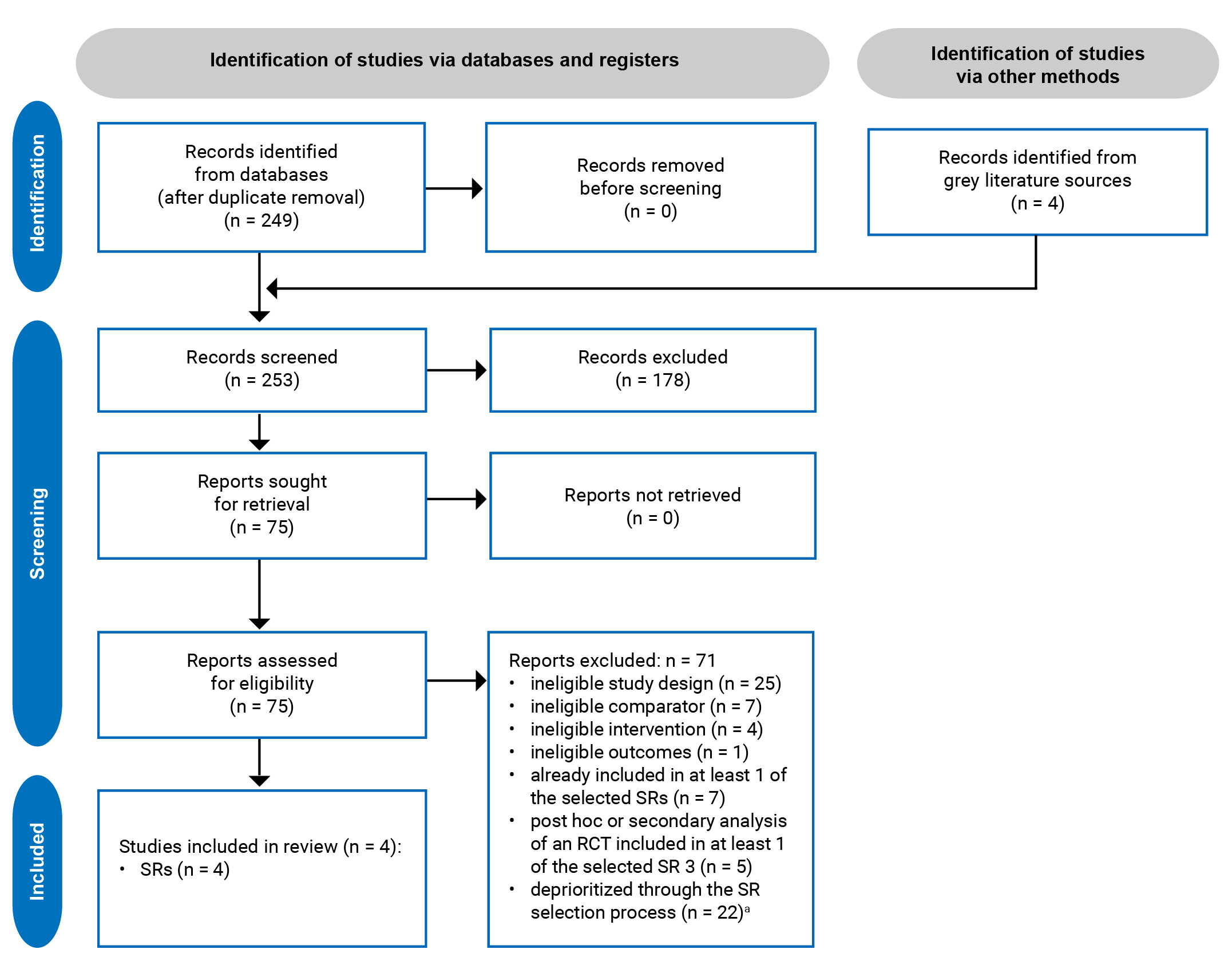
PRISMA = Preferred Reporting Items for Systematic Reviews and Meta-Analyses; RCT = randomized controlled trial; SR = systematic review.
aStudies deprioritized through the SR selection process and their reasons for exclusion are provided in Appendix 3.
Appendix 3: List of Studies Excluded During Systematic Review Prioritization
Please note that this appendix has not been copy-edited.
Table 3: Eligible Systematic Reviews Excluded During Prioritization
Study citation | Primary reason for exclusion |
|---|---|
Clement KD, et al. World J Urol. 2021;39(6):1733-1746. | Its included relevant RCTs (n = 5) were fully captured by selected SRs, which provided broader coverage of the RCT evidence across the PICOs of interest. |
Dong L, et al. Medicine (Baltimore). 2022;101(34):e30291. | Its included relevant RCTs (n = 2) were fully captured by selected SRs, which provided broader coverage of the RCT evidence across the PICOs of interest. |
Fallara G, et al. Minerva Urol Nephrol. 2023;75(2):134-143. | Its included relevant RCTs (n = 7) were fully captured by selected SRs, which provided broader coverage of the RCT evidence across the PICOs of interest. |
Flammia RS, et al. J Clin Med. 2024;13(8):2421. | Its included relevant RCTs (n = 8) were fully captured by selected SRs that provided broader coverage of the PICOs of interest. |
Fontanet S, et al. Actas Urol Esp (Engl Ed). 2023;47(5):261-270. | Its included relevant RCTs (n = 8) were fully captured by selected SRs that provided broader coverage of the PICOs of interest. |
Fu S, et al. Int J Surg. 2024;110(4):2366-2380. | Its included relevant RCTs (n = 4) were fully captured by selected SRs, which provided broader coverage of the RCT evidence across the PICOs of interest. |
Gan L, et al. World J Urol. 2026;44(1):531 | Its analyses combined RCT (n = 5) and observational data, whereas the selected SRs reported analyses using RCT data only. |
Greco F, et al. AME Med J. 2021;6:14. | Its included relevant RCTs (n = 6) were fully captured by selected SRs, which provided broader coverage of the RCT evidence across the PICOs of interest. |
Hawkins DA, et al. J Robot Surg. 2025;19(1):712. | Its included relevant RCTs (n = 6) were fully captured by selected SRs, which provided broader coverage of the RCT evidence across the PICOs of interest. |
Khetrapal P, et al. Eur Urol. 2023;84(4):393-405. | Its included relevant RCTs (n = 8) were fully captured by selected SRs of higher quality based on preliminary AMSTAR 2 assessments. |
Li JM, et al. J Robot Surg. 2025;19(1):700. | Its included relevant RCTs (n = 4) were fully captured by selected SRs, which provided broader coverage of the RCT evidence across the PICOs of interest. |
Liu H, et al. World J Surg Oncol. 2023;21(1):240. | Its included relevant RCTs (n = 8) were fully captured by selected SRs that provided broader coverage of the PICOs of interest. |
Luo H, et al. Asian J Surg. 2026; https://doi.org/10.1016/j.asjsur.2026.06.058 | Its included relevant RCTs (n = 8) were fully captured by selected SRs of higher quality based on preliminary AMSTAR 2 assessments. |
Luo J, et al. J Robot Surg. 2025;19(1):168. | It included no RCTs and did not address any critical gaps in the PICO elements covered by the available RCT evidence. |
McNicholas DP, et al. J Robot Surg. 2024;18(1):100. | It included no RCTs and did not address any critical gaps in the PICO elements covered by the available RCT evidence. |
Nainggolan HJ, et al. Med J Indones. 2025;34(3):201-213. | Its included relevant RCTs (n = 2) were fully captured by selected SRs, which provided broader coverage of the RCT evidence across the PICOs of interest. |
Ohene-Agyei J, et al. J Clin Transl Sci. 2024;8(1):e57. | Its included relevant RCTs (n = 6) were fully captured by selected SRs, which provided broader coverage of the RCT evidence across the PICOs of interest. |
Orakzai FK, et al. J Robot Surg. 2026;20(1):151. | Its included relevant RCTs (n = 5) were fully captured by selected SRs, which provided broader coverage of the RCT evidence across the PICOs of interest. |
Yang Z, et al. Int Braz J Urol. 2024;50(6):683-702. | Its analyses combined RCT (n = 8) and observational data, whereas the selected SRs reported analyses using RCT data only. |
Zahid A, et al. J Robot Surg. 2023;17(1):11-29. | Its included relevant RCTs (n = 4) were fully captured by selected SRs, which provided broader coverage of the RCT evidence across the PICOs of interest. |
Zhao L, et al. J Robotic Surg. 2026;20(1):552. | Its included relevant RCTs (n = 8) were fully captured by selected SRs that provided broader coverage of the PICOs of interest. |
Zhou N, et al. Int J Surg. 2021;94(6):106137. | It included no RCTs and did not address any critical gaps in the PICO elements covered by the available RCT evidence. |
AMSTAR 2 = A MeaSurement Tool to Assess systematic Reviews 2; NA = not applicable; PICO = population, intervention, comparator, outcome; RCT = randomized controlled trial; SR = systematic review.
In this table, n refers to number of RCTs.
Appendix 4: Characteristics of Included Systematic Reviews
Please note that this appendix has not been copy-edited.
Table 4: Characteristics of Included Systematic Reviews
Study citation, countries of eligible studies, funding source | Study designs and number and characteristics of included primary studies | Population characteristics | Intervention and comparator(s) | Clinical outcomes, length of follow-up |
|---|---|---|---|---|
Cella et al. (2024)43 Countries of relevant included studies:
Funding source: None | Study design: SR and MA of RCTs published up to March 2024. Number of relevant included studies: 8 RCTs (described in 14 reports) Primary study timelines: The patient enrolment and follow-up dates for the relevant RCTs were NR | People diagnosed with nonmetastatic bladder cancer that is either muscle-invasive or non-muscle-invasive and refractory to conservative treatment. Number of participants: RCTs included between 40 and 317 participants (total of 1,024 participants) Age: NR Sex or gender: NR BMI: NR Cancer staging: Across the relevant RCTs, the proportion of participants with pTis-T1 disease ranged from 19% to 58% in the RARC groups and 21% to 70% in the ORC groups. The proportion with pT2-T4 disease ranged from 42% to 81% in the RARC groups and from 30% to 79% in the ORC groups. Neoadjuvant chemotherapy: Across the relevant RCTs, the proportion of participants with neoadjuvant chemotherapy ranged from 10% to 40% in the RARC groups and 15% to 45% in the ORC groups, when reported. Other PROGRESS-Plus criteria: NRa | Intervention: Robot-assisted radical cystectomy. Comparator: Open radical cystectomy The included RCTs used extracorporeal urinary diversion (4 RCTs), intracorporeal urinary diversion (3 RCTs), or both approaches (1 RCT). Details on the urinary diversion technique (e.g., ileal conduit, neobladder) were NR. The SR did not report the types of robotic surgical systems used in the included RCTs or details about surgeon or institution experience. | Relevant outcomes:
Follow-up: Varied by individual primary study and outcome. Median follow-up ranged from 3 months to 36 months (where reported). |
Kowalewski et al. (2023)44 Countries of relevant included studies eligible for the current review: • Denmark (n = 1) • Italy (n = 1) • UK (n = 2) • US (n = 4) Funding source: None | Study design: SR and NMA of RCTs published up to May 20, 2022 Number of relevant included studies: 8 RCTs (described in 15 reports) Primary study timelines: The patient enrolment and follow-up dates for the relevant RCTs were NR | People (aged older than 18 years) with bladder cancer. Number of participants: Relevant RCTs included between 40 and 317 participants (total of 1,024 participants). Age: When reported, the mean age of participants from relevant RCTs ranged from 68.6 years to 69.3 years in the RARC group and 66.6 years to 68.7 years in the ORC group. BMI: When reported, the mean BMI of participants from relevant RCTs ranged from 27.5 kg/m2 to 27.9 kg/m2 in the RARC group and 27.4 kg/m2 to 29.0 kg/m2 in the ORC group. Sex or gender: The proportion of female participants in relevant primary studies ranged from 10% to 33% in the RARC group and 10% to 31% in the ORC group; other sexes or genders were NR. Cancer staging: NR Neoadjuvant chemotherapy: NR Other PROGRESS-Plus criteria: NRa | Relevant intervention: Robot-assisted radical cystectomy.b Comparator: Open radical cystectomy The included RCTs used extracorporeal urinary diversion (5 RCTs) or intracorporeal urinary diversion (3 RCTs) in the RARC group. Details on the urinary diversion technique (e.g., ileal conduit, neobladder) were NR. The SR did not report the types of robotic surgical systems used in the included RCTs or details about surgeon or institution experience. | Relevant outcomes: • Overall survival • Recurrence-free survival • Positive margin rates • Length of hospital stay • Health-related quality of life • Blood transfusion rates • Operating time • Complications, including overall and major (CD grade III to V) Follow-up: Varied by individual primary study and outcome. |
Riveros et al. (2023)45 Countries of relevant included studies:
Funding source: NR | Study design: SR and NMA of RCTs published up to May 30, 2022 Number of relevant included studies: 8 RCTs (described in 13 reports) Primary study timelines: Trial periods were between April 2008 and October 2020 | Adults with bladder cancer. Number of participants: RCTs included between 40 and 317 participants (total of 1,024 participants). Age: The mean or median age of participants from RCTs ranged from 64 years to 70 years in the RARC group and 64.5 years to 69.2 years in the ORC group. Sex or gender: NR BMI: NR Cancer staging: NR Neoadjuvant chemotherapy: NR Other PROGRESS-Plus criteria: NRa | Intervention: Robot-assisted radical cystectomy, with intracorporeal or extracorporeal urinary reconstruction Comparator: Open radical cystectomy The included RCTs used extracorporeal urinary diversion (5 RCTs) or intracorporeal urinary diversion (3 RCTs) in the RARC group. Details on the urinary diversion technique (e.g., ileal conduit, neobladder) were NR. The SR did not report the types of robotic surgical systems used in the included RCTs or details about surgeon or institution experience. | Relevant outcomes:
Follow-up: Varied by individual primary study and outcome. Median follow-up ranged from 3 months to 60 months (where reported). |
Sathianathen et al. (2023)46 Countries of relevant included studies:
Funding source: None | Study design: SR and MA of RCTs published up to May 25, 2022 Number of relevant included studies: 7 RCTs (described in 12 reports) Primary study timelines: The patient enrolment and follow-up dates for the relevant RCTs were NR | People with bladder cancer. People with metastatic disease undergoing palliative cystectomy were excluded. Number of participants: RCTs included between 41 and 350 participants (total of 1,004 participants) Age: NR Sex or gender: NR BMI: NR Cancer staging: NR Neoadjuvant chemotherapy: NR Other PROGRESS-Plus criteria: NRa | Intervention: Robot-assisted radical cystectomy, with intracorporeal or extracorporeal urinary diversion Comparator: Open radical cystectomy The included RCTs used extracorporeal urinary diversion (5 RCTs) or intracorporeal urinary diversion (2 RCTs) in the RARC group. Urinary diversion techniques were reported for 6 RCTs, with 42% to 100% of participants undergoing ileal conduit diversion and 0% to 58% undergoing neobladder diversion. The SR did not report the types of robotic surgical systems used in the included RCTs. Surgeon experience was reported for 4 RCTs. Details about institution experience were NR. | Relevant outcomes:
Follow-up: Varied by individual primary study and outcome. |
BMI = body mass index; CD = Clavien-Dindo; MA = meta-analysis; NMA = network meta-analysis; NR = not reported; ORC = open radical cystectomy; RARC = robot-assisted radical cystectomy; RCT = randomized controlled trial; SR = systematic review.
In this table, n refers to number of primary studies.
aThe main PROGRESS-Plus criteria include place of residence, race, ethnicity, culture, language, occupation, gender, sex, religion, education, socioeconomic status, and social capital, personal characteristics associated with discrimination (e.g., age, disability), features of relationships, and time-dependent relationships.53
bThe scope of this SR was broader than that of this report and included conventional laparoscopic radical cystectomy as an additional intervention. Only the comparison relevant to this report was included (i.e., robot-assisted vs. open).
Appendix 5: Critical Appraisal of Included Studies
Please note that this appendix has not been copy-edited.
Table 5: Critical Appraisal of Cella et al. (2024)43 Using AMSTAR 239
AMSTAR 2 item | Domain type | Judgment | Support for judgment |
|---|---|---|---|
1. Did the research questions and inclusion criteria for the review include the components of PICO? | Noncritical | Yes | The review clearly defined its inclusion criteria using the PICO components, including the population (people diagnosed with nonmetastatic bladder cancer), intervention (robot-assisted radical cystectomy), comparator (open radical cystectomy), and outcomes of interest. |
2. Did the report of the review contain an explicit statement that the review methods were established before the conduct of the review and did the report justify any significant deviations from the protocol? | Critical | Yes | The protocol for the review was prospectively registered on PROSPERO (CRD42024517560). The protocol outlined the search strategy, eligibility criteria, and methods for RoB assessment and data synthesis. The review methods were consistent with the prespecified approach. |
3. Did the review authors explain their selection of the study designs for inclusion in the review? | Noncritical | Partial yes | The review authors did not provide an explanation for including only RCTs, though it could be inferred this approach was intended to focus on evidence from studies at a lower risk of bias. |
4. Did the review authors use a comprehensive literature search strategy? | Critical | Partial yes | The authors searched multiple databases (PubMed/MEDLINE, Web of Science, and Embase) with no restrictions by publication date and provided their search strategy. Additionally, authors searched the reference lists of excluded studies for potentially relevant articles. The authors did not conduct searches for grey literature or registered trials or provide an explanation for including only studies published in English. |
5. Did the review authors perform study selection in duplicate? | Noncritical | Yes | Two authors independently performed study selection, with a third reviewer resolving disagreements. |
6. Did the review authors perform data extraction in duplicate? | Noncritical | Yes | Two authors independently performed data extraction. The process for resolving disagreements was not described. |
7. Did the review authors provide a list of excluded studies and justify the exclusions? | Noncriticala | Yes | The authors provided a list of records excluded after full-text review with reasons in the supplementary material. |
8. Did the review authors describe the included studies in adequate detail? | Noncritical | Partial yes | The review includes a table that describes the study design, population (e.g., number of participants, cancer staging), treatment, and comparator for each included study. Some important participant characteristics were missing, including age, sex or gender, prognostic factors, and other relevant PROGRESS-Plus criteria.53 |
9. Did the review authors use a satisfactory technique for assessing the RoB in individual studies that were included in the review? | Critical | Yes | Two independent reviewers evaluated the RoB of included studies using the Cochrane RoB 2 tool for RCTs. RoB was assessed across all outcomes and results for an entire study, rather than at the results level. |
10. Did the review authors report on the sources of funding for the studies included in the review? | Noncritical | No | The authors did not report funding sources for the included studies. |
11. If meta-analysis was performed did the review authors use appropriate methods for statistical combination of results? | Critical | Partial yes | The authors did not explicitly state the principles on which they based their decision to perform meta-analyses or justify why pooling was appropriate by considering the clinical and methodological similarity of included studies. The authors used appropriate techniques to calculate summary statistics for each study, which were described in detail. The authors used a statistical test for heterogeneity (Cochran's Q test) to inform their selection of a fixed-effect or a random-effects meta-analysis. |
12. If meta-analysis was performed, did the review authors assess the potential impact of RoB in individual studies on the results of the meta-analysis or other evidence synthesis? | Noncritical | No | The meta-analyses included RCTs at variable RoB and the authors did not investigate or discuss the likely impact of RoB on the results. |
13. Did the review authors account for RoB in individual studies when interpreting/discussing the results of the review? | Critical | No | The authors acknowledged some RoB considerations as a limitation (e.g., blinding of patients and care providers, confounding), but they did not provide a discussion of the likely impact of RoB on the results. |
14. Did the review authors provide a satisfactory explanation for, and discussion of, any heterogeneity observed in the results of the review? | Noncritical | Yes | There was no significant heterogeneity for most results. When results had significant heterogeneity, authors performed sensitivity analysis to identify the contributing studies. |
15. If they performed quantitative synthesis did the review authors carry out an adequate investigation of publication bias (small study bias) and discuss its likely impact on the results of the review? | Critical | Partial yes | The authors stated that publication bias was not assessed because no outcome had more than 10 included studies, which limits the reliability of statistical methods. However, they did not conduct any nonstatistical investigations of potential publication bias (e.g., searching clinical trial registries) or discuss the potential impact of publications bias on the interpretation of the findings. |
16. Did the review authors report any potential sources of conflict of interest, including any funding they received for conducting the review? | Noncritical | Yes | The authors declared that they had no conflicts of interest and received no funding for conducting the review. |
AMSTAR 2 = A MeaSurement Tool to Assess systematic Reviews 2; PICO = population, intervention, comparison, and outcomes; PROSPERO = International Prospective Register of Systematic Reviews; RCT = randomized controlled trial; RoB = risk of bias.
aWe considered this domain to be noncritical for the purpose of this rapid review.
Table 6: Critical Appraisal of Kowalewski et al. (2023)44 Using AMSTAR 239
AMSTAR 2 item | Domain type | Judgment | Support for judgment |
|---|---|---|---|
1. Did the research questions and inclusion criteria for the review include the components of PICO? | Noncritical | Yes | The review clearly defined its inclusion criteria using the PICO components, including the population (people aged older than 18 years with bladder cancer), intervention (robot-assisted radical cystectomy or laparoscopic radical cystectomy), comparator (open radical cystectomy), and outcomes of interest. |
2. Did the report of the review contain an explicit statement that the review methods were established prior to the conduct of the review and did the report justify any significant deviations from the protocol? | Critical | Partial yes | The review authors stated that the protocol for the review was prospectively registered on Research Registry (reviewregistry1383). However, the date of protocol registration (June 23, 2022) was after the date of last literature search (May 20, 2022). The protocol outlined the planned information sources, eligibility criteria, and methods for RoB assessment and data synthesis. The review methods were mostly consistent with the approach outlined in the protocol, with some deviations (e.g., the review used databases not specified in the protocol). |
3. Did the review authors explain their selection of the study designs for inclusion in the review? | Noncritical | Yes | The authors indicated that they restricted the review to RCTs with the aim of improving the certainty of evidence compared to that reported in a previous Cochrane systematic review. |
4. Did the review authors use a comprehensive literature search strategy? | Critical | Partial yes | The authors searched multiple databases (Cochrane Central Register of Controlled Trials, MEDLINE via PubMed, and Web of Science) with no restrictions by publication date and provided their search strategy. The authors did not conduct searches for grey literature, screen bibliographies of retrieved records, or report whether there were any publication restrictions by language. |
5. Did the review authors perform study selection in duplicate? | Noncritical | Yes | Two authors independently performed study selection. Disagreements were resolved by consensus or by consulting a third reviewer. |
6. Did the review authors perform data extraction in duplicate? | Noncritical | Yes | One author performed data extraction. A second author reviewed all extracted data for accuracy and completeness. |
7. Did the review authors provide a list of excluded studies and justify the exclusions? | Noncriticala | No | Authors provided a study selection flow diagram with reasons for excluding records after full-text review but did not provide a list of excluded studies. |
8. Did the review authors describe the included studies in adequate detail? | Noncritical | Partial yes | The review includes a table that describes the study design, population (e.g., number of participants, age, sex, BMI), treatment, and comparator for each included study. Some important participant characteristics were missing, including prognostic factors and other relevant PROGRESS-Plus criteria.53 |
9. Did the review authors use a satisfactory technique for assessing the RoB in individual studies that were included in the review? | Critical | Yes | Authors evaluated the RoB of included studies using the Cochrane RoB 2 tool for RCTs. RoB was assessed at the outcome level. |
10. Did the review authors report on the sources of funding for the studies included in the review? | Noncritical | Yes | The authors reported the sources of funding for the studies included in the review the supplementary material. |
11. If meta-analysis was performed did the review authors use appropriate methods for statistical combination of results? | Critical | Partial yes | The authors did not explicitly state the principles on which they based their decision to perform meta-analyses or justify why pooling was appropriate by considering the clinical and methodological similarity of included studies. The authors used appropriate techniques to calculate summary statistics for each study, which were described in detail. The authors appropriately used a random-effects model for all analyses. |
12. If meta-analysis was performed, did the review authors assess the potential impact of RoB in individual studies on the results of the meta-analysis or other evidence synthesis? | Noncritical | No | The meta-analyses included RCTs at variable RoB and the authors did not investigate or discuss the likely impact of RoB on the results. |
13. Did the review authors account for RoB in individual studies when interpreting/discussing the results of the review? | Critical | Yes | The authors used the GRADE framework to assess the certainty of the evidence for each outcome, which considers the RoB in individual studies. The authors used these assessments to inform interpretation of the results of the review. |
14. Did the review authors provide a satisfactory explanation for, and discussion of, any heterogeneity observed in the results of the review? | Noncritical | Partial yes | The authors investigated heterogeneity by performing subgroup analyses of studies using intracorporeal and extracorporeal urinary diversion for each outcome, but there was limited discussion of the observed heterogeneity and its impact on the results of the review. |
15. If they performed quantitative synthesis did the review authors carry out an adequate investigation of publication bias (small study bias) and discuss its likely impact on the results of the review? | Critical | Partial yes | The authors used the GRADE framework to assess the certainty of the evidence for each outcome, which should consider publication bias. However, they did not report if or how publication bias was investigated or discuss its potential impact on the results of the review. |
16. Did the review authors report any potential sources of conflict of interest, including any funding they received for conducting the review? | Noncritical | Yes | The authors declared that they had no conflicts of interest and received no funding for conducting the review. |
AMSTAR 2 = A MeaSurement Tool to Assess systematic Reviews 2; BMI = body mass index; GRADE = Grading of Recommendations Assessment, Development, and Evaluation; PICO = population, intervention, comparison, and outcomes; RCT = randomized controlled trial; RoB = risk of bias.
aWe considered this domain to be noncritical for the purpose of this rapid review.
Table 7: Critical Appraisal of Riveros et al. (2023)45 Using AMSTAR 239
AMSTAR 2 item | Domain type | Judgment | Support for judgment |
|---|---|---|---|
1. Did the research questions and inclusion criteria for the review include the components of PICO? | Noncritical | Yes | The review clearly defined its inclusion criteria using the PICO components, including the population (adults with bladder cancer), intervention (robot-assisted radical cystectomy), comparator (open radical cystectomy), and outcomes of interest. |
2. Did the report of the review contain an explicit statement that the review methods were established prior to the conduct of the review and did the report justify any significant deviations from the protocol? | Critical | Partial yes | The review authors stated that the protocol for the review was preregistered on PROSPERO (CRD341117). However, the date of initial PROSPERO registration (August 20, 2022) was after the indicated review start date (April 1, 2022) and literature search date (May 30, 2022). The protocol outlined the planned information sources, eligibility criteria, and methods for RoB assessment and data synthesis. The review methods were consistent with the approach outlined in the protocol. |
3. Did the review authors explain their selection of the study designs for inclusion in the review? | Noncritical | Yes | The authors indicated that they restricted the review to RCTs with the aim of updating their previous meta-analysis to include recent RCTs comparing robot-assisted radical cystectomy with intracorporeal urinary diversion to open radical cystectomy. |
4. Did the review authors use a comprehensive literature search strategy? | Critical | Partial yes | The authors searched multiple databases (MEDLINE, Embase, and Scopus) with no restrictions by publication date and provided their search strategy. Additionally, the authors searched for registered trials in the International Clinical Trials Registry Platform and ClinicalTrials.gov. The authors did not conduct searches for grey literature, search the reference lists of retrieved records, or provide an explanation for including only studies published in English. |
5. Did the review authors perform study selection in duplicate? | Noncritical | Yes | Two authors independently performed study selection. Disagreements were resolved by consulting a third reviewer. |
6. Did the review authors perform data extraction in duplicate? | Noncritical | Yes | Two authors independently performed data extraction. The process for resolving disagreements was not described. |
7. Did the review authors provide a list of excluded studies and justify the exclusions? | Noncriticala | No | Authors provided a study selection flow diagram with reasons for excluding records after full-text review but did not provide a list of excluded studies. |
8. Did the review authors describe the included studies in adequate detail? | Noncritical | Partial yes | The review includes a table that describes the study design, population (e.g., number of participants, age), treatment, and comparator for each included study. Some important participant characteristics were missing, including sex or gender, prognostic factors, and other relevant PROGRESS-Plus criteria.53 |
9. Did the review authors use a satisfactory technique for assessing the RoB in individual studies that were included in the review? | Critical | Yes | Authors evaluated the RoB of included studies using the Cochrane RoB tool for RCTs. RoB was assessed across all outcomes and results for an entire study, rather than at the results level. |
10. Did the review authors report on the sources of funding for the studies included in the review? | Noncritical | No | The authors did not report funding sources for the included studies. |
11. If meta-analysis was performed did the review authors use appropriate methods for statistical combination of results? | Critical | Partial yes | The authors did not explicitly state the principles on which they based their decision to perform meta-analyses or justify why pooling was appropriate by considering the clinical and methodological similarity of included studies. The authors used appropriate techniques to calculate summary statistics for each study, which were described in detail. The authors appropriately used a random-effects model for all analyses. |
12. If meta-analysis was performed, did the review authors assess the potential impact of RoB in individual studies on the results of the meta-analysis or other evidence synthesis? | Noncritical | No | The meta-analyses included RCTs at variable RoB and the authors did not investigate or discuss the likely impact of RoB on the results. |
13. Did the review authors account for RoB in individual studies when interpreting/discussing the results of the review? | Critical | No | The authors acknowledged some RoB considerations as a limitation (e.g., there was a high risk of performance bias across included studies), but they did not provide a discussion of the likely impact of RoB on the results. |
14. Did the review authors provide a satisfactory explanation for, and discussion of, any heterogeneity observed in the results of the review? | Noncritical | No | There was heterogeneity observed for several results (e.g., for length of stay, readmissions, lymph node yield, estimate blood loss). The authors did not explore the possible causes of heterogeneity or discuss the potential impact on the results of the review. |
15. If they performed quantitative synthesis did the review authors carry out an adequate investigation of publication bias (small study bias) and discuss its likely impact on the results of the review? | Critical | No | The authors did not assess publication bias using statistical or nonstatistical methods or discuss its potential impact on the results of the review. |
16. Did the review authors report any potential sources of conflict of interest, including any funding they received for conducting the review? | Noncritical | Partial yes | The authors declared their personal or financial interests related to the review but did not explicitly state whether they received any funding for conducting the review. |
AMSTAR 2 = A MeaSurement Tool to Assess systematic Reviews 2; PICO = population, intervention, comparison, and outcomes; PROSPERO = International Prospective Register of Systematic Reviews; RCT = randomized controlled trial; RoB = risk of bias.
aWe considered this domain to be noncritical for the purpose of this rapid review.
Table 8: Critical Appraisal of Sathianathen et al. (2023)46 Using AMSTAR 239
AMSTAR 2 item | Domain type | Judgment | Support for judgment |
|---|---|---|---|
1. Did the research questions and inclusion criteria for the review include the components of PICO? | Noncritical | Yes | The review clearly defined its inclusion criteria using the PICO components, including the population (people with bladder cancer), intervention (robot-assisted radical cystectomy), comparator (open radical cystectomy), and outcomes of interest. |
2. Did the report of the review contain an explicit statement that the review methods were established prior to the conduct of the review and did the report justify any significant deviations from the protocol? | Critical | Yes | The protocol for the review was prospectively registered on PROSPERO (CRD42018103678). The protocol outlined the search strategy, eligibility criteria, and methods for RoB assessment and data synthesis. The review methods were consistent with the prespecified approach. |
3. Did the review authors explain their selection of the study designs for inclusion in the review? | Noncritical | Yes | The authors indicated that they restricted the review to RCTs to focus on higher-quality evidence. |
4. Did the review authors use a comprehensive literature search strategy? | Critical | Partial yes | The authors searched multiple databases (MEDLINE, Embase, ScienceDirect, Cochrane Libraries, HTA database, and Web of Science) with no restrictions by publication date or language. The authors stated they used the same search terms as their previously published systematic review. Additionally, authors searched the reference lists of eligible studies for potentially relevant articles. The authors did not conduct searches for grey literature or registered trials. |
5. Did the review authors perform study selection in duplicate? | Noncritical | Yes | Two authors independently performed study selection. Disagreements were resolved by consulting a third reviewer. |
6. Did the review authors perform data extraction in duplicate? | Noncritical | Yes | Two authors independently performed data extraction. Disagreements were resolved by consulting a third reviewer. |
7. Did the review authors provide a list of excluded studies and justify the exclusions? | Noncriticala | No | Authors provided a study selection flow diagram showing the number of records excluded after full-text review but did not provide reasons for exclusion or a list of excluded studies. |
8. Did the review authors describe the included studies in adequate detail? | Noncritical | Partial yes | The review includes a table that describes the study design, population (e.g., number of participants), treatment, and comparator for each included study. Some important participant characteristics were missing, including age, sex or gender, prognostic factors, and other relevant PROGRESS-Plus criteria.53 |
9. Did the review authors use a satisfactory technique for assessing the RoB in individual studies that were included in the review? | Critical | Yes | Authors evaluated the RoB of included studies using the Cochrane RoB 2 tool for RCTs. RoB was assessed at the outcome level. |
10. Did the review authors report on the sources of funding for the studies included in the review? | Noncritical | No | The authors did not report funding sources for the included studies. |
11. If meta-analysis was performed did the review authors use appropriate methods for statistical combination of results? | Critical | Partial yes | The authors did not explicitly state the principles on which they based their decision to perform meta-analyses or justify why pooling was appropriate by considering the clinical and methodological similarity of included studies. The authors used appropriate techniques to calculate summary statistics for each study. The authors appropriately used a random-effects model for all analyses. |
12. If meta-analysis was performed, did the review authors assess the potential impact of RoB in individual studies on the results of the meta-analysis or other evidence synthesis? | Noncritical | No | The meta-analyses included RCTs at variable RoB and the authors did not investigate (e.g., through regression analysis) or discuss the likely impact of RoB on the results. |
13. Did the review authors account for RoB in individual studies when interpreting/discussing the results of the review? | Critical | Yes | The authors used the GRADE framework to assess the certainty of the evidence for each outcome, which considers the RoB in individual studies. The authors used these assessments to inform interpretation of the results of the review. |
14. Did the review authors provide a satisfactory explanation for, and discussion of, any heterogeneity observed in the results of the review? | Noncritical | No | There was heterogeneity observed for several results (e.g., for operative time, thromboembolic events, paralytic ileus). The authors did not explore the possible causes of heterogeneity or discuss the potential impact on the results of the review. |
15. If they performed quantitative synthesis did the review authors carry out an adequate investigation of publication bias (small study bias) and discuss its likely impact on the results of the review? | Critical | Partial yes | The authors used the GRADE framework to assess the certainty of the evidence for each outcome, which should consider publication bias. However, they did not report if or how publication bias was investigated or discuss its potential impact on the results of the review. |
16. Did the review authors report any potential sources of conflict of interest, including any funding they received for conducting the review? | Noncritical | Yes | The authors stated their potential sources of conflicts of interest and how they were managed. Additionally, the authors declared that they received no funding for conducting the review. |
AMSTAR 2 = A MeaSurement Tool to Assess systematic Reviews 2; GRADE = Grading of Recommendations Assessment, Development, and Evaluation; PICO = population, intervention, comparison, and outcomes; PROSPERO = International Prospective Register of Systematic Reviews; RCT = randomized controlled trial; RoB = risk of bias.
aWe considered this domain to be noncritical for the purpose of this rapid review.
Appendix 6: Main Systematic Review Findings
Please note that this appendix has not been copy-edited.
Table 9: Summary of Findings by Outcome — Overall Survival
Citation | Outcome | Evidence source, number of participants | Absolute effects | Effect estimate (95% CI) | P value (between groups) | Certaintya |
|---|---|---|---|---|---|---|
Kowalewski et al. (2023)44 | Overall survival, anticipated survival events | MA (5 RCTs); 903 participants |
| HR = 0.98 (0.73 to 1.30) | 0.87 | Moderate (due to imprecision)b |
MA (2 RCTs); NR participants Subgroup analysis: Studies of RARC performed with IUD | NR | HR = 0.92 (0.54 to 1.56) | 0.83 | NR | ||
MA (3 RCTs); NR participants Subgroup analysis: Studies of RARC performed with EUD | NR | HR = 1.01 (0.70 to 1.45) | 0.96 | NR |
CI = confidence interval; EUD = extracorporeal urinary diversion; HR = hazard ratio; IUD = intracorporeal urinary diversion; MA = meta-analysis; NR = not reported; ORC = open radical cystectomy; RARC = robot-assisted radical cystectomy; RCT = randomized controlled trial; SR = systematic review.
aAs assessed by the authors of the SR using the methods of the Grading of Recommendations Assessment, Development, and Evaluation (GRADE) Working Group.
bWe consider low certainty to be a more appropriate rating, due to very serious imprecision.
Table 10: Summary of Findings by Outcome — Disease Control
Citation | Outcome | Evidence source, number of participants | Absolute effects | Effect estimate (95% CI) | P value (between groups) | Certaintya |
|---|---|---|---|---|---|---|
Kowalewski et al. (2023)44 | Recurrence-free survival | MA (5 RCTs); 903 participants |
| HR = 0.99 (0.75 to 1.31) | 0.95 | Moderate (due to imprecision)b |
MA (2 RCTs); NR participants Subgroup analysis: Studies of RARC performed with IUD | NR | HR = 1.10 (0.67 to 1.79) | 0.71 | NR | ||
MA (3 RCTs); NR participants Subgroup analysis: Studies of RARC performed with EUD | NR | HR = 0.95 (0.68 to 1.32) | 0.74 | NR | ||
Sathianathen et al. (2023)46 | Participants with disease progressionc | MA (4 RCTs); 775 participantsd |
| RR = 0.98 (0.78 to 1.23) | 0.87 | Moderate (due to risk of bias) |
1 RCT; 317 participantse Subgroup analysis: Studies of RARC performed with IUD | NR | RR = 1.12 (0.69 to 1.83) | 0.64 | NR | ||
MA (3 RCTs); 458 participantsf Subgroup analysis: Studies of RARC performed with EUD | NR | RR = 0.94 (0.69 to 1.29) | 0.72 | NR | ||
Cella et al. (2024)43 | Participants with local bladder cancer recurrence | MA (5 RCTs); NR participants | NR | HR = 0.94 (0.71 to 1.25) | 0.67 | NR |
Sathianathen et al. (2023)46 | Participants with local bladder cancer recurrence | MA (3 RCTs); 458 participants |
| RR = 2.08 (0.96 to 4.50) | 0.06 | Low (due to risk of bias and imprecision) |
CI = confidence interval; EUD = extracorporeal urinary diversion; HR = hazard ratio; IUD = intracorporeal urinary diversion; MA = meta-analysis; NA = not applicable; NR = not reported; ORC = open radical cystectomy; RARC = robot-assisted radical cystectomy; RCT = randomized controlled trial; RR = risk ratio; SR = systematic review.
aAs assessed by the authors of the SR using the methods of the Grading of Recommendations Assessment, Development, and Evaluation (GRADE) Working Group.
bWe consider low certainty to be a more appropriate rating, due to very serious imprecision.
cDisease progression was defined as defined as radiological or pathological evidence of disease following radical cystectomy or death from bladder cancer.
dOf the 4 RCTs included in this analysis, 2 reported disease progression at 2 years, while the other 2 reported after a median follow-up of 5 years.
eThe RCT reported disease progression after 2 years.
fOf the 3 RCTs included in this analysis, 1 reported disease progression at 2 years, while the other 2 reported after a median follow-up of 5 years.
Table 11: Summary of Findings by Outcome — Health-Related Quality of Life
Citation | Outcome | Evidence source, number of participants | Absolute effects | Effect estimate (95% CI) | P value (between groups) | Certaintya |
|---|---|---|---|---|---|---|
Follow-up: 90 days or 3 months | ||||||
Cella et al. (2024)43 | Participants’ global health status scores, meanb | MA (5 RCTs); 553 participants | NR | SMD = −0.13 (−0.36 to 0.10) | 0.28 | NR |
Participants’ emotional functioning scores, meanb | MA (4 RCTs); 321 participants | NR | SMD = −0.02 (−0.24 to 0.20) | 0.88 | NR | |
Participants’ role functioning scores, meanb | MA (4 RCTs); 333 participants | NR | SMD = −0.09 (−0.43 to 0.26) | 0.63 | NR | |
Participants’ social functioning scores, meanb | MA (4 RCTs); 333 participants | NR | SMD = −0.12 (−0.33 to 0.10) | 0.28 | NR | |
Participants’ physical functioning scores, meanb | MA (4 RCTs); 334 participants | NR | SMD = −0.18 (−0.40 to 0.03) | 0.10 | NR | |
Sathianathen et al. (2023)46 | Participants’ quality of life scores, meanc | MA (4 RCTs); 511 participants | NR | SMD = 0.05 (−0.13 to 0.22) | 0.60 | Low (due to risk of bias) |
1 RCT; 240 participants Subgroup analysis: Studies of RARC performed with IUD | NR | SMD = 0.13 (−0.13 to 0.38) | 0.32 | NR | ||
MA (3 RCTs); 271 participants Subgroup analysis: Studies of RARC performed with EUD | NR | SMD = −0.03 (−0.27 to 0.21) | 0.83 | NR | ||
Follow-up: 6 months | ||||||
Cella et al. (2024)43 | Participants’ global health status scores, meanb | MA (5 RCTs); 586 participants | NR | SMD = 0.04 (−0.13 to 0.20) | 0.65 | NR |
Participants’ emotional functioning scores, meanb | MA (4 RCTs); 371 participants | NR | SMD = −0.00 (−0.21 to 0.20) | 0.98 | NR | |
Participants’ role functioning scores, meanb | MA (4 RCTs); 379 participants | NR | SMD = 0.04 (−0.16 to 0.25) | 0.67 | NR | |
Participants’ social functioning scores, meanb | MA (4 RCTs); 381 participants | NR | SMD = 0.05 (−0.15 to 0.26) | 0.60 | NR | |
Participants’ physical functioning scores, meanb | MA (4 RCTs); 382 participants | NR | SMD = −0.08 (−0.29 to 0.12) | 0.42 | NR | |
Kowalewski et al. (2023)44 | Participants’ quality of life scores, meand | MA (7 RCTs); 665 participants | NR | SMD = −0.02 (−0.17 to 0.13) | 0.78 | Low (due to risk of bias) |
MA (3 RCTs); 370 participants Subgroup analysis: Studies of RARC performed with IUD | NR | SMD = −0.11 (−0.33 to 0.12) | 0.34 | NR | ||
MA (4 RCTs); 295 participants Subgroup analysis: Studies of RARC performed with EUD | NR | SMD = 0.09 (−0.14 to 0.32) | 0.45 | NR | ||
Follow-up: Between 6 months and 12 months | ||||||
Riveros et al. (2023)45 | Participants’ quality of life scores, meane | MA (6 RCTs); 617 participants | NR | SMD = −0.02 (−0.17 to 0.14) | 0.84 | NR |
MA (2 RCTs); 322 participants Subgroup analysis: Studies of RARC performed with IUD | NR | SMD = 0.05 (−0.23 to 0.33) | 0.71 | NR | ||
MA (4 RCTs); 295 participants Subgroup analysis: Studies of RARC performed with EUD | NR | SMD = −0.11 (−0.34 to 0.12) | 0.34 | NR | ||
Follow-up: NR | ||||||
Cella et al. (2024)43 | Participants’ cognitive functioning scores, meanb | MA (3 RCTs); 223 participants | NR | SMD = −0.11 (−0.38 to 0.15) | 0.40 | NR |
CI = confidence interval; EORTC QLQ-C30 = European Organization for Research and Treatment of Cancer Quality of Life Questionnaire Core 30; EUD = extracorporeal urinary diversion; FACT-Bl = Functional Assessment of Cancer Therapy – Bladder; FACT-VCI = Functional Assessment of Cancer Therapy – Vanderbilt Cystectomy Index; IUD = intracorporeal urinary diversion; MA = meta-analysis; NR = not reported; ORC = open radical cystectomy; RARC = robot-assisted radical cystectomy; RCT = randomized controlled trial; SMD = standardized mean difference; SR = systematic review.
aAs assessed by the authors of the SR using the methods of the Grading of Recommendations Assessment, Development, and Evaluation (GRADE) Working Group.
bMeasured in the included RCTs using either the FACT-VCI or EORTC QLQ-C30 questionnaire.
cMeasured by a validated quality of life instrument (e.g., Functional Assessment of Cancer Therapy scale).
dMeasured in the included primary studies using the EORTC QLQ-C30, FACT-BI (Version 4), or the FACT-VCI questionnaire.
eThe tools used to measure quality of life in the included primary studies were not reported.
Table 12: Summary of Findings by Outcome — Estimated Blood Loss
Citation | Outcome | Evidence source, number of participants | Absolute effects | Effect estimate (95% CI) | P value (between groups) | Certaintya |
|---|---|---|---|---|---|---|
Riveros et al. (2023)45 | Participants’ estimated blood loss (mL), mean | MA (7 RCTs); 978 participants |
| MD = −312.61 (−447.00 to −178.22) | < 0.00001 (favours RARC) | NR |
MA (3 RCTs); 483 participants Subgroup analysis: Studies of RARC performed with IUD |
| MD = −359.17 (−616.50 to −101.83) | 0.006 (favours RARC) | NR | ||
MA (4 RCTs); 495 participants Subgroup analysis: Studies of RARC performed with EUD |
| MD = −280.47 (−435.67 to −125.27) | 0.0004 (favours RARC) | NR |
CI = confidence interval; EUD = extracorporeal urinary diversion; IUD = intracorporeal urinary diversion; MA = meta-analysis; MD = mean difference; NR = not reported; ORC = open radical cystectomy; RARC = robot-assisted radical cystectomy; RCT = randomized controlled trial; SR = systematic review.
aAs assessed by the authors of the SR using the methods of the Grading of Recommendations Assessment, Development, and Evaluation (GRADE) Working Group.
Table 13: Summary of Findings by Outcome — Blood Transfusions
Citation | Outcome | Evidence source, number of participants | Absolute effects | Effect estimate (95% CI) | P value (between groups) | Certaintya |
|---|---|---|---|---|---|---|
Follow-up: 90 days | ||||||
Sathianathen et al. (2023)46 | Participants who received perioperative blood transfusions up to 90 days | MA (4 RCTs); 683 participants |
| RR = 0.57 (0.43 to 0.76) | < 0.0001 (favours RARC) | High |
MA (2 RCTs); 357 participants Subgroup analysis: Studies of RARC performed with IUD | NR | RR = 0.46 (0.14 to 1.44) | 0.27 | NR | ||
MA (2 RCTs); 326 participants Subgroup analysis: Studies of RARC performed with EUD | NR | RR = 0.58 (0.43 to 0.88) | 0.0007 (favours RARC) | NR | ||
Follow-up: NR | ||||||
Cella et al. (2024)43 | Participants who received perioperative blood transfusions | MA (5 RCTs); 825 participants | NR | OR = 0.43 (0.30 to 0.61) | < 0.00001 (favours RARC) | NR |
Kowalewski et al. (2023)44 | Participants who received perioperative blood transfusions | MA (5 RCTs); 797 participants |
| OR = 0.42 (0.30 to 0.59) | < 0.01 (favours RARC) | High |
MA (3 RCTs); 471 participants Subgroup analysis: Studies of RARC performed with IUD | NR | OR = 0.42 (0.25 to 0.69) | < 0.01 (favours RARC) | NR | ||
MA (2 RCTs); 326 participants Subgroup analysis: Studies of RARC performed with EUD | NR | OR = 0.42 (0.26 to 0.67) | < 0.01 (favours RARC) | NR | ||
CI = confidence interval; EUD = extracorporeal urinary diversion; IUD = intracorporeal urinary diversion; MA = meta-analysis; NR = not reported; OR = odds ratio; ORC = open radical cystectomy; RARC = robot-assisted radical cystectomy; RCT = randomized controlled trial; RR = risk ratio; SR = systematic review.
aAs assessed by the authors of the SR using the methods of the Grading of Recommendations Assessment, Development, and Evaluation (GRADE) Working Group.
Table 14: Summary of Findings by Outcome — Operative Time
Citation | Outcome | Evidence source, number of participants | Absolute effects | Effect estimate (95% CI) | P value (between groups) | Certaintya |
|---|---|---|---|---|---|---|
Cella et al. (2024)43 | Operative time (minutes), mean | MA (7 RCTs); 980 participants |
| MD = 92.34 (83.83 to 100.84) | < 0.001 (favours ORC) | NR |
MA (3 RCTs); 483 participants Subgroup analysis: Studies of RARC performed with IUD |
| MD = 89.40 (27.35 to 151.46) | < 0.00001 (favours ORC) | NR | ||
MA (2 RCTs); 158 participants Subgroup analysis: Studies of RARC performed with EUD |
| MD = 125.50 (101.02 to 149.99) | < 0.00001 (favours ORC) | NR | ||
Kowalewski et al. (2023)44 | Operative time (minutes), mean | MA (8 RCTs); 1,011 participants |
| MD = 78.54 (45.87 to 111.21) | < 0.01 (favours ORC) | High |
MA (3 RCTs); 471 participants Subgroup analysis: Studies of RARC performed with IUD |
| MD = 91.89 (26.80 to 156.97) | < 0.01 (favours ORC) | NR | ||
MA (5 RCTs); 540 participants Subgroup analysis: Studies of RARC performed with EUD |
| MD = 69.49 (31.39 to 107.59) | < 0.01 (favours ORC) | NR | ||
Riveros et al. (2023)45 | Operative time (minutes), mean | MA (7 RCTs); 983 participants |
| MD = 82.34 (44.82 to 119.86) | < 0.001 (favours ORC) | NR |
MA (3 RCTs); 483 participants Subgroup analysis: Studies of RARC performed with IUD |
| MD = 89.42 (27.35 to 151.49) | 0.005 (favours ORC) | NR | ||
MA (4 RCTs); 500 participants Subgroup analysis: Studies of RARC performed with EUD |
| MD = 76.45 (29.28 to 123.63) | 0.001 (favours ORC) | NR | ||
Sathianathen et al. (2023)46 | Operative time (minutes), mean | MA (7 RCTs); 907 participants |
| MD = 70.43 (34.13 to 106.74) | 0.0001 (favours ORC) | High |
MA (2 RCTs); 367 participants Subgroup analysis: Studies of RARC performed with IUD |
| MD = 74.78 (−27.63 to 177.19) | 0.15 | NR | ||
MA (5 RCTs); 540 participants Subgroup analysis: Studies of RARC performed with EUD |
| MD = 68.51 (30.55 to 106.48) | 0.0004 (favours ORC) | NR |
CI = confidence interval; EUD = extracorporeal urinary diversion; IUD = intracorporeal urinary diversion; MA = meta-analysis; MD = mean difference; NR = not reported; ORC = open radical cystectomy; RARC = robot-assisted radical cystectomy; RCT = randomized controlled trial; SR = systematic review.
aAs assessed by the authors of the SR using the methods of the Grading of Recommendations Assessment, Development, and Evaluation (GRADE) Working Group.
Table 15: Summary of Findings by Outcome — Length of Stay
Citation | Outcome | Evidence source, number of participants | Absolute effects | Effect estimate (95% CI) | P value (between groups) | Certaintya |
|---|---|---|---|---|---|---|
Cella et al. (2024)43 | Length of hospital stay (days), mean | MA (8 RCTs); 1,023 participants |
| MD = −0.29 (−0.71 to 0.13) | 0.18 | NR |
MA (2 RCTs); 166 participants Subgroup analysis: Studies of RARC performed with IUD |
| MD = 0.87 (0.11 to 1.62) | 0.02 (favours ORC) | NR | ||
MA (4 RCTs); 500 participants Subgroup analysis: Studies of RARC performed with EUD |
| MD = −0.59 (−1.19 to 0.02) | 0.06 | NR | ||
MA (7 RCTs); 907 participants Sensitivity analysis: Excluding the RCT by Mastroianni et al. (2024) due to heterogeneity |
| MD = −0.72 (−1.21 to −0.24) | 0.003 (favours RARC) | NR | ||
Kowalewski et al. (2023)44 | Length of hospital stay (days), mean | MA (8 RCTs); 1,011 participants |
| MD = −0.31 (−0.95 to 0.34) | 0.35 | Moderate (due to risk of bias) |
MA (3 RCTs); 471 participants Subgroup analysis: Studies of RARC performed with IUD |
| MD = 0.25 (−1.07 to 1.56) | 0.71 | NR | ||
MA (5 RCTs); 540 participants Subgroup analysis: Studies of RARC performed with EUD |
| MD = −0.67 (−1.21 to −0.13) | 0.01 (favours RARC) | NR | ||
Riveros et al. (2023)45 | Length of hospital stay (days), mean | MA (6 RCTs); 931 participants |
| MD = −0.22 (−1.10 to 0.65) | 0.62 | NR |
MA (3 RCTs); 471 participants Subgroup analysis: Studies of RARC performed with IUD |
| MD = −0.09 (−1.88 to 1.69) | 0.92 | NR | ||
MA (3 RCTs); 460 participants Subgroup analysis: Studies of RARC performed with EUD |
| MD = −0.50 (−1.15 to 0.14) | 0.13 | NR | ||
Sathianathen et al. (2023)46 | Length of hospital stay (days), mean | MA (7 RCTs); 895 participants |
| MD = −0.62 (−1.11 to −0.13) | 0.01 (favours RARC) | Moderate (due to imprecision) |
MA (2 RCTs); 355 participants Subgroup analysis: Studies of RARC performed with IUD |
| MD = −0.45 (−1.79 to 0.89) | 0.51 | NR | ||
MA (5 RCTs); 540 participants Subgroup analysis: Studies of RARC performed with EUD |
| MD = −0.63 (−1.21 to −0.05) | 0.03 (favours RARC) | NR |
CI = confidence interval; EUD = extracorporeal urinary diversion; IUD = intracorporeal urinary diversion; MA = meta-analysis; MD = mean difference; NR = not reported; ORC = open radical cystectomy; RARC = robot-assisted radical cystectomy; RCT = randomized controlled trial; SR = systematic review.
aAs assessed by the authors of the SR using the methods of the Grading of Recommendations Assessment, Development, and Evaluation (GRADE) Working Group.
Table 16: Summary of Findings by Outcome — Margin Status
Citation | Outcome | Evidence source, number of participants | Absolute effects | Effect estimate (95% CI) | P value (between groups) | Certaintya |
|---|---|---|---|---|---|---|
Cella et al. (2024)43 | Participants with positive surgical margins | MA (8 RCTs); 867 participants | NR | OR = 1.07 (0.61 to 1.88) | 0.81 | NR |
MA (3 RCTs); 367 participants Subgroup analysis: Studies of RARC performed with IUD | NR | OR = 0.97 (0.42 to 2.23) | 0.95 | NR | ||
MA (5 RCTs); 460 participants Subgroup analysis: Studies of RARC performed with EUD | NR | OR = 1.18 (0.53 to 2.62) | 0.68 | NR | ||
Kowalewski et al. (2023)44 | Participants with positive surgical margins | MA (8 RCTs); 968 participants |
| OR = 1.05 (0.60 to 1.85) | 0.87 | Moderate (due to imprecision) |
MA (3 RCTs); 427 participants Subgroup analysis: Studies of RARC performed with IUD | NR | OR = 0.93 (0.40 to 2.13) | 0.86 | NR | ||
MA (5 RCTs); 541 participants Subgroup analysis: Studies of RARC performed with EUD | NR | OR = 1.17 (0.54 to 2.54) | 0.69 | NR | ||
Riveros et al. (2023)45 | Participants with positive surgical margins | MA (7 RCTs); 927 participants | NR | OR = 1.05 (0.60 to 1.85) | 0.87 | NR |
MA (3 RCTs); 427 participants Subgroup analysis: Studies of RARC performed with IUD | NR | OR = 0.93 (0.40 to 2.13) | 0.86 | NR | ||
MA (4 RCTs); 500 participants Subgroup analysis: Studies of RARC performed with EUD | NR | OR = 1.17 (0.54 to 2.54) | 0.69 | NR | ||
Sathianathen et al. (2023)46 | Participants with positive surgical margins | MA (6 RCTs); 591 participants |
| RR = 1.14 (0.58 to 2.24) | 0.70 | Moderate (due to imprecision) |
1 RCT; 50 participants Subgroup analysis: Studies of RARC performed with IUD | NR | RR = 1.00 (0.15 to 6.55) | 1.00 | NR | ||
MA (5 RCTs); 541 participants Subgroup analysis: Studies of RARC performed with EUD | NR | RR = 1.16 (0.56 to 2.40) | 0.68 | NR |
CI = confidence interval; EUD = extracorporeal urinary diversion; IUD = intracorporeal urinary diversion; MA = meta-analysis; NA = not applicable; NR = not reported; OR = odds ratio; ORC = open radical cystectomy; RARC = robot-assisted radical cystectomy; RCT = randomized controlled trial; RR = risk ratio; SR = systematic review.
aAs assessed by the authors of the SR using the methods of the Grading of Recommendations Assessment, Development, and Evaluation (GRADE) Working Group.
Table 17: Summary of Findings by Outcome — Lymph Node Yield
Citation | Outcome | Evidence source, number of participants | Absolute effects | Effect estimate (95% CI) | P value (between groups) | Certaintya |
|---|---|---|---|---|---|---|
Cella et al. (2024)43 | Lymph node yield, mean | MA (8 RCTs); 1,024 participants |
| MD = −0.45 (−1.77 to 0.87) | 0.50 | NR |
Riveros et al. (2023)45 | Lymph node yield, mean | MA (7 RCTs); 941 participants |
| MD = −0.63 (−2.63 to 1.37) | 0.54 | NR |
MA (3 RCTs); 440 participants Subgroup analysis: Studies of RARC performed with IUD |
| MD = 0.84 (−0.91 to 2.60) | 0.35 | NR | ||
MA (4 RCTs); 501 participants Subgroup analysis: Studies of RARC performed with EUD |
| MD = −2.24 (−5.72 to 1.24) | 0.21 | NR |
CI = confidence interval; EUD = extracorporeal urinary diversion; IUD = intracorporeal urinary diversion; MA = meta-analysis; MD = mean difference; NR = not reported; ORC = open radical cystectomy; RARC = robot-assisted radical cystectomy; RCT = randomized controlled trial; SR = systematic review.
aAs assessed by the authors of the SR using the methods of the Grading of Recommendations Assessment, Development, and Evaluation (GRADE) Working Group.
Table 18: Summary of Findings by Outcome — Readmissions
Citation | Outcome | Evidence source, number of participants | Absolute effects | Effect estimate (95% CI) | P value (between groups) | Certaintya |
|---|---|---|---|---|---|---|
Follow-up: 90 days | ||||||
Riveros et al. (2023)45 | Participants with a readmission within 90 days | MA (4 RCTs); 771 participants | NR | OR = 0.90 (0.60 to 1.35) | 0.61 | NR |
MA (3 RCTs); 469 participants Subgroup analysis: Studies of RARC performed with IUD | NR | OR = 0.86 (0.47 to 1.57) | 0.62 | NR | ||
1 RCT; 302 participants Subgroup analysis: Studies of RARC performed with EUD | NR | OR = 1.06 (0.62 to 1.80) | 0.84 | NR | ||
CI = confidence interval; EUD = extracorporeal urinary diversion; IUD = intracorporeal urinary diversion; MA = meta-analysis; NA = not applicable; NR = not reported; ORC = open radical cystectomy; RARC = robot-assisted radical cystectomy; RCT = randomized controlled trial; SR = systematic review.
aAs assessed by the authors of the SR using the methods of the Grading of Recommendations Assessment, Development, and Evaluation (GRADE) Working Group.
Table 19: Summary of Findings by Outcome — Complications
Citation | Outcome | Evidence source, number of participants | Absolute effects | Effect estimate (95% CI) | P value (between groups) | Certaintya |
|---|---|---|---|---|---|---|
Follow-up: 30 days | ||||||
Cella et al. (2024)43 | Participants with CD grade III to V postoperative complications at 30 days | MA (3 RCTs); 206 participants | NR | OR = 1.00 (0.44 to 2.28) | 1.00 | NR |
Participants with any complication at 30 days | MA (6 RCTs); 405 participants | NR | OR = 0.68 (0.43 to 1.09) | 0.11 | NR | |
MA (2 RCTs); 166 participants Subgroup analysis: Studies of RARC performed with IUD | NR | OR = 0.92 (0.41 to 2.05) | 0.84 | NR | ||
MA (3 RCTs); 199 participants Subgroup analysis: Studies of RARC performed with EUD | NR | OR = 0.55 (0.30 to 1.04) | 0.07 | NR | ||
Follow-up: 90 days | ||||||
Cella et al. (2024)43 | Participants with CD grade III to V postoperative complications at 90 days | MA (5 RCTs); 825 participants | NR | OR = 0.91 (0.64 to 1.28) | 0.57 | NR |
Participants with any complication at 90 days | MA (5 RCTs); 825 participants | NR | OR = 0.85 (0.64 to 1.14) | 0.28 | NR | |
Kowalewski et al. (2023)44 | Participants with CD grade III to V postoperative complications at 90 days | MA (8 RCTs); 1,008 participants |
| OR = 0.95 (0.69 to 1.30) | 0.73 | Low (due to risk of bias and imprecision) |
MA (3 RCTs); 467 participants Subgroup analysis: Studies of RARC performed with IUD | NR | OR = 0.82 (0.51 to 1.30) | 0.39 | NR | ||
MA (5 RCTs); 541 participants Subgroup analysis: Studies of RARC performed with EUD | NR | OR = 1.07 (0.70 to 1.65) | 0.75 | NR | ||
Participants with any complication at 90 days | MA (7 RCTs); 890 participants |
| OR = 0.81 (0.61 to 1.07) | 0.14 | Low (due to risk of bias and imprecision) | |
MA (3 RCTs); 467 participants Subgroup analysis: Studies of RARC performed with IUD | NR | OR = 0.80 (0.55 to 1.18) | 0.26 | NR | ||
MA (4 RCTs); 423 participants Subgroup analysis: Studies of RARC performed with EUD | NR | OR = 0.82 (0.55 to 1.24) | 0.35 | NR | ||
Riveros et al. (2023)45 | Participants with CD grade III to V postoperative complications at 90 days | MA (6 RCTs); 925 participants | NR | OR = 0.94 (0.69 to 1.30) | 0.73 | NR |
MA (3 RCTs); 465 participants Subgroup analysis: Studies of RARC performed with IUD | NR | OR = 0.82 (0.51 to 1.30) | 0.39 | NR | ||
MA (3 RCTs); 460 participants Subgroup analysis: Studies of RARC performed with EUD | NR | OR = 1.08 (0.69 to 1.67) | 0.74 | NR | ||
Participants with any complication at 90 days | MA (6 RCTs); 847 participants | NR | OR = 0.81 (0.61 to 1.07) | 0.14 | NR | |
MA (3 RCTs); 465 participants Subgroup analysis: Studies of RARC performed with IUD | NR | OR = 0.80 (0.54 to 1.18) | 0.26 | NR | ||
MA (3 RCTs); 382 participants Subgroup analysis: Studies of RARC performed with EUD | NR | OR = 0.82 (0.53 to 1.25) | 0.35 | NR | ||
Sathianathen et al. (2023)46 | Participants with CD grade III to V postoperative complications at 90 days | MA (5 RCTs); 827 participants |
| RR = 0.95 (0.72 to 1.24) | 0.69 | Moderate (due to risk of bias) |
MA (2 RCTs); 367 participants Subgroup analysis: Studies of RARC performed with IUD | NR | RR = 0.77 (0.49 to 1.22) | 0.26 | NR | ||
MA (3 RCTs); 460 participants Subgroup analysis: Studies of RARC performed with EUD | NR | RR = 1.06 (0.75 to 1.49) | 0.74 | NR | ||
Follow-up: NR | ||||||
Sathianathen et al. (2023)46 | Participants with a ureteric strictureb | MA (3 RCTs); 658 participants |
| RR = 4.21 (1.07 to 16.53) | 0.04 (favours ORC) | Low (due to risk of bias and imprecision) |
1 RCT; 317 participants Subgroup analysis: Studies of RARC performed with IUD | NR | RR = 3.88 (0.44 to 34.29) | 0.26 | NR | ||
MA (2 RCTs); 341 participants Subgroup analysis: Studies of RARC performed with EUD | NR | RR = 4.44 (0.76 to 25.74) | 0.61 | NR | ||
Participants with thromboembolic eventsc | MA (6 RCTs); 867 participants |
| RR = 0.48 (0.20 to 1.11) | 0.09 | Low (due to risk of bias and imprecision) | |
MA (2 RCTs); 367 participants Subgroup analysis: Studies of RARC performed with IUD | NR | RR = 0.24 (0.07 to 0.75) | 0.01 (favours RARC) | NR | ||
MA (4 RCTs); 500 participants Subgroup analysis: Studies of RARC performed with EUD | NR | RR = 0.72 (0.22 to 2.43) | 0.15 | NR | ||
Participants with wound complicationsd | MA (5 RCTs); 827 participants |
| RR = 0.34 (0.21 to 0.55) | < 0.00001 (favours RARC) | Moderate (due to risk of bias) | |
MA (2 RCTs); 367 participants Subgroup analysis: Studies of RARC performed with IUD | NR | RR = 0.31 (0.16 to 0.62) | 0.26 | NR | ||
MA (3 RCTs); 460 participants Subgroup analysis: Studies of RARC performed with EUD | NR | RR = 0.37 (0.19 to 0.72) | 0.61 | NR | ||
Participants with paralytic ileuse | MA (4 RCTs); 432 participants |
| RR = 0.97 (0.46 to 2.05) | 0.93 | Low (due to risk of bias and imprecision)f | |
1 RCT; 50 participants Subgroup analysis: Studies of RARC performed with IUD | NR | RR = 1.75 (0.58 to 5.24) | 0.32 | NR | ||
MA (3 RCTs); 382 participants Subgroup analysis: Studies of RARC performed with EUD | NR | RR = 0.65 (0.18 to 2.31) | 0.50 | NR | ||
CD = Clavien-Dindo; CI = confidence interval; EUD = extracorporeal urinary diversion; IUD = intracorporeal urinary diversion; MA = meta-analysis; NA = not applicable; NR = not reported; OR = odds ratio; ORC = open radical cystectomy; RARC = robot-assisted radical cystectomy; RCT = randomized controlled trial; RR = risk ratio; SR = systematic review.
aAs assessed by the authors of the SR using the methods of the Grading of Recommendations Assessment, Development, and Evaluation (GRADE) Working Group.
bDefined as a narrowing in the ureter at the level at the uretero-ileal anastomosis (with or without intervention) that had caused kidney obstruction as demonstrated by symptomatic, biochemical and/or radiological means.
cDefined as the occurrence of a deep vein thrombosis and/or pulmonary embolus.
dDefined as the occurrence of superficial/deep wound infection and/or wound dehiscence.
eDefined as a non-mechanical reduction in bowel motility.
fWe consider very low certainty to be a more appropriate rating, due to serious risk of bias and very serious imprecision.
Appendix 7: Overlap Between Included Systematic Reviews
Please note that this appendix has not been copy-edited.
Table 20: Overlap in Relevant Randomized Controlled Trials Between Included Systematic Reviews
Primary study citation | Trial name or identifier | Cella et al. (2024)43 | Kowalewski et al. (2023)44 | Riveros et al. (2023)45 | Sathianathen et al. (2023)46 |
|---|---|---|---|---|---|
Becerra MF, et al. J Urol. 2020;204(3):450-459. | RAZOR | — | Yes | — | Yes |
Bochner BH, et al. Eur Urol. 2015;67(6):1042-1050. | NCT01076387 | Yes | Yes | Yes | Yes |
Bochner BH, et al. Eur Urol. 2018;74(4):465-471. | NCT01076387 | Yes | Yes | Yes | Yes |
Catto JWF, et al. JAMA. 2022;327(21):2092-2103. | iROC | Yes | Yes | Yes | Yes |
Khan MS, et al. Eur Urol. 2016;69(4):613-621. | CORAL | Yes | Yes | Yes | Yes |
Khan MS, et al. Eur Urol. 2020;77(1):110-118. | CORAL | Yes | Yes | Yes | Yes |
Maibom SL, et al. BJU Int. 2022;130(1):102-113. | BORARC | Yes | Yes | Yes | Yes |
Mastroianni R, et al. Eur Urol Focus. 2022; 8(2):465-471. | NCT03434132 | — | Yes | Yes | — |
Mastroianni R, et al. J Urol. 2022;207(5):982-992. | NCT03434132 | — | Yes | — | — |
Mastroianni R, et al. Eur Urol. 2024;85(5):422-430. | NCT03434132 | Yes | — | — | — |
Messer JC, et al. BJU Int. 2014;114(6):896-902. | NAa | Yes | Yes | Yes | Yes |
Nix J, et al. Eur Urol. 2010;57(2):196-201. | NA | Yes | Yes | Yes | Yes |
Parekh DJ, et al. J Urol. 2013;189(2):474-479. | NAa | Yes | Yes | Yes | Yes |
Parekh DJ, et al. Lancet. 2018;391(10139):2525-2536. | RAZOR | Yes | Yes | Yes | Yes |
Vejlgaard M, et al. World J Urol. 2022;40(7):1669-1677. | BORARC | Yes | Yes | Yes | — |
Venkatramani V, et al. J Urol. 2020;203(3):522-529. | RAZOR | Yes | Yes | Yes | Yes |
Venkatramani V, et al. JAMA Netw Open. 2022;5(2):e2148329. | RAZOR | Yes | — | — | — |
NA = not applicable.
aThese publications report results from the same pilot trial, which did not have a name and was not submitted to a registry of clinical studies.
Appendix 8: Patient Involvement
Please note that this appendix has not been copy-edited.
Table 21: Summary of Patient Involvement Using the GRIPP2 Short Form Reporting Checklist95
Topic | Item | Report section(s) |
|---|---|---|
Aim | The purpose of engagement was to gather lived experience perspectives from individuals who had undergone radical cystectomy for bladder cancer to inform the Rapid Review examining the clinical effectiveness and safety of robot-assisted radical cystectomy compared with open surgery. Engagement sought to understand experiences related to treatment decision-making, recovery, outcomes, access to care, quality of life, and factors that patients considered important when evaluating surgical approaches. Participant perspectives were intended to help contextualize the clinical evidence and identify outcomes and experiences important to people undergoing radical cystectomy. | Key messages, Methods, Appendix 1 |
Methods | Outreach, recruitment, and engagement support were coordinated by CDA-AMC staff. Three people with experience undergoing radical cystectomy for bladder cancer participated in a 1-hour virtual interview. Participants were recruited through patient networks and organizations, particularly Bladder Cancer Canada. Interviews were attended by 1 or 2 engagement officers and a Senior Clinical Research Officer. Guiding questions and a conflict-of-interest form were provided in advance. Interviews explored experiences related to treatment decision-making, access to surgery, recovery, outcomes, quality of life, and long-term impacts. Summaries were prepared and were shared with participants for review and validation. Engagement activities were conducted during the report drafting stage of the rapid review process to gather lived experience perspectives and provide contextual information alongside the clinical evidence. | Methods, Appendix 1 |
Results | Participants consistently identified cancer removal, survival, and preventing recurrence as the outcomes most important to them when considering surgery. Decisions to proceed with cystectomy were also influenced by recommendations from health care providers and the desire to maximize the chances of long-term survival. Participants discussed the importance of preserving quality of life following surgery, including maintaining independence, participating in work and recreational activities, travelling, and returning to everyday routines. Those who underwent robot-assisted surgery viewed the approach positively and described perceived benefits related to smaller incisions, shorter recovery, reduced pain, and fewer complications. Participants also highlighted challenges related to recovery, fatigue, digestive changes, sexual function, adapting to urinary diversion or neobladder reconstruction, and other long-term lifestyle adjustments. Additional themes included wait-time anxiety, caregiver impacts, maintaining independence, and the need for better patient education regarding surgery, recovery, and life after bladder removal. | Key messages, Summary of findings, conclusion and implications for decision- or policy-making |
Discussion and conclusions | Engagement findings highlighted outcomes and experiences that were important to people with lived experience, including survival, cancer control, recurrence prevention, quality of life, recovery time, long-term functional outcomes, and access to specialized surgical care. Participants provided important context regarding treatment decision-making, trade-offs between surgical approaches, and the practical realities of living with the outcomes of bladder removal surgery. Engagement findings also highlighted practical considerations that may not be fully captured in clinical studies, including caregiver impacts, travel requirements, and patient education needs. Findings were shared with the review team to inform discussions of access considerations and broader considerations relevant to decision-making. Some issues raised by participants, including health care system navigation, may extend beyond the scope of the review. | Key messages, conclusions and implications for decision- or policy-making |
Reflections and critical perspective | Participants received project information, guiding questions, and a conflict-of-interest form in advance and were given the opportunity to review and validate interview summaries. Interviews were conducted virtually and scheduled flexibly to accommodate participants. An Honorarium was provided in recognition of participants' time and expertise. A strength of the engagement was the inclusion of participants with experience across different surgical approaches, which contributed varied perspectives on treatment decision-making and recovery. Participants represented both robot-assisted and partially open surgical experiences, providing varied perspectives on the patient journey. Recruitment was successful through outreach to patient networks and organizations, and individuals with relevant lived experience were identified within project timelines. A limitation of this engagement was the small number of participants and limited demographic diversity, which may have restricted the range of perspectives represented and may not reflect the broader population of people who have undergone radical cystectomy for bladder cancer in Canada. | Limitations |
GRIPP 2 = Guidance for Reporting Involvement of Patients and the Public (version 2).
ISSN: 2563-6596
Canada’s Drug Agency (CDA-AMC) is a pan-Canadian health organization. Created and funded by Canada’s federal, provincial, and territorial governments, we’re responsible for driving better coordination, alignment, and public value within Canada’s drug and health technology landscape. We provide Canada’s health system leaders with independent evidence and advice so they can make informed drug, health technology, and health system decisions, and we collaborate with national and international partners to enhance our collective impact.
Disclaimer: CDA-AMC has taken care to ensure that the information in this document was accurate, complete, and up to date when it was published, but does not make any guarantee to that effect. Your use of this information is subject to this disclaimer and the Terms of Use at cda-amc.ca.
The information in this document is made available for informational and educational purposes only and should not be used as a substitute for professional medical advice, the application of clinical judgment in respect of the care of a particular patient, or other professional judgments in any decision-making process. You assume full responsibility for the use of the information and rely on it at your own risk.
CDA-AMC does not endorse any information, drugs, therapies, treatments, products, processes, or services. The views and opinions of third parties published in this document do not necessarily reflect those of CDA-AMC. The copyright and other intellectual property rights in this document are owned by the Canadian Agency for Drugs and Technologies in Health (operating as CDA-AMC) and its licensors.
Questions or requests for information about this report can be directed to requests@cda-amc.ca.