Drugs, Health Technologies, Health Systems
Reimbursement Review
Vosoritide (Voxzogo)
Sponsor: BioMarin Pharmaceutical (Canada) Inc.
Therapeutic area: Achondroplasia
Summary
What Is Achondroplasia?
Achondroplasia (ACH) is a rare, progressive, genetic disorder in which a variant in the FGFR3 gene causes impaired endochondral bone formation. ACH is typically diagnosed before or shortly after birth based on clinical characteristics that include disproportionate short stature, long-bone shortening that affects aspects of the upper and lower extremities, and macrocephaly.
Due to impaired bone formation, patients with ACH experience disproportionate short stature resulting in an average height that is approximately 23 cm shorter than that of the general population in the first 5 years of life. The average final adult height is approximately 125 cm in females and 132 cm in males.
ACH complications can involve the bones and joints (e.g., spinal stenosis, bowed legs, kyphosis, back pain). There can also be respiratory (e.g., sleep apnea), neurologic (e.g., hydrocephalus), dental (crowded teeth), and metabolic (e.g., obesity, cardiovascular disease) issues, often stemming from constricted bone growth, especially at the skull base and spine.
In North America, the estimated prevalence is 4 per every 100,000 individuals.
What Are the Treatment Goals and Current Treatment Options for ACH?
The clinical experts and the clinician group indicated that because there are currently no approved medications that target the underlying cause of ACH, treatment goals for patients with ACH focus on addressing complications associated with the condition (e.g., foramen magnum stenosis, spinal stenosis, sleep apnea) and optimizing function.
Outcomes noted to be important by both patients and clinicians include a need for effective and safe treatment options that increase growth, reduce spinal and leg deformities, reduce complications (e.g., foramen magnum and spinal stenosis, sleep apnea) and surgeries associated with ACH, improve mobility, and improve health-related quality of life (HRQoL).
What Is Voxzogo and Why Did Canada’s Drug Agency Conduct This Review?
Voxzogo is a stabilized version of naturally occurring C-type natriuretic peptide that counteracts the effects caused by the FGFR3 gene variant present in ACH, thereby promoting endochondral bone growth.
Voxzogo is a drug that is administered by subcutaneous injection based on the patient's weight at a recommended dose of 15 mcg/kg to 30 mcg/kg. The approved Health Canada indication for Voxzogo (vosoritide for injection) is indicated to increase linear growth in patients with ACH who are 4 months of age and older whose epiphyses are not closed. The diagnosis of achondroplasia should be confirmed by appropriate genetic testing.
Canada’s Drug Agency (CDA-AMC) reviewed Voxzogo to inform a recommendation to the participating public drug programs on whether it should be reimbursed for the indication under review by Health Canada.
How Did CDA-AMC Evaluate Voxzogo?
CDA-AMC reviewed the clinical evidence on the beneficial and harmful effects, as well as the economic evidence, of Voxzogo versus other treatments used in Canada for pediatric patients aged 4 months and older whose epiphyses are not closed. Because there are no approved medications for ACH, best supportive care (BSC) was considered a relevant treatment to compare with Voxzogo when reviewing the clinical evidence.
CDA-AMC reviewed ethical considerations related to the target population, the evidentiary basis, the use of Voxzogo, and health systems.
The review was informed by materials submitted by the sponsor, which included clinical and economic evidence, and by literature searches.
The review was also informed by 1 patient group submission and 1 clinician group submission in response to our call for input, and by input from the participating public drug programs around issues that might affect their ability to implement a recommendation.
Two pediatric endocrinologists and 1 geneticist with representation from Ontario and British Columbia were consulted as part of the review process. In addition to these 3 clinical experts, a panel discussion included 1 geneticist from Ontario.
What Were the Findings?
Clinical Evidence
CDA-AMC reviewed the following clinical evidence:
one pivotal, randomized, controlled phase III trial (Study 111-301) comparing Voxzogo with placebo in 121 patients aged 5 years to younger than 18 years with ACH, and its single-arm, long-term extension (LTE) study (Study 111-302) assessing Voxzogo in 119 patients with ACH
one randomized, controlled, phase II trial (Study 111-206) comparing Voxzogo with placebo in 75 patients aged 0 months to younger than 5 years with ACH, and its single-arm LTE study (Study 111-208)
three studies addressing gaps in the evidence:
a natural history integrated comparative analysis study comparing Voxzogo to no treatment (external cohort)
two real-world evidence studies (Reincke et al. [2025]; Sawamura et al. [2025]).
For the comparison of Voxzogo versus placebo in patients with ACH aged 5 years to younger than 18 years whose epiphyses were not closed:
Study 111-301 showed high certainty of evidence that treatment with Voxzogo results in a potentially clinically important increase in annualized growth velocity (AGV) and height z score at 52 weeks. According to the clinical experts, the potential for these results to be clinically meaningful is based on the assumption that if patients started the treatment as early as possible, they would achieve a final adult height that would result in clinically meaningful improvements in functional outcomes important to patients. The experts also noted that for patients starting treatment later in age (e.g., 14 years or older), any increase in final adult height may not be clinically meaningful.
The trial showed high certainty of evidence that treatment with Voxzogo results in little to no difference in upper-to-lower body segment ratio at 52 weeks.
At 52 weeks, there was low certainty of evidence for little to no difference in caregiver-reported HRQoL and very low certainty of evidence in patient-reported HRQoL.
There was no evidence for the effect of Voxzogo on sleep apnea or hypopnea.
There were no notable safety signals identified, and the safety profile of Voxzogo appears to be manageable. However, longer-term treatment data are required to evaluate the effect of Voxzogo on important safety outcomes that may not be detected in the included trials (e.g., spinal stenosis and foramen magnum stenosis).
The efficacy and safety of Voxzogo for up to 364 weeks in the LTE study (Study 111-302) appeared consistent with that of the pivotal trial (Study 111-301). However, there is uncertainty in the results due to the open-label design and lack of a comparator group.
Based on the evidence submitted to CDA-AMC, the effect of Voxzogo on important long-term outcomes, such as medical complications associated with ACH (e.g., foramen magnum stenosis, spinal stenosis), is unclear as is the need for BSC therapies.
For the comparison of Voxzogo versus placebo in patients with ACH aged 0 months to younger than 5 years whose epiphyses were not closed:
The 111-206 trial showed that treatment with Voxzogo showed little to no difference in height z score, upper-to-lower body segment ratio, sleep apnea or hypopnea, and HRQoL. For AGV, the results favoured Voxzogo. However, these results are subject to uncertainty because the trial was not designed to be confirmatory of efficacy. Additionally, the sample size was small; there is an increased risk that prognostic balance between groups was not achieved and effect estimates were frequently affected by imprecision.
The efficacy and safety of Voxzogo for up to 286 weeks in the LTE study (Study 111-208) appeared consistent with the parent trial (Study 111-206). However, there is uncertainty in the results due to the open-label design and lack of a comparator group.
The evidence from the natural history integrated comparative analysis was too uncertain to draw any conclusions about the comparative effects of Voxzogo in patients versus the natural history cohort. This uncertainty was attributed mainly to a high risk of residual confounding, small sample size, and imprecision in the estimates.
Evidence was reviewed from 2 real-world evidence studies in populations treated with Voxzogo in which additional outcomes were assessed; however, the interpretation of the findings was limited by the study design, the lack of a comparator, small sample sizes, and single-centre settings.
Economic Evidence
Voxzogo is available as 0.4 mg, 0.56 mg, and 1.2 mg vials of powder and diluent for subcutaneous injection. At the submitted price of $950.00 per vial (regardless of strength), the annual cost of Voxzogo is expected to be $346,988 per patient, based on the Health Canada–recommended dosage.
Key clinical efficacy data (i.e., AGV) used to inform the economic model were derived from the sponsor’s natural history analysis for patients aged younger than 5 years and from Study 111-302 for patients aged 5 years to younger than 18 years.
The results of the CDA-AMC base case suggest:
Voxzogo is predicted to be associated with higher costs to the health care system than BSC (incremental cost = $2,216,565), driven by increased costs associated with Voxzogo acquisition.
Voxzogo is predicted to be associated with a gain of 5.36 quality-adjusted life-years (QALYs) compared to BSC. This is driven entirely by a permanent increase in HRQoL derived from a higher height score.
The incremental cost-effectiveness ratio of Voxzogo compared to BSC was $413,585 per QALY gained in the CDA-AMC base case. This estimate is highly uncertain due to the unknown long-term impacts associated with increases in height on HRQoL. This analysis assumes a substantial improvement in HRQoL that was not derived using data from the clinical trial; therefore, it may overestimate the incremental QALYs associated with Voxzogo. Refer to the CDA-AMC Ethics Report for a discussion of the ethical questions raised by the use of height as a measure of improvement.
CDA-AMC estimates that the budget impact of reimbursing Voxzogo to increase linear growth in patients with achondroplasia aged 4 months or older whose epiphyses are not closed will be approximately $112 million over the first 3 years of reimbursement (expenditure on Voxzogo: $112 million). The actual budget impact of reimbursing Voxzogo will depend on the number of people eligible for treatment, the proportion of patients with public drug plan coverage, and the uptake of Voxzogo.
Ethical Considerations
Achondroplasia is understood and experienced as disabling through multiple, coexisting conceptual models of disability. Some individuals and caregivers emphasize physical impairment and medical vulnerability as primary drivers of disability (medical model); others locate disability primarily in inaccessible environments, stigma, and discrimination (social model); and others understand achondroplasia as becoming disabling through the combined impacts of physical vulnerability and social exclusion (embodied model). These differing orientations shape what is understood as unmet need for individuals with achondroplasia and caregivers. Attending to these diverse framings of unmet need can support our understanding of how best to support people with achondroplasia and whether interventions like Voxzogo are likely to be experienced as desirable, misaligned with treatment goals, or even potentially discriminatory.
The primary ethical uncertainty in the evidence base concerns whether the outcomes assessed correspond meaningfully to what individuals with achondroplasia (and their caregivers) identify as important to supporting their goals of living well with achondroplasia. The evidence evaluated for this review focused on measures of height (i.e., rate of growth and relative to mean for age), the relevance of which varies depending on whether disability is understood through medical, social, or embodied models of disability. Even when height gains are interpreted as a proxy for future functional or health benefits within a medical model, such downstream benefits remain unproven.
Funding decisions do not merely allocate resources; they also communicate social value. Within the current evidentiary landscape, the public reimbursement and use of Voxzogo foregrounds a medicalized account of benefit that carries ethical implications beyond clinical uncertainty. By privileging height as the primary site of intervention, normalizing the use of Voxzogo risks social harm by implicitly framing short stature as a problem requiring correction — an interpretation that may be experienced as discriminatory by individuals who view dwarfism as a legitimate and valued form of identity. These dynamics place caregivers in ethically fraught positions, requiring them to make early, consequential decisions for children under conditions of uncertainty, moral pressure, and contested values. In this context, deferring responsibility to caregiver choice does not resolve ethical tensions, but may instead shift its burden onto caregivers while shaping the future autonomy of children whose values and understanding of stature as a component of their identity are not yet formed. If Voxzogo is recommended for reimbursement, mitigating these risks will require ensuring that families who decline treatment continue to receive comprehensive, nonjudgmental care, and that supportive services are not implicitly or materially deprioritized as Voxzogo becomes available.
The integration of Voxzogo into routine care may exacerbate existing inequities due to potential diagnostic requirements and ongoing monitoring demands, particularly for individuals and caregivers in rural or under-resourced settings.
Abbreviations
ACH
achondroplasia
AE
adverse event
AGV
annualized growth velocity
BMI
body mass index
BSC
best supportive care
CDA-AMC
Canada’s Drug Agency
CI
confidence interval
FAS
full analysis set
GRADE
Grading of Recommendations Assessment, Development and Evaluation
HRQoL
health-related quality of life
ICER
incremental cost-effectiveness ratio
ITQoL
Infant Toddler Quality of Life Questionnaire
LS
least squares
LTE
long-term extension
QALY
quality-adjusted life-year
QoL
quality of life
QoLISSY
Quality of Life in Short Stature Youth
RCT
randomized controlled trial
RWE
real-world evidence
SD
standard deviation
TEAE
treatment-emergent adverse event
Background
Introduction
The objectives of this report are as follows:
Review and critically appraise the evidence submitted by the sponsor on the beneficial and harmful effects of vosoritide 15 mcg/kg to 30 mcg/kg, via subcutaneous injection, in the treatment of achondroplasia (ACH) in pediatric patients aged 4 months and older whose epiphyses are not closed. The focus will be on comparing vosoritide to relevant comparators in clinical practice in Canada and identifying gaps in the current evidence. This focus is outlined in Table 1.
Review and critically appraise the economic information submitted by the sponsor, including a cost-effectiveness analysis and a budget impact analysis. The focus of the Economic Review is aligned with the scope of the Clinical Review, unless otherwise stated. For most reviews, a Canada’s Drug Agency (CDA-AMC) base case is developed. This base case is informed by clinical expert input, the available clinical evidence, and the best interpretation of the economic evidence based on the information provided by the sponsor.
Identify and describe the ethical considerations associated with the use of vosoritide in the treatment of ACH in pediatric patients aged 4 months and older whose epiphyses are not closed.
The application was submitted by the sponsor before receiving a Notice of Compliance with Conditions from Health Canada. This report reflects the indication and recommended dosages for vosoritide.
Table 1: Information on the Application Submitted for Review and on the CDA-AMC Review
Item | Description |
|---|---|
Information on the application submitted for review | |
Drug | Vosoritide (Voxzogo), 0.4 mg per 0.5 mL vial (0.8 mg/mL), 0.56 mg per 0.7 mL vial (0.8 mg/mL), and 1.2 mg per 0.6 mL vial (2 mg/mL), subcutaneous injection |
Sponsor | BioMarin Pharmaceutical (Canada) Inc. |
Health Canada indication | Voxzogo (vosoritide for injection) is indicated to increase linear growth in patients with achondroplasia who are 4 months of age and older whose epiphyses are not closed. The diagnosis of achondroplasia should be confirmed by appropriate genetic testing. |
Health Canada approval status | NOC/ca |
Health Canada review pathway | Standard |
NOC date | January 21, 2026 |
Mechanism of action | Vosoritide inhibits the mitogen-activated protein kinase pathway through natriuretic peptide receptor B, thereby promoting endochondral bone growth. |
Recommended dosage | The recommended dose, by subcutaneous injection, is based on the patient's weight and is approximately between 15 mcg/kg and 30 mcg/kg. Each injection requires the use of 1 vial of vosoritide. Treatment with vosoritide should be stopped upon confirmation of no further growth potential, indicated by a growth velocity of < 1.5 cm per year and the closure of epiphyses. |
Submission type | Initial |
Sponsor’s reimbursement request | Per indication |
Submitted price | $950.00 per 0.4 mg vial $950.00 per 0.56 mg vial $950.00 per 1.2 mg vial |
Information on the CDA-AMC review | |
Review type | Complex |
Clinical review focusa | Population: As defined in the Health Canada indication Intervention: Per recommended dosage Comparator: Best supportive care (nonpharmacological) Outcomes:
Outcomes important to patients not included as efficacy end points:
Subgroups of interest:
|
CDA-AMC = Canada’s Drug Agency; NOC = Notice of Compliance; NOC/c = Notice of Compliance with Conditions.
aThis indication is approved based on an improvement in annualized growth velocity. Continued approval for this indication may be contingent upon verification and description of clinical benefit in confirmatory trial(s).
bThe Economic Review aligns with the scope of the Clinical Review, unless otherwise stated.
Submission History for the Drug Under Review
CDA-AMC has not previously reviewed vosoritide through the reimbursement review process.
Sources of Information
The contents of the Reimbursement Review report are informed by materials submitted by the sponsor, input received from interested parties (patient groups, clinician groups, and drug programs), and input from clinical experts consulted for this review. The Ethics Review was informed by a literature search.
Calls for patient group and clinician group input are issued for each Reimbursement Review. One patient group submission from The Chandler Project was received. Information was gathered via an online survey and interviews with parents of children who have ACH. Respondents to the online survey (N = 42) identified themselves as caregivers. This included anyone who was a part of the patient’s support system (i.e., a loved one, family, friend, or external caregiver). Of the 20 respondents living in Canada, the majority were from Ontario (n = 15), followed by Alberta (n = 2), Quebec (n = 2), and British Columbia (n = 1). Other respondents were from the US (n = 14) and other countries (n = 8) (Algeria, Australia, Ethiopia, Hungary, Italy, New Zealand, Ukraine). Of the 3 families who were interviewed and had direct experience with vosoritide, 2 were from Canada and 1 was from the US. Approximately half of the respondents (52.6%) indicated that their loved one with ACH was younger than 2 years; 26.2% were between ages 3 and 6 years; and 21.4% were between ages 7 and 12 years. One clinician group submission (from Canadian Skeletal Dysplasia Group) with input from 20 clinicians was received. The full submissions received are available on the project landing page in the consolidated input document.
Input from patient and clinician groups is considered throughout the review, including in the selection of outcomes to include in the Clinical Review and in the interpretation of the clinical and economic evidence. Relevant patient and clinician group inputs are summarized in the Disease Background section, Current Management section, and Unmet Needs and Existing Challenges section.
The drug programs provide input on each drug being reviewed through the Reimbursement Review process by identifying issues that may affect their ability to implement a recommendation. The implementation questions and corresponding responses from the clinical experts consulted for this review are summarized in the Summary of Drug Program Input and Clinical Expert Responses table in Appendix 1 of the Supplemental Material document.
Each review team includes at least 1 clinical expert with expertise regarding the diagnosis and management of the condition for which the drug is indicated. Clinical experts are a critical part of the review team and are involved in all phases of the review process. Two pediatric endocrinologists and 1 geneticist with expertise in the diagnosis and management of ACH participated as part of the review team. In addition, a panel of 4 clinical experts from across Canada was convened to characterize unmet therapeutic needs, promote the early identification of potential implementation challenges, gain further insight into the clinical management of patients living with achondroplasia, and explore the potential place in therapy of the drug. In addition to 3 clinical experts from the review team, the panel included 1 geneticist (who provided written input) with expertise in the diagnosis and management of achondroplasia.
Disease Background
ACH is a rare, progressive, autosomal-dominant genetic disorder in which a mutation in the FGFR3 gene causes impaired endochondral bone formation.1 ACH is most frequently diagnosed before or shortly after birth based on clinical characteristics.1,2 The most notable clinical features include disproportionate short stature, long-bone shortening that affects aspects of the upper and lower extremities, and macrocephaly.3 Due to impaired bone formation, patients with ACH experience disproportionate short stature, resulting in an average height that is approximately 23 cm shorter than that of the general population in the first 5 years of life.4,5 The average final adult height is approximately 125 cm in females and 132 cm in males (standard deviation [SD] approximately 5.0 cm to 7.0 cm less than average stature).1,5
Patients with ACH may experience a range of lifelong, serious, debilitating symptoms and comorbidities. These include orthopedic and neurologic complications, such as motor deficits in the upper and lower limbs; respiratory complications (ear, nose and throat); sleep-disordered breathing; obesity; hypertension; leg bowing; narrowing of the lumbar spine; and cervicomedullary compression.1,3,6 In addition, they may be unable to perform activities related to self-care and hygiene independently, largely due to impaired mobility and reach.6,7 Therefore, reduced physical functioning, mobility, and reach — as well as social and emotional factors — can negatively affect their quality of life (QoL).
The prevalence of ACH at birth is substantially higher in North Africa, sub-Saharan Africa, and the Middle East than in other regions.8 A 2020 systematic review reported that the worldwide birth prevalence of achondroplasia was 4.73 per every 100,000 births. The estimated birth prevalence in North America (excluding Canada) was 4 per every 100,000 births, based on data from 9 studies with 15 birth prevalence estimates.8
Patient group input: Caregivers identified disproportionate growth and shortened limbs as symptoms having a significant impact on everyday functioning. They also reported respiratory and neurological complications, including breathing difficulties, sleep apnea, foramen magnum narrowing, and spinal cord issues as highly impactful. In addition, they noted that QoL was further strained by emotional distress caused by limitations in independence, financial strain driven by the use of medical resources, and motor skill difficulties (e.g., holding, drawing, or opening objects).
Current Management
Treatment Goals
Patient group input: Respondents to the online survey suggested that there is a need for new treatments that target the underlying cause of ACH, especially in children who are still growing. They identified the need for new treatments to help increase growth and reduce the risk of additional health complications and surgeries (e.g., orthopedic corrective surgery or invasive limb-lengthening surgery). They hoped new treatments could reduce spinal and leg deformities, improve mobility, prevent complications such as sleep apnea and breathing difficulties, reduce spinal stenosis, and improve the foramen magnum size. They suggested that overall, a new treatment targeting the underlying cause of ACH and resulting in the desired improvements would lead to a fuller life, fewer physical limitations, more independence, and the ability to enjoy everyday activities as other children do.
Clinician input: The clinical experts and clinician group indicated that because there are currently no approved condition-modifying pharmacological treatments for ACH, treatment goals for patients with ACH focus on addressing the complications associated with ACH (e.g., foramen magnum stenosis, spinal stenosis, sleep apnea) and optimizing function.
Current Treatment Options
The clinical experts indicated that patients with ACH are managed by best supportive care (BSC), which may include surgical interventions, such as foramen magnum decompression, occupational therapy to support environmental adaptation, and physiotherapy as needed.
According to the draft product monograph,9 vosoritide is available as a subcutaneous injection. The dosing is weight-dependent and ranges from 15 mcg/kg to 30 mcg/kg. Vosoritide should be administered once daily. It can be administered at home by caregivers under the direction of a health care provider. To reduce the risk of a potential decrease in blood pressure and associated symptoms (dizziness, fatigue, and nausea), patients should be well hydrated at the time of the injection. Treatment with vosoritide should be stopped upon confirmation of no further growth potential, indicated by the closure of epiphyses.
Vosoritide is a modified type C natriuretic peptide. As per the draft product monograph,9 in patients with ACH, endochondral bone growth is negatively regulated due to a gain of function mutation in FGFR3. The binding of vosoritide to natriuretic peptide receptor results in the inhibition of the extracellular signal-regulated kinases 1 and 2 in the mitogen-activated protein kinase pathway at the level of RAF-1. As a result, vosoritide acts as a positive regulator of endochondral bone growth because it promotes chondrocyte proliferation and differentiation.
The approved Health Canada indication for vosoritide (for injection) is to increase linear growth in patients with achondroplasia who are 4 months of age and older whose epiphyses are not closed. The diagnosis of achondroplasia should be confirmed by appropriate genetic testing. A Notice of Compliance with Conditions was granted. This indication is approved based on improvement in annualized growth velocity (AGV). Continued approval for this indication may be contingent upon verification and description of clinical benefit in 1 or more confirmatory trials. The approved indication is aligned with the reimbursement request. Vosoritide has not been previously reviewed by CDA-AMC.
Unmet Needs and Existing Challenges
Patient group input: Survey respondents noted that current care and treatment for ACH focuses on multidisciplinary management to reduce the complications associated with the condition’s physical manifestations. Therapeutic interventions primarily involve symptom management, supportive care, and specialized procedures or complex surgeries. Therefore, respondents felt there is a need for a therapy that targets the underlying cause of ACH, especially in children who are still growing.
Clinician input: The clinician group and clinical experts noted that management of ACH is currently limited to addressing complications associated with ACH (e.g., foramen magnum stenosis, spinal stenosis, sleep apnea) and optimizing function. They highlighted that there is considerable variability and disparity in access to care across the country. Current supportive treatments are generally available only in tertiary pediatric care centres, which include specialized services, such as pediatric respirology for the management of sleep apnea, pediatric neurosurgery for foramen magnum or spinal stenosis, and otolaryngology for recurrent otitis media. The need to travel for specialist visits can be a burden for some families.
In addition, they noted a patient’s physical environment should be adapted to accommodate short stature and related accessibility challenges. They also noted that although supportive treatments may reduce the burden on caregivers and help patients achieve independence, these do not address the underlying genetic component of the disorder. The groups highlighted that spinal stenosis in adulthood was almost universal, and health-related quality of life (HRQoL) issues related to short stature (typically linked to social stigma and/or exclusion and inaccessible built environments), comorbidities, and developmental delays result in life challenges.
According to the clinical experts, if pharmacological therapy (that addresses the underlying cause of ACH) is made available to patients, the goals would be to prevent life-threatening morbidities (e.g., foramen magnum stenosis, hydrocephalus, spinal stenosis), minimize the number of surgeries and surgical morbidity, improve body proportions, enhance functional status, and decrease the need for occupational therapy and physiotherapy.
Considerations for Using the Drug Under Review
Contents within this section have been informed by input from the clinical experts consulted for the purpose of this review and from clinician groups, as well as the reimbursement conditions proposed by the sponsor (refer to the Initiation, Renewal, Discontinuation, and Prescribing Conditions Proposed by the Sponsor table in Appendix 1 in the Supplemental Material document). The implementation questions from the public drug programs and corresponding responses from the clinical experts consulted for this review are summarized in the Supplemental Material document, in the Summary of Drug Program Input and Clinical Expert Responses table in Appendix 1. The following has been summarized by the review team.
Place in Therapy
The clinical experts and clinician group indicated that vosoritide would represent the first therapy that targets the underlying pathophysiology of ACH and could be used as first-line treatment in pediatric patients aged 4 months or older with ACH whose epiphyses are not closed. The experts also noted that the International Consensus Guidelines10 recommend that patients be referred to an expert centre as soon as ACH is suspected, to begin treatment discussions and so that vosoritide treatment can be initiated as early as possible to maximize the potential benefits. They noted that vosoritide is not a cure for ACH and that it could be used in combination with BSC (e.g., surgery, physiotherapy) as needed.
Patient Population
The clinical experts noted that the children with ACH who would benefit most from vosoritide include those who have open epiphyses and the greatest potential for growth. The experts indicated that vosoritide should be initiated as early as possible, preferably in infancy, to maximize its potential impact on the development of foramen magnum stenosis and overall skeletal growth. The experts noted that the decision to initiate vosoritide should consider the family’s wishes and readiness to proceed with treatment (refer to the Ethics Report for additional details). They noted that treatment with vosoritide should continue until epiphyseal closure, but it remains uncertain whether therapy should be maintained beyond this stage because no studies have yet evaluated the use of vosoritide in individuals with closed epiphyses.
In general, the experts agreed with the sponsor’s proposed treatment initiation criteria. However, 2 of the experts indicated that the condition of “patients must not have evidence of growth plate closure demonstrated by an annual growth velocity of greater than 1.5 cm per year as assessed over a period of at least 6 months” is not necessary for the following reasons:
the requirement of measuring growth velocity implies that treatment cannot commence at birth, which is the optimal time for intervention to maximize effectiveness
accurately measuring growth velocity in infants and toddlers may pose challenges that add additional complexity to the treatment eligibility process
if bilateral lower extremity X-rays (proximal tibia, distal femur) taken within 6 months of application if puberty has commenced or bilateral lower extremity X-rays (proximal tibia, distal femur) taken within 2 years of commencing treatment if puberty has not commenced indicate that the growth plates are not yet fused and growth potential remains, an additional criterion regarding growth velocity is redundant.
In addition, all the experts indicated that the diagnosis of ACH should not be limited to genetic testing because ACH can be reliably diagnosed clinically due to its distinct and pathognomonic features. They also noted that the requirement of genetic testing could pose significant barriers to access, particularly for individuals in rural areas or those with limited access to genetic testing facilities. The additional wait time for genetic confirmation may also delay treatment initiation, and therefore not maximize the potential benefits of vosoritide.
Clinician group input: The clinician group noted that treatment should be offered to any interested family of a patient who has had no prior treatment but should not be imposed (refer to the Ethics Report for additional details). In addition, they noted that greatest benefit was observed in patients who received treatment early.
Assessing the Response to Treatment
The clinical experts noted that for patients with ACH, response measures used in clinical trials generally parallel those used in clinical practice. These include improvements in AGV, height, and upper-to-lower body segment ratio. The experts noted that treatment response related to growth should be assessed annually. In addition, the experts indicated that clinical trials with longer durations would be required to observe the effect of vosoritide on final adult height and how this would relate to medical complications associated with ACH (e.g., foramen magnum stenosis, spinal stenosis), HRQoL, and the need for BSC.
The experts did not agree with the sponsor’s proposed treatment renewal criteria, which are the same as those proposed for treatment initiation. The experts noted that if treatment response is defined as an increase in growth velocity beyond that expected for individuals with ACH, the renewal conditions should be reimbursement of vosoritide should be renewed when there is an improvement in growth velocity from baseline, although baseline growth velocity may be hard to establish if treatment is initiated at birth.
Clinician group input: The clinician group noted that to assess a patient’s response, the annualized height growth velocity should be measured at regular intervals, depending on the age of the patient. They mentioned that the recommended monitoring schedule is based on age: every 3 months (age 0 to 2 years), every 4 to 6 months (age 3 to 5 years), and every 6 months (age > 5 years). In addition, they noted that the magnitude of response varied across patients and over time, but as long as the annual growth velocity remained positive, the treatment could be continued.
Discontinuing Treatment
The clinical experts indicated that treatment with vosoritide should be discontinued if patients do not respond to treatment after 2 years (i.e., no increase in growth velocity), show evidence of epiphyseal closure, or prefer to discontinue, or if treatment is intolerable. The clinical experts agreed with the sponsor’s proposed treatment discontinuation criteria: when annual height velocity has slowed to less than 1.5 cm per year, radiography should be performed to check the status of the growth plates, and if these are closed, then treatment with vosoritide should be stopped.
Clinician group input: The clinician group noted that treatment with vosoritide must be discontinued once the annual height velocity has slowed to less than 1.5 cm per year or when patients reached the desired height. The group noted that treatment is ineffective once the individual’s plates have closed. In addition, the group mentioned that treatment should be discontinued based on family or patient preference.
Prescribing Considerations
The clinical experts noted that a specialist with experience managing patients with ACH should be required to prescribe vosoritide, although monitoring of patients with ACH could be provided by primary care providers with specialist oversight.
Clinician group input: The clinician group noted that genetic testing is ordered by a clinical geneticist, although the clinical experts noted that, in many provinces across Canada, pediatricians can order genetic testing. Parents and/or patients will receive initial instructions in a hospital setting and be followed by a medical specialist who is familiar with skeletal disorders.
Clinical Review
Methods
The review team considered studies in the sponsor’s systematic review (pivotal studies and randomized controlled trials [RCTs]), sponsor-submitted long-term extension (LTE) studies, indirect treatment comparisons, and studies addressing gaps in the evidence for inclusion. Eligible studies for the systematic review included published and unpublished pivotal studies and phase III and IV RCTs. Relevant patients and interventions were defined by the indication and recommended dosage in the product monograph. Baseline age (≥ 5 to < 8 years, ≥ 8 to < 11 years, ≥ 11 to < 15 years, and ≥ 15 to < 18 years), Tanner stage (I or > I), and Tanner stage stratum (female stage I, male stage I, female stage > I, or male stage > I) at baseline were considered as potentially important subgroups for informing the reimbursement recommendation. The relevant comparators were nondrug treatments used in clinical practice in Canada to treat the patients described in the indication under review. These are defined as BSC, which may include addressing complications and optimizing function, including surgical interventions such as foramen magnum decompression, occupational therapy to support environmental adaptation, and physiotherapy as needed. LTEs of included pivotal studies and RCTs were included, regardless of whether these included comparison groups. Indirect treatment comparisons and studies addressing gaps submitted by the sponsor were included when they filled an identified gap in the systematic review evidence (e.g., missing comparator, longer follow-up time).
The review team selected outcomes and follow-up times for review considering the sponsor’s Summary of Clinical Evidence, clinical expert input, and patient and clinician group input. The included outcomes are those considered relevant to expert committee deliberations, and they were selected in consultation with committee members. Evidence from the systematic review for the most important outcomes was assessed using the Grading of Recommendations Assessment, Development and Evaluation (GRADE) approach. The following outcomes from the pivotal phase III trial were assessed with GRADE because they are efficacy measures that address some of the treatment goals for ACH: AGV, height z score, upper-to-lower body segment ratio, and sleep apnea-hypopnea index score. The Quality of Life in Short Stature Youth (QoLISSY) caregiver and patient self-reported total scores and serious treatment-emergent adverse events (TEAEs) were included because patients’ quality of life and burden from disease and treatment were considered as important outcomes in the patient group input. The following outcomes were also considered important to patients and clinicians, although they were not measured as efficacy end points in the included trials: medical complications and the need for surgical interventions related to ACH, spinal stenosis, and foramen magnum size.
Methods for data extraction, risk of bias appraisal, and certainty of evidence assessment are in the Supplemental Material document in Appendix 2.
Clinical Evidence
In this report, the following sources of evidence submitted by the sponsor are reviewed and appraised:
one pivotal, phase III RCT (Study 111-301) and 1 phase II RCT (Study 111-206) (included in the systematic review)
two LTE studies (Study 111-302 and Study 111-208)
three studies addressing gaps in the evidence (a natural history integrated comparative analysis study and 2 real-world evidence [RWE] studies: Reincke et al. [2025]11 and Sawamura et al. [2025]12).
The sponsor also submitted the following studies:
Study 111-20213
Study 111-20514
RWE studies (Cormier-Daire et al. [2025],15 Mohnike et al. [2024],16 and Rua et al. [2025]17).
However, these studies were excluded from this report because the CDA-AMC review team determined that they do not address a gap in the evidence that is not otherwise addressed by the studies included in the report.
Systematic Review
Description of Studies
Study Characteristics
Study characteristics for Study 111-301 and Study 111-206 are in the Supplemental Material document in Appendix 3.
Study 111-301 was a phase III, randomized, placebo-controlled, double-blind, multicentre trial performed at 24 centres in 7 countries, including Australia, Germany, Japan, Spain, Turkey, the UK, and the US.18 The objective of the trial was to assess the efficacy and safety of vosoritide 15 mcg/kg via subcutaneous injection once daily versus placebo in children with ACH aged 5 years to younger than 18 years. Enrolled patients had to have a diagnosis of ACH confirmed through genetic testing. They also had to be ambulatory and to have participated for at least 6 months in a lead-in observational growth study (Study 111-901) in which growth assessments were conducted. Patients with decreased AGV (< 1.5 cm per year), radiographic evidence of closed growth plates, planned bone- or limb-lengthening surgery, severe untreated sleep apnea, and other medical conditions or treatments known to affect growth were excluded. Investigators discontinued the administration of vosoritide or placebo when there was evidence of decreased AGV (< 1.5 cm per year) or radiographic evidence of closed growth plates.
The screening phase in Study 111-301 was up to 4 weeks, and the treatment phase was up to 52 weeks. Among the 124 patients screened, 121 were randomly assigned in a 1:1 ratio to receive vosoritide 15 mcg/kg (n = 60) or placebo (n = 61). In the original protocol, randomization was stratified by sex and age (< 11 years or ≥ 11 years), although this was amended to stratification by sex and Tanner stage of pubertal development (stage I or stage> I). Two patients were randomized in the study according to the strata in the original protocol, and the rest were randomized by sex (approximately 50% of each male and female enrolled, with neither to exceed 55%) and by Tanner stage of pubertal development (stage I or stage > I, with no more than 20% of patients at stage > I). The following medications were prohibited: antihypertensive medications, angiotensin-converting enzyme inhibitors, angiotensin II receptor blockers, diuretics, beta-blockers, calcium-channel blockers, cardiac glycosides, systemic anticholinergic drugs, gonadotropin-releasing hormone (GnRH) agonists, any medication that might impair or enhance compensatory tachycardia, diuretics, and other drugs known to alter renal or tubular function. Patients were required to attend clinical assessments at days 1, 2, 3, and 10, at week 6, and at months 3, 6, 9, and 12. The relevant outcomes for this review included the primary outcome of AGV, key secondary outcomes of height z score and upper-to-lower body segment ratio, HRQoL measured through the QoLISSY, and the exploratory outcome of the sleep apnea-hypopnea index. The following outcomes were also considered important to patients and clinicians, although they were not measured as efficacy end points in Study 111-301: reduced medical complications and surgical interventions related to ACH, reduced severity of spinal stenosis, and increased foramen magnum size. In the trial, spinal stenosis and foramen magnum stenosis were included as harms. At the end of the treatment period, patients in both groups were eligible to receive vosoritide 15 mcg/kg in the LTE Study 111-302 to assess the safety and efficacy of vosoritide over the longer term. Data from the safety extension phase are summarized in the LTE Studies section of this report.
Study 111-206 was a phase II, randomized, placebo-controlled, double-blind, multicentre trial performed at 16 centres in 4 countries: Australia, Japan, the UK, and the US. The objective of the trial was to evaluate the safety of vosoritide and its impact on growth in infants and younger children recruited from birth to younger than 60 months (5 years) of age with a genetically confirmed diagnosis of ACH. The trial eligibility criteria, screening periods, and treatment periods were consistent with those of Study 111-301. Among the 75 patients enrolled into the study, 64 were randomized to receive vosoritide (n = 32) or placebo (n = 32), and 11 patients were enrolled to receive vosoritide (i.e., sentinel participants). Sentinel patients enrolled to receive vosoritide were studied for short-term safety and pharmacokinetic data. Patients were enrolled by a staggered, age-descending recruitment of 3 age cohorts based on age at study screening: cohort 1 (35 patients) included children aged 24 months to younger than 60 months; cohort 2 (20 patients) included children aged 6 months to younger than 24 months; and cohort 3 (20 patients) included children aged 0 months to younger than 6 months. The daily dose for each cohort was determined after the pharmacokinetic evaluation of vosoritide in sentinel patients. Patients were randomized by age strata using an interactive response system in a 1:1 ratio to receive vosoritide 15 mcg/kg to 30 mcg/kg through subcutaneous injection once daily or placebo; no randomization was performed for the sentinel patients. Patients in cohort 1 received a daily dose of 15 mcg/kg; patients in cohort 2 received 15 mcg/kg to 30 mcg/kg; and patients in cohort 3 received 30 mcg/kg. Patients in cohorts 2 and 3 received 30 mcg/kg while they were younger than 2 years. The daily dose for patients in cohort 2 was adjusted to 15 mcg/kg during the visit immediately preceding the 2-year birthday. The primary end point was change from baseline to week 52 in height z score. Other end points considered relevant to this report included change from baseline to week 52 in AGV, upper-to-lower body segment ratio, sleep apnea-hypopnea index, and HRQoL (assessed using the Infant Toddler Quality of Life [ITQoL] questionnaire). The incidences of on-study procedures, interventions, and surgeries were reported as part of the safety analysis. After completion of the study, patients in both groups were eligible to receive vosoritide 15 mcg/kg in LTE Study 111-208 to assess the safety and efficacy of vosoritide over the longer term. These results are summarized in the LTE Studies section of this report.
Statistical Testing and Analysis Populations
The power calculation in Study 111-301 was based on data from Study 111-202 and Study 111-901. With 55 patients planned in each of the 2 randomized groups (vosoritide and placebo), the power to detect a difference of 1.75 cm per year in change from baseline in AGV at 12 months between groups was approximately 90%. It was assumed that the pooled SD of the change from baseline in AGV was 2.80, using a 2-sided, 2-sample t test at a 0.05 significance level. The overall type I family-wise error rate for testing the primary and key secondary outcomes was controlled at the 2-sided 0.05 significance level using a 3-step serial gatekeeping multiple comparisons procedure. In this procedure, advancement to the next step occurred only if the null hypotheses within a step and the previous step(s) were all rejected at the significance level of 0.05 in favour of vosoritide. If any null hypothesis within a step was not rejected, or was rejected but not in favour of vosoritide, the hypothesis tests corresponding to all subsequent steps would not be considered confirmatory. The full analysis set (FAS) was the primary analysis set used for the efficacy analyses, defined as all randomized patients. All safety analyses were based on the safety analysis set, defined as all patients in the FAS who received at least 1 dose of treatment.
No formal sample size calculation was performed in Study 111-206. Approximately 70 patients aged 0 months to younger than 60 months at study entry were planned for participation. This sample size was considered appropriate by the sponsor to evaluate the efficacy and safety of vosoritide in the target population, although no justification was provided. All testing was descriptive, and the efficacy analyses were exploratory, with no type I error control. The primary efficacy analyses were conducted on randomized patients in the FAS. All safety analyses were based on the safety analysis set, defined as all patients in the FAS who received at least 1 dose of treatment. The focus of the results is on the FAS of randomized vosoritide and placebo groups (i.e., pooled data from cohorts 1, 2, and 3).
Patient Disposition
Of the 124 patients screened for eligibility in Study 111-301, 121 were randomized (vosoritide: n = 60; placebo: n = 61); this group constituted the FAS. After 52 weeks, all patients in the placebo group and 96.7% of patients (n = 58) in the vosoritide group completed treatment; 2 patients discontinued from treatment and the study (due to an adverse event [AE] and patient withdrawal, respectively). Overall, 66.7% (n = 40) of patients in the vosoritide group and 75.4% (n = 46) of patients in the placebo group had at least 1 major protocol deviation. Most major protocol deviations were related to a procedure not completed (46.7% and 54.1% for the vosoritide group and placebo group, respectively). The procedures most frequently not completed, in descending order, were postdose vital signs, postdose electrocardiograms, clinical laboratory measures, and anthropometric measures.
Of the 75 patients enrolled in Study 111-206, 64 were randomized to receive vosoritide (n = 32) or placebo (n = 32), and 11 patients were enrolled to receive vosoritide (sentinel patients); all these patients constituted the FAS. Almost all patients completed treatment and the study (approximately 97% in each group). One patient in each of the vosoritide and placebo groups discontinued from treatment and the study (due to an AE of sudden infant death syndrome and withdrawal by patient, respectively). Of the randomized patients, 81.3% (n = 26) of patients in the vosoritide group and 90.6% (n = 29) of patients in the placebo group had at least 1 major protocol deviation. Most major protocol deviations were related to a procedure not completed (78.1% and 87.5%, respectively).
Baseline Characteristics
The baseline characteristics outlined are limited to those that are most relevant to this review or were considered to affect the outcomes or interpretation of the study results.
Study 111-301
A summary of key baseline patient characteristics of the FAS group in Study 111-301 is presented in Table 2. In general, key baseline characteristics were comparable between the treatment groups except for mean age. The mean age was 8.35 years (SD = 2.43 years) in the vosoritide group and 9.06 years (SD = 2.47 years) in the placebo group. The vosoritide group had more patients aged 5 years to younger than 8 years (51.7%) compared to the placebo group (39.3%) and fewer patients aged 8 years to younger than 11 years (28.3% versus 39.3% of patients in the placebo group). Overall, 47.1% of patients were female and 52.9% were male; this distribution was similar between groups. Most patients were white (71.1%); of the remaining, 19% were Asian, 4.1% were Black or African American, 5.8% were of multiple origin [categories are as reported in study]. Most patients were at Tanner stage I (79.3%), while 20.7% were at Tanner stage greater than I, which was comparable between groups. Weight and body mass index (BMI) were also comparable between the groups: mean weight was 22.9 kg (SD = 8.0 kg) in the vosoritide group and 24.6 kg (SD = 9.1 kg) in the placebo group.
Table 2: Summary of Baseline Characteristics in the FAS Population (Ages 5 to < 18 Years) — Study 111-301
Characteristic | Vosoritide 15 mcg/kg (N = 60) | Placebo (N = 61) |
|---|---|---|
Age at day 1 of study (years), mean (SD) | 8.35 (2.43) | 9.06 (2.47) |
Age range at day 1, n (%)a | ||
≥ 5 to < 8 years | 31 (51.7) | 24 (39.3) |
≥ 8 to < 11 years | 17 (28.3) | 24 (39.3) |
≥ 11 to < 15 years | 12 (20.0) | 13 (21.3) |
Sex, n (%)a | ||
Female | 29 (48.3) | 28 (45.9) |
Male | 31 (51.7) | 33 (54.1) |
Race, n (%)a | ||
Asian | 10 (16.7) | 13 (21.3) |
Japanese | 3 (5.0) | 4 (6.6) |
Other | 7 (11.7) | 9 (14.8) |
Black or African American | 3 (5.0) | 2 (3.3) |
White | 45 (75.0) | 41 (67.2) |
Multiple | 2 (3.3) | 5 (8.2) |
Tanner stage,b n (%)a | ||
I | 48 (80.0) | 48 (78.7) |
> I | 12 (20.0) | 13 (21.3) |
Weight (kg), mean (SD) | 22.88 (7.96) | 24.62 (9.07) |
Weight z score, mean (SD) | −1.49 (1.19) | −1.62 (1.44) |
BMI (kg/m2), mean (SD) | 22.22 (3.44) | 22.64 (5.43) |
BMI z score, mean (SD) | 1.86 (0.62) | 1.71 (0.61) |
BMI = body mass index; FAS = full analysis set; SD = standard deviation.
Note: Z scores were derived using age- and sex-specific reference data (i.e., means and SD scores) for children of average stature per the Centers for Disease Control and Prevention. Racial categories used in the table are as reported in the source and may not align with Canada's Drug Agency inclusive language guidelines.
aPercentages were calculated using the total number of patients in the FAS (N for each treatment group) as the denominator.
bTanner stage (I or > I) was determined using the breast and genitalia Tanner stage for females and males, respectively.
Source: Study 111-301 Clinical Study Report.18 Details included in the table are from the sponsor’s Summary of Clinical Evidence.
Study 111-206
The mean age was 24.4 months (SD = 16.8) in the vosoritide group and 27.8 months (SD = 19.3) in the placebo group. In the vosoritide group, 46.9% of patients were female and 53% were male compared with 59.4% female and 40.6% male in the placebo group. Most patients were white (65.6% versus 78.1% in the placebo group) and Asian (31.3% versus 18.8% in the placebo group). Weight and BMI were comparable between groups; mean weight was 10.20 kg (SD = 3.8 kg) in the vosoritide group and 10.6 kg (SD = 4.3 kg) in the placebo group. Mean BMI was 19.48 kg/m2 (SD = 2.45 kg/m2) in the vosoritide group and 20.14 kg/m2 (SD = 2.39 kg/m2) in the placebo group.
Table 3: Summary of Baseline Characteristics in the FAS Population — Study 111-206
Characteristic | Randomized patients | |
|---|---|---|
Vosoritide (N = 32) | Placebo (N = 32) | |
Age on day 1 of study (months), mean (SD) | 24.39 (16.83) | 27.82 (19.25) |
Sex, n (%)a | ||
Female | 15 (46.9) | 19 (59.4) |
Male | 17 (53.1) | 13 (40.6) |
Race, n (%)a | ||
Asian | 10 (31.3) | 6 (18.8) |
Japanese | 4 (12.5) | 4 (12.5) |
Other | 6 (18.8) | 2 (6.3) |
Native Hawaiian or Other Pacific Islander | 0 | 1 (3.1) |
White | 21 (65.6) | 25 (78.1) |
Multiple | 1 (3.1) | 0 |
Weight (kg), mean (SD) | 10.20 (3.83) | 10.55 (4.31) |
Weight z score, mean (SD) | −1.49 (1.26) | −1.59 (1.44) |
BMI (kg/m2), mean (SD) | 19.48 (2.45) | 20.14 (2.39) |
BMI z score, mean (SD) | 2.52 (1.15) | 2.77 (0.75) |
BMI = body mass index; FAS = full analysis set; SD = standard deviation.
Notes: Z scores were derived using age- and sex-specific reference data (i.e., means and SDs) for children of average stature per the Centers for Disease Control and Prevention. For height used in BMI calculations in participants aged < 24 months, body length took precedence over standing height. Participants aged < 24 months at baseline and ≥ 24 months at week 52, body length took precedence. BMI z scores were derived only for participants aged 24 months or older. Racial categories used in the table are as reported in the source and may not align with Canada's Drug Agency inclusive language guidelines.
aPercentages were calculated using the total number of participants in the FAS of each column as the denominator.
Source: Details included in the table are from the sponsor’s Summary of Clinical Evidence19 and the Clinical Study Report for Study 111-206.20
Treatment Exposure and Concomitant Medications
Study 111-301
The mean duration of treatment and number of missed doses were comparable between groups. Total treatment exposure was 58.0 person-years in the vosoritide group and 60.9 person-years in the placebo group. In the vosoritide group, the mean duration of treatment was 353.0 days (SD = 65.6 days), with a mean number of 348.8 doses (SD = 65.1 doses) administered and 4.4 doses missed (SD = 7.0 doses). A total of 40 patients (66.7%) missed at least 1 dose. The average weight-adjusted daily dose was 14.91 mcg/kg per day (SD = 0.59 mcg/kg per day). In the placebo group, the mean duration of treatment was 364.8 days (SD = 4.8 days), with a mean number of 359.6 doses (SD = 9.5 doses) administered and 5.3 doses missed (SD = 10.1 doses missed). A total of 39 patients (63.9%) missed at least 1 dose. The average weight-adjusted daily dose was 14.84 mcg/kg per day (SD = 0.57 mcg/kg per day). Concomitant medications taken during the study were similar between groups; 90.0% in the vosoritide group and 93.4% in the placebo group. The most frequently reported concomitant medications were ibuprofen (47.9%), paracetamol (43.8%), and vitamin D (32.2%). The sponsor noted that the use of pain relief during the study was predominantly to manage events of headaches, colds, and fever that are typical in patients of this age. One patient in the placebo group received a prohibited medication (triptorelin) during the study to delay puberty and was not removed from the FAS analysis.
Study 111-206
The duration of treatment was comparable between the vosoritide group (mean = 363.0 days [SD = 25.3 days]) and the placebo group (365.5 days [SD = 10.2 days]); few doses were missed in either group (mean = 4.8 [SD = 8.1] versus 7.5 [SD = 10.9] in the placebo group). The primary reasons for missed doses in both groups were “other” (37.4% versus 26.6% in the placebo group), AE (32.5% versus 32.4% in the placebo group), and patient or caregiver error (27.7% versus 40.2% in the placebo group). Overall, all patients took 1 or more concomitant medication during the study. The most frequently reported concomitant medications were paracetamol (83.7% versus 68.8% in the placebo group), ibuprofen (65.1% versus 65.6% in the placebo group), influenza vaccine (46.9% versus 39.5% in the placebo group), and amoxicillin (37.2% versus 34.4% in the placebo group).
Critical Appraisal
Study 111-301
Internal Validity
Randomization and concealment procedures, including stratification by sex and Tanner stage of pubertal development, were appropriate for limiting the risk of bias arising from the randomization process. The vosoritide group had a lower mean age (8.35 years) compared to the placebo group (9.06 years). The sponsor noted that this was due to a higher number of patients aged 5 years to younger than 8 years and fewer patients aged 8 years to younger than 11 years in the vosoritide group. This imbalance was considered by the CDA-AMC review team to have likely arisen due to chance because all other baseline characteristics appeared balanced between groups and based on clinical expert feedback, unlikely to have introduced bias.
Sample size and power calculations were based on the primary outcome of AGV, and the trial was powered to detect significant differences for AGV. The primary and key secondary outcomes (height z score and upper-to-lower body segment ratio) were appropriately controlled for multiple comparisons. All other analyses were descriptive. Results of prespecified subgroup analyses relevant to this review suggested a smaller treatment effect among older patients (aged 11 to < 15 years) and among male patients at Tanner stage > I. Results among other subgroups were generally consistent with the those for the main analysis. However, the sample sizes in each subgroup were small; the trial was unlikely powered to detect subgroup differences (should these exist); and there was no testing for treatment by subgroup interactions, limiting the ability to draw credible conclusions about effect modification. As such, these subgroup analyses should be considered hypothesis-generating.
Rates of treatment and study discontinuation were low and similar between the groups: 2 patients in the vosoritide group discontinued from the study due to withdrawal by patient and an AE, respectively. For AGV, height z score, and upper-to-lower body segment ratio outcomes, there were no missing data. For the QoLISSY questionnaire caregiver-reported and self-reported total scores, 3 patients in the vosoritide group and 1 patient in the placebo group did not contribute to the analyses, respectively. Multiple imputation techniques were planned for the primary analysis; however, the sponsor noted that there were insufficient data to apply these techniques. Therefore, missing standing height values at week 52 were imputed by applying the baseline AGV (cm per year) to the last available height assessment; this approach was deemed appropriate by the CDA-AMC review team. The sensitivity analysis included washout imputation in which missing data for an outcome were imputed using data from the placebo group. Because the between-group missing outcome data rates were not pronounced and the results of the sensitivity analyses were consistent with those of the primary analysis, the CDA-AMC review team judged that the risk of bias due to missing outcome data for the primary and key secondary outcomes was low.
HRQoL was assessed using the QoLISSY questionnaire caregiver-reported and self-reported total score. This approach has been validated in patients with ACH, although no minimal important differences were identified in the literature. The result of the self-reported total score was subject to potential bias because the results were only being informed by patients aged 8 years or older, and randomization was not stratified by this age group. As such, there is a risk of bias because it is uncertain whether prognostic balance was maintained within this subpopulation of patients. The direction and magnitude of the bias is unclear.
The investigators, patients, and study personnel were blinded to the treatment, and the sponsor noted that there was no emergency unblinding during the study, which reduces the risk of bias due to deviations from the intended interventions. While it is possible for patients and personnel to become unblinded due to known AEs or clear efficacy of the study drug, there was not clear evidence that this occurred. Few patients in either treatment group discontinued treatment early, and adherence was 90% or greater in more than 95% of patients in both groups. The use of concomitant therapies was also generally balanced between the treatment groups. Similarly, the blinding of the trial supported a low potential for bias in outcome assessment.
Important protocol deviations were slightly more frequent in the placebo group (75.4%) than in the vosoritide group (66.7%) and were primarily due to a procedure not being completed (54.1% versus 46.7%). Other reasons for major protocol deviations were balanced across the 2 groups, and most were considered by the CDA-AMC review team to be unlikely to affect the study results. Dosing irregularities occurred among 18% and 20% of patients in the placebo and vosoritide groups, respectively. Without further details about the irregularities, the CDA-AMC review team was unable to judge whether these may have resulted in risk of bias.
External Validity
The population requested for reimbursement aligns with the approved Health Canada indication and overall trial population. However, given the small sample size of patients enrolled in the trial, the observed results may not be generalizable to broader populations of patients with ACH. The CDA-AMC review team acknowledges that larger trials may not be feasible in this disease area. According to the clinical experts consulted by CDA-AMC, the eligibility criteria and baseline characteristics of Study 111-301 are generalizable to children with ACH in the clinical setting in Canada. However, the clinical experts noted that the following trial eligibility criteria would not apply in clinical practice because these could preclude patients who could potentially benefit from treatment from receiving it: a 6-month pretreatment period to assess baseline growth parameters, genetic testing to confirm ACH, and excluding those with severe sleep apnea.
The dosing and administration of vosoritide were consistent with the approved product monograph. Vosoritide was administered by caregivers at home or by home health care providers, as would be expected to occur in practice. The placebo comparator used in the trial was considered acceptable because no other disease-modifying therapies are currently available in Canada.
There were insufficient data to analyze the sleep apnea-hypopnea index score, an important outcome for patients. This represents a gap in the available direct evidence for children aged 5 years to younger than 18 years with ACH.
Direct assessment of the effect of vosoritide treatment on final adult height and how this relates to functionality and HRQoL in people with ACH was not conducted. According to the clinical experts, the trial’s duration of follow-up may not have been long enough to observe the benefit on some outcomes, including upper-to-lower body segment ratio. In addition, whether treatment with vosoritide will ameliorate the medical complications associated with ACH (e.g., foramen magnum stenosis, spinal stenosis) and decrease the need for BSC therapies, including surgical interventions, is unclear. As is common in regulatory trials, this trial was likely powered to detect only the most common harms of vosoritide; less common and rare harms were likely not detected. Harms occurring with longer treatment durations (i.e., beyond 52 weeks), which could be important to patients, were also not measured in this trial.
Study 111-206
Internal Validity
The randomization methods were appropriate for limiting the risk of bias arising from the randomization process. However, owing to the small sample size, there is an increased risk that prognostic balance between treatment groups was not achieved, as evidenced by imbalances in the baseline characteristics between treatment groups (e.g., sex, race, height z score, AGV). The clinical experts consulted for this review suggested that these baseline imbalances would not affect the trial results. However, there remains the risk that the observed effects may be overestimated or underestimated, and that these may have been influenced by prognostic differences between the groups rather than solely by treatment.
As is characteristic of phase II RCTs, Study 111-206 was not designed to be confirmatory of efficacy.21 There were no formal sample size calculations. Therefore, it is uncertain whether the trial was powered to detect meaningful differences between treatment groups in any of the end points assessed. The effect estimates for multiple end points, including the height z score and AGV, were affected by imprecision. That is, the 95% confidence intervals (CIs) for the between-group effects often crossed the null or included the potential for a small benefit that may not be clinically meaningful. Analyses were undertaken without control for multiple testing. As such, there is an increased risk that statistically significant results are type 1 errors (false positives). The trial was double-blind, and the CDA-AMC review team considered that it was unlikely that patients or outcome assessors would have been able to infer treatment group assignment (e.g., due to clear efficacy or notable harms). As such, the risk of bias in the measurement of the outcomes is considered low.
Most patients in each group incurred a major protocol deviation; most of these were attributed to “procedure not done,” “out of window,” or “dosing irregularity,” and all were more frequent in the placebo group. According to the sponsor, the major protocol deviations related to procedures not being performed or assessments being done out of window were attributable to the COVID-19 pandemic; these are unlikely to introduce bias. In the absence of additional details about the dosing irregularities, it is unclear whether these may have influenced the results. However, adherence to the study interventions was high in both groups throughout follow-up, so the risk of bias due to deviations from the intended interventions is likely low.
HRQoL was assessed using the ITQoL questionnaire, which has not been validated in patients with ACH, and no minimal important differences were identified in the literature. From baseline to week 52, the number of evaluable patients was low across each cohort, especially in the placebo groups. There is a risk of bias due to the missing outcome data the in the vosoritide and placebo arms; however, the direction and magnitude of bias are unknown. Similarly, the results of the sleep apnea-hypopnea index were subject to uncertainty due to missing data at week 52 in the vosoritide and placebo groups.
External Validity
The population requested for reimbursement aligns with the approved Health Canada indication and overall trial population. However, given the small sample size of patients enrolled in the trial, it is uncertain whether the observed results could be generalized to broader populations of patients with ACH. The CDA-AMC review team acknowledges that larger trials may not be feasible in this disease area.
Vosoritide was administered by caregivers at home or by home health care providers, as is expected to occur in practice. According to the clinical experts consulted by CDA-AMC, the eligibility criteria and baseline characteristics of Study 111-206 are generalizable to children with ACH in the clinical setting in Canada. However, the clinical experts noted that the following 2 trial eligibility criteria would not apply in clinical practice because these could preclude patients who could potentially benefit from treatment from receiving it: a 6-month pretreatment period to assess baseline growth parameters, and genetic testing to confirm ACH.
Furthermore, clinical experts consulted by CDA-AMC noted that the 52-week time frame was likely too short to demonstrate any clinically meaningful differences in this population for height z score, AGV, and upper-to-lower body segment ratio.
As is common in regulatory trials, this trial was likely powered to detect only the most common harms of vosoritide; less common and rare harms were likely undetected. Harms occurring with longer treatment (beyond 52 weeks), which could be important to patients, were also not measured in this trial.
Results
The key efficacy and harms results for Study 111-301 and Study 111-206 and the findings from the GRADE assessment for Study 111-301 are presented in this section. Detailed efficacy and harms results can be found in Appendix 4 in the Supplemental Material document.
Efficacy
Summary of Findings and Certainty of the Evidence for Study 111-301
For all outcomes, the clinical experts were unable to suggest a specific threshold for a clinically important effect; however, with their input, the CDA-AMC review team rated the certainty in the presence of a nonnull effect and judged whether the point estimates represented clinically important effects. Table 4 presents the GRADE summary of findings for vosoritide versus placebo for patients in Study 111-301 (aged 5 years to < 18 years).
Subgroup Analysis for Study 111-301
The AGV results were mostly consistent across the subgroup analyses of interest by baseline age, Tanner stage, and stratum in favour of vosoritide; however, treatment effects appeared to be smaller among older patients (aged 11 to < 15 years) and among male patients at Tanner stage I or later (refer to Appendix 4 in the Supplemental Material document). The key secondary outcome results were also consistent across the subgroup analyses of interest, favouring vosoritide (data not shown).
Harms
Study 111-301
Key harms results include the following:
Almost all patients in both groups reported at least 1 TEAE (98.3% in the vosoritide group versus 98.4% in the placebo group). The most frequently reported TEAEs (≥ 20% in either group) in both groups were injection site reaction (73.3% versus 47.5%), injection site erythema (68.3% versus 65.6%), injection site swelling (38.3% versus 9.8%), nasopharyngitis (26.7% versus 29.5%), headache (23.3% versus 26.2%), and pyrexia (16.7% versus 21.3%). Most TEAEs were grade 1 (i.e., mild) in both groups (96.7%). Grade 3 AEs were reported for 5.0% of patients in the vosoritide group and 4.9% of patients in the placebo group. There were no grade 4 AEs.
In each group, 10 patients (16.7% in the vosoritide group versus 16.4% in the placebo group) experienced TEAEs that led to dose interruption.
The incidence of serious TEAEs was similar between the vosoritide (5.0%) and placebo (6.6%) groups.
One patient in the vosoritide group experienced a TEAE that led to study treatment discontinuation.
For notable harms, the incidences of blood pressure decreases (13.3% versus 4.9%) and hypersensitivity (26.7% versus 11.5%) were higher in the vosoritide group than in the placebo group. The sponsor indicated that all these events were transient and nonserious, and that the majority resolved without medical intervention. One patient in the vosoritide group had a fracture due to a fall. There were no events reported for heart rate change, avascular necrosis or osteonecrosis, or slipped capital femoral epiphysis. The incidence of foramen magnum stenosis was similar between groups (11. 7% versus 11.5%). The incidence of spinal stenosis was 1.7% in the vosoritide group and 8.2% in the placebo group.
No deaths were reported in either group.
Table 4: Summary of Findings for Vosoritide Versus Placebo for Patients With ACH (Aged 5 to < 18 Years) — Study 111-301
Outcome and follow-up | Patients (studies), N | Relative effect (95% CI) | Absolute effects (95% CI) | Certainty | What happens | ||
|---|---|---|---|---|---|---|---|
Placebo | Vosoritide | Difference | |||||
Growth outcomes (FAS) | |||||||
AGV (cm per year), LS mean change from baseline; higher value indicates increased growth velocity Follow-up: 52 weeks | 121 (1 RCT) | NA | 0.13 | 1.71 (1.40 to 2.01) | 1.57 (1.22 to 1.93) | Higha | Vosoritide results in an increase in AGV at 52 weeks when compared with placebo. The clinical meaningfulness of the increase is uncertain. |
Height z score (SD score), LS mean change from baseline; an increase represents a change closer to, or greater than, the median of the age- and sex-matched reference population (growth standards for the average stature population) Follow-up: 52 weeks | 121 (1 RCT) | NA | −0.01 | 0.27 (0.18 to 0.36) | 0.28 (0.17 to 0.39) | Higha | Vosoritide results in an increase in height z score at 52 weeks when compared with placebo. The clinical meaningfulness of the increase is uncertain. |
Upper-to-lower body segment ratio, LS mean change from baseline; a decrease suggests that the upper body is becoming proportionally smaller compared with the lower body Follow-up: 52 weeks | 121 (1 RCT) | NA | −0.02 | −0.03 (−0.06 to 0.0) | −0.01 (−0.05 to 0.02) | Highb | Vosoritide results in little to no difference in upper-to-lower body segment ratio at 52 weeks when compared with placebo. |
HRQoL measured by QoLISSY (FAS) | |||||||
Caregiver-reported total score; total scores range from 0 to 100, with higher scores indicating better quality of life Follow-up: 52 weeks | 116 (1 RCT) | NA | 58.3 | 57.1 (SD = 17.30) | 1.26 (−5.64 to 8.17) | Lowc (Very serious imprecision) | Vosoritide may result in little to no difference in caregiver-reported HRQoL at 52 weeks when compared with placebo. |
Self-reported (patients ≥ 8 years) total score; total scores range from 0 to 100, with higher scores indicating better quality of life Follow-up: 52 weeks | 61 (1 RCT) | NA | 64.7 | 67.39 (SD = 16.41) | −2.71 (−10.6 to 5.20) | Very lowd (Serious study limitations, very serious imprecision) | The evidence is very uncertain about the effect of vosoritide on self-reported HRQoL at 52 weeks when compared with placebo. |
Sleep apnea-hypopnea index (FAS) | |||||||
Insufficient data to conduct analyses | NE (1 RCT) | NA | NE | NE | NE | NA | There is no evidence for the effect of vosoritide on sleep apnea-hypopnea index score (data were insufficient to conduct analyses). |
Serious TEAEs (safety FAS) | |||||||
Proportion of patients with 1 or more serious TEAEs Follow-up: 52 weeks | 121 (1 RCT) | NA | 66 per 1,000 | 50 per 1,000 (NR) | 16 fewer per 1,000 (99 fewer to 68 more) | Very lowe (Very serious imprecision; few events) | The evidence is very uncertain about the effect of vosoritide on serious TEAEs at week 52 when compared with placebo. |
ACH = achondroplasia; AGV = annualized growth velocity; CI = confidence interval; FAS = full analysis set; HRQoL = health-related quality of life; LS = least squares; NA = not applicable; NE = not estimable; NR = not reported; QoLISSY = Quality of Life in Short Stature Youth; RCT = randomized controlled trial; SD = standard deviation; TEAE = treatment-emergent adverse event.
Note: Study limitations (which refer to internal validity or risk of bias), indirectness, imprecision of effects, and publication bias were considered when assessing the certainty of the evidence. All serious concerns in these domains that led to the rating down of the level of certainty are documented in the table footnotes.
aFor AGV and height z score, the clinical experts could not suggest a threshold for a clinically meaningful between-group difference, so the null was used as the threshold.
bFor upper-to-lower body segment ratio, the clinical experts could not suggest a threshold for a clinically meaningful between-group difference, so the null was used as the threshold.
cRated down 2 levels for very serious imprecision due to the 95% CI for the between-group mean difference including the possibility of benefit and harm. There was no known minimal important difference, so target of certainty appraisal was any effect.
dRated down 2 levels for very serious imprecision due to the 95% CI for the between-group mean difference including the possibility of benefit and harm; rated down 1 level for risk of bias due to potential prognostic balance because the patient self-report outcome was measured only among patients aged 8 years or older and randomization was not stratified by age. There was no known minimal important difference, so target of certainty appraisal was any effect.
eRated down 2 levels for very serious imprecision due to the 95% CI for the between-group absolute risk difference including the possibility of both benefit and harm; rated down 1 level for too few events to draw a conclusion of any certainty. There was no known minimal important difference, so target of certainty appraisal was any effect.
Source: Study 111-301 Clinical Study Report.18 Details included in the table are from the sponsor’s Summary of Clinical Evidence.
Study 111-206
Change in Height Z Score at Week 52
Across the cohorts, the mean height z score was −3.79 (SD = 0.17) in the vosoritide group and −4.28 (SD = 0.26) in the placebo group at baseline. The overall difference in least squares mean (LSM) change from baseline at week 52 was 0.25 (95% CI, −0.02 to 0.53; P value = 0.0712). The difference in LSM change from baseline at week 52 by patient cohort was:
0.33 (95% CI, 0.00 to 0.67; P value = 0.0510) for cohort 1 (aged ≥ 24 months to < 60 months)
0.21 (95% CI, −0.37 to 0.79; P value = 0.4427) for cohort 2 (aged ≥ 6 months to < 24 months)
0.23 (95% CI, −0.45 to 0.91; P value = 0.5083) for cohort 3 (aged 0 months to < 6 months).
Change in AGV at Week 52
Across the cohorts, the mean AGV at baseline was 11.06 cm (SD = 1.34 cm) in the vosoritide group and 9.60 cm (SD = 1.37 cm) in the placebo group. The difference in LSM change from baseline at week 52 was 0.78 (95% CI, 0.02 to 1.54; P value = 0.0452). The differences in LSM change from baseline at week 52 by patient cohort was:
1.10 (95% CI, 0.13 to 2.07; P value = 0.0276) for cohort 1 (aged ≥ 24 months to < 60 months)
0.63 (95% CI, −0.60, 1.87; P value = 0.2802) for cohort 2 (aged ≥ 6 months to < 24 months)
0.79 (95% CI, −1.08, 2.67; P value = 0.4072) for cohort 3 (aged 0 months to < 6 months).
Change in Upper-to-Lower Body Segment Ratio at Week 52
Across the cohorts, the mean upper-to-lower body segment ratios at baseline were 2.60 (SD = 0.07) in the vosoritide group and 2.52 (SD = 0.06) in the placebo group. The difference in LSM change from baseline at week 52 was −0.07 (95% CI, −0.17 to 0.04; P value = 0.2163). The differences in LSM change from baseline at week 52 by patient cohort were:
−0.06 (95% CI, −0.20, 0.09; P value = 0.4253) for cohort 1 (aged ≥ 24 months to < 60 months)
−0.21 (95% CI, −0.42, 0.00; P value = 0.0534) for cohort 2 (aged ≥ 6 months to < 24 months)
0.03 (95% CI, −0.27 to 0.32; P value = 0.8533) for cohort 3 (aged 0 months to < 6 months).
Change in ITQoL at Week 52
Across the cohorts, at week 52, the mean overall health score was 88.15 (SD = 15.20) in the vosoritide group (n = 27) and 87.68 (SD = 12.06) in the placebo group (n = 28). The mean difference between the vosoritide and placebo groups was −0.47 (95% CI, −7.92 to 6.98). The mean overall health score by patient cohort was:
In cohort 1, 82.67 (SD = 17.71) in the vosoritide group (n = 15) and 82.14 (SD = 15.90) in the placebo group (n = 14) at baseline (aged ≥ 24 months to < 60 months). The change from baseline to week 52 was 5.42 points (SD = 16.85 points) in the vosoritide group (n = 12) and 3.75 points (SD = 17.60 points) in the placebo group (n = 12).
In cohort 2, 87.50 (SD = 13.36) in the vosoritide group (n = 8) and 93.57 (SD = 8.02) in the placebo group (n = 7) at baseline (aged ≥ 6 months to < 24 months). The change from baseline to week 52 was −3.57 points (SD = 12.82 points) in the vosoritide group (n = 7) and −5.00 points (SD = 15.41 points) in the placebo group (n = 5).
In cohort 3, 84.44 (SD = 15.50) in the vosoritide group (n = 9) and 95.00 (SD = 7.75) in the placebo group (n = 6) at baseline (aged 0 months to < 6 months). The change from baseline to week 52 was 0.63 points (SD = 14.74 points) in the vosoritide group (n = 8) and −5.00 points (SD = 7.75 points) in the placebo group (n = 6).
Change in Apnea-Hypopnea Index at Week 52
Across the cohorts, at week 52, the mean apnea-hypopnea index (number per hours) was 2.12 (SD = 2.26) in the vosoritide group (n = 25) and 3.18 (SD = 4.37) in the placebo group (n = 26). The mean difference between groups was 1.07 (95% CI, −0.90 to 3.03). The mean apnea-hypopnea index scores by patient cohort were:
In cohort 1, 1.55 (SD = 1.91) in the vosoritide group (n = 15) and 2.98 (SD = 4.79) in the placebo group (n = 16) at baseline (aged ≥ 24 months to < 60 months). The change from baseline to week 52 was −0.63 (SD = 2.13) in the vosoritide group and −1.07 (2.12) in the placebo group (n = 14).
In cohort 2, 1.79 (SD = 0.69) in the vosoritide group (n = 7) and 3.96 (SD = 4.44) in the placebo group (n = 8) at baseline (aged ≥ 6 months to < 24 months). The change from baseline to week 52 was −0.17 (SD = 1.04) in the vosoritide group (n = 6) and 1.06 (SD = 4.80) in the placebo group (n = 5).
In cohort 3, 2.16 (SD = 1.64) in the vosoritide group (n = 8) and 3.21 (SD = 1.81) in the placebo group (n = 8) at baseline (aged 0 months to < 6 months). The change from baseline to week 52 was −0.34 (SD = 0.99) in the vosoritide group (n = 7) and 1.89 (SD = 6.31) in the placebo group (n = 7).
Change in Other Growth Measures at Week 52
The change from baseline to week 52 in other growth measures (upper body length, arm span, lower body length) were analyzed descriptively. Minimal changes from baseline were observed in both groups (refer to Appendix 4 in the Supplemental Material document).
Change in MRI Parameters at Week 52
From baseline to week 52, little to no difference was observed in MRI parameters (area of foramen magnum, area of spinal cord at the foramen magnum level, ratio of area of spinal cord to foramen magnum, and ratio of face to calvarium) in the vosoritide and placebo groups within each cohort (refer to Appendix 4 in the Supplemental Material document).
Study 111-206
Key harms results include the following:
All patients in the safety population had at least 1 TEAE during the study. The most frequently reported TEAEs (≥ 40% in either group) in both groups were injection site reactions (81.3% in the vosoritide group versus 40.6% in the placebo group), injection site erythema (78.1% in the vosoritide group versus 40.6% in the placebo group), and pyrexia (43.8% in the vosoritide group versus 59.5% in the placebo group).
Dose interruptions due to any AE were reported in 11 patients (34.4%) in the vosoritide group and 15 patients (46.9%) in the placebo group. In addition, 1 patient (3.1%) each in the vosoritide group experienced an AE that led to study discontinuation or discontinuation of the treatment and/or study.
The incidence of serious TEAEs was 9.5% in the vosoritide group versus 18.8% in the placebo group. In patients who received vosoritide, 1 patient (3.1%) each experienced a serious TEAE leading to dose interruption, study discontinuation, and/or treatment discontinuation. In patients who received placebo, 5 patients (15.6%) experienced a serious TEAE leading to dose interruption.
One patient in the vosoritide group had a TEAE (sudden infant death syndrome) leading to study discontinuation, and the sponsor noted that it was not related to the study drug. This was the only death reported in the study.
Surgical and medical procedures were reported in 10 patients (31.3%) in the vosoritide group and 12 patients (37.5%) in the placebo group. Neurosurgery was reported in 1 patient in the vosoritide group.
In terms of notable harms, hypersensitivity was the most common (34.4% in both groups). Hypotension was reported in 6.3% of patients in the vosoritide group and 6.3% of patients in the placebo group. In both groups, there were no events of heart rate change, avascular necrosis or osteonecrosis, foramen magnum stenosis, spinal stenosis, slipped capital femoral epiphysis, or anaphylaxis. There was 1 fracture in the placebo group.
Long-Term Extension Study
Description of Studies
Study 111-302 (LTE of Study 111-301)
Study 111-302 is an ongoing, phase III, open-label, multicentre, LTE study performed at the same study centres as Study 111-301. The primary objective of the study is to evaluate the long-term safety, tolerability, and efficacy of vosoritide for growth in children with ACH for 5 years or until they reach near-final adult height, whichever comes later. Near-final adult height is defined as evidence of decreased AGV (i.e., < 1.5 cm per year) as assessed over a period of at least 6 months and of growth plate closure (proximal tibia, distal femur) through bilateral lower extremity X-rays. Of the 121 participants randomized in Study 111-301 who completed treatment with either vosoritide or placebo, 119 participants enrolled into Study 111-302 to receive 15 mcg/kg vosoritide daily. Participants are required to continue in the study until they reach their near-final adult height and at least age 16 years for females or 18 years for males, whichever comes later. The primary efficacy end point is change from baseline in mean AGV through study completion. Other key end points include changes in HRQoL as measured by QoLISSY, height z score, and upper-to-lower body segment ratios. Data on the sleep apnea-hypopnea index were not collected because only 9 patients enrolled in the optional sleep study. The sponsor noted that the data would not be meaningful enough to draw any conclusions. Therefore, the optional sleep study was removed from the 111-302 study protocol in an amendment dated July 31, 2019.
Baseline is defined as the last assessment before the first dose of vosoritide. The baseline for vosoritide-vosoritide patients is the same as in Study 111-301. The baseline for placebo-vosoritide patients is immediately before the first dose in Study 111-302. The baseline visit for Study 111-302 occurred the same day as the final treatment visit and study completion visit (week 52) for Study 111-301. If the baseline visit did not occur on the same day as the final treatment visit and completion of Study 111-301 or within 2 weeks, baseline assessments were reperformed. After day 1, patients were required to attend assessments at weeks 13, 26, 39, 52, 65, 78, 91, 104, 130, 156, 182, 208, 234, and 260. A safety follow-up visit was conducted at week 264. For patients who continued treatment for more than 5 years (because they did not meet the stopping criteria at week 260), most assessments were conducted at week 286 and every 26 weeks thereafter. HRQoL was assessed at week 312 and every 52 weeks thereafter. Participants who discontinued the study drug were encouraged to continue in the study to complete the remaining assessments. Medications that were restricted in Study 111-301 were also restricted in the LTE study.
No formal sample size was calculated. The analysis populations include the FAS and safety population. All efficacy end points were assessed using the FAS. Efficacy assessments are summarized using descriptive statistics (mean, SD, median, minimum, maximum). Where applicable, AGV, height z score, and upper-to-lower body segment ratio was compared to the baseline value as recorded in Study 111-301.
The efficacy results reported are from an interim analysis with a data cut-off date of February 25, 2024. The harms results reported are from an earlier analysis with a data cut-off date of October 31, 2019.
Study 111-208 (LTE of Study 111-206)
Study 111-208 is an ongoing, phase II, multicentre, open-label LTE to evaluate the safety and efficacy of vosoritide in children with ACH. All participants who completed Study 111-206 are eligible to receive a daily dose of vosoritide determined to be appropriate for their age. Participants aged younger than 2 years initially receive a daily dose of 30 mcg/kg. The daily dose was adjusted to 15 mcg/kg during the visit immediately preceding the 2-year birthday. Participants receive vosoritide until they reach their near-final adult height (defined as radiographic evidence of growth plate closure and AGV < 1.5 cm per year).
A total of 73 patients enrolled in the LTE. The primary outcome was change from baseline in height z score. The height z score was assessed at up to 6 months before baseline, at baseline, every 26 weeks up to week 312, and every 52 weeks thereafter. Several secondary efficacy end points considered relevant to this report are assessed: change from baseline in AGV, change in HRQoL, upper-to-lower body segment ratio, and sleep study indices. The incidences of on-study procedures, interventions, and surgeries were reported as part of the safety analysis. Other efficacy outcomes of interest, as identified by clinical experts consulted by CDA-AMC, include foramen magnum size, arm span, and lower body length.
No formal sample size calculations were performed. All efficacy end points were assessed on the FAS. Baseline was defined as the last assessment before the first dose of vosoritide treatment. For patients who received vosoritide in Study 111-206 (including sentinels), the baseline for Study 111-208 was the same as their baseline in Study 111-206. For patients who received placebo in Study 111-206 and vosoritide in Study 111-208, their baseline was the first day they received vosoritide treatment in Study 111-208. Data are presented from the first dose of vosoritide, either from the start of Study 111-206 for participants who received vosoritide in Study 111-206 (vosoritide-vosoritide group, n = 42) or from the start of Study 111-208 for participants who received placebo in Study 111-206 (placebo-vosoritide group, n = 31). Only on-treatment assessments are considered in the analyses (descriptive or comparative) up to 45 days posttreatment discontinuation.
The efficacy results (AGV, height, height z score, MRI parameters) reported are from an interim analysis with a data cut-off date of February 25, 2024. Other efficacy results (change in other growth measures, sleep apnea-hypopnea index) and the harms results reported are from an analysis with a data cut-off date of January 26, 2022.
Patient Disposition
Study 111-302
A total of 119 patients enrolled in the LTE. Of these, 61 patients had previously received placebo (referred to as the placebo-vosoritide group in this section) and 58 patients had previously received vosoritide (referred to as the vosoritide-vosoritide group) in Study 111-301. As of the interim analysis data cut-off date, 75 patients (63.0%) were receiving treatment. Of the 44 patients (37.0%) who discontinued treatment, 22 patients (18.5%) discontinued from the study, 9 patients (7.6%) completed the study, and 13 patients (10.9%) were continuing the study. Reasons for discontinuation of study treatment were patient and/or family decision (n = 19), limb-lengthening surgery (n = 3), patient reaching near-final adult height (n = 13), physician decision (n = 2), AEs (n = 1), and unknown or other reasons (n = 6). For the 19 patients who discontinued study treatment due to patient and/or family decision, the additional breakdown for patient decision included: parents felt their child was no longer benefiting from treatment (n = 3), injection burden (n = 7), treatment considered ineffective (n = 3), no change in AGV from baseline up to 3 years and/or 3.5 years of treatment (n = 2), patient decided to participate in the Paralympic Games (n = 1), and other (n = 3). Of the 13 patients who reached near-final adult height, 5 patients remained in the study, 2 patients discontinued the study (withdrawal by patient), and 6 patients completed the study.
Study 111-208
Of the 73 patients enrolled in the LTE, 11 patients were aged 0 months to younger than 6 months, 22 patients were aged 6 months to younger than 24 months, 34 patients were aged 24 months to younger than 60 months, and 6 patients were aged 60 months or older. At the time of the data cut-off date (February 25, 2024), ██ patients (██████ remained in the study and were continuing treatment with vosoritide. ███████ ███████ patients (|| from the 0 to < 6 months group, || from the ≥ 6 to < 24 months group, || from the ≥ 24 to < 60 months group, and || from ≥ 60 months group) discontinued study treatment and ██ ███████ patients discontinued the study (2 from the 0 to < 6 months group, || from the ≥ 6 to < 24 months group, || from the ≥ 24 to < 60 months group, and || from ≥ 60 months group). The main reasons for treatment discontinuation were patient request (n = ||), other (n = ||; || of || patients discontinued due to a site closure in Japan), loss to follow-up (n = ||), and AE (n = ||). The main reasons for study discontinuation were patient withdrawal (n = ||), study termination by sponsor (n = ||), and other reasons (n = ||).
Baseline Characteristics
Study 111-302
The mean ages in this study were 8.26 years (SD = 2.42 years) in the vosoritide-vosoritide group and 10.07 years (SD = 2.48 years) in the placebo-vosoritide group (9.18 years [SD = 2.60 years] overall). Fifty-three percent of patients in the vosoritide-vosoritide group and 24.6% of patients in the placebo-vosoritide group were aged 5 years to younger than 8 years (38.7% overall). A lower proportion of patients were aged 8 years to younger than 11 years in the vosoritide-vosoritide group than in the placebo-vosoritide group (27.6% versus 34.4%; 31.1% overall). Similarly, a lower proportion of patients were aged 11 years to younger than 15 years in the vosoritide-vosoritide group than in the placebo-vosoritide group (19.0% versus 39.3%; 29.4% overall). Based on pooled estimates, for characteristics that were similar in the 2 groups, 47.1% of patients were female and 52.9% were male. Most patients were white (71.4%); 17.6% were Asian, 4.2% were of Black or African American, and 6.7% were of multiple origin [categories are as reported in study]. More patients were at Tanner stage I in the vosoritide-vosoritide group than in the placebo-vosoritide group (81.0% versus 68.9%; 74.8% overall). The mean weight was 22.73 kg (SD = 8.02 kg) in the vosoritide-vosoritide group and 27.53 kg (SD = 9.92 kg) in the placebo-vosoritide group (25.19 kg [SD = 9.32 kg] overall). Across the pooled data, the mean BMI was 22.82 kg/m2 (SD = 4.84 kg/m2).
Study 111-208
Overall, the pooled mean age in this study was 31.5 months (SD = 19.77 months); 49.3% of patients were female and 50.7% were male. Most patients were white (69.9%); of the remaining, 23.3% were Asian, and 1.4% each were native Hawaiian or other Pacific islander, 4.1% were of multiple origin or unknown [categories are as reported in study]. The pooled mean weight across the cohorts was 11.47 kg (SD = 4.36 kg). Mean BMI was 20.13 kg/m2 (SD = 2.46 kg/m2); mean height was 74.03 cm (SD = 10.61 cm); mean AGV was 9.47 cm per year (SD = 6.44 cm per year); and mean upper-to-lower body segment ratio was 2.49 (SD = 0.38).
Exposure to Study Treatments
Study 111-302
Exposure to study treatments for the safety population up to the October 31, 2019, data cut-off date was as follows:
The mean number of doses administered in the placebo-vosoritide group was 133.4 (SD = 120.4) versus 489.9 doses (SD = 118.8) in the vosoritide-vosoritide group. Overall, the mean number of doses administered was 307.1 (SD = 215.0).
The average weight-adjusted daily dose administered in the placebo-vosoritide group was 14.71 mcg/kg (SD = 0.78 mcg/kg) versus 14.79 mcg/kg (SD = 0.54 mcg/kg) in the vosoritide-vosoritide group. Overall, the average weight-adjusted daily dose administered was 14.75 mcg/kg (SD = 0.67 mcg/kg).
The mean duration of treatment in the placebo-vosoritide group was 135.6 days (SD = 121.7 days) versus 498.3 days (SD = 119.3 days) in the vosoritide-vosoritide group. Overall, the mean duration of treatment was 312.4 days (SD = 218.1 days), ranging from 1 to 1,054 days.
The mean number of missed doses in the placebo-vosoritide group was 2.7 (SD = 4.3) versus 8.9 (SD = 11.6) in the vosoritide-vosoritide group. Overall, the mean number of missed doses was 5.7 (SD = 9.2).
The mean adherence with protocol-specified treatment regimen in the placebo-vosoritide group was 98.93% (SD = 2.40%) versus 99.04% (SD = 2.44%) in the vosoritide-vosoritide group. Overall, the mean adherence with protocol-specified treatment regimen was 98.98% (SD = 2.41%).
Overall exposure to study treatments in the safety population up to the February 25, 2024, data cut-off date was as follows:
the average weight-adjusted daily dose administered was █████ mcg/kg (SD = ████ mcg/kg).
the mean duration of treatment was ██████ days (SD = █████ days), ranging from ███ to ████ days.
the mean number of doses administered was ██████ (SD = █████).
the mean number of missed doses was ████ (SD = ████).
the mean adherence with the protocol-specified treatment regimen was ██████ (SD = ████).
Study 111-208
The mean duration of treatment across all age groups as of the January 26, 2022, data cut-off date was 731.9 days (SD = 325.0 days), with a range of 1 to 1,324 days. The mean duration of treatment was 618 days (SD = 172.9 days) in the group aged 0 months to younger than 6 months; 600.6 days (SD = 398.8 days) in the group aged 6 months to younger than 24 months; 868.3 days (SD = 284.9 days) in the group aged 24 months to younger than 60 months; and 649.2 days (SD = 136.9 days) days in the group aged 60 months and older.
The mean duration of treatment across all age groups as of the February 25, 2024, data cut-off date was ██████ days (SD = █████ days), with a range of ███ to ████ days. The mean duration of treatment by age group was ██████ days (SD = █████ days) in the group aged 60 months or older; ██████ days (SD = █████ days) in the group aged 24 months to younger than 60 months; ██████ days (SD = █████ days) in the group aged 6 months to younger than 24 months; and ██████ days (SD █████ days) in the group aged 0 months to younger than 6 months. Overall, patients had a mean treatment adherence of ████%.
Concomitant Medications
Study 111-302
Fifty patients (86.2%) in the vosoritide-vosoritide group and 54 patients (88.5%) in the placebo-vosoritide group reported use of concomitant medications during the LTE. Commonly reported concomitant medications included vitamins, anti-inflammatory and antirheumatic products, antipruritic drugs, and analgesics.
Study 111-208
None reported.
Critical Appraisal
Study 111-302
Internal Validity
Study 111-302 is a single-arm, open-label, nonrandomized trial. As such, it lacks the key design features that are instrumental to limiting bias: randomized treatment allocation and blinding of patients and outcome assessors. Due to the lack of a randomized comparison group, it is not possible to determine the extent to which the effects observed can be attributed to vosoritide, as opposed to other influences, such as natural history.22 Further, the open-label design introduces risk of bias in the assessment of subjective outcomes (i.e., HRQoL and subjective harms). The number of evaluable patients decreased over time, particularly with longer follow-up periods, resulting in increased uncertainty in the effect estimates at longer follow-up periods. For example, for the primary end point of change from baseline in AGV, of the 119 patients enrolled, data were available for 111 patients (93%) at 52 weeks, 112 patients (94%) at 104 weeks, 111 patients (93%) at 156 weeks, ██ █████ patients at 208 weeks, ██ █████ patients at 260 weeks, █████ patients at 312 weeks, and █████ patient at 364 weeks. Further, patients who discontinued the study and those with missing outcome data were not included in the analysis, resulting in risk of bias due to missing outcome data for all end points assessed.
External Validity
Patients who took part in the open-label, long-term safety extension phase originally participated in the pivotal Study 111-301, and the eligibility criteria remained the same. Outcomes important to patients and clinicians (i.e., sleep apnea-hypopnea index, change in foramen magnum size) were not evaluated; therefore, whether long-term treatment with vosoritide reduces medical complications is unknown. Further, the results apply only to patients who were willing and able to continue receiving treatment and who did not incur intolerable harms leading to treatment discontinuation, not to all patients who started on vosoritide. Evidence for harms was not available for the most recent data cut; therefore, harms that may have occurred with longer follow-up periods are not known. Owing to the small sample size, the results may not be generalizable to broader populations of patients with ACH. However, the CDA-AMC review team acknowledges that larger trials may not be feasible due to the rarity of the disease.
Study 111-208
Internal Validity
Study 111-208 was open label and single arm. As such, it lacks the key design features that are instrumental to avoiding bias: randomized treatment allocation and blinding of patients and outcome assessors. Due to the lack of a randomized comparison group, it is not possible to determine the extent to which the effects observed can be attributed to vosoritide, as opposed to other influences, such as natural history.22 The open-label design introduces risk of bias in the reporting of subjective harms. QoL, as measured by ITQoL and an important outcome for patients was not evaluated in the first interim analysis (January 2022) and was not reported in the updated efficacy analysis (February 2024). As such, this study does not inform on the impact of vosoritide on HRQoL. For other outcomes, the number of evaluable patients decreased over time, resulting in increased uncertainty in the estimates at longer follow-up times, particularly after 1 year.
External Validity
Patients who took part in the open-label, long-term safety extension phase originally participated in the phase II Study 111-206, and the eligibility criteria remained the same. Clinical experts consulted by CDA-AMC noted that outcomes such as change in arm span and foramen magnum size would be of greater clinical importance than changes in height z score in younger patients, especially the cohort aged 0 months to younger than 6 months. The sample size in each age group was small, and the number of evaluable patients decreased over time; therefore, the results may not be generalizable to broader populations of patients with ACH. However, the CDA-AMC team acknowledged that larger trials may not be feasible due to the rarity of the disease. Evidence for harms was not available for the most recent data cut-off date, so harms that may have occurred with longer follow-up times are not known.
Results
Efficacy
Study 111-302
Detailed results for the outcomes relevant to this review are in Appendix 5 in the Supplemental Material document. The effect of vosoritide on final adult height (defined as height achieved at age 16 years for females and 18 years for males) was introduced as a secondary objective. As of the data cut-off date of February 25, 2024, 25 patients (17 females and 8 males) had reached the age of 16 years or 18 years; however, the results for final adult height for these patients were not included in the interim report.
Key results include the following:
Change in AGV
Overall, the mean cumulative AGV changed from 4.01 cm per year (SD = 1.43 cm per year) at baseline (n = 119) to 5.66 cm per year (SD = 1.24 cm per year) at week 52 (n = 111). The change was maintained at week 104 (5.55 cm per year [SD = 1.12 cm per year]; n = 112), week 156 (5.41 cm per year [SD = 1.03 cm per year]; n = 111), week 208 (████ cm per year [SD = ████ cm per year]; n = ██), and week 260 (████ cm per year [SD = ████ cm per year]; n = ██). At week 312, the change from baseline was ███ cm per year (SD = ████ cm per year); however, the data of only █ patients was available at the data cut-off date. At week 364, the change from baseline in mean AGV was ████ cm per year (██), with only █ patient contributing to the analysis.
Change in height z score
Overall, the mean height z score was −5.12 (SD = 1.09) at baseline (n = 119). The change from baseline was 0.23 (SD = 0.32) SDS at week 52 (n = 111), ████ (SD = ████) SDS at week 104 (n = ███), ████ (SD = ████) SDS at week 156 (n = ███), ████ (SD = ████) SDS at week 208 (n = ██), and ████ (SD = ████) SDS at week 260 (n = ██). In participants who continued vosoritide treatment at week 312 (n = █) and week 364 (n = █), the change from baseline in height z score was ████ (SD = ███) SDS and ████ (SD = ██), respectively.
Change in upper-to-lower body segment ratio
Overall, the mean upper-to-lower body segment ratio at baseline (n = 119) was 1.98 (SD = 0.19). The change from baseline was −0.03 (SD = 0.10) at week 52 (n = 104), −████ (SD = ████) at week 104 (n = ███), █████ (SD = ████) at week 156 (n = ███), █████ (SD = ████) at week 208 (n = ██), −0.20 (SD = ████) at week 260 (n = ██), -████ (SD = ████) at week 312 (n = █), and █████████ at week 312 (n = █).
Change in HRQoL
HRQoL was assessed using caregiver-reported and self-reported total scores from the QoLISSY questionnaire. The mean caregiver-reported total score was 57.46 points (SD = 19.03 points) at baseline (n = 119). The change from baseline was 2.36 points (SD = 14.73 points) at week 26 (n = 69), 0.06 points (SD = 15.35 points) at week 52 (n = 60), 4.08 points (SD = 21.25 points) at week 78 (n = 14), 1.62 points (SD = 14.24 points) at week 104 (n = 3), and ██████ points (SD not available) at week 130 (n = █). For the self-reported questionnaire, which was completed by patients aged 8 years or older, the mean total score was 64.50 points (SD = 18.84 points) at baseline (n = 73). The change from baseline was 4.09 points (SD = 14.41 points) at week 26 (n = 37), 3.64 points (SD = 15.13 points) at week 52 (n = 30), 2.87 points (SD = 23.40 points) at week 78 (n = 7), and 38.12 points (SD not available) at week 104 (n = 1).
Study 111-208
Change in Height Z Score
At baseline, the mean height z score was −3.42 (SD = 0.99) in children aged 0 months to younger than 6 months (n = 11), −3.63 (SD = 0.75) in children aged 6 months to younger than 24 months (n = 22), −4.72 (SD = 1.04) in children aged 24 months to younger than 60 months (n = 34), and −4.71 (SD = 1.10) in children aged 60 months or older (n = 6).
For children aged 0 months to younger than 6 months, the mean change from baseline was −0.44 (SD = 0.45) at week 26, −0.64 (SD = 0.57) at week 52 (n = 11), █████ (SD = ████) at week 78 (n = ██), █████ (SD = ████) at week 104 (n = ██), █████ (SD = ████) at week 130 (n = ██), -████ (SD = ████) at week 156 (n = ██), █████ (SD = ████) at week 182 (n = ||), and █████ (SD = ████) at week 208 (n = ||).
For children aged 6 months to younger than 24 months, the mean change from baseline was 0.01 (SD = 0.40) at week 26 (n = 21), 0.09 (SD = 0.40) at week 52 (n = 21), █████ (SD = ████) at week 78 (n = ██), █████ (SD = ████) at week 104 (n = ██), █████ (SD = ████) at week 130 (n = ██), −0.14 (SD = ████) at week 156 (n = ██), −0.08 (SD = ████) at week 182 (n = ██), 0.07 (SD = ████) at week 208 (n = ██), ████ (SD = ████) at week 234 (n = ||), and ████ ████ at week 260 (n = ||).
For children aged 24 months to younger than 60 months, the mean change from baseline was 0.08 (SD = 0.41) at week 26 (n = 33), 0.22 (SD = 0.49) at week 52 (n = 34), ████ (SD = ████) at week 78 (n = ██), ████ (SD = ████) at week 104 (n = ██), ████ (SD = ████) at week 130 (n = ██), ███7 (SD = ████) at week 156 (n = ██), 0███ (SD = ████) at week 182 (n = ██), ████ (SD = ████) at week 208 (n = ██), ████ (SD = ████) at week 234 (n = ██), 0.75 (SD = ████) at week 260 (n = ██), and ████ (SD = ████) at week 286 (n = ||).
For children aged 60 months and older, the mean change from baseline was 0.05 (SD = 0.19) at week 26 (n = 5), 0.11 (SD = 0.22) at week 52 (n = 6), ████ (SD = ████) at week 78 (n = ||), 0.28 (SD = ████) at week 104 (n = ||), ████ (SD = ████) at week 130 (n = ||), ████ (SD = ████) at week 156 (n = ||), ████ (SD = ████) at week 182 (n = ||), and ████ ███) at week 208 (n = ||).
Change in AGV
At baseline, mean AGV was 22.03 (SD = 3.87) in children aged 0 months to younger than 6 months, 10.61 (SD = 3.75) in children aged 6 months to younger than 24 months, 5.49 (SD = 1.78) in children 24 months to younger than 60 months, and 4.80 (SD = 0.91) in children 60 months and older.
For children aged 0 months to younger than 6 months, the mean change from baseline in AGV was −8.21 (SD = 3.25) at 6 months (n = 9), −11.73 (SD = 4.33) at 12 months (n = 11), −13.18 (SD = 4.36) at 18 months (n = 11), −18.00 (SD = 6.20) at 24 months (n = 11), ██████ ███ █ ████) at 30 months (n = ██), ██████ (SD = ████) at 36 months (n = ██), ██████ (SD = ████) at 42 months (n = ||), and ██████ (SD = ████) at 48 months (n = ||).
For children aged 6 months to younger than 24 months, the mean change from baseline in AGV was −2.04 (SD = 3.99) at 6 months (n = 21), −1.76 (SD = 2.84) at 12 months (n = 21), −7.31 (SD = 4.60) at 18 months (n = 21), −4.60 (SD = 4.07) at 24 months (n = 21), █████ ██████ at 30 months (n = ██), -████ (SD = ████) at 36 months (n = ██), █████ (SD = ████) at 42 months (n = ██), █████ (SD = ████) at 48 months (n = ██), -████ (SD = ████) at 54 months (n = ||), and ██████ (SD not available) at 60 months (n = ||).
For children aged 24 months to younger than 60 months, the mean change from baseline in AGV was 0.82 (SD = 3.31) at 6 months (n = 33), 0.76 (SD = 2.42) at 12 months (n = 34), −0.53 (SD = 2.21) at 18 months (n = 31), 0.31 (SD = 2.97) at 24 months (n = 32), █████ ██████ at 30 months (n = ██), ████ ██████ at 36 months (n = ██), ████ ██████ at 42 months (n = ██), ████ ██████ at 48 months (n = ██), ████ ██████ at 54 months (n = ██), █████ █████) at 60 months (n = ██), and █████ (SD = ████) at 80 months (n = ||).
For children aged 60 months and older, the mean change from baseline in AGV was 1.35 (SD = 1.83) at 6 months (n = 5), 1.10 (SD = 1.24) at 12 months (n = 6), 1.32 (SD = 2.00) at 18 months (n = 6), 0.62 (SD = 2.00) at 24 months (n = 6), █████ ██████ at 30 months (n = ||), ████ ██████ at 36 months (n = ||), █████ ██████ at 42 months (n = ||), and ████ ███) at 48 months (n = ||).
Change in Upper-to-Lower Body Segment Ratio
At baseline, the mean upper-to-lower body segment ratio was 3.03 (SD = 0.45) in children aged 0 months to younger than 6 months, 2.62 (SD = 0.24) in children aged 6 months to younger than 24 months, 2.30 (SD = 0.22) in children aged 24 months to younger than 60 months, and 2.11 (SD = 0.18) in children aged 60 months and older.
For children aged 0 months to younger than 6 months, the mean change from baseline in upper-to-lower body segment ratio was −0.22 (SD = 0.37) at week 26 (n = 9), −0.38 (SD = 0.38) at week 52 (n = 11), −0.48 (SD = 0.47) at week 78 (n = 11), −0.72 (SD = 0.59) at week 104 (n = 11), −0.68 (SD = 0.51) at week 130 (n = 10), █████ (SD = ████) at week 156 (n = ██), █████ (SD █████) at week 182 (n = ||), and █████ (SD = ████) at week 208 (n = ||).
For children aged 6 months to younger than 24 months, the mean change from baseline in upper-to-lower body segment ratio was −0.10 (SD = 0.16) at week 26 (n = 21), −0.21 (SD = 0.22) at week 52 (n = 21), −0.22 (SD = 0.25) at week 78 (n = 21), −0.39 (SD = 0.17) at week 104 (n = 21), −0.39 (SD = 0.18) at week 130 (n = 16), █████ (SD | ████) at week 156 (n = ██), -████ (SD = ████) at week 182 (n = ██), █████ (SD = ████) at week 208 (n = ██), █████ (SD = ████) at week 234 (n = ||), and █████ ████ at week 260 (n = ||).
For children aged 24 months to younger than 60 months, the mean change from baseline in upper-to-lower body segment ratio was −0.05 (SD = 0.16) at week 26 (n = 33), −0.09 (SD = 0.18) at week 52 (n = 34), −0.14 (SD = 0.14) at week 78 (n = 31), −0.18 (SD = 0.15) at week 104 (n = 32), −0.21 (SD = 0.12) at week 156 (n = 28), █████ (SD = ████) at week 182 (n = ██), █████ (SD = ████) at week 208 (n = ██), █████ (SD = ████) at week 234 (n = ██), █████ (SD = ████) at week 260 (n = ██), and █████ (SD = ████) at week 286 (n = ||).
For children aged 60 months and older, the mean change from baseline in upper-to-lower body segment ratio was −0.10 (SD = 0.07) at week 26 (n = 5), −0.02 (SD = 0.10) at week 52 (n = 6), −0.08 (SD = 0.13) at week 78 (n = 6), −0.11 (SD = 0.09) at week 104 (n = 5), −0.11 (SD = 0.13) at week 130 (n = 5), █████ (SD = ████) at week 156 (n = ||), █████ (SD = ████) at week 182 (n = ||), and █████ ███) at week 208 (n = ||).
Change in Apnea-Hypopnea Index
At baseline, the mean apnea-hypopnea index (number per hour) was 4.05 (SD = 5.13) in children aged 6 months to younger than 24 months (n = 10) and 3.00 (SD = 4.12) in children aged 24 months to younger than 60 months (n = 15). The mean change from baseline to week 52 was −1.65 (SD = 3.18) in children ages 6 months to younger than 24 months (n = 2) and 0.95 (SD = 1.83) in children aged 24 months to younger than 60 months (n = 4). There were no data for this outcome beyond 52 weeks.
Changes in Other Growth Measures
For arm span, the mean was 49.93 cm (SD = 2.15 cm) in children aged 0 months to younger than 6 months (n = 11), 60.42 cm (SD = 4.33 cm) in children aged 6 months to younger than 24 months (n = 22), 70.51 cm (SD = 5.59 cm) in children aged 24 months to younger than 60 months (n = 34), and 80.55 cm (SD = 6.70 cm) in children aged at least 60 months at baseline (refer to Appendix 5 in the Supplemental Material document). For children aged 0 months to younger than 6 months, the mean change from baseline ranged from 9.28 cm (SD = 4.63 cm) at week 52 (n = 11) to 18.97 cm (SD = 1.92 cm) at week 104 (n = 3). For children aged 6 months to younger than 24 months, the mean change from baseline ranged from 7.26 cm (SD = 1.35 cm) at week 52 (n = 12) to 14.19 cm (SD = 4.15 cm) at week 130 (n = 6). For children aged 24 months to younger than 60 months, the mean change from baseline ranged from 5.32 cm (SD = 2.88 cm) at week 52 (n = 33) to 16.62 cm (SD = 1.11 cm) at week 182 (n = 2). For children aged 60 months and older, the mean changes from baseline were 5.23 cm (SD = 0.87 cm) at week 52 (n = 5) and 8.29 cm (SD = 1.92 cm) at week 78 (n = 5).
For upper body length, the mean was 42.56 cm (SD 1.81 cm) in children aged 0 months to younger than 6 months (n = 11), 49.83 cm (SD = 2.49 cm) in children aged 6 months to younger than 24 months (n = 22), 55.45 cm (SD = 3.04 cm) in children aged 24 months to younger than 60 months (n = 34), and 62.17 cm (SD = 2.53 cm) in children aged 60 months and older (n = 6) at baseline (refer to Appendix 5 in the Supplemental Material document). For children aged 0 months to 6 months, the mean change from baseline ranged from 6.75 cm (SD = 0.86 cm) at week 52 (n = 11) to 10.35 cm (SD = 1.61 cm) at week 78 (n = 7). For children aged 6 months to younger than 24 months, the mean change from baseline ranged from 4.88 cm (SD = 1.63 cm) at week 52 (n = 14) to 10.38 cm (SD = 2.39 cm) at week 130 (n = 8). For children aged 24 months to younger than 60 months, the mean change from baseline ranged from 3.60 cm (SD = 1.65 cm) at week 52 to 10.90 cm (SD = 1.71 cm) at week 156 (n = 8). For children aged 60 months and older, the mean change from baseline was 3.83 cm (SD = 0.70 cm) at week 52 (n = 6) and 4.80 cm (SD = 0.64 cm) at week 78 (n = 5).
For lower body length, the mean was 14.27 cm (SD = 1.74 cm) in children aged 0 months to younger than 6 months (n = 11), 19.15 cm (SD = 2.09 cm) in children aged 6 months to younger than 24 months (n = 22), 24.27 cm (SD = 2.75 cm) in children aged 24 months to younger than 60 months (n = 34), and 29.69 cm (SD = 2.91 cm) in children aged 60 months and older (n = 6) at baseline (refer to Appendix 5 in the Supplemental Material document). For children aged 0 months to younger than 6 months, the mean change from baseline ranged from 4.41 cm (SD = 1.53 cm) at week 52 (n = 11) to 10.11 cm (SD = 4.80 cm) at week 104 (n = 3). For children aged 6 months to younger than 24 months, the mean change from baseline ranged from 3.82 cm (SD = 1.83 cm) at week 78 (n = 12) to 6.89 cm (SD = 2.18 cm) at week 130 (n = 8). For children aged 24 months to younger than 60 months, the mean change from baseline ranged from 2.53 cm (SD = 1.84 cm) at week 52 (n = 33) to 9.38 cm (SD = 0.16 cm) at week 182 (n = 2). For children aged 60 months and older, the mean change from baseline was 2.10 cm (SD = 1.16 cm) at week 52 (n = 6) and 3.99 cm (SD = 2.36 cm) at week 78 (n = 5).
Change in MRI Parameters
From baseline to week 52, there was little to no difference in the results of the MRI parameters (area of foramen magnum, area of spinal cord to foramen magnum, ratio of area of spinal cord to foramen magnum) for children aged 0 months to younger than 60 months. No results were available for children aged 60 months and older (refer to Appendix 7 in the Supplemental Material document).
Harms
Key harm results for Study 111-302 include the following:
Overall, most patients (75.6%) experienced at least 1 AE during the study (placebo-vosoritide group: 32 patients [52.5%]; vosoritide-vosoritide group: 58 patients [100.0%]). Of these, 4 patients (6.6%) in the placebo-vosoritide group and 12 patients (20.7%) in the vosoritide-vosoritide group experienced AEs that led to dose interruption. No patient experienced an AE that led to treatment discontinuation.
The most common AEs were:
injection site reaction (vosoritide-vosoritide group: 72.4%; placebo-vosoritide group: 1.6%)
injection site erythema (vosoritide-vosoritide group: 70.7%; placebo-vosoritide group: 0)
nasopharyngitis (vosoritide-vosoritide group: 29.3%; placebo-vosoritide group: 16.4%)
injection site swelling (vosoritide-vosoritide group: 39.7%; placebo-vosoritide group: 0)
vomiting (vosoritide-vosoritide group: 29.3%; placebo-vosoritide group: 4.9%)
headache (vosoritide-vosoritide group: 25.9%, placebo-vosoritide group: 4.9%)
pyrexia (vosoritide-vosoritide group: 25.9%; placebo-vosoritide group: 4.9%)
upper respiratory tract infection (vosoritide-vosoritide group: 15.5%; placebo-vosoritide group: 9.8%)
cough (vosoritide-vosoritide group: 19.0%; placebo-vosoritide group: 4.9%).
Serious adverse events (SAEs) were reported in 5 patients (4.2%) (placebo-vosoritide group: 1 patient [1.6%]; vosoritide-vosoritide group: 4 patients [6.9%]); of these, 5 patients (2.5%) in the vosoritide-vosoritide group experienced an SAE that led to dose interruption. SAEs included generalized tonic-clonic seizure and chronic otitis media. No patient experienced an SAE that led to treatment discontinuation.
AEs of interest included injection site reaction (vosoritide-vosoritide group: 84.5%; placebo-vosoritide group: 1.6%), hypotension (vosoritide-vosoritide group: 15.5%; placebo-vosoritide group: 4.9%), hypersensitivity (vosoritide-vosoritide group: 31.0%; placebo-vosoritide group: 6.6%), and heart rate change (vosoritide-vosoritide group:1.7%; placebo-vosoritide group: 0). One patient in the vosoritide-vosoritide group had a radius fracture due to a fall during participation in Study 111-301. No events of avascular necrosis or osteonecrosis, slipped capital femoral epiphysis, foramen magnum stenosis, or spinal stenosis were reported.
No deaths were reported in the study.
Key harm results for Study 111-208 include the following:
Almost all patients in the safety population experienced at least 1 AE (n = 71; 97.3%). The 5 most frequently reported AEs included pyrexia (42.5%), upper respiratory tract infection (38.4%), nasopharyngitis (32.9%), vomiting (27.4%), and ear infection (26.0%).
Twenty-seven participants (37%) experienced an AE leading to dose interruption. No patients experienced an AE leading to study drug discontinuation or study discontinuation.
Seven patients (9.6%) experienced an SAE, and dose interruptions were reported in 4 patients (5.5%). No patients experienced an AE leading to study drug discontinuation or study discontinuation.
For notable harms, 23 patients (31.5%) reported hypersensitivity, 14 patients (19.2%) reported injection site reactions, 2 patients (2.7%) reported hypotension, and 1 patient (1.4%) reported a fracture. No events of heart rate change, avascular necrosis or osteonecrosis, foramen magnum stenosis, spinal stenosis, or slipped capital femoral epiphysis were reported.
Surgical and medical procedures were reported in 34 patients (46.6%), with cranial operation, neurosurgery, and spinal decompression reported in 1 patient (1.4%) each.
No patients died during the study.
Studies Addressing Gaps in the Systematic Review Evidence
Results from a natural history integrated comparative analysis submitted by the sponsor are presented to supplement the pharmacoeconomic evaluation. Additionally, 2 RWE studies in populations treated with vosoritide and assessing additional outcomes are summarized.
Description of Studies
Natural History Integrated Comparative Analysis
A comparative analysis was conducted to inform the magnitude and durability of vosoritide’s treatment effect. Patients treated with vosoritide in Study 111-206 and Study 111-208 were compared to 2 external cohorts that served as controls.
Achondroplasia natural history (AchNH) external control: Natural history data from the AchNH Multicenter Study; a protocol-driven, multicentre, retrospective study (referred to as the AchNH Study)23 which enrolled 1,374 participants aged between 0 months and 75 years who had a total of 14,292 height assessments. Data from 1,323 participants with at least 1 height assessment measured at a known age were included in the analyses to assess the adequacy of the dataset.
Observational or placebo external control: Observational data from BioMarin-sponsored Study 111-901 pooled with pretreatment data (observational data) from Study 111-206 and with follow-up data from the placebo periods in Study 111-301 and Study 111-206. This included 369 participants aged between 0 months and 15 years with a total of 3,089 height assessments.
For the longitudinal comparative analyses, analysis of covariance (ANCOVA) models were used to estimate vosoritide treatment effect after 1, 2, 3, 4, and 5 years of follow-up, according to data availability, for height z score referenced to children of average stature, height, AGV (assessed at year 1 only), height z score referenced to untreated children with ACH, and upper-to-lower body segment ratio. There were not sufficient data in the observational or placebo control sources to complete all the longitudinal comparisons.
For the longitudinal analysis, participants in the natural history dataset were matched to participants who received vosoritide on the following variables: age, sex, baseline height, and baseline height z score. The algorithm required each natural history participant to have at least 3 height assessments, including at baseline, at postbaseline follow-up, and at 3 months (for the group aged 0 months to < 6 months) or 6 months before baseline to derive the baseline AGV. For each participant in the vosoritide group, all participants in the natural history cohort were identified who were the same sex and had:
a height assessment at the baseline age plus or minus 1 month with the height z score difference from the active participant within plus or minus 1 SDS and height difference within plus or minus 5 cm
a height assessment at 6 plus or minus 1.5 months (or at 3 plus or minus 1.5 months for the group aged 0 months to < 6 months) before baseline and a height assessment at the given follow-up time point, within a window of plus or minus 1.5 months.
For the cross-sectional analysis, participants were matched on age and sex. The matching algorithm was applied separately for the postbaseline and baseline assessments. For each participant in the vosoritide arm, all participants in the AchNH Study efficacy analysis population were identified who were the same sex and had received a height assessment at the baseline age (or postbaseline age, for follow-up) plus or minus 1 month. If multiple sets of data points met all the criteria, then the one closest to the age of the participant in the vosoritide arm was selected. If participants in the AchNH Study cohort were matched to more than 1 participant in the vosoritide arms, they were assigned to just 1 participant using a selection process that aimed to balance the matches.
Results for AGV at year 1 from the comparative analysis are discussed in this report to supplement the pharmacoeconomic evaluation. Results for other outcomes (height, height z score) that provide comparative data beyond week 52 in patients aged younger than 5 years can be found in the Supplemental Material document, Appendix 7. The data presented in this section are from the technical report dated September 22, 2022.
Baseline Characteristics
The proportion of females was 48.8%, and the proportion of males was 51.2% in the efficacy analysis population before matching. Most participants (77.3%) were white; the remaining were Asian (5.5%), Black of African American (5.4%), or “other” (9.8%) [categories are as reported in study]. Other baseline characteristics (i.e., weight, BMI) were not provided in the sponsor-supplied summary of evidence. After matching, there were negligible differences in baseline growth parameters, with the exception of AGV for patients in the cohort aged 0 months to younger than 6 months and in the cohort aged 6 months to younger than 24 months. At baseline, AGV was lower in the vosoritide arm compared to patients matched using the natural history cohort, with differences of −3.38 cm per year in the cohort aged 0 months to younger than 6 months and −2.38 cm per year in the cohort aged 6 months to younger than 24 months for the longitudinal analysis.
Critical Appraisal
The selection of the natural history dataset for the comparative efficacy analysis was based on FDA recommendations rare diseases.24 This comparative analysis was limited to patients aged 0 months to 5 years, a subgroup of the Health Canada–approved indication. The AchNH Study was a retrospective, protocol-driven, multicentre study designed primarily to characterize growth in participants with ACH. Patients included in the study were from 4 specialized sites in the US only. As noted, patients in the natural history cohort were predominantly white, which may not be representative of the ethnically and racially diverse population of patients seen in clinical practice in Canada. How this may affect the generalizability of study findings is unknown.
Data were retrospectively collected from existing medical charts and reviewed by the principal investigator to ensure the consistency and clinical plausibility of the anthropometric data at a level akin to standards required in clinical studies. Patients were excluded if they did not have a height assessment available that was measured at a known age, if they had received growth hormone or undergone limb-lengthening surgery, if they had a growth hormone deficiency, or if they were enrolled in a vosoritide interventional study. The exclusion of patients without a height assessment may introduce bias if these patients differ systematically from those with available assessments. It may also lead to a cohort that is more compliant with visits and monitored routinely, which may not be reflective of what happens in real-world practice and could limit the generalizability of the study findings.
Natural history data were collected at irregular intervals, and data closest to the time point required for assessment were used. This approach may introduce bias, particularly for outcomes that are subject to change (e.g., height, AGV) and may affect the precision of estimates. In addition, no distinction was made between whether the measure was body length or standing height; this could also bias study results. Furthermore, there was no information about exposure to treatment with vosoritide limiting the assessment of observed treatment effects. Data for AGV were only reported at year 1; therefore, the effects beyond 1 year remain unknown.
Sample sizes in the vosoritide group from Study 111-206 and Study 111-208 for the comparative analysis within each subgroup were very small. As a result, there was imprecision in the estimates, as indicated by the wide 95% CI, especially in the group aged 0 months to younger than 6 months. Additionally, the results are unstable, and there is an increased risk that treatment effects may be explained by random statistical variation. The ANCOVA model for the longitudinal analysis included baseline age strata, baseline AGV, and baseline height and height z score as fixed effects to attempt to control for confounding variables. However, these are not likely to encompass all the potential confounding variables; given the small sample size of the vosoritide group, the model is unlikely to adequately adjust for confounding. There is a high risk that residual confounding remains, and no evaluation of its extent or direction was reported. Due to these limitations, the presented comparisons cannot reliably establish causality.
Outcomes important to patients and clinicians, including QoL, sleep apnea-hypopnea index, foramen magnum size, arm span, lower body length, and harms, were not evaluated and/or not reported in the comparative analysis. The absence of these outcomes limits the ability of the review team to fully assess the clinical benefit of treatment with vosoritide.
Results
Efficacy
AGV at Year 1
The mean difference in AGV between patients in the vosoritide group and AchNH external control group was 1.87 cm per year (95% CI, 1.22 cm to 2.53 cm) for children aged 24 months to younger than 60 months, 2.62 cm per year (95% CI, 1.40 cm to 3.83 cm) for children aged 6 months to younger than 24 months, and 0.36 cm (95% CI, −1.32 cm to 2.05 cm) for children aged 0 months to younger than 6 months.
Change in Height and Height Z Score
The point estimate and 95% CI of the between-group difference in height and height z score favoured vosoritide in the comparative analysis in children aged 6 months to younger than 24 months (at years 1 and 2) and in children aged 24 months to younger than 60 months (at years 1, 2, and 3). In children aged 0 months to younger than 6 months, the 95% CI of the between-group difference in height and height z score crossed the null for the comparative analyses at years 1 and 1.5. For the cross-sectional analysis using the natural history cohort, the point estimate and 95% CI of the between-group difference in height and height z score favoured vosoritide for children aged 0 months to younger than 6 months (refer to Appendix 7 in the Supplemental Material document).
The results for height and height z score for the comparative analysis were available from an updated efficacy report for an additional 2 years in each age cohort (refer to Appendix 7 in the Supplemental Material document).
HRQoL, change in foramen magnum size, lower body length, arm span, and sleep apnea-hypopnea index results were not evaluated as a part of the comparative analysis.
Harms
Harms were not evaluated as a part of the comparative analysis.
RWE Studies
Table 5: Summary of Gaps Potentially Addressed in the Reincke et al. (2025) Studya
Detail | Description |
|---|---|
Evidence gap | To provide real-world evidence reflecting populations with real-world utilization of vosoritide and additional outcomes such as functional assessment measured via 6-minute walk score |
Study design |
|
Population |
|
Interventions |
|
Key findings |
|
Limitations |
|
ACH = achondroplasia; AGV = annualized growth velocity; IQR = interquartile range; QoL = quality of life; SD = standard deviation.
aPatients included in the Reincke et al. (2025) study represent a subset of patients from the CrescNet registry. CrescNet registry data were included in the sponsor’s Summary of Clinical Evidence as part of the submission (conference presentation by Mohnike [2024]);16 however, the sponsor was unable to provide proper source documents for appraisal by CDA-AMC. Only the publication by Reincke et al. (2025) was available upon request by CDA-AMC.
Source: Details included in the table are from the sponsor’s Summary of Clinical Evidence19 and Reincke et al. (2025).11
Table 6: Summary of Gaps Potentially Addressed by the Sawamura et al. (2025) Study
Detail | Description |
|---|---|
Evidence gap | To provide real-world evidence reflecting populations with real-world utilization of vosoritide and additional outcomes, such as spinal and lower limb malalignment |
Study design | Single-centre, open-label, prospective study |
Population |
|
Interventions | Treatment with vosoritide for 1 year |
Key findings | After 1 year of treatment, changes from baseline were as follows:
|
Limitations |
|
ACH = achondroplasia; SD = standard deviation.
Source: Details included in the table are from the sponsor’s Summary of Clinical Evidence19 and Sawamura et al. (2025).12
Table 7: Summary of Additional Studies Submitted by the Sponsor
Sponsor-identified gap in the systematic review evidence | Description of the sponsor-submitted study | Reasons for study exclusion |
|---|---|---|
Data from Study 202 and open-label extension studies (studies 205, 208, and 302) beyond 52 weeks and up to 7 years demonstrate benefits beyond growth parameters and would more accurately represent the totality of the evidence provided by the sponsor. | Study 202 was a phase II, open-label, sequential-cohort, dose-escalation study. The study was performed at 9 study centres in 4 countries (Australia, France, the UK, and the US). The study included patients aged 5 to 14 years with ACH. There was no formal sample size calculation. A total of 35 patients were treated in 4 sequential cohorts with a single daily SC dose of vosoritide. The following were the dosing regimens for the initial 6-month dose-finding period:
The study had a screening phase of 30 days and a treatment phase of 24 months. Patients who stopped treatment and did not continue into the extension phase were followed up after 1 month. The primary objective of the study was to assess the safety and tolerability of daily vosoritide administered to patients with a clinical diagnosis of ACH. The primary end points included change from baseline in AGV (annualized to cm per year), growth parameters (such as height, height z score, standing height), and body proportions (i.e., upper arm to forearm length, upper leg to lower leg length, and upper-to-lower body segment ratios) at 6 and 24 months. Secondary points included exposure to PK profiles of vosoritide at each dose level and over multiple days. Several exploratory end points were assessed, including growth plate morphology, sleep apnea, elbow joint range of motion (by goniometry), vosoritide activity biomarkers, and bone or collagen biomarkers. Safety was evaluated by assessing the incidence of AEs and SAEs, laboratory test results (urinalysis, chemistry, hematology), changes in vital signs, physical examinations, ECG and ECHO results, imaging, clinical hip assessment, and immunogenicity assessments. Study 205 is a phase II, ongoing, open-label, long-term extension of Study 202. Eligible patients who completed 2 years of vosoritide treatment in Study 111-202 were enrolled in the Study 111-205 extension study to continue receiving the same stable dose they had received upon completing Study 111-202 (15 mcg/kg or 30 mcg/kg daily). From Study 111-202, a total of 30 participants enrolled in Study 111-205 and continued to receive vosoritide at 15 mcg/kg (cohorts 1 to 3) or 30 mcg/kg (cohort 4). Participants are to receive SC vosoritide daily until they reach NFAH and up to age 16 years for females or 18 years for males, whichever is later. The primary objective of the study is to evaluate the long-term safety and tolerability of daily SC injections of vosoritide administered in children with ACH. Primary end points include change from baseline in AGV (annualized to cm per year), growth parameters (i.e., anthropometric measurements, such as height, height z score, standing height, arm span), and body proportions (i.e., upper arm to forearm length, upper leg to lower leg length, and upper-to-lower body segment ratios), and up to at least age 16 years for females and 18 years for males, whichever comes later, and final adult height. Safety was evaluated by the incidence of AEs and SAEs, laboratory test results (urinalysis, chemistry, and hematology), changes in vital signs, physical examination, ECG and ECHO results, X-rays and/or quantitative CT results, clinical hip assessments, and biomarker assessments. | Upon review, the CDA-AMC review team concluded that the studies:
|
The efficacy, safety, and impact on QoL of vosoritide were investigated in a comprehensive and robust clinical development program. RWE can demonstrate the sustained efficacy of vosoritide in practice. | The French EAP is based on temporary approval for the use of vosoritide. The study included children with genetically confirmed achondroplasia who were aged ≥ 5 years with open growth plates. Patients received once-daily SC vosoritide at a dose of 15 mcg/kg. After the start of treatment and therapeutic education for parents (day admission), patients were followed at months 1, 3, and 6, and every 6 months thereafter. Safety and effectiveness (height, height z score, and AGV) data over a 12-month follow-up period were collected for participants enrolled during the EAP, including assessment of any missed doses. Additional height data were collected post hoc at the 18-month follow-up. Height z scores referenced to the average stature population were derived from Centers for Disease Control and Prevention data. Publications: Cormier-Daire et al. (2025)15 A recent, single-centre, Portuguese study evaluated growth, safety, and treatment compliance in children with achondroplasia receiving vosoritide (n = 27). This retrospective cohort study aimed to evaluate growth parameters (i.e., height SDS, AGV, standing height, arm span, sitting height, upper-to-lower body segment ratio, sitting-to-height ratio), safety (adverse reactions and treatment adherence), and treatment compliance in children with achondroplasia receiving vosoritide under an early access program in Portugal. Student’s t tests were used for statistical comparisons. Safety and tolerability end points included adverse drug reactions and treatment adherence. Publications: Rua et al. (2025)17 | Upon review of the studies, the CDA-AMC review team concluded that the studies:
|
ACH = achondroplasia; AE = adverse event; AGV = annualized growth velocity; CDA-AMC = Canada’s Drug Agency; EAP = early access program; ECG = electrocardiogram; ECHO = echocardiogram; NFAH = near-final adult height; PK = pharmacokinetic; QoL = quality of life; RWE = real-world evidence; SAE = serious adverse event; SC = subcutaneous; SDS = standard deviation score; vs. = versus.
Source: Details included in the table are from the sponsor’s Summary of Clinical Evidence.19
Discussion
One pivotal phase III and 1 phase II randomized, double-blind controlled trials, 2 LTE studies, and 3 studies addressing gaps in the evidence submitted by the sponsor are summarized in this report.
The 111-301 pivotal trial (N = 121) met the inclusion criteria for the systematic review conducted by the sponsor. The objective of the trial was to assess the efficacy and safety of vosoritide 15 mcg/kg, administered through subcutaneous injection once daily, versus placebo in children aged 5 years to younger than 18 years with ACH. Enrolled patients had to have a diagnosis of ACH confirmed through genetic testing and be ambulatory, and were required to have participated for at least 6 months in a lead-in observational growth study in which growth assessments were conducted. Patients with decreased AGV (< 1.5 cm per year) or radiographic evidence of closed growth plates, planned bone- or limb-lengthening surgery, severe untreated sleep apnea, and other medical conditions or treatments known to affect growth were excluded. The approved Health Canada indication and reimbursement request aligned with the trial’s population, although children aged younger than 5 years were not included. The outcomes measured in this trial that were relevant to this review included the primary outcome of AGV, key secondary outcomes of height z score and upper-to-lower body segment ratio, HRQoL measured through the QoLISSY questionnaire total score, the sleep apnea-hypopnea index, and harms. The following outcomes, considered important to patients and clinicians, were not measured as efficacy end points in the included trials: reducing medical complications and surgical interventions related to ACH, reducing spinal stenosis, and improving foramen magnum size (spinal and foramen magnum stenosis were measured as AEs). Overall, key baseline characteristics were comparable between the treatment groups, except that mean age was 8.35 years (SD = 2.43 years) in the vosoritide group and 9.06 years (SD = 2.47 years) in the placebo group. The vosoritide group had more patients who were aged 5 years to younger than 8 years (51.7%) compared to the placebo group (39.3%), and fewer patients who were aged 8 years to younger than 11 years (28.3% versus 39.3% of patients in the placebo group). Overall, 47.1% of patients were female and 52.9% were male; this distribution was similar between groups. Most patients were white (71.1%); of the remaining, 19% were of Asian, 4.1% were of Black or African American, and 5.8% were of multiple origin [categories as cited in the study]. Most patients were at Tanner stage I (79.3%), while 20.7% were at Tanner stage greater than I, which was comparable between groups. Weight and BMI were also comparable between groups.
After completing the 52-week treatment period, patients in both groups were eligible to receive vosoritide 15 mcg/kg in the ongoing LTE Study 111-302, an open-label, nonrandomized trial, to assess the safety and efficacy of vosoritide over the longer term. The key outcomes in the LTE study were the same as those in the pivotal trial. The mean age was 8.26 years (SD = 2.42 years) in the vosoritide-vosoritide group and 10.07 years (SD = 2.48 years) in the placebo-vosoritide group. Fifty-three percent of patients in the vosoritide-vosoritide group and 24.6% pf patients in the placebo-vosoritide group were aged 5 years to younger than 8 years. A lower proportion of patients were aged 15 years to younger than 18 years in the vosoritide-vosoritide group than in the placebo-vosoritide group (19.0% versus 39.3%). Based on pooled estimates, 47.1% of patients were female and 52.9% were male.
Study 111-206 was a phase II, randomized, placebo-controlled, double-blind multicentre trial that included children aged 0 months to younger than 5 years, an age group not represented in the pivotal trial. The primary objective of the trial was to evaluate the safety of vosoritide and its impact on growth in infants and younger children recruited from birth to younger than 60 months (5 years) of age with a genetically confirmed diagnosis of ACH. The trial eligibility criteria, screening, and treatment periods were consistent with the pivotal trial. Patients in cohort 1 (aged ≥ 24 to < 60 months) received a daily vosoritide dose of 15 mcg/kg; patients in cohort 2 (aged ≥ 6 to < 24 months) received 15 mcg/kg to 30 mcg/kg; and patients in cohort 3 (aged 0 to < 6 months) received 30 mcg/kg or placebo. Patients in cohorts 2 and 3 received 30 mcg/kg vosoritide while they were aged younger than 2 years. The daily dose of vosoritide for patients in cohort 2 was adjusted to 15 mcg/kg during the visit immediately preceding the 2-year birthday. The primary outcome of the trial was change in height z score. The key secondary outcomes were AGV, upper-to-lower body segment ratio, HRQoL measured by ITQoL, sleep apnea-hypopnea index, and serious TEAEs. Other outcomes of interest identified by clinical experts consulted by CDA-AMC included foramen magnum size, arm span, and lower body length in children aged 0 months to younger than 6 months. Upon completion of Study 111-206 (52 weeks of treatment), patients in both groups were eligible to enrol in the ongoing LTE Study 111-208, which is assessing the safety and efficacy of vosoritide in children with ACH. A natural history comparative analysis was conducted to inform the magnitude and durability of vosoritide’s treatment effect. Patients treated with vosoritide in Study 111-206 and Study 111-208 were compared to patients from the natural history cohort (AchNH Study) and observational or placebo groups (patients who received placebo in Study 111-301 and Study 111-206). Results for AGV at year 1 from the comparative analysis supplement the pharmacoeconomic evaluation. Results for height and height z score provide comparative data beyond week 52 in patients aged younger than 5 years.
Two RWE studies were reviewed; these included populations treated with vosoritide and assessed additional outcomes, such as functional assessment (6-minute walk score) and spinal and lower limb malalignment.
Efficacy
The evidence from the pivotal trial (Study 111-301) addressed some treatment outcomes noted to be important by both patients and clinicians. The patient and clinician group inputs and the clinical experts indicated a need for effective and safe treatment options that target the underlying cause of ACH, increase growth, reduce spinal and leg deformities, reduce complications (e.g., foramen magnum and spinal stenosis, sleep apnea), reduce surgeries associated with ACH, improve mobility, and improve HRQoL. Direct assessment of the effect of vosoritide treatment on final adult height and how this relates to functionality and HRQoL was not evaluated. In addition, whether treatment with vosoritide will ameliorate the medical complications associated with ACH (e.g., foramen magnum stenosis, spinal stenosis) and decrease the need for BSC therapies, including surgeries, is unclear and requires longer-term follow-up. These longer-term outcomes were not addressed in the LTE studies (Study 111-302, Study 111-208) or in the studies addressing gaps.
Study 111-301 demonstrated that treatment with vosoritide resulted in an increase in AGV and height z score in children (aged 5 to < 18 years) with ACH whose epiphyses were not closed. For the GRADE assessment, the clinical experts consulted by CDA-AMC could not determine a threshold for a clinically meaningful between-group difference for these outcomes; however, they considered the effect estimates as potentially clinically meaningful, with high certainty of evidence, in favour of vosoritide. The clinical experts noted that the potential for results to be clinically meaningful is based on the assumption that if patients started the treatment as early as possible, they would achieve a final adult height that would result in clinically meaningful improvements in functional outcomes that are important to patients. The evidence submitted by the sponsor did not include any literature supporting AGV as a surrogate for functional outcomes. The experts also noted that, for patients starting treatment later in age (e.g., 14 years), any increase in final adult height may not be clinically meaningful. For upper-to-lower body segment ratio at 52 weeks, there was high certainty of evidence of little to no difference between groups. The clinical experts noted that the duration of follow-up for this outcome may not have been long enough to observe a clinically meaningful benefit.
For QoLISSY caregiver-reported and patient self-reported total scores at 52 weeks, there was low certainty of evidence for little to no difference in HRQoL and very low certainty of evidence, respectively. As there was no established minimal important difference for this outcome, the target of certainty appraisal was any effect. The low certainty was attributed to very serious imprecision due to the 95% CI for the between-group mean difference including the possibility of both benefit and harm, and the very low certainty was attributed to very serious imprecision and risk of bias due potential prognostic balance because the patient self-report outcome was measured only in patients aged 8 years or older and randomization was not stratified by this age group. There was no evidence for the effect of vosoritide on sleep apnea-hypopnea index score; therefore, it is unknown whether vosoritide has any impact on this outcome. In the ongoing LTE Study 111-302, increases in AGV from baseline were maintained through week 312; however, interpretation beyond week 260 is limited due to reductions in sample sizes. Consistent changes in height z score were observed from baseline to week 260; however, the ability to interpret these changes is limited due to reductions in sample sizes (i.e., there were only 7 patients by week 312 and there was only 1 patient at week 364). Minimal changes from baseline were observed in upper-to-lower body segment ratios and HRQoL during the LTE. In the absence of a randomized comparator, it is not possible to determine the extent to which the observed effects can be attributed to vosoritide.
Study 111-206, which enrolled patients younger than 5 years, was not designed to be confirmatory of efficacy. Because there were no formal sample size calculations, it is uncertain whether the trial was powered to detect meaningful differences for any of the end points. The results of the primary end point, change in height z score at week 52, were not statistically significant between the vosoritide and placebo arms. Results for the secondary end point, change in AGV at week 52, favoured vosoritide. The imprecision in the estimates for these outcomes is attributable to small sample sizes overall and within each cohort. Furthermore, clinical experts consulted by CDA-AMC noted that a 52-week trial was likely too short to observe any clinically meaningful differences in children aged younger than 5 years. However, they emphasized that the anticipated treatment effect is cumulative, with benefits in growth parameters expected to accrue over time with earlier treatment initiation. There appears to be little to no difference in the change from baseline in HRQoL at 52 weeks among patients treated with vosoritide compared with placebo. Several outcomes considered as clinically relevant by the clinical experts consulted by CDA-AMC, including MRI parameters (i.e., foramen magnum size), lower body length, and arm span, were presented descriptively, without formal statistical testing. The small sample sizes across the cohorts resulted in substantial uncertainty regarding the interpretation of the study results. For the LTE study (Study 111-208), the interpretation of the observed changes for each cohort for height z score, AGV, and upper-to-lower body segment ratio was limited by the absence of a randomized comparator and by the small sample sizes. Further, clinical experts consulted by CDA-AMC considered changes in foramen magnum size to be more important than height z score in patients aged younger than 5 years; however, these observations were also subject to the same limitations. Without a randomized comparator, the review team could not determine whether the observed effects reflect treatment efficacy or natural history. Similarly, clinical experts were unable to comment on the clinical significance of changes in the spinal cord area at the foramen magnum and related ratios. HRQoL has not yet been analyzed in this LTE.
The results of the natural history comparative analysis for change in AGV suggested a potential benefit in favour of vosoritide in children aged 6 months to younger than 24 months and 24 months to younger than 60 months. In infants aged 0 months to younger than 6 months, the effects were uncertain because the CI included the possibility of no effect. Similar results were found for the height z score and height analyses in these age cohorts. However, due to important limitations of the analysis, including reliance on an external cohort, a high risk of confounding, small sample sizes, and wide CIs, especially in the youngest cohort, the results are too uncertain to draw any conclusions.
The RWE study by Reincke et al. (2025) was retrospective, nonrandomized, and observational. Interpretation of the results of the functional outcome assessed (6-minute walk score) is limited due to the small sample size (from a single centre in Germany), the retrospective design, and the lack of a randomized comparator. The study by Sawamura et al. (2025) was a single-centre, open-label, prospective study. There is risk of bias due to the open-label design and the subjectivity of assessing spinal and lower limb alignment outcomes; in addition, the absence of a comparator limits causal interpretation. The small sample from Japan, the exclusion of patients under the age of 3 years, and the use of growth hormone by some patients further reduce generalizability. The long-term effects of treatment with vosoritide (beyond year 1) on spinal and limb alignment remain unknown.
Harms
In the 111-301 trial, almost all patients in both groups reported at least 1 TEAE. The most frequently reported TEAEs in both groups were injection site reaction and injection site erythema, with a higher proportion of patients in the vosoritide group reporting these events than in the placebo group. In both groups, most TEAEs were grade 1 (i.e., mild). In each group, 10 patients experienced TEAEs that led to treatment dose interruption. The clinical experts indicated that these TEAEs are manageable and that there were no concerning safety signals. Based on the GRADE assessment, the evidence is very uncertain about the effect of vosoritide on serious TEAEs at 52 weeks compared to placebo. Given that there was no established minimal important difference for this outcome, the target of certainty appraisal was any effect, and the very low certainty was attributed to very serious imprecision due to the 95% CI for the between-group mean difference including the possibility of both benefit and harm and very few events. As is common in regulatory trials, this trial was likely powered to detect only the most common harms of vosoritide; less common and rare harms were likely undetected. Harms occurring with longer treatment (i.e., beyond 52 weeks), which could be important to patients, were also not measured in this trial. One patient in the vosoritide group experienced a TEAE that led to study treatment discontinuation or study discontinuation. For notable harms, the incidence of blood pressure decrease and hypersensitivity were higher in the vosoritide group than in the placebo group. These events were reported as transient and nonserious; the majority resolved without medical intervention. One patient in the vosoritide group had a fracture due to a fall. There were no events reported for heart rate change, avascular necrosis or osteonecrosis, or slipped capital femoral epiphysis. The incidence of foramen magnum stenosis was similar between groups (11.7% versus 11.5%); the incidence of spinal stenosis in the vosoritide group was 1.7% versus 8.2% in the placebo group. No deaths were reported. No notable safety signals were identified in the ongoing LTE study (Study 111-302). For the phase II trial (Study 111-206), frequently reported TEAEs were similar to those reported in the pivotal trial. One patient in the vosoritide group had a TEAE (sudden infant death syndrome) leading to study discontinuation and death. In terms of notable harms, hypersensitivity was the most common, followed by hypotension. There were no events of heart rate change, avascular necrosis, slipped capital femoral epiphysis, foramen magnum stenosis or spinal stenosis, or anaphylaxis. One fracture, due to a fall, was reported in the placebo group. In the LTE study (Study 111-208) of the phase II trial, no notable safety signals were identified. No AEs or SAEs led to treatment discontinuation or study discontinuation. The integrated natural history comparative analysis did not evaluate and/or report on any harms.
Ethics and Equity Considerations
There is political controversy surrounding vosoritide and how to view and understand the treatment goals implied by the variables measured as primary outcomes in the trial evidence submitted by the sponsor and considered in this Clinical Review report. There are 3 overarching conceptual models of disability through which life with ACH is understood as disabling: the medical model, the social model, and the embodied model (refer to the Ethics Review report for additional detail). The input considered (i.e., from the patient group, clinician group, and clinical experts) and the evidence evaluated throughout this Clinical Review report are most closely aligned with a medical model of disability that understands disability as grounded within the physical impairments (e.g., decreased stature, disproportionate limbs, and medical complications, such as constricted foramen magnum or spinal stenosis) of individuals with achondroplasia. As such, attempts to mitigate the experiences of disability for people with ACH primarily focused on medical interventions that act on the bodies of people with ACH. In this review, this focus is represented through the placement of AGV and height z scores as key outcomes in both the pivotal trial and additional evidence submitted by the sponsor. Although the input from clinical experts and the clinician group indicated that some individuals with ACH may experience negative social stigma related to their short stature (and desire options to alter their height to avoid it), these experts added that others may prefer not to pursue height-altering interventions, viewing the social stigma to be the issue in need of resolution, rather than their height. As described in the Ethics Review report, these conflicting perspectives regarding what counts as an unmet need and people’s expectations regarding novel interventions (and the potential community-level harms of implementing certain novel interventions) are important to consider when evaluating both the clinical value of the evidence and whether vosoritide meets an unmet clinical (or nonclinical) need for individuals living with ACH.
Beyond this broader concern, the clinical experts noted that because children with ACH require evaluation and monitoring by specialists, there is a risk that access to care may be more challenging for those living in rural or underserved areas. Patients with ACH often require frequent and intensive contact with the medical system to manage the physical and psychological challenges of their disorder, which can take a significant emotional and financial toll on patients and their families. These factors should be considered to ensure equitable and patient-centred care.
Conclusion
Evidence from 1 phase III, randomized, double-blind controlled trial (Study 111-301) reported on some outcomes that were important to both the patients and clinicians who provided input for this review. The trial showed high certainty of evidence that treatment with vosoritide in children aged 5 years to younger than 18 years with ACH, whose epiphyses were not closed, results in a potentially clinically important increase in AGV and height z score at 52 weeks compared to placebo. The potential for these results to be clinically meaningful is based on the assumption that if patients started the treatment as early as possible, they would achieve a final adult height that would result in clinically meaningful improvements in functional outcomes that are important to patients. The trial showed high certainty of evidence that treatment with vosoritide results in little to no difference in upper-to-lower body segment ratio at 52 weeks. There was low certainty of evidence for little to no difference in HRQoL reported by caregivers and very low certainty of evidence for HRQoL by patient self-report at 52 weeks. There was no evidence for the effect of vosoritide on sleep apnea or hypopnea.
There were no notable safety signals identified; the safety profile of vosoritide appears to be manageable, although less common harms and those occurring with longer durations of treatment are not known. The efficacy and safety of vosoritide for up to 364 weeks in the LTE study (Study 111-302) appeared to be consistent with that of the pivotal trial (Study 111-301); however, there is uncertainty due to the open-label design and lack of a comparator group. Based on the evidence submitted to CDA-AMC, the effect of vosoritide on important long-term outcomes, such as medical complications associated with ACH (e.g., foramen magnum stenosis, spinal stenosis) and the need for BSC therapies, is unclear. A longer comparative treatment period is needed to assess the long-term efficacy and safety of vosoritide in children aged 5 years to younger than 18 years.
Evidence from the phase II, randomized, double-blind, placebo-controlled trial (Study 111-206) in children aged younger than 5 years with ACH indicates that treatment with vosoritide has little to no difference in height z score, upper-to-lower body segment ratio, sleep apnea or hypopnea, or HRQoL compared to placebo. For AGV, the results favoured vosoritide. However, these results are subject to uncertainty because the trial was not designed to be confirmatory of efficacy. Additionally, the sample size was small; there is an increased risk that prognostic balance between groups was not achieved; and the effect estimates were frequently affected by imprecision. The efficacy and safety of vosoritide for up to 286 weeks in the LTE study (Study 111-208) appeared to be consistent with those of the parent trial (Study 111-206); however, there is uncertainty due to the open-label design and lack of a comparator group. The evidence from the natural history integrated comparative analysis was too uncertain to draw any conclusions about the comparative effects of vosoritide versus the natural history cohort. This uncertainty was mostly attributed to a high risk of confounding, small sample size, and imprecision in the estimates. Evidence from 2 RWE studies in populations treated with vosoritide and assessing additional outcomes was reviewed; however, the interpretation of findings was limited by study design, the lack of a comparator, small sample sizes, and single-centre settings.
Economic Review
Methods
The review team appraised the pharmacoeconomic evidence submitted by the sponsor on the cost-effectiveness and budget impact of vosoritide in addition to BSC compared to BSC alone for the treatment achondroplasia in pediatric patients whose epiphyses are not closed. Vosoritide is being reviewed by CDA-AMC through the complex review pathway (scenario 1); as such, CDA-AMC has appraised 2 cost-effectiveness analyses submitted by the sponsor: 1 adopting a publicly funded health care payer perspective and 1 adopting a societal perspective.
Summary of the Submitted Economic Evaluation
The sponsor submitted a cost-utility analysis to estimate the cost-effectiveness of vosoritide plus BSC from the perspective of a public health care payer in Canada and from a societal perspective over a lifetime horizon (101 years) versus BSC alone, which was defined in the economic model as care associated with managing the symptoms and complications of achondroplasia. The sponsor assumed that patients would initiate treatment with vosoritide at the age of 4 months, which is in line with the Health Canada indication for vosoritide (i.e., “to increase linear growth in patients with achondroplasia who are 4 months of age and older whose epiphyses are not closed”). The sponsor’s base-case analysis included costs related to drug acquisition, the treatment of complications of achondroplasia, and limb-lengthening surgery. The sponsor’s societal base case additionally included caregiver disutilities and costs associated with productivity loss for patients and caregivers.
In the sponsor’s base case, which adopted a health care payer perspective, vosoritide plus BSC was associated with incremental costs of $3,739,841 and 14.69 incremental quality-adjusted life-years (QALYs) relative to BSC alone, resulting in an incremental cost-effectiveness ratio (ICER) of $254,640 per QALY gained. From a societal perspective, the ICER was $230,803 per QALY gained. In the sponsor’s model, approximately 10% of the incremental QALYs with vosoritide were accrued before the age of 17 years (i.e., while receiving vosoritide). Additional information about the sponsor’s submission is summarized in Supplemental Materials document, Appendix 10.
CDA-AMC identified several key issues with the sponsor’s analysis (refer to Table 8; full details are provided in Supplemental Materials document, Appendix 11).
Table 8: Key Issues With the Sponsor’s Economic Submission
Issue | What evidence is there to inform this issue? | How was this issue addressed by CDA-AMC? | Did CDA-AMC explore uncertainty in a scenario analysis? |
|---|---|---|---|
The magnitude of clinical benefit with vosoritide in patients aged younger than 5 years is highly uncertain. | Efficacy in the economic model for patients aged younger than 5 years was derived from the sponsor’s natural history comparative analysis. As noted in the CDA-AMC Clinical Review report, data from this analysis were considered too uncertain to support conclusions about the magnitude of benefit for vosoritide vs. BSC for this age group. | CDA-AMC used data from the sponsor’s RCT (Study 111-206) for children younger than 5 years. | No scenario analysis was conducted. |
The assumption that all patients will initiate vosoritide at the age of 4 months does not reflect initial use in clinical practice. | If reimbursed, vosoritide is likely to be offered to prevalent patients with achondroplasia who meet the Health Canada indication (i.e., patients aged 4 months or older whose epiphyses are not closed). Clinical expert input received by CDA-AMC suggests that patients who receive vosoritide at younger ages are likely to have the greatest potential for benefit vs. those who start later in childhood. Thus, the incremental QALYs predicted in the sponsor’s base case may overestimate the gain that will be experienced in clinical practice for patients who meet the eligibility criteria at the time of reimbursement. | CDA-AMC assumed that all prevalent patients who meet the Health Canada indication would be eligible for vosoritide (i.e., initiation between the ages of 4 months and approximately 16 years). | CDA-AMC conducted a scenario analysis in which only newly diagnosed patients initiate vosoritide (i.e., at age 4 months). |
The impact of vosoritide on mortality and complications of achondroplasia is unknown. | The impact of vosoritide on mortality and the risk of achondroplasia complications have not been assessed in clinical trials. In the sponsor’s economic model, height was used as a surrogate to inform the risk of mortality and complications. Although clinical experts consulted by CDA-AMC indicated that it is plausible that there is a relationship between condition-modifying treatments, such as vosoritide, and reduced risk of death and some complications associated with achondroplasia, the experts did not find the use of height z score ratios to be a plausible predictor of the magnitude of improvement. | CDA-AMC excluded mortality and complication benefit based on height z score. | No scenario analysis was conducted. |
The long-term benefits of vosoritide are highly uncertain. | The predicted incremental gains in LYs and QALYs were derived based on gains in patient height. Because the magnitude of benefit with vosoritide is highly uncertain for patients aged younger than 5 years, the overall predicted growth of the modelled cohort is highly uncertain. The 2 long-term extension studies submitted by the sponsor do not include a comparator group or functional outcomes noted to be of interest to clinicians or patients. | CDA-AMC was unable to address this limitation due to the lack of long-term clinical data. | CDA-AMC conducted a scenario analysis with a 20-year time horizon. |
The impact of vosoritide on HRQoL is highly uncertain. | Evidence from RCTs submitted by the sponsor suggests that vosoritide results in little to no difference in HRQoL after 52 weeks of treatment. In the model, the sponsor used utility values from the literature based on height z score and included an additional 0.15 utility benefit for patients who achieved a height threshold of 145 cm. | Uncertainty in the use of height as a surrogate for utility could not be explored owing to the structure of the sponsor’s model. CDA-AMC excluded the utility benefit given to patients whose height exceeded 145 cm. | No scenario analysis was conducted. |
Work productivity losses and caregiver impacts were uncertain in the societal perspective analysis. | Productivity estimates for patients and caregivers were driven by patient height. Inputs were derived from a survey of people with constitutional growth delay from Italy in the 1990s; this population is unlikely to reflect the current experience of patients with achondroplasia and their caregivers in Canada. The sponsor’s costing approach likely overestimates productivity losses. | CDA-AMC did not present a societal perspective base case due to these issues. | No scenario analysis was conducted. |
BSC = best supportive care; CDA-AMC = Canada’s Drug Agency; LY = life-year; QALY = quality-adjusted life-year; RCT = randomized controlled trial; vs. = versus.
Note: Full details of the issues identified by CDA-AMC are provided in Appendix 4 of the Supplemental Material document.
CDA-AMC Assessment of Cost-Effectiveness
The CDA-AMC base case was derived by making changes to model parameter values and assumptions (refer to Table 8) in consultation with clinical experts. Detailed information about the CDA-AMC base case is provided in Supplemental Material document, Appendix 11.
Impact on Health Care Costs
Vosoritide plus BSC was predicted to be associated with additional health care costs versus BSC alone (incremental cost: $2.2 million). Incremental costs were due to the acquisition cost of vosoritide (i.e., there was no predicted increase or decrease in other health care–related costs).
Figure 1 illustrates the potential impact that vosoritide plus BSC is predicted to have on health system costs.
Figure 1: Impact of Vosoritide Plus BSC vs. BSC Alone on Health Care Costs
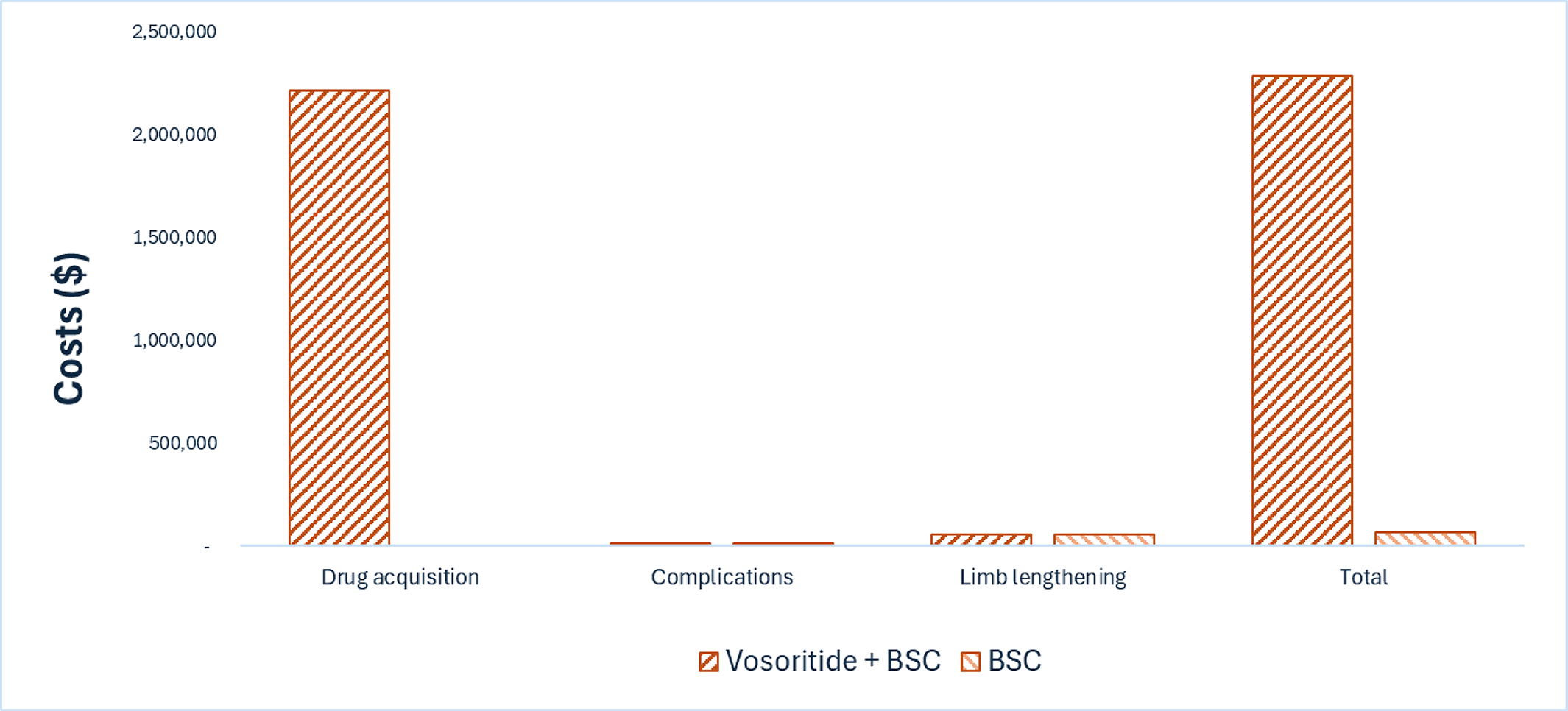
BSC = best supportive care; vs. = versus.
Impact on Health
Relative to BSC alone, vosoritide plus BSC was predicted to be associated with additional QALYs per patient compared to BSC alone in the CDA-AMC base case (incremental QALYs: 5.36).
Figure 2 illustrates the potential impact that vosoritide plus BSC is predicted to have on patient health. Note that the 5.36 incremental QALYs between vosoritide plus BSC and BSC alone are entirely due to patient height.
Figure 2: Impact of Vosoritide Plus BSC vs. BSC Alone on Patient Health
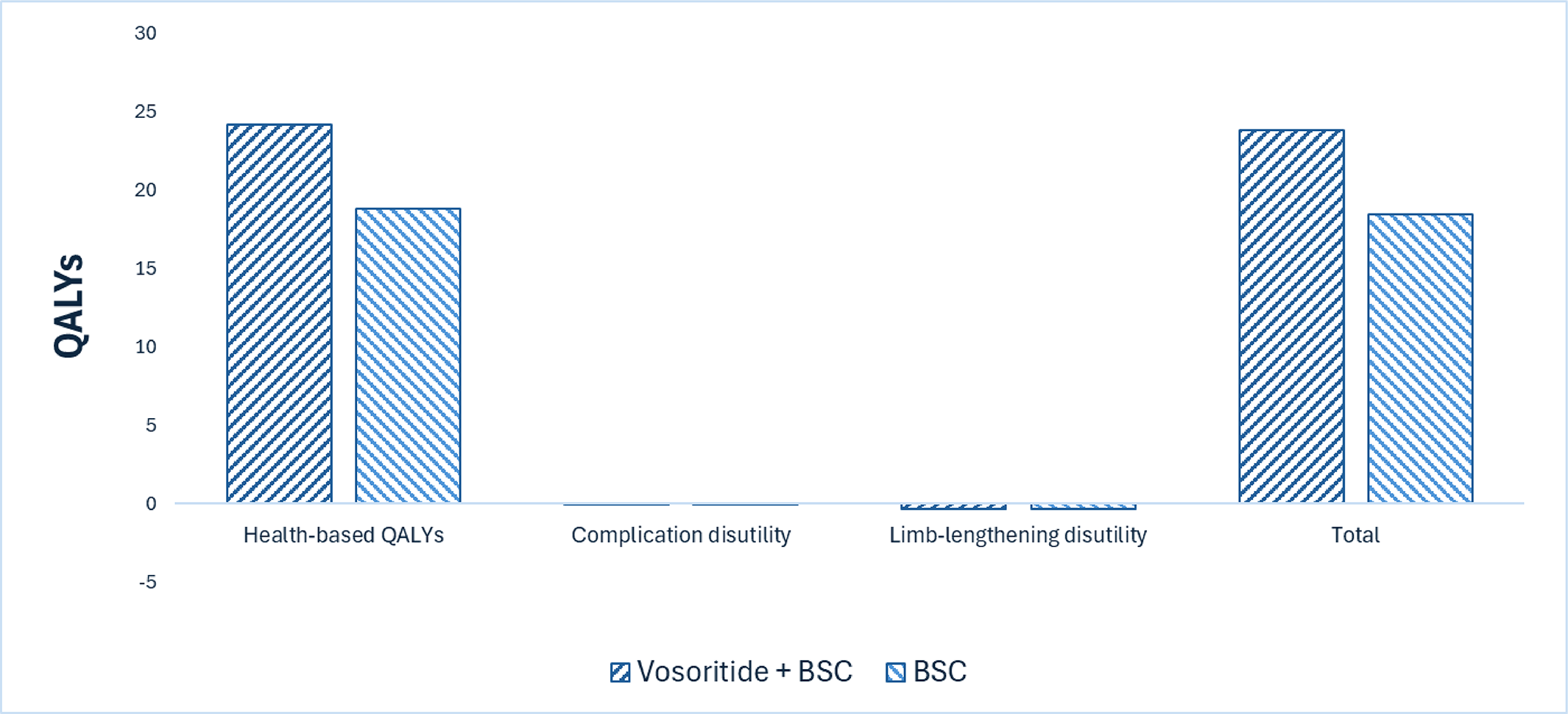
BSC = best supportive care; QALY = quality-adjusted life-year.
Note: Limb-lengthening disutilities were those associated with the limb-lengthening procedure.
Overall Results
The results of the analysis conducted by CDA-AMC suggest an ICER for vosoritide plus BSC versus BSC alone may be $413,585 per QALY gained (refer to Supplemental Material document, Appendix 11, Table 16). The result of this analysis is highly uncertain owing to uncertainty in the efficacy of vosoritide in children aged younger than 5 years and to the lack of evidence regarding how height scores translate into HRQoL improvements.
CDA-AMC was unable to provide an estimate of the cost-effectiveness of vosoritide plus BSC versus BSC alone when a societal perspective is adopted owing to limitations in the sponsor’s analysis.
Summary of the Budget Impact
The sponsor submitted a budget impact analysis to estimate the 3-year (2026 to 2028) budget impact of reimbursing vosoritide for use in the Health Canada–indicated population. The sponsor assumed that the payer would be CDA-AMC–participating public drug plans and derived the size of the eligible population using an epidemiologic approach. The price of vosoritide was aligned with the price included in the sponsor’s economic evaluation, while BSC was assumed to be associated with no incremental cost (i.e., it was assumed by the sponsor to be zero). Additional information pertaining to the sponsor’s submission is provided in Supplemental Materials document, Appendix 12.
CDA-AMC identified a number of issues with the sponsor’s estimated budget impact and made changes to model parameters and assumptions in consultation with clinical experts to derive the CDA-AMC base case (Supplemental Materials document, Appendix 12). CDA-AMC estimated that by year 3 of reimbursement, 180 patients would be eligible for vosoritide; of these, 144 patients are expected to receive it. The estimated incremental budget impact of reimbursing vosoritide is predicted to be approximately $112 million over the first 3 years (expenditure on vosoritide: $112 million). The actual budget impact of reimbursing vosoritide will depend on the number of eligible people, the proportion of patients with public drug plan coverage, and the uptake of vosoritide.
Conclusion
Based on the CDA-AMC base case, vosoritide for use in combination with BSC would be considered cost-effective at the submitted price if the public health care system was willing to pay $413,585 for each additional QALY gained. If the public health care system is not willing to pay that amount, a price reduction should be considered (refer to Figure 3; full details of the impact of price reductions on cost-effectiveness are presented in Supplemental Materials document, Appendix 12, Table 18).
The estimated cost-effectiveness of vosoritide plus BSC compared to BSC alone is highly uncertain due to uncertainty in the efficacy of vosoritide plus BSC in children younger than 5 years, and the unknown impact of vosoritide on mortality and complications associated with achondroplasia, as well as uncertainty in the relationship between height and HRQoL. If the incremental QALYs with vosoritide plus BSC are lower than predicted in the CDA-AMC scenario analyses, then further price reductions than those presented in this report may be required.
The budget impact of reimbursing vosoritide for use in combination with BSC to the public drug plans in the first 3 years is estimated to be approximately $112 million (expenditure on vosoritide: $112 million). The actual budget impact of reimbursing vosoritide will depend on the number of eligible people, the proportion of patients with public drug plan coverage, and the uptake of vosoritide.
Figure 3: Summary of the CDA-AMC Economic Analysis and Price Reductions

BSC = best supportive care; CDA-AMC = Canada’s Drug Agency; ICER = incremental cost-effectiveness ratio; QALY = quality-adjusted life-year.
Note: Expenditure includes only the drug cost of vosoritide.
Ethics Review
Key Ethical Considerations
Conceptual Models of Disability Related to Achondroplasia
As the most common form of dwarfism, achondroplasia is clinically characterized by typical physical features (e.g., short stature, disproportionate limb growth) and an elevated risk of experiencing several medical complications (e.g., foramen magnum stenosis, spinal stenosis, and obstructive sleep apnea, among others). Although these features help to identify achondroplasia as a medical condition, they are unable to tell us what it means to live with achondroplasia. Achondroplasia is lived and experienced as disabling through an interplay of elements such as physical impairment, social relationships, built environments, and sociocultural interpretations of bodily difference.25-27 Understanding how best to support people with achondroplasia requires attending to this interplay and considering the variety of ways in which individuals, caregivers, and the broader community understand these elements to relate to disability.
Here, we highlight 3 overarching conceptual models of disability (medical, social, and embodied) through which achondroplasia is often understood and described. Across these 3 models, what is seen as driving the disabling experience of achondroplasia varies. From within this variability emerge distinct ideas of what constitutes unmet need and expectations of support that can help us consider whether interventions such as vosoritide will be seen as desirable and beneficial.
The Medical Model: Physical Impairment and Medical Vulnerability
This model locates the source of disability within the body of the person with achondroplasia. Because nearly 80% of children with achondroplasia are born to parents of average stature, diagnosis often precipitates anxiety, uncertainty, and an abrupt shift from an imagined future with a child without a disability to a present filled with intensive monitoring and complex decision-making.28-32 The patient group input described repeated hospitalizations, surgeries, and persistent surveillance for neurologic and respiratory risks, with some caregivers living in constant “problem-solving mode” and fearing that ordinary childhood events (e.g., falls) may signal serious complications. Beyond the elevated risk of medical complications, caregivers (and some individuals with achondroplasia) highlight negative cultural portrayals of people with dwarfism and worry that their child’s (or their own) stature and disproportionate limb growth will expose them to ridicule while also limiting their ability to live independently and fully participate in society.28-33
Against this backdrop, it is easy to understand why many new caregivers (and some individuals with achondroplasia) emphasize physical impairment as the primary source of disability when considering their child’s (or their own) future. From within this frame, the primary site of unmet need and intervention is explicitly tied to physical impairment of an individual’s body. The prevention of life-threatening or painful complications is paired with interventions primarily focused on body modifications (e.g., limb-lengthening surgeries) that can make the child (or people with achondroplasia themselves) more suitable to social and structural environments that privilege average-statured bodies. In this way, altering height and proportionality become not ends in themselves, but proximal means of achieving the goals of functional ease, reduced dependence, and a safer (e.g., increased visibility when navigating traffic as a pedestrian) or less precarious future.32-34
The Social Model: Accessibility, Stigma, and Discrimination
In contrast to a medical model that views the body as the source of disability, many individuals with achondroplasia (and some caregivers) articulate a clear distinction between the reality of their physical impairments and their disabling experiences in society. Rather than centring on physical impairment, this model emphasizes public spaces built around average-statured bodies, recurrent experiences of teasing or hypervisibility, and cultural representations that frame dwarfism as comedic or “abnormal” as the primary source and drivers of disability.29,35-38
From within this frame, the disabling element is located primarily in social organization: in inaccessible design, discriminatory attitudes, and diminished recognition of dwarfism as a legitimate way of being. Individuals who adopt this orientation articulate unmet need in terms of accessible infrastructure, equitable participation in education and employment, reduction of stigma, and psychosocial supports that foster resilience and self-esteem. Here, interventions aimed at bodily modification appear misaligned with the core sources of disadvantage and may be experienced as discriminatory.39 These risk becoming biomedical responses to social and architectural problems — problems more appropriately addressed through accessibility policy, attitudinal change, and structural reform than through altering individual bodies.
The Embodied Model: Negotiating Vulnerability and Stigma Together
For many individuals with achondroplasia (and some caregivers), their experience of achondroplasia as a disability is framed as neither purely biological nor purely social. Instead, achondroplasia is understood as an embodied experience that cannot be reduced either to physical impairment alone (as in medical models) or to environmental barriers alone (as in strict social models). This perspective recognizes that bodies can be sources of pain, fatigue, and medical vulnerability while also serving as sites of pride, identity, and belonging.25,27 The body with achondroplasia is the medium through which individuals encounter the world, interpret their capacities, and participate in relationships and community life.32,40
From this orientation, disability is lived through continual negotiation between the realities of physical vulnerability and social conditions. Individuals may value their stature as integral to who they are and how they relate to dwarfism communities while also wishing for fewer surgeries, reduced physical strain, or relief from chronic pain.25,27 These desires are not contradictory; rather, these reflect the complexity of inhabiting a body that is simultaneously vulnerable, meaningful, and legitimate.
Within this frame, unmet need is understood as the absence of clinical, social, structural, and relational conditions that allow individuals to inhabit their bodies with dignity, autonomy, and legitimacy. This includes medical care that responds to real vulnerabilities without undermining identity and social environments that recognize short stature as a meaningful and legitimate form of human diversity.41 In this context, explicit and exclusive attention to height modification may feel misaligned with individual goals — not because individuals deny impairment, but because altering stature can be experienced as modifying something constitutive of self-understanding, community belonging, or “dwarf pride.”30,39
Ethical Considerations of Evaluated Evidence
As described in the Clinical Review report, the current evidence appraised for this review has largely focused on outcomes that are readily measurable (i.e., AGV, height z scores, upper-to-lower body segment ratios) rather than on the outcomes many individuals and caregivers identify as meaningful indicators of well-being (e.g., reducing medical complications, minimizing surgeries, improving stamina and functional ease, or supporting independence). This approach aligns more closely with a medical model and raises ethical questions about evidentiary relevance across the 3 models of achondroplasia as disabling (as previously discussed):
For individuals and caregivers who understand achondroplasia primarily through social or embodied models of disability, altering height is not a desired treatment goal; intentional modification of height may even be experienced as discriminatory. While some may view improvements in upper-to-lower body segment ratio as a relevant marker of functionality (thereby presumably supporting improvements in QoL), the evidence does not currently demonstrate any clinically meaningful effects of vosoritide on proportionality.
For those oriented toward a medical model of disability, height is a valued site of intervention, though it is seen largely as a proxy for anticipated improvements in functionality, QoL, and long-term health. Whether the changes in height demonstrated in the evidence affect any of these remains uncertain.
Because the clinical trials assessed the impact of vosoritide primarily from the medical model perspective, the evidentiary basis risks misalignment with the lived experiences and unmet needs identified by individuals with achondroplasia and caregivers. This raises broader questions about what, in practice, height gains signify, and whether publicly funding a therapy on this basis reflects or distorts the values and priorities of those most affected.
Ethical Considerations Associated With Use of Vosoritide
As the first disease-modifying therapy for achondroplasia, the sponsor has stated that vosoritide has the potential to “significantly alter the natural course of achondroplasia, enhancing the quality of life for patients and consequently reducing the burden on caregivers” (p. 5).42 Clinical experts echoed this sentiment and were optimistic that increases in height might eventually translate into functional or health-related benefits. The patient group input further supported this statement and offered anecdotal reports suggesting that some children may experience improvements in daily functioning or comorbidities. Given the manageable safety profile demonstrated across trials and the strong desire for any therapeutic options, all 3 clinical experts indicated that they would be willing to prescribe vosoritide were it available in Canada.
These hopes reflect an orientation toward achondroplasia that is consistent with the medical model in which modifying growth parameters is assumed to improve overall well-being. By demonstrating an impact on 1 growth parameter (i.e., height), vosoritide is understood as addressing a key disabling feature of achondroplasia and, by extension, contributing to a broader sense of well-being, despite limited evidence supports this assumption. Within this context, height becomes a symbolically loaded outcome — not only a measure of growth, but also a marker of normality, making its prioritization ethically and socially consequential.
Although many people with achondroplasia (and their caregivers) may desire interventions that reduce experiences of debilitating medical complications (e.g., skeletal abnormalities that are painful and may require frequent surgical intervention), height itself is not typically identified as a primary source of disadvantage. As such, a medical model interpretation does not exhaust how disability may be understood by people living with achondroplasia (and their caregivers). Instead, as previously described, people who interpret achondroplasia through social or embodied models of disability tend to locate the most consequential challenges in inaccessible environments, stigma, and experiences of chronic medical vulnerability.
For these reasons, vosoritide remains a controversial intervention. Its primary demonstrated effect concerns an outcome that is variably valued and unevenly aligned with the primary sources of disadvantage in achondroplasia. The resulting tension is not simply one of evidentiary uncertainty, but of whether height-based change can reasonably be understood as a meaningful benefit across differing interpretations of disability and well-being.
Caregiver Vulnerability and the Moral Pressures of Early Decision-Making
Amid the controversy surrounding vosoritide, those in favour of its availability have emphasized the importance of caregiver “choice” in navigating the question of whether height-based changes can be understood as providing meaningful benefit. Caregivers who value height, or hope that gains in height signal broader improvements in functionality and well-being, may choose to pursue treatment with vosoritide, while others may simply choose to decline. However, framing the uptake of vosoritide as primarily a matter of individual choice risks obscuring the societally constructed conditions under which these decisions would be made.
Most caregivers learn of achondroplasia at the birth of an affected child and lack any experiential or community-based understanding of achondroplasia or dwarfism more broadly.39 Early understandings of achondroplasia are, therefore, often shaped by clinical discourse focused on the risk of medical complications and by broader social narratives that stigmatize short stature.39 Therefore, decisions to pursue vosoritide would be made under conditions of profound uncertainty, high emotional vulnerability, and compressed timelines — particularly because the clinical experts and international guidelines emphasize that earlier initiation may maximize effect.10
Taken together, these conditions may bias caregiver decision-making toward a medicalized understanding of disability, in which clinical interventions and medical complications are foregrounded while examples of living well with dwarfism remain largely invisible. In this context, presenting vosoritide as a discretionary option can implicitly shape what counts as “good care,” such that acceptance of treatment appears aligned with responsible caregiving and refusal appears increasingly exceptional.30,39
Deferring the primary responsibility for decision-making to individual caregivers under these conditions can also function as a redistribution of ethical responsibility rather than its resolution. Even with thorough informed consent, caregivers are left to absorb the practical, emotional, and moral consequences of decisions made amid unresolved uncertainty. Not only is it unclear whether height gains will ultimately translate into meaningful clinical benefits, but caregivers will also be making treatment decisions long before their child has had the opportunity to consider whether a medicalized framing appropriately reflects their own embodied understanding of what it might mean to live well (or not) with achondroplasia. Further, although many caregivers will have had limited engagement with the achondroplasia community before making treatment decisions, their decisions may nonetheless have far-ranging impacts for the broader community, in which growth-modifying therapies are the subject of ongoing moral debate and controversy.30,39,41 Within this broader social field, caregiver decisions may be interpreted as social signals about how bodies with dwarfism ought to be understood (e.g., as problems to be addressed through interventions focused on height gain or as valued forms of human difference), and subsequently as contributing to experiences of social harm by those within the achondroplasia community.
Thus, caregivers will navigate competing expectations while attempting to act in what they understand to be their child’s best interests. Being thrown into a moral and political debate with which they are unfamiliar — and expected to make life-altering decisions for a child — can be paralyzing. One mother captured this tension when she described fearing that her child might later ask why she chose not to pursue treatment, while simultaneously fearing that pursuing treatment would prompt the child to question why their short stature was not embraced.29 This dilemma reflects a deeper ethical challenge: caregivers must make decisions that will have lasting implications for their child’s future embodiment, identity, and autonomy at a time when those futures (and the values through which these will later be interpreted) cannot yet be known. Therefore, the risk is not simply that a decision may turn out to be “wrong,” but that the choices made under conditions of uncertainty may later be experienced as misaligned with the child’s emerging sense of self and belonging while also contributing to a broader sense of social harm among members of the achondroplasia community.
Accounting for Competing Conceptions of Benefit
The ethical significance of vosoritide cannot be understood solely in terms of demonstrated clinical outcomes. It must also be understood in terms of the benefit that public systems choose to support or decline. For some individuals with achondroplasia, as well as caregivers and health care providers, increases in stature are understood as a meaningful pathway toward reduced medical complications, improved functional capacity, and/or greater social acceptance. For others, prioritization of growth parameters is experienced as a misalignment with how disadvantage is experienced and addressed in everyday life — particularly when the factors that make achondroplasia disabling are seen as arising from inaccessible environments, stigma, or debilitating medical complications rather than from height itself.
The challenge for decision-makers is not to identify a single “correct” account of benefit, but to recognize that different, and sometimes incompatible, conceptions of benefit and living well are at stake.43 Evaluation requires attention not only to what the therapy may offer, but also to what its normalization might displace: commitments to diverse visions of living well, accessible environments, and futures untethered to conformity with average-stature norms.39
If vosoritide is recommended for public reimbursement, it will be vital to ensure that the decision to pursue treatment does not become a normative expectation. Protecting the future autonomy of children with achondroplasia will require supporting caregivers as they make decisions regarding vosoritide by offering clear communication about the limits of the current evidence, the speculative nature of the potential downstream benefits, and the absence of demonstrated improvements in clinically meaningful outcomes.
Given that most caregivers making decisions about vosoritide will have limited prior exposure to achondroplasia or dwarfism communities, it will be important to balance the clinical emphasis on medical risks with examples of lives well lived with achondroplasia.39 This may include facilitating early connections to local achondroplasia-specific (or broader dwarfism) communities before families finalize their decision about whether to pursue treatment with vosoritide. Finally, attention must be given to supporting caregivers who decline vosoritide treatment, ensuring they do not face implicit or explicit judgments that their choice reflects inadequate care and ensuring that BSC and supports remain in place for those who opt out of treatment with vosoritide.
Health System Considerations
The introduction of vosoritide into routine care raises several health system considerations that may affect equitable access, treatment feasibility, and the overall experience of people with achondroplasia and their caregivers. Pretreatment requirements, including genetic confirmation of FGFR3 variants and baseline assessments, may exceed the diagnostic capacity of some centres, particularly those in smaller or rural settings.44 Although the clinical experts consulted questioned whether genetic confirmation must be required, diagnostic and follow-up demands may still exacerbate existing geographic and resource disparities. Because achondroplasia care is already concentrated in specialized multidisciplinary clinics, integrating vosoritide may further centralize services, requiring families, especially those in rural or remote regions, to travel long distances for assessment, treatment initiation, and ongoing monitoring.44
Implications of Public Reimbursement
Funding decisions do not merely allocate resources; such decisions also communicate social norms and values. As the only demonstrated benefit of vosoritide is its impact on height (without corresponding evidence of reductions in surgical burden, pain, sleep apnea, or other debilitating clinical complications), public reimbursement could be perceived as signalling that small stature itself constitutes a “problem” warranting clinical intervention and substantial public investment.45 For children who grow up without treatment (or those who later choose to discontinue it), public reimbursement and the normalization of vosoritide in clinical practice may subtly reinforce the idea that their natural embodiment is less acceptable within prevailing social and clinical norms.30,39,46-48 Even if unintentionally, reimbursement may constitute a social harm among individuals who consider their height to be a meaningful and legitimate part of their identity.
References
1.Pauli RM. Achondroplasia: a comprehensive clinical review. Orphanet J Rare Dis. 2019;14(1):1. doi:10.1186/s13023-018-0972-6 PubMed
2.Fagen KE, Blask AR, Rubio EI, Bulas DI. Achondroplasia in the Premature Infant: An Elusive Diagnosis in the Neonatal Intensive Care Unit. AJP Rep. 2017;7(1):e8-e12. doi:10.1055/s-0036-1592188 PubMed
3.Bacino CA. Kaplan SL, Kremen J, eds. Achondroplasia. UpToDate; 2023. Accessed 2025 October 14. http://www.uptodate.com
4.Chilbule SK, Dutt V, Madhuri V. Limb lengthening in achondroplasia. Indian J Orthop. 2016;50(4):397-405. doi:10.4103/0019-5413.185604 PubMed
5.Merker A, Neumeyer L, Hertel NT, et al. Growth in achondroplasia: Development of height, weight, head circumference, and body mass index in a European cohort. Am J Med Genet A. 2018;176(8):1723-1734. doi:10.1002/ajmg.a.38853 PubMed
6.Alade Y, Tunkel D, Schulze K, et al. Cross-sectional assessment of pain and physical function in skeletal dysplasia patients. Clin Genet. 2013;84(3):237-43. doi:10.1111/cge.12045 PubMed
7.BioMarin. Data on File. 111-501 Observational Study Report [sponsor supplied reference]. 2020.
8.Foreman PK, van Kessel F, van Hoorn R, van den Bosch J, Shediac R, Landis S. Birth prevalence of achondroplasia: A systematic literature review and meta-analysis. Am J Med Genet A. 2020;182(10):2297-2316. doi:10.1002/ajmg.a.61787 PubMed
9.BioMarin Pharmaceutical (Canada) Inc. VOXZOGO® [Draft Product Monograph] [sponsor supplied reference]. 2024.
10.Savarirayan R, Hoover-Fong J, Ozono K, et al. International consensus guidelines on the implementation and monitoring of vosoritide therapy in individuals with achondroplasia. Nat Rev Endocrinol. 2025;21(5):314-324. doi:10.1038/s41574-024-01074-9 PubMed
11.Reincke S, Semler O, Junghanel-Welzing S, et al. Real-world Outcome of Vosoritide Treatment in Children With Achondroplasia: A 12-month Retrospective Observational Study. J Endocr Soc. 2025;9(5):bvaf041. doi:10.1210/jendso/bvaf041 PubMed
12.Sawamura K, Kitoh H, Kamiya Y, Mishima K, Matsushita M, Imagama S. Changes in the Alignment of the Spine and Lower Limb in Children With Achondroplasia Treated With Vosoritide: A Single-center, 1-year Follow-up Prospective Study. J Pediatr Orthop. 2025;45(8):519-524. doi:10.1097/BPO.0000000000002980 PubMed
13.BioMarin. Clinical Study Report: 111-202. A Phase 2, Open-label, Sequential Cohort Dose-escalation Study of BMN 111 in Children with Achondroplasia [internal sponsor's report]. October 18, 2018.
14.BioMarin. Clinical Study Report: 111-205. A Phase 2, Open-Label, Extension Study to Evaluate the Long-Term Safety, Tolerability, and Efficacy of BMN 111 in Children with Achondroplasia [internal sponsor's report]. May 21, 2020.
15.Cormier-Daire V, Edouard T, Isidor B, et al. Real-World Safety and Effectiveness of Vosoritide in Children with Achondroplasia: French Early Access Program. Horm Res Paediatr. 2025:1-9. doi:10.1159/000543743 PubMed
16.Mohnike K. FC2.6 - Expansion of the CrescNet Registry Achondroplasia Module: Real-World Demographic Data and Outcomes after up to 2 Years of Vosoritide Treatment. 62nd Annual Meeting European Society for Paediatric Endocrinology, Liverpool. 2024.
17.Rua IB, Silva I, Beger C, et al. Real-World Safety and Effectiveness of Vosoritide in Achondroplasia: Results from a Single Center in Portugal. Adv Ther. 2025;42(8):3726-3742. doi:10.1007/s12325-025-03223-6 PubMed
18.BioMarin. Clinical Study Report: 111-301. A Phase 3 Randomized, Double-Blind, Placebo-Controlled, Multicenter Study to Evaluate the Efficacy and Safety of BMN 111 in Children with Achondroplasia [internal sponsor's report]. April 21, 2020.
19.BioMarin Pharmaceutical (Canada) Inc. Sponsor's clinical summary report. Vosoritide (voxzogo) [internal sponsor's report]. In: Drug Reimbursement Review sponsor submission: Voxzogo (vosoritide injection), 0.4 mg/0.5 mL (0.8 mg/mL), 0.56 mg/0.7 mL (0.8 mg/mL), 1.2 mg/0.6 mL (2 mg/mL) subcutaneous injection. September 30. 2025.
20.BioMarin. Clinical Study Report: 111-206. A Phase 2 Randomized, Double-Blind, Placebo-Controlled Clinical Trial to Evaluate the Safety and Efficacy of BMN 111 in Infants and Young Children with Achondroplasia, Age 0 to < 60 Months[internal sponsor's report]. July 18, 2022.
21.Torres-Saavedra PA, Winter KA. An Overview of Phase 2 Clinical Trial Designs. Int J Radiat Oncol Biol Phys. 2022;112(1):22-29. doi:10.1016/j.ijrobp.2021.07.1700 PubMed
22.European Medicines Agency Reflection paper on establishing efficacy based on single-arm trials submitted as pivotal evidence in a marketing authorisation application - Considerations on evidence from single-arm trials 2024. Accessed December 16. https://www.ema.europa.eu/en/documents/scientific-guideline/reflection-paper-establishing-efficacy-based-single-arm-trials-submitted-pivotal-evidence-marketing-authorisation-application_en.pdf
23.Hoover-Fong JE, Schulze KJ, Alade AY, et al. Growth in achondroplasia including stature, weight, weight-for-height and head circumference from CLARITY: achondroplasia natural history study-a multi-center retrospective cohort study of achondroplasia in the US. Orphanet J Rare Dis. 2021;16(1):522. doi:10.1186/s13023-021-02141-4 PubMed
24.Food and Drug Administration (FDA). Rare Diseases: Natural History Studies for Drug Development - Guidance for Industry. 2019. Accessed 2025 December 12 https://www.fda.gov/media/122425/download
25.Shakespeare T, Watson N. The social model of disability: An outdated ideology? In: Barnartt SN, Altman BM, eds. Exploring Theories and Expanding Methodologies: Where we are and where we need to go. Emerald Group Publishing Limited; 2001:0.
26.Shakespeare T. Disability rights and wrongs revisited. Routledge; 2013.
27.Watermeyer B, Harvey C. Screwing With Our Embodiment: A Response to Thorneycroft’s Re-Imagining of the Social Model. Scandinavian Journal of Disability Research. 2025;27(1).
28.Adedeji A, Witt S, Innig F, et al. Coping and quality of life of parents of children with achondroplasia-a narrative review. Front Med (Lausanne). 2025;12:1500389. doi:10.3389/fmed.2025.1500389 PubMed
29.Shediac R, Moshkovich O, Gerould H, et al. Experiences of children and adolescents living with achondroplasia and their caregivers. Mol Genet Genomic Med. 2022;10(4):e1891. doi:10.1002/mgg3.1891 PubMed
30.Saville K-M. Biopower, Biotechnologies, and the Biopolitics of Mothering: A Sociological Exploration of Maternal Subjectivities within UK Dwarfism Communities. Aston University; 2024.
31.Pfeiffer KM, Brod M, Smith A, et al. Assessing the impacts of having a child with achondroplasia on parent well-being. Qual Life Res. 2021;30(1):203-215. doi:10.1007/s11136-020-02594-3 PubMed
32.Origin. Dwarf Story: Little People, Big Choice (a film by Riccardo Servini). YouTube; 2025. Accessed 7 January 2026. https://www.youtube.com/watch?v=7M2ewuU-4vA
33.Crews C. Love What Matters. February 21, 2020. https://chandlercrews.com/love-what-matters/
34.McGraw SA, Henne JC, Nutter J, Larkin AA, Chen E. Treatment Goals for Achondroplasia: A Qualitative Study with Parents and Adults. Adv Ther. 2022;39(7):3378-3391. doi:10.1007/s12325-022-02190-6 PubMed
35.Gollust SE, Thompson RE, Gooding HC, Biesecker BB. Living with achondroplasia in an average-sized world: an assessment of quality of life. Am J Med Genet A. 2003;120A(4):447-58. doi:10.1002/ajmg.a.20127 PubMed
36.Pfeiffer KM, Brod M, Smith A, Viuff D, Ota S, Charlton RW. Functioning and well-being in older children and adolescents with achondroplasia: A qualitative study. Am J Med Genet A. 2022;188(2):454-462. doi:10.1002/ajmg.a.62534 PubMed
37.Pritchard E. The spatial experiences of dwarfs within public spaces. Scandinavian Journal of Disability Research. 2016. doi:10.1080/15017419.2015.1063542
38.Pritchard E. Cultural Representations of dwarfs and their disabling affects on dwarfs in society. Considering Disability Journal. 2017:1985.
39.Pritchard E. A World Without Dwarfism. Journal of Literary & Cultural Disability Studies. 2022;16(4):475-477.
40.Witt S, Rohenkohl A, Bullinger M, et al. Understanding, Assessing and Improving Health-Related Quality of Life of Young People with Achondroplasia- A Collaboration between a Patient Organization and Academic Medicine. Pediatr Endocrinol Rev. 2017;15(Suppl 1):109-118. doi:10.17458/per.vol15.2017.wrm.improvinghealthrelatedquality PubMed
41.America LPo. LPA's Position Statement Regarding Biomarin's Voxzogo. Accessed 5 December 2025. https://www.lpaonline.org/voxzogo-position-statement
42.BioMarin Pharmaceutical (Canada) Inc. Executive Summary [internal sponsor's submission].
43.Howard D. The political value of letting hopes die. Critical Review of International Social and Political Philosophy. 2024;27(6):928-951. doi:10.1080/13698230.2024.2344383
44.Semler O, Cormier-Daire V, Lausch E, et al. Vosoritide Therapy in Children with Achondroplasia: Early Experience and Practical Considerations for Clinical Practice. Adv Ther. 2024;41(1):198-214. doi:10.1007/s12325-023-02705-9 PubMed
45.Magnusson E. Disability, Relational Equality, and the Expressivist Objection. Hastings Cent Rep. 2025;55(2):15-25. doi:10.1002/hast.4975 PubMed
46.Saner E. ‘There is a fear that this will eradicate dwarfism’: the controversy over a new growth drug. The Guardian; 2020. Accessed 5 December 2025. https://www.theguardian.com/science/2020/sep/28/there-is-a-fear-that-this-will-eradicate-dwarfism-the-controversy-over-a-new-growth-drug
47.Stoll K. FDA Approval of Voxzogo – An Unmet Medical Need? The DNA Exchange blog. December 1, 2021. https://thednaexchange.com/2021/12/01/fda-approval-of-voxzogo-an-unmet-medical-need/
48.Garde D. A new treatment promises to make little people taller. Is it an insult to ‘dwarf pride’? STAT; 2019. Accessed 5 December 2025. https://www.statnews.com/2019/11/18/a-new-treatment-promises-to-make-little-people-taller-is-it-an-insult-to-dwarf-pride/
ISSN: 2563-6596
Canada’s Drug Agency (CDA-AMC) is a pan-Canadian health organization. Created and funded by Canada’s federal, provincial, and territorial governments, we’re responsible for driving better coordination, alignment, and public value within Canada’s drug and health technology landscape. We provide Canada’s health system leaders with independent evidence and advice so they can make informed drug, health technology, and health system decisions, and we collaborate with national and international partners to enhance our collective impact.
Disclaimer: CDA-AMC has taken care to ensure that the information in this document was accurate, complete, and up to date when it was published, but does not make any guarantee to that effect. Your use of this information is subject to this disclaimer and the Terms of Use at cda-amc.ca.
The information in this document is made available for informational and educational purposes only and should not be used as a substitute for professional medical advice, the application of clinical judgment in respect of the care of a particular patient, or other professional judgments in any decision-making process. You assume full responsibility for the use of the information and rely on it at your own risk.
CDA-AMC does not endorse any information, drugs, therapies, treatments, products, processes, or services. The views and opinions of third parties published in this document do not necessarily reflect those of CDA-AMC. The copyright and other intellectual property rights in this document are owned by the Canadian Agency for Drugs and Technologies in Health (operating as CDA-AMC) and its licensors.
Questions or requests for information about this report can be directed to Requests@CDA-AMC.ca.