Drugs, Health Technologies, Health Systems
Reimbursement Review
Tirzepatide (Mounjaro)
Sponsor: Eli Lilly Canada Inc.
Therapeutic area: Diabetes mellitus, type 2
Summary
What Is Type 2 Diabetes?
Diabetes mellitus is a common metabolic disease characterized by persistent elevations in blood glucose (hyperglycemia) caused by a progressive loss of pancreatic beta-cell function, impaired insulin secretion, and/or insulin resistance. Type 2 diabetes (T2DM) is the most common type of diabetes, representing approximately 90% of cases.
Several genetic and lifestyle-related risk factors are associated with the development of T2DM, including diet, obesity, physical inactivity, genetics, age, and cigarette smoking. Approximately 4 million people in Canada (a prevalence of 10%) were living with diabetes mellitus in 2024, and the prevalence is expected to increase to 12% by 2034.
What Are the Treatment Goals and Current Treatment Options for T2DM?
According to the clinical experts consulted for this review, preventing symptoms of hyperglycemia through glycemic control, reducing the risk of microvascular complications (e.g., eye complications and neuropathy) and macrovascular complications (e.g., cardiovascular [CV] events), managing CV risk factors, managing weight (if appropriate), and protecting cardiorenal health are priorities when treating T2DM.
Cost, coverage, and weight management issues associated with medications were identified as important outcomes in the patient group input. Other important outcomes identified through clinician input include treatments that are associated with weight loss, a minimal risk of hypoglycemia, and the achievement of hemoglobin A1C targets; for patients with known CV comorbidities, drugs with evidence supporting risk lowering are additionally preferred.
The management of T2DM includes education, lifestyle modification, and pharmacological therapy. Metformin is recommended as first-line therapy, plus cardiorenal protective drugs added if indicated at diagnosis. Following this, if hemoglobin A1C is above target, additional therapies can be added according to clinical priorities (e.g., desired hemoglobin A1C targets and weight loss). Relevant comparators to Mounjaro include incretins (dipeptidyl peptidase-4 inhibitors and glucagon-like peptide-1 receptor agonists), insulins, secretagogues (sulfonylureas [SUs] and meglitinides), and sodium-glucose cotransporter-2 (SGLT2) inhibitors.
What Is Mounjaro and Why Did Canada’s Drug Agency Conduct This Review?
Mounjaro is a drug that is administered by subcutaneous injection. Health Canada has approved Mounjaro for once-weekly administration as an adjunct to diet and exercise to improve glycemic control for the treatment of adult patients with T2DM as monotherapy when metformin is inappropriate due to contraindication or intolerance in combination with metformin, metformin and a SU, metformin and a SGLT2 inhibitor, or basal insulin with or without metformin.
Canada’s Drug Agency (CDA-AMC) reviewed Mounjaro to inform a recommendation to the participating public drug programs on whether the drug should be reimbursed for once-weekly administration as an adjunct to diet and exercise to improve glycemic control in adult patients with T2DM when used in combination with metformin, metformin and an SU, or metformin and an SGLT2 inhibitor. The sponsor is seeking reimbursement for this patient population.
How Did CDA-AMC Evaluate Mounjaro?
CDA-AMC reviewed the clinical evidence on the beneficial and harmful effects, as well as the economic evidence, of Mounjaro versus other treatments used in Canada for T2DM. Semaglutide, dulaglutide, and liraglutide were considered as relevant treatments to compare with Mounjaro when reviewing the clinical evidence.
CDA-AMC identified equity and ethical considerations relevant to Mounjaro and T2DM.
The review was informed by materials submitted by the sponsor, which included clinical and economic evidence.
The review was also informed by 1 patient group submission and 3 clinician group submissions in response to the call for input by CDA-AMC, and by input from the participating public drug programs around issues that may affect their ability to implement a recommendation.
Three endocrinologists with representation from Ontario and British Columbia were consulted as part of the review process.
What Were the Findings?
Clinical Evidence
CDA-AMC reviewed the following clinical evidence:
3 randomized, active-controlled, open-label phase III studies (SURPASS-2, SURPASS-3, and SURPASS-4) comparing Mounjaro 5 mg, 10 mg, and 15 mg to semaglutide 1 mg (the SURPASS-2 study) in adult patients with T2DM receiving metformin; titrated insulin degludec (the SURPASS-3 study) in adult patients with T2DM receiving metformin with or without an SGLT2 inhibitor; and titrated insulin glargine (the SURPASS-4 study) in adult patients with T2DM and CV risk factors receiving metformin with or without an SGLT2 inhibitor or SU
1 randomized, double-blind, active-controlled phase III study (the SURPASS-CVOT study) comparing the maximum tolerated dose (MTD) of Mounjaro with dulaglutide 1.5 mg in patients with T2DM aged 40 years or older with established CV disease
2 network meta-analyses (NMAs) of Mounjaro versus relevant comparators in patients receiving 1 or 2 oral antidiabetic drugs (OADs).
For the comparison of Mounjaro versus semaglutide 1 mg (the SURPASS-2 study):
For hemoglobin A1C, treatment with Mounjaro 5 mg resulted in little to no difference compared to semaglutide 1 mg, and treatment with Mounjaro 10 mg and 15 mg resulted in a clinically important reduction in hemoglobin A1C. For the proportion of patients achieving weight loss of 5% or more, treatment with Mounjaro 5 mg likely resulted in an increase, and treatment with Mounjaro 10 mg and 15 mg resulted in an increase, in the proportion of patients achieving weight loss of 5% or more. Treatment with Mounjaro 5 mg, 10 mg, and 15 mg likely resulted in little to no difference in transformed total Ability to Perform Physical Activities of Daily Living (APPADL) score. For the proportion of patients with at least 1 serious adverse event (SAE), treatment with Mounjaro 5 mg resulted in an increase, and treatment with Mounjaro 10 mg and 15 mg likely resulted in an increase, in the proportion of patients with at least 1 SAE.
For the comparison of Mounjaro versus insulin (the SURPASS-3 and SURPASS-4 studies):
In the SURPASS-3 study, compared to insulin degludec, treatment with Mounjaro 5 mg, 10 mg, and 15 mg resulted in a clinically important reduction in hemoglobin A1C; resulted in an increase in the proportion of patients attaining weight loss of 5% or greater; likely resulted in little to no difference in transformed total APPADL score; and may have resulted in little to no difference in the proportion of patients with SAEs.
In the SURPASS-4 study, compared to insulin glargine, treatment with Mounjaro 5 mg, 10 mg, and 15 mg resulted in a clinically important reduction in hemoglobin A1C. Treatment with Mounjaro 5 mg, 10 mg, and 15 mg resulted in a clinically important increase in the proportion of patients attaining weight loss of 5% or greater. Treatment with Mounjaro 5 mg, 10 mg, and 15 mg may have resulted in an increase in the total transformed APPADL score. For the proportion of patients reporting 1 or more SAEs, treatment with Mounjaro 5 mg may have resulted in a decrease, treatment with Mounjaro 10 mg may have resulted in little to no difference, and treatment with Mounjaro 15 mg resulted in a decrease compared to insulin glargine.
Across the SURPASS-2, SURPASS-3, and SURPASS-4 studies, the results for health-related quality of life and subjective harms are subject to potential bias from the open-label nature of the studies, and the baseline hemoglobin A1C, racial distribution, and the number or combinations of OADs represented in the study populations may not be fully generalizable to clinical practice.
For the comparison of Mounjaro versus dulaglutide (the SURPASS-CVOT study):
Treatment with Mounjaro at the MTD likely resulted in little to no difference in the cumulative risk of the composite major adverse CV event, death from cardiovascular or undetermined causes, myocardial infarction, or stroke (MACE-3) outcome. Treatment with Mounjaro at the MTD resulted in a clinically important decrease in hemoglobin A1C. Treatment with Mounjaro at the MTD resulted in a reduction in the proportion of patients attaining weight loss of 5% or greater. Treatment with Mounjaro at the MTD resulted in little to no difference in the total transformed APPADL score. Mounjaro may have resulted in little to no difference in the proportion of patients reporting 1 or more SAEs.
The baseline hemoglobin A1C, racial distribution, and the number or combinations of OADs represented in the study population may not be fully generalizable to clinical practice.
Indirect comparisons from NMAs of Mounjaro versus other antidiabetic drugs in patients with 1 to 2 background OADs:
For the change from baseline in hemoglobin A1C, the NMAs suggested Mounjaro 10 mg and 15 mg may be favoured compared to each of semaglutide 0.5 mg once weekly, semaglutide 1.0 mg once weekly, oral semaglutide 7.0 mg once daily, and oral semaglutide 14.0 mg once daily, but not semaglutide 2.0 mg. Mounjaro may also be favoured over dulaglutide 3.0 mg, and Mounjaro 10 mg and 15 mg may be favoured compared to dulaglutide 4.5 mg. The comparison between Mounjaro 5 mg and dulaglutide 4.5 mg suggests there may be little to no difference between treatments.
For the change from baseline in body weight, the NMAs suggested that all doses of Mounjaro (5 mg, 10 mg, or 15 mg) may be favoured compared to all included doses of semaglutide, except that there may be little to no difference between Mounjaro 5 mg and semaglutide 2.0 mg. Results suggested all doses of Mounjaro may also be favoured over any dose of dulaglutide and liraglutide.
There was substantial between-trial heterogeneity that reduced certainty in the NMA results.
Economic Evidence
Mounjaro is available as 2.5 mg, 5 mg, 7.5 mg, 10 mg, 12.5 mg, and 15 mg per 0.6 mL solution for subcutaneous injection (multidose prefilled pens) or 2.5 mg, 5 mg, 7.5 mg, 10 mg, 12.5 mg, and 15 mg per 0.5 mL solution for subcutaneous injection (single-dose vials). At the submitted price of $300.00 per 2.5 mg or 5 mg multidose prefilled pen, $420.00 per 7.5 mg or 10 mg multidose prefilled pen, $540.00 per 12.5 mg or 15 mg multidose prefilled pen, $75.00 per 2.5 mg or 5 mg single-dose vial, $105.00 per 7.5 mg or 10 mg single-dose vial, and $135.00 per 12.5 mg or 15 mg single-dose vial, the annual cost of Mounjaro is expected to range from $3,913 to $7,044 per patient depending on the dose.
The clinical efficacy in the economic analysis (the change from baseline in hemoglobin A1C and the change from baseline in body weight) was derived from a sponsor-submitted indirect treatment comparison, with the efficacy of Mounjaro informed by the SURPASS-2 and SURPASS-3 trials. Indirect evidence submitted by the sponsor suggests that Mounjaro 10 mg and 15 mg may be associated with favoured outcomes for change from baseline in hemoglobin A1C compared to several comparators. However, there remains a large amount of between-trial heterogeneity with regard to the baseline demographic and disease-related characteristics of patients, and a wide range of publication dates that may span different eras of diabetes management, all of which reduce the certainty in the NMA results. Additionally, the selection of different end points for Mounjaro and comparators for outcomes in the NMA introduces further uncertainty. The comparisons were more often statistically significant when the Mounjaro dose was 15 mg, compared to the lower doses of 10 mg, and especially 5 mg. Similar findings for change from baseline in body weight and the proportion of patients who achieved at least 5% weight loss from baseline body weight were identified.
The CDA-AMC Clinical Review noted that, based on the sponsor-submitted indirect treatment comparison, the effect of Mounjaro 5 mg on the change from baseline in hemoglobin A1C was not favoured compared to semaglutide 1 mg. When considering the effect on weight loss, Mounjaro 5 mg may be associated with favoured outcomes versus semaglutide 1 mg; however, the limitations of the NMA, described in the preceding paragraph, still apply. Based on the evidence reviewed for this submission, there is no robust evidence to suggest that Mounjaro 5 mg provides greater glycemic control than semaglutide 1 mg. Therefore, the cost of Mounjaro 5 mg should not exceed that of semaglutide 1 mg for the same indication.
Based on clinical expert feedback and the sponsor’s submitted market share distributions for the budget impact analysis, Mounjaro is expected to only displace injectable semaglutide upon reimbursement. As such, CDA-AMC analyses were conducted with injectable semaglutide as the most relevant comparator.
The results of the CDA-AMC base case suggest:
Mounjaro 10 mg and 15 mg are predicted to be associated with higher costs to the health care system than semaglutide 1 mg (incremental costs = $44,543 and $71,871, respectively), primarily driven by increased drug costs associated with Mounjaro 10 mg and 15 mg.
Mounjaro 10 mg and 15 mg are predicted to be associated with a gain of 0.01 and 0.02 life-years compared to semaglutide 1 mg and may result in a gain of 0.10 and 0.13 quality-adjusted life-years (QALYs) compared to semaglutide 1 mg.
The incremental cost-effectiveness ratio (ICER) of Mounjaro 10 mg compared to semaglutide 1 mg was $453,118 per QALY gained, whereas the ICER of Mounjaro 15 mg compared to semaglutide 1 mg was $548,277 per QALY gained in the CDA-AMC base case.
The estimated ICERs are uncertain due to limitations in the underlying clinical evidence, model structure and assumptions, and unresolved uncertainty regarding treatment pathways in clinical practice. In particular, uncertainty surrounding the effect of changes in the body mass index of patients on modelled health-related quality of life and long-term complications was explored through scenario analyses that varied the inclusion of these outcomes. However, given the identified limitations with the submitted model structure and uncertainty in the long-term efficacy data, the economic analysis may not accurately assess the impact of Mounjaro on patient health and health care resources. Thus, the cost-effectiveness estimates are uncertain and higher price reductions may be required to achieve a given willingness-to-pay threshold.
CDA-AMC estimates that the budget impact of reimbursing Mounjaro for the indicated population will be approximately $820 million over the first 3 years of reimbursement compared to the amount currently spent on the comparator, with an estimated expenditure of $1.97 billion on Mounjaro over this period. The actual budget impact of reimbursing Mounjaro will depend on the market uptake and distribution of Mounjaro doses.
Abbreviations
AE
adverse event
ANCOVA
analysis of covariance
APPADL
Ability to Perform Physical Activities of Daily Living
BMI
body mass index
CDA-AMC
Canada’s Drug Agency
CEC
clinical end point committee
CI
confidence interval
CKD
chronic kidney disease
CRD
Centre for Reviews and Dissemination
CrI
credible interval
CV
cardiovascular
CVD
cardiovascular disease
CVOT
cardiovascular outcomes trial
DIC
deviance information criterion
DTSQ
Diabetes Treatment Satisfaction Questionnaire
GIP
glucose-dependent insulinotropic polypeptide
GLP-1
glucagon-like peptide
GRADE
Grading of Recommendations Assessment, Development and Evaluation
HR
hazard ratio
HRQoL
health-related quality of life
IA
interim analysis
ICER
incremental cost-effectiveness ratio
ITC
indirect treatment comparison
ITT
intention to treat
IWRS
interactive web response system
LS
least squares
MACE
major adverse cardiovascular event
MACE-3
major adverse cardiovascular events, death from cardiovascular or undetermined causes, myocardial infarction, or stroke
MID
minimal important difference
mITT
modified intention to treat
MTD
maximum tolerated dose
NMA
network meta-analysis
OAD
oral antidiabetic drug
OR
odds ratio
QALY
quality-adjusted life-year
RA
receptor agonist
RCT
randomized controlled trial
SAE
serious adverse event
SC
subcutaneous
SD
standard deviation
SE
standard error
SU
sulfonylurea
T2DM
type 2 diabetes mellitus
TEAE
treatment-emergent adverse event
TTT
treat to target
Background
Introduction
The objectives of this report are as follows:
Review and critically appraise the evidence submitted by the sponsor on the beneficial and harmful effects of tirzepatide 2.5 mg per 0.5 mL, 5 mg per 0.5 mL, 7.5 mg per 0.5 mL, 10 mg per 0.5 mL, 12.5 mg per 0.5 mL, and 15 mg per 0.5 mL solution in a single-dose, prefilled pen or vial for subcutaneous (SC) use in the treatment of adults with type 2 diabetes mellitus (T2DM). The focus will be placed on comparing tirzepatide to relevant comparators in clinical practice in Canada and identifying gaps in the current evidence, as outlined in Table 1.
Review and critically appraise the economic information submitted by the sponsor, including a cost-effectiveness analysis and budget impact analysis. The focus of the Economic Review is aligned with the scope of the Clinical Review, unless otherwise stated. For most reviews, a Canada’s Drug Agency (CDA-AMC) base case is developed, informed by clinical expert input, the available clinical evidence, and the best interpretation of the economic evidence based on the information provided by the sponsor.
Table 1: Information on the Application Submitted for Review and on the CDA-AMC Review
Item | Description |
|---|---|
Information on the application submitted for review | |
Drug | Tirzepatide (Mounjaro), 2.5 mg/0.5 mL, 5 mg/0.5 mL, 7.5 mg/0.5 mL, 10 mg/0.5 mL, 12.5 mg/0.5 mL, and 15 mg/0.5 mL solution in a single-dose, prefilled pen, or vial for SC use |
Sponsor | Eli Lilly Canada Inc. |
Health Canada indication | For once-weekly administration as an adjunct to diet and exercise to improve glycemic control for the treatment of adult patients with type 2 diabetes mellitus:
|
Health Canada approval status | NOC |
Health Canada review pathway | Standard |
NOC date | August 31, 2023 (vial); September 24, 2024 (KwikPen) |
Mechanism of action | GIP and a GLP-1 receptor agonist; the activity of tirzepatide on the GIP receptor is similar to native GIP hormone and the activity of tirzepatide on the GLP-1 receptor is lower compared to native GLP-1 hormone. |
Recommended dosage | For treatment initiation only and not for glycemic control, 2.5 mg injected SC once weekly. Increase to 5 mg injected SC once weekly after 4 weeks. If additional glycemic control is needed, increase the dosage in 2.5 mg increments after no less than 4 weeks on the current dose. Maximum dose is 15 mg injected SC once weekly. |
Submission type | Initial |
Sponsor’s reimbursement request | For once-weekly administration as an adjunct to diet and exercise to improve glycemic control for the treatment of adult patients with type 2 diabetes mellitus:
|
Submitted price | $300.00 per 2.5 mg/0.6 mL or 5 mg/0.6 mL multidose prefilled pen $420.00 per 7.5 mg/0.6 mL or 10 mg/0.6 mL multidose prefilled pen $540.00 per 12.5 mg/0.6 mL or 15 mg/0.6 mL multidose prefilled pen $75.00 per 2.5 mg/0.5 mL or 5 mg/0.5 mL single-dose vial $105.00 per 7.5 mg/0.5 mL or 10 mg/0.5 mL single-dose vial $135.00 per 12.5 mg/0.5 mL or 15 mg/0.5 mL single-dose vial |
Information on the CDA-AMC review | |
Review type | Standard |
Clinical review focusa | Population: as defined in the reimbursement request Intervention: per recommended dosage Comparators: semaglutide, dulaglutide, and liraglutide Outcomes:
|
APPADL = Ability to Perform Physical Activities of Daily Living; CDA-AMC = Canada’s Drug Agency; CV = cardiovascular; DTSQ = Diabetes Treatment Satisfaction Questionnaire; GIP = glucose-dependent insulinotropic polypeptide; GLP-1 = glucagon-like peptide-1; MACE-3 = major adverse cardiovascular events, death from cardiovascular or undetermined causes, myocardial infarction, or stroke; NOC = Notice of Compliance; SC = subcutaneous; SGLT2 = sodium-glucose cotransporter-2.
aThe Economic Review aligns with the scope of the Clinical Review, unless otherwise stated.
Submission History for the Drug Under Review
CDA-AMC has not previously reviewed tirzepatide through the reimbursement review process.
Sources of Information
The contents of the Reimbursement Review report are informed by materials submitted by the sponsor, input received from interested parties (patient groups, clinician groups, and drug programs), and input from clinical experts consulted for this review.
Calls for patient group and clinician group input are issued for each Reimbursement Review. One patient group submission from Diabetes Canada and 3 clinician group submissions (from Dilico Anishinabek Family Care and Maamwesying North Shore Community Health, Canadian Primary Care Clinicians in Support of Tirzepatide Access, and LMC Diabetes and Endocrinology) were received. The patient group input was collected using an online self-administered questionnaire directed at people living with T2DM and/or caregivers of people living with T2DM and included 65 respondents. The clinician group inputs were based on clinical expert experience, literature, and organizational database information. The full submissions received are available on the project landing page in the consolidated input document. The drug programs provide input on each drug being reviewed through the reimbursement review process by identifying issues that may impact their ability to implement a recommendation.
Input from patient and clinician groups is considered throughout the review, including in the selection of outcomes to include in the Clinical Review and in the interpretation of the clinical and economic evidence. Relevant patient and clinician group input is summarized in the Disease Background, Current Management, and Unmet Needs and Existing Challenges sections.
Each review team includes at least 1 clinical expert with expertise regarding the diagnosis and management of the condition for which the drug is indicated. Clinical experts are a critical part of the review team and are involved in all phases of the review process. Three clinical experts with expertise in the diagnosis and management of T2DM participated as part of the review team, with representation from Ontario and British Columbia.
Disease Background
Diabetes mellitus is a common metabolic disease that is characterized by persistent elevations in blood glucose (hyperglycemia) caused by progressive loss of pancreatic beta-cell function, impaired insulin secretion, and/or insulin resistance.1 Approximately 4 million people living in Canada had diabetes mellitus in 2024 (a prevalence of approximately 10%), and the prevalence is expected to increase to 12% by 2034, principally because of rising obesity.2,3 Diabetes was ranked as the seventh leading cause of mortality in Canada in 2023, accounting for 7,273 deaths,4 and it is estimated that diabetes is associated with an average reduction in lifespan of 5 to 15 years.2 T2DM is the most common type of diabetes, accounting for approximately 90% of cases.5 Several genetic and lifestyle-related risk factors are associated with the development of T2DM, including diet, obesity, physical inactivity, genetics, age, and cigarette smoking.6
The diagnosis of T2DM is based on assessment of laboratory methods related to plasma glucose or hemoglobin A1C. Common symptoms of T2DM include unusual thirst, frequent urination, extreme fatigue, blurred vision, tingling or numbness in the extremities, and weight change.7 The persistent hyperglycemia that is characteristic of T2DM is associated with numerous long-term complications, including both microvascular (e.g., retinopathy, nephropathy, and neuropathy) and macrovascular (e.g., heart disease, peripheral artery disease, and stroke) complications.1,8
As part of the patient group input, a survey was conducted by Diabetes Canada in which 65 people living with T2DM (and their caregivers) described common symptoms that included extreme fatigue, unusual thirst, frequent urination, and weight gain or loss. Respondents noted that consequences of T2DM and its management can include low blood sugar, which can cause an acute crisis such as confusion, coma, and seizure, or high blood sugar, which can cause irreversible cumulative damage to blood vessel and nerves, and can eventually result in issues such as blindness, heart disease, kidney dysfunction, foot ulcers, and nontraumatic lower limb amputation.
Current Management
Treatment Goals
The clinical experts consulted for this review noted that preventing symptoms of hyperglycemia through glycemic control, reducing the risk of microvascular (e.g., eye complications, neuropathy) and macrovascular (e.g., cardiovascular [CV] events) complications, managing CV risk factors, managing weight (if appropriate), and protecting cardiorenal health are holistic priorities that align with the Diabetes Canada guidelines. The clinician input was consistent with these treatment goals, noting that preventing chronic kidney disease (CKD) progression and reducing dialysis risk were also important goals, and emphasized the importance of clinically meaningful (e.g., 5% to 10%) weight loss, durable hemoglobin A1C reduction, and treatments with proven benefit in reducing CV events and mortality. Canadian Diabetes guidelines, clinician input, and the experts consulted for this review noted that the hemoglobin A1C treatment target is less than 7% for most individuals, although in some individuals a higher or lower hemoglobin A1C target may be appropriate.9 The patient input noted that their treatment goals were to keep glucose levels within target range, minimize symptoms, and decrease the risk of complications or consequences.
Current Treatment Options
Key characteristics of tirzepatide are summarized with those of other glucagon-like peptide (GLP-1) receptor agonist (RA) treatments available for T2DM in the Key Characteristics table in Appendix 1 in the Supplemental Material document (available on the project landing page).
According to the clinical experts consulted for this review as well as Canadian guidelines, management of T2DM includes a foundation of diabetes education and lifestyle modification, along with the addition of pharmacological therapy for additional control depending on patient clinical factors such as glycemic control and comorbidities. Metformin is recommended as the first-line of pharmacological therapy, plus cardiorenal protective drugs if indicated at diagnosis. Following this, if hemoglobin A1C is above target, additional therapies can be added according to clinical priorities (e.g., the desired magnitude of hemoglobin A1C, lipid, or blood pressure lowering, the side effect profile of treatments, the possibility of pregnancy, weight loss, or the avoidance of hypoglycemia). Second-line drugs that may be considered for addition to metformin include incretins (DPP-4 inhibitors [e.g., sitagliptin], dual glucose-dependent insulinotropic polypeptide [GIP] and GLP-1 RAs [e.g., tirzepatide], GLP-1 RAs [e.g., semaglutide]), insulins, secretagogues (sulfonylureas [SUs] [e.g., glyburide] and meglitinides [e.g., repaglinide]), and sodium-glucose cotransporter-2 (SGLT2) inhibitors (e.g., canagliflozin). The experts consulted for this review noted that insulins are generally reserved for patients with metabolic decompensation, while those with higher CV risk (established CV disease [CVD] or risk factors) receive therapies with proven CV benefits, such as a GLP-1 RA or an SGLT2 inhibitor. For patients with heart failure or CKD, treatments supported by evidence in these conditions should be used (e.g., SGLT2 inhibitors for heart failure, and either SGLT2 inhibitors or GLP-1 RAs for CKD). Based on the supportive evidence in different comorbid conditions, the clinical experts noted that SGLT2 inhibitors, GLP-1 RAs, and dual GIP and GLP-1 RAs would be the preferred treatment classes, with DPP-4 inhibitors having an intermediate role, and SUs and insulin would be less preferred due to the potential for weight gain and hypoglycemia.
The patient input noted that the majority (94%) of respondents (n = 44) reported taking medications for T2DM, most commonly insulin (n = 22), SGLT2 inhibitors (n = 21), and metformin (n = 18). Six respondents reported GLP-1 RA use. Many also reported experiences with nonpharmacological interventions such as healthy eating (n = 39, 86%), physical activity (n = 33; 75%), over-the-counter supplements (n = 12; 27%), or medically supervised weight loss programs (n = 5; 11%).
Unmet Needs and Existing Challenges
The clinical experts consulted for this review noted that many patients do not meet glycemic or weight loss targets with currently available treatments and still require multiple, sequential glucose-lowering drugs to reach glycemic targets, which can result in additional side effects such as weight gain and may counter the goals of treatment (e.g., insulins must be injected, sometimes multiple times per day, which can be burdensome for patients, and can cause weight gain or hypoglycemia). Experts also noted that in some patients with T2DM, there are additional risks of CV and kidney disease that must be addressed. However, not all treatments for glycemic control are available to all patients because metformin and SGLT2 inhibitors are contraindicated in patients with severe CKD, and the clinical experts highlighted that additional options for glycemic control are required in these patients. They also noted that cost barriers remain for the GLP-1 RAs. The clinician group input was largely consistent with the clinical experts, while noting that most existing incretins have limited CV protection (e.g., DPP-4 inhibitors) and that treatments that are associated with weight loss, have a minimal risk of hypoglycemia, and achieve hemoglobin A1C targets are ideal. The clinician group also noted that for patients with known CV comorbidities, drugs with evidence supporting CV risk lowering are additionally preferred.
The patient input described the impact of T2DM as preoccupying, inconvenient, worrying, and burdensome because management requires foresight and planning, particularly managing blood glucose in relation to diet. Respondents to the patient input noted that current treatments are generally easy to use and mostly effective for blood sugar control but also come with factors they dislike, including supply and cost issues, lack of insurance coverage, and weight management issues associated with medications. In total, 27% said they experienced issues or barriers to access, including out-of-pocket costs, lack of insurance coverage, difficulty obtaining insurance, no primary care provider to fill prescriptions, or shortages at the pharmacy. However, none of the respondents said they had difficulty using their medications. Out of 48 respondents, 10 respondents (21%) reported experiencing hyperglycemia once per week and 4 respondents (9%) reported experiencing hypoglycemia more than once per week. Factors that patients ranked as very important in choosing medications for their T2DM included keeping blood sugar in range during the day (84%) or upon waking or after fasting (75%), avoiding low blood sugar during the day (67%) or overnight (69%), avoiding high blood sugar at any time (75%), avoiding or reducing weight gain (75%), reducing high blood pressure (61%) and the risk of heart problems (69%), or avoiding gastrointestinal side effects (72%), yeast infections or urinary tract infections (60%), and fluid retention (68%). Other factors of value to respondents would be fewer pills and greater affordability.
Considerations for Using the Drug Under Review
Contents within this section have been informed by input from the clinical experts consulted for the purpose of this review and from clinician groups, as well as the reimbursement conditions proposed by the sponsor (refer to the Initiation, Renewal, Discontinuation, and Prescribing Conditions Proposed by the Sponsor table in Appendix 1 in the Supplemental Material document). The implementation questions from the public drug programs and corresponding responses from the clinical experts consulted for this review are summarized in the Summary of Drug Program Input and Clinical Expert Responses table in Appendix 1 in the Supplemental Material document. The following has been summarized by the review team.
Place in Therapy
The clinical experts consulted for this review highlighted that treatment is guided by the Diabetes Canada guidelines, which include metformin as the initial first-line pharmacologic treatment option and additional medications added to achieve glycemic control. The clinical experts noted that per the Health Canada indication, patients should first be treated with metformin before initiating treatment with a GLP-1 RA, although 1 expert noted that there may be situations where tirzepatide could be initiated simultaneously with metformin or other drugs. The clinician group noted that reimbursement of tirzepatide would likely further shift the treatment paradigm toward the earlier use of incretins in primary care due to the efficacy and cardiorenal safety. In contrast, the clinical experts consulted for this review felt that tirzepatide, while unique as a dual GIP and GLP-1 RA, would mainly be considered an alternative treatment option to semaglutide. One clinical expert noted that its introduction would not dramatically change the treatment paradigm because the choice of drug still depends on patient-specific priorities. However, another expert noted that it may be preferentially selected over other treatments, and although not the focus of the Clinical Review, the clinical experts also noted that reimbursement according to the Health Canada indication, as opposed to the sponsor’s reimbursement request, would increase treatment access.
Patient Population
The clinical experts consulted for this review and the clinician group input both noted that treatment decisions are patient-dependent, and the choice of treatment would ideally account for their comorbidities and treatment priorities. The experts all agreed that, in general, patients with hemoglobin A1C above target (indicating poorly controlled T2DM), those with overweight or obesity, or those who are at high risk for adverse cardiac and renal outcomes are most in need of additional treatment options. They also noted that the effectiveness likely would not differ significantly across subgroups or clinical variables. Clinician groups noted that tirzepatide should be available to patients with or without obesity who require additional glycemic control after metformin, and with or without an SGLT2 inhibitor, but noted that it should especially be considered for patients with T2DM and overweight or obesity. One clinician group also noted that patients needing potent hemoglobin A1C reduction with low hypoglycemia risk, as well as patients aged 40 years or older with CVD or CKD, would also be ideal candidates for treatment. The clinical experts stated that tirzepatide would not be reserved for patients who are unable to tolerate other treatments or in whom other treatments are contraindicated. The clinical experts noted that patients with contraindications, patients who have decompensated hyperglycemia, patients in whom weight loss is not desired (e.g., patients with frailty), or those with specific clinical indications for GLP‑1 RAs (e.g., CKD, established atherosclerotic CVD) may not be suitable candidates.
The clinical experts noted that the initiation criteria proposed by the sponsor align with the patients most in need of additional treatment options. However, as previously noted, there is an ongoing clinical need among patients who would be covered under the Health Canada indication but who are not covered under the reimbursement request, particularly patients receiving insulin.
Assessing the Response to Treatment
The clinical experts consulted for this review noted that it is not feasible to identify patients with T2DM who are most likely to respond to tirzepatide. Patients would be diagnosed by health care providers based on clinical assessments, including medical history, examination, and laboratory testing using hemoglobin A1C, which are readily available in Canada. Assessing response to treatment is generally aligned with clinical trial outcomes, such as hemoglobin A1C lowering, the percentage of individuals reaching the hemoglobin A1C target (< 7% for most individuals), and weight loss, which are each common markers of treatment response. Additional considerations that should factor into assessing response include risk of hypoglycemia and CV protection. The clinical experts noted that a reduction of hemoglobin A1C of more than 0.5% would be considered clinically important; however, this has to be interpreted with respect to a patient’s individual clinical context and the other drugs for T2DM that they might be receiving (e.g., whether they discontinued a drug with hypoglycemia risk to initiate tirzepatide). One clinician group representing Indigenous patients noted that any reduction in hemoglobin A1C would be meaningful. For weight loss, the experts noted that a reduction of 5% or more would be meaningful and is associated with improvements in blood pressure and major adverse cardiovascular event (MACE) outcomes. The clinical experts and clinician groups agreed that treatment response should be assessed every 3 to 6 months; this would include glycemic control (hemoglobin A1C) but also risk of hypoglycemia, weight loss, adverse events (AEs), overall cardiorenal risk reduction, and assessment of comorbidities.
The clinical experts noted that the sponsor’s proposal not to include renewal criteria is in line with other drugs for T2DM because ongoing therapy without interruption is necessary for sustained metabolic control and cardiorenal protection.
Discontinuing Treatment
The clinical experts noted that the main reasons to discontinue tirzepatide would be for AEs or lack of tolerability, or if the treatment is not effective (i.e., lack of a clinically important reduction in hemoglobin A1C and/or weight after receiving a therapeutic dose for 6 to 9 months). The clinician groups agreed, providing examples such as persistent or intolerable gastrointestinal side effects or a lack of glycemic response after 6 to 9 months. The clinical experts agreed with the sponsor’s proposal not to include discontinuation criteria, and they noted that the choice to discontinue should be a clinical decision.
Prescribing Considerations
The clinical experts and clinician groups noted that prescribing should not be restricted to specific specialties, and primary care providers, as well as specialists, would be well-suited to monitoring and prescribing. One clinician group noted that specialist consultation may be needed if complex CKD or multiple comorbidities are present. The clinician group representing Indigenous patients noted that for patients in rural areas, nurses can assist with monitoring outcomes and AEs. They did not foresee any issues affecting equitable access, given that laboratory testing for hemoglobin A1C or other markers of T2DM control is routinely available.
Clinical Review
Methods
The review team considered studies in the sponsor’s systematic review (pivotal studies and randomized controlled trials [RCTs]), sponsor-submitted long-term extensions, and indirect treatment comparisons (ITCs) for inclusion. Eligible studies for the systematic review included published and unpublished pivotal studies and phase III and IV RCTs. Relevant patients and interventions were defined by the indication and the recommended dosage in the product monograph. According to the clinical experts consulted for this review, none of the subgroups specified by the sponsor (baseline hemoglobin A1C, body mass index [BMI] or body weight, and background diabetes therapy: drug naive versus oral antidiabetic drug [OAD] versus insulin) were considered important for informing the reimbursement recommendation. Relevant comparators were drugs used in clinical practice in Canada to treat patients described in the indication under review. These included metformin, SUs, SGLT2 inhibitors (canagliflozin, dapagliflozin, empagliflozin, and ertugliflozin), GLP-1 RAs (semaglutide, dulaglutide, and liraglutide), DPP-4 inhibitors (i.e., alogliptin, linagliptin, sitagliptin, and saxagliptin), thiazolidinediones (i.e., pioglitazone and rosiglitazone), meglitinides (i.e., repaglinide), alpha-glucosidase inhibitors (i.e., acarbose), and insulin and insulin analogues (including basal and prandial regimens). Long-term extensions of included pivotal studies and RCTs were included, regardless of whether there was a comparison group. ITCs submitted by the sponsor were included when they filled an identified gap in the systematic review evidence (e.g., missing comparator, longer follow-up time).
The review team selected outcomes (and follow-up times) for review considering the sponsor’s Summary of Clinical Evidence, clinical expert input, and patient and clinician group input. Included outcomes are those considered relevant to expert committee deliberations, and they were selected in consultation with committee members. Evidence from the systematic review for the most important outcomes was assessed using the Grading of Recommendations Assessment, Development and Evaluation (GRADE) approach. Outcome measures that were selected for GRADE assessment (i.e., the change from baseline in hemoglobin A1C, the proportion of patients achieving weight loss of 5% or more, the change from baseline in the Ability to Perform Physical Activities of Daily Living [APPADL] score, the incidence of the composite MACE-3 outcome, and the proportion of patients reporting 1 or more serious adverse events [SAEs]) were related to treatment goals identified from patient group and clinician group input (i.e., glycemic control and weight loss), and are used in clinical practice to assess patients. Additional outcomes selected for inclusion in the report (but not evaluated in the GRADE assessment) were the proportion of patients achieving a hemoglobin A1C of 7% or less, change from baseline in the Diabetes Treatment Satisfaction Questionnaire (DTSQ), and change from baseline in weight (in kg), as these outcomes provide additional context to the results.
Methods for data extraction, risk of bias appraisal, and certainty of evidence assessment are in Appendix 2 in the Supplemental Material document.
Clinical Evidence
In this report, the following sources of evidence submitted by the sponsor are reviewed and appraised:
4 pivotal studies or RCTs included in the systematic review: SURPASS-2 study (comparing tirzepatide to semaglutide), the SURPASS-3 study (comparing tirzepatide to insulin degludec), the SURPASS-4 study (comparing tirzepatide to insulin glargine), and the SURPASS-CVOT study (comparing tirzepatide to dulaglutide)
2 ITCs.
A deviation request to omit 2 subgroups in the approved Health Canada indication from the pharmacoeconomic model (as monotherapy for patients where metformin is inappropriate due to contraindication or intolerance, and in combination with basal insulin with or without metformin) was accepted by CDA-AMC, and the review team selected RCTs for review considering the sponsor’s reimbursement request as opposed to the approved Health Canada indication. As such, the SURPASS-1 and SURPASS-6 studies, which include tirzepatide monotherapy and tirzepatide in combination with insulin, respectively, were not included in the clinical report. Similarly, the SURPASS-5 study, which compared tirzepatide added to insulin glargine to placebo, was also excluded from the Clinical Review as this comparator did not match the reimbursement request.
Systematic Review
Description of Studies
Study Characteristics
Characteristics of the included studies are summarized in Table 2. Details pertaining to the eligibility criteria, interventions and comparators, and relevant outcome measures are in Appendix 3 in the Supplemental Material document.
In total, 4 studies were included in the Clinical Review in line with the reimbursement request: the SURPASS-2, SURPASS-3, SURPASS-4, and SURPASS-CVOT studies. The primary objective of the SURPASS-2 study was to demonstrate the noninferiority of tirzepatide 10 mg and/or tirzepatide 15 mg to semaglutide 1 mg for the primary end point (change in hemoglobin A1C). The primary objective for the SURPASS-3 study was to assess noninferiority, and the study was also powered to assess superiority of tirzepatide 10 mg and 15 mg, each tested in parallel against titrated insulin degludec. The primary objective of the SURPASS-4 study was to establish noninferiority, with sample size selection guided by the objective of establishing superiority of each tirzepatide dose to insulin glargine.
The SURPASS-2 study was a phase III, randomized, open-label, parallel-group, active-controlled study of tirzepatide (5 mg, 10 mg, or 15 mg) compared with once-weekly SC semaglutide 1 mg in patients with T2DM who had inadequate glycemic control with metformin monotherapy and had not been treated with any other OADs. The SURPASS-3 study was a phase III, randomized, open-label, parallel-group study of tirzepatide (5 mg, 10 mg, or 15 mg) compared with titrated insulin degludec in patients with T2DM who had inadequate glycemic control on stable doses of metformin with or without an SGLT2 inhibitor, and who had not previously received insulin. The SURPASS-2 and SURPASS-3 studies each consisted of 3 periods: period 1 (screening and lead-in lasting 3 weeks), period 2 (a treatment period lasting 40 weeks in the SURPASS-2 study and 52 weeks in the SURPASS-3 study, including a dose-escalation period for the tirzepatide arms lasting 4 weeks [5 mg arm] to 20 weeks [15 mg arm]), and period 3 (safety follow-up period lasting 4 weeks). Both studies used stratified randomization 1:1:1:1 via an interactive web response system (IWRS). In the SURPASS-2 study, 1,879 patients were randomized to tirzepatide 5 mg (n = 471), tirzepatide 10 mg (n = 469), tirzepatide 15 mg (n = 470), and semaglutide 1 mg (n = 469). Stratification factors consisted of country and hemoglobin A1C level at screening (≤ 8.5% or > 8.5%). In the SURPASS-3 study, 1,444 patients were randomized to tirzepatide 5 mg (n = 359), tirzepatide 10 mg (n = 361), tirzepatide 15 mg (n = 359), and insulin degludec (n = 365). Stratification factors consisted of hemoglobin A1C at screening (≤ 8.5% or > 8.5%), country, and the use of concomitant OADs (metformin alone or metformin plus SGLT2 inhibitors). The study designs were open-label for the assignment to the comparator versus tirzepatide, but within the tirzepatide arms, the dose of tirzepatide was blinded to patients, investigators, and the sponsor. Investigators in the SURPASS-2 study used the IWRS to receive the appropriate study drug dispensing information to preserve blinding of tirzepatide doses. In the SURPASS-3 study, monitoring the adherence of patients to the treat-to-target (TTT) algorithm required the sponsor’s study team to be unblinded to the patients assigned to the insulin degludec arm and their last insulin dose before each postbaseline visit.
The SURPASS-4 study was a phase III, randomized, open-label, parallel-group study of tirzepatide (5 mg, 10 mg, or 15 mg) compared to insulin glargine in patients with T2DM with an increased CV risk who had inadequate glycemic control on stable doses of at least 1 and no more than 3 oral antihyperglycemic drugs, including metformin, an SGLT2 inhibitor, and/or an SU. The SURPASS-4 study consisted of 4 periods: period 1 (a screening period and lead-in lasting 3 weeks), period 2 (a treatment period lasting 52 weeks, including a dose-escalation period lasting 4 weeks [the 5 mg arm] to 20 weeks [the 15 mg arm]), period 3 (a period of variable duration, starting after 52 weeks and continuing up to 104 weeks), and period 4 (a safety follow-up period lasting 4 weeks). The study was planned to continue until all of the following criteria were fulfilled: at least 52 weeks had elapsed since the last patient was randomized; at least 300 patients assigned to the combined tirzepatide groups had received at least 78 weeks of treatment; and approximately 110 patients in this study had experienced at least 1 component event of the composite CV end point of CV death, MI, stroke, or hospitalization for unstable angina. In total, 2,002 eligible patients were randomized 1:1:1:3 via IWRS to tirzepatide 5 mg (n = 329), tirzepatide 10 mg (n = 330), tirzepatide 15 mg (n = 338), or titrated insulin glargine (n = 1,005). Stratification factors consisted of country, baseline hemoglobin A1C (≤ 8.5% or > 8.5%), and the use of SGLT2 inhibitors. Patients completed a 52- to 104-week treatment period after randomization and remained in the study until either 104 weeks had elapsed or all of the prespecified study closing criteria were met. Therefore, the first patients who were randomized had longer exposure than the last patients who were randomized. When the sponsor determined that the study completion criteria were met, all patients returned to the site for a final treatment visit within 30 days.
The SURPASS-CVOT study was a phase III, event-driven, randomized, double-blind, active-comparator, parallel-group study of once-weekly tirzepatide at the maximum tolerated dose (MTD), up to 15 mg, compared to dulaglutide 1.5 mg once weekly in patients with T2DM with established CVD. The study consisted of 2 phases: an escalation phase over 24 weeks in which patients who were randomized to tirzepatide had their dose gradually increased to 15 mg once weekly or the MTD, followed by a maintenance phase. To maintain blinding, a sham escalation of dulaglutide was employed. In total, 13,299 patients who were eligible were randomized 1:1 to tirzepatide (n = 6,648) or dulaglutide (n = 6,651). Stratification factors consisted of country of enrolment and SGLT2 inhibitor use at baseline.
Table 2: Characteristics of Studies Included in the Systematic Review
Study name, design, and sample size | Key inclusion criteria | Key exclusion criteria | Intervention and comparator | Relevant end points |
|---|---|---|---|---|
The SURPASS-2 study Phase III, open-label, active-controlled, parallel-group, multicentre, randomized study N = 1,879 Study sites: Argentina, Australia, Brazil, Canada (8 sites), Israel, Mexico, the UK, and the US |
|
| Intervention:d
Comparator:
|
|
The SURPASS-3 study Phase III, multicentre, randomized, open-label, parallel-group study N = 1,444 Study sites: Argentina, Austria, Greece, Hungary, Italy, Poland, Romania, South Korea, Spain, Taiwan, Ukraine, and the US |
|
| Intervention:d
Comparator: insulin degludec starting at 10 IU/day, titrated to FSG < 5.0 mmol/L following the TTT algorithmf |
|
The SURPASS-4 study Phase III, open-label comparator, multicentre, parallel-arm, randomized study N = 2,002 Study sites: Argentina, Australia, Brazil, Canada (19 sites), Greece, Israel, Mexico, Poland, Romania, Russia, Slovakia, Spain, Taiwan, and the US |
|
| Intervention:d
Comparator: insulin glargine starting at 10 IU/day, titrated to FSG < 5.6 mmol/L following the TTT algorithml |
|
The SURPASS-CVOT study Phase III, event-driven, multicentre, international, randomized, double-blind, active-comparator, parallel‑group study N = 13,299 Study sites: sites in the Asia‑Pacific regions, Europe, 30 countries in North America (29 sites in Canada), and in South America |
|
| Intervention:
Comparator:
|
|
APPADL = Ability to Perform Physical Activities of Daily Living; BMI = body mass index; CHF = congestive heart failure; CKD = chronic kidney disease; CKD-EPI = Chronic Kidney Disease Epidemiology; CV = cardiovascular; CVD = cardiovascular disease; DTSQ = Diabetes Treatment Satisfaction Questionnaire; eGFR = estimated glomerular filtration rate; FSG = fasting serum glucose; MACE-3 = major adverse cardiovascular events, death from cardiovascular or undetermined causes, myocardial infarction, or stroke; MTD = maximum tolerated dose; NAFLD = nonalcoholic fatty liver disease; q.w. = every week; SGLT2 = sodium-glucose cotransporter-2; T1DM = type 1 diabetes mellitus; T2DM = type 2 diabetes mellitus; TTT = treat to target; ULN = upper limit of normal.
aPatients with MASLD were permitted, provided their ALT was less than or equal to 3 times the ULN.
bExcept for the use of insulin to treat gestational diabetes, or acute, temporary use (≤ 14 days) for conditions such as acute illness, hospitalizations, or elective surgery.
cSaxenda (liraglutide 3.0 mg), Xenical (orlistat), Meridia (sibutramine), Acutrim (phenylpropanolamine), Sanorex (mazindol), Adipex (phentermine), BELVIQ (lorcaserin), Qsymia (phentermine and topiramate combination), Contrave (naltrexone and bupropion), or other similar body weight loss medications including over-the-counter medications (e.g., Alli).
dThere was no restriction on the time of day tirzepatide could be given, but patients were advised to administer the injections at the same time each day and each week, with or without food, and to record the time and date of administration. If a dose was missed, patients were instructed to take the dose as soon as possible unless it was within 72 hours of the next dose. In that case, the dose was to be skipped and the next dose was to be taken at the appropriate time. No adjustments to the doses were allowed.
eSemaglutide was to be administered weekly on the same day each week, at any time of the day, with or without meals. The day of weekly administration was allowed to be changed if necessary, as long as the time between 2 doses was at least 2 days (> 48 hours). If a dose was missed, semaglutide was to be administered as soon as possible within 5 days after the missed dose. If more than 5 days were passed, the missed dose was to be skipped and the next dose was to be administered on the regularly scheduled day. No adjustments to the doses were allowed.
fPatients were advised to administer their daily doses at the time of day agreed upon between the patient and the investigator, ideally at bedtime. Patients adjusted their insulin doses once weekly to a target fasting blood glucose based on the median value of the last 3 self-monitoring blood glucose values. During the first 8 weeks, patients and investigators titrated the dose together per the prespecified TTT algorithm. If a dose of insulin was missed, the patients were instructed to wait until the next scheduled dose and not inject twice on the same day.
gCoronary heart disease documented by any of the following: a history of acute myocardial infarction (ST-elevation or non–ST-elevation); stenosis of 50% or greater in at least 1 major (left main, left anterior descending, ramus intermedius, left circumflex, right) coronary artery as determined by cardiac imaging; a coronary calcium score of 300 or greater; stable angina pectoris treated with antianginal medication; asymptomatic cardiac ischemia documented by cardiac imaging on exercise or pharmacological stress test; a history of coronary revascularization (percutaneous coronary intervention or coronary artery bypass surgery).
hPeripheral arterial disease presumed to be of atherosclerotic origin documented as a history of any of the following: current or intermittent claudication; resting limb ischemia; stenosis of 50% or greater in an iliac, femoral, popliteal, or subclavian artery; ankle-brachial index of 0.90 or less; peripheral arterial revascularization or amputation due to atherosclerotic vascular disease; asymptomatic carotid stenosis of 70% or greater; carotid artery revascularization; or abdominal aortic aneurysm.
iCerebrovascular disease presumed to be of atherosclerotic origin documented as a history of ischemic stroke or transient ischemic attack, or patients with a history of transient ischemic attack aged 50 years or older, not including stroke or transient ischemic attack due to nonatherosclerotic causes (e.g., hypertension, embolism, or hemorrhagic stroke).
jAge ≥ 50 years, a history of CKD, and an eGFR < 60 mL/min per 1.73 m2 (CKD-EPI) on consecutive measurements (visits 1 and 2).
kAge ≥ 50 years and CHF documented as New York Heart Association functional classification II to III.
lDuring the first 8 weeks, the weekly insulin glargine dose adjustment was determined by the investigator in discussion with the patient. After week 8, the titration decision was made and implemented by the patient in a weekly manner. Between weeks 8 and 16, investigators or study site personnel contacted the patient every 2 to 3 weeks (office or telephone visit) to review the insulin dose adjustment made by the patient and to provide additional training if required at each of these visits.
mCoronary artery disease with any of the following: a documented history of spontaneous myocardial infarction; ≥ 50% stenosis in 1 or more major coronary arteries determined by invasive angiography; ≥ 50% stenosis in 2 or more major coronary arteries determined by CT coronary angiography; or a history of surgical or percutaneous coronary revascularization procedure.
nCerebrovascular disease with any of the following: a documented history of ischemic stroke; carotid arterial disease with ≥ 50% stenosis documented by carotid ultrasound, MRI, or angiography; carotid stenting; or surgical revascularization.
oPeripheral arterial disease with either of the following: intermittent claudication and an ankle-brachial index < 0.9; or prior nontraumatic amputation or peripheral vascular procedure (e.g., stenting or surgical revascularization) due to peripheral arterial ischemia.
Sources: Details included in the table are from the sponsor’s Summary of Clinical Evidence,10 and the Clinical Study Reports for the SURPASS-2,11 SURPASS-3,12 SURPASS-413 and SURPASS-CVOT14 studies.
Statistical Testing and Analysis Populations
Statistical analyses were based on the intention-to-treat (ITT) principle, where patients were analyzed according to the arm they were randomized to regardless of adherence to the intervention. The sponsor noted that the trials were not powered to detect differences between tirzepatide doses; therefore, cross-dose comparisons were not planned or conducted. The submission contained 2 estimands: the efficacy estimand, which represented efficacy before discontinuation of the study drug or initiation of rescue therapy for severe persistent hyperglycemia and used the efficacy analysis set; and the treatment-regimen estimand, which represented efficacy irrespective of adherence to the investigational product or introduction of rescue therapy for severe persistent hyperglycemia and used the full analysis set. No multiplicity adjustments were made for the 2 primary assessments corresponding to the efficacy and treatment-regimen estimands. Unless otherwise specified, CDA-AMC reported and critically appraised results based on the treatment-regimen estimand.
The SURPASS-2 study:
Power calculations: Based on the power assumptions, randomly assigning approximately 1,872 patients 1:1:1:1 to the 4 treatments would ensure 90% power to demonstrate noninferiority for the treatment-regimen estimand conducted using an analysis of covariance (ANCOVA) with all available hemoglobin A1C data at 40 weeks. A noninferiority margin of 0.3% for the upper limit of the confidence interval (CI) was used in the SURPASS-2 study.
Interim analysis and multiplicity control: There were no interim analyses planned or conducted for the SURPASS-2 study; final analysis results were presented after 40 weeks of treatment. A graphical testing scheme was employed to control the family-wise type I error at 5% for the primary and key secondary end points. Briefly, a 2-sided 97.5% CI for the difference in mean change in hemoglobin A1C from baseline to the 40-week visit between tirzepatide 10 mg and semaglutide 1 mg, as well as between tirzepatide 15 mg and semaglutide 1 mg, was constructed. If the upper limit of the CI was less than or equal to 0.3%, then the respective dose of tirzepatide (10 mg or 15 mg) was to be declared noninferior to semaglutide. The testing scheme tested noninferiority of tirzepatide 10 mg and 15 mg, followed by superiority of these doses, then noninferiority followed by superiority of tirzepatide 5 mg for mean change from baseline in hemoglobin A1C, and finally superiority of all 3 doses for the proportion of patients achieving a hemoglobin A1C level less than 5.7%. Most other tests of treatment effects were conducted at a 2-sided alpha level of 0.05, and CIs were 2-sided and reported at 95%. Other secondary and exploratory objectives were not controlled for type I error.
The SURPASS-3 study: A sample size of 1,420 patients was required to ensure at least 90% power to demonstrate superiority of tirzepatide 10 mg and/or 15 mg to insulin degludec for the primary end point. A noninferiority margin of 0.3% was used for the SURPASS-3 study.
Interim analysis and multiplicity control: There were no interim analyses planned or conducted for the SURPASS-3 study; final analysis results were presented after 52 weeks of treatment. Hypotheses for both treatment-regimen and efficacy estimands for the primary and key secondary end points were tested using 2-sided alpha levels to control the family-wise type I error at a rate of 0.05 across all primary and key secondary end points. Briefly, tirzepatide 10 mg and 15 mg were evaluated hierarchically in parallel for noninferiority, then superiority for hemoglobin A1C and weight change. If the objectives were satisfied, the 5 mg dose was evaluated for noninferiority, then superiority, for change in hemoglobin A1C and weight change, and all 3 doses were evaluated for superiority after that. Other secondary and exploratory objectives were not controlled for type I error.
The SURPASS-4 study: While the primary objective for the SURPASS-4 study was to establish noninferiority, sample size selection was also guided by the objective of establishing superiority of each tirzepatide dose to insulin glargine. Based on the power assumptions, randomizing 1,878 patients in a 1:1:1:3 ratio to tirzepatide 5 mg, tirzepatide 10 mg, tirzepatide 15 mg, and insulin glargine would provide 90% power to demonstrate superiority of each tirzepatide dose to insulin glargine. A noninferiority margin of 0.3% for the upper limit of the CI was used for the SURPASS-4 study.
Interim analysis and multiplicity control: There were no interim analyses testing efficacy of tirzepatide planned or conducted for the SURPASS-4 study; final analysis results were presented at 52 weeks. Hypotheses for both treatment-regimen and efficacy estimands for the primary and key secondary end points were tested using 2-sided alpha levels to control the family-wise type I error at a rate of 0.05 across all primary and key secondary end points. The hierarchy of testing was similar to the SURPASS-3 study, where tirzepatide 10 mg and 15 mg were tested in parallel, followed by tirzepatide 5 mg and all 3 doses.
Interim CV risk meta-analysis: The SURPASS-4 study was also designed to contribute toward a meta-analysis across phase III trials demonstrating that tirzepatide treatment is not associated with excessive CV risk (added by protocol amendment). The anticipated treatment allocation of pooled tirzepatide versus pooled comparator was 3:1 in other tirzepatide phase III clinical trials. The primary measure of CV risk was the hazard rate of the clinical end point committee (CEC)–confirmed MACE outcome: death due to CV causes, myocardial infarction, stroke, and hospitalization for unstable angina (MACE-4). Under the assumption of no increase or decrease in CV risk with tirzepatide compared to the pooled comparator, approximately 133 patients with MACE-4 events were required to have 90% power to ensure that the upper 95% CI for the hazard ratio (HR) would be less than 1.8 in the meta-analysis. Assuming 33 to 40 patients with MACE-4 events per 1,000 patient-years of exposure and a 2% reduction in exposure due to loss to follow-up, an average follow-up of 18 to 22 months was expected to result in 110 patients with MACE-4 events.
The interim CV safety meta-analysis was planned to be conducted under the following conditions: at least 100 patients reached MACE-4 end point confirmed by the CEC across all trials included in the CV meta-analysis; all trials included in the CV meta-analysis statistical analysis plan, except for the current trial, had achieved their database lock; all patients in the current trial who did not discontinue the study before 12 months had completed the 12-month primary end point assessment; at least 300 patients in the current trial received 18 months or more of exposure to tirzepatide. If the interim safety CV meta-analysis did not discharge excessive CV risk with tirzepatide, then the study was to continue until approximately 133 patients reached the MACE-4 end point confirmed by the CEC across all trials included in the safety CV meta-analysis.
The interim CV meta-analysis was conducted when 116 patients in the tirzepatide T2DM program had experienced a MACE-4. Of these, 86 patients were enrolled in the SURPASS-4 study; the submission did not specify which other studies were included in the meta-analysis. Of the 86 patients with events in the SURPASS-4 study, all had completed the 52-week primary end point visits, and more than 300 patients in the combined tirzepatide groups had at least 78 weeks of exposure. The interim safety CV meta-analysis resulted in discharging excessive CV risk with tirzepatide for the T2DM program, and based on this result, the SURPASS-4 study met the prespecified criteria for closing the study.
The SURPASS-CVOT study:
The SURPASS-CVOT study was an event-driven study, and the primary objective was to demonstrate noninferiority of tirzepatide to dulaglutide for the outcome of time to first occurrence of MACE-3. Noninferiority of tirzepatide to dulaglutide was assessed by inspecting the upper bound of the 2-sided 95.3% CI for the HR of tirzepatide versus dulaglutide, and noninferiority was established if that upper bound was less than or equal to 1.05. The noninferiority margin of 1.05 was chosen because it represented the inverse of the 97.5th percentile of the posterior distribution of the HR, derived using a Bayesian hierarchical meta-analysis of patients with a history of CVD from 6 completed GLP-1 RA cardiovascular outcomes trials (CVOTs), including the REWIND CVOT study.15 The SURPASS-CVOT study was to be continued until at least 1,615 patients experienced 1 or more components of the CEC-confirmed MACE-3 end point. An upper bound of a 2-sided 95% CI for the HR (tirzepatide versus dulaglutide) less than or equal to 1.05 in a 1,615-event CVOT would ensure that the point estimate of the HR (tirzepatide versus dulaglutide) would be less than 0.95; this would show that an observed HR less than 0.95 would ensure preservation of at least 50% of the dulaglutide efficacy in the REWIND CVOT study.
The sample size provided 90% power to demonstrate the superiority of tirzepatide compared to dulaglutide relative to MACE-3 risk at a 2-sided alpha of 0.0472 significance level, if tirzepatide is associated with a 15% reduction in hazard compared to dulaglutide for the MACE-3 end point. When establishing noninferiority to dulaglutide, the effectiveness of tirzepatide versus placebo in MACE risk reduction was declared. Contingent upon establishing noninferiority of tirzepatide to dulaglutide, superiority of tirzepatide would be claimed if the upper bound of the 2-sided 95.3% CI was less than 1.
Interim analysis and multiplicity control: The interim analysis (IA) for the SURPASS-CVOT study was to discharge the FDA regulatory requirement to rule out a 30% or greater increased CV risk with tirzepatide compared to placebo by a direct comparison between tirzepatide and dulaglutide, by demonstrating that the upper bound of the 95% CI of the HR (test drug versus placebo) is less than 1.3 in a CVOT. The SURPASS-CVOT study, comparing tirzepatide to placebo, with 1,615 primary end point events provided 90% power to discharge a 17% or greater increase in hazard (i.e., the upper bound of the 95% CI of the HR is < 1.17) when the true HR is 1. The interim efficacy analysis was conducted using an alpha spending function with a gamma of −4.75.16 The alpha level was determined based on the number of primary end points at the IA and the number of primary end points at the final analysis. For example, if the number of end points at the interim and final analyses were 1,075 and 1,615, respectively, the IA would be conducted at a 2-sided 0.01 significance level and the final analysis would be conducted at a 2-sided 0.0472 significance level, with the noninferiority assessment guided by a 95.3% CI for the HR (tirzepatide versus dulaglutide). To account for multiple comparisons related to the primary outcome conducted at the final analysis, the analyses were conducted hierarchically. Because the comparison was to dulaglutide, if the upper bound of the 95.3% CI of the HR was equal to 1.23, then the regulatory requirement was considered met. The study continued after the IA according to the recommendation of the independent data monitoring committee.
Protocol amendments and deviations: The original protocol for the SURPASS-2 study was approved on March 19, 2019. Only 2 amendments were made in April 2019 and June 2020 to manage disruptions as a result of the COVID-19 pandemic. For the SURPASS-3 study, the original study protocol was approved on October 26, 2018, with 3 protocol amendments (March 2019, April 2020, and July 2020), 2 of which were related to the COVID-19 pandemic. The original protocol for the SURPASS-4 study was approved on July 18, 2018. There were 2 amendments (September 2018 and July 2020) implementing clarifications and due to the COVID-19 pandemic. ██████████████ █████████████████████████████████████████████████████████████████████ ████████ ████████████████████████████████████████████ ███████████████████████ ████████████████████████████████ ████████████████████████████████████ ██████████████████████████████████████████████████████. Overall, none of the protocol amendments across studies included in this review were considered to substantially affect study conduct or validity. Protocol deviations for each included study are summarized in Appendix 4 in the Supplemental Material document.
Patient Disposition
Patient disposition for each study is summarized in Appendix 4 in the Supplemental Material document. Briefly, in all SURPASS trials, the most common reason for patients not proceeding beyond screening was that they did not meet the study eligibility criteria (the SURPASS-2 study ████████); in the SURPASS-3 and SURPASS-4 studies, the reason was reported as “screen failure.” Nearly all patients completed the study or the study treatment in all 4 trials (> 90% across studies). In the SURPASS-2 study, a numerically higher proportion of patients discontinued study treatment in the tirzepatide 10 mg and 15 mg arms (12.4% and 13.2%, respectively) than in the tirzepatide 5 mg arm and semaglutide 1 mg arm (approximately 8% in each). The most common reason for discontinuing in all study arms were AEs (7.7% and 7.9% in the tirzepatide 10 mg and 15 mg arms, respectively, 5.1% in the tirzepatide 5 mg arm, and 3.8% in the semaglutide 1 mg arm). In the SURPASS-CVOT study, a similar proportion of patients discontinued treatment in each study arm (21.6% in the tirzepatide MTD arm versus 19.8% in the dulaglutide arm); the most common reason for discontinuing was AEs in both study arms (13.3% in the tirzepatide arm and 10.2% in the dulaglutide arm). In the SURPASS-3 and SURPASS-4 studies, the proportion of patients who discontinued treatment was not consistently higher or lower in any study arm (ranging from 11.0% in the insulin degludec arm to 18.3% in the tirzepatide 10 mg arm of the SURPASS-3 study; from 13.3% in the tirzepatide 10 mg arm to 16.3% in the tirzepatide 15 mg arm in the SURPASS-4 study). However, in both trials, the most common reason for discontinuation in the tirzepatide arms was AEs (the SURPASS-3 study: 7.2% [5 mg arm], 9.7% [10 mg arm], 10.9% [15 mg arm]; the SURPASS-4 study: 7.3% [5 mg arm], 7.9% [10 mg arm], 8.9% [15 mg arm]), while in the insulin arms, the most common reason for discontinuing study treatment was withdrawal by the patient (7.1% in the SURPASS-3 study and 4.7% in the SURPASS-4 study).
In the SURPASS-2 study, 32 patients (1.7%) required 1 or more rescue therapies as add-on treatment to the study drug for severe, persistent hyperglycemia (1.5%, 1.3%, and 1.3% in the tirzepatide 5 mg, 10 mg, and 15 mg arms, respectively, and 2.8% in the semaglutide arm). The most commonly used drugs were SGLT2 inhibitors (n = 23; 1.2%), followed by SUs (n = 6; 0.3%). In the SURPASS-3 study, a total of 1.1%, 1.1%, and 1.7% of patients in the tirzepatide 5 mg, 10 mg, and 15 mg arms, respectively, and 0.6% in the insulin degludec arm required rescue therapy for severe, persistent hyperglycemia, consisting of SGLT2 inhibitors and SUs. In the SURPASS-4 study, a total of 0.3%, 0.3%, and 0.9% of patients in the tirzepatide 5 mg, 10 mg, and 15 mg arms, respectively, and 0.5% in the insulin glargine arm required rescue therapy consisting of fast-acting insulins and analogues and SGLT2 inhibitors.
Baseline Characteristics
Details of the key baseline characteristics for the SURPASS-2 and -CVOT studies (the trials that compared tirzepatide to GLP-1 RAs) are summarized in Table 3, and the key baseline characteristics for the SURPASS-3 and SURPASS-4 studies (the trials that compared tirzepatide to basal insulin) are summarized in Table 4. Additional baseline characteristics are in Appendix 4 in the Supplemental Material document.
In the SURPASS-2 study, the mean age of patients ranged from 55 to 57 years; approximately half of the patients were female, and the mean hemoglobin A1C ranged from 8.25% to 8.32% across study arms. The mean duration of T2DM was 8 to 9 years, and the mean weight of patients ranged from 92 to 94 kg across study arms.
In the SURPASS-3 study, the mean age of patients was 57 years, nearly half of patients were female, and the mean hemoglobin A1C ranged from 8.12% to 8.21% across study arms. The mean duration of T2DM was 8 years, and patients had a mean weight of 93 kg across study arms. Approximately 31% of patients were receiving an SGLT2 inhibitor at baseline, and the remaining 70% were receiving metformin alone; the average metformin dose was approximately 2,000 mg per day.
In the SURPASS-4 study, the mean age of patients was 63 years, 36% to 39% of patients were female, patients had a mean weight of 90 kg, and the mean hemoglobin A1C ranged from 8.50% to 8.59%. The mean duration of T2DM was 11 years, and the majority of patients had a history of CVD.
In the SURPASS-CVOT study, the mean age of patients was 64 years; the majority of patients were male (> 70% were male in both study arms) and the mean hemoglobin A1C was approximately 8.40% in both arms. Approximately 30% of patients reported the use of an SGLT2 inhibitor at baseline in both study arms. The mean duration of T2DM was 14 years, the mean weight was 93 kg, and the majority of patients (████) had a BMI of 30 kg/m2 or greater.
Table 3: Summary of Baseline Characteristics From the SURPASS-2 and SURPASS-CVOT Studies
Characteristic | SURPASS-2 study | SURPASS-CVOT study | ||||
|---|---|---|---|---|---|---|
Tirzepatide 5 mg (N = 470) | Tirzepatide 10 mg (N = 469) | Tirzepatide 15 mg (N = 470) | Semaglutide 1 mg (N = 469) | Tirzepatide MTD (N = 6,586) | Dulaglutide 1.5 mg (N = 6,579) | |
Age (years), mean (SD) | 56.3 (10.0) | 57.2 (10.5) | 55.9 (10.4) | 56.9 (10.8) | 64.0 (8.8) | 64.1 (8.7) |
Sex, n (%) | ||||||
Female | 265 (56.4) | 231 (49.3) | 256 (54.5) | 244 (52.0) | 1,891 (28.7) | 1,926 (29.3) |
Male | NR | NR | NR | NR | 4,695 (71.3) | 4,653 (70.7) |
Race, n (%) | ||||||
American Indian or Alaska Native | 53 (11.3) | 53 (11.3) | 57 (12.1) | 45 (9.6) | ██████ | ██████ |
Asian | 6 (1.3) | 11 (2.3) | 5 (1.1) | 3 (0.6) | ██████ | ██████ |
Black or African American | 28 (6.0) | 21 (4.5) | 15 (3.2) | 15 (3.2) | ██████ | ██████ |
Multiple | 1 (0.2) | 8 (1.7) | 0 | 3 (0.6) | ██████ | ██████ |
Native Hawaiian or other Pacific Islander | NR | NR | 1 (0.2) | 2 (0.4) | ██████ | ██████ |
White | 382 (81.3) | 376 (80.2) | 392 (83.4) | 401 (85.5) | 5,299 (81.5) | 5,282 (81.4) |
Missing | NR | NR | NR | NR | ██████ | ██████ |
Duration of T2DM (years), mean (SD) | 9.1 (7.2) | 8.4 (5.9) | 8.7 (6.9) | 8.3 (5.8) | 14.8 (8.8) | 14.7 (8.7) |
BMI (kg/m2), mean (SD) | 33.8 (6.9) | 34.3 (6.6) | 34.5 (7.1) | 34.2 (7.2) | 32.6 (5.5) | 32.6 (5.5) |
BMI category 1, n (%) | ||||||
< 27 kg/m2 | 55 (11.7) | 52 (11.1) | 54 (11.5) | 47 (10.0) | ██████ | ██████ |
≥ 27 to ≤ 30 kg/m2 | NR | NR | NR | NR | ██████ | ██████ |
> 30 kg/m2 | NR | NR | NR | NR | ██████ | ██████ |
BMI category 2, n (%) | ||||||
< 30kg/m2 | 140 (29.8) | 133 (28.4) | 135 (28.7) | 144 (30.7) | NR | NR |
30 to < 35 kg/m2 | 168 (35.7) | 155 (33.0) | 156 (33.2) | 157 (33.5) | NR | NR |
≥ 35 kg/m2 | 162 (34.5) | 181 (38.6) | 179 (38.1) | 168 (35.8) | ██████ | ██████ |
Weight (kg), mean (SD) | 92.5 (21.8) | 94.8 (22.7) | 93.8 (21.8) | 93.7 (21.1) | 92.6 (18.9) | 92.5 (18.8) |
Hemoglobin A1C (%), mean (SD) | 8.32 (1.08) | 8.30 (1.02) | 8.26 (1.00) | 8.25 (1.01) | 8.40 (0.92) | 8.38 (0.93) |
Hemoglobin A1C category, n (%) | ||||||
≤ 8.5% | 293 (62.3) | 294 (62.7) | 303 (64.5) | 302 (64.4) | ██████ | ██████ |
> 8.5% | 177 (37.7) | 175 (37.3) | 167 (35.5) | 167 (35.6) | ██████ | ██████ |
eGFR (mL/min per 1.73 m2), mean (SD) | 96.6 (17.5) | 95.5 (16.6) | 96.3 (16.9) | 95.6 (17.3) | 78.5 (24.2) | 79.2 (23.5) |
SGLT2 inhibitor use, n (%) | ||||||
No | NR | NR | NR | NR | 4,584 (69.6) | 4,554 (69.2) |
Yes | NR | NR | NR | NR | ██████ | ██████ |
BMI = body mass index; eGFR = estimated glomerular filtration rate; MTD = maximum tolerated dose; NR = not reported; SD = standard deviation; SGLT2 = sodium-glucose cotransporter-2; T2DM = type 2 diabetes mellitus.
Note: Racial categories used in the table are as reported in the source and may not align with Canada's Drug Agency inclusive language guidelines.
Sources: Details included in the table are from the sponsor’s Summary of Clinical Evidence10 and the Clinical Study Reports for the SURPASS-211 and SURPASS-CVOT14 studies.
Table 4: Summary of Baseline Characteristics From the SURPASS-3 and SURPASS‑4 Studies
Characteristic | SURPASS-3 study | SURPASS-4 study | ||||||
|---|---|---|---|---|---|---|---|---|
Tirzepatide 5 mg (N = 358) | Tirzepatide 10 mg (N = 360) | Tirzepatide 15 mg (N = 359) | Insulin degludec (N = 360) | Tirzepatide 5 mg (N = 329) | Tirzepatide 10 mg (N = 328) | Tirzepatide 15 mg (N = 338) | Insulin glargine (N = 1,000) | |
Age (years), mean (SD) | 57.2 (10.1) | 57.4 (9.7) | 57.5 (10.2) | 57.5 (10.1) | 62.9 (8.6) | 63.7 (8.7) | 63.7 (8.6) | 63.8 (8.5) |
Sex, n (%) | ||||||||
Female | 158 (44.1) | 165 (45.8) | 165 (46.0) | 147 (40.8) | 131 (39.8) | 119 (36.3) | 135 (39.9) | 364 (36.4) |
Male | NR | NR | NR | NR | NR | NR | NR | NR |
Race, n (%) | ||||||||
American Indian or Alaska Native | 0 | 1 (0.3) | 1 (0.3) | 2 (0.6) | 32 (9.8) | 30 (9.1) | 26 (7.7) | 85 (8.5) |
Asian | 20 (5.6) | 19 (5.3) | 20 (5.6) | 17 (4.7) | 15 (4.6) | 16 (4.9) | 8 (2.4) | 31 (3.1) |
Black or African American | 13 (3.6) | 12 (3.3) | 8 (2.2) | 11 (3.1) | 13 (4.0) | 17 (5.2) | 11 (3.3) | 32 (3.2) |
Multiple | 1 (0.3) | 0 | 1 (0.3) | 2 (0.1) | 8 (2.4) | 6 (1.8) | 5 (1.5) | 24 (2.4) |
Native Hawaiian or other Pacific Islander | 1 (0.3) | 0 | 2 (0.6) | 1 (0.3) | 0 | 0 | 2 (0.6) | 1 (0.1) |
White | 323 (90.2) | 328 (91.1) | 327 (91.1) | 329 (91.4) | 260 (79.3) | 259 (79.0) | 285 (84.6) | 825 (82.7) |
Missing | NR | NR | NR | NR | 1 (0.3) | 0 | 1 (0.3) | 2 (0.2) |
Duration of T2DM (years), mean (SD) | 8.47 (5.83) | 8.43 (6.59) | 8.52 (6.47) | 8.12 (6.04) | 11.14 (7.08) | 11.96 (7.45) | 11.48 (7.54) | 12.03 (7.66) |
BMI (kg/m2), mean (SD) | 33.58 (5.87) | 33.58 (5.87) | 33.68 (6.11) | 33.42 (6.06) | 32.638 (6.064) | 32.810 (5.513) | 32.497 (5.019) | 32.454 (5.546) |
BMI category, n (%) | ||||||||
< 30 kg/m2 | 104 (29.1) | 116 (32.2) | 109 (30.4) | 117 (32.5) | 119 (36.2) | 109 (33.2) | 111 (32.8) | 379 (37.9) |
30 to < 35 kg/m2 | 136 (38.0) | 119 (33.1) | 121 (33.7) | 120 (33.3) | 121 (36.8) | 126 (38.4) | 132 (39.1) | 342 (34.2) |
≥ 35 kg/m2 | 118 (33.0) | 125 (34.7) | 129 (35.9) | 123 (34.2) | 89 (27.1) | 93 (28.4) | 95 (28.1) | 279 (27.9) |
Weight (kg), mean (SD) | 94.43 (18.86) | 93.80 (19.81) | 94.90 (20.98) | 93.98 (20.59) | 90.29 (20.32) | 90.62 (18.21) | 90.03 (16.34) | 90.22 (19.00) |
Hemoglobin A1C (%), mean (SD) | 8.17 (0.89) | 8.18 (0.89) | 8.21 (0.94) | 8.12 (0.94) | 8.52 (0.84) | 8.59 (0.91) | 8.52 (0.98) | 8.50 (0.85) |
Hemoglobin A1C category, n (%) | ||||||||
≤ 8.5% | 248 (69.3) | 249 (69.2) | 252 (70.2) | 256 (71.1) | 193 (58.7) | 170 (51.8) | 193 (57.1) | 575 (57.5) |
> 8.5% | 110 (30.7) | 111 (30.8) | 107 (29.8) | 104 (28.9) | 136 (41.3) | 158 (48.2) | 145 (42.9) | 425 (42.5) |
Use of medications for T2DM, n (%) | ||||||||
Metformin alone | 246 (68.7) | 242 (67.2) | 247 (68.8) | 244 (67.8) | NR | NR | NR | NR |
Metformin plus an SGLT2 inhibitor | 112 (31.3) | 118 (32.8) | 112 (31.2) | 116 (32.2) | NR | NR | NR | NR |
Metformin dose (mg/day), mean (SD) | 2,061 (470.1) | 2,079 (458.6) | 2,034 (475.5) | 2,042 (433.4) | NR | NR | NR | NR |
History of CV disease, n (%) | NR | NR | NR | NR | 275 (83.6) | 296 (89.7) | 293 (86.7) | 874 (87.0) |
eGFR (mL/min per 1.73 m2), mean (SD) | 95.14 (17.22) | 93.65 (16.90) | 93.09 (17.25) | 94.63 (16.78) | 80.28 (22.66) | 81.43 (20.44) | 81.55 (21.22) | 81.47 ± 20.78 |
BMI = body mass index; CV = cardiovascular; eGFR = estimated glomerular filtration rate; NR = not reported; SD = standard deviation; SGLT2 = sodium-glucose cotransporter-2; T2DM = type 2 diabetes mellitus.
Note: Racial categories used in the table are as reported in the source and may not align with Canada's Drug Agency inclusive language guidelines.
Sources: Details included in the table are from the sponsor’s Summary of Clinical Evidence10 and the Clinical Study Reports for the SURPASS-312 and SURPASS-413 studies.
Treatment Exposure and Concomitant Medications
Details of patients’ treatment exposure and the use of concomitant antihyperglycemic medications at baseline in each included study are in Appendix 4 in the Supplemental Material document. Briefly, the mean and median exposure to the study treatment were within 5 weeks of the total study duration across all 4 trials, suggesting a consistent degree of medication exposure.
The total number of patient-years of exposure in the SURPASS-CVOT study was ████████ patient-years in the tirzepatide arm and ████████ patient-years in the dulaglutide arm. The number of person-years of follow-up for the SURPASS-CVOT study CV outcomes was ████████ person-years (in the tirzepatide arm) and ████████ person-years (in the dulaglutide arm) for MACE-3, ████████ person-years (in the tirzepatide arm) and ████████ person-years (in the dulaglutide arm) for all-cause death, and ████████ person-years (in the tirzepatide arm) and ████████ person-years (in the dulaglutide arm) for CV death.
A minority of patients (< 13% of patients in each study arm) across all the SURPASS trials reported prior use of a GLP-1 RA.
Critical Appraisal
Internal Validity
The SURPASS-2, SURPASS-3, and SURPASS-4 trials were similarly designed phase III RCTs with similar methods. Randomization (using interactive response technology) and treatment allocation methods used in all trials were considered adequate to limit the risk of bias in the randomization process. Randomization was stratified by country and hemoglobin A1C level at screening in the SURPASS-2, SURPASS-3, and SURPASS-4 studies, with the addition of OAD use (metformin alone or metformin plus an SGLT2 inhibitor) in the SURPASS-3 study and SGLT2 inhibitor use in the SURPASS-4 study, and was intended to balance known prognostic variables between treatment groups. There was generally no notable imbalance in the baseline patient demographic and disease characteristics between treatment groups in the SURPASS-2, SURPASS-3, and SURPASS-4 studies. While the dose allocation of tirzepatide was concealed where possible, there is an increased risk of bias because the trials were open-label for the assignment of comparators versus tirzepatide, although this was considered acceptable from a methodological and operational perspective given the nature of the comparators and drug delivery mechanisms. Furthermore, it is possible that patients and investigators may infer which treatment dose was received based on the change in hemoglobin A1C, body weight, and safety outcomes known to be associated with GLP-1 RAs, such as nausea. Thus, the evaluation of health-related quality of life (HRQoL) and safety reporting for more subjective events such as pain or nausea may be affected by knowledge of the treatment regimen; the extent and direction of this potential bias could not be ascertained. The primary and key secondary outcomes in the SURPASS-2, SURPASS-3, and SURPASS-4 studies were the change in hemoglobin A1C and body weight, which are objective outcome measures, and thus knowledge of treatment is unlikely to have affected these study results. Additionally, the primary outcome of the SURPASS-2, SURPASS-3, and SURPASS-4 studies is considered a widely accepted surrogate measure of glycemic control that correlates well with mean blood glucose, and a follow-up of up to 52 weeks was considered adequate to examine the change in hemoglobin A1C and body weight (and SURPASS-4 results provide a follow-up of up to 104 weeks). However, the studies were not designed to examine longer-term diabetes-related morbidity or mortality.
A noninferiority margin of 0.3% was prespecified for hemoglobin A1C in the SURPASS-2, SURPASS-3, and SURPASS-4 studies, which aligns with the European Medicines Agency and FDA guidance on noninferiority trials.17,18 Clinical experts noted that a 0.3% margin would be considered clinically meaningful. However, an important limitation in the interpretation of the evidence as a whole is that the trials were not powered to compare individual tirzepatide doses to one another; therefore, a dose-response effect of treatment can only be commented on qualitatively.
Across all SURPASS trials evaluated, most patients completed the study (> 87% of patients across treatment arms). A numerically low proportion of patients (< 2% of patients in all study arms and in all studies) were lost to follow-up. Across trials, the most common reason for discontinuing treatment in the tirzepatide arms was AEs (the SURPASS-2 study: 5.1% to 7.9% in the tirzepatide arms versus 3.8% in the semaglutide arm; the SURPASS-3 study: 7.2% to 10.9% in the tirzepatide arms versus 1.4% in the insulin degludec arm; and the SURPASS-4 study: 7.3% to 8.9% in the tirzepatide arms versus 1.9% in the insulin glargine arm). Discontinuations related to AEs were higher in the tirzepatide arms compared to the comparator arms, which may bias results in favour of tirzepatide because participants who discontinue treatment may have had less favourable changes in hemoglobin A1C and body weight. In the SURPASS-3 and SURPASS-4 studies, the most common reason for discontinuing study treatment in the comparator arms was patient withdrawal (the SURPASS-3 study: 7.1%; the SURPASS-4 study: 4.7%). Regardless, the proportions of patients discontinuing treatment due to AEs or withdrawals across arms were generally considered low, suggesting there is likely a low risk of bias due to deviations from the intended interventions. In addition, the proportion of patients reporting discontinuation due to “other” reasons was numerically higher in the SURPASS-CVOT study (███████████████████████████ versus < 1.5% across study arms in all other SURPASS trials), and it is unclear what may drive this difference. Overall, this also affected a low proportion of patients and was considered unlikely to materially bias the results.
The SURPASS-2, SURPASS-3, and SURPASS-4 trials all included statistical analyses on the modified ITT (mITT) full analysis set, which assessed the impact of the assignment to the intervention (treatment-regimen estimand), as well as the efficacy analysis set, which assessed the impact of adhering to the intervention (efficacy estimand). For the SURPASS-2, SURPASS-3, and SURPASS-4 trials, primary efficacy, key secondary efficacy, secondary efficacy end points, and safety analyses were presented based on the treatment-regimen strategy in this review, assessing treatment effects regardless of adherence to the study medication or the use of rescue therapy for severe, persistent hyperglycemia. The European Medicines Agency guideline on trial design for drugs for the treatment of diabetes recommends estimating treatment effects under the assumption that rescue medication or other medications that would influence hemoglobin A1C values were not introduced.15 The use of rescue medication in all treatment groups across the SURPASS-2, SURPASS-3, and SURPASS-4 studies was low (< 3%), suggesting that the risk that results were confounded by postrandomization rescue medication is low. Results using the efficacy estimand, which used data up to the time of treatment discontinuation or initiation of rescue therapy, yielded findings consistent with those from the mITT analysis, although effect estimates were larger in magnitude.
For the SURPASS-2, SURPASS-3, and SURPASS-4 trials, for the primary end point of change in hemoglobin A1C and key secondary end point of change in body weight, mixed models for repeated measures were applied to estimate efficacy estimands, while ANCOVA models were applied to estimate treatment-regimen estimands. Per the sponsor, this was prespecified to be conducted in parallel for the 2 estimands. The ANCOVA approach used for the treatment-regimen estimands does not incorporate all available repeat measures and does not model the interdependence of repeated measures over time, which may inflate the type I error. Missing hemoglobin A1C and body weight data at the 40‑week visit were imputed based on “retrieved dropouts,” defined as patients in the same treatment arm who had prematurely discontinued study treatment and had their hemoglobin A1C value measured at the 40‑week visit. This method of imputation assumes data are missing at random, which assumes that patients with missing outcomes would have followed the same distribution as patients who remained under observation after treatment discontinuation or initiation of rescue medication, adhering to treatment-policy strategy. This assumption may not be true, and clinical experts noted that hemoglobin A1C and body weight measures would likely be influenced by choice of rescue medication. For DTSQ and APPADL, missing data were imputed based on last observation carried forward, which assumes that the last observed measurement remains stable over time, which may not be appropriate for a chronic, progressive disease like diabetes where patients continue to lose glycemic control over time. Because the proportions of patients missing hemoglobin A1C and body weight were low (< 6%), the overall risk of bias for these outcomes is considered low. However, for DTSQ and APPADL, there was a notable proportion of patients missing from the mITT analysis, and there may be a risk of bias due to missing outcome data because 11.7% to 20% of patients had missing data for the DTSQ, and 4.5% to 10.3% of patients had missing data for the APPADL at the end of the study treatment.
In all SURPASS trials, the primary outcome and key secondary outcomes were adjusted for multiple comparisons. Other secondary outcomes (the proportion of patients achieving ≥ 5% weight loss, the change in DTSQ score, and the change in transformed APPADL score) were considered supportive evidence because they were not adjusted for multiple comparisons, increasing the risk of a type I error (i.e., false-positive results) for those outcomes. This also applies to the change from baseline in hemoglobin A1C and the change from baseline in weight in the SURPASS-CVOT study.
The SURPASS-CVOT study, uniquely, was double-blind, employed a sham dose escalation of the dulaglutide comparator, and randomization was stratified by country and SGLT2 inhibitor use. Methods were considered adequate to limit the risk of bias in the randomization process, and stratification factors were appropriate to balance known prognostic variables between treatment groups. Although hemoglobin A1C was not used as a stratification factor, baseline hemoglobin A1C was similar in both treatment arms. Baseline patient demographic and disease characteristics were overall balanced between treatment groups. Although approximately 1% of patients were randomized in error, their disposition was reported separately, and the risk of bias was considered low. There was a higher degree of protocol deviations in the SURPASS-CVOT study compared to the other SURPASS studies, with study procedure adherence being the highest reported (████████████████████████████████). Although the frequency of these deviations was balanced between arms, there are no additional details provided and therefore the extent and direction of the potential bias could not be ascertained. More than 98% of patients finished the study; however, 21.6% and 19.8% of patients in the tirzepatide and dulaglutide arms, respectively, discontinued study treatment, primarily due to AEs (13.3% in the tirzepatide arm compared to 10.2% in the dulaglutide arm), which may bias results in favour of tirzepatide because participants who discontinue treatment may have had less favourable outcomes for change in hemoglobin A1C and body weight. The SURPASS-CVOT study conducted analyses in the mITT population. The trial adjusted for multiplicity for the primary efficacy outcome of MACE-3, but not for each individual component of the primary efficacy outcome, key secondary outcomes, secondary outcomes (including hemoglobin A1C and body weight), and exploratory outcomes (e.g., APPADL), increasing the risk of a type I error; these results are therefore considered supportive. While heterogeneity was not formally assessed, the direction, magnitude, and event occurrence of individual components of the composite primary end point were similar, supporting the assumption of homogeneity of treatment effect across its components. The results for MACE-3 were also broadly similar across subgroups including baseline hemoglobin A1C, race, and weight. The use of a CEC to adjudicate events reduces the potential for bias in outcome ascertainment, and similarly to the other SURPASS trials, hemoglobin A1C and weight were measured using standard procedures or a central laboratory. In addition, the risk of potential double-counting was mitigated using prespecified rules for when to count a CEC-confirmed event as 1 event or more than 1 event (details are provided in the Supplemental Material document). A tipping-point analysis and a sensitivity analysis for multiple imputation of missing events in the MACE-3 outcome were provided, which generally supported the main result for MACE-3 events. There was a notable proportion of missing data at the 36-month mark for hemoglobin A1C and at the 24-month mark for HRQoL. For the HRQoL analysis, missing data were handled using mixed models for repeated measures, which assume that data are missing at random. Given the structure of a time-to-event study, this may not be an accurate assumption because HRQoL would only be measured in survivors.
External Validity
The SURPASS-2, SURPASS-3, SURPASS-4, and SURPASS-CVOT trials reflected patient populations at different stages of T2DM progression (e.g., patients receiving metformin only, metformin with or without SGLT2 inhibitors, patients receiving 1 to 3 OADs, or patients with increased CV risk factors). There are some notable limitations around generalizability that apply to all of the SURPASS studies. The clinical experts consulted for this review noted that the racial distribution of patients in the trials does not completely reflect clinical practice in Canada, which includes a more diverse patient population than that represented in the trials such as patients of South Asian descent, who they noted are also more likely to have T2DM with a lower BMI. Furthermore, they noted that the proportion of patients with a BMI greater than 30 kg/m² may be higher than that observed in clinical practice. They also noted that the mean hemoglobin A1C across studies, which ranged between 8.0% and 8.6% in the SURPASS studies, represented better glycemic control than that typically observed in clinical practice. Similarly, patients with reduced kidney function (stage 5 CKD), a BMI less than 25 kg/m², hepatic impairments other than nonalcoholic fatty liver disease, proliferative diabetic retinopathy, macular edema, nonproliferative retinopathy requiring acute treatment, a history of chronic or acute pancreatitis, or malignancies apart from specific conditions, were also excluded. The results from the SURPASS studies therefore may not be generalizable to these groups, and the clinical experts consulted for this review noted that the presence of any of these conditions would not necessarily preclude treatment in clinical practice. In addition, there were notable proportions of patients who discontinued tirzepatide due to AEs (7% to 11% across the tirzepatide arms in all studies); therefore, the results from the studies reflect a population of patients who were able to tolerate the drug, which might not represent all potential candidates for treatment in clinical practice.
The clinical experts noted that some treatment combinations that were restricted in the SURPASS trials (e.g., the SURPASS-2 study excluded all antihyperglycemics as concomitant medications except for acute insulin therapy) would not necessarily be precluded in practice because treatment guidelines for diabetes recommend adding treatments rather than switching treatments, and it is possible that combinations of therapies not used in the trials would be used in clinical practice. In addition, visits were prespecified in the clinical study reports for all trials; however, the study schedule was not available in the submission and therefore how well the frequency of visits matches clinical practice is not known. Furthermore, while the background and rescue therapies were broadly consistent with standard of care in the SURPASS studies, the comparator regimens used in the trials may differ in intensity from typical practice. For example, in the studies, many participants were only receiving 1 to 2 OADs, which the clinical experts noted may not be generalizable to clinical practice or to patients receiving additional drugs for T2DM control. Furthermore, patients receiving 2 prior OADs, for example, may represent a population with more advanced T2DM, a longer history of disease, more comorbidities or diabetes-related complications, and a history of inadequate response to previous treatment than patients receiving 1 OAD.
The outcomes measured in all trials were aligned with key treatment goals identified to be important based on input from patient and clinical groups and deemed relevant by the clinical experts consulted for this review. The duration of the SURPASS-2, SURPASS-3, and SURPASS-4 studies ranged from 40 weeks to 52 weeks. As such, the efficacy and safety of tirzepatide beyond 1 year are unknown for each dose. Furthermore, the primary end points in the SURPASS-2, SURPASS-3, and SURPASS-4 studies were surrogate outcomes (hemoglobin A1C and weight). Prior studies suggest that hemoglobin A1C correlates well with microvascular complications (e.g., retinopathy, nephropathy, and neuropathy), but may not correlate as well with macrovascular complications (e.g., heart disease, peripheral artery disease, MI, heart failure, and stroke); therefore, how well the results from the SURPASS-2, SURPASS-3, and SURPASS-4 studies correlate with CV outcomes in these patient populations is uncertain. While the SURPASS-CVOT study was longer (with a landmark analysis at 36 months), the effects of specific tirzepatide doses remain unknown because the trial used MTD tirzepatide and did not distinguish by dose.
Results
The key efficacy and harms results and findings from the GRADE assessment are presented in this section. Detailed efficacy and harms results can be found in Appendix 4 in the Supplemental Material document.
Efficacy
Findings from the GRADE assessment of the SURPASS trials are also summarized in Table 5, Table 6, Table 7, and Table 8. The efficacy analyses for outcomes of interest to this review were conducted at 40 weeks in the SURPASS-2 study and at 52 weeks in the SURPASS-3 and SURPASS-4 studies. Analyses of hemoglobin A1C and weight-related outcomes in the SURPASS-CVOT study were conducted at 36 months. Key efficacy results from the SURPASS-2, SURPASS-3, SURPASS-4, and SURPASS-CVOT include the following:
MACE-3 composite events:
In the SURPASS-CVOT study, 12.2% of patients (n = 801) in the tirzepatide MTD arm and 13.1% of patients (n = 862) in the dulaglutide arm experienced a MACE-3 composite event (HR = 0.92; 95.3% CI, 0.83 to 1.01). Based on the 95.3% CI, tirzepatide was noninferior to dulaglutide but was not superior.
All-cause death and CV death:
In the SURPASS-CVOT study, 8.6% of patients (n = 566) in the tirzepatide MTD arm and 10.2% of patients (n = 669) in the dulaglutide arm died from any cause (HR = 0.84; 95% CI, 0.75 to 0.94).
In the SURPASS-CVOT study, ███████████ patients in the tirzepatide MTD arm and ███████████ patients in the dulaglutide arm experienced CV death ███████████████████████████.
Change from baseline in hemoglobin A1C:
In the SURPASS-2 study, tirzepatide 5 mg, 10 mg, and 15 mg achieved noninferiority and superiority to semaglutide. The mean between-group difference in the change from baseline in hemoglobin A1C at 40 weeks compared to semaglutide 1 mg was −0.15% (95% CI, −0.28% to −0.03%; P for superiority = 0.018) in the tirzepatide 5 mg arm, −0.39% (95% CI, −0.51% to −0.26%; P for superiority < 0.001) in the tirzepatide 10 mg arm, and −0.45% (95% CI, −0.57% to −0.32%; P for superiority < 0.001) in the tirzepatide 15 mg arm.
In the SURPASS-3 study, tirzepatide 5 mg, 10 mg, and 15 mg achieved noninferiority and superiority to insulin degludec. The mean between-group difference in the change from baseline in hemoglobin A1C at 52 weeks compared to insulin degludec was −0.60% (95% CI, −0.74% to −0.45%; P for superiority < 0.001) in the tirzepatide 5 mg arm, −0.76% (95% CI, −0.90% to −0.61%; P for superiority < 0.001) in the tirzepatide 10 mg arm, and −0.89% (95% CI, −1.03% to −0.74%; P for superiority < 0.001) in the tirzepatide 15 mg arm.
In the SURPASS-4 study, tirzepatide 5 mg, 10 mg, and 15 mg achieved noninferiority and superiority to insulin glargine. The mean between-group difference in the change from baseline in hemoglobin A1C at 52 weeks compared to insulin glargine was −0.72% (95% CI, −0.86% to −0.58%; P for superiority < 0.001) in the tirzepatide 5 mg arm, −0.91% (95% CI, −1.05% to −0.77%; P for superiority < 0.001) in the tirzepatide 10 mg arm, and −1.02% (95% CI, −1.15% to −0.89%; P for superiority < 0.001) in the tirzepatide 15 mg arm.
In the SURPASS-CVOT study, the mean between-group change in hemoglobin A1C at 36 months compared to dulaglutide 1.5 mg was ██████████████████████████████████.
Proportion of patients attaining a hemoglobin A1C level of 7% or less:
In the SURPASS-2 study, tirzepatide 10 mg and 15 mg achieved noninferiority and superiority to semaglutide. The proportion of patients achieving a hemoglobin A1C target of 7% or less at 40 weeks was 84.0% (n = 379) in the tirzepatide 5 mg arm (odds ratio [OR] = 1.29; 95% CI, 0.91 to 1.83; P for superiority = 0.158), 87.4% (n = 389) in the tirzepatide 10 mg arm (OR = 1.68; 95% CI, 1.15 to 2.45; P for superiority = 0.007), 87.9% (n = 393) in the tirzepatide 15 mg arm (OR = 1.72; 95% CI, 1.18 to 2.51; P for superiority = 0.005), and 81.0% (n = 359) in the semaglutide arm.
In the SURPASS-3 study, tirzepatide 5 mg, 10 mg, and 15 mg achieved noninferiority and superiority to insulin degludec. The proportion of patients achieving a hemoglobin A1C target of less than 7% at 52 weeks was 81.2% (n = 272) in the tirzepatide 5 mg arm (OR = 3.05; 95% CI, 2.11 to 4.41; P for superiority < 0.001), 85.2% (n = 276) in the tirzepatide 10 mg arm (OR = 3.63; 95% CI, 2.43 to 5.43; P for superiority < 0.001), 85.8% (n = 291) in the tirzepatide 15 mg arm (OR = 4.22; 95% CI, 2.87 to 6.23; P for superiority < 0.001), and 61.6% (n = 202) in the insulin degludec arm.
In the SURPASS-4 study, tirzepatide 5 mg, 10 mg, and 15 mg achieved noninferiority and superiority to insulin glargine. The proportion of patients achieving a hemoglobin A1C target of less than 7% at 52 weeks was 78.9% (n = 236) in the tirzepatide 5 mg arm (OR = 3.45; 95% CI, 2.49 to 4.79; P for superiority < 0.001), 85.6% (n = 262) in the tirzepatide 10 mg arm (OR = 6.03; 95% CI, 4.21 to 8.65; P for superiority < 0.001), 87.0% (n = 280) in the tirzepatide 15 mg arm (OR = 6.77; 95% CI, 4.75 to 9.65; P for superiority < 0.001), and 50.8% (n = 462) in the insulin glargine arm.
|██████████████████████████ ███████████████████████████████████████████████ ██████████████████ █████████████████████████████████████████████ █████████████████████████████████████████████████████████.
Change from baseline in weight:
In the SURPASS-2 study, the change from baseline in weight at 40 weeks was −7.6 kg (standard error [SE] = 0.33 kg) in the tirzepatide 5 mg arm, −9.3 kg (SE = 0.32 kg) in the tirzepatide 10 mg arm, −11.2 kg (SE = 0.32 kg) in the tirzepatide 15 mg arm, and −5.7 kg (SE = 0.32 kg) in the semaglutide 1 mg arm. The between-group difference for each tirzepatide dose compared with semaglutide was −1.9 kg (95% CI, −2.8 kg to −1.0 kg; P for superiority < 0.001) for the tirzepatide 5 mg arm, −3.6 kg (95% CI, −4.5 kg to −2.7 kg; P for superiority < 0.001) for the tirzepatide 10 mg arm, and −5.5 kg (95% CI, −6.4 kg to −4.6 kg; P for superiority = 0.001) for the tirzepatide 15 mg arm, all demonstrating noninferiority and superiority of tirzepatide 5 mg, 10 mg, and 15 mg.
In the SURPASS-3 study, the change from baseline in weight at 52 weeks was −7.0 kg (SE = 0.4 kg) in the tirzepatide 5 mg arm, −9.6 kg (SE = 0.4 kg) in the tirzepatide 10 mg arm, −11.3 kg (SE = 0.4 kg) in the tirzepatide 15 mg arm, and 1.9 kg (SE = 0.4 kg) in the insulin degludec arm. The between-group difference for each tirzepatide dose with insulin degludec was −8.9 kg (95% CI, −10.0 kg to −7.8 kg; P for superiority < 0.001) in the tirzepatide 5 mg arm, −11.5 kg (95% CI, −12.6 kg to −10.4 kg; P for superiority = 0.001) in the tirzepatide 10 mg arm, and −13.2 kg (95% CI, −14.3 kg to −12.1 kg; P for superiority < 0.001) in the tirzepatide 15 mg arm, all demonstrating noninferiority and superiority of tirzepatide 5 mg, 10 mg, and 15 mg.
In the SURPASS-4 study, the change from baseline in weight at 52 weeks was −6.4 kg (SE = 0.4 kg) in the tirzepatide 5 mg arm, −8.9 kg (SE = 0.37 kg) in the tirzepatide 10 mg arm, −10.6 kg (SE = 0.34 kg) in the tirzepatide 15 mg arm and 1.7 kg (SE = 0.21 kg) in the insulin glargine arm. The between-group difference for each tirzepatide dose was −8.1 kg (95% CI, −8.9 kg to −7.3 kg; P = < 0.001) in the tirzepatide 5 mg arm, −10.6 kg (95% CI, −11.4 kg to −9.8 kg; P = < 0.001) in the tirzepatide 10 mg arm, and −12.2 kg (95% CI, −13.0 kg to −11.5 kg; P = < 0.001) in the tirzepatide 15 mg arm, all demonstrating noninferiority and superiority of tirzepatide 5 mg, 10 mg, and 15 mg.
In the SURPASS-CVOT study, the change in weight at 36 months was ███████████████ in the tirzepatide MTD arm and █████████████ in the dulaglutide 1.5 mg arm. The between-group difference was ██████████████████████████████ favouring tirzepatide.
Proportion of patients with 5% or greater reduction in weight:
In the SURPASS-2 study, the proportion of patients achieving a target of 5% or greater reduction in weight at week 40 was 66.0% (n = 297) in the tirzepatide 5 mg arm (OR = 1.62; 95% CI, 1.23 to 2.14; P < 0.001), 78.1% (n = 346) in the tirzepatide 10 mg arm (OR = 2.81; 95% CI, 2.09 to 3.79; P < 0.001]), 81.3% (n = 364) in the tirzepatide 15 mg arm (OR = 3.43; 95% CI, 2.53 to 4.64; P < 0.001]), and 55.4% (n = 246) in the semaglutide arm.
In the SURPASS-3 study, the proportion of patients achieving a target of 5% or greater reduction in weight at week 52 was 61.6% (n = 204) in the tirzepatide 5 mg arm (OR = 17.46; 95% CI, 10.05 to 30.34; P < 0.001), 77.2% (n = 250) in the tirzepatide 10 mg arm (OR = 32.72; 95% CI, 18.60 to 57.57; P < 0.001), 80.6% (n = 274) in the tirzepatide 15 mg arm (OR 41.86; 95% CI, 23.72 to 73.89; P < 0.001), and 7.0% (n = 23) in the insulin degludec arm.
In the SURPASS-4 study, the proportion of patients achieving a target of 5% or greater reduction in weight at week 52 was 62.1% (n = 177) in the tirzepatide 5 mg arm (OR = 21.61; 95% CI, 15.13 to 30.86; P < 0.001), 76.7% (n = 221) in the tirzepatide 10 mg arm (OR = 47.66; 95% CI, 32.35 to 70.22; P < 0.001), 84.9% (n = 247) in the tirzepatide 15 mg arm (OR = 80.36; 95% CI, 52.59 to 122.78; P < 0.001), and 7.3% (n = 68) in the insulin glargine arm.
|████████████████████████████ ██████████████████ ███████████████████████████ ███████████ █████████████████████████ ████████████████████████████ █████████████████████████ █████████████████ ████████████████.
Change from baseline in APPADL total score: Items were scored on a 5-point numeric rating scale ranging from 1 (“unable to do”) to 5 (“not at all difficult”). Total APPADL scores were transformed to a scale ranging from 0 to 100, with higher scores indicating better self-reported ability to perform physical activities of daily living.
In the SURPASS-2 study, transformed APPADL total scores at baseline were 69.1 points (standard deviation [SD] = 22.3 points), 68.6 points (SD = 23.2 points), 69.0 points (SD = 23.1 points), and 68.5 points (SD = 24.2 points) in the tirzepatide 5 mg, 10 mg, and 15 mg arms, and the semaglutide arm, respectively. The mean change from baseline in APPADL total score to week 40 was 5.2 points (SD = 16.58 points) in the tirzepatide 5 mg arm, 6.2 points (SD = 18.33 points) in the tirzepatide 10 mg arm, 7.3 points (SD = 19.43 points) in the tirzepatide 15 mg arm, and 5.3 points (SD = 18.55 points) in the semaglutide arm. This corresponded to a between-group least squares (LS) mean difference of 0.1 points (95% CI, −2.0 points to 2.2 points; P = 0.903), 1.0 point (95% CI, −1.1 points to 3.1 points; P = 0.345), and 2.2 points (95% CI, 0.1 points to 4.3 points; P = 0.041), for tirzepatide 5 mg, 10 mg, and 15 mg versus semaglutide, respectively.
In the SURPASS-3 study, transformed APPADL total scores at baseline were 70.5 points (SD = 22.2 points), 69.6 points (SD = 23.3 points), 70.2 points (SD = 22.6 points), and 70.1 points (SD = 23.6 points) in the tirzepatide 5 mg, 10 mg, and 15 mg, and the insulin degludec arms, respectively. The mean change from baseline in APPADL total score to week 52 was 2.6 points (SD = 18.60 points) in the tirzepatide 5 mg arm, 5.2 points (SD = 17.38 points) in the tirzepatide 10 mg arm, 5.4 points (SD = 16.43 points) in the tirzepatide 15 mg arm, and −0.7 points (SD = 16.40 points) in the insulin degludec arm. This corresponded to a between-group LS mean difference of 3.40 points (95% CI, 1.10 points to 5.80 points; P = 0.005), 5.90 points (95% CI, 3.50 points to 8.30 points; P < 0.001), and 6.20 points (95% CI, 3.80 points to 8.50 points; P < 0.001) versus insulin degludec, respectively.
In the SURPASS-4 study, transformed APPADL total scores at baseline were 64.0 points (SD = 23.8 points), 61.5 points (SD = 23.6 points), 62.1 points (SD = 24.4 points), and 63.4 points (SD = 23.3 points) in the tirzepatide 5 mg, 10 mg, and 15 mg, and the insulin glargine arms. The mean change from baseline in APPADL total score to week 52 was 5.4 points (SD = 18.83 points) in the tirzepatide 5 mg arm, 5.9 points (SD = 19.70 points) in the tirzepatide 10 mg arm, 5.1 points (SD = 19.92 points) in the tirzepatide 15 mg arm and −1.4 points (SD = 19.85 points) in the insulin glargine arm. This corresponded to a between-group LS mean difference of 6.90 points (95% CI, 4.50 points to 9.30 points; P < 0.001), 6.80 points (95% CI, 4.40 points to 9.20 points; P < 0.001), and 6.10 points (95% CI, 3.80 points to 8.40 points; P < 0.001) versus insulin glargine, respectively.
In the SURPASS-CVOT study, transformed APPADL total scores at baseline were ███████████████████ in the tirzepatide arm and ██████████████████ in the dulaglutide arm. The mean change from baseline in APPADL total score to ██████████████████████████████ in the tirzepatide MTD arm and █████████████████████ in the dulaglutide arm. This corresponded to a between-group difference of ███████████████████████████████.
Change from baseline in DTSQ total score: The status and change versions of the DTSQ were used during the study to assess patients’ satisfaction with their diabetes treatment. A higher positive score on the change version indicates a greater improvement in satisfaction with each aspect of treatment.
In the SURPASS-2 study, the mean between-group difference in change from baseline in DTSQ total score at week 40 compared to semaglutide 1 mg was −0.17 points (95% CI, −0.72 points to 0.37 points; P = 0.528) in the tirzepatide 5 mg arm, −0.61 points (95% CI, −1.15 points to −0.07 points; P = 0.028) in the tirzepatide 10 mg arm, and 0.12 points (95% CI, −0.42 points to 0.66 points; P = 0.667) in the tirzepatide 15 mg arm.
In the SURPASS-3 study, the between-group difference in change from baseline in DTSQ total score at week 52 compared to insulin degludec was 2.70 points (95% CI, 1.95 points to 3.45 points; P < 0.001) in the tirzepatide 5 mg arm, 2.82 points (95% CI, 2.07 points to 3.58 points; P < 0.001) in the tirzepatide 10 mg arm, and 2.73 points (95% CI, 1.98 points to 3.47 points; P < 0.001).
In the SURPASS-4 study, the between-group difference in change from baseline in DTSQ total score at week 52 compared to insulin glargine was 1.59 points (95% CI, 0.97 points to 2.21 points; P < 0.001) for tirzepatide 5 mg, 1.88 points (95% CI, 1.26 points to 2.49 points; P < 0.001) for tirzepatide 10 mg, and 1.32 points (95% CI, 0.72 points to 1.91 points; P < 0.001).
Harms
Key results include the following:
Treatment-emergent adverse events:
In the SURPASS-2 study, 63.6%, 68.7% and 68.9% of patients in the tirzepatide 5 mg, 10 mg, and 15 mg arms experienced 1 or more treatment-emergent adverse events (TEAEs), respectively, compared to 64.2% of patients in the semaglutide arm. The most common TEAEs were nausea (17.4%, 19.2%, and 22.1% in the tirzepatide 5 mg, 10 mg, and 15 mg arms, respectively; 17.9% in the semaglutide arm) and diarrhea (13.2%, 16.4%, and 13.8% in the tirzepatide 5 mg, 10 mg, and 15 mg arms, respectively; 11.5% in the semaglutide arm).
In the SURPASS-3 study, a numerically higher proportion of patients in the tirzepatide arms reported TEAEs than the insulin degludec arm (61.2%, 68.9%, and 73.3% in the 5 mg, 10 mg, and 15 mg arm, respectively, versus 53.6% in the insulin degludec arm). The most common TEAEs were nausea (11.5%, 22.5%, and 23.7% in the 5 mg, 10 mg, and 15 mg arms, respectively, versus 1.7% in the insulin degludec arm), diarrhea (15.4%, 16.7%, and 15.6% in the 5 mg, 10 mg, and 15 mg arms, respectively, versus 3.9% in the insulin degludec arm), decreased appetite (6.1%, 10.3%, and 12.0% in the 5 mg, 10 mg, and 15 mg arms, respectively, versus 0.6% in the insulin degludec arm), vomiting (5.9%, 9.4%, and 10.0% in the 5 mg, 10 mg, and 15 mg arms, versus 1.1% in the insulin degludec arm), and dyspepsia (4.2%, 8.9% and 5.0% in the 5 mg, 10 mg, and 15 mg arms, respectively, versus 0 in the insulin degludec arm).
In the SURPASS-4 study, a numerically higher proportion of patients reported TEAEs in the tirzepatide arms (62.9%, 70.4%, and 71.0% in the 5 mg, 10 mg, and 15 mg arms, respectively, versus 59.6% in the insulin glargine arm). The most common TEAEs were diarrhea (12.2%, 19.5%, and 20.4% in the tirzepatide 5 mg, 10 mg, and 15 mg arms, respectively, versus 3.2% in the insulin glargine arm), nausea (11.9%, 15.9%, and 22.2% in the tirzepatide 5 mg, 10 mg, and 15 mg arms, respectively, versus 1.6% in the insulin glargine arm), decreased appetite (8.8%, 10.7%, and 10.4% in the tirzepatide 5 mg, 10 mg, and 15 mg arms, respectively, and 0.5% in the insulin glargine arm), vomiting (4.9%, 8.2%, and 8.3% in the tirzepatide 5 mg, 10 mg, and 15 mg arms, respectively, versus 1.1% in the insulin glargine arm), and dyspepsia (5.2%, 8.2%, and 7.4% in the tirzepatide 5 mg, 10 mg, and 15 mg arms, respectively, versus 1.2% in the insulin glargine arm).
In the SURPASS-CVOT study, a numerically higher proportion of patients reported TEAEs than in the other SURPASS trials (89.6% in the tirzepatide arm and 88.7% in the dulaglutide arm). The most common TEAEs were broadly balanced between study arms and were nausea (25.1% in the tirzepatide arm and 22.4% in the dulaglutide arm), diarrhea (24.8% in the tirzepatide arm and 19.1% in the dulaglutide arm), and ██████████████ █████████████████████████████.
Serious adverse events:
In the SURPASS-2 study, a numerically higher proportion of patients in the tirzepatide arms (7.0%, 5.3%, and 5.7% in the 5 mg, 10 mg and 15 mg arms, respectively) reported SAEs relative to the semaglutide arm (2.8%). The most common SAEs were infections and infestations (1.9% in the 5 mg arm, 1.7% in the 10 mg arm, 1.7% in the 15 mg arm; 1.3% in the semaglutide arm).
In the SURPASS-3 study, 8.1% of patients in the tirzepatide 5 mg arm, 5.6% of patients in the tirzepatide 10 mg arm, 7.2% of patients in the tirzepatide 15 mg arm, and 6.1% of patients in the insulin degludec arm reported SAEs.
In the SURPASS-4 study, 14.6% of patients in the tirzepatide 5 mg arm, 16.5% of patients in the tirzepatide 10 mg arm, 12.1% of patients in the tirzepatide 15 mg arm, and 19.3% of patients in the insulin glargine arm reported SAEs.
In the SURPASS-CVOT study, █████ of patients in the tirzepatide arm and █████ of patients in the dulaglutide arm reported SAEs. The most common SAEs were ██████████████████████████████████████████████████████████ ████████████████████████████████████████████████████████████████████████ █████████████████████████████. Excluding CV end points confirmed by the CEC, 31.8% of patients in the tirzepatide arm and 31.9% of patients in the dulaglutide arm reported SAEs; the most common were █████████████████████████████████████████████████████████████████████.
Stopping treatment due to AEs:
In the SURPASS-2 study, 6.0% of patients in the tirzepatide 5 mg arm, 8.5% of patients in the tirzepatide 10 mg arm, and 8.5% of patients in the tirzepatide 15 mg arm permanently discontinued treatment due to AEs compared to 4.1% of patients in the semaglutide arm.
In the SURPASS-3 study, 7.0% of patients in the tirzepatide 5 mg arm, 10.3% of patients in the tirzepatide 10 mg arm, and 10.9% of patients in the tirzepatide 15 mg arm discontinued treatment due to AEs compared to 1.4% of patients in the insulin degludec arm.
In the SURPASS-4 study, 8.2% of patients in the tirzepatide 5 mg arm, 7.3% of patients in the tirzepatide 10 mg arm, and 8.9% of patients in the tirzepatide 15 mg arm discontinued treatment due to AEs compared to 2.9% of patients in the insulin glargine arm.
In the SURPASS-CVOT study, 13.2% of patients in the tirzepatide arm and 10.1% of patients in the dulaglutide arm discontinued treatment due to AEs.
Mortality:
In the SURPASS-2 study, 0.9% of patients in each of the tirzepatide 5 mg, 10 mg, and 15 mg arms died compared to 0.2% of patients in the semaglutide arm.
In the SURPASS-3 study, 0.3% of patients in the tirzepatide 5 mg arm, 0.6% of patients in the tirzepatide 10 mg arm, and 0.3% of patients in the tirzepatide 15 mg arm died compared to 0.3% of patients in the insulin degludec arm.
In the SURPASS-4 study, a numerically higher proportion of patients died in the tirzepatide 5 mg arm (4.6%) than in the other tirzepatide arms (0.6% in the 10 mg arm and 2.4% in the 15 mg arm), and 3.5% of patients died in the insulin glargine arm. Of the patients who died, there were 1.2% in the tirzepatide 5 mg arm, 0.6% in the tirzepatide 15 mg arm, and 0.9% in the insulin glargine arm with CV death.
In the SURPASS-CVOT study, the proportion of patients who died due to AEs was consistent across study arms: ████ in the tirzepatide arm and █████ in the dulaglutide arm.
Notable harms:
Notable harms of interest to this review consisted of gastrointestinal AEs. Across the SURPASS trials, 32.8% to █████ of patients in the tirzepatide arms reported gastrointestinal disorder AEs, compared to 41.2% in the semaglutide arm (the SURPASS-2 study), 8.9% in the insulin degludec arm (the SURPASS-3 study), 14.6% in the insulin glargine arm (the SURPASS-4 study), and █████ in the dulaglutide arm (the SURPASS-CVOT study).
Summary of Findings and Certainty of the Evidence
A combination of literature-based minimal important difference (MID) estimates, the noninferiority margin of 0.3% in the SURPASS studies, and clinical expert input were used to inform the threshold for the change from baseline in hemoglobin A1C. Thresholds suggested by the clinical experts were used for the proportion of patients reaching a weight loss of 5% or greater. Literature-based MIDs were used for the change from baseline in APPADL. Given that the SURPASS-CVOT study used an active comparator, the certainty in the presence of a nonnull effect was rated for the absolute risk difference of MACE-3, death due to any cause, and CV death; this threshold was chosen after consultation within the CDA-AMC clinical team. Refer to the summary of outcome measures in Appendix 3 of the Supplemental Material document.
Table 5: Summary of Findings for Tirzepatide vs. Semaglutide for Patients With T2DM on Metformin
Outcome and follow-up | Patients (studies), N | Relative effect OR (95% CI) | Absolute effects (95% CI) | Certainty | What happens | ||
|---|---|---|---|---|---|---|---|
Semaglutide | Tirzepatide | Difference | |||||
Clinical efficacy | |||||||
Change from baseline in hemoglobin A1C Follow-up: 40 weeks | 1,879 (1 RCT) | NA | −1.86 (NR) | 5 mg: −2.01 (NR) 10 mg: −2.24 (NR) 15 mg: −2.30 (NR) | 5 mg: −0.15 (−0.28 to −0.03) 10 mg: −0.39 (−0.51 to −0.26) 15 mg: −0.45 (−0.57 to −0.30) | 5 mg: high 10 mg: moderatea (serious imprecision) 15 mg: high | Tirzepatide 5 mg results in little to no difference; tirzepatide 10 mg likely results in a clinically important reduction; and tirzepatide 15 mg results in a clinically important reduction in when compared with semaglutide. |
Proportion of patients reaching ≥ 5% weight loss from baselineb Follow-up: 40 weeks | 1,879 (1 RCT) | 5 mg: 1.62 (1.23 to 2.14) 10 mg: 2.81 (2.09 to 3.79) 15 mg: 3.43 (2.53 to 4.64) | 54.0 per 100 (NR) | 5 mg: 65.3 per 100 (NR) 10 mg: 76.2 per 100 (NR) 15 mg: 79.7 per 100 (NR) | 5 mg: 11.3 more per 100 (NR) 10 mg: 22.2 more per 100 (NR) 15 mg: 25.7 more per 100 (NR) | 5 mg: moderatec (serious imprecision) 10 mg and 15 mg: high | Tirzepatide 5 mg likely results in a clinically important increase in the proportion of patients attaining ≥ 5% weight loss, and tirzepatide 10 mg and 15 mg result in a clinically important increase in the proportion of patients attaining ≥ 5% weight loss compared with semaglutide. |
Health-related quality of life | |||||||
Change from baseline in transformed APPADL score (0 [worst] to 100 [best])d Follow-up: 40 weeks | 1,879 (1 RCT) | NA | 5.3 (NR) | 5 mg: 5.2 (NR) 10 mg: 6.2 (NR) 15 mg: 7.3 (NR) | 5 mg: 0.1 (−2.0 to 2.2) 10 mg: 1.0 (−1.1 to 3.1) 15 mg: 2.2 (0.1 to 4.3) | Moderatee (serious study limitations) | Tirzepatide 5 mg, 10 mg, and 15 mg likely result in little to no difference in transformed total APPADL score when compared with semaglutide. |
Harmsf | |||||||
Proportion of patients with ≥ 1 SAE Follow-up: 40 weeks | 1,879 (1 RCT) | NA | 2.8 per 100 (NR) | 5 mg: 7.0 per 100 (NR) 10 mg: 5.3 per 100 (NR) 15 mg: 5.7 per 100 (NR) | 5 mg: 4.2 more per 100 (NR) 10 mg: 2.5 more per 100 (NR) 15 mg: 2.9 more per 100 (NR) | 5 mg: high 10 mg and 15 mg: moderateg (serious imprecision) | Tirzepatide 5 mg results in an increase and tirzepatide 10 mg and 15 mg likely result in an increase in the proportion of patients with ≥ 1 SAE compared to semaglutide. The clinical importance of this increase is unclear. |
APPADL = Ability to Perform Physical Activities of Daily Living; CI = confidence interval; EMA = European Medicines Agency; GRADE = Grading of Recommendations Assessment, Development and Evaluation; MID = minimal important difference; NA = not applicable; NR = not reported; OIS = optimal information size; OR = odds ratio; RCT = randomized controlled trial; SAE = serious adverse event; T2DM = type 2 diabetes mellitus; vs. = versus.
Note: Study limitations (which refer to internal validity or risk of bias), inconsistency across studies, indirectness, imprecision of effects, and publication bias were considered when assessing the certainty of the evidence. All serious concerns in these domains that led to the rating down of the level of certainty are documented in the table footnotes.
aRated down 1 level for serious imprecision. There is no established between-group MID for hemoglobin A1C; however, based on a target threshold of 0.3% informed by the EMA, as well as clinical expert input on a clinically important between-group difference and the noninferiority boundary for the SURPASS-2 study, an MID of 0.3% was used in this review. The point estimate and lower bound of 95% CI suggest a clinically important difference, while the upper bound of the 95% CI included the potential for little to no difference.
bThe differences for this outcome were calculated for the purposes of the GRADE assessment. The assessment of imprecision was based on the point estimates for the difference, as well as a qualitative assessment of the confidence intervals of the OR provided by the sponsor.
cRated down 1 level for serious imprecision. The clinical experts consulted for this review suggested that a 5% between-group absolute difference would be clinically meaningful. It is not clear whether the lower bound of the 95% CI for the OR includes the potential for a clinically important difference.
dThere is no established between-group MID for APPADL. Based on a within-group MID obtained from the sponsor of 6 to 14 points, a between-group threshold of 6 points was extrapolated and informed the assessment of the certainty of evidence.
eRated down 1 level for serious study limitations arising from the open-label study design and subjective nature of the outcome.
fThe differences for this outcome were calculated for the purposes of the GRADE assessment.
gRated down 1 level for serious imprecision. Total sample size and number of events did not reach the OIS.
Sources: Details included in the table are from the sponsor’s Summary of Clinical Evidence10 and the Clinical Study Report for the SURPASS-211 study.
Table 6: Summary of Findings for Tirzepatide vs. Insulin Degludec for Patients With Type 2 Diabetes Receiving Metformin With or Without an SGLT2 Inhibitor
Outcome and follow-up | Patients (studies), N | Relative effect OR (95% CI) | Absolute effects (95% CI) | Certainty | What happens | ||
|---|---|---|---|---|---|---|---|
Insulin degludec | Tirzepatide | Difference | |||||
Clinical efficacy | |||||||
Change from baseline in hemoglobin A1C Follow-up: 52 weeks | 1,444 (1 RCT) | NA | −1.25 (NR) | 5 mg: −1.85 (NR) 10 mg: −2.01 (NR) 15 mg: −2.14 (NR) | 5 mg: −0.60 (−0.74 to −0.45) 10 mg: −0.76 (−0.90 to −0.61) 15 mg: −0.89 (−1.03 to −0.74) | High | Tirzepatide 5 mg, 10 mg, and 15 mg result in a clinically important reduction in hemoglobin A1C when compared with insulin degludec. |
Proportion of patients reaching ≥ 5% weight loss from baselinea Follow-up: 52 weeks | 1,444 (1 RCT) | 5 mg: 17.46 (10.05 to 30.34) 10 mg: 32.72 (18.60 to 57.57) 15 mg: 41.86 (23.72 to 73.89) | 8.35 per 100 (NR) | 5 mg: 60.56 per 100 (NR) 10 mg: 73.97 per 100 (NR) 15 mg: 78.69 per 100 (NR) | 5 mg: 52.21 more per 100 (NR) 10 mg: 65.62 more per 100 (NR) 15 mg: 70.34 more per 100 (NR) | High | Tirzepatide 5 mg, 10 mg, and 15 mg result in a clinically important increase in the proportion of patients attaining 5% weight loss or greater when compared with insulin degludec. |
Health-related quality of life | |||||||
Change from baseline in transformed APPADL score (0 [worst] to 100 [best])b Follow-up: 52 weeks | 1,444 (1 RCT) | NA | −0.7 (NR) | 5 mg: 2.6 (NR) 10 mg: 5.2 (NR) 15 mg: 5.4 (NR) | 5 mg: 3.4 (1.1 to 5.8) 10 mg: 5.9 (3.5 to 8.3) 15 mg: 6.2 (3.8 to 8.5) | 5 mg: moderatec (serious study limitations) 10 mg and 15 mg: lowc,d (serious study limitations and serious imprecision) | Tirzepatide 5 mg likely results in little to no difference; tirzepatide 10 mg and 15 mg may result in a clinically important increase in transformed total APPADL score when compared with insulin degludec. |
Harmse | |||||||
Proportion of patients with ≥ 1 SAE Follow-up: 52 weeks | 1,444 (1 RCT) | NA | 6.1 per 100 (NR) | 5 mg: 8.1 per 100 (NR) 10 mg: 5.6 per 100 (NR) 15 mg: 7.2 per 100 (NR) | 5 mg: 2.0 more per 100 (NR) 10 mg: 0.5 fewer per 100 (NR) 15 mg: 1.1 more per 100 (NR) | Lowf | Tirzepatide 5 mg, 10 mg, and 15 mg may result in little to no difference in the proportion of patients with SAEs when compared to insulin degludec. |
APPADL = Ability to Perform Physical Activities of Daily Living; CI = confidence interval; GRADE = Grading of Recommendations Assessment, Development and Evaluation; MID = minimal important difference; NA = not applicable; NR = not reported; OIS = optimal information size; OR = odds ratio; RCT = randomized controlled trial; SAE = serious adverse event; SGLT2 = sodium-glucose cotransporter-2; TTT = treat to target; vs. = versus.
Note: Study limitations (which refer to internal validity or risk of bias), inconsistency across studies, indirectness, imprecision of effects, and publication bias were considered when assessing the certainty of the evidence. All serious concerns in these domains that led to the rating down of the level of certainty are documented in the table footnotes.
aThe differences for this outcome were calculated for the purposes of the GRADE assessment. The assessment of imprecision was based on the point estimates for the difference, as well as qualitative assessment of the confidence intervals of the OR provided by the sponsor.
bThere is no established between-group MID for APPADL. Based on a within-group MID obtained from the sponsor of 6 to 14 points, a between-group threshold of 6 points was extrapolated and informed the assessment of the certainty of evidence.
cRated down 1 level for serious study limitations arising from the open-label study design and subjective nature of the outcome.
dRated down 1 level for serious imprecision. Based on a within-group MID obtained from the sponsor of 6 to 14 points and an extrapolated between-group threshold of 6 points, which informed the assessment of the certainty of the evidence, the CIs for the 10 mg and 15 mg doses include the potential for clinically meaningful benefit as well as benefit that is not clinically meaningful.
eThe differences for this outcome were calculated for the purposes of the GRADE assessment.
fRated down 2 levels for very serious imprecision. Total sample size and number of events did not reach the OIS.
Sources: Details included in the table are from the sponsor’s Summary of Clinical Evidence10 and the Clinical Study Report for the SURPASS-312 study.
Table 7: Summary of Findings for Tirzepatide vs. Insulin Glargine for Patients With Type 2 Diabetes and Cardiovascular Risk Factors on Metformin With or Without Sulfonylureas or SGLT2 Inhibitors
Outcome and follow-up | Patients (studies), N | Relative effect (95% CI) | Absolute effects (95% CI) | Certainty | What happens | ||
|---|---|---|---|---|---|---|---|
Insulin glargine | Tirzepatide | Difference | |||||
Clinical efficacy | |||||||
Change from baseline in hemoglobin A1C Follow-up: 52 weeks | 2,002 (1 RCT) | NA | −1.39 (NR) | 5 mg: −2.11 (NR) 10 mg: −2.30 (NR) 15 mg: −2.41 (NR) | 5 mg: −0.72 (−0.86 to −0.58) 10 mg: −0.91 (−1.05 to −0.77) 15 mg: −1.02 (−1.15 to −0.89) | High | Tirzepatide 5 mg, 10 mg, and 15 mg result in a clinically important reduction in hemoglobin A1C when compared with insulin glargine. |
Proportion of patients reaching ≥ 5% weight loss from baselinea Follow-up: 52 weeks | 2,002 (1 RCT) | 5 mg: 21.61 (15.13 to 30.86) 10 mg: 47.66 (32.35 to 70.22) 15 mg: 80.36 (52.59 to 122.78) | 7.02 per 100 (NR) | 5 mg: 62.00 per 100 (NR) 10 mg: 78.25 per 100 (NR) 15 mg: 85.85 per 100 (NR) | 5 mg: 54.98 more per 100 (NR) 10 mg: 71.23 more per 100 (NR) 15 mg: 78.83 more per 100 (NR) | High | Tirzepatide 5 mg, 10 mg, and 15 mg result in a clinically important increase in the proportion of patients attaining 5% weight loss or greater when compared with insulin glargine. |
Health-related quality of life | |||||||
Change from baseline in transformed APPADL score (0 [worst] to 100 [best]) Follow-up: 52 weeks | 2,002 (1 RCT) | NA | −1.3 (NR) | 5 mg: 5.6 (NR) 10 mg: 5.5 (NR) 15 mg: 4.8 (NR) | 5 mg: 6.9 (4.5 to 9.3) 10 mg: 6.8 (4.4 to 9.2) 15 mg: 6.1 (3.8 to 8.4) | Lowb,c (serious study limitations, serious imprecision) | Tirzepatide 5 mg, 10 mg, and 15 mg may result in an increase in the total transformed APPADL score when compared to insulin glargine. |
Harmsd | |||||||
Proportion of patients with ≥ 1 SAE Follow-up: 52 weeks | 2,002 (1 RCT) | NA | 19.3 per 100 (NR) | 5 mg: 14.6 per 100 (NR) 10 mg: 16.5 per 100 (NR) 15 mg: 12.1 per 100 (NR) | 5 mg: 4.7 less per 100 (NR) 10 mg: 2.8 less per 100 (NR) 15 mg: 7.2 less per 100 (NR) | 5 mg and 10 mg: Lowe 15 mg: High | Tirzepatide 5 mg may result in a decrease; tirzepatide 10 mg may result in little to no difference; and tirzepatide 15 mg results in a decrease in the proportion of patients reporting ≥ 1 SAE compared to insulin glargine. The clinical importance of the decrease is unclear. |
APPADL = Ability to Perform Physical Activities of Daily Living; CI = confidence interval; GRADE = Grading of Recommendations Assessment, Development and Evaluation; MID = minimal important difference; NA = not applicable; NR = not reported; OIS = optimal information size; OR = odds ratio; RCT = randomized controlled trial; SAE = serious adverse event; SGLT2 = sodium-glucose cotransporter-2; vs. = versus.
Note: Study limitations (which refer to internal validity or risk of bias), inconsistency across studies, indirectness, imprecision of effects, and publication bias were considered when assessing the certainty of the evidence. All serious concerns in these domains that led to the rating down of the level of certainty are documented in the table footnotes.
aThe differences for this outcome were calculated for the purposes of the GRADE assessment. The assessment of imprecision was based on the point estimates for the difference, as well as qualitative assessment of the CIs for the OR provided by the sponsor.
bRated down 1 level for serious study limitations arising from the open-label study design and subjective nature of the outcome.
cRated down 1 level for serious imprecision. There is no established between-group MID for APPADL. Based on a within-group MID obtained from the sponsor of 6 to 14 points, a between-group threshold of 6 points was extrapolated and informed the assessment of the certainty of evidence. The point estimate and upper bound of the 95% CI suggest a clinically meaningful effect, while the lower bound of the 95% CI suggest little to no difference.
dThe differences for this outcome were calculated for the purposes of the GRADE assessment.
eRated down 2 levels for very serious imprecision. Total sample size and number of events did not reach the OIS.
Sources: Details included in the table are from the sponsor’s Summary of Clinical Evidence10 and the Clinical Study Report for the SURPASS-413 study.
Table 8: Summary of Findings for Tirzepatide vs. Dulaglutide for Patients With Type 2 Diabetes and Cardiovascular Disease on Standard of Care
Outcome and follow-up | Patients (studies), N | Relative effect HR (95% CI) | Absolute effects (95% CI) | Certainty | What happens | ||
|---|---|---|---|---|---|---|---|
Dulaglutide 1.5mg | Tirzepatide MTD | Difference | |||||
Mortality | |||||||
Incidence of composite MACE-3 events Follow-up: 24,646.4 person-years (tirzepatide arm), 24,831.6 person-years (dulaglutide arm) | 13,165 (1 RCT) | 0.92 (0.83 to 1.01)a | 13.1 per 100 (NR) | 12.2 per 100 (NR) | ███████ | Moderateb (serious imprecision) | Tirzepatide likely results in little to no difference in the incidence of composite MACE-3 events when compared to dulaglutide. Noninferiority was demonstrated in the trial. |
Clinical efficacy | |||||||
Change from baseline in hemoglobin A1C (%) Follow-up: 36 months | 13,165 (1 RCT) | NA | −0.88 (NR) | −1.66 (NR) | −0.78 (−0.84 to −0.72) | High | Tirzepatide results in a clinically important decrease in hemoglobin A1C compared to dulaglutide. |
Proportion of patients reaching ≥ 5% weight loss Follow-up: 36 months | 13,165 (1 RCT) | ███████ | ███████ | ███████ | ███████ | High | Tirzepatide results in a clinically important increase in the proportion of patients attaining 5% or greater weight loss compared to dulaglutide. |
Health-related quality of life | |||||||
Change from baseline in transformed APPADL Follow-up: 24 months | 13,165 (1 RCT) | ███████ | ███████ | ███████ | ███████ | High | Tirzepatide results in little to no difference in the total transformed APPADL score compared to dulaglutide. |
Harms | |||||||
Proportion of patients with ≥ 1 SAE Follow-up: NR | 13,165 (1 RCT) | ███████ | ███████ | ███████ | ███████ | Lowc (very serious imprecision) | Tirzepatide may result in little to no difference in the proportion of patients reporting ≥ 1 SAE. |
APPADL = Ability to Perform Physical Activities of Daily Living; CI = confidence interval; GRADE = Grading of Recommendations Assessment, Development and Evaluation; HR = hazard ratio; MACE = major adverse cardiovascular event; MACE-3 = major adverse cardiovascular events, death from cardiovascular or undetermined causes, myocardial infarction, or stroke; MTD = maximum tolerated dose; NA = not applicable; NR = not reported; OIS = optimal information size; RCT = randomized controlled trial; SAE = serious adverse event; vs. = versus.
Note: Study limitations (which refer to internal validity or risk of bias), inconsistency across studies, indirectness, imprecision of effects, and publication bias were considered when assessing the certainty of the evidence. All serious concerns in these domains that led to the rating down of the level of certainty are documented in the table footnotes.
aA 95.3% CI is reported for the MACE-3 HR estimate.
bRated down 1 level for serious imprecision. The lack of a CI, combined with the marginal between-group difference, means it cannot be ruled out that the CI may contain the possibility of an impact that is not clinically meaningful. Based on the noninferiority margin of a HR of 1.05 provided by the sponsor, the results suggest that tirzepatide MTD is noninferior to dulaglutide 1.5 mg; however, tirzepatide at MTD was not superior to dulaglutide 1.5 mg based on the upper bound of the 95.3% CI for the relative effect, which is greater than 1 and includes the possibility of no benefit.
cRated down 2 levels for very serious imprecision. Total sample size and number of events did not reach the OIS.
Sources: Details included in the table are from the sponsor’s Summary of Clinical Evidence10 and the Clinical Study Report for the SURPASS-CVOT14 study.
Long-Term Extension Studies
No long-term extension studies were submitted.
Indirect Evidence
The ITCs were submitted to address a gap in direct evidence for comparisons between tirzepatide and key comparators, aside from those previously described in the SURPASS study clinical trial program.
Description of ITCs
The sponsor submitted 2 ITCs, 1 of which included studies conducted in patients receiving 1 OAD and the other in patients receiving 1 or 2 OADs. All of the studies included in the network meta-analysis (NMA) of patients receiving 1 OAD ████████████ were also included in the NMA of patients receiving 1 or 2 OADs ██████████████. As such, this report will focus primarily on the broader 1 or 2 OAD NMA, with commentary throughout about any notable differences in the methods, heterogeneity assessments, critical appraisal points, and results of the narrower 1 OAD NMA.
In both cases, the objective was to assess the comparative efficacy and safety of tirzepatide and GLP-1 RAs as the second-line (or second-line and third-line) therapy for T2DM compared to other drugs approved for use in Canada or Europe. Because some drugs are currently approved and/or used in European nations but not Canada, the Results section in this report will focus only on drugs relevant to typical treatment practices in Canada.
Study Selection and Review Methods
Study selection and data extraction methods: The NMAs were informed by a systematic literature review of electronic databases (Cochrane Central Register of Controlled Trials, Embase, MEDLINE, and MEDLINE In-Process) and conference proceedings of several major diabetes and endocrinology conferences, in addition to searches of ClinicalTrials.gov and WHO International Clinical Trials Registry Platform. Studies were screened based first on title and abstract, then based on the full text by 2 independent reviewers, with arbitration by a third independent reviewer. Data were extracted by a single reviewer and validated by a second reviewer. The systematic literature review was most recently updated as of July 2023.
Study eligibility criteria: The eligibility criteria for the NMAs were the same except for the line of therapy. For both NMAs, selected studies were RCTs conducted in adults aged at least 18 years with T2DM. The 1 OAD NMA included studies of patients who were receiving 1 OAD, with 90% or more of the patients on metformin. The 1 or 2 OAD NMA included studies of patients who were receiving either 1 OAD (> 90% receiving metformin) or 2 OADs (> 50% receiving metformin). The thresholds for the proportion receiving metformin were used to improve comparability between the included trials and because metformin is a commonly used first-line therapy in many countries.
The NMAs excluded trials that were primarily focused on CV outcomes due to differences in the patient populations and objectives of these studies, and because such studies may not be powered to detect significant changes in glycemic levels between treatment groups. Studies conducted in populations of patients with severe insulin resistance or a minimum level of renal impairment, studies conducted during Ramadan, and those conducted in populations consisting primarily of patients who are Asian were also excluded to reduce sources of heterogeneity in the network.
Relevant comparators from the sponsor’s perspective were GLP-1 RA treatment options approved in Canada or Europe, which included several doses of each of dulaglutide (0.75 mg, 1.5 mg, 3.0 mg, and 4.5 mg once weekly), liraglutide (1.2 mg and 1.8 mg once daily), semaglutide (0.5 mg, 1.0 mg, and 2.0 mg once weekly by injection; 7.0 mg and 14 mg once daily orally), and placebo. Several doses of exenatide and lixisenatide were also included in the sponsor’s NMAs, but these are not used in clinical practice in Canada and so will not be further discussed in this report. Albiglutide (all strengths), loxenatide (all strengths), liraglutide (0.9 mg), and the oral 3.0 mg dose of semaglutide were excluded from the NMAs because they were not currently marketed in Canada or Europe. Studies assessing flexible dosing or with short or unclear dosing or titration were also excluded because they are not relevant to the treatment practices in either location.
ITC Analysis Methods
For additional information on the analysis methods for the ITC, refer to Appendix 6 in the Supplemental Material document.
NMA methodology: The main analyses were conducted using Bayesian mixed treatment comparisons. Both fixed-effects and random-effects models were fitted. If the random-effects model did not converge or was shown to have unstable properties and these were not improved when using informative priors, then the fixed-effects model was used as the base-case model. When the random-effects and fixed-effects models had similar fit, the random-effects model was selected. Each dose of each therapy was represented as a node in the network; there was no pooling of doses for active interventions. Placebo groups in placebo-controlled studies were assumed to be equivalent and pooled into 1 placebo node.
Priors: Vague priors were used for the relative treatment effects, between-trial SD, and baseline risk. If a model appeared sensitive to the choice of vague priors (e.g., wide credible intervals [CrIs]), informative priors for between-study variance were used, as defined by Turner et al.19 (binary outcomes) and Rhodes et al.20 (continuous outcomes).
Heterogeneity: Heterogeneity was assessed by the sponsor via visual inspections of forest plots, the I2 statistic, and the Cochrane Q test statistic. The sponsor declared “no concerns” when the I2 was less than 40%, or when the I2 was between 40% and 60% and the Cochrane Q test P value was greater than 0.1. Differences between fixed-effects and random-effects treatment estimates were also assessed by visual inspection.
Meta-regression: To adjust for the foreseen heterogeneity in hemoglobin A1C, weight, and BMI, random-effects models using meta-regression were conducted for comparisons that were identified as having heterogeneity based on the I2 statistic and the Cochrane Q test statistic. The variables that the sponsor identified as potentially causing heterogeneity between the studies and the treatment arms (and that were identified as such during cross-functional workshops) included:
baseline hemoglobin A1C
baseline weight
assessment time points
number of OADs (1 versus 2).
To understand how much the between-study variance was explained by these variables, the “unadjusted” NMA (where no covariates are included) was compared to the “adjusted” meta-regression NMA using the deviance information criterion (DIC) and residual deviance values, in addition to assessing the between-study variability of the 2 models and coefficient of the variable being adjusted for.
A meta-regression analysis adjusting for baseline risk (i.e., placebo response) as the covariate was also performed. Models adjusting for baseline risk were compared with the unadjusted model. If the model fit statistics showed an improved model fit (DIC and residual deviance) and the meta-regression coefficient was statistically significant, then the meta-regression model was selected as the primary model.
Inconsistency: The sponsor used the DIC to test for consistency in the direct and indirect evidence. When the DIC for the consistency model was greater than the DIC of the inconsistency model by a margin of 2, the sponsor suggested concerns regarding inconsistency.
End points: Outcomes evaluated in the NMAs that were considered relevant to this review included the change from baseline in hemoglobin A1C and weight and the proportion of patients who discontinued treatment due to AEs.
Time point: The time point assessed in the base-case NMAs differed for the intervention (tirzepatide, all doses) and the comparators. The sponsor selected 26-week data (plus or minus 4 weeks) for comparator studies but 40-week data for the tirzepatide studies, with the justification that the tirzepatide 10 mg and 15 mg doses have longer titration periods of 12 and 20 weeks, respectively. The sponsor stated that they therefore assumed that 40-week tirzepatide data for all doses were comparable to 26-week data (plus or minus 4 weeks) for all comparator doses. A sensitivity analysis was conducted in which data for tirzepatide were selected at 26 weeks instead.
For AEs, due to differences in safety follow-up durations, analysis of AEs in the NMAs allowed for the inclusion of safety windows ending outside the 26-week (plus or minus 4 weeks) analysis window.
Subgroups: According to the sponsor, no subgroups were of interest to the analysis.
Missing data: When data were missing for the change from baseline, but the baseline and final values were reported, the change from baseline was calculated using subtraction. Where SEs were not reported, they were calculated from the SD or 95% CI. If the SEs for baseline and final measurements were available but not the SE for the change from baseline, it was calculated from the variances of the final and baseline values using a correlation coefficient of 0.5 for all studies. If the SD of the change from baseline in a specific treatment arm was not available, but the SD of the estimated treatment difference between this arm and another was available, then it was calculated using different equations depending on whether the sample sizes were the same or different.
If the SD of the change from baseline and the SD of the baseline and/or final value were unavailable, the following steps were done to impute the SD of the change from baseline:
using the SD of the change from baseline from another time point for the same study arm within the same study
using the comparator SD of the change from baseline from the same or another time point within the same study
taking a weighted average of variances from other studies of the same treatment arm.
If the SD of the change from baseline was only available in 1 trial, the SD of this trial was used to impute the SD of the change.
If the N was missing for a particular end point, the N of the population was used, typically the ITT population reported at baseline.
The mean at baseline, at the analysis time point, or the mean change from baseline was sometimes reported as a geometric mean with SE, or SD, or coefficient of variation. If the LS mean or arithmetic mean was not available, the geometric mean was used instead. If only the coefficient of variation was reported and no SE or SD, the SD was calculated from the coefficient of variation.
For binary end points, if only the percentage and number of patients in the population were reported, then the number of patients with the event was calculated and rounded to the nearest integer.
Sensitivity Analyses
The following sensitivity analyses were conducted (where feasible) for the change from baseline in hemoglobin A1C, weight, and BMI:
an earlier time point for the SURPASS tirzepatide studies (24 weeks) to align with the time point used in the comparator studies in the base-case NMAs
meta-regression models adjusting for baseline hemoglobin A1C, baseline weight, assessment time point, and, in the 1 or 2 OAD NMA, the number of OADs (1 versus 2)
studies that included patients receiving 3 OADs or studies with an unclear proportion of patients receiving metformin were included
model-based NMAs fitting various candidate time-course models with data up to 1 year (52 weeks) for studies with data reported for at least 3 time points within 52 weeks.
For the purpose of this report, only the earlier time point sensitivity analysis will be discussed further.
Summary of Included Studies
Number of studies:
In the 1 or 2 OAD NMA, 54 studies were included in the main analysis, although up to █████████ were included in some sensitivity analyses. In the 1 OAD NMA, █████████████████████, all of which were also included in the 1 or 2 OAD NMA.
In the main analyses of both NMAs, the included RCTs were single-blind, double-blind, triple-blind, open-label, mixed (both double-blind and open-label aspects to the study design), or the blinding was not well reported.
Design and patient characteristics:
For the 1 or 2 OAD NMA, the main analysis recruited patients receiving a background of metformin monotherapy ████████████████ followed by metformin alone or metformin plus SUs ████████████████metformin alone or with thiazolidinedione ███████████████ metformin alone or with an SGLT2 inhibitor ███████████████ and 1 each of other combinations (metformin, SU, and thiazolidinedione; an SGLT2 inhibitor alone or an SGLT2 inhibitor plus metformin or SU; metformin alone or metformin plus SU, a DPP-4 inhibitor, an SGLT2 inhibitor, or glinides; or metformin, SU, and a DPP-4 inhibitor).
Across the studies included in the 1 or 2 OAD NMA, the eligibility criteria for the lower bound of hemoglobin A1C ranged from █████████ and the upper bound ranged from ████████████████████ (or no upper limit specified). The following patient baseline characteristics varied across the studies included in the 1 or 2 OAD NMA (where reported):
the number of enrolled patients: █████████████████
the proportion of patients who were female: ████████████████████████
the mean age: ███████████████████████████████████
the mean weight: ████████████████████████████
the mean BMI: █████████████████████████
the mean baseline hemoglobin A1C: ██████████████████████
the mean duration of diabetes: ██████████████████████████████████.
The ranges of baseline values were similar in the studies included in the 1 OAD NMA. The sponsor did not summarize what proportion of patients were receiving background basal insulin therapies across studies. Figures depicting the baseline characteristics across studies can be found in Appendix 6 in the Supplemental Material document.
Risk of bias:
Studies were assessed using either the Cochrane risk of bias tool or the Centre for Reviews and Dissemination (CRD) tool. It was not clear why some studies were assessed using 1 tool rather than the other.
In the 1 or 2 OAD NMA, most of the █████████ were assessed as having a low risk of bias across the domains of randomization, allocation concealment, blinding, withdrawals, and outcome selection, and reporting using either of the tools. Exceptions included studies that had unclear risks in randomization ████████████ allocation concealment ████████████ withdrawals ███████████ and outcome selection and reporting █████████. Some studies also had a high risk of bias in some domains: blinding █████████ withdrawals ███████████ and outcome selection and reporting █████████.
For the █████ studies that were assessed using the CRD tool instead of the Cochrane tool, there was also a domain of statistical methodology, which was reported to have a low risk in ███████, an unclear risk in █████, and a high risk in █████.
As previously mentioned, all of the studies in the 1 OAD NMA were also within the broader 1 or 2 OAD NMA. For the risk of bias assessment, the CRD tool was used to assess only ██ of the studies in the 1 OAD NMA (the SURPASS-2 study), which was considered to have a low risk of bias across all domains, including the statistical methodology domain. The remaining ████ studies were mostly determined to have a low risk of bias across all of the Cochrane risk of bias domains, except: █████ had an unclear risk in the randomization domain, ███ had an unclear risk in the allocation concealment domain, ██ had an unclear risk in the withdrawals domain, and ███ had a high risk ██████████ in the withdrawals domain.
Critical Appraisal of ITCs
This section will primarily discuss the 1 or 2 OAD NMA, with mention of how the 1 OAD NMA differs where relevant. The NMA and the associated systematic literature reviews were conducted based on predefined protocol. The sponsor noted that the ITC was performed in accordance with the Cochrane Handbook for Systematic Reviews of Interventions and reported in alignment with the Preferred Reporting Items for Systematic Reviews and Meta-Analyses statement. The search, study selection, and data extraction were deemed adequate and included multiple standard electronic databases, relevant conference proceedings, and other sources of information. The search was last updated in mid-2023, which may introduce a risk of bias due to missing information. It is possible that additional studies or publications, including updated data from the trials included in the NMA, may have been published after the search date and may have been relevant to include in the NMAs. Overall, risk of bias due to potential missing information was expected to be low based on the cut-off date and consultation with clinical experts.
Risk of bias assessment of each included study was done using the Cochrane Collaboration’s Risk of Bias tool and CRD RCT checklist. The risk of bias assessment was conducted at the trial level as opposed to the end point level, which may overlook the risk of bias that is specific to different outcome assessments, particularly for domains such as detection, attrition, and reporting bias. In the risk of bias assessments, some studies were noted as having an unclear risk of bias in some domains, and a few had a high risk of bias in some domains. Therefore, the risk of bias reported by the sponsor for each study may not apply to all end points of interest. It was unclear whether any sensitivity analyses were conducted to examine the robustness of study findings based on the risk of bias assessments.
A key limitation of the NMA was the heterogeneity across trials in terms of study designs (e.g., variable trial durations) and patient characteristics (e.g., baseline hemoglobin A1C, background therapy, duration of diabetes), which were considered as potential effect modifiers. Most studies were single-blind, double-blind, or triple-blind, although ███ were open-label. The inclusion of open-label studies with blinded studies may introduce bias if treatment effects are influenced by knowledge of treatment, and this may violate the transitivity assumption underlying the NMA. The impact is expected to be low for objective outcomes of hemoglobin A1C and body weight; however, it may have contributed to differences in discontinuations due to AEs between studies. Sensitivity analyses based on study design were not conducted, and therefore the extent or direction of potential bias could not be ascertained. Furthermore, the NMA included studies conducted in patients receiving 1 or 2 OADs, which may reflect 2 different populations because patients receiving 2 OADs may represent a more advanced T2DM population. The results from the 1 OAD network, which represents a more homogenous patient population, and the 1 or 2 OAD network were largely consistent, supporting robustness of the results.
The NMA included studies with a wide range of publication dates, which may contribute to the heterogeneity given the changing landscape of T2DM management and the shifting demographics of patients with T2DM over time. Differences in demographic and disease characteristics across the studies also potentially violate the transitivity assumption. The clinical experts consulted by CDA-AMC suggested that baseline hemoglobin A1C, BMI, or body weight may be particularly important treatment-effect modifiers, while sex and age may be less important. Additionally, between-study differences were not reported for baseline renal function, which was highlighted by the clinical experts as likely important. The sponsor also did not assess or summarize the proportion of patients receiving background therapies other than OADs (e.g., basal insulin), disease severity (the sponsor reported this as “not available” with no further insights), or treatment history (also reported as “not available”) across the included studies. To our knowledge, no sensitivity analyses excluding studies that were likely outliers based on baseline patient characteristics or study design elements (e.g., publication date) were reported.
According to the sponsor-submitted technical reports, frequentist meta-analyses were also conducted to assess heterogeneity and understand the data, but how this was done or used is not described, and these methods were not used in the main analyses. As an assessment of robustness to heterogeneity, meta-regression analyses were performed adjusting for baseline hemoglobin A1C, baseline weight, assessment time points, and, in the broader NMA, the number of OADs (1 or 2). Of these, the sponsor stated that only the adjustment for baseline hemoglobin A1C resulted in a statistically significant meta-regression coefficient, which identified that higher baseline hemoglobin A1C levels were associated with greater decreases in hemoglobin A1C from baseline during the trial period. However, overall, the pairwise results from the NMA were similar to the primary model reported, supporting the robustness of the results to variations in baseline hemoglobin A1C. There were also differences in the baseline risk (i.e., placebo response) observed across placebo-controlled studies for the change from baseline in hemoglobin A1C and weight. The sponsor noted that this may be due to the different combination therapies used across the included studies but concluded that because the NMA is based on relative treatment effects, this likely does not invalidate the assumption of treating placebo as 1 node. Meta-regression adjusting for baseline risk was also conducted, but the results were not reported. The sponsor stated that meta-regression results did not demonstrate statistically significant improvement in model fit compared to the primary models reported.
It is not clear if there was an effort made to harmonize outcome definitions or address possible differences in outcome definitions across the studies. There may be differences in the assessment schedule and how the end points considered in this report (change from baseline in hemoglobin A1C and weight) were measured (e.g., imputation metrics), although potential bias due to different definitions was expected to be low given the objective nature of these outcomes. The proportion of patients who had any SAE and patient-reported outcome measures were not included as outcomes in the NMA; however, results were included for specific AEs of interest (e.g., nausea).
In the statistical assessment of consistency of direct effects versus indirect effects, the sponsor reported that no inconsistency was detected using the unrelated mean effects model. No node-splitting results were provided, and failure to detect inconsistency does not imply consistency. Of the previously described meta-regressions conducted, only the adjustment for baseline hemoglobin A1C improved model fit. Furthermore, the sponsor reported using results based on efficacy estimands in the NMA and, if not available, using results based on the treatment-regimen estimands (i.e., assignment to the intervention). Combining estimates from both estimands may violate the exchangeability assumption underlying the NMA because studies are estimating different treatment effects, especially if adherence or intercurrent events differ across treatments. The number of studies included using efficacy estimands compared to treatment-regimen estimands was not reported and not investigated in sensitivity analyses or meta-regression; therefore, the extent of bias could not be ascertained.
The time point selected by the sponsor for the end points was different for the tirzepatide data (40 weeks) than the comparator data (26 weeks ± 4 weeks), with the justification that titration of tirzepatide up to 15 mg is notably longer than titration to the effective doses of comparators. Although the titration to the effective dose for tirzepatide 15 mg is longer in duration, as validated by the clinical experts consulted for this review, this is less relevant for the lower doses of tirzepatide, which have shorter titration schedules. Given that weight loss occurs gradually over time, selecting an outcome time point that is approximately 13 weeks later for tirzepatide relative to the comparators introduces a bias in favour of tirzepatide, particularly for the lower doses, where prolonged titration does not justify the extended assessment window. However, the sponsor conducted a sensitivity analysis in which the time point of the tirzepatide studies was selected to be more similar to the comparators (24 weeks). Although the effect estimates at the 24-week time point were smaller in magnitude compared to the base case, the direction of the results was overall similar. A few comparisons that were statistically significant in the base case were no longer significant in the sensitivity analysis. Although it is reassuring that the direction of the results was similar between the base case and sensitivity analysis, selecting comparable time points better reflects clinical practice (i.e., delayed attainment of treatment effect due to the longer titration period of higher-dose tirzepatide). Furthermore, there was variation in the outcome assessment time points among comparator studies with available outcome data (26 weeks ± 4 weeks of treatment). This may have introduced bias in the measurement of outcomes, though the extent and direction of any bias was unclear as the timing of outcome assessment was not investigated in sensitivity analyses.
In the NMA, for the proportion of patients who achieved 5% or greater weight loss and for the proportion of patients who discontinued due to AEs, outcome assessments were affected by substantial imprecision, which was reflected by very wide 95% CrIs of the effect estimates. The fixed-effects model for the proportion of patients who achieved 5% or greater weight loss provided a better fit, and no random-effects models were presented by the sponsor. However, given the sparseness of the network, the fixed-effects models may underestimate the between-study heterogeneity, leading to biased or overly precise comparative estimates. The results for these end points are affected by considerable imprecision, and certainty of the effect estimates are low.
Efficacy and Harms Results of ITCs
Heterogeneity and Inconsistency
For continuous variables in the analyses, there was substantial heterogeneity based on assessment of the I2 statistic and the Cochrane Q test P value in at least 1 of the relative comparisons for each outcome. There was also substantial heterogeneity in the binary outcomes of the proportion of patients reaching hemoglobin A1C targets of 6.5% or less and 7% or less, and the proportion of patients with treatment discontinuation due to AEs. The sponsor identified no concerns with inconsistency in the analyses.
Substantial between-study heterogeneity was observed in all baseline characteristics highlighted previously.
Efficacy End Points
Hemoglobin A1C: In the 1 or 2 OAD NMA, a total of ████ studies and 23 treatment nodes were included in the main analysis of this end point. For the full results table for change from baseline in hemoglobin A1C, please refer to Appendix 6 in the Supplementary Material document.
In the random-effects model for change from baseline in hemoglobin A1C:
Excluding comparators that are not relevant to clinical practice in Canada, the network included the following nodes: placebo; tirzepatide (doses: 5 mg, 10 mg, and 15 mg); semaglutide (doses: 0.5 mg, 1.0 mg, 2.0 mg, 7.0 mg, and 14.0 mg); liraglutide (doses: 1.2 mg and 1.8 mg); and dulaglutide (doses: 0.75 mg, 1.5 mg, 3.0 mg, and 4.5 mg).
Tirzepatide 15 mg was favoured over tirzepatide 5 mg, but there was no difference between tirzepatide 15 mg and 10 mg. Tirzepatide 15 mg was also favoured over all included doses of semaglutide, liraglutide, and dulaglutide.
Tirzepatide 10 mg was favoured over tirzepatide 5 mg, semaglutide (all doses except semaglutide 2.0 mg), and all included doses of liraglutide and dulaglutide. There was no difference observed between tirzepatide 10 mg and semaglutide 2.0 mg.
Tirzepatide 5 mg was favoured over semaglutide 0.5 mg (but not 1.0 mg or 2.0 mg), liraglutide 1.2 mg and 1.8 mg, dulaglutide 0.75 mg and 1.5 mg (but not 3.0 mg or 4.5 mg), and the oral semaglutide doses (7.0 mg and 14.0 mg).
In the sensitivity analysis in which the tirzepatide data were limited to 24 weeks, the results were largely similar. However, 1 difference was observed in that there was no longer a difference detected between tirzepatide 15 mg and semaglutide 2.0 mg.
Because the 1 OAD NMA is nested within the 1 or 2 OAD NMA, the results will not be described in detail. The main analysis for change from baseline in hemoglobin A1C included ████ studies comprising 18 treatment nodes, and the results were largely similar to those of the 1 or 2 OAD NMA. There was 1 difference observed in that the comparison between tirzepatide 10 mg and dulaglutide 4.5 mg resulted in no difference between treatments; otherwise, the direction of the results was the same as that of the 1 or 2 OAD NMA.
In the random-effects model for the proportion achieving a target of hemoglobin A1C target of less than 7% in the 1 or 2 OAD NMA:
Excluding comparators that are not relevant to clinical practice in Canada, the network included the following nodes: placebo; tirzepatide (doses: 5 mg, 10 mg, and 15 mg); semaglutide (doses: 0.5 mg, 1.0 mg, 2.0 mg, 7.0 mg, and 14.0 mg), liraglutide (doses: 1.2 mg and 1.8 mg), and dulaglutide (doses: 0.75 mg, 1.5 mg, 3.0 mg, and 4.5 mg).
Tirzepatide 15 mg was favoured over all included doses of semaglutide, liraglutide, and dulaglutide. No differences were observed in the comparisons between the tirzepatide doses.
Tirzepatide 10 mg was favoured over most doses of semaglutide (0.5 mg, 7.0 mg oral, and 14.0 mg oral), all doses of liraglutide, and most doses of dulaglutide (0.75 mg, 1.5 mg, and 3.0 mg). There were no differences between tirzepatide 10 mg and semaglutide 2.0 mg or dulaglutide 4.5 mg.
Tirzepatide 5 mg was favoured over semaglutide 7.0 mg oral, all doses of liraglutide, and some doses of dulaglutide (0.75 mg and 1.5 mg). There were no differences observed between tirzepatide 5 mg and most doses of semaglutide (0.5 mg, 1.0 mg, and 14.0 mg oral) or between tirzepatide 5 mg and dulaglutide 3.0 mg or 4.5 mg.
Body weight: In the 1 or 2 OAD NMA, a total of ██ studies and 23 treatment nodes were included in the main analysis of this end point. For the full results table for change from baseline in body weight (kg), please refer to Appendix 6 in the Supplementary Material document.
In the random-effects model for change from baseline in body weight:
Excluding comparators that are not relevant to clinical practice in Canada, the network included the following nodes: placebo, tirzepatide (doses: 5 mg, 10 mg, and 15 mg); semaglutide (doses: 0.5 mg, 1.0 mg, 2.0 mg, 7.0 mg, and 14.0 mg); liraglutide (doses: 1.2 mg and 1.8 mg), and dulaglutide (doses: 0.75 mg, 1.5 mg, 3.0 mg, and 4.5 mg).
There were differences reported in favour of tirzepatide 15 mg compared to the other tirzepatide doses (5 mg and 10 mg), placebo, and all included doses of semaglutide, liraglutide, and dulaglutide.
The results for tirzepatide 10 mg and 5 mg were the same as previously described for 15 mg. The comparisons between lower and higher tirzepatide doses favoured the higher doses.
In the sensitivity analysis in which the tirzepatide data were limited to 24 weeks (instead of 40 weeks in the main analysis) to match the comparator data at 26 weeks, plus or minus 4 weeks, the results were similar to the main analysis.
Because the 1 OAD NMA is nested within the 1 or 2 OAD NMA, the results will not be described in detail. The main analysis for change from baseline in body weight included ████ studies comprising 18 treatment nodes, and the results were largely similar to those of the 1 or 2 OAD NMA. There were 2 differences observed in that the comparison between tirzepatide 5 mg and semaglutide 0.5 mg and between tirzepatide 5 mg and dulaglutide 4.5 mg resulted in no differences. Otherwise, the direction of the results was the same as that of the 1 or 2 OAD NMA.
For the proportion achieving a target of at least 5% weight loss, there were █████ studies and 10 treatment nodes included in the network. The sponsor selected the fixed-effects model as the base-case model, in which all 3 doses of tirzepatide were favoured over semaglutide 0.5 mg and 1.0 mg; other relevant comparators were not available for this analysis.
Safety End Points
Treatment discontinuation due to AEs: For the full results table for the NMA of the proportion of patients who discontinued treatment due to AEs, please refer to Appendix 6 in the Supplemental Material document.
In the random-effects model for the proportion of patients who discontinued treatment due to AEs in the 1 or 2 OAD NMA, the number of studies was not reported, but the network included 14 treatment nodes. Higher proportions of patients discontinued treatment due to AEs in the tirzepatide groups (all doses) compared to placebo, dulaglutide 0.75 mg, and dulaglutide 1.5 mg, but there were no significant differences between any tirzepatide dose and any included dose of semaglutide (0.5 mg or 1.0 mg) or liraglutide (1.2 mg or 1.8 mg).
In the random-effects model for the 1 OAD NMA, there were no differences in any comparisons.
Studies Addressing Gaps in the Systematic Review Evidence
No studies addressing gaps were submitted.
Discussion
This report summarizes the evidence for tirzepatide 5 mg, 10 mg, and 15 mg once-weekly SC administration as an adjunct to diet and exercise to improve glycemic control for the treatment of adult patients with T2DM. The evidence appraised was based on 3 phase III, randomized, open-label, parallel-group, active-controlled studies comparing tirzepatide 5 mg, 10 mg, and 15 mg to semaglutide 1 mg (the SURPASS-2 study; n = 1,879), insulin degludec TTT (the SURPASS-3 study; n = 1,444), and insulin glargine TTT (the SURPASS-4 study; n = 2,002), as well as 1 phase III, randomized, double-blind, active-comparator, parallel-group study comparing tirzepatide MTD to dulaglutide 1.5 mg (the SURPASS-CVOT study; n = 13,299). The included trials enrolled patients with T2DM at different stages of progression. In the SURPASS-2 study, patients were receiving metformin only; in the SURPASS-3 study, patients were receiving metformin with or without an SGLT2 inhibitor; in the SURPASS-4 study, patients had to have received at least 1 but no more than 3 OADs (e.g., metformin, SGLT2 inhibitors, and/or SUs). In the SURPASS-4 study, most patients had a history of CVD, and patients in the SURPASS-CVOT study were required to have established CVD. Across trials, the mean age of patients ranged from 55.9 to 57.5 years in the SURPASS-2 and SURPASS-3 studies and from 62.9 to 64.1 years in the SURPASS-4 and -CVOT studies. Patients in the trials that enrolled older patients (the SURPASS-4 and -CVOT studies) also had a longer duration of disease compared to patients in trials that enrolled younger patients (the SURPASS-2 and SURPASS-3 studies). Across trials, the mean hemoglobin A1C at baseline ranged from 8.12% to 8.59%.
The evidence appraised also included 2 ITCs, 1 of which included studies conducted in patients receiving 1 OAD and the other in patients receiving 1 or 2 OADs, with the objective of assessing the comparative efficacy and safety of tirzepatide and GLP-1 RAs as the second-line (or second-line and third-line) therapy for T2DM compared to other drugs approved for use in Canada or Europe.
Efficacy
Several drug classes may be considered for addition to metformin when additional glycemic control is needed, including incretins (DPP-4 inhibitors [e.g., sitagliptin], dual GIP and GLP-1 RAs [e.g., tirzepatide], GLP-1 RAs [e.g., semaglutide]), insulins, secretagogues (SUs [e.g., glyburide] and meglitinides [e.g., repaglinide]), and SGLT2 inhibitors (e.g., canagliflozin). Despite this, the clinical experts and clinician groups highlighted a need for additional treatment options, noting that patients often require multiple, sequential treatments for glycemic control given the progressive nature of T2DM and that the cost of treatments and burden of comorbidities such as obesity, CVD, and CKD may make certain drugs less desirable or rule them out due to contraindications. Patient input indicated general satisfaction with existing treatment options, but noted that supply and cost issues remain, as well as weight management issues associated with their medication.
Validated outcomes of relevance to patient and clinician groups (the change in hemoglobin A1C, weight, and MACE outcomes) were assessed in the SURPASS studies. Hemoglobin A1C is a valid surrogate for microvascular complications in T2DM, and obesity is a key pathophysiologic driver in diabetes, making these end points valid measures for disease progression and protection from certain disease complications. The body of evidence appraised included a variety of patient populations and comparators. The SURPASS-2 study recruited patients who were stable on metformin only; the SURPASS-3 study recruited patients stable on metformin, with or without SGLT2 inhibitors; the SURPASS-4 study recruited patients with CV risk factors and permitted the concomitant use of metformin with or without SGLT2 inhibitors and SUs; and the SURPASS-CVOT study recruited older patients (aged > 40 years) with established CVD who were receiving standard of care treatment apart from GLP-1 RAs, pramlintide, and DDP-4 inhibitors. Therefore, the evidence included in this review evaluated tirzepatide in patients at potentially different stages of T2DM, as well as patients with CV risk factors and established CVD, in combination with various OADs and compared to semaglutide 1 mg, dulaglutide 1.5 mg, insulin degludec, and insulin glargine. Across the studies that included patients receiving background SGLT2 inhibitors, approximately only 30% of patients reported their use, which the clinical experts noted may not reflect current clinical practice. Dulaglutide 1.5 mg was selected as the comparator in the SURPASS-CVOT study based on results from the REWIND trial, which demonstrated a reduction in MACE-3 outcome in patients with T2DM with both primary and secondary prevention. However, the clinical experts noted that dulaglutide may not be the most relevant comparator because it is not publicly funded and is not commonly used in clinical practice in Canada. While the body of evidence does include some relevant comparators such as semaglutide and includes tirzepatide in combination with several relevant treatments, there remain some generalizability concerns with the patient populations included in the appraisal. The sponsor’s reimbursement request does not include tirzepatide in combination with insulin, whereas the Health Canada indication for tirzepatide includes the combination of tirzepatide with basal insulin with or without metformin. The clinical experts consulted for this review noted that this population should be considered for treatment with tirzepatide when additional glycemic control is required. CDA-AMC notes that the SURPASS-5 and SURPASS-6 studies, which evaluated the use of tirzepatide in combination with insulin, were not included in the clinical report; the focus of this review was the population specified in the reimbursement request, and therefore these studies were not summarized or appraised by CDA-AMC.
The patient populations included in the evidence base had hemoglobin A1C between 7% and 10.5%, and the mean hemoglobin A1C was approximately 8% across studies. More than 80% of patients were white across studies, which the clinical experts noted may not be generalizable to other populations such as patients of Chinese, Filipino, or South Asian descent, who generally have T2DM with a lower BMI. The SURPASS-CVOT study was a much larger, global study that was conducted across 30 countries and included a greater proportion of patients who were of Asian descent; however, the proportion of patients who were white remained consistent with other SURPASS studies. The clinical experts consulted noted that the mean hemoglobin A1C in the SURPASS studies was higher than what is typically seen in the real world; thus, it is uncertain whether the results will be clinically important in patients with higher hemoglobin A1C levels. Additionally, the experts noted that tirzepatide 5 mg is a low dose and expected that higher doses of tirzepatide would be required in clinical practice, which may also impact tolerability of the drug, as evidenced by the discontinuation rates in the SURPASS trials.
The primary objective of the SURPASS studies was to assess the noninferiority of tirzepatide relative to comparators, followed by superiority. The SURPASS-2 study evaluated the most relevant comparison (tirzepatide versus semaglutide) for this review, and the results demonstrated noninferiority to semaglutide 1 mg for the change from baseline in hemoglobin A1C at 40 weeks. The results also suggested superiority for this outcome and were considered clinically meaningful using the noninferiority margin of 0.3% (apart from tirzepatide 5 mg). Tirzepatide at all doses was also noninferior and superior to semaglutide for weight change from baseline, and there was an increased proportion of patients attaining weight loss of 5% or greater, a threshold that the clinical experts considered clinically meaningful and applicable to their practice. The clinical experts noted that weight loss is a priority of many patients with T2DM. As a dual GIP and GLP-1 RA, tirzepatide enhances insulin secretion, slows gastric emptying, and reduces hunger. The results of the SURPASS studies demonstrated that all tirzepatide doses resulted in greater weight loss compared to semaglutide 1 mg (−1.9 kg to −5.5 kg), insulin degludec (−8.9 kg to −13.2 kg), insulin glargine (−8.1 kg to −12.2 kg), and dulaglutide (−6.5 kg). However, CDA-AMC notes that many patients with T2DM in Canada may be receiving higher doses of semaglutide than that evaluated in the SURPASS-2 trial, and although tirzepatide was both noninferior and superior to semaglutide 1 mg for important outcomes, there is no direct evidence comparing tirzepatide doses to other doses of semaglutide (e.g., 2 mg), which, despite the lack of approval for higher doses in T2DM at the time of this review, is used in clinical practice in Canada. As such, the magnitude of benefit in hemoglobin A1C lowering and weight loss relative to arguably more effective doses of semaglutide is unknown. Additionally, it is important to note patients in the SURPASS-2 study were only receiving metformin as a background glucose-lowering therapy, and the generalizability concerns around combinations with other OADs (particularly SGLT2 inhibitors, which are common in clinical practice), race, mean hemoglobin A1C, and BMI also apply to the results from this trial. As noted, the results of the SURPASS-3 and SURPASS-4 studies demonstrated that tirzepatide at all doses was noninferior and superior to both insulin degludec and insulin glargine for the change from baseline in hemoglobin A1C, the proportion of patients attaining hemoglobin A1C less than 7%, and the change from baseline in weight. The results for outcomes related to weight compared to insulin were considered clinically plausible, given that weight gain is a known side effect of insulin, although this may overestimate the treatment effect of tirzepatide in this specific population. The clinical experts noted that the change from baseline in hemoglobin A1C or weight is unlikely to be interpreted in isolation when assessing the impact of treatment in their patients; they are likely to consider hemoglobin A1C, weight, and other patient-specific factors such as comorbidities when judging tirzepatide’s clinical effectiveness.
The results for CV outcomes came from the SURPASS-CVOT study only and demonstrated that tirzepatide was noninferior, but not superior, to dulaglutide for the composite outcome of MACE-3 (comprising death from CV or undetermined causes, myocardial infarction, or stroke) in patients aged 40 years or older with T2DM and established CVD. The individual components of the composite end point were mostly balanced between the tirzepatide and dulaglutide arms, and there was no suggestion that 1 component was driving the results. Because superiority was not established for the MACE outcome (the upper bound of the 95.3% CI was greater than 1), the remaining time-to-event outcomes were nominally tested only and showed no significant difference between tirzepatide and dulaglutide. The results from this study are subject to some generalizability concerns because most patients were white and male; therefore, the results might not be generalizable to patients of other racial backgrounds or female patients with CVD. As previously noted, dulaglutide may not be the most relevant comparator; thus, the cardioprotective effects of tirzepatide relative to semaglutide or other relevant comparators remain unknown, as does the magnitude of CVD risk reduction.
HRQoL was assessed using 2 measures in the submission: treatment satisfaction was assessed using the DTSQ, and the self-reported ability to carry out activities of daily living was assessed using the APPADL, both validated measures in T2DM. As the SURPASS-2, SURPASS-3, and SURPASS-4 studies were all open-label with regard to treatment allocation, HRQoL results are subject to bias as they were self-reported questionnaires, although it was specified in the studies that patients filled out the questionnaires before discussing their condition with investigators, which mitigates some bias. While there was no between-group MID specified for these measures or found in the literature, the interpretation of HRQoL results depended on the comparator used in the study. DTSQ results generally suggested no difference between semaglutide and tirzepatide, although point estimates trended toward less satisfaction. However, there was also a trend toward improved treatment satisfaction relative to insulin comparators in the SURPASS-3 and SURPASS-4 studies, but in the absence of an MID, the clinical importance of these results is unknown. Although difficult to interpret given the limitations associated with this outcome, patients in the SURPASS-2 study were previously only receiving OADs; thus, the addition of injectable treatments may have resulted in decreased satisfaction. Similarly, results for the APPADL score, which assesses activities of daily living, suggested a trend toward improved scores relative to basal insulin but no difference relative to semaglutide or dulaglutide. Based on a between-group MID of 6 points extrapolated from literature within groups, the results were not considered clinically meaningful, and the evidence for these outcomes is also uncertain due to imprecision and the open-label design.
The sponsor submitted 2 NMAs of the 3 tirzepatide doses compared to several comparators, 1 of which included studies of patients receiving 1 OAD and the other studies of patients receiving 1 or 2 OADs. There were differences seen in favour of tirzepatide versus several comparators for the outcomes of change from baseline in hemoglobin A1C, change from baseline in body weight, and the proportion of patients who achieved at least 5% weight loss from baseline. As with the pivotal studies, the higher doses of tirzepatide, especially 15 mg, were more commonly favoured in the pairwise comparisons than the lower doses. Indirect comparisons between the individual tirzepatide doses also favoured the higher doses for some end points. Although tirzepatide was noninferior and superior to semaglutide 1 mg in the SURPASS-2 study, several comparisons to semaglutide doses (SC and oral) in the ITC did not demonstrate a difference between tirzepatide and semaglutide. For change from baseline in hemoglobin A1C (in the 1 or 2 OAD NMA, random-effects model, sensitivity analysis with aligned time points), this includes the comparisons between tirzepatide 5 mg versus semaglutide 1.0 mg and between tirzepatide 5 mg, 10 mg, or 15 mg versus semaglutide 2.0 mg, which, at the time of this review, was not an approved dose in Canada but is still used in clinical practice. In the NMA of change from baseline in body weight, there was no difference in the comparison between tirzepatide 5 mg and semaglutide 2.0 mg. Because this sensitivity analysis with aligned time points was not conducted for the proportion of patients who reached weight loss of at least 5%, it is unknown what the results would be, but in the base case, which had a higher risk of bias, all doses of tirzepatide were favoured compared to semaglutide 0.5 mg or 1.0 mg. The base-case NMAs used a time point for tirzepatide data that allowed 13 additional weeks of treatment compared to the approximate time point of all comparators. If the sensitivity analysis in which the time points were approximately similar between tirzepatide and the comparators is considered instead, the results were largely similar, albeit with a few additional comparisons yielding no difference. However, it is worth noting that there was a large amount of between-trial heterogeneity with regards to the patient baseline demographic and disease-related characteristics, and a wide range of publication dates that may span different eras of diabetes management. The presence of heterogeneity may reduce certainty in the NMA results, but meta-regressions and sensitivity analyses demonstrated some robustness to these concerns. Overall, the results observed in the efficacy NMAs related to hemoglobin A1C and weight were considered by the clinical experts to be reasonable per their expectations of the relative efficacy of the included therapies.
Harms
The proportion of patients reporting TEAEs in general was also broadly consistent between the SURPASS-2, SURPASS-3, and SURPASS-4 studies, but was numerically higher in the SURPASS-CVOT study in both study arms. The SURPASS-3 and SURPASS-4 studies had numerically higher proportions of patients reporting TEAEs in the tirzepatide arms than in the insulin arms, whereas the SURPASS-2 and SURPASS-CVOT studies were more broadly consistent between the comparator arms and the tirzepatide arms. This suggests that the TEAE burden for tirzepatide may be more comparable to that of semaglutide or dulaglutide than basal insulin. Of note, the imbalance between the tirzepatide and the insulin comparator arms was not reported for the proportion of patients reporting SAEs; these were consistent between the study arms for all SURPASS studies. While SAEs occurred in a numerically small (< 10%) proportion of patients in the SURPASS-2 and SURPASS-3 studies, they occurred in higher proportions in the SURPASS-4 study (14.6% to 19.3%) and in the SURPASS-CVOT study (████████████). Similarly to TEAEs, the reasons for this are unclear, but the SURPASS-4 and SURPASS-CVOT studies recruited patients with CV risk factors and established CVD, which suggests that patient comorbidities may also be a consideration for tirzepatide.
Gastrointestinal AEs are known side effects associated with GLP-1 RAs and were considered AEs of interest to this review, as highlighted by the clinical experts. Compared to semaglutide in the SURPASS-2 study and dulaglutide in the SURPASS-CVOT study, gastrointestinal AEs (e.g., nausea and diarrhea) were generally similar, although higher doses of tirzepatide generally displayed higher rates of these AEs. However, as previously noted, higher doses of semaglutide are used in clinical practice in Canada, and dulaglutide may not be the most relevant comparator because its use may be more limited in clinical practice in Canada. There was a numerically greater proportion of patients reporting gastrointestinal AEs in the tirzepatide arms than the insulin degludec and insulin glargine arms in the SURPASS-3 and SURPASS-4 studies.
Discontinuation due to AEs in the SURPASS-2 and SURPASS-CVOT studies was generally well balanced, though in the SURPASS-2 study, the rate of study drug discontinuations in the tirzepatide 10 mg and 15 mg arms was slightly higher than in the semaglutide arm. The numeric imbalance in these proportions suggests that AEs may be a consideration for patients who may need higher doses of tirzepatide. Discontinuation due to AEs was also more commonly reported in the tirzepatide arms than in the insulin arms of the SURPASS-3 and SURPASS-4 studies. In general, the proportions of patients who discontinued the study drug due to death remained low in the SURPASS studies where death was not an end point.
The harms results are subject to some limitations. The open-label nature of the SURPASS-2, SURPASS-3, and SURPASS-4 studies may bias the reporting of potentially subjective harms such as pain. In addition, the treatment duration of these studies was at most 52 weeks for harms reporting relative to insulin degludec, insulin glargine, and semaglutide; the full duration of the SURPASS-CVOT study to the end of follow-up was included for safety reporting and was longer, which mitigates some concerns about long-term harms.
The only safety outcome considered in the NMAs was the proportion of patients who discontinued due to AE. Overall, results were very uncertain due to substantial imprecision and between-trial heterogeneity.
Ethics and Equity Considerations
The clinical experts consulted for this review and the clinician groups highlighted some ethics and equity considerations relevant to patients with T2DM. In general, the clinical experts noted that a patient’s likelihood of achieving glycemic control is associated with income quintile and geographic location. Patient input also noted that supply issues and insurance coverage are features of T2DM treatment they are unsatisfied with. This suggests that patients with greater socioeconomic status may have a greater ability to manage additional costs or insurance coverage associated with requiring additional, sequential T2DM drugs, and this may affect clinical outcomes unevenly based on patients’ means.
The clinical experts also commented on some racial disparities in T2DM clinical presentation and the risk of developing T2DM. Input from clinician groups noted that there is still room for improvement in CV protection in Indigenous patients and that most Indigenous patients also experience obesity and weight management concerns. This remains an underlying etiology which impacts T2DM management and CV risk. Furthermore, patients who are Indigenous may experience the intersection of remote locations that may be more prone to food insecurity and barriers to accessing care providers for weight loss programs or diabetes treatments. Indigenous Peoples in Canada have an increased risk of developing T2DM, may be diagnosed at a younger age, and may have more severe symptoms, higher rates of complications, and poorer treatment outcomes.21 For many Indigenous populations, attaining glycemic control targets remains a concern. These concerns were not addressed in the submission as the SURPASS studies did not explicitly recruit patients who are Indigenous. Additionally, concerns about equity in access due to place of residence and barriers to access to care are not addressed by tirzepatide.
Conclusion
The sponsor is requesting reimbursement of tirzepatide for adults with T2DM in combination with metformin, metformin and an SU, or metformin and an SGLT2 inhibitor, which is narrower than the Health Canada–approved indication. As such, evidence from 3 randomized, phase III, open-label, active-comparator studies (the SURPASS-2, SURPASS-3, and SURPASS-4 studies), 1 randomized, phase III, double-blind, active-comparator study (the SURPASS-CVOT study), and 2 NMAs was summarized and appraised in this review. Across the SURPASS trials, treatment with tirzepatide 5 mg, 10 mg, and 15 mg demonstrated noninferiority and superiority in hemoglobin A1C reduction compared to semaglutide 1 mg, and tirzepatide 5 mg, 10 mg, and 15 mg demonstrated noninferiority and superiority compared to insulin degludec and insulin glargine up to 52 weeks. Additionally, across the SURPASS-2, SURPASS-3, and SURPASS-4 studies, tirzepatide was superior to comparator treatments in the mean change from baseline in weight, which is an outcome important to patients. The results of the SURPASS-2 study were of particular interest as semaglutide is a commonly used, relevant comparator in the treatment of T2DM; however, the magnitude of effect compared to higher doses of semaglutide, which are used in clinical practice in Canada, remains uncertain and was not studied in the SURPASS trials. Importantly, the evidence base for tirzepatide also included CV outcomes from the SUPASS-CVOT study. Results of this study demonstrated that tirzepatide was noninferior to dulaglutide for MACE-3 composite events. However, the clinical experts consulted by CDA-AMC noted that dulaglutide may not be the most relevant comparator because it is not widely used in clinical practice, and the magnitude of cardioprotective benefit relative to semaglutide or other comparators remains unknown. Although tirzepatide was studied in patients at different stages of T2DM management, not all treatment combinations that may be used in clinical practice were included in the studies evaluated in this review (e.g., combination with insulin and combinations of more than 3 OADs), which may impact the overall magnitude of benefit of tirzepatide to an unknown extent.
The overall safety profile of tirzepatide was similar to that of semaglutide 1 mg in the SURPASS-2 study, and tirzepatide was associated with a greater proportion of patients reporting TEAEs and SAEs compared to insulin degludec and insulin glargine in the SURPASS-3 and SURPASS-4 studies. AEs with tirzepatide occurred at a greater frequency in the SURPASS-4 and SURPASS-CVOT studies, which suggests that side effect burden may depend on patient population and tirzepatide dose because patients enrolled in these trials had increased CV risk and/or established CVD. Consistent with the established safety profile of other GLP-1 RAs, gastrointestinal AEs were the most frequently reported AEs with tirzepatide in the included studies, and AEs of this class were generally more frequent with higher doses of tirzepatide. However, no new safety concerns were identified, and the AE profile of GLP-1 RAs is considered manageable.
Comparisons to alternative doses of semaglutide (e.g., 2 mg) and to other antidiabetic drugs (liraglutide and dulaglutide) were informed by the submitted indirect evidence. The estimates of effect from the sponsor’s NMAs generally favoured tirzepatide versus most comparators for the end points of hemoglobin A1C and change in body weight; however, only tirzepatide 15 mg was favoured over semaglutide 2 mg for both outcomes. Results from the NMAs were limited by heterogeneity and imprecision (i.e., wide CrIs) making it challenging to evaluate if there are meaningful differences across the different GLP-1 RAs approved for use in the target population.
Despite the multitude of treatments available for T2DM, many patients with T2DM do not achieve glycemic control with current therapies and need additional treatment to achieve treatment targets. The totality of evidence provided suggested that tirzepatide represents an additional treatment option, offering improved glycemic control and weight loss compared to semaglutide 1 mg.
Economic Review
Methods
The review team appraised the pharmacoeconomic evidence submitted by the sponsor on the cost-effectiveness and budget impact of tirzepatide compared to other relevant treatments for the requested reimbursement population (i.e., the treatment of adult patients with T2DM in combination with metformin, metformin and an SU, or metformin and an SGLT2 inhibitor), which is narrower than the Health Canada indication.
Summary of the Submitted Economic Evaluation
The sponsor submitted a cost-utility analysis to estimate the cost-effectiveness of tirzepatide from the perspective of a public health care payer in Canada over a lifetime horizon (up to 50 years). The modelled population consisted of patients with T2DM receiving metformin, metformin and an SU, or metformin and an SGLT2 inhibitor, which is aligned with the reimbursement request but narrower than the Health Canada population and was based on the participants in the SURPASS-2 and SURPASS-3 trials. The sponsor’s base-case analysis included costs related to drug acquisition, administration, monitoring, and diabetes-related complications.
In the sponsor’s base case, tirzepatide 5 mg was associated with incremental costs of $2,650 to $2,819 and 0.06 to 0.07 incremental quality-adjusted life-years (QALYs) relative to semaglutide 1 mg (the next comparator on the frontier), depending on the subpopulation. This resulted in an incremental cost-effectiveness ratio (ICER) of $37,857 to $46,983 per QALY gained. Tirzepatide 10 mg was associated with incremental costs of $7,306 to 7,698 and 0.14 incremental QALYs relative to semaglutide 1 mg, depending on the subpopulation. This resulted in an ICER of $52,186 to $54,986. Lastly, tirzepatide 15 mg was associated with incremental costs of $11,839 to $12,817 and 0.17 to 0.19 incremental QALYs relative to semaglutide 1 mg. This resulted in an ICER of $66,432 to $69,641 per QALY gained, depending on the subpopulation. Additional information about the sponsor’s submission is summarized in Appendix 10 in the Supplemental Material document.
CDA-AMC identified several key issues with the sponsor’s analysis (refer to Table 9; full details are provided in Appendix 11 in the Supplemental Material document).
Table 9: Key Issues With the Sponsor’s Economic Submission
Issue | What evidence is there to inform this issue? | How was this issue addressed by CDA-AMC? | Did CDA-AMC explore uncertainty in a scenario analysis? |
|---|---|---|---|
The efficacy of tirzepatide compared to relevant comparators is uncertain. | Comparative efficacy in the model was informed by the sponsor-submitted ITCs. While the indirect evidence submitted by the sponsor suggests that tirzepatide may be associated with favourable outcomes for change from baseline in hemoglobin A1C and change from baseline in body weight compared to several comparators, certainty in these results is reduced as the NMAs were found to be associated with differing assessment time points, a large amount of between-trial heterogeneity, and a wide range of publication dates that may span different eras of diabetes management. The CDA-AMC Clinical Review noted that tirzepatide 5 mg did not have a favourable change from baseline in hemoglobin A1C compared to semaglutide 1 mg. Additionally, the population captured within the sponsor’s 1 or 2 OAD NMA does not accurately reflect the modelled subpopulations of metformin plus sulfonylurea and metformin plus SGLT2 inhibitors because 46.3% ████████ of studies in this NMA included patients receiving a single OAD rather than multiple OADs. | CDA-AMC conducted a single analysis (i.e., all 3 subgroups in one) assessing tirzepatide 10 mg, tirzepatide 15 mg, and semaglutide 1 mg, informed by the 1 or 2 OAD NMA. Background therapy costs in this analysis were weighted by subpopulation distributions submitted by the sponsor (i.e., ████% metformin monotherapy, ████% metformin plus sulfonylurea, and ████% metformin plus SGLT2 inhibitors). CDA-AMC could not address the limitation with the ITC for the comparison of tirzepatide 5 mg and semaglutide. Given limitations with the sponsor’s ITC, it is uncertain whether tirzepatide 5 mg provides greater glycemic control than semaglutide 1 mg. | No scenario analysis was conducted. |
The modelled treatment pathway does not reflect clinical practice. | The clinical experts consulted by CDA-AMC indicated that the sponsor’s approach to modelling treatment intensification (i.e., discontinuing GLP-1 therapy and switching to basal insulin alone) once patients reach a hemoglobin A1C target of 7% is not reflective of clinical practice in Canada. Instead, patients would typically continue GLP-1 therapy and have basal insulin added in addition to it. This approach is further supported by the clinical practice guidelines.22 This structural assumption may underestimate both health benefits and costs associated with continued GLP-1 receptor agonist therapy. Lastly, tirzepatide 5 mg, 10 mg, and 15 mg were evaluated as mutually exclusive treatment options, which do not capture within-treatment titration pathways that are central to the clinical use of tirzepatide. | CDA-AMC partially resolved this issue by assuming that patients would remain on their initial treatment and add basal insulin when they reached the hemoglobin A1C threshold of 7%. The analysis did not allow for consideration of dose titration or gradual discontinuation over time (due to patient choice, for example), and so these issues could not be resolved by CDA-AMC. | No scenario analysis was conducted. |
The predicted benefits associated with BMI are uncertain. | There is uncertainty in the sponsor’s approach to incorporating the effect of weight loss on quality of life as this was not measured in the trial. Additionally, the occurrence of complications is influenced by multiple correlated risk factors and therefore the effect of weight loss on future complications is difficult to assess. In the absence of long-term efficacy data informing the effect of weight loss on long-term complications, the long-term effect of weight loss on complications was informed by risk equations from the UKPDS-OM2, which is associated with additional uncertainty (refer to the next key issue). | CDA-AMC excluded the effect of change in BMI on HRQoL and complications in the reanalysis. | CDA-AMC conducted a scenario analysis exploring the impact of change in BMI on HRQoL and complications. |
The UKPDS-OM2 may not accurately capture risks associated with T2DM. | The UKPDS-OM2 and its risk equations have been commonly used for health technology assessments for diabetes treatments along with other diabetes simulation models; however, studies have shown that it has been associated with overpredicting cardiovascular events and mortality.23-26 This suggests that results produced by a model using the risk equations may not accurately capture risks associated with T2DM. | CDA-AMC could not address this issue due to a lack of alternative data. | No scenario analysis was conducted. |
The omission of semaglutide 2 mg as a comparator in the economic analysis is not appropriate. | The 2 mg dose of semaglutide is approved by Health Canada, reimbursed in certain jurisdictions, and used in clinical practice. In the absence of direct head-to-head comparisons between the tirzepatide doses and semaglutide 2 mg, the direction and magnitude of benefit and, thus, the cost-effectiveness of tirzepatide compared to this relevant comparator are uncertain. | Due to limitations with the sponsor’s submission, CDA-AMC could not address this issue. | No scenario analysis was conducted. |
The submission lacked transparency due to poor practices. | The sponsor-submitted model included numerous IFERROR statements, and the overall submission involved numerous reporting inconsistencies, which made thorough auditing of the submitted economic materials difficult. | CDA-AMC was unable to address this issue, and a thorough validation of the sponsor’s model was not possible. | No scenario analysis was conducted. |
BMI = body mass index; CDA-AMC = Canada’s Drug Agency; GLP-1 = glucagon-like peptide-1; HRQoL = health-related quality of life; ITC = indirect treatment comparison; NMA = network meta-analysis; OAD = oral antidiabetic drug; SGLT2 = sodium-glucose cotransporter-2; T2DM = type 2 diabetes mellitus; UKPDS-OM2 = UK Prospective Diabetes Study Outcomes Model 2.
Note: Full details of the issues identified by CDA-AMC are provided in Appendix 11 in the Supplemental Material document.
CDA-AMC Assessment of Cost-Effectiveness
The CDA-AMC base case was derived by making changes to model parameter values and assumptions in consultation with clinical experts (refer to Appendix 11 in the Supplemental Material document). Detailed information about the CDA-AMC base case is provided in Appendix 11 in the Supplemental Material document.
Impact on Health Care Costs
Tirzepatide 10 mg and 15 mg are predicted to be associated with additional health care costs compared to semaglutide 1 mg (incremental costs = $44,543 and $71,871, respectively). This increase in health care spending results from drug acquisition costs associated with tirzepatide 10 mg and 15 mg (refer to Figure 1).
Figure 1: Impact of Tirzepatide vs. Semaglutide 1 mg on Health Care Costs
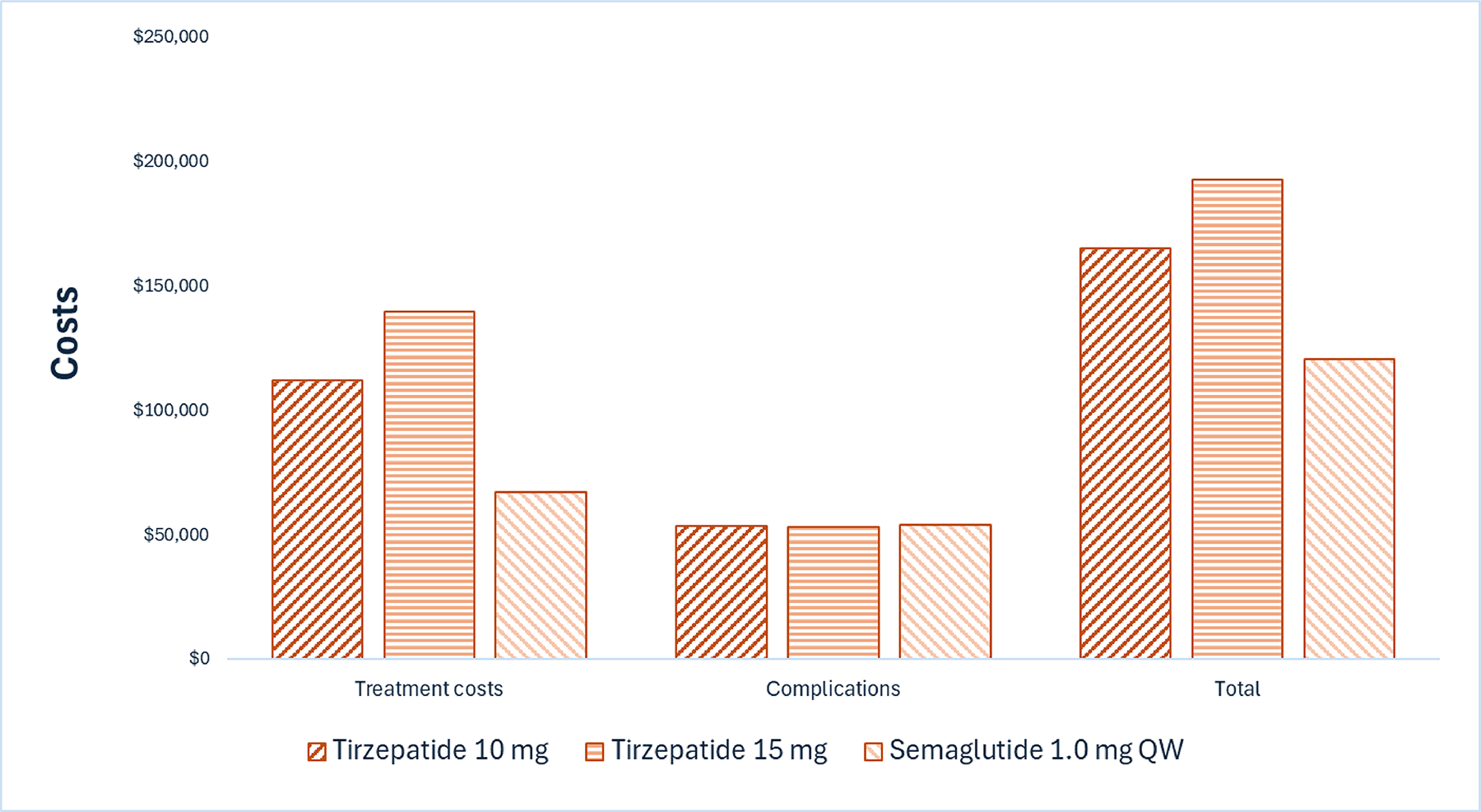
QW = every week; vs. = versus.
Note: For disaggregated complication costs, refer to Appendix 11 in the Supplemental Material document.
Impact on Health
Relative to semaglutide 1 mg, tirzepatide 10 mg and tirzepatide 15 mg are predicted to result in 0.01 and 0.02 additional life-years per patient, respectively. When considering quality and duration of life, tirzepatide 10 mg and 15 mg are associated with 0.10 and 0.13 additional QALYs per patient, respectively (refer to Appendix 11 in the Supplemental Material document). Additionally, tirzepatide 10 mg and 15 mg are generally predicted to result in fewer cumulative micro- and macrovascular complications (incremental differences ranging from 0.03% to 0.11%) compared to semaglutide 1 mg (refer to Figure 2).
Figure 2: Cumulative Complications From the CDA-AMC Base Case
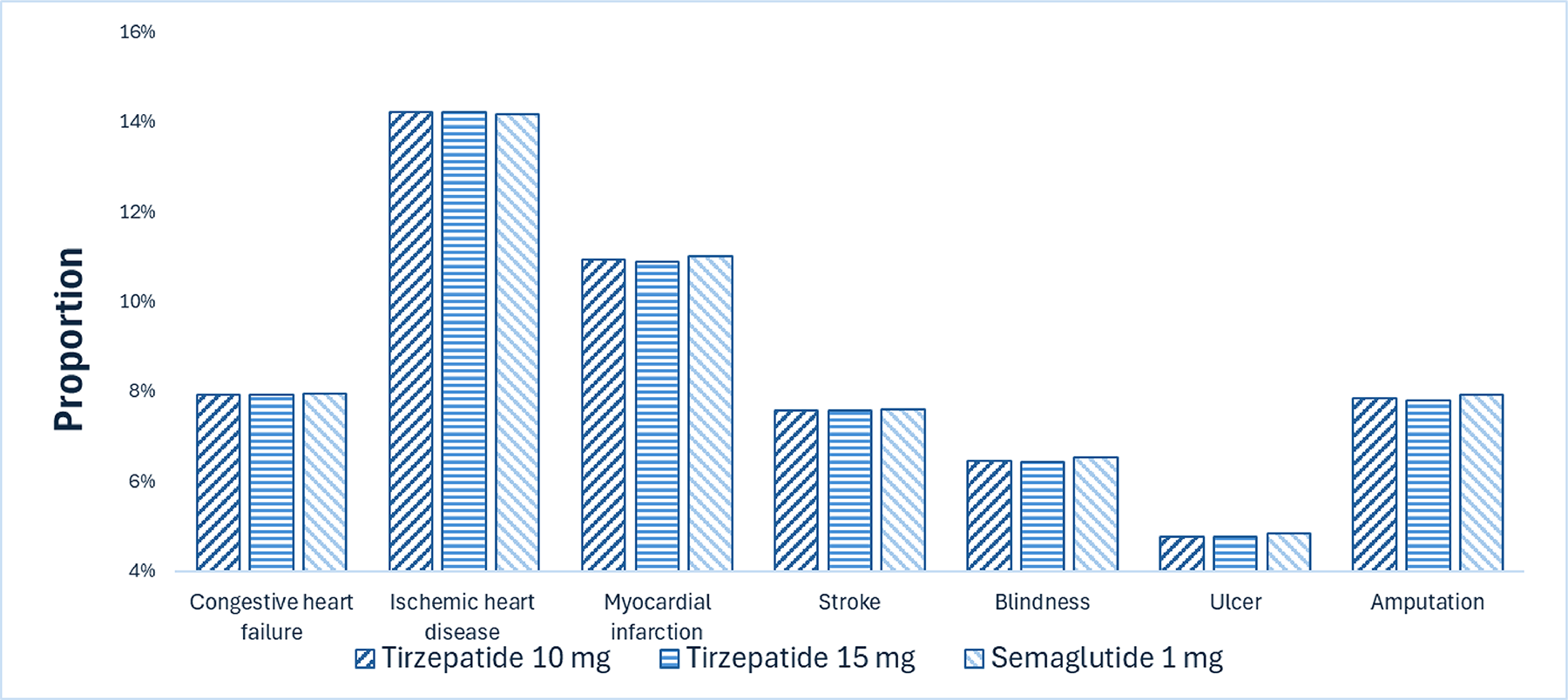
CDA-AMC = Canada’s Drug Agency; vs. = versus.
Overall Results
The results of the CDA-AMC base case suggest ICERs of $453,118 and $548,277 per QALY gained for tirzepatide 10 mg and tirzepatide 15 mg, respectively, compared to semaglutide 1 mg (refer to Table 10). Additional details on the CDA-AMC base case are available in Appendix 11 in the Supplemental Material document.
Table 10: Summary of CDA-AMC Economic Evaluation Results
Drug | Total costs ($) | Total QALYs | ICER vs. semaglutide 1 mg ($/QALY) |
|---|---|---|---|
Tirzepatide 10 mg | |||
Semaglutide 1 mg | 120,619 | 10.51 | Reference |
Tirzepatide 10 mg | 165,163 | 10.60 | 453,118 |
Tirzepatide 15 mg | |||
Semaglutide 1 mg | 120,619 | 10.51 | Reference |
Tirzepatide 15 mg | 192,490 | 10.64 | 548,277 |
CDA-AMC = Canada’s Drug Agency; ICER = incremental cost-effectiveness ratio; QALY = quality-adjusted life-year; vs. = versus.
Note: Publicly available list prices were used for all comparators. Semaglutide 0.5 mg was dominated by semaglutide 1 mg and tirzepatide 10 mg.
Uncertainty and Sensitivity
The results of the CDA-AMC base-case analyses for tirzepatide 10 mg and 15 mg remain uncertain due to issues with the underlying clinical data, the submitted model structure and associated assumptions, and uncertainty in the evidence informing the effect of change in the BMI of patients on long-term health outcomes.
CDA-AMC used clinical efficacy inputs from the sponsor-submitted NMA for patients receiving 1 or 2 OADs for all 3 modelled subpopulations (i.e., the background therapies included in the reimbursement request). However, there is outstanding uncertainty in the efficacy data due to the grouping of patients receiving different background therapies in the economic evidence. Additionally, CDA-AMC was unable to resolve uncertainty related to dose escalation among patients receiving tirzepatide (e.g., patients initially receiving tirzepatide 10 mg may escalate to 12.5 mg or 15 mg in clinical practice if additional glycemic control is required). The effect of this treatment pathway on incremental costs, incremental benefits, and overall cost-effectiveness of tirzepatide could not be assessed and remains unknown.
A key area of uncertainty in estimating the cost-effectiveness of tirzepatide for the reimbursement-requested population relates to the impact of changes in the BMI of patients on HRQoL and the risk of long-term complications over the modelled time horizon. The evidence to support the estimation of potential benefits is highly uncertain. As such, CDA-AMC has explored this through a scenario analysis. Due to limitations in the model structure, weight loss is assumed to be sustained indefinitely.
In this scenario analysis, CDA-AMC included both BMI-related utility effects and BMI-dependent impacts on the risk of microvascular and macrovascular complications over the lifetime horizon. Under this scenario, tirzepatide 10 mg was associated with 0.19 incremental QALYs and $44,130 incremental costs compared with semaglutide 1 mg, resulting in an ICER of $227,781 per QALY gained. Tirzepatide 15 mg was associated with 0.27 incremental QALYs, $71,354 incremental costs, and an ICER of $265,002 per QALY gained. Tirzepatide 5 mg was associated with 0.04 incremental QALYs, $17,495 in incremental costs, and an ICER of $498,684 per QALY gained compared to semaglutide 1 mg. The magnitude of the incremental benefit in this scenario is driven by long-term extrapolation and by risk equations that attribute changes in complication incidence directly to changes in BMI. The evidence supporting these relationships in the reimbursement-requested population, particularly over a lifetime horizon, is limited.
Summary of the Budget Impact
The sponsor submitted a budget impact analysis to estimate the 3-year (2027 to 2029) budget impact of reimbursing tirzepatide for use in the reimbursement-requested population. The sponsor assumed that the payer would be CDA-AMC–participating public drug plans and derived the size of the eligible population using a claims-based approach. The price of tirzepatide was aligned with the price included in the sponsor’s economic evaluation, while the prices of comparators were based on the publicly available list prices. Additional information pertaining to the sponsor’s submission is provided in Appendix 12 in the Supplemental Material document.
CDA-AMC identified a number of issues with the sponsor’s estimated budget impact that could not be addressed. Although the sponsor estimated that the budget impact of reimbursing tirzepatide for use in the reimbursement-requested population will be approximately $820 million over the first 3 years (estimated expenditure = $1.97 billion), the impact of reimbursing tirzepatide is highly uncertain. The actual budget impact of reimbursing tirzepatide is highly uncertain because the sponsor’s use of a claims-based approach introduced uncertainty in the analysis, and there is uncertainty in the market uptake of tirzepatide, the distribution of tirzepatide doses expected in clinical practice, and the confidential prices paid by public drug plans for comparators.
Conclusion
Based on the CDA-AMC base case, tirzepatide 10 mg and 15 mg would be considered cost-effective at the submitted price if the public health care system was willing to pay at least $453,118 and $548,277, respectively, for each additional QALY gained. If the public health care system is not willing to pay that amount, a price reduction should be considered (refer to Figure 3; full details of the impact of price reductions on cost-effectiveness are presented in Appendix 11 in the Supplemental Material document). The estimated cost-effectiveness of tirzepatide compared to semaglutide is uncertain due to limitations in the indirect evidence informing comparative efficacy, uncertainty in the modelled treatment pathway related to treatment escalation, the use of the UK Prospective Diabetes Study Outcomes Model 2 risk equations, and poor practices that made thorough auditing of the submitted economic materials difficult.
Additionally, the CDA-AMC Clinical Review noted that, based on the sponsor-submitted ITC, the effects of tirzepatide 5 mg on change from baseline in hemoglobin A1C compared to semaglutide 1 mg are not statistically significant. Given the uncertainty in the comparative clinical evidence, there is no evidence to suggest that tirzepatide 5 mg provides greater hemoglobin A1C control than semaglutide 1 mg. If there are no differences in glycemic control between tirzepatide 5 mg and semaglutide 1 mg, then the cost of tirzepatide 5 mg should not exceed that of semaglutide 1 mg.
The budget impact of reimbursing tirzepatide to the public drug plans in the first 3 years is estimated to be approximately $820 million. The 3-year expenditure on tirzepatide (i.e., not accounting for current expenditure on comparators) is estimated to be $1.97 billion. The estimated budget impact is uncertain due to the claims-based approach and market uptake assumptions.
Figure 3: Summary of the CDA-AMC Economic Analysis and Price Reduction for Tirzepatide 10 mg

CDA-AMC = Canada’s Drug Agency; ICER = incremental cost-effectiveness ratio; QALY = quality-adjusted life-year.
Notes: Expenditure includes only the drug cost of tirzepatide. The term dominant indicates that a drug costs less and provides more QALYs than the comparator.
No ICER is included for the comparison of tirzepatide 5 mg to semaglutide 1 mg because the evidence was not sufficiently robust to inform the economic analysis.
References
1.American Diabetes Association Professional Practice C. 2. Classification and Diagnosis of Diabetes: Standards of Medical Care in Diabetes-2022. Diabetes Care. 2022;45(Suppl 1):S17-S38. doi:10.2337/dc22-S002
2.Diabetes Canada. Estimated Prevalence and Cost of Diabetes. Accessed January 2025. Available at: https://www.diabetes.ca/en-CA/research-(1)/advocacy-reports/national-and-provincial-backgrounders/diabetes-in-canada [sponsor provided reference].
3.Janssen I. The public health burden of obesity in Canada. Can J Diabetes. 2013;37(2):90-6. doi:10.1016/j.jcjd.2013.02.059 PubMed
4.Statistics Canada. Table 13-10-0394-01. Leading causes of death, total population, by age group. 2023 [sponsor provided reference].
5.Public Health Agency of Canada. Diabetes in Canada: fact and figures from the public health perspective. 2011. https://www.canada.ca/content/dam/phac-aspc/migration/phac-aspc/cd-mc/publications/diabetes-diabete/facts-figures-faits-chiffres-2011/pdf/facts-figures-faits-chiffres-eng.pdf. Accessed December 6, 2023 [sponsor provided reference].
6.Reed J, Bain S, Kanamarlapudi V. A Review of Current Trends with Type 2 Diabetes Epidemiology, Aetiology, Pathogenesis, Treatments and Future Perspectives. Diabetes Metab Syndr Obes. 2021;14:3567-3602. doi:10.2147/DMSO.S319895 PubMed
7.Diabetes Canada. Type 2 Symptoms. https://www.diabetes.ca/about-diabetes/type-2/symptoms. Accessed December 6, 2023 [sponsor provided reference].
8.Diabetes Canada Clinical Practice Guidelines Expert Committee. Diabetes Canada 2018 Clinical Practice Guidelines for the Prevention and Management of Diabetes in Canada. Can J Diabetes. 2018;42(1):S1-S325.
9.Diabetes Canada Clinical Practice Guidelines Expert Committee. Quick Reference Guide: 2025 Clinical Practice Guidellines. Diabetes Canada; 2025. Accessed Deb 8, 2025. https://guidelines.diabetes.ca/GuideLines/media/Docs/Quick%20Reference%20Guide/2024-CPG-Quick-Reference-Guide.pdf
10.Eli Lilly Canada Inc. Sponsor summary of clinical evidence (tirzepatide injection) [internal sponsor's report]. In: Drug Reimbursement Review sponsor submission: Mounjaro and Mounjaro KwikPen injection [internal sponsor's package]. September 2025.
11.Eli Lilly and Company. Clinical Study Report: I8F-MC-GPGL. A Phase 3, Randomized, Open-Label Trial Comparing Efficacy and Safety of Tirzepatide versus Semaglutide Once Weekly as Add-on Therapy to Metformin in Patients with Type 2 Diabetes [internal sponsor's report]. June 17, 2021.
12.Eli Lilly and Company. Clinical Study Report: I8F-MC-GPGH. A Randomized, Phase 3, Open-Label Trial Comparing the Effect of LY3298176 versus Titrated Insulin Degludec on Glycemic Control in Patients with Type 2 Diabetes[internal sponsor's report]. June 15, 2021.
13.Eli Lilly and Company. Clinical Study Report: I8F-MC-GPGM. Efficacy and Safety of LY3298176 Once Weekly versus Insulin Glargine in Patients with Type 2 Diabetes and Increased Cardiovascular Risk [internal sponsor's report]. August 4, 2021.
14.Eli Lilly and Company. Clinical Study Report: I8F-MC-GPGN. The Effect of Tirzepatide versus Dulaglutide on Major Adverse Cardiovascular Events in Participants with Type 2 Diabetes (SURPASS-CVOT) [internal sponsor's report]. October 9, 2025.
15.Gerstein HC, Colhoun HM, Dagenais GR, et al. Dulaglutide and cardiovascular outcomes in type 2 diabetes (REWIND): a double-blind, randomised placebo-controlled trial. The Lancet. 2019;394(10193):121-130. doi:10.1016/S0140-6736(19)31149-3 PubMed
16.Hwang IK, Shih WJ, De Cani JS. Group sequential designs using a family of type I error probability spending functions. Statistics in Medicine. 1990;9(12):1439-1445. doi:https://doi.org/10.1002/sim.4780091207 PubMed
17.Committee for Medicinal Products for Human Use. Guideline on clinical investigation of medicinal products in the treatment or prevention of diabetes mellitus. CPMP/EWP/1080/00 Rev.2. European Medicines Agency; 2023. Accessed January 19, 2026. https://www.ema.europa.eu/en/documents/scientific-guideline/guideline-clinical-investigation-medicinal-products-treatment-or-prevention-diabetes-mellitus-revision-2_en.pdf
18.U.S. Food and Drug Administration. Diabetes Mellitus: Efficacy Endpoints for Clinical Trials Investigating Antidiabetic Drugs and Biological Products Draft Guidance for Industry. 2023. https://www.fda.gov/media/168475/download
19.Turner RM, Jackson D, Wei Y, Thompson SG, Higgins JP. Predictive distributions for between-study heterogeneity and simple methods for their application in Bayesian meta-analysis. Stat Med. 2015;34(6):984-998. doi:10.1002/sim.6381PubMed
20.Rhodes KM, Turner RM, Higgins JP. Predictive distributions were developed for the extent of heterogeneity in meta-analyses of continuous outcome data. J Clin Epidemiol. 2015;68(1):52-60. doi:10.1016/j.jclinepi.2014.08.012PubMed
21.Diabetes Canada Clinical Practice Guidelines Expert Committee, Crowshoe L, Dannenbaum D, et al. Type 2 Diabetes and Indigenous People. Accessed February 6, 2026. https://www.diabetes.ca/health-care-providers/clinical-practice-guidelines/chapter-38#panel-tab_FullText
22.Diabetes Canada Clinical Practice Guidelines Expert Working G, Shah BR, Bajaj HS, et al. Pharmacologic Glycemic Management of Type 2 Diabetes in Adults—2024 Update. Canadian Journal of Diabetes. 2024;48(7):415-424. doi:10.1016/j.jcjd.2024.08.002 PubMed
23.Keng MJ, Leal J, Mafham M, Bowman L, Armitage J, Mihaylova B. Performance of the UK Prospective Diabetes Study Outcomes Model 2 in a Contemporary UK Type 2 Diabetes Trial Cohort. Value Health. 2022;25(3):435-442. doi:https://doi.org/10.1016/j.jval.2021.09.005 PubMed
24.Laxy M, Schöning VM, Kurz C, et al. Performance of the UKPDS Outcomes Model 2 for Predicting Death and Cardiovascular Events in Patients with Type 2 Diabetes Mellitus from a German Population-Based Cohort. Pharmacoeconomics. 2019;37(12):1485-1494. doi:10.1007/s40273-019-00822-4 PubMed
25.Basu S, Sussman JB, Berkowitz SA, et al. Validation of Risk Equations for Complications of Type 2 Diabetes (RECODe) Using Individual Participant Data From Diverse Longitudinal Cohorts in the U.S. Diabetes Care. 2018;41(3):586-595. doi:10.2337/dc17-2002 PubMed
26.Pagano E, Konings SRA, Di Cuonzo D, et al. Prediction of mortality and major cardiovascular complications in type 2 diabetes: External validation of UK Prospective Diabetes Study outcomes model version 2 in two European observational cohorts. Diabetes, Obesity and Metabolism. 2021;23(5):1084-1091. doi:https://doi.org/10.1111/dom.14311 PubMed
ISSN: 2563-6596
Canada’s Drug Agency (CDA-AMC) is a pan-Canadian health organization. Created and funded by Canada’s federal, provincial, and territorial governments, we’re responsible for driving better coordination, alignment, and public value within Canada’s drug and health technology landscape. We provide Canada’s health system leaders with independent evidence and advice so they can make informed drug, health technology, and health system decisions, and we collaborate with national and international partners to enhance our collective impact.
Disclaimer: CDA-AMC has taken care to ensure that the information in this document was accurate, complete, and up to date when it was published, but does not make any guarantee to that effect. Your use of this information is subject to this disclaimer and the Terms of Use at cda-amc.ca.
The information in this document is made available for informational and educational purposes only and should not be used as a substitute for professional medical advice, the application of clinical judgment in respect of the care of a particular patient, or other professional judgments in any decision-making process. You assume full responsibility for the use of the information and rely on it at your own risk.
CDA-AMC does not endorse any information, drugs, therapies, treatments, products, processes, or services. The views and opinions of third parties published in this document do not necessarily reflect those of CDA-AMC. The copyright and other intellectual property rights in this document are owned by the Canadian Agency for Drugs and Technologies in Health (operating as CDA-AMC) and its licensors.
Questions or requests for information about this report can be directed to Requests@cda-amc.ca.