Drugs, Health Technologies, Health Systems
Reimbursement Review
Pegcetacoplan (Empaveli)
Sponsor: Swedish Orphan Biovitrum (Sobi) Canada, Inc.
Therapeutic area: C3 glomerulopathy or primary immune-complex membranoproliferative glomerulonephritis
Summary
What Is Complement 3 Glomerulopathy or Primary Immune-Complex Membranoproliferative Glomerulonephritis?
Complement 3 glomerulopathy (C3G) and primary immune-complex membranoproliferative glomerulonephritis (IC-MPGN) are rare, progressive kidney diseases caused by complement system dysregulation. This leads to progressive glomerular damage, proteinuria, hematuria, and kidney failure in approximately 50% of patients within 10 years; kidney failure requires dialysis or kidney transplant. Disease onset typically occurs in childhood or young adulthood, and the combined prevalence is estimated at approximately 3 per 100,000 in Canada. C3G and IC-MPGN are predicted to affect approximately 910 adults and adolescents by 2026.
What Are the Treatment Goals and Current Treatment Options for C3G and IC-MPGN?
The primary treatment goals for C3G and IC-MPGN are to preserve kidney function by reducing proteinuria and slowing the decline in estimated glomerular filtration rate (eGFR), prevent progression to end-stage kidney disease, and improve health-related quality of life. Additional goals include minimizing medication-related side effects, managing physical symptoms, and addressing emotional well-being. As a marker of disease control, a reduction in C3 deposition may be considered a meaningful marker of disease control if repeat biopsies are performed. Input from the patient group identified key outcomes, including improving quality of life, enhancing tolerability, reducing swelling and/or edema, lowering blood pressure, decreasing protein levels in the urine, reducing fatigue and weakness, and addressing affordability concerns. The clinician group noted that slowing disease progression is considered an important outcome, which is measured through reduction in proteinuria, stabilization of eGFR, diminution of C3 deposits on histology, and improvement in quality of life. Clinicians also highlighted reducing recurrences as an additional important outcome.
Current management for C3G and primary IC-MPGN primarily involves supportive care with angiotensin-converting enzyme inhibitors, angiotensin II receptor blockers, and SGLT2 inhibitors to reduce proteinuria and slow eGFR decline. Immunosuppressive therapies are used in severe cases but have inconsistent efficacy and significant adverse effects. None of the currently available treatments target the underlying complement dysregulation.
What Is Empaveli and Why Did Canada’s Drug Agency Conduct This Review?
Empaveli is a protein C3 inhibitor that is administered by subcutaneous infusion. At the time this review was conducted, Health Canada was reviewing Empaveli for the treatment of adults and adolescents aged 12 years or older with C3G or primary IC-MPGN.
Canada’s Drug Agency (CDA-AMC) reviewed Empaveli to inform a recommendation to the participating public drug plans on whether it should be reimbursed for the indication under review by Health Canada.
How Did CDA-AMC Evaluate Empaveli?
CDA-AMC reviewed the clinical evidence on the beneficial and harmful effects, as well as the economic evidence, of Empaveli versus other treatments used in Canada for C3G and primary IC-MPGN. Standard of care (SOC) treatment options, including off-label use of angiotensin-converting enzyme inhibitors, angiotensin II receptor blockers, SGLT2 inhibitors, mycophenolate mofetil, corticosteroids, and immunosuppressants, were considered relevant treatments to compare with Empaveli when reviewing the clinical evidence.
CDA-AMC identified equity and ethical considerations relevant to Empaveli and the treatment of adults and adolescents aged 12 years or older with C3G or primary IC-MPGN.
The review was informed by materials submitted by the sponsor, which included clinical and economic evidence.
The review was also informed by 1 patient group submission and 1 clinician group submission in response to the call for input by CDA-AMC, and by input from the participating public drug plans regarding issues that may impact their ability to implement a recommendation.
Three clinicians with expertise in the diagnosis and management of C3G and IC-MPGN were consulted as part of the review process.
What Were the Findings?
Clinical Evidence
CDA-AMC reviewed the following clinical evidence:
1 phase III, double-blind, placebo-controlled trial (VALIANT) comparing Empaveli with placebo in 124 adults and adolescents with C3G or primary IC-MPGN; patients in both groups received background supportive therapies
1 long-term extension study (VALE) in the ██ ████████ who completed the 52-week treatment period of the VALIANT trial
1 phase II randomized controlled trial (NOBLE) in 13 patients with post-transplant recurrence.
For the comparison of Empaveli versus placebo at week 26 based on the VALIANT study:
Empaveli results in a clinically meaningful reduction in proteinuria.
Empaveli likely results in a clinically important increase in the proportion of patients who meet the composite renal end point, which measures both kidney function and proteinuria, and in a clinically important reduction in eGFR decline.
Empaveli may result in a clinically important increase in the proportion of patients with decreases in C3c staining on kidney biopsy. The small sample size, wide 95% confidence interval, and risk of bias due to restricting the C3c staining to adult patients introduce uncertainty.
Empaveli may result in little to no clinically meaningful difference in health-related quality of life, which was measured using the Kidney Disease Quality of Life 36-item survey score. Risk of bias due to a substantial proportion of missing Kidney Disease Quality of Life 36-item survey data and the wide 95% confidence interval introduce uncertainty.
No notable safety concerns for Empaveli were identified during the study period. As the sample size was small and the event rates were relatively low, the findings were unlikely to adequately capture rare harms. In terms of adverse events of special interest, Empaveli may result in little to no difference in the incidence of infusion-site reactions. Empaveli may result in an increase in the incidence of hypersensitivity, the clinical importance of which is unclear. The evidence is very uncertain about the effect of Empaveli on the incidence of severe infection.
The open-label, noncomparative VALE extension study partially addressed an evidence gap from the VALIANT trial by providing data on the efficacy and safety of Empaveli beyond week 52. Based on the VALE long-term extension study:
Findings suggested potential sustained efficacy of Empaveli, with continued reductions in proteinuria and stabilization of kidney function as measured by eGFR. These findings are highly uncertain because of the small sample size, risk of selection bias, and missing data. Causal interpretations about the effect of Empaveli are not possible due to the single-arm design.
The safety profile of Empaveli was consistent with the previously reported data from the VALIANT trial. As of the data cut-off date, no new safety concerns for Empaveli were identified with the additional follow-up period.
The NOBLE trial addressed another evidence gap from the VALIANT trial by providing supportive evidence of potential efficacy of Empaveli in patients with post-transplant recurrence of C3G or primary IC-MPGN. Based on the NOBLE trial:
Findings complement those from the VALIANT and VALE studies, and are suggestive of the potential efficacy of Empaveli in the high-risk subgroup of patients with post-transplant recurrence. These findings are highly uncertain because of the risk of confounding for the 12‑week findings, a lack of comparator at longer follow-up, and very small sample size, which could only capture very common harms.
Economic Evidence
Empaveli is available as a 54 mg/mL solution in a 20 mL single-dose vial (total dose of 1,080 mg per vial) for subcutaneous infusion. At the submitted price of $4,970.00 per single-dose vial, the annual cost of Empaveli is expected to be $518,655 per patient, based on the Health Canada–recommended dosage.
Key clinical efficacy data (log-transformed ratio of urine protein-to-creatinine ratio at week 26 compared to baseline and eGFR decline) used to inform the economic model were derived from the VALIANT trial, which compared Empaveli plus SOC with SOC alone. Evidence submitted by the sponsor indicates that Empaveli results in a clinically important reduction in proteinuria at week 26 when compared with SOC alone and likely results in a clinically important reduction in eGFR decline at week 26 when compared with SOC alone among patients with C3G or primary IC-MPGN.
The results of the CDA-AMC base case suggest:
Empaveli plus SOC is predicted to be associated with higher costs to the health care system than SOC alone (incremental costs = $5,623,370), primarily driven by increased costs associated with drug acquisition.
Empaveli plus SOC is predicted to be associated with a gain of 1.22 life-years compared to SOC alone and may result in a gain of 2.60 quality-adjusted life‑years compared to SOC alone.
The incremental cost-effectiveness ratio of Empaveli plus SOC compared to SOC alone was $2,165,155 per quality-adjusted life-years gained in the CDA-AMC base case. The estimated cost-effectiveness ratio was highly sensitive to assumptions regarding long-term benefit of pegcetacoplan. In the absence of long-term clinical data or real-world evidence, 99% of the observed benefit associated with pegcetacoplan plus SOC was accrued after the trial period.
The cost-effectiveness of Empaveli plus SOC compared to SOC alone is driven by assumptions about the association between short-term improvements in urine protein-to-creatinine ratio and eGFR and long-term improvements in quality-adjusted survival. These assumptions are uncertain and not supported by robust evidence. While the increase in drug costs associated with Empaveli is clear, the magnitude of health benefit for patients remains extremely uncertain. Additional price reductions than those presented in this report may therefore be required to achieve cost-effectiveness at a given willingness-to-pay threshold.
CDA-AMC estimates that the budget impact of reimbursing Empaveli plus SOC for the treatment of adults and adolescents aged 12 years or older with C3G or primary IC-MPGN will be approximately $472,617,193 over the first 3 years of reimbursement compared to the amount currently spent on SOC alone, with an estimated expenditure of $473 million on Empaveli over this period. The actual budget impact of reimbursing Empaveli plus SOC will depend on the proportion of patients who are eligible for treatment and the market share of Empaveli. At the submitted price, the incremental budget impact of reimbursing Empaveli plus SOC is predicted to be greater than $40 million in year 1, year 2, and year 3 of reimbursement, and the economic feasibility of adoption must be addressed. Additionally, the magnitude of uncertainty in the budget impact must be addressed to ensure the feasibility of adoption, given the difference between the sponsor’s estimate and the CDA-AMC estimate.
Abbreviations
ACEi
angiotensin-converting enzyme inhibitor
AE
adverse event
ARB
angiotensin II receptor blocker
C3G
complement 3 glomerulopathy
CI
confidence interval
CKD
chronic kidney disease
eGFR
estimated glomerular filtration rate
ESKD
end-stage kidney disease
FMU
first-morning spot urine
GRADE
Grading of Recommendations Assessment, Development and Evaluation
HRQoL
health-related quality of life
ICE
intercurrent event
ICER
incremental cost-effectiveness ratio
IC-MPGN
immune-complex membranoproliferative glomerulonephritis
ITC
indirect treatment comparison
ITT
intention to treat
KDQOL-36
Kidney Disease Quality of Life 36-item survey
LS
least squares
LTE
long-term extension
MID
minimal important difference
MMF
mycophenolate mofetil
OLP
open-label period
OOM
orders of magnitude
QALY
quality-adjusted life-year
RCP
randomized controlled period
RCT
randomized controlled trial
SAE
serious adverse event
SC
subcutaneous
SD
standard deviation
SOC
standard of care
uPCR
urine protein-to-creatinine ratio
Background
Introduction
Context for the Review
The objectives of this report are as follows:
This report will review and critically appraise the evidence submitted by the sponsor on the beneficial and harmful effects of pegcetacoplan, 1,080 mg per 20 mL subcutaneous (SC) infusion, for the treatment of complement 3 glomerulopathy (C3G) or immune-complex membranoproliferative glomerulonephritis (IC-MPGN) in adults and adolescents aged 12 years or older. The focus will be placed on comparing pegcetacoplan to relevant comparators in clinical practice in Canada and identifying gaps in the current evidence, as outlined in Table 1.
This report will review and critically appraise the economic information submitted by the sponsor, including a cost-effectiveness analysis and a budget impact analysis. The focus of the economic review is aligned with the scope of the clinical review, unless otherwise stated. For most reviews, a CDA-AMC base case is developed, informed by clinical expert input, the available clinical evidence, and the best interpretation of the economic evidence based on the information provided by the sponsor.
The application was submitted by the sponsor before receiving a Notice of Compliance from Health Canada. This report reflects the anticipated indication and recommended dosage for pegcetacoplan during the initial CDA-AMC review period.
Table 1: Information on the Application Submitted for Review and on the CDA-AMC Review
Item | Description |
|---|---|
Information on the application submitted for review | |
Drug | Pegcetacoplan (Empaveli), 1,080 mg/20 mL (54 mg/mL) solution for subcutaneous infusion |
Sponsor | Sobi Canada, Inc. |
Health Canada indication | Proposed: For the treatment of adults and adolescents aged 12 years and older with C3G or primary IC-MPGN. |
Health Canada approval status | NOC |
Health Canada review pathway | Priority review |
NOC date | April 8, 2026 |
Mechanism of action | Pegcetacoplan is an inhibitor of the complement system that binds to complement protein C3 and its activation fragment C3b, thereby regulating the cleavage of C3 and the generation of downstream effectors of complement activation. |
Recommended dosage | Pegcetacoplan is administered twice weekly as a subcutaneous infusion on day 1 and day 4 of each treatment week. For adult patients, pegcetacoplan is administered twice weekly as a 1,080 mg subcutaneous infusion. For adolescent patients, the dosing regimen is based on the patient’s body weight.
|
Submission type | Initial |
Sponsor’s reimbursement request | Per indication |
Submitted price | $4,970.00 per vial |
Information on the CDA-AMC review | |
Review type | Complex |
Clinical review focusa | Population: as defined in the Health Canada indication Subgroups: adolescent vs. adult patients Intervention: per recommended dosage Comparators: standard of care treatment options, including off-label use of ACEi (e.g., enalapril), ARBs (e.g., losartan), SGLT2 inhibitors (e.g., dapagliflozin), MMF, corticosteroids (e.g., prednisone), and immunosuppressants (e.g., cyclophosphamide) Outcomes: proteinuria (log-transformed FMU uPCR), composite renal end point, immunofluorescence marker of disease activity (C3c staining on renal biopsy), kidney function (eGFR), HRQoL (KDQOL-36), and standard harms outcomes (AEs, SAEs, WDAEs, deaths, AESIs) |
ACEi = angiotensin-converting enzyme inhibitor; AE = adverse event; AESI = adverse event of special interest; ARB = angiotensin receptor blocker; C3G = complement 3 glomerulopathy; CDA-AMC = Canada’s Drug Agency; eGFR = estimated glomerular filtration rate; FMU = first-morning spot urine; IC-MPGN = immune-complex membranoproliferative glomerulonephritis; MMF = mycophenolate mofetil; HRQoL = health-related quality of life; KDQOL-36 = Kidney Disease Quality of Life 36-item survey; NOC = Notice of Compliance; SAE = serious adverse event; uPCR = urine protein-to-creatinine ratio; vs. = versus; WDAE = withdrawal due to adverse event.
aThe economic review aligns with the scope of the clinical review, unless otherwise stated.
Submission History for the Drug Under Review
CDA-AMC previously reviewed pegcetacoplan through the reimbursement review process for the treatment of adult patients with paroxysmal nocturnal hemoglobinuria who have an inadequate response to, or are intolerant of, a complement protein 5 inhibitor and issued a recommendation of “reimburse with clinical criteria and/or conditions.”1
Sources of Information
The contents of the Reimbursement Review report are informed by materials submitted by the sponsor, input received from interested parties (patient groups, clinician groups, and drug plans), and input from clinical experts consulted for this review.
Calls for patient group and clinician group input are issued for each reimbursement review. CDA-AMC received 1 patient group submission from The Kidney Foundation of Canada and 1 clinician group submission from The Canadian C3G and IC-MPGN Physician Network. Input from the patient group was collected in September and October 2025 by The Kidney Foundation of Canada via a self-administered online questionnaire available to individuals living with C3G or IC-MPGN and their caregivers. A total of 49 people responded to the survey, including 38 complete and 11 partial responses. Input from the clinician group was gathered from members’ clinical experiences and relevant scientific and medical literature. The full submissions received are available on the CDA-AMC project landing page in the consolidated Patient and Clinician Group Input document.
Input from patient and clinician groups is considered throughout the review, including in the selection of outcomes to include in the clinical review and in the interpretation of the clinical and economic evidence. Relevant patient and clinician group input is summarized in the Disease Background, Current Management, and Unmet Needs and Existing Challenges sections.
The drug plans provide input on each drug being reviewed through the reimbursement review process by identifying issues that may impact their ability to implement a recommendation. The implementation questions from the public drug plans and corresponding responses from the clinical experts consulted for this review are summarized in the Summary of Drug Program Input and Clinical Expert Responses table in Appendix 1 in the Supplemental Material document.
Each review team includes at least 1 clinical expert with expertise regarding the diagnosis and management of the condition for which the drug is indicated. Clinical experts are a critical part of the review team and are involved in all phases of the review process. Three clinicians with expertise in the diagnosis and management of C3G and IC-MPGN participated as part of the review team.
Disease Background
C3G and primary IC-MPGN are rare, progressive kidney diseases driven by dysregulation of the complement system. This dysregulation leads to excessive deposition of C3 activation products (i.e., C3 deposits) in the glomeruli, triggering inflammation.2-4 The accumulation of C3 deposits in the glomeruli causes structural damage and leakage into the urine of protein (proteinuria) and red blood cells (hematuria).5 Progressive glomerular inflammation ultimately leads to the development of chronic kidney disease (CKD). Continuous decline in kidney function culminates in kidney failure2 in approximately 50% of patients within 10 years, which requires dialysis or kidney transplant.6-8 However, kidney transplant does not address the underlying mechanism of disease, leading to high rates of recurrence and kidney allograft loss.9 A retrospective cohort study of adult patients who had a first kidney transplant in the US between 1996 and 2011 revealed that patients with C3G or primary IC-MPGN have a 76% greater relative hazard of mortality after transplant than patients with IgA nephropathy after a median follow-up of 5.5 years.9,10 Disease onset for most patients occurs in childhood or young adulthood, and both diseases share similar kidney and extrakidney manifestations.11
Based on the reported incidence rates and input from the clinical experts in Canada, the estimated combined prevalence rate of C3G and primary IC-MPGN in Canada is 3 per 100,000.12,13 By 2026, the number of adults and adolescents aged 12 years or older with C3G or primary IC-MPGN in Canada is projected to be approximately 910 according to the sponsor.14 None of the available inputs identified whether any equity-deserving groups experience a higher prevalence of C3G or IC-MPGN.
Patients typically present to their health care provider with symptoms of kidney dysfunction.6 Initial evaluation includes urinalysis for hematuria and proteinuria, quantification of proteinuria, and measurement of estimated glomerular filtration rate (eGFR) to assess the degree of kidney impairment.15,16 However, a definitive diagnosis requires a kidney biopsy with histopathology analysis through light microscopy and immunofluorescence staining2 and, ideally, electron microscopy, as the disease presentation often overlaps with other glomerular diseases. While kidney biopsy procedures are generally available across Canada, access may be more limited in remote regions, requiring referrals to larger centres.12,17 In addition, not all laboratories in Canada have access to C3c-specific staining, and some are only equipped to perform general C3 staining.18
Patient group input: Input from the patient group indicated that C3G and primary IC-MPGN have a negative impact on quality of life, largely due to fatigue, low energy, and lethargy, but also because of a range of additional physical symptoms. Patients described disruptions to their daily routines, social activities, and emotional well-being. Likewise, caregivers noted the emotional toll, stress, and additional time off work associated with managing daily treatments and symptoms. Patients also emphasized the financial burden stemming from out-of-pocket medical expenses and loss of employment. The resulting loss of income may further limit their ability to meet their medical needs and maintain their well-being.
Current Management
Treatment Goals
Patient group input: Input from the patient group identified the key treatment goals as follows: improvements in quality of life, management of physical symptoms (including swelling, weakness, and tiredness), preservation of kidney function, and enhancement of emotional and mental well-being.
Clinician input: The clinical experts indicated that the most important goals of treatment for C3G and IC-MPGN include reducing proteinuria, preserving kidney function by slowing eGFR decline, preventing progression to end-stage kidney disease (ESKD), and improving health-related quality of life (HRQoL). If repeat biopsies are performed, a reduction in C3 deposition is also considered a meaningful marker of disease control. Input from the clinician group also highlighted similar treatment goals. The clinical experts additionally noted other important goals, such as minimizing medication-related side effects and preventing extrakidney manifestations, including macular drusen, lipodystrophy, and fatigue.
Current Treatment Options
The clinical experts consulted by CDA-AMC agreed that both C3G and primary IC-MPGN share similar clinical features, progression patterns, and treatment responses despite some histological distinctions between the conditions. Therefore, C3G and IC-MPGN are managed using similar therapeutic approaches. The current management primarily involves supportive care, including the use of angiotensin-converting enzyme inhibitors (ACEi), angiotensin II receptor blockers (ARBs), and increasingly SGLT2 inhibitors, to help reduce proteinuria, and slow the decline in eGFR. However, these treatments do not address the underlying complement pathway dysregulation that drives disease progression. The clinical experts indicated that in Canada, the treatment of C3G and idiopathic IC-MPGN is largely guided by international expert consensus because of the absence of disease-specific therapies and randomized controlled trials (RCTs) that inform the use of these supportive care treatment options. The clinical experts also mentioned that immunosuppressive therapies such as glucocorticoids and mycophenolate mofetil (MMF) are used during disease flares or in severe cases, but their efficacy is inconsistent and associated with significant adverse events (AEs). Other rescue therapies, such as rituximab, cyclophosphamide, calcineurin inhibitors, eculizumab, and avacopan are being used off-label in Canada. These treatments are generally considered rescue options rather than relevant comparators because they have shown limited benefit and are associated with access barriers. The clinical experts noted that an ideal treatment would directly address the dysregulation of the alternative complement pathway, in addition to reducing progression to kidney failure and minimizing post-transplant recurrence.
Key characteristics of pegcetacoplan are summarized with other treatments available for C3G and IC-MPGN in the Key Characteristics table in Appendix 1 in the Supplemental Material document, available on the CDA-AMC project landing page.
Unmet Needs and Existing Challenges
Patient group input: Input from the patient group highlighted the need for treatments that preserve kidney function, are accessible, and offer convenient modes of administration. Patients also emphasized the importance of therapies that are affordable and minimize out-of-pocket expenses, are well-tolerated, and improve quality of life by reducing physical symptoms as well as the emotional and mental burden.
Clinician input: The clinical experts highlighted significant unmet needs in the treatment of C3G and IC-MPGN in Canada, particularly the need for therapies that are both effective and tolerable, and have meaningful impacts on long-term kidney function and overall patient well-being. Currently, there are no approved therapies in Canada that target the underlying pathophysiology of complement dysregulation and that have a meaningful impact on preventing progression to ESKD or recurrence post-transplant. As such, the clinical experts noted that in most patients, the disease does not respond adequately to these therapies and outcomes remain poor. These treatments are also associated with substantial toxicities. The clinical experts indicated that the harms profiles of current treatments pose significant challenges, including increased infection risk, weight gain, teratogenicity, gastrointestinal issues, and bone marrow suppression, as well as growth suppression and developmental concerns in pediatric patients. Broad immunosuppression was reported to have a substantial negative impact on patients’ quality of life. These toxicities are burdensome, especially for pediatric patients and those with advanced kidney disease. The high rate of disease recurrence post-transplant also limits the possibility of repeated kidney transplant, especially for younger patients. Thus, pediatric patients may experience disproportionate treatment-related harms.
The clinical experts noted that while standard supportive care therapies are generally available, their administration often requires guidance from specialized centres, particularly for pediatric patients. SGLT2 inhibitors are becoming more accessible, but their use remains limited in children because of insufficient pediatric-specific data. Advanced therapies such as eculizumab and avacopan are only available through compassionate access programs or private insurance, restricting broader patient access. These limitations, combined with geographic and systemic barriers to specialized care (e.g., a shortage of specialists who can diagnose and treat the disease), underscore the need for safer, more targeted, and widely accessible treatments.
Input from the clinician group was consistent with that of the clinical experts consulted for this review. The clinician group also highlighted that C3G and IC-MPGN are rare diseases associated with a poor prognosis, a high disease burden, as well as a high risk of recurrence among patients who have received a kidney transplant. Overall, the unmet needs within the current standard of care (SOC) include a lack of disease-specific, effective, and well-tolerated therapies that can meaningfully reduce the burden of the disease and improve quality of life.
Considerations for Using the Drug Under Review
Contents within this section have been informed by input from the clinical experts consulted for the purpose of this review and from clinician groups, as well as the reimbursement conditions proposed by the sponsor (refer to the Initiation, Renewal, Discontinuation, and Prescribing Conditions Proposed by the Sponsor table in Appendix 1 in the Supplemental Material document, available on the CDA-AMC project landing page). The implementation questions from the public drug plans and corresponding responses from the clinical experts consulted for this review are summarized in the Summary of Drug Program Input and Clinical Expert Responses table in Appendix 1 in the Supplemental Material document. The following information has been summarized by the review team.
Place in Therapy
The clinical experts anticipate that pegcetacoplan will represent a paradigm shift in the management of C3G and IC-MPGN. The clinical experts agreed that it should be considered a first-line therapy and potentially a new SOC, especially for patients who are considered to be at high risk of disease progression. The experts also indicated that while pegcetacoplan may be used as monotherapy, combination with immunosuppressants such as MMF or glucocorticoids could be considered in specific subgroups, such as those with autoantibodies or acute flares. Adjunctive use of ACEi, ARBs, and SGLT2 inhibitors is expected to continue for managing residual proteinuria.
The clinical experts considered that it would not be appropriate to require patients to try other treatments before initiating pegcetacoplan. They emphasized that use of existing therapies, such as MMF and glucocorticoids, is based on expert consensus rather than proven efficacy, and has not demonstrated consistent long-term benefits in altering disease progression. Given the progressive nature of C3G and IC-MPGN, the clinical experts highlighted that access to a drug such as pegcetacoplan may help improve patient outcomes. They recommended that treatment decisions be guided by individualized assessments of disease severity and risk, so that patients with high-risk disease may access pegcetacoplan without showing evidence that their disease did not respond to treatment or that they were intolerant of other treatments.
Input from the clinician group noted that pegcetacoplan offers a novel therapeutic option for proximal complement blockade in the treatment of C3G and IC-MPGN. Consistent with the insights offered by the clinical experts, the clinician group suggested that pegcetacoplan should be considered a first-line therapy. They noted that initial treatment with prednisone or MMF may not be necessary before initiating pegcetacoplan, although those drugs may be used concomitantly.
Patient Population
The clinical experts indicated that patients with C3G or IC-MPGN who are at high risk of disease progression are most in need of intervention and would be best suited for treatment with pegcetacoplan. High-risk features typically include proteinuria of 0.5 g to 1 g per day or more, rapid or progressive decline in eGFR, high-risk biopsy findings (such as severe inflammation), high-risk genetic or autoantibody profiles, and recurrence in kidney transplant recipients.
While clinical trials have typically enrolled patients with proteinuria exceeding 1 g per day, the clinical experts emphasized that patients with lower levels of proteinuria may also be at high risk of disease progression, particularly when additional risk factors are present. Early intervention, especially in children and adolescents with a confirmed diagnosis, may offer the greatest potential for preserving kidney function. Conversely, patients with advanced CKD, defined as an eGFR less than 15 mL/min per 1.73 m2, or minimal disease activity (e.g., proteinuria less than 0.15 g per day), would be considered less likely to benefit from pegcetacoplan. The clinical experts indicated that risk assessment is multifactorial and individualized, relying on clinical judgment supported by laboratory tests, kidney biopsy findings, and genetic or immunologic markers. The clinical experts did not identify specific companion diagnostics; however, they noted that diagnosis can be complex. Thus, involvement of a specialist in diagnosis and treatment management is important.
The sponsor’s proposed initiation criteria are adults and adolescents aged 12 years or older and weighing at least 30 kg, who have a confirmed diagnosis of C3G or primary IC-MPGN based on renal biopsy, and proteinuria of at least 0.5 g per day. According to the clinical experts, these criteria were appropriate, feasible for implementation, and aligned well with the target patient population and treatment goals in clinical practice. Kidney biopsy is essential for diagnosing C3G and IC-MPGN and is routinely performed in clinical practice, including in children aged younger than 12 years; therefore, this would not constitute a barrier to implementation. The clinical experts supported a flexible, clinician-driven approach to identifying patients who are considered to be at high risk, noting that rigid thresholds may exclude individuals who could benefit from early intervention.
Input from the clinician group was consistent with that of the clinical experts, including in terms of high-risk features and characteristics of patients who may not benefit from treatment with pegcetacoplan.
Assessing the Response to Treatment
The clinical experts agreed that treatment response in C3G and IC-MPGN is primarily assessed using objective measures such as a reduction in proteinuria, stabilization or improvement of eGFR, and, when feasible, clearance of C3 deposits on repeat biopsy. However, repeat biopsies and complement testing are less common in routine practice. The clinical experts indicated that a clinically meaningful response generally includes a 20% to 50% reduction in proteinuria over 6 to 12 months and slowing or stabilization of the eGFR decline, although thresholds and interpretation may vary among physicians.19,20 The clinical experts stated that response assessment typically occurs every 3 to 6 months, but meaningful changes often require at least 6 to 12 months.
Input from the clinician group was consistent with the treatment response measures suggested by the clinical experts, although the clinician group noted that formal remission criteria for C3G and IC-MPGN have not yet been established. Clinicians in this group noted that a 20% to 30% reduction in proteinuria within 6 months and even a mild eGFR increase from baseline, or a positive change in eGFR slope over 1 to 2 years, reflect clinically meaningful responses.
Discontinuing Treatment
The clinical experts stated that discontinuation of pegcetacoplan should be considered in cases of recurrent or serious adverse events (SAEs), allergy to the drug, progression to ESKD without an imminent plan for kidney transplant, or clear lack of meaningful response after an adequate treatment period (typically up to 12 months). The experts indicated that defining nonresponse is challenging and requires specialist judgment, often based on a lack of reduction in proteinuria, lack of stabilization of eGFR, or lack of improvement in complement biomarkers. Overall, the clinical experts stated that discontinuation decisions should balance clinical benefit against risks and feasibility of long-term therapy, recognizing that C3G and IC-MPGN are chronic and progressive conditions with potential relapse risk if treatment is stopped.
Input from the clinician group indicated that the optimal duration of pegcetacoplan therapy remains undetermined and that discontinuation may increase the risk of disease relapse. The clinician group agreed with the clinical experts on the definition of nonresponse. They also mentioned that treatment discontinuation decisions may be guided by patient preference and pregnancy planning.
Prescribing Considerations
The clinical experts agreed with the sponsor’s proposed prescribing conditions and indicated that these align well with clinical practice and are considered readily implementable without significant challenges. Pegcetacoplan should be prescribed and monitored by a nephrologist (adult or pediatric) or, if access is limited, by an internal medicine or pediatric specialist with experience in C3G and IC-MPGN, ideally within a shared-care model. The clinical experts expected pegcetacoplan to be equitably accessible across Canada. Regional shortages of nephrologists may necessitate consultation-based approaches to ensure timely care (i.e., disease and treatment management by specialists in general internal medicine or pediatricians in consultation with specialized nephrologists). Ongoing monitoring may also involve allied health professionals. The clinical experts emphasized that such a consultation model may help mitigate access barriers in regions lacking specialist nephrologists, when necessary.
The clinical experts stated that treatment is generally appropriate in outpatient or specialty clinic settings. According to the clinical experts, most patients can self-administer the SC infusion at home with appropriate training and support programs. For patients who are unable to self-administer (e.g., young children, individuals living with disabilities, or those with visual impairment), assistance may be provided through patient support programs, home nursing, or pharmacy services, rather than relying on private infusion clinics, which could otherwise pose a barrier for those without private insurance. Overall, the clinical experts indicated that these conditions align well with clinical practice and are considered readily implementable without significant challenges.
Input from the clinician group was consistent with that of the clinical experts.
Clinical Review
Methods
The CDA-AMC review considers the following evidence for inclusion: studies in the sponsor’s systematic review (pivotal studies and RCTs), sponsor-submitted long-term extension (LTE) studies, indirect treatment comparisons (ITCs), and studies addressing gaps in the evidence. Eligible studies in the sponsor-submitted systematic review included published and unpublished pivotal studies and phase III RCTs. Relevant patients and interventions were defined by the indication or reimbursement request and the recommended dosage in the product monograph. One subgroup comparison was considered potentially important for informing the reimbursement recommendation: adolescents versus adults. Relevant comparators were treatments used as the SOC in clinical practice in Canada for patients described in the indication under review. These included off-label use of ACEi, ARBs, SGLT2 inhibitors, MMF, corticosteroids, and cyclophosphamide. LTEs of included pivotal studies and RCTs were included in the systematic review, regardless of whether there was a comparison group. Studies addressing gaps submitted by the sponsor were included when they filled an identified gap in the systematic review evidence (e.g., longer follow-up time). No ITCs were included in the review.
The review team selected outcomes and follow-up times for review, considering the sponsor’s Summary of Clinical Evidence, input from the clinical experts, and input from the patient and clinician groups. Included outcomes are those considered relevant to expert committee deliberations, and they were selected in consultation with committee members. Evidence from the systematic review for the most important outcomes at week 26 was assessed using the Grading of Recommendations Assessment, Development and Evaluation (GRADE) approach. These outcomes address important treatment goals for C3G or IC-MPGN, are considered important to patients and clinicians according to patient group input and clinician input, and provide the source for a key input in the sponsor’s pharmacoeconomic model:
urine protein-to-creatinine ratio (uPCR)
composite renal end point
C3c staining
eGFR
HRQoL.
Methods for data extraction, risk of bias appraisal, and certainty of evidence assessment are in Appendix 2 in the Supplemental Material document.
Outcomes not assessed using GRADE but pertinent to the review and appearing in the report include at least 50% reduction from baseline in first-morning spot urine (FMU) uPCR, C3G histologic index score, annual rate of change from up to 3 years before screening in eGFR, and proportion of patients with proteinuria less than 1 g per day. Results for these outcomes were considered less critical to decision-making but were nevertheless included as supportive outcomes for contextual interpretation and/or pharmacoeconomic modelling. Detailed results of these outcomes can be found in Appendix 4 in the Supplemental Material document.
Clinical Evidence
In this report, the following sources of evidence submitted by the sponsor are reviewed and appraised:
1 phase III, double-blind, placebo-controlled RCT included in the systematic review (VALIANT)
1 LTE study (VALE)
1 phase II, randomized, open-label RCT addressing gaps in the evidence (NOBLE).
Systematic Review
Description of Studies
Study Characteristics
Characteristics of the VALIANT study are summarized in Table 2. Details pertaining to the study objectives, design, eligibility criteria, and relevant outcome measures are in Appendix 3 in the Supplemental Material document.
The VALIANT study was a phase III, double-blind, placebo-controlled RCT that evaluated the efficacy and safety of pegcetacoplan compared to placebo in adults and adolescents aged 12 years or older with C3G or IC-MPGN. Patients were randomized in a 1:1 ratio to receive either pegcetacoplan (n = 63) or placebo (n = 61). Randomization was conducted using a computer-generated permuted block design with a block size of 4 and stratified by baseline transplant status (post-transplant recurrence versus nontransplant) and baseline kidney biopsy status (with versus without). The VALIANT trial had 4 periods: a 10‑week screening period, a 26‑week randomized controlled period (RCP); a 26-week open-label period (OLP); and an 8‑week follow-up period for patients who were not eligible to roll over into the VALE study, which was the LTE study of the VALIANT study. Patients received pegcetacoplan or placebo according to their assigned groups during the RCP, and patients in both groups received pegcetacoplan in the OLP of the study for a total of 52 weeks of treatment. The planned length of participation in the study for each patient was a maximum of approximately 70 weeks. The study was conducted at 122 sites in 19 countries in North America (including 2 sites in Canada with 3 patients enrolled), South America, Europe, Asia, and Oceania (Australia).
Patients were required to be on SOC supportive treatments (e.g., ACEi, ARBs, and/or SGLT2 inhibitors) and immunosuppressive therapy (e.g., steroids, MMF, and/or other allowed immunosuppressants) as per inclusion criteria and remained on those treatments throughout the trial, provided they were on a stable, optimized regimen. Changes to these treatments throughout the study were intended to be minimized as much as possible. Rescue treatment (e.g., high dose corticosteroids and/or C5 inhibitors) could be considered for patients with an increase in serum creatinine to at least twice the baseline level. If the rescue therapy was a prohibited medication, patients discontinued the study drugs.
The main body of this report presents data from the RCP for VALIANT up to 26 weeks with a data cut-off date of June 20, 2024.
Table 2: Characteristics of the Study Included in the Systematic Review
Study name, design, and sample size | Key inclusion criteria | Key exclusion criteria | Intervention and comparator | Relevant end points |
|---|---|---|---|---|
The VALIANT study Multicentre, phase III, double-blind, placebo-controlled RCT Total N = 124 |
|
| Intervention: pegcetacoplan, up to 1,080 mg twice-weekly subcutaneous infusionsc Comparator: placebo, matching volumes twice-weekly subcutaneous infusions All patients received concomitant treatment consisting of a stable, supportive care regimen for C3G or IC-MPGN. |
|
ACEi = angiotensin-converting enzyme inhibitor; ARB = angiotensin receptor blocker; C3G = complement 3 glomerulopathy; eGFR = estimated glomerular filtration rate; FMU = first-morning spot urine; IC-MPGN = immune-complex membranoproliferative glomerulonephritis; KDQOL-36 = Kidney Disease Quality of Life 36-item survey; SC = subcutaneous; uPCR = urine protein-to-creatinine ratio.
aWhere approved, adolescents (aged 12 to 17 years) weighing at least 30 kg were eligible for enrolment.
bIn adults and adolescents with a baseline kidney biopsy collected during screening or a historic biopsy collected within 28 weeks before randomization, active disease was defined as at least 2+ C3 staining in kidney biopsy. In adolescents without a baseline kidney biopsy, active disease was defined as at least 1 of the following: sC5b-9 levels greater than the upper limit of normal during screening, serum C3 less than the lower limit of normal during screening, active urine sediment during screening, or the presence of C3 nephritic factor within 6 months of screening.
cAdults and adolescents who weighed at least 50 kg received 1,080 mg per 20 mL SC infusions. Adolescent patients who weighed at least 35 kg but less than 50 kg received a reduced infusion volume (648 mg per 12 mL for the first infusion and 810 mg per 15 mL for each infusion thereafter). Adolescent patients who weighed at least 30 kg but less than 35 kg received a further reduced infusion volume (540 mg per 10 mL for the first 2 infusions and 648 mg per 12 mL twice weekly thereafter).
dThe composite renal end point was defined as a stable or improved eGFR compared with the baseline visit (≤ 15% reduction in eGFR) and a ≥ 50% reduction in uPCR compared with the baseline visit.
eDecreased C3c staining was defined as a decrease of at least 2 orders of magnitude of intensity from baseline.
Sources: VALIANT 26-Week Clinical Study Report (2024).21 Details included in the table are from the sponsor’s Summary of Clinical Evidence.14
Statistical Testing and Analysis Populations
A sample size of 70 patients provided at least 90% power at a 1-sided alpha level of 0.025 under the following assumptions based on preliminary data from the NOBLE study: a 60% reduction in uPCR in the pegcetacoplan group compared to 20% in the placebo group, corresponding to mean log ratio to baseline of −0.92 versus −0.22, and a standard deviation (SD) of 0.88. To account for 10% attrition, the study planned to enrol 80 to 100 patients, including at least 78 participants with disease affecting their native kidneys; of these, 63 patients (80%) were expected to have C3G affecting their native kidneys.
The trial-wise type I error rate for the primary, key secondary, and additional secondary end points was controlled at a 0.05 significance level using a fixed-sequence testing procedure. The primary end point was tested at the 2-sided 0.05 level, and if the null hypothesis for the primary end point was rejected, the secondary end points were tested sequentially. Testing stopped once a null hypothesis was not rejected.
Efficacy analyses were performed primarily using the intention-to-treat (ITT) analysis set, which included all randomized patients grouped according to the treatment assigned at randomization. Safety analyses were performed on the safety set, which included all participants who received at least 1 dose of pegcetacoplan or placebo, grouped according to the actual treatment received.
Details pertaining to the multiple testing procedure are in Appendix 3 in the Supplemental Material document.
Patient Disposition
A total of 261 patients with C3G or IC-MPGN were screened; among them, 124 patients were eligible and randomized to receive pegcetacoplan (n = 63) or placebo (n = 61). During the RCP, similar proportions of patients discontinued treatment in the pegcetacoplan group and the placebo group: 2 patients (3.2%) in the pegcetacoplan group versus 4 patients (6.6%) in the placebo group. The most commonly reported reason for treatment discontinuation was AEs (2 patients [3.2%] versus 1 patient [1.6%]). Similar proportions of patients discontinued study participation during the RCP in the pegcetacoplan group and placebo group (2 patients [3.2%] versus 4 patients [6.6%]). Reasons for study discontinuation included investigator or medical monitor decision (1 patient [1.6%] versus no patients [0.0%]), death (1 patient [1.6%] versus no patients [0.0%]), lost to follow-up (no patients [0.0%] versus 1 patient [1.6%]), pregnancy (no patients [0.0%] versus 1 patient [1.6%]), and withdrawal of consent (no patients [0.0%] versus 2 patients [3.2%]).
During the RCP, the number of major protocol deviations was generally similar between the treatment groups and was most commonly related to informed consent documentation and missing or out-of-window urine collections. All participants had at least 6 of 9 urine measurements at baseline and week 26, which met the prespecified criterion for the primary analysis.
Details of patient disposition and major protocol deviations during the RCP of the VALIANT trial are summarized in Appendix 4 in the Supplemental Material document.
Baseline Characteristics
Detailed baseline characteristics for patients in the VALIANT trial are available in the Supplemental Material document. The median age of all study patients was 19.0 years, with a range of 12 to 74 years; 55 patients (44.4%) were adolescents aged 12 to 17 years. At baseline, 96 patients (77.4%) were diagnosed with C3G and 28 patients (22.6%) with IC-MPGN. Most patients had not received a kidney transplant (92.7%) and had received immunosuppressive treatment (72.7%). Baseline patient and disease characteristics were generally balanced between the groups, except for proteinuria and eGFR. Specifically, the mean 24-hour and triplicate FMU proteinuria levels were numerically higher in the pegcetacoplan group (24-hour: 3,954.73 mg/g; triplicate FMU: 3,116.15 mg/g) than in the placebo group (24-hour: 3,290.13 mg/g; triplicate FMU: 2,540.75 mg/g) and the mean eGFR was numerically lower in the pegcetacoplan group (78.50 mL/min per 1.73 m2) than in the placebo group (87.30 mL/min per 1.73 m2).
Table 3: Summary of Key Baseline Characteristics From VALIANT (ITT Analysis Set; Data Cut-Off: June 20, 2024)
Characteristic | Pegcetacoplan (N = 63) | Placebo (N = 61) |
|---|---|---|
Demographics | ||
Age at screening (years) | ||
Mean (SD) | 28.2 (17.1) | 23.6 (14.3) |
Median (range) | 19.0 (12 to 62) | 19.0 (12 to 74) |
Adolescents (aged 12 to 17 years), n (%) | 28 (44.4) | 27 (44.3) |
Adults (≥ 18 years), n (%) | 35 (55.6) | 34 (55.7) |
Disease characteristics | ||
Underlying disease based on screening biopsy, n (%) | ||
C3G | 51 (81.0) | 45 (73.8) |
C3GN | 45 (71.4) | 41 (67.2) |
DDD | 4 (6.3) | 4 (6.6) |
Undetermined | 2 (3.2) | 0 (0.0) |
Primary IC-MPGN | 12 (19.0) | 16 (26.2) |
Baseline 24-hour uPCR (mg/g), mean (SD) | 3,954.73 (2,887.6) | 3,290.13 (2,357.5) |
Baseline triplicate FMU uPCR (mg/ga), mean (SD) | 3,123.78 (2,408.3) | 2,540.75 (2,014.6) |
Baseline eGFR (mL/min per 1.73 m2), mean (SD) | 78.50 (34.1) | 87.30 (37.2) |
Transplant, n (%) | ||
Yes | 5 (7.9) | 4 (6.6) |
No | 58 (92.1) | 57 (93.4) |
Immunosuppressants, n (%) | ||
Yes | 48 (76.2) | 42 (68.9) |
No | 15 (23.8) | 19 (31.1) |
C3G = complement 3 glomerulopathy; C3GN = C3 glomerulonephritis; DDD = dense deposit disease; eGFR = estimated glomerular filtration rate; FMU = first-morning spot urine; IC-MPGN = immune-complex membranoproliferative glomerulonephritis; ITT = intention to treat; SD = standard deviation; uPCR = urine protein-to-creatinine ratio.
aBaseline uPCR reported was the average of up to 9 values collected.
Sources: VALIANT 26-Week Clinical Study Report (2024).21 Details included in the table are from the sponsor’s Summary of Clinical Evidence.14
Treatment Exposure and Concomitant Medications
During the RCP, the duration of treatment was similar between groups. The median duration of treatment was 180.0 days (range, 1.0 to 207.0 days) in the pegcetacoplan group and 180.0 days (range, 60.0 to 204.0 days) in the placebo group. Most patients adhered to the treatment regimens, with an overall adherence of 99.1%.
The proportion of patients who received concomitant medications during the RCP was similar between treatment groups (98.4% in the pegcetacoplan group versus 100.0% in the placebo group). The most frequently used concomitant medications included ACEi and/or ARBs, which were reported in similar proportions of patients between groups (90.5% in the pegcetacoplan group versus 91.8% in the placebo group), followed by immunosuppressants (74.6% versus 68.9%, respectively), and SGLT2 inhibitors (11.1% versus 9.8%, respectively), which were reported in slightly higher proportions of patients in the pegcetacoplan group than in the placebo group.
Details of patients’ treatment exposure, adherence, and concomitant medications during the RCP of the VALIANT trial are in Appendix 4 in the Supplemental Material document.
Critical Appraisal
Internal Validity
Overall, the VALIANT trial was well-designed with appropriate randomization methodology. Randomization was performed using an interactive response technology system, ensuring adequate allocation concealment. Stratification factors were prespecified and clinically relevant, including disease type (C3G versus IC-MPGN) and prior kidney transplant status (yes versus no), to enhance balance across these prognostic variables. Baseline demographic and disease characteristics were generally balanced between treatment groups, except for proteinuria and eGFR. The pegcetacoplan group reported higher proteinuria and lower eGFR at baseline. These imbalances may reflect sampling variability associated with the small sample size, which increases the risk that prognostic factors were not balanced between groups. The clinical experts consulted by the review team suggested that these particular imbalances could introduce bias against the treatment effect of pegcetacoplan. Indeed, a higher proportion of patients in the pegcetacoplan group had characteristics that were consistent with more severe disease at baseline, which may indicate that those patients are expected to have a worse prognosis. Additionally, the C3c staining outcome was assessed only in patients with available biopsy samples, which were obtained in adults but not in adolescents. Because age was not a stratification factor during randomization, restricting the analysis to adults may have compromised the balance between treatment groups and introduced a risk of bias.
The concomitant therapies used in the trial may affect internal validity. In the VALIANT trial, the concomitant use of SOC treatment options was permitted, which can independently reduce proteinuria and potentially bias results. A slightly higher proportion of patients in the pegcetacoplan group received immunosuppressants (74.6% versus 68.9%) compared to placebo, creating an imbalance that could favour pegcetacoplan. While the clinical experts noted that these differences were minimal and likely reflect more severe disease at baseline in the pegcetacoplan group, they introduce some uncertainty regarding the true magnitude of the effect of pegcetacoplan. However, the risk of performance bias is likely low because the trial was adequately blinded during the RCP. Dosing was double-blinded, and participants, investigators, and study personnel remained blinded to treatment allocation until database lock. Therefore, differences in concomitant therapy use likely reflect baseline characteristics rather than deviations because of knowledge of treatment allocation.
The clinical experts considered the trial duration sufficient to detect a clinically meaningful difference in proteinuria. The sample size of the VALIANT trial was adequate for the primary analysis according to sample size assumptions stated in the statistical analysis plan. Subgroup analyses were performed to evaluate the consistency of treatment effects; the direction of effect was aligned across the adult and adolescent subgroups. Given the size of the trial, the subgroups were very small, and no conclusions can be drawn regarding effect modification.
In the VALIANT study, several strategies were applied to handle intercurrent events (ICEs). For continuous end points, patients who required rescue therapy had subsequent values imputed using copy-reference (i.e., observed placebo values), whereas patients who initiated kidney replacement therapy were imputed with the worst observed change across all participants. Although these assumptions cannot be verified, they may be considered reasonable given that the ICEs likely indicate that the treatment failed. The proportion of patients with ICEs was small, suggesting a limited impact of these assumptions on the results. Sporadic missing data for other reasons were imputed under a missing-at-random assumption (i.e., related to other observed values but not the outcome), which may not be plausible. Because the proportions of missing data for the primary end point and eGFR were small, it is unlikely that this assumption had an important impact on the results. Sensitivity analyses of the primary end point (all ICEs imputed as missing at random and tipping point) supported the robustness of the primary analysis. However, substantial missing data for the Kidney Disease Quality of Life 36-item survey (KDQOL-36) score, combined with an absence of sensitivity analyses, introduces a high risk of bias for these results.
For binary end points, all patients who needed rescue therapy or kidney replacement therapy, discontinued treatment, or had missing data were imputed as “nonresponders.” Nonresponder imputation may be appropriate when the ICE is compatible with the treatment failing (e.g., need for rescue therapy, kidney replacement therapy). However, treatment discontinuation and other missing data may not be compatible with the treatment failing in all cases. For analysis of the proportion of patients with a decrease in C3c staining, an increased proportion of patients imputed as having no response because of treatment discontinuation or missing data introduces a high risk of bias. There was some concern for risk of bias in the composite renal end point for the same reason.
The KDQOL-36 score is a kidney disease-specific measure of HRQoL and was used in the VALIANT trial; however, its validity and reliability have not been established in patients with C3G or IC-MPGN. This introduces some uncertainty regarding the validity of this outcome measure for this population. While differential measurement error across treatment groups is unlikely, the lack of validation data raises uncertainty about any potential bias in outcome measurement. In contrast, other outcomes in the trial (e.g., eGFR and uPCR) are standard objective measures for patients with C3G or IC-MPGN, and the use of triplicate FMU collections helps mitigate day-to-day variability, which is appropriate.
A higher proportion of patients in the placebo group had missed or incomplete infusions compared to the pegcetacoplan group. The reasons for missed or incomplete infusions were not clearly explained in the trial report, and the clinical experts could not identify a plausible explanation. Therefore, the potential impact of this imbalance remains uncertain. Overall, because most participants in the pegcetacoplan group received infusions as intended and missed and/or incomplete infusions were more frequent in the placebo group, this pattern is unlikely to introduce meaningful adherence-related bias or affect objective outcomes.
Multiplicity was adequately controlled across the primary and key secondary end points using a prespecified hierarchical testing procedure. However, the statistical hierarchy failed after the third key secondary end point (C3G histologic index activity score). As a result, no formal statistical testing was conducted for subsequent end points, including C3c staining, eGFR, and proteinuria less than 1 g per day, considering the increased risk of type I error (i.e., rejecting the null hypothesis when it is true). Therefore, findings for these end points should be interpreted as supportive evidence rather than confirmatory.
External Validity
Overall, the estimands, end points, and outcome measures in the VALIANT trial were appropriate and aligned with the protocol objectives. Several of these outcomes are commonly used in clinical practice; however, these were assessed as surrogate end points in the context of the trial. This represents an evidence gap that introduces uncertainty regarding the true clinical impact of treatment. However, the reliance on surrogate outcomes likely reflects feasibility constraints, as collecting data on outcomes such as progression to ESKD would require long-term follow-up and a substantially larger sample size, which is challenging because of the rarity of the condition.
For the primary end point of proteinuria reduction, the use of log-transformed uPCR helped normalize skewed data and minimize the influence of extreme values. The clinical experts noted that this approach is standard across clinical trials, but the values may not be readily interpretable for clinicians. The trial also reported geometric means for uPCR comparisons, offering a more clinically meaningful representation of treatment effect.
The VALIANT trial required patients to be on a stable regimen of supportive care (e.g., ACEi, ARBs, SGLT2 inhibitors, medications affecting proteinuria, and systemic corticosteroids ≤ 20 mg per day) for at least 12 weeks before randomization. The clinical experts indicated that this criterion does not reflect real-world practice, because prior or current use of these drugs should not determine eligibility for pegcetacoplan. In routine care, sequencing and combination of supportive therapies are individualized based on patient characteristics and clinician judgment.
According to clinical experts consulted by CDA-AMC, the eligibility criteria of the VALIANT trial were generally reflective of clinical practice for C3G and IC-MPGN but were more restrictive in some respects, which may limit external validity. For example, the trial excluded children aged younger than 12 years and patients with rapidly progressive disease who could not maintain a stable background regimen, although these groups receive treatment in real-world settings and may stand to benefit most from early intervention, according to the clinical experts. Additionally, patients with proteinuria between 0.5 g and 0.99 g per day were not studied, despite evidence from registries and observational studies indicating that this range is associated with a risk of progression.22-25 The requirement for an eGFR of at least 30 mL/min per 1.73 m2 also does not align with clinical practice, because the clinical experts emphasized that patients with more advanced disease may still benefit from treatment. The trial also enrolled a subgroup of patients with normal kidney function and proteinuria; this is important, because eGFR is a lagging marker of disease progression. The trial included only 9 patients in the kidney transplant subgroup, which limits the strength of evidence for this population. Furthermore, the C3c staining end point was not assessed in pediatric patients. While this is understandable, it is noteworthy if this histologic measure is considered important for evaluating treatment effect, because its absence reduces the completeness of evidence for this subgroup. In addition, baseline characteristics indicate that participants were predominantly white, with limited or no representation from American Indian or Alaskan Native, or Black or African American participants (categories as reported in study). Given the small overall sample size, there may be some limitations in the generalizability to diverse populations of patients with C3G or IC-MPGN. However, the CDA-AMC review team acknowledges that larger trials may not be feasible due to the rarity of these conditions.
The follow-up duration in the VALIANT study was sufficient to assess short-term response; however, patients are expected to remain on treatment for a longer period, and extended follow-up is needed to fully characterize long-term efficacy and safety.
Overall, while the VALIANT study provides important evidence for patient populations who are considered to be at high-risk, its restrictive criteria and limited diversity may limit generalizability to broader patient groups encountered in practice in Canada.
Results
The key efficacy and harms results from the RCP of the VALIANT trial and findings from the GRADE assessment are presented in this section. Detailed efficacy and harms results up to 52 weeks can be found in Appendix 4 in the Supplemental Material document.
Efficacy
Key results include the following:
The least squares (LS) mean change from baseline in log-transformed FMU uPCR at week 26 was −1.12 (95% confidence interval [CI], −1.38 to −0.85) in the pegcetacoplan group and 0.03 (95% CI, −0.09 to 0.15) in the placebo group. The between-group difference was −1.14 (95% CI, −1.48 to −0.85; P < 0.0001), corresponding to a relative reduction of 68.1% (95% CI, 57.3% to 76.2%) with pegcetacoplan compared to placebo.
Subgroup analyses of change from baseline in uPCR also favoured pegcetacoplan compared with placebo across all prespecified subgroups, including in the adolescent (relative reduction, 74.5%) and adult (relative reduction, 62.5%) populations.
A total of 31 patients (49.2%) in the pegcetacoplan group and 2 patients (3.3%) in the placebo group met the composite renal end point at week 26. The between-group difference was 45.6% (95% CI, 21.2 to 70.0; P < 0.0001) in favour of pegcetacoplan versus placebo.
The proportion of patients with stable or improved eGFR from baseline was 68.3% in the pegcetacoplan group and 59.0% in the placebo group.
The proportion of patients with at least a 50% reduction in uPCR compared to baseline was 60.3% in the pegcetacoplan group and 4.9% in the placebo group.
Among the patients who had baseline kidney biopsy (35 patients in the pegcetacoplan group and 34 patients in the placebo group), 26 patients (74.3%) in the pegcetacoplan group and 4 patients (11.8%) in the placebo group showed a decrease in C3c staining on kidney biopsy at week 26. The between-group difference was 64.3% (95% CI, 41.4% to 87.2%). This end point was not formally tested because of the earlier failure of the statistical hierarchy.
The LS mean change from baseline in eGFR at week 26 was –1.50 mL/min per 1.73 m2 (95% CI, –5.89 to 2.90) in the pegcetacoplan group and –7.81 mL/min per 1.73 m2 (95% CI, –11.57 to –4.05) in the placebo group; the between-group difference (LS mean difference) was 6.3 mL/min per 1.73 m2 (95% CI, 0.5 to 12.1) in favour of pegcetacoplan versus placebo. This end point was not formally tested because of the earlier failure of the statistical hierarchy.
The LS mean change from baseline in the KDQOL-36 summary score at week 26 was 0.86 points (95% CI, –2.32 to 4.04) in the pegcetacoplan group and –0.46 points (95% CI, –3.60 to 2.69) in the placebo group; the between-group difference (LS mean difference) was 1.3 points (95% CI, –3.18 to 5.81) in favour of pegcetacoplan versus placebo. This end point was not formally tested because of the earlier failure of the statistical hierarchy.
Results observed at week 52 for patients who received pegcetacoplan were similar to those observed in the pegcetacoplan group at week 26 for changes in log-transformed FMU uPCR, the proportion of patients meeting the composite renal end point, the proportion of patients with at least a 50% reduction in uPCR from baseline, and changes in eGFR. Details of the results at week 52 can be found in Appendix 4 in the Supplemental Material document.
Results for the following supportive outcomes are in Appendix 4 in the Supplemental Material document: at least a 50% reduction from baseline in FMU uPCR, C3G histologic index score, annual rate of change from up to 3 years before screening in eGFR, and the proportion of patients with proteinuria less than 1 g per day.
Harms
Key results include the following:
At least 1 AE was reported for 53 patients (84.1%) in the pegcetacoplan group and 57 patients (93.4%) in the placebo group. The most common AEs, reported in 20% or more of patients in either group, were infections and infestations (55.6% in the pegcetacoplan group versus 44.3% in the placebo group), general disorders and administration site conditions (46.0% versus 47.5%), gastrointestinal disorders (30.2% versus 27.9%), and nervous system disorders (15.9% versus 21.3%).
At least 1 SAE was reported for 6 patients (9.5%) in the pegcetacoplan group and 6 patients (9.7%) in the placebo group. The most common (3% or more) SAEs in both groups were infections and infestations (4.8% in the pegcetacoplan group versus 1.6% in the placebo group) and kidney and urinary disorders (3.2% versus 6.6%), including acute kidney injury (1.6% versus 3.3%).
A total of 2 patients (3.2%) in the pegcetacoplan group and 2 patients (3.3%) in the placebo group reported an AE that led to study drug discontinuation.
Overall, 1 patient (1.6%) in the pegcetacoplan group and no patients in the placebo group had a fatal AE during the RCP. The cause of death was respiratory failure because of COVID-19 pneumonia.
The clinical experts consulted by CDA-AMC and/or the sponsor identified the following AEs of special interest for treatment with pegcetacoplan:
infusion-site reactions: 28.6% versus 27.9% for pegcetacoplan versus placebo; the between-group difference was 0.7% (95% CI, –15.1% to 16.5%)
severe infection: 3.2% versus 0.0%; the between-group difference was 3.2% (95% CI, –1.2% to 7.5%)
hypersensitivity: 12.7% versus 8.2%; the between-group difference was 4.5% (95% CI, –6.2% to 15.2%).
Details of the results can be found in Appendix 4 in the Supplemental Material document.
Summary of Findings and Certainty of the Evidence
In the absence of literature-based minimal important difference (MID) estimates, thresholds suggested by the sponsor based on expert opinion were used for uPCR (threshold: relative reduction of 50%). Thresholds suggested by the clinical experts were used for the composite renal end point (threshold: 20%) and the KDQOL-36 summary score (threshold: 3 points). In the absence of a known threshold, the certainty in the presence of a nonnull effect was rated for eGFR and harms. For C3c staining, the clinical expert was unable to suggest a specific threshold for a clinically important effect; however, with their input, the review team judged whether the point estimates and relevant bounds of the CI represented clinically important effects. Details of the summary of outcome measures can be found in Appendix 3 in the Supplemental Material document.
Table 4: Summary of Findings for Pegcetacoplan vs. Placebo for Patients With C3G or IC-MPGN
Outcome and follow-up | Patients (studies), N | Relative effect (95% CI) | Absolute effects (95% CI) | Certainty | What happens | ||
|---|---|---|---|---|---|---|---|
Placebo | Pegcetacoplan | Difference | |||||
Proteinuria | |||||||
Ratio of FMU uPCR at week 26 compared to baseline | 124 (1 RCT) | Change from baseline to week 26 in log-transformed FMU uPCR Pegcetacoplan: −1.12 (−1.38 to −0.85) Placebo: 0.03 (−0.09 to 0.15) Difference: −1.14 (−1.48 to −0.85) Ratio of the geometric means comparing FMU uPCR at week 26 to baseline (relative change) Pegcetacoplan: 67.2% reduction (57.2% to 74.9%) Placebo: 2.9% increase (8.6% reduction to 15.9%) Relative difference: 68.1% reduction (57.3 to 76.2%) with pegcetacoplan vs. placebo | Higha | Pegcetacoplan results in a clinically important relative reduction in proteinuria at week 26 when compared with placebo. | |||
Composite renal end point | |||||||
Proportion of patients who meet the composite renal end point at week 26 | 124 (1 RCT) | OR = 27.48 (6.10 to 123.85) | 32 per 1,000 | 492 per 1,000 (NR) | 456 more per 1,000 (212 to 700 more per 1,000) | Moderateb (serious imprecision) | Pegcetacoplan likely results in a clinically important increase in the proportion of patients who meet the composite renal end point at week 26 when compared with placebo. |
C3c staining | |||||||
Proportion of patients with decreases in C3c staining on kidney biopsy from baseline to week 26 | 79 (1 RCT) | OR = 27.39 (6.48 to 115.85) | 118 per 1,000 | 743 per 1,000 (NR) | 643 more per 1,000 (414 to 872 more per 1,000) | Lowc (serious risk of bias and imprecision) | Pegcetacoplan may result in a clinically important increase in the proportion of patients with decreases in C3c staining on kidney biopsy at week 26 when compared with placebo. |
Change from baseline to week 26 in eGFR (mL/min per 1.73 m2) | 124 (1 RCT) | NA | –7.81 | –1.50 (–5.89 to 2.90) | 6.31 (0.50 to 12.12) | Moderated (serious imprecision) | Pegcetacoplan likely results in a clinically important reduction in the decline in eGFR at week 26 when compared with placebo. |
Health-related quality of life | |||||||
Change from baseline to week 26 in the KDQOL‑36 summary score (points; 0 [worst] to 100 [best]) Follow-up: 26 weeks | 124 (1 RCT) | NA | –0.46 | 0.86 (–2.32 to 4.04) | 1.32 (–3.18 to 5.81) | Lowe (serious risk of bias and imprecision) | Pegcetacoplan may result in little to no clinically important difference in KDQOL-36 summary score at week 26 when compared with placebo. |
Harms | |||||||
Incidence of infusion-site reactions Follow-up: 26 weeks | 124 (1 RCT) | RR = 1.03 (0.6 to 1.8) | 279 per 1,000 | 286 per 1,000 (NR) | 7 more per 1,000 (151 less to 165 more per 1,000)f | Lowg (very serious imprecision) | Pegcetacoplan may result in little to no difference in the incidence of infusion-site reactions at week 26 when compared with placebo. The clinical importance of the increase is unclear. |
Incidence of severe infection Follow-up: 26 weeks | 124 (1 RCT) | NE | 0 | 32 per 1,000 | 32 more (12 less to 75 more per 1,000)f | Very lowg (Extremely serious imprecision) | The evidence is very uncertain about the effect of pegcetacoplan on the incidence of severe infection at week 26 when compared with placebo. |
Incidence of hypersensitivity Follow-up: 26 weeks | 124 (1 RCT) | RR = 1.55 (0.5 to 4.5) | 82 per 1,000 | 127 per 1,000 | 45 more per 1,000 (62 less to 152 more per 1,000)f | Lowg (very serious imprecision) | Pegcetacoplan may result in an increase in the incidence of hypersensitivity at week 26 when compared with placebo. The clinical importance of the increase is unclear. |
C3G = complement 3 glomerulopathy; CDA-AMC = Canada’s Drug Agency; CI = confidence interval; eGFR = estimated glomerular filtration rate; FMU = first-morning spot urine; GRADE = Grading of Recommendations Assessment, Development and Evaluation; ICE = intercurrent event; IC-MPGN = immune-complex membranoproliferative glomerulonephritis; KDQOL-36 = Kidney Disease Quality of Life 36-item survey; MID = minimal important difference; NA = not applicable; NE = not estimable; NR = not reported; OR = odds ratio; RCT = randomized controlled trial; RR = risk ratio; uPCR = urine protein-to-creatinine ratio; vs. = versus.
Note: Study limitations (which refer to internal validity or risk of bias), inconsistency across studies, indirectness, imprecision of effects, and publication bias were considered when assessing the certainty of the evidence. All serious concerns in these domains that led to the rating down of the level of certainty are documented in the table footnotes.
aThere is no established between-group MID for log-transformed FMU uPCR or geometric mean ratio, and the clinical experts consulted by CDA-AMC could not suggest a threshold of importance. According to the sponsor, based on Canadian and European clinician opinion, the MID for proteinuria is greater than or equal to a 50% reduction over a 6-month period. The point estimate and 95% CI for relative reduction with pegcetacoplan compared to placebo suggested a clinically important difference.
bRated down 1 level for serious imprecision. There is no established between-group MID for the proportion of patients who meet the composite renal end point at week 26. The clinical experts suggested that a 20% difference between groups could be considered clinically meaningful. The point estimates and the 95% CIs for the difference between groups suggested a difference exceeding this threshold, supporting the conclusion that the observed treatment effects are clinically important. However, given the small sample size (N = 124), the effect estimate is likely unstable, and even a minor shift (e.g., moving a few events between groups) could result in the CI crossing the threshold.
cRated down 1 level for serious risk of bias and 1 level for serious imprecision. There is no established between-group MID for the proportion of patients with decreases in C3c staining on kidney biopsy from baseline to week 26, and the clinical experts consulted by CDA-AMC could not suggest a threshold of importance. Although no formal threshold exists, experts agreed that even the lower bound of the 95% CI for the between-group difference (41.4%) would be considered clinically meaningful, supporting the conclusion that the observed treatment effects are clinically important. However, the sample size for this end point (N = 79) was less than the total trial size and although the effect appears large, the estimate is likely unstable. Therefore, imprecision was rated down by 1 level due to the limited sample size. The C3c staining outcome was assessed only in patients with available biopsy samples, which were obtained in adults but not in adolescents. As age was not a stratification factor during randomization, restricting this analysis to adults may compromise the balance between treatment groups and introduce a risk of bias. Additionally, there was a risk of bias due to missing outcome data.
dRated down 1 level for serious imprecision. There is no established between-group MID for the change from baseline in eGFR at week 26. The clinical experts consulted by CDA-AMC could not suggest a threshold of importance but considered the between-group difference clinically important. However, given the small sample size (N = 124), the effect estimate is likely unstable.
eRated down 1 level for serious risk of bias and 1 level for serious imprecision. A substantial proportion of KDQOL-36 data were missing for reasons unrelated to ICEs (30.2% in the pegcetacoplan group vs. 23.0% in the placebo group). This missingness was greater in the pegcetacoplan group, and no sensitivity analyses were conducted, introducing a serious risk of attrition bias with an uncertain direction of bias. There is no established between-group MID for the change from baseline to week 26 in KDQOL-36 summary score, but the clinical experts suggested that a 3-point difference between groups could be considered clinically meaningful. Certainty was rated down 1 level given that the point estimate and upper bound of the 95% CI for the difference between groups included both clinically important benefit and no difference based on a 3-point threshold, and the lower bound of the 95% CI (−3.18) was barely crossing the 3-point threshold.
fThis analysis was not part of the statistical analysis plan and was requested from the sponsor by CDA-AMC to facilitate the GRADE assessment.
gRated down 2 levels for very serious imprecision. There is no established between-group MID for the incidence of infusion-site reactions, severe infection, or hypersensitivity. The clinical experts consulted by CDA-AMC could not suggest a threshold of importance. The certainty of evidence assessment focused on whether there was any effect relative to the null. The 95% CI for the difference between groups included benefit, harm, and no difference. For severe infection, given that only 2 events were reported in the pegcetacoplan group, the harm may be rare, and the sample size was insufficient to reliably estimate the risk. Due to this extremely sparse data, imprecision was rated down 3 levels. The evidence available to support a definitive conclusion is very limited for severe infection.
Sources: The VALIANT study 26-week Clinical Study Report (2024),21 Fakhouri et al. (2025),26 and sponsor provided additional data (November 20, 2025).27 Details included in the table are from the sponsor’s Summary of Clinical Evidence.14
LTE Studies
Description of Studies
One LTE study, VALE (an ongoing, open-label, single-arm, multicentre study), was submitted to provide evidence regarding the long-term safety and efficacy of twice-weekly pegcetacoplan SC infusion in patients with C3G or primary IC-MPGN. Dosing followed the weight-based maintenance doses used during the VALIANT trial. The population included all patients who completed the 52-week treatment period (26-week RCP plus 26-week OLP) of the VALIANT study and who, in the opinion of the investigator, had experienced clinical benefit from pegcetacoplan administration. In addition, patients were required to remain on a stable regimen for C3G or primary IC-MPGN treatment according to the VALIANT study requirements. Patients are enrolled in this study for a minimum of 120 weeks (approximately 2.5 years), and evaluations are performed every 12 weeks. Patients may remain in the study after completion of 120 weeks and continue to receive treatment with pegcetacoplan until it is commercially available and accessible in their countries, or the development program for C3G and/or IC-MPGN is terminated. Changes to the baseline treatment regimens for C3G or primary IC-MPGN (including medications, dietary restrictions, and lifestyle modifications) were made only when required for the well-being of the participant (except for post-transplant immunosuppression). Rescue therapy was considered when serum creatinine increased to at least 2 times the baseline level and, in the opinion of the investigator, the increase was due to underlying C3G or primary IC-MPGN.
The primary end point of the VALE study was the log-transformed ratio of uPCR over time compared to pretreatment baseline. Key secondary end points included change from pretreatment in eGFR values over time, the proportion of patients with a reduction in uPCR of at least 50% from pretreatment values over time, and the proportion of patients with stable or improved eGFR values from pretreatment values over time. The safety outcomes that were evaluated included AEs, SAEs, and ███████ ███ ███████████████ ████████ █████ ██████ ██████████ █████████ █████████ ███ ██████ ██████████ █████ ████ ████ ████ ██████████.
The realigned baseline was defined differently depending on the patients’ treatment assignment in the VALIANT study. For patients who received pegcetacoplan during the VALIANT RCP, the baseline was defined as the baseline value used in the VALIANT study. For patients who received placebo during the VALIANT RCP, the baseline was defined as the last assessment before enrolling in the OLP of the VALIANT study.
The results presented in this interim analysis reflect the data available as of June 20, 2024.
Patient Disposition
Patient disposition for the included study is summarized in Appendix 5 in the Supplemental Material document.
Of the 124 patients enrolled in the VALIANT study, 114 patients (91.9%) completed the study treatment. Among these, ██ ███████ patients subsequently enrolled in the VALE study; ██ ████████ were originally randomized to receive pegcetacoplan during the VALIANT study, whereas ████ were randomized to receive placebo and later transitioned to pegcetacoplan after 26 weeks. As of the clinical data cut-off date of June 20, 2024, ██████ ████████ patients discontinued treatment in the VALE study; of these, █████ ████████ ██████ patients discontinued because of AEs and ███████ ██████ patients discontinued because of lack of efficacy. ███ ██████ ████████ patients withdrew from the study; specifically, ███ ███████ ████████ ███████ and the █████ ████████████ ███ ██ ████████████ ██ ███████ ███████ ████████.
Baseline Characteristics
███ ███ ███████ ██████████ ████████ ██ ███ ████ ██████ ███ ████ ████ ███ ███ ████ ██████ ██████ ██████ ███████ ██ ████████ ████████ ████ ██ █████ ██ ███ ██ ████████ ██ ███████ ████ ███████ ██ ███ ██ ██████ ███ ███ ██████ ███ ████ ████ ██ ██████ █████ ███ █ ██████ ██████████ ██ ███████ ███████ ████████ ██ █████ ████████ ███ ████████ ██ ████████ ████████ ███████ ████ █████ ███ ████ ███ ████████ ██ ██████ ████████ ████ ████████ ███████ ████ █████████ ████ ████ ████ ███████ ███████ █████ ██ █████████ ███████ ███ ██████████ ██ ████████ ████ ███ ███ █████ ██ ███ ██████████████████████████████ █████ ███ █████ ██ ███ ████████████████████████ ██████ ███ ██████████ ██ ████████ ████ ███████ ███ █████ ██ ███ ████████████████████████ █████ ███ █████ ██ ███ ██████████████████████████████ ██████.
Exposure to Study Treatments
███████ ██ █████████ █████████ █████████ ███ ███ ██ ███████████ ███████████ ██ ███ ████ █████ ███ ██ ███ ████████████ ████████ █████████ ████████ ██.
███ ████████ ██ ███ ███ ██████ ████████ ███ ████████ ██ █████ ███ █████████ ███ ███ ████ ████ ████████ ██ █████████ ███ █████ ███████ █████ ██ ████ ████████ ████ ███ ████ ████ █████████ ███ █████ ████████ █████████ ██ ████ ████ ███ ███ ████████ ███ █████ ██ ████████ ███ █████████ ██ ███████ ████ ███ ███ ████████ ███ ███ ██ █████████.
██████ ███ ███ ████████ ███████ ████ ███████████ ███████████ ██████ ███ ██████ ███ ████ ██████████ ██████ ████ ███████████ ███████████ ███ ██████ ██████ ██ ███ █████████████████ ██████ ████████ ████████ ████████ ██████████████████ ████████ ███ ██████████ ████████████ ████████.
Critical Appraisal
Internal Validity
The VALE study is open-label, which may influence the perception of improvement by patients and clinicians, particularly for outcomes that are subjective in measurement and interpretation (e.g., subjective AEs and KDQOL-36 scores). The measurement of objective end points would not be affected. The single-arm design does not support causal interpretations about the effect of pegcetacoplan. Enrolment was restricted to participants who completed the VALIANT study week 52 visit requirements and were deemed to have experienced clinical benefit from pegcetacoplan, based on the judgment of investigators. As a result, patients whose disease did not respond or who experienced adverse effects were systematically excluded, which decreased the sample size from the VALIANT study and introduced selection bias. Furthermore, there were substantial missing data, and as of the data cut-off date, only ████ patients had data available for the latest follow-up assessment at 88 weeks (36 weeks after joining the VALE study), limiting the reliability and interpretability of the long-term outcomes of interest. The small sample size resulted in wide CIs for the estimates of change from baseline. Additional limitations include the reliance on surrogate end points, such as uPCR, similar to the VALIANT study, and the use of descriptive analyses. The concomitant medications used during the study are consistent with medications used as supportive SOC and immunosuppressive therapy in clinical practice in Canada.
External Validity
Because the patients who took part in the open-label, LTE safety phase were originally from the VALIANT trial and the eligibility criteria remained the same, similar limitations to generalizability apply. Notably, the inclusion criteria for the VALE study were restricted to patients who completed the VALIANT study and experienced clinical benefit, as determined by the investigator. Thus, the included sample may not be representative of the broader population of patients with C3G or IC-MPGN. Likewise, as the sample size was limited, and only ████ patient was older than 65 years and 3 patients had a prior kidney transplant, the generalizability of findings may be further reduced. Additionally, the majority of patients included in the VALE study (█████ in the 314 patients in the ITT set) were white, potentially limiting the generalizability of findings to other racial or ethnic groups.
Results
Efficacy
Detailed results for outcomes relevant to this review are in Appendix 5 in the Supplemental Material document. Key efficacy results include the following:
|███ ████ ████ ██████ ██ ███████████████ ███ ████ ████ ███ █████████ ████████ ██ ████ ███ █████ ██████████ ██ █████████████ ██████████ ███ █████ ████████████████████████ ██████ ███ █████ ██████ ██ ████████████████████████ ██████ ████ ████████████ ██ █ ████████ █████ ████ ███ ████ ██ ██████ █████████ ██ ████████████████████████████████ █████ ███ █ █████ ████ ███ ████ ██ ██████ █████████ ██ ███ ████████████████████████ ██████.
|██ ████ █████████████ ███ ████ ████ ██████ ██ ███████████████ ███ ████ ████ ███ █████████ ████████ ██ ████ ███ █████ ██████████ ██ █████████████ ██████████ ███ █████ ██████ ██ ███ ██████████████████████████████ ██████ ████ ████████████ ██ █ ████████ █████ █████████ ████ ███ █████ █████████ ██ ████ █████████ ██ ██████████████████████ ██████ █████ ███ ██ ████ ████████ ███ ███ ████████████████████████ █████ ██.
|███ ████ ████ ██████ ██ ████ ████ ███ █████████ ████████ ██ ████ ███ ███ ██ █████████ █████ ██████████ ██ █████████████ ██████████ ███ ███ ███████████████████████████ ███ ██████████████████████████████ ██████ ███ ████ █████████████████ █████████████ ███ ████████████████████████ ██████.
|███ ████ ████ ██████ ██ ████ ████ ███ █████████ ████████ ██ ████ ███ █████ ██████████ ██ █████████████ ██████████ ███ ████ █████████████████ █████████████████ ██████ █████ ███ ██ ████ ████████ ███ ███ ████████████████████████ █████ ██ ████ ███.
|██████ ███████ ███ ███ ████ ██ █████ ████████ ██ ███ ██████████████████████████████ █████ ███ ██ █████ █ ███ █████████ ██ ███ ████ ██ ████ ███ █████ ██████████ ████████████ ██████████ ████ ███ █████████ █████████ ████ ███████ ███ ███ ████ ██ █████ ████████ ██ ███ ████████████████████████ █████ ███ ██ █████ █ ███ █████████ ██ ███ ████ ██ ████ ███ █████ ██████████ ██ █████████████ ██████████ ████ ███ █████████ ██.
|███████ ██ ██ ███████ ███ ███ ████ ██ █████ ████████ ██ ████████████████████████████ █████ ███ █ ██ █ ███████ ███ ███ ████ ██ █████ ██ ███ ████████████████████████ █████ ███ ██████ ██ ████████ ████ ██ ████ ███ █████ ██████████ ██ █████████████ ██████████.
|███ ████ ████ ██████ ██ █████ █████ ████ ███ █████████ ████████ ██ ████ ███ █████ ██████████ ██ █████████████ ██████████ ███ ████ ██████ ██ █████████████████████████ ██████ ███ ████ ████ ██ ███ ████████████████████████ ██████.
Harms
Detailed results for harms are presented in Appendix 5 in the Supplemental Material document. Key results include the following:
|█████ ███ ████████ ███ ████████ █ ████ ██ █████████████ ██ ███████ ███ ████ ████████.
|███ ██ ████████ ███████████ ██ █████ ███ █████████ ████████ ███████ ██████ ███ ████ ██████████ ████████ ██████ ████ ███████ ███ ████████████████ ████ █████████ ██ ███ ██ █████████.
|███ ██ ████████ ███████████ ██ █████ ███ ███████ █████████ ████████ ███████ ███████ ███ ████ ██████ ██████ ████ ██████████ ███ ████████████ ██ ███ ███ █████ ██████ ██████ ██ ██ ██ █████████.
|███ ████████ ████████████████ ██████████████████ ███████ ███████ ████ ███ █████████ ███ ████ ██████.
|██ ███████ ██████████ ████ ████████ ██████ ███ ████ █████ ██ ██ ███ ████ ██████ █████.
|██ ███ ████ ██████ ███ ███████ ███████ █████████ ███ ██ ███ █████ ██████ ████████.
|█████ ████ ██ ██████ ████ ████████ ██ ███ ████ █████ ██ ██ ███ ████████ ██████ █████.
|█████ ████ ██ ██████ ██████████ █████████ ███ █████ ████ ████████ ██ ███████████████ █████████.
Indirect Evidence
The sponsor did not submit ITCs. In Canada, the current SOC treatment for patients with C3G or IC-MPGN includes supportive therapies such as ACEi and ARBs, along with off-label use of immunosuppressants. Their use is largely guided by international expert consensus because of the absence of disease-specific therapies and RCTs evaluating the efficacy and safety of these supportive care treatment options. The VALIANT trial evaluated pegcetacoplan versus placebo in a population in which all but 1 patient were receiving background therapy with ACEi, ARBs, and off-label immunosuppressants as concomitant medications. Based on the current evidence and expert opinion, pegcetacoplan is considered a novel disease-modifying therapy; there are no other drugs approved in Canada for the treatment of C3G and IC-MPGN.
Studies Addressing Gaps in the Systematic Review Evidence
An identified evidence gap is the small sample size of patients who had received a kidney transplant and were receiving treatment with pegcetacoplan in the VALIANT trial and the VALE open-label extension study. In the VALIANT study, 9 patients who had received a kidney transplant were enrolled because of the rarity of C3G and primary IC-MPGN. One open-label, randomized, controlled, phase II study has been summarized to provide additional evidence regarding the efficacy and safety of pegcetacoplan in treating patients with post-transplant recurrence of C3G or primary IC-MPGN.
Table 5: Summary of Gaps in the Systematic Review Evidence
Study name | Evidence gap |
|---|---|
An open-label, randomized, controlled, phase II study to evaluate the safety and efficacy of pegcetacoplan in the treatment of post-transplant recurrence of C3G or IC-MPGN (NOBLE) | Nine patients who had a previous kidney transplant and received treatment with pegcetacoplan were included in the VALIANT trial and the VALE OLE study. The NOBLE study provides additional data about the efficacy and safety of pegcetacoplan in treating patients with post-transplant recurrence of C3G or primary IC-MPGN. |
C3G = complement 3 glomerulopathy; IC-MPGN = immune-complex membranoproliferative glomerulonephritis; OLE = open-label extension.
Source: Details included in the table are from the sponsor’s Summary of Clinical Evidence.14
Description of Studies
Characteristics of the included study are summarized in Table 6.
The NOBLE study was a prospective, phase II, multicentre, open-label RCT that evaluated the efficacy and safety of pegcetacoplan versus the SOC for primary, recurrent post-transplant C3G or IC-MPGN. The objective of the NOBLE study was to evaluate the efficacy and safety of pegcetacoplan on the underlying pathophysiology of C3G or primary IC-MPGN in patients with post-transplant disease recurrence up to 52 weeks of treatment.
Adult patients aged 18 years or older with biopsy-proven primary, recurrent post-transplant C3G or IC-MPGN with at least 2+ staining for C3c on kidney biopsy and an eGFR of at least 15 mL/min per 1.73 m2 were eligible for enrolment. In addition, patients had to have stable (but not improving) or worsening disease in the 2 months preceding the first dose of pegcetacoplan. Patients had to have been receiving a stable SOC regimen of medications relevant to their kidney disease for at least 4 weeks before the screening kidney allograft biopsy and from the time of the screening kidney allograft biopsy until randomization. Key exclusion criteria included previous treatment with pegcetacoplan, evidence of rejection on the screening kidney allograft biopsy that required treatment, and a history of meningococcal disease.
Patients were randomized in a 3:1 ratio to receive either 1,080 mg of twice-weekly SC pegcetacoplan with SOC or SOC medications relevant to their kidney disease alone for 12 weeks. During the subsequent 40-week noncontrolled period, all patients received 1,080 mg twice-weekly SC pegcetacoplan from weeks 13 through 52. Upon completion of the 40-week noncontrolled period, patients could enter an LTE study. Patients who did not enter the LTE study completed an 8-week follow-up period.
The primary end point was the proportion of patients with a reduction in kidney biopsy C3c staining (defined as a decrease of ≥ 2) at week 12 from baseline. Key secondary end points included the proportion of participants with a reduction in C3c staining on kidney biopsy after 52 weeks of treatment, the proportion of participants with stabilization or improvement in eGFR over time, the proportion of participants with stabilization or improvement in serum creatinine concentration over time, and changes from baseline biopsy in C3c staining over time.
Table 6: Characteristics of Studies Addressing Gaps in Systematic Review Evidence
Study name, design, and sample size | Patient population | Intervention and comparator | Relevant end points |
|---|---|---|---|
The NOBLE study Phase II, multicentre, open-label, RCT Total N = 13 |
| Patients were randomized 3:1 to receive either 1,080 mg twice-weekly SC pegcetacoplan with SOC or SOC alone for 12 weeks. During the subsequent 40-week noncontrolled period, all patients received 1,080 mg twice-weekly SC pegcetacoplan from weeks 13 through 52. |
|
C3G = complement 3 glomerulopathy; eGFR = estimated glomerular filtration rate; IC-MPGN = immune-complex membranoproliferative glomerulonephritis; RCT = randomized controlled trial; SC = subcutaneous; SOC = standard of care.
Sources: The NOBLE study week 12 and week 52 Clinical Study Reports.28,29 Details included in the table are from the sponsor’s Summary of Clinical Evidence.14
Patient Dispositions
A total of 25 patients were screened; 13 patients were enrolled and randomized at the beginning of the study (i.e., the ITT set). Ten participants were randomized to the pegcetacoplan plus SOC group and 3 participants were randomized to the SOC group. All patients completed the study up to week 12, and no patients discontinued treatment. At week 52, 10 of 13 patients (76.9%) completed treatment. Two patients (15.4%) had discontinued treatment and the study because of AEs, and 1 patient (7.7%) had discontinued because of the physician’s decision.
Baseline Characteristics
Baseline characteristics are summarized for all randomized patients. The mean age was 40.8 years (SD = 14.80 years), with most patients (92.3%) aged 65 years or younger. Six patients (46.2%) were female and 7 patients (53.8%) were male. Most patients were white (92.3%) and identified as not being Hispanic or Latino (84.6%).
Of the 13 participants overall, 10 participants (76.9%) had C3G based on screening biopsy (8 participants [80.0%] in the pegcetacoplan group and 2 participants [66.7%] in the SOC group). A total of 3 participants (23.1%) had IC-MPGN based on screening biopsy (2 participants [20.0%] in the pegcetacoplan group and 1 participant [33.3%] in the SOC group). The mean time since the last kidney transplant was 1.89 years (SD = 1.32 years) in the pegcetacoplan group and 5.48 years (SD = 0.52 years) in the SOC group. The majority of patients (69.2%) had 1 kidney transplant. The mean time since most recent post-transplant recurrence was 1.00 year (SD = 0.89 years) in the pegcetacoplan group, and 2.78 years (SD = 2.42 years) in the SOC group.
Exposure to Study Treatments
During the 12-week RCP, the median adherence to pegcetacoplan treatment was 100% (interquartile range, 96% to 100%). At week 52, 9 patients had completed the study with at least 80% adherence.
In the pegcetacoplan group, the mean total dose administered was 24,840.0 mg (SD = 2,694.0 mg), and the mean duration of treatment was 80.3 days (SD = 3.3 days) during the 12-week RCP. All patients (100%) in the pegcetacoplan group received at least 1 infusion, with 3 patients (30.0%) missing at least 1 infusion, 1 patient (10.0%) having 1 or more incomplete infusions, and 3 patients (30.0%) having at least 1 interrupted infusion. Information about the proportion of patients with missed infusions for the SOC group was not reported.
At week 52, all 13 participants (100%) received at least 1 infusion of pegcetacoplan. Overall, the mean total dose administered was 87,812.3 mg (SD = 26,275.3 mg) and the mean duration of treatment was 311.7 days (SD = 81.3 days) since the first dose of pegcetacoplan. Eight of 13 patients (61.5%) missed at least 1 infusion, 2 patients (15.4%) had 1 or more incomplete infusions, and 3 patients (23.1%) had at least 1 interrupted infusion.
Across both groups, 10 of 13 participants (76.9%) had at least 1 recorded concomitant medication.
Critical Appraisal
Internal Validity
With a total of 13 patients, prognostic balance between the pegcetacoplan plus SOC and SOC groups is unlikely, creating a high risk of bias because of confounding when comparing outcomes at 12 weeks. Results are presented descriptively without between-group differences and often without CIs, which limits credible interpretation. The very small sample size increases the likelihood of chance findings attributable to random variation rather than true treatment effects. The findings are also highly unstable, as the outcomes of a few patients could substantially alter the results. This is evidenced by wide CIs on the results for the primary end point, which include a large range of plausible values. The limited sample size means that only common harms are likely to be detected.
External Validity
The NOBLE study had a very small sample size. The study included adult patients only; 1 patient was older than 65 years. Additionally, most participants in the NOBLE study were white (92.3%). The limited representation of racialized groups in the NOBLE study may limit the generalizability of the findings to these groups. The included population is unlikely to be representative of the overall population of patients with post-transplant recurrence who would be eligible for treatment with pegcetacoplan.
Results
Detailed results for efficacy are presented in Appendix 7 in the Supplemental Material document. Key results include the following:
Efficacy
At week 12:
Five of 10 patients (50%; 95% CI not reported) who received pegcetacoplan and SOC and 0 of 3 patients (0%; 95% CI not reported) in the SOC group had at least a 50% reduction in proteinuria.
Five of 10 patients (50%; 95% CI, 18.7 to 81.3) who received pegcetacoplan and SOC showed a reduction in C3c staining of at least 2 orders of magnitude (OOM) of intensity versus 1 of 3 patients (33%; 95% CI, 0.8 to 90.6) in the SOC group.
Stabilization or improvement in eGFR was observed in 8 of 10 participants (80.0%; 95% CI not reported) in the pegcetacoplan and SOC group, and in all 3 participants (100%; 95% CI not reported) in the SOC group.
The change from baseline in eGFR among patients randomized to the pegcetacoplan and SOC group was 1.9 mL/min per 1.73m2 (21.74), and −6.0 mL/min per 1.73m2 (2.65) among patients in the SOC group.
At week 52:
Three of 13 patients (23.1%; 95% CI not reported) had at least a 50% reduction in proteinuria in the pegcetacoplan and SOC group. No patients had at least a 50% reduction in proteinuria in the SOC group.
Five of 10 patients (50%; 95% CI, 18.7 to 81.3) who received pegcetacoplan and SOC showed a reduction in C3c staining of at least 2 OOM of intensity. Two of 3 patients (66.7%; 95% CI, 9.4 to 99.2) in the SOC group showed a reduction in C3c staining of at least 2 OOM of intensity. Overall, 7 of 13 patients (53.8%; 95% CI, 25.1 to 80.8) showed a reduction in C3c staining of at least 2 OOM of intensity.
Seven of 10 patients (70%; 95% CI not reported) who received pegcetacoplan and SOC showed a stabilization or improvement in eGFR. Two of 3 patients (66.7%; 95% CI not reported) in the SOC group showed a stabilization or improvement in eGFR. Overall, stabilization or improvement in eGFR was observed in 9 of 13 participants (69.2%; 95% CI not reported).
The overall change from baseline in eGFR was 5.0 (30.01) mL/min per 1.73m2.
Harms
At week 12:
Seven patients (70%) in the pegcetacoplan and SOC group and 3 patients (100%) in the SOC group experienced treatment-emergent AEs.
The most commonly reported treatment-emergent AEs were infections and infestations in 4 of 13 patients (30.8%), kidney and urinary disorders in 4 of 13 patients (30.8%), blood and lymphatic system disorders in 3 of 13 patients (23.1%), and gastrointestinal disorders in 3 of 13 patients (23.1%).
Five patients (50%) in the pegcetacoplan and SOC group and no patients in the SOC group experienced serious treatment-emergent AEs.
Two patients (15.4%) in the pegcetacoplan and SOC group experienced infusion-related treatment-emergent AEs.
There were no deaths and no AEs leading to study or treatment discontinuation.
At week 52:
A total of 11 of 13 patients (84.6%) in the overall group in the noncontrolled portion of the study experienced treatment‑emergent AEs.
The most commonly reported treatment-emergent AEs were infections and infestations in 7 of 13 patients (53.8%), kidney and urinary disorders in 6 of 13 patients (46.2%), blood and lymphatic system disorders in 2 of 13 patients (15.4%), and gastrointestinal disorders in 3 of 13 patients (23.1%).
In the noncontrolled portion of the study, a total of 5 of 13 patients (38.5%) had serious treatment-emergent AEs.
During the 12-week controlled portion of the study, 2 patients (20.0%) reported infusion-related treatment-emergent AEs after the first dose of study drug in the pegcetacoplan group compared to none in the placebo group. During the subsequent uncontrolled portion of the study, 1 of 13 patients (7.7%) experienced infusion-related treatment-emergent AEs.
Two of 13 patients (15.4%) experienced rejection episodes, with none reported in the SOC group.
There were no treatment-emergent AEs leading to death.
No patients discontinued the study because of treatment-emergent AEs.
Discussion
Efficacy
The VALIANT trial evaluated the effects of pegcetacoplan on proteinuria (uPCR), the composite renal end point, the C3c staining marker of disease activity on kidney biopsy, kidney function (eGFR), and HRQoL, as measured by KDQOL-36. These efficacy outcomes aligned with patients’ expectations of important outcomes, which included slowing disease progression, preserving kidney function, and improving quality of life. However, the reported end points are surrogate end points or biomarkers that are indicative of disease progression rather than direct clinical outcomes, such as progression to ESKD. Although surrogate measures are commonly used in rare renal disease trials because it is not practical to enrol large cohorts and follow them for many years to capture hard clinical outcomes, reliance on these measures highlights an evidence gap regarding how patients feel, function, or survive.
Based on the results of the VALIANT trial, pegcetacoplan reduced log-transformed FMU uPCR compared with placebo. There is no established between-group MID for log-transformed FMU uPCR or the geometric mean ratio, and the clinical experts could not suggest a threshold of importance. According to the sponsor, based on input from clinicians in Canada and Europe, the MID for proteinuria is at least a 50% reduction over 6 months.12 The point estimate and 95% CI for the relative reduction with pegcetacoplan versus placebo indicated a meaningful difference, exceeding the 50% threshold and suggesting a clinically relevant benefit on this surrogate outcome. The observed effect for the primary end point appears large, but the relatively small sample size may introduce some uncertainty regarding the true magnitude of the effect, as small studies may yield unstable estimates and may also overestimate treatment effects because of chance.30 However, the CDA-AMC review team acknowledges the challenges of recruiting larger cohorts given the rarity of C3G and primary IC-MPGN. Overall, the findings suggest that pegcetacoplan results in a clinically important relative reduction in proteinuria at week 26 compared with placebo.
The CDA-AMC review team considered the subgroups of adults and adolescents to be of interest because they may inform decision-making. Subgroup analyses of the adolescent and adult subgroups indicated a similar direction of effect, suggesting that the treatment benefit may be maintained regardless of subgroup characteristics. Subgroups were very small, and findings may be viewed as supportive.
In the VALIANT study, findings for the key secondary end points were supportive of the primary end point of proteinuria reductions. Pegcetacoplan likely results in a clinically important increase in the proportion of patients who meet the composite renal end point at week 26 when compared with placebo. According to the clinical experts, the composite renal end point primarily served to support that the reduction in proteinuria was not accompanied by a decline in kidney function (i.e., eGFR), addressing the concern that some interventions (e.g., nonsteroidal anti-inflammatory drugs) can reduce proteinuria while harming kidney function. For change in eGFR at week 26, there is no established between-group MID for this outcome, and clinical experts could not identify a specific threshold, although they considered the observed difference to be clinically meaningful. Given the small sample size, the effect estimate was likely unstable. The trial also evaluated C3c staining on kidney biopsy in adult patients, which is an outcome considered highly impactful by the clinical experts because it demonstrates tissue-level improvement that is typically not observed over 6 months in the natural disease trajectory of C3G and primary IC-MPGN. The observed between-group difference was clinically meaningful according to the clinical experts consulted by the review team; the finding supported that pegcetacoplan may address the underlying pathology. However, this end point was assessed in a smaller subgroup (N = 79) with a large but potentially unstable effect estimate. This may introduce uncertainty, whereas restricting the analysis to adults with biopsy samples may introduce bias because of a lack of age stratification. Overall, compared with placebo, pegcetacoplan likely results in a clinically important increase in the proportion of patients who meet the composite renal end point and a clinically important reduction in the eGFR decline at week 26. Compared with placebo, pegcetacoplan may also result in a clinically important increase in the proportion of patients with decreases in C3c staining on kidney biopsy at week 26.
Findings from the VALIANT trial showed that pegcetacoplan may result in little to no clinically important difference in KDQOL-36 summary score at week 26 when compared with placebo, as the between-group difference was not clinically important. This was anticipated by the clinical experts because the enrolled patients, although considered to be at high risk, were in relatively early stages of kidney disease that are typically asymptomatic and primarily monitored through laboratory parameters. Although patients indicated that they desire improved HRQoL, the clinical experts considered the absence of deterioration in HRQoL to be reassuring, as the primary concern in this context is to avoid any negative impact on the quality of life of patients because of the treatment or disease progression. This consideration is particularly important when contrasted with treatments such as mycophenolate and glucocorticoids, which, according to the clinical experts, are known to substantially impair HRQoL because of adverse effects. However, a substantial proportion of missing data unrelated to ICEs introduces a serious risk of attrition bias, as the statistical analysis did not specify the multiple imputation strategy employed and no sensitivity analysis was conducted for this end point. Therefore, these factors introduce important uncertainty in interpreting the HRQoL findings.
Aside from HRQoL, the evidence for pegcetacoplan relies on surrogate end points, without information about its effect on long-term clinical outcomes, such as progression to ESKD, initiation of dialysis, kidney transplant, cardiovascular events, and mortality. The evidence submitted by the sponsor suggests that, at a patient level, reductions in uPCR and stabilization of eGFR may each be associated with longer-term patient-important clinical outcomes, such as delayed progression to ESKD and reduced mortality.19,20,31,32 However, the preferred evidence for the validity of a surrogate end point is trial-based evidence that demonstrates the surrogate’s ability to predict a clinically relevant treatment effect (i.e., between-group difference) on patient-important clinical outcomes.33 This evidence was not available to review for pegcetacoplan, representing an evidence gap. The sponsor explained that the reliance on surrogate end points reflects feasibility challenges in generating RCT evidence for the effect of pegcetacoplan on long-term clinical outcomes. Because C3G and IC-MPGN are rare, it would not be feasible to enrol the number of patients required to power the trial for these outcomes, and long-term follow-up would be required.
The VALIANT trial did not provide data on the long-term efficacy and safety of pegcetacoplan beyond week 52. This evidence gap was partially addressed by the open-label, noncomparative VALE study, which served as an LTE to evaluate outcomes over an extended follow-up period. Findings from the VALE study suggested potential sustained efficacy of pegcetacoplan, with continued reductions in proteinuria and stabilization of kidney function as measured by eGFR. However, the single-arm design does not support causal interpretations of the findings. Additionally, the findings were limited by the enrolment of a restricted sample of patients who completed the VALIANT study and were deemed to have benefited from pegcetacoplan. The small sample size and substantial missing data further limit the validity of the findings regarding long-term outcomes, thus reducing the overall strength of evidence.
The NOBLE study addressed an important evidence gap related to the limited number of post-transplant patients who had received a kidney transplant included in the VALIANT and VALE studies. The NOBLE study was an open-label, randomized, controlled phase II trial that provided additional data on the efficacy and safety of pegcetacoplan in patients with recurrent C3G or primary IC-MPGN following kidney transplant. Findings from the NOBLE trial complement those from the VALIANT and VALE studies and are suggestive of the potential efficacy of pegcetacoplan in this subgroup of patients who are considered to be at high-risk. However, this evidence is highly uncertain because of the very small sample size (N = 13, with only 3 patients in the SOC group), within which there is a high risk of bias because of confounding for results at week 12. With this sample size, it is not possible to confidently separate true treatment effects from chance findings resulting from random statistical variation. Causal interpretations of the longer-term (week 52) findings are further limited by the lack of a comparison group.
Harms
Pegcetacoplan has been available in Canada for the treatment of paroxysmal nocturnal hemoglobinuria since 2022, providing some clinical experience with its use. In the VALIANT trial, no new safety concerns were identified. The clinical experts noted that the safety profile is consistent with expectations for C3 inhibitors, with the primary concern being an increased risk of infections caused by encapsulated bacteria (e.g., meningococcal and pneumococcal). These risks can be mitigated through vaccination and antibiotic prophylaxis. Serious infections were infrequent (less than 5%) and largely unrelated to treatment (e.g., COVID-19 and influenza). Infusion-site reactions were more frequent in the pegcetacoplan group than in the placebo group, which the clinical experts noted is expected with SC administration; these reactions were generally mild. Hypersensitivity events showed a small difference between groups (4.5%), which the clinical experts did not consider to be clinically meaningful. For adolescents aged 12 to 18 years, although such a comparison was not available in the trial, the clinical experts indicated that the safety profile is expected to be comparable to adults, with the only consideration being potential needle phobia associated with SC infusion. Overall, clinical experts concluded that, with appropriate infection prevention measures, pegcetacoplan is considered to have an acceptable and tolerable safety profile.
The safety profile of pegcetacoplan in the VALE LTE study was consistent with the previously reported data from the VALIANT study; as of the data cut-off date, no new safety concerns for pegcetacoplan were identified with the additional follow-up period. Reductions in sample size mean that uncommon harms were unlikely to be captured. The NOBLE study, which included patients with post-transplant recurrence of C3G or primary IC-MPGN, was very small; therefore, only very common harms could be captured.
Ethics and Equity Considerations
No information was available in any of the inputs regarding whether any racial or ethnic groups experience a higher prevalence of C3G or IC-MPGN. In addition, there was limited representation of racialized groups in the VALIANT trial, its LTE study (VALE), and the NOBLE study. The clinical experts consulted by CDA-AMC indicated that findings from these studies are expected to be generalizable to the overall population in clinical practice; however, CDA-AMC notes that the lack of data on the safety and efficacy of pegcetacoplan in diverse population groups introduces uncertainty that should be considered in clinical decision-making for populations or groups not represented in the trials.
In addition, diagnostic inequities exist, including limited access to kidney biopsies for people in rural and remote regions and the lack of C3c-specific staining in some laboratories across Canada, which may delay diagnosis for some patients. Access considerations also include the feasibility of at-home SC administration; while most patients and/or caregivers can self-administer with appropriate training, children or adolescents, people with disability, severe visual impairment, or developmental delay, may require structured supports (patient support programs, home nursing, pharmacy-based injection assistance), alongside clear pathways for troubleshooting and safety monitoring.
Given the rarity of C3G and primary IC-MPGN, evidence generation is inherently constrained, and it is neither feasible nor ethical to hold these conditions to evidentiary standards typical of common diseases (e.g., large hard-outcome trials). C3G and IC-MPGN can substantially compromise the autonomy and dignity of patients by limiting their ability to maintain independence and control over daily activities. Persistent symptoms such as fatigue, edema, pain, and gastrointestinal issues, coupled with the demands of strict dietary restrictions, complex medication regimens, and frequent medical appointments, impose significant physical and emotional burdens. These factors often disrupt social engagement and routine responsibilities, diminishing quality of life, and contributing to a loss of personal agency. At-home SC administration of pegcetacoplan would potentially reduce travel- and time-related burdens for all patients, especially for patients who live in rural and remote areas. Regional shortages of nephrologists may result in the need for consultation-based, shared-care models, such as general internal medicine or pediatric specialists working with nephrology and glomerulonephritis specialists, to support timely treatment initiation and monitoring with limited local expertise. Allied health professionals can also facilitate ongoing monitoring, as noted in the prescribing section, further supporting continuity of care in these settings.
Finally, the potentially high cost of pegcetacoplan should be weighed against avoided downstream costs (dialysis and kidney transplant) and the broader impacts on the autonomy and dignity of patients and caregiver burden (time away from work, income loss, and stress). Funding policies that acknowledge rare-disease constraints and support home-based care with adequate training and monitoring are essential to ensure appropriate use and equitable uptake across Canada.
Conclusion
One phase III, randomized, double-blind, placebo-controlled trial (VALIANT) provided evidence for the efficacy and safety of pegcetacoplan in adults and adolescents aged 12 years or older with C3G or primary IC-MPGN. Evidence from the VALIANT study showed with high certainty that pegcetacoplan resulted in a clinically important reduction in proteinuria at week 26 compared with placebo. In addition, pegcetacoplan likely resulted in a clinically important increase in the proportion of patients who met the composite renal end point and a clinically important reduction in eGFR decline. Pegcetacoplan may also result in a clinically important increase in the proportion of adult patients with decreases in C3c staining on kidney biopsy at week 26. These surrogate end points are considered prognostic of long-term clinical outcomes based on observational evidence. Although this remains an evidence gap, reliance on surrogate measures is common in rare kidney diseases and reflects feasibility challenges in generating evidence. Therefore, pegcetacoplan may address patient-identified unmet needs for treatments that preserve kidney function. Pegcetacoplan may have little to no clinically meaningful impact on patients’ HRQoL compared to placebo. This was anticipated by the clinical experts because patients in relatively early stages of kidney disease are typically asymptomatic despite being at high risk of progression. The study population was broadly representative of patients seen in clinical practice in Canada; however, some categories of patients who may stand to benefit from early intervention were excluded, according to the clinical experts. Patients in both groups received supportive therapies; however, none of the currently available treatments target the underlying disease pathophysiology of complement dysregulation. Results from the VALE study suggested the potential for sustained efficacy beyond 52 weeks, but causal interpretations could not be made because of the single-arm design and substantial reductions in sample size over time. The NOBLE study provided limited supportive evidence of the potential efficacy of pegcetacoplan in patients with post-transplant recurrence of C3G or primary IC-MPGN.
Compared with placebo, pegcetacoplan may result in little to no difference in the incidence of infusion-site reactions, and in an increase in the incidence of hypersensitivity, the clinical importance of which is unclear. The evidence is very uncertain about the effect of pegcetacoplan on the incidence of severe infection at week 26. The VALE and NOBLE studies support a consistent safety profile for pegcetacoplan during extended follow-up and in patients with post-transplant recurrence of C3G or primary IC-MPGN. However, these studies were small and unlikely to detect harms that are not common. Overall, no new safety signals were identified; according to the experts consulted, harms were considered manageable in clinical practice and consistent with the known expected safety profile of pegcetacoplan.
Economic Review
Methods
The review team appraised the pharmacoeconomic evidence submitted by the sponsor on the cost-effectiveness and budget impact of pegcetacoplan plus SOC compared to other relevant treatments for adults and adolescents aged 12 years or older with C3G or primary IC-MPGN. Pegcetacoplan is being reviewed by CDA-AMC through the complex review pathway (scenario 1); as such, CDA-AMC has appraised 2 cost-effectiveness analyses submitted by the sponsor: 1 adopting a publicly funded health care payer perspective and 1 adopting a societal perspective.
Summary of the Submitted Economic Evaluation
The sponsor submitted a cost-utility analysis to estimate the cost-effectiveness of pegcetacoplan from the perspective of a public health care payer in Canada and from a societal perspective over a lifetime horizon (74 years). The modelled population consisted of adults and adolescents aged 12 years or older with C3G or primary IC-MPGN, which is aligned with the Health Canada indication and was based on the participants in the VALIANT trial. The sponsor’s base-case analysis included costs related to drug acquisition, treatment administration, vaccination, disease management, dialysis and kidney transplant, cardiovascular events, and AEs, as well as savings from repurposed kidney transplants. The sponsor’s societal base case included additional costs associated with productivity loss.
In the sponsor’s base case, which adopted a health care payer perspective, pegcetacoplan plus SOC was associated with incremental costs of $5,489,797 and 5.06 incremental quality-adjusted life-years (QALYs) relative to SOC alone. This resulted in an incremental cost-effectiveness ratio (ICER) of $1,085,425 per QALY gained. From a societal perspective, the ICER was $1,074,453 per QALY gained. Of the incremental benefit compared to SOC alone (5.06 incremental QALYs), approximately 99% of the benefit was predicted to be accrued after the observation period of the VALIANT trial (maximum follow-up = 52 weeks). Additional information about the sponsor’s submission is summarized in Appendix 10 in the Supplemental Material document.
CDA-AMC identified several key issues with the sponsor’s analysis (e.g., refer to Table 7; full details are provided in Appendix 11 in the Supplemental Material document).
Table 7: Key Issues With the Sponsor’s Economic Submission
Issue | What evidence is there to inform this issue? | How was this issue addressed | Did CDA-AMC explore uncertainty in a scenario analysis? |
|---|---|---|---|
The effect of pegcetacoplan on kidney outcomes is uncertain. | In the submitted model, the use of uPCR and eGFR as surrogate outcomes predicted a reduced risk of disease progression to ESKD or mortality in patients receiving pegcetacoplan plus SOC compared to SOC alone. While the relationship between uPCR, eGFR, and renal outcomes is credible and documented in the literature, the quantification of the associated risk reduction among patients with C3G or IC-MPGN is uncertain. | CDA-AMC could not address this issue in the base case because of a lack of clinical trial data. The analysis may therefore overestimate or underestimate the benefits associated with reduced risk of ESKD. | No scenario analysis was conducted. |
The sponsor inappropriately included benefit associated with repurposed kidney transplant. | The sponsor’s model assumes that treatment with pegcetacoplan plus SOC reduces the need for kidney transplant among patients with C3G or primary IC-MPGN, thereby “freeing” kidneys for other patients with CKD. The sponsor’s method for assigning benefits accrued to other patients with CKD (i.e., those receiving kidneys) was inappropriate. | CDA-AMC removed the QALY and cost gains associated with repurposed kidney transplant for patients who received pegcetacoplan plus SOC. | No scenario analysis was conducted. |
The long-term benefit associated with pegcetacoplan is uncertain. | The sponsor’s analysis assumed that the treatment effect observed during the 52-week follow-up period of the VALIANT trial could be extrapolated over a lifetime time horizon (74 years). As such, 99% of the observed benefit associated with pegcetacoplan plus SOC was accrued after the trial period. | In the absence of long-term data to inform extrapolation over a lifetime time horizon, CDA-AMC was unable to address this limitation. | No scenario analysis was conducted. |
The proportion of patients with stable disease is underestimated. | The sponsor’s base-case analysis did not consider disease stabilization, despite evidence from the VALIANT trial demonstrating stabilized renal function among patients who received pegcetacoplan plus SOC. The sponsor’s base-case analysis likely underestimates the treatment benefit associated with pegcetacoplan because the proportion of patients with stable disease or how these patients were treated was not appropriately modelled. | CDA-AMC could not address this issue in the base case because of uncertainty about the proportion of patients whose disease would be stable and the proportion who would discontinue treatment in clinical practice. | To explore uncertainty around this issue, CDA-AMC conducted a scenario analysis in which disease stabilization was considered. |
Health state utility values for uPCR and CKD stages lack face validity. | In the submitted model, health state utility values were derived from the VALIANT trial data (CKD stage 1 and CKD stage 2) and from the literature (CKD stage 3, CKD stage 4, and CKD stage 5). Clinical experts noted that the utility values assumed by the sponsor likely underestimated HRQoL for patients with uPCR > 3.0 g/g. | In the absence of data to inform health state utility values, CDA-AMC was unable to address this limitation. | No scenario analysis was conducted. |
Productivity loss from premature death is uncertain. | From the societal perspective, the sponsor’s analysis used a human capital approach to calculate productivity loss from premature death. The human capital approach overestimates the value of lost productivity. In addition, the sponsor did not consider retirement, which further overestimated productivity costs. Finally, the sponsor did not include productivity loss associated with caregiver burden or disease management. | CDA-AMC was unable to address this limitation in the base case because of the high degree of uncertainty regarding the impact on productivity costs, as well as missing data. | To explore uncertainty around this issue, CDA-AMC conducted a scenario analysis in which the societal perspective was considered. |
C3G = complement 3 glomerulopathy; CDA-AMC = Canada’s Drug Agency; CKD = chronic kidney disease; eGFR = estimated glomerular filtration rate; ESKD = end-stage kidney disease; HRQoL = health-related quality of life; IC-MPGN = immune-complex membranoproliferative glomerulonephritis; QALY = quality-adjusted life-year; SOC = standard of care; uPCR = urine protein-to-creatinine ratio.
Note: Full details of the issues identified by CDA-AMC are provided in Appendix 11 in the Supplemental Material document.
CDA-AMC Assessment of Cost-Effectiveness
In consultation with the clinical experts, the CDA-AMC base case was derived by making changes to model parameter values and assumptions. Detailed information about the CDA-AMC base case is provided in Appendix 11 in the Supplemental Material document.
Impact on Health Care Costs
Pegcetacoplan plus SOC is predicted to be associated with additional health care costs compared to SOC alone (incremental costs = $5,623,370). This increase in health care spending is primarily driven by drug acquisition costs associated with pegcetacoplan plus SOC (refer to Figure 1). Health care costs associated with SOC ($2,282,000) are driven by costs accrued across CKD stages, kidney transplant, and dialysis.
Figure 1: Impact of Pegcetacoplan Plus SOC vs. SOC Alone on Health Care Costs
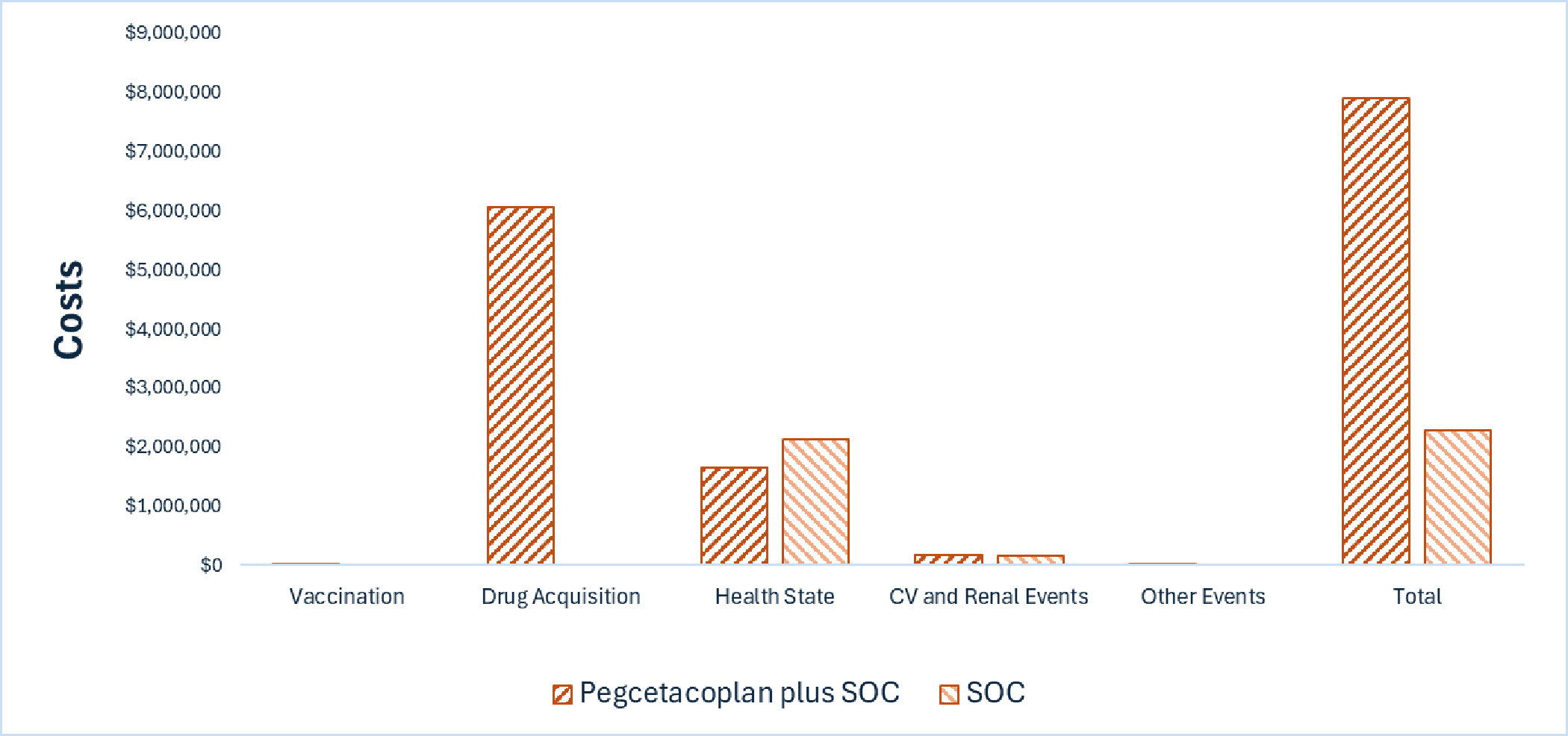
CKD = chronic kidney disease; CV = cardiovascular; SOC = standard of care; vs. = versus.
Note: Health state costs include costs associated with CKD stages 1 to 5, kidney transplant, hemodialysis, and peritoneal dialysis.
Impact on Health
Relative to SOC alone, pegcetacoplan plus SOC is predicted to result in 2.60 additional QALYs per patient over the lifetime time horizon (refer to Figure 2). The model estimates that patients who receive pegcetacoplan plus SOC spend more time in CKD stages 1 to 3 and less time in CKD stages 4 to 5, dialysis, and kidney transplant than patients who receive SOC alone. Approximately 99% of the predicted incremental benefit was based on extrapolation.
Figure 2: Impact of Pegcetacoplan Plus SOC vs. SOC Alone on Patient Health
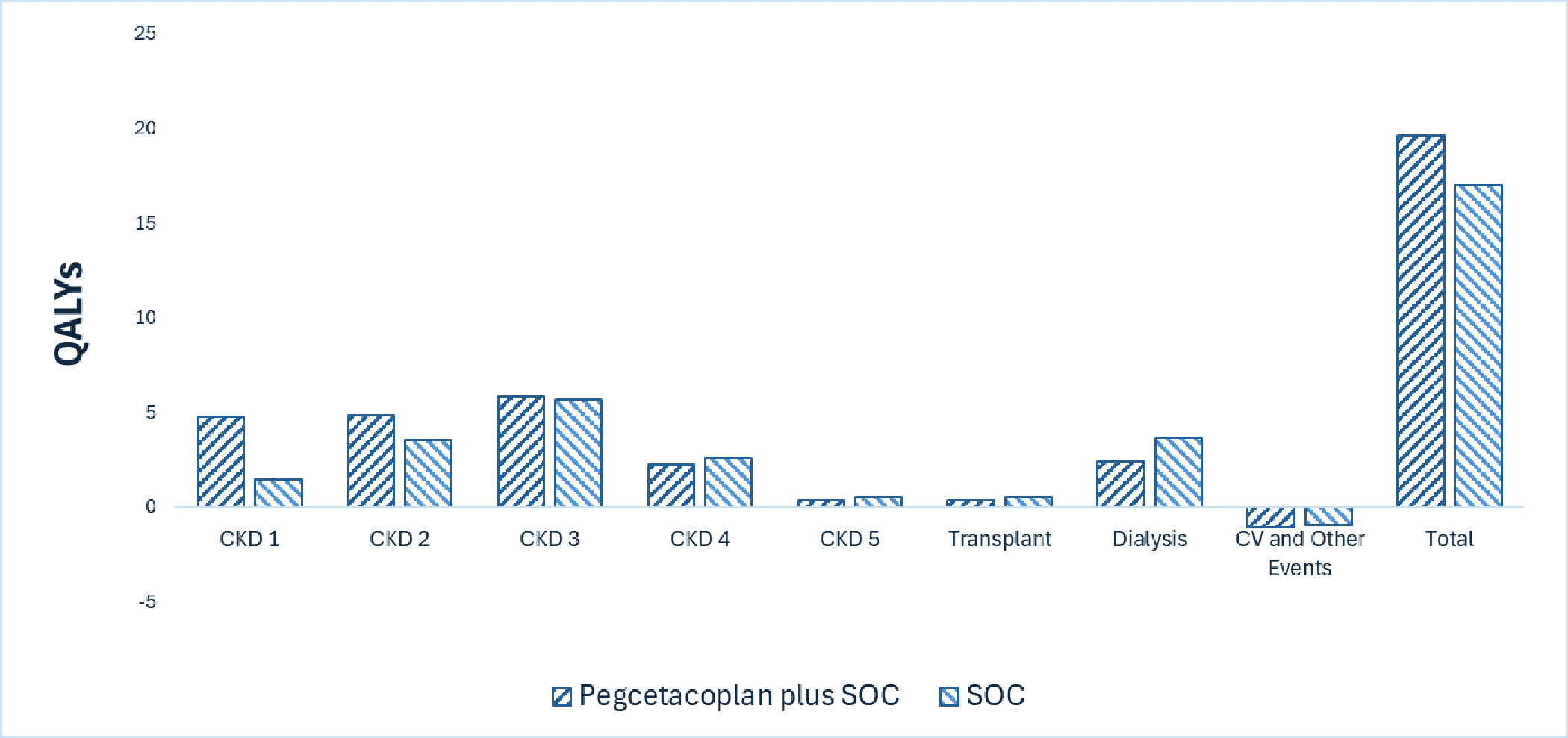
CKD = chronic kidney disease; CV = cardiovascular; QALY = quality-adjusted life-year; SOC = standard of care; vs. = versus.
Overall Results
The results of the CDA-AMC base case suggest an ICER of $2,165,155 per QALY gained for pegcetacoplan plus SOC compared to SOC alone (refer to Table 8). Additional details on the CDA-AMC base case are available in Appendix 11 in the Supplemental Material document.
Table 8: Summary of CDA-AMC Economic Evaluation Results
Drug | Total costs ($) | Total QALYs | ICER vs. SOC alone ($/QALY) |
|---|---|---|---|
Publicly funded health care payer perspective | |||
SOC alone | 2,282,000 | 17.02 | Reference |
Pegcetacoplan plus SOC | 7,905,370 | 19.62 | 2,165,155 |
CDA-AMC = Canada’s Drug Agency; ICER = incremental cost-effectiveness ratio; QALY = quality-adjusted life-year; SOC = standard of care; vs. = versus.
Note: Publicly available list prices were used for all comparators.
Uncertainty and Sensitivity
Uncertainty was explored in scenario analyses. Assumptions related to stable disease had the largest impact on the cost-effectiveness conclusions (e.g., refer to Appendix 11 in the Supplemental Material document).
Summary of the Budget Impact
The sponsor submitted a budget impact analysis to estimate the 3-year (2027 to 2029) budget impact of reimbursing pegcetacoplan for the treatment of adults and adolescents aged 12 years or older with C3G or primary IC-MPGN. The sponsor assumed that the payer would be CDA-AMC–participating public drug plans and derived the size of the eligible population using an epidemiologic approach. The price of pegcetacoplan was aligned with the price included in the sponsor’s economic evaluation, and the prices of comparators were based on the publicly available list prices. Additional information pertaining to the sponsor’s submission is provided in Appendix 12 in the Supplemental Material document.
CDA-AMC identified a number of issues with the sponsor’s estimated budget impact and made changes to model parameters and assumptions in consultation with clinical experts to derive the CDA-AMC base case (refer to Appendix 12 in the Supplemental Material document). CDA-AMC estimated that by year 3 of reimbursement, 973 patients would be eligible for pegcetacoplan plus SOC; of these, 438 patients would be expected to receive pegcetacoplan plus SOC. The estimated incremental budget impact of reimbursing pegcetacoplan plus SOC is predicted to be approximately $473 million over the first 3 years, with an expected expenditure of $473 million on pegcetacoplan plus SOC. The actual budget impact of reimbursing pegcetacoplan plus SOC for patients with C3G or primary IC-MPGN will depend on the proportion of patients eligible for treatment and the market share of pegcetacoplan.
Conclusion
Based on the CDA-AMC base case, pegcetacoplan plus SOC would be considered cost-effective at the submitted price if the public health care system is willing to pay at least $2,165,155 for each additional QALY gained. If the public health care system is not willing to pay that amount, a price reduction should be considered (refer to Figure 3; full details of the impact of price reductions on cost-effectiveness are presented in Appendix 11 in the Supplemental Material document). The estimated cost-effectiveness of pegcetacoplan plus SOC compared to SOC alone is uncertain because of uncertainty in the long-term clinical benefit associated with pegcetacoplan and the long-term impact of pegcetacoplan on renal outcomes.
The budget impact to the public drug plans of reimbursing pegcetacoplan plus SOC in the first 3 years is estimated to be approximately $473 million. The 3-year expenditure on pegcetacoplan (i.e., not accounting for current expenditure on comparators) is estimated to be $473 million.
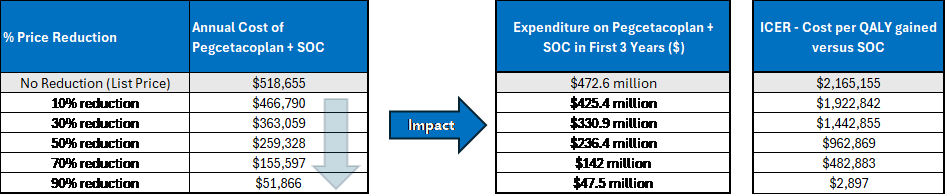
References
1.Canada's Drug Agency. Reimbursement recommendation: Pegcetacoplan (Empaveli). Can J Health Technol. 2023;3(4).
2.Smith RJH, Appel GB, Blom AM, et al. C3 glomerulopathy - understanding a rare complement-driven renal disease. Nat Rev Nephrol. 2019;15(3):129-143. doi:10.1038/s41581-018-0107-2 PubMed
3.Bomback AS, Charu V, Fakhouri F. Challenges in the Diagnosis and Management of Immune Complex-Mediated Membranoproliferative Glomerulonephritis and Complement 3 Glomerulopathy. Kidney Int Rep. 2025;10(1):17-28. doi:10.1016/j.ekir.2024.09.017 PubMed
4.Fakhouri F, Fremeaux-Bacchi V, Noel LH, Cook HT, Pickering MC. C3 glomerulopathy: a new classification. Nat Rev Nephrol. 2010;6(8):494-9. doi:10.1038/nrneph.2010.85 PubMed
5.National Kidney Foundation. Understanding Glomerular Diseases [sponsor supplied reference]. Accessed July 21, 2025. https://www.kidney.org/kidney-topics/understanding-glomerular-diseases
6.Heiderscheit AK, Hauer JJ, Smith RJH. C3 glomerulopathy: Understanding an ultra-rare complement-mediated renal disease. Am J Med Genet C Semin Med Genet. 2022;190(3):344-357. doi:10.1002/ajmg.c.31986 PubMed
7.Masoud S, Wong K, Pitcher D, et al. Quantifying association of early proteinuria and eGFR changes with long-term kidney failure hazard in C3G and IC-MPGN [non peer-reviewed preprint; sponsor supplied reference]. medRxiv; 2024:doi:10.1101/2024.02.03.24301605. http://medrxiv.org/content/early/2024/08/29/2024.02.03.24301605.abstract
8.Licht C, Vivarelli M, Riedl Khursigara M, Pickering MC, Walker PD. Membranoproliferative Glomerulonephritis and C3 Glomerulopathy in Children [sponsor supplied reference]. In: Emma F, Goldstein SL, Bagga A, Bates CM, Shroff R, eds. Pediatric Nephology. Eighth ed. Springer; 2022:563–593.
9.Alasfar S, Carter-Monroe N, Rosenberg AZ, Montgomery RA, Alachkar N. Membranoproliferative glomerulonephritis recurrence after kidney transplantation: using the new classification. BMC Nephrol. 2016;17:7. doi:10.1186/s12882-015-0219-x PubMed
10.O'Shaughnessy MM, Liu S, Montez-Rath ME, Lenihan CR, Lafayette RA, Winkelmayer WC. Kidney Transplantation Outcomes across GN Subtypes in the United States. J Am Soc Nephrol. 2017;28(2):632-644. doi:10.1681/ASN.2016020126 PubMed
11.Schaefer F, Hofstetter J, Ruiz EM, et al. #1196 C3G and ic-MPGN across the life span: findings from the European Rare Kidney Disease Registry. Nephrol Dial Transplant. 2024;39(Supplement_1):gfae069–0029–1196. doi:10.1093/ndt/gfae069.029
12.Sobi Canada Inc. Canadian Clinical Expert Feedback Report: C3G & Primary IC-MPGN [sponsor supplied reference]. 2025.
13.O'Keeffe H, Storrar J, Ramakrishna C, et al. Membranoproliferative Glomerulonephritis over 20 Years at a Tertiary Referral Center in the UK. Glomerular Dis. 2024;4(1):159-166. doi:10.1159/000540672 PubMed
14.Swedish Orphan Biovitrum (SOBI) Canada Inc. Sponsor Summary of Clinical Evidence Template: Empaveli (pegcetacoplan) 1,080 mg/20 mL (54 mg/mL) solution for subcutaneous infusion [internal sponsor's report]. In: Drug Reimbursement Review sponsor submission: Empaveli (pegcetacoplan), 54 mg/mL solution in single-dose vials, for subcutaneous use. September 2025.
15.Carroll MF, Temte JL. Proteinuria in adults: a diagnostic approach. Am Fam Physician. 2000;62(6):1333-40. PubMed
16.Kidney Disease: Improving Global Outcomes (KDIGO) Glomerular Diseases Work Group. KDIGO 2021 Clinical Practice Guideline for the Management of Glomerular Diseases. Kidney Int. 2021;100(4S):S1-S276. doi:10.1016/j.kint.2021.05.021 PubMed
17.British Columbia. Surgery Wait Times for “Adult - Biopsy in OR” [sponsor supplied reference]. https://swt.hlth.gov.bc.ca/WaitTimesResults.xhtml?procName=Biopsy+in+OR&adult=Y
18.MedCom Sobi Canada Inc. Sobi Canada C3G and Primary IC-MPGN National Advisory Board Summary Report [sponsor supplied reference]. 2025.
19.Masoud S, Wong K, Pitcher D, et al. Quantifying association of early proteinuria and estimated glomerular filtration rate changes with long-term kidney failure in C3 glomerulopathy and immune-complex membranoproliferative glomerulonephritis using the United Kingdom RaDaR Registry. Kidney Int. 2025;108(3):455-469. doi:10.1016/j.kint.2025.06.003 PubMed
20.Caravaca-Fontan F, Cavero T, Diaz-Encarnacion M, et al. Clinical Profiles and Patterns of Kidney Disease Progression in C3 Glomerulopathy. Kidney360. 2023;4(5):659-672. doi:10.34067/KID.0000000000000115 PubMed
21.Apellis Pharmaceuticals Inc. Pegcetacoplan APL2-C3G-310 Week 26 Clinical Study Report, December 5th, 2024. 2024.
22.Gleeson PJ, O'Shaughnessy MM, Barratt J. IgA nephropathy in adults—treatment standard. Nephrol Dial Transplant. 2023;38(11):2464-2473. doi:10.1093/ndt/gfad146 PubMed
23.Sim JJ, Chen Q, Cannizzaro N, et al. CKD progression, kidney failure, and mortality among US patients with IgA nephropathy. Nephrol Dial Transplant. 2025;40(11):2104-2117. doi:10.1093/ndt/gfaf084 PubMed
24.Stamellou E, Bruchfeld A, Caravaca-Fontan F, et al. The 2025 KDIGO IgA nephropathy guideline update: an ERA Immunonephrology Working Group perspective. Clin Kidney J. 2025;18(11):sfaf324. doi:10.1093/ckj/sfaf324 PubMed
25.Tang C, Chen P, Si FL, et al. Time-Varying Proteinuria and Progression of IgA Nephropathy: A Cohort Study. Am J Kidney Dis. 2024;84(2):170-178.e1. doi:10.1053/j.ajkd.2023.12.016 PubMed
26.Fakhouri F, Bomback AS, Ariceta G, et al. Trial of Pegcetacoplan in C3 Glomerulopathy and Immune-Complex MPGN. N Engl J Med. 2025;393(22):2210-2220. doi:10.1056/NEJMoa2501510 PubMed
27.Sobi Canada I. Sobi Canada, Inc. response to Canada's Drug Agency request for additional information regarding pegcetacoplan review on November 5, 2025: Harms results [internal additional sponsor's information]. November 20, 2025.
28.Apellis Pharmaceuticals Inc. Clinical Study Report: APL2-C3G-204 (12 Week). An open-label, randomized, controlled, phase 2 study to evaluate the safety and efficacy of pegcetacoplan in the treatment of posttransplant recurrence of C3G or IC-MPGN [internal sponsor's report]. December 11, 2023.
29.Apellis Pharmaceuticals Inc. Clinical Study Report: APL2-C3G-204 Week 52. An open-label, randomized, controlled, phase 2 study to evaluate the safety and efficacy of pegcetacoplan in the treatment of posttransplant recurrence of C3G or IC-MPGN [internal sponsor's report]. August 13, 2024.
30.Dechartres A, Trinquart L, Boutron I, Ravaud P. Influence of trial sample size on treatment effect estimates: meta-epidemiological study. BMJ. 2013;346:f2304. doi:10.1136/bmj.f2304 PubMed
31.Masoud S, Wong K, Pitcher D, et al. Clinical Predictors of Long-term Outcomes in C3 Glomerulopathy and Immune-Complex Membranoproliferative Glomerulonephritis within the UK RaDaR Registry [non peer-reviewed preprint; sponsor supplied reference]. medRxiv; 2024:doi:10.1101/2024.02.03.24301605. https://www.medrxiv.org/content/10.1101/2024.02.03.24301605v1
32.Caravaca-Fontan F, Diaz-Encarnacion M, Cabello V, et al. Longitudinal change in proteinuria and kidney outcomes in C3 glomerulopathy. Nephrol Dial Transplant. 2022;37(7):1270-1280. doi:10.1093/ndt/gfab075 PubMed
33.Ciani O, Buyse M, Drummond M, Rasi G, Saad ED, Taylor RS. Time to Review the Role of Surrogate End Points in Health Policy: State of the Art and the Way Forward. Value Health. 2017;20(3):487-495. doi: https://doi.org/10.1016/j.jval.2016.10.011 PubMed
ISSN: 2563-6596
Canada’s Drug Agency (CDA-AMC) is a pan-Canadian health organization. Created and funded by Canada’s federal, provincial, and territorial governments, we’re responsible for driving better coordination, alignment, and public value within Canada’s drug and health technology landscape. We provide Canada’s health system leaders with independent evidence and advice so they can make informed drug, health technology, and health system decisions, and we collaborate with national and international partners to enhance our collective impact.
Disclaimer: CDA-AMC has taken care to ensure that the information in this document was accurate, complete, and up to date when it was published, but does not make any guarantee to that effect. Your use of this information is subject to this disclaimer and the Terms of Use at cda-amc.ca.
The information in this document is made available for informational and educational purposes only and should not be used as a substitute for professional medical advice, the application of clinical judgment in respect of the care of a particular patient, or other professional judgments in any decision-making process. You assume full responsibility for the use of the information and rely on it at your own risk.
CDA-AMC does not endorse any information, drugs, therapies, treatments, products, processes, or services. The views and opinions of third parties published in this document do not necessarily reflect those of CDA-AMC. The copyright and other intellectual property rights in this document are owned by the Canadian Agency for Drugs and Technologies in Health (operating as CDA-AMC) and its licensors.
Questions or requests for information about this report can be directed to requests@cda-amc.ca.