Drugs, Health Technologies, Health Systems
Reimbursement Review
Nipocalimab (Imaavy)
Sponsor: Janssen Inc.
Therapeutic area: Generalized myasthenia gravis
Summary
What Is Generalized Myasthenia Gravis?
Generalized myasthenia gravis (gMG) is a rare, chronic autoimmune disorder characterized by fluctuating skeletal muscle weakness due to impaired neuromuscular transmission. It most commonly affects the ocular, bulbar, limb, and respiratory muscles, leading to symptoms such as ptosis, diplopia, dysphagia, dysarthria, and exertional fatigue. The condition is mediated by autoantibodies against molecular targets such as AChR and MuSK, which disrupt signal transmission and, in severe cases, can result in myasthenic crisis requiring ventilatory support. gMG markedly reduces quality of life, independence, and functional capacity, often necessitating long-term immunosuppressive therapy. The incidence of MG is estimated at 2.3 to 2.7 per 100,000 individuals in Canada, with a prevalence of approximately 32 per 100,000 individuals.
What Are the Treatment Goals and Current Treatment Options for Generalized Myasthenia Gravis?
Treatment aims are to achieve rapid and sustained symptom control, restore functional ability, prevent exacerbations or crises, and minimize long-term corticosteroid toxicity.
Standard of care (SOC) therapies include acetylcholinesterase inhibitors, corticosteroids, and nonsteroidal immunosuppressant therapies, such as azathioprine, mycophenolate mofetil, cyclosporine, and rituximab.
For patients with an inadequate response or intolerance, IV immunoglobulin (IVIg) or plasma exchange (PLEX) is used as short-term rescue or maintenance therapy.
In recent years, targeted biologics have expanded treatment options, namely complement inhibitors (zilucoplan and ravulizumab) and FcRn antagonists (efgartigimod and rozanolixizumab), which provide more individualized, mechanism-based approaches for antibody-positive or refractory disease.
What Is Nipocalimab and Why Did Canada’s Drug Agency Conduct This Review?
Nipocalimab is a drug that is administered by IV infusion. Health Canada has approved nipocalimab as “an add-on to standard therapy for the treatment of gMG in adult and adolescent patients aged 12 years and older who are anti-AChR or anti-MuSK antibody positive.”
Canada’s Drug Agency (CDA-AMC) initially reviewed nipocalimab to inform a recommendation to the participating public drug programs on whether it should be reimbursed as per the proposed indication, which is “for the treatment of gMG in adults (aged ≥ 18 years) and adolescents (aged 12 to < 18 years) who are antibody-positive (anti-AChR, anti-MuSK, or anti-LRP4).” The initial reimbursement request was as an add-on therapy for antibody-positive (AChR, MuSK, or LRP4) gMG in adults (aged ≥ 18 years) and adolescents (aged 12 to < 18 years) whose symptoms persist despite adequate treatment with AChEIs, corticosteroids, and/or NSISTs. The Health Canada indication, and consequently the reimbursement request, changed during the review to exclude the language regarding patients “who are anti-LRP4 antibody positive.” Due to the timing of the revision, the report was updated to remove all mention of anti-LRP4 antibody positive, except in the budget impact analysis.
How Did CDA-AMC Evaluate Nipocalimab?
The clinical evidence was identified through systematic searches for available studies.
CDA-AMC reviewed the clinical evidence on the beneficial and harmful effects, as well as the economic evidence, of nipocalimab versus other treatments used in Canada as “an add-on to standard therapy for the treatment of gMG in adult and adolescent patients aged 12 years and older who are anti-AChR or anti-MuSK antibody positive.” Efgartigimod, rozanolixizumab, ravulizumab, zilucoplan, IVIg, and PLEX were considered relevant treatments to compare with nipocalimab.
CDA-AMC identified ethical considerations relevant to nipocalimab and gMG.
The review was informed by materials submitted by the sponsor, which included clinical and economic evidence.
The review was also informed by 1 patient group and 1 clinician group submission received in response to our call for input, and by input from participating public drug programs regarding issues that may impact their ability to implement a recommendation.
Two clinical experts (neurologists with expertise in neuromuscular disorders) were consulted as part of the review process.
What Were the Findings?
Clinical Evidence
CDA-AMC reviewed the following clinical evidence:
one pivotal phase III, randomized, double-blind, placebo-controlled trial (VIVACITY-MG3) comparing nipocalimab to placebo in adult patients with gMG who are antibody positive for AChR or MuSK and whose disease was inadequately controlled with SOC
one open-label, single-arm, phase II and III trial (VIBRANCE-MG) of nipocalimab in adolescents with anti-AChR antibody–-positive gMG whose disease was inadequately controlled with SOC
one ongoing open-label extension study (VIVACITY-MG3 OLE) evaluating the long-term effects of nipocalimab in adult patients with antibody-positive gMG
one network meta-analysis of nipocalimab versus relevant comparators, including efgartigimod, ravulizumab, rozanolixizumab, zilucoplan, IVIg, and PLEX, in adults with anti-AChR antibody–positive gMG; comparisons versus IVIg and PLEX were limited to safety only.
For the comparison of nipocalimab versus placebo in adults with antibody-positive gMG:
Based on 1 randomized controlled trial (VIVACITY-MG3), nipocalimab added to SOC likely results in a marginal clinically meaningful improvement in functional ability (Myasthenia Gravis Activities of Daily Living [MG-ADL] score) and muscle strength (Quantitative Myasthenia Gravis [QMG] score) compared with placebo over 24 weeks. The certainty of the conclusion is reduced due to imprecision.
Health-related quality of life (Myasthenia Gravis Quality of Life 15-item scale revised score) may improve with treatment with nipocalimab compared with placebo; however, the clinical importance of the improvement is uncertain. There may be little to no clinically important difference in fatigue with nipocalimab compared with placebo. The certainty of the conclusion is reduced due to imprecision and a risk of bias due to missing outcome data.
Harms of nipocalimab are likely similar to placebo. Treatment with nipocalimab may result in little to no difference in serious or severe infection or hypoalbuminemia compared to placebo. The certainty of the conclusion is reduced due to concerns for very serious imprecision.
Results from the VIVACITY-MG3 OLE study suggested the potential for maintained improvements in MG-ADL and QMG scores for at least 60 weeks following the 24-week double-blind, randomized controlled trial; however, the evidence is very uncertain due to risk of bias (open-label design, missing outcome data, selection bias) and the noncomparative design, which precludes causal interpretation. No new safety concerns were observed.
For the effect of nipocalimab in adolescents:
The evidence in adolescents is very uncertain, based solely on a small, single-arm, open-label study (VIBRANCE-MG; n = 8) with no comparator group.
Numerical improvements in MG-ADL and QMG scores were observed, but the estimates are unstable and subject to high uncertainty due to the design, the very small sample size, and the lack of formal hypothesis testing.
No causal conclusions can be drawn regarding the effect of nipocalimab in this population.
Harms were reported descriptively, but the sample was too small to support meaningful safety conclusions.
All participants had anti-AChR antibody–positive gMG; therefore, the efficacy and safety of nipocalimab in adolescents with anti-MuSK antibody–positive gMG are unknown.
For the comparison of nipocalimab versus active comparators:
No direct comparative evidence versus relevant comparators was submitted. The results of the sponsor-submitted indirect treatment comparison suggest that the comparative efficacy of nipocalimab in improving MG-ADL and QMG scores relative to active comparators (efgartigimod, rozanolixizumab, ravulizumab, and zilucoplan) is uncertain. Similarly, the safety profile of nipocalimab (i.e., the risk of experiencing any adverse event or any serious adverse event) relative to all other comparators is uncertain. Additionally, only patients with anti-AChR antibody–positive gMG were assessed. The comparative effects versus relevant comparators in adult patients with anti-MuSK antibody–positive gMG remain unknown. No health-related quality of life outcomes were assessed.
Economic Evidence
Nipocalimab is available as a solution for IV infusion (185 mg/mL). At the submitted prices of $3,646.14 and $14,584.56 per 300 mg and 1,200 mg vial, respectively, the cost of nipocalimab is expected to be $395,085 in the first year of treatment and $380,501 per patient in subsequent years, based on the Health Canada–recommended dosage and a patient weight of 76 kg.
Key clinical efficacy inputs in the economic analysis (i.e., proportion of patients whose gMG responded, change from baseline in MG-ADL score, and adverse events) for nipocalimab versus SOC were derived from the VIVACITY-MG3 trial. Evidence submitted by the sponsor indicates that treatment with nipocalimab is likely to improve MG-ADL score and response compared with placebo among adult patients with anti-AChR antibody–positive gMG whose symptoms persist despite adequate treatment with SOC. For nipocalimab versus the other advanced add-on therapies, clinical efficacy was informed by naive comparison of proportion of responders and adverse events in pivotal trials for each comparator as well as a sponsor-submitted indirect treatment comparison as difference in change from baseline MG-ADL score. CDA-AMC identified that the results of the indirect treatment comparison were uncertain due to limitations associated with between-trial heterogeneity and methodology, whereas no adjustments were made for between-trial differences in the naive comparisons. This precludes any meaningful conclusions on the relative safety and efficacy of nipocalimab versus these comparators.
The results of the CDA-AMC base case suggest:
Nipocalimab is predicted to be associated with higher costs to the health care system than zilucoplan (incremental costs = $86,026), primarily driven by increased costs associated with drug acquisition.
Nipocalimab is predicted to be associated with a loss of 0.02 life-years and may result in a loss of 0.04 quality-adjusted life-years compared to zilucoplan.
In the CDA-AMC base case, nipocalimab plus SOC was less effective and more costly than zilucoplan plus SOC. This finding is uncertain due to uncertainty in the relative clinical efficacy and safety of nipocalimab compared to other add-on therapies for gMG. If it is anticipated that treatment with nipocalimab plus SOC produces similar outcomes to other add-on therapies for gMG, then the total cost of nipocalimab should not exceed that of the lowest-cost add-on therapy for gMG.
The cost-effectiveness of nipocalimab plus SOC in adolescent patients and/or in patients with anti-MuSK antibody–positive gMG is unknown.
Additional price reductions than those presented in this report may therefore be required to achieve cost-effectiveness at a given willingness to pay threshold.
CDA-AMC estimates that the budget impact of reimbursing nipocalimab as an add-on to SOC for the treatment of its Health Canada–indicated population will be approximately $705 million over the first 3 years of reimbursement compared to the amount currently spent on comparators, with an estimated expenditure of $706 million on nipocalimab over this period. If reimbursement is limited to the reimbursement request population, the estimated budget impact of reimbursing nipocalimab would be $154 million over the first 3 years, with an estimated expenditure of $166 million on nipocalimab. The actual budget impact of reimbursing nipocalimab will depend on the number of people eligible for treatment and the uptake of nipocalimab. The incremental budget impact of reimbursing nipocalimab is predicted to be greater than $40 million in year 2 and year 3 of the analysis, and the economic feasibility of adoption must be addressed.
Abbreviations
AChEI
acetylcholinesterase inhibitor
AE
adverse event
AESI
adverse event of special interest
AUC
area under the curve
BIA
budget impact analysis
BMI
body mass index
CDA-AMC
Canada’s Drug Agency
CI
confidence interval
CrI
credible interval
EMA
European Medicines Agency
gMG
generalized myasthenia gravis
HRQoL
health-related quality of life
ITC
indirect treatment comparison
IVIg
IV immunoglobulin
LTE
long-term extension
MAR
missing at random
MG
myasthenia gravis
MG-ADL
Myasthenia Gravis Activities of Daily Living
MGFA
Myasthenia Gravis Foundation of America
MG-QoL15r
Myasthenia Gravis Quality of Life 15-item scale revised
MID
minimally important difference
MMRM
mixed model for repeated measurements
Neuro-QoL
Quality of Life in Neurologic Disorders
NMA
network meta-analysis
NSIST
nonsteroidal immunosuppressant therapy
OLE
open-label extension
PLEX
plasma exchange
QALY
quality-adjusted life-year
QMG
Quantitative Myasthenia Gravis
RCT
randomized controlled trial
SAE
serious adverse event
SD
standard deviation
SLR
systematic literature review
SOC
standard of care
TEAE
treatment-emergent adverse event
Background
Introduction
The objectives of this report are as follows:
Review and critically appraise the evidence submitted by the sponsor on the beneficial and harmful effects of nipocalimab 30 mg/kg administered intravenously over approximately 30 minutes, followed by a maintenance dose of 15 mg/kg administered over approximately 15 minutes every 2 weeks thereafter, as “an add-on to standard therapy for the treatment of generalized myasthenia gravis (gMG) in adult and adolescent patients aged 12 years and older who are anti-AChR or anti-MuSK antibody positive.” The focus will be placed on comparing nipocalimab to relevant comparators in clinical practice in Canada and identifying gaps in the current evidence, as outlined in Table 1.
Review and critically appraise the economic information submitted by the sponsor, including a cost-effectiveness analysis and budget impact analysis (BIA). The focus of the Economic Review is aligned with the scope of the Clinical Review, unless otherwise stated. For most reviews, a Canada’s Drug Agency (CDA-AMC) base case is developed, informed by clinical expert input, the available clinical evidence, and the best interpretation of the economic evidence based on the information provided by the sponsor.
The application was submitted by the sponsor before receiving a Notice of Compliance from Health Canada. This report reflects the anticipated indication and recommended dosage for nipocalimab during the initial CDA-AMC review period.
Table 1: Information on the Application Submitted for Review and on the CDA-AMC Review
Item | Description |
|---|---|
Information on the application submitted for review | |
Drug | Nipocalimab (Imaavy), 300 mg per 1.62 mL and 1,200 mg per 6.5 mL solution, for IV use |
Sponsor | Janssen Inc. |
Health Canada indication | As “an add-on to standard therapy for the treatment of gMG in adult and adolescent patients aged 12 years and older who are anti-AChR or anti-MuSK antibody positive.”a |
Health Canada approval status | NOC |
Health Canada review pathway | Standard review |
NOC date | December 5, 2025 |
Mechanism of action | A fully human IgG1 monoclonal antibody that binds to FcRn, blocking IgG recycling, lowering total IgG (including autoantibodies and alloantibodies), and preventing the transfer of IgG to the fetus during pregnancy |
Recommended dosage | For adults and adolescents aged 12 years and older with gMG: 30 mg/kg administered over approximately 30 minutes, followed by a maintenance dose of 15 mg/kg administered over approximately 15 minutes every 2 weeks thereafter |
Submission type | Initial |
Sponsor’s reimbursement request | “As an add-on therapy for AChR or MuSK antibody positive adult (≥ 18 years) and adolescent (12 to < 18 years) gMG patients whose symptoms persist despite adequate treatment with AChEIs, corticosteroids, and/or NSISTs” |
Submitted price | $3,646.14 per 300 mg vial $14,584.56 per 1,200 mg vial |
Information on the CDA-AMC review | |
Review type | Standard |
Clinical review focusb | Population: As defined in the Health Canada indication Subgroups: Antibody subtype (AChR positive, MuSK positive) Intervention: Nipocalimab, loading dose of 30 mg/kg IV, followed by a maintenance dose of 15 mg/kg IV every 2 weeks thereafter Comparators:c
Outcomes
|
AChEI = acetylcholinesterase inhibitor; CDA-AMC = Canada’s Drug Agency; gMG = generalized myasthenia gravis; HRQoL = health-related quality of life; IgG = immunoglobulin G; IgG1= immunoglobulin G subclass 1; MG-ADL = Myasthenia Gravis Activities of Daily Living; MG-QoL15r = Myasthenia Gravis Quality of Life 15-item scale revised; Neuro-QoL = Quality of Life in Neurological Disorders; NOC = Notice of Compliance; NSIST = nonsteroidal immunosuppressant therapy; PLEX = plasma exchange; QMG = Quantitative Myasthenia Gravis.
aAt the time this review was conducted, the Notice of Compliance had not been granted. The review was conducted based on the proposed indication: “for the treatment of generalized gMG in adults (≥ 18 years) and adolescent patients (12 to < 18 years) who are antibody positive (anti-AChR, anti-MuSK, or anti–low-density lipoprotein-related protein 4).”
bThe Economic Review aligns with the scope of the Clinical Review, unless otherwise stated.
cEculizumab is not currently listed as a reimbursed benefit across participating jurisdictions in Canada and was therefore not considered a relevant comparator for this review.
dQMG response was defined as improvement of ≥ 3 points in the Quantitative Myasthenia Gravis (QMG) score.
eSerious or severe infection was defined as infections that were severe or required IV anti-infective treatment or operative or invasive intervention.
Source: Details included in the table are from the Sponsor’s Summary of Clinical Evidence.1
Submission History for the Drug Under Review
CDA-AMC has not previously reviewed nipocalimab through the Reimbursement Review process.
Sources of Information
The contents of the Reimbursement Review report are informed by materials submitted by the sponsor, input received from interested parties (patient groups, clinician groups, and drug programs), and input from clinical experts consulted for this review.
Calls for patient group and clinician group input are issued for each Reimbursement Review. One patient group submission from Muscular Dystrophy Canada and 1 clinician group submission from the Neuromuscular Disease Network for Canada were received. Muscular Dystrophy Canada collected patient input through a health care experience survey, virtual interviews, and round table sessions with individuals living with MG. In total, 215 patients from across Canada, with an average age of 49 years, responded. Input from Neuromuscular Disease Network for Canada was provided by 6 contributing clinicians. The full submissions received are available on the project landing page in the consolidated input document. The drug programs provide input on each drug being reviewed through the Reimbursement Review process by identifying issues that may impact their ability to implement a recommendation.
Input from patient and clinician groups is considered throughout the review, including in the selection of outcomes to include in the Clinical Review and in the interpretation of the clinical and economic evidence. Relevant patient and clinician group input is summarized in the Disease Background, Current Management, and Unmet Needs and Existing Challenges sections.
Each review team includes at least 1 clinical expert with expertise regarding the diagnosis and management of the condition for which the drug is indicated. The review team included 2 clinical experts with expertise regarding the diagnosis and management of gMG for which nipocalimab is indicated. Clinical experts are a critical part of the review team and are involved in all phases of the review process.
Disease Background
Myasthenia gravis (MG) is a rare, chronic, and heterogeneous neuromuscular disease characterized by fluctuating, fatigable muscle weakness. Weakness most often affects ocular, bulbar, proximal extremity, neck, and respiratory muscles. Weakness fluctuates during the day, and worsens with fatigue, repetitive activities, heat, infection, and stress.2
In most cases, initial symptoms are ocular (i.e., Myasthenia Gravis Foundation of America [MGFA] class I MG) and include ptosis and diplopia, but within 2 to 3 years of onset, the disease usually worsens. In approximately 85% of patients, additional muscles are affected, leading to gMG, which is classified by MGFA as classes II to V. Disease exacerbation is common. A 2025 analysis reported that approximately half of patients with gMG experienced an exacerbation over a mean 33-month follow-up period.3
The incidence of MG ranges from 0.3 to 2.8 per 100,000 person-years worldwide. A population-based study from Ontario estimated that the prevalence of MG in Canada is approximately 32 per 100,000 and the incidence is approximately 2.3 to 2.7 per 100,000 person-years.4 Most patients with MG first present with ocular symptoms. Approximately 80% eventually develop generalized disease, with a vast majority (approximately 90%) transitioning to gMG within the 2 to 3 years after diagnosis. Risk factors for MG include female sex and age younger than 40 years, male sex and age older than 60 years, being Black or African American, presence of hyperthyroidism, a family history of autoimmune disease, and thymoma.5-13 However, epidemiological studies based in Canada do not always include data stratified by race, ethnicity, other equity-deserving population groups, or social determinants of health such as socioeconomic status. Consequently, it is uncertain whether these risk patterns directly apply to the Canadian context.
MG can occur at any age, but the age of onset has a bimodal distribution.14 The first peak occurs when patients are in their 30s, predominantly in females, and the second peak occurs when patients are in their 50s or older, predominantly in males. As such, pediatric MG is rare, with approximately 10% to 15% of new cases of MG being diagnosed in the pediatric population (aged < 18 years).15 The majority of MG cases in the adolescent population are limited to ocular symptoms; the rate of conversion from ocular MG to gMG is reportedly lower in the adolescent population versus adults.16-18
Approximately 85% of patients with MG have detectable AChR autoantibodies, 8% have detectable MuSK autoantibodies, and 1% to 2% have detectable LRP4 autoantibodies.
It was estimated in 2025 there were 9,124 adults living with gMG in Canada (excluding Quebec). There are no estimates of gMG prevalence among the pediatric or adolescent population in Canada. Epidemiologic studies from the UK report pediatric MG prevalence ranging from 2.8 to 14.8 per 1,000,000 children.19 A published population-based retrospective study from the US found the prevalence of diagnosed MG among adolescents (aged 12 to 17 years) to range between 32.2 and 49 per 1,000,000 persons in 2020, depending on the claims database analyzed.20 Given these estimates, the number of adolescents living with MG in Canada (excluding Quebec) is likely around 100 patients in 2025.
The clinical diagnosis of gMG is based on clinical examination, serologic testing for antibodies, thymus imaging, and/or neurophysiological tests.
Patient group input: Individuals living with gMG consistently described wide-ranging impacts on their daily lives. These included reduced productivity and challenges with employment, persistent fatigue and low energy, poor sleep quality, respiratory difficulties, reduced mobility and muscle strength, loss of independence, and limitations in social participation and relationships. Patients also reported difficulties with vision, speech, and swallowing, highlighting that the consequences of gMG extend across physical, emotional, and social domains. Individuals living with MG expressed that its effects go well beyond physical symptoms, influencing their mental health, overall quality of life, and the well-being of their families.
Current Management
Treatment Goals
The patient group reported that the most important treatment goals were to decrease exacerbations, maintain disease control, including experiencing less weakness, fatigue, difficulty breathing, and maintaining quality of life. They expressed the need for reduced treatment-related harms, maintenance of independence, and reduced hospital admissions.
Similarly, the clinician group noted that the primary goals of MG treatment are to stabilize disease, reduce exacerbations and hospitalizations, minimize steroid use, improve quality of life, and ensure treatment safety and convenience.
The clinician group emphasized that the ideal goal in gMG management is complete absence of symptoms without treatment-related adverse reactions, although this is rarely achievable. Instead, they noted that the practical goal is to achieve minimal symptom expression (Myasthenia Gravis Activities of Daily Living [MG-ADL] score of 0 to 1) with the fewest possible adverse reactions from treatment. The patient group emphasized the importance of preserving daily function, including work, family, and social life. They highlighted that they valued improvements in weakness, vision, swallowing, speech, and breathing, as well as the ability to maintain independence. Both patient and clinician groups noted that treatment tolerability, avoidance of long-term steroid toxicity, and reducing treatment burden are also central for individuals living with gMG.
Current Treatment Options
There are currently no published Canadian guidelines for gMG; however, international consensus recommendations are widely adopted and reflect practice in Canada. Management of gMG in Canada follows a stepwise approach based on antibody subtype and disease severity.
For patients with anti-AChR antibody–positive disease, first-line therapy typically includes acetylcholinesterase inhibitors (AChEIs), followed by corticosteroids and/or nonsteroidal immunosuppressive therapies (NSISTs). Patients with persistent symptoms despite optimized standard of care (SOC) — defined here as an adequately dosed and stable use of AChEIs, corticosteroids, or NSISTs — may receive rituximab, IV immunoglobulin (IVIg), or plasma exchange (PLEX). More recently, advanced biologics, including complement inhibitors (ravulizumab, eculizumab, and zilucoplan) and FcRn antagonists (efgartigimod, rozanolixizumab), have been approved or recommended for reimbursement as add-on therapies for patients whose gMG has an inadequate response to SOC. However, access to these biologics remains uneven across provinces despite pan-Canadian Pharmaceutical Alliance (pCPA) agreements for some products, and eculizumab is not reimbursed by the jurisdictions in Canada.
For patients with anti-MuSK antibody–positive gMG, AChEIs are generally ineffective; treatment typically involves corticosteroids or NSISTs, followed by IVIg, PLEX, or rituximab in later lines. Rozanolixizumab has been recommended as an add-on option for this group.
Treatment options for adolescents are limited to conventional therapies (e.g., AChEIs, corticosteroids, and NSISTs), with care focused on balancing efficacy and minimizing steroid-related adverse effects such as growth suppression.
Access to advanced biologics often depends on a mix of public coverage, private insurance, compassionate programs, and clinical trial participation. Overall, the gMG treatment landscape in Canada mirrors international standards but remains constrained by variability in access to novel biologics.
A summary of these treatment options is provided in Figure 1. Key characteristics of nipocalimab are summarized with other treatments available for gMG in Appendix 1 in the Supplemental Material document.
Unmet Needs and Existing Challenges
According to the patient group input, while current treatment options for MG can be effective and patients expressed positive experiences with some treatments, such as IVIg, for managing their disease, there are concerns about the long-term and sustained benefits of these treatments. The experience is marked by exhausting and unpredictable treatment journey and reliance on steroids as well as challenges accessing newer, potentially safer alternatives. For patients in Canada living with gMG, the current treatment landscape remains marked by trial and error, long delays before improvement, and serious adverse effects.
Corticosteroids and traditional immunosuppressants often take months to work and can lead to life-changing complications such as infections, fractures, diabetes, and osteoporosis. Rescue treatments such as IVIg and PLEX require repeated hospital visits, are not accessible in all regions, and may be unsafe for many individuals. Even with the arrival of novel therapies, many patients continue to face high disease burden and inequities in access depending on their province of residence and whether their clinician has access to specialized MG clinics. In the patient group input, it was reported that the high cost of infusion treatments can impose a substantial financial burden on themselves and their families. The patient group emphasized the urgent need for more accessible and affordable treatment options that better control gMG and decrease serious adverse effects.
The clinician group noted conventional gMG treatments, such as corticosteroids, nonsteroidal immunosuppressants, IVIg, and PLEX, are effective but limited by delayed onset, adverse events (AEs), monitoring requirements, and unequal access. They indicated IVIg is costly and not consistently available, with unequal access in rural areas. PLEX is offered only in a small number of hospitals across the country.
Novel therapies expand treatment options but have restricted indications (mainly adults with generalized anti-AChR antibody–positive gMG), and are not approved for patients with ocular disease, patients who have had thymectomy, patients with seronegative disease, pediatric patients, or patients who are pregnant. Key unmet needs identified in the clinician group input include refractory disease, intolerable AEs, limited access, absence of biomarkers to select the most appropriate therapy for each patient, and insufficient data in specific subgroups (i.e., for patients with disabling purely ocular symptoms, seronegative MG, recent thymectomy, or age younger than 18 years).
The clinical experts consulted by CDA-AMC indicated that approximately 10% of patients have gMG that remains refractory, and continue to experience significant symptoms or dependence on chronic treatment with IVIg or PLEX despite standard therapies. They noted that treatment-related AEs from corticosteroid and NSISTs, including metabolic complications such as diabetes, create additional unmet needs, particularly in older patients and younger women.
According to clinical experts, patients with anti-MuSK antibody–positive disease, ocular MG, and seronegative disease have fewer effective options, and older adult patients often face safety and tolerability challenges because of comorbidities. The clinical experts highlighted that access to IVIg and PLEX is limited to specialized centres, which creates geographic barriers for patients in rural and remote areas who must travel long distances to receive treatment. They further noted that these therapies impose substantial patient and caregiver burden due to the long duration of infusions or apheresis sessions, the need for frequent visits, transportation requirements, and the need for caregiver accompaniment during and after procedures. Insurance restrictions and high costs of novel biologics compound these challenges, particularly for marginalized patients with limited health system access.
Figure 1: Treatment Options Reimbursed or Under Review for Adults With Antibody-Positive gMG in Canada
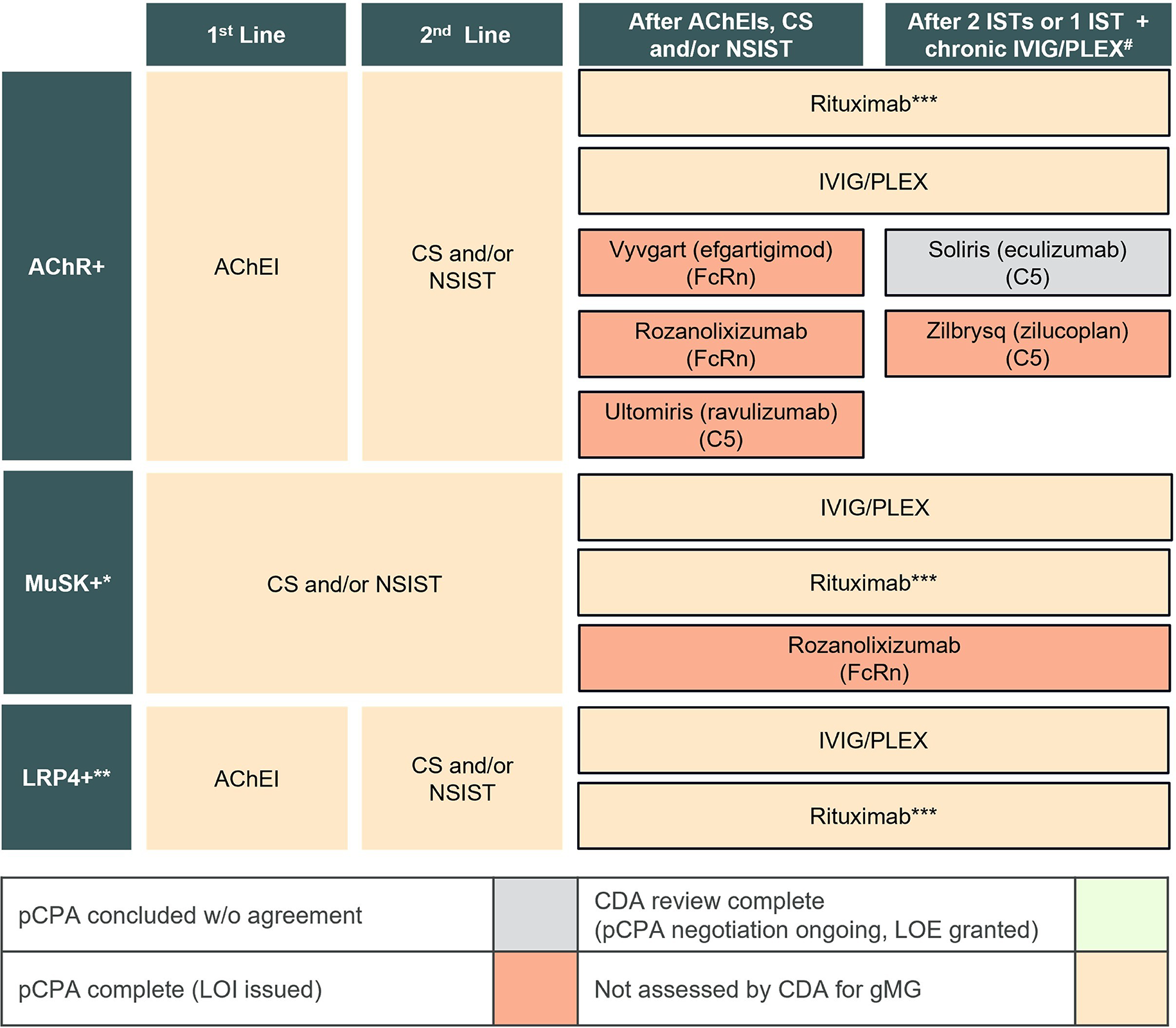
AChEI = acetylcholinesterase inhibitor; CDA-AMC = Canada’s Drug Agency; CS = corticosteroid; gMG = generalized myasthenia gravis; HTA = health technology assessment; IST = immunosuppressant therapy; IVIG = IV immunoglobulin; LOE = Letter of Engagement; LOI = Letter of Intent; NSIST = nonsteroidal immunosuppressant therapy; pCPA = pan-Canadian Pharmaceutical Alliance; PLEX = plasma exchange; w/o = without.
*AChEIs are not used for anti-MuSK antibody–positive gMG.
**LRP4 positivity is not routinely tested; it is assumed to be managed similar to AChR positivity in the first and second line.
***Rituximab is sometimes used off label but is not available for gMG in all provinces and territories in Canada.
#Refractory gMG is as defined in prior HTA reviews for zilucoplan and eculizumab.
Source: Details included in the figure are included in the sponsor’s Summary of Clinical Evidence.1
Considerations for Using the Drug Under Review
Contents within this section have been informed by input from the clinical experts consulted for the purpose of this review, patient and clinician group input, and the reimbursement conditions proposed by the sponsor (refer to Supplemental Material document, Appendix 1, Table 2). The implementation questions from the public drug programs and corresponding responses from the clinical experts consulted for this review are summarized in the Supplemental Material document, Appendix 1, Table 3. The following has been summarized by the review team.
Place in Therapy
The clinical experts consulted by CDA-AMC noted that nipocalimab is expected to be used as a second- or third-line therapy, similar to other FcRn inhibitors. It may provide an alternative to IVIg for bridging or for patients whose symptoms persist despite conventional treatments, including AChEIs, corticosteroids, and NSISTs. The clinical experts did not anticipate a major shift in the treatment paradigm, given the availability of other FcRn inhibitors, and noted that the high cost of FcRn inhibitors makes first-line use unlikely.
Patient Population
The clinical experts consulted by CDA-AMC noted that there is clinical trial evidence for nipocalimab in patients with seropositive gMG (AChR, MuSK), moderate-to-severe disease (MGFA classes II to IV), and significant symptoms (MG-ADL score ≥ 6) despite conventional therapy. According to these experts, these patients are most likely to benefit from nipocalimab treatment. Despite limited clinical trial evidence in adolescent patients, the clinical experts felt that adolescents are reasonable candidates for nipocalimab treatment, given the lack of treatment options for these patients. The clinical experts noted that there is no clinical reason to expect a different response in adolescents compared with adults.
The clinical experts also indicated that patients with purely ocular MG or seronegative disease are not suitable due to lack of supporting evidence. Diagnosis typically requires antibody testing and neurologist evaluation, sometimes supported by electromyography. The clinical experts noted that antibody testing is widely accessible in Canada, although the turnaround may take 2 to 3 weeks, and that inequities related to rural and remote residence and limited specialist availability may delay diagnosis and treatment initiation.
The clinical experts noted that the initiation criteria for nipocalimab proposed by the sponsor are similar to the reimbursement criteria for currently available novel therapies and are reasonable.
Assessing the Response to Treatment
The clinical experts consulted by CDA-AMC indicated that in clinical practice, the MG-ADL scale is the most practical tool for monitoring, while the Quantitative Myasthenia Gravis (QMG) score is primarily used in trials. The experts noted that improvements in the severity and frequency of symptoms (e.g., muscle weakness, swallowing, speech, or breathing) and activities of daily living are key indicators for response to treatment. The experts also noted that most clinicians would consider a change of 2 or more points from baseline in MG-ADL score, as well as reduction in steroid dose (at least 20 mg/day reduction) or IVIg use (reduction of 50% or more), to be clinically meaningful.
The clinical experts emphasized that assessment should be performed every 1 to 3 months early in treatment and every 6 months in patients whose gMG is stable on treatment. They further clarified that decisions regarding renewal or discontinuation should not be made before 3 to 6 months of therapy. They also agreed with the renewal criteria proposed by the sponsor and added that stability accompanied by reduced adjunctive therapy could also justify continuation.
Discontinuing Treatment
The clinical experts consulted by CDA-AMC noted that treatment discontinuation should be considered if the disease has not responded after 6 months, if symptoms worsen, or if AEs or tolerability issues arise. The experts agreed that lack of improvement in MG-ADL score or continued clinical deterioration requiring hospitalization or rescue therapy would indicate lack of benefit.
Prescribing Considerations
As outlined by the clinical experts consulted by CDA-AMC, diagnosis and initiation of nipocalimab should be undertaken by neurologists, preferably those with expertise in neuromuscular disorders, due to the need for antibody testing, individualized treatment optimization, and ongoing monitoring. The experts agreed that restricting initiation to neurologists is appropriate; however, they also stated that shared or coordinated follow-up with family physicians or internists may be reasonable in rural or remote areas where access to neurology services is limited.
The clinical experts consulted by CDA-AMC generally supported the prescribing conditions proposed by the sponsor, indicating that nipocalimab would most appropriately be used as a second- or third-line therapy, consistent with current clinical practice in Canada. One of the consulted clinical experts additionally noted that broader use in earlier lines could be justified if the cost were substantially reduced. Patients should undergo follow-up assessments every 1 to 3 months — or up to 6 months if gMG is clinically stable — to evaluate treatment response and guide continuation decisions. According to these clinical experts, a clinically meaningful response was described as an improvement in symptoms, resumption of normal physical and daily activities, and a notable reduction in prednisone use (e.g., by more than 20 mg daily) or IVIg requirements (e.g., at least a 50% reduction in monthly dose).
Additional Considerations
As access to infusion-based therapies is essential for minimizing disparities in gMG care, the clinical experts consulted by CDA-AMC noted that infusion services for gMG are available across multiple provinces, which may help support equitable access for patients living outside major academic centres. They also emphasized that shared-care models, in which neurologists oversee treatment planning while family physicians facilitate routine monitoring and infusion coordination, allow patients to receive therapy safely in community settings. This care model can reduce travel burdens, support continuity for patients in rural or remote regions, and help mitigate structural barriers that disproportionately affect equity-deserving groups.
Clinical Review
Methods
The review considered studies in the sponsor’s systematic review, including pivotal studies and randomized controlled trials (RCTs), long-term extension (LTE) studies, indirect treatment comparisons (ITCs), and studies addressing gaps in the evidence for inclusion. Eligible studies for the systematic review were RCTs. Relevant patients and interventions were defined by the indication and the recommended dosage in the product monograph. Subgroups of interest included autoantibody subtype (AChR and MuSK positivity). Relevant comparators were active treatments used in clinical practice in Canada for refractory or inadequately controlled gMG, including corticosteroids, NSISTs (e.g., azathioprine, mycophenolate mofetil), IVIg, PLEX, and complement or FcRn inhibitors (e.g., efgartigimod, rozanolixizumab, zilucoplan, and ravulizumab). LTEs of included pivotal studies and RCTs were included, regardless of whether there was a comparison group. ITCs and studies addressing gaps submitted by the sponsor were included when they filled an identified gap in the systematic review evidence (e.g., missing comparator, longer follow-up time).
The review team selected outcomes and follow-up times for review considering the sponsor’s Summary of Clinical Evidence, clinical expert input, and patient and clinician group input. Included outcomes were those considered relevant to expert committee deliberations, and they were selected in consultation with committee members. Evidence from the systematic review for the most important outcomes was assessed using the Grading of Recommendations Assessment, Development and Evaluation (GRADE) approach. Outcomes considered critical for decision-making were MG-ADL score (mean change from baseline and responder analyses), QMG score (mean change from baseline and responder analyses), health-related quality of life (HRQoL) (MG-QoL15r,Quality of Life in Neurologic Disorders [Neuro-QoL] Fatigue), and AEs of special interest (AESIs), including serious or severe infections, defined as infections that were severe or required IV anti-infective treatment or an operative or invasive intervention, and hypoalbuminemia (serum albumin < 20 g/L). These measures were selected because they represent key treatment goals in gMG: improved daily function, reduced symptom burden, and enhanced quality of life.
Methods for data extraction, risk of bias appraisal, and certainty of evidence assessment are detailed in the Supplemental Material document in Appendix 2.
Clinical Evidence
In this report, the following sources of evidence submitted by the sponsor are reviewed and appraised:
one phase III RCT in adults (VIVACITY-MG321)
one open-label, single-arm phase II and III trial in adolescents (VIBRANCE-MG22)
one LTE study (VIVACITY-MG3 open-label extension [OLE])
one ITC.
Systematic Review
Description of Studies
Study Characteristics
Characteristics of the included studies are summarized in Table 2. Details pertaining to the eligibility criteria, interventions and comparators, and relevant outcome measures are in the Supplemental Material document in Appendix 3.
The VIVACITY-MG3 trial21 is an ongoing, phase III, randomized, double-blind, placebo-controlled study conducted in 81 centres from 17 countries including Australia (n = 1), Belgium (n = 5), Canada (n = 3), China (n = 10), Czech Republic (n = 3), Denmark (n = 1), France (n = 3), Germany (n = 2), Italy (n = 5), Japan (n = 14), Mexico (n = 2), Poland (n = 5), South Korea (n = 3), Spain (n = 7), Sweden (n = 2), Taiwan (n = 2), and the US (n = 13). The study includes a screening phase of up to 4 weeks, a 24-week double-blind, placebo-controlled phase, and an OLE phase. The primary objective is to assess whether IV nipocalimab improves symptoms and functional outcomes compared with placebo in adults with gMG that is antibody-positive for AChR or MuSK, and is inadequately controlled on SOC therapies, including AChEIs, corticosteroids, or NSISTs.
A total of 199 participants were randomized in a 1:1 ratio to receive either nipocalimab (IV loading dose of 30 mg/kg followed by 15 mg/kg every 2 weeks plus SOC) or placebo (IV infusion every 2 weeks plus SOC) over the 24-week double-blind phase. Randomization in the VIVACITY-MG3 study was stratified by autoantibody subtype (anti-AChR antibody positive and/or anti-MuSK antibody positive versus anti-AChR antibody negative and anti-MuSK antibody negative), day 1 MG-ADL score (≤ 9 versus > 9), and region (East Asia, the US, or the rest of world). Consistent with the trial’s prespecified analysis plan, the primary efficacy analysis included only patients with seropositive gMG (AChR positive or MuSK positive), reflecting the population for whom efficacy estimates were formally evaluated.
Outcome assessment was centrally coordinated. MG-ADL and QMG evaluations were performed by trained, blinded investigators at scheduled intervals — baseline, every 2 to 4 weeks, and at weeks 22 to 24 for primary efficacy analyses — following standardized procedures to reduce interrater variability. Safety was monitored throughout the study. Patients who completed the double-blind phase could enter a long-term OLE lasting up to 60 additional weeks to evaluate durability of effect and long-term safety.
The VIBRANCE-MG study22 was designed to address the evidence gap in adolescents in 15 centres in Japan, the Netherlands, Poland, and the US. This phase II and III, open-label, single-arm trial enrolled 8 participants aged 12 years to younger than 18 years, all of whom had AChR antibody–positive gMG. Participants received nipocalimab infusions (IV loading dose of 30 mg/kg followed by 15 mg/kg every 2 weeks plus SOC) for 24 weeks. Patients who completed the active treatment phase could enter the LTE phase of variable duration. Although not powered for hypothesis testing, the trial collected descriptive data on MG-ADL and QMG outcomes and HRQoL using the same centrally standardized assessment schedule as the VIVACITY-MG3 study, the pivotal randomized cohort in adults with antibody-positive gMG. The focus of this report is on cohort 1, which included patients aged 12 to younger than 18 years. Cohort 2 (patients aged 2 to younger than 12 years) is not included because this cohort is not relevant to the indication or reimbursement request under review.
Both studies were funded by the sponsor.
Table 2: Characteristics of Studies Included in the Systematic Review
Study name, design, and sample size | Key inclusion criteria | Key exclusion criteria | Intervention and comparator | Relevant end points |
|---|---|---|---|---|
VIVACITY-MG3 study Phase III, randomized, DB, placebo-controlled, multicentre study N = 199 |
|
| Intervention:
Comparator:
In both groups:
| Primary
Key secondary
Other secondary
|
VIBRANCE-MG study Phase II and III, open-label, uncontrolled, multicentre study N = 8 (cohort 1) |
|
| Intervention:
Comparator: None |
|
AChEI = acetylcholinesterase inhibitor; gMG = generalized myasthenia gravis; IVIg = IV immunoglobulin; MG-ADL = Myasthenia Gravis Activities of Daily Living; MG-QoL15r = Myasthenia Gravis Quality of Life 15-item scale revised; MGFA = Myasthenia Gravis Foundation of America; Neuro-QoL = Quality of Life in Neurological Disorders; NSIST = nonsteroidal immunosuppressant therapy; PLEX = plasma exchange; q.2.w. = every 2 weeks; QMG = Quantitative Myasthenia Gravis; SOC = standard of care.
aStable therapy was defined as follows: AChEIs — stable dose for ≥ 2 weeks before screening (i.e., dose changes allowed during the trial only if medically necessary); corticosteroids — stable dose for ≥ 4 weeks before baseline; immunosuppressants — therapy for ≥ 6 months and stable dose for ≥ 3 months before baseline (azathioprine, mycophenolate mofetil/acid, methotrexate, cyclosporine, tacrolimus, or cyclophosphamide permitted); Alternatively, patients who discontinued corticosteroids or immunosuppressants or immunomodulators (including eculizumab or other approved agents) ≥ 4 weeks before screening due to intolerance or lack of efficacy were eligible provided background medications had been optimized and unchanged as described.
Source: Details included in the table are from the sponsor’s Summary of Clinical Evidence.1
Statistical Testing and Analysis Populations
In the VIVACITY-MG3 trial, a total of 75 patients with antibody-positive gMG per group was required, accounting for a 20% dropout rate at week 24, to provide at least 90% power to detect a standardized effect size of 0.57 in MG-ADL mean change from baseline, corresponding to an expected between-group difference of at least 1.7 points (standard deviation [SD] of approximately 3 points), at a 2-sided significance level of 0.05. This sample size also provides at least 90% power to detect a standardized effect size of 0.57 for the change from baseline in QMG score, corresponding to a between-group difference of approximately 2.9 points. The hierarchical testing strategy controlled for type I error across the primary and 5 key secondary end points, each tested only if the preceding end point reached statistical significance.
Analysis populations in the VIVACITY-MG3 study were defined as follows:
Primary efficacy analysis set: All randomized participants with seropositive gMG (AChR positive or MuSK positive) who received at least 1 dose of study treatment (placebo: n = 76; nipocalimab: n = 77). This was the analysis population for all prespecified efficacy analyses.
Anti-AChR antibody–positive subset: Participants within the primary efficacy analysis set who had anti-AChR antibody–positive gMG (placebo: n = 71; nipocalimab: n = 63), used for subgroup analyses.
Safety set: All participants who received at least 1 dose of study treatment, analyzed according to the actual treatment received (n = 98 per arm). This set was used for all safety evaluations.
The VIBRANCE-MG study planned to enrol 12 participants, including 6 adolescents aged 12 years to younger than 18 years. Power calculations suggested that 2 patients could provide 90% power to detect a 70% immunoglobulin G (IgG reduction) (SD = 7.8%) using a 2-sided, 1-sample t test at a 2-sided significance level of 0.05. Both the evaluable set and the safety set included all patients who received at least 1 dose of study drug (n = 8). These sets were used for efficacy and safety analyses.
Patient Disposition
In the VIVACITY-MG3 trial, 199 participants were randomized, and 196 received at least 1 dose of study treatment. Of these,153 participants had seropositive gMG and received at least 1 dose of study drug (nipocalimab: n = 77; placebo: n = 76) and formed the primary efficacy analysis set. Within this set, during the double-blind phase, 7 participants (9.1%) discontinued treatment in the nipocalimab arm and 13 participants (17.1%) in the placebo arm. The most common reasons for treatment discontinuation were AEs, protocol deviations, and deaths. However, not all participants who discontinued treatment withdrew from the study; several continued protocol-specified follow-up assessments.
In the VIBRANCE-MG study, 9 adolescents were enrolled and screened, of whom 8 received at least 1 dose of nipocalimab. Seven participants (87.5%) completed the 24-week open-label treatment period, and 1 participant (12.5%) continued treatment at the time of the data cut-off (November 17, 2023). No discontinuations were reported during the treatment period.
Detailed patient disposition for each of the included studies is provided in the Supplemental Material, Appendix 4.
Baseline Characteristics
The enrolled population in the VIVACITY-MG3 study had a mean age of 52.5 years (SD = 15.66 years) in the nipocalimab arm and 52.3 years (SD = 16.37 years) in the placebo arm. Females comprised a higher proportion in the nipocalimab arm (64.9%) compared to the placebo arm (55.3%). Most participants identified as white (63.6% and 61.8% in the nipocalimab and placebo groups, respectively), followed by Asian (31.2% and 32.9%); very few identified as African American, American Indian, or Alaska Native [racial categories used in source]. Body mass index (BMI) indicated an overweight profile in both groups (27.6 kg/m2 [SD = 6.2 kg/m2] versus 28.5 kg/m2 [SD = 6.8 kg/m2]).
For disease characteristics, average MG-ADL scores were 9.4 (SD = 2.73) in the nipocalimab arm and 9.0 (SD = 1.97) in the placebo arm, indicating moderate disease burden. QMG scores in the nipocalimab and placebo arms averaged 15.1 (SD = 4.78) and 15.7 (SD = 4.92), respectively, consistent with moderate impairment. Disease duration was shorter in the nipocalimab group (mean = 6.9 years [SD = 7.44 years]) compared to the placebo group (mean = 8.9 years [SD = 8.13 years]).
Most patients had anti-AChR antibody–positive gMG (81.8% and 93.4% in the nipocalimab and placebo arms, respectively), with an imbalance noted for those with anti-MuSK antibody–positive gMG (15.6% vs. 5.3% in the nipocalimab and placebo arms, respectively).
The gMG MGFA classification for most patients fell within MGFA class IIIa (nipocalimab: 44.2%; placebo: 38.2%), or class IIIb (nipocalimab: 22.1%; placebo: 19.7%).
In the VIBRANCE-MG study, all participants were adolescents (██████████ Most were female (87.5%) and the majority 62.5% were Asian (refer to Table 3 for data across all study groups). BMI averaged █████████████. All patients had anti-AChR antibody–positive gMG. The mean MG-ADL score was 4.4 (SD = 2.26), and the mean QMG score was 13.3 (SD = 4.13). MGFA classifications were primarily class IIa (50.0%), with the remainder in class IIIa ████████████.
Baseline demographic and disease characteristics for participants in both trials are summarized in Table 3.
Table 3: Summary of Baseline Demographics and Disease Characteristics From the VIVACITY-MG3 Study (Primary Efficacy Analysis Set) and the VIBRANCE-MG Study (Evaluable Analysis Set)
Characteristic | VIVACITY-MG3a | VIBRANCE-MG (cohort 1) | |
|---|---|---|---|
Placebo + SOC N = 76 | Nipocalimab + SOC N = 77 | Nipocalimab + SOC N = 8 | |
Age (years) | |||
N | 76 | 77 | || |
Mean (SD) | 52.3 (16.37) | 52.5 (15.66) | ██████████ |
Median (range) | 51.5 (20 to 81) | 53.0 (20 to 81) | 13.5 (12 to 16) |
Sex | |||
N | 76 | 77 | 8 |
Female, n (%) | 42 (55.3%) | 50 (64.9%) | 7 (87.5%) |
Male, n (%) | 34 (44.7%) | 27 (35.1%) | ████████ |
Race | |||
N | 76 | 77 | 8 |
Racial category, n (%)b | |||
American Indian or Alaska Native | 0 | 1 (1.3%) | || |
Asian | 25 (32.9%) | 24 (31.2%) | 5 (62.5%) |
Black or African American | 1 (1.3%) | 1 (1.3%) | 1 (12.5%) |
White | 47 (61.8%) | 49 (63.6%) | || |
Not reported | 3 (3.9%) | 2 (2.6%) | || |
Unknown | — | — | 2 (25.0%) |
Body mass index (kg/m2) | |||
N | 76 | 77 | || |
Mean (SD) | 28.5 (5.78) | 27.6 (5.39) | ███████████ |
Median | 27.5 | 27.6 | ████ |
Range | 16 to 44 | 16 to 40 | █████████ |
MG-ADL total score | |||
N | 76 | 77 | || |
Mean (SD) | 9.0 (1.97) | 9.4 (2.73) | 4.4 (2.26) |
Median | 9.0 | 8.5 | ███ |
Range | 6 to 13 | 6 to 18 | ███████ |
Score, n (%) | |||
≤ 9 | 45 (59.2%) | 48 (62.3%) | || |
> 9 | 31 (40.8%) | 29 (37.7%) | || |
QMG total score | |||
N | 76 | 73 | || |
Mean (SD) | 15.7 (4.92) | 15.1 (4.78) | 13.3 (4.13) |
Median | 15.0 | 14.5 | █████ |
Range | 5 to 28 | 7 to 28 | ████████ |
Duration of MG (years) | |||
N | 69 | 68 | || |
Mean (SD) | 8.9 (8.13) | 6.9 (7.44) | █████████ |
Median | 7.0 | 5.0 | ████ |
Range | 0 to 37 | 0 to 38 | ████████ |
Age at onset of MG (years) | |||
N | 69 | 68 | || |
Mean (SD) | 42.6 (18.70) | 45.1 (17.27) | █████████ |
Median | 41.0 | 45.5 | 10.5 |
Range | 7 to 80 | 4 to 78 | 0.5 to 13.4 |
Autoantibody status at screening | |||
N | 76 | 77 | 8 |
Antibody positive, n (%) | 76 (100.0%) | 77 (100.0%) | 8 (100.0%) |
AChR positive | 71 (93.4%) | 63 (81.8%) | 8 (100.0%) |
MuSK positive | 4 (5.3%) | 12 (15.6%) | || |
LRP4 positive | 1 (1.3%) | 2 (2.6%) | || |
MGFA classc | |||
N | 76 | 77 | || |
Class, n (%) | |||
I | 0 | 1 (1.3%) | || |
IIa | 10 (13.2%) | 7 (9.1%) | ████████ |
IIb | 10 (13.2%) | 11 (14.3%) | || |
IIIa | 29 (38.2%) | 34 (44.2%) | ████████ |
IIIb | 15 (19.7%) | 17 (22.1%) | ████████ |
IVa | 10 (13.2%) | 3 (3.9%) | || |
IVb | 2 (2.6%) | 4 (5.2%) | || |
MG = myasthenia gravis; MG-ADL = Myasthenia Gravis Activities of Daily Living; MGFA = Myasthenia Gravis Foundation of America; QMG = Quantitative Myasthenia Gravis; SD = standard deviation; SOC = standard of care.
aFor the VIVACITY-MG3 trial, the demographic characteristics of the primary efficacy analysis set were similar to those in the AChR and MuSK subgroups.
bRacial categories used in the table are as reported in the source and may not align with Canada's Drug Agency inclusive language guidelines.
cOne patient with MGFA class I at baseline had MGFA class IIa at screening and an MG-ADL score of 8 at both screening and baseline.
Source: Details included in the table are from the sponsor’s Summary of Clinical Evidence.
Treatment Exposure and Concomitant Medications
Details of patients’ treatment exposure and the use of concomitant medications and rescue therapies are presented in Appendix 4 in the Supplemental Material document.
In the VIVACITY-MG3 study, treatment exposure was similar across groups and aligned with the scheduled 24-week double-blind period. The mean duration of study treatment was 20.3 weeks (SD = 5.41 weeks) in the nipocalimab arm and 20.1 weeks (SD = 5.47 weeks) in the placebo arm. The mean number of infusions was 10.9 (SD = 2.69) and 10.8 (SD = 2.72), respectively.
In the VIBRANCE-MG study, adolescents had a mean treatment duration of █████████ weeks and received a mean of █████████ infusions.
Concomitant gMG therapies were widely used and remained stable throughout the double-blind phase, in accordance with protocol requirements. In the VIVACITY-MG3 study, 97.4% of participants in the nipocalimab arm and 100% of those in the placebo arm continued at least 1 background gMG therapy. The most common combinations were AChEI plus corticosteroids, with (29.9% [nipocalimab] versus 34.2% [placebo]) or without (20.8% [nipocalimab] versus 26.3% [placebo]) an additional NSIST.
Non-gMG concomitant therapies were common. Approximately 95% of patients in each arm received at least 1 additional medication (e.g., analgesics, antihistamines, anti-infectives, gastrointestinal agents), and approximately 78% initiated new non-gMG medications; these were balanced across treatment arms.
Rescue therapy use during the double-blind phase was infrequent and comparable between groups. In the VIVACITY-MG3 study, clinical deterioration requiring rescue treatment occurred in 5 patients in the placebo group and 3 patients in the nipocalimab group. Rescue therapies consisted of IVIg or PLEX administered at the investigator’s discretion based on worsening of myasthenic symptoms.
In the VIBRANCE-MG study, all adolescents received background gMG therapy, and no imbalances in concomitant medication use were observed.
Critical Appraisal
Internal Validity
VIVACITY-MG3 Study
Randomization and allocation concealment were appropriately implemented using a computer-generated randomization schedule and centralized allocation using an interactive web response system. Stratification included autoantibody status (anti-AChR and/or anti-MuSK antibody positive or negative), baseline MG-ADL score (≤ 9 versus > 9), and geographic region, ensuring balanced distribution of key prognostic variables within the seropositive primary efficacy analysis set.
Most demographic characteristics including age, race, BMI, and disease duration, were generally comparable between treatment groups. Sex distribution differed modestly; however, the clinical experts consulted by CDA-AMC indicated that sex is not considered a prognostic factor and is unlikely to influence comparative treatment response. For disease characteristics, average MG-ADL and QMG scores were similar between groups, indicating comparable disease severity. Disease duration differed between groups (6.9 years versus 8.9 years), but clinical experts emphasized that MG-ADL and QMG disease severity are more prognostically relevant than disease duration, making this difference unlikely to affect outcomes. Baseline anti-AChR antibody positivity was 81.8% in the nipocalimab group and 93.4% in the placebo group. Baseline anti-MuSK antibody positivity was 15.6% in the nipocalimab group and 5.3% in the placebo group. There was an imbalance in the proportion of patients with anti-AChR antibody–positive and anti-MuSK antibody–positive disease across groups, which may introduce a risk of bias, but the direction and magnitude are unclear.
In the VIVACITY-MG3 study, the participants, investigators, site personnel, and sponsor were blinded to the study treatment using matched placebo infusions, and blinding was maintained throughout the trial. Although it was possible for patients or personnel to become unblinded as a result of known harms, there is no evidence that this occurred. Exposure and adherence to the specified treatments (nipocalimab or placebo) were similar across groups. SOC background treatments were intended to remain stable throughout the study, and their use appeared similar across groups. The use of rescue therapy was relatively low (3.9% in the nipocalimab arm versus 6.6% in the placebo arm) and did not meaningfully differ between groups. Almost all patients in both groups used other concomitant treatments, which were not expected to have an impact on the efficacy evaluation.
Key end points of interest (relating to MG-ADL score, QMG score, MG-QoL15r score, and Neuro-QoL Fatigue score) were measured using validated scales. There were established literature-based minimally important differences (MIDs) available for the MG-ADL scale (2 points) and the QMG score (3 points). However, these MIDs are estimated for within-group effects, and therefore introduce some uncertainty in the magnitude of effect that might be considered clinically important between groups. This uncertainty is reflected in the appraisal of the clinical importance of the observed effects. These outcomes were patient- or clinician-reported; however, the blinded nature of the trial and low likelihood of unblinding suggests that there is a low risk of bias in the measurement of the outcomes.
The trial was adequately powered for the primary and first key secondary end points, and analyses of key end points were controlled for multiplicity through a prespecified hierarchy testing. The analysis of the proportion of patients with at least a 50% improvement in MG-ADL score was tested after failure of the statistical hierarchy. Therefore, it constitutes an exploratory outcome that was not protected by multiplicity adjustment and at increased risk of type I error. Other end points of interest (e.g., HRQoL measures, proportion of patients with at least a 3-point improvement in QMG score) were not included in the statistical hierarchy and not formally tested. These can be viewed as providing supportive evidence.
There was a higher treatment discontinuation rate in the placebo group (17%) compared to the nipocalimab group (9%). The most common reason for discontinuation was due to AEs (3.9% in the nipocalimab group versus 6.6% in the placebo group), with other reasons each occurring in 1 or 2 patients in each group. Although missingness appeared substantial at weeks 22 to 24, the Clinical Study Report did not report the exact number of intercurrent events (ICEs) or the precise proportion of participants without end point assessments; available listings indicate that a notable proportion of patients (approximately 20%) had missing data. Given the incomplete reporting of missingness and the clinical reasons for treatment discontinuation, the plausibility of the missing at random (MAR) assumption is uncertain. However, tipping-point sensitivity analyses supported the robustness of the primary end point (change from baseline in MG-ADL score) and the first key secondary end point (change from baseline in QMG score) to concerns regarding the missing data. Other relevant continuous end points (i.e., HRQoL scores) were analyzed similarly but without sensitivity analyses; therefore, these outcomes are at increased risk of bias due to missing data. For categorical end points, nonresponder imputation was used for patients with ICEs, but limited information was available on the occurrence of ICEs and the extent of sporadic missing assessments, limiting the ability to fully appraise the potential impact on bias.
No major protocol amendments affecting interpretation were identified in either study. Subgroup analyses in the VIVACITY-MG3 study were prespecified by antibody status and baseline factors. Results were directionally consistent in the anti-AChR antibody–positive and anti-MuSK antibody–positive subgroups, although the small size of the anti-MuSK antibody–positive subgroup resulted in imprecise estimates.
VIBRANCE-MG Study
The single-arm nature of the VIBRANCE-MG3 study precludes causal interpretations about the effect of nipocalimab in the adolescent population. It is not possible to separate the effects of nipocalimab from those of background treatments or natural history. Additionally, the open-label design introduces a risk of bias in the measurement of subjective outcomes and may introduce performance bias. Missing data were minimal, although no formal statistical analyses were undertaken. As a result of the very small sample size (n = 8), the estimates of effect are unstable, resulting in high uncertainty in the efficacy results. The ability to detect harms other than those that are very common is limited.
External Validity
VIVACITY-MG3 Study
The VIVACITY-MG3 trial enrolled adult patients with antibody-positive gMG whose symptoms persisted despite optimized SOC therapy (AChEIs, corticosteroids, NSISTs). The trial excluded those with MGFA class I (mild) and class V (crisis) gMG. It did include those with moderate disease (MGFA class II to IV), as gMG in this patient population was most likely to demonstrate efficacy while avoiding safety concerns in patients with severe disease or receiving ventilation. This limits representativeness of mild and very severe gMG. This population is broadly representative of patients who are potentially eligible for nipocalimab in clinical practice in Canada.
Adults enrolled in the VIVACITY-MG3 study had moderate antibody-positive gMG and were predominantly female and Asian or white, with a mean age of approximately 52 years. These demographics are consistent with the broader gMG population, although many racialized population groups were underrepresented, such as Indigenous Peoples and Black or African American populations. Patients with severe disease (MGFA class V), recent myasthenic crisis, or unstable comorbidities were excluded; therefore, the efficacy of nipocalimab in these patients is unknown.
Similarly, representation of the anti-MuSK antibody–positive subtype was limited (5% to 16%), resulting in a very small subgroup. The clinical experts consulted for this review indicated that the results are likely generalizable to adults with moderate anti-MuSK antibody–positive gMG.
The dosing and administration of nipocalimab in the study (30 mg/kg IV loading dose followed by 15 mg/kg every 2 weeks) are consistent with the draft product monograph.23 Participants received concurrent SOC, which is consistent with treatment guidelines in Canada, thus providing an appropriate clinical context for evaluating the incremental benefit of add-on nipocalimab. Of note, the comparator of the study was placebo plus SOC. The absence of direct comparative evidence versus relevant comparators, including efgartigimod, rozanolixizumab, ravulizumab, zilucoplan, rituximab, IVIg, and PLEX, represents a gap in the evidence.
The outcome measures (MG-ADL, QMG, MG-QoL15r, and Neuro-QoL Fatigue) are validated instruments used in gMG research. However, only MG-ADL is routinely used in clinical practice in Canada, while the other instruments are primarily research or specialist clinic tools rather than standard clinical assessments. These measures or instruments nonetheless capture patient-centred domains — including functional ability, muscle strength, quality of life, and fatigue — that are relevant to treatment goals in gMG.
The 24-week double-blind phase was sufficient to capture short-term symptomatic improvement but insufficient to assess long-term durability or relapse prevention. The study’s close follow-up schedule and multidisciplinary oversight are different from what is typical in routine clinical practice, but concomitant medication use, monitoring patterns, and access to rescue therapy (IVIg and PLEX), remained consistent with standards of care in Canada.
Although this regimen is feasible in hospital and specialty infusion settings, implementation may be more challenging in community or rural clinics with limited infusion capacity, potentially affecting real-world accessibility. The pivotal trial population and infrastructure requirements suggest the results may be most directly applicable to tertiary or academic centres with comparable multidisciplinary expertise.
VIBRANCE-MG Study
The VIBRANCE-MG study evaluated 8 adolescents (mean age = 13.9 years), providing exploratory rather than confirmatory findings in a population rarely represented in clinical trials of gMG. Numerical improvements in MG-ADL and QMG scores from baseline followed a direction similar to that observed in adults; however, the single-arm design and very small sample size introduce substantial uncertainty about generalizability of the results to a broader patient population.
Additionally, all adolescents enrolled had anti-AChR antibody–positive gMG, and no data were available for adolescents with anti-MuSK antibody–positive gMG, thus representing a notable evidence gap.
Results
The key efficacy and harms results and findings from the GRADE assessment are presented in this section. Detailed efficacy and harms results can be found in Appendix 4 in the Supplemental Material document.
Efficacy
In the pivotal VIVACITY-MG3 trial, the least squares mean change from baseline to weeks 22 to 24 in MG-ADL total score was –4.70 points (95% confidence interval [CI], –5.35 to –4.05 points) in the nipocalimab group and –3.25 points (95% CI, –3.91 to –2.59 points) in the placebo group, yielding a between-group difference of –1.45 points (95% CI, –2.38 to –0.52 points; P = 0.002).
For QMG total score, the least squares mean change from baseline to weeks 22 and 24 was –4.86 points on average (95% CI, –5.86 to –3.86 points) in the nipocalimab group and –2.05 points (95% CI, –3.04 to –1.06 points) in the placebo group, with a between-group difference of –2.81 points (95% CI, –4.22 to –1.41 points; P < 0.001).
Responder outcomes were reported as follows:
At least a 2-point improvement in MG-ADL score at weeks 22 to 24 — 68.8% in the nipocalimab arm and 52.6% in the placebo arm (difference = 16.2%; 95% CI, 0.9% to 31.5%).
At least a 3-point improvement in QMG score at weeks 22 to 24 — 44.2% in the nipocalimab arm and 27.6% in the placebo arm (difference = 16.6%; 95% CI, not reported).
HRQoL results were:
MG-QoL15r score, mean change from baseline, averaged over weeks 22 and 24: ████ ████ ███ █████ ██ ██████ for nipocalimab ██ █████ ████ ███ █████ ██ ██████ for placebo ██████████ ██████ ███ ███ █████ ██ █████.
Neuro-QoL Fatigue score, mean change from baseline, averaged over weeks 22 and 24: ██████ ████ ███ ██████ ██ ██████ ██ ██████ ████ ███ ██████ ██ ██████ ███████████ ██████ ██████ █████ ██ ██████.
Subgroup results for MG-ADL and QMG scores were reported for participants with anti-AChR antibody–positive and anti-MuSK antibody–positive gMG. The effects were aligned in direction with the primary analysis, and CIs for patients with anti-MuSK antibody–positive gMG were wide due to small sample size. No treatment effect was observed in seronegative patients (i.e., the point estimate was near the null with a wide CI).
In the VIBRANCE-MG study (n = 8), descriptive results at week 24 were as follows:
MG-ADL total score — mean change from baseline of –2.57 (SD = 0.54) among 7 participants who completed 24 weeks.
QMG total score — mean change from baseline of –4.93 (SD = 3.81) among the same participants.
All patients had at least a 2-point improvement in mean MG-ADL score.
Neuro-QoL Fatigue score, mean change from baseline at week 24 was ███ ███ █████.
Harms
Detailed harms results can be found in Appendix 4 in the Supplemental Material document.
VIVACITY-MG3 Study
Treatment-emergent AEs (TEAEs) occurred in 81.6% of participants receiving nipocalimab and 82.7% of those receiving placebo.
The most frequent TEAEs for nipocalimab were headache (14.3% with nipocalimab versus 17.3% with placebo), MG (12.2% versus 12.2%), muscle spasm (12.2% versus 3.1%), and COVID 19 (11.2% versus 10.2%).
Serious AEs (SAEs) occurred in 9.2% of participants in the nipocalimab arm and 14.3% in the placebo arm.
AEs leading to permanent treatment discontinuation occurred in 5.1% of participants receiving nipocalimab and 7.1% of those receiving placebo.
AESIs were reported as follows:
serious or severe infections — 3.1% (nipocalimab) versus 4.1% (placebo)
hypoalbuminemia (< 20 g/L) — 0 cases in either arm
Deaths during the double-blind period included 1 participant in the nipocalimab arm (myasthenic crisis) and 2 participants in the placebo arm (COVID-19; myocardial infarction).
VIBRANCE-MG Study
All 8 enrolled participants experienced at least 1 TEAE.
The most common TEAEs were nasopharyngitis (3 participants) and COVID-19 (2 participants).
No deaths, SAEs, treatment discontinuations due to AEs, or AESIs (serious or severe infections and hypoalbuminemia) were reported.
Summary of Findings and Certainty of Evidence
Table 4: Summary of Findings for Nipocalimab vs. Placebo for the Treatment of Generalized Myasthenia Gravis in Adults With Anti-AChR or Anti-MuSK Antibody–Positive gMG (the VIVACITY-MG3 Study)
Outcome and follow-up | Patients N (studies) | Relative effect (95% CI) | Absolute effects (95% CI) | Certainty | What happens | ||
|---|---|---|---|---|---|---|---|
Placebo | Nipocalimab | Difference | |||||
MG-ADL | |||||||
MG-ADL score, LS mean change from baseline to weeks 22 to 24 (range, 0 [best] to 24 [worst]) | 153 (1 RCT) | NA | −3.25 | −4.70 (–5.35 to –4.05) | −1.45 (−2.38 to −0.52) | Moderatea (serious imprecision) | Nipocalimab likely results in a clinically meaningful improvement in MG-ADL score compared with placebo. |
Proportion of patients with a ≥ 2-point MG-ADL increase at weeks 22 to 24 | 153 (1 RCT) | NR | 526 per 1,000 | 688 per 1,000 (NR) | 162 more per 1,000 (9 to 315 more per 1,000) | Moderateb (serious imprecision) | Nipocalimab likely results in little to no clinically important difference in the proportion of patients achieving an MG-ADL response compared to placebo. |
QMG | |||||||
QMG score, LS mean change from baseline to weeks 22 to 24 (range, 0 [best] to 39 [worst]) | 153 (1 RCT) | NA | −2.05 | −4.86 (−5.86 to −3.86) | −2.81 (−4.22 to −1.41) | Moderatec (serious imprecision) | Nipocalimab likely results in a clinically meaningful improvement in QMG score compared with placebo. |
Proportion of patients with a ≥ 3-point QMG increase at weeks 22 to 24 | 153 (1 RCT) | NA | 276 per 1,000 | 442 per 1,000 (NR) | 166 more per 1,000 (NR) | Moderated (serious imprecision) | Nipocalimab likely results in little to no difference in the proportion of patients achieving a QMG response compared to placebo. |
HRQoL | |||||||
MG-QoL15r score, mean change from baseline to weeks 22 to 24 (range, 0 [best] to 60 [worst]) | 153 (1 RCT) | NA | █████ | █████ ██████ ██ ██████ | █████ ██████ ██ █████ | Lowe (serious study limitations and imprecision) | Nipocalimab may result in an improvement in MG-QoL15r score compared to placebo. The clinical importance of the improvement is uncertain. |
Neuro-QoL Fatigue score, mean change from baseline to weeks 22 to 24 (range, 19 [best] to 95 [worst]) | 153 (1 RCT) | NA | ██████ | █████ ██████ ██ ██████ | █████ ██████ ██ █████ | Lowf (serious study limitations and imprecision) | Nipocalimab may result in little to no clinically important difference in Neuro-QoL Fatigue score compared to placebo. |
Harms | |||||||
Proportion of patients with ≥ 1 AESIs (serious or severe infectionh or hypoalbuminemia < 20 g/L) Time point: week 24 | 153 (1 RCT) | NA | 41 per 1,000 | 31 per 1,000 (NR) | 10 fewer per 1,000 (70 fewer to 50 more per 1,000) | Lowg (very serious imprecision) | Nipocalimab may result in little to no difference in AESIs compared to placebo. |
AESI = adverse event of special interest; CI = confidence interval; gMG = generalized myasthenia gravis; HRQoL = health-related quality of life; LS = least squares; MG-ADL = Myasthenia Gravis Activities of Daily Living; MG-QoL15r = Myasthenia Gravis Quality of Life 15-item scale revised; Neuro-QoL = Quality of Life in Neurologic Disorders; NA = not applicable; NR = not reported; QMG = Quantitative Myasthenia Gravis; RCT = randomized clinical trial; vs. = versus.
aRated down 1 level for serious imprecision. The point estimate suggests that the clinical importance of the effect is unclear compared to the literature-based MID of 2 points, and the lower bound of the 95% CI includes an effect that is not clinically important. The literature-based MID is for within-group effects, and uncertainty in its application to between-group differences was considered in the rating.
bRated down 1 level for serious imprecision. In the absence of a literature-based MID, the clinical experts consulted by the review team suggested that the smallest meaningful between-group difference would be 20%. The point estimate suggests little to no clinically important difference, but the upper bound of the 95% CI includes the potential for benefit.
cRated down 1 level for serious imprecision. Although the point estimate approaches the literature-based MID of 3 points, the lower bound of the 95% CI includes an effect that is not clinically important. The literature-based MID is for within-group effects, and uncertainty in its application to between-group differences was considered in the rating.
dRated down 1 level for serious imprecision. No absolute between-group difference and CI was available; the point estimate was calculated by the review team. In the absence of a literature-based MID the clinical experts consulted by the review team suggested that the smallest meaningful between-group difference would be 20%. The point estimate did not meet this threshold, but the estimate is informed by a small number of events and may be unstable.
eRated down 1 level for serious study limitations; there is risk of bias due to missing outcome data. Rated down 1 level for serious imprecision; no literature-based MID estimate was identified, and it was not possible to estimate an MID in consultation with the clinical experts, so the null was used. The point estimate suggests an improvement, but the 95% CI crosses the null.
fRated down 1 level for serious study limitations; there is risk of bias due to missing outcome data. Rated down 1 level for serious imprecision; the point estimate suggests little to no clinically important difference based on the literature-based MID of 5.3 points, but the lower bound of the 95% CI includes the possibility of benefit.
gRated down 2 levels for very serious imprecision; using the null as a threshold, the point estimate suggests little to no difference, but the CI suggests possible benefit or harm.
hSerious or severe infection was defined as infections that were severe or required IV anti-infective or operative or invasive intervention.
Source: Details included in the table are from sponsor’s Summary of Clinical Evidence.
Table 5: Summary of Findings for Nipocalimab for the Treatment of Adolescents With Anti-AChR Antibody–Positive gMG (the VIBRANCE-MG Study)
Outcome and follow-up | Patients N (studies) | Effect estimate (SD) | Certaintya | What happens |
|---|---|---|---|---|
MG-ADL | ||||
MG-ADL score, LS mean change from baseline to week 24 (range, 0 [best] to 24 [worst]) | 8 (1 single-arm trial) | Nipocalimab: ██████████ | Very lowb | The evidence is very uncertain about the effect of nipocalimab on MG-ADL score when compared with any comparator. |
Proportion of patients with a ≥ 2-point MG-ADL increase at week 24 | 8 (1 single-arm trial) | Nipocalimab: 100% | Very lowb | The evidence is very uncertain about the effect of nipocalimab on the proportion of patients achieving a 2-point or greater improvement in MG-ADL score when compared with any comparator. |
QMG | ||||
QMG score, LS mean change from baseline to week 24 (range, 0 [best] to 39 [worst]) | 8 (1 single-arm trial) | █████ █████ | Very lowb | The evidence is very uncertain about the effect of nipocalimab on QMG score when compared with any comparator. |
Proportion of patients with a ≥ 3-point QMG increase at week 24 | 8 (1 single-arm trial) | No data available | Not applicable | There is no evidence for the effect of nipocalimab on the proportion of patients achieving a 3-point or greater improvement in QMG score. |
HRQoL | ||||
MG-QoL15r score, mean change from baseline to week 24 (range 0 [best] to 60 [worst]) | 8 (1 single-arm trial) | No data available | Not applicable | There is no evidence for the effect of nipocalimab on MG-QoL15r score. |
Neuro-QoL Fatigue score, mean change from baseline to week 24 (range, 19 [best] to 95 [worst]) | 8 (1 single-arm trial) | ████ ██████ | Very lowb | The evidence is very uncertain about the effect of nipocalimab on fatigue when compared with any comparator. |
Harms | ||||
AESIs (serious or severe infection or hypoalbuminemia < 20 g/L) Follow-up: Week 24 | 8 (1 single-arm trial) | 0 | Very lowc | The evidence is very uncertain about the effect of nipocalimab on AESIs when compared with any comparator. |
AESI = adverse event of special interest; gMG = generalized myasthenia gravis; HRQoL = health-related quality of life; LS = least squares; MG-ADL = Myasthenia Gravis Activities of Daily Living; MG-QoL15r = Myasthenia Gravis Quality of Life 15-item scale revised; Neuro-QoL = Quality of Life in Neurological Disorders; QMG = Quantitative Myasthenia Gravis; SD = standard deviation.
aIn absence of a comparator arm, conclusions about efficacy relative to any comparator cannot be drawn, and the certainty of evidence started at very low.
bRated down 1 level for serious study limitations; there is risk of bias in the measurement of subjective outcomes and potential performance bias because of the open-label design. Rated down 2 levels for imprecision; the effect is informed by a very small sample size and is therefore unstable.
cRated down 2 levels for imprecision; the effect is informed by a very small sample size and is therefore unstable.
LTE Studies
Description of Studies
One OLE study of the VIVACITY-MG3 trial was submitted by the sponsor. The VIVACITY-MG3 OLE trial evaluated the long-term efficacy and safety of nipocalimab in adult patients with gMG whose disease had had an insufficient response to ongoing, stable SOC therapy. The OLE study is ongoing and will be of variable duration per participating country or territory, depending on the timing of market authorization and commercial availability of nipocalimab. The data presented summarize results as of the data cut-off date on November 17, 2023, with an additional recent analysis for select efficacy outcomes (change from baseline in MG-ADL and QMG scores) and harms outcomes (TEAE, SAE, treatment discontinuation due to AE) based as of the data cut-off date of August 23, 2024.
The OLE of the VIBRANCE-MG study is ongoing. Due to the lack of sufficiently mature data (n = 4 receiving nipocalimab infusion as of the data cut-off date of December 15, 2023), the OLE trial is not described further.
Populations
Participants who completed the double-blind, placebo-controlled phase of the VIVACITY-MG3 trial continued to the OLE phase after completing screening eligibility assessments. The OLE phase was open to 2 groups of participants: those who completed the 24-week double-blind, placebo-controlled phase III study, and those enrolled in the nipocalimab phase II study who were affected by the COVID-19–related phase II study termination. Only patients previously enrolled in the VIVACITY-MG3 study are described in this report. Participants who had completed the 24-week double-blind, placebo-controlled phase continued to the OLE phase. Participants whose study intervention was discontinued for a reason other than clinical deterioration requiring hospitalization or rescue therapy (IVIg, plasmapheresis), and who completed the schedule of assessments for the full 24-week double-blind, placebo-controlled phase, could enter the OLE at the investigator’s discretion. Participants whose study intervention was discontinued because of rescue therapy during the double-blind phase were eligible to enter the OLE phase at the investigator’s discretion after completion of an end-of-phase visit. Participants who received IVIg as rescue treatment during the double-blind, placebo-controlled phase had to wait at least 4 weeks after receiving IVIg before receiving nipocalimab in the OLE.
In the present summary, patient groupings from the phase III study are according to treatment sequence: placebo and nipocalimab if they were randomized to placebo plus SOC (placebo hereafter) and nipocalimab and nipocalimab if they were randomized to nipocalimab plus SOC (nipocalimab hereafter) in the DB phase, respectively.
All participants entering the OLE phase received open-label nipocalimab 15 mg/kg by IV infusion every 2 weeks starting on OLE day 1. While tapering of prior MG medications was permitted during the OLE phase, an increase in dose of stable SOC therapy was not permitted in either the double-blind or open-label phases of the study, nor was the addition of new immunomodulatory therapies. The OLE study reported very few demographic details and did not provide any disease-related baseline characteristics.
Efficacy end points for OLE that are included in this summary are as follows:
mean change from baseline in MG-ADL score at week 60
mean change from baseline in QMG score at week 60
HRQoL measures including MG-QoL15r and Neuro-QoL Fatigue scores at week 60.
All results presented are from the seropositive efficacy analysis set, which included all participants with seropositive gMG who received at least 1 dose (partial or complete) of nipocalimab in the OLE phase. The safety analysis set includes all participants who received at least 1 dose (partial or complete) of nipocalimab in the OLE phase.
Patient Disposition
Patient disposition for the included study is summarized in the Supplemental Material document in Appendix 5.
A total of 176 patients from the phase III VIVACITY-MG3 were enrolled in the OLE phase of the trial. Of those, 88 participants were from the placebo arm (placebo and nipocalimab) and 88 were from a nipocalimab arm (nipocalimab and nipocalimab). Among those,155 (85.8%) participants received ongoing treatment. As of the data cut-off date of November 17, 2023, 29 (14.9%) participants discontinued nipocalimab in the OLE study. Primary reasons for termination were lack of efficacy (5.7%) in the placebo arm and adverse events (5.7%) in the nipocalimab arm. Although tapering of prior MG medications was permitted during the OLE phase, an increase in dose of the stable standard of care therapy was not permitted in either the double-blind or open-label phases of the study, nor was the addition of new immunomodulatory therapies.
Baseline and Disease Characteristics
Baseline characteristics of patients who participated in the OLE phase were generally comparable between nipocalimab and placebo groups. Detailed information is presented in Appendix 5 in the Supplemental Material document.
Critical Appraisal
Internal Validity
The clinical experts noted that the OLE phase was of sufficient duration to assess long-term efficacy and safety. However, the OLE design of the VIVACITY-MG3 trial introduces potential bias in the assessment and reporting of certain end points. Because both patients and investigators were aware of the treatment received, perceptions of efficacy and safety may have been influenced, particularly for outcomes that rely onsubjective reporting or interpretation (i.e., MG-ADL, MG-QoL15r, Neuro-QoL Fatigue scores). Because all patients were taking nipocalimab 15 mg/kg every 2 weeks during the OLE phase, there was no relevant randomized comparison group, which precludes causal conclusions about the impact of nipocalimab during this phase. Additionally, the interim analysis in the VIVACITY-MG3 trial was descriptive in nature, without formal hypothesis testing or inferential statistical comparisons, which further limits the strength of efficacy conclusions. Eligibility of the study was limited to patients who had completed the double-blind phase, which may have introduced selection bias, favouring participants who were able to tolerate the drug, had shown good adherence and tolerability, and/or had previously responded positively in the double-blind phase. An increased proportion of patients terminated the OLE phase prematurely (16% in the nipocalimab group), and there were substantial missing data at the 60-week time point. Missing data were not imputed; therefore, the results are at high risk of bias due to missing outcome data. The OLE was preplanned and protocol driven. However, time points for reporting outcomes in the OLE phase were not determined in the protocol, introducing potential bias in the selection of the reported result.
External Validity
External validity is limited due to the selective inclusion of patients who completed the pivotal trial, many of whom had prior drug exposure and with good adherence, tolerability, and responsiveness to treatment. This introduces potential selection bias and may overrepresent individuals who were able to tolerate treatment or with treatment responsiveness. Because the eligibility criteria remained the same as in the double-blind phase, it is reasonable to expect that the same limitations to generalizability are relevant to the OLE study. For instance, a high percentage of participants were white, and there was an underrepresentation of other racial groups. Moreover, adolescents were not enrolled in the OLE phase; therefore, the generalizability to that population is unknown.
Results
Efficacy
Detailed results for outcomes relevant to this review are in Appendix 5 in the Supplemental Material document.
Key results include the following:
The mean change in MG-ADL total score at OLE week 60 from the double-blind phase baseline (data cut-off: August 23, 2024) was −6.01 (SE = 0.503) and −5.64 (0.621) in the placebo (n = 40) and nipocalimab (n = 38) groups, respectively. At the longest follow-up at week 120, based on 1 patient in each group in the analysis, the mean change in MG-ADL total score from the double-blind baseline was −1.5 (SE = NR) in the placebo group and −9.5 (SE = NR) in the nipocalimab group.
The mean change in QMG score at OLE week 60 from the double-blind phase baseline (data cut-off: August 23, 2024) was −5.94 (SE = 0.749) and −5.16 (SE = 0.860) in the placebo (n = 40) and nipocalimab (n = 34) groups, respectively. At the longest follow-up at week 120, based on 1 patient in each group in the analysis, the mean change in QMG total score from the double-blind baseline was −3.5 (SE = NR) in the placebo group and −8.5 (SE = NR) in the nipocalimab group.
The mean change in Neuro-QoL fatigue total score at OLE week 60 from the double-blind phase baseline (data cut-off: November 17, 2023) was ██████ ████████ and █████ ███████ in the placebo (n = 10) and nipocalimab (████) groups, respectively.
The mean change in MG-QoL total score at OLE week 60 from the double-blind phase baseline (data cut-off: November 17, 2023) was █████████), and ███████████ the placebo (n = 10) and nipocalimab (██ ██) groups, respectively.
Harms
Detailed results for harms based on the data cut-off date of November 17, 2023, are presented in Appendix 5 in the Supplemental Material document. Results from the updated analysis (data cut-off date: August 23, 2024) are summarized in the following, where available. Key results include the following:
The incidence of TEAEs (data cut-off: August 23, 2024) was 90.9% versus 89.8% in the placebo and nipocalimab groups, respectively.
The incidence of SAEs (data cut-off: August 23, 2024) was 23.9% versus 28.4% in the placebo and nipocalimab groups, respectively.
AEs leading to permanent discontinuation of study treatment (data cut-off: August 23, 2024) occurred in 9.1% and 5.7% of patients in the placebo and nipocalimab groups, respectively.
In the OLE phase (data cut-off: November 17, 2023), there were 3 deaths reported (due to hypertensive heart disease, cardiorespiratory arrest, or hemophagocytic lymphohistiocytosis). Two deaths were reported in the placebo group and 1 death in the nipocalimab group.
The proportion of patients with more than 1 AESI (data cut-off: November 17, 2023) was 4.5% for the placebo group and 3.4% for the nipocalimab group. The AESIs identified included sepsis, pneumonia, cellulitis, COVID-19, perinephric abscess, pneumonia aspiration, and urosepsis.
Indirect Evidence
In the absence of head-to-head RCTs comparing nipocalimab with relevant comparators, the sponsor submitted indirect evidence to inform comparative efficacy and safety. Furthermore, an appraisal of the indirect evidence was needed because evidence from the network meta-analysis (NMA) was incorporated into the sponsor’s pharmacoeconomic model.
Description of ITCs
The objective of the ITC was to provide evidence on the comparative efficacy and safety of nipocalimab versus relevant comparators in the treatment of adults with gMG. A systematic literature review (SLR) of clinical trials in gMG was conducted to compile an evidence base for the NMA. The comparators included in the NMAs were efgartigimod, rozanolixizumab, eculizumab, zilucoplan, ravulizumab, rituximab, and chronic IVIg. Of these, efgartigimod, rozanolixizumab, zilucoplan, and ravulizumab were relevant to the review. Eculizumab was not considered as a relevant comparator because it is not funded across jurisdictions. Trials with IVIg, PLEX, and rituximab were not part of the network for the primary efficacy analysis of the NMA due to challenges identified in the sponsor’s feasibility assessment but were included in the safety analysis.
Study Selection and Review Methods
A broad SLR was performed to identify published clinical trials evaluating the efficacy and safety of gMG therapies. An electronic search of biomedical databases was conducted from database inception and restricted to August 3, 2023, and included Embase, MEDLINE, and Cochrane Central on the Ovid platform. Grey literature and hand searches were conducted for 2021 to 2023. The eligible population was patients diagnosed with gMG. The full study selection and eligibility criteria are described in Appendix 6 in the Supplemental Material document. Interventions of interest were add-on therapies, SOC therapies, and thymectomy. The efficacy outcomes of interest were the change from baseline in MG-ADL and QMG scores.
The database and grey literature searches identified 186 records meeting the PICOS (population, intervention, comparison, outcomes, and study) criteria, which represented 47 unique trials. Of the 47 included trials, 32 were RCTs, 7 were OLE studies, and 8 were single-arm trials. Of the 32 RCTs, 6 were pivotal phase III trials for targeted immunotherapies approved in Canada by Health Canada, in the US by the FDA, or in Europe by the European Medicines Agency (EMA). The risk of bias assessment of eligible RCTs was performed using the National Institute for Health and Care Excellence Quality Appraisal Checklist for RCTs.
Feasibility Assessment
The sponsor conducted an ITC feasibility assessment by comparing the design (including study duration and dosing schedules), populations, and outcome characteristics (definitions and assessment time points) of retrieved trials. The sponsor also investigated network connectivity to consider an appropriate ITC method for the submission.24 Potential treatment effect modifiers that were considered included age, sex, race, geographical region, antibody status, duration of disease, MGFA class, baseline MG-ADL score or QMG score, and prior immunosuppressive therapy use. The evidence base for the ITC feasibility assessment comprised of phase II or III RCTs investigating FDA- and EMA-approved dosing regimens (and routes of administration) for targeted add-on therapies to SOC for gMG, off-label add-on therapies recommended in published national or international gMG treatment guidelines (i.e., rituximab and chronic IVIg), and nipocalimab. Only the VIVACITY-MG3 phase III trial was included because the phase II VIVACITY-MG trial did not include the dosing regimen expected to be approved by Health Canada, the FDA, or the EMA. At the time of the assessment, FDA- and EMA-approved therapies were efgartigimod, rozanolixizumab, zilucoplan, and ravulizumab. Additional guideline-recommended treatments were rituximab and chronic IVIg.
Of the 32 RCTs identified by the SLR, 13 were eligible for the feasibility assessment. In addition, the VIVACITY-MG3 study was included as well as 1 additional phase II RCT of chronic IVIg published outside the SLR’s eligible date limit (i.e., 2003). The sponsor’s feasibility assessment noted that ITC analyses in gMG were identified to have potential challenges related to imbalances in treatment effect modifiers across trials, heterogeneity in placebo arm characteristics (e.g., route of administration, background therapies, placebo response), a sparse network with few trials per treatment connection, and varying dosing and assessment time points. The feasibility assessment noted that change from baseline analyses at a single time point may not reflect full treatment effects, particularly when dosing schedules and trial durations differ, and suggested that using area under the curve (AUC) data for the NMA can partially mitigate this issue. Despite the heterogeneity across trials, the sponsor’s feasibility assessment concluded that NMAs rather than matching-adjusted indirect comparisons were feasible, but their validity might be impacted by cross-trial heterogeneity. The NMAs focused on adults with anti-AChR antibody–positive gMG to best align with available data across included trials. In addition, adults with anti-AChR antibody–positive gMG were the focus of the sponsor’s pharmacoeconomic model.
ITC Analysis Methods
The full details of the ITC analysis methods are presented in Appendix 6 in the Supplemental Material document.
A Bayesian NMA was used to compare treatments of interest. All NMAs used a fixed-effect modelling approach, which the sponsor indicated was used because it was not possible to effectively estimate the between-trial variability given the sparseness of the network.25
Reference-case NMAs for the efficacy outcomes of MG-ADL change from baseline and QMG change from baseline were based on the normalized AUC, estimated using the observed data (no missing data imputation) for the VIVACITY-MG3 study and registration phase III RCTs for approved targeted gMG therapies. The AUC approach was chosen to assess change from baseline in efficacy outcomes to account for cross-trial differences in both the extent and duration of the treatment effect from baseline to the end of follow-up. As a first step in estimating normalized AUC, the mean difference in AUC between the active treatment arm and the placebo arm was estimated for each trial. This value was then divided by the number of weeks of trial follow-up (i.e., normalized). An NMA model with a normal likelihood and identity link was used for MG-ADL and QMG change from baseline outcomes with treatment effects modelled as mean differences.
Sensitivity analyses for the NMAs of the efficacy outcomes of MG-ADL change from baseline and QMG change from baseline, based on the normalized AUC, were estimated using mixed model for repeated measurements (MMRM) data for the VIVACITY-MG3 study at week 20 or week 24 and other phase III RCTs for approved targeted gMG therapies.
NMAs for the safety outcomes of the proportion of patients experiencing any AE and any SAE during the randomized phase of included trials were conducted using proportions (where reported) for all RCTs considered in the feasibility assessment. An NMA model with a binomial likelihood and a logit link was used for safety outcomes (any AE and any SAE).
Summary of Included Studies
A total of 6 pivotal phase III RCTs were included in the NMAs. These comprised the VIVACITY-MG3 study for nipocalimab and 5 targeted immunotherapies, including the ADAPT study (efgartigimod), the MycarinG study (rozanolixizumab), REGAIN (eculizumab), the CHAMPION-MG study (ravulizumab), and the RAISE study (zilucoplan). All studies were placebo-controlled, double-blind, multicentre trials in adults aged 18 years and older with gMG whose disease had had an inadequate response to prior SOC. Sample sizes ranged from 126 to 200 patients per trial, with follow-up durations from 6 to 26 weeks. Although detailed results of the risk of bias appraisal were not reported, the studies included were generally described by the sponsor as having low to moderate risk. Across trials, all patients received prior treatment for gMG and concomitant use of standard therapies, such as AChEIs, corticosteroids, and NSISTs. The ADAPT, MycarinG, and VIVACITY-MG3 trials enrolled patients with anti-AChR antibody–positive and anti-AChR antibody–negative gMG, whereas the REGAIN, CHAMPION-MG and RAISE trials included only patients with anti-AChR antibody–positive gMG.
Important differences across the trials included the intensity of prior treatment requirements. The VIVACITY-MG3, ADAPT, MycarinG, and CHAMPION-MG studies required symptoms despite a stable dose of conventional therapy, while the REGAIN and RAISE studies required inadequate disease control after at least 1 year of treatment with multiple immunosuppressants or chronic PLEX or IVIg. Follow-up durations and dosing schedules varied, with some therapies administered continuously and others cyclically. Outcome assessment end points were inconsistent across trials; as such, normalized AUC for MG-ADL and QMG scores was used. The resulting evidence base constituted a star-shaped network anchored on placebo plus SOC, with a single trial per active comparator.
Critical Appraisal of ITC
The sponsor used an SLR to identify studies for the NMA. The SLR methods were adequate to reduce the risk of bias and error in the process. The search was limited to August 2023; therefore, the SLR may be considered out of date. It is not known whether any relevant more recent studies were missed or what the impact would be on the NMA results. Risk of bias appraisals were done at the level of the included trial. This method fails to recognize that risk of bias may differ by outcome; therefore, the appraisals might not be universally applicable across all analyses. Moderate risk of bias was identified for some included trials, which introduced potential bias into the network.
A key limitation of the NMA was heterogeneity in patient characteristics (including potential effect modifiers), length of follow-up, placebo group responses, and treatment refractoriness. In some cases, the information within the included studies was insufficient to fully assess the similarity of the trials across the network. Dosing strategies and trial duration varied considerably across the included RCTs. These ranged from continuous IV dosing (nipocalimab, and ravulizumab) to cyclical IV dosing (efgartigimod), short weekly subcutaneous dosing for 6 weeks (rozanolixizumab, evaluated in a single treatment cycle in MycarinG), and daily subcutaneous dosing (zilucoplan). Although the efficacy outcomes being compared were aligned across trials, it is not clear that the ICE strategies were aligned, which may reduce the comparability of treatment effect across trials. Follow-up duration also ranged from 6 to 26 weeks across trials. The sponsor attempted to address this using the AUC approach normalized over the study period. However, this approach does not fully address the limitation of discordant time points, as the normalization cannot account for different treatment stages represented by the large differences in length of follow-up or the potential for time-dependent effects (e.g., peaks, troughs, plateaus). The trapezoidal rule assumes that the change in the outcome is linear between measured time points, which may have introduced error. The estimand targeted by the approach complicates clinical interpretation because the results represent differences in average cumulative changes over the study periods rather than informing between-group differences at any clinically meaningful time point.
Placebo responses varied substantially across trials, particularly for MG-ADL. Such variations are likely due to the differences in disease severity and dosing schedules across studies, as well as other sources of measured and unmeasured cross-trial heterogeneity. Because the sponsor’s NMAs relied on placebo as the common comparator, these inconsistencies likely introduce bias, undermining the validity of placebo-anchored comparisons. There were also differences in refractoriness across trials. The REGAIN study enrolled patients with treatment-resistant disease after at least 1 year of multiagent immunosuppression or chronic PLEX or IVIg, whereas the VIVACITY-MG3, ADAPT, and MycarinG studies included patients with less refractory disease, and the CHAMPION-MG and RAISE studies were intermediate. The clinical experts consulted by CDA-AMC noted that differences in background therapy (e.g., length and dose of corticosteroid tapering) may further contribute to heterogeneity in baseline disease control and observed treatment effect. However, the feasibility assessment noted that the proportion of patients receiving specific background treatments, and their doses, routes, and frequencies of administration, were not well reported across trials. Hence, although differences in background treatments may introduce bias in ITCs, it is difficult to assess the extent of the issue. The clinical experts indicated that there have not been any major changes in the clinical management of gMG during the period in which these trials were conducted. The aforementioned sources of heterogeneity across trials suggest that there is a violation of the exchangeability assumption, which must be upheld to produce valid comparative effect estimates from the NMA. The violation of this assumption means that there is a high risk that the comparative effect estimates from the NMA are biased (i.e., systematically different than the true effects).
The network was star-shaped with a single RCT per comparator and a single closed loop formed by a single trial that included different doses of rozanolixizumab. This network prevented formal testing of consistency (i.e., alignment between direct and indirect estimates) and limited the assessment of model fit. Given the sparse network, additional methods to address sources of heterogeneity (e.g., meta-regression for treatment effect modifiers, baseline risk adjustment, subgroup analyses) would not have been feasible.
The fixed-effect model used for analysis assumes that there is a single true effect size across the included studies and no between-study variation. The sponsor chose this approach because the between-study heterogeneity considered in random-effects models cannot be reliably estimated in sparse networks. However, the sources of heterogeneity previously elaborated indicate that the assumption underlying the fixed-effect model is not appropriate, and the model therefore underestimates the true uncertainty (width of 95% credible intervals [CrIs]) in the comparative effects. The absence of random-effects sensitivity analyses using relevant informative priors prevents the evaluation of how heterogeneity might influence the magnitude and precision of the estimated effects.26 The overall strength of the evidence is also reduced, as all comparisons of interest are informed only by limited indirect evidence. According to the sponsor, dropout rates across trials may have introduced bias into the AUC estimates. Sensitivity analyses were limited to substituting MMRM data for observed data in some trials. However, neither analysis addresses the possibility that data were missing not at random, and neither analysis accounts for patterns of missing data, so the robustness of the results to bias due to nonrandom missing data is uncertain.
The efficacy NMAs were restricted to patients with anti-AChR antibody–positive gMG, aligning with trials of complement inhibitors. Although this restriction is in line with the sponsor’s reimbursement request, it limits applicability to patients with anti-MuSK antibody–positive gMG, who may have different treatment responses. The exclusion of patients with anti-AChR antibody–negative gMG further limits broader generalizability because FcRn-targeted therapies such as nipocalimab may theoretically benefit patients with both anti-AChR antibody–positive and anti-AChR antibody–negative serotypes, and likely underestimates potential heterogeneity in real-world settings. Additionally, the focus on patients with anti-AChR antibody–positive disease required the use of subgroup data from some trials. There is no indication in the ITC report about whether randomization was stratified for this variable across trials, raising concern of bias due to prognostic imbalances within individual trials.
Responder outcomes, such as the proportion of patients with clinically meaningful improvement in MG-ADL score, were not included in the analysis due to varied definitions across trials, but this further limits the clinical interpretability of the results. The clinical experts consulted by CDA-AMC noted that continuous outcomes such as MG-ADL and QMG scores assessed using normalized AUC data over the trial length do not indicate the proportion of patients who achieved meaningful symptom improvement, which is often a more relevant measure of clinical benefit. This may also conceal potential differences in responder distributions between therapies that may produce similar mean effects but differ in individual-level benefit. Additional outcomes of importance to patients, such as HRQoL, were not considered in the NMA.
The relatively short trial durations of several FcRn comparator trials (6 to 8 weeks), compared to nipocalimab (24 weeks), preclude comparative assessment of efficacy and safety outcomes. However, the clinical experts consulted for the review noted that this is not a major concern. In addition, some efficacy comparisons, such as IVIg and rituximab, did not contribute data to the efficacy NMAs, as they were not available in the network due to limited or inconsistent reporting across trials. This further restricts the completeness of the evidence base. Finally, the NMA provides no comparative information for the adolescent population due to insufficient data to perform such comparisons.
Efficacy and Harms Results of ITCs
Key results of the ITCs are in Table 6 and Table 7.
Change From Baseline in MG-ADL (Normalized AUC)
The mean differences in change from baseline in MG-ADL score (normalized AUC) between nipocalimab and active comparators (efgartigimod, rozanolixizumab, zilucoplan, and ravulizumab) had 95% CrIs that crossed the null. These normalized AUC values represent the average cumulative change from baseline in MG-ADL scores over the entire treatment period, standardized to account for differing trial durations. Results of sensitivity analyses of the scenario fixed-effect Bayesian NMA for change from baseline in MG-ADL score, (normalized AUC) using MMRM data for the VIVACITY-MG3 study and baseline to week 24 data for the ADAPT study, aligned with the base-case analysis.
Change From Baseline in QMG Score (Normalized AUC)
The mean differences in average cumulative change from baseline in QMG score (normalized AUC) between nipocalimab and active comparators had 95% CrIs that crossed the null. Sensitivity analysis results for a scenario fixed-effect Bayesian NMA for change from baseline in QMG score (normalized AUC) using MMRM data for the VIVACITY-MG3 study and baseline to week 24 data for the ADAPT study was consistent with the base-case analysis.
Table 6: Summary of NMA Results for Nipocalimab vs. Comparators (Observed Data for the VIVACITY-MG3 Study and Baseline to Week 24 Data for the ADAPT Study)
Comparator | Average cumulative change from baseline (normalized AUC), difference between nipocalimab and comparator (95% CrI) | |
|---|---|---|
MG-ADL | QMG | |
Efgartigimod | ██████████████████ | █████████████████ |
Rozanolixizumab, 7 mg/kg | ██████████████████ | ██████████████████ |
Rozanolixizumab, 10 mg/kg | ██████████████████ | █████████████████ |
Zilucoplan | █████████████████ | ██████████████████ |
Ravulizumab | ██████████████████ | ██████████████████ |
AUC = area under the curve; CrI = credible interval; MG-ADL = Myasthenia Gravis Activities of Daily Living; NMA = network meta-analysis; QMG = Quantitative Myasthenia Gravis; vs. = versus.
Note: Negative values indicate greater improvement in MG-ADL or QMG (normalized AUC) with nipocalimab relative to the comparator. Positive values indicate less improvement with nipocalimab relative to the comparator.
Source: Details included in the table are from the sponsor’s Summary of Clinical Evidence.
Harms
The risk of experiencing AEs was not significantly different between any active treatments. The odds of experiencing 1 or more SAEs were also significantly lower for nipocalimab compared to ravulizumab. The rate of SAEs was not significantly different with any other active treatments compared with nipocalimab, except for the comparison to ravulizumab where the analysis suggests a lower risk with nipocalimab.
Table 7: Results of Fixed-Effect Bayesian NMA of Harms for Nipocalimab vs. Comparators in the Anti-AChR Antibody–Positive Population for the VIVACITY-MG3 Study
Comparator | Nipocalimab vs. comparator, OR (95% CrI) | |
|---|---|---|
Any AE | Any SAE | |
Efgartigimod | ████████████████ | ████████████████ |
Rozanolixizumab, 7 mg/kg | ████████████████ | ████████████████ |
Rozanolixizumab, 10 mg/kg | ████████████████ | ████████████████ |
Zilucoplan | ████████████████ | ████████████████ |
Ravulizumab | ████████████████ | ████████████████ |
Efgartigimod PH20 SC | ████████████████ | ████████████████ |
Rituximab | ████████████████ | ████████████████ |
Chronic IVIg | █████████████████ | ████████████████ |
AE = adverse event; CrI = credible interval; IVIg = IV immunoglobulin; NMA = network meta-analysis; OR = odds ratio; SAE = serious adverse event; SC = subcutaneous; vs. = versus.
Source: Details included in the table are from the sponsor’s Summary of Clinical Evidence.
Studies Addressing Gaps in the Systematic Review Evidence
No additional studies to address gaps within the systematic review evidence were submitted.
Discussion
The current review critically examines the clinical evidence submitted by the sponsor in assessing the efficacy and safety of nipocalimab as “an add-on to standard therapy for the treatment of gMG in adult and adolescent patients aged 12 years and older who are anti-AChR or anti-MuSK antibody positive.” The evidence package includes a systematic review encompassing 1 pivotal phase III randomized, double-blind, placebo-controlled trial (VIVACITY-MG3;21 N = 199) in adults, and 1 open-label, single-arm phase II and III trial in adolescents (VIBRANCE-MG;22 N = 8).
Additionally, an ongoing OLE study (VIVACITY-MG3 OLE), which enrolled 176 patients from the VIVACITY-MG3 study, provided supplementary data of up to 120 weeks on the durability of treatment response and the incidence of TEAEs with longer-term exposure to nipocalimab.
To address the gap in comparative evidence for the efficacy and safety for nipocalimab relative to other available therapies, the sponsor submitted an ITC (an NMA). This analysis estimates the comparative clinical efficacy of nipocalimab against relevant comparators, including efgartigimod, ravulizumab, rozanolixizumab, and zilucoplan, as add-on therapy to SOC in adults with anti-AChR antibody–positive gMG. In the comparative harms assessment, nipocalimab was further compared with rituximab, PLEX, and IVIg.
Efficacy
The evidence supporting the clinical efficacy of nipocalimab for the treatment of antibody-positive gMG is derived primarily from the phase III VIVACITY-MG3 pivotal RCT in adults, supported by the VIBRANCE-MG open-label, single-arm study in adolescents. Patient groups consulted for this review emphasized persistent unmet needs despite available therapies, notably the desire for faster and more durable symptom relief, improved ability to perform daily activities, reduced fatigue, and decreased reliance on steroids, IVIg, or rescue treatments. These priorities align closely with the functional and strength-based outcomes assessed in the clinical trials and help contextualize the relevance of the observed treatment effects.
The evidence from the VIVACITY-MG3 study indicates that nipocalimab likely improves MG-ADL and QMG scores at weeks 22 to 24 compared with placebo, but some uncertainty remains regarding the clinical importance of the effect. The effect sizes (–1.45 points for MG-ADL score and –2.81 points for QMG score) are less than the literature-based MIDs (2 points for MG-ADL score and 3 points for QMG score); however, the review team acknowledged that these MIDs are estimated for within-group changes, leaving some uncertainty in applying them to between-group differences. The review team considered this source of uncertainty and consulted clinical experts to better understand the clinical importance of the observed effects. These experts believed that the point estimates still likely represent a clinically important benefit in the context of moderate disease severity, despite not meeting the literature-based MIDs. The certainty in this conclusion was decreased due to imprecision because the 95% CIs include the potential for small differences that are not likely to be clinically important. The parallel improvements in the MD-ADL and QMG scores reflect domains that patients identified as most meaningful to day-to-day functioning, such as mobility, speech, swallowing, and fatigue. Subgroup analyses showed consistent direction of effect across patients with anti-AChR antibody–positive and anti-MuSK antibody–positive gMG, which are relevant for the reimbursement request. When analyzed via responder analysis, the point estimate did not meet the threshold suggested by the clinical experts (20%) to represent the smallest clinically important difference between groups. There is some uncertainty in this conclusion due to imprecision (the 95% CI includes clinically important effects).
HRQoL was assessed using MG-QoL15r, a disease-specific scale, that is commonly used in clinical trials of gMG. There is low-certainty evidence that nipocalimab may result in an improvement in MG-QoL15r score compared to placebo, and the clinical importance of this improvement is uncertain. There is no established MID, and the clinical experts consulted were unable to provide an MID estimate; therefore, certainty of the evidence was rated based on the null. The point estimate suggests an improvement, but there is evidence of imprecision given that the 95% CI crosses the null. There is also a risk of bias due to substantial missing outcome data. The MMRM model used for the analysis assumes that the data were MAR; however, given incomplete reporting of missingness and the clinical reasons for treatment discontinuation, the plausibility of the MAR assumption is uncertain. The lack of sensitivity analysis prevents the review team from assessing robustness of the data.
Fatigue is a common symptom noted by patients and was assessed using the Neuro-QoL Fatigue scale in the trial. There is low-certainty evidence that nipocalimab may result in little to no clinically important difference in Neuro-QoL Fatigue score compared to placebo. The aforementioned concerns for missing outcome data of the MG-QoL15r analysis similarly apply to the Neuro-QoL Fatigue analysis. In addition, there is evidence of imprecise results. The effect estimate was less than the literature-identified MID of 5.3 points, but the lower bound of the 95% CI includes the possibility of benefit.
Nipocalimab was assessed as an add-on treatment to SOC in VIVACITY-MG, reflecting its anticipated place in therapy as a second-line therapy. In consultation with the clinical experts, the review team considered the patient population to be broadly representative of adult patients potentially eligible for nipocalimab in clinical practice in Canada. However, patients with mild and very severe gMG were excluded from the trial, and the effects of nipocalimab in these patients are unknown. Additionally, the proportion of patients with anti-MuSK antibody–positive gMG was low (10.5%). The review team acknowledged that distribution of antibody status observed in the trial is reflective of clinical practice; however, the small number of patients with anti-MuSK antibody–positive gMG could potentially limit the generalizability of results to these patients. The clinical experts did not have any major concerns with generalizability and expected that patients with anti-MuSK antibody–positive gMG could benefit from nipocalimab treatment.
In the VIBRANCE-MG study, 8 adolescents (aged 12 to < 18 years) demonstrated numeric improvements in MG-ADL and QMG scores compared to baseline at week 24, but the lack of a comparator group precludes drawing causal interpretations of the effect of nipocalimab in this population. The open-label design introduces risk of bias in the measurement of subjective end points. The lack of formal statistical hypothesis testing and the small sample size limits interpretability and hinder external validity. As well, all adolescent patients assessed had gMG seropositive for AChR; the absence of evidence in adolescent patients with gMG seropositive for MuSK is a gap in the evidence. Clinical experts consulted by the review team indicated that extrapolation of results from the adult population to the adolescent population is biologically plausible, given that anti-AChR antibody–positive gMG in adolescents shares the same IgG-mediated pathophysiology as adult disease, that FcRn inhibition is not expected to differ meaningfully across these ages, and that adolescents typically demonstrate similar responses to IgG-lowering therapies such as IVIg and PLEX.
The ongoing VIVACITY-MG3 OLE study enrolled 176 seropositive patients who completed the double-blind phase to evaluate the long-term efficacy and safety of nipocalimab, with all participants receiving 15 mg/kg every 2 weeks. Within-group improvements in MG-ADL and QMG scores appeared to be maintained during the OLE phase, although the data were immature, with less than 50% of patients contributing to the analysis at week 84 to week 120 (data cut-off: August 23, 2024). The changes in Neuro-QoL Fatigue and MG-QoL15r scores suggested continued HRQoL improvement, but the results were similarly immature, with very few patients contributing to the analysis at week 60. The single-arm design precludes causal attribution of the changes from baseline to nipocalimab, and the evidence was further limited by risk of bias (open-label design and missing outcome data).
The sponsor-submitted ITC evaluated the relative efficacy and safety of nipocalimab versus active comparators. The results of the ITC suggest that the relative efficacy of nipocalimab in reducing MG-ADL and QMG scores was uncertain. This is because the ITC is limited by substantial cross-trial differences in patient characteristics, refractoriness, dosing schedules, follow-up duration, placebo responses, and incomplete reporting of background treatments, all of which violate the exchangeability assumption and may bias the NMA results. Additional limitations included limited sensitivity analyses and missing comparisons for some therapies, further reducing confidence in the estimates of relative efficacy. The ITC did not include comparative efficacy analyses of nipocalimab versus IVIg, PLEX, or rituximab in adult patients with anti-AChR antibody–positive gMG, and no comparative evidence was available for nipocalimab versus relevant comparators in patients with anti-MuSK antibody–positive gMG. The absence of these comparisons further limits the completeness of the evidence base and contributes to additional uncertainty in the relative efficacy of nipocalimab across this clinically important subgroup. Although the point estimates for MG-ADL between nipocalimab and the comparators were within the literature-identified MID (± 2 points) for MG-ADL, the substantial methodological limitations prevent firm conclusions about whether nipocalimab provides comparable efficacy to comparators. The CrIs around the efficacy estimates were narrow, but in the presence of between-study heterogeneity, these underestimate the uncertainty in the between-group differences due to reliance on a fixed-effect model. The true variability in the results is not known.
Harms
In the VIVACITY-MG3 study, nipocalimab was generally well tolerated, with an AE profile that is consistent with the FcRn inhibitor class. In the 24-week double-blind phase of the study, TEAEs were reported in 82.7% of participants receiving nipocalimab and 81.6% of those receiving placebo. The most frequent TEAEs of nipocalimab were headache (14.3%), MG (12.2%), muscle spasm (12.2%), and COVID-19 (11.2%), all of which were similar in frequency in both treatment groups, except that muscle spasm was less common in the placebo group (3.1%). No opportunistic or fatal infections were observed. Deaths were rare (1 in the nipocalimab arm, 2 in placebo). The evidence suggested little to no difference in AESIs, specifically serious or severe infections or clinically significant hypoalbuminemia (< 20 g/L), between groups, but the evidence was uncertain due to concerns for very serious imprecision.
In the VIBRANCE-MG adolescent study, the interpretation of AEs is limited by the very small sample size and single-arm design. Although TEAEs were recorded (e.g., headache, nasopharyngitis), the trial is too small to draw any reliable conclusions about the safety of nipocalimab in adolescents. Study findings should be considered supportive only. No SAEs, AESIs, or discontinuations were reported during the treatment period.
During the OLE of VIVACITY-MG3, no new safety signals were identified. The overall pattern and type of AEs were consistent with those in the double-blind phase, with no increase in infection risk or mortality during prolonged exposure.
Results from the sponsor-submitted ITC showed that the comparative safety of nipocalimab relative to other comparators (efgartigimod, rozanolixizumab, zilucoplan, ravulizumab, IVIg, PLEX, and rituximab) was uncertain due risk of bias in the included studies, violation of the exchangeability assumption leading to bias in the comparative effects, network sparsity, underestimation of the uncertainty (i.e., CrI) due to use of a fixed-effect model, and imprecision. There is an evidence gap due to the focus only on anti-AChR–positive serotype and noninclusion of adolescents.
Ethics and Equity Considerations
Higher rates of gMG have been reported among Black populations. In the VIVACITY-MG3 study and its LTE study, Black populations and Indigenous Peoples were underrepresented, which limits understanding of the safety and efficacy of nipocalimab in these groups. This gap in the evidence base reinforces the need for shared decision-making between patients, caregivers, and clinicians when considering treatment with nipocalimab in these population groups.
From an ethical and equity perspective, the clinical experts consulted by CDA-AMC emphasized the importance of accessibility and continuity of care. Treatment delivery is expected to occur in outpatient settings and at home, as well as available through tertiary or specialized centres. Although initial infusion administration is expected to occur in tertiary or specialized centres, the clinical experts consulted by CDA-AMC confirmed that existing community infusion programs and shared-care arrangements with family physicians can facilitate access, particularly for patients residing in rural or remote regions. However, availability of community infusion capacity varies across jurisdictions, and access for patients in rural or remote regions may remain limited. The safety monitoring requirements for nipocalimab are modest and align with those already in place for IVIg therapy, supporting potential delivery outside academic centres with appropriate coordination.
Both patient and clinician groups described challenges related to prolonged diagnostic pathways because of limited specialist availability and inequities in access to care for people living in rural and remote areas, fluctuating symptoms, and reliance on caregivers — particularly when fatigue, bulbar impairment, or mobility limitations restrict independence.
The patient group also prioritized improvements in functional independence, fatigue, and quality of life, outcomes that were consistently aligned with trial end points and clinician group priorities. Both groups expressed concern about the long-term burden of corticosteroid use and the need for therapies that reduce reliance on rescue interventions such as IVIg or PLEX. These priorities reflect a shared desire for sustained disease control and minimized treatment burden.
Conclusion
Evidence from 1 pivotal trial in adults with antibody-positive gMG whose disease had had an inadequate response to SOC (N = 199) demonstrated that nipocalimab, when added to SOC, likely results in improvements in daily function and disease severity over weeks 22 and 24 compared to placebo; however, there is uncertainty regarding the clinical importance of these effects. In the absence of a literature-based threshold for clinical importance that can be reliably used to assess between-group differences, clinical expert input was considered, which suggested that nipocalimab appears to have marginal, clinically important benefits on these outcomes. There is low-certainty evidence that nipocalimab may improve HRQoL compared with placebo; however, the clinical importance of this improvement is uncertain. There is also low-certainty evidence suggesting that nipocalimab may result in little to no clinically important difference in fatigue level.
A single-arm study in adolescents aged 12 years to younger than 18 years (N = 8, all with anti-AChR antibody–positive gMG) reported numerical within-group improvements in MG-ADL and QMG scores from baseline. Because this evidence is derived from a very small, noncomparative sample, the certainty of evidence is very low, and no causal conclusions can be drawn. The absence of evidence for adolescents with anti-MuSK antibody–positive disease and the absence of HRQoL outcomes represent meaningful gaps in the adolescent evidence base.
Findings from the OLE study provide additional evidence suggesting that treatment benefits with nipocalimab may be durable through at least 60 weeks of continued exposure, with no new or cumulative safety concerns identified. Due to the single-arm design, causal interpretation of the results is not possible, and there is additional uncertainty due to risk of bias (open-label design, missing outcome data).
No direct comparative evidence between nipocalimab and relevant comparators was submitted. The sponsor-submitted ITC suggests that the comparative efficacy (in improving MG-ADL and QMG) and safety (any AEs or SAEs) of nipocalimab relative to all active comparators is uncertain due to substantial limitations identified in the ITC. These limitations include substantial cross-trial differences in patient characteristics, refractoriness, follow-up duration, and incomplete reporting of background treatments, all of which violate the exchangeability assumption. Additional limitations included moderate risk of bias in some trials, restricted anti-AChR antibody–positive populations, sparse network structure, lack of responder outcomes, missing comparative data for patients with anti-MuSK antibody–positive gMG, and the reliance on a fixed-effect model.
Across the available evidence, no notable safety concerns for nipocalimab were identified in adults. The safety profile was broadly consistent with the FcRn inhibitor class, with similar rates of AEs and SAEs compared with placebo in the pivotal RCT. However, the small sample size and uncontrolled design of the adolescent study preclude meaningful conclusions about safety in adolescent patients.
Economic Review
Methods
The objective of the economic review is to review and critically appraise the submitted pharmacoeconomic evidence, which included an economic evaluation comparing the cost-effectiveness of nipocalimab plus SOC to other advanced add-on therapies plus SOC in adult patients with anti-AChR antibody–positive gMG whose symptoms persist despite adequate treatment with AChEIs, corticosteroids, and/or NSISTs. This population is narrower than the proposed Health Canada indication (adult and adolescent patients with anti-AChR, anti-MuSK, or anti-LRP4 antibody–positive gMG) and the requested reimbursement population (indicated patients whose symptoms persist despite adequate treatment with AChEIs, corticosteroids, and/or NSISTs), as per accepted deviation request. The sponsor additionally submitted a BIA assessing the budgetary impact of reimbursing nipocalimab for the requested reimbursement population, as well as for the full Health Canada indication.
The appraisal by CDA-AMC was undertaken based on the submitted information, and the appraisal was not revised after the Notice of Compliance was received which exclude the language on patients “who are anti-LRP4 antibody positive.” The updated indication is not expected to materially impact conclusions on cost-effectiveness. As the updated indication is narrower than the submitted indication, the budget impact presented is slightly overestimated.
Summary of the Submitted Economic Evaluation
The sponsor submitted a cost-utility analysis to estimate the cost-effectiveness of nipocalimab added to SOC from the perspective of a public health care payer in Canada over a lifetime horizon (50 years). The modelled population comprised adult patients with AChR antibody–positive gMG with persistent symptoms despite adequate treatment with AChEIs, corticosteroids, and/or NISISTs. This is narrower than the Health Canada indication, and the reimbursement request and was based on the participants in the VIVACITY-MG3 trial, as per accepted deviation request. The sponsor’s base-case analysis included costs related to drug acquisition, drug administration, disease monitoring, crises and exacerbations, corticosteroid complications, AEs, vaccinations, and end-of-life costs.
In the sponsor’s base case, nipocalimab plus SOC was dominated by zilucoplan plus SOC (more costly and less effective). Additional information about the sponsor’s submission is summarized in the Supplemental Material document, Appendix 10. Of the included comparators, only SOC and zilucoplan were on the cost-effectiveness frontier.
CDA-AMC identified several key issues with the sponsor’s analysis (refer to Table 25; full details are provided in Appendix 11 in the Supplemental Material document).
Table 8: Key Issues With the Sponsor’s Economic Submission
Issue | What evidence is there to inform this issue? | How was this issue addressed by CDA-AMC? | Did CDA-AMC explore uncertainty in a scenario analysis? |
|---|---|---|---|
The modelled population was narrower than the Health Canada indication. | Efficacy of nipocalimab in the sponsor’s model was informed by observations in the VIVACITY-MG3 trial, which enrolled adult patients with antibody-positive gMG, an MG-ADL score of at least 6, and gMG with a suboptimal response to SOC. Efficacy for the other add-on comparators was derived from the pivotal trials for those comparators, which often did not include patients with non-AChR antibody–positive gMG and did not include adolescent patients. | CDA-AMC could not address this issue in the base case due to a lack of comparative evidence in adolescent patients, in adult patients with anti-MuSK antibody–positive gMG, and in patients whose gMG was not inadequately controlled despite SOC. | No scenario analysis was conducted. |
The relative clinical efficacy and safety of nipocalimab are highly uncertain. | The sponsor’s model used naive comparison of trial results to inform relative response rates and AE rates between add-on therapies, while the extent of improvement from baseline in MG-ADL score was derived from the sponsor’s ITC, which was associated with between-trial heterogeneity. Definitions of response varied between the included trials. | CDA-AMC adjusted response rates for some comparators to better reflect the definition of response used in the nipocalimab trial, but otherwise could not address this issue. | CDA-AMC conducted a scenario in which response rate, MG-ADL score improvement, and AE rates for all add-on therapies were set to equal to that of nipocalimab. |
Discontinuation does not reflect clinical practice or requested renewal criteria. | Modelled patients who did not respond by 4 weeks discontinued therapy, despite recommended initial authorizations for most comparators being for 6 months, including that requested for nipocalimab. Additionally, patients who discontinued their add-on therapy remained on SOC for the remainder of their lives. According to clinical expert input obtained by CDA-AMC, patients who discontinue add-on therapy would most likely switch to another therapy. | CDA-AMC assumed that patients whose gMG did not respond to their initial therapy accrued costs for that therapy for 6 months (8 weeks for rozanolixizumab). No adjustment could be made for the lack of subsequent add-on therapy for patients whose gMG did not respond. | No scenario analysis was conducted. |
Annual cost of intermittent add-on comparators may be overestimated. | The sponsor’s estimates for the annual number of treatment cycles of efgartigimod and rozanolixizumab that patients would receive are likely overestimated compared to clinical practice in Canada. | CDA-AMC assumed fewer treatment cycles per year for efgartigimod and rozanolixizumab, consistent with trial data. | This change was reverted back to the sponsor’s assumption in a scenario. |
The cost of ICU stays during exacerbations and myasthenic crises was overestimated. | The sponsor estimated an ICU cost of $32,822 per patient per day, which is inconsistent with the source cited and with other reports of ICU costs in Canada. | CDA-AMC estimated an ICU cost of $6,564 per patient per day, which was consistent with the source cited and other reports of ICU costs. | No scenario analysis was conducted. |
AE = adverse event; CDA-AMC = Canada’s Drug Agency; gMG = generalized myasthenia gravis; ICU = intensive care unit; ITC = indirect treatment comparison; MG-ADL = Myasthenia Gravis Activities of Daily Living; SOC = standard of care.
Note: Full details of the issues identified by CDA-AMC are provided in Appendix 11 in the Supplemental Material document.
CDA-AMC Assessment of Cost-Effectiveness
The CDA-AMC base case was derived by making changes to model parameter values and assumptions (refer to Supplemental Material document, Appendix 11, Table 25), in consultation with clinical experts. Detailed information about the CDA-AMC base case is provided in Appendix 11. Of the included comparators, only SOC and zilucoplan were on the cost-effectiveness frontier; nipocalimab was dominated by zilucoplan (being more costly and less effective).
Impact on Health Care Costs
Nipocalimab plus SOC is predicted to be associated with additional health care costs compared to SOC alone (incremental costs = $1,370,263) and compared to zilucoplan plus SOC (incremental costs = $86,027). This increase in health care spending results from drug acquisition costs associated with nipocalimab (i.e., refer to Figure 2).
Figure 2: Impact of Nipocalimab vs. Zilucoplan and SOC on Health Care Costs
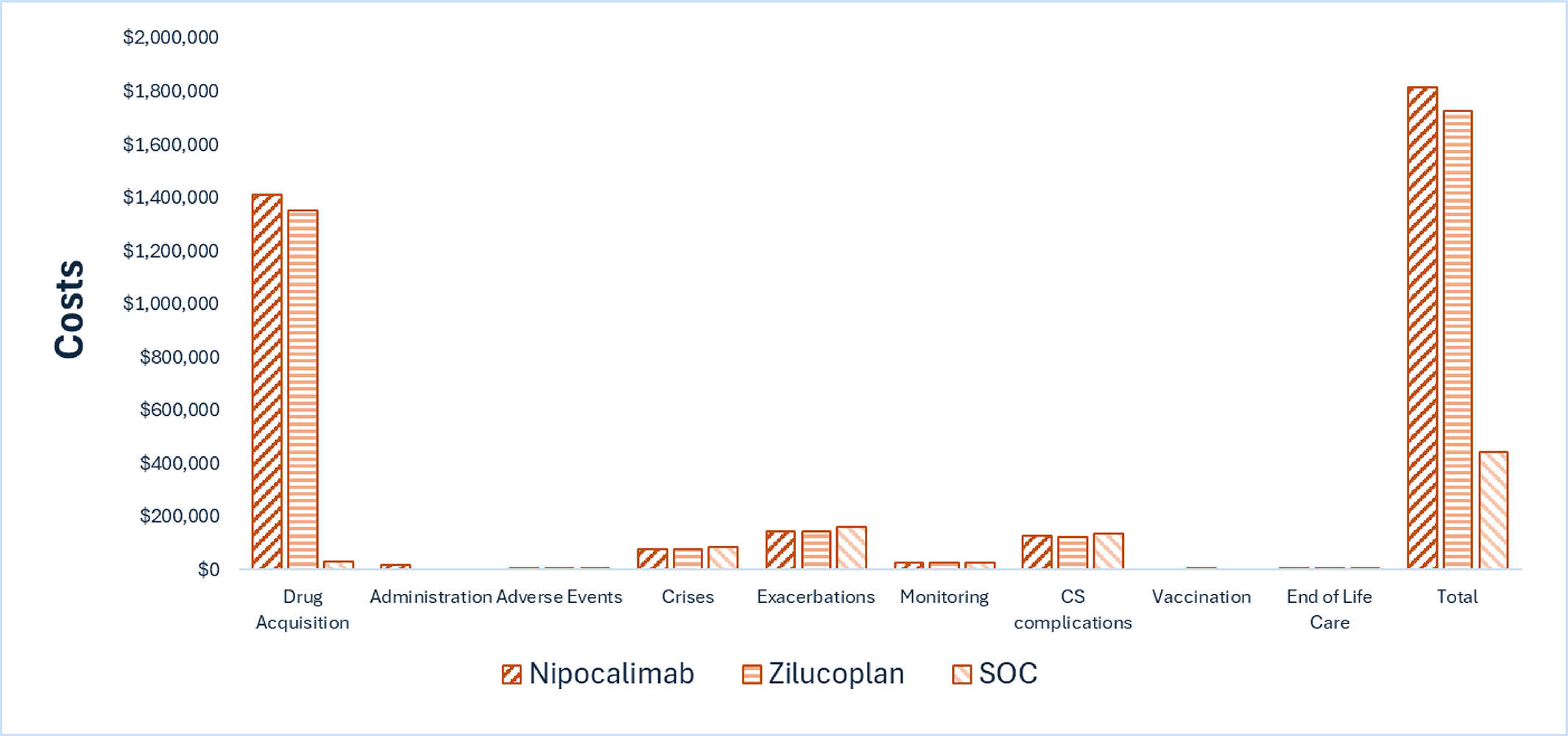
CS = corticosteroid; SOC = standard of care; vs. versus.
Note: Results for efgartigimod, ravulizumab, rozanolixizumab are not presented in this figure. Refer to Appendix 11 in the Supplemental Material document for full results.
Impact on Health
Relative to zilucoplan plus SOC, nipocalimab plus SOC is predicted to result in 0.04 fewer quality-adjusted life-years per patient (refer to Supplemental Material document, Appendix 11, Table 26).
Overall Results
The results of the CDA-AMC base case suggest that nipocalimab plus SOC is dominated by zilucoplan plus SOC, being more costly and less effective (refer to Table 9). Additional details on the CDA-AMC base case are available in Supplemental Material document, Appendix 11.
Based on the CDA-AMC analysis, the following treatments are on the cost-effectiveness frontier (that is, they are not dominated by other treatments): SOC and zilucoplan plus SOC.
Table 9: Summary of CDA-AMC Economic Evaluation Results
Drug | Total costs ($) | Total QALYs | Sequential ICER ($/QALY) |
|---|---|---|---|
SOC | 442,628 | 16.13 | Reference |
Zilucoplan plus SOC | 1,726,864 | 16.49 | 3,598,947 |
Nipocalimab plus SOC | 1,812,890 | 16.44 | Dominated through zilucoplan plus SOC |
CDA-AMC = Canada’s Drug Agency; ICER = incremental cost-effectiveness ratio; QALY = quality-adjusted life-year; SOC = standard of care; vs. = versus.
Note: Publicly available list prices were used for all comparators. Apart from nipocalimab, comparators that were dominated or extendedly dominated were not reported in this table. Refer to Appendix 11 in the Supplemental Material document for full results.
Uncertainty and Sensitivity
Due to a lack of robust comparative clinical data, the relative efficacy and safety of nipocalimab compared to other add-on therapies for gMG is highly uncertain. The impact of assuming equivalent efficacy and safety between add-on comparators was explored in scenario analyses (refer to Table 29, Appendix 11). Based on the results of this analysis, nipocalimab and all other add-on comparators were dominated by efgartigimod, resulting in higher costs when being assumed equivalent in efficacy.
Summary of the Budget Impact
The sponsor submitted a BIA to estimate the 3-year (2026 to 2028) budget impact of reimbursing nipocalimab for use in the proposed Health Canada–indicated population and the reimbursement requested population. The sponsor assumed that the payer would be CDA-AMC–participating public drug plans and derived the size of the eligible population using an epidemiologic approach. The price of nipocalimab was aligned with the price included in the sponsor’s economic evaluation, while the prices of comparators were based on the publicly available list prices. Additional information pertaining to the sponsor’s submission is provided in the Supplemental Material document, Appendix 12.
CDA-AMC identified a number of issues with the sponsor’s estimated budget impact and made changes to model parameters and assumptions, in consultation with clinical experts to derive the CDA-AMC base case (Supplemental Material document, Appendix 12). CDA-AMC estimated that by year 3 of reimbursement, if funded for its full Health Canada indication, 5,854 patients would be eligible for nipocalimab; of these, 822 patients would be expected to receive nipocalimab. The estimated incremental budget impact of reimbursing nipocalimab is predicted to be approximately $705 million over the first 3 years, with an expected expenditure of $706 million on nipocalimab. If funded for the sponsor’s narrower reimbursement request population, 1,380 patients would be eligible for nipocalimab by year 3, of whom 194 patients would be expected to receive nipocalimab. The estimated incremental budget impact of reimbursing nipocalimab for the reimbursement request population is predicted to be approximately $154 million, with an expected expenditure of $166 million on nipocalimab. The actual budget impact will depend on the number of people eligible for treatment and the uptake of nipocalimab.
Conclusion
Based on the CDA-AMC base case as well as the sponsor’s base case, nipocalimab plus SOC would not be considered cost-effective at the submitted price, regardless of what the public health care system was willing to pay for each additional quality-adjusted life-year gained, because zilucoplan plus SOC was more effective and less costly. A price reduction could be considered, which would make nipocalimab plus SOC less costly than zilucoplan plus SOC, but unlikely to be deemed cost-effective relative to SOC (refer to Figure 3; full details of the impact of price reductions on cost-effectiveness are presented in Supplemental Material document, Appendix 11, Table 28). The estimated cost-effectiveness of nipocalimab plus SOC compared to the included add-on therapies is uncertain due to uncertainty in the relative clinical efficacy and safety between comparators. If equal efficacy and safety are assumed between add-on comparators, then the cost of nipocalimab should not exceed the cost of the least expensive add-on therapy reimbursed for the treatment of gMG which is inadequately controlled with SOC alone. The cost-effectiveness of nipocalimab in adolescent patients or those with anti-MuSK antibody–positive gMG is unknown.
The budget impact of reimbursing nipocalimab to the public drug plans in the first 3 years, if funded for its full indicated population, is estimated to be approximately $705 million, with a 3-year estimated expenditure on nipocalimab of $706 million. (i.e., not accounting for current expenditure on comparators). If funded for the sponsor’s narrower reimbursement request population, the budget impact of reimbursing nipocalimab is estimated to be $154 million, with an expected expenditure of $166 million on nipocalimab.
Figure 3: Summary of the CDA-AMC Economic Analysis and Price Reduction

CDA-AMC = Canada’s Drug Agency; ICER = incremental cost-effectiveness ratio; QALY = quality-adjusted life-year; SOC = standard of care.
Note: Expenditure includes only the drug cost of nipocalimab. The term dominated indicates that nipocalimab costs more and provides fewer QALYs than the comparator. Only comparators on the cost-effectiveness frontier have been included in this figure.
References
1.Janssen Research & Development. Clinical Study Report: Study Number: MOM-M281-011; Study Phase 3 [Date: 9 May 2024]. 2024.
2.Grob D, Brunner N, Namba T, Pagala M. Lifetime course of myasthenia gravis. Muscle Nerve. 2008;37(2):141-9. doi:10.1002/mus.20950 PubMed
3.Grover K, Gandhi K, Cloutier M, et al. Real-world treatment patterns among patients with generalized myasthenia gravis [Abstract P6.027]. 2025:
4.Breiner A, Widdifield J, Katzberg HD, Barnett C, Bril V, Tu K. Epidemiology of myasthenia gravis in Ontario, Canada. Neuromuscul Disord. 2016;26(1):41-6. doi:10.1016/j.nmd.2015.10.009 PubMed
5.Gilhus NE, Tzartos S, Evoli A, Palace J, Burns TM, Verschuuren J. Myasthenia gravis. Nat Rev Dis Primers. 2019;5(1):30. doi:10.1038/s41572-019-0079-y PubMed
6.Lazaridis K, Tzartos SJ. Autoantibody Specificities in Myasthenia Gravis; Implications for Improved Diagnostics and Therapeutics. Front Immunol. 2020;11:212. doi:10.3389/fimmu.2020.00212 PubMed
7.Avidan N, Le Panse R, Berrih-Aknin S, Miller A. Genetic basis of myasthenia gravis - a comprehensive review. J Autoimmun. 2014;52:146-53. doi:10.1016/j.jaut.2013.12.001 PubMed
8.Bubuioc AM, Kudebayeva A, Turuspekova S, Lisnic V, Leone MA. The epidemiology of myasthenia gravis. J Med Life. 2021;14(1):7-16. doi:10.25122/jml-2020-0145 PubMed
9.Qiu D, Xia Z, Jiao X, Deng J, Zhang L, Li J. Altered Gut Microbiota in Myasthenia Gravis. Front Microbiol. 2018;9:2627. doi:10.3389/fmicb.2018.02627 PubMed
10.Totzeck A, Ramakrishnan E, Schlag M, et al. Gut bacterial microbiota in patients with myasthenia gravis: results from the MYBIOM study. Ther Adv Neurol Disord. 2021;14:17562864211035657. doi:10.1177/17562864211035657 PubMed
11.Nemet AY, Kaiserman I, Mimouni M, Segal O, Vinker S. High prevalence of myasthenia gravis among rural adult populations. J Clin Neuromuscul Dis. 2014;16(2):47-50. doi:10.1097/CND.0000000000000054 PubMed
12.Samih M, Ahami AOT. Excessive Pesticide Use Likely to Cause the Onset of Myasthenia Gravis in the Moroccan Agricultural Population. Pak J Biol Sci. 2020;23(7):917-921. doi:10.3923/pjbs.2020.917.921 PubMed
13.Sheikh S, Alvi U, Soliven B, Rezania K. Drugs That Induce or Cause Deterioration of Myasthenia Gravis: An Update. J Clin Med. 2021;10(7):1537. doi:10.3390/jcm10071537 PubMed
14.Morren JA, Li Y. Myasthenia gravis: Frequently asked questions. Cleve Clin J Med. 2023;90(2):103-113. doi:10.3949/ccjm.90a.22017 PubMed
15.Phillips LH, 2nd, Torner JC, Anderson MS, Cox GM. The epidemiology of myasthenia gravis in central and western Virginia. Neurology. 1992;42(10):1888-93. doi:10.1212/wnl.42.10.1888 PubMed
16.Finnis MF, Jayawant S. Juvenile myasthenia gravis: a paediatric perspective. Autoimmune Dis. 2011;2011:404101. doi:10.4061/2011/404101 PubMed
17.Taylor PC, Schett G, Huizinga TW, et al. Nipocalimab, an anti-FcRn monoclonal antibody, in participants with moderate to severe active rheumatoid arthritis and inadequate response or intolerance to anti-TNF therapy: results from the phase 2a IRIS-RA study. RMD Open. 2024;10(2):28. doi:10.1136/rmdopen-2024-004278 PubMed
18.Mullaney P, Vajsar J, Smith R, Buncic JR. The natural history and ophthalmic involvement in childhood myasthenia gravis at the hospital for sick children. Ophthalmology. 2000;107(3):504-10. doi:10.1016/s0161-6420(99)00138-4 PubMed
19.Parr JR, Andrew MJ, Finnis M, Beeson D, Vincent A, Jayawant S. How common is childhood myasthenia? The UK incidence and prevalence of autoimmune and congenital myasthenia. Arch Dis Child. 2014;99(6):539-42. doi:10.1136/archdischild-2013-304788 PubMed
20.Zhou J, Kuba A, Nilius S, Pilipczuk O, Tarancon T, Tennigkeit F. Incidence and Prevalence of Juvenile Myasthenia Gravis in the United States Between 2010 and 2020: Analysis of Two Claims Databases. Neurol Ther. 2025;14(3):1093-1103. doi:10.1007/s40120-025-00750-w PubMed
21.Janssen Research & Development LLC. Clinical Study Report: MOM-M281-011. Phase 3, multicenter, randomized, double-blind, placebo-controlled study to evaluate the efficacy, safety, pharmacokinetics, and pharmacodynamics of nipocalimab administered to adults with generalized myasthenia gravis [internal sponsor's report]. August 1, 2024.
22.Janssen Research & Development LLC. Clinical Study Report: 80202135MYG2001. An open-label uncontrolled multicenter study to evaluate the pharmacokinetics, pharmacodynamics, safety and activity of nipocalimab in children aged 2 to less than 18 years with generalized myasthenia gravis [internal sponsor's report]. February 19, 2025.
23.Janssen Inc. Imaavy (nipocalimab for injection): 300 mg/1.62 mL and 1200 mg/6.5 mL solution, for intravenous use [product monograph]. Updated December 5, 2025.
24.Gilhus NE, Jacob S, Hashim M, et al. Network connectivity, between-study heterogeneity and timepoint challenges in generalized myasthenia gravis: a feasibility assessment of indirect treatment comparisons. J Comp Eff Res. 2025;14(6):e250009. doi:10.57264/cer-2025-0009 PubMed
25.Dias S, Sutton AJ, Ades AE, Welton NJ. Evidence synthesis for decision making 2: a generalized linear modeling framework for pairwise and network meta-analysis of randomized controlled trials. Med Decis Making. 2013;33(5):607-17. doi:10.1177/0272989X12458724 PubMed
26.Barnett C, Herbelin L, Dimachkie MM, Barohn RJ. Measuring Clinical Treatment Response in Myasthenia Gravis. Neurol Clin. 2018;36(2):339-353. doi:10.1016/j.ncl.2018.01.006 PubMed
ISSN: 2563-6596
Canada’s Drug Agency (CDA-AMC) is a pan-Canadian health organization. Created and funded by Canada’s federal, provincial, and territorial governments, we’re responsible for driving better coordination, alignment, and public value within Canada’s drug and health technology landscape. We provide Canada’s health system leaders with independent evidence and advice so they can make informed drug, health technology, and health system decisions, and we collaborate with national and international partners to enhance our collective impact.
Disclaimer: CDA-AMC has taken care to ensure that the information in this document was accurate, complete, and up to date when it was published, but does not make any guarantee to that effect. Your use of this information is subject to this disclaimer and the Terms of Use at cda-amc.ca.
The information in this document is made available for informational and educational purposes only and should not be used as a substitute for professional medical advice, the application of clinical judgment in respect of the care of a particular patient, or other professional judgments in any decision-making process. You assume full responsibility for the use of the information and rely on it at your own risk.
CDA-AMC does not endorse any information, drugs, therapies, treatments, products, processes, or services. The views and opinions of third parties published in this document do not necessarily reflect those of CDA-AMC. The copyright and other intellectual property rights in this document are owned by the Canadian Agency for Drugs and Technologies in Health (operating as CDA-AMC) and its licensors.
Questions or requests for information about this report can be directed to Requests@CDA-AMC.ca.