Drugs, Health Technologies, Health Systems
Reimbursement Review
Anifrolumab (Saphnelo)
Sponsor: AstraZeneca Canada Inc.
Therapeutic area: Systemic lupus erythematosus (SLE)
Summary
What Is Systemic Lupus Erythematosus?
Lupus is a chronic and debilitating rheumatic autoimmune disease and systemic lupus erythematosus (SLE) is the most common and serious form of the disease; diagnosing SLE is complex as the disease presents in a heterogenous fashion, with initial symptoms often nonspecific (e.g., fatigue, arthralgia, anorexia) and with further manifestations presenting over a course of months or years.
What Are the Treatment Goals and Current Treatment Options for SLE?
The goals of treatment for active, autoantibody-positive SLE are to achieve definition of remission in SLE remission or lupus low disease activity score (LLDAS), prevent organ damage accrual, minimize glucocorticoid exposure, and improve health-related quality of life.
Treatment options that support shared decision-making, reflect disease severity, and address individual circumstances were identified as important outcomes in the patient group input. Other important outcomes identified through clinician input include reduced oral corticosteroid (OCS) use, LLDAS, and definition of remission in SLE remission.
Hydroxychloroquine remains the standard of care for patients; immunosuppressive therapy such as methotrexate, azathioprine, and mycophenolate are used in moderate to severe disease and glucocorticoids are used in the context of disease flares. Patients with moderate to severe disease activity despite treatment would be considered for additional lupus-specific treatments such as belimumab or Saphnelo.
What Is Saphnelo and Why Did CDA-AMC Conduct This Review?
Saphnelo is a drug that is administered by subcutaneous (SC) injection. Health Canada has approved both the IV formulation and SC formulation of Saphnelo as an addition to standard therapy for the treatment of adult patients with active, autoantibody-positive SLE.
Canada’s Drug Agency (CDA-AMC) reviewed Saphnelo to inform a recommendation to the participating public drug programs on whether it should be reimbursed for the indication approved by Health Canada on March 5, 2026.
How Did CDA-AMC Evaluate Saphnelo?
CDA-AMC reviewed the clinical evidence on the beneficial and harmful effects, as well as the economic evidence, of Saphnelo versus other treatments used in Canada for active, autoantibody-positive SLE.
Saphnelo SC was reviewed through a product variation tailored review process that focuses on whether the drug under review has similar clinical benefit and harms to 1 or more appropriate comparators, and whether Saphnelo SC should be reimbursed in accordance with the existing reimbursement criteria for Saphnelo IV.
The review was informed by materials submitted by the sponsor, which included clinical and economic evidence.
The review was also informed by 3 patient group submissions and 3 clinician group submissions in response to our call for input and by input from the participating public drug programs around issues that may impact their ability to implement a recommendation.
Two rheumatologists from Ontario were consulted as part of the review process.
What Did CDA-AMC Find?
Clinical Evidence
CDA-AMC reviewed the following clinical evidence:
1 randomized controlled phase III trial (TULIP-SC) comparing Saphnelo SC with placebo in 367 patients with SLE.
For the comparison of Saphnelo SC versus placebo:
There was an increased British Isles Lupus Assessment Group-based composite lupus assessment response at 52 weeks (rate difference [RD] = 19.1%; 95% confidence interval [CI], 9.0% to 29.2%; P = 0.0002) and British Isles Lupus Assessment Group-based composite lupus assessment response with maintained or low OCS use at 52 weeks (RD = 22.3%; 95% CI, 12.3% to 32.2%; P < 0.0001), versus placebo, although the results are imprecise based on the threshold of approximately 14% provided by clinical experts.
There was a reduction in the proportion of patients with an OCS dose of 7.5 mg per day or less (RD = 21.0; 95% CI, 7.2% to 34.8%; P = 0.0029) and an increase in the proportion of patients with a Systemic Lupus Erythematosus Responder Index response (RD = 15.7%; 95% CI, 5.7% to 25.7%; P = 0.0020), although the results are imprecise based on the threshold of approximately 14% provided by clinical experts.
Results for the annualized flare rate were not significant between study arms (rate ratio = 0.78; 95% CI, 0.57 to 1.08; P = 0.1311).
According to the clinical experts consulted for this review, the reporting of harms was as they expected and broadly consistent with the safety profile for Saphnelo IV.
There was no direct clinical evidence to inform how Saphnelo SC compares with Saphnelo IV. The SC and IV formulations were compared in bioequivalence studies which were reviewed by Health Canada; the quality review team did not raise any major concerns regarding the review of the SC formulation, and the product has received its Notice of Compliance.
Economic Evidence
Saphnelo SC is available as solution for SC injection (120 mg/0.8 mL; $1,736.14 per 4-pack unit). At the submitted price of $1,736.14 per 4-pack unit, the annual cost of Saphnelo SC is expected to be $22,647 per patient, based on the Health Canada–recommended dosage.
Compared to Saphnelo IV, funding of Saphnelo SC for use in the Health Canada-indicated population is expected to result in budget neutrality.
According to the Health Canada product monograph, the first dose of Saphnelo SC must be given under supervision of a health care professional. The sponsor provides a patient support program which absorbs these additional health care resource use costs to the public drug plans. The funding of Saphnelo SC is therefore not expected to increase health care resource use costs, contingent on the continued provision of the sponsor’s patient support program for Saphnelo SC and IV.
Funding Saphnelo SC can only achieve cost parity by negotiating its list price to match the confidential list price of Saphnelo IV.
The sponsor estimates that the budget impact of reimbursing Saphnelo SC for SLE will be neutral, with $0 to public drug plans for the first 3 years of reimbursement compared to the amount currently spent on Saphnelo IV, with an expected expenditure of $14 million on Saphnelo SC over this period. CDA-AMC was unable to provide a more robust estimate of the expected budget impact owing to a lack of reliable estimates. Whether there will be cost parity to the public drug plans, the extent of cost parity and the expenditure on Saphnelo SC is uncertain and will depend on the negotiated price of Saphnelo SC and its comparator.
Abbreviations
AE
adverse event
AESI
adverse event of specific interest
BICLA
British Isles Lupus Assessment Group-based Composite Lupus Assessment
BILAG
British Isles Lupus Assessment Group
CDA-AMC
Canada’s Drug Agency
CI
confidence interval
DB
double blind
DORIS
definition of remission in systemic lupus erythematosus
ERES
exposure-response exposure-safety
FAS
full analysis set
GC
glucocorticoid
HRQoL
health-related quality of life
IA
interim analysis
ICE
intercurrent event
ITT
intention to treat
LLDAS
lupus low disease activity score
MACE
major adverse cardiovascular event
NC
noncompliance
NOC
Notice of Compliance
OCS
oral corticosteroid
PGA
Physician’s Global Assessment
PEOT
premature end of treatment
PopPK
population pharmacokinetic
RD
rate difference
RM
restricted medication
SAE
serious adverse event
SC
subcutaneous
SLE
systemic lupus erythematosus
SLEDAI-2K
Systemic Lupus Erythematosus Disease Activity Index 2000
SOC
standard of care
SRI
Systemic Lupus Erythematosus Responder Index
VAS
visual analogue scale
Background
Sponsor’s Summary of Disease Background and Current Management
Application Summary
Table 1: Application Submitted for Review
Item | Description |
|---|---|
Drug (product) | anifrolumab (SAPHNELO), 120 mg in 0.8mL, solution for injection, sub-cutaneous |
Sponsor | AstraZeneca Canada Inc. |
Health Canada indication | Is indicated in addition to standard therapy for the treatment of adult patients with active, autoantibody positive, systemic lupus erythematosus (SLE). |
Sponsor’s reimbursement request | The proposed reimbursement criteria for SAPHNELO SC are aligned to the 2023 CDA-AMC Reimbursement recommendation for SAPHNELO IV |
Health Canada approval status | NOC |
Health Canada review pathway | Standard |
NOC date | March 5, 2026 |
NOC = Notice of Compliance.
Disease Background
Lupus is a chronic and debilitating rheumatic autoimmune disease that affects approximately 1 in every 1,000 Canadians, or approximately 0.1% of the population, and Systemic Lupus erythematosus (SLE) is the most common and serious form of the disease.2 Patients with SLE can experience a range of debilitating symptoms—including fatigue, joint pain, rashes, and serious organ involvement—significantly impacting their quality of life and leading to irreversible damage, increased morbidity, and mortality.2,3 As SLE remains incurable, treatment recommendations aim to target achieving remission and low disease activity, reduction in flares and steroid use, and prevention of further end-organ damage.
SLE is referred to as the “disease of a thousand faces,” as the clinical presentation, disease trajectory, and prognosis vary from patient to patient, and is dependent on the severity of the disease and the organ system(s) affected.4 The majority of patients (~70%) present with alternating periods of heightened disease activity (“flares”), which often require escalation in therapy, followed by periods of quiescence (remission). The annual flare rate, which represents the number of flares a patient experiences in a given year, is an important marker to describe disease severity in SLE. According to a retrospective cohort study using US commercial claims data among 2227 patients from 2004 to 2015, the overall annual flare rate was 3.5 per year per patient which increased with disease severity. Frequent flares can contribute to organ damage, further diminishing the quality of life, thus any evidence that novel therapies can reduce flare rates represents an important clinical outcome in SLE management.
Symptoms in early stage disease may manifest as being flu-like, along with severe fatigue, weight fluctuation, headaches, hair loss, hives, high blood pressure, a red rash across upper cheeks and bridge of nose (“butterfly rash”) as well as possibly cold induced changes in the colour of fingers due to decreased blood flow (Raynaud’s phenomenon).2,3 In particular, skin involvement affects 80% of patients with SLE,5 and is associated with an impaired quality of life, especially with respects to the patient’s emotional wellbeing.6 Patients with cutaneous lupus have worse quality of life than those with other common dermatologic conditions, such as acne, non-melanoma skin cancer, and alopecia.6 In addition, patients report that fatigue and arthralgia (joint pain) are two of the most persistent and bothersome symptoms of SLE.4 Commonly affected joints include the fingers, wrists, and knees, with up to 44% of patients developing osteonecrosis, despite young age.7 Several studies have identified that both fatigue and pain are key drivers of reduced health-related quality of life (HRQoL), especially among women,8 and contribute to sleep disturbances and comorbid psychiatric disorders, such as depression and anxiety.
While the 10-year survival rate for SLE remains elevated since the advent of 21st century therapies, the most frequent causes of death are often due to secondary organ involvement, particularly, infections and diseases of the cardiovascular, renal, pulmonary, and central nervous systems.9 Indeed, end-organ damage progresses and accrues over the course of the disease, even during periods of remission, and is often worsened by certain SLE therapies such as glucocorticoids (GC). GC use and SLE organ damage follow a dose-response relationship; the cumulative probability of damage-free survival is 44% in patients receiving prednisone at doses greater than 30 mg per day, 64% at doses less than 30 mg per day, 73% at doses less than 7.5 mg per day, and 86% with no prednisone use.10 Note, the EULAR-2003 recommendations for the management of SLE have recently lowered the maximum recommended maintenance dose to 5 mg/day from 7.5 mg/day.11 Estimates suggest that within 7 years of diagnosis, 61% of patients develop clinically detectable organ damage, where the most commonly affected systems are the neuropsychiatric (20.5%), musculoskeletal (18.5%), and renal (15.5%) organ systems.12 In particular, the use of GC to manage pathological inflammation associated with SLE has been linked to worsening organ damage,13 poorer quality of life,14 and increased mortality. Thus, reducing GC use remains a clinically- and patient-important treatment goal, as it can help limit irreversible organ damage.
Current Management and Place in Therapy of the Drug Under Review
Current Treatment Options
Systemic lupus erythematosus is a chronic autoimmune disease that causes a range of debilitating symptoms—including fatigue, joint pain, rashes, and serious organ involvement—significantly impacting quality of life and leading to irreversible damage, increased morbidity, and mortality.2,3,5,6,15 As SLE remains incurable, treatment recommendations aim to target achieving remission and low disease activity, reduction in flares and steroid use, and prevention of further end-organ damage.11,16
For decades, standard of care (SoC) relied on antimalarials, GC, and immunosuppressants, which are all non-specific therapies that broadly aim to suppress the immune system. Antimalarials are primarily used first-line for the management of SLE; GC and immunosuppressants are traditionally added for more severe symptoms but frequently require continued high doses, especially GC. As mentioned earlier, the use of GC to manage pathological inflammation associated with SLE has been linked to additional worsening organ damage,13 poorer quality of life and physical functioning,14 and increased mortality. Thus, reducing GC use remains a clinically- and patient-important therapeutic goal.
Although these older therapies remain the backbone of SLE management, they are associated with significant side effects, such as retinal toxicity from antimalarials, increased risk of infections and organ damage from corticosteroids, and adverse events from immunosuppressants, including infections and, in some rare cases, cancer. The recent introduction of SAPHNELO (anifrolumab) has provided SLE patients an option for targeted treatment and improved clinical outcomes. In particular, the intravenous (IV) formulation of SAPHNELO has addressed the need for innovative medicines that targets the lupus specific pathogenic pathway that can reduce disease activity, lower chronic and concomitant GC use, and lessen the severity and frequency of disease flares; and hence reduce the irreversible organ damage accrual.
Nevertheless, a significant challenge remains for both patients and the healthcare system. Monthly clinic infusions disrupt daily routines, work commitments, and family responsibilities—especially for those with mobility, transportation, or geographic barriers. A “one-hour infusion” often becomes a half- or full-day: 60–90 minutes of travel each way, 20–30 minutes for parking and check-in, plus time for pre-infusion labs and waiting. Many patients need a caregiver to drive and stay with them, doubling the time burden and complicating household schedules (childcare, eldercare, and limited weekday-only appointments).17,18 These demands drive emotional stress, financial strain from lost work time for both patient and caregiver, and lower adherence when logistics or side effects make attendance difficult. For rural and underserved patients, long distances, early departures, occasional overnight stays, and unreliable public transport further amplify fatigue and disruption.18 Regular infusion requirements strain clinic capacity, staffing, and scheduling, making consistent care harder to sustain. Delays in labs, pharmacy compounding, or nursing availability can cascade into longer visits, rescheduling, and waitlists—especially when chairs and appointments are tightly booked. Over time, these bottlenecks reduce flexibility, increase missed appointments, and burden providers with reactive workarounds.
Altogether, these burdens underscore a persistent need for more accessible and convenient treatment options that make long-term SLE management more sustainable for both patients and the healthcare system.
Key characteristics of SAPHNELO are summarized with other treatments available for SLE in the Supplemental Material document, Appendix 1.
Impact of the Drug Under Review on Treatment Options
The introduction of SAPHNELO marks a major advancement in SLE management, offering much needed innovation for patients. Unlike traditional agents, the IV formulation of SAPHNELO specifically targets key pathogenic pathways in SLE, leading to significant reductions in disease activity and organ damage, lowering chronic GC use, and decreasing the severity and frequency of disease flares.19,20 Long-term extension data from TULIP studies and real-world evidence further confirm the considerable efficacy and safety of SAPHNELO IV, demonstrating meaningful and sustained improvements in patient outcomes.21,22
Despite these advances, monthly clinic infusions continue to disrupt patients’ daily routines, work commitments, and family responsibilities, posing a significant burden to individuals living with the disease.17,18 This is especially challenging for those with mobility or transportation issues. There is a clear need for more convenient treatment options that reduce these burdens and support sustained disease management while easing demands on the healthcare system.23
The SC formulation of SAPHNELO offers SLE patients a more convenient alternative to monthly infusions, without compromising clinical benefit. The TULIP-SC trial demonstrated that SAPHNELO SC delivers robust and sustained improvements in disease activity compared to standard care, with a higher and faster rate of BILAG-based Composite Lupus Assessment (BICLA) response at 52 weeks. Both SC and IV formulations were well tolerated, and their therapeutic equivalence was demonstrated via pharmacokinetic (PK) analyses, confirming both formats can be used interchangeably. SAPHNELO SC provides an innovative treatment option that reduces patient burden while maintaining the proven efficacy and safety of the IV formulation.24,25 With SC administration, patients can avoid regular clinic visits and manage their treatment at home, offering greater independence and flexibility in daily life. This convenience may suggest improved treatment adherence and overall well-being for people living with SLE.18
SAPHNELO is a first-in-class therapy that has transformed SLE care, delivering proven efficacy and safety through both IV and anticipated SC formulations – achieving outcomes beyond standard treatments. The addition of the SC formulation not only removes barriers of frequent clinic visits and empowers patients to manage their disease at home but also offers greater choice and independence in how patients receive care. Reimbursement of SAPHNELO SC aligned to its IV alternative will expand patient access to a more convenient treatment option, enabling individuals to select the approach that best fits their day-to-day lives, while also improving quality of life, with no incremental impact on drug plan budgets. SAPHNELO SC should be reimbursed in line with the IV formulation to ensure that SLE patients in Canada can rapidly benefit from a more convenient treatment option with efficacy comparable to an already reimbursed alternative.
CDA-AMC Sources of Information and Summary of Input
This section was prepared by CDA-AMC based on materials submitted by the sponsor and input from interested parties.
The objective of the clinical review is to review and critically appraise the evidence submitted by the sponsor on the beneficial and harmful effects of anifrolumab 120 mg per 0.8 mL subcutaneous (SC) for the treatment of adult patients with active, autoantibody-positive SLE. The focus will be on comparing anifrolumab to relevant comparators in clinical practice in Canada and identifying gaps in the current evidence. This application has been submitted through the tailored review process. The focus of tailored reviews is whether the evidence supports that the drug under review demonstrates comparable clinical benefit and harms to appropriate comparators, as well as a comparison of drug acquisition costs and budget impact analysis. Belimumab, which was not recommended for reimbursement by Canada’s Drug Agency (CDA-AMC) for active, autoantibody-positive SLE, was not included in the review.
Table 2: Overview of Included Evidence
Study or analysis | Design | Role in the submission to Health Canada |
|---|---|---|
TULIP SC | Phase III, randomized, double-blind RCT | Provide evidence to evaluate the efficacy and safety of anifrolumab SC compared to placebo in the treatment of SLE |
Pharmacometrics report | Exposure-efficacy and exposure safety analysis of SC and IV anifrolumab | Provide evidence for Health Canada to evaluate the bioequivalence of anifrolumab SC compared to anifrolumab IV |
Population pharmacokinetics analysis | Population pharmacokinetic analysis of anifrolumab | Provide evidence for Health Canada to evaluate the bioequivalence of anifrolumab SC compared to anifrolumab IV |
CDA-AMC = Canada’s Drug Agency; RCT = randomized controlled trial; SC = subcutaneous; SLE = systemic lupus erythematous.
Notes: The focus of the CDA-AMC review is to evaluate the efficacy and safety of anifrolumab SC for the treatment of active, autoantibody-positive SLE. CDA-AMC defers to Health Canada for the evaluation and analysis of the bioequivalence of different formulations of anifrolumab.
Sources of Information
This report is informed by materials submitted by the sponsor and input received from interested parties. Calls for patient group and clinician group input are issued for each Reimbursement Review. We received 3 patient group submissions from Arthritis Consumer Experts, Lupus Canada, the Canadian Arthritis Patient Alliance and Lupus Ontario (joint submission), as well as 3 clinician group submissions from the Canadian Network for Improved Outcomes in SLE (authored by 28 clinicians), the Canadian Rheumatology Association (authored by 2 clinicians), and the Toronto Lupus Program (authored by 2 clinicians). The patient inputs compiled information from 8 anonymous patients who responded to the 2025 ACE National Survey on Lupus, a cross-sectional survey (n = 89) from patients in the Lupus Canada database which was conducted for the purpose of the patient input, findings from the 2022 Lupus Focus Group, 3 interviews with patients with SLE, input from the Lupus Ontario Medical Advisory Board, and findings from the 2019 Arthritis Society and Canadian Arthritis Patient Alliance survey. Eight patients indicated that they had experience with anifrolumab. The clinician group input compiled relevant information from the scientific and medical literature, searches of relevant guidelines and position papers, and additional expert input. The full submissions received are available on the project landing page in the consolidated input document. The drug programs provide input on each drug being reviewed through the reimbursement review process by identifying issues that may impact their ability to implement a recommendation.
Input from patient and clinician groups is considered throughout the review, including in the selection of outcomes to include in the clinical review and in the interpretation of the clinical evidence. Relevant patient and clinician group input is summarized in the Summary of Input section.
Each review team includes at least 1 clinical specialist with expertise in the diagnosis and management of the condition for which the drug is indicated. Clinical experts are a critical part of the review team and are involved in all phases of the review process. Two rheumatologists from Ontario with expertise in the diagnosis and management of SLE participated as part of the review team.
Summary of Input
Disease Background and Impacts of the Disease
The description of SLE provided by the clinical experts consulted for this review generally aligned with the sponsor’s summary of the disease background. The clinical experts further noted that the diagnosis of SLE is complex as the disease presents in a heterogenous fashion, with initial symptoms often nonspecific (e.g., fatigue, arthralgia, anorexia) and with further manifestations presenting over a course of months or years. The average duration from initial symptom onset to diagnosis may be as long as 5 to 7 years, and there are no specific laboratory abnormalities which in isolation lead to diagnosis. They noted that while a positive antinuclear antibody test is required to establish diagnosis, the presence of this result is not specific for SLE, as positive testing is found in populations who do not have SLE, and other disease states. The diagnosis of SLE is therefore not based on 1 specific laboratory investigation or clinical finding but rather a combination of historical features reported by patient, physical examination findings, presence of antibodies to nuclear antigens, and other immunologic and laboratory abnormalities (e.g., reduced complement, cytopenia, renal dysfunction) that lead to diagnosis.
While there are no Canadian guidelines for SLE treatment, clinical experts consulted for this review stated that clinicians tend to align with the 2023 update of the European Alliance of Associations for Rheumatology recommendations and the 2025 American College of Rheumatology guidelines for the management of SLE. They noted that a general treatment paradigm has shifted toward earlier introduction of biologic therapies and more rapid escalation, greater focus on achieving lupus low disease activity score (LLDAS) as a goal of therapy. They also emphasized the importance of less reliance on long-term GC therapy as well as recognizing organ damage accrual in patients due to GC therapy and persistent, mild to moderate disease.
Patient input noted that SLE has wide-ranging impacts on their lives, including financial (due to work absenteeism for appointments), ability to participate in daily activities, particularly physical activities, and emotional wellbeing. Survey results showed that 52% of those who responded reported daily or near-daily musculoskeletal symptoms including pain, swelling, joint stiffness; 44% reported headaches daily or near-daily, and 52% reported work impairment. Results from the Short Form (36) Health Survey, a validated quality of life questionnaire, show that domains of physical health tended to be most impacted, as well as low energy and fatigue scores suggesting general poor health. A total of 73% of patients reported that they have to make changes to their work and 49% reported having to take days off from work.
Treatment Goals and Treatment Options
Clinical experts consulted for this review and clinician group input agreed that the goals of treatment for active, autoantibody-positive SLE are to achieve remission (e.g., definition of remission in SLE [DORIS]) or low disease activity (e.g., achieving LLDAS), prevent organ damage accrual, minimize GC exposure, and improve HRQoL. They noted that the evolving philosophy is to lower GCs further even if the patient has low disease activity. These goals generally aligned with the sponsor summary. Patient input noted that they would prefer options that support shared decision-making, reflect both the disease severity and individual circumstances – they were also concerned with the risks associated with prolonged oral corticosteroid (OCS) use.
The clinical expert input and clinician group input on current standards of treatment also broadly aligned with the sponsor’s clinical summary, with some additional detail. They noted that hydroxychloroquine specifically remains the SOC for virtually all patients unless there is a contraindication, as it has evidence for improved survival along with flare reduction and potentially reducing organ damage. Immunosuppressive therapies such as methotrexate, azathioprine, and mycophenolate are used for moderate to severe disease, but are nonspecific in their immunosuppressive effects which increases the risk of toxicity with ongoing use. GCs are used in the context of disease flares for induction and control of moderate to severe disease activity. Patients with moderate to severe disease activity (measured by the Systemic Lupus Erythematosus Disease Activity Index 2000 [SLEDAI-2K] score, with ≥ 6 being moderate and ≥ 10 considered severe) despite hydroxychloroquine treatment and who need GCs to manage persistent disease activity or flares would be considered for additional lupus-specific treatments such as belimumab or monthly anifrolumab IV infusions, which would typically be added on to current therapy; these can be used even if patients have not yet tried other immunosuppressive therapies. The experts noted that anifrolumab and belimumab are the only therapies with SLE-specific targeted activity and which address the disease mechanisms of action. Rituximab is used off label in severe disease which is refractory to other therapies. Patient input noted that medication management itself is a significant part of their daily lives, requiring them to coordinate complex medication schedules, laboratory monitoring, and sometimes scheduling regular IV infusions during the time away from work, school, or family responsibilities. These demands can make travel difficult, limit spontaneity, and require careful planning around flares, treatment timing, and access to care.
In addition to pharmacologic treatment of SLE, the clinical experts also noted that nonpharmacologic measures for disease management include addressing cardiovascular risk modification (hypertension, dyslipidemia), assessing vaccination status, osteoporosis prevention, sun protection, smoking cessation, pregnancy planning, and collaboration with high-risk obstetric medicine teams if needed, mental health screening, and structured organ damage monitoring.
Unmet Needs and Existing Challenges
The clinical experts consulted for this review noted that achieving the goals of treatment, which are associated with maintaining long-term LLDAS, have been challenging in the past when biologic therapies were not yet readily available. While current therapeutic strategies have improved disease control and reduced flare frequency, other treatment goals including durable remission, GC independence, and preventing organ damage are not consistently achieved. Responses to biologic therapies are modest and nonresponse is common. Many patients achieve only partial disease control with persistent moderate activity, sustained remission without GCs is uncommon, and disease relapses are frequent even in patients with combined immunosuppressive and biologic therapy. Related to this, the experts noted that while biologics allow for GC tapering in some patients, chronic use remains prevalent and therefore the associated negative outcomes and GC-related complications (e.g., cardiovascular disease, osteoporosis, infection risk, metabolic complications, and cumulative organ damage) remain common. GC use and persistent disease activity both contribute to end-organ damage. A clinically meaningful subset of patients remains refractory despite receiving currently available therapies; refractory cutaneous lupus, cytopenias, neuropsychiatric disease, and lupus nephritis remain important and challenging manifestations to treat. The clinician group input broadly agreed with this, and further noted that treatment adherence is also a common concern among patients (approximately 40% to 75% of patients may not fully adhere to their treatments in the first few years after diagnosis). Overall, the experts and the clinician groups noted that there remains a need for treatments that can more effectively modify the underlying immune dysregulation and prevent long-term damage.
Clinical experts, clinician group input, and patient input all noted that patients of African, Asian, Hispanic, and Indigenous descent typically manifest higher disease severity and are at elevated risk of damage accrual and mortality. There also remains structural barriers to biologic access (e.g., lack of private health coverage, variability in provincial coverage rules for public reimbursement, distances travelled to hospital to receive treatment) which may amplify disparities. Both clinical experts and patient input noted that IV forms of therapy are typically administered in outpatient infusion centres which, while prevalent in large urban centres, are less available to patients living in remote or rural settings and this increases the burden of treatment with travel and associated costs such as time off work. The patient input survey reported that the majority of patients (73%) had to make changes to their work due to SLE, with 49% having to take days off. Some patients reported not being able to work or taking early retirement, although others did not report work impacts. In addition, clinical experts noted that females of childbearing age have additional clinical challenges around family planning, as immunosuppressive therapies are teratogenic and there is limited safety data in pregnancy for biologic therapies.
Patient input noted that SLE impacts nearly all aspects of their lives to varying degrees, with many reporting long delays in diagnosis, limited access to specialists and culturally appropriate care, and reimbursement barriers. Survey results showed a 44% loss in work productivity is attributable to SLE (measured by the Work Productivity and Activity Impairment questionnaire), as well as a 41% loss of productivity while at work. A total of 85.4% of patients who responded to the survey reported at least 1 flare in the past year, 38% reported at least 6 flares, and 6.7% reported more than 20 flares. When discussing barriers to care, 27% highlighted cost barriers, 41% noted they had insurance coverage issues, and 41% highlighted distance to the hospital or clinic. Among those who responded to the survey and who are currently receiving IV treatment (n = 13), 73% indicated they would prefer switching to SC injection or would consider it.
Considerations for Using the Drug Under Review
The contents within this section have been informed by input from the clinical experts consulted for the purpose of this review and from clinician groups. The implementation questions from the public drug programs and corresponding responses from the clinical experts consulted for this review are summarized in the Supplemental Material document, Appendix 1, Table 2. The following has been summarized by the review team.
Place in Therapy
Patient Population
The clinical experts consulted for this review and the clinician group input both noted that anifrolumab SC should be considered in the same place in treatment paradigms as the current IV formulation, and patients with antibody-positive, moderate (SLEDAI score ≥ 6) to severe (SLEDAI score ≥ 10) disease activity despite background hydroxychloroquine and GC treatment (particularly at doses > 7.5 mg per day) would be suitable candidates for treatment. The clinical experts consulted for this review further noted that it could also be used for patients who have had insufficient response to immunosuppressive therapies (e.g., methotrexate), but prior exposure to immunosuppressive therapies should not be required to initiate treatment; they noted that current guidelines position anifrolumab IV across the spectrum of disease activity and is considered equal to other conventional immunosuppressive therapies, and should therefore be positioned in line with these therapies.
Furthermore, clinical experts consulted for this review noted that any patient who would prefer the ability to self-administer treatment in SC form would be suited to receive anifrolumab SC if they met the disease activity requirements for anifrolumab; patients who are likely to respond to anifrolumab IV would also be likely to respond to the SC formulation. Patients with limited access to infusion centres due to geography, inability to travel, or time constraints due to family obligations may also benefit from the SC formulation. Clinician group input generally agreed with the experts on this. The experts also noted that patients with severe lupus nephritis proliferative forms or severe neuropsychiatric disease would not be suitable for anifrolumab treatment in either IV or SC form, and patients currently being managed with other biologic treatments (e.g., belimumab, rituximab) should not be treated with anifrolumab.
Given the context of SLE and the complexity of its diagnosis, the clinical experts likewise noted that many factors would need to be taken into account to diagnose moderate disease activity, including recent laboratory investigations, antibody status, immunologic factors (reduced complement factors), cell counts, and renal function or urinalysis, which are components used to calculate SLEDAI-2K measures for severity. Clinical examination would also identify clinical disease (e.g., mucocutaneous, inflammatory arthritis, serositis) consistent with moderate activity. They noted that anifrolumab treatment has been shown to be of benefit in patients who are autoantibody positive with moderate to severe disease, and testing for these immunologic factors is easily accessible in community laboratory settings.
Assessing Treatment Response
The clinical experts consulted for this review noted that management of SLE is individualized, often by disease severity and specific organ involvement, therefore clinicians may use several factors to determine efficacy. According to the treat to target recommendations of recent guidelines, goals of treatment include attaining LLDAS or DORIS remission. These are composite targets which require improvement of a SLEDAI score of 4 (LLDAS) or less (clinical SLEDAI score of 0 for remission) and maintenance of this clinical reduction in disease activity despite doses of prednisone of 7.5 mg or less or equivalent (LLDAS) or 5 mg or less (DORIS remission), with the patient being maintained with background hydroxychloroquine and/or stable biologic or immunosuppressive treatments. A reduction of SLEDAI-2K by 4 points, reduced prednisone to 7.5 mg per day or less (or equivalent), and achievement of LLDAS or DORIS remission would be considered treatment response; 1 expert noted that SLEDAI score reductions alone would not be sufficient, and that reductions in prednisone alongside with low disease activity would be considered a treatment response. Clinician group input noted that either a reduction in severity and frequency of symptoms (reflected by SLEDAI-2K and British Isles Lupus Assessment Group [BILAG] scores), a reduction in daily prednisone dose to 5 mg or less per day (or equivalent), or the reduction in frequency and intensity of flares could be considered a disease response. Patients with active disease started on biologic treatment should be assessed every 2 to 3 months. They noted that the renewal criteria proposed for anifrolumab IV align well with the proposed treatment response and could be easily implemented in practice.
Discontinuing Treatment
The clinical experts consulted for this review noted that treatment failure would be criteria for discontinuing. They defined this as either a lack of SLEDAI-2K response at 12 months (i.e., improvement of SLEDAI-2K by ≥ 4), inability to wean prednisone to less than 7.5 mg daily (or equivalent), or side effects or intolerance to treatment. The clinician group input broadly agreed and noted that discontinuing after 12 months in cases where no partial response could be demonstrated would be reasonable.
Prescribing Considerations
The clinical experts consulted for this review noted that treatment should be initiated and monitored by a physician with expertise in the management of SLE, ideally a rheumatologist or in the absence of one, an internist with experience managing this disease.
Sponsor’s Summary of the Clinical Evidence
Pivotal Studies
Table 3: Details of Included Studies
Characteristics | TULIP-SC |
|---|---|
Study design and population | |
Study design | DB RCT |
Locations | 145 Sites from the following countries: United States, Argentina, Bulgaria, Chile, Colombia, Germany, Hungary, Japan, Mexico, Philippines, Poland, Spain, Thailand, Ukraine, United Kingdom |
Patient enrolment dates | First patient enrolled: 08 June 2021 Last patient enrolled: 18 July 2024 |
Randomized (N) | N = 367 SAPHNELO (anifrolumab): N = 184 Placebo: N = 183 |
Inclusion criteria | 1. 18–70 years of age at time of signing the informed consent form 2. Diagnosis of SLE according to the ACR criteria ≥24 weeks prior signing the informed consent form 3. SLEDAI-2K score ≥6 (excluding points from fever, SLE headache, or organic brain syndrome) 4. Clinical SLEDAI-2K score ≥4 (excluding points from laboratory results) 5. BILAG-2004 organ domain score of ≥1 level A disease or ≥2 level B disease 6. PGA of disease activity score ≥1 (0–3 scale) 7. Seropositive for antinuclear antibodies, anti-double stranded DNA, or anti-smith antibodies 8. Weigh ≥40 kg at screening 9. Ongoing stable treatment with OCS doses and/or antimalarials and/or immunosuppressants (azathioprine, methotrexate, MMF or mizoribine) |
Exclusion criteria | 1. Receipt of intra-articular, IM or IV corticosteroids ≤8 weeks prior to day 1 2. History/current diagnosis of clinically significant non SLE-related vasculitis syndrome 3. Active severe or unstable neuropsychiatric SLE 4. Active severe SLE-driven renal disease 5. Diagnosis (within 1 year of enrolment) of mixed connective tissue disease or any history of overlap syndromes of SLE or systemic sclerosis 6. History of/current inflammatory joint of skin disease other than SLE 7. History of any non-SLE disease that required treatment with corticosteroids for >2 weeks within the last 24 weeks prior to enrolment |
Drugs | |
Intervention | SAPHNELO, 120 mg on 0.8 mL, sub-cutaneous injection, once weekly |
Comparator(s) | Placebo, sub-cutaneous injection, once weekly |
Duration | |
Screening phase | Up to 35 days |
Treatment phase | 52 weeks |
OLE Period | 52 weeks |
Outcomes | |
Primary end point | BICLA, a composite binary response defined by meeting all of the following criteria:
|
Publication status | |
Publications | Manzi, S., Bruce, I.N., Morand, E.F., Furie, R., Tanaka, Y., Kalunian, K.C., Askanase, A., Puzio, P., Khan, E., Wissmar, J., Song, M., Lindholm, C. and investigators, T.T.-S. (2026), Efficacy and Safety of Subcutaneous Anifrolumab in Systemic Lupus Erythematosus: the Randomized, Phase 3, TULIP-SC Study. Arthritis Rheumatol. Manuscript. https://doi.org/10.1002/art.7004126 |
ACR, America College of Rheumatology, BICLA, British Isles Lupus Assessment Group-based Composite Lupus Assessment, BILAG, British Isles Lupus Assessment Group 2004, DB, double-blind, DMARD, disease modifying antirheumatic drugs; DNA, deoxyribonucleic acid; HIV. human immunodeficiency virus, ICF, informed consent form, IV, intravenous, MMF, mycophenolate mofetil; N/A, not available, OCS, oral corticosteroid; OLE, open-label extension; PGA, Physician’s Global Assessment; RCT, randomized controlled trial, SLE, systemic lupus erythematosus; SLEDAI-2K, SLE disease activity index 2000; VAS, visual analog scale
Source: TULIP-SC Clinical Study Report27
Description of Studies
TULIP SC is a Phase III, multicenter, multinational, randomized, double-blind (DB), placebo-controlled study to evaluate the efficacy and safety of a SC treatment regimen of SAPHNELO versus placebo in adult patients with moderate to severe SLE despite receiving standard therapy.
In the TULIP-SC study, a total of 367 patients were randomized prior to interim analysis (IA) clinical data lock (13 September 2024) in a 1:1 ratio to receive a fixed SC 120 mg dose of SAPHNELO (n=184) or SoC (n=183) once weekly (QW) with the primary endpoint evaluated at week 52. The IA was conducted once approximately 220 randomized patients completed week 52 or withdrew early from the study (analysis conducted at data cut-off 23 July 2024). The final efficacy analysis was conducted on data up to the data cut-off date (DCO) of 23 August 2025.
The study design of TULIP-SC included four periods (Figure 1):28
A screening period of up to 35 days,
A double-blind treatment period of 52 weeks,
An open-label extension (OLE) period from week 52 to week 104, and
A follow-up period which was 12 weeks after the final dose.
The OLE was primarily designed to collect data on longer-term safety and tolerability.28
Randomization was stratified using the following factors:28
SLE disease activity index 2000 (SLEDAI-2K) score at screening (< 10 points versus ≥ 10 points),
Week 0 (day 1) oral corticosteroid (OCS) dose (< 10 mg/day versus ≥ 10 mg/day prednisone or equivalent), and
Results of the interferon (IFN) test at screening (high versus low).
Regardless of the IA efficacy results, the study was planned to continue until all patients had completed week 52 or withdrew early from the study.
Figure 1: Study Design for TULIP-SC
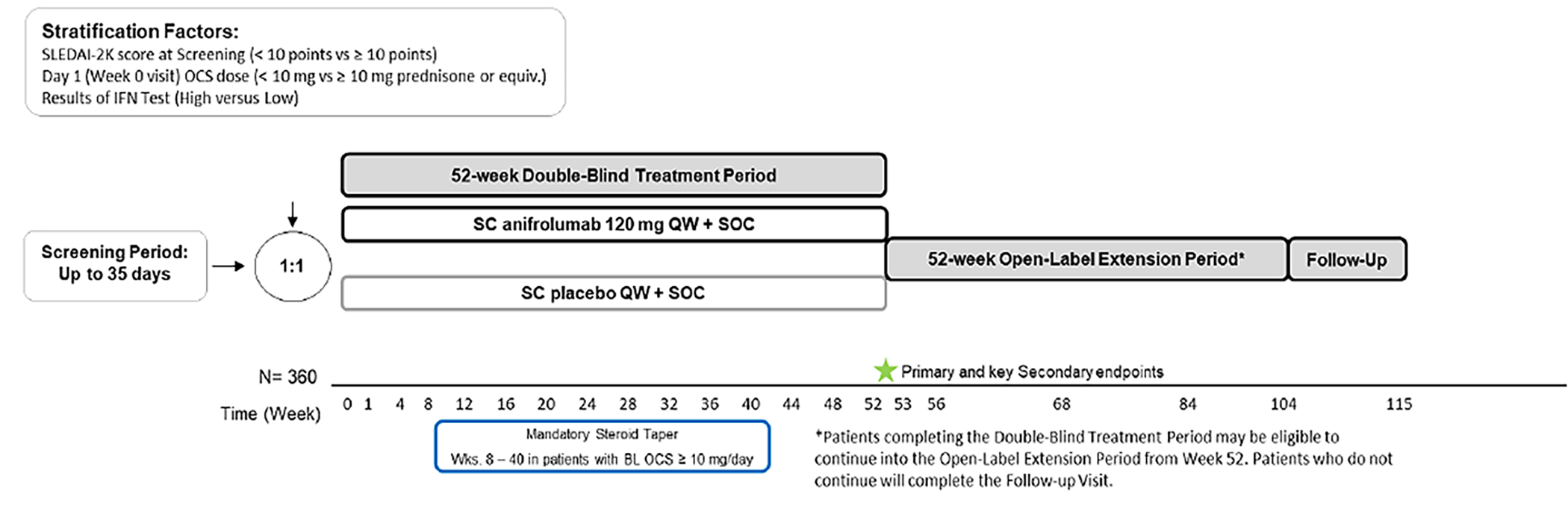
Abbreviations: BL, baseline; IFN, interferon; SC, subcutaneous; OCS, oral corticosteroid; SOC, standard of care; QW, once weekly; Wks, weeks; SLEDAI-2K, systemic lupus erythematosus disease activity index 2000
Source: TULIP-SC Clinical Study Report, Figure 127
Eligibility Criteria
Key inclusion and exclusion criteria for the TULIP-SC trial are presented below (Table 4).
Table 4: Key Inclusion and Exclusion Criteria of TULIP-SC
Inclusion criteria | Exclusion criteria |
|---|---|
|
|
Abbreviations: ACR, American College of Rheumatology; BILAG-2004, British Isles Lupus Assessment Group 2004; DNA deoxyribonucleic acid; IM, intramuscular; IV, intravenous; OCS, oral corticosteroid use; MMF, mycophenolate mofetil; PGA, Physician global assessment; SLE, systemic lupus erythematosus; SLEDAI-2K, SLE disease activity index 2000.
Source; TULIP-SC Clinical Study Report27
Interventions
Intervention and Comparator
SAPHNELO was administered subcutaneously via an accessorized prefilled syringe (aPFS) once a week during the double-blind treatment period (from Week 0 to Week 51 [total of 52 doses]). The placebo utilized in TULIP-SC is a matching placebo solution for injection also in an aPFS. Similar to the SC administration of SAPHNELO, it is a sub-cutaneous injection administered QW.
Concomitant Therapy
The following standard of care regimens were required:
Oral prednisone (or equivalent) monotherapy or
Antimalarials (e.g., hydroxychloroquine) and/or
Immunosuppressants with or without OCS
Medical Device
AstraZeneca’s manufactured combination product with a device constituent provided for use in this study is the aPFS. The aPFS is a single use, disposable system that is designed to deliver the labelled dose to the SC space during one injection and passively provide a safety mechanism to cover the used needle upon activation to reduce the occurrence of accidental needle sticks during disposal of the system. The aPFS consists of a prefilled syringe sub-assembly (1 mL prefilled syringe barrel with a 1/2-inch 27-gauge thin wall staked in needle, rigid needle shield, plunger stopper) and safety device.
Outcomes
A summary of the relevant outcomes assessed in the TULIP-SC trial is presented in Table 5, below.
Table 5: Summary of Relevant Outcomes and Associated Timepoints
Outcome measure | Timepoint | TULIP-SC |
|---|---|---|
BICLA, a composite binary response defined by meeting all of the following criteria:
| At Week 52 | Primarya |
Proportion of patients who are BICLA responders at Week 52, and have maintained low (or reduced) OCS use through Week 52
| At Week 52 | Key Secondarya |
The time from first dose of IP during the double-blind treatment period to first BICLA response sustained through Week 52. | Through Week 52 | Key Secondarya |
Time to flare through Week 52 where flare is defined as either one or more new BILAG-2004 A or 2 or more new BILAG-2004 B items compared to the previous visit | Through Week 52 | Key Secondarya |
Proportion of patients with baseline OCS ≥ 10 mg/day who have maintained OCS reduction through Week 52 defined by meeting all of the following criteria:
| Through Week 52 | Other Secondary |
Annualized flare rate through Week 52 with flare defined as either one or more new BILAG-2004 A or 2 or more new BILAG-2004 B items compared to the previous visit | Through Week 52 | Other Secondary |
Proportion of patients achieving a (SRI[4]) response at Week 52, defined by meeting all of the following criteria:
| At Week 52 | Other Secondary |
aStatistical testing for these endpoints was adjusted for multiple comparisons (e.g., hierarchal testing)
Abbreviations: BICLA, British Isles Lupus Assessment Group-based Composite Lupus Assessment; BILAG, British Isles Lupus Assessment Group; IP, investigational product; OCS, oral corticosteroids; PGA, Physician’s Global Assessment; SLEDAI-2K, Systemic Lupus Erythematosus Disease Activity Index 2000; SRI(4), Systemic Lupus Erythematosus Responder Index ≥4; VAS, visual analog scale.
Source: TULIP-SC Clinical Study Report, Table 127
Sample Size and Power Calculation
Approximately 360 patients were planned to be randomly assigned in a 1:1 ratio (180 patients per treatment group) to receive either a fixed SC dose of SAPHNELO (120 mg) or placebo once weekly. An IA was conducted once the first 220 randomized participants had completed Week 52 or withdrawn early from the study. Regardless of the interim efficacy result, the study was planned to continue until all participants had been randomized and completed Week 52 or withdrawn early from the study.
The sample size for the final analyses was determined based on a fixed study design, with the study powered to detect a clinically meaningful difference of at least 10% in the proportion of BICLA responders at Week 52 comparing SAPHNELO to placebo (primary endpoint). The assumed BICLA response proportions at Week 52 were 30.8% and 47.5% in the placebo and SAPHNELO groups, respectively (based on the pooling of observed results in the SAPHNELO studies NCT02446899 and NCT02794285). Randomizing 180 patients per treatment group would yield 90% power to reject the hypothesis of no difference using a 2-sided α of 0.05. The minimal detectable difference in BICLA between SAPHNELO versus placebo would be approximately 10% with this sample size. Calculations are based on a 2-group chi-squared test of equal proportions.
Statistical Testing
Please refer to the Supplemental Materials for detailed descriptions of statistical analysis methods used in the TULIP-SC study. To control for the type 1 error at 5% (two-sided) level across the primary and key secondary efficacy endpoints at interim and final analysis, an α spending approach will be used.
Analysis Methods
The FA was performed after all randomized participants had completed Week 52 or withdrawn early from the study. All efficacy analyses were based on data available as of the DCO, 23 August 2025. The DCOs for pharmacodynamics (21 June 2025) and PK and immunogenicity assessments (23 July 2025) were earlier than the DCO for the efficacy analyses.
The primary endpoint, BICLA response at Week 52, underwent hypothesis testing at the IA (DCO: 23 July 2024). As the observed p-value for the primary endpoint was ≤ α_IA of 3.54%, a statistically significant difference between the treatment groups was concluded based on the Pocock alpha spending function. Therefore, the primary endpoint was not tested again as part of the multiple testing procedure at the FA.
As the primary endpoint was statistically significant at the IA, the full α of 5% is preserved for the testing of key secondary endpoints at the FA. The key secondary endpoints were tested hierarchically using a 5% two-sided significance level in the following specified sequence:
Proportion of patients who are BICLA responders at Week 52, and have maintained low (or reduced) OCS use;
Time from first dose of study intervention to first BICLA response consecutively maintained through Week 52;
Time to first flare through Week 52.
The first key secondary endpoint was tested at an α level of 0.05. If the observed p-value was ≤ 0.05 and treatment effect favored the SAPHNELO group, a statistically significant difference between treatment groups was concluded, and the α of 0.05 was preserved for testing of the next key secondary endpoint. This was repeated until either the observed p-value was > 0.05 or the last key secondary endpoint had been tested. If the observed p-value was > 0.05 for one of the key secondary endpoints, no statistically significant difference was declared for that endpoint and p-values for all remaining key secondary endpoints were nominal and presented as descriptive statistics. This was tested formally through the primary estimands for the primary and key secondary endpoints.
The primary endpoint, BICLA response at Week 52, was analyzed for the IA using a stratified Cochran-Mantel-Haenszel (CMH) method. The key secondary endpoint, proportion of participants who were BICLA responders while maintaining low (or reduced) OCS use was analyzed for the FA by the same method. The key secondary endpoints, time to first sustained BICLA response and time to first flare were analyzed for the FA using a Cox proportional hazards model. Intercurrent events (ICEs) accounted for in the estimand included:
Restricted medication (RM) use
Premature end of treatment (PEOT)
Death
Non-compliance (NC) for reasons related to civil crisis, natural disaster, or public health crisis.
For the primary endpoint, participants who had ICE due to RM use, PEOT and/or death, the BICLA response after the ICE was set to non-response as per the composite strategy. For participants who had ICE due to NC, response after NC was imputed using the hypothetical strategy.
For the key secondary endpoint, proportion of participants who were BICLA responders while maintaining low (or reduced) OCS use, participants who had ICE due to RM use, PEOT and/or death, had their response after the ICE set to non-response as per the composite strategy. For participants who had ICE due to NC, response after NC was imputed using the hypothetical strategy.
For the key secondary endpoint time to first sustained BICLA response, participants who had ICE due to RM use, PEOT and/or death, had BICLA response after the ICE set to non-response as per the composite strategy. For participants who had ICE due to NC, the participant was censored after NC.
For the key secondary endpoint, time to first flare, ICE due to RM use, PEOT and/or death, resulted in a flare status from the visit for which the ICE occurs. For participants who had ICE due to NC, the participant was censored after NC. As of the DCO for FA, 23 August 2025, there were no NC events due to COVID-19. A total of 7 participants were impacted due to the ongoing crisis in Ukraine. Five of the participants were impacted due to the site’s or participant’s inability to adhere to CSP, resulting in IP discontinuation. Scheduled visits and assessments for these participants were impacted. Two of the participants were impacted by the inability to distribute IP as planned to site.
Supplemental and sensitivity analyses, including a treatment policy strategy and tipping point analyses were conducted to assess the impact of ICEs and robustness on the estimated treatment effect. Note the key secondary endpoints were not hypothesis tested at the IA under the multiple testing procedure, as pre-specified in the SAP. After the DCO for the IA, the study blind was maintained at the site and participant level, which was planned regardless of the outcome of the IA. The data monitoring committee (DMC) made the decision to unblind the study following the IA, with the decision endorsed by the URC (unblinded review committee).
Subgroup Analyses
To explore the uniformity of the detected overall treatment effect, subgroup analyses on the primary estimand are performed for the following factors at Week 52:
SLEDAI-2K score at screening (< 10 points versus ≥ 10 points)
OCS dose at baseline (< 10 mg/day versus ≥ 10 mg/day prednisone or equivalent)
IFN test at screening (high versus low)
Gender (Male, Female)
Age (≥ 18 to 65, ≥ 65 years)
Geographic region (Asia Pacific, Europe, Latin America, United States of America and Rest of the World)
Onset of disease (adult versus paediatric onset)
age at onset is calculated as: (diagnosis Year - birth Year) where diagnosis Year is collected in case report form BILAG Specific SLE History (BILAGHS).
age at onset ≥ 18 years is classified as adult and onset: <18 years as paediatric onset
BMI (≤ 28, > 28 kg/m2)
Race (White, Black or African American; Asian, native Hawaiian or other Pacific Islander, American Indian or Alaska native, Other). If a subject selects multiple races, the hierarchy selection order as specified in Section 4.1.4.1 is used to determine the race category.
Baseline Biomarkers (Low complement C3 and/or C4, or positive anti-dsDNA; Normal complement C3 and C4, and negative anti-dsDNA)
Anti-drug antibodies (ADA) result (positive at any time, negative, persistently positive, ADA positive with titer greater than median of maximum titer, and neutralizing antibody positive).
If there are too few subjects available for a meaningful analysis of a particular subgroup (it is not considered appropriate to present analyses where there are less than 20 subjects in combined treatment arms in a subgroup), the point estimates of treatment differences are not produced for that subgroup. In this case, only descriptive summaries for each treatment group are provided.
Treatment effect is estimated by the stratified CMH model. Summary table and forest plots reporting response rates, estimated differences with its 95% CI for treatment derived by the stratified CMH model are presented overall and by subgroups.
Analysis Populations
The analysis populations of TULIP-SC are outlined in Table 6, below.
Table 6: Analysis Populations of the TULIP-SC Trial
Population | Definition | Application |
|---|---|---|
Enrolled Analysis Set | All patients who have signed an ICF for the study. | For reporting disposition and screening failures |
Randomized Population Set | All patients who have been randomized. | For reporting of disposition tables and listings generation |
Full Analysis Set | All randomized patients who received at least 1 dose of study intervention and were analyzed according to their randomized treatment (modified Intention-To-Treat) irrespective of whether or not they received treatment as randomized or prematurely discontinued. Patients who withdrew consent to participate in the study were included up to the date of their study termination. | For reporting efficacy |
Safety Analysis Set | All patients who have received at least 1 dose of study intervention. Erroneously treated patients (e.g., those randomized to receive treatment A but actually given treatment B) were accounted for in the treatment group of the treatment they actually received. A patient who has on one or several occasions received SAPHNELO is classified in the SAPHNELO group. | For analysis of safety endpoints |
Pharmacokinetic Analysis Set | All patients who were randomized to treatment and who received at least 1 dose of SAPHNELO and who had at least 1 quantifiable serum PK observation post first dose of study intervention during the Double-Blind Treatment Period. | For reporting PK summaries |
Abbreviations: ICF = informed consent form, PK = pharmacokinetic
Source: TULIP-SC Clinical Study Protocol,28 TULIP-SC Statistical Analysis Protocol29
Sponsor’s Summary of the Results
Baseline Characteristics
The baseline characteristics of the TULIP-SC trial as of the FA data cut-off on August 23, 2025 are presented in Table 7.
Table 7: Baseline Characteristics Summary of the TULIP-SC Trial (FAS, FA Data Cut-Off 23 August 2025)
Characteristic | SAPHNELO SC 120mg (N = 184) | Placebo (N = 183) | Total (N = 367) |
|---|---|---|---|
Age, mean (SD), years | 42.5 (12.01) | 42.6 (11.97) | 42.5 (11.97) |
Sex, female, n (%) | 1165 (89.7) | 171 (93.4) | 336 (91.6) |
Race, n (%) | |||
White | 130 (70.7) | 143 (78.1) | 273 (74.4) |
Black or African American | 10 (5.4) | 7 (3.8) | 17 (4.6) |
Asian | 17 (9.2) | 15 (8.2) | 32 (8.7) |
Native Hawaiian or Other Pacific Islander | 0 | 0 | 0 |
American Indian or Alaska Native | 18 (9.8) | 13 (7.1) | 31 (8.4) |
Other/missing | 9 (4.9) | 5 (2.7) | 14 (3.8) |
Hispanic/Latino ethnic group, n (%) | 78 (42.4) | 74 (40.4) | 152 (41.4) |
Geographic region, n (%) | |||
United States of America | 24 (13.0) | 19 (10.4) | 43 (11.7) |
Europe | 77 (41.8) | 86 (47.0) | 163 (44.4) |
Asia | 13 (7.1) | 14 (7.7) | 27 (7.4) |
Latin America | 70 (38.0) | 64 (35.0) | 134 (36.5) |
Rest of World | 0 | 0 | 0 |
Median time from initial SLE diagnosis to randomization, months (range) | 87.737 (0.986-461.339) | 80.690 (0.854-466.431) | 84.107 (0.854-466.431) |
Baseline disease characteristics | |||
SLEDAI-2K score, mean (SD) | 11.1 (3.65) | 10.6 (2.94) | 10.8 (3.32) |
SLEDAI-2K score ≥10, n (%) | 127 (69.0) | 120 (65.6) | 247 (67.3) |
BILAG-2004 global score, mean (SD) | 18.4 (3.84) | 18.1 (3.60) | 18.3 (3.72) |
BILAG-2004 ≥1 A item, n (%) | 85 (46.2) | 70 (38.3) | 155 (42.2) |
BILAG-2004 no A item and ≥2 B items, n (%) | 93 (50.5) | 107 (58.5) | 200 (54.5) |
PGA score, mean (SD) | 1.91 (0.392) | 1.81 (0.372) | 1.86 (0.385) |
CLASI activity score, mean (SD) | 8.1 (6.13) | 8.0 (5.55) | 8.1 (5.84) |
SDI global score, mean (SD) | 0.4 (0.70) | 0.4 (0.83) | 0.4 (0.77) |
Patients with swollen joints, n (%) | 183 (99.5) | 177 (96.7) | 360 (98.1) |
Patients with tender joints, n (%) | 182 (98.9) | 177 (96.7) | 359 (97.8) |
Patients with active joints, n (%) | 180 (97.8) | 176 (96.2) | 356 (97.0) |
Baseline SLE treatments, n (%) | |||
OCS | 155 (84.2) | 147 (80.3) | 302 (82.3) |
Mean dose mg/day, n (SD) | 8.447 (6.177) | 7.615 (6.086) | 8.032 (6.138) |
OCS ≥10 mg/day, n (%) | 91 (49.5) | 80 (43.7) | 171 (46.6) |
Antimalarials | 150 (81.5) | 152 (83.1) | 302 (82.3) |
Azathioprine | 37 (20.1) | 32 (17.5) | 69 (18.8) |
Methotrexate | 40 (21.7) | 37 (20.2) | 77 (21.0) |
Mycophenolate* | 30 (16.3) | 25 (13.7) | 55 (15.0) |
Non-steroidal anti-inflammatory drugs | 28 (15.2) | 41 (22.4) | 69 (18.8) |
Active joints are defined for the joints where both swollen and tender are in the same joint. Immunosuppressant: azathioprine, mycophenolate mofetil/mycophenolic acid, methotrexate, cyclosporine, tacrolimus, or mizoribine.
*Mycophenolate or mycophenolic acid.
Abbreviations: BILAG, British Isles Lupus Assessment Group; BMI = body mass index; CLASI, cutaneous lupus erythematosus disease area and severity index; FAS, full analysis set; OCS, oral corticosteroid; PGA, Physician Global Assessment; SD = standard deviation; SDI, Systemic Lupus International Collaborating Clinics/American College of Rheumatology damage index; SLE, systemic lupus erythematosus; SLEDAI-2K, SLE disease activity index 2000; SoC, standard of care.
Source: TULIP-SC Clinical Study Report Table 10, Table 11, Table 1227
Patient Disposition
The patient disposition of the TULIP-SC trial is outlined in Table 8, below.
Table 8: Patient Disposition of the TULIP-SC Trial (FAS, FA Data Cut-Off 23 August 2025)
Characteristics | TULIP-SC | ||
|---|---|---|---|
SAPHNELO SC 120 mg, n (%) | Placebo, n (%) | Total, n (%) | |
Subjects screened | 695 | ||
Screen failure | 328 | ||
Subjects randomized | 184 | 183 | 367 |
Subjects randomized, not treated | 0 | 0 | 0 |
Subjects started double-blind treatmenta | 184 | 183 | 367 |
Subjects completed or discontinued double-blind treatment | 184 (100) | 183 (100) | 367 (100) |
Subjects completed double-blind treatment | 150 (81.5) | 141 (77.0) | 291 (79.3) |
Subjects discontinued double-blind treatment | 34 (18.5) | 42 (23.0) | 76 (20.7) |
Subject decision | 12 (6.5) | 14 (7.7) | 26 (7.1) |
Adverse event | 14 (7.6) | 8 (4.4) | 22 (6.0) |
Lack of therapeutic response | 2 (1.1) | 6 (3.3) | 8 (2.2) |
Development of study specific discontinuation criteria | 1 (0.5) | 1 (0.5) | 2 (0.5) |
Subject lost to follow-up | 0 | 2 (1.1) | 2 (0.5) |
Pregnancy | 1 (0.5) | 2 (1.1) | 3 (0.8) |
Other | 4 (2.2) | 9 (4.9) | 13 (3.5) |
Subjects ongoing study follow-up without entering open-label extension | 5 (2.7) | 4 (2.2) | 9 (2.5) |
Subjects completed study without entering open-label extension | 55 (29.9) | 49 (26.8) | 104 (28.3) |
Subjects withdrawn from study without entering open-label extension | 32 (17.4) | 42 (23.0) | 74 (20.2) |
Development of study-specific withdrawal criteria | 1 (0.5) | 3 (1.6) | 4 (1.1) |
Other | 3 (1.6) | 7 (3.8) | 10 (2.7) |
Death | 1 (0.5) | 0 | 1 (0.3) |
Adverse event | 4 (2.2) | 4 (2.2) | 8 (2.2) |
Lost to follow-up | 1 (0.5) | 3 (1.6) | 4 (1.1) |
Withdrawal by subject | 18 (9.8) | 17 (9.3) | 35 (9.5) |
Physician decision | 4 (2.2) | 8 (4.4) | 12 (3.3) |
Subjects enter open-label extension treatmentb | 92 (100) | 88 (100) | 180 (100) |
Subjects ongoing open-label extension treatment | 52 (56.5) | 47 (53.4) | 99 (55.0) |
Subjects completed open-label extension treatment | 31 (33.7) | 37 (42.0) | 68 (37.8) |
Subjects discontinued open-label extension treatment | 9 (9.8) | 4 (4.5) | 13 (7.2) |
Subject decision | 3 (3.3) | 2 (2.3) | 5 (2.8) |
Adverse event | 4 (4.3) | 0 | 4 (2.2) |
Lack of therapeutic response | 1 (1.1) | 2 (2.3) | 5 (2.8) |
Other | 1 (1.1) | 0 | 1 (0.6) |
Subjects ongoing study follow-up | 10 (10.9) | 13 (14.8) | 23 (12.8) |
Subjects completed study | 22 (23.9) | 24 (27.3) | 46 (25.6) |
Subjects withdrawn from study | 8 (8.7) | 4 (4.5) | 12 (6.7) |
Other | 2 (2.2) | 2 (2.3) | 4 (2.2) |
Adverse event | 1 (1.1) | 0 | 1 (0.6) |
Withdrawal by subject | 2 (2.2) | 1 (1.1) | 3 (1.7) |
Physician decision | 3 (3.3) | 1 (1.1) | 4 (2.2) |
Overall subject study statusa | |||
Subjects ongoing study follow-up | 15 (8.2) | 17 (9.3) | 32 (8.7) |
Subjects completed study | 77 (41.8) | 73 (39.9) | 150 (40.9) |
Subjects withdrawn from study | 40 (21.7) | 46 (25.1) | 86 (23.4) |
Development of study-specific withdrawal criteria | 1 (0.5) | 3 (1.6) | 4 (1.1) |
Other | 5 (2.7) | 9 (4.9) | 14 (3.8) |
Death | 1 (0.5) | 0 | 1 (0.3) |
Adverse event | 5 (2.7) | 4 (2.2) | 9 (2.5) |
Lost to follow-up | 1 (0.5) | 3 (1.6) | 4 (1.1) |
Withdrawal by subject | 20 (10.9) | 18 (9.8) | 38 (10.4) |
Physician decision | 7(3.8) | 9 (4.9) | 16 (4.4) |
aPercentages are based on the number of subjects who started double-blind treatment.
bPercentages are based on the number of subjects who started open-label extension treatment.
Screened subjects are those who signed informed consent. Discontinued treatment subjects are those who prematurely and permanently discontinued study intervention. Completed study subjects are those completed and exit study according study protocol.
Source: TULIP-SC Clinical Study Report Table 727
Exposure to Study Treatments
Study Treatments
The total PY of treatment exposure to SAPHNELO was 128.56 PY and was similar to the placebo group. A summary of the exposure duration between SAPHNELO and the placebo groups in the TULIP-SC trial is presented in Table 9, below.
Table 9: Exposure Duration to Study Treatments of TULIP-SC During Double-Blind Treatment (SAS, FA Data Cut-Off 23 August 2025)
Characteristics | SAPHNELO SC 120 mg (N=185) | Placebo (N=182) | Total (N=367) |
|---|---|---|---|
Total PYs of exposure | 170.78 | 163.66 | 334.45 |
Duration (days) | |||
N | 185 | 182 | 367 |
Mean | 337.2 | 328.5 | 332.9 |
SD | 97.14 | 100.10 | 98.58 |
Median | 364.0 | 364.0 | 364.0 |
Min | 29 | 29 | 29 |
Max | 448 | 462 | 462 |
Exposure duration is calculated as: (Last dosing date + 28 days) – first dosing date + 1.
The total PY of exposure is the sum of duration of exposure (days) of all patients in the respective treatment group divided by 265.25 (days/year).
Abbreviations: PY, patient year; SAS, safety analysis set; SD, standard deviation
Source: TULIP-SC Clinical Study Report Table 2927
Concomitant Medications and Co-Interventions
Prior to signing ICF, patients were required to be on one of the standard of care regimens – oral prednisone (or equivalent) monotherapy or antimalarials and/or Immunosuppressants with or without OCS.
During the DB treatment period in the study, non-protocol permitted changes to standard of care medications for SLE (e.g., OCS, antimalarials, immunosuppressants, etc.) were only allowed if necessary to treat an AE or increased disease activity. Further, patients were instructed not to start any new medications/regimens or make changes to any existing medications/regimens, including over-the-counter products, without first consulting the Investigator.
During the OLE treatment period in the study, permitted standard of care medications include OCS, antimalarials, and immunosuppressants but should not exceed maximally permitted doses as defined by the inclusion criteria. Please refer to the Supplemental Material document, Appendix 4, Table 4 for detailed information on exposure to concomitant interventions.
The use of concomitant medications was similar between patients in the SAPHNELO and placebo groups, both by Anatomical Therapeutic Chemical (ATC) classification and generic drug name, during the 52-week double-blind treatment period. The most frequently used concomitant medications were in ATC classifications of glucocorticoids (63.6%), anilides (23.6%), and mucolytics (12.7%).
The use of SLE-related treatments prior to study was similar between patients in the SAPHNELO and placebo groups. The most frequently used prior SLE-related treatments were methotrexate (22.7%), azathioprine (20.5%), and hydroxychloroquine (15.9%). Prior belimumab use in a total of 21 patients (9.5%) was balanced between the SAPHNELO and placebo groups. Rituximab use was reported in a total of 3 patients (1.4%), with one patient in the SAPHNELO group and 2 patients in the placebo group.
Baseline SLE-related treatments were generally balanced between the SAPHNELO and placebo groups (Table 13). However, the OCS use was higher in patients in the SAPHNELO group compared with the placebo group; a higher proportion of patients in the SAPHNELO group were taking immunosuppressants. These differences were not considered to have a meaningful impact on the interpretation of the results.
Non-SLE Steroid Use
During the DB treatment period, patients were allowed to receive one additional course of burst and taper corticosteroids for increased non-SLE disease activity (e.g., asthma, chronic obstructive pulmonary disease) between Week 12 and Week 40. In addition, patients were allowed to receive up to an additional 20 mg/day prednisolone (or equivalent) at the discretion of the Investigator for up to 14 days, or a single dose of IV hydrocortisone (≤ 100 mg hydrocortisone followed by half that dose for 2 days before returning to their usual dose) for a severe illness, surgery, or symptoms of adrenal insufficiency or corticosteroid withdrawal, if clinically warranted.
During the OLE period, patients were allowed to receive up to an additional 20 mg/day prednisone or equivalent at the discretion of the Investigator for up to 14 days or a single dose of IV hydrocortisone (≤ 100 mg hydrocortisone followed by half that dose for 2 days before returning to their usual dose) for a severe illness, surgery, or symptoms of adrenal insufficiency or corticosteroid withdrawal, if clinically warranted.
Efficacy
The efficacy data includes data available at the time of the DCO for the FA (23 August 2025). The primary objective of the study was met. Under the multiple testing procedure, the primary endpoint underwent hypothesis testing at the IA. SAPHNELO significantly improved SLEDAI-2K response compared with placebo and resulted in a statistically significant and clinically meaningful benefit in overall disease activity compared with placebo (59.4 versus 43.9; difference 15.5 [95% CI 2.3, 28.6]; p = 0.0211). The primary endpoint was not tested again as part of the multiple testing procedure at the FA.
Efficacy analyses at the FA were performed using the FAS for the FA that consisted of all (N = 367) randomized participants who completed Week 52 or withdrew early from the study. An overview of the results of the primary and key secondary analyses at the FA of the DB treatment period is presented in Table 10.
Results of the analysis of the primary endpoint at the FA were consistent with those at the IA and demonstrated the efficacy of SAPHNELO SC (Table 10). At the FA, treatment with SAPHNELO 120 mg SC QW added to standard of care provided a clinically meaningful benefit in overall disease activity, as assessed by BICLA response at Week 52, compared with placebo added to standard of care in adult participants with moderate to severe active SLE.
The key secondary endpoints were not hypothesis tested at the IA but were tested sequentially at the 2-sided α level of 5% for this FA. Results of the FA of the key secondary endpoints demonstrated the efficacy of SAPHNELO SC: statistically significant and clinically meaningful improvements were seen in the proportion of participants who were BICLA responders while maintaining low (or reduced) OCS use and time to first sustained BICLA response; a numerical delay in time to first flare was also observed (Table 10). Results at the FA were consistent with results at the IA. Results of the final analyses of the other secondary endpoints (OCS response, annualized flare rate, and SRI[4]) were also consistent with those observed at the IA and further demonstrated the efficacy of SAPHNELO SC. Clinically meaningful results of analyses of the exploratory endpoints of the proportion of participants who were DORIS remission responders at Week 52 and the proportion of participants who were LLDAS responders at Week 52 provided further evidence supporting the efficacy of SAPHNELO SC.
Table 10: Efficacy Variables and Overview of Key Results in the TULIP-SC Trial (FAS, FA Data Cut-Off 23 August 2025)
Variable | TULIP-SC | |
|---|---|---|
SAPHNELO SC 120 mg N = 184 | Placebo N = 183 | |
BICLA response rate at week 52 | ||
Responders, n (%) | 103 (56.2) | 68 (37.1) |
Rate Difference‡ (95% CI) | 19.1 (9.0, 29.2) | |
p-value | 0.0002 | |
BICLA response at week 52 with maintained Low (or reduced) OCS use, n (%) | ||
Responders, n (%) | 103 (56.2) | 62 (34.0) |
Rate Difference (95% CI) | 22.3 (12.3, 32.2) | |
p-value | <0.0001 | |
Time to BICLA response sustained through week 52, n (%) | ||
Responders†, n (%) | 76 (41.5) | 40 (22.6) |
Hazard ratio (95% CI) | 2.161 (1.482, 3.199) | |
p-value | <0.0001 | |
Time to first flare through week 52, n (%) | ||
Responders†, n (%) | 74 (40.9) | 87 (48.5) |
Hazard ratio (95% CI) | 0.757 (0.554,1.033) | |
p-value | 0.0798 | |
OCS dose of ≤7.5 mg/day at week 40, sustained through week 52, n (%) | ||
Responders, n (%) | 65 (71.4)* | 43 (50.4)* |
Rate Difference (95% CI) | 21.0 (7.2, 34.8) | |
p-value | 0.0029 | |
Annualized flare rate | ||
Number of events (Total Exposure time in Years) | 90 (157.6) | 110 (150.7) |
Adjusted ratea | 0.60 | 0.76 |
Rate ratio¥ (95% CI) | 0.78 (0.57, 1.08) | |
p-value | 0.1311 | |
SRI (4) | ||
Subjects with Event, n % | 121 (65.5) | 91 (49.8) |
Rate Difference (95% CI) | 15.7 (5.7, 25.7) | |
p-value | 0.0020 | |
Only patients with non-missing covariates/stratification factors were included in the analysis. At the interim analysis, only the primary endpoint was tested at 0.0354 level. The 0.0354 is determined based on the information fraction at the time of the interim analysis using Pocock spending function. All other p-values were nominal. The responder/non-responder rates (percentages) were performed using stratified CMH adjusting for the stratification factors. Missing data were imputed using multiple imputation as specified in the SAP, and all results were combined to obtain a single estimated treatment effect as per the Rubins rule.
Stratification factors levels were type I IFNGS test result = high and SLEDAI < 10 points, IFN = high and SLEDAI > = 10 points, and IFN = low.
‡A positive rate difference favours SAPHNELO.
†For time to BICLA sustained response and time to flare through week 52, Kaplan-Meier estimate with its 95% CI was presented for each treatment group. HRs, and 95% CIs for HRs were estimated using a Cox regression model with treatment groups and the stratification factors.
*For SAPHNELO group, N=66 and for SoC group, N=53
¥A rate ratio below 1 favours SAPHNELO.
aThe annualized flare rate is calculated as the number of flares divided by the flare exposure time in days multiplied with 365.25.
Abbreviations: BICLA, British Isles Lupus Assessment Group-based Composite Lupus Assessment; CI, confidence interval; OCS, oral corticosteroid; CMH, Cochran-Mantel-Haenszel; HR, hazard ratio; IFNGS, interferon gene signature; SD, standard deviation; SE, standard error, SRI = The Systemic Lupus Erythematosus Responder Index
Source: TULIP-SC Clinical Study Report, Table 14, Table 20, Table 23, Table 24
Primary Endpoint: BICLA Response at Week 52
The primary objective of the study was met at the IA: SAPHNELO significantly improved BICLA response compared with placebo and resulted in a statistically significant and clinically meaningful benefit in overall disease activity compared with placebo. For the primary endpoint at the FA, point estimates, CIs, and nominal p-values were produced but no hypothesis testing was conducted under the multiple testing procedure.
At the FA, participants treated with SAPHNELO 120 mg SC added to standard of care had a clinically meaningful benefit in overall disease activity compared with participants on placebo added to standard of care, as measured by proportion of participants with BICLA response at Week 52 (Table 10). Results at the FA were consistent with those at the IA. Patients treated with SAPHNELO added to SoC showed a statistically significant and clinically meaningful benefit in overall disease activity compared with those treated with SoC only. This was evidenced by a greater proportion of patients achieving the primary endpoint of BICLA response at week 52 following SC SAPHNELO treatment (59.4%) versus SoC only (43.9%) (Table 10). At week 52, 56.3% patients in the SAPHNELO group showed BILAG improvement compared to 38.4% in the SoC group, demonstrating the efficacy of SAPHNELO in reducing disease activity across all affected organs.30 A separation in BICLA response rate favoring SAPHNELO over placebo was apparent from Week 12 and was maintained throughout the DB treatment period, with nominal significance for treatment difference at all timepoints from Week 24 and onwards (Supplemental Materials).
Sensitivity Analyses
The results of a sensitivity analysis of the primary endpoint, excluding patients with no BILAG A or B at baseline, as well as those with a baseline Physician’s Global Assessment (PGA) Visual Analog Scale (VAS) score > 2.7, were consistent with the primary analysis and support the robustness of the primary efficacy results at the IA. Note, results at the FA were consistent with those at the IA.
Supplementary Analyses
The results of supplementary analyses of the primary endpoint were also consistent with the primary analysis at the IA, supporting the robustness of the observed treatment effect when targeting different estimands. As mentioned above, the results at the FA were consistent with those at the IA.
Subgroup Analyses
The treatment effect observed with SAPHNELO versus SoC in the overall population was generally consistent across pre-defined subgroups (SLEDAI-2K score at screening, OCS dose at baseline, IFN test high/low, gender, age, geographic region, disease onset, body-mass index, race, baseline biomarkers, and anti-drug antibody at anytime).
All subgroups had point estimates favoring SAPHNELO with the exception of the geographic region of the United States of America (n = 43) as well as Asian race (n = 32). For the United States of America and Asian race, the CIs were wide and overlapped with the treatment effect in the overall participant population. Given that the study was not designed or powered to assess efficacy in any individual subgroup, the results should be interpreted with caution.30 (Supplemental Materials)
Secondary Endpoints: Proportion of Patients Who Are BICLA Responders at Week 52 and Have Maintained Low (Or Reduced) OCS Use Through Week 52
A significantly greater proportion of participants treated with SAPHNELO 120 mg SC added to standard of care achieved a BICLA response at Week 52 while achieving or maintaining low OCS use through Weeks 40 to 52, compared with placebo added to SoC.30
Sensitivity Analyses
The results of a sensitivity analysis of the key secondary endpoint, BICLA response while maintaining low (or reduced) OCS use, excluding participants with no BILAG A or B at baseline, as well as those with a baseline PGA VAS score > 2.7, were consistent with the primary analysis and support the robustness of the primary efficacy results.
Supplementary Analyses
The results of supplementary analyses of the key secondary endpoint, BICLA response while maintaining low (or reduced) OCS use, were also consistent with the primary analysis, supporting the robustness of the observed treatment effect when targeting different estimands.
Subgroup Analyses
Consistent with results for the primary endpoint, subgroup analyses were generally consistent across pre-defined subgroups. Please refer to the Supplemental Material for more detail on the results of the subgroup analyses.
Time to First BICLA Response Sustained Through Week 52
Treatment with SAPHNELO 120 mg SC added to standard of care significantly reduced the time to the first BICLA response that was subsequently sustained up to and including Week 52, compared with placebo added to standard of care SoC (Table 10).
Sensitivity Analyses
The results of a sensitivity analysis of the key secondary endpoint, time to first sustained BICLA response, excluding participants with no BILAG A or B at baseline, as well as those with a baseline PGA VAS score > 2.7, were consistent with the primary analysis and support the robustness of the primary efficacy results. The results of a sensitivity analysis of the key secondary endpoint, time to first sustained BICLA response, dropping the requirement of at least 3 consecutive visits with BICLA responders, were consistent with the primary analysis and support the robustness of the primary efficacy results
Supplementary Analyses
The results of supplementary analyses of the key secondary endpoint, time to first sustained BICLA response, were also consistent with the main analysis, supporting the robustness of the observed treatment effect when targeting different estimands
Subgroup Analyses
Consistent with results for the primary endpoint, subgroup analyses were generally consistent across pre-defined subgroups.
Time to First Flare Through Week 52
Treatment with SAPHNELO 120 mg SC added to standard of care numerically delayed time to first flare, compared with placebo added to SoC (Table 10 and Supplemental Material).
OCS Response Rate
A higher proportion of participants with baseline OCS ≥ 10 mg/day receiving SAPHNELO 120 mg SC added to standard of care achieved an OCS dose of ≤ 7.5 mg/day at Week 40, which was maintained through Week 52, compared with participants receiving placebo added to SoC (Table 10).30
Annualized Flare Rate
There was a numerical reduction of the annual flare rate for the SAPHNELO 120 mg SC group compared with the placebo group (Table 10).30
SRI(4) Response Rate
A numerically higher proportion of participants treated with SAPHNELO 120 mg SC achieved an SRI(4) response at Week 52 compared with participants receiving placebo (Table 10).30
Harms
Safety Evaluation Plan
The following safety data were collected: vital signs, physical examination, 12-lead electrocardiogram, clinical laboratory tests (including haematology, clinical chemistry and urinalysis), Columbia Suicide Severity Rating Scale (C-SSRS) and adverse events (AEs) (including AEs of specific interest [AESIs]). The AEs experienced by the subjects were collected throughout the entire study and coded using the latest version of MedDRA. AESI as marked in the clinical study protocol included: non-opportunistic serious infections are defined by the investigator, opportunistic infections are defined by the investigator, herpes zoster (HZ), tuberculosis (TB) (including latent TB), malignancy, major adverse cardiovascular events (MACE), and injection site reaction (as assessed by the investigator).
Safety analyses were performed using the safety analysis set. Unless otherwise specified, safety data were presented using descriptive statistics referring to on double-blind treatment period and on study period. Missing safety data were generally not be imputed. AEs that have missing causality or intensity (after data querying) were left as missing.
Overview of Safety
SAPHNELO 120 mg SC QW was generally well tolerated in adult participants with moderate to severe SLE during 52 weeks of treatment. The safety profile of SAPHNELO 120 mg SC QW was consistent with the well-established safety profile of SAPHNELO 300 mg IV Q4W.
There were no new safety concerns identified. The analysis of safety data was based on the 52-week DB treatment period, including all available data up to the DCO for the FA (23 August 2025), irrespective of whether the participant had completed the 52-week DB treatment period or withdrawn from the study early (i.e., Safety Analysis Set) (N = 367). The incidence of any AE during the DB treatment period was 85.9% in the SAPHNELO 120 mg SC group and 78.6% in the placebo group (Appendix 5, Supplemental Materials). Most AEs were mild to moderate in intensity.
The proportions of patients with serious AEs (SAEs) were low and balanced between the SAPHNELO and placebo groups with no (preferred term) PT predominating during the 52-week DB treatment period (Appendix 5, Supplemental Materials). The proportions of patients with AEs leading to investigational product (IP) discontinuation were low in the SAPHNELO and placebo groups with no PT predominating during the 52-week DB treatment.
One participant in the SAPHNELO group had an AE with an outcome of death (PT: sepsis. Note: this PT was reported as gastrointestinal infection at the IA and was subsequently revised to sepsis at the FA) up to the date of the FA clinical data lock (Appendix 5, Supplemental Materials). The event was assessed as not possibly related to IP by the Investigator.
Withdrawals Due to Adverse Events
The proportions of patients with AEs leading to discontinuation of IP were low with no PT predominating during the 52-week DB treatment period.
Adverse Events of Special Interest
Based on the SAPHNELO mechanism of action and method of administration, AESIs included non-opportunistic serious infections, opportunistic infections, herpes zoster, tuberculosis (including latent tuberculosis), MACE, malignancy, and injection site reactions.
Infections
The protocol specified AESIs related to infections included non-opportunistic serious infections, opportunistic infections, herpes zoster, and tuberculosis (including latent tuberculosis). The incidence of infections was 67.0% (EAIR: 137.61 per 100 PY) in the SAPHNELO group and 58.8% (EAIR: 102.63 per 100 PY) in the placebo group during the 52-week DB treatment period (EAIR difference of 34.98; 95% CI: 4.24, 66.86).
Non-Opportunistic Serious Infections
The incidence of non-opportunistic serious infections was 7.0% (EAIR: 7.85 per 100 PY) in the SAPHNELO group and 3.3% (EAIR: 3.71 per 100 PY) in the placebo group during the 52-week DB treatment period (EAIR difference of 4.14 [95% CI −1.20, 10.14]).
Opportunistic Infections
No opportunistic infections were reported during the 52-week DB treatment period.
Herpes Zoster
Consistent with the known safety profile of SAPHNELO 300 mg IV, patients in the SAPHNELO 120 mg SC group had an increased incidence of herpes zoster compared with the placebo group during the 52-week DB treatment period. Most events were cutaneous localized, nonserious, mild or moderate in intensity, resolved with conventional therapy, and did not lead to IP discontinuation. In the SAPHNELO group, 3 of the 7 events had an onset during the first 12 weeks of treatment.
Tuberculosis
A total of one event of tuberculosis (including latent tuberculosis) was reported in the 52-week DB treatment period in the placebo group. The event was reported as extrapulmonary tuberculosis, was assessed as possibly related to IP by the Investigator, was categorized as an SAE, and led to IP discontinuation.
The start date for one event of latent tuberculosis in the SAPHNELO 120 mg SC QW group was updated after the DCO for the IA to reflect that the event began during screening. This event of latent tuberculosis is no longer treatment-emergent. The event in the placebo group was reported as extrapulmonary tuberculosis that was assessed as possibly related to IP by the Investigator, was categorized as an SAE, and led to IP discontinuation.
Major Adverse Cardiovascular Events
A total of 4 MACE events [cardiovascular event adjudication committee (CV-EAC) confirmed] were reported during the 52-week DB treatment period, 3 in the SAPHNELO group (adjudication outcomes: acute myocardial infarction [2 events], cerebrovascular accident) and one in the placebo group (adjudication outcome: acute myocardial infarction).
Malignancy
During the 52-week DB treatment period, no malignancies were reported for the SAPHNELO group; invasive ductal breast carcinoma was reported for one participant in the placebo group
Injection Site Reactions
The SAPHNELO 120 mg SC injection was well tolerated. The proportions of participants with AESI of injection site reactions were similar in the SAPHNELO group (29 participants [15.7%]) and in the placebo group (28 participants [15.4%]). Most injection site reaction AESIs were nonserious, mild/moderate in intensity, transient, and none led to discontinuation of IP. Most injection site reaction AEs were reported in the first 12 weeks of treatment in both treatment groups.
Similarity of Subcutaneous Drug Administration
Additional PK analyses were undertaken to compare SAPHNELO IV to SAPHNELO SC, and demonstrate therapeutic equivalence between the SC (120 mg weekly) and IV (300 mg monthly) formulations.
AstraZeneca applied population pharmacokinetic (PopPK) analyses to confirm that both dosing approaches achieve comparable drug levels. Exposure-response exposure-safety (ERES) analyses further support that these similar drug concentrations translate into similar efficacy, reinforcing the case for therapeutic equivalence between SAPHNELO SC and IV treatments.
Population Pharmacokinetic Analyses of SAPHNELO Subcutaneous Versus Intravenous Formulations
The primary goal of the PopPK analysis was to comprehensively characterize the PK profile of SAPHNELO by integrating data from the TULIP SC trial with ████ █████ ████████ ███████ ██████ █████████ ██████ █████████ █████ █ ██ ████ █████████ ████ ████ ███ ████████ ███ ███████ █████████24 Initially, the PopPK model was developed with the IA data set from TULIP-SC, and then updated with additional data from the FA data set of TULIP-SC. The analysis specifically aimed to confirm the relevance of previously identified covariates, assess the impact of additional factors such as race and region, compare exposure metrics between the 120 mg SC QW formulation and the IV 300 mg Q4W formulation, and establish optimal protocols for transitioning patients between IV and SC formulations while maintaining stable drug exposure | | ███████████████ ███████████ █████ ███ █████████ █████████████ ███████████ ██████████ ███ ████████ ███████████ ████ █████████ ██████ ███████████ ██████████ ████████ ████████ █████████ ████████ ███ ███████ ████████ ████ ███████ ██ ████████ ███████████ ███████ ████████ █████████ ████ ███████ ████ █████ ████████ ██████████ ██████████ ███ ██████ █████████ ███████ ████ ██████ ██████ ███ █████████ █████ █████ ████████ ███ █████████ █████ ███████████████ █████ ███ ██████ ██████████ ███████ ███ ███████████ ████ █████████ to determine the optimal timing for dose transitions between IV and SC administration.
The interim and final PopPK model adequately described the PK profile of SAPHNELO, confirming suitability for pooled data including the TULIP SC study. ███████████ ██████████ █████████ ██ ████████ ████ ███████ ███ ██████ █████████ ███████ ████████ ██████████ ██████████ ████ ████████ ████ ████ ██████ ██████████ ████████ ██ █████ ██████ ██ ████████ ███████ ██ ████████ █████████ ████ █████████ ██████ ███████ █████ ██ █ ███████ ██████████ █████████ ████████ ██████ ███ ███ ██████ ████████ █████████ ████████████ ███████ ██████ ████ ████ ██ ████ ██ ███ ███ ██ ████ ██ ████ ████████████ ███████ ███████ ████████████ █████████ ████ ███ ████ █████ ██ █████ ██████ ██ ██████ ████ ███ █████ ██████ ██ ██████ █████ ████████████████ ███████████ ██ ████████ ███████ ██████ ███ ████ ███████████ ███████ █████ ██ ████████ ██████████ ████████ █████████ ███ █████ ██ ████ ██ ████ █████ ███ █████ █████ ███ ████ ██ █████ ███ ███ █████ ██ ████ ██████ ██ █████ ████ █████ █████ ███ ████ ██ █████ The modelling results indicate there were no significant changes with the addition of subjects and samples in the FA compared to the IA data set, supporting that the two formulations can be used interchangeably.
Exposure-Response Analyses of SAPHNELO Subcutaneous Versus Intravenous Formulations
The primary objectives of the ERES analysis were to: (1) assess the relationship between SAPHNELO exposure and efficacy, measured by BICLA response at 52 weeks, using pooled data from the Phase III TULIP-1, TULIP-2, and TULIP SC studies (encompassing adult SLE patients treated with SAPHNELO via IV or SC routes); (2) evaluate the impact of patient covariates—including body weight, BMI, sex, age, race, renal function, albumin, gene signatures, anti-drug antibody (ADA) status, and administration route—on the exposure-response relationship; and (3) determine the exposure-response relationship for safety outcomes such as AEs, AESI, injection site reactions, and hypersensitivity, specifically within the TULIP SC study.25 ███ ████████ ███████ ████████ ████████ ███████ █████████████ ██ ██████ █████ ██████ ██████ █████ ██████ ████ █████ ███ █████ ████████ ███████ █████████████ ██████████ ███ ███████ █████████████ ██████████ ██████ ████████ ██████████ ███ ███████████ ████████ ████ ████████ ██ ████████████ ███ █████████████ ███████ ████ ████████ ███ ████ ████████ ██████ █████████ ███ ███ █████ ██ ██████ ██████████ ███ ███████ ██ ██████████ ████ ███████ ████████ ███████ ██████████ █████████ The ERES analysis was initially informed by the interim PopPK model, and then updated with the final PopPK model which included the FA data set of TULIP-SC.
███ ███████ ███ █████ ████ ████████ █████ █ ████████████ ████████ █████████████████ ████████████ ███████ ████████ █████████ ███ █████ ████████ ██ ██ █████ ██████ ███ ██████ ████ ███ ███ █████ ████████ █████████████ ██████████ ██████ ███ ██ ████ ██ ████ ███ ██ ██ █████████████ ██████████ ██████ ███ ████████ █████████ ███ ██ ██ ███ ███ █████ █████████ ███ ██ ██ ██ ██████ ██████████ █████████ ███ █████ ████████ ██████ ██████████ ███████████ ███████████ ███████ █████ █████████████ █████████ ███ █████ █████████ ███████████ ██ █████ ████████ ███ █ ██████ ████ ██ ████ █████ ████ ██████ ██ ███ ██ ██ ███ ███ █████ ████ ██ ███████████ █████ ███ ███████████ ██ ████████ ███ █ ██████ ████ ██ ████ █████ ████ ██████ ██ ███ ██ ██ ████ ███ █████ ████ ██ ██████████ ██████ ████ ██████████ ███████ █████████ ██████ ███ ███████████ ███████████ ███████ ██████ ██ █████████████████ ███ ███████ █████ ████ █ ███ ██████ ██ ██████ ███████ ██ ███████████ █████████████████ ████████████ █████ ██ ██████████ ███ ██████ █████████ ███ ███ ████████ ██████ ████████ ████████ █████████████ ███ █████ ███ ███ ██ ███ ███ ████ █ ████████ ███████ █████ ██ ██████ ███████ ███████████ █████████████████ ██████████ ███ ███████████ ██████ ██████ ██████ ████████ ████ ████████
Table 11: Probability of BICLA Response in 52 Weeks of the SAPHNELO SC 120 mg and IV 300 mg Formulations
Statistic | SAPHNELO SC 120 mg | SAPHNELO IV 300 mg |
|---|---|---|
Median Cave (CV%) | ██ ██ ██ | ██ ██ ██ |
Probability of BICLA response, % (90% PI*) | ██ ██ ██ | ██ ██ ██ |
*The prediction interval range defined by the 5th and 95th percentile of the predicted patient response.
The PopPK and ERES analyses include data from the FAS of the FA data cut-off (23 August 2025) of TULIP-SC, TULIP-1, and TULIP-2.
Abbreviations: BICLA, British Isles Lupus Assessment Group-based Composite Lupus Assessment; Cave, average concentration; CI, confidence interval; CV, coefficient of variation; IV, intravenous; PI; prediction interval; SC, subcutaneous; ss, steady state
Source: SAPHNELO ERES Report25
Conclusions
The PopPK and ERES analyses were undertaken to compare SAPHNELO IV to SAPHNELO SC, and demonstrate therapeutic equivalence between the SC (120 mg weekly) and IV (300 mg monthly) formulations. Overall, the SC and IV formulations of SAPHNELO provide equivalent efficacy and safety, supporting their interchangeable use for SLE management. These PK results are further reinforced by the consistent efficacy and safety observed across the pivotal TULIP studies. Moreover, both formulations demonstrated that higher SAPHNELO exposure was associated with increased probability of BICLA response at 52 weeks, and no exposure-response relationships could be identified for safety endpoints. Health Canada evaluated the therapeutic equivalence between the two formulations, and has approved Saphnelo SC on March 5th, 2026; additional information on interchangeability can be found in the Product Monograph.
CDA-AMC Critical Appraisal of the Clinical Evidence
This section was prepared by CDA-AMC based on the sponsor’s summary of the systematic review evidence and other material submitted by the sponsor.
Additional Results From the Included Studies
Table 12: Components of BICLA Response at Week 52 in the TULIP SC Trial (FAS)
Component of BICLA response | TULIP SC | |
|---|---|---|
Saphnelo SC 120 mg N = 184 | Placebo N = 183 | |
BILAG Improvement, n (%) | 104 (56.3) | 70 (38.4) |
No worsening of SLEDAI-2K, n (%) | 136 (73.7) | 125 (68.4) |
No worsening of PGA, n (%) | 137 (74.4) | 129 (70.4) |
BICLA = British Isles Lupus Assessment Group-based Composite Lupus Assessment; BILAG = British Isles Lupus Assessment Group; FAS = full analysis set; PGA = Physician’s Global Assessment; SC = subcutaneous; SLEDAI-2K = Systemic Lupus Erythematosus Disease Activity Index 2000.
Source: Details included in the table are from the sponsor’s TULIP-SC Clinical Study Report.27
Table 13: DORIS Remissiona Response Rate at Week 52 in the TULIP-SC Trial (FAS)
Variable | TULIP-SC | |
|---|---|---|
Saphnelo SC 120 mg N = 184 | Placebo N = 183 | |
Patients contributing to analysis, n | 129 | 116 |
Patients with DORIS remission, n | 53 | 27 |
Adjusted response rate, % (95% CI) | 29.0 (22.4 to 35.5) | 14.7 (9.2 to 20.3) |
Rate difference, % (95% CI) | 14.2 (5.6, 22.8) | |
P value | 0.0012 | |
CI = confidence interval; CMH = Cochran-Mantel-Haensel; DORIS = definitions of remission in systemic lupus erythematosus; FAS = full analysis set; LOCF = last observation carried forward; MAR = missing at random; NC = noncompliance; OCS = oral corticosteroid; PEOT = premature end of treatment; PGA = Physician’s Global Assessment; RM = restricted medication; SC = subcutaneous; SLEDAI-2K = Systemic Lupus Erythematosus Disease Activity Index 2000; VAS = visual analogue scale.
Notes: The analyses were performed using stratified CMH adjusting for the stratification factors. Missing data were imputed using LOCF if only a single (nonconsecutive) visit has missing data for that component. RM, PEOT, and deaths were considered by the sponsor as nonresponder if they are the first intercurrent event. For subjects who have the first intercurrent event of NC, response after NC will be imputed using multiple imputation (assuming MAR). All results are combined to obtain a single estimated treatment effect as per the Rubins rule. Stratification factors levels were type I IFN gene signature test result = high and SLEDAI < 10 points and OCS dose < 10 mg/day, IFN = high and SLEDAI-2K < 10 points and OCS dose ≥ 10 mg/day, IFN = high and SLEDAI-2K ≥ 10 points and OCS dose < 10 mg/day, IFN = high and SLEDAI-2K ≥ 10 points and OCS dose ≥ 10 mg/day, and IFN = low.
aDORIS response is a composite response defined by meeting all criteria: clinical SLEDAI-2K score equal to 0; PGA (VAS) score < 0.5; OCS dose ≤ 5 mg/day; and standard maintenance doses of immunosuppressive drugs. Clinical SLEDAI-2K score is derived as the sum of all SLEDAI-2K items except for increased DNA binding.
Source: Details included in the table are from the sponsor’s TULIP-SC Clinical Study Report.27
Table 14: LLDASa Response Rate at Week 52 in the TULIP-SC Trial (FAS)
Variable | TULIP-SC | |
|---|---|---|
Saphnelo SC 120 mg N = 184 | Placebo N = 183 | |
Patients contributing to analysis, n | 128 | 116 |
Patients with LLDAS, n | 74 | 48 |
Adjusted response rate, % (95% CI) | 40.1 (33.0 to 47.1) | 26.0 (19.6 to 32.4) |
Rate difference, % (95% CI) | 14.1 (4.6 to 23.6) | |
P value | 0.0038 | |
CI = confidence interval; CMH = Cochran-Mantel-Haensel; DORIS = definitions of remission in systemic lupus erythematosus; FAS = full analysis set; LLDAS = lupus low disease activity score; LOCF = last observation carried forward; MAR = missing at random; NC = noncompliance; OCS = oral corticosteroid; PEOT = premature end of treatment; PGA = Physician’s Global Assessment; RM = restricted medication; SC = subcutaneous; SLEDAI-2K = Systemic Lupus Erythematosus Disease Activity Index 2000; VAS = visual analogue scale.
Notes: The analyses are performed using stratified CMH adjusting for the stratification factors. Missing data were imputed using LOCF if only a single (nonconsecutive) visit has missing data for that component. RM, PEOT, and deaths were considered by the sponsor to be nonresponder if they are the first intercurrent event. For subjects who have the first intercurrent event of NC, response after NC will be imputed using hypothetical strategy. All results are combined to obtain a single estimated treatment effect as per the Rubins rule. Stratification factors levels are type I IFN gene signature test result = high and SLEDAI-2K < 10 points and OCS dose < 10 mg/day, IFN = high and SLEDAI-2K < 10 points and OCS dose ≥ 10 mg/day, IFN = high and SLEDAI-2K ≥ 10 points and OCS dose < 10 mg/day, IFN = high and SLEDAI-2K ≥ 10 points and OCS dose ≥ 10 mg/day, and IFN = low.
aLLDAS response is a composite response defined by meeting all criteria: SLEDAI-2K score ≤ 4 with no activity in major organ systems; no new SLEDAI-2K assessed disease activity compared with the previous visit; PGA (VAS) score ≤ 1; OCS dose ≤ 7.5mg/day; and no nonstandard immunosuppressant dosing, with antimalarials allowed.
Source: Details included in the table are from the sponsor’s TULIP-SC Clinical Study Report.27
Internal Validity
The clinical experts consulted for this review noted that the stratification factors used for the randomization were reasonable and aligned with other clinical trials in the disease area; likewise, the randomization methods were at low risk of bias. The baseline characteristics were broadly balanced between study arms and while there was misstratification of randomization with regards to the SLEDAI-2K, this impacted 10% of patients. Patient disposition was similarly balanced between study arms apart from discontinuations of the double-blind treatment due to AEs, which was reported by 7.6% of patients in the anifrolumab arm and 4.4% of patients in the placebo arm, and discontinuations due to lack of therapeutic effect (anifrolumab = 1.1%, placebo = 3.3%). The imbalance between these 2 arms and the numerically higher number of patients in the placebo arm who discontinued due to “other” reasons (4.9% versus 2.2% in the anifrolumab arm) impact a small number of patients and therefore are at low risk of bias to the results. The same number of patients in the anifrolumab and placebo arms (n = 9; 4.9% of patients in each arm) reported protocol deviations and the exact deviations were spread out among safety, study intervention administration, and visit schedule in the anifrolumab arm, and study intervention administration in the placebo arm. Deviations related to study intervention compliance impacted 0.5% of patients in the anifrolumab arm and 0% of patients in the placebo arm. Therefore, protocol deviations are also unlikely to be a source of bias and impact a numerically low number of patients. While the majority of concomitant SLE therapies were balanced between study arms, a numerically higher proportion of patients in the placebo arm (22.4%) reported nonsteroidal anti-inflammatory drug use at baseline than patients in the anifrolumab arm (15.4%). This may bias the results in favour of placebo, but the exact impact of this imbalance is uncertain.
The primary and key secondary outcome measures analyzed in the TULIP-SC study were measures that the clinician group input and the clinical experts noted were used in clinical practice, and which are valid, reliable assessments of lupus disease activity over time. For the BILAG, the study included prespecified modifications to the traditional definitions and definitions for the different categories; the submission did not specify whether the BILAG scores provided in the baseline characteristics were scored according to the modified definitions or the original BILAG. While the sponsor’s submission included minimal important differences for clinically meaningful response, the sponsor did not note whether these were between-group or within-patient changes. No other minimal important differences were provided for the remaining end points. The sponsor noted that the BICLA, which combines the SLEDAI-2K, BILAG, and the PGA measures, has been used in other SLE trials including other anifrolumab studies. The outcome measures were also supplemented by time to event analyses for time to BICLA response and time to first flare. The Kaplan-Meier curves for these outcomes demonstrate that the curves separate after 4 weeks in the time to BICLA, and 16 weeks in the time to first flare. This suggests that the hazard ratio from the results may not be applicable at all time points.
The TULIP-SC study was unblinded following the recommendation of the data monitoring committee and there was no mention of crossover in the clinical study report. The sponsor noted that patients and investigators remained unaware of their treatment allocation following unblinding and there were no changes to the design or procedures due to the analysis, and therefore the unblinding imparts a low risk of bias to the results. The study design included contingencies for specific ICEs and procedures to account for these in the analysis, depending on the event (e.g., RM use versus NC). Similarly, imputation for missing values was carried out using a prespecified procedure that would be replaced with the ICE procedure where applicable. Missing data in the TULIP-SC trial were otherwise imputed using a procedure of multiple imputation which assumed the data were missing at random and which used logistic regression for imputation. Apart from assuming missingness at random, a possible limitation of this approach is that imputing BILAG organ domains and SLEDAI items independently using different imputation models may fail to capture the correlation between organ systems and global disease activity, potentially leading to implausible combinations of disease activity, misclassification of BICLA response, and increasing variability in the primary end point. Sensitivity analyses, including a treatment policy strategy and tipping point analyses were conducted to assess the impact of ICEs and robustness on the estimated treatment effect; these results showed similar BICLA response rates under the assumptions of the sensitivity analysis, and that only clinically implausible values for the key secondary end points would tip to nonsignificance under different placebo response rate assumptions. Similarly, the results of supplementary analyses for the primary end point, which tested different assumptions for RM, PEOT (including due to lack of efficacy or worsening of disease), deaths, and NC were broadly consistent with the primary analysis at the IA. However, while the results of the sensitivity analyses for the primary end point relative to the IA were similar, the primary end point was tested only at the IA and while missing data were imputed it is unclear how many patients had missing data which required imputing. Therefore, the robustness of the full analysis set (FAS) remains uncertain. Furthermore, there were no sensitivity analyses for missing data or ICE handling for OCS response, annualized flare rare, or Systemic Lupus Erythematosus Responder Index (SRI), therefore, risk for bias cannot be entirely excluded in the absence of sensitivity analyses.
The FAS was used as the primary population for reporting efficacy, which consisted of all randomized participants who received at least 1 dose of the study drug and were analyzed according to their randomized treatment irrespective of whether or not they have received treatment as randomized or prematurely discontinued (i.e., modified intent to treat); as this differs from the intention-to-treat (ITT) population by only 1 patient, modified ITT is adequate for this analysis. While the primary and key secondary end points were tested using a hierarchical testing procedure which employed an alpha-spending fraction according to the information available at the time of the IA, this did not cover the secondary or exploratory end points with significant response (i.e., annualized flare rate, proportion of patients with SRI, proportion of patients with LLDAS, and proportion of patients with DORIS remission); these are therefore considered supporting information and are at risk of inflated type I error.
External Validity
Clinical experts consulted for this review noted that the baseline characteristics of the patient population in the TULIP-SC trial generally represented patients they would see in clinical practice, and were in keeping with other typical phase III clinical trials in the lupus disease area. Of note, patients with other forms of lupus (e.g., lupus nephritis) were not included and the generalizability of the results to these populations is uncertain. The therapies that patients were receiving at baseline in the TULIP-SC trial also were representative of clinical practice in Canada, and the baseline SLEDAI-2K and BILAG measures were consistent with a patient population of moderate to severe SLE. While they noted that the majority of patients in the trial were white, and that historically patients of other races have been underrepresented in clinical trials, the majority of patients they tend to see in clinical practice are also white. That said, they also noted that patients of African, Asian, Hispanic, and Indigenous descent typically manifest higher disease severity and therefore are at elevated risk of damage accrual and mortality, and those who are pregnant also have reduced treatment options; results from the TULIP-SC study may not be directly applicable to these populations. In addition to this, 1 of the experts noted that the dosing allowed in the study may not be entirely reflective of average doses prescribed in clinical practice, as the doses in the TULIP-SC study were daily doses, while in clinical practice dosing may be based on blood levels or may be higher than in the study. Similarly, the population enrolled in the clinical trial may exclude patients with specific medical conditions which might not preclude them from treatment in clinical practice. While the time point of 52 weeks was sufficiently long to ascertain the full impact of treatment, efficacy and harms results beyond this time point are uncertain as the main study was designed for analysis. Similarly, there is no direct comparison to anifrolumab IV, which would be important, and so the efficacy of anifrolumab relative to all relevant comparators available in practice is uncertain. However, the PopPK and ERES analyses submitted to Health Canada to support the SC formulation for the intended population were accepted as sufficient evidence for review and subsequent Notice of Compliance (NOC), thereby supporting the bioequivalence of the SC and IV formulations.
Summary of Findings and Certainty of the Evidence
For a tailored review application, CDA-AMC only applies the Grading of Recommendations Assessment, Development and Evaluation approach when the sponsor submits direct evidence comparing the drug under review with a relevant comparator. Given that the sponsor has not submitted this type of direct evidence, the Grading of Recommendations Assessment, Development and Evaluation approach was not used.
Discussion
This report summarizes the evidence for anifrolumab SC compared to placebo in addition to standard therapy for the treatment of adult patients with active, autoantibody-positive SLE. The evidence appraised was based on the final analysis from a single phase III, multicentre, multinational, randomized, double-blind, placebo-controlled study (TULIP-SC; N = 367) where patients were randomized 1:1 to either anifrolumab SC once weekly (n = 184) or placebo (n = 183) groups, both in combination with SOC which comprised either oral prednisone (or equivalent) monotherapy, antimalarials, and/or immunosuppressants with or without OCS. Bioequivalence between anifrolumab SC and IV formulations was evaluated using a PopPK analysis to assess whether both dosing approaches achieve comparable drug levels, and an ERES analysis to confirm bioequivalence. The SC and IV formulations have been compared in bioequivalence studies and that those data were considered acceptable evidence by Health Canada for the purpose of the indicated population; at the time of this review a supplement for the SC 120 mg per 0.8 mL prefilled pen formulation has been added to the anifrolumab NOC by Health Canada. The bioequivalence of the SC and IV formulations was not further appraised by CDA-AMC and the review appraised the evidence evaluating the SC formulation compared to placebo.
Efficacy
Patient input noted that SLE impacts multiple areas of their life including work, and that the distance to a hospital or clinic is a treatment barrier. Clinical experts and clinician groups also noted that despite current treatment options, patients may still require OCS to control disease activity and there are patients who remain refractory to treatment. Clinical experts consulted for this report noted that the sponsor’s description of the disease background, flare pattern, causes of mortality, and the disease presentation aligned with their experience, as did the proportion of patients who develop clinically detectable organ damage and the most commonly impacted organ systems. The TULIP-SC trial in general evaluated outcomes of BICLA response (which includes assessments of disease activity from the SLEDAI-2K, BILAG-2004, and PGA), as well as the SRI. Assessments of LLDAS and DORIS remission were also included as exploratory end points. These represent measures of disease activity that are of relevance to clinical experts and clinician groups. However, the TULIP-SC study did not include any measures of HRQoL and therefore assessments of quality of life, which are outcomes of importance to patient groups, could not be commented on in this review.
Clinical experts noted that the outcomes assessed in the TULIP-SC trial were similar to what would have been reported in the other anifrolumab studies and are standard data collected in clinical trials for SLE. The BICLA response, which was the primary end point in TULIP-SC, is a composite end point requiring improvement of all baseline BILAG-2004 A and B scores, and no worsening as assessed by SLEDAI-2K and PGA. The sponsor noted that clinically meaningful responses for the BICLA are increases of 3 to 4 points for worsening, decreases of 1 to 2 points for improvement,31 and increases of 3 points for associated flares.32 The sponsor likewise noted the results from the TULIP-SC trial were clinically meaningful, but did not specify the threshold or sources of information used to gauge this. The European Medicines Agency emphasizes demonstration of a clinically relevant treatment effect without specifying a numerical threshold. The clinical experts consulted for this review noted that a 14% to 15% absolute between-group difference in the proportion of patients with BICLA response (defined as per the trial), the proportion with reduced OCS use, the proportion with sustained corticosteroid use of less than 7.5 mg/day, and the proportion of patients with an SRI event would be considered a clinically meaningful response. Based on this last threshold, the point estimate for the rate difference attained a clinically meaningful BICLA response at 52 weeks; however, the results are imprecise and the confidence interval (CI) contains the possibility of a response that is more than null, but may not be clinically meaningful. The improvement in BICLA was largely driven by the BILAG, with smaller differences in the other components. This interpretation was broadly supported by the time to BICLA response, which was significantly shorter for patients randomized to anifrolumab. The same interpretation applies for the proportion of patients with, and time to, BICLA response at 52 weeks with maintained or low OCS use. While the estimates for the proportion of patients with an OCS dose of 7.5 mg per day or less and the proportion of patients with SRI do not have CIs, the CIs for the risk differences were imprecise and included the possibility of an effect that was not clinically important according to the threshold proposed by the clinical experts. For the difference in annualized flare rate, the experts noted that a between-group difference of 20% would be meaningful. Based on this threshold, while there were no CIs in these estimates, the adjusted rate showed a reduction of 16, which did not quite attain the threshold proposed. Similarly, the CI around the rate ratio included the possibility of no effect, and the time to first flare was not statistically significant. However, overall, the experts noted that the results from the TULIP-SC study generally compared favourably to the IV treatment arms and what has been observed in other clinical studies, and that results were generally what they expected for the drug.
The clinical experts also referenced DORIS remission and LLDAS as important goals of treatment, which are composite end points encompassing elements of a patient’s physical examination, immunologic criteria assessed via bloodwork, background therapy, and a global assessment of how the patient is faring. Both end points include SLEDAI-2K score reduction and prednisone dose reductions. According to the experts, attaining these states are important goals but maintaining them is equally so. They noted that new guidelines also indicate that clinicians should seek opportunities to further optimize care even when patients with SLE are taking low (i.e., < 5 mg) doses of prednisone, even if a patient’s condition is considered clinically stable. Results for DORIS remission and LLDAS demonstrated that in comparison with placebo, there was an increase in the proportion of patients with DORIS remission and LLDAS states. However, the results are only exploratory end points in the trial and therefore are only considered supportive data.
While there is no direct comparative evidence for SC versus IV formulation evaluating clinical efficacy, safety, or adherence in patients with SLE, the clinical experts consulted for this review felt that anifrolumab SC and IV would be generally identical. A direct comparison is not necessarily required because in their experience, biologics in general perform well administered SC versus IV. They noted that factors which may impact the choice of IV compared to SC would be more related to a patient’s preference, such as the desire for regular monitoring which may suggest the IV formation, or whether patients live near an infusion centre. They felt that the same initiation, renewal, and prescribing criteria could apply to anifrolumab SC as applies to the IV formulation, and would be easily implementable in practice. Patients may want to transition to between formulations at different stages of their lives and based on population pharmacokinetic analyses, the first SC dose is best given 2 weeks after the last IV dose, and the first IV dose should be given 4 weeks after the last SC dose. The Health Canada reviewer’s report notes that the quality review team did not raise any major concerns regarding the review of the SC formulation, and the product received its NOC in March 2026.
Harms
Overall, the majority of patients (85.9% in the anifrolumab arm, 78.6% in the placebo arm) experienced any AE. However, a numerically small proportion of AEs led to discontinuation (7.6% anifrolumab, 4.4% placebo) and a numerically similar proportion of patients experienced any SAEs between treatment arms (11.9% anifrolumab, 10.4% placebo), and SAEs with the outcome of death were rare (1 patient in the anifrolumab arm). Several AEs were broadly consistent between study arms, with the exception of upper respiratory tract infections, injection site reactions, and diarrhea, which were more commonly reported in the anifrolumab arm, and injection site erythema, which was more commonly reported in the placebo arm.
The clinical experts consulted for this review noted that the safety findings in the TULIP-SC trial did not differ significantly from the original TULIP trials conducted with the IV formulation. They noted that the list of AESIs identified by the sponsor (nonopportunistic serious infections, opportunistic infections, herpes zoster, tuberculosis [including latent tuberculosis], MACE, malignancy, and injection site reactions) was generally comprehensive of the harms they would consider important for anifrolumab SC. Overall, for these AESIs, nonopportunistic serious infections were more commonly reported in the anifrolumab arm (7.0% versus 3.3%), and 3 of these resulted in discontinuation of the study drug. There was an increased risk of herpes zoster also reported in patients randomized to the anifrolumab arm, which was consistent with the safety profile of anifrolumab IV. There was 1 event of tuberculosis, no malignancies, and the proportion of patients with injection site reactions was generally consistent between study arms. A total of 3 MACE events were reported in the anifrolumab arm versus 1 in the placebo arm. Overall, the Health Canada reviewer’s report noted that no new safety concerns were identified with SC administration of anifrolumab compared to the established IV formulation.
Conclusion
This report summarizes the evidence for anifrolumab SC compared to placebo in addition to standard therapy for the treatment of adult patients with active, autoantibody-positive SLE. This review was a tailored product variation review. The evidence appraised was based on the final analysis from a single phase III, multicentre, multinational, randomized, double-blind, placebo-controlled study (TULIP-SC; N = 367), and covered the efficacy of anifrolumab SC versus placebo. Anifrolumab SC was approved by Health Canada based on bioequivalence studies versus anifrolumab IV.
The sponsor and clinical experts consulted for this review were in broad agreement on the unmet needs that remain for patients with SLE and the importance of additional treatment options. Patient input likewise noted that SLE remains impactful in most aspects of their lives and highlighted that travel to appointments and treatment access can be a barrier. While impacted by imprecision, overall, a clinically meaningful impact of anifrolumab SC treatment was reported compared to placebo (+ SOC), with regards to BICLA response, the proportion of patients with sustained BICLA response and low OCS, OCS response rate, and SRI which was broadly consistent with the conclusions by the clinical experts and the sponsor. Similarly, exploratory results suggested an improvement in the proportion of patients with DORIS remission and LLDAS, although the results are considered supportive evidence only. However, the difference in the flare rate did not attain the threshold for clinical meaningfulness, and there was imprecision in the BICLA response estimate which includes the possibility of an effect which is not clinically meaningful. The lack of HRQoL outcomes in the trial is an important limitation, and therefore the impact of anifrolumab SC on patient quality of life remains unknown. Overall, the safety profile for anifrolumab did not raise any new signals. The clinical experts consulted for this review felt that anifrolumab SC and IV would be generally identical and that results were generally what they expected for the drug. The Health Canada quality review team did not raise any major concerns regarding their review of the SC formulation.
CDA-AMC Pharmacoeconomic Evaluation
Economic Review
The review team appraised the pharmacoeconomic evidence submitted by the sponsor on the drug cost and budget impact of SC anifrolumab compared to IV anifrolumab for active, autoantibody-positive SLE. This review was submitted via the product variation tailored review pathway; as such, the economic information provided within this report is limited to cost tables and budget impact.
Summary of the Submitted Cost Information
The sponsor submitted a cost comparison for SC anifrolumab compared with IV anifrolumab. The cost comparison included a comparison of drug costs. Drug costs were calculated by the sponsor using the submitted price for anifrolumab SC and IQVIA Delta PA list price for anifrolumab IV.1 In their calculation of drug acquisition costs, the sponsor assumed the standard days per claim to be 28 days based on the dosing schedules from the respective product monograph (1 injection per week for the anifrolumab SC or 1 infusion per 4 weeks for the anifrolumab IV).1 One claim of anifrolumab SC includes a pack of 4 injections provided every 28-day period.1 The cost per claim was multiplied by the number of annual claims to determine the annual drug cost.
The estimated drug costs as submitted by the sponsor are provided in the Supplemental Material document, Appendix 1. The sponsor reported an annual cost for anifrolumab SC of $22,631.81 per patient based on a unit price of $1,736.14 per 4-pack unit.1 The annual cost for the comparator was estimated to be $22,631.81. Incremental costs associated with anifrolumab SC are $0.
The sponsor provides a patient support program which covers costs associated with administration. Based on this patient support program, the sponsor assumes that the costs associated with health care resource use would not differ between anifrolumab SC and anifrolumab IV. According to the product monograph, anifrolumab SC is assumed to require only 1 initial administration under supervision or training by a health care professional in comparison to anifrolumab IV which requires IV administration under supervision every 4 weeks.1,2 The sponsor’s calculations for costs associated with health care resource use are provided in the Supplemental Material document, Appendix 1.
CDA-AMC Cost Comparison
Results of the CDA-AMC cost comparison suggest that at the sponsor’s submitted price of anifrolumab SC and public list prices of all comparators, reimbursement of anifrolumab SC is expected to be associated with equivalent drug costs to health care systems (budget neutrality = $0 annually).
The administration of anifrolumab SC requires dosing by a health care professional. However, administration costs are not included as this service is provided for patients at no cost through the sponsor’s patient support program. In general, other resource items were not anticipated to differ and as such were not included in the analysis.
Table 15: CDA-AMC Cost Comparison Table
Treatment | Strength or concentration | Form | Price ($) | Recommended dosage | Annual drug cost ($) | Difference in annual cost ($) |
|---|---|---|---|---|---|---|
Anifrolumab SC (Saphnelo SC) | 120 mg/0.8 mL | 4-pack unit | $1,736.1391a | 120 mg once weekly | 22,647 | Reference |
Comparators | ||||||
Anifrolumab IV (Saphnelo IV) | 150 mg/mL | 2 mL vial | $1,736.1391b | 300 mg every 4 weeks | 22,647 | 0 |
CDA-AMC = Canada’s Drug Agency; SC = subcutaneous.
aSponsor’s submitted price per 4-pack unit.1
bIQVIA Delta PA (accessed February 2026).3
Summary of the Budget Impact
The sponsor submitted a budget impact analysis to estimate the 3-year (2027 to 2030) budget impact of reimbursing anifrolumab SC for use in the Health Canada-indicated population.4 The sponsor assumed that the payer would be CDA-AMC–participating public drug plans and derived the size of the eligible population using a claims-based approach.4 The price of anifrolumab SC was aligned with the price included in the sponsor’s cost comparison, while the prices of comparators were based on the publicly available list prices.4 Additional information pertaining to the sponsor’s submission is provided in the Supplemental Material document, Appendix 8.
The sponsor estimated that by year 3 of reimbursement, 7,181 patients would be eligible for anifrolumab SC; of these, 3,949 patients are expected to receive anifrolumab SC.4 The estimated incremental budget impact of reimbursing anifrolumab SC is predicted to be approximately $0 over the first 3 years, with an expected expenditure of $14 million for anifrolumab SC. The extent of the budget neutrality will depend on the negotiated price of anifrolumab SC and its comparator.
Conclusion
At the submitted price of $1,736.14 per 4-pack unit, the annual drug acquisition cost of anifrolumab SC is estimated to be $22,647 per patient. The actual drug cost of anifrolumab SC will depend on the negotiated list price of the drug under review and its comparator.
Using publicly available list prices for comparators, the annual cost of anifrolumab SC is expected to be equal to the associated annual cost of anifrolumab IV. While anifrolumab SC requires the first dose to be infused by a health care professional, and anifrolumab IV requires monthly dosing by a health care professional, the sponsor’s patient support program covers health care resource utilization costs associated with both treatment formulations.
The sponsor estimates that the budget impact of reimbursing anifrolumab SC will be budget neutral, resulting in $0 over the first 3 years of reimbursement compared to the amount currently spent on anifrolumab IV, with an expected expenditure of $14 million on anifrolumab SC over this period. CDA-AMC was unable to provide a more robust estimate of the expected budget impact owing to the lack of reliable estimates to inform the budget impact model such as the confidential list price of anifrolumab IV. The extent to which anifrolumab SC will remain budget neutral will depend on its negotiated price compared to anifrolumab.
References
1.Arthritis Society Canada. What is systemic lupus erythematosus (SLE)? FAQs. 2017. Accessed March 28, 2026. https://arthritis.ca/about-arthritis/arthritis-types/systemic-lupus-erythematosus/
2.Lupus Q&A: Ask the Experts | Lupus Canada [sponsor submitted reference]. https://lupuscanada.org/living-with-lupus/lupus-qa-ask-the-experts/
3.Musculoskeletal diseases: Systemic lupus erythematosus [sponsor submitted reference]. https://www150.statcan.gc.ca/n1/pub/82-619-m/2006003/4053548-eng.htm
4.Lam NC, Ghetu MV, Bieniek ML. Systemic Lupus Erythematosus: Primary Care Approach to Diagnosis and Management. Am Fam Physician. 2016;94(4):284-94. PubMed
5.Systemic lupus erythematosus | DermNet NZ [sponsor submitted reference]. https://www.dermnetnz.org/topics/systemic-lupus-erythematosus
6.Klein R, Moghadam-Kia S, Taylor L, et al. Quality of life in cutaneous lupus erythematosus. J Am Acad Dermatol. 2011;64(5):849-58. doi:10.1016/j.jaad.2010.02.008 PubMed
7.Hussein S, Suitner M, Beland-Bonenfant S, et al. Monitoring of Osteonecrosis in Systemic Lupus Erythematosus: A Systematic Review and Metaanalysis. J Rheumatol. 2018;45(10):1462-1476. doi:10.3899/jrheum.170837 PubMed
8.Pettersson S, Moller S, Svenungsson E, Gunnarsson I, Welin Henriksson E. Women's experience of SLE-related fatigue: a focus group interview study. Rheumatology (Oxford). 2010;49(10):1935-42. doi:10.1093/rheumatology/keq174 PubMed
9.Alamanos Y, Voulgari PV, Papassava M, Tsamandouraki K, Drosos AA. Survival and mortality rates of systemic lupus erythematosus patients in northwest Greece. Study of a 21-year incidence cohort. Rheumatology (Oxford). 2003;42(9):1122-3. doi:10.1093/rheumatology/keg291 PubMed
10.Ruiz-Arruza I, Ugarte A, Cabezas-Rodriguez I, Medina JA, Moran MA, Ruiz-Irastorza G. Glucocorticoids and irreversible damage in patients with systemic lupus erythematosus. Rheumatology (Oxford). 2014;53(8):1470-6. doi:10.1093/rheumatology/keu148 PubMed
11.Fanouriakis A, Kostopoulou M, Andersen J, et al. EULAR recommendations for the management of systemic lupus erythematosus: 2023 update. Ann Rheum Dis. 2024;83(1):15-29. doi:10.1136/ard-2023-224762 PubMed
12.Gill J, Quisel AM, Rocca PV, Walters DT. Diagnosis of systemic lupus erythematosus. American family physician. Am Fam Physician. 2003;68(11):2179-86. PubMed
13.Al Sawah S, Zhang X, Zhu B, et al. Effect of corticosteroid use by dose on the risk of developing organ damage over time in systemic lupus erythematosus-the Hopkins Lupus Cohort. Lupus Sci Med. 2015;2(1):e000066. doi:10.1136/lupus-2014-000066 PubMed
14.Lupus Medications | Lupus Canada [sponsor submitted reference]. https://lupuscanada.org/resources/fact-sheets/lupus-medications/
15.Bruce IN, O'Keeffe AG, Farewell V, et al. Factors associated with damage accrual in patients with systemic lupus erythematosus: results from the Systemic Lupus International Collaborating Clinics (SLICC) Inception Cohort. Ann Rheum Dis. 2015;74(9):1706-13. doi:10.1136/annrheumdis-2013-205171 PubMed
16.American College of Rheumatology. 2025 American College of Rheumatology (ACR) Guideline for the Treatment of Systemic Lupus Erythematosus (SLE) Guideline Summary [sponsor submitted reference]. https://assets.contentstack.io/v3/assets/bltee37abb6b278ab2c/bltec93920aad624e33/sle-guideline-summary-2025.pdf
17.Falanga M, Canzona A, Mazzoni D. Preference for Subcutaneous Injection or Intravenous Infusion of Biological Therapy Among Italian Patients With SLE. J Patient Exp. 2019;6(1):41-45. doi:10.1177/2374373518770811 PubMed
18.Dashiell-Aje E, Harding G, Pascoe K, DeVries J, Berry P, Ramachandran S. Patient Evaluation of Satisfaction and Outcomes with an Autoinjector for Self-Administration of Subcutaneous Belimumab in Patients with Systemic Lupus Erythematosus. Patient. 2018;11(1):119-129. doi:10.1007/s40271-017-0276-2 PubMed
19.Furie RA, Morand EF, Bruce IN, et al. Type I interferon inhibitor anifrolumab in active systemic lupus erythematosus (TULIP-1): a randomised, controlled, phase 3 trial. Lancet Rheumatol. 2019;1(4):e208-e219. doi:10.1016/S2665-9913(19)30076-1 PubMed
20.Morand EF, Furie R, Tanaka Y, et al. Trial of Anifrolumab in Active Systemic Lupus Erythematosus. N Engl J Med. 2020;382(3):211-221. doi:10.1056/NEJMoa1912196 PubMed
21.Morand EF, van Vollenhoven R, Furie RA, et al. LLDAS and remission attainment with anifrolumab treatment in patients with systemic lupus erythematosus: results from the TULIP and long-term extension randomised controlled trials. Ann Rheum Dis. 2025;84(5):777-788. doi:10.1016/j.ard.2025.01.016 PubMed
22.Touma Z, Bruce IN, Furie R, et al. Reduced organ damage accumulation in adult patients with SLE on anifrolumab plus standard of care compared to real-world external controls. Ann Rheum Dis. 2025;84(5):767-776. doi:10.1016/j.ard.2025.01.025 PubMed
23.Ridyard CH, Dawoud DM, Tuersley LV, Hughes DA. A Systematic Review of Patients' Perspectives on the Subcutaneous Route of Medication Administration. Patient. 2016;9(4):281-92. doi:10.1007/s40271-015-0160-x PubMed
24.AstraZeneca. Population Pharmacokinetic Analysis of Anifrolumab in Patients with Systemic Lupus Erythematosus in the TULIP SC study (D3465C00001) [sponsor submitted reference]. 2025.
25.AstraZeneca. Pharmacometrics Report of Exposure-Efficacy and Exposure-Safety Analysis of Subcutaneous and Intravenous Anifrolumab in Adults with Moderate-to-Severe Systemic Lupus Erythematosus Despite Standard of Care [sponsor submitted reference]. 2025.
26.Manzi S, Bruce IN, Morand EF, et al. Efficacy and Safety of Subcutaneous Anifrolumab in Systemic Lupus Erythematosus: the Randomized, Phase 3, TULIP-SC Study. Arthritis Rheumatol. 2025;n/a(n/a). doi:10.1002/art.70041
27.AstraZeneca. TULIP-SC Clinical Study Report: A Multicentre, Randomised, Double-blind, Placebo-controlled, Phase 3 Study Evaluating the Efficacy and Safety of Subcutaneous Anifrolumab in Adult Patients with Systemic Lupus Erythematosus [sponsor submitted reference]. 2025.
28.AstraZeneca. TULIP-SC Clinical Study Protocol: A Multicentre, Randomised, Double-blind, Placebo-controlled, Phase 3 Study Evaluating the Efficacy and Safety of Subcutaneous Anifrolumab in Adult Patients with Systemic Lupus Erythematosus. 2025.
29.AstraZeneca. TULIP-SC Statistical Analysis Plan: A Multicentre, Randomised, Double-blind, Placebo-controlled, Phase 3 Study Evaluating the Efficacy and Safety of Subcutaneous Anifrolumab in Adult Patients with Systemic Lupus Erythematosus. 2024.
30.AstraZeneca. Data on file: Clinical Study Report Errata List Anifrolumab - D3465C00001 v1.0, 25 June 2025. 2025.
31.Yee CS, Farewell VT, Isenberg DA, et al. The use of Systemic Lupus Erythematosus Disease Activity Index-2000 to define active disease and minimal clinically meaningful change based on data from a large cohort of systemic lupus erythematosus patients. Rheumatology (Oxford). 2011;50(5):982-8. doi:10.1093/rheumatology/keq376 PubMed
32.Gladman DD, Urowitz MB, Kagal A, Hallett D. Accurately describing changes in disease activity in Systemic Lupus Erythematosus. J Rheumatol. 2000;27(2):377-9. PubMed
ISSN: 2563-6596
Canada’s Drug Agency (CDA-AMC) is a pan-Canadian health organization. Created and funded by Canada’s federal, provincial, and territorial governments, we’re responsible for driving better coordination, alignment, and public value within Canada’s drug and health technology landscape. We provide Canada’s health system leaders with independent evidence and advice so they can make informed drug, health technology, and health system decisions, and we collaborate with national and international partners to enhance our collective impact.
Disclaimer: CDA-AMC has taken care to ensure that the information in this document was accurate, complete, and up to date when it was published, but does not make any guarantee to that effect. Your use of this information is subject to this disclaimer and the Terms of Use at cda-amc.ca.
The information in this document is made available for informational and educational purposes only and should not be used as a substitute for professional medical advice, the application of clinical judgment in respect of the care of a particular patient, or other professional judgments in any decision-making process. You assume full responsibility for the use of the information and rely on it at your own risk.
CDA-AMC does not endorse any information, drugs, therapies, treatments, products, processes, or services. The views and opinions of third parties published in this document do not necessarily reflect those of CDA-AMC. The copyright and other intellectual property rights in this document are owned by the Canadian Agency for Drugs and Technologies in Health (operating as CDA-AMC) and its licensors.
Questions or requests for information about this report can be directed to Requests@CDA-AMC.ca.