Drugs, Health Technologies, Health Systems
Reimbursement Review
Beclomethasone Dipropionate, Glycopyrronium (as Bromide), and Formoterol Fumarate Dihydrate (Trimbow)
Sponsor: Methapharm Specialty Pharmaceuticals
Therapeutic area: Chronic obstructive pulmonary disease
Summary
What Is Chronic Obstructive Pulmonary Disease?
Chronic obstructive pulmonary disease (COPD) is a chronic lung disease associated with inflammation and obstruction of the airways. COPD progresses through 4 stages of increasing airflow limitation — mild, moderate, severe, and very severe — with symptoms and functional limitations worsening at each stage. Symptoms include difficulty in breathing, cough, and flare-ups (exacerbations) that may require hospitalization. As of 2022–2023, the prevalence of COPD was 8.74% in Canada.
What Are the Treatment Goals and Current Treatment Options for COPD?
Goals of therapy include relieving shortness of breath (dyspnea), improving health status, preventing acute exacerbation of COPD, and reducing mortality.
Clinician input identified rates of moderate and severe exacerbations, lung function measured by forced expiratory volume in 1 second (FEV1), health-related quality of life (HRQoL), and all-cause mortality as important outcomes.
For patients with persistent moderate to severe dyspnea and/or poor health status despite treatment with single-inhaler dual therapy, such as a long-acting muscarinic antagonist (LAMA) plus a long-acting beta2-adrenergic agonist (LABA) (LAMA-LABA) or an inhaled corticosteroid (ICS) plus a long-acting beta2-adrenergic agonist (ICS-LABA), the 2023 Canadian Thoracic Society Guideline on Pharmacotherapy in Patients with Stable COPD recommends stepping up to single-inhaler triple therapy.
What Is Trimbow and Why Did Canada’s Drug Agency Conduct This Review?
Trimbow is a drug that is administered by oral inhalation. Health Canada has approved Trimbow for adult patients whose condition is not adequately treated by a combination of an ICS-LABA or a combination of a LAMA-LABA:
for the long-term maintenance treatment of airflow obstruction in patients with COPD, including chronic bronchitis and/or emphysema
to reduce exacerbations of COPD in patients with a history of exacerbations.
Canada’s Drug Agency (CDA-AMC) reviewed Trimbow to inform a recommendation to the participating public drug programs on whether the drug should be reimbursed for the Health Canada–approved indication.
How Did CDA-AMC Evaluate Trimbow?
CDA-AMC reviewed the clinical evidence on the beneficial and harmful effects, as well as the economic evidence, of Trimbow versus other treatments used in Canada for COPD. Single- and multi-inhaler combination therapies were considered relevant treatments to compare with Trimbow, with the single-inhaler triple therapy being the most relevant comparator.
Trimbow was reviewed through a tailored review process that focused on whether the drug under review has beneficial and harmful effects similar to that of the most appropriate comparator treatments.
The review was informed by materials submitted by the sponsor, which included clinical and economic evidence.
No patient group or clinician group responded to the CDA-AMC call for input.
The review was also informed by input from the participating public drug programs around issues that may impact their ability to implement a recommendation.
Two clinical experts with a medical specialty in pulmonary medicine and respirology were consulted as part of the review process.
What Did CDA-AMC Find?
Clinical Evidence
We reviewed the following clinical evidence:
1 phase III double-blind randomized controlled trial (TRINITY) comparing Trimbow with beclomethasone dipropionate-formoterol fumarate (BEC-FOR) plus tiotropium (TIO) in 2,691 patients with severe or very severe COPD
1 phase III open-label randomized controlled trial (TRISTAR) comparing Trimbow with fluticasone furoate-vilanterol (FLU-VIL) plus TIO in 1,157 patients with severe or very severe COPD
1 network meta-analysis of Trimbow versus a combination of fluticasone furoate-umeclidinium-vilanterol (FLU-UME-VIL) and versus a combination of budesonide-glycopyrronium-formoterol fumarate (BUD‑GLY-FOR), with a focus on an assessment timepoint at 52 weeks.
The certainty of evidence was rated using the Grading of Recommendations Assessment, Development and Evaluation (GRADE) approach.
For the comparison of Trimbow versus BEC-FOR + TIO:
Trimbow likely results in little to no difference in the rate of moderate and severe COPD exacerbations and in lung function (moderate certainty).
Trimbow may result in little to no difference in HRQoL (low certainty).
Trimbow likely results in little to no difference in adverse events of pneumonia (moderate certainty).
For the comparison of Trimbow versus FLU-VIL + TIO:
Trimbow may result in little to no difference in the rate of moderate and severe COPD exacerbations, lung function, and HRQoL, but the evidence is very uncertain (very-low certainty).
Trimbow may result in little to no difference in adverse events of pneumonia (low certainty).
There was no evidence to inform how Trimbow compares with BEC-FOR + TIO and with FLU-VIL + TIO on all-cause mortality. There was no long-term extension period to assess long-term harm, and follow-up was limited to 1 week after the 26-week treatment period in the TRISTAR trial.
For the comparison of Trimbow versus FLU-UME-VIL:
Very low–certainty evidence suggested that Trimbow may result in little to no difference in the rate of moderate and severe COPD exacerbations and lung function.
Very low–certainty evidence suggested that Trimbow may result in little to no difference in the rates of pneumonia.
For the comparison of Trimbow versus BUD-GLY-FOR:
Very low–certainty evidence suggested that Trimbow may result in little to no difference in the rate of moderate and severe COPD exacerbations.
There was no evidence to inform how Trimbow compares with BUD‑GLY-FOR on lung function or rates of pneumonia.
Overall, the available evidence shows that Trimbow may have beneficial effects similar to those of FLU-UME-VIL and BUD-GLY-FOR, which are the most appropriate current single-inhaler triple-therapy treatments for comparison, but the network meta-analysis evidence is very uncertain due to wide credible intervals, heterogeneity across the included studies, and sparse evidence networks. There was no evidence to inform how Trimbow compares with FLU-UME-VIL and with BUD-GLY-FOR on all-cause mortality, HRQoL, and standard harms.
Economic Evidence
Trimbow is available as a pressurized inhalation solution of 100 mcg beclomethasone dipropionate, 10 mcg glycopyrronium (as bromide), and 6 mcg formoterol fumarate dihydrate per actuation. At the submitted price of $109.00 per 120-dose inhaler, the annual cost of Trimbow is expected to be $1,327 per patient, based on the Health Canada–recommended dosage.
Based on the publicly available list prices for all comparators and the sponsor’s submitted price for Trimbow, the reimbursement of Trimbow is expected to be associated with lower drug costs to the health care system versus other single-inhaler triple therapies (incremental savings = $219 to $349 per year) and with lower or higher costs versus multi-inhaler triple therapies, depending on the combination (range, incremental savings of $1,573 to incremental cost of $404 per year).
CDA-AMC estimates that the budget impact of reimbursing Trimbow for the indicated population will be a savings of approximately $723,000 over the first 3 years of reimbursement compared to the amount currently spent on its comparators, with an estimated expenditure of $24.6 million on Trimbow over this period. The actual budget impact of reimbursing Trimbow will depend on the number of patients who will receive it, the comparators it will displace, and the confidentially negotiated prices of those comparators.
Abbreviations
AE
adverse event
BEC-FOR
beclomethasone dipropionate-formoterol fumarate
BEC-GLY-FOR
beclomethasone dipropionate-glycopyrronium (as bromide)-formoterol fumarate dihydrate
BUD-GLY-FOR
budesonide-glycopyrronium-formoterol fumarate
CAT
COPD Assessment Test
CDA-AMC
Canada’s Drug Agency
CI
confidence interval
COPD
chronic obstructive pulmonary disease
CrI
credible interval
CTS
Canadian Thoracic Society
DPI
dry powder inhaler
FEM
fixed-effects model
FEV1
forced expiratory volume in 1 second
FLU-UME-VIL
fluticasone furoate-umeclidinium-vilanterol
FLU-VIL
fluticasone furoate-vilanterol
GRADE
Grading of Recommendations Assessment, Development and Evaluation
HRQoL
health-related quality of life
ICS
inhaled corticosteroid
ICS-LABA
inhaled corticosteroid
LABA
long-acting beta2-adrenergic agonist
LAMA
long-acting muscarinic antagonist
MID
minimal important difference
MDI
metered-dose inhaler
NMA
network meta-analysis
pMDI
pressurized metered-dose inhaler
REM
random-effects model
SGRQ
St. George’s Respiratory Questionnaire
SLR
systematic literature review
TIO
tiotropium
Background
Sponsor’s Summary of Disease Background and Current Management
Application Summary
Table 1: Application Submitted for Review
Item | Description |
|---|---|
Drug (product) | Beclomethasone dipropionate, glycopyrronium (as bromide) and formoterol fumarate dihydrate (PrTRIMBOW™), 100/10/6* μg, pressurized inhalation solution, oral inhalation |
Sponsor | Methapharm Inc. |
Health Canada indication | TRIMBOW (beclomethasone dipropionate, glycopyrronium (as bromide) and formoterol fumarate dihydrate) pressurized inhalation solution is a combination of an ICS, a LAMA, and a LABA, indicated in adult patients who are not adequately treated by a combination of an ICS and a LABA or a combination of a LABA and a LAMA:
|
Sponsor’s reimbursement request | As per indication |
Health Canada approval status | NOC |
Health Canada review pathway | Standard review |
NOC date | May 16, 2025 |
COPD = Chronic Obstructive Pulmonary Disease; ICS = Inhaled Corticosteroid; LABA = Long-Acting Beta2-Adrenergic Agonist; LAMA = Long-Acting Muscarinic Antagonist; NOC = Notice of Compliance
*Each metered dose (the dose leaving the valve) contains 100 micrograms of beclomethasone dipropionate (BDP), 610 micrograms of glycopyrronium (equivalent to 12.5 micrograms of glycopyrronium bromide), and 6 micrograms of formoterol fumarate dihydrate (FF); delivered dose per actuation (the dose leaving the mouthpiece) contains 87 mcg of beclomethasone dipropionate, 9 mcg of glycopyrronium (as bromide) and 5 mcg of formoterol fumarate dihydrate.
Disease Background
Chronic obstructive pulmonary disease (COPD) is a common, incurable, and life-threatening lung disease characterized by progressive airflow limitation and chronic respiratory symptoms with episodic exacerbations. It progresses through four stages: mild, moderate, severe, and very severe, with increasing symptom burden and functional impairment.1-4 Symptoms include dyspnea, chronic cough, and sputum production. Tobacco smoking is the primary risk factor, accounting for 80–90% of cases in Canada. Other contributors include passive smoke exposure, indoor air pollution (e.g., biomass fuel), occupational exposures, and outdoor air pollution.1
Epidemiology
In Canada, the incidence of COPD among individuals aged 35 years and older has declined steadily over the past two decades.5 In 2000/2001, the incidence rate was 1,200 per 100,000 population, decreasing to 554 per 100,000 in 2022/2023.5 In contrast, the prevalence of COPD in this population has increased over the same period. As of 2022/2023, the national prevalence was 8.74%, with a slightly higher rate in males (9.04%) compared to females (8.49%).5 Despite the observed trends in incidence and prevalence, COPD is underdiagnosed and undertreated in Canada.6 Up to one million additional Canadians may be living with undiagnosed COPD.7
Burden of Illness
COPD imposes a substantial and growing burden on individuals and healthcare systems, often underestimated due to misdiagnosis and underreporting.8 As the population ages, this burden is expected to rise.9 In Canada, COPD is a leading cause of morbidity and mortality, with an age-standardized mortality rate nearly three times higher in affected individuals (2022/2023). Exacerbations drive clinical deterioration, mortality, and healthcare use, with each event increasing future risk.1,10,11
Hospitalizations are the largest contributor to direct costs. COPD admissions rose 1.2% annually between 2002 and 2017 and are projected to increase 210% by 2030.12 Estimated annual costs exceed CAD $1.5 billion, with affected individuals incurring 2.7 times higher direct medical costs than matched controls.
COPD significantly impairs HRQoL, particularly in patients with severe airflow limitation. Poor HRQoL is linked to dyspnea, reduced physical function, and increased anxiety and depression. Comorbidities—including cardiovascular disease, psychiatric conditions, and sleep disturbances—are common and associated with worse outcomes. 10,13-16
Diagnosis of the Condition
A diagnosis of COPD should be considered in individuals aged 40 years or older who present with any of the following clinical indicators1: Dyspnea that is progressive, persistent, and worsens with exercise; Chronic cough, which may be intermittent, unproductive, or associated with recurrent wheeze; Chronic sputum production; A history of exposure to risk factors for COPD; A family history of COPD and/or relevant childhood factors.
Confirmation of COPD requires spirometry. A post-bronchodilator forced expiratory volume in one second to forced vital capacity (FEV1/FVC) ratio of <0.70 confirms the presence of persistent airflow limitation and supports a diagnosis of COPD.1
Current Management and Place in Therapy of the Drug Under Review
The primary goals of COPD management are to reduce symptoms and prevent disease progression, exacerbations, and mortality.1 However, current treatments do not fully address inflammation or halt lung function decline17. While single or dual inhaled therapies alone are appropriate for earlier stages of disease, they are not relevant comparators for patients who require escalation.6
Triple therapy has demonstrated superior efficacy in reducing exacerbations, improving lung function and HRQoL, and lowering all-cause mortality in patients with moderate to severe COPD and high exacerbation risk.1,18 However, the effectiveness of inhaled therapies is often limited by poor adherence and poor inhaler technique, and may contribute to reduced treatment persistence and increased healthcare resource use.19-21 In contrast, SITT offers a convenient, simplified option that has been associated with better adherence,22,23 reduced exacerbation risk, reduced hospitalizations and mortality,24 and lower healthcare costs.19-21
The 2023 Canadian Thoracic Society (CTS) guideline on Pharmacotherapy in Patients with Stable COPD recommends18:
“...Single inhaler dual therapy (LAMA/LABA) in those with moderate to severe dyspnea and/or poor health status, with a step up to SITT in those with persistent moderate to severe dyspnea and/or poor health status despite treatment with single inhaler dual therapy...Given that SITT reduces mortality in individuals with moderate-severe disease and a high risk of AECOPD, we also suggest SITT in all patients at high risk of AECOPD.”
The CTS guidance stands in contrast to CDA-AMC’s current reimbursement criteria, but is aligned with INESSS’ recently published updated optimal use guidelines for the treatment of patients with COPD. In these guidelines, INESSS recommends triple combination therapy as initial treatment for patients at high risk of experiencing an exacerbation.25 CDA-AMC currently requires prior use of dual therapies before escalation to triple therapy and has not recommended triple therapy as a first line treatment option. However, CDA-AMC has acknowledged this misalignment and is currently conducting a review to determine the optimal placement of COPD inhalers within the Canadian treatment landscape.26
Impact of the Drug Under Review on Treatment Options
TRIMBOW, a fixed-dose combination of ICS, LAMA, and LABA delivered via a single inhaler, offers a simplified treatment option for COPD patients whose symptoms are not effectively controlled. TRIMBOW is the third COPD SITT available in Canada after TRELEGY® ELLIPTA® (fluticasone furoate, umeclidinium, vilanterol) and BREZTRI® AEROSPHERE® (budesonide, glycopyrronium, formoterol fumarate) and provides an additional treatment choice in the SITT space for practitioners. TRIMBOW is differentiated from TRELEGY as the latter is a DPI while TRIMBOW is an PMDI formulation and certain patients are likely to prefer a PMDI due to the inhalation technique for each formulation. Twice a day administration may be preferred by certain patients as opposed to TRELEGY’s once per day dosing, for example in the case of missed doses and timing until the next dose. TRIMBOW is differentiated from BREZTRI as its ICS component is beclomethasone while BREZTRI’s ICS component is budesonide. BREZTRI is a suspension for inhalation while TRIMBOW is a solution for inhalation which Methapharm believes makes it easier for patients to clean the TRIMBOW inhaler. Additionally, the proposed list price of TRIMBOW is markedly lower than the published prices of the two SITT comparators already on the Canadian market.
TRIMBOW is the only inhaled therapy that combines beclomethasone, glycopyrronium and formoterol; there are no dual therapy inhalers in Canada containing any combination of these molecules and can only otherwise be taken together using ICS + LABA + LAMA single inhalers. TRIMBOW will offer an additional treatment choice alongside currently used triple therapies (refer to Appendix 1 in the Supplemental Material document) for patients who are not adequately treated by dual therapies or multiple inhaler triple therapy regimens.
CDA-AMC Sources of Information and Summary of Input
This section was prepared by Canada’s Drug Agency (CDA-AMC) based on materials submitted by the sponsor and input from interested parties.
The objective of the clinical review is to review and critically appraise the evidence submitted by the sponsor on the beneficial and harmful effects of single-inhaler triple-combination of 100 mcg beclomethasone dipropionate, 10 mcg glycopyrronium (as bromide), and 6 mcg formoterol fumarate dihydrate (BEC-GLY-FOR) for oral inhalation for the treatment of chronic obstructive pulmonary disease (COPD), including chronic bronchitis and/or emphysema, in adults whose disease is not adequately treated by a combination of an inhaled corticosteroid (ICS) and a long-acting beta2-adrenergic agonist (LABA), or a combination of a LABA and a long-acting muscarinic antagonist (LAMA). The focus will be on comparing BEC-GLY-FOR to relevant comparators in clinical practice in Canada and identifying gaps in the current evidence.
This application has been submitted through the tailored review process. The focus of tailored reviews is to determine whether the evidence supports that the drug under review demonstrates clinical benefit and harms that are comparable to appropriate comparators, to compare drug acquisition costs, and to perform a budget impact analysis.
The comparators considered relevant to this review were single- and multiple-inhaler triple-combination therapy, with the single inhaler being the most relevant to this review. The single-inhaler triple-combination therapies for which CDA-AMC has issued a recommendation to reimburse for the same (or a similar) indication are fluticasone furoate-umeclidinium-vilanterol (FLU-UME-VIL) (the final recommendation document is available on the project landing page on the CDA-AMC website) and budesonide-glycopyrronium-formoterol fumarate (BUD-GLY-FOR) (the final recommendation document is available on the project landing page on the CDA-AMC website).
Sources of Information
This report is informed by materials submitted by the sponsor and input received from interested parties. CDA-AMC issues a call for patient group and clinician group input for each reimbursement review. Input received from patient and clinician groups is considered throughout the review, including in the selection of outcomes to include in the clinical review and in the interpretation of the clinical evidence. We received no submission from any patient group or clinician group for this review.
The drug programs provide input on each drug being reviewed through the reimbursement review process by identifying issues that may impact their ability to implement a recommendation.
Each review team includes at least 1 clinical specialist with expertise in the diagnosis and management of the condition for which the drug is indicated. Clinical experts are a critical part of the review team and are involved in all phases of the review process. Two clinical experts (1 from Alberta and 1 from Ontario) with a medical specialty in pulmonary medicine and respirology and with expertise in the diagnosis and management of COPD were consulted as part of the review process.
Summary of Input
Disease Background and Impacts of the Disease
Refer to the sponsor’s Disease Background section.
Treatment Goals and Treatment Options
The 2023 Canadian Thoracic Society Guideline on Pharmacotherapy in Patients with Stable COPD identified the following as goals of therapy: alleviate dyspnea, improve health status, prevent acute exacerbation of COPD, and reduce mortality.27 The clinical experts consulted by CDA-AMC for this review noted that preventing acute COPD exacerbations is important because exacerbations are a significant cause of mortality and disease progression.28 The clinical experts also noted that reducing mortality is an important goal for patients with severe chronic diseases, including COPD.29
Additional goals of therapy identified by the clinical experts include improving quality of life, reducing exacerbation frequency, improving other symptoms (e.g., cough), enhancing exercise tolerance, and increasing functional capacity.
Refer to the sponsor’s Current Management and Place in Therapy of the Drug Under Review section for the current treatment options suggested by the 2023 Canadian Thoracic Society (CTS) guideline for the indication under review.27
Unmet Needs and Existing Challenges
The clinical experts identified the following unmet needs and existing challenges:
COPD remains 1 of the leading causes of death in Canada.
No treatment currently exists to reverse the course of COPD.
Current available therapies reduce the frequency of COPD exacerbations but do not eliminate them for many patients.
Few therapies provide meaningful, sustained improvements in quality of life.
Dyspnea continues to be a debilitating symptom for most patients with severe disease.
Currently available triple-combination therapies produce an initial partial, but incomplete, improvement in forced expiratory volume in 1 second (FEV1) (a physiological surrogate for COPD progression).
The clinical experts identified the following existing challenges specific to multiple-inhaler triple-combination therapy:
Real-world dose delivery, and thus clinical benefit, varies substantially because poor inhaler technique is common among patients. Inhaler technique can be affected by:
the severity of the COPD (e.g., inability to generate sufficient inspiratory flow to effectively inhale the medication)
comorbidities (e.g., osteoarthritis impairing device actuation).
Each component of triple therapy is associated with potential adverse effects that may preclude use, require discontinuation, or pose barriers to adherence.
Considerations for Using the Drug Under Review
The contents within this section have been informed by input from the clinical experts consulted by CDA-AMC for this review. The implementation questions from the public drug programs and corresponding responses from the clinical experts consulted for this review are summarized in the Summary of Drug Program Input and Clinical Expert Responses table in Appendix 1 in the Supplemental Material document. The following was summarized by the review team.
Place in Therapy
The clinical experts indicated that BEC-GLY-FOR is the fourth inhaled corticosteroid plus a long-acting muscarinic agonist and a long-acting beta2-adrenergic agonist (ICS-LAMA-LABA) single-inhaler triple-combination therapy available on the market in Canada, alongside Trelegy, Breztri, and Enerzair (off-label use). Therefore, the clinical experts anticipated that BEC-GLY-FOR:
would not be expected to shift the current treatment paradigm
would likely be used in a manner similar to that for existing single-inhaler triple-combination therapies
would be considered an additional treatment choice alongside current triple-combination therapies for patients whose disease is not adequately treated by dual-combination therapies or multiple-inhaler triple-combination therapy regimens
could be considered an initial maintenance therapy for patients with COPD at high risk of future exacerbations.
Overall, the clinical experts indicated that while BEC-GLY-FOR provides an additional treatment option, it does not meet a new need. Therefore, the clinical experts suggested that BEC-GLY-FOR should be reimbursed in a manner similar to that of existing single-inhaler triple-combination therapies for initiation, renewal, discontinuation, and prescribing. However, the clinical experts also highlighted that according to the 2023 CTS guideline,27 patients who are at increased risk of exacerbations or have an increased symptom burden or both should be able to access triple-combination therapies.
Patient Population
According to the clinical experts, patients with the greatest need for BEC-GLY-FOR closely correspond to those currently treated with or expected to require combination-triple therapy, as recommended by the CTS guideline.27 Specifically, they indicated that the patients most likely to experience a response to treatment with BEC-GLY-FOR are:
patients at high risk for future exacerbations
patients at low risk for future exacerbations who derive insufficient benefit from an inhaled corticosteroid plus a long-acting beta2-adrenergic agonist (ICS-LABA) or a long-acting beta2-adrenergic agonist plus a long-acting muscarinic antagonist (LABA-LAMA) dual-combination therapy.
The clinical experts indicated that patients at high risk of significant adverse effects from any component of BEC-GLY-FOR would be least suitable for treatment. Important adverse effects include:
ICS: pneumonia, oral candidiasis, hoarseness
LABA: tachyarrhythmias, tremors, muscle cramps
LAMA: urinary retention, dry mouth
any component: glaucoma.
The clinical experts further indicated that patients at low risk for future exacerbations who achieve adequate control with ICS-LABA or LABA-LAMA dual therapy do not require BEC-GLY-FOR. The clinical experts noted that a spirometry test (refer to the sponsor’s Diagnosis of the Condition section for details) is commonly available in most urban settings to identify patients best suited for treatment with BEC-GLY-FOR; however, access may be limited in rural areas and in some urban regions across Canada. They indicated that a complete blood count with differential could help identify patients who are likely to experience a response to an ICS by measuring peripheral blood eosinophil levels. According to the clinical experts, patients with higher blood eosinophil counts, as well as those with asthma–COPD overlap, are more likely to experience a response to combination-triple therapy that includes an ICS component, whereas patients with no measurable peripheral blood eosinophils are less likely to experience a response to an ICS.
Assessing Treatment Response
The clinical experts indicated that treatment response is assessed by reductions in the frequency of exacerbations or improvements in symptoms, functional capacity, quality of life, or lung function, with the following outcomes constituting clinically meaningful responses:
prevention of even a single exacerbation (at the individual patient level)
increase of 100 mL in the FEV1
improvement of 30 m in the 6-minute walk distance.
Other outcomes are often assessed qualitatively in clinical practice but can be measured quantitatively using validated tools commonly used in clinical trials. At the individual patient level, the following changes are considered clinically meaningful:
1-point change in modified Medical Research Council Dyspnea Scale score
2-point change in the COPD Assessment Test (CAT) score
4-point change in St. George’s Respiratory Questionnaire (SGRQ) score.
The clinical experts indicated that assessing treatment effects on exacerbations typically requires at least 1 year of treatment due to seasonal variation in exacerbation risk, whereas other indicators of treatment response can generally be evaluated after 3 to 4 months of treatment initiation. They also emphasized that there is no guideline specifying the optimal timing for these assessments, and that the approach is often individualized to patient needs rather than determined by the specific drug.
Discontinuing Treatment
The clinical experts identified several factors to consider in deciding to discontinue BEC-GLY-FOR, including patient preference, adverse events (AEs) (e.g., pneumonia, dysphonia, recurrent oral candidiasis), and difficulty using metered-dose inhaler (MDI) devices, such as may occur due to osteoarthritis in the patient’s hand, impairing their ability to actuate the inhaler. They also noted that the CTS guideline does not recommend stepping down therapy for patients initiated on triple-combination therapy; rather it advises continuing triple therapy for patients with adequate disease control or considering add-on therapies for those without adequate disease control.27
Prescribing Considerations
The clinical experts indicated that COPD is common and can typically be diagnosed and managed by family physicians. Patients with recurrent exacerbations or those who do not experience a response to standard therapy are generally referred to a pulmonary medicine specialist. Internal medicine specialists, hospitalists, and family physicians generally provide care for patients hospitalized due to exacerbations.
Sponsor’s Summary of the Systematic Review Evidence
Objective and Methods
The objective is to perform a systematic review of the safety and efficacy of TRIMBOW for the long-term, maintenance treatment of airflow obstruction in patients with COPD, including chronic bronchitis and/or emphysema and to reduce exacerbations of COPD in patients with a history of exacerbations versus relevant comparators in clinical practice in Canada. Refer to Appendix 3 in the Supplemental Material document for details on the systematic review protocol, literature search strategy, and study selection process and refer to Appendix 4 in the Supplemental Material document for the list of excluded studies.
Included Studies
Table 2: Details of Included Studies
Item | TRINITY | TRISTAR |
|---|---|---|
Study design and population | ||
Study design | Phase III, randomised, double-blind, double‑dummy, active-controlled, 3‑arm parallel group, multicentre, multinational trial | Phase IIIb, randomised, open-label, active‑controlled, 2-arm parallel-group, multicentre, multinational trial |
Locations | 224 sites in 15 countries (Russian Federation = 53; Ukraine = 43; Poland = 33; Germany = 17; Romania = 16; Hungary = 14; Bulgaria = 10; Argentina = 6; Slovakia = 6; Belarus = 5; Croatia = 5; Mexico = 5; Turkey = 5; Italy = 3; UK = 3) | 103 sites in 12 countries (Russian Federation = 27; Poland = 11; Germany = 8; Romania = 10; Hungary = 13; Belgium = 1; Turkey = 8; UK = 3; Lithuania = 8; South Africa = 7; Sweden = 4; Netherlands = 3) |
Patient enrolment dates | FPFV: January 2014; LPLV: March 2016 | FPFV: May 2015; LPLV: January 2017 |
Randomized (N) | N = 2691 TRIMBOW (BDP/FF/GB): n=1078; SPIRIVA (tiotropium): n = 1075; FOSTER (BDP/FF) + SPIRIVA (tiotropium): n = 538 | N=1157 TRIMBOW (BDP/FF/GB): n=578; RELVAR (FLF/VT) + SPIRIVA (tiotropium): n = 579 |
Inclusion criteria | Male and female patients with COPD patients aged ≥40 years | Male and female patients with severe or very severe COPD airflow limitation aged ≥40 years |
| ||
Exclusion criteria |
|
|
| ||
Drugs | ||
Intervention | TRIMBOW 100/10/6* μg pMDI, 2 puffs BID | TRIMBOW 100/10/6* μg pMDI, 2 puffs BID |
Comparator(s) | FOSTER 100/6 μg pMDI, 2 puffs BID + SPIRIVA, 1 18 μg inhaled capsule OD SPIRIVA, 1 18 μg inhaled capsule OD | RELVAR 100/25 μg 1 inhalation OD + SPIRIVA 1 18 μg inhaled capsule OD |
Duration (weeks) | ||
Pre-screening phase | 1 | 1 |
Run-in phase | 2 | 2 |
Treatment phase | 52 | 26 |
Follow-up phase | NA | 1 |
Outcomes | ||
Primary end point | Moderate and severe COPD exacerbation rate over 52 weeks of treatment | CFB in SGRQ total score at Week 26 |
Publication status | ||
Publications | Vestbo J, Papi A, Corradi M, et al. Single inhaler extrafine triple therapy versus long-acting muscarinic antagonist therapy for chronic obstructive pulmonary disease (TRINITY): a double-blind, parallel group, randomised controlled trial. Lancet. 2017;389(10082):1919‑1929. | None |
BDP = Beclomethasone dipropionate; BID = Twice daily; CAT = COPD Assessment Test; CFB = Change from baseline; COPD = Chronic Obstructive Pulmonary Disease; ECG = Electrocardiogram; FEV1 = Forced Expiratory Volume in 1 second; FF = Formoterol fumarate; FLF = Fluticasone furoate; FPFV = First Patient First Visit; FVC = Forced Vital Capacity; GB = Glycopyrronium bromide; ICS = Inhaled Corticosteroid; LABA = Long-Acting Beta2-Adrenergic Agonist; LAMA = Long-Acting Muscarinic Antagonist; LPLV = Last Patient Last Visit; NA = Not applicable; OD = Once daily; PDE-4 = Phosphodiesterase-4; PRN = As needed; QTcF = QT interval corrected using Fridericia’s formula; SGRQ = St. George’s Respiratory Questionnaire; VT = Vilanterol;
*Each metered dose (the dose leaving the valve) contains 100 micrograms of beclomethasone dipropionate (BDP), 6 micrograms of formoterol fumarate dihydrate (FF) and 10 micrograms of glycopyrronium (equivalent to 12.5 micrograms of glycopyrronium bromide) and 6 micrograms of formoterol fumarate dihydrate (FF); delivered dose per actuation (the dose leaving the mouthpiece) contains 87 mcg of beclomethasone dipropionate, 9 mcg of glycopyrronium (as bromide) and 5 mcg of formoterol fumarate dihydrate.
Source: TRINITY CSR30 and TRISTAR CSR31
TRINITY
Study Objectives
TRINITY was designed to demonstrate the superiority of TRIMBOW over SPIRIVA in terms of reducing moderate/severe COPD exacerbation rates and pre-dose FEV1 over 52 weeks. Key secondary objectives included demonstrating the non-inferiority of TRIMBOW relative to FOSTER + SPIRIVA in terms of pre-dose FEV1, and the superiority of TRIMBOW over SPIRIVA, in improving pre-dose morning FEV1 at Week 52. This Clinical Evidence Template presents non-inferiority data for TRIMBOW vs. FOSTER + SPIRIVA, as this comparison is more clinically relevant than comparison to monotherapy.
Overall Study Design and Plan
TRINITY was a phase III, double-blind, double-dummy, randomised, multinational, multicentre, three-arm, parallel-group, active-controlled study. It included a pre-screening visit (≤1 week), a 2-week run-in, and a 52-week treatment period. Patients were randomised 2:2:1 to TRIMBOW, SPIRIVA, or FOSTER + SPIRIVA using block randomisation stratified by country and airflow limitation severity (FEV1 <30% or ≥30% predicted). At least 20% of patients with very severe airflow limitation were to be enrolled. Efficacy and safety were assessed at each visit, and patients recorded daily medication use and symptoms via eDiary. (Figure 1).
Figure 1: TRINITY Study Design and Schedule of Visits
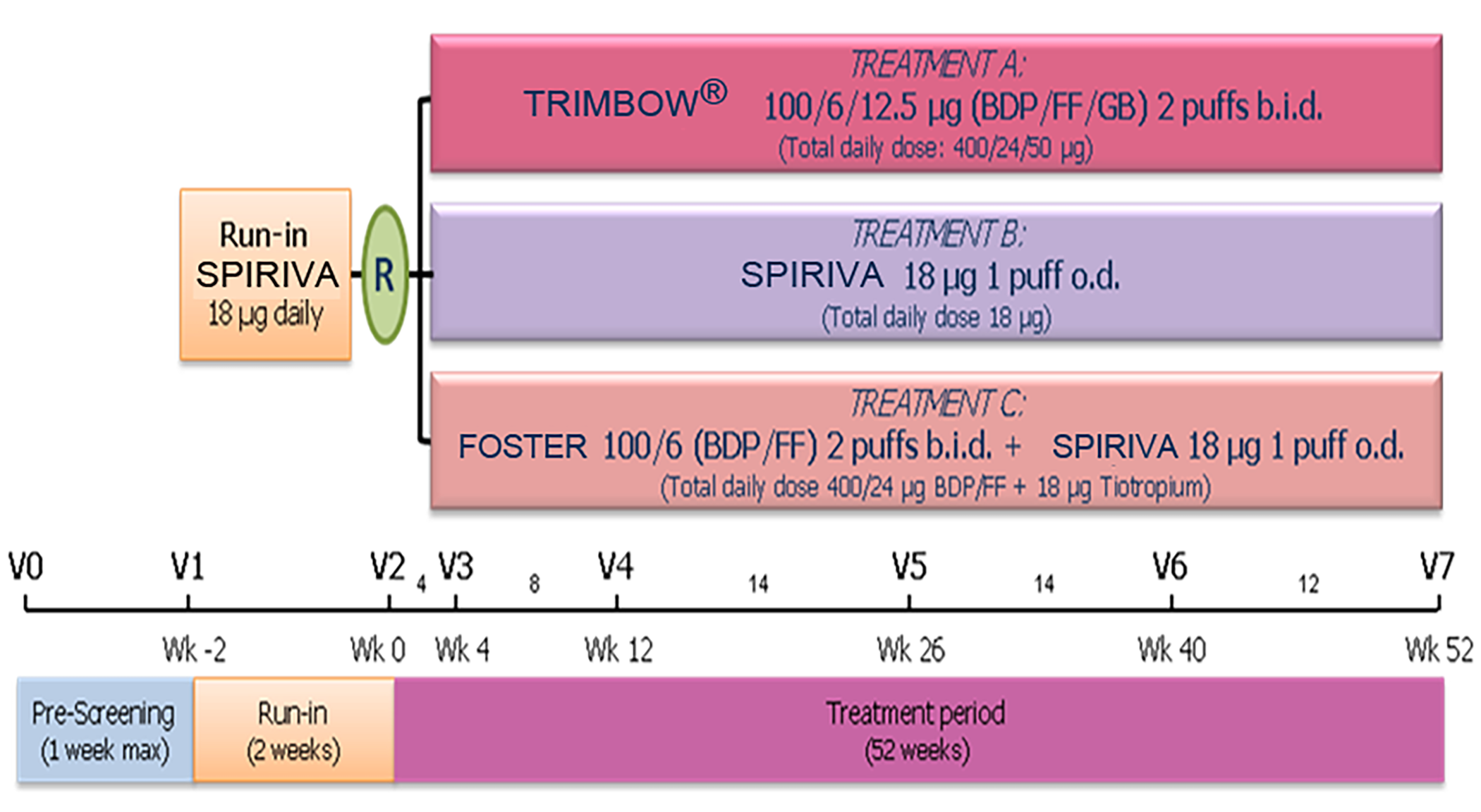
BDP = beclomethasone dipropionate; BID= twice daily; FF= formoterol fumarate; GB= glycopyrronium bromide; OD= once daily; R= randomization; V= visit
*Each metered dose (the dose leaving the valve) contains 100 micrograms of beclomethasone dipropionate (BDP), 6 micrograms of formoterol fumarate dihydrate (FF) and 10 micrograms of glycopyrronium (equivalent to 12.5 micrograms of glycopyrronium bromide)
Source: TRINITY CSR30
TRISTAR
The primary objective of TRISTAR was to demonstrate the non-inferiority of TRIMBOW vs. RELVAR + SPIRIVA in terms of quality of life (QoL) in patients with severe or very severe COPD. Secondary objectives in TRISTAR included: to evaluate the effect of TRIMBOW on lung function parameters, patient’s health status, and on clinical outcome measures; to collect data in order to assess the impact of study treatments on health economic outcomes; and to assess the safety and tolerability of the study treatments.
Overall Study Design and Plan
TRISTAR was a Phase IIIb, multinational, randomised, open-label, 2-arm study. The study included a pre-screening visit, a 2‑week open-label run-in with SPIRIVA (18 μg/day), and a 26-week treatment period. Patients were randomised 1:1 to receive either TRIMBOW 100/10/6 μg (2 puffs BID) or fluticasone/vilanterol 100/25 μg DPI (1 inhalation OD) + SPIRIVA 18 μg (1 capsule OD). Randomisation was stratified by country and airflow limitation severity (FEV1 <30% or ≥30% predicted), with ≥20% of patients expected to have very severe airflow limitation. Efficacy and safety were assessed at each visit. An eDiary was used to record daily use of run-in, treatment, and rescue medications, as well as night-time COPD symptoms (Figure 2).
Figure 2: TRISTAR Study Design and Schedule of Visits
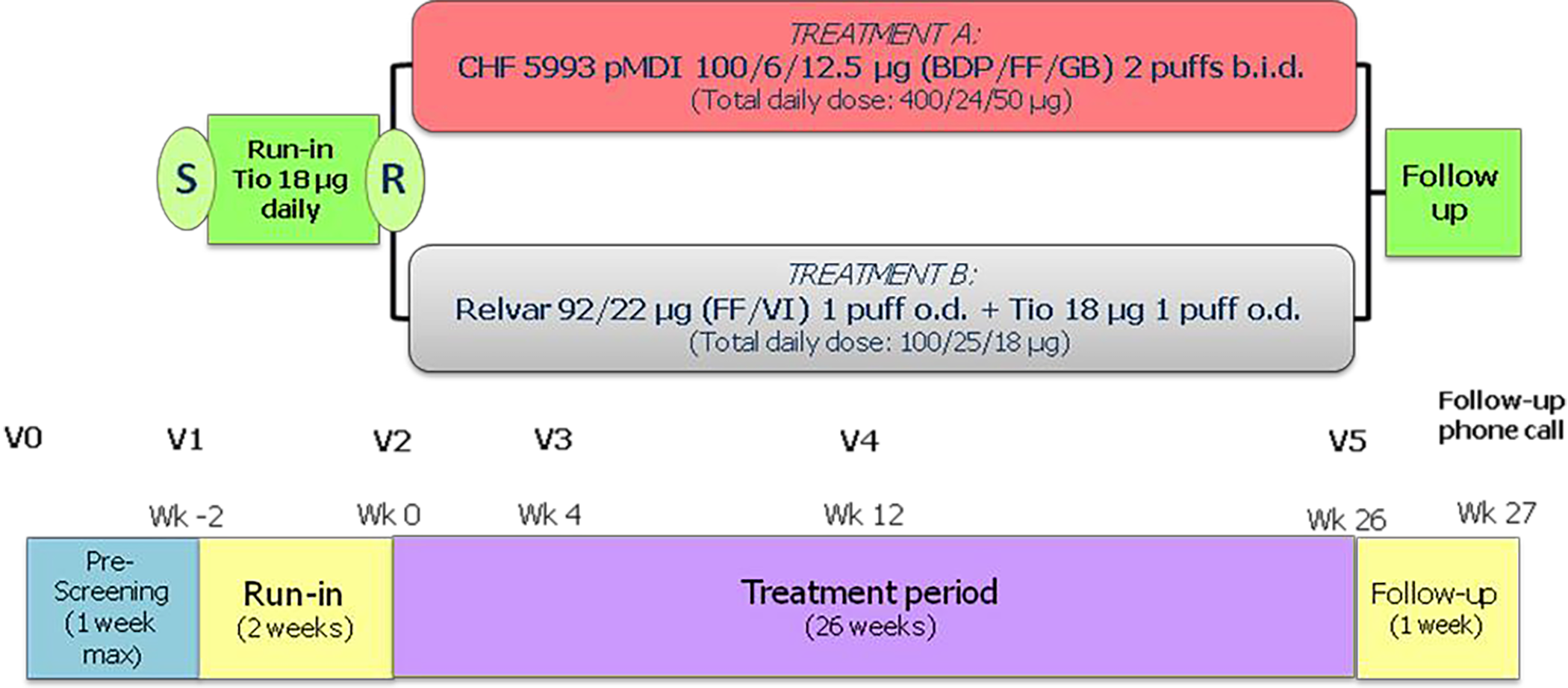
BDP = beclomethasone dipropionate; BID= twice daily; FF= formoterol fumarate; GB= glycopyrronium bromide; OD= once daily; R= randomization; V= visit; VI = Vilanterol
*Each metered dose (the dose leaving the valve) contains 100 micrograms of beclomethasone dipropionate (BDP), 6 micrograms of formoterol fumarate dihydrate (FF) and 10 micrograms of glycopyrronium (equivalent to 12.5 micrograms of glycopyrronium bromide) and 6 micrograms of formoterol fumarate dihydrate (FF); delivered dose per actuation (the dose leaving the mouthpiece) contains 87 mcg of beclomethasone dipropionate, 9 mcg of glycopyrronium (as bromide) and 5 mcg of formoterol fumarate dihydrate.
Source: TRISTAR CSR31
Interventions
In the TRINITY trial, patients were randomized to receive one of three treatments: TRIMBOW (2 puffs BID), dual therapy with FOSTER (2 puffs BID) plus SPIRIVA (18 μg OD), or SPIRIVA (18 μg OD). Patients accustomed to using a spacer continued to do so during the study (AeroChamber Plus™).
In the TRISTAR trial, patients were randomized to receive one of two treatments: TRIMBOW (2 puffs BID), or dual therapy with RELVAR (100/25 μg DPI) plus SPIRIVA (18 μg OD).
Run In Therapies
At screening (V1, Week –2), eligible patients in TRINITY and TRISTAR received SPIRIVA (18 μg/day) via HandiHaler for 2 weeks as run-in therapy. In TRINITY, salbutamol was provided as rescue medication. In TRISTAR, salbutamol pMDI or terbutaline DPI was prescribed locally for use as needed during both run-in and treatment.
Permitted Concomitant Medications
Permitted medications included rescue salbutamol (or terbutaline in TRISTAR), long-acting antihistamines (if stable ≥2 months or PRN), and short courses of systemic corticosteroids, inhaled SABAs/SAMAs or combinations, antibiotics, theophylline, oxygen, or mechanical ventilation for COPD exacerbations. Up to two short courses of nasal corticosteroids (≤10 days each) were also allowed.
Prohibited Concomitant Medications
Use of depot corticosteroids, ICS, LAMAs, LABAs, and their combinations outside of study treatments was not permitted. Both studies also prohibited oral/IV/IM corticosteroids, nebulised bronchodilators or steroids, and inhaled SABAs or SAMAs, except short courses during exacerbations. Additional exclusions included non-cardioselective β-blockers, QTc-prolonging agents (unless stable at screening), oral xanthines (TRISTAR allowed short courses), PDE-4 inhibitors, leukotriene modifiers, and non–potassium-sparing diuretics (unless in fixed-dose combinations). TRISTAR also excluded potent CYP3A4 inhibitors from screening onward.
Outcomes
Detailed descriptions of relevant outcome measures are presented in Appendix 5 in the Supplemental Material document.
Table 3: Summary of TRINITY and TRISTAR Primary and Key Secondary Efficacy Outcomes
Outcome measure | Timepoint | TRINITY | TRISTAR |
|---|---|---|---|
Moderate and severe COPD exacerbation rate | Over 52 weeks of treatment | Primarya,b | NA |
Change from baseline in pre-dose morning FEV1 | At Week 52 | Key secondarya | NA |
Change from baseline in the SGRQ total score | Week 26 | NA | Primary |
COPD = Chronic Obstructive Pulmonary Disease; FEV1 = Forced Expiratory Volume in 1 second; NA = Not Applicable; SGRQ = St. George’s Respiratory Questionnaire.
aStatistical testing for these endpoints was adjusted for multiple comparisons using hierarchal testing
bComparison of TRIMBOW versus FOSTER + SPIRIVA considered a secondary efficacy analysis
Source: TRINITY CSR30 and TRISTAR CSR31
Sample Size and Power Calculation
TRINITY
A total of 2,580 patients were planned for TRINITY, accounting for expected drop-out rates (13% at Week 12, 16.5% at Week 26, and 20% at Week 52) and 9% non-evaluable due to protocol deviations. The sample size provided ~93.3% power to detect a rate ratio of 0.8 between TRIMBOW and SPIRIVA for exacerbations (two-sided α=0.05). For FEV1, 825 evaluable patients per group provided ~99.7% power to detect a 60 mL difference (SD 260 mL). For non-inferiority, 751 TRIMBOW and 375 FOSTER + SPIRIVA patients provided ~86.0% power (one-sided α=0.025) to rule out a margin of –50 mL, assuming no difference (SD 260 mL). At least 20% of patients were expected to have very severe airflow limitation (FEV1 <30% predicted).
TRISTAR
TRISTAR planned to randomize 1,142 patients (571 per group) to ensure 850 evaluable patients (425 per group) in the per-protocol population. This provided ~90% power to demonstrate non-inferiority of TRIMBOW vs. RELVAR + SPIRIVA in SGRQ total score at Week 26 (one-sided α=0.025), assuming no difference, SD of 18, and a non-inferiority margin of 4 units. The sample size accounted for a 16.5% non-evaluable rate and 10.8% with major protocol deviations. At least 20% of patients were expected to have very severe airflow limitation (FEV1 <30% predicted).
Statistical Testing
Detailed descriptions of statistical analysis methods are presented in Appendix 5 in the Supplemental Material document.
In TRINITY, a hierarchical testing strategy controlled type I errors across primary and key secondary endpoints. Non-inferiority was assessed using MMRM with a –50 mL margin and α=0.025. Sensitivity analyses included multiple imputation. No interim analyses or additional multiplicity adjustments were applied.
In TRISTAR, the primary endpoint (SGRQ total score at Week 26) was analyzed using ANCOVA. Non‑inferiority was demonstrated if the upper bound of the 95% CI was below the 4-unit margin. Sensitivity analyses included multiple imputation and airflow severity discrepancies. FEV1 was analyzed using the same model.
Subgroup Analyses
In both TRINITY and TRISTAR, exploratory subgroup analyses were conducted in the ITT population for key efficacy endpoints. Subgroups included airflow limitation severity, smoking status, and gender. TRINITY also assessed reversibility, phenotype, eosinophil count, age, prior exacerbations, and cardiovascular comorbidities. No adjustments for multiplicity were applied.
Analysis Populations
Table 4: Analysis Populations of TRINITY and TRISTAR
Population | Definition | Application |
|---|---|---|
ITT | All randomised patients who received at least one dose of the study treatment and with at least one available evaluation of efficacy (primary or secondary efficacy variables) after baseline. | Primary and key secondary efficacy outcome analyses |
PP | All patients from the ITT population without any major protocol deviations (e.g., wrong inclusions, poor compliance, non-permitted medications) | As above |
Safety | All randomised patients who received at least one dose of the study treatment. | Safety analyses |
ITT = Intent-to-Treat; PP = Per-Protocol
Source: TRINITY CSR30 and TRISTAR CSR31
Patient Population
Baseline Characteristics
Table 5: Summary of Baseline Characteristics of TRINITY and TRISTAR (Safety Population)
Parameter | TRINITY | TRISTAR | |||
|---|---|---|---|---|---|
TRIMBOW N=1077 | FOSTER+SPIRIVA N=537 | TRIMBOW N=578 | RELVAR+SPIRIVA N=579 | ||
Males (n %) | 829 (77.0) | 397 (73.9) | 445 (77.0) | 429 (74.1) | |
Age (years), mean (SD) | 63·4 (8.7) | 62·6 (8.9) | 63.6 (7.7) | 64.2 (7.7) | |
Race | Black/African American | 1 (0.1) | 0 | █████ | █████ |
White | 1067 (99.1) | 532 (99.1) | █████ | █████ | |
Other | 9 (0.8) | 5 (0.9) | █████ | █████ | |
Weight (kg) mean (SD) | █████ | █████ | █████ | █████ | |
Height (cm), mean (SD) | █████ | █████ | █████ | █████ | |
BMI (kg/m2) mean (SD) | 26.39 (5.07) | 26.28 (5.33) | █████ | █████ | |
Current smokers, n% | 517 (48.0) | 266 (49.5) | █████ | █████ | |
Time since first COPD diagnosis (years) | 7.93 (5.58) | 7.76 (5.44) | █████ | █████ | |
Most plausible COPD phenotype, n% | Chronic bronchitis only | █████ | █████ | █████ | █████ |
Emphysema only | █████ | █████ | █████ | █████ | |
Chronic bronchitis + emphysema | █████ | █████ | █████ | █████ | |
COPD medication at study entry, n (%) | ICS/LABA | 802 (74.5) | █████ | █████ | █████ |
ICS/LAMA | 37 (3.4) | █████ | █████ | █████ | |
LABA/LAMA | 125 (11.6) | █████ | █████ | █████ | |
LAMA Alone | 113 (10.5) | █████ | █████ | █████ | |
Exacerbations in the previous year, mean (SD) | 1.3 (0.7) | 1.2 (0.6) | █████ | █████ | |
Exacerbations in the previous year, n (%) | 1 | █████ | █████ | █████ | █████ |
2 | █████ | █████ | █████ | █████ | |
3 | █████ | █████ | █████ | █████ | |
>3 | █████ | █████ | █████ | █████ | |
FEV1 pre-salbutamol (L), mean (SD) | 1.050 (0.332) | 1.054 (0.342) | █████ | █████ | |
FEV1 post-salbutamol (L), mean (SD) | 1.117 (0.330) | 1.127 (0.331) | █████ | █████ | |
FEV1% of predicted*, mean (SD) | 36. 6 (8.3) | 36. 7 (8.3) | █████ | █████ | |
FEV1/FVC ratio*, mean (SD) | 0.423 (0.104) | 0.423 (0.103) | █████ | █████ | |
Reversibility (L), mean (SD) | █████ | █████ | █████ | █████ | |
Reversibility (%), mean (SD) | █████ | █████ | █████ | █████ | |
Very severe airflow limitation, n (%) | 228 (21.2) | 113 (21.0) | █████ | █████ | |
BMI = Body Mass Index; COPD = Chronic Obstructive Pulmonary Disease; FEV1 = Forced Expiratory Volume in 1 second; FVC = Forced Vital Capacity; ICS = Inhaled Corticosteroid; LABA = Long-Acting Beta2-Adrenergic Agonist; LAMA = Long-Acting Muscarinic Antagonist; OD = Once daily; SD = Standard Deviation
Source: TRINITY CSR Tables 9, 10, 11, and 1230; TRISTAR CSR Tables 7, 8, 9, and 1031
Patient Disposition
Table 6: Patient Disposition for TRINITY and TRISTAR
Patient disposition | TRINITY | TRISTAR | ||
|---|---|---|---|---|
TRIMBOW | FOSTER+SPIRIVA | TRIMBOW | RELVAR+SPIRIVA | |
Screened, N | 3433 | 1477 | ||
Reason for screening failure, N (%) | 742 (21.61) | █████ | ||
Unmet inclusion/met exclusion criteria | 519 (69.95) | █████ | ||
Consent withdrawal | 149 (20.08) | █████ | ||
Lost to follow-up | 28 (3.77) | █████ | ||
Other | 28 (3.77) | █████ | ||
AE | 12 (1.62) | █████ | ||
Protocol violation | 5 (0.67) | █████ | ||
Death | 1 (0.13) | █████ | ||
Randomized, N (%) | 2691 (78.39) | 1157 (78.33) | ||
Discontinued from study, N (%) | 92 (3.42) | 42 (1.56) | 33 (2.85) | 30 (2.59) |
Consent withdrawal | 49 (53.26) | 19 (45.24) | 13 (39.39) | 9 (30) |
Death | 19 (20.65) | 8 (19.05) | 3 (9.09) | 4 (13.33) |
AE | 13 (14.13) | 5 (11.90) | 6 (18.18) | 10 (33.33) |
Lost to follow-up | 7 (7.61) | 5 (11.90) | 2 (6.06) | 2 (6.67) |
Protocol violation | 2 (2.17) | 3 (7.14) | 3 (9.09) | 1 (3.33) |
Lack of efficacy | 1 (1.09) | 2 (4.76) | 2 (6.06) | 3 (10) |
Other | 1 (1.09) | 0 | 4 (12.12) | 1 (3.33) |
ITT, N | 1077 | 538 | 577 | 579 |
PP, N | 1012 | 512 | 559 | 557 |
Safety, N | 1077 | 537 | 578 | 579 |
AE = adverse event; ITT = Intent-to-Treat; PP = Per-Protocol;
Source: TRINITY CSR Figure 230 and TRISTAR CSR Figure 231
Exposure to Interventions
Table 7: Exposure to Study Treatment for TRINITY and TRISTAR (Safety Population)
Exposure | TRINITY | TRISTAR | ||
|---|---|---|---|---|
TRIMBOW (N=1077) | FOSTER+SPIRIVA (N=537) | TRIMBOW (N=578) | RELVAR+SPIRIVA (N=579) | |
Exposure (days), mean (SD) | █████ | █████ | █████ | █████ |
SD = standard deviation
Source: TRINITY CSR30 and TRISTAR CSR31
Concomitant Medications and Co-Interventions
TRINITY
Concomitant medications were permitted during the study and included both COPD-related and non-COPD treatments. Use of non-exacerbation-related COPD medications was low, with 21 patients (1.9%) in the TRIMBOW group and 8 (1.5%) in the FOSTER + SPIRIVA group. The most common class used was drugs for obstructive airway diseases.
Medications used to manage COPD exacerbations were more frequent. These included systemic antibacterials (used by 287 and 139 patients in the TRIMBOW and FOSTER + SPIRIVA groups, respectively), systemic corticosteroids (241 and 112 patients), cough and cold preparations (182 and 73 patients), and additional bronchodilators (115 and 51 patients). These treatments were administered as needed during exacerbation events; no tapering schedules were specified.
TRISTAR
Concomitant medications were permitted during the TRISTAR study and included COPD-related, exacerbation-related, and non-COPD treatments. Use of non-exacerbation COPD medications was low, with 14 patients (2.4%) in the TRIMBOW group and 11 (1.9%) in the RELVAR + SPIRIVA group. The most common class used was drugs for obstructive airway diseases (1.4% and 1.6%, respectively). Medications used to manage COPD exacerbations were more frequent and included systemic antibacterials (108 and 99 patients), systemic corticosteroids (80 and 75 patients), and cough and cold preparations (37 and 45 patients) in the TRIMBOW and comparator groups, respectively. Non-COPD concomitant medications were reported in 27.2% and 27.5% of patients, most commonly analgesics (6.8% and 7.6%), systemic antibacterials (4.7% and 6.6%), anti-inflammatory and anti-rheumatic products (4.5% and 5.9%), and cough and cold preparations (3.3% and 5.0%).
Results
Efficacy
TRINITY
Moderate/Severe COPD Exacerbation Adjusted Rate Ratios
Table 8: TRINITY - Moderate and Severe COPD Exacerbations Over 52 Weeks of Treatment (ITT Population)
Parameter | TRIMBOW (N=1077) | FOSTER+SPIRIVA (N=538) |
|---|---|---|
Total follow up time (years) | 1026.64 | 515.19 |
Number (%) of Patients with Exacerbations | 351 (32.6) | 167 (31.0) |
Number of Exacerbations | 485 | 244 |
Exacerbation Rate per Patient per Year | 0.472 | 0.474 |
Adjusted Exacerbation Rate per Patient per Year (95% CI) | 0.457 (0.412, 0.508) | 0.452 (0.389, 0.524) |
Adjusted rate ratio (95% CI; p-value) | 1.013 (0.846–1.214; 0.887) | |
Absolute mean difference (95% CI) | 0.006 (-0.076; 0.088) | |
Adj. = adjusted; CI = confidence interval; COPD = chronic obstructive pulmonary disease; ITT = intention-to-treat
Source: TRINITY CSR Table 1930
Table 9: Moderate and Severe COPD Exacerbations Over 52 Weeks of Treatment (PP Population)
Parameter | TRIMBOW N=1012 | RELVAR+SPIRIVA N=512 | |
|---|---|---|---|
Total follow up time (years) | 971.23 | 492.71 | |
All Moderate/Severe COPD Exacerbations | |||
Number (%) of Patients with Exacerbations | 320 (31.6) | 157 (30.7) | |
Number of Exacerbations | 432 | 227 | |
Exacerbation Rate per Patient per Year | 0.445 | 0.461 | |
Adjusted Exacerbation Rate per Patient per Year | 0.433 | 0.439 | |
TRIMBOW vs. RELVAR + SPIRIVA | Adj. rate ratio (95% CI) | 0.986 (0.818; 1.189) | |
p-value | 0.882 | ||
Adj.= adjusted; CI= confidence interval; COPD= chronic obstructive pulmonary disease; PP= Per Protocol
Source: TRINITY CSR Table 2030
Figure 3: Moderate/Severe COPD Exacerbation Adjusted Rate Ratios
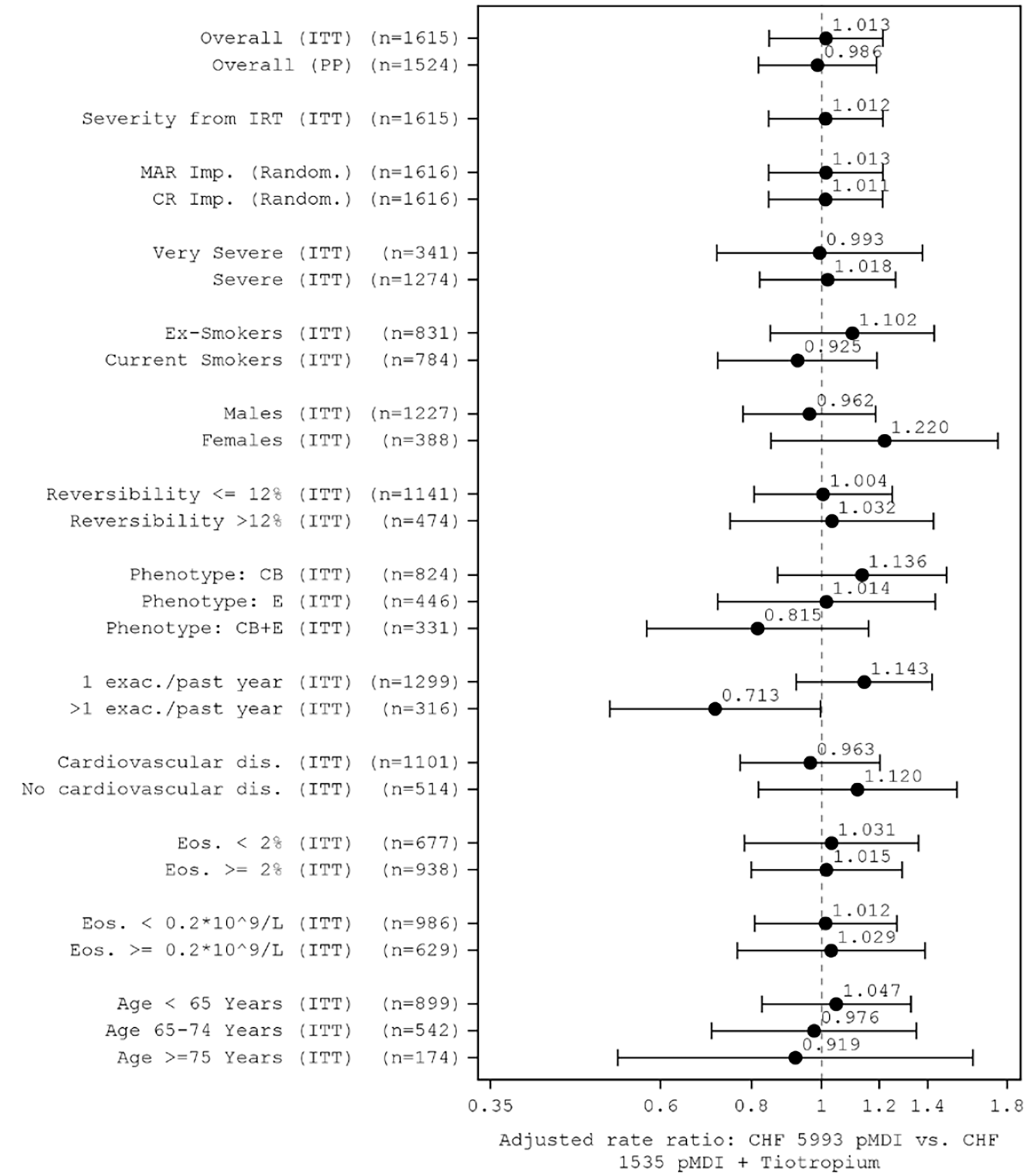
CB = Chronic bronchitis; COPD = Chronic obstructive pulmonary disease; CR = Copy reference; dis = Disease; E = Emphysema; Eos = Eosinophils; exac = Exacerbation; Imp. = Imputation; IRT = Interactive response technology; ITT = Intention-to-treat; MAR = Missing at random; PP = Per protocol; Random. = Randomised; FEV1 = Forced expiratory volume in the 1st second; vs. = Versus.
Severe and very severe refer to the level of airflow limitation at screening based on the percentage of the predicted normal value of post-bronchodilator FEV1. Severe = ≥ 30% and < 50%, very severe = < 30%.
Note: Bars represent 95% CI.
Source: TRINITY CSR Figure 530
Adjusted Mean Differences Between Treatments in Pre-dose Morning FEV1 (L) at Week 52
Table 10: TRINITY – Change From Baseline in Pre-Dose Morning FEV1 at Week 52 (ITT Population)
Parameter | TRIMBOW (N=1077) | FOSTER+SPIRIVA (N=538) | |
|---|---|---|---|
Baseline | Mean (SD), L | 1.118 (0.384) | 1.137 (0.391) |
Actual values | N | 985 | 495 |
Mean (SD), L | 1.217 (0.465) | 1.232 (0.439) | |
Change from baseline | N | 985 | 495 |
Mean (SD), L | 0.089 (0.309) | 0.090 (0.282) | |
Adj. mean (95% CI) | 0.082 (0.065–0.100) | 0.085 (0.061–0.110) | |
p-value | <0.001 | <0.001 | |
Adjusted mean difference (95% CI; p-value) | -0.003 (-0.033 to 0.027; 0.852) | ||
Adj.= adjusted; CI= confidence interval; FEV1= forced expiratory volume in one second; ITT= intention-to-treat; SD= standard deviation
Source: TRINITY CSR Table 2230
Table 11: Change From Baseline in Pre-Dose Morning FEV1 at Week 52 (PP Population)
Parameter | TRIMBOW N=1012 | RELVAR+SPIRIVA N=512 | ||
|---|---|---|---|---|
Baseline | n | 1012 | 512 | |
Mean (SD) | 1.124 (0.387) | 1.140 (0.386) | ||
Week 52 | Actual values | n | 936 | 477 |
Mean (SD) | 1.223 (0.468) | 1.236 (0.443) | ||
Change from baseline | n | 936 | 477 | |
Mean (SD) | 0.092 (0.313) | 0.086 (0.281) | ||
Adjusted mean (95% CI) | 0.086 (0.069; 0.104) | 0.085 (0.060; 0.110) | ||
p-value | <0.001 | <0.001 | ||
TRIMBOW vs. RELVAR + SPIRIVA | Adjusted mean difference (95% CI) | 0.002 (-0.029; 0.032) | ||
p-value | 0.905 | |||
Adj.= adjusted; CI= confidence interval; COPD= chronic obstructive pulmonary disease; PP= Per Protocol; SD = standard deviation
Source: TRINITY CSR Table 2330
Change From Baseline in SGRQ Total Score at All Clinic Visits
Figure 4: Adjusted Mean Change From Baseline in SGRQ Total Score (ITT Population)
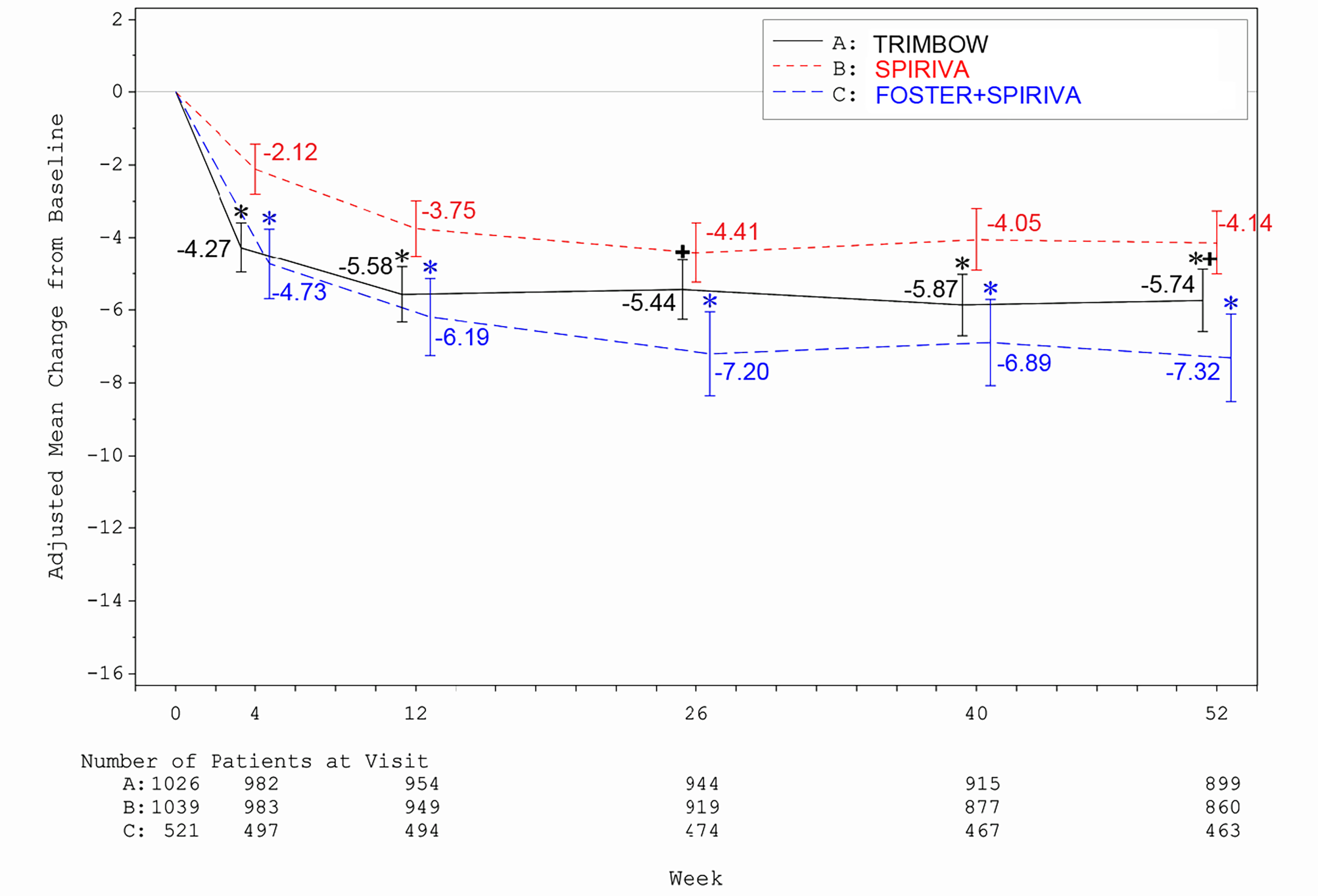
ITT= intention-to-treat; SGRQ= St George’s respiratory questionnaire.
Bars represent 95% confidence intervals; * denotes statistically significant superiority versus SPIRIVA (p<0.05); + denotes statistically significant difference in favour of FOSTER+SPIRIVA versus TRIMBOW (p<0.05)
Source: TRINITY CSR Figure 1430
SGRQ Response at Week 26 and Week 52
Table 12: SGRQ Responders at Week 26 and Week 52 (ITT Population)
Time point | Group | TRIMBOW N=1077 | FOSTER+SPIRIVA N=538 | |
|---|---|---|---|---|
Week 26 | Responder | n (%) | 508 (47.2) | 276 (51.3) |
TRIMBOW vs. FOSTER + SPIRIVA | OR (95% CI) | 0.81 (0.65; 1.00) | ||
p-value | 0.049 | |||
Week 52 | Responder | n (%) | 494 (45.9) | 254 (47.2) |
TRIMBOW vs. FOSTER + SPIRIVA | OR (95% CI) | 0.91 (0.73; 1.13) | ||
p-value | 0.373 | |||
ITT = intent-to-treat; OR = odds ratio; SGRQ = St. George’s Respiratory Questionnaire
Source: TRINITY CSR Table 3030
TRISTAR
Table 13: TRISTAR - Change From Baseline in SGRQ Total Score at Week 26 (ITT Population)
Parameter | TRIMBOW (N=577) | RELVAR+SPIRIVA (N=579) | |
|---|---|---|---|
Baseline | n | 577 | 579 |
Mean (SD) | █████ | █████ | |
Actual values | n | 553 | 553 |
Mean (SD) | █████ | █████ | |
Change from baseline | n | 553 | 553 |
Mean (SD) | █████ | █████ | |
Adjusted mean (95% CI) | -6.77 (-7.91; -5.64) | -7.82 (-8.95; -6.68) | |
p-value | █████ | █████ | |
Adjusted mean difference (95% CI; p-value) | 1.04 (-0.56; 2.65; 0.204) | ||
CI = confidence interval; ITT = intention to-treat; SD = standard deviation;
Source: TRISTAR CSR Table 1631
Change From Baseline in the SGRQ Total Score at Week 26 – PP Population
Table 14: Change From Baseline in SGRQ Total Score at Week 26 (PP Population)
Parameter | TRIMBOW N=559 | RELVAR+SPIRIVA N=557 | ||
|---|---|---|---|---|
Baseline | n | █████ | █████ | |
Mean (SD) | █████ | █████ | ||
Week 26 | Actual values | █████ | █████ | █ ███ █ |
█████ | █████ | █ ███ █ | ||
Change from baseline | █████ | █████ | █ ███ █ | |
█████ | █████ | █ ███ █ | ||
Adjusted mean (95% CI) | -6.82 (-7.97; -5.66) | -7.82 (-8.98; -6.66) | ||
p-value | █████ | █████ | ||
TRIMBOW vs. RELVAR + SPIRIVA | Adjusted mean difference (95% CI) | █████ | ||
p-value | █████ | |||
CI = confidence interval; ITT = intention-to-treat; SD = standard deviation;
Source: TRISTAR CSR Table 1731
Figure 5: Forest Plot for Adjusted Mean Differences Between Treatments in the SGRQ Total Score at Week 26
![Forest plot showing adjusted mean differences (with 95% confidence intervals) in St. George’s Respiratory Questionnaire (SGRQ) total score at Week 26 comparing TRIMBOW versus RELVAR+SPIRIVA across patient subgroups. Each horizontal line represents the confidence interval for a subgroup, and the vertical reference line indicates zero difference. Points to the left of the line favour TRIMBOW (lower SGRQ score, better health status), while points to the right favor RELVAR+SPIRIVA. Results include overall estimates for the intention-to-treat (ITT) population (mean difference: —) and per-protocol (PP) population (mean difference: [redacted]), as well as sensitivity analyses by severity, missing at random imputation, smoking status, gender, and airflow limitation.](https://www.canjhealthtechnol.ca/index.php/cjht/article/download/SR0907r/version/1501/3617/13853/SR0907r-fig05.png)
The figure was redacted as requested by the sponsor.
SGRQ = St. George’s Respiratory Questionnaire
Source: TRISTAR CSR Figure 431
Change From Baseline in Pre-dose Morning FEV1 at All Clinic Visits
Table 15: Change From Baseline in Pre-Dose Morning FEV1 at All Clinic Visits (ITT Population)
Parameter | TRIMBOW N=577 | RELVAR+SPIRIVA N=579 |
|---|---|---|
Change from baseline in pre-dose morning FEV1 at Week 4 (L) | ||
n Mean (SD) | █████ █████ | █████ |
Adj. mean (95% CI) p-value | █████ █████ | █████ |
Adj. mean difference (95% CI) p-value | █████ █████ | |
Change from baseline in pre-dose morning FEV1 at Week 12 (L) | ||
n Mean (SD) | █████ █████ | █████ █████ |
Adj. mean (95% CI) p-value | █████ █████ | █████ █████ |
Adj. mean difference (95% CI) p-value | █████ █████ | |
Change from baseline in pre-dose morning FEV1 at Week 26 (L) | ||
n Mean (SD) | 553 0.059 (0.245) | 548 0.109 (0.252) |
Adj. mean (95% CI) p-value | █████ █████ | █████ █████ |
Adj. mean difference (95% CI) p-value | █████ █████ | |
Adj. = adjusted; CI = confidence interval; FEV1 = forced expiratory volume in one second; ITT= intention-to-treat; L = litres; SD = standard deviation;
Source: TRISTAR CSR Table 2031
Change From Baseline in Pre-dose Morning FEV1 at Week 26
Table 16: FEV1 Responders (Change From Baseline in Pre-Dose Morning FEV1 ≥ 100 mL) at Week 26 (ITT Population)
Response Thresholda | Parameter | TRIMBOW N=577 | RELVAR+SPIRIVA N=579 |
|---|---|---|---|
100 mL | Responder, n (%) | 211 (36.6) | 248 (42.8) |
Odds ratio (95% CI) p-value | █████ █████ | ||
CI= confidence interval; FEV1= forced expiratory volume in one second; ITT= intention-to-treat;
aResponse = change from baseline in pre-dose morning FEV1 ≥ threshold; Non-response = Change from baseline in pre-dose morning FEV1 < threshold or missing data.
Source: TRISTAR CSR Table 2131
Rate of Severe COPD Exacerbations Over 26 Weeks of Treatment
Table 17: TRISTAR – Moderate and Severe COPD Exacerbations Over 26 Weeks of Treatment (ITT Population)
Parameter | TRIMBOW N=577 | RELVAR+SPIRIVA N=579 | |
|---|---|---|---|
Total follow up time (years) | █████ | █████ | |
All Moderate/Severe COPD Exacerbations | |||
Number (%) of Patients with Exacerbations | █████ | █████ | |
Number of Exacerbations | █████ | █████ | |
Exacerbation Rate per Patient per Year | 0.516 | 0.474 | |
Adjusted Exacerbation Rate per Patient per Year (95% CI) | █████ | █████ | |
Adjusted rate ratio (95% CI; p-value) | █████ | ||
Absolute mean difference (95% CI) | █████ | ||
Severe COPD Exacerbations | |||
Number (%) of Patients with Exacerbations | █████ | █████ | |
Number of Exacerbations | █████ | █████ | |
Exacerbation Rate per Patient per Year | █████ | █████ | |
Adjusted Exacerbation Rate per Patient per Year | █████ | █████ | |
TRIMBOW vs. RELVAR + SPIRIVA | █████ | █████ | |
█████ | █████ | ||
Adj. = adjusted; CI = confidence interval; ITT = intention-to-treat;
Source: TRISTAR CSR Table 2531
TRINITY
Moderate and Severe COPD Exacerbations Over 52 Weeks of Treatment
The comparison of TRIMBOW vs. FOSTER + SPIRIVA was a secondary efficacy analysis. The adjusted moderate/severe exacerbation rate per patient per year was similar with TRIMBOW and FOSTER + SPIRIVA (0.457 and 0.452, respectively), and the adjusted rate ratio was 1.013 (95% CI: 0.846; 1.214, p=0.887). In line with this, the results of the analysis of FOSTER + SPIRIVA vs. SPIRIVA were similar to those seen for TRIMBOW vs. SPIRIVA in the primary efficacy analysis. These results were confirmed in the PP population and in the sensitivity analyses. The stratified analyses of the moderate/severe COPD exacerbation rate showed similar trends to those seen in the overall analysis except in patients who had > 1 COPD exacerbation in the last year where the adjusted rate ratio was 0.713 in favour of TRIMBOW.
Change From Baseline in Pre-dose Morning FEV1 at Week 52
At baseline, mean pre-dose morning FEV1 was comparable in the two groups, being 1.118 L in the TRIMBOW group and 1.137 L in the FOSTER + SPIRIVA group.
The adjusted mean change in pre-dose morning FEV1 from baseline to Week 52 was a statistically significant increase with both treatments: 0.082 L (95% CI 0.065–0.100 L; p<0.001) with TRIMBOW and 0.085 L (95% CI 0.061–0.110 L; p<0.001) with FOSTER + SPIRIVA.
Non-inferiority of TRIMBOW relative to FOSTER + SPIRIVA was demonstrated since the adjusted mean difference (95% CI) between treatments was -0.003 L (-0.033; 0.027; p=0.852), with a lower confidence limit well above the pre-defined non-inferiority margin of -0.050 L. The difference between FOSTER + SPIRIVA and SPIRIVA was of a similar magnitude to the difference between TRIMBOW and SPIRIVA. These results were confirmed in the PP population and in the sensitivity analyses. The stratified analyses of the change from baseline in pre-dose morning FEV1 at Week 52 by smoking status, gender, degree of reversibility, COPD phenotype, blood eosinophil count at screening and age showed similar trends to those seen in the overall analysis.
Change From Baseline in SGRQ Total Score at All Clinic Visits
At baseline, the mean SGRQ total score was 54.42 in the TRIMBOW group and 53.02 in the FOSTER + SPIRIVA group.
The adjusted mean change from baseline in SGRQ total score (Figure 4) showed a statistically significant decrease (i.e., improvement) at all visits in all three treatment groups (all p<0.001).
At Weeks 26 and 52, the FOSTER + SPIRIVA group had statistically significantly greater improvements in SGRQ total score (‑7.20 and -7.32, respectively) than the TRIMBOW group (-5.44 and -5.74, respectively; p=0.014 and p=0.036).
SGRQ Response at Week 26 and Week 52
At Week 26, a total of 508 (47.2%) patients in the TRIMBOW group achieved an improvement from baseline in SGRQ total score of ≥ 4 units, which was marginally lower than that obtained in the FOSTER + SPIRIVA group (276 [51.3%] patients) (OR 0.81, 95% CI 0.65–1.00; p=0.049).
At week 52, a total of 494 (45.9%) patients in the TRIMBOW group achieved an improvement from baseline in SGRQ total score of ≥ 4 units was comparable with the FOSTER + SPIRIVA group (276 [51.3%] patients) (OR 0.91, 95% CI 0.73–1.13; p=0.373).
TRISTAR
Change From Baseline in the SGRQ Total Score at Week 26
The analysis of the primary efficacy variable (i.e., change from baseline in the SGRQ total score at Week 26) demonstrated the non-inferiority of TRIMBOW vs. RELVAR + SPIRIVA in the ITT population, with a difference in adjusted means (95% CI) between treatments of 1.04 (-0.56; 2.65), p=0.204. The above results were confirmed in the PP population. For both populations, the upper limit of the 95% CI of the adjusted mean difference between treatments in change from baseline in SGRQ total score was below 4 units at Week 26. The above results were confirmed in the sensitivity analyses.
Change From Baseline in Pre-dose Morning FEV1 at All Clinic Visits
The adjusted mean change in pre-dose morning FEV1 from baseline to Week 4, 12 and 26 showed a statistically significant increase in both treatment arms (refer to Appendix 7 in the Supplemental Material document).
Change from baseline in pre-dose morning FEV1 was:
At Week 4, ████████████████████ with TRIMBOW; and ████████████████████ with RELVAR + SPIRIVA.
At Week 12, ████████████████████ with TRIMBOW; ████████████████████ with RELVAR + SPIRIVA.
At Week 26, 0.057 L (95% CI 0.036-0.077; p<0.0010 with TRIMBOW; 0.105 (95% CI 0.085-0.125; p<0.001) with RELVAR + SPIRIVA.
RELVAR + SPIRIVA showed statistically significant improvement in pre-dose morning FEV1 from baseline compared to TRIMBOW at week 4 (█████), week 12 (█████), and week 26 (█████).
Change From Baseline in Pre-dose Morning FEV1 at Week 26
At week 26, the number of FEV1 responders (≥ 0.1 L) in the TRIMBOW group (211 [36.6%] patients) was significantly lower as compared to RELVAR + SPIRIVA ████████████████████.
Rate of Severe COPD Exacerbations Over 26 Weeks of Treatment
The number of moderate/severe exacerbations was comparable between the TRIMBOW (█████) and RELVAR + SPIRIVA groups (█████), with no statistically significant difference observed between the groups for the exacerbation rate ████████████████████.
Overall █████ of patients in the TRIMBOW group experienced severe exacerbations versus █████ in RELVAR + SPIRIVA group. The number of exacerbations reported was ██ lower with TRIMBOW than with RELVAR + SPIRIVA (█████). The adjusted rate of severe exacerbations per patient per year was significantly lower in the TRIMBOW group than in the RELVAR + SPIRIVA group ████████████████████.
Harms
Detailed results for harms are presented in Appendix 8 in the Supplemental Material document.
TRINITY
TEAEs were experienced by 594 (55.2%) patients reported with 1422 TEAEs in the TRIMBOW group and 309 (57.5%) patients reported with 740 TEAEs in the FOSTER + SPIRIVA group. There were 201 serious TEAEs reported in 140 (13.0%) patients in the TRIMBOW group and 88 serious TEAEs reported in 68 (12.7%) patients in the FOSTER + SPIRIVA group. There were 23 TEAEs leading to death reported in 20 (1.9%) patients in the TRIMBOW group and 8 TEAEs leading to death reported in 8 (1.5%) patients in the FOSTER + SPIRIVA group.
TRISTAR
TEAEs were experienced by 255 (44.1%) patients reported with 530 TEAEs in the TRIMBOW group and 246 (42.5%) patients reported with 491 TEAEs in the RELVAR + SPIRIVA group. There were 63 serious TEAEs reported in 39 (6.7%) patients in the TRIMBOW group and 87 serious TEAEs reported in 56 (9.7%) patients in the RELVAR + SPIRIVA group. COPD exacerbation, pneumonia and respiratory failure were the most frequently reported serious TEAEs.
There were 3 TEAEs leading to death reported in 3 (0.5%) patients in the TRIMBOW group and 6 TEAEs leading to death reported in 5 (0.9%) patients in the RELVAR + SPIRIVA group. COPD exacerbation led to death in 2 (0.3%) patients in the RELVAR + SPIRIVA group. None of the deaths were considered related to the study treatment.
Withdrawals Due to Adverse Events
TRINITY
TEAEs leading to study drug discontinuation were reported in 33 (3.1%) patients in the TRIMBOW group (41 events) and 15 (2.8%) patients in the FOSTER + SPIRIVA group (15 events). Events reported in >2 patients included COPD exacerbation, pneumonia, cardiac failure, and dyspnea.
TRISTAR
TEAEs leading to discontinuation occurred in 11 (1.9%) TRIMBOW patients (12 events) and 13 (2.2%) RELVAR + SPIRIVA patients (14 events). COPD exacerbation was the only event reported in >2 patients (3 events in 3 [0.5%] patients per group).
Adverse Events of Special Interest
TRINITY
There were 30 events of treatment-emergent pneumonias (including PTs of pneumonia, bronchopneumonia, lobar pneumonia and interstitial lung disease) reported in 28 (2.6%) patients in the TRIMBOW group and 13 events reported in 12 (2.2%) patients in the FOSTER+SPIRIVA group. None were considered treatment-related. Serious pneumonias were experienced by 21 (1.9%) patients reported with 21 events
TRISTAR
There were 13 and 15 treatment-emergent pneumonias (including PTs of bronchopneumonia, lobar pneumonia, pneumonia and pneumonia staphylococcal) reported in 11 (1.9%) patients and 15 (2.6%) patients in the TRIMBOW and RELVAR + SPIRIVA groups, respectively. Serious pneumonias were experienced by 8 (1.4%) patients reported with 9 events in the TRIMBOW group and 11 (1.9%) patients reported with 11 events in the RELVAR + SPIRIVA group. None were considered treatment-related. One event of pneumonia led to study treatment discontinuation in 1 (0.2%) patient and 1 event of pneumonia led to death in 1 (0.2%) patient in the RELVAR + SPIRIVA group. The pneumonia rate per 1,000 patients per year was comparable in both groups: 44.2 in the TRIMBOW group and 50.6 in the RELVAR + SPIRIVA group.
CDA-AMC Critical Appraisal of the Systematic Review Evidence
This section was prepared by CDA-AMC based on the sponsor’s summary of the systematic review evidence and other material submitted by the sponsor.
Additional Information From the Included Studies
Table 18 and Table 19 were prepared by CDA-AMC based on material submitted by the sponsor.
Table 18: Summary of Change From Baseline in SGRQ Total Score at Week 52 From the TRINITY Trial (ITT Population)
Variable | TRINITY trial | |
|---|---|---|
BEC-GLY-FOR N = 1,077 | BEC-FOR + TIO N = 538 | |
SGRQ total score (lower scores indicate improvement in HRQoL) at week 52 | ||
Number of patients contributing to the analysis, n (%) | 899 (83.5) | 463 (86.1) |
Baseline score (units), mean (SD) | 48.05 (16.72) | 45.40 (17.06) |
Change from baseline score (units), mean (SD) | –6.14 (14.96) | –6.96 (14.37) |
Adjusted mean change from baseline score (units), mean (95% CI) | –5.74 (–6.60 to –4.88) | –7.32 (–8.51 to –6.12) |
Adjusted mean treatment group difference versus active control (95% CI)a | 1.57 (0.10 to 3.05) | |
P valueb | 0.036 | |
BEC-FOR = beclomethasone dipropionate-formoterol fumarate; BEC-GLY-FOR = beclomethasone dipropionate-glycopyrrolate (as bromide)–formoterol fumarate dihydrate; CI = confidence interval; COPD = chronic obstructive pulmonary disease; HRQoL = health-related quality of life; ITT = intention to treat; SD = standard deviation; SGRQ = Saint George’s Respiratory Questionnaire; TIO = tiotropium.
aThe analysis was based on a linear mixed model for repeated measures, including treatment, visit, treatment by visit interaction, country, number of COPD exacerbations in the previous year, severity of airflow limitation, and smoking status at screening as fixed effects, and baseline value and baseline by visit interaction as covariates. Data from patients who discontinued prematurely and underwent the visit 7 (week 52) assessments were reallocated to the most appropriate visit.
bP value was not adjusted for multiple testing.
Source: Clinical Study Report for the TRINITY trial.30
Table 19: Summary of AEs of Pneumonia From the TRINITY and TRISTAR Trials (Safety Population)
Variable | TRINITY trial | TRISTAR trial | ||
|---|---|---|---|---|
BEC-GLY-FOR N = 1,077 | BEC-FOR + TIO N = 537 | BEC-GLY-FOR N = 578 | FLU-VIL + TIO N = 579 | |
Pneumonia | ||||
Patients with AEs of pneumonia, n (%) | 28 (2.6) | 12 (2.2) | 11 (1.9) | 15 (2.6) |
Risk difference (95% CI) | 0.4 (–1.2 to 1.9) | –0.7 (–2.4 to 1.0) | ||
AE = adverse event; BEC-FOR = beclomethasone dipropionate-formoterol fumarate; BEC-GLY-FOR = beclomethasone dipropionate-glycopyrrolate (as bromide)–formoterol fumarate dihydrate; CDA-AMC = Canada’s Drug Agency; CI = confident interval; FLU-VIL = fluticasone furoate-vilanterol; FOR = formoterol fumarate; GRADE = Grading of Recommendations Assessment, Development and Evaluation; TIO = tiotropium.
Note: This analysis was not part of the statistical analysis plan and was requested from the sponsor by CDA-AMC to facilitate the GRADE assessment.
Source: Response to a request by CDA-AMC for additional information regarding Trimbow review.32
Internal Validity
Trial Design
To standardize the trial populations on the same treatment without deterioration of disease, the TRINITY and TRISTAR trials included a 2-week run-in period in which all patients received 1 capsule of tiotropium (TIO) 18 mcg once daily via a HandiHaler inhaler. The clinical experts considered a 2-week run-in period with TIO monotherapy reasonable because the trials (conducted between 2014 to 2017) reflected the practice at that time. However, the clinical experts noted that 2 weeks may be a relatively short period for steroid withdrawal. The review team, in consultation with the clinical experts, further considered whether patients transitioning from an ICS-containing regimen to the trials could have residual steroid effects that could influence outcomes. However, given the randomization effect and baseline similarities in patient characteristics, including history of using ICS-containing regimens, it was concluded that any residual steroid effect was unlikely to significantly bias the observed outcome.
Patients were centrally assigned at each centre at the end of the run-in period using an interactive response technology system. The system allocated each patient to a treatment group using a list-based randomization algorithm and assigned them to a study medication kit number corresponding to the assigned treatment group. No major concern was identified regarding the adequacy of allocation concealment in either trial.
In both trials, randomization was stratified by country and severity of airflow limitation (postbronchodilator FEV1 at screening of < 30% or ≥ 30% predicted). The clinical experts identified severity of airflow limitation as a potential prognostic factor because disease severity is associated with more frequent COPD exacerbations and poorer baseline quality of life. The differences between groups in baseline characteristics were considered to be small, suggesting that randomization achieved prognostic balance in both trials; therefore, there is a low risk of bias in the randomization process.
The risk of unblinding in the TRINITY trial was considered low because a double-dummy design was implemented. Patients randomized to receive BEC-GLY-FOR via a pressurized metered-dose inhaler (pMDI) also received a TIO bromide–matched placebo.
The TRISTAR trial used an open-label design; the Clinical Study Report mentioned this was because the compared treatments groups required different delivery devices (pMDI versus dry powder inhaler [DPI] and HandiHaler inhaler). However, given that the primary efficacy end point was a patient-reported outcome, the open-label design represents a major limitation, with a high risk of bias in the efficacy and harms outcomes due to subjectivity as well as a potential for performance bias. Even for the more objective outcomes, the clinical experts agreed with the reviewers that there is some concern for risk of bias in the outcome measurement. The risk-of-bias concerns with the exacerbation rate for moderate and severe COPD was due to the open-label study design and patient-reported outcomes gathered without using an electronic diary to capture potential exacerbations (refer to details in the Moderate and Severe COPD Exacerbation Rate section). Similarly, the open-label study design was a risk for measuring predose morning FEV1 outcomes.
No other major concern was identified regarding the adequacy of the outcome measurement methods (refer to Appendix 5 in the Supplemental Material document for details):
In general, the outcome measurement methods were considered appropriate although not without some limitations, as illustrated subsequently.
COPD exacerbations were predefined in both trials. However, identification relied on investigator-reported changes in medication (systemic corticosteroids and/or antibiotics) or hospitalization. While these criteria are commonly used, they remain subject to clinical judgment and may introduce variability across sites.
The washout periods for the concomitant medications used before conducting the spirometry test were prespecified and generally appropriate, which helps reduce measurement bias. Patients were instructed not to take the study medication on the morning of each visit, and spirometry testing was performed using a central laboratory with centralized reading. Although these measures strengthen internal validity, it should be noted that while the highest spirometry value from 3 satisfactory attempts may be consistent with guideline recommendations, that may overestimate lung function relative to average performance.
Health-related quality of life (HRQoL) was assessed using the 76-item SGRQ, a widely used patient-reported outcome measure in chronic airway diseases.33 The sponsor provided evidence supporting its validity and reliability for COPD populations. However, the instrument is a lengthy questionnaire with potential response burden and reliance affected by completion rates. It was unknown how the investigators addressed these concerns in the studies, and the practicality of the SGRQ in clinical practice is unclear.
In reference to the length of follow-up in the TRINITY and TRISTAR trials, the clinical experts consulted by CDA-AMC for this review mentioned that studies of COPD pharmacotherapies have demonstrated significant differences in exacerbation rates within as short a period as 12 weeks. They considered the 52-week duration of the TRINITY trial adequate for evaluating the effects of BEC-GLY-FOR. The TRISTAR trial was shorter and evaluated outcomes at 26 weeks. However, both the clinical experts and methodological guidance suggest that the effect on exacerbations would optimally be assessed after at least 1 year of treatment to account for seasonal variability.34 The experts also noted that HRQoL and lung function assessments are influenced by exacerbations, which drive disease progression over time. Additional analyses across both trials included per-protocol analyses, multiple sensitivity analyses addressing missing data, and exploratory subgroup analyses.
The efficacy results included in the sponsor’s summary of the systematic review evidence were broader than the scope outlined in the Outcomes section of this review. The CDA-AMC review team focused on the outcomes important for informing expert committee deliberations and considerations for reimbursement of the drug under review. The following paragraphs are for outcome-specific appraisals.
Moderate and Severe COPD Exacerbation Rate
The rate of moderate and severe COPD exacerbation was a secondary outcome in the TRINITY trial (comparing BEC-GLY-FOR versus beclomethasone dipropionate-formoterol fumarate [BEC-FOR] + TIO over 52 weeks) and the TRISTAR trial (BEC-GLY-FOR versus fluticasone furoate-vilanterol trifenatate [FLU-VIL] + TIO over 26 weeks). The results are considered supportive evidence because the trials were not designed or powered to test a specific hypothesis for this outcome.
In the TRINITY trial, the use of the Exacerbations of Chronic Pulmonary Disease Tool (EXACT) electronic diary provided structured, daily symptom monitoring with automated alerts, reducing the likelihood of missed or inconsistently captured exacerbations. In contrast, the TRISTAR trial relied solely on unstructured patient self-report without an electronic diary, increasing the risk of underdetection and inconsistent identification of exacerbations. This limitation is compounded by the open-label design, which further heightens the potential for differential reporting bias.
In the TRISTAR trial, the use of an electronic diary was limited to recording nighttime COPD impact, rescue medication use, and adherence, and did not capture symptoms indicative of exacerbations. The clinical experts emphasized a substantial risk of underreporting in this trial because patients were required to independently recognize worsening signs and symptom and contacting the investigational site as appropriate.35 This reliance on patient-initiated reporting introduces a high likelihood of missed or delayed identification of exacerbations.
Pulmonary Function Assessed by Predose Morning FEV1
In the TRINITY trial, noninferiority testing of the difference between BEC-GLY-FOR versus BEC-FOR + TIO in the change from baseline in predose morning FEV1 at week 52 was a key secondary end point included in the prespecified hierarchical testing procedure. The sponsor used a noninferiority margin of 0.050 L for trough FEV1. The sponsor claimed that margin had been used in prior COPD studies (though no references were provided), represented half of the accepted minimal important difference (MID), and no smaller margin had been used at the time of the study. The clinical experts noted that the noninferiority margin is acceptable because it reflects no clinically meaningful difference between treatment groups. The results showed that BEC-GLY-FOR met the noninferiority criteria versus BEC-FOR + TIO for change in predose morning FEV1 at week 52 because the 95% confidence interval (CI) lay to the right of the –0.050 L margin with no hierarchy violations. Missing data at week 52 were low and similar between groups (8.5% versus 8.0%), indicating minimal risk of bias from missing data.
In the TRISTAR trial, change from baseline in predose morning FEV1 at all clinic visits, including week 26, was a secondary efficacy outcome. Although the change from baseline in the predose morning FEV1 was collected at all clinic visits in the TRISTAR trial, including week 26, these data provide only supportive evidence because the outcome was not included in a multiplicity-controlled testing strategy and the trial was not designed or powered to evaluate any specific hypothesis; thus, the interpretability of the statistically significant findings is limited. Missing data at week 26 were low and similar between groups (██████████), but this does not mitigate the fundamental limitation that the analysis lacks confirmatory value.
HRQoL Assessed by SGRQ Total Score
In the TRINITY trial, change from baseline in SGRQ total score, including at week 52, provides only supportive evidence because it was a secondary outcome without multiplicity adjustment and the trial was not designed or powered to test hypotheses for this measure. Interpretation is further limited by a high proportion of missing data at week 52 (16.5% for BEC-FOR-GLY and 13.9% for BEC-FOR + TIO), with no sensitivity analyses conducted to assess its impact, resulting in a high risk of bias. However, responder analyses (using the 4-unit MID) were generally consistent with the intention-to-treat results. The relevant results are presented in Appendix 7 in the Supplemental Material document.
In the TRISTAR trial, the primary efficacy end point was change from baseline in the SGRQ total score at week 26. The sponsor justified the 4-unit noninferiority margin for SGRQ using statistical arguments, clinical considerations, and published MID estimates. They submitted evidence for an MID of –4 units for the general patient population with COPD, and an alternative MID of –8.3 units at 1 month and –7.1 units at 6 months’ follow-up after intervention for patients with severe COPD.36 Although the evidence base for this margin remains indirect and relies on assumptions from meta-analytic estimates rather than direct comparative data, the clinical experts considered the margins acceptable because they do not reflect clinically important difference between groups. The noninferiority of BEC-GLY-FOR versus FLU-VIL + TIO at week 26 was demonstrated because the upper limit of the 95% CI of the adjusted mean difference between treatments was below the predefined noninferiority margin of 4 units. Missing data at week 26 were low and similar between groups (██████████).
Pneumonia
In both the TRINITY and TRISTAR trials, most treatment-emergent pneumonias were confirmed using medical imaging, which is an appropriate and unbiased diagnostic method even in an open-label setting. However, the clinical experts noted that both trials were of relatively short duration for adequately assessing long-term safety outcomes associated with ICSs, such as worsening of pre-existing diabetes or differences in pneumonia risk, which often require 2 to 3 years to emerge. The small number of events and the absence of an extension study further limit the ability to draw high-certainty conclusions about long-term harms, although major differences between groups are not expected, given that similar drug classes were compared.
External Validity
Population
The sponsor is seeking alignment with existing CDA-AMC reimbursement criteria used for relevant comparators, specifically, FLU-UME-VIL (available on its project landing page on the CDA-AMC website) and BUD-GLY-FOR (available on its project landing page on the CDA-AMC website). The TRINITY and TRISTAR trials enrolled adult patients with COPD inadequately controlled on dual therapy with a postbronchodilator FEV1 result of less than 50% of predicted normal value, at least 1 exacerbation in the past year, and a CAT score of 10 or greater, which are broadly consistent with existing CDA‑AMC reimbursement criteria used for the relevant comparators. Across the 2 trials, about 80% of patients had severe COPD airflow limitation (postbronchodilator FEV1 at screening of ≥ 30% and < 50% of predicted normal value) and 20% had very severe COPD airflow limitation (< 30% of predicted normal value). Although the trials on the comparator products previously reviewed by CDA-AMC predominantly included patients with severe or very severe airflow limitation,37,38 many patients considered for BEC-GLY-FOR in practice have moderate disease. However, the clinical experts did not identify major generalizability concerns because the enrolled populations had more frequent exacerbations and worse baseline quality of life. Both the TRINITY and TRISTAR trials excluded patients with recent exacerbations during the run-in period. The clinical experts considered this exclusion reasonable, given unstable disease, and noted no significant concerns regarding generalizability.
Intervention
The clinical experts noted that the use of concomitant medications in both the TRINITY and TRISTAR trials reflects clinical practice, and that the overall lower use observed in the TRISTAR trial likely reflects the relatively short treatment duration of 26 weeks. Incidences of major protocol deviations related to nonpermitted medications or study-treatment misadministration were few across both the trials and were not considered to have a meaningful impact on the observed treatment outcomes.
Comparator
The inhaled combination therapies marketed as the Foster inhaler and Relvar Ellipta inhaler are not available in Canada at the time of this review, but it should be noted that Breo Ellipta, which is marketed in Canada, is identical to Relvar Ellipta (same molecules, dosage, and inhaler device). The clinical experts indicated that BEC-FOR + TIO and FLU-VIL + TIO represent relevant open triple-combination therapy options and are relevant comparators to BEC-GLY-FOR. The clinical experts noted that TIO was administered via a DPI in the trials conducted between 2014 and 2017, reflecting practice at that time. However, TIO is now available as a soft-mist inhaler, which is less difficult to use and more suitable for patients with severe or very severe disease. The clinical experts noted that the actual dose delivered, and thus the real-world clinical benefit, can vary significantly due to poor inhaler technique, which is common and influenced by factors such as disease severity (e.g., insufficient inspiratory flow) and comorbidities (e.g., osteoarthritis affecting device actuation). However, it was unclear if patients in the comparator group may have received suboptimal therapy compared to current practice.
The clinical experts noted that BEC-GLY-FOR offers an advantage over triple-combination therapy administered via multiple inhalers. Therefore, other single-inhaler triple-combination therapies available in Canada (FLU-UME-VIL and BUD-GLY-FOR) would have been more relevant comparators in the Canadian context. The sponsor’s submission included an indirect treatment comparison to address this issue, and it has been summarized in this report.
Outcomes
In alignment with the rationale for the reimbursement recommendations for FLU-UME-VIL and BUD-GLY-FOR, the following outcomes were considered relevant for this review: moderate and severe COPD exacerbation rate, lung function (FEV1), HRQoL as assessed by the SGRQ total score, and AEs of pneumonia (a concern for ICS-containing therapies).
Although the clinical experts noted that all-cause mortality would also be highly relevant, they also noted that the rates in the pivotal trials were too low for this outcome to be informative. Information on mortality was reported within the analysis of treatment-emergent AEs leading to death in both trials, instead of as an efficacy outcome. There was no long-term extension period to assess long-term harms. In the TRISTAR trial, follow-up was limited to 1 week after the 26-week treatment period.
Summary of Findings and Certainty of the Evidence
We assessed the certainty of evidence using the Grading of Recommendations Assessment, Development and Evaluation (GRADE) approach based on direct comparative data for BEC-GLY-FOR versus relevant comparators from the TRINITY and TRISTAR trials, focusing on moderate and severe COPD exacerbation rates, lung function (FEV1), HRQoL measured by the SGRQ total score and pneumonia and other AEs.39,40
The clinical experts were unable to suggest a specific threshold for a between-group difference in clinically important effect for the moderate and severe exacerbation rate and AEs of pneumonia; however, with their input, the review team judged whether the point estimates and relevant bounds of the CI represented clinically important effects.
We used the noninferiority margin of –0.050 L in the TRINITY and TRISTAR trials as the threshold for a clinically important effect for predose morning FEV1.
We used the noninferiority margin of 4 units in the TRINITY and TRISTAR trials as the threshold for a clinically important effect for SGRQ total score.
BEC-GLY-FOR Versus BEC-FOR + TIO
In accordance with GRADE methodology, CDA-AMC rated the certainty of evidence down 1 level due to serious concerns in the indirectness domain because patients in the comparator group may have received suboptimal therapy compared to current clinical practice. For the SGRQ total score, the review team additionally rated the certainty of evidence down 1 level for serious concerns in the study limitations domain, given the high risk of bias associated with a high proportion of missing data. Thus, the conclusion and certainty rating for each efficacy outcome were as follows:
BEC-GLY-FOR likely results in little to no difference in the moderate and severe COPD exacerbation rate when compared with BEC-FOR + TIO (moderate certainty).
BEC-GLY-FOR likely results in little to no difference in predose morning FEV1 when compared with BEC-FOR + TIO (moderate certainty).
BEC-GLY-FOR may result in little to no difference in SGRQ total score when compared with BEC‑FOR + TIO (low certainty).
For AEs of pneumonia, CDA-AMC rated the certainty of evidence down 1 level due to serious concerns in the imprecision domain because few events were observed to inform a higher-certainty judgment. Thus, the conclusion and certainty rating for the harms outcome were as follows:
BEC-GLY-FOR likely results in little to no difference in AEs of pneumonia when compared with BEC‑FOR + TIO (moderate certainty).
BEC-GLY-FOR Versus FLU-VIL + TIO
We rated the certainty of evidence down 1 level for all efficacy outcomes due to serious concerns in the indirectness domain because patients in the comparator group may have received suboptimal therapy compared to current clinical practice. For the moderate and severe COPD exacerbation rate, the review team additionally rated the certainty of evidence down 1 level for serious concerns in the study limitations domain, given the potential risk of bias, because potential exacerbations were reported by patients without the use of an electronic diary to help capture potential exacerbations and within an open-label study design. CDA-AMC also rated the certainty of evidence down 1 level for serious concerns in the imprecision domain because the upper limit of the 95% CI included the possibility that the effect was not comparable (i.e., that BEC-GLY-FOR performs worse than BEC-FOR + TIO). For predose morning FEV1, CDA-AMC additionally rated the certainty of evidence down 1 level for serious concerns in the study limitations domain because the concern for risk of bias in outcome measurement (pulmonary function) cannot be excluded within an open-label study design. We also rated the certainty of evidence down 1 level for serious concerns in the imprecision domain because the lower limit of the 95% CI included the possibility that the effect was not comparable (i.e., that BEC-GLY-FOR performs worse than BEC-FOR + TIO). For SGRQ total score, the review team additionally rated the certainty of evidence down 2 levels for very serious concerns in the study limitations domain, given the high risk of bias associated with the open-label assessment of a subjective, patient-reported outcome. Thus, the conclusion and certainty rating for each efficacy outcome were as follows:
BEC-GLY-FOR may result in little to no difference in moderate and severe COPD exacerbation rate when compared with FLU-VIL + TIO, but the evidence is very uncertain (very-low certainty).
BEC-GLY-FOR may result in little to no difference in predose morning FEV1 when compared with FLU-VIL + TIO, but the evidence is very uncertain (very-low certainty).
BEC-GLY-FOR may result in little to no difference in SGRQ total score when compared with FLU-VIL + TIO, but the evidence is very uncertain (very-low certainty).
For AEs of pneumonia, the review team rated the certainty of evidence down 2 levels due to very serious concerns in the imprecision domain because few events were observed within a short treatment period that may not be adequate to capture differences in harms. Thus, the conclusion and certainty rating for the harms outcome were as follows:
BEC-GLY-FOR may result in little to no difference in AEs of pneumonia when compared with FLU-VIL + TIO (low certainty).
Sponsor’s Summary of the Indirect Evidence
Description of Indirect Treatment Comparison(s)
Objectives
COPD treatment has grown increasingly complex due to expanding therapies and delivery devices, yet comparative evidence remains limited. To address this, an SLR and NMA was conducted in 2021 and updated in 2023, and 2024 assessing TRIMBOW’s relative efficacy. The 2024 update aimed to evaluate TRIMBOW’s safety, efficacy, and HRQoL, assess NMA feasibility, estimate treatment effects and rankings, and identify data gaps.
Study Selection and Review Methods
Details on study selection criteria and review methods are presented in Appendix 9 in the Supplemental Material document.
Eligible studies were RCTs in adults ≥40 years of age with moderate to very severe COPD. Systematic reviews and meta-analyses were used only to cross-check references. Interventions included TRIMBOW, TRELEGY ELLIPTA (fluticasone furoate; umeclidinium [umeclidinium bromide]; vilanterol [vilanterol trifenatate]), BREZTRI AEROSPHERE (budesonide, glycopyrronium, formoterol fumarate dihydrate pressurized inhalation suspension), and multiple inhaler triple combination therapies. Comparators included triple or dual therapies, pharmacological agents, best supportive care, or placebo. Outcomes included peak/trough FEV1, exacerbation rates, SGRQ, CAT, TDI, CCQ, mMRC, death, and pneumonia. Studies were excluded if they involved non-human subjects, pediatric populations, observational designs, case reports, editorials, letters, notes, or comments.
Indirect Comparison Analysis Methods
Details on analysis methods for the indirect comparison(s) are presented in Appendix 9 in the Supplemental Material document.
The feasibility of NMAs was informed by data availability, baseline characteristics, and study design. Analyses followed a Bayesian framework using MCMC simulation. Both FEMs and REMs were considered, and model selection was based on DIC and residual deviance. Given similar model fit and limited data, FEMs were used to report results. Scenario analyses excluding the FULFIL trial, which was powered for 24-week outcomes, and by pooling LABA/LAMA therapies under the assumption of a treatment class effect were done. Table 20 summarizes feasible analyses; Table 21 outlines model settings.
Table 20: Summary of Analyses Feasible in 2024 NMA Update
Outcome | Time-point | Base-case analysis feasible | Scenario analysis feasible |
|---|---|---|---|
CFB in trough FEV1 | 52 weeks | Yes | Yes |
Moderate and severe COPD exacerbation rate | 52 weeks | Yes | Yes |
Moderate COPD exacerbation rate | 52 weeks | Yes | Yes |
Severe COPD exacerbation rate | 52 weeks | Yes | Yes |
Pneumonia rate | 52 weeks | Yes† | Yes |
CFB = change from baseline; COPD = Chronic Obstructive Pulmonary Disease; FEV1 = Forced Expiratory Volume in 1 second.
*Scenario analysis involved removal of the FULFIL trial and pooling of LABA/LAMA treatments.
†FULFIL trial excluded due to use of an extension cohort/subgroup for pneumonia outcomes.
Source: Network Meta-Analysis Report (2024 update)41
Table 21: Generalized Linear Model Settings for Outcomes of Interest
Outcome | Effect measure | Model likelihood | Link function |
|---|---|---|---|
Trough FEV1 CFB | Mean difference | Normal | Identity |
Moderate/severe exacerbation rate | Rate ratio | Poisson | Log |
Moderate exacerbation rate | Rate ratio | Poisson | Log |
Severe exacerbation rate | Rate ratio | Poisson | Log |
Pneumonia rate | Odds ratio | Binomial | Log |
CFB = change from baseline; FEV1 = Forced Expiratory Volume in 1 second.
Source: Network Meta-Analysis Report (2024 update)41
Results
Summary of Included Studies
Overview of Search Results
In the 2024 update (search date: April 22), 552 additional records were retrieved. After deduplication, 480 references underwent title and abstract screening. Of these, 7 publications were reviewed in full text, and 4 were included in the SLR. These 4 publications, reporting results from 3 studies, did not contain new data; all relevant information had already been captured in the 2023 SLR update. Publications reporting SLRs and NMAs were excluded but assessed for relevant citations, with no new references identified. Relevant conferences were also searched; 2 abstracts were included but not extracted, as they reported subgroup or stratified analyses. Seven studies were included in the 2024 NMA, all of which were a subset of those included in the 2023 NMA update and focused on the 52-week time point. No additional publications identified in the 2024 update were eligible for inclusion due to lack of new data or reporting of subgroup analyses.
Overview of Studies Included in NMA
All studies included in the NMA were double-blind, randomized trials. Trial population sizes varied, with IMPACT and ETHOS enrolling the largest cohorts42,43 and TRILOGY and TRIBUTE the smallest.44,45 Differences were noted in run-in duration and exacerbation definitions. Most trials had a 2-week run-in; WISDOM had 30 days,46 and ETHOS had none.43 Exacerbation definitions varied. Most trials defined exacerbations by symptom worsening and IMPACT relied on investigator judgment.42 Only FULFIL differentiated by severity.47
Heterogeneity was also assessed for key baseline characteristics. Most studies exhibited low heterogeneity across baseline characteristics, including disease duration, age, sex, smoking status, exacerbation history, CAT score, FEV1 % predicted, and post-bronchodilator FEV1. Higher heterogeneity was observed for disease severity (GOLD classification) and FEV1 reversibility.
Table 22: Assessment of Homogeneity
Characteristics | Description and handling of potential effect modifiers |
|---|---|
Disease severity | GOLD disease severity stage shows the greatest heterogeneity across studies: three trials (TRINITY30, TRILOGY44, WISDOM46) exclude patients at stage 2. |
Treatment history | No evidence of effect modification. |
Trial eligibility criteria | Three trials (TRINITY30, TRILOGY44, WISDOM46) exclude patients at stage 2. |
Dosing of comparators | No evidence of effect modification. |
Placebo response | No evidence of effect modification. |
Definitions of endpoints | Exacerbation definitions varied. Most trials defined exacerbations by symptom worsening and IMPACT relied on investigator judgment.42 Only FULFIL differentiated by severity.47 |
Timing of endpoint evaluation | FULFIL47 reported CFB in trough FEV1 and in SGRQ total score at Week 24 TRILOGY44 reported CFB trough (morning) FEV1, CFB 2h post-dose-FEV1, and TDI focal score at week 26 week Exacerbation endpoints were evaluated over 52 weeks or 12 months (TRINITY30, ETHOS43, IMPACT42, WISDOM46). TRIBUTE did not specify timing.45 |
Withdrawal frequency | No evidence of effect modification. |
Clinical trial setting | No evidence of effect modification. |
Study design | All included studies were double blind and randomized trials. |
CAT = COPD Assessment Test; CFB = change from baseline; FEV1 = Forced Expiratory Volume in 1 second; TDI = Transition Dyspnea Index
Source: Network Meta-Analysis Report (2024 update)41
Risk of Bias
Study quality was assessed using a modified Cochrane risk of bias tool. All studies included in the NMA, except WISDOM, were judged to have low risk of bias. Randomization and blinding methods were unclear in WISDOM.
Table 23: Overview of Study Designs for Trials Included in the Network Meta-Analysis
Study | Interventions | Study design |
|---|---|---|
TRILOGY (N=1368) | TRIMBOW | Phase III, 52-week, double-blind, randomized, multinational, multicenter, 2‑arm parallel-group, active controlled clinical trial |
BDP 200 µ BID + FOR 12 µ BID | ||
TIO 18 µ OD + BUD 320 µ BID + FOR 9 µ BID | ||
TRINITY (N=2691) | TRIMBOW | Phase III, 52-week, double blind, double dummy, randomized, multinational, multicenter, 3‑arm parallel group, active controlled clinical trial |
TIO 18 µ OD | ||
TIO 18 µ OD + BDP 200 µ BID + FOR 12 µ BID | ||
TRIBUTE (N=1532) | TRIMBOW | Phase IIIb, 52-week, double blind, double dummy, randomized, multinational, multicenter, 2‑arm parallel group, active controlled clinical trial |
IND 85 µ OD + GLY 43 µ OD | ||
FULFIL (N=1810) | TRELEGY | Phase III, 24 weeks (with a 52 week ext population); randomized, double-blind, double-dummy, parallel group multicenter |
BUD 400 µ BID + FOR 12 µ BID | ||
ETHOS (N=8588) | BREZTRI/ Trixeo 320 | Phase III, 52 weeks; randomized, double-blind, multi-center, parallel-group study |
BREZTRI/ Trixeo 160 | ||
GLY 14.4 µ BID + FOR 9.6 µ | ||
BUD 320 μg BID + FOR 9.6 μg BID | ||
WISDOM (N=2488) | TIO 18 µ OD + FP 500 µ BID + SAL 50 µ BID | Phase IV, 52 weeks; multinational, randomized, double-blind, parallel-group, active-controlled trial |
TIO 18 µ OD + FP 250 µ BID + SAL 50 µ BID reducing | ||
IMPACT (N=10355) | TRELEGY | Phase III, 52 weeks; randomized, double-blind, 3-arm parallel group study |
FF 100 µ OD + VIL 25 µ OD | ||
UMEC 62.5 µ OD + VIL 25 µ OD |
BDP = Beclomethasone dipropionate; BID = Twice daily; BUD = Budesonide; FF = Fluticasone furoate; FOR = Formoterol fumarate; FP = Fluticasone propionate; GLY = Glycopyrronium; IND = Indacaterol; μg = Micrograms; OD = Once daily; SAL = Salmeterol; TIO = Tiotropium; UMEC = Umeclidinium; VIL = Vilanterol
Source: Network Meta-Analysis Report (2024 update)41
Efficacy
At Week 52, TRIMBOW demonstrated ███████████████ across several efficacy outcomes. For trough FEV1, TRIMBOW was ███████████████ compared to ICS/LABA MD, IND/GLY, and TIO, and ███████████████ to FF/UMEC/VI MD. Sensitivity analysis confirmed ███████████████ with TRIMBOW over ICS/LABA MD, LABA/LAMA, and TIO. For moderate and severe COPD exacerbation rates, TRIMBOW was ███████████████ compared with any of ICS/LABA MD, TIO, UMEC/VI, and GLY/FOR. Results of the sensitivity analysis were ███████████████ with these findings and with comparison of TRIMBOW versus LABA/LAMA. For moderate exacerbation rates, TRIMBOW was ███████████████ compared to ICS/LABA MD, TIO, and UMEC/VI in both base-case and sensitivity analyses. For severe exacerbation rates, TRIMBOW was ██████████ compared to TIO in both analyses. For pneumonia rates, TRIMBOW was ██████████ compared to GLY/FOR and UMEC/VI in the base case. ███████████████ were observed in the sensitivity analysis.
Table 24: Summary of Base Case and Sensitivity Analyses Posterior Estimates (95% CrI) for Efficacy Outcomes at Week 52
Comparator | FEV1 CFB (L) | Mod/Sev Exac Rate | Mod Exac Rate | Sev Exac Rate | Pneumonia Rate | |
|---|---|---|---|---|---|---|
BDP/FOR + TIO | BC | █████ | █████ | █████ | █████ | █████ |
SA | █████ | █████ | █████ | █████ | █████ | |
BUD/GLY/FOR LD | BC | █████ | █████ | █████ | █████ | █████ |
SA | █████ | █████ | █████ | |||
BUD/GLY/FOR MD | BC | █████ | █████ | █████ | █████ | █████ |
SA | █████ | █████ | █████ | |||
FF/UMEC/VI MD | BC | █████ | █████ | █████ | █████ | █████ |
SA | █████ | █████ | █████ | █████ | █████ | |
GLY/FOR | BC | █████ | █████ | █████ | █████ | █████ |
ICS/LABA MD | BC | █████ | █████ | █████ | █████ | █████ |
SA | █████ | █████ | █████ | █████ | █████ | |
IND/GLY | BC | █████ | █████ | █████ | █████ | █████ |
TIO (18 µg) | BC | █████ | █████ | █████ | █████ | █████ |
SA | █████ | █████ | █████ | █████ | █████ | |
UMEC/VI | BC | █████ | █████ | █████ | █████ | █████ |
LABA/LAMA | SA | █████ | █████ | █████ | █████ | █████ |
BC = Base Case; BDP = Beclomethasone dipropionate; BID = Twice daily; BUD = Budesonide; FOR = Formoterol fumarate; GLY = Glycopyrronium; ICS = Inhaled Corticosteroid; IND = Indacaterol; LABA = Long-Acting Beta2-Adrenergic Agonist; LAMA = Long-Acting Muscarinic Antagonist; LD = Low Dose; MD = Medium Dose; █████; SA = Sensitivity Analysis; TIO = Tiotropium; UMEC = Umeclidinium; VI = Vilanterol
Source: Network Meta-Analysis Report Workbook (2024 update)48
Harms
No harms endpoints were evaluated in the indirect comparison.
CDA-AMC Critical Appraisal of the Indirect Evidence
This section was prepared by CDA-AMC based on the sponsor’s summary of the systematic review evidence and other material submitted by the sponsor.
Additional Results From the Indirect Treatment Comparison
Four assumptions on comparators were validated by the sponsor’s clinical experts before forming the evidence networks:
Equal efficacy was assumed for different inhaler types with the same substance and dose combinations.
Equal efficacy was assumed for open and fixed combinations of the same substance.
Class-level efficacy was assumed for ICS-LABA combinations to pool the treatments.
Certain treatments were pooled into low, medium, and high ICS doses according to Global Initiative for Asthma guidelines ranges. Pooling was considered because the large variety in dosing regimens across treatments posed a challenge when connecting nodes within the network of evidence.
In addition to the sponsor’s summary of indirect evidence (Table 24), a summary of estimated treatment effects for each relevant pairwise comparison at week 52 from the network meta-analysis (NMA) results is presented in Table 25 focusing on the indirect comparison with single-inhaler triple therapy, relevant outcomes aligning with the systematic review evidence, and the results from the random-effects models (REMs).
Table 25: Summary of Estimated Treatment Effects for Each Relevant (Single-Inhaler Triple Therapy) Pairwise Comparison at Week 52 in the NMA
Comparator | Comparator versus BEC-GLY-FOR | ||||||||
|---|---|---|---|---|---|---|---|---|---|
Trough FEV1 (L) | Moderate and severe exacerbation | Pneumonia | |||||||
Mean difference in CFB (95% CrI)a | Rate ratio (95% CrI)b | Odds ratio (95% CrI)c | |||||||
FEM (base case) | REM | FEM (SA) | FEM (base case) | REM | FEM (SA) | FEM (base case) | REM | FEM (SA) | |
BUD-GLY-FOR LD | ██ | ██ | ██ | ██ | ██ | ██ | ██ | ██ | ██ |
BUD-GLY-FOR MD | ██ | ██ | ██ | ██ | ██ | ██ | ██ | ██ | ██ |
FLU-UME-VIL MD | ██ | ██ | ██ | ██ | ██ | ██ | ██ | ██ | ██ |
BEC-GLY-FOR = beclomethasone dipropionate-glycopyrronium (as bromide)-formoterol fumarate dihydrate; BUD-GLY-FOR = budesonide-glycopyrronium-formoterol fumarate; CFB = change from baseline; CrI = credible interval; FEM = fixed-effects model; FEV1 = forced expiratory volume in 1 second; FLU-UME-VIL = fluticasone furoate-umeclidinium-vilanterol; LD = low dose; MD = medium dose; ██████; NMA = network meta-analysis; REM = random-effects model; SA = scenario analysis.
Note: REM results were unavailable for the SA.
aTrough FEV1: A value lower than 0 is in favour of BEC-GLY-FOR.
bModerate or severe exacerbation rate: A value higher than 1 is in favour of BEC-GLY-FOR.
cPneumonia rate: A value higher than 1 is in favour of BEC-GLY-FOR.
██████████.
██████████████████████████████████████████████████████████████████████████████████████████████████████████████████████.
Source: Response to a Canada's Drug Agency request for additional information regarding the Trimbow review.32
Critical Appraisal
Studies included in the NMA were selected from those identified in the systematic literature review (SLR). The SLR was conducted using standard methods with defined research questions, and multiple databases were searched in 2017 (updated in 2021, 2023, and 2024), and an NMA was conducted in 2017 (updated in 2023 and 2024). The sponsor’s technical report did not clearly indicate whether any undocumented or unplanned changes were made during each update. Consequently, there is an increased risk that the reported results were selected based on multiple analyses of the data based on favourable magnitude or direction of effect.
The sponsor limited the 2021 SLR search to studies published from 2016 to January 2021 because the first single-inhaler triple-therapy study in COPD appeared in 2016. As a result, the evidence was based on publications about single-inhaler and open triple-therapy regimens produced from 2016 onward. The clinical experts noted that this was a reasonable approach. The most recent search is more than 1 year old; however, it is unknown whether that search remains sufficiently comprehensive or misses significant recent evidence.
The clinical experts noted that the overall scope and population, intervention, comparison, and outcome (PICO) criteria for the 2024 NMA were relevant to this review, with a focus on comparison with single-inhaler triple therapy (FLU-UME-VIL and BUD-GLY-FOR). In consultation with the clinical experts, the following relevant outcomes were identified as missing from the criteria for the NMA: mortality (although the clinical trial designs preclude a meaningful mortality signal), HRQoL, and harms.
The risk of bias for the included studies was assessed using a modified version of the Cochrane risk-of-bias tool. As the sponsor’s technical report did not provide a description of the modified version of the tool used, it is unclear how risk of bias was assessed. Although the authors judged most included studies to be at low risk of bias with respect to randomization, baseline characteristics, withdrawals, and statistical methodology, this assessment was conducted at the study level rather than for each reported outcome. This approach overlooks the fact that risk of bias can differ by outcome measure, particularly for domains such as performance, attrition, and reporting bias. Consequently, the risk-of-bias rating at the study level may not apply uniformly to all of the outcomes the study reports. An assessment of the potential for publication (small study) bias was not reported; therefore, this risk could not be excluded.
A total of 19 studies were included in the feasibility assessment, of which 7 were included in the NMA after applying the scope and criteria for the 2024 NMA. The authors of the NMA assessed heterogeneity in select baseline characteristics across the studies identified in the SLR, including disease duration, sex, age, smoking status, disease severity (Global Initiative for Chronic Obstructive Lung Disease and CAT), moderate and severe COPD exacerbations in prior year, FEV1 percent of predicted, FEV1 reversibility, and postbronchodilator FEV1. The sponsor’s technical report did not clearly indicate whether the list of baseline characteristics and the potential effect modification were validated by the sponsor’s clinical experts or by a literature search as potential prognostic factors and treatment-effect modifiers. The clinical experts consulted by CDA-AMC for this review suggested that the list of baseline characteristics included the most relevant treatment-effect modifiers. The exception was eosinophil count because peripheral blood eosinophil levels can influence responsiveness to ICS treatment. However, the clinical experts indicated that its omission does not significantly lower the certainty of the findings because it is expected to be a weak effect modifier (although patients with higher levels of eosinophils may be more likely to benefit from triple therapy, lower levels of eosinophils do not preclude benefit).
The sponsor’s assessment of heterogeneity (Table 22) appears to be based on the larger pool of studies used in the feasibility assessment. For this reason, it does not fully reflect the set of studies included in the NMA. The CDA‑AMC review team’s independent assessment of heterogeneity yielded the following:
Current smoker status: The IMPACT study had a slightly lower proportion of current smokers (< 40%) compared to the ETHOS, FULFIL, TRIBUTE, TRILOGY, and TRINITY studies, which reported a proportion of approximately 40% or slightly higher.
Disease severity (Global Initiative for Chronic Obstructive Lung Disease): Imbalances in disease severity were observed across the ETHOS, TRILOGY, TRINITY, and WISDOM studies. The TRINITY, TRILOGY, and WISDOM studies included patients with stage 3 and stage 4 disease, whereas the ETHOS study included patients with stages 2 through 4.
Moderate and severe COPD exacerbations in prior year: Imbalances in the number of moderate and severe exacerbations in the prior year were observed across the ETHOS, FULFIL, IMPACT, TRIBUTE, TRIOLOGY, and TRINITY studies. The TRIBUTE, TRILOGY, and TRINITY studies showed similarity in this characteristic, as did the ETHOS and IMPACT studies. Only the FULFIL study included patients with 0 moderate or severe exacerbations as well as those patients with 1 or more in the prior year, whereas the other studies included only patients with at least 1 exacerbation in the prior year.
Postbronchodilator FEV1: The FULFIL trial had a higher mean postbronchodilator FEV1 (approximately 1.25 L) compared to the TRIBUTE, TRILOGY, and TRINITY studies (approximately 1.0 L).
Postbronchodilator FEV1 reversibility: The FULFIL, TRIBUTE, TRILOGY, and TRINITY studies had low postbronchodilator FEV1 reversibility (approximately 10%) compared to the ETHOS study (approximately 30%).
FEV1 percent predicted: The TRIBUTE study had a high mean FEV1 percent predicted (> 60%) compared to the ETHOS, FULFIL, IMPACT, TRILOGY, TRINITY, and WISDOM studies (approximately 40% or slightly lower).
Run-in duration: A 2-week run-in period was included in most studies (TRILOGY, TRINITY, TRIBUTE, FULFIL, and IMPACT); the exceptions were the WISDOM study (30-day run-in period) and the ETHOS study (no run-in period).
The FULFIL and IMPACT studies included patients receiving triple therapy during the run-in periods who were then randomized to receive dual therapy, which differed from the BEC-GLY-FOR pivotal trials. The authors of the NMA noted that this step down from triple therapy to dual therapy at study entry may have led to a greater difference in effect between groups, introducing bias in favour of the triple-therapy group in those trials.
Exacerbation definition: Definitions of exacerbations were heterogenous across the studies. Most studies defined exacerbations by the number and intensity of symptoms related to worsening of the condition. Only the FULFIL study defined exacerbations based on severity. The IMPACT study defined exacerbations by the investigator on an ad hoc basis.
Not all studies were reported for each characteristic because the studies themselves did not report these characteristics, as per the sponsor’s technical report. This limits the ability to assess similarity or differences across the studies. The scenario analysis that excluded the FULFIL study (which was powered for 24-week outcomes) and pooled LABA-LAMA therapies under the assumption of a class effect did not address the heterogeneity observed across the included studies.
The clinical and methodological heterogeneity across studies raises concern for intransitivity, which means that the assumption of exchangeability required to produce valid effect estimates from an NMA does not hold. When this assumption is violated, effect estimates will be biased. Additionally, the statistical manifestation of intransitivity (inconsistency) was not tested and would not likely be informative due to a sparse network with few direct and indirect comparisons.
Clinical expert opinion was mixed on the implications of the between-study heterogeneity, based on studies where the information was available. One expert felt that this was unlikely to meaningfully impact conclusions, while the other indicated that bias is possible, which is common in NMAs. Taking clinical opinion, the lack of information on relevant characteristics in some studies, and the inability to test for consistency together suggests the risk of bias due to between-study heterogeneity remains possible in the NMA, but the potential impact on the results is not certain.
The 4 assumptions on comparators for forming the evidence networks were also validated by the clinical experts consulted by CDA-AMC for this review. The evidence networks were sparse (a total of 7 studies were included) with mostly 1 study per node, further contributing to the uncertainty in the results. Because of this, it would not have been feasible to perform meta-regression or stratified analyses to address differences in effect modifiers across the included studies.
The authors of the NMA stated that, given the comparable model fit and results between the fixed-effect model (FEM) and REMs and considering the limited number of studies informing each treatment comparison, the FEM was selected as the base case based on the principle of parsimony. However, the sparse network provided limited information to inform the between-study heterogeneity. In such cases, a preferred approach would be to select the model with the most plausible underlying assumptions and that most appropriately reflects the uncertainty in the treatment effect.49 The FEM assumes that all studies share a single true effect size, an assumption that is generally unrealistic and fails to capture between-study heterogeneity (i.e., credible intervals [CrIs] will be unreasonably narrow when heterogeneity exists). In contrast, the REM accounts for within-study and between-study heterogeneity and is therefore more likely to adequately reflect the uncertainty associated with heterogeneity — typically resulting in wider 95% CrIs.50 In contrast to the results from the FEM, the CrIs from the REM were wide and included the null as well as implausible values that challenge any meaningful interpretation of the results. An analysis using a reasonable informative prior for the between-study heterogeneity could support more interpretable results,49 but such an analysis was not undertaken. Therefore, there is considerable uncertainty in the evidence due to imprecision in the results.
CDA-AMC Clinical Review Discussion and Conclusion
This section was prepared by CDA-AMC based on the preceding sections.
Discussion
Efficacy
The 2023 Canadian Thoracic Society Guideline on Pharmacotherapy in Patients with Stable COPD recommends stepping up to single-inhaler triple therapy for patients with persistent moderate to severe dyspnea and/or poor health status despite treatment with single-inhaler dual therapy with LAMA-LABA or ICS-LABA.27
BEC-GLY-FOR is the third single-inhaler triple-combination therapy available in the Canadian market that is indicated for COPD. The sponsor is seeking alignment with existing reimbursement criteria that have been recommended by CDA-AMC and/or are currently used for the reimbursement of the most relevant comparators, specifically, FLU-UME-VIL and BUD-GLY-FOR. The sponsor’s systematic review included 2 phase III trials: a randomized, double-blind, active-controlled 52-week trial (TRINITY) and a randomized, open-label, active-controlled 26-week trial (TRISTAR). The TRINITY trial compared BEC-GLY-FOR with BEC-FOR + TIO, while the TRISTAR trial compared BEC-GLY-FOR with FLU-VIL + TIO. Both trials enrolled adults aged 40 years or older with severe or very severe disease who had experienced at least 1 documented exacerbation in the past 12 months, were receiving dual therapy for a minimum of 2 months, and were symptomatic with a CAT score of 10 or higher.
For moderate and severe COPD exacerbations, predose morning FEV1 results indicated that BEC-GLY-FOR provided little to no difference in lung function compared with BEC-FOR + TIO at week 52 in the TRINITY trial, or compared with FLU-VIL + TIO at week 26 in the TRISTAR trial. Based on the limitations outlined in the critical appraisal, the certainty of evidence was rated as moderate for the TRINITY trial and very low for the TRISTAR trial using the GRADE approach. BEC-GLY-FOR was delivered via a pMDI, whereas BEC-FOR + TIO was delivered using a DPI and FLU-UME-VIL was delivered via DPI plus inhalation once daily. Although the clinical experts noted that device type and inhaler technique may influence treatment effectiveness, no evidence was available to assess how these factors may have affected the relative treatment effects in these comparisons.
The SGRQ total scores indicated that BEC-GLY-FOR provided little to no difference in HRQoL compared with BEC-FOR + TIO at week 52 in the TRINITY trial, or compared with FLU-VIL + TIO at week 26 in the TRISTAR trial. Based on the limitations outlined in the critical appraisal, the certainty of evidence was rated as low for the TRINITY trial and very low for the TRISTAR trial using the GRADE approach.
Across both trials, additional analyses, including per-protocol analyses, multiple sensitivity analyses for handling missing data, and exploratory subgroup analyses, were generally consistent with and supportive of the main intention-to-treat findings for exacerbation rates, FEV1, and SGRQ. However, interpretation of these results is limited by potential prognostic imbalances, reduced statistical power, and the absence of statistical tests for interaction.
In addition to the TRINITY and TRISTAR trials, which compared BEC-GLY-FOR with open triple therapy, the sponsor submitted an NMA comparing the efficacy and safety of BEC-GLY-FOR versus FLU-UME-VIL and BUD-GLY-FOR, which are the other single-inhaler triple-combination therapies currently available in Canada for adults with moderate to very severe COPD.
The NMA results indicated that compared to FLU-UME-VIL, 52 weeks of treatment with BEC-GLY-FOR may result in little to no difference in the rate of moderate and severe COPD exacerbations or in trough FEV1. Similarly, the NMA suggested that compared to BUD-GLY-FOR, treatment with BEC-GLY-FOR may result in little to no difference in the rate of moderate and severe COPD exacerbations. However, the evidence is very uncertain because the REM produced estimates with wide CrIs that spanned the null and implied implausible magnitudes of both benefit and harm. In addition, results from the base-case and scenario analyses of the FEM did not support the findings from the REM, further undermining confidence in these estimates. Other limitations of the NMA include the lack of an assessment of heterogeneity across the included studies and the sparsity of the evidence networks, both of which contribute additional uncertainty toward its findings. The NMA had no data for the comparison of BEC-GLY-FOR versus BUD-GLY-FOR on lung function, and it did not evaluate HRQoL outcomes.
Overall, the clinical experts indicated that, based on their clinical experience, no clinically meaningful difference would be expected between BEC-GLY-FOR versus relevant comparators (single- and multi-inhaler triple therapy) because all of the comparators in the NMA were triple-therapy inhalers. Of note, although the input from the drug programs mentioned mortality as an important outcome (refer to the Summary of Drug Program Input and Clinical Expert Responses in Appendix 2 of the Supplemental Material document), no evidence was submitted on the comparative effect of BEC-GLY-FOR on all-cause mortality versus the relevant comparators.
Harms
In the comparison of BEC-GLY-FOR versus BEC-FOR + TIO and versus FLU-VIL + TIO, the differences between groups in the proportion of patients with AEs were considered to be small, including serious AEs, AEs leading to treatment withdrawal, and AEs leading to death. There was no long-term extension period to assess long-term harms, and follow-up was limited to 1 week after the 26-week treatment period in the TRISTAR trial.
For the comparison of BEC-GLY-FOR versus BEC-FOR + TIO, BEC-GLY-FOR likely results in little to no difference in AEs of pneumonia (moderate certainty). For the comparison of BEC-GLY-FOR versus FLU-VIL + TIO, BEC-GLY-FOR may result in little to no difference in AEs of pneumonia (low certainty). The certainty of evidence was rated down due to imprecision because few events were observed to support a higher-certainty judgment. For the comparison of BEC-GLY-FOR versus FLU-VIL + TIO, the certainty of evidence was additionally rated down because the short 26‑week treatment period was likely not adequate to fully characterize harms. The clinical experts noted that both trials were of relatively short duration for assessing the long-term safety of BEC-GLY-FOR; for example, differences in pneumonia frequency may take 2 to 3 years to emerge. Although no extension study was available to evaluate harms, the clinical experts noted that differences between groups are unlikely, given that the same drug classes were compared.
For the comparison of BEC-GLY-FOR versus FLU-UME-VIL, the NMA suggested that 52 weeks of treatment with BEC-GLY-FOR may result in little to no difference in the rates of pneumonia; however, the evidence is very uncertain for the same reasons outlined in the Efficacy discussion section. No data (base case) was available for the comparison of BEC-GLY-FOR versus BUD-GLY-FOR. The NMA did not assess the effect of BEC-GLY-FOR on standard harms.
Of note, the clinical experts noted that the overall benefit of treatment with triple therapy outweighs the risk of pneumonia commonly associated with ICSs.
Ethics and Equity Considerations
The clinical experts noted that Indigenous individuals and populations with lower socioeconomic status have higher incidence and prevalence of COPD, as well as greater disease severity, and would therefore benefit most from the availability of the drug under review. The clinical experts also noted that Black populations are more likely than white populations to experience higher mortality, increased hospitalizations, poorer quality of life, and greater symptom burden due to COPD,51 and are therefore more likely to have an indication for triple therapy. Given the lower representation of these patient groups in the studies, this raises some uncertainty as to whether the magnitude of the benefits and harms observed in the study can be generalized to these patient groups, which has implications for clinical decision-making, informed consent and patient decision-making, and health system decision-making.
The clinical experts noted that the drug under review is delivered via an MDI containing the propellant norflurane, a hydrofluoroalkane (HFA) and potent greenhouse gas. In contrast to DPIs, the use of HFA-containing inhalers at a population level contributes meaningfully to climate change.52 Despite their environmental impact, the clinical experts noted that HFA-containing MDIs may still be preferred for some patients due to improved drug delivery (e.g., in patients with severe airflow obstruction who cannot generate sufficient inspiratory force to use DPIs effectively), ease of use (e.g., compatibility with spacer devices, reducing the need to coordinate inhalation with actuation), differences in AE profiles (e.g., higher incidence of hoarseness or thrush with ICS-containing DPIs), or patient preference.
The clinical experts noted that the drug under review must be taken twice daily, whereas other single-inhaler triple therapies are taken once daily. The clinical experts noted that this results in a minor additional burden for patients using the drug under review (or for caregivers involved in monitoring or administering treatment); however, it may still have a meaningful impact on treatment adherence.53
Conclusion
BEC-GLY-FOR is the third single-inhaler triple therapy for COPD available in Canada. The sponsor is seeking alignment with existing reimbursement criteria that have been recommended by CDA-AMC and/or are currently used for the reimbursement of most appropriate treatments for comparison (single-inhaler triple therapy). The sponsor’s systematic review included 2 phase III randomized controlled trials in adults with severe or very severe disease: the 52-week double-blind TRINITY trial and the 26‑week open-label TRISTAR trial. Evidence of moderate certainty from the TRINITY trial showed that compared with BEC-FOR + TIO, treatment with BEC-GLY-FOR likely results in little to no difference in the rate of moderate and severe COPD exacerbations, and low-certainty evidence from the TRISTAR trial showed that compared with FLU-VIL + TIO, treatment with BEC-GLY-FOR may result in little to no difference in these outcomes. Very low–certainty evidence from the 2 trials suggests that treatment with BEC-GLY-FOR may result in little to no difference in HRQoL compared to BEC-FOR + TIO or FLU-VIL + TIO. Certainty of evidence was rated down for risk of bias, indirectness, and imprecision.
The sponsor’s NMA compared BEC-GLY-FOR with single-inhaler triple therapies at 52 weeks in adults with moderate to very severe COPD. The NMA analyses suggested that BEC-GLY-FOR may offer little to no difference in moderate and severe exacerbation rates or lung function compared with FLU-UME-VIL, and little to no difference in exacerbation rates compared with BUD-GLY-FOR. However, the certainty of this evidence is very low due to wide CrIs, heterogeneity across included studies, and sparse evidence networks. No data were available for trough FEV1 or pneumonia for the BUD-GLY-FOR comparison, and the NMA did not evaluate HRQoL or standard harms.
Across the comparisons of BEC-GLY-FOR with BEC-FOR + TIO and with FLU-VIL + TIO, differences in AEs were small. Moderate-certainty evidence indicates that BEC-GLY-FOR likely results in little to no difference in pneumonia compared with BEC-FOR + TIO and may result in little to no difference compared with FLU-VIL + TIO (low-certainty evidence). In the NMA, BEC-GLY-FOR also appeared to have little to no difference in pneumonia rates versus FLU-UME-VIL, but the evidence was very uncertain. The effect of BEC-GLY-FOR on all-cause mortality remains unknown, and there was no evidence for long-term harms beyond the 52-week data reported in the TRINITY trial.
CDA-AMC Pharmacoeconomic Evaluation
CDA-AMC prepared this section based on the sponsor’s summary of its economic evaluation in Appendix 10 in the Supplemental Material document and other material submitted by the sponsor.
The review team appraised the pharmacoeconomic evidence submitted by the sponsor on the drug cost and budget impact of BEC-GLY-FOR compared to other triple therapies for adult patients whose disease is not adequately treated by a combination of an ICS and a LABA or a combination of a LABA and a LAMA for either the long-term maintenance treatment of airflow obstruction in patients with COPD, including chronic bronchitis and/or emphysema, or to reduce exacerbations of COPD in patients with a history of exacerbations. This review was submitted via the Pharmaceuticals With Anticipated Comparable Efficacy and Safety (PACES) tailored review pathway; as such, the economic information provided within this report is limited to cost tables and budget impact.
Summary of the Submitted Cost Information
The sponsor submitted a cost comparison for BEC-GLY-FOR compared with other triple-therapy combinations of an ICS, LABA, and LAMA. The cost comparison included a comparison of drug costs. Drug costs were calculated by the sponsor using the submitted price for BEC-GLY-FOR and Ontario Drug Benefit list prices for the comparators.54,55
The estimated drug costs as submitted by the sponsor are provided in the Supplemental Material document, Appendix 10. The sponsor reported an annual drug cost for BEC-GLY-FOR of $1,327 per patient based on a unit price of $109.00 per 120‑dose MDI. Annual drug costs for single-inhaler triple therapies ranged from $1,546 to $1,676, while those for multi-inhaler triple therapies ranged from $924 to $2,900. Incremental savings associated with BEC-GLY-FOR ranged from $219 to $349 annually compared to the other single-inhaler triple therapies, while incremental differences ranged from a savings of $1,573 to a cost of $404 annually when BEC-GLY-FOR was compared to all ICS plus LAMA plus LABA combinations possible from dual- and single-therapy inhalers funded for COPD.
CDA-AMC Cost Comparison
The following CDA-AMC cost comparison tables present the drug cost for the long-term maintenance treatment of airflow obstruction in patients with COPD. Based on the publicly available list prices of all comparators and the sponsor’s submitted price for BEC-GLY-FOR, reimbursement of BEC-GLY-FOR is expected to be associated with lower drug costs to the health care system versus other single-inhaler triple therapies (incremental savings = $219 to $349 per year) and associated with either lower or higher costs versus multi-inhaler triple therapies, depending on the combination (range, incremental savings of $1,573 to incremental cost of $404 per year).
If BEC-GLY-FOR replaces triple-therapy regimens consisting of 2 or 3 inhalers, a savings in associated dispensing fees is also expected.
Table 26: CDA-AMC Incremental Cost Comparison Table for BEC-GLY-FOR (Trimbow) vs. Single-Inhaler Triple Therapies
Generic name (brand name) | Difference vs. BEC-GLY-FOR in total costs per yeara ($) |
|---|---|
Fluticasone furoate-umeclidinium-vilanterol (Trelegy Ellipta) | –349 |
Budesonide-glycopyrronium- formoterol fumarate (Breztri Aerosphere) | –219 |
BEC-GLY-FOR = beclomethasone dipropionate-glycopyrronium (as bromide)-formoterol fumarate dihydrate; vs. = versus.
Note: A positive value indicates the comparator treatment is less costly compared to BEC-GLY-FOR; a negative value indicates the comparator treatment is more costly compared to BEC-GLY-FOR.
Sources: Sponsor’s submission.55 The cost of BEC-GLY-FOR was based on the sponsor’s submitted price. Comparator costs were based on Ontario Drug Benefit list prices.54
Table 27: CDA-AMC Incremental Cost Comparison Table for BEC-GLY-FOR (Trimbow) vs. LAMA + ICS-LABA Combinations
Type of therapy: Generic name (brand name) | Difference vs. BEC-GLY-FOR in total costs per yeara ($) | |||
|---|---|---|---|---|
ICS-LABA: Budesonide-formoterol (Symbicort Turbuhaler) | ICS-LABA: Fluticasone propionate (250 mcg)–salmeterol (50 mcg) (Advair Diskus, Wixela, generic) | ICS-LABA: Fluticasone propionate (500 mcg)–salmeterol (50 mcg) (Advair Diskus, Wixela, generic) | ICS-LABA: Fluticasone furoate–vilanterol trifenatate (Breo Ellipta) | |
LAMA: Tiotropium bromide monohydrate (Spiriva Respimat) | –581 | 41 | –218 | –686 |
LAMA: Tiotropium bromide monohydrate (Spiriva, generic) | –247 | 375 | 116 | –352 |
LAMA: Umeclidinium bromide (Incruse Ellipta) | –521 | 100 | –159 | –627 |
LAMA: Glycopyrronium bromide (Seebri Breezhaler) | –581 | 41 | –219 | –687 |
LAMA: Aclidinium bromide (Tudorza Genuair) | –607 | 15 | –245 | –713 |
BEC-GLY-FOR = beclomethasone dipropionate-glycopyrronium (as bromide)-formoterol fumarate dihydrate; ICS = inhaled corticosteroid; LABA = long-acting beta2-adrenergic agonist; LAMA = long-acting muscarinic antagonist; vs. = versus.
Note: A positive value indicates the comparator treatment is less costly compared to BEC-GLY-FOR; a negative value indicates the comparator treatment is more costly compared to BEC-GLY-FOR.
Sources: Sponsor’s submission.55 The cost of BEC-GLY-FOR was based on the sponsor’s submitted price. Comparator costs were based on Ontario Drug Benefit list prices.54
Table 28: CDA-AMC Incremental Cost Comparison Table for BEC-GLY-FOR (Trimbow) vs. ICS + LAMA-LABA Combinations
Type of therapy: Generic name (brand name), dose | Difference vs. BEC-GLY-FOR in total costs per yeara ($) | |||
|---|---|---|---|---|
LAMA-LABA: Umeclidinium-vilanterol (Anoro Ellipta) | LAMA-LABA: Indacaterol maleate–glycopyrronium bromide (Ultibro Breezhaler) | LAMA-LABA: Tiotropium bromide monohydrate–olodaterol hydrochloride (Inspiolto Respimat) | LAMA-LABA: Aclidinium bromide–formoterol fumarate dihydrate (Duaklir Genuair) | |
ICS: Budesonide (Pulmicort Turbuhaler, generic) 100 mcg | 110 | 244 | 404 | 394 |
ICS: Budesonide (Pulmicort Turbuhaler, generic) 200 mcg | –36 | 98 | 257 | 248 |
ICS: Budesonide (Pulmicort Turbuhaler, generic) 400 mcg | –168 | –34 | 126 | 116 |
ICS: Beclomethasone (QVAR) 100 mcg | –64 | 70 | 230 | 220 |
ICS: Ciclesonide (Alvesco) 100 mcg | 81 | 215 | 375 | 365 |
ICS: Ciclesonide (Alvesco) 200 mcg | –29 | 105 | 265 | 255 |
ICS: Fluticasone furoate (Arnuity Ellipta) 100 mcg | –369 | –235 | –75 | –85 |
ICS: Fluticasone furoate (Arnuity Ellipta) 200 mcg | –987 | –853 | –694 | –703 |
ICS: Fluticasone propionate (Flovent Diskus) 250 mcg | –459 | –325 | –165 | –175 |
ICS: Fluticasone propionate (Flovent Diskus) 500 mcg | –853 | –719 | –559 | –569 |
ICS: Fluticasone propionate (Flovent HFA, generic) 50 mcg | 76 | 211 | 370 | 361 |
ICS: Fluticasone propionate (Flovent HFA, generic) 125 mcg | –36 | 99 | 258 | 249 |
ICS: Fluticasone propionate (Flovent HFA, generic) 250 mcg | –299 | –164 | –5 | –14 |
ICS: Fluticasone propionate (Aermony Respiclick) 55 mcg | 43 | 177 | 337 | 327 |
ICS: Fluticasone propionate (Aermony Respiclick) 113 mcg | –127 | 7 | 166 | 157 |
ICS: Fluticasone propionate (Aermony Respiclick) 232 mcg | –337 | –203 | –43 | –53 |
BEC-GLY-FOR = beclomethasone dipropionate-glycopyrronium (as bromide)-formoterol fumarate dihydrate; HFA = hydrofluoroalkane; ICS = inhaled corticosteroid; LABA = long-acting beta2-adrenergic agonist; LAMA = long-acting muscarinic antagonist; vs. = versus.
Note: A positive value indicates the comparator treatment is less costly compared to BEC-GLY-FOR; a negative value indicates the comparator treatment is more costly compared to BEC-GLY-FOR.
Sources: Sponsor’s submission.55 The cost of BEC-GLY-FOR was based on the sponsor’s submitted price. Comparator costs were based on Ontario Drug Benefit list prices.54
Table 29: CDA-AMC Incremental Cost Comparison Table for BEC-GLY-FOR (Trimbow) vs. ICS + LABA + LAMA Combinations
Type of therapy: Generic name (brand name), dose | Difference vs. BEC-GLY-FOR in total costs per yeara ($) | |||||
|---|---|---|---|---|---|---|
LAMA: Tiotropium bromide monohydrate (Spiriva Respimat) | LAMA: Tiotropium bromide monohydrate (Spiriva, generic) | LAMA: Umeclidinium bromide (Incruse Ellipta) | LAMA: Glycopyrronium bromide (Seebri Breezhaler) | LAMA: Aclidinium bromide (Tudorza Genuair) | ||
ICS: Budesonide (Pulmicort Turbuhaler, generic) 100 mcg | LABA: Formoterol (Oxeze) 6 mcg | 53 | 387 | 112 | 52 | 26 |
LABA: Formoterol (Oxeze) 12 mcg | –102 | 232 | –43 | –102 | –128 | |
LABA: Salmeterol (Serevent Diskus) | –449 | –115 | –390 | –450 | –476 | |
ICS: Budesonide (Pulmicort Turbuhaler, generic) 200 mcg | LABA: Formoterol (Oxeze) 6 mcg | –93 | 241 | –34 | –94 | –120 |
LABA: Formoterol (Oxeze) 12 mcg | –248 | 86 | –189 | –249 | –275 | |
LABA: Salmeterol (Serevent Diskus) | –595 | –261 | –536 | –596 | –622 | |
ICS: Budesonide (Pulmicort Turbuhaler, generic) 400 mcg | LABA: Formoterol (Oxeze) 6 mcg | –225 | 109 | –166 | –225 | –251 |
LABA: Formoterol (Oxeze) 12 mcg | –379 | –45 | –320 | –380 | –406 | |
LABA: Salmeterol (Serevent Diskus) | –727 | –393 | –668 | –727 | –753 | |
ICS: Beclomethasone (QVAR) 100 mcg | LABA: Formoterol (Oxeze) 6 mcg | –121 | 213 | –62 | –122 | –148 |
LABA: Formoterol (Oxeze) 12 mcg | –276 | 58 | –216 | –276 | –302 | |
LABA: Salmeterol (Serevent Diskus) | –623 | –289 | –564 | –624 | –650 | |
ICS: Ciclesonide (Alvesco) 100 mcg | LABA: Formoterol (Oxeze) 6 mcg | 24 | 358 | 83 | 24 | –2 |
LABA: Formoterol (Oxeze) 12 mcg | –130 | 204 | –71 | –131 | –157 | |
LABA: Salmeterol (Serevent Diskus) | –478 | –144 | –419 | –478 | –504 | |
ICS: Ciclesonide (Alvesco) 200 mcg | LABA: Formoterol (Oxeze) 6 mcg | –86 | 248 | –27 | –87 | –113 |
LABA: Formoterol (Oxeze) 12 mcg | –240 | 93 | –181 | –241 | –267 | |
LABA: Salmeterol (Serevent Diskus) | –588 | –254 | –529 | –588 | –615 | |
ICS: Fluticasone furoate (Arnuity Ellipta) 100 mcg | LABA: Formoterol (Oxeze) 6 mcg | –426 | –92 | –367 | –427 | –453 |
LABA: Formoterol (Oxeze) 12 mcg | –581 | –247 | –522 | –581 | –607 | |
LABA: Salmeterol (Serevent Diskus) | –928 | –594 | –869 | –929 | –955 | |
ICS: Fluticasone furoate (Arnuity Ellipta) 200 mcg | LABA: Formoterol (Oxeze) 6 mcg | –1,044 | –710 | –985 | –1,045 | –1,071 |
LABA: Formoterol (Oxeze) 12 mcg | –1,199 | –865 | –1,140 | –1,199 | –1,226 | |
LABA: Salmeterol (Serevent Diskus) | –1,546 | –1,212 | –1,487 | –1,547 | –1,573 | |
ICS: Fluticasone propionate (Flovent Diskus) 250 mcg | LABA: Formoterol (Oxeze) 6 mcg | –516 | –182 | –457 | –517 | –543 |
LABA: Formoterol (Oxeze) 12 mcg | –671 | –337 | –612 | –671 | –697 | |
LABA: Salmeterol (Serevent Diskus) | –1,018 | –684 | –959 | –1,019 | –1,045 | |
ICS: Fluticasone propionate (Flovent Diskus) 500 mcg | LABA: Formoterol (Oxeze) 6 mcg | –910 | –576 | –851 | –911 | –937 |
LABA: Formoterol (Oxeze) 12 mcg | –1,064 | –731 | –1,005 | –1,065 | –1,091 | |
LABA: Salmeterol (Serevent Diskus) | –1,412 | –1,078 | –1,353 | –1,412 | –1,439 | |
ICS: Fluticasone propionate (Flovent HFA, generic) 50 mcg | LABA: Formoterol (Oxeze) 6 mcg | 19 | 353 | 79 | 19 | –7 |
LABA: Formoterol (Oxeze) 12 mcg | –135 | 199 | –76 | –136 | –162 | |
LABA: Salmeterol (Serevent Diskus) | –482 | –148 | –423 | –483 | –509 | |
ICS: Fluticasone propionate (Flovent HFA, generic) 125 mcg | LABA: Formoterol (Oxeze) 6 mcg | –93 | 241 | –33 | –93 | –119 |
LABA: Formoterol (Oxeze) 12 mcg | –247 | 87 | –188 | –248 | –274 | |
LABA: Salmeterol (Serevent Diskus) | –594 | –261 | –535 | –595 | –621 | |
ICS: Fluticasone propionate (Flovent HFA, generic) 250 mcg | LABA: Formoterol (Oxeze) 6 mcg | –356 | –22 | –297 | –356 | –382 |
LABA: Formoterol (Oxeze) 12 mcg | –510 | –176 | –451 | –511 | –537 | |
LABA: Salmeterol (Serevent Diskus) | –858 | –524 | –798 | –858 | –884 | |
ICS: Fluticasone propionate (Aermony Respiclick) 55 mcg | LABA: Formoterol (Oxeze) 6 mcg | –14 | 320 | 45 | –15 | –41 |
LABA: Formoterol (Oxeze) 12 mcg | –168 | 165 | –109 | –169 | –195 | |
LABA: Salmeterol (Serevent Diskus) | –516 | –182 | –457 | –517 | –543 | |
ICS: Fluticasone propionate (Aermony Respiclick) 113 mcg | LABA: Formoterol (Oxeze) 6 mcg | –185 | 149 | –125 | –185 | –211 |
LABA: Formoterol (Oxeze) 12 mcg | –339 | –5 | –280 | –340 | –366 | |
LABA: Salmeterol (Serevent Diskus) | –686 | –352 | –627 | –687 | –713 | |
ICS: Fluticasone propionate (Aermony Respiclick) 232 mcg | LABA: Formoterol (Oxeze) 6 mcg | –394 | –60 | –335 | –394 | –420 |
LABA: Formoterol (Oxeze) 12 mcg | –548 | –214 | –489 | –549 | –575 | |
LABA: Salmeterol (Serevent Diskus) | –896 | –562 | –837 | –896 | –922 | |
BEC-GLY-FOR = beclomethasone dipropionate-glycopyrronium (as bromide)-formoterol fumarate dihydrate; HFA = hydrofluoroalkane; ICS = inhaled corticosteroid; LABA = long-acting beta2-adrenergic agonist; LAMA = long-acting muscarinic antagonist; vs. = versus.
Note: A positive value indicates the comparator treatment is less costly compared to BEC-GLY-FOR; a negative value indicates the comparator treatment is more costly compared to BEC-GLY-FOR.
Sources: Sponsor’s submission.55 The cost of BEC-GLY-FOR was based on the sponsor’s submitted price. Comparator costs were based on Ontario Drug Benefit list prices.54
Summary of the Budget Impact
The sponsor submitted a budget impact analysis to estimate the 3-year (2027 to 2029) budget impact of reimbursing BEC-GLY-FOR for use in the Health Canada–indicated population. The sponsor assumed that the payer would be CDA-AMC–participating public drug plans and derived the size of the eligible population using an epidemiological approach. The price of BEC-GLY-FOR was aligned with the price included in the sponsor’s cost comparison, while the prices of comparators were based on the publicly available list prices. Additional information pertaining to the sponsor’s submission is provided in the Supplemental Material document, Appendix 11.
CDA-AMC identified a number of issues with the sponsor’s estimated budget impact that could not be addressed. Although the sponsor estimates that reimbursing BEC-GLY-FOR for use in the indicated population will be a cost saving for the public drug plan, this result is uncertain and will depend on the number of people who will be eligible and the comparator regimens being displaced. Whether there will be cost savings realized by the drug plans, and the extent of any savings, is highly uncertain and will depend on the comparators that will be displaced and the confidentially negotiated prices of those comparators.
Conclusion
At the submitted price of $109.00 per 120-dose inhaler, the annual drug acquisition cost of BEC-GLY-FOR is estimated to be $1,327 per patient.
Based on the sponsor-submitted price for BEC-GLY-FOR and publicly available list prices for comparators, the annual cost of BEC-GLY-FOR is expected to be lower than the associated annual cost of other single-inhaler triple therapies and within the range of possible combinations of multi-inhaler triple therapies. Should BEC-GLY-FOR displace multi-inhaler triple-therapy regimens, some additional savings may result from decreased dispensing fees.
BEC-GLY-FOR is anticipated to result in cost savings for public drug plans; however, this result is uncertain and will depend on the number of patients who will be eligible, the comparators being displaced, and the confidentially negotiated pricing of those comparators.
References
1.Global Initiative for Chronic Obstructive Lung Disease (GOLD). GLOBAL STRATEGY FOR THE DIAGNOSIS, MANAGEMENT, AND PREVENTION OF CHRONIC OBSTRUCTIVE PULMONARY DISEASE - 2021 Report. 2021. https://goldcopd.org/wp-content/uploads/2020/11/GOLD-REPORT-2021-v1.1-25Nov20_WMV.pdf
2.Haughney J, Gruffydd-Jones K, Roberts J, Lee AJ, Hardwell A, McGarvey L. The distribution of COPD in UK general practice using the new GOLD classification. Eur Respir J. 2014;43(4):993-1002. doi:10.1183/09031936.00065013 PubMed
3.Vogelmeier CF, Criner GJ, Martinez FJ, et al. Global Strategy for the Diagnosis, Management, and Prevention of Chronic Obstructive Lung Disease 2017 Report. GOLD Executive Summary. Am J Respir Crit Care Med. 2017;195(5):557-582. doi:10.1164/rccm.201701-0218PP PubMed
4.World Health Organization - WHO. Chronic obstructive pulmonary disease (COPD) Fact Sheet March 2015. 2015. Accessed 2016 Aug 09. https://www.who.int/mediacentre/factsheets/fs315/en/
5.Government of Canada. Canadian Chronic Disease Surveillance System (CCDSS). 2025. Accessed 2025 Aug 08. https://health-infobase.canada.ca/ccdss/data-tool/Index
6.Samaria J, Santhakumar S. Management of the AECOPD in primary and secondary care health facilities. A5194.
7.Canadian Lung Association BREATHE. What is COPD?
8.European Respiratory Society - ERS. European Lung White Book. 2016 Oct. 24. http://www.erswhitebook.org/chapters/
9.Lopez-Campos JL, Tan W, Soriano JB. Global burden of COPD. Respirology. 2016;21(1):14-23. doi:10.1111/resp.12660 PubMed
10.Halpin DM, Miravitlles M, Metzdorf N, Celli B. Impact and prevention of severe exacerbations of COPD: a review of the evidence. Int J Chron Obstruct Pulmon Dis. 2017;12:2891-2908. doi:10.2147/COPD.S139470 PubMed
11.Suissa S, Dell'Aniello S, Ernst P. Long-term natural history of chronic obstructive pulmonary disease: severe exacerbations and mortality. Thorax. 2012;67(11):957-63. doi:10.1136/thoraxjnl-2011-201518 PubMed
12.Khakban A, Sin DD, FitzGerald JM, et al. The Projected Epidemic of Chronic Obstructive Pulmonary Disease Hospitalizations over the Next 15 Years. A Population-based Perspective. Am J Respir Crit Care Med. 2017;195(3):287-291. doi:10.1164/rccm.201606-1162PP PubMed
13.Chaudhary SC, Nanda S, Tripathi A, et al. Prevalence of psychiatric comorbidities in chronic obstructive pulmonary disease patients. Lung India. 2016;33(2):174-8. doi:10.4103/0970-2113.177441 PubMed
14.Kelemence A, Abadoglu O, Gumus C, Berk S, Epozturk K, Akkurt I. The frequency of chronic rhinosinusitis/nasal polyp in COPD and its effect on the severity of COPD. COPD. 2011;8(1):8-12. doi:10.3109/15412555.2010.540272 PubMed
15.Mehta JR, Ratnani IJ, Dave JD, Panchal BN, Patel AK, Vala AU. Association of psychiatric co-morbidities and quality of life with severity of chronic obstructive pulmonary disease. East Asian Arch Psychiatry. 2014;24(4):148-55. PubMed
16.Nunes DM, Mota RM, de Pontes Neto OL, Pereira ED, de Bruin VM, de Bruin PF. Impaired sleep reduces quality of life in chronic obstructive pulmonary disease. Lung. 2009;187(3):159-63. doi:10.1007/s00408-009-9147-5 PubMed
17.Kaplan W. Background Paper 6.13 Chronic Obstructive Pulmonary Disease (COPD). In: Priority Medicines for Europe and the World "A Public Health Approach to Innovation" World Health Organization. 2016 Aug 09. https://www.who.int/medicines/areas/priority_medicines/BP6_13COPD.pdf
18.Zhu Y, Zhang T, Li H, et al. Discovering the Relative Efficacy of Inhaled Medications for Chronic Obstructive Pulmonary Disease: Multiple Treatment Comparisons. Cell Physiol Biochem. 2017;41(4):1532-1546. doi:10.1159/000470818 PubMed
19.Pérez M, Dominguez J, Armengol S, Paz S, L. L. PRS16: The influence of improved adherence and persistence in chronic obstructive pulmonary disease (COPD) costs: Systematic review of the literature. . A368-A369.
20.Sulaiman I, Seheult J, MacHale E, et al. Observational study of patients following an acute exacerbation of COPD: Medication adherence, its associations and possible consequences. American Journal of Respiratory and Critical Care Medicine. 191:A2534.
21.Alcazar-Navarrete B, Jamart L, Sanchez-Covisa J, Juarez M, Graefenhain R, Sicras-Mainar A. Clinical Characteristics, Treatment Persistence, and Outcomes Among Patients With COPD Treated With Single- or Multiple-Inhaler Triple Therapy: A Retrospective Analysis in Spain. Chest. 2022;162(5):1017-1029. doi:10.1016/j.chest.2022.06.033 PubMed
22.Nannini L, Cates CJ, Lasserson TJ, Poole P. Combined corticosteroid and long-acting beta-agonist in one inhaler versus placebo for chronic obstructive pulmonary disease. Cochrane Database Syst Rev. 2007;(4):CD003794. doi:10.1002/14651858.CD003794.pub3 PubMed
23.Nannini LJ, Poole P, Milan SJ, Kesterton A. Combined corticosteroid and long-acting beta(2)-agonist in one inhaler versus inhaled corticosteroids alone for chronic obstructive pulmonary disease. Cochrane Database Syst Rev. 2013;2013(8):CD006826. doi:10.1002/14651858.CD006826.pub2 PubMed
24.Vestbo J, Anderson JA, Calverley PM, et al. Adherence to inhaled therapy, mortality and hospital admission in COPD. Thorax. 2009;64(11):939-43. doi:10.1136/thx.2009.113662 PubMed
25.INESSS. MÉDICAMENTS EN INHALATION: MALADIE PULMONAIRE OBSTRUCTIVE CHRONIQUE. 2025 Sept. https://www.inesss.qc.ca/fileadmin/doc/INESSS/Rapports/Usage_optimal/INESSS_MPOC_GUO_FR.pdf
26.Najeeb S, Abdelrazeq SY, Kelly SE, et al. Therapeutic Review Protocol: Long-Acting Inhaled Drugs for Chronic Obstructive Pulmonary Disease. 2025. https://www.cda-amc.ca/sites/default/files/ou-tr/TR0016_COPD_TR_Protocol_FINAL2.pdf
27.Bourbeau J, Bhutani M, Hernandez P, et al. 2023 Canadian Thoracic Society Guideline on Pharmacotherapy in Patients With Stable COPD. Chest. 2023;164(5):1159-1183. doi:10.1016/j.chest.2023.08.014 PubMed
28.Soler-Cataluña JJ, Martínez-García MA, Román Sánchez P, Salcedo E, Navarro M, Ochando R. Severe acute exacerbations and mortality in patients with chronic obstructive pulmonary disease. Thorax. 2005;60(11):925-31. doi:10.1136/thx.2005.040527 PubMed
29.Fried TR, Bradley EH, Towle VR, Allore H. Understanding the treatment preferences of seriously ill patients. N Engl J Med. 2002;346(14):1061-6. doi:10.1056/NEJMsa012528 PubMed
30.Chiesi Farmaceutici S.p.A. TRINITY Study Report: A 52-week, double blind, double dummy, randomized, multinational, multicentre, 3-arm parallel group, active controlled clinical trial of fixed combination of beclometasone dipropionate plus formoterol fumarate plus glycopyrrolate bromide administered via pMDI (CHF 5993) versus tiotropium bromide and versus fixed combination of beclometasone dipropionate plus formoterol fumarate administered via pMDI and tiotropium bromide in patients with chronic obstructive pulmonary disease. 2016.
31.Chiesi Farmaceutici S.p.A. TRISTAR Study Report: A multinational, multicentre, randomised, open-label, active-controlled, 26-week, 2-arm, parallel group study to evaluate the non-inferiority of fixed combination of beclometasone dipropionate plus formoterol fumarate plus glycopyrronium bromide administered via pMDI (CHF 5993) versus fixed combination of fluticasone furoate plus vilanterol administered via DPI (Relvar®) plus tiotropium bromide (Spiriva®) for the treatment of patients with Chronic Obstructive Pulmonary Disease. 2017.
32.Methapharm Inc. Methapharm Inc. response to Canada's Drug Agency request for additional information regarding Trimbow review on December 12, 2025: [internal additional sponsor's information]. December 19, 2025.
33.Jones PW, Quirk FH, Baveystock CM. The St George's Respiratory Questionnaire. Respir Med. 1991;85 Suppl B:25-31; discussion 33-7. doi:10.1016/s0954-6111(06)80166-6
34.European Medicines Agency. Guideline on clinical investigation of medicinal products in the treatment of chronic obstructive pulmonary disease (COPD). EMA/CHMP/483572/2012 -corr. 2012. Accessed February 20, 2026. https://www.ema.europa.eu/en/documents/scientific-guideline/guideline-clinical-investigation-medicinal-products-treatment-chronic-obstructive-pulmonary-disease_en.pdf
35.Langsetmo L, Platt RW, Ernst P, Bourbeau J. Underreporting exacerbation of chronic obstructive pulmonary disease in a longitudinal cohort. Am J Respir Crit Care Med. 2008;177(4):396-401. doi:10.1164/rccm.200708-1290OC PubMed
36.Welling JB, Hartman JE, Ten Hacken NH, Klooster K, Slebos DJ. The minimal important difference for the St George's Respiratory Questionnaire in patients with severe COPD. Eur Respir J. 2015;46(6):1598-604. doi:10.1183/13993003.00535-2015 PubMed
37.CADTH. Drug Reimbursement Review clinical guidance report: FLUTICASONE FUROATE/UMECLIDINIUM/VILANTEROL (TRELEGY ELLIPTA) for Long-term, once daily, maintenance treatment of chronic obstructive pulmonary disease (COPD), including chronic bronchitis and/or emphysema in patients who are not adequately treated by a combination of an ICS/LABA. September 2018. Accessed January 20, 2026. https://www.cda-amc.ca/fluticasone-furoateumeclidiniumvilanterol
38.Canada's Drug Agency. Reimbursement Review: Budesonide-Glycopyrronium-Formoterol Fumarate Dihydrate (Breztri Aerosphere). Can J Health Technol. November 2021;1(11)doi:https://doi.org/10.51731/cjht.2021.182
39.Balshem H, Helfand M, Schünemann HJ, et al. GRADE guidelines: 3. Rating the quality of evidence. J Clin Epidemiol. 2011;64(4):401-6. doi:10.1016/j.jclinepi.2010.07.015 PubMed
40.Santesso N, Glenton C, Dahm P, et al. GRADE guidelines 26: informative statements to communicate the findings of systematic reviews of interventions. J Clin Epidemiol. 2020;119:126-135. doi:10.1016/j.jclinepi.2019.10.014 PubMed
41.IQVIA. Trimbow® for the Treatment of Moderate to Severe COPD Network Meta-Analysis Report (2024 update). 2024. 2024 Aug 30.
42.Bogart MR, Hopson SD, Shih HC, Stanford RH, Coutinho AD. COPD exacerbation costs in the IMPACT study: a within-trial analysis. Am J Manag Care. 2020;26(5):e150-e154. doi:10.37765/ajmc.2020.43157 PubMed
43.Rabe KF, Martinez FJ, Ferguson GT, et al. Triple Inhaled Therapy at Two Glucocorticoid Doses in Moderate-to-Very-Severe COPD. New England Journal of Medicine. 2020;383(1):35-48. doi:10.1056/NEJMoa1916046 PubMed
44.Chiesi Farmaceutici S.p.A. TRILOGY Study Report: A 52-week, double-blind, randomised, multinational, multicentre, 2-arm parallel-group, active controlled clinical trial of fixed combination of beclometasone dipropionate plus formoterol fumarate plus glycopyrrolate bromide administered via pMDI (CHF 5993) versus fixed combination of beclometasone dipropionate plus formoterol fumarate administered via pMDI in patients with chronic obstructive pulmonary disease. 2016.
45.Chiesi Farmaceutici S.p.A. Tribute Study Report: A 52-week, double blind, double dummy, randomized, multinational, multicentre, 2-arm parallel group, active controlled clinical trial of fixed combination of beclomethasone dipropionate plus formoterol fumarate plus glycopyrronium bromide administered via pMDI (CHF 5993) versus indacaterol/glycopyrronium (Ultibro®) via DPI in patients with chronic obstructive pulmonary disease (TRIBUTE). 2017.
46.Ferguson GT, Shaikh A, Tetzlaff K, Mueller A, Magnussen H, Watz H. Effect of Inhaled Corticosteroid Withdrawal on Chronic Obstructive Pulmonary Disease Exacerbations in Patients Taking Triple Therapy at Baseline. Int J Chron Obstruct Pulmon Dis. 2020;15:2879-2888. doi:10.2147/copd.S237408 PubMed
47.Lipson DA, Barnacle H, Birk R, et al. FULFIL Trial: Once-Daily Triple Therapy for Patients with Chronic Obstructive Pulmonary Disease. Am J Respir Crit Care Med. 2017;196(4):438-446. doi:10.1164/rccm.201703-0449OC PubMed
48.IQVIA. Trimbow® for the Treatment of Moderate to Severe COPD Network Meta-Analysis Report (2024 update) Main Results Workbook. 2024. 2024 Aug 30.
49.Ren S, Oakley JE, Stevens JW. Incorporating Genuine Prior Information about Between-Study Heterogeneity in Random Effects Pairwise and Network Meta-analyses. Med Decis Making. 2018;38(4):531-542. doi:10.1177/0272989x18759488 PubMed
50.Zhai C, Guyatt G. Fixed-effect and random-effects models in meta-analysis. Chin Med J (Engl). 2024;137(1):1-4. doi:10.1097/cm9.0000000000002814 PubMed
51.Ejike CO, Dransfield MT, Hansel NN, et al. Chronic Obstructive Pulmonary Disease in America's Black Population. Am J Respir Crit Care Med. 2019;200(4):423-430. doi:10.1164/rccm.201810-1909PP PubMed
52.Gupta S, Couillard S, Digby G, et al. Canadian Thoracic Society Position Statement on Climate Change and Choice of Inhalers for Patients with Respiratory Disease. Canadian Journal of Respiratory, Critical Care, and Sleep Medicine. 2023;7(5):232-239. doi:10.1080/24745332.2023.2254283
53.De Keyser H, Vuong V, Kaye L, Anderson WC, 3rd, Szefler S, Stempel DA. Is Once Versus Twice Daily Dosing Better for Adherence in Asthma and Chronic Obstructive Pulmonary Disease? J Allergy Clin Immunol Pract. 2023;11(7):2087-2093.e3. doi:10.1016/j.jaip.2023.03.053 PubMed
54.Ontario Ministry of Health. Ontario drug benefit formulary/comparative drug index. Accessed January 2, 2026. https://www.formulary.health.gov.on.ca/formulary/
55.Methapharm Inc. Drug Reimbursement Review sponsor submission: Trimbow (beclomethasone dipropionate, glycopyrronium (as bromide) and formoterol fumarate dihydrate), 100 mcg beclomethasone dipropionate / 10 mcg glycopyrronium (as bromide) / 6 mcg formoterol fumarate dihydrate per metered actuation, pressurized inhalation solution for oral inhalation use [internal sponsor's package]. November 19, 2025.
ISSN: 2563-6596
Canada’s Drug Agency (CDA-AMC) is a pan-Canadian health organization. Created and funded by Canada’s federal, provincial, and territorial governments, we’re responsible for driving better coordination, alignment, and public value within Canada’s drug and health technology landscape. We provide Canada’s health system leaders with independent evidence and advice so they can make informed drug, health technology, and health system decisions, and we collaborate with national and international partners to enhance our collective impact.
Disclaimer: CDA-AMC has taken care to ensure that the information in this document was accurate, complete, and up to date when it was published, but does not make any guarantee to that effect. Your use of this information is subject to this disclaimer and the Terms of Use at cda-amc.ca.
The information in this document is made available for informational and educational purposes only and should not be used as a substitute for professional medical advice, the application of clinical judgment in respect of the care of a particular patient, or other professional judgments in any decision-making process. You assume full responsibility for the use of the information and rely on it at your own risk.
CDA-AMC does not endorse any information, drugs, therapies, treatments, products, processes, or services. The views and opinions of third parties published in this document do not necessarily reflect those of CDA-AMC. The copyright and other intellectual property rights in this document are owned by the Canadian Agency for Drugs and Technologies in Health (operating as CDA-AMC) and its licensors.
Questions or requests for information about this report can be directed to Requests@cda-amc.ca.