Drugs, Health Technologies, Health Systems
Reimbursement Review
Maralixibat (Livmarli)
Sponsor: Mirum Pharmaceuticals Inc.
Therapeutic area: Progressive familial intrahepatic cholestasis
Summary
What Is Progressive Familial Intrahepatic Cholestasis?
Progressive familial intrahepatic cholestasis (PFIC) is a rare, inherited liver disease that starts in infancy or childhood. It causes a buildup of bile acids in the liver, leading to severe itching (pruritus), sleep problems, poor growth, and, over time, liver damage that can require a transplant. PFIC is considered a rare condition; reliable prevalence estimates in Canada are not available, but cases are uncommon across all provinces and territories.
What Are the Treatment Goals and Current Treatment Options for PFIC?
The main goals of treatment are to reduce itching and improve sleep and daily life for children and families, support growth and nutrition, and prevent or delay serious liver problems and the need for transplant.
From patient and caregiver perspectives, the most important outcomes are relief from itching, better sleep, improved skin, and improve quality of life. Clinicians place the greatest emphasis on halting liver disease progression and monitoring objective measures, such as serum bile acids and bilirubin, growth, and transplant-free survival.
Current options in Canada include symptom-relief medicines (e.g., ursodeoxycholic acid, rifampin, cholestyramine, naltrexone), odevixibat (an IBAT inhibitor), and surgical procedures, such as biliary diversion. Liver transplant may be needed if disease progresses or morbidity becomes intolerable despite use of current therapies.
What Is Livmarli and Why Did Canada’s Drug Agency Conduct This Review?
Livmarli (maralixibat) is a medicine called an IBAT inhibitor that is taken orally. At the time of this review, Health Canada was reviewing Livmarli for the treatment of PFIC in patients 12 months of age and older.
CDA-AMC reviewed Livmarli to inform participating public drug programs on whether it should be reimbursed for children and adults with PFIC who meet the Health Canada indication.
How Did CDA-AMC Evaluate Livmarli?
CDA-AMC examined clinical evidence on the benefits and harms of Livmarli, compared with other treatments used in Canada for PFIC. Relevant comparators included odevixibat and usual medical or surgical care used for symptom control. CDA-AMC also identified ethical and equity considerations related to PFIC and its care (e.g., access to specialized pediatric liver services, the travel burden for families).
The review was informed by materials submitted by the sponsor (clinical and economic evidence). CDA-AMC also considered input from patient and clinician communities and from public drug programs about issues that may affect real-world implementation. Clinical experts in pediatric hepatology and gastroenterology in Canada were consulted.
What Were the Findings?
Clinical Evidence
CDA-AMC reviewed the following clinical evidence:
one randomized controlled phase III trial (MARCH) comparing Livmarli with placebo in children with PFIC
one long-term extension study (MARCH-ON) following children who received Livmarli over a longer period
one indirect treatment comparison assessing Livmarli versus odevixibat using data from separate trials.
Livmarli versus placebo: Children receiving Livmarli had meaningful improvements in itching and blood markers of cholestasis. Families reported better sleep related to itching, improved skin, and gains in day-to-day functioning.
Harms: Side effects were mostly gastrointestinal (e.g., diarrhea, stomach pain) and vitamins A, D, E, and K changes related to the medicine’s action. These were usually mild to moderate and managed with dose adjustments, routine monitoring, and vitamin supplementation when required.
Livmarli versus odevixibat: The indirect comparison between Livmarli and odevixibat, conducted without a head-to-head trial, suggested possible advantages of Livmarli on some biochemical measures. However, both studies used for the comparison were small and differed in design, making it uncertain which IBAT inhibitor offers greater overall benefit or if they were comparable. Notably, pruritus — the most burdensome symptom for patients — was not assessed, limiting conclusions to biochemical outcomes.
Evidence gaps: Studies involved relatively small numbers of children, with limited data in very young infants, children with advanced liver disease, and a limited number of PFIC genetic subtypes. Longer-term effects — such as survival, growth, bone health, vitamin levels, and transplant prevention — need more study.
Overall, Livmarli may represent a useful nonsurgical treatment option that targets bile acid accumulation and alleviates pruritus — the symptom identified by patients and families as the most burdensome. Further evidence is needed to confirm its long-term benefits and safety, to directly compare Livmarli with odevixibat, and to determine its impact on the progression and broader manifestations of liver disease in PFIC.
Economic Evidence
Livmarli is available as a solution for oral administration (19 mg/mL in a 30 mL bottle) and oral tablets (i.e., 10 mg, 15 mg, 20 mg, and 30 mg). At the submitted price of $3,100.00/mL, the annual cost of Livmarli is expected to be between $263,004 and $3,315,450 per patient in the first year and $271,746 and $3,396,825 per patient in subsequent years, depending on patient weight, based on the Health Canada–recommended dosage. At the submitted price of $1,631.58 per 10 mg, $2,447.37 per 15 mg, $3,263.16 per 20 mg, and $4,894.74 per 30 mg, the annual per patient cost of Livmarli is expected to be $3,489,947 in the first year and $3,575,605 in subsequent years, assuming patient weight of 50 kg.
Key clinical efficacy data (i.e., pruritus response) in the economic analysis for Livmarli plus best supportive care (BSC) versus BSC alone was derived from the MARCH-PFIC trial. Evidence from the MARCH-PFIC trial indicated that Livmarli plus BSC is likely to improve pruritus response compared with placebo among children with PFIC. For Livmarli plus BSC versus odevixibat plus BSC, clinical efficacy was informed by a naive comparison of the MARCH-PFIC and PEDFIC 1 trials, respectively, in the pharmacoeconomic model. According to the CDA-AMC Clinical Review, no direct or indirect evidence on the relative efficacy of Livmarli plus BSC and odevixibat plus BSC is available for pruritus. The indirect treatment comparison suggested that Livmarli may be associated with greater biochemical efficacy compared with odevixibat; however, these findings were uncertain due to methodological limitations.
There is no robust evidence to suggest that Livmarli plus BSC provides greater health benefits to patients than odevixibat plus BSC in terms of pruritus response. If there are no differences in health outcomes between Livmarli and odevixibat, then the total cost of Livmarli to the health system should not exceed that of odevixibat for the treatment of PFIC in patients aged 3 months and older. The cost-effectiveness of Livmarli versus BSC alone is highly uncertain. Scenario analyses suggest that the incremental cost-effectiveness ratio may fall between $3,322,139 and $17,230,763 per quality-adjusted life-year gained, depending on whether there is a long-term liver and mortality benefit associated with Livmarli.
CDA-AMC estimates that the budget impact of reimbursing Livmarli plus BSC for the treatment of PFIC in patients aged 3 months and older will be approximately $44.6 million over the first 3 years of reimbursement compared to the amount currently spent on comparators, with an estimated expenditure of $45.6 million on Livmarli plus BSC over this period. The budget impact of Livmarli plus BSC is likely underestimated because it is based on an anticipated market share of only 5% in prevalent patient population with PFIC type 1 and 2. The actual budget impact of reimbursing Livmarli plus BSC will depend on the reimbursement status of odevixibat plus BSC for PFIC and resulting market share of Livmarli plus BSC and comparators.
Abbreviations
AE
adverse event
AITC
adjusted indirect treatment comparison
BSC
best supportive care
CFB
change from baseline
CI
confidence interval
CSS
Clinician Scratch Scale
ESS
effective sample size
ICER
incremental cost-effectiveness ratio
ITC
indirect treatment comparison
ItchRO(Obs)
Itch Reported Outcome (Observer)
ITT
intention-to-treat
LTE
long-term extension study
MAIC
matched-adjusted indirect treatment comparison
MAR
missing at random
MID
minimal important difference
MMRM
mixed-effects model for repeated measures
nt-PFIC
nontruncating progressive familial intrahepatic cholestasis
PBO
placebo
PedsQL
Pediatric Quality of Life Inventory
PFIC
progressive familial intrahepatic cholestasis
QALY
quality-adjusted life-year
RCT
randomized controlled trial
SAE
serious adverse event
sBA
serum bile acid
SBD
surgical biliary diversion
SD
standard deviation
SE
standard error
TEAE
treatment-emergent adverse events
TSB
total serum bilirubin
UDCA
ursodeoxycholic acid
WDAE
withdrawal due to adverse event
Background
Introduction
The objectives of this report are as follows:
Review and critically appraise the evidence submitted by the sponsor on the beneficial and harmful effects of maralixibat, oral solution (19 mg/mL) and tablets (10 mg, 20 mg, 30 mg), in the treatment of patients with progressive familial intrahepatic cholestasis (PFIC). The focus will be placed on comparing maralixibat with pertinent comparators in clinical practice in Canada and identifying gaps in the current evidence. This focus is outlined in Table 1.
Review and critically appraise the economic information submitted by the sponsor, including a cost-effectiveness analysis and budget impact analysis. The focus of the Economic Review is aligned with the scope of the Clinical Review, unless otherwise stated. For most reviews, a CDA-AMC base case is developed, informed by clinical expert input, the available clinical evidence, and the best interpretation of the economic evidence based on the information provided by the sponsor.
Table 1: Information on the Application Submitted for Review and on the CDA-AMC Review
Item | Description |
|---|---|
Information on the application submitted for review | |
Drug | Maralixibat (Livmarli), 19 mg/mL oral solution and 10 mg, 15 mg, 20 mg, and 30 mg tablets |
Sponsor | Mirum Pharmaceuticals Inc. |
Health Canada indication | Proposed: Treatment of cholestatic pruritus in patients aged 12 months or older with progressive familial intrahepatic cholestasis (PFIC) |
Health Canada approval status | NOC |
Health Canada review pathway | Standard |
NOC date | January 30, 2026 |
Mechanism of action | Maralixibat is an inhibitor of the ileal bile acid transporter. Maralixibat interrupts the enterohepatic circulation of bile acids, leading to decreased serum bile acid levels and increased fecal bile acid secretion. |
Recommended dosage | The recommended dosage for PFIC is 570 mcg/kg twice daily 30 minutes before a meal. |
Submission type | Initial |
Sponsor’s reimbursement request | As per indication |
Submitted price | Maralixibat: $3,100.00/mL or $93,000.00 per 30 mL bottle Maralixibat: $1,631.58 per 10 mg tablet Maralixibat: $2,447.37 per 15 mg tablet Maralixibat: $3,263.16 per 20 mg tablet Maralixibat: $4,894.74 per 30 mg tablet |
Information on the CDA-AMC review | |
Review type | Standard |
Clinical review focusa | Population: As defined in the Health Canada indication Subgroups: PFIC types Intervention: Maralixibat 570 mcg/kg twice daily Comparator: Odevixibat Outcomes: Transplant-free survival (native liver survival) and EFS Time to liver event Surgical biliary diversion Liver transplant Hepatocellular carcinoma Death Cholestasis Progressive liver disease Change in serum bile acid Change in fecal bile acid Change in 7 alpha-hydroxy-4-cholesten-3-one Change in liver biomarkers and enzymes (ALT, AST, and bilirubin) PRO and HRQoL outcomes |
CDA-AMC = Canada’s Drug Agency; HRQoL = health-related quality of life; NOC = Notice of Compliance; PFIC = progressive familial intrahepatic cholestasis; PRO = patient reported outcome.
aThe Economic Review aligns with the scope of the Clinical Review, unless otherwise stated.
Submission History for the Drug Under Review
Canada’s Drug Agency (CDA-AMC) has not previously reviewed maralixibat through the Reimbursement Review process.
Sources of Information
The contents of the Reimbursement Review report are informed by materials submitted by the sponsor, input received from interested parties (e.g., patient groups, clinician groups, and drug programs), and input from clinical experts consulted for this review.
Calls for patient group and clinician group input are issued for each Reimbursement Review. Three patient group submissions from Liver Canada, the PFIC network, and the Alagille Syndrome Alliance were received. Three clinician group submission from the Canadian Pediatric Hepatology Research Group of the Canadian Association for the Study of the Liver, University of Alberta at Stollery Children’s Hospital, and the Autoimmune and Rare Liver Disease Program at Toronto General Hospital were received. The patient group submission from Liver Canada incorporated the experience of a family with 2 children with PFIC, 1 of which has had direct experience of maralixibat. The patient group submission from the PFIC network incorporated the experience of 6 families in Canada, including caregivers of children currently having treatment and adults with PFIC. The patient group submission from the Alagille Syndrome Alliance reported the experience living with PFIC from several events, in which 4 or more families in Canada affected by PFIC contributed. The clinician group submission from Canadian Pediatric Hepatology Research Group was based on a review of published literature and relevant conference abstracts, and the clinical interpretation of this information through the experience of caring for people with PFIC. Twelve clinicians contributed to the submission. The clinician group submissions from hospitals in Alberta and Toronto (with contributions from 4 and 2 clinicians, respectively) gathered insights through their experience caring for people with PFIC, and their expert interpretation of the published peer-reviewed literature. One hospital has previous experience with maralixibat through Health Canada’s Special Authorisation and compassionate release from the company. The other hospital has experience with maralixibat for Alagille syndrome and in research for other IBAT inhibitors in adult liver diseases. The full submissions received are available on the project landing page in the consolidated input document. The drug programs provide input on each drug being reviewed through the Reimbursement Review process by identifying issues that may impact their ability to implement a recommendation.
Input from patient and clinician groups is considered throughout the review, including in the selection of outcomes to include in the Clinical Review and in the interpretation of the clinical and economic evidence. Relevant patient and clinician group input is summarized in the Disease Background, Current Management, and Unmet Needs and Existing Challenges sections.
Each review team includes at least 1 clinical expert with expertise regarding the diagnosis and management of the condition for which the drug is indicated. Clinical experts are a critical part of the review team and are involved in all phases of the review process. Two clinical specialists with expertise in the diagnosis and management of PFIC in patients aged 3 months and older were part of the review team.
Disease Background
PFIC is a heterogeneous group of liver disorders that affect the production and/or composition of bile from the liver. It is rare, inherited recessively, and life-shortening. It is characterized by early onset of cholestasis (i.e., slow or blocked bile from the liver), usually during infancy. The main symptoms include severe pruritus and fat malabsorption.1 Other symptoms could include jaundice, hepatomegaly, splenomegaly, diarrhea, discoloured stools, failure to thrive, fat-soluble vitamin deficiency (i.e., A, D, E, and K), and pancreatitis.2 High bile acid concentrations is suspected to lead to liver inflammation, fibrosis, cirrhosis, and eventually liver failure.
Clinical experts noted that diagnosis involves several steps:
Clinical presentation (e.g., jaundice, pruritus)
Baseline laboratory testing, including conjugated bilirubin, liver enzymes, and liver function tests
Genetic testing to confirm pathogenic variants and establish a definitive diagnosis
Liver biopsy may be performed to exclude biliary atresia but is not required for diagnosing PFIC and often does not contribute meaningfully to diagnosis. Measurement of serum bile acid (sBA) levels is not essential for diagnosis, although it may provide supportive biochemical information where available.
PFIC is categorized based on specific pathogenic variants in specific genes that regulate bile formation and transport (refer to Table 2). These genes encode proteins involved in the synthesis, secretion, or movement of bile acids across hepatocytes and bile canaliculi. Disruption of these proteins impairs bile flow, leading to toxic accumulation of bile acids in the liver. For instance, PFIC 1 results from mutations in ATP8B1, which maintains integrity of the canalicular membrane. PFIC 2 involves ABCB11, encoding the bile salt export pump (BSEP) responsible for bile acid secretion into bile. PFIC 3 involves ABCB4, which encodes MDR3, a phospholipid flippase that stabilizes bile composition. Other, rarer subtypes (e.g., TJP2, NR1H4, MYO5B) affect hepatocellular junctions, nuclear receptor signalling, or intracellular trafficking but share a final common pathway of impaired bile acid transport and accumulation, resulting in progressive cholestasis. At least 13 subtypes of PFIC have been described in the literature. Clinical experts note that new genotypes are still being discovered and added as new PFIC subtypes, but these are rarer. PFIC 2 is the most common (38% to 56%), followed by PFIC 1 (10% to 38%) and PFIC 3 (28% to 38%).2-5 PFIC 1 and PFIC 2 present in the first few months of life and are more aggressive diseases.6 PFIC 3 is less severe and can occur in infancy, childhood, and even young adulthood.
Subtype | Protein deficiency | Mutated gene |
|---|---|---|
PFIC 1 | FIC 1 | ATP8B1 |
PFIC 2 | BSEP | ABC11 |
PFIC 3 | MDR3 | ABCB4 |
PFIC 4 | TJP2 | TJP2 |
PFIC 5 | FXR | NR1H4 |
PFIC 10 (formerly known as PFIC 6) | MYO5B | MYO5B |
PFIC = progressive familial intrahepatic cholestasis.
Source: Details included in the table are from the sponsor’s Summary of Clinical Evidence.7
PFIC is estimated to affect 1 in every 50,000 to 100,000 children born worldwide, but the exact prevalence is not known.4,8 Prevalence and incidence estimates in Canada are based on Statistics Canada population data. Prevalence is approximately 1 in 75,000 for patients aged 1 to 19 years and 1 in 100,000 for those older than 20 years.7 Incidence rates in children younger than 1 year are approximately 1 in 70,000.7 PFIC is believed to be responsible for about 10% to 15% of cholestatic liver diseases and liver transplant indications in children.4,8 PFIC can be fatal if left untreated. Survival is 50% at age 10 for patients with PFIC 1 and PFIC 2 who have not undergone surgical biliary diversion (SBD) or liver transplant and approaches zero at age 20.6
In Canada, although PFIC is rare overall, cases appear to cluster in certain regions and communities, particularly among Indigenous (e.g., First Nations, Métis, and Inuit) and some refugee populations. Clinical experts noted that these groups may face disproportionate barriers to timely diagnosis and access to specialized pediatric liver care due to geographic isolation, travel requirements, and language or cultural differences. Such factors can contribute to underdiagnosis and delays in referral to tertiary hepatology centres, potentially affecting outcomes.
In a qualitative study with patients and caregivers on the daily impacts associated with PFIC and other pediatric cholestatic liver diseases, severe pruritus was the most common and debilitating symptom, most troublesome at night, with pruritus-related sleep disturbance reported by 67% of PFIC patients.9 Significant pruritus can lead to severe cutaneous mutilation (often drawing blood), loss of sleep, irritability, poor attention, and impaired school performance.10
Patient group input: Patients providing input indicated that PFIC is all-consuming and affects nearly every aspect of daily life, resulting in poor sleep, malnutrition, and emotional exhaustion. They confirmed that the most noticeable and impactful symptom is severe itching (pruritus), which affects children’s sleep, concentration, play, and sense of dignity. Families described that the relentless need to scratch often leads to visible skin injury, bleeding, and scarring, causing self-consciousness of their condition. Children may become increasingly dependent on caregivers for comfort and wound care and feel loss of control over their own bodies, which together can undermine their sense of autonomy. Pruritus leads to chronic sleep deprivation for children and their caregivers and a dramatic decline in quality of life. Caregivers feel a sense of helplessness and frustration alongside the exhaustion.
Current Management
Treatment Goals
Patient group input: Patient-centred outcomes that meaningfully affect the quality of life of individuals with PFIC are considered particularly important. Among these, controlling pruritus is often the highest priority, as it directly impacts sleep, school attendance, play, and family life. Improving nutrition and growth, and for those whose disease does not respond to current available therapies, avoiding or delaying liver transplant are key goals. However, liver transplantation is a major, life-altering procedure that entails lifelong medical, psychological, and social consequences.
Clinician input: Clinician groups emphasized that the primary goals of treatment are to manage the complications of PFIC — such as ascites and esophageal varices resulting from advanced hepatic fibrosis and cirrhosis — and to improve patients’ quality of life by alleviating pruritus and its impact on sleep. They also highlighted the importance of providing adequate nutritional support, particularly supplementation with fat-soluble vitamins, to promote growth and mitigate long-term effects on extrahepatic organs, such as bone. Clinician groups further noted that IBAT inhibitors represent a potential disease-modifying therapy that targets the underlying cholestasis rather than only its symptoms.
Current Treatment Options
Management of patients with PFIC in Canada combines supportive care, pharmacologic therapy directed at improving symptoms, procedures aimed at reducing sBA levels, and liver transplants, typically coordinated through tertiary pediatric hepatology centres. Core nonpharmacologic measures include nutritional optimization (e.g., high-calorie diets, medium-chain triglycerides when indicated), supplementation of fat-soluble vitamins (i.e., A, D, E, and K), and growth monitoring, with enteral feeding support as needed. Symptom-directed drugs are used off-label to reduce pruritus and cholestasis, including ursodeoxycholic acid (UDCA) (with variable benefit across genotypes), bile acid sequestrants (e.g., cholestyramine), rifampin, naltrexone, and sedating antihistamines for sleep disruption. When medical therapy is inadequate, surgical options that interrupt enterohepatic circulation, such as partial external biliary diversion, ileal exclusion, or other diversion procedures, may be considered in appropriate candidates.
For progressive disease or refractory complications (e.g., intractable pruritus, failure to thrive, portal hypertension, decompensated cirrhosis), liver transplant remains the standard treatment option. However, it requires lifelong specialized medical care and the use of costly immunosuppressive therapies, which carry substantial risks and long-term morbidity. IBATs, such as maralixibat and odevixibat, represent a newer, disease-modifying therapy that lowers sBA levels by preventing their reuptake in the terminal ileum. Odevixibat (Bylvay) is currently approved by Health Canada for the treatment of pruritus in PFIC and was recommended for reimbursement by CDA-AMC. Maralixibat (Livmarli) represents an alternative IBAT inhibitor.
Key characteristics of maralixibat and relevant comparators are summarized with other available treatments for PFIC in the Supplemental Material document (Appendix 1: Key Characteristics table).
Unmet Needs and Existing Challenges
Patient group input: According to patients, there are not enough treatment options that adequately address PFIC symptoms and improve quality of life. Existing treatments like UDCA, cholestyramine, rifampin, and even SBD offer limited or inconsistent relief of itching or the impacts of itching, such as sleep, mood, and overall quality of life. The lack of effective options means that many children will require a liver transplant to improve their quality of life (particularly that impacted by pruritus), even if their livers have not yet failed. Families described multiple barriers to obtaining a timely diagnosis, including long travel distances to tertiary pediatric centres, the need for specialized testing available only in major cities, and delays in referral due to limited awareness of PFIC among primary care providers. In some cases, access to pediatric hepatologists and genetic testing is restricted to a few provincial centres, resulting in wait times of several months. Access to drugs for pruritus was also reported to be difficult, primarily because of limited availability through public formularies and the high out-of-pocket costs associated with medications or travel to obtain them. Some patients and families also reported a financial burden related to treatment, including the costs of treatment itself and travel, as well as ending employment because of the time required for treatments.
Clinician input: Clinician groups noted that PFIC remains underrecognized due to its rarity, particularly among primary care providers, such as family physicians, general pediatricians, and nurse practitioners, who may not immediately associate pruritus or cholestasis in infants and children with a rare genetic liver disease. This limited awareness can delay referral to pediatric hepatology or gastroenterology specialists, where diagnosis is more readily available. As a result, variability in care and limited access to expert centres persists. Experts indicated that availability of a licensed therapy could improve disease awareness and facilitate earlier diagnosis. While odevixibat has improved pruritus management for some patients, not all children can access it or tolerate it due to side effects. Surgical options are invasive, often disfiguring, and may provide only temporary relief. Consequently, there remains a significant treatment gap for patients with persistent, treatment-refractory pruritus, which severely impacts children and their families. Clinicians also noted the absence of therapies that clearly modify the underlying disease process or prevent disease progression. The long-term effect of IBAT inhibitors on the natural history of PFIC and the need for liver transplant remains uncertain. Many patients still progress to cirrhosis and end-stage liver disease, ultimately requiring transplant and lifelong immunosuppression. No treatments are known to prevent the development of hepatocellular carcinoma associated with PFIC.
Considerations for Using the Drug Under Review
Contents within this section have been informed by input from the clinical experts consulted for the purpose of this review and from clinician groups, as well as the reimbursement conditions proposed by the sponsor (refer to the Initiation, Renewal, Discontinuation, and Prescribing Conditions Proposed by the Sponsor table in Appendix 1 in the Supplemental Material document).
The implementation questions from the public drug programs and corresponding responses from the clinical experts consulted for this review are summarized in the Supplemental Material document, in the Summary of Drug Program Input and Clinical Expert Responses table in Appendix 1. The following has been summarized by the review team.
Place in Therapy
According to clinical experts and clinician group input, maralixibat is expected to play a significant role in managing PFIC, particularly for patients with pruritus. Most clinicians considered it appropriate after inadequate response to or in combination with ursodeoxycholic acid (UDCA), which remains a common first-line therapy. Some clinician groups suggested it could follow failure of antihistamines and UDCA or be added to UDCA when symptoms persist.
One clinical expert and a clinician group anticipated that maralixibat could replace current off-label first-line treatments because it directly targets the disease mechanism and is among the few therapies expected to be licensed for PFIC. Both clinical experts noted that IBAT inhibitors represent a paradigm shift, offering a pharmacologic alternative to SBD and potentially reducing the need for liver transplant.
Two clinician groups cited the 2024 European Association for the Study of the Liver Clinical Practice Guideline, which recommend IBAT inhibitors as second-line therapy after UDCA and allow for rifampin use alongside or after IBAT inhibitors if pruritus persists.
Overall, experts agreed that maralixibat would most appropriately be used in patients with moderate to severe pruritus despite UDCA, complementing rather than replacing it. Clinicians expect maralixibat to meaningfully shift the current treatment paradigm toward earlier, targeted, nonsurgical management of PFIC.
Patient Population
PFIC is a rare, inherited liver disorder affecting approximately 1 in 50,000 to 100,000 births.1 The clinical experts and clinician groups agreed that patients most likely to benefit from maralixibat are those with a confirmed diagnosis of PFIC who experience moderate to severe pruritus that significantly impacts quality of life, sleep, and daily functioning, despite supportive care, such as UDCA. These patients represent the subgroup with the greatest unmet need, as persistent pruritus is often refractory to current treatments and may lead to liver transplant primarily for symptom control rather than organ failure.
Clinicians noted that identification of suitable patients requires confirmation of PFIC through genetic testing, typically organized by pediatric hepatologists at tertiary centres, and clinical assessment of pruritus severity using validated tools or caregiver reports. Diagnosis can be delayed due to limited awareness of the condition and variable clinical presentations, along with access to specialized testing, especially in smaller or remote centres, though testing can usually be completed within 1 month once ordered.
Both clinical experts agreed that the initiation conditions proposed by the sponsor — PFIC diagnosis, age older than 3 months, and moderate to severe pruritus (e.g., ItchRO, Clinical Scratch Scale of 2 or more) — are appropriate and feasible to implement in practice in Canada. Refer to Appendix 1 in the Supplemental Material document for detailed reimbursement conditions proposed by the sponsor.
Patients least suitable for maralixibat would include those with advanced liver failure requiring transplant and those with biallelic truncating mutations in the ABCB11 (BSEP and PFIC 2) gene, for whom response may be limited, although a therapeutic trial could still be considered given observed variability in outcomes in any subtype of PFIC. No evidence currently supports use in presymptomatic patients.
Assessing the Response to Treatment
Clinical experts agreed that response to maralixibat should be evaluated primarily through clinical assessment of pruritus severity, as this is the most relevant and patient-centred indicator of benefit. In routine practice, pruritus is assessed by history and physical examination for signs such as scratch marks, excoriations, and scabs, along with caregiver or patient reports on sleep disturbance, daytime sleepiness, ability to concentrate, and skin condition. Improvements in these areas, together with better growth parameters (e.g., weight and height) and tolerability, would indicate a clinically meaningful response.
Initial clinical evaluation should occur about 3 months after treatment initiation, followed by regular follow-up during the first year, which may be reduced thereafter at the discretion of a physician experienced in managing children with liver disease and PFIC. Experts agreed that these timelines are realistic and feasible in practice in Canada, although follow-up frequency should reflect disease severity and access to specialty centres. Families participating in patient group input described that the frequency of appointments — particularly in the first year— can place a substantial burden on caregivers, who must accompany children to clinic visits, arrange time off work, coordinate childcare for siblings, and in many cases travel long distances to tertiary centres. These requirements can contribute to emotional strain and financial pressure, especially for families living in rural, remote, or northern regions or those already facing socioeconomic challenges. A shared-care model between local health care providers and tertiary pediatric hepatology or gastroenterology specialists is already in use and can be applied as circumstances require, Clinicians noted that this approach may help reduce travel demands and associated costs for families by allowing routine monitoring to occur closer to home.
Although the pivotal trial used validated patient-reported instruments, such as the Itch Reported Outcome (Observer) (ItchRO[Obs]) scale, experts noted that formal scoring tools are not routinely used in clinical practice, as similar information can be obtained through structured history taking. Introducing these instruments into routine care is therefore not essential and could be burdensome, though clinicians would likely adopt them if required for administrative purposes or to support access to therapy.
One clinical expert suggested including sBA measurements as an objective surrogate of treatment effect and liver toxicity, with testing every 12 to 24 weeks. However, another expert noted that these measurements are not widely available across Canada, limiting their practicality for regular monitoring. Both agreed that standard bloodwork (e.g., liver enzymes, bilirubin, albumin, international normalization ratio) should continue to be performed at similar intervals to assess hepatic function, along with liver imaging to assess changes in hepatic fibrosis.
Overall, clinicians considered a clinically meaningful response to be a noticeable and sustained reduction in pruritus and associated symptoms, supported by improved sleep, skin integrity, and growth, with no evidence of treatment-related harms. The proposed assessment schedule and criteria were viewed as appropriate and implementable in practice in Canada.
Discontinuing Treatment
Clinical experts agreed that treatment with maralixibat should be discontinued when there is clear evidence that the patient is no longer benefiting or is unable to tolerate therapy. The most common reasons for discontinuation include progression to advanced liver disease requiring transplant, lack of improvement in pruritus despite adequate adherence and dose optimization, or intolerable adverse effects, such as persistent gastrointestinal symptoms (e.g., diarrhea).
Some experts also noted that treatment may be stopped if there is no clinically meaningful reduction in sBA levels (approximately a 50% decrease from baseline or if less than 100 µmol/L), though they acknowledged that bile acid testing is not routinely available in all jurisdictions in Canada. In such cases, discontinuation decisions would rely primarily on clinical indicators of response, including pruritus severity, sleep, skin condition, and overall quality of life.
In general, discontinuation is appropriate when the disease progresses to end-stage liver failure or when maralixibat no longer provides meaningful symptomatic benefit. The experts considered these criteria consistent with routine clinical judgment and feasible to implement in practice in Canada.
Prescribing Considerations
Clinical experts agreed that maralixibat should be prescribed and monitored by clinicians with expertise in pediatric hepatology or gastroenterology, given the rarity and complexity of PFIC and the need for specialized assessment, genetic confirmation, and ongoing monitoring of treatment response. Management would typically take place in pediatric hepatology or gastroenterology clinics within tertiary medical centres, primarily in an outpatient setting. Family physicians and pediatricians may participate in shared care by assisting with routine laboratory monitoring and supporting medication adherence, particularly for patients who live far from specialized centres.
Experts noted that the recommended dosage and frequency as per the product monograph are appropriate and should not require restriction or modification. Maralixibat may be used in combination with UDCA, which remains part of standard supportive care in PFIC, but concurrent use with other bile acid–modifying agents is generally not expected.
Given the rarity of PFIC and limited number of pediatric medical centres across Canada, regional variation in access to specialists is anticipated. Coordination through tertiary care networks and telehealth follow-up typically involves pediatric hepatology centres supporting local providers — such as family physicians and general pediatricians — with shared-care plans, laboratory monitoring guidance, and remote consultation. This model allows specialist teams to oversee treatment while enabling portions of routine care to be delivered closer to home, augmented by telehealth visits when in-person evaluation is not required. Overall, the proposed prescribing conditions were considered appropriate and feasible to implement in clinical practice in Canada.
Clinical Review
Methods
The review team considered studies in the sponsor’s systematic review (i.e., pivotal studies and randomized controlled trials [RCTs]), sponsor-submitted long-term extension studies (LTEs), indirect treatment comparisons (ITCs), and studies addressing gaps in the evidence for inclusion. Eligible studies for the systematic review included published and unpublished pivotal studies and phase III and IV RCTs, or other designs as relevant. Relevant patients and interventions were defined by the indication and the recommended dosage in the product monograph. PFIC subtypes (and other variables as subgroups) were considered as potentially important for informing the reimbursement recommendation. Several comparators were considered in this submission, including drugs used in clinical practice in Canada to treat patients with PFIC, as described in the indication under review. These included odevixibat (the only other IBAT approved for treating pruritus in patients with PFIC in Canada), and off-label medical treatments, including UDCA or ursodiol, cholestyramine, rifampicin, naltrexone, and ondansetron. LTEs of the included pivotal study MARCH-502, regardless of whether there was a comparison group, were included. ITCs and studies addressing gaps submitted by the sponsor were included when they filled an identified gap in the systematic review evidence (e.g., missing comparator, longer follow-up time).
The review team selected outcomes (and follow-up times) for review considering the sponsor’s Summary of Clinical Evidence, clinical expert input, and patient and clinician group input. Included outcomes are those considered relevant to expert committee deliberations, and they were selected in consultation with committee members. Evidence from the systematic review for the most important outcomes was assessed using the Grading of Recommendations Assessment, Development and Evaluation (GRADE) approach. The following outcomes were selected for inclusion in this report:
transplant-free survival
all-cause mortality (deaths)
pruritus (ItchRO[Obs]) — change from baseline to weeks 15 to 26, primary and PFIC cohorts
pruritus — proportion of patients with improvement in ItchRO(Obs) score, weeks 15 to 26, primary and PFIC cohorts
sBA — change in level from baseline, average of weeks 18, 22, 26; primary and PFIC cohorts
sBA — proportion of patients with improvement in levels; weeks 18 to 26; primary and PFIC cohorts
growth and weight parameters (i.e., height and weight z scores) — change from baseline to weeks 18 to 26; primary and PFIC cohorts
Pediatric Quality of Life Inventory (PedsQL) (parent) score — change from baseline to weeks 18 to 26; primary and PFIC cohorts
Clinician Scratch Scale (CSS) — change from baseline to weeks 18 to 26; primary and PFIC cohorts
total bilirubin — change between baseline and average of weeks 18, 22, and 26 in the primary and PFIC cohorts
adverse events (AEs), serious AEs (SAEs), and AEs of special interest — diarrhea and lipid-soluble vitamin deficiency
Methods for data extraction, risk-of-bias appraisal, and certainty of evidence assessment are in the Supplemental Material document in Appendix 2.
Clinical Evidence
In this report, the following sources of evidence submitted by the sponsor are reviewed and appraised:
one pivotal study (RCT) included in the systematic review, the MARCH-PFIC study (MRX-502, referred to as MARCH from this point on)
one long-term extension study (the MARCH-ON study [MRX-503])
one ITC comparing maralixibat (from the MARCH study) and odevixibat (from the PEDFIC 1 study) assessed as adjusted ITC (AITC) and matched-adjusted indirect comparison (MAIC)
one study addressing gaps in the evidence (the RISE study [MRX-801]).
Systematic Review
Description of Studies
Study Characteristics
Characteristics of the included study are summarized in Table 3 and depicted in Figure 1. Details pertaining to the eligibility criteria, interventions and comparators, and relevant outcome measures are presented in the Supplemental Material document in Appendix 3.
The primary objective of MARCH (MRX-502) study was to evaluate the efficacy and safety of maralixibat compared with placebo in reducing the severity of pruritus among children with PFIC, specifically those with biallelic, nontruncated BSEP deficiency (the primary cohort). Secondary objectives included assessing effects on sBA levels, bilirubin, growth parameters, and additional measures of pruritus across both BSEP and broader PFIC subtypes.
The trial was conducted at 29 community and hospital centres across 16 countries in Europe, North America, South America, and Asia, including several sites in Canada. Patients were randomized 1:1 to maralixibat or placebo using a computer-generated stratified block design (block size = 4), stratified by PFIC subtype (BSEP versus other PFIC types). Randomization was implemented centrally using an interactive response technology system.
The study consisted of a 26-week, double-blind treatment period following screening, with 2 phases: a dose-escalation period of 4 to 6 weeks and a stable dosing period of 20 to 22 weeks. Efficacy was assessed primarily between weeks 15 and 26 (ItchRO[Obs]) and weeks 18, 22, and 26 (sBA levels). Safety was monitored throughout, with clinic visits every 2 weeks in the dose-escalation phase and every 4 weeks thereafter, and follow-up for 7 days posttreatment in those not entering the extension study (MRX-503).
The trial used a conventional fixed parallel-group design without adaptive or enrichment features. A run-in period was used primarily for screening and to establish baseline pruritus (ItchRO[Obs]) scores and eligibility. Patients were required to be on stable concomitant treatments for at least 30 days before baseline. Patients who failed to meet pruritus thresholds, biochemical criteria, or diary completion requirements were excluded at screening rather than withdrawn after randomization.
Protocol amendments during recruitment included refinement of exclusion criteria to explicitly exclude patients with other chronic pruritic diseases (e.g., atopic dermatitis) and clarification of eligibility for certain PFIC subtypes. These changes did not alter the core study objectives but modestly narrowed the eligible population, particularly in the early phase of enrolment.
Table 3: Characteristics of Study Included in the Systematic Review
Study name, design, and sample size | Key inclusion criteria | Key exclusion criteria | Intervention and comparator | Relevant end points reported in the study |
|---|---|---|---|---|
MARCH (MRX-502) multicentre, randomized, double-blind, placebo-controlled, phase III trial. 93 patients randomized (47 to maralixibat; 46 to placebo). |
|
| Intervention: Maralixibat oral solution, initiated at 142.5 mcg/kg twice daily, escalated weekly to 570 mcg/kg twice daily (or maximum tolerated dose), administered for 26 weeks. Comparator: Matching placebo oral solution, same administration schedule, for 26 weeks. | Primary end point (BSEP cohort): Mean change in morning ItchRO(Obs) severity score from baseline to weeks 15 to 26. Key secondary end point (BSEP cohort): Mean change in total sBA levels from baseline to the average of weeks 18, 22, and 26. Other secondary end points: Proportion of patients with improvements in pruritus and sBA levels in both the BSEP and all-PFIC cohorts Change in bilirubin concentrations, growth parameters (height and weight z scores), and liver chemistry Exploratory end points: Sleep disturbance (EDQ[Obs]), Clinician Scratch Scale, health-related quality of life, fibrosis markers, and longer-term liver outcomes. |
EDQ = exploratory diary questionnaire; INR = international normalization ratio; ItchRO(Obs) = Itch Reported Outcome (Observer); PFIC = progressive familial intrahepatic cholestasis; sBA = serum bile acid; TSB = total serum bilirubin.
Source: Details included in the table are from the sponsor’s Summary of Clinical Evidence.7
Figure 1: Study Design Flow Chart
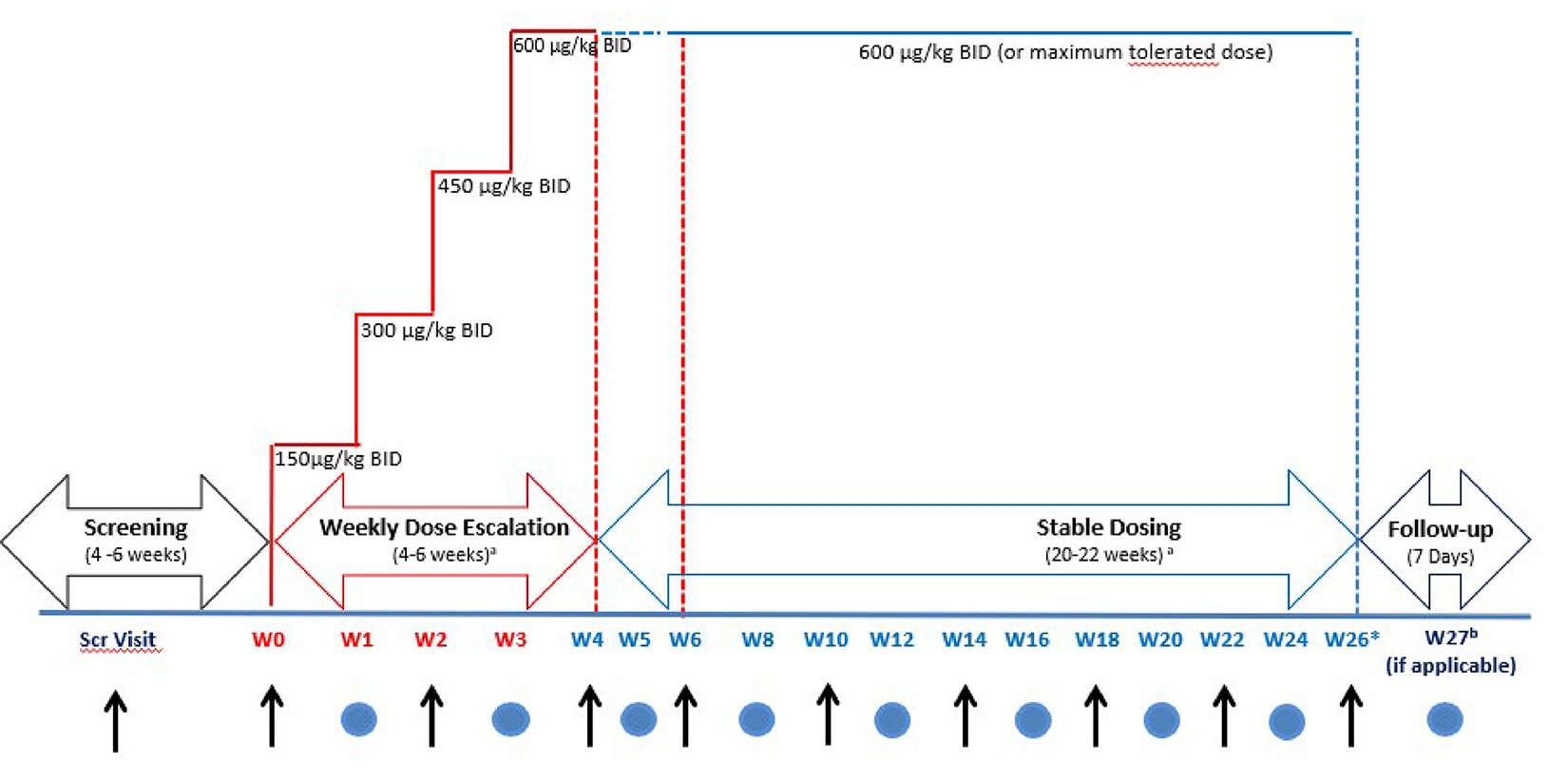
BID = twice daily; Scr = screening; W = week.
Notes: Upper arrows = clinic visit; blue circles = telephone or email contact; * = end of treatment or early termination.
The investigational product is maralixibat chloride. The conversion factor to maralixibat free base is 0.95.
aDose escalation may occur over 4 to 6 weeks, depending on tolerability. Stable dosing will occur over 20 to 22 weeks, depending on the duration of the dose-escalation period.
bSafety follow-up visit for patients not continuing into the extension study (MRX-503).
Source: MARCH study Clinical Study Report.11
Statistical Testing and Analysis Populations
Statistical Testing: The trial was powered for the primary efficacy outcome in the nontruncating progressive familial intrahepatic cholestasis (nt-PFIC 2) (BSEP) cohort: mean change in morning ItchRO(Obs) from baseline to weeks 15 to 26. The target total sample size was chosen to provide conventional power (≥ 80%) at a 2-sided alpha = 0.05 to detect a clinically meaningful between-group difference on ItchRO(Obs), assuming variability consistent with prior PFIC/IBAT data. The study was not event-driven; enrolment targets were patient-count based rather than dependent on time-to-event accrual.
For the primary end point, 26 complete participants (13 per group) were estimated to yield 80% power for comparison, accounting for a 10% dropout rate, resulting in 30 participants (15 per group) being randomized. For the secondary end point of mean change from baseline in the 4-week average morning ItchRO(Obs) frequency score from week 15 to week 26, 26 participants (13 in each group) were estimated to provide 81% power for comparison with the following assumptions: between-treatment group least square (LS) mean difference of 0.676, pooled standard deviation (SD) of 0.580, and the effect size of 1.166.
A hierarchical (gatekeeping) testing strategy that controlled the family-wise type I error rate at alpha = 0.05 (two-sided) within the primary (BSEP) cohort was specified:
Primary: change in ItchRO(Obs) (weeks 15 to 26).
Key secondary: change in total sBA levels (average of weeks 18, 22, and 26). Only if the preceding test was statistically significant would the next be formally tested. Outcomes outside the hierarchy (e.g., response analyses, other biochemistry, pruritus measures in the all-PFIC cohort) were analyzed nominally and not included in the type I error–controlled family. There were no multiple primary end points or interim looks that required additional alpha allocation.
The all-PFIC cohort analyses were prespecified as supportive and exploratory, using the same statistical models and analytic principles (i.e., mixed-effects model for repeated measures [MMRM] for continuous outcomes and generalized models for binary outcomes) but without hierarchical error control.
Continuous end points (e.g., ItchRO[Obs], sBA) were analyzed via MMRM with fixed effects for treatment, visit, and treatment-by-visit and baseline covariate adjustment; LS mean differences with two-sided 95% confidence intervals (CIs) were reported. Binary end points (e.g., response) used generalized models with effect estimates and 95% CIs. Sensitivity analyses included: (i) repeating the primary analysis using only 1 randomly selected sibling per family in the intention-to-treat (ITT) set; (ii) multiple imputation (i.e., missing at random [MAR]) for missing data; and (iii) a tipping-point analysis. All these were consistent with the primary analysis.
Analysis Populations:
Efficacy (primary cohort): an ITT set comprising all randomized patients with nt-PFIC 2, analyzed according to randomized treatment.
Safety: all patients who received 1 or more doses of the study drug (any cohort), analyzed by treatment received.
Per-protocol or “completer” analyses were considered supportive only and not used for primary inference.
Timing of Assessments: The primary efficacy window was weeks 15 to 26 for ItchRO(Obs); the key secondary sBA end point used the average of weeks 18, 22, and 26. Harm information was collected throughout the double-blind treatment (i.e., dose escalation then maintenance) with scheduled visits at increasing intervals.
The study used a fixed, parallel-group, double-blind design. The screening and run-in phase established baseline pruritus diary adherence and symptom levels, verified eligibility, and ensured stable background therapy. Patients who did not meet diary or clinical or biochemical thresholds were screen failures (prerandomization).
Efficacy and safety analyses were based on the predefined double-blind database lock at week 26 of the randomized period; any longer-term follow-up and LTE data were analyzed separately.
Patient Disposition
Patient disposition for the included study is summarized in the Supplemental Material document, Appendix 4.
Overall, 125 children were screened and 93 were randomized (maralixibat: n = 47; placebo: n = 46), with 86 completing the 26-week double-blind period and 7 discontinuing. Screening failures were predominantly due to not meeting biochemical or symptom thresholds (e.g., sBA levels less than the prespecified cut-off, insufficient pruritus), incomplete ItchRO(Obs) diary compliance, ALT or TSB that is more than allowable limits, imaging suggestive of a liver mass, decompensated cirrhosis, or other exclusionary factors, such as prohibited medications or procedures, lack of an eligible genotype, or prerandomization withdrawal. Among randomized patients, discontinuations were few and broadly similar across arms; the most common reason was withdrawal of consent. One discontinuation due to an AE (diarrhea) and 1 due to liver transplant occurred in the maralixibat arm, whereas 1 discontinuation due to disease progression occurred in the placebo arm. Notable protocol issues relevant to disposition included a single interactive response technology randomization error in a participant who did not satisfy eligibility (i.e., retained in the ITT analysis). No additional protocol deviations with material impact on patient flow were identified.
The full cohort included 93 patients and contains 2 subsets of patients: 1 conforming the PFIC cohort (64 participants), which in itself includes the second subset, named the primary (BSEP) cohort, with 31 patients (Figure 2).
Of 93 patients from the full cohort, 29 did not meet criteria for the PFIC cohort, that is, participants with truncated BSEP mutations (t-PFIC 2), heterozygosis, no variant associated with PFIC disease, low or fluctuating sBA levels, or previous surgery for PFIC.
In the primary (BSEP) cohort, 31 participants with nt-PFIC 2 were enrolled (14 maralixibat and 17 placebo). A total of 28 participants (90.3%) completed the study (13 maralixibat and 15 placebo). Three participants discontinued from the study (1 maralixibat and 2 placebo). In the all-PFIC cohort (i.e., PFIC 1, nt-PFIC 2, PFIC 3, PFIC 4, PFIC 10) 64 participants were enrolled (33 maralixibat and 31 placebo). No participant with PFIC5 was enrolled. A total of 60 participants (93.8%) completed the study (32 maralixibat and 28 placebo). Four participants discontinued from the study (1 maralixibat and 3 placebo). A total of additional 29 participants did not meet criteria for the all-PFIC cohort and were enrolled as part of the full cohort (14 maralixibat and 15 placebo). A total of 26 participants (89.7%) completed the study (12 maralixibat, 14 placebo). Three participants discontinued the study (2 maralixibat and 1 placebo).
Figure 2: Diagram of Participant Cohorts
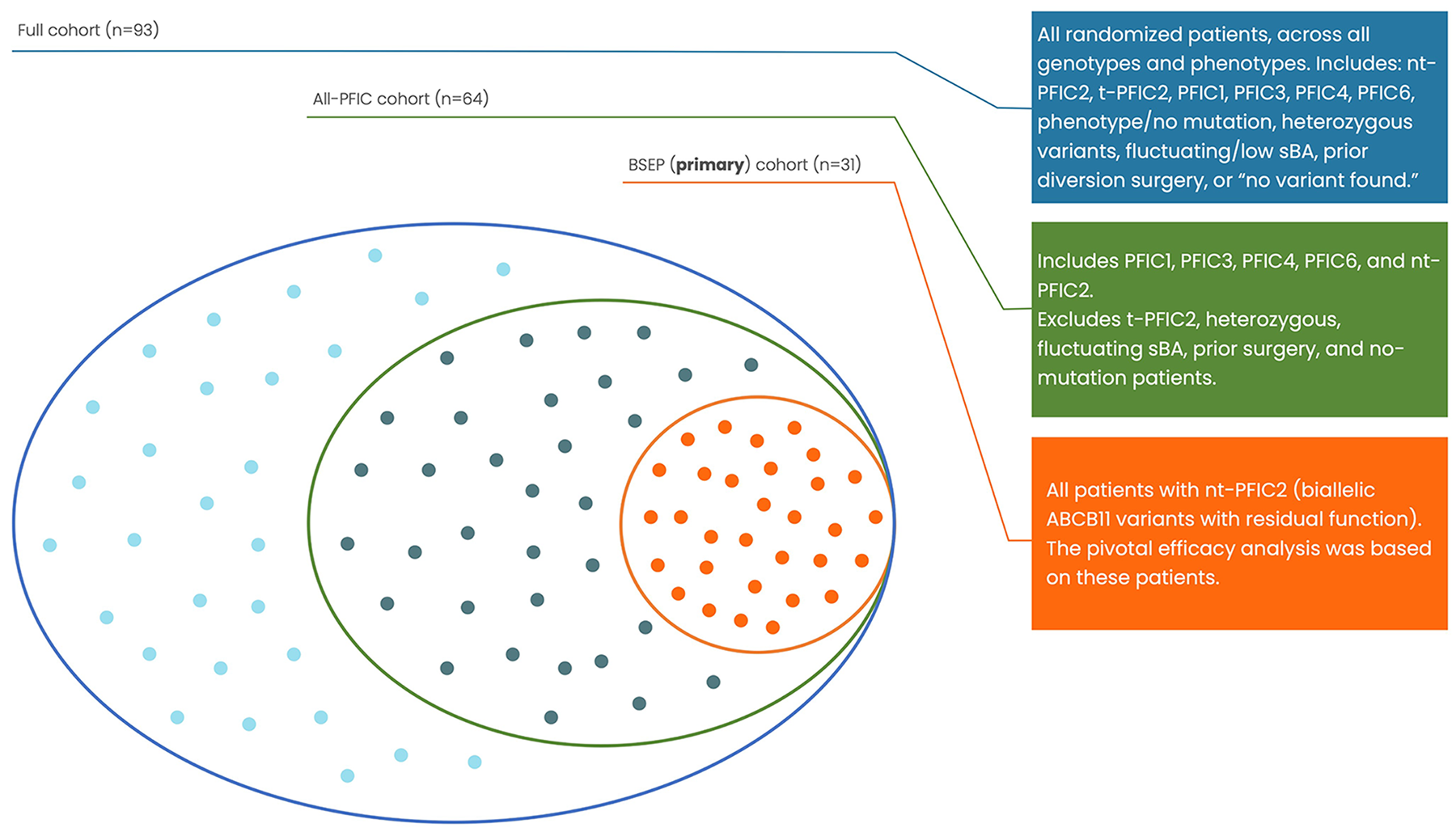
nt-PFIC = nontruncating progressive familial intrahepatic cholestasis; PFIC = progressive familial intrahepatic cholestasis; sBA = serum bile acid; t-PFIC = truncating progressive familial intrahepatic cholestasis.
Notes: Each dot represents one patient. The primary cohort included participants with nt-PFIC 2 (except for nt-PFIC 2 participants with heterozygosis, participants with low or fluctuating sBAs, or participants with previous surgery to treat PFIC). The all-PFIC (i.e., PFIC in this report) cohort included participants with PFIC 1, nt-PFIC 2, PFIC 3, PFIC 4, and PFIC 10 (i.e., all known established genotypes except for participants with t-PFIC 2 and heterozygosis, low or fluctuating sBAs, previous surgery to treat PFIC, or participants who had no established variant associated with PFIC disease). The full cohort included all participants enrolled: primary cohort, PFIC cohort, and participants with truncated BSEP mutations (t-PFIC 2), heterozygosis, or no established variant associated with PFIC disease, participants with low of fluctuating sBAs, and those with previous surgery to treat PFIC.
Source: Adapted from the Evidence for Clinical Submission11
Baseline Characteristics
Baseline characteristics were broadly balanced, with small differences in growth parameters (i.e., weight- and body mass index−for-age z scores) as depicted in Table 4. The full description of baseline characteristics is described in Appendix 4 in the Supplemental Material document.
Table 4: Summary of Baseline Characteristics From the MARCH Study
Status or category | Primary (BSEP) cohort | All-PFIC cohort | ||||
|---|---|---|---|---|---|---|
Maralixibat (n = 14) | Placebo (n = 17) | Overall (N = 31) | Maralixibat (n = 33) | Placebo (n = 31) | Overall (N = 64) | |
Age (years)a | ||||||
Median | 4.0 | 3.0 | 3.0 | 3.0 | 3.0 | 3.0 |
Q1 to Q3 | 3.0 to 11.0 | 1.0 to 7.0 | 1.0 to 8.0 | 2.0 to 7.0 | 1.0 to 7.0 | 1.0 to 7.0 |
Age category (years),a n (%) | ||||||
1 to < 6 | 9 (64.3) | 11 (64.7) | 20 (64.5) | 22 (66.7) | 19 (61.3) | 41 (64.1) |
6 to < 13 | 2 (14.3) | 5 (29.4) | 7 (22.6) | 8 (24.2) | 11 (35.5) | 19 (29.7) |
13 to 18 | 3 (21.4) | 1 (5.9) | 4 (12.9) | 3 (9.1) | 1 (3.2) | 4 (6.3) |
Sex, n (%) | ||||||
Female | 7 (50.0) | 11 (64.7) | 18 (58.1) | 16 (48.5) | 18 (58.1) | 34 (53.1) |
Male | 7 (50.0) | 6 (35.3) | 13 (41.9) | 17 (51.5) | 13 (41.9) | 30 (46.9) |
Race, n (%)b | ||||||
American Indian or Alaska Native | 3 (21.4) | 3 (17.6) | 6 (19.4) | 3 (9.1) | 4 (12.9) | 7 (10.9) |
Asian | 0 | 0 | 0 | 3 (9.1) | 0 | 3 (4.7) |
Black or African American | 1 (7.1) | 2 (11.8) | 3 (9.7) | 1 (3.0) | 2 (6.5) | 3 (4.7) |
White | 9 (64.3) | 9 (52.9) | 18 (58.1) | 24 (72.7) | 19 (61.3) | 43 (67.2) |
More than 1 race | 1 (7.1) | 2 (11.8) | 3 (9.7) | 2 (6.1) | 4 (12.9) | 6 (9.4) |
Not reported | 0 | 1 (5.9) | 1 (3.2) | 0 | 2 (6.5) | 2 (3.1) |
██████ | ||||||
██████ | ██████ | ██████ | ██████ | ██████ | ██████ | ██████ |
██████ | ██████ | ██████ | ██████ | ██████ | ██████ | ██████ |
██████ | ██████ | ██████ | ██████ | ██████ | ██████ | ██████ |
██████ | ██████ | ██████ | ██████ | ██████ | ██████ | ██████ |
██████ | ██████ | ██████ | ██████ | ██████ | ██████ | ██████ |
Height z scorec | ||||||
n | 14 | 17 | ██████ | 33 | 31 | ██████ |
Mean | −1.964 | −2.191 | ██████ | −2.081 | −2.064 | ██████ |
SD | 1.3882 | 1.4149 | ██████ | 1.2924 | 1.4798 | ██████ |
Weight z scorec | ||||||
n | 14 | 17 | ██████ | 33 | 31 | ██████ |
Mean | −1.526 | −1.242 | ██████ | −1.752 | −1.283 | ██████ |
SD | 1.3796 | 1.4962 | ██████ | 1.2925 | 1.3251 | ██████ |
██████ | ||||||
██████ | ██████ | ██████ | ██████ | ██████ | ██████ | ██████ |
██████ | ██████ | ██████ | ██████ | ██████ | ██████ | ██████ |
██████ | ██████ | ██████ | ██████ | ██████ | ██████ | ██████ |
BMI = body mass index; PFIC = progressive familial intrahepatic cholestasis; SD = standard deviation; Q1 = 25th percentile; Q3 = 75th percentile.
Note: Percentages = (n/N) × 100. Full cohort results are presented in the appendices in the Supplemental Material document.
aAge at baseline visit.
bRacial categories used in the table are as reported in the source and may not align with Canada's Drug Agency inclusive language guidelines.
cHeight, weight, and BMI z scores are based on a participant’s sex and age at the baseline visit. WHO growth charts were used to derive z scores for participants < 24 months, and the Center for Disease Control growth charts were used to derive z scores for participants ≥ 24 months old.
Source: MARCH Study Clinical Study Report.11
Treatment Exposure and Concomitant Medications
Details of patients’ treatment exposure and adherence, as well as concomitant medications are presented in the Supplemental Material document, Appendix 4.
Exposure to randomized treatment was high and protocol-directed titration was followed: participants escalated weekly from 150 mcg/kg to 300 mcg/kg, to 450 mcg/kg, and to 600 mcg/kg maralixibat as tolerated, with allowances for temporary down-titration in the event of liver parameter or gastrointestinal tolerability concerns; patients unable to tolerate 150 mcg/kg twice a day were discontinued. Adherence, calculated as the proportion of scheduled doses taken, was consistently high (most patients ≥ 90%).
Concomitant therapy use was universal (100%). In the full randomized cohort, the most common ongoing or background therapies were UDCA (83.9%), rifampicin (57.0%), tocopherol and vitamin E (54.8%), vitamin K not otherwise specified (35.5%), and cholecalciferol and vitamin D (32.3%), with similar UDCA use across arms; antihistamines and other symptomatic agents were also frequently used. These patterns were expected given PFIC management and appeared balanced between maralixibat and placebo.
Cointervention policy required stable dosing for more than 30 days before screening for permitted pruritus and cholestasis medications (e.g., UDCA and cholic acid, rifampicin, diphenhydramine and hydroxyzine, naltrexone and naloxone, phenobarbital, antihistamines), and prohibited therapies likely to confound bile acid handling or duplicate mechanism (i.e., bile acid and lipid binding resins, phenylbutyrates, any investigational drug, other IBAT inhibitors) during screening and the blinded period. Rescue therapy beyond these stable background agents was not allowed.
Critical Appraisal
Internal Validity
Randomization was conducted centrally through an interactive response technology system using a prespecified 1:1 parallel scheme, which appears adequate. Allocation concealment and maintenance of blinding were appropriate for a placebo-controlled design. Subgroups of interest were included as stratification factors to maintain balance across treatment arms. The trial employed double-blind procedures; however, the higher frequency of diarrhea in the active treatment group could have served as a signal of treatment assignment, potentially introducing expectation or reporting bias in subjective outcomes, such as pruritus. Nonetheless, adherence to both treatment and placebo exceeded 90%, suggesting that blinding was largely maintained as the trial progressed. The direction and magnitude of any resulting bias are uncertain.
Primary and secondary continuous outcomes were analyzed using an MMRM with baseline adjustment under a MAR assumption and prespecified sensitivity analyses yielded consistent results. The hierarchical (gatekeeping) strategy applied to the primary (BSEP) cohort controlled for multiplicity only in the prespecified sequence of ItchRO(Obs) and sBA levels. All other analyses, including those in the all-PFIC cohort, were conducted nominally. While diary-based patient-reported outcomes are inherently prone to missing data, overall completeness was acceptable, and follow-up was good, with few patients discontinuing therapy in either arm. A single eligibility (or allocation) error was retained in the ITT population, minimizing bias associated with after randomization exclusions. Sensitivity analyses (e.g., multiple imputation under MAR, one-sibling-per-family ITT, and tipping-point analyses) were consistent with the primary analysis.
Baseline characteristics were generally well balanced between treatment groups, although some imbalances were noted, including a younger average age and greater use of UDCA in the placebo arm of the primary cohort, as well as modest differences in ALT levels and pruritus severity. Notably, systemic antihistamine use was substantially higher in the maralixibat group (78.6%) than in the placebo group (29.4%). These variations, likely attributable to the small sample size, could have attenuated or accentuated the estimated treatment effect; however, the overall direction of any resulting bias remains uncertain and was considered in the interpretation of results. Concomitant use of UDCA, rifampicin, and vitamin supplementation was common but similar between groups, reflecting standard PFIC management. All permitted therapies were stabilized before randomization, minimizing the likelihood of residual confounding, though it cannot be completely ruled out.
The ItchRO(Obs) instrument was used to assess pruritus severity and is a relevant, caregiver-reported measure for pediatric cholestatic pruritus with acceptable measurement properties in a randomized trial. The definition of response (i.e., a ≥ 1-point improvement or achieving a score ≤ 1.0) is clinically intuitive, although the minimal important difference (MID) is based on limited empirical certainty. sBA levels were also evaluated as a surrogate outcome; while biologically plausible and considered clinically meaningful by experts, the strength and certainty of its correlation with long-term clinical outcomes, such as transplant-free survival, remain uncertain over short time horizons.
A mid-recruitment protocol amendment refined eligibility criteria by excluding participants with low baseline serum bile acid levels from the primary cohort; this change was not expected to meaningfully affect internal validity. No protocol deviations were identified that would have influenced the primary outcomes. Safety was evaluated over 26 weeks, which was sufficient to identify common gastrointestinal and laboratory AEs but not long-term or rare hepatic events, which require longer observation for full characterization.
External Validity
Population: The pediatric PFIC population, with emphasis on nt-PFIC 2, represents a clinically important subgroup in clinical practice in Canada. However, other genotypes were sparsely represented. For instance, older adolescents were few, with no patients younger than 1 year or older than 18 years enrolled. Generalizability to infants younger than 12 months and non-BSEP PFIC is still limited. Given the rarity of PFIC, the small sample size and limited racial and ethnic diversity in the MARCH trial are expected. Although no biological differences in treatment response are known, the minimal inclusion of participants who were American Indian or Alaska Native, Black or African American, or Asian [categories used in study], which limits certainty about the effects in these groups.
Intervention: The dose escalation then maintenance regimen mirrors the intended clinical use. The adherence to the use of the drug was high, supporting the applicability in routine clinical settings.
Comparator: A placebo control appropriately isolates drug effects but does not inform comparative effectiveness versus active options used in Canada (e.g., other IBAT inhibitors, surgical diversion), limiting external comparative inferences.
Outcomes and follow-up: Selected outcomes are clinically relevant (e.g., pruritus, sBA, growth), but the 26-week horizon is short for detecting disease-modifying effects (e.g., overall mortality, transplant-free survival). In addition, according to clinical experts, the ItchRO(Obs) is a research instrument not routinely used in clinical practice. If this tool is required for monitoring, the feasibility and burden for caregivers and clinicians (e.g., training, diary completion, data capture) should be considered in the feasibility and implementation plans.
Setting and background care: This was a multiregional trial that included sites in Canada. Concomitant therapies and monitoring align with practice in Canada according to clinical experts consulted by CDA-AMC, supporting the applicability of the process. No requirement for failure of prior medications was proposed in the reimbursement criteria by the sponsor or drug plans, which is consistent with potential first-line use; nonetheless, applicability to previously treated populations and relative place in therapy in Canada will also depend on comparative evidence to drugs currently approved for the same indication (e.g., odevixibat).
Results
The key efficacy and harms results and findings from the GRADE assessment are presented in this section. Detailed efficacy and harms results can be found in Appendix 4 in the Supplemental Material document.
Efficacy
Key results include the following:
Deaths, transplant-free survival, and liver transplant or listing: No deaths and no liver-associated events, which included liver transplant or transplant listing, were reported in either arm during the 26-week blinded period. Consequently, there were no between-group differences for these outcomes.
ItchRO(Obs) — change from baseline (CFB), weeks 15 to 26:
Primary (BSEP) cohort (n = 31): The primary end point was met for the study. There was a reduction (i.e., improvement) in average morning ItchRO(Obs) severity score between baseline and weeks 15 to 26 in the maralixibat treatment group with LS mean reduction of −1.718 (95% CI, −2.272 to −1.163). In the placebo group, the LS mean reduction in ItchRO(Obs) was −0.628 (95% CI, −1.136 to −0.121). The difference between groups was of −1.089 points (95% CI, −1.845 to −0.334; P = 0.0063) in favour of maralixibat. Sensitivity analyses (e.g., multiple imputation under MAR, 1-sibling-per-family ITT, tipping-point) were consistent with the primary analysis.
All-PFIC cohort (n = 64): This was a prespecified secondary end point using the 4-week average morning ItchRO(Obs). The LS mean difference versus placebo was −1.20 (95% CI,−1.727 to −0.674; P < 0.0001). The within-group LS means CFB was −1.811 (standard error [SE] = 0.183) in the maralixibat group versus −0.610 (SE = 0.194) in the placebo arm. Improvement with maralixibat emerged early (by week 2 to 4) and was maintained through week 26 across the 3 evaluation windows. Sensitivity analyses (e.g., multiple imputation under MAR, 1-sibling-per-family ITT, tipping-point) were consistent with the primary analysis.
ItchRO(Obs) response, weeks 15 to 26 (definition: a 1-point or greater decrease from baseline or an average score ≤ 1.0 across the three 4-week windows):
Primary (BSEP) cohort: 57.1% of patients (8 of 14) in maralixibat versus 23.5% (4 of 17) in placebo; P = 0.0736 (not multiplicity adjusted). An absolute risk difference of 33.6% (95% CI, −4.0% to 64.9%).
All-PFIC cohort: 21 of 33 (63.6%) patients in the maralixibat group versus 8 of 31 (25.8%) in placebo; P = 0.0023 (not multiplicity adjusted). An absolute risk difference of 37.8% (95% CI, 11.3% to 59.4%).
sBA levels (μmol/L) — CFB, average of weeks 18, 22, 26:
Primary (BSEP) cohort: Within-group change (i.e., descriptive results and P values) in maralixibat group of −175.536 (95% CI,−256.716 to −94.356; P = 0.0001; n = 14); placebo 11.187 (95% CI,−58.073 to 80.446; P = 0.7428; n = 17). Between-group LS mean difference (i.e., key secondary end point; multiplicity controlled within the BSEP hierarchy) of −186.723 (95% CI, −293.454 to −79.992; P = 0.0013).
All-PFIC cohort: Within-group change (i.e., descriptive results and P values) in maralixibat −157.489 (95% CI, −200.276 to −114.703; P < 0.0001; n = 33); placebo 2.91 (95% CI, −42.32 to 48.14; P = 0.8980; n = 31). Between-group: LS mean difference (not multiplicity adjusted) of −160.40 (95% CI, −220.83 to −99.97; P < 0.0001).
sBA response, weeks 18 to 26 (definition: average sBA level < 102 μmol/L if baseline ≥ 102, or ≥ 75% reduction from baseline):
Primary (BSEP) cohort: 5 of 14 (35.7%) patients in the maralixibat group versus 1 of 17 (5.9%) in the placebo arm were categorized as responders. An absolute risk difference of 29.8% (95% CI, 0.8% to 59.2%).
All-PFIC cohort: 15 of 33 patients (45.5%) in the maralixibat group versus 2 of 31 (6.5%) in placebo were categorized as responders; P = 0.0004 (i.e., Barnard’s exact test, not multiplicity adjusted). An absolute risk difference of 39.0% (95% CI, 16.5% to 58.2%).
Height z score — CFB at weeks 18 to 26 combined:
|██ ███ ███████ ██████ ███████ ███ ███████████ █████ ██████ █ █████ ████████████ ████████ ██ ██████ ████ ██ ██████ ██ ██████ ██████████ ███████ ███ ███████ █████ ██████ █ ██████ ████████. The LS mean difference between groups was 0.222 (95% CI,−0.141 to 0.585; P = 0.220).
|██ ███ ████████ ███████ ███ ███████████ █████ ████████████ █ ████ ██████ ██ ██████ ████ ██ ██████ ██ ██████ ███████ ██████████ █████ ███ ███████ █████ ██████ █ █████ █████████. The LS mean difference between groups was 0.208 (95% CI, −0.036 to 0.453; P = 0.0939).
None of the P values were adjusted for multiplicity.
Weight z score — CFB at weeks 18 to 26 combined:
|██ ███ ███████ ██████ ███████ ███ ███████████ █████ ██████ █ ████ ████████ ██ █████ ████ ██ █████ ██ ██████ ███████ ██████████ █████ ███ ███████ █████ █████████ ██ █████ ████ ██ █████ ██ ██████ ███████ ██████████. The between-group LS mean difference was 0.112 (95% CI,−0.163 to 0.388; nominal P = 0.4096).
|██ ███ ████████ ███████ ███ ███████████ █████ █████████ ██ █████ ████ ██ █████ ██ ██████ ███████ ██████████ ████████ ████ █████ ████ ██ ██████ ██ ██████ █████████ ██ ███ ███████ ██████. The between-group LS mean difference was 0.227 (95% CI, 0.012 to 0.442; P = 0.0391). Improvement in weight z scores in the maralixibat group was observed as early as week 4.
None of the P values were adjusted for multiplicity.
CSS — CFB weeks 18 to 26 combined:
|██ ███ ███████ ██████ ███████ ███ ███████████ █████ ██████ ██ ██ ████ █████████ ██ ██████ ████ ██ ██████ ██ ███████ ██████████ ████████ ████ ██████ ████ ██ ██████ ██ ███████ █████████ ██ ███ ███████ ██████. The LS mean difference between groups was −1.050 (95% CI,−1.720 to −0.381; P = 0.0034).
|██ ███ ████████ ███████ ███ ███████████ █████ ██████ ██ ██ ████ █████████ ██ █████ ████ ██ ██████ ██ ███████ ██████████ ███ ███ ███████ █████ ██████ ████ ██ ██████ ██ ███████ ██████████. The LS mean difference between groups was −1.129 (95% CI,−1.654 to −0.604; P < 0.0001). Reductions in CSS scores were observed as early as week 2.
None of the P values were adjusted for multiplicity.
|██████ ████████ █████ █████ █ ████ ██████ ████ ████ ███ █████ █████ ███████.
|██ ███ ███████ ██████ ███████ ███ ██ ████ ██████ ████ ████████ ███ ██████ ████ ██ █████ ██ ███████ █████████ ███ ███████████ ███ ██████ ████ ██ ██████ ██ ███████ █████████ ███ ████████ ███ ██ ████ ██████████ ███████ ██████ ███ ███████ ████ ██ ██████ ██ ███████ ██████████.
|██ ███ ████████ ███████ ███ ██ ████ ██████ ████ ████████ ███ ███████ ████ ██ █████ ██ ███████ █████████ ███ ███████████ ███ ███████ ████ ██ █████ ██ ███████ █████████ ███ ████████ ███ ██ ████ ██████████ ███████ ██████ ███ ██████ ████ ██ ██████ ██ ███████ ██████████.
|██████ ███ ████ ██████ ██████ ██ ██ ███ ███ ███ ███ ███ ████ ██████ ████████ █████ ██████ ████████ ██ ████ █████████ █████ ███ ██ █████████████ ███████████ ████ ████████ ██ ███ ████████ █████ █████ █████████.
|███ ████████ ███ ███ ████████ ███ █████████████.
TSB – mean CFB weeks 18 to 26 combined:
In the primary (BSEP) cohort (secondary outcome), the LS mean difference between maralixibat and placebo was −1.999 mg/dL (95% CI, −5.981 mg/dL to 1.983 mg/dL; P = 0.2916).
In the all-PFIC cohort, the LS mean difference between groups was −2.003 mg/dL (95% CI, −3.980 mg/dL to −0.027 mg/dL; P = 0.0471).
None of the P values were adjusted for multiplicity.
Harms
Key results of the double-blind safety population from the MARCH study (maralixibat n = 47; placebo n = 46) include the following:
Overall AEs, SAEs, withdrawals due to adverse events (WDAEs), and deaths:
Any AE: 47 of 47 (100%) versus 43 of 46 (93.5%)
SAE: 5 of 47 (11%) versus 3 of 46 (7%)
AE-related discontinuation: 1 of 47 (2%) versus 0 of 46 (0%) (1 maralixibat patient for mild diarrhea)
Deaths: 0 of 47 (0%) versus 0 of 46 (0%)
Most common AEs (more than 10% in either arm):
Diarrhea: 27 of 47 (57.4%) versus 9 of 46 (19.6%) (i.e., mild or moderate; transient)
Pyrexia: 17 of 47 (36.2%) versus 13 of 46 (28.3%)
|█████████ █████ █████ ███████ ██ ████ ███████
Rhinorrhea: 8 of 47 (17.0%) versus 5 of 46 (10.9%)
Cough: 7 of 47 (14.9%) versus 5 of 46 (10.9%)
ALT increased: 6 of 47 (12.8%) versus 3 of 46 (6.5%)
Notable harms and adverse events of special interest (AESIs):
Diarrhea (AESI): 27 of 47 (57.4%) versus 9 of 46 (19.6%); no serious diarrhea; typically resolved on treatment
Elevated transaminases (AESI): 7 of 47 (14.9%) versus 3 of 46 (6.5%); all mild or moderate; none led to discontinuation
WDAEs: 1 patient in the maralixibat arm (2%) discontinued for diarrhea; 0 in placebo arm. No WDAEs in the primary or PFIC cohorts when analyzed separately.
Summary of Findings and Certainty of the Evidence
Literature-based MID estimates were used as the thresholds for the following outcomes:
Pruritus, as CFB in the ItchRO(Obs]) score (0 to 4 scale, higher scores indicate greater severity), with an MID established at 1-point reduction.
The ItchRO(Obs) response rate, assessed over weeks 15 to 26, was defined as achieving a 1-point or more reduction from baseline or a weekly average score of 1.0 or less. These thresholds are consistent with meaningful symptomatic relief observed in validation and clinical trial analyses. Clinical experts supported this interpretation and suggested that, when considering absolute treatment effects, an increase of approximately 20 additional responses per 1,000 patients (or 2 per 100) would represent the minimum clinically meaningful difference.
CFB in total sBA level, averaged across weeks 18, 22, and 26, are biologically plausible surrogates of cholestasis. While no validated MID exists, decreases of 70% or more from baseline or to 70 µmol/L or less are commonly interpreted as meaningful biochemical responses, consistent with previous cholestatic studies. Responder analyses used these same thresholds and were interpreted as indicators of efficacy rather than validated MIDs. Clinical experts aligned with this interpretation.
Growth parameters (height and weight z scores) were objectively measured using WHO standards. Maintenance or improvement of height and weight z scores over 26 weeks was considered clinically relevant by clinicians and patient groups, given the strong association between growth failure and disease burden in PFIC. However, no formal MID could be established for short-term changes in these parameters, hence the null was used for the GRADE assessment.
CFB in PedsQL (parent proxy) scores between weeks 18 and 26 is a well-validated and reliable health-related quality of life instrument for children and adolescents, though it has not been specifically validated in PFIC. Total scores range from 0 to 100, with higher scores representing improvement in health-related quality of life. In pediatric chronic health conditions, a 4- to 5-point improvement in the total score is generally considered clinically meaningful.
The CSS is a 5-point clinician-rated tool (i.e., from 0 to 4, where higher scores denote greater scratching severity and worse pruritus) used to assess scratching behaviour and skin damage. While no validated MID has been defined, a 1-point improvement has been pragmatically used to denote a clinically meaningful response in studies of Alagille syndrome.
Higher TSB concentrations in PFIC and other cholestatic diseases reflect greater disease severity. TSB is an objective biomarker and, although no validated MID has been defined for PFIC, decreases are generally interpreted as improvement in biochemical responses. Given this, the null effect was used as the MID in this report for the GRADE assessments.
Refer to the summary of outcome measures in Appendix 3 of the Supplemental Material document.
Table 5: Summary of Findings for Maralixibat vs. Placebo for Patients With PFIC
Outcome and follow‑up | Patients (studies), N | Relative effect (95% CI) | Absolute effects (95% CI) | Certainty | What happens | ||
|---|---|---|---|---|---|---|---|
Placebo | Maralixibat | Difference | |||||
Efficacy | |||||||
Deaths: all-cause mortality Follow-up: median 104 weeks | 64 (1 RCT) | NA | No deaths occurred during the 26-week randomized phase. | Lowa,b | Maralixibat may result in little to no difference in deaths when compared with placebo. | ||
Transplant: liver-related adverse event Follow-up: median 104 weeks | 64 (1 RCT) | NA | No liver transplants occurred during the 26-week randomized phase. | Lowa,b | Maralixibat may result in little to no difference in transplant when compared with placebo. | ||
Pruritus: CFB in ItchRO(Obs) score Lower scores indicate improvement Follow-up: range 15 weeks to 26 weeks | 64 (1 RCT) | NA | −0.610 points | −1.81 points | −1.2 points (−1.727 to −0.674) | Moderatec | Maralixibat likely results in a clinically important decrease in pruritus when compared with placebo. |
Pruritus response, ItchRO(Obs) Response: ≥ 1‑point decrease from baseline, or an average score ≤ 1.0 Follow-up: range 15 weeks to 26 weeks | 64 (1 RCT) | NA | 26 per 100 | 64 per 100 | 38 more per 100 (from 11 more to 59 more) | Highd | Maralixibat results in a higher proportion of patients with response when compared with placebo. |
Biomarkers | |||||||
Serum bile acids, CFB (μmol/L) Lower values indicate improvement. Follow-up: range 15 weeks to 26 weeks | 64 (1 RCT) | NA | 2.913 μmol/L | −157.487 μmol/L | −160.4 (−220.83 to −99.97) | Highe | Maralixibat results in a decrease in sBA levels when compared with placebo. |
Serum bile acids response: average sBA level of < 102 µmol/L (if baseline sBA level was ≥ 102 µmol/L) OR at least a 75% average reduction from baseline Follow-up: range 15 weeks to 26 weeks | 64 (1 RCT) | NA | 6 per 100 | 45 per 100 | 39 more per 100 (from 17 more to 58 more) | Highd | Maralixibat results in an increase in the proportion of patients with sBA response when compared with placebo. |
Total serum bilirubin: CFB in mg/dL. Lower values indicate improvement. Follow-up: range 18 weeks to 26 weeks | 64 (1 RCT) | NA | 0.931 | −1.072 | −2.003 (−3.98 to −0.027) | High | Maralixibat results in a decrease in total serum bilirubin when compared with placebo. The clinical importance of the decrease is uncertain. |
Growth parameters | |||||||
Height z score, z scores in SDs. Higher values indicate improvement. Follow-up: range 18 weeks to 26 weeks | 64 (1 RCT) | NA | █████ | █████ | 0.208 (−0.036 to 0.453) | Moderatef | Maralixibat likely results in little to no difference in height z score when compared with placebo. |
Weight z score, z scores in standard deviations. Higher values indicate improvement. Follow-up: range 18 weeks to 26 weeks | 64 (1 RCT) | NA | █████ | █████ | 0.227 (0.012 to 0.442) | Highg | Maralixibat results in an increase in weight z score when compared with placebo. The clinical importance of the increase is uncertain. |
HRQoL, patient-reported outcomes | |||||||
Clinician Scratch Scale, CFB over time in units of the scale. Lower values indicate improvement. Follow-up: range 18 weeks to 26 weeks | 64 (1 RCT) | NA | █████ | █████ | −1.129 (−1.654 to −0.604) | Moderateh | Maralixibat likely results in a clinically important decrease in Clinician Scratch Scale score when compared with placebo. |
████ █████████ | █████ | █████ | █████ | █████ | █████ | ███ | █████████ |
Harms | |||||||
AE, SEA, and events of special interest Follow-up: 26 weeks | 93 (1 RCT) | In maralixibat vs. placebo: Any AE: 47 of 47 (100%) vs. 43 of 46 (93.5%); SAE: 5 of 47 (11%) vs. 3 of 46 (7%); AE-related discontinuation: 1 of 47 (2%) vs. 0 of 46 (0%) Most common AEs were diarrhea: 27 of 47 (57.4%) vs. 9 of 46 (19.6%) (mild or moderate; transient); abdominal pain: 12 of 47 (25.5%) vs. 6 of 46 (13.0%); ALT increased: 6 of 47 (12.8%) vs. 3 of 46 (6.5%) | Lowb | Maralixibat may result in little to no difference in the number of AEs, SAEs, and withdrawal due to AEs when compared with placebo. | |||
AE – adverse event; CFB = change from baseline; CI = confidence interval; HRQoL = health-related quality of life; ItchRO(Obs) = Itch Reported Outcome (Observer); NA = not applicable; PBO = placebo; PFIC = progressive familial intrahepatic cholestasis; RCT = randomized controlled trial; SAE = serious adverse event; sBA = serum bile acid; SD = standard deviation; vs. = versus.
Note: Study limitations (which refer to internal validity or risk of bias), inconsistency across studies, indirectness, imprecision of effects, and publication bias were considered when assessing the certainty of the evidence. All serious concerns in these domains that led to the rating down of the level of certainty are documented in the table footnotes.
aThe MARCH-502 study continued into MARCH-ON (MRX-503), an open-label, uncontrolled long-term extension of the same cohort. In this study, 2 deaths in the maralixibat group were reported during long-term follow-up (median 104 weeks). These deaths were attributed to progression of underlying liver disease. These 2 deaths were not included in this table. For transplant outcomes, in the combined long-term follow-up, 3 liver transplants were reported, one in the MRX-MRX group and 2 in the PBO-MRX group. All transplantation events were attributed to progression of underlying liver disease rather than treatment.
bNo threshold for a clinically important difference was prespecified for this end point, and no formal statistical testing was conducted. The very low number of events and small overall sample size prevent a precise estimate of effect. Therefore, the certainty of evidence was rated down by 2 levels for imprecision, as the total population analyzed (< 250 participants) was less than a conservative optimal information size threshold.
cThe 95% CI crosses the minimally important difference threshold of a ≥ 1-point reduction in the ItchRO(Obs) score, introducing uncertainty about the magnitude of the true effect; therefore, the certainty of evidence was rated down by 1 level for imprecision.
dThere was an increase in absolute effects on the proportion of patients achieving response, well beyond the 2-per-100 threshold suggested by clinical experts. Even though there was a small sample size, the certainty was not rated down for imprecision.
eThe 95% CI around the mean difference is less than the null and well separated from any plausible threshold of clinical importance. Despite the small sample size, the estimate is precise in direction and magnitude of a biochemical objectively measured effect; therefore, the certainty was not rated down for imprecision.
fThe 95%CI for change in height z score includes the null value, and no MID was established. Therefore, the certainty was rated down 1 level for imprecision.
gThe 95% CI excludes the null value, which was established as the MID. Therefore, the certainty was not rated down for imprecision.
hThe 95% CI includes a threshold of 1-point improvement in the CSS, which was considered as the MID for this end point. Therefore, we rated down 1 level for imprecision.
iThe 95% CI includes the null value and the thresholds of minimal important effects, determined at 4 points in the Pediatric Quality of Life Inventory (PedsQL) scale. Therefore, we rated down 2 levels for imprecision.
Source: Details included in the table are from the sponsor’s Summary of Clinical Evidence.7
Long-Term Extension Studies
Description of Study
The MARCH-ON (MRX-503) study has been summarized to provide evidence on the safety, tolerability, and longer-term efficacy of maralixibat in participants diagnosed with PFIC who previously participated in and completed the MARCH (MRX-502) study described in the Systematic Review section.
To participate in the MARCH-ON study, participants had to have completed the MARCH study (i.e., complied and adhered to treatment). Any interruption of treatment between studies was avoided (i.e., MARCH-ON was initiated immediately upon participant completion of the MARCH study). The baseline visit for the MARCH-ON study was on the same day as the end of treatment visit in the MARCH study. The MARCH-ON study is intended to provide about 2 years of data (including 4 to 6 weeks of the dosing phase) on the efficacy and harms of maralixibat. However, interim results presented from a data cut-off of June 23, 2022, comprise around 18 months of data for participants who had maralixibat in both the MARCH and MARCH-ON studies, and about a year of data for those who had placebo in the MARCH study but transitioned to maralixibat in the MARCH-ON study.
All participants in the MARCH-ON study were treated with maralixibat, regardless of what treatment they received in the MARCH study. Participants in both treatment arms started dose escalation at the same starting dosage in the MARCH-ON study to maintain treatment blinding while the MARCH study was still ongoing. The MARCH-ON study used the same study schedule as MARCH up to week 26.
Outcomes and Analyses
The primary efficacy outcome was the mean change from maralixibat baseline over time in the average morning ItchRO(Obs) severity score. For participants treated with maralixibat in the MARCH study, the maralixibat baseline was the baseline from that study; for those treated with placebo in the MARCH study, the maralixibat baseline was from the MARCH-ON study. The primary safety outcomes included incidence of treatment-emergent adverse events (TEAEs) during the study and safety laboratory parameters from maralixibat baseline over time.
Secondary outcomes (for primary cohort; exploratory for the all-PFIC cohort) reported included mean CFB in sBA levels and mean CFB in height and weight z scores.
The same participant cohorts used for the analysis in the MARCH study were used in the MARCH-ON study, as described in the Systematic Review section (i.e., primary, all-PFIC, and full). Participants were also analyzed using subgroups relating to the treatment they had in MARCH:
MRX-MRX group received maralixibat in the MARCH study.
Placebo (PBO)-MRX group received placebo in the MARCH study but maralixibat in the MARCH-ON study.
All MRX group received maralixibat in either study, including those who discontinued the MARCH study early or did not continue into the MARCH-ON study.
All safety analyses included all participants randomized in the MARCH study who received at least 1 dose of the study drug in the MARCH-ON study.
Patient Disposition
Of the 86 participants who completed the MARCH study, 74 enrolled in the MARCH-ON study: 36 who received maralixibat, and 38 who received placebo in the MARCH study. However, the analysis reported for the MARCH-ON study (i.e., MRX-MRX and all MRX subgroups) included all participants in the MARCH study who received maralixibat, including those who had not yet enrolled in the MARCH-ON study. So, the analysis included 47 participants in the MRX-MRX group, 38 in the PBO-MRX group, and 85 in the all MRX group.
Of the full PFIC cohort that received maralixibat in either study (N = 85), ██ █████ ████████████ ██████ ██ █████ ██ ███ ███████ ██████ ███ █ ████ ██ ███ ███████ ██████ ██ █████ ███ █████████ ████████ ████ ██ ████ ████ ██ ███ ████████ ███████ █ ████ ███████ ███ █ ████ ████████. Reasons for discontinuation included:
Four in the MRX-MRX group withdrew because of an AE (3 in the all-PFIC cohort) and 1 because of a withdrawal of consent during the MARCH study, compared to none in the ███████ group for these reasons.
Two participants in the MRX-MRX group and 1 in the PBO-MRX group stopped because of liver transplant.
|█████ ████████████ ██ ███ ███████ █████ ███ █ ██ ███ ███████ █████ ███████ ███████ ██ █ ██████████ ██ ███ ███████████ ██ ████████ ██████ ███ ████████ ██████.
Exposure to Study Treatments
The mean average daily dose of all patients who had maralixibat was 980.51 mcg/kg (SD = 182.494 mcg/kg) and was similar between the MRX-MRX and PBO-MRX groups. Dose escalation to the maximum dosage of 600 mcg/kg twice a day occurred in 91.89% (68 of 74) of all participants. Mean exposure to maralixibat was 386 days (SD = 205 days) in the MRX-MRX group (mean = 177.1 days [SD = 36.57 days] in MARCH) and 284 days (SD = 193 days) in the PBO-MRX group.
Concomitant medications were permitted in the study protocol except for other IBAT inhibitors. All participants took concomitant medications, with similar rates taking UDCA (82% to 85%) and slightly more taking rifampicin (60% compared with 50% to 55% in MARCH).
Critical Appraisal
Internal Validity
As all participants received maralixibat, there was no comparator to represent a baseline. It was not possible to control for possible confounding variables that might influence the outcome (e.g., with randomization or other adjustments for confounding). So, longer-term data provided by this study beyond the MARCH study is subject to this limitation,
Some potential biases were mitigated because the study followed on from the MARCH trial, including largely following the treatment structure and outcome measurement in the MARCH study. Because patients who completed the MARCH trial were eligible for inclusion (regardless of which treatment they had in MARCH), there is a theoretical lower risk that this study introduced selection bias. However, only 86% (74 of 86) of participants who completed the MARCH study continued into the MARCH-ON study, increasing the risk of bias by potentially enriching for patients who could tolerate and adhere well to the medication and may have been more likely to have a positive response.
The results presented were from an interim data cut and some participants from the MARCH study had not yet enrolled in the extension trial. So, there were very few participants included at later follow-up time points, resulting in an overall high uncertainty in the results.
In terms of outcome measurement, the comments on outcome validity for the MARCH trial are also relevant to the MARCH-ON study (e.g., the relevance of ItchRO[Obs] and the certainty in its MID, as well as the uncertainty in the relationship between sBA level and longer-term outcomes). However, because this trial extension was open label, there is a risk of measurement bias from lack of blinding in the assessment of the outcome. For example, it is possible that subjective outcomes like pruritus may be assessed more favourably. Also, because of the open-label and single-arm nature, the results are predominantly descriptive, apart from determining if the CFB is statistically significant. There was no description of controlling for multiplicity, so results are at a high risk of type I error and should be interpreted in light of this limitation.
External Validity
General: The same limitations to generalizability of the results from the MARCH trial are relevant to this long-term extension study. This is because the patients who took part in this study were from the MARCH trial, and the eligibility criteria and patient characteristics remained the same for the MARCH-ON study. However, it is possible that the results from the MARCH-ON study may be more representative of what may be observed in long-term clinical setting for a chronic disease than the MARCH study. As in the MARCH trial, racial and ethnic diversity in the MARCH-ON study was minimal, limiting certainty about the long-term safety and efficacy of maralixibat in underrepresented populations.
Intervention: There is potential for a lack of generalizability to how maralixibat would be used in clinical practice because patients who received maralixibat in the MARCH study had a second dose-escalation phase in the MARCH-ON study. The temporary reduction in maralixibat dosage for these patients may have resulted in a temporary reduction in the impact of maralixibat on outcomes (i.e., the reduction in ItchRO[Obs] severity score at weeks 1 to 6 was smaller than at later weeks, but still a statistically significant improvement). It is unclear if this might have any longer-term impact.
Outcomes: Although this extension study provides around 2 years of data and it did report some data on people who had experienced transplant, the length is still likely too short to reliably assess mortality, transplant-free survival, or longer-term hepatic safety outcomes.
Results
Efficacy
Detailed results for outcomes relevant to this review are in Appendix 5 in the Supplemental Material document.
Key results in the ITT population include the following:
Liver-related AEs (overall): There were 3 liver-associated events in the all-PFIC cohort: 1 event (3.0%; liver transplantation) in the MRX-MRX group and 2 events (8.3%; partial external SBD and liver transplantation) in the PBO-MRX group.
Deaths: There were 2 deaths in the MRX-MRX group (not related to the medical) and 0 in the PBO-MRX group.
Morning ItchRO(Obs) severity — change from maralixibat baseline: Consistent improvement from maralixibat baseline in the MRX-MRX and PBO-MRX groups was observed in both primary and all-PFIC cohorts.
MRX-MRX group: ██████ ████ ███████ █████████ ███████ ██████ ███████ ███ ██████ ████ ███████ █████████ ████████ ███████ ██ █████ █████ ████ ███ ██████ ███ ███ ██████ █████████████ █████████████ ████ ████████ ██ ███████████.
PBO-MRX group: ██████ ████ ███████ █████████ ███████ ██████ ███████ ███ ██████ ████ ███████ █████████ ████████ ███████ ██ █████ █████ ████ ███ ██████ ███ ███ ██████ ██ █████████████ █████████████ ████ ████████ ██ ████████████.
Note: All P values are not adjusted for multiplicity; results are presented descriptively to illustrate observed trends rather than infer statistical significance.
Total sBA level (μmol/L) — change from maralixibat baseline: Consistent improvement in the MRX-MRX and PBO-MRX groups was observed in both cohorts.
MRX-MRX group:
|███████ ██████ ███████ ██████ ███████ █████████████ █████████ ██ ████ ██ ████ ██████ ██ █████████████.
|████████ ███████ ██████ ███████ ███████ ██████ █████████ ██ ████ ██ ████ ██████ ██ ██████████████.
PBO-MRX group:
|███████ ███████ ██████ ███████ ████████ ██████ █████████ █████ ████ ██ █████ ███ █████████ ██ ████ ███ ████ ██████ ██ █████████████
|████████ ███████ ██████ ███████ ███████ ██████ █████████ █████ ████ ██ ████ ██████ ██ ██████████████.
Note: All P values are not adjusted for multiplicity; results are presented descriptively to illustrate observed trends rather than infer statistical significance.
Growth (height and weight z scores) — change from maralixibat baseline: Consistent increase for the MRX-MRX and PBO-MRX groups was observed in both cohorts.
MRX-MRX group:
|███████ ██████ ███████ ██████████ █████████ ██ ███ ███████ ██████ ████ ████ ██ ██ ████ ██ ███ ██████ ██████ ███████ ██████ ███████ █████████ ███ ██████ ██ █████████████ ███ ████ █████ ████ █ ██ ████ ██ ███ ██████ ██████ ██████ ███████ ███████ ███████ █████████ ███ ██████ ██ █████████████.
|████████ ███████ ██████████ █████████ █████ ████ ██ ██ ██ ███ ██████ ██████ ███████ ██████ ███████ ████████ ███ ████ ████ █ ██ ██ ███ ██████ ██████ ██████ ███████ ██████ ███████ ██████████ ████ ███████ ██ ██████████████.
PBO-MRX group:
|██ ███ ██████ ███ ████ ██ ███ ██████ ███████ █████ ███ ███████ █████████ ███ ███ ██ █████ ██████ ██████ ███ ████ ███ ███████ █████ ███████ ███████ ███████ █████████ ███████ █████ ███████ ███████ ███████ █████████.
|████████ ███████ █████████████ ███████████ █████████ ██ ██████ ████ ████ ██ ██ ██ ██████ ███████ ██████ ███████ ██████████ ███ ███ ███ ██████ ██████ ███████ ███████ ███████ █████████ ████ ███████ ██ ██████████████.
Note: All P values are not adjusted for multiplicity; results are presented descriptively to illustrate observed trends rather than infer statistical significance.
Harms
Detailed results for harms are presented in Appendix 5 in the Supplemental Material document. Results are consistent with the MARCH trial. Key results include the following:
AEs: 97% of patients had a TEAE (100% in the MRX-MRX group and 92.1% in the PBO-MRX group); 17% of patients had at least 1 treatment-emergent SAE. Gastroenteritis was the most common SAE.
Notable harms and events of clinical interest:
diarrhea events of clinical interest: 68% (32 of 47) people in the MRX-MRX group and 40% (15 of 38) in the MRX-PBO group had at least 1 event of diarrhea.
elevated transaminases events of clinical interest: 21% (10 of 47) in the MRX-MRX group and 20% (9 of 38) in the MRX-PBO group had at least 1 event of elevated transaminases.
WDAE or death: only occurred in participants in the MRX-MRX group:
6.4% (3 of 47) stopped treatment due to AEs; 1 was related to the study drug
4.5% (2 of 47) died; these were unrelated to the study drug
Indirect Evidence
In the absence of head-to-head RCT comparing maralixibat with odevixibat in patients with PFIC, indirect evidence was needed to estimate their relative efficacy and safety. The evidence gap relates to the lack of direct comparative data between these 2 IBAT inhibitors, which represent the key comparators for reimbursement decision-making. Indirect evidence from RCTs of each drug versus placebo was therefore used to inform the comparative effectiveness, and the results supported inputs into the pharmacoeconomic model.
Description of ITC(s)
The sponsor submitted an ITC between maralixibat and odevixibat. The objective was to estimate the relative effectiveness of maralixibat (600 mcg/kg twice daily) compared with odevixibat (120 mcg/kg once daily) in children with PFIC. The analysis drew on data from 2 pivotal, placebo-controlled, phase III trials: MRX-502 (MARCH) and PEDFIC 1. For MRX-502, the sponsor restricted the analysis to a cohort of 35 patients (i.e., 16 maralixibat, 19 placebo) with nt-PFIC 2, as this genotype overlapped with the PEDFIC 1 population and was judged comparable across trials. This new cohort of 35 patients was termed the MARCH ITC cohort.
Study Selection and Review Methods
Study selection for the ITC was based on the identification of the only 2 completed phase III placebo-controlled, randomized trials in PFIC: the MARCH (MRX-502) study and PEDFIC 1. To ensure comparability, the ITC analysis was restricted to a modified cohort named the MARCH ITC cohort, which included patients from the original nt-PFIC 2 primary (BSEP) cohort of the MARCH trial (n = 31) and patients from the all-PFIC cohort of the same study with confirmed diagnosis of PFIC 1 variant (n = 13). A more restrictive criteria was applied to the added 13 patients (i.e., baseline sBA concentration of at least 100 μmol/L, baseline ALT level not more than 10 times the upper limit of normal, and baseline TSB concentration not more than 10 times the upper limit of normal). Of these 13, a total of 4 patients were added to the cohort, finalizing with 35 patients in total (i.e., 16 maralixibat and 19 placebo patients) included in the MARCH ITC cohort. This was more closely aligned, though not identical, to the PFIC 1 and nt-PFIC 2 genotypes included in PEDFIC 1.
The outcomes assessed included the proportion of patients achieving an sBA response (defined in PEDFIC 1 as a ≥ 70% reduction from baseline or ≤ 70 µmol/L), as well as CFB in total sBA level and TSB at 24 to 26 weeks. Both trials were randomized, double-blind, placebo-controlled designs, and no other studies met the inclusion criteria. Trials without relevant PFIC genotypes or without a placebo comparator were excluded. Evidence was drawn from sponsor-submitted patient-level data for MRX-502 and aggregate (published or regulatory) data only for PEDFIC 1. An initial feasibility assessment highlighted meaningful imbalances across the trials in baseline age, sBA levels, pruritus severity, rifampicin and UDCA use, and regional and racial composition, which necessitated adjusted analytical approaches in the ITC. Pruritus outcomes were not compared because the trials used different instruments — ItchRO(Obs) in MRX-502 and the PRUCISION ObsRO in PEDFIC 1 — rendering the data not directly compatible for quantitative comparison.
ITC Analysis Methods
For additional information on the analysis methods for the ITC, refer to Appendix 6 in the Supplemental Material document.
The ITC was conducted using an AITC framework, anchored through placebo following the Bucher method, with regression models applied to patient-level data from MRX-502 and aggregate (summary-level) data from PEDFIC 1. End points analyzed included sBA response and CFB in sBA level and TSB at 24 to 26 weeks. Logistic regression was used for binary outcomes (i.e., the proportion of patients achieving a sBA response), while linear regression was used for continuous outcomes (CFB in sBA level and TSB). The analyses included odevixibat dose groups of 40 mcg/kg once daily, 120 mcg/kg once daily, and an “all doses” pooled group; however, the 120 mcg/kg dose was selected as the primary comparator to maralixibat 600 mcg/kg administered twice daily, with placebo arms from both trials serving as the common comparator.
Two sensitivity analyses were performed to assess the robustness of results. The first used an expanded MRX-502 cohort (n = 44) that included additional PFIC 1 and broader PFIC 2 genotypes (beyond the nontruncated PFIC 2 cohort used in the primary analysis) to have a broader alignment with the PEDFIC 1 population. The second sensitivity analysis applied an anchored MAIC, in which patients in MRX-502 were re-weighted to align baseline distributions with those of PEDFIC 1 across key effect modifiers, including age, sex, race, region, baseline sBA level, pruritus severity, TSB, ALT, and concomitant UDCA and rifampicin use. Weights were estimated using logistic regression and the method of moments, where the effective sample size (ESS) was reduced from 35 to 20 patients (a 43% reduction), indicating lower precision after weighting. Residual confounding was not formally assessed beyond reporting the ESS.
Summary of Included Studies
Two phase III, randomized, double-blind, placebo-controlled trials were included in the evidence base for the ITC. The ITC analysis used 35 patients from the MARCH ITC cohort (i.e., 16 maralixibat; 19 placebo) and 62 patients from PEDFIC 1 (i.e., 42 odevixibat; 20 placebo). The main comparison of interest aligned the labelled or intended regimens — maralixibat 600 mcg/kg twice a day versus odevixibat 120 mcg/kg daily — with indirect estimates anchored on each placebo arm from each trial. Common end points included the proportion of patients with an sBA response (harmonized to the PEDFIC 1 definition), CFB in sBA level, and CFB in TSB over approximately 24 to 26 weeks. These features and counts are detailed in Appendix 6 in the Supplemental Material document.
A formal, tool-based risk-of-bias assessment was not reported in the ITC technical report; instead, the document presents a feasibility assessment, limitations, and discussion sections (but no dedicated risk-of-bias section), and proceeds with adjusted and sensitivity analyses to address cross-trial differences.
Key patient characteristics and potential effect modifiers showed notable between-trial differences (i.e., age, baseline sBA level and pruritus severity, concomitant rifampicin and UDCA use, and region or race composition). These imbalances motivated adjusted analyses (i.e., AITC; MAIC sensitivity) rather than relying solely on an unadjusted ITC.
Other sources of heterogeneity relevant for interpretation included: (i) intervention dosing (i.e., maralixibat 600 mcg/kg twice a day; odevixibat 120 mcg/kg daily, with PEDFIC 1 permitting titration to 120 mcg/kg), (ii) end point definitions and harmonization (e.g., PEDFIC 1 sBA response definition adopted for the ITC), and (iii) follow-up timing (i.e., weeks 22 to 26 harmonization for change analyses).
Table 6: Demographic and Baseline Characteristics — MARCH (ITC Cohort) and PEDFIC 1
Variable | MARCH ITC cohort | PEDFIC 1 Full population | ||||||
|---|---|---|---|---|---|---|---|---|
MRX (n = 16) | Placebo (n = 19) | Overall (N = 35) | ODX, 40 mcg/kg (n = 23) | ODX, 120 mcg/kg (n = 19) | ODX, all doses (n = 42) | Placebo (n = 20) | Overall (N = 62) | |
Genotype, n (%) | ||||||||
PFIC 2 (ABCB11) | 11 (69) | 16 (84) | 27 (77) | 16 (70) | 14 (74) | 30 (71) | 15 (75) | 45 (73) |
BSEP1 | 2 (18) | 5 (31) | 7 (26) | 2 (12) | 4 (29) | 6 (20) | 6 (40) | 12 (27) |
BSEP2 | 9 (82) | 11 (69) | 20 (74) | 14 (88) | 10 (71) | 24 (80) | 9 (60) | 33 (73) |
PFIC 1 (ATP8B1) | 5 (31) | 3 (16) | 8 (23) | 7 (30) | 5 (26) | 12 (29) | 5 (25) | 17 (27) |
Age (years), mean (SD) | 6.8 (4.8) | 4.0 (3.4) | 5.3 (4.3) | 3.9 (3.7) | 5.2 (4.2) | 4.5 (3.9) | 3.8 (3.9) | 4.3 (3.9) |
Sex, n (%) | ||||||||
Female | 7 (44) | 14 (76) | 21 (60) | 12 (52) | 11 (58) | 23 (55) | 8 (40) | 31 (50) |
Male | 9 (56) | 5 (26) | 14 (40) | 11 (48) | 8 (42) | 19 (45) | 12 (60) | 31 (50) |
Race, n (%) | ||||||||
Asian | 1 (6) | — | 1 (3) | — | 1 (5) | 1 (2) | 1 (5) | 2 (3) |
Black or African American | — | 2 (11) | 2 (6) | 2 (9) | — | 2 (5) | — | 2 (3) |
White | 11 (69) | 11 (58) | 22 (63) | 18 (78) | 17 (90) | 35 (83) | 17 (85) | 52 (84) |
Othera | 4 (25) | 6 (32) | 10 (29) | 3 (13) | 1 (58) | 4 (10) | 2 (10) | 6 (10) |
Ethnicity, n (%) | ||||||||
Hispanic or Latino | 10 (63) | 9 (47) | 19 (54) | — | — | — | 1 (5) | 1 (2) |
Not Hispanic or Latino | 6 (37) | 9 (47) | 15 (43) | 23 (100) | 19 (100) | 42 (100) | 19 (95) | 61 (98) |
Not reported | — | 1 (5) | 1 (3) | — | — | — | — | — |
Region, n (%) | ||||||||
European | 4 (25) | 4 (21) | 8 (23) | 13 (57) | 10 (53) | 23 (55) | 12 (60) | 35 (56) |
North American | 5 (31) | 10 (53) | 15 (43) | 2 (9) | 3 (16) | 5 (12) | 3 (15) | 8 (13) |
Rest of world | 7 (44) | 5 (26) | 12 (34) | 8 (35) | 6 (32) | 14 (33) | 5 (25) | 19 (31) |
Height (z score), mean (SD) | −2.18 (1.37) | −2.40 (1.25) | −2.30 (1.29) | −1.45 (1.29) | −2.09 (1.62) | −1.74 (1.44) | −2.26 (1.52) | −1.91 (1.47) |
Weight (z score), mean (SD) | −1.68 (1.41) | −1.31 (1.43) | −1.48 (1.41) | −0.74 (1.28) | −1.19 (1.50) | −0.94 (1.38) | −1.52 (1.43) | −1.13 (1.40) |
Baseline medication usage, n (%) | ||||||||
UDCA | 13 (81) | 19 (100) | 32 (91) | 19 (83) | 13 (68) | 32 (76) | 18 (90) | 50 (81) |
Rifampicin | 8 (50) | 9 (47) | 17 (49) | 13 (57) | 11 (58) | 24 (57) | 17 (85) | 41 (66) |
Baseline biochemical measures, mean (SD) | ||||||||
sBA (µmol/L) | 277 (143) | 302 (147) | 291 (143) | 254 (114) | 249 (150) | 252 (130) | 248 (100) | 251 (120) |
AST (U/L) | 92 (48) | 153 (121) | 125 (99) | 114 (83) | 96 (70) | 106 (77) | 90 (52) | 101 (69) |
ALT (U/L) | 92 (77) | 150 (124) | 124 (108) | 128 (166) | 89 (87) | 110 (130) | 76 (56) | 99 (106) |
TSB (mg/dL) | 4.3 (3.8) | 3.8 (3.7) | 4.0 (3.7) | 3.1 (2.8) | 3.3 (4.6) | 3·2 (3.7) | 3·1 (3.4) | 3.2 (3.6) |
Autotaxin (ng/mL) | 2,641 (822) | 2,486 (1,451) | 2,558 (1,184) | 2,915 (1,513) | 2,191 (1,052) | 2,595 (1,361) | 2,295 (1,127) | 2,499 (1,286) |
C4 (ng/mL) | 3.6 (3.2) | 5.6 (5.0) | 4.7 (4.4) | 4.3 (4.0) | 5.2 (4.6) | 4.7 (4.2) | 5·7 (6.5) | 5.0 (5.0) |
FIB-4 score | 0.3 (0.4) | 0.1 (0.1) | 0.2 (0.3) | 0.1 (0.1) | 0.2 (0.3) | 0.1 (0.2) | 0.1 (0.2) | 0.1 (0.2) |
PELD or MELD score | −0.8 (7.7) | −0.6 (8.0) | −0.7 (7.8) | −2.9 (6.4) | 0.2 (8.2) | –1·5 (7.4) | –0·8 (7.6) | −1.3 (7.5) |
C4 = 7-alpha-hydroxy4-cholesten-3-one; FIB-4 = Fibrosis-4; ITC = indirect treatment comparison; MELD = Model for End-Stage Liver Disease; MRX = maralixibat; ODX = odevixibat; PELD = Pediatric End-Stage Liver Disease; PFIC 1 = progressive familial intrahepatic, cholestasis type; nt-PFIC 2 = nontruncated progressive familial intrahepatic cholestasis type 2; sBA = serum bile acid; SD = standard deviation; TSB = total serum bilirubin; UDCA = ursodeoxycholic acid.
aOther includes American Indian or Alaska Native, participants reporting more than 1 race, and those with no reported race. Racial categories used in the table are as reported in the source and may not align with Canada's Drug Agency inclusive language guidelines.
Source: ITC technical report.12
Critical Appraisal of the ITC
Strengths of the analysis include the use of patient-level data from MRX-502, which allowed adjustment for baseline imbalances, the application of 3 complementary approaches (an initial unadjusted Bucher comparison, an AITC, and an anchored MAIC), and the use of a placebo-anchored design consistent with the Bucher framework. End points assessing sBA levels and TSB were conceptually aligned across trials but required post hoc harmonization; specifically, the MRX-502 sBA response definition was recalculated to match the PEDFIC 1 definition because individual patient data for PEDFIC 1 were not available. This modification effectively altered the original “response” definition used in MRX-502, which may influence interpretation of comparative efficacy results.
Several limitations reduce confidence in the findings. The analysis relied on small sample sizes (MARCH cohort, n = 35; PEDFIC 1, n = 62), and the MAIC further reduced the ESS to 20 patients (a 40% reduction), decreasing precision and generalizability, as results may be driven by a small number of heavily weighted individuals. Additional patients with PFIC 1 from MRX-502 were included to better align genotypes with PEDFIC 1. This addition produced an expanded cohort that was no longer fully randomized relative to its placebo comparator, introducing additional potential for bias. Between-trial heterogeneity was substantial, including differences in genotype composition, age, baseline sBA level, pruritus severity, rifampicin and UDCA use, and regional or racial distribution. Although the AITC model adjusted for several of these characteristics, residual confounding is likely given reliance on aggregated data for PEDFIC 1, which limited adjustment to reported covariates and introduced risk of ecological bias — that is, bias arising when relationships estimated at the trial level do not reflect individual-level effects. Differences in placebo response rates between MRX-502 and PEDFIC 1 further challenge the transitivity assumption fundamental to indirect comparisons. Numerically, the magnitude of relative effects varied across analyses and sensitivity populations, with several-fold differences in odds ratios depending on the analytic approach, indicating inconsistency and limited robustness.
Across end points, efficacy results showed substantial imprecision, with wide CIs reflecting small sample sizes and reduced ESS. Additionally, the risk of bias of individual trials was not formally assessed within the ITC, and methodological issues in the source studies may have influenced results. Pruritus outcomes were not assessed in the ITC; only biochemical end points were analyzed.
Overall, while the direction of effect consistently favoured maralixibat across analyses, the robustness of these findings is weakened by small and potentially unbalanced samples, harmonized rather than identical end points, and variable effect sizes across sensitivity analyses. Harms were summarized descriptively but not quantitatively analyzed. Importantly, pruritus — the symptom most burdensome to patients — was not assessed in the ITC, which restricts interpretation to biochemical outcomes rather than patient-relevant outcomes. Taken together, the ITC provides supportive but uncertain evidence suggesting possible biochemical superiority of maralixibat over odevixibat, with a high level of uncertainty in the comparative estimates.
Efficacy and Harms Results of ITCs
Key results of the ITCs are presented in Table 7, Table 8, Table 9, and Table 10.
Efficacy
In the indirect comparison, maralixibat was consistently favoured over odevixibat for efficacy outcomes. In the primary AITC, maralixibat was associated with a significantly higher proportion of patients with an sBA response compared with odevixibat 120 mcg/kg (estimated treatment difference 32.3%; 95% CI, 1.1% to 63.4%). Results for continuous outcomes were directionally consistent, with greater reductions from baseline in both sBA (treatment difference in CFB in sBA level was of −85.4 µmol/L; 95% CI, −208.7 µmol/L to 37.9 µmol/L) and TSB (−2.32 mg/dL; 95% CI, −5.13 mg/dL to 0.49 mg/dL) with maralixibat when compared to odevixibat 120 mcg/kg, though confidence intervals were wide. Assessing the results using a MAIC (stated as sensitivity analysis in the ITC) supported these findings. After reweighting data points from the MRX-502 to align with PEDFIC 1, maralixibat showed a larger difference in sBA response (49.7%; 95% CI, 19.0% to 80.4%) and numerical, although not statistically significant, improvements in sBA (treatment difference in CFB in sBA levels: −94.8 µmol/L; 95% CI, −206.4 µmol/L to 16.7 µmol/L) and TSB reductions (difference in CFB in TSB: −2.32 mg/dL; 95% CI, −5.13 mg/dL to 0.49 mg/dL).
Table 7: Analyses for the Proportion of Patients Considered to Have a Serum Bile Acid Response
Comparison | Estimated treatment difference (95% CI; P value) | ||
|---|---|---|---|
Primary analysis: AITC, MARCH (ITC) cohort (n = 35) | Sensitivity analysis 1: AITC, expanded PFIC eligibility cohort (n = 44) | Sensitivity analysis 2: MAIC analysis, ITC cohort (n = 35) | |
MRX vs. ODX: 40 mcg/kg | 9.8% (−22.6% to 41.2%; 0.552) | −3.5% (−33.0% to 26.0%; 0.817) | 27.2% (−4.7% to 59.1%; 0.094) |
MRX vs. ODX: 120 mcg/kg | 32.3% (1.1% to 63.4%; 0.043) | 19.0% (−9.3% to 47.2%; 0.188) | 49.7% (19.0% to 80.4%; 0.002) |
MRX vs. ODX: All | 20.0% (−9.0% to 48.9%; 0.177) | 6.7% (−19.1% to 32.4%; 0.612) | 37.4% (8.9% to 65.8%; 0.010) |
AITC = adjusted indirect treatment comparison, CI = confidence interval; ITC = indirect treatment comparison; MRX = maralixibat; MAIC = matched-adjusted treatment comparison, ODX = odevixibat.
Source: ITC technical report.12
Table 8: Analyses for Change From Baseline in Serum Bile Acid Concentrations (µmol/L)
Comparison | Estimated treatment difference (95% CI; P value) | ||
|---|---|---|---|
Primary analysis: AITC, MARCH (ITC) cohort (n = 35) | Sensitivity analysis 1: AITC, expanded PFIC eligibility cohort (n = 44) | Sensitivity analysis 2: MAIC analysis, ITC cohort (n = 35) | |
MRX vs. ODX: 40 mcg/kg | −35.9 (−156.4 to 84.7; 0.560) | −25.7 (−134.7 to 83.3; 0.645) | −45.3 (−153.7 to 63.2; 0.414) |
MRX vs. ODX: 120 mcg/kg | −85.4 (−208.7 to 37.9; 0.174) | −75.2 (−187.3 to 36.9; 0.188) | −94.8 (−206.4 to 16.7; 0.096) |
MRX vs. ODX: All | −60.7 (−176.7 to 55.3; 0.305) | −50.5 (−154.4 to 53.5; 0.341) | −70.1 (−173.4 to 33.3; 0.184) |
AITC = adjusted indirect treatment comparison, CI = confidence interval; ITC = indirect treatment comparison; MRX = maralixibat; MAIC = matched-adjusted treatment comparison, ODX = odevixibat.
Source: ITC technical report.12
Table 9: AITC of Maralixibat vs. Odevixibat in the Change From Baseline in Total Serum Bilirubin Concentration (mg/dL)
Comparisona | Estimated treatment difference (95% CI; P value) |
|---|---|
MRX vs. ODX: 40 mcg/kg | −2.43 (−5.21 to 0.35; 0.086) |
MRX vs. ODX: 120 mcg/kg | −2.32 (−5.13 to 0.49; 0.106) |
AITC = adjusted indirect treatment comparison; CI = confidence interval; ETD = estimated treatment difference; MRX = maralixibat; ODX = odevixibat.
aCombined outcomes for ODX 40 mcg/kg and 120 mcg/kg doses are not available.
Source: ITC technical report.12
Harms
In the ITC, harms were summarized descriptively because differences in AE reporting across MRX-502 and PEDFIC 1 precluded adjusted comparisons. Overall, the proportion of patients with AEs was high for both treatments, with all maralixibat-treated patients (16 of 16; 100%) and 35 of 42 odevixibat-treated patients (83%) experiencing at least 1 event. The severity profile differed between the 2 treatments; for instance, events with maralixibat were predominantly mild (12 of 16; 75%) and moderate (4 of 16; 25%), with no severe events, whereas odevixibat showed a broader severity distribution (19 of 42 mild [45%], 13 of 42 moderate [31%], and 3 of 42 severe [7%], with the remainder not specified in the source data).
SAEs were infrequent in both trials, occurring in approximately 2 of 21 patients receiving maralixibat (10%), with only 1 event considered drug-related; most SAEs were infections or gastrointestinal in nature and were judged unrelated to treatment. Few discontinuations due to AEs were reported, with 1 patient in MRX-502 discontinuing maralixibat because of elevated ALT levels. No deaths attributable to study drug were observed in either trial. The most common AEs with maralixibat were gastrointestinal events (e.g., diarrhea, vomiting, abdominal pain) and infections (e.g., nasopharyngitis, upper respiratory tract infection), consistent with findings from long-term extension studies in which diarrhea and pyrexia were most frequent. Overall, both drugs demonstrated high AE rates typical of PFIC populations, but maralixibat was associated with milder events, with SAEs and discontinuations remaining uncommon and no drug-related deaths reported.
Table 10: Harms Assessment; MARCH (ITC Cohort) and PEDFIC 1
Variable | MARCH | PEDFIC 1 | ||||
|---|---|---|---|---|---|---|
MRX n = 16 | Placebo n = 19 | ODX, 40 mcg/kg n = 23 | ODX, 120 mcg/kg n = 19 | ODX, all doses n = 42 | Placebo n = 20 | |
AEs, n (%) | ||||||
Anya | 16 (100) | 18 (95) | 19 (83) | 16 (84) | 35 (83) | 17 (85) |
Mild | 12 (75) | 8 (42) | 11 (48) | 8 (42) | 19 (45) | 6 (30) |
Moderate | 3 (25) | 9 (47) | 7 (30) | 6 (32) | 13 (31) | 9 (45) |
Severe | 0 | 1 (5) | 1 (4) | 2 (11) | 3 (7) | 2 (10) |
Serious | 2 (13) | 1 (5) | 0 | 3 (16) | 3 (7) | 5 (25) |
Treatment discontinuation due to AE | 0 | 0 | 0 | 1 (5) | 1 (2) | 0 |
AEs occurring in ≥ 5% of patients overall, by preferred term, n (%) | ||||||
Diarrhea or frequent bowel movements | 11 (69) | 3 (16) | 9 (39) | 4 (21) | 13 (31) | 2 (10) |
Pyrexia | 7 (44) | 3 (16) | 7 (30) | 5 (26) | 12 (29) | 5 (25) |
Upper respiratory tract infection | 1 (6) | 1 (5) | 3 (13) | 5 (26) | 8 (19) | 3 (15) |
Vomiting | 2 (13) | 4 (21) | 4 (17) | 3 (16) | 7 (17) | 0 |
ALT increased | 1 (6) | 3 (16) | 3 (13) | 3 (16) | 6 (14) | 1 (5) |
Total serum bilirubin increased | 4 (25) | 4 (21) | 3 (13) | 2 (11) | 5 (12) | 2 (10) |
Abdominal pain | 3 (19) | 2 (11) | 2 (9) | 1 (5) | 3 (7) | 0 |
AST increased | 0 | 1 (5) | 2 (9) | 1 (5) | 3 (7) | 1 (5) |
Nasopharyngitis | 1 (6) | 1 (5) | 1 (4) | 2 (11) | 3 (7) | 1 (5) |
Pruritus | 3 (19) | 4 (21) | 2 (9) | 1 (5) | 3 (7) | 1 (5) |
Cough | 2 (13) | 3 (16) | 0 | 2 (11) | 2 (5) | 3 (15) |
Urinary tract infection | 1 (6) | 0 | 1 (4) | 1 (5) | 2 (5) | 3 (15) |
Epistaxis | 1 (6) | 1 (5) | 1 (4) | 1 (5) | 2 (5) | 1 (5) |
Viral upper respiratory tract infection | 1 (6) | 0 | 2 (9) | 0 | 2 (5) | 1 (5) |
Vitamin D deficiency | 0 | 1 (5) | 0 | 2 (11) | 2 (5) | 1 (5) |
Influenza | 4 (25) | 0 | 0 | 1 (5) | 1 (2) | 2 (10) |
Constipation | 1 (6) | 1 (5) | 0 | 0 | 0 | 4 (20) |
Rash | 1 (6) | 2 (11) | 0 | 0 | 0 | 3 (15) |
AE = adverse events; ITC = indirect treatment comparison; ODX = odevixibat; MRX = maralixibat.
aDoes not add to 100 because patients could have more than 1 type of AE.
Source: ITC technical report.12
Studies Addressing Gaps in the Systematic Review Evidence
One single-arm trial, RISE (MRX-801), has been summarized to provide evidence on the safety and tolerability of maralixibat in patients with PFIC younger than 12 months old.
Description of Studies
Characteristics of the included study is summarized in Table 11.
Table 11: Characteristics of Studies Addressing Gaps in Systematic Review Evidence
Study name, design, and sample size | Patient population | Intervention and comparator | Relevant end points |
|---|---|---|---|
RISE (MRX-801) Open-label, multicentre phase II single-arm study, including a long-term extension period N = 10 with PFIC |
| Maralixibat 600 mcg/kg twice daily or highest tolerated dose for 13 weeks (including 2 to 6 weeks of dose escalation) plus a long-term extension from week 13 onward. There was no comparator. |
|
ALGS = Alagille syndrome; PFIC = progressive familial intrahepatic cholestasis.
Source: Details included in the table are from the sponsor’s Summary of Clinical Evidence.7
Patient Disposition
Of the 10 participants included in the study, 1 discontinued during the study because of an AE considered unrelated to maralixibat. The remaining 9 participants completed the 13 weeks of treatment and entered the long-term extension study. One participant discontinued in the long-term extension period because they transitioned to a maralixibat early-access program.
Baseline Characteristics
Of the 10 participants, the mean age was 6.6 months (SD = 3.89 months), 30% were female and 70% were male and 70% had PFIC 2 (the others had PFIC 1 and PFIC 4).
Exposure to Study Treatments
Mean treatment duration was 356 days (SD = 179 days), ranging from 24 to 624 days.
Critical Appraisal
Internal Validity
The study provides some evidence for the safety of maralixibat in this population. However, the study design limits causal inference on efficacy due to its open-label design and the absence of a control group. There is uncertainty in the study results because they are from an interim data cut and the trial contains a small number of patients, reflective of the rarity of this condition. The interim analysis relied solely on descriptive statistics, with no formal hypothesis testing or inferential comparisons. The sponsor did not submit information on the use of prior and concomitant treatments. Therefore, it is not possible to consider the potential effects these may have on the outcomes.
External Validity
Population: Pediatric patients younger than 1 year are an important group of patients in clinical practice that are not addressed within the MARCH and MARCH-ON trials. As with the MARCH trial, most patients have PFIC 2, so the generalisability of the study to patients with other types of PFIC is limited.
Intervention: The drug administration and the dose escalation (similar to MARCH and MARCH-ON) represent clinical practice.
Outcome: Thirteen weeks of treatment is unlikely to provide sufficient time to detect longer-term hepatic safety outcomes.
Setting: The protocol noted the study was conducted at sites in North America and Europe, but it was not clear if any there were any sites based in Canada, potentially limiting generalizability to settings in Canada.
Results
Harms
All participants had at least 1 TEAE:
Most TEAEs were grade 1.
One participant had a grade ≥ 3 TEAE; it was considered unrelated to maralixibat.
Three had a TEAE related to maralixibat. All were grade 1 and classified under gastrointestinal disorder (e.g., diarrhea, abdominal discomfort, abdominal pain, frequent bowel movements). All were resolved, some requiring temporary reduction of maralixibat dosage.
One TEAE — increased ALT considered unrelated to maralixibat — led to drug and study discontinuation.
No TEAE led to death.
Most frequent TEAEs were considered to be unrelated to maralixibat: vomiting (50%) and nasopharyngitis (40%).
Two participants had an SAE, which was considered unrelated to maralixibat, and all events resolved.
One participant had a liver parameter disruption requiring interruption and/or dose modification of maralixibat.
No participants had lipid-soluble vitamin deficiency requiring stopping maralixibat or any events suspected and/or confirmed to be due to propylene glycol toxicity (e.g., neurologic complications, hemolysis, cardiac arrhythmias).
There was an overall decrease in ALT and TSB during the study, including 2 participants who had large decreases in bilirubin (82% and 85%). Most participants maintained or had mild increases in lipid-soluble vitamins during the core and long-term extension periods of the study, consistent with vitamin supplementation administration.
Discussion
Efficacy
Evidence from the pivotal MARCH (MRX-502) trial and its long-term extension (MARCH-ON) consistently demonstrated that maralixibat meaningfully improved pruritus and biochemical measures of cholestasis in children with PFIC compared with placebo. Improvements in pruritus — the outcome most prioritized by patients and caregivers — were clinically relevant, with early onset and sustained effect through the 26-week blinded period and during the open-label follow-up. Parallel reductions in sBA concentrations and TSB supported a pharmacologic effect consistent with the drug’s mechanism of action. Gains in growth parameters and health-related quality of life were also observed, aligning with symptomatic and functional benefit, although effect sizes were modest and not uniformly meaningful across cohorts.
No deaths or liver-related events, including transplant or transplant listing, occurred during the 26-week, double-blind period of the MARCH trial. However, the study was not designed or powered to detect differences in rare, long-term end points. The relatively short duration of follow-up was also insufficient to assess effects of maralixibat on disease progression or long-term hepatic outcomes. These end points therefore remain uncertain until longer-term data are available.
The certainty of evidence from the randomized trial was high for some outcomes (e.g., pruritus response, biomarkers) and low to moderate across other relevant outcomes (e.g., long-term end points, pruritus CFB), primarily due to risk of bias and imprecision related to the small sample size. Longer-term data from the MARCH-ON trial suggested durability of benefit up to 104 weeks, with sustained reductions in pruritus and sBA levels and a low rate of progression to transplant or death, although only 60 children were followed for 104 weeks, and long-term effects remain unknown. The open-label design also introduces bias and limits causal interpretation at this follow-up point.
Formal subgroup analyses were not conducted; however, treatment effects appeared consistent across PFIC genotypes. Clinical experts noted that patients with other genotypes (PFIC 1, 3, 4, or 6) may still achieve meaningful symptomatic relief, and that the absence of genotype-specific evidence should not preclude use in patients with severe pruritus. Data were insufficient to assess efficacy in infants younger than 1 year or in those with advanced cirrhosis, limiting generalizability to these groups.
The sponsor-submitted ITC included 3 analyses comparing maralixibat with odevixibat, the only other IBAT inhibitor approved in Canada: an unadjusted Bucher comparison, an AITC, and an anchored MAIC. All analyses compared maralixibat 600 mcg/kg twice daily with odevixibat 40 mcg/kg and 120 mcg/kg once daily, the latter serving as the primary comparator. Although all analyses generally favoured maralixibat for biochemical outcomes (i.e., CFB in sBA levels, sBA response rates, and change in TSB), the magnitude of effect varied substantially across models, reflecting different methodological assumptions and population alignments. Importantly, pruritus was not assessed in the ITC, and its comparative effect between IBAT inhibitors remains unknown. Confidence in these findings is limited by small effective sample sizes (yielding imprecise estimates), heterogeneity between trials, and reliance on aggregate data, all of which increase uncertainty and risk of bias. End points were harmonized post hoc, and harms were summarized descriptively. Overall, the ITC suggests that maralixibat may be associated with greater biochemical efficacy compared with odevixibat; however, all interpretations should be made in the context of the methodological and analytical limitations.
From the perspective of patients and caregivers, improvements in itch, sleep, and skin integrity are highly meaningful. While sleep quality and skin health were supportive exploratory outcomes, improvement in itching was a principal finding of the submitted evidence, directly addressing the most burdensome symptom of PFIC. Clinician input reinforced that such symptomatic improvements, even without demonstrated survival or transplant-free survival benefit, represent a substantial advance in the management of this rare and debilitating condition.
In summary, while maralixibat demonstrated clinically relevant improvement in pruritus and biochemical markers relative to placebo in PFIC, the absence of a formal comparative evaluation with odevixibat for pruritus limits conclusions on relative effectiveness in this regard. The available ITC evidence supports potential biochemical advantages for maralixibat but with considerable uncertainty due to methodological limitations. Overall, maralixibat appears to address key unmet needs in PFIC management by offering an effective, nonsurgical option for pruritus, albeit with some degree of uncertainty for clinical decision-making in practice in Canada.
Harms
Across the blinded MARCH trial and the open-label MARCH-ON extension, the overall safety profile of maralixibat was consistent with expectations for the IBAT inhibitor class. AEs were predominantly gastrointestinal (e.g., diarrhea, abdominal pain, vomiting) and were typically mild to moderate in severity. Transient liver test abnormalities and fat-soluble vitamin (i.e., A, D, E, and K) deficiencies were observed, aligning with the drug’s mechanism of increased fecal bile acid loss. (Patients received supplementation with fat-soluble vitamins as part of standard supportive care, which helped mitigate these deficiencies.) Most events were manageable with dose interruption or reduction, symptomatic treatment, and routine laboratory monitoring. Discontinuations due to AEs were uncommon in the short-term. Patient and caregiver input indicated that these harms were viewed as acceptable trade-offs given the magnitude of itch relief and associated improvements in sleep and skin integrity.
Interpretation of harms is constrained by the small sample size; the short, blinded exposure (26 weeks); and the open-label design of long-term follow-up, which introduces reporting and selection biases. As a result, rare or delayed toxicities cannot be excluded. Concomitant therapies (e.g., UDCA, rifampin) and variable nutritional support further complicate attribution for some laboratory changes, including those related to vitamin levels. Infants younger than 1 year, children with advanced cirrhosis or portal hypertension, and PFIC subtypes other than nontruncating BSEP deficiency were underrepresented, limiting certainty about safety in these populations. The long-term effects of treatment on growth, bone health, and vitamin sufficiency require continued surveillance beyond currently available data.
The sponsor’s ITC summarized harms descriptively and did not include comparative statistical analyses. Differences in trial design, exposure duration, and reporting conventions preclude firm conclusions about relative safety of maralixibat versus odevixibat. Directionally, the findings suggest similar overall tolerability between these IBAT inhibitors, with gastrointestinal and vitamin-related events representing class-consistent effects, though confidence in these conclusions is low because of methodological and sample size limitations.
Evidence gaps persist, particularly regarding infants and those older than 18 years, patients with advanced liver disease or prior surgical diversion, non-BSEP genotypes, and extended exposure beyond 2 years. Additional uncertainties include the true incidence of rare SAEs, sustained effects on growth and bone outcomes, and long-term vitamin sufficiency despite supplementation, as well as the absence of head-to-head comparative safety data of maralixibat versus odevixibat or surgical diversion.
Overall, the harms profile of maralixibat appears manageable within pediatric hepatology practice and acceptable to patients and caregivers considering the substantial symptomatic benefit. Nonetheless, the certainty surrounding uncommon and long-term risks remains limited, underscoring the importance of ongoing postmarketing safety monitoring and long-term follow-up.
Ethics and Equity
PFIC disproportionately affects certain systemically marginalized populations in Canada, particularly Inuit and First Nations communities and refugee families, as noted by clinical experts. These groups often face geographic barriers to tertiary hepatology centres, limited access to specialized genetic testing, and long travel requirements for diagnosis and follow-up. The cost and logistical burden of repeated travel, caregiver accompaniment, and extended time away from work or school can further exacerbate inequities in access to timely diagnosis and ongoing care.
Representation within the clinical trials was limited: most participants in the pivotal MARCH-PFIC trial were recruited from large international centres in Europe and the Americas, with minimal inclusion of patients in Canada or Indigenous patients. Participants from other population groups who may face health inequities — such as Black or African American, Asian, American Indian or Alaska Native individuals [categories as reported in the source] — were also minimally represented. This creates uncertainty about both short- and long-term safety and efficacy in equity-deserving populations and underscores the relevance of disproportionate PFIC burden among First Nations, Inuit, and refugee communities in Canada. This restricts the certainty with which results can be generalized to populations living in remote or resource-constrained settings, where comorbidities, nutritional status, or treatment adherence may differ.
Access-related challenges extend beyond diagnosis. PFIC management requires specialist oversight for prescribing and monitoring of IBAT inhibitors, which is available only at a few tertiary pediatric hepatology programs across Canada. Routine monitoring — liver function tests, anthropometry, and where feasible, sBA levels and specialized hepatic imaging — may require travel to urban centres, representing a continuing treatment-related burden for patients and caregivers. While maralixibat is administered orally, reducing procedural burden relative to SBD, ongoing follow-up and laboratory monitoring still entail logistical and financial strain, particularly for families living far from specialized care. To mitigate some of these barriers, clinician input highlighted the role of coordinated care through tertiary networks, including shared-care models that involve family physicians or local pediatricians in routine monitoring, and the use of telehealth for interim assessments and follow-up when feasible.
As noted earlier in this report, families caring for children with PFIC often face substantial logistical and financial burdens associated with treatment and follow-up. Frequent appointments — particularly in the first year of therapy — require caregivers to accompany children to specialized centres, arrange time away from work, and, for many families in rural, remote, or northern communities, undertake significant travel. These demands can exacerbate existing socioeconomic inequities and affect a family’s capacity to sustain long-term treatment.
Nonclinical needs and caregiver burden are substantial. Families report chronic sleep disruption, emotional exhaustion, and social isolation due to the child’s persistent pruritus and the demands of care. Improved symptom control with maralixibat could reduce caregiver stress and improve family quality of life, yet equitable benefit depends on addressing access gaps to diagnosis, prescribing, and follow-up services nationwide.
No specific ethical concerns were identified related to privacy, confidentiality, or autonomy beyond standard considerations for pediatric populations and consent obtained through guardians. Clinical experts emphasized that transparent communication and shared decision-making are essential, given the uncertainties in the evidence for several underrepresented racial and ethnic groups, limited representation of Indigenous and remote populations in clinical trials, and unknown long-term effects on native liver survival and transplant outcomes.
Overall, key ethical and equity considerations for maralixibat include:
disproportionate impact of PFIC on Indigenous, refugee, and geographically remote communities
limited representation of these populations and other racial and ethnic groups in clinical evidence
geographic and financial barriers to diagnosis, prescribing, and follow-up
high caregiver burden and nonclinical demands of treatment
importance of equitable implementation across provinces to avoid widening existing disparities in access to pediatric hepatology care.
Conclusion
Based on the totality of available evidence, maralixibat demonstrated clinically meaningful improvements over placebo in pruritus and biochemical markers of cholestasis in children with PFIC, with additional benefits in skin integrity and quality of life — outcomes identified by patients and caregivers as most important. These improvements were consistent across study phases and sustained during longer-term follow-up.
The safety profile aligns with the expected effects of IBAT inhibition and appears manageable in pediatric hepatology practice, with gastrointestinal symptoms and diarrhea as the main effects. These events were generally mild to moderate, reversible, and acceptable to patients and caregivers given the symptomatic benefits observed.
Indirect evidence comparing maralixibat with odevixibat suggests a potential advantage in biochemical outcomes, but certainty in comparative effects remains low. Differences in study design, patient populations, and analytic methods (along with the absence of head-to-head data) limit confidence in determining relative efficacy or safety between the IBAT inhibitors. Moreover, no direct or indirect evidence is available comparing maralixibat and odevixibat for the end point of pruritus, the symptom most prioritized by patients and caregivers.
Overall, maralixibat represents a clinically valuable, nonsurgical treatment option that directly targets bile acid circulation and addresses an important need for patients with PFIC and moderate to severe pruritus. While uncertainties persist regarding its comparative performance and long-term disease-modifying potential, the evidence supports a favourable balance of benefit and risk and a meaningful advancement in care for this rare pediatric condition.
Economic Review
Methods
The review team appraised the pharmacoeconomic evidence submitted by the sponsor on the cost-effectiveness and budget impact of maralixibat plus BSC compared with odevixibat plus BSC and BSC alone for the treatment of cholestatic pruritus in patients aged 12 months and older with PFIC.
Summary of the Submitted Economic Evaluation
The sponsor submitted a cost-utility analysis to estimate the cost-effectiveness of maralixibat plus BSC from the perspective of a public health care payer in Canada over a lifetime horizon (i.e., 100 years). The modelled population comprised patients aged 4.70 years and older with all subtypes of PFIC and was based on the participants in the MARCH-PFIC trial. The CDA-AMC Clinical Review noted that the MARCH-PFIC trial did not include patients younger than 12 months. Health Canada's indication is broader than the population included in the MARCH-PFIC trial. The sponsor’s base-case analysis included costs related to drug acquisition, health care resource use, hospitalization, liver transplant, and AEs.
In the sponsor’s base case, maralixibat plus BSC was associated with incremental costs of $7,883,595 and 2.64 incremental quality-adjusted life-years (QALYs) relative to BSC alone. This resulted in an incremental cost-effectiveness ratio (ICER) of $2,983,397 per QALY gained. Of the incremental benefit compared to BSC alone, 100% of the sponsor’s estimated incremental life-years and approximately 99% of the incremental QALYs were derived after the maximum follow-up period (i.e., 26 weeks) of the MARCH-PFIC trial.13 Compared with odevixibat plus BSC, maralixibat plus BSC was associated with incremental costs of $4,845,539 and 0.36 incremental QALYs, resulting in an ICER of $13,466,319 per QALY gained. Additional information about the sponsor’s submission is summarized in the Supplemental Material document, Appendix 10.
CDA-AMC identified several key issues with the sponsor’s analysis (refer to Table 12; full details are provided in the Supplemental Material document, Appendix 11).
Table 12: Key Issues With the Sponsor’s Economic Submission
Issue | What evidence is there to inform this issue? | How was this issue addressed by CDA-AMC? | Did CDA-AMC explore uncertainty in a scenario analysis? |
|---|---|---|---|
The comparative clinical efficacy and safety of maralixibat plus BSC vs. odevixibat plus BSC is highly uncertain. | The sponsor adopted different definitions for response rates in terms of pruritus improvement from each treatment’s respective trial. The sponsor's approach is a naive comparison of maralixibat and odevixibat for the outcome of pruritus, which is inappropriate due to trial heterogeneity and potential confounding. Comparative efficacy in terms of pruritus response for maralixibat vs. odevixibat is unknown. | CDA-AMC could not address this issue in the base case due to lack of appropriate comparative evidence. | The comparative effectiveness of maralixibat compared to odevixibat in terms of pruritus response is unknown. |
The comparative efficacy of maralixibat plus BSC compared to BSC alone is overestimated in the model. | The sponsor assumed a 0% response rate for BSC alone. This is inconsistent with findings from the MARCH-PFIC trial, which reported a 25.8% response among patients receiving placebo plus BSC. Clinical expert feedback also indicated that some patients on BSC alone experience improvement in pruritus in clinical practice. Modelling maralixibat response using trial data while assuming zero BSC response results in an overestimation of the treatment benefit of maralixibat. | This issue could not be addressed. | To explore uncertainty around this issue, CDA-AMC conducted 2 scenario analyses using the placebo-controlled trial response rate for BSC: 1 assumed BSC had the same loss of response rate as maralixibat (3.13% per cycle); another assumed a 50% annual loss of response for BSC alone. |
The predicted benefit in terms of overall survival, transplant-free survival, and hepatocellular carcinoma for maralixibat plus BSC is highly uncertain. | There is no clinical trial evidence to support a benefit in terms of mortality, hepatocellular carcinoma, and liver transplant for maralixibat plus BSC compared to BSC alone. According to clinical expert feedback, benefits in terms of mortality, hepatocellular carcinoma, and liver transplant are considered aspirational without clinical trial data to support a benefit for maralixibat for these outcomes compared to odevixibat plus BSC and BSC alone. Clinical expert input noted that differences between maralixibat and odevixibat are implausible given similar mechanisms of action. | CDA-AMC could not address this issue in the base case due to a lack of clinical evidence on these outcomes. | To explore uncertainty around this issue, CDA-AMC conducted a scenario analysis removing the predicted benefits associated with maralixibat for survival, hepatocellular carcinoma, and liver transplant. |
The cost of odevixibat may have been overestimated because the proportion of patients on high dose of odevixibat is uncertain. | The CDA-AMC review of odevixibat noted a lack of evidence for a dose-response relationship in the PEDFIC 1 trial. Clinical experts indicated that estimating the proportion of patients receiving a high dose of odevixibat is uncertain given limited prescribing experience. Assuming most patients receive the higher dose overestimated odevixibat treatment costs. | CDA-AMC could not address this issue in the base case due to uncertainty about dosing patterns in clinical practice. | To explore uncertainty around this issue, CDA-AMC conducted a scenario analysis assuming no patients will receive the high dose regimen of odevixibat. |
BSC = best supportive care; CDA-AMC = Canada’s Drug Agency.
Note: Full details of the issues identified by CDA-AMC are provided in Supplemental Material document, Appendix 11.
CDA-AMC Assessment of Cost-Effectiveness
Based on the CDA-AMC Clinical Review of the MARCH-PFIC trial, maralixibat demonstrated clinically meaningful improvements over placebo in pruritus and biochemical markers of cholestasis in children with PFIC. The relatively short duration of follow-up was insufficient to assess effects of maralixibat plus BSC compared with placebo plus BSC on disease progression, long-term hepatic outcomes (i.e., hepatocellular carcinoma and liver transplant) or death. These end points therefore remain uncertain until longer-term data are available. There was also a lack of long-term comparative clinical evidence to support assumptions on duration of treatment effect for maralixibat.
Given the degree of uncertainty with the submitted analysis, no base-case analysis was performed. A series of scenario analyses were conducted to assess the impact of potential biases associated with the submitted analysis. Based on these analyses, the ICER for maralixibat plus BSC versus BSC alone varied from $3,322,139 to $17,230,763 per QALY gained. If it is assumed there is no benefit associated with maralixibat in terms of mortality, hepatocellular carcinoma, and liver transplant, then the ICER is likely to be closer to $17,230,763 per QALY gained. If these benefits are assumed, then the ICER may be between $3,322,139 and $5,091,463 depending on how quickly patients on BSC experience loss of response. All estimates remain highly uncertain given the lack of long-term data.
The CDA-AMC Clinical Review of the sponsor-submitted ITC comparing maralixibat plus BSC with odevixibat plus BSC suggested a potential advantage in biochemical outcomes, but certainty in comparative effects remains low due to differences in study design, patient populations, and analytic methods. Pruritus, which is the modelled treatment response, was not evaluated in sponsor-conducted ITC. Due to these limitations, no definitive conclusions could be drawn on the comparative efficacy and safety when comparing maralixibat and odevixibat for the treatment of cholestatic pruritus in patients aged 12 months and older with PFIC. As such, no reanalyses were performed. Maralixibat was associated with higher annual drug acquisition costs compared with all other comparators (refer to Supplemental Material document, Appendix 8, Table 33). If there are no differences in health outcomes between maralixibat and odevixibat, then the total cost of maralixibat to the health system should not exceed that of odevixibat for the treatment of cholestatic pruritus in patients aged 12 months and older with PFIC.
Impact on Health Care Costs
Figure 3 illustrates the potential impact maralixibat has on health system costs using scenario analysis 1 as an example. In a scenario analysis, treatment response based on pruritus score was aligned with the MARCH-PFIC trial data for BSC alone, and the loss of response for patients on BSC alone was assumed to be the same as maralixibat (scenario 1). Maralixibat plus BSC is predicted to be associated with additional health care costs compared with BSC (incremental costs = $7,872,917). This increase in health care spending results from drug acquisition costs associated with maralixibat plus BSC (refer to Figure 3).
Figure 3: Impact of Maralixibat Plus BSC vs. BSC on Health Care Costs
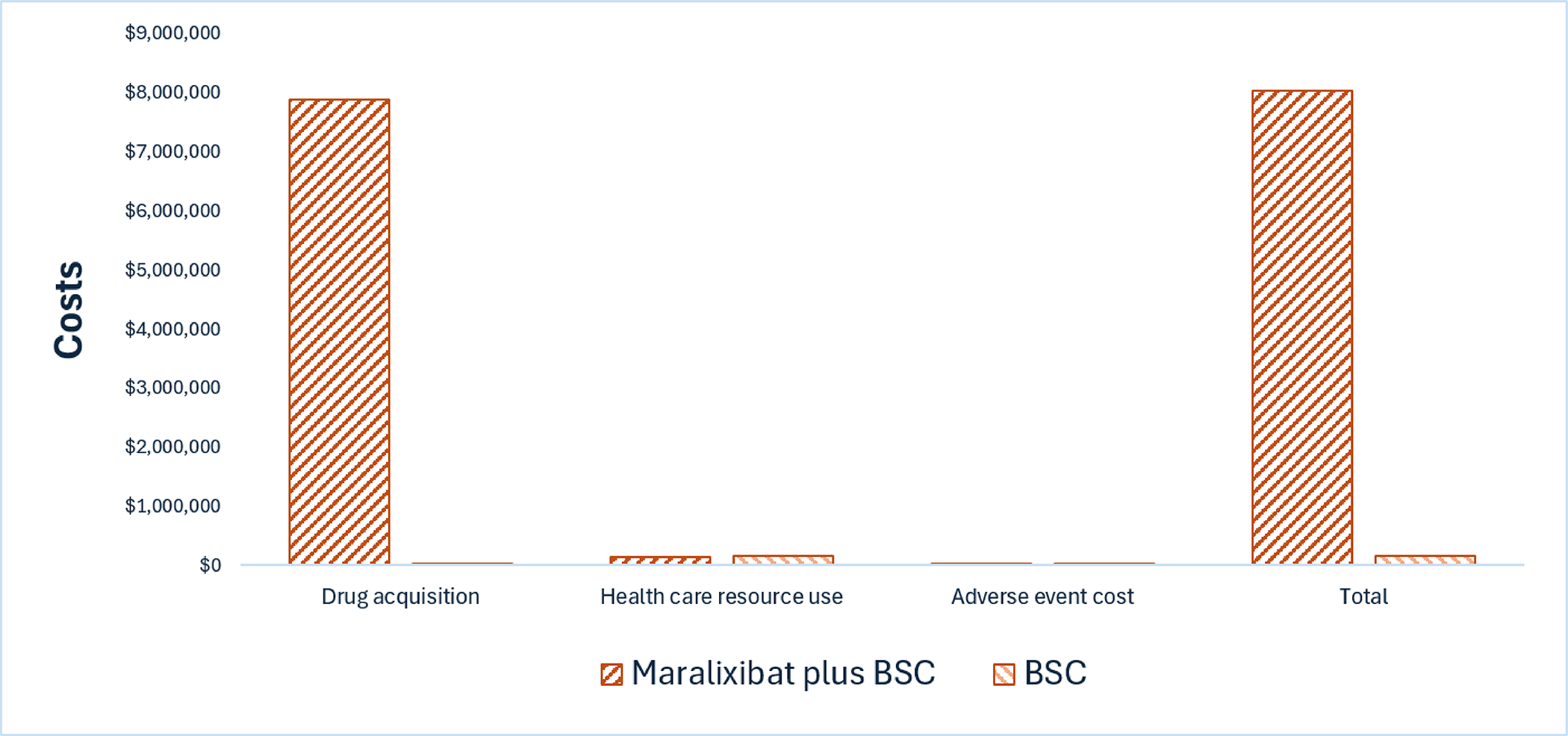
BSC = best supportive care; vs. = versus.
Notes: Deterministic results are presented. Results presented are for scenario analysis 1. Results for all scenario analyses are presented in the Supplemental Material document, Appendix 11, Table 36.
Impact on Health
Figure 4 illustrates the potential impact maralixibat has on patient health using scenario analysis 1 as an example. Relative to BSC, maralixibat plus BSC is predicted to increase the amount of time a patient remains in the “Treatment response” health state by approximately 2.48 years and extend overall survival by 1.90 years. Considering the impact of treatment on both quality and length of life, maralixibat plus BSC is predicted to result in 1.55 additional QALYs per patient compared with BSC alone (refer to Figure 4). Approximately 99% of the predicted incremental benefit was accrued on the basis of extrapolation.
Figure 4: Impact of Maralixibat Plus BSC vs. BSC on Patient Health
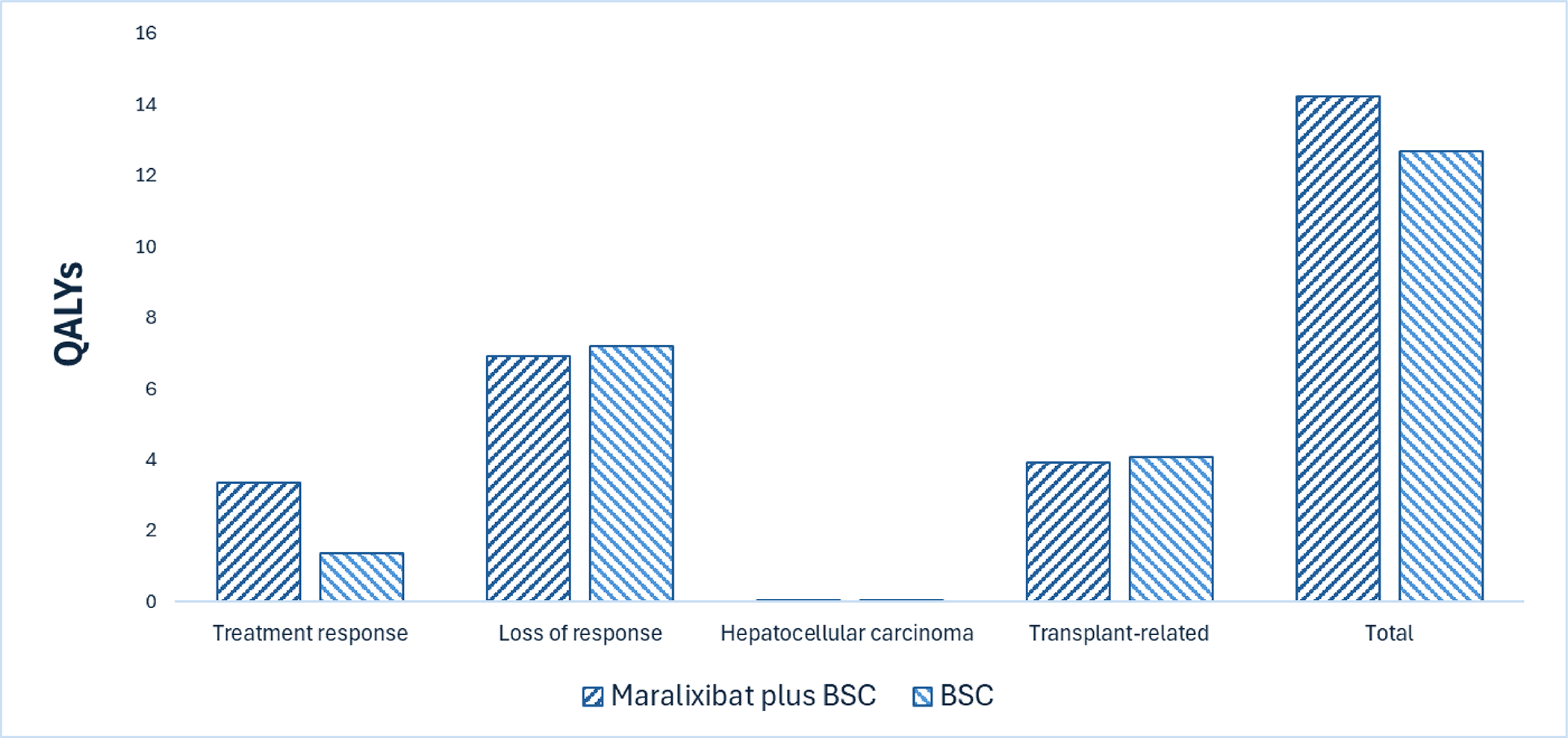
BSC = best supportive care; QALY = quality-adjusted life-year; vs. = versus.
Notes: Transplant-related QALYs included those accrued in the “Transplant” and “Posttransplant” health states. Deterministic results are presented.
Results presented are for scenario analysis 1. Results for all scenario analyses are presented in Supplemental Material document, Appendix 11, Table 36.
Summary of the Budget Impact
The sponsor submitted a budget impact analysis to estimate the 3-year (2026 to 2028) budget impact of reimbursing maralixibat plus BSC for use in the Health Canada–indicated population. The sponsor assumed that the payer would be CDA-AMC–participating public drug plans and derived the size of the eligible population using an epidemiologic approach. The price of maralixibat plus BSC was aligned with the price included in the sponsor’s economic evaluation, while the prices of comparators were based on the publicly available list prices. Additional information pertaining to the sponsor’s submission is provided in Supplemental Material document, Appendix 12.
CDA-AMC identified a number of issues with the sponsor’s estimated budget impact and made changes to model parameters and assumptions in consultation with clinical experts to derive the CDA-AMC base case (Supplemental Material document, Appendix 12). CDA-AMC estimated that by year 3 of reimbursement, 43.6 patients would be eligible for maralixibat plus BSC; of these, 15.7 patients are expected to receive maralixibat plus BSC. The estimated incremental budget impact of reimbursing maralixibat plus BSC is predicted to be approximately $44.6 million over the first 3 years, with an expected expenditure of $45.6 million on maralixibat plus BSC. The actual budget impact of reimbursing maralixibat plus BSC will depend on reimbursement of odevixibat and market share assumptions.
Conclusion
Based on the sponsor’s base case, maralixibat plus BSC would be considered cost-effective at the submitted price compared to BSC alone if the public health care system was willing to pay at least $2,983,397 for each additional QALY gained. If the public health care system is not willing to pay that amount, a price reduction should be considered. (Full details of the impact of price reductions on cost-effectiveness are presented in Supplemental Material document, Appendix 11, Table 37).
The estimated cost-effectiveness of maralixibat plus BSC compared to odevixibat plus BSC is uncertain due to the unknown comparative efficacy in terms of pruritus between the 2 IBAT inhibitors. As such, there is insufficient evidence to determine whether maralixibat plus BSC provides greater health benefit than odevixibat plus BSC. If there are no differences in health outcomes between maralixibat plus BSC and odevixibat plus BSC, then the total cost of maralixibat to the health system should not exceed that of odevixibat.
The budget impact of reimbursing maralixibat plus BSC to the public drug plans in the first 3 years is estimated to be approximately $44.6 million. The 3-year expenditure on maralixibat plus BSC (i.e., not accounting for current expenditure on comparators) is estimated to be $45.6 million. The estimated budget impact is uncertain due to uncertainty in reimbursement status of odevixibat and market share assumptions.
Figure 5: Summary of the Sponsor’s Economic Analysis and Price Reduction
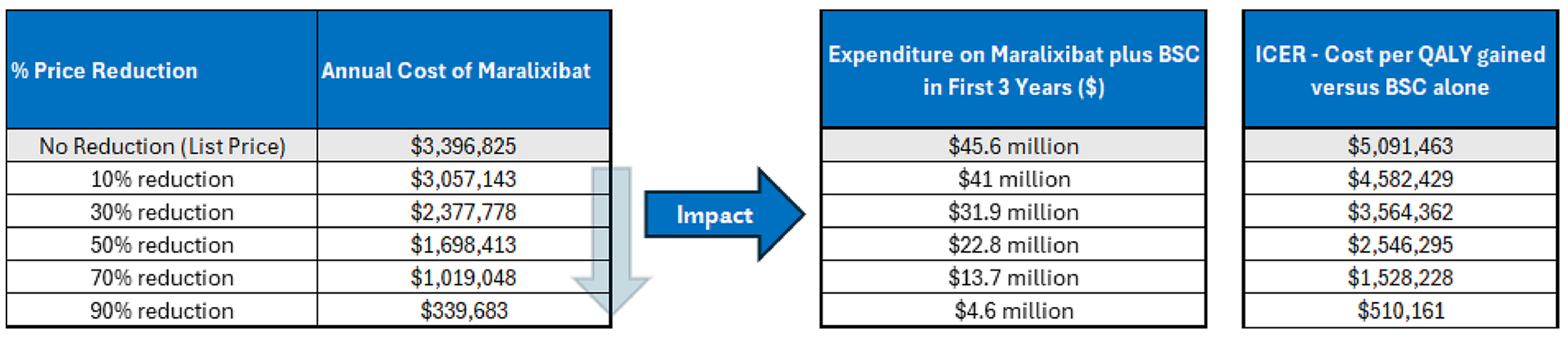
BSC = best supportive care; ICER = incremental cost-effectiveness ratio; QALY = quality-adjusted life-year.
Notes: Expenditure includes only the drug cost of maralixibat. Annual cost of maralixibat is based on a patient weight of 50 kg and the recommended dosage of 570 mcg/kg twice daily.
Deterministic ICER results are presented for scenario analysis 1. Price reductions for all scenario analyses are presented in Supplemental Material document, Appendix 11, Table 37.
References
1.Gunaydin M, Cil ATB. Progressive familial intrahepatic cholestasis: diagnosis, management, and treatment. Hepat Med. 2018;10:95. PubMed
2.Baker A, Kerkar N, Todorova L, Kamath BM, Houwen RHJ. Systematic review of progressive familial intrahepatic cholestasis. Clin Res Hepatol Gastroenterol. 2019;43(1):20-36. doi:10.1016/j.clinre.2018.07.010 PubMed
3.Al Mehaidib A, Al Shahrani A. 1381 Progressive Familial Intrahepatic Cholestasis in Arabs. J Hepatol. 2013;58(Suppl 1):S555-S556. doi:10.1016/s0168-8278(13)61380-x
4.Davit-Spraul A, Gonzales E, Baussan C, Jacquemin E. Progressive familial intrahepatic cholestasis. Orphanet J Rare Dis. 2009;4:1. doi:10.1186/1750-1172-4-1 PubMed
5.Alissa FT, Jaffe R, Shneider BL. Update on progressive familial intrahepatic cholestasis. J Pediatr Gastroenterol Nutr. 2008;46(3):241-52. doi:10.1097/MPG.0b013e3181596060 PubMed
6.Pawlikowska L, Strautnieks S, Jankowska I, et al. Differences in presentation and progression between severe FIC1 and BSEP deficiencies. J Hepatol. 2010;53(1):170-178. PubMed
7.Mirum Pharmaceuticals Inc. Clinical Evidence Summary: LIVMARLI for Progressive Familial Intrahepatic Cholestasis (PFIC) [internal sponsor's report]. In: Drug Reimbursement Review sponsor submission: Livmarli (maralixibat), oral solution and oral tablets. August 6, 2025.
8.Srivastava A. Progressive familial intrahepatic cholestasis. J Clin Exp Hepatol. 2014;4(1):25-36. doi:10.1016/j.jceh.2013.10.005 PubMed
9.Torfgard K, Gwaltney C, Paty J, Mattsson JP, Soni PN. Symptoms and daily impacts associated with progressive familial intrahepatic cholestasis and other pediatric cholestatic liver diseases: a qualitative study with patients and caregivers. Abstract H-P-088. General Hepatology. 2018;67(suppl 1):S208-S209.
10.Mehl A, Bohorquez H, Serrano M-S, Galliano G, Reichman TW. Liver transplantation and the management of progressive familial intrahepatic cholestasis in children. World J Transplant. 2016;6(2):278. PubMed
11.Mirum Pharmaceuticals Inc. Maralixibat Chloride Clinical Study Report, MRX-502: Randomized Double-Blind Placebo-Controlled Phase 3 Study to Evaluate the Efficacy and Safety of Maralixibat in the Treatment of Subjects with Progressive Familial Intrahepatic Cholestasis (PFIC)–MARCH-PFIC. 2023.
12.Mirum Pharmaceuticals Inc. ITC report: Indirect comparison of maralixibat and odevixibat for the treatment of progressive familial intrahepatic cholestasis (PFIC). 30/08/2023.
13.Mirum Pharmaceuticals Inc. Clinical Study Report: MRX-502 (MARCH). Randomized Double-Blind Placebo-Controlled Phase 3 Study to Evaluate the Efficacy and Safety of Maralixibat in the Treatment of Subjects with Progressive Familial Intrahepatic Cholestasis (PFIC)–MARCH-PFIC [internal sponsor's report]. May 18, 2023.
ISSN: 2563-6596
Canada’s Drug Agency (CDA-AMC) is a pan-Canadian health organization. Created and funded by Canada’s federal, provincial, and territorial governments, we’re responsible for driving better coordination, alignment, and public value within Canada’s drug and health technology landscape. We provide Canada’s health system leaders with independent evidence and advice so they can make informed drug, health technology, and health system decisions, and we collaborate with national and international partners to enhance our collective impact.
Disclaimer: CDA-AMC has taken care to ensure that the information in this document was accurate, complete, and up to date when it was published, but does not make any guarantee to that effect. Your use of this information is subject to this disclaimer and the Terms of Use at cda-amc.ca.
The information in this document is made available for informational and educational purposes only and should not be used as a substitute for professional medical advice, the application of clinical judgment in respect of the care of a particular patient, or other professional judgments in any decision-making process. You assume full responsibility for the use of the information and rely on it at your own risk.
CDA-AMC does not endorse any information, drugs, therapies, treatments, products, processes, or services. The views and opinions of third parties published in this document do not necessarily reflect those of CDA-AMC. The copyright and other intellectual property rights in this document are owned by the Canadian Agency for Drugs and Technologies in Health (operating as CDA-AMC) and its licensors.
Questions or requests for information about this report can be directed to Requests@CDA-AMC.ca.