Drugs, Health Technologies, Health Systems
Reimbursement Review
Bempedoic Acid (Nilemdo)
Sponsor: HLS Therapeutics Inc.
Therapeutic area: Primary hyperlipidemia and cardiovascular disease
Summary
What Are Primary Hyperlipidemia and Cardiovascular Disease?
Hyperlipidemia occurs when there is an unhealthy amount of fat in the blood. Atherosclerotic cardiovascular disease (ASCVD) occurs when cholesterol accumulates on the inner lining of blood vessels, leading to damage of the heart, brain, and blood vessels throughout the body. ASCVD is an important cause of cardiovascular disease (CVD), which is a leading cause of death in adults in Canada. The age-standardized prevalence of CVD in Canada was estimated to be 6,799 per 100,000 individuals in 2019.
Familial hypercholesterolemia (FH) is the most common genetic cause of high cholesterol and is a leading cause of ASCVD. Heterozygous FH (HeFH) is a less severe form of FH and is estimated to affect approximately 1 in 250 to 1 in 311 individuals.
What Are the Treatment Goals and Current Treatment Options for Primary Hyperlipidemia and CVD?
Reducing the risk of cardiovascular (CV) events and lowering cholesterol levels were the most important outcomes to patients and clinicians according to the input received for this review. Both groups also noted the importance of having safe and tolerable treatments that do not compromise health-related quality of life.
The 2021 Canadian Cardiovascular Society Dyslipidemia Guidelines recommend starting with lifestyle modification and statin therapy. If a patient’s cholesterol remains high, an oral nonstatin drug called ezetimibe is added. For some patients, injectable therapies may be options, but access to these may be restricted based on the type of disease.
What Is Nilemdo and Why Did Canada’s Drug Agency Conduct This Review?
Nilemdo is a drug that is available as an oral tablet. Health Canada has approved Nilemdo to reduce cholesterol in adults who have primary hyperlipidemia (high levels of fat in the blood due to a genetic cause), as well as for the prevention of CV events, including death, heart attack, stroke, or procedures needed to restore blood to the heart in adults. Nilemdo is to be used with dietary changes, with or without statins or other nonstatin drugs.
Canada’s Drug Agency (CDA-AMC) reviewed Nilemdo to inform a recommendation to the participating public drug programs on whether it should be reimbursed for adult patients with hypercholesterolemia who have a history of ASCVD or who are at elevated CV risk despite receiving stable recommended statin therapy or being unable to receive recommended statin therapy (including those receiving no statin therapy). Nilemdo can be taken as monotherapy, with any dosage of statin therapy, and/or with ezetimibe.
How Did CDA-AMC Evaluate Nilemdo?
CDA-AMC reviewed the clinical evidence on the beneficial and harmful effects, as well as the economic evidence, of Nilemdo versus other treatments used in Canada for primary hyperlipidemia and for the prevention of CV events. Ezetimibe, evolocumab, alirocumab, inclisiran were considered as relevant treatments to compare with Nilemdo when reviewing the clinical evidence.
CDA-AMC identified equity and ethical considerations relevant to Nilemdo and patients with hypercholesterolemia or those who have a history of ASCVD or at high CV risk.
The review was informed by materials submitted by the sponsor, which included clinical and economic evidence.
The review was also informed by 1 patient group submission, 7 clinician group submissions, and 1 industry submission in response to the CDA-AMC call for input, and by input from the participating public drug programs around issues that may impact their ability to implement a recommendation.
Two specialists in cardiology and internal medicine with representation from Ontario and British Columbia were consulted as part of the review process.
What Were the Findings?
Clinical Evidence
CDA-AMC reviewed the following clinical evidence:
Six phase III, randomized controlled trials comparing Nilemdo with placebo:
The CLEAR Outcomes study (N = 13,970) included adults who had a low-density lipoprotein cholesterol (LDL-C) level of at least 2.6 mmol/L, had a history of or were at high risk for CVD, and were statin intolerant (i.e., receiving low, very low, or no statin therapy).
The CLEAR Harmony (N = 2,230) and CLEAR Wisdom (N = 779) studies included adults who had an LDL-C level of at least 1.8 mmol/L, had a high CV risk, and were receiving stable, maximally tolerated statins with or without other lipid-modifying therapies (LMTs).
The CLEAR Serenity study (N = 345) included adults who had an LDL-C level of at least 3.4 mmol/L for primary prevention or at least 2.6 mmol/L for secondary prevention and/or HeFH and required statins but were statin intolerant (this study was included as supportive evidence).
The CLEAR Tranquility study (N = 269) included adults who had an LDL-C of at least 2.6 mmol/L while receiving ezetimibe and required statins but were statin intolerant (this study was included as supportive evidence).
Study 053 (N = 382) included adults who had ASCVD or HeFH with an LDL-C level of at least 2.6 mmol/L or had multiple CV risk factors with an LDL-C level of at least 3.4 mmol/L, and all patients were receiving maximally tolerated statins (this study was included as supportive evidence).
One phase III, open-label extension study (N = 1,462) assessing longer-term use of Nilemdo in patients who completed the CLEAR Harmony study.
One indirect treatment comparison (ITC) of Nilemdo (with or without ezetimibe) versus ezetimibe, alirocumab, evolocumab, and inclisiran.
For the comparison of Nilemdo versus placebo based on the CLEAR Outcomes study in patients who have a history of or were at high risk for CVD and who were receiving low, very low, or no statin therapy, after a median follow-up of 3.4 years (range, 0 to 5.6 years):
Nilemdo results in a clinically meaningful reduction in the risk of a 4-component major adverse cardiovascular event (MACE-4) (first occurrence of CV death, nonfatal myocardial infarction [MI], nonfatal stroke, or coronary revascularization).
Nilemdo likely results in a clinically meaningful reduction in the risk of 3-component major adverse cardiovascular event (MACE-3) (CV death, nonfatal MI, or nonfatal stroke).
Nilemdo likely results in a clinically meaningful reduction in the risk of fatal or nonfatal MI.
Nilemdo may result in a reduction in the risk of fatal or nonfatal stroke. There was uncertainty due to very serious imprecision.
Nilemdo may result in an increase in the risk of CV death. There was uncertainty due to very serious imprecision.
Nilemdo results in a clinically meaningful reduction in percent change in LDL-C from baseline to month 6.
Nilemdo likely results in an increase in serious adverse events (SAEs). There was uncertainty due to serious imprecision.
For the comparison of Nilemdo versus placebo based on the CLEAR Harmony and CLEAR Wisdom studies in patients who have a high CV risk and who are receiving maximally tolerated statin therapy:
Nilemdo results in a clinically meaningful reduction in percent change in LDL-C from baseline to week 12.
Nilemdo likely results in a clinically meaningful increase in SAEs. There was uncertainty due to serious imprecision.
For longer-term use of Nilemdo based on the CLEAR Harmony open-label extension study:
Nilemdo may result in a clinically meaningful reduction in percent change in LDL-C from baseline to week 12 that is maintained with continued treatment for up to 78 weeks. There was uncertainty due to methodological limitations.
For the comparison of Nilemdo versus relevant comparators based on the sponsor-submitted ITC:
There was no clear difference between Nilemdo and ezetimibe 10 mg for percent change from baseline to weeks 12 and 24 in LDL-C. There was uncertainty due to imprecision.
The PCSK9 inhibitors (alirocumab, evolocumab, and inclisiran) lowered LDL-C more than Nilemdo alone or ezetimibe alone at week 12. There was uncertainty due to methodological limitations.
Longer-term comparisons at 52 weeks were inconclusive due to indirectness, heterogeneity, and imprecision.
No serious safety concerns were detected with Nilemdo. Incidences of gout, cholelithiasis, and tendinopathy were low in the studies, when reported.
Patients receiving maximally tolerated statins were not studied in the CLEAR Outcomes study; therefore, there is no evidence from this study for the effect of Nilemdo on CV outcomes in this patient population.
There is no evidence for the effect of Nilemdo on health-related quality of life.
The evidence available for review was limited to a median follow-up of 3.4 years (range, 0 to 5.6 years), and the potential benefits and harms of Nilemdo beyond that are uncertain.
Economic Evidence
Nilemdo is available as a 180 mg tablet. At the submitted price of $4.35 per 180 mg tablet, the annual cost of Nilemdo is expected to be $1,589 per patient, based on the Health Canada–recommended dosage.
Key clinical efficacy in the economic analysis (percent change in LDL-C from baseline) was derived from a sponsor-submitted ITC, with the efficacy of Nilemdo (with or without ezetimibe) informed by the 7 studies (the 5 CLEAR studies and 2 additional studies). Indirect evidence submitted by the sponsor suggests that Nilemdo 180 mg monotherapy is associated with greater LDL-C reduction than placebo at week 12, but shows no clear difference versus ezetimibe, and appears less effective than PCSK9 inhibitors for short-term LDL-C lowering. Nilemdo plus ezetimibe lowered LDL-C more than either treatment alone at week 12, although PCSK9 inhibitors were still favoured over the combination treatment. The confidence in these findings is limited due to key methodological issues and imprecision. The CLEAR Outcomes trial was used to inform the population for the sponsor’s economic evaluation. The clinical data and economic analysis were not stratified by prior statin use, or by patients who are able to access PSCK9 inhibitors and those who cannot.
The results of the CDA-AMC base case suggest:
Nilemdo is predicted to be associated with higher costs to the health care system than ezetimibe (incremental costs = $9,674) over a lifetime (35-year) horizon. Increased costs are primarily driven by drug acquisition. Nilemdo was less costly than all PCSK9 inhibitors.
Nilemdo is predicted to be associated with a gain of 0.01 quality-adjusted life-years (QALYs) compared to ezetimibe over a lifetime (35-year) horizon. Nilemdo was associated with fewer QALYs relative to all PCSK9 inhibitors.
The cost-effectiveness frontier included only ezetimibe and evolocumab; this means that Nilemdo would not be considered cost-effective at any threshold. Nilemdo was associated with an incremental cost-effectiveness ratio (ICER) of $853,262 per QALY compared with ezetimibe.
In an alternative analysis of Nilemdo plus ezetimibe, that combination was associated with more costs and QALYs than ezetimibe, and fewer costs and QALYs than PCSK9 inhibitors. The cost-effectiveness frontier included ezetimibe, Nilemdo plus ezetimibe, and evolocumab. In this analysis, Nilemdo plus ezetimibe had an ICER of $44,304 per QALY relative to ezetimibe alone. Evolocumab was more costly and more effective than Nilemdo in combination with ezetimibe.
The results were sensitive to assumptions regarding treatment discontinuation and baseline LDL-C, with notable uncertainty due to heterogeneity in the target population, particularly because the population combined patients receiving maximally tolerated statins and those who are statin intolerant or unable to receive statins; those 2 groups are expected to differ in baseline risk and treatment response. Additional uncertainty was introduced through the high risk of bias in the ITC, and by limitations with the Nilemdo plus ezetimibe analysis, which was informed by a study evaluating a fixed-dose combination that is not yet available in Canada. No evidence was provided to assess Nilemdo plus a PSCK9 inhibitor.
CDA-AMC estimates that the budget impact of reimbursing Nilemdo for the treatment of the reimbursement-requested population will be approximately $137 million over the first 3 years of reimbursement compared to the amount currently spent on comparators, with an estimated expenditure of $248 million on Nilemdo over this period. The actual budget impact will depend on the total eligible patient population, market share and market uptake assumptions, the market displacement of PCSK9 inhibitors, and treatment discontinuation. The magnitude of uncertainty in the budget impact must be addressed to ensure the feasibility of adoption, given the difference between the sponsor’s estimate and the CDA-AMC estimate. Additionally, the incremental budget impact of reimbursing Nilemdo is predicted to be greater than $40 million in year 2 and year 3, and the economic feasibility of adoption must be addressed.
Abbreviations
AE
adverse event
ASCVD
atherosclerotic cardiovascular disease
CCS
Canadian Cardiovascular Society
CDA-AMC
Canada’s Drug Agency
CI
confidence interval
CrI
credible interval
CV
cardiovascular
CVD
cardiovascular disease
FDC
fixed-dose combination
FH
familial hypercholesterolemia
GRADE
Grading of Recommendations Assessment, Development and Evaluation
HeFH
heterozygous familial hypercholesterolemia
HR
hazard ratio
HRQoL
health-related quality of life
ICER
incremental cost-effectiveness ratio
ITC
indirect treatment comparison
LDL-C
low-density lipoprotein cholesterol
LMT
lipid-modifying therapy
LS
least squares
MACE
major adverse cardiovascular event
MACE-3
3-component major adverse cardiovascular event
MACE-4
4-component major adverse cardiovascular event
MI
myocardial infarction
NMA
network meta-analysis
OLE
open-label extension
QALY
quality-adjusted life-year
RCT
randomized controlled trial
SAE
serious adverse event
SE
standard error
WDAE
withdrawal due to adverse event
Background
Introduction
Context for the Review
The objectives of this report are as follows:
Review and critically appraise the evidence submitted by the sponsor on the beneficial and harmful effects of bempedoic acid, 180 mg, oral, in the treatment of primary hyperlipidemia and cardiovascular disease (CVD) in adult patients with hypercholesterolemia who have a history of atherosclerotic cardiovascular disease (ASCVD) or who are at elevated cardiovascular (CV) risk, despite receiving stable recommended statin therapy or being unable to receive recommended statin therapy (including those receiving no statin therapy). Bempedoic acid can be taken as monotherapy, with any dosage of statin therapy, and/or with ezetimibe. The focus will be placed on comparing bempedoic acid to relevant comparators in clinical practice in Canada and identifying gaps in the current evidence, and this focus is outlined in Table 1.
Review and critically appraise the economic information submitted by the sponsor, including a cost-effectiveness analysis and budget impact analysis. The focus of the economic review is aligned with the scope of the clinical review, unless otherwise stated. For most reviews, a Canada’s Drug Agency (CDA-AMC) base case is developed, informed by the available clinical evidence, clinical expert input, and the best interpretation of the economic evidence based on the information provided by the sponsor.
Table 1: Information on the Application Submitted for Review and on the CDA-AMC Review
Item | Description |
|---|---|
Information on the application submitted for review | |
Drug | Bempedoic acid (Nilemdo), 180 mg, tablet, oral |
Sponsor | HLS Therapeutics Inc. |
Health Canada indication | Primary hyperlipidemia Nilemdo (bempedoic acid) is indicated for the reduction of low-density lipoprotein cholesterol (LDL-C) in adults with hyperlipidemia, i.e., heterozygous familial hypercholesterolemia (HeFH) and mixed dyslipidemias,
Prevention of cardiovascular events Nilemdo is indicated to reduce the risk of adverse cardiovascular events, defined as cardiovascular death, myocardial infarction, stroke, or coronary revascularisation, in adults at increased risk for these events. Nilemdo should be used with statin drug therapy, as tolerated, with or without ezetimibe and PCSK9 inhibitors. In patients unable to take statins at any dose, Nilemdo may be used as monotherapy, or combined with ezetimibe and/or PCSK9 inhibitors, as appropriate. |
Health Canada approval status | NOC |
Health Canada review pathway | Standard |
NOC date | November 14, 2025 |
Mechanism of action | Lipid metabolism regulator: adenosine triphosphate citrate lyase inhibitor |
Recommended dosage | 180 mg taken orally once daily |
Submission type | Initial |
Sponsor’s reimbursement request | Adult patients with hypercholesterolemia who have a history of ASCVD or who are at elevated CV risk, despite receiving stable recommended statin therapy or being unable to receive recommended statin therapy (including those receiving no statin therapy). Bempedoic acid can be taken as monotherapy, with any dosage of statin therapy, and/or with ezetimibe. |
Submitted price | $4.35 per 180 mg tablet |
Information on the CDA-AMC review | |
Review type | Standard |
Clinical review focusa | As defined in the reimbursement request. Subgroups: Primary and secondary prevention Intervention: Per recommended dosage Comparators: Ezetimibe, evolocumab,b alirocumab,b inclisiranb Outcomes: MACE-4 (composite end point of CV death, nonfatal MI, nonfatal stroke, or coronary revascularization), MACE-3 (composite end point of CV death, nonfatal MI, or nonfatal stroke), fatal or nonfatal MI, fatal or nonfatal stroke, CV death, percent change from baseline in LDL-C, SAEs |
ASCVD = atherosclerotic cardiovascular disease; CDA-AMC = Canada’s Drug Agency; CV = cardiovascular disease; LDL-C = low-density lipoprotein cholesterol; MACE-3 = 3-component major adverse cardiovascular event; MACE-4 = 4-component major adverse cardiovascular event; MI = myocardial infarction; NOC = Notice of Compliance; SAE = serious adverse event.
aThe economic review aligns with the scope of the clinical review, unless otherwise stated.
bCDA-AMC has previously issued a reimbursement recommendation for this drug for the same indication or a similar indication.
Sources: Sponsor submission documents.1
Submission History for the Drug Under Review
CDA-AMC has not previously reviewed bempedoic acid through the reimbursement review process.
Sources of Information
The contents of the Reimbursement Review report are informed by materials submitted by the sponsor, input received from interested parties (patient groups, clinician groups, and drug programs), and input from the clinical experts consulted for this review.
Calls for patient group and clinician group input are issued for each reimbursement review. One patient group submission was received from HeartLife Foundation, and clinician submissions were received from 7 groups: Riverside Cardiology and Diagnostic Imaging, Total Cardiology Rehabilitation, key opinion leaders in the management of CV risk factors, Collaborative CME and Research Network, Oakville Cardiologists, and Saskatchewan Cardiologists, and a group from St. Michael’s Hospital, Unity Health Toronto, and the University of Toronto. HeartLife conducted clinician and patient interviews as well as a patient survey with a total of 11 respondents. The clinician groups, which comprised a total of 47 clinicians, gathered information through literature reviews and clinical practice guidelines as well as through discussions and email exchanges informed by their collective clinical experience. The full submissions received are available on the CDA-AMC project landing page in the consolidated input document.
Input from patient and clinician groups is considered throughout the review, including in the selection of outcomes for inclusion in the clinical review and in the interpretation of the clinical and economic evidence. Relevant patient and clinician group input is summarized in the Disease Background, Current Management, and Unmet Needs and Existing Challenges sections of the input document.
The drug programs provide input on each drug being reviewed through the reimbursement review process by identifying issues that may impact their ability to implement a recommendation. The implementation questions from the public drug programs and corresponding responses from the clinical experts consulted for this review are summarized in the Supplemental Material document in the Summary of Drug Program Input and Clinical Expert Responses table in Appendix 1.
Each review team includes at least 1 clinical expert with expertise in the diagnosis and management of the condition for which the drug is indicated. Clinical experts are a critical part of the review team and are involved in all phases of the review process. Two specialists in internal medicine and cardiology with expertise in the diagnosis and management of primary hyperlipidemia and CVD participated as part of the review team, with representation from Ontario and British Columbia.
Disease Background
CVDs, mainly ischemic heart disease and stroke, are the leading causes of death worldwide, accounting for 16% and 11% of global deaths, respectively, in 2019.2 The global burden of CVD is partly due to population growth and aging as well as the continued presence of modifiable risk factors and sociodemographic factors. In 2019, the age-standardized prevalence of CVD in Canada was 6,799 per 100,000 individuals, and the age-standardized incidence was 627 per 100,000. Despite this burden, the age-standardized mortality rate from a major CVD in Canada has declined substantially, from 308.3 per 100,000 in 2000 to 158.5 per 100,000 in 2021.2
Atherosclerosis is a disease process in which low-density lipoprotein cholesterol (LDL-C) accumulates in the inner lining of arteries. This buildup drives progressive damage to the coronary, cerebral, and peripheral arteries and the aorta, and is generally asymptomatic.3 Atherosclerosis is the dominant underlying pathophysiology of ischemic heart disease, stroke, and peripheral arterial disease, collectively referred to as ASCVD.2 The 2021 Canadian Cardiovascular Society (CCS) guidelines note that primary prevention refers to strategies aimed at individuals to prevent or delay the onset of ASCVD.4 Secondary prevention refers to efforts to treat established, clinically significant ASCVD and to prevent or delay further disease manifestations.4
Familial hypercholesterolemia (FH) is the most common autosomal dominant genetic disease and is caused by major gene mutations that impair the function of low-density lipoprotein receptors. The condition leads to very high LDL-C levels and an increased risk of early-onset ASCVD.5 The less severe form, heterozygous familial hypercholesterolemia (HeFH), is inherited from 1 parent and is typically associated with LDL-C levels greater than approximately 4.9 mmol/L.6 HeFH has an estimated prevalence of approximately 1 in 250 individuals,7 but a more recent worldwide meta-analysis suggests a prevalence of approximately 1 in 311.8,9
Patient group input: Patients living with high cholesterol and increased CV risk described their condition as a silent disorder with no noticeable physical symptoms until a major CV event occurs. As a result, patients report experiencing persistent fear and anxiety with the knowledge that a CV event can be sudden and fatal.
Current Management
Treatment Goals
Patient group input: LDL-C reduction was consistently identified by patients as the most important aspect of the illness to control, given its direct link to future CV events. Patients noted the desire for effective and tolerable treatments that can be used long term and do not compromise quality of life, daily functioning, and emotional well-being.
Clinician input: The clinical experts indicated that the principal aim is to mitigate CV risk and prevent CV events through LDL-C reduction. Achieving a reduction in lipid levels serves as a surrogate marker due to the demonstrated correlation between lipid levels and improved CV outcomes in clinical trials. While guideline LDL-C thresholds help assess goal attainment, the overarching aim remains CV risk reduction regardless of the exact lipid level achieved. According to the clinical experts, because bempedoic acid is available as a fixed 180 mg once-daily dose with no dose titration to lipid targets, individual variability in achieved lipid levels is expected. The clinician group input noted that treatment goals also include preventing recurrent events, supporting tolerability and adherence, and offering therapies aligned with patient preference, recognizing that many patients prefer oral therapies over injectables.
Current Treatment Options
In Canada, the 2021 CCS dyslipidemia guidelines recommend a stepwise, LDL-C target–driven approach starting with lifestyle modification and maximally tolerated statin therapy.4 If LDL-C thresholds are not achieved or statins are intolerable, ezetimibe is added, with PCSK9 inhibitors reserved for patients at very high risk of CVD, such as those with ASCVD (with recent hospitalization for acute coronary syndrome events and ongoing high LDL-C, despite maximally tolerated statins) or FH. According to the clinician group input, the use of injectable PCSK9 inhibitors is limited by cost and restrictive provincial coverage criteria, thus constraining patient access.
Recently updated European10 and American11 guidelines for managing dyslipidemia recommend that nonstatin treatments, including bempedoic acid, be taken alone or in combination with maximally tolerated statins when LDL-C thresholds are not met in patients with ASCVD.
Key characteristics of bempedoic acid are summarized with other treatments available for primary hyperlipidemia and CVD in the Supplemental Material document (available on the project landing page) in the Key Characteristics table in Appendix 1.
Unmet Needs and Existing Challenges
Patient group input: The unmet needs described by patients include preventing disease progression and further CV damage, particularly when lifestyle modifications alone are insufficient. Patients noted that their increased CV risk has led to chronic stress and uncertainty, particularly among patients with prior CV events. Patients living with statin intolerance or persistent elevation of LDL-C, despite available therapies, described prolonged periods of uncertainty, frustration, and anxiety about future CV events. This emotional burden was tied to fears of disease progression and uncertainty about long-term outcomes after repeated treatments.
Clinician input: The clinical experts and clinician group input highlighted unmet needs in LDL-C management, particularly in secondary prevention. Despite guideline-recommended lifestyle modification combined with maximally tolerated statins and ezetimibe, a large proportion of patients with ASCVD do not achieve LDL-C targets, a challenge that is expected to intensify as guidelines converge toward lower thresholds. Statin intolerance, affecting a meaningful minority of patients through muscle symptoms or creatine kinase elevations, and patient reluctance to use statins remain major barriers. Ezetimibe monotherapy provides only modest LDL-C reductions (15% to 20%) that are often insufficient in high-risk populations.4
Access to potent injectable therapies (i.e., PCSK9 inhibitors) is another key challenge. Although effective, the clinical experts and clinician groups noted that their use is constrained by high cost, restrictive reimbursement criteria, limited coverage windows, geographic and jurisdictional variability, and patient reluctance to use injectable treatments. These obstacles currently have a greater impact on patients who lack private insurance, which may result in their LDL-C levels remaining above target levels.
Considerations for Using the Drug Under Review
Contents within this section have been informed by input from the clinical experts consulted for the purpose of this review and from clinician groups, as well as the reimbursement conditions proposed by the sponsor (refer to the Initiation, Renewal, Discontinuation, and Prescribing Conditions Proposed by the Sponsor table in Appendix 1 in the Supplemental Material document). The implementation questions from the public drug programs and corresponding responses from the clinical experts consulted for this review are summarized in the Supplemental Material document in the Summary of Drug Program Input and Clinical Expert Responses table in Appendix 1. The following was summarized by the review team.
Place in Therapy
According to the clinical experts and clinician groups that submitted input, the most immediate use of bempedoic acid would be in patients who are statin intolerant or statin reluctant, who cannot access or prefer to avoid injectable PCSK9 inhibitors, and for whom it may represent the only effective oral option. It can also be positioned as an add-on therapy for patients receiving maximally tolerated statins with or without ezetimibe who require further LDL-C reduction, offering an oral alternative before escalation to injectable therapy. The clinical experts noted that a trial of ezetimibe would not be necessary before initiating treatment with bempedoic acid. For patients at high CVD risk whose LDL-C levels are still above target despite using statins, ezetimibe, and PCSK9 inhibitors, bempedoic acid could be considered as an additional treatment.
Patient Population
According to the clinical experts and clinician group input, the patients most likely to benefit from bempedoic acid are those at high CV risk who are unable to reach LDL-C targets with standard lipid-modifying therapies (LMTs). This includes patients with established ASCVD or HeFH, as well as patients at high CV risk requiring primary prevention, such as those with diabetes or chronic kidney disease, and whose LDL-C levels remain above acceptable thresholds despite maximally tolerated statin therapy, with or without ezetimibe.
The clinical experts noted that bempedoic acid would also be useful for patients who are statin intolerant or unable to tolerate high-intensity statins, those with persistently high LDL-C levels requiring additional oral therapy, and individuals who prefer oral treatment or are unwilling or unable to use injectable PCSK9 inhibitors. The clinician groups noted that it may also be a practical add-on treatment for patients receiving statins with or without ezetimibe who do not meet the criteria for injectable therapies but continue to have elevated LDL-C levels and remain at high CV risk, especially in settings where an oral drug may improve adherence.
Assessing the Response to Treatment
The clinical experts indicated that LDL-C levels should be assessed on an annual basis to assess response to treatment. They noted that the clinical relevance of bempedoic acid depends on a patient’s proximity to their LDL-C target, adding that reductions in LDL-C averaging 20% would be considered clinically meaningful, whereas decreases of less than 10% are unlikely to be clinically meaningful. These effects are expected to be sustained with continued therapy and, given the established relationship between LDL-C reduction and CV risk, should translate into fewer CV events over time.
One of the clinician groups and both clinical experts agreed that annual renewal with lab tests should not be required, noting that once LDL-C reduction is demonstrated at 2 to 3 months, yearly reauthorization creates unnecessary burden without clinical benefit.
Discontinuing Treatment
According to the clinical experts, discontinuation of bempedoic acid would typically occur due to a lack of therapeutic response or clinically significant adverse events (AEs). Treatment should be stopped if ALT or AST levels exceed 3 times the upper limit of normal, given the associated safety risk, even in the absence of symptoms. Uric acid elevations have also been observed and require monitoring due to the risk of gout, and the clinical experts noted that post hoc analyses suggest levels of uric acid may decrease with allopurinol use.
Prescribing Considerations
The clinical experts and clinician groups agreed that bempedoic acid can be prescribed and monitored by any qualified health care professional managing lipid disorders, including primary care physicians, CV specialists, nurse practitioners, and pharmacists (in jurisdictions where pharmacists prescribe medications), both in inpatient and outpatient settings.
Clinical Review
Methods
The CDA-AMC review considers the studies in the sponsor’s systematic review (pivotal studies and randomized controlled trials [RCTs]), sponsor-submitted open-label extension (OLE) studies, indirect treatment comparisons (ITCs), and studies addressing gaps in the evidence for inclusion. Eligible studies in the sponsor-submitted systematic review included published and unpublished pivotal studies and phase III RCTs. Relevant patients and interventions were defined by the reimbursement request and the recommended dosage in the product monograph. The subgroup analysis for primary versus secondary prevention in the CLEAR Outcomes study was considered to be potentially relevant for informing the reimbursement recommendation. The relevant comparators were drugs used in clinical practice in Canada to treat the types of patients described in the indication under review. The comparators included ezetimibe, evolocumab, alirocumab, and inclisiran. OLE studies of included pivotal studies and RCTs were included in the systematic review, regardless of whether there was a comparison group. The ITCs submitted by the sponsor were included when they filled an identified gap in the systematic review evidence (e.g., missing comparator, longer follow-up time). No studies addressing gaps in the systematic review evidence were submitted by the sponsor.
The review team selected outcomes (and follow-up times) for review considering the sponsor’s Summary of Clinical Evidence, clinical expert input, and patient and clinician group input. The outcomes included are those considered relevant to expert committee deliberations, and they were selected in consultation with committee members. Evidence from the systematic review for the most important outcomes was assessed using the Grading of Recommendations Assessment, Development and Evaluation (GRADE) approach:
CV outcomes, such as time to first occurrence of a 4-component major adverse cardiovascular event (MACE-4) (composite end point of CV death, nonfatal myocardial infarction [MI], nonfatal stroke, or coronary revascularization), 3-component major adverse cardiovascular event (MACE-3) (CV death, nonfatal MI, or nonfatal stroke), fatal or nonfatal MI, fatal or nonfatal stroke, and CV death, address a main treatment goal for CVD (i.e., preventing disease progression and further CV damage) and are important to patients, according to input from the patient and clinician groups and clinical experts.
LDL-C level is an established surrogate outcome for CV risk, is commonly used in clinical practice to assess treatment response according to the clinical experts, is important to patients, and is relevant to the pharmacoeconomic review.
Safety outcomes, such as serious adverse events (SAEs), were used to inform on the harms of treatment.
Outcomes not assessed using GRADE but pertinent to the review and appearing in the report include time to first coronary revascularization, all-cause mortality, and individual AEs of special interest (e.g., gout, cholelithiasis, and tendinopathy). Results for these outcomes were considered less critical to decision-making but were nevertheless included as supportive outcomes for contextual interpretation and/or pharmacoeconomic modelling. Detailed results for these outcomes can be found in Appendix 4 in the Supplemental Material document.
Methods for data extraction, the risk-of-bias appraisal, and the certainty-of-evidence assessment are in the Supplemental Material document in Appendix 2.
Clinical Evidence
In this report, the following sources of evidence submitted by the sponsor are reviewed and appraised:
The 6 RCTs included in the systematic review:
The CLEAR Harmony and CLEAR Wisdom studies and Study 053 in patients with HeFH or ASCVD receiving stable maximally tolerated statins alone or with other LMTs.
The CLEAR Serenity and CLEAR Outcomes studies in patients with a history of or at high risk of CVD (secondary or primary prevention) receiving low to no statins.
The CLEAR Tranquility study in patients with elevated LDL-C receiving low to no statins.
One OLE study: The CLEAR Harmony OLE study.
One sponsor-submitted ITC.
The focus of the review is on the CLEAR Harmony, CLEAR Wisdom, and CLEAR Outcomes studies because these were considered to provide the most relevant information to inform discussions about reimbursement decisions. The CLEAR Serenity and CLEAR Tranquility studies enrolled populations similar to those in the CLEAR Outcomes study in terms of demographic and baseline disease characteristics, were smaller in size (N = 345 and N = 269 versus N = 13,970, respectively), and focused on lipid parameters instead of CV outcomes. The main analyses of Study 053 evaluated the single-pill, fixed-dose combination (FDC) of bempedoic acid 180 mg and ezetimibe 10 mg, which was not commercially available in Canada at the time of this review, as opposed to comparisons with bempedoic acid alone, which are of interest for this review. Therefore, findings for the CLEAR Serenity and CLEAR Tranquility studies and Study 053 were considered less critical to decision-making but are included as supportive evidence for contextual interpretation. Detailed descriptions and results for the CLEAR Serenity and CLEAR Tranquility studies and Study 053 can be found in appendices 2, 3, and 4 in the Supplemental Material document.
Systematic Review
Description of Studies
Study Characteristics
The characteristics of the included studies are summarized in Table 2. Details pertaining to the eligibility criteria, interventions and comparators, and relevant outcome measures are in the Supplemental Material document in Appendix 3.
The studies appraised in the systematic review were similar in design (phase III, double-blind, parallel-group, multicentre RCTs). The CLEAR Harmony and CLEAR Wisdom studies enrolled patients with prior ASCVD and/or HeFH with other ASCVD risk factors who were receiving maximally tolerated statin therapy as stable background treatment. The CLEAR Outcomes study enrolled patients with prior ASCVD or at high risk for ASCVD with a history of statin intolerance who were receiving low, very low, or no statin therapy. Only the CLEAR Outcomes study included time to CV events as primary and secondary end points, while the other studies focused on lipid parameters (e.g., LDL-C).
Table 2: Characteristics of Studies Included in the Systematic Review
Study name, design, and sample size | Key inclusion criteria | Key exclusion criteria | Intervention and comparator | Relevant end points |
|---|---|---|---|---|
CLEAR Harmony Phase III, double-blind, parallel-group, multicentre RCT N = 2,230 |
| Recent history (within 3 months) of clinically significant CVD,a total fasting TGs ≥ 500 mg/dL (5.6 mmol/L), renal dysfunction, BMI ≥ 50 kg/m2, uncontrolled hypertension, hemoglobin A1C ≥ 10%, liver disease, hematologic disorders, or unexplained CK > 3 × ULN |
|
|
CLEAR Wisdom Phase III, double-blind, parallel-group, multicentre RCT N = 779 |
| Recent history (within 3 months) of clinically significant CVD,a total fasting TGs ≥ 500 mg/dL (5.6 mmol/L), renal dysfunction, BMI ≥ 50 kg/m2, uncontrolled hypertension, hemoglobin A1C ≥ 10%, liver disease, hematologic disorders, or unexplained CK > 3 × ULN |
|
|
CLEAR Outcomes Phase III, double-blind, parallel-group, multicentre RCT N = 13,970 |
| Recent history (within 3 months) of clinically significant CVD,a total fasting TGs > 500 mg/dL (5.6 mmol/L), renal dysfunction, hemoglobin A1C ≥ 10%, uncontrolled hypothyroidism liver disease, hematologic disorders, or unexplained CK > 3 × ULN |
|
|
apoB = apolipoprotein B; ASCVD = atherosclerotic cardiovascular disease; BMI = body mass index; CABG = coronary artery bypass graft; CK = creatine kinase; CV = cardiovascular; CVD = cardiovascular disease; HDL-C = high-density lipoprotein cholesterol; HeFH = heterozygous familial hypercholesterolemia; hsCRP = high-sensitivity C-reactive protein; LDL-C = low-density lipoprotein cholesterol; LMT = lipid-modifying therapy; MACE = major adverse cardiovascular event; MACE-3 = 3-component major adverse cardiovascular event; MACE-4 = 4-component major adverse cardiovascular event; MACE-5 = 5-component major adverse cardiovascular event; MI = myocardial infarction; NODM = new-onset diabetes mellitus; PCI = percutaneous coronary intervention; RCT = randomized controlled trial; S = screening; TC = total cholesterol; TG = triglyceride; TIA = transient ischemic attack; ULN = upper limit of normal.
aMay include MI, unstable angina leading to hospitalization, uncontrolled symptomatic cardiac arrhythmia, CABG, PCI, carotid surgery or stenting, cerebrovascular accident, TIA, uncontrolled hypertension, endovascular procedure or surgical intervention for peripheral vascular disease, New York Heart Association Functional Classification Class IV heart failure, or plans to undergo a major surgical or interventional procedure.
bBased on the supplementary appendix of the publication by Nissen et al. (2023) for the CLEAR Outcomes study, patient-reported statin intolerance was due to an adverse effect that began or worsened with statin therapy and resolved or improved after statin discontinuation.12 Statin intolerance was considered when there was intolerance to 2 or more statins at any dose, or 1 statin at any dose and the patient was unwilling or advised not to try a second statin. Patients who were tolerating very low–dose statin therapy (an average daily dose of rosuvastatin < 5 mg, atorvastatin < 10 mg, simvastatin < 10 mg, lovastatin < 20 mg, pravastatin < 40 mg, fluvastatin < 40 mg, or pitavastatin < 2 mg) were considered to be intolerant to that low–dose statin. Very low–dose statin therapy could continue throughout the study if it was stable (for ≥ 4 weeks before screening) and well tolerated. Both patient and investigator provided written confirmation that the patient was statin intolerant (as defined previously); were aware of the benefit of statin use to reduce the risk of MACE, including death; and were also aware that many patients who are unable to tolerate a statin are able to tolerate a different statin or dose.
cMACE-3 included CV death, nonfatal MI, or nonfatal stroke; MACE-4 included CV death, nonfatal MI, nonfatal stroke, or coronary revascularization; and MACE-5 included CV death, nonfatal MI, nonfatal stroke, coronary revascularization, or hospitalization for unstable angina.
Sources: The CLEAR Harmony, CLEAR Wisdom, and CLEAR Outcomes studies’ clinical study reports. Details included in the table are from the sponsor’s Summary of Clinical Evidence.13-16
Statistical Testing and Analysis Populations
The CLEAR Harmony study: A total of 1,950 patients were planned for enrolment (1,300 to bempedoic acid and 650 to placebo). The sample size was chosen to determine the absolute risk with at least 95% power to detect AEs that occur at rates similar to those in the placebo group for AEs of special interest in the long-term safety study for alirocumab. A stepdown approach was used to control for type I error by sequentially testing the primary efficacy end point, then the key secondary efficacy end points. The sequence was: percent change from baseline to week 12 in LDL-C, percent change from baseline to week 24 in LDL-C, and percent change from baseline to week 12 in each of high-density lipoprotein cholesterol, total cholesterol, apoB, and hsCRP. Each end point was tested at a 2-sided significance level of 0.05, and statistical significance at each step was required to test the next.
Relevant analysis populations included the safety analysis set (included all randomized patients who received at least 1 dose of the study treatment; patients were included in the group for the treatment they received) and the full analysis set (included all randomized patients; patients were included in the group for the treatment they were randomized to).
The CLEAR Wisdom study: A total of 750 patients were planned for enrolment (500 to bempedoic acid and 250 to placebo), which would provide more than 95% power to detect a 15% difference in the percent change from baseline to week 12 in LDL-C between the treatment groups. The calculation was based on a 2-sided t test at a 5% significance level and a common standard deviation of 15%. The sample size was also used to support 52-week safety data for the LDL-C–lowering indication. Statistical testing was consistent with that performed in the CLEAR Harmony study.
The relevant analysis populations were the same as those in the CLEAR Harmony study.
The CLEAR Outcomes study: The study was designed to provide at least 90% power to detect an approximate 15% relative risk reduction in the hazard ratio (HR) corresponding to the primary composite MACE-4 end point at an overall study significance level of 0.05. Assuming a 3.59% annual event rate in the placebo group, a minimum of 1,620 primary composite MACE-4 events was needed. The mean follow-up duration for all patients was estimated to be approximately 42 months, with an enrolment phase of approximately 33 months, a minimum follow-up duration of 24 months, and a lost to follow-up rate of 1% per year. Based on these assumptions, approximately 14,000 patients (7,000 in each of the bempedoic acid and placebo groups) were to be randomized to achieve 1,620 patients experiencing a positively adjudicated primary end point event. It was expected that at least 50% of the 1,620 patients experiencing a positively adjudicated MACE-4 would also experience a positively adjudicated MACE-3 (i.e., 810 patients). Therefore, the study would stop when at least 1,620 patients experienced a positively adjudicated primary MACE-4, with 810 of these patients experiencing a positively adjudicated MACE-3, and when a minimum of 24 months had elapsed since the last patient was randomized. Statistical testing was consistent with that conducted in the CLEAR Harmony study, but the hierarchical testing sequence was time to first MACE-4, MACE-3, fatal or nonfatal MI, coronary revascularization, fatal or nonfatal stroke, CV death, and all-cause mortality. There was no interim analysis and randomization was not stratified.
The relevant analysis populations included the full analysis set for efficacy analyses (comprising all randomized patients except for patients enrolled at site 18705 due to suspected falsification of data), the safety analysis set for safety analyses (comprising all randomized patients who received at least 1 dose of the study treatment), and the per-protocol set (a subset of the full analysis set that excluded patients with selected major protocol deviations as defined in the statistical analysis plan; the patients in the per-protocol set had the same treatment group assignment as the full analysis set). There was no data imputation for the primary and key secondary analyses.
Patient Disposition
Patient disposition for each included study is summarized in the Supplemental Material document, Appendix 4.
The CLEAR Harmony study: Of 3,395 individuals screened, 1,488 were randomized to the bempedoic acid group and 742 were randomized to the placebo group. The reasons individuals were screened out were not available in aggregate form. Overall, 84 patients (5.6%) in the bempedoic acid group and 36 patients (4.9%) in the placebo group discontinued the study. Reasons for discontinuation were balanced, and patient withdrawal and AEs were the most common reasons.
The CLEAR Wisdom study: Of 2,300 individuals screened, 522 were randomized to the bempedoic acid group and 257 were randomized to the placebo group. The main reason individuals were screened out was due to not meeting the randomization criteria (96.5%). Overall, 32 patients (6.1%) in the bempedoic acid group and 7 patients (2.7%) in the placebo group discontinued the study. The reasons for discontinuation were balanced; being lost to follow-up, death, and patient withdrawal were the most common reasons.
The CLEAR Outcomes study: Of the 22,084 individuals screened, 6,992 were randomized to the bempedoic acid group and 6,978 were randomized to the placebo group. The main reason individuals were screened out was due to not meeting the eligibility criteria (89.1%). Overall, 295 patients (4.2%) in the bempedoic acid group and 358 patients (5.1%) in the placebo group discontinued the study. The reasons for discontinuation were balanced; withdrawn consent and other were the most common reasons.
Baseline Characteristics
The baseline characteristics for each included study are summarized in Table 3, and additional details are available in the Supplemental Material document, Appendix 4.
The mean age (64 to 67 years) and BMI (approximately 30 kg/m2) were balanced between treatment groups and similar across the CLEAR Harmony, CLEAR Wisdom, and CLEAR Outcomes studies. There were fewer females than males in the CLEAR Harmony and CLEAR Wisdom studies, but the proportions were more balanced in the CLEAR Outcomes study.
Mean LDL-C (2.6 mmol/L to 3.2 mmol/L) was balanced between treatment groups and similar between the CLEAR Harmony and CLEAR Wisdom studies. Notably, mean baseline LDL-C levels were lower in these 2 studies because patients were receiving maximally tolerated statin therapy compared to patients in the CLEAR Outcomes study (mean LDL-C of 3.6 mmol/L in both treatment groups). Across the 3 studies, coronary revascularization and acute MI were the most common CV risk factors reported.
Table 3: Summary of Baseline Characteristics From the CLEAR Harmony, CLEAR Wisdom, and CLEAR Outcomes Studies
Characteristic | Maximally tolerated statin therapy | Low, very low, or no statin therapy | ||||
|---|---|---|---|---|---|---|
CLEAR Harmony | CLEAR Wisdom | CLEAR Outcomes | ||||
BA (N = 1,487) | PBO (N = 742) | BA (N = 522) | PBO (N = 257) | BA (N = 6,692) | PBO (N = 6,978) | |
Demographics — SAS | ||||||
Age (years), mean (SD) | 65.8 (9.1) | 66.8 (8.6) | 64.1 (8.8) | 64.7 (8.7) | 65.5 (9.1) | 65.5 (8.9) |
Female, n (%) | 388 (26.1) | 213 (28.7) | 194 (37.2) | 89 (34.6) | 3,361 (48.1) | 3,379 (48.4) |
Male, n (%) | 1,099 (73.9) | 529 (71.3) | 328 (62.8) | 168 (65.4) | 3,631 (51.9) | 3,599 (51.6) |
BMI (kg/m2), mean (SD) | 29.7 (4.9) | 29.4 (4.9) | 30.0 (5.2) | 30.6 (5.0) | 29.9 (5.2) | 30.0 (5.2) |
Baseline LDL-C and CV history — FAS | ||||||
LDL-C (mmol/L) | ||||||
Mean (SD) | 2.7 (0.8) | 2.6 (0.8) | 3.1 (1.0) | 3.2 (1.0) | 3.6 (0.9) | 3.6 (0.9) |
Median (range) | 2.5 (1.3 to 9.2) | 2.5 (1.4 to 10.6) | 2.9 (1.1 to 10.5) | 2.9 (1.5 to 8.5) | 3.5 (1.0 to 11.9) | 3.5 (0.7 to 10.8) |
History of ASCVD, n (%) | 1,449 (97.4) | 727 (98.0) | NR | NR | NR | NR |
ASCVD only (without HeFH), n (%) | 1,415 (95.1) | 707 (95.3) | 495 (94.8) | 241 (93.8) | NR | NR |
HeFH (with or without ASCVD), n (%) | 73 (4.9) | 35 (4.7) | 27 (5.2) | 16 (6.2) | NR | NR |
CV history or risk factors, n (%) | ||||||
Coronary revascularization procedure (PCI or CABG) | 1,065 (71.6) | 527 (71.0) | 153 (59.5) | 331 (63.4) | 2,626 (53.7) | 2,623 (53.8) |
Clinically significant CHD diagnosed by invasive or noninvasive testing | 758 (50.9) | 381 (51.3) | 92 (35.8) | 196 (37.5) | NR | NR |
Acute MI | 740 (49.7) | 322 (43.4) | 127 (49.4) | 263 (50.4) | 2,274 (46.5) | 2,199 (45.1) |
PAD | 209 (14.0) | 113 (15.2) | 38 (14.8) | 75 (14.4) | 794 (16.2) | 830 (17.0) |
Unstable angina | 166 (11.2) | 92 (12.4) | 41 (16.0) | 65 (12.5) | NR | NR |
Ischemic stroke | 162 (10.9) | 87 (11.7) | 39 (15.2) | 71 (13.6) | 825 (16.9) | 836 (17.2) |
Silent MI | 31 (2.1) | 31 (4.2) | 4 (1.6) | 9 (1.7) | NR | NR |
Abdominal aortic aneurysm | 34 (2.3) | 16 (2.2) | NR | NR | 78 (1.6) | 68 (1.4) |
ASCVD = atherosclerotic cardiovascular disease; BA = bempedoic acid; CABG = coronary artery bypass grafting; CHD = coronary heart disease; CV = cardiovascular; FAS = full analysis set; HeFH = heterozygous familial hypercholesterolemia; LDL-C = low-density lipoprotein cholesterol; MI = myocardial infarction; NR = not reported; PAD = peripheral artery disease; PBO = placebo; PCI = percutaneous coronary intervention; SAS = safety analysis set; SD = standard deviation.
Sources: The CLEAR Harmony, CLEAR Wisdom, and CLEAR Outcomes studies’ clinical study reports. Details included in the table are from the sponsor’s Summary of Clinical Evidence.13-16
Treatment Exposure and Concomitant Medications
Details of patients’ use of background therapy, treatment exposure, and adherence in each included study are in the Supplemental Material document, Appendix 3 and Appendix 4.
In the CLEAR Harmony and CLEAR Wisdom studies, background therapy for all patients included stable, maximally tolerated statin therapy with or without other LMTs. Statins were the most commonly used concomitant medication (nearly 100% in the CLEAR Harmony study and more than 90% in the CLEAR Wisdom study). Other treatments were less common; these included LMTs such as alirocumab, evolocumab, and ezetimibe (less than 15% in both studies), fibrates (less than 7%), bile acid sequestrants (less than 2%), and nicotinic acid and derivatives (less than 1%).
In the CLEAR Outcomes study, stable LMTs included very low–dose statins, selective cholesterol and/or bile acid absorption inhibitors, fibrates, PCSK9 inhibitors, niacin, and triglyceride-lowering drugs. Statins were the most commonly used concomitant medication (28% in the bempedoic acid group and 30% in the placebo group), followed by other LMTs (23% and 26%, respectively), and fibrates (7% in each group). Overall, 660 patients (9.4%) in the bempedoic acid group and 1,089 patients (15.6%) in the placebo group started cross-in LMTs (i.e., new or higher-intensity LMTs). The most common cross-in LMTs were statins (4.0% in the bempedoic acid group and 6.5% in the placebo group), PCSK9 inhibitors (2.8% and 4.5%, respectively), and ezetimibe (2.7% and 5.5%).
Bempedoic acid 180 mg, or matching placebo, was administered orally once daily. In the CLEAR Harmony and CLEAR Wisdom studies, median treatment exposure was approximately 364 days (range, 1 to 538 days), and adherence was greater than 97%. In the CLEAR Outcomes study, median treatment exposure was 3.1 years (range, 0 to 5.6 years), and 95.7% of patients had a treatment adherence of at least 80%. Median exposure and adherence were balanced between treatment groups in each study.
Critical Appraisal
Internal Validity
In general, the risk of bias associated with the CLEAR Harmony, CLEAR Wisdom, CLEAR Outcomes, CLEAR Serenity, and CLEAR Tranquility studies and Study 053 was likely low. The randomization process appeared to be adequate, and baseline characteristics and concomitant medications were mostly balanced between treatment groups. Additionally, each study was double blinded and included a matching placebo to mask treatment assignment. Blinding appeared to be adequate, given that harms were mostly balanced between treatment groups in each study and the efficacy outcomes (LDL-C and CV outcomes) were objective in nature and/or adjudicated by a blinded, independent expert committee. The amount of missing data for the primary outcome (change from baseline in LDL-C) in the CLEAR Harmony, CLEAR Wisdom, and CLEAR Serenity studies was less than 5% and less than 10% for the CLEAR Tranquility study and Study 053, and the risk of bias due to missing outcomes data is likely to be low. In the CLEAR Outcomes study, more than 80% of patients were censored on or after study completion for not experiencing the primary end point (MACE-4). Of these patients, the proportion of patients censored for a non-CV death or censored before study closeout and not by non-CV death was less than 5% and balanced between treatment groups.
Change from baseline in LDL-C was the primary efficacy outcome in the CLEAR Harmony, CLEAR Wisdom, CLEAR Serenity, and CLEAR Tranquility studies and Study 053. Most of the studies (excluding Study 053) included positively adjudicated treatment-emergent major adverse cardiovascular events (MACEs) as safety outcomes, but the studies were only 12 to 52 weeks long and do not adequately inform on long-term CV outcomes for bempedoic acid. In the CLEAR Outcomes study, a blinded, independent expert committee adjudicated MACE and non-MACE end points for the primary and secondary outcomes. According to the clinical experts consulted for this review, change in LDL-C is an acceptable and established surrogate outcome for CV risk. The literature also supports that lowering LDL-C with LMTs is associated with a meaningful reduction in the overall risk of major vascular events (i.e., heart attack, revascularization, and ischemic stroke).17
In past CDA-AMC reimbursement reviews, a relative reduction of at least 20% in LDL-C from baseline has been considered clinically meaningful and thus was used as a clinically meaningful threshold for the current review.18 The clinical experts for the current review added that this threshold may vary in some contexts, depending on the baseline LDL-C. For instance, a reduction of approximately 20% is meaningful for patients who are receiving low to no statins and thus typically present with higher baseline LDL-C levels. On the other hand, a reduction of slightly less than 20% may be meaningful for patients receiving statin therapy and presenting with lower baseline LDL-C levels. However, they noted that a reduction of less than 10% in LDL-C would likely not be clinically meaningful.
To control for type I error, the statistical testing of outcomes in all 6 studies used a hierarchical testing sequence in which each end point had to have reached statistical significance to test the next end point. In the CLEAR Outcomes study, the results comparing bempedoic acid versus placebo for fatal or nonfatal stroke were not statistically significant, and P values for subsequent tests (CV death and all-cause mortality) were considered nominal. The main analyses of Study 053 were comparisons with the FDC of bempedoic acid 180 mg and ezetimibe 10 mg (not commercially available in Canada at the time of this review) as opposed to comparisons with bempedoic acid alone, which are of interest for this review.
Protocol deviations were reported in the CLEAR Harmony (18.3% overall), CLEAR Wisdom (23.5% overall), CLEAR Outcomes (57.2% overall), CLEAR Serenity (36.2% overall), and CLEAR Tranquility (14.1% overall) studies and Study 053 (total not reported). The most common deviations (e.g., related to study treatment, patient randomization, study procedures, concomitant medication criteria) may have impacted the results, but it is difficult to determine the possible direction or magnitude of bias because the proportions were generally balanced between treatment groups in each study.
A subgroup of interest for this reimbursement review was the baseline CVD risk category (primary prevention versus secondary prevention) for the primary end point in the CLEAR Outcomes study. However, this analysis was not adjusted for multiplicity, randomization was not stratified by the primary versus secondary prevention groups, the study was not powered for this subgroup analysis, and there were few events in the primary prevention group, with a wide 95% confidence interval (CI) indicating imprecision.
External Validity
There are 2 Health Canada indications for bempedoic acid: primary hyperlipidemia (hypercholesterolemia and mixed dyslipidemia) and prevention of CV events. The sponsor has requested reimbursement for a mixed population of adult patients with hypercholesterolemia, a history of ASCVD, or at elevated CV risk. To be eligible for inclusion in the CLEAR Harmony and CLEAR Wisdom studies, patients had to have an LDL-C of at least 1.8 mmol/L, and these patients are considered to be above the threshold for high cholesterol.4 In the CLEAR Harmony study, baseline LDL-C was 2.7 mmol/L in the bempedoic acid group and 2.6 mmol/L in the placebo group; in the CLEAR Wisdom study, baseline LDL-C was 3.1 mmol/L in the bempedoic acid group and 3.2 mmol/L in the placebo group. In the CLEAR Outcomes study, patients had to have an LDL-C of at least 2.6 mmol/L, and baseline LDL-C was 3.6 mmol/L in both study arms. In addition, patients in the CLEAR Harmony and CLEAR Wisdom studies and Study 053 had to be at high CV risk, patients in the CLEAR Outcomes study had to have a history of CVD (secondary prevention) or be at high risk for CVD (primary prevention) and, finally, patients in the CLEAR Serenity study had to require statins for primary or secondary prevention of CV events. Patients in the CLEAR Tranquility study had to have elevated LDL-C that required additional lowering, but there were no specific inclusion criteria pertaining to a history of ASCVD or elevated cardiac risk. Although there is some heterogeneity in the eligibility criteria across studies, the clinical experts indicated that the study populations were adequately captured within the sponsor’s reimbursement request.
In the CLEAR Harmony and CLEAR Wisdom studies, high CV risk was defined as a diagnosis of HeFH or having ASCVD. Nearly all patients were identified as having a history of ASCVD at baseline, and few were diagnosed with HeFH. The clinical experts noted that the definition for high CV risk was acceptable, but added that HeFH is underdiagnosed in clinical practice due to low awareness, the complexity of diagnostic algorithms, and limited access to genetic testing. Instead, patients are identified through a widely used Canadian diagnostic algorithm, and the clinical experts did not believe that this would hinder the accurate identification of patients who could receive bempedoic acid. The clinical experts also noted that the trials’ definition for high CV risk is more specific than, and adequately captured within, the definition in the 2021 CCS guidelines.4 They added that the definitions used in the CLEAR Outcomes study for identifying patients with a history of or at high risk for CVD were reasonably similar to those used in the 2021 CCS guidelines; therefore, they expect the patient populations in the trials would be similar to patients from clinical practice in Canada, and that there would be no major issues with diagnosis or generalizability.4 The studies included either patients who were receiving maximally tolerated statins or receiving low to no statins (i.e., statin intolerant). The clinical experts considered the study definitions for maximally tolerated statins and statin intolerance to be adequately generalizable to practice in Canada.
The reasons why patients were screened out were not reported as aggregate numbers for the CLEAR Harmony study; the most common reason reported in the other studies was not meeting the randomization criteria.
The clinical experts consulted for this review indicated that, based on the study eligibility criteria and baseline characteristics, the patients in the studies were mostly similar to those who could receive bempedoic acid in clinical practice. They also noted there were nearly equal proportions of females and males in the CLEAR Outcomes study, which is uncommon for CVD studies and was not seen in either the CLEAR Harmony or CLEAR Wisdom studies. More than 90% of patients across the studies were white, which is not representative of the general patient population in Canada and may limit generalizability of the results to other ethnic groups. Additionally, 1.8% of patients in the CLEAR Wisdom study, 27.2% of patients in the CLEAR Serenity study, and 6.2% of patients in the CLEAR Tranquility study were from Canada, which supports limited generalizability. The percentage of patients from North America, as opposed to Canada, was reported for the CLEAR Harmony (34.4%) and CLEAR Outcomes (21.6%) studies. All study sites in Study 053 were in the US.
According to the clinical experts, bempedoic acid is expected to be used mainly as a second-line treatment added on after statin therapy, which aligns with the reimbursement request: “adult patients with hypercholesterolemia…despite receiving stable recommended statin therapy or being unable to receive recommended statin therapy (including those receiving no statin therapy).”
Use of relevant concomitant medications was mostly balanced between treatment groups for most of the studies, which is presented in the Supplemental Material document. In the CLEAR Harmony and CLEAR Wisdom studies, less than 1% of patients were receiving alirocumab or evolocumab, and 7% to 9% of patients per treatment group were receiving ezetimibe. In the CLEAR Outcomes study, 1% to 4% of patients per treatment group were receiving alirocumab or evolocumab, while 15% of patients receiving bempedoic acid and 18% of patients receiving placebo were receiving ezetimibe. In the CLEAR Serenity study, less than 15% of patients in either treatment group were receiving ezetimibe and, in the CLEAR Tranquility study, all patients were receiving study-supplied ezetimibe as background therapy; however, these studies were small (N = 345 and N = 269, respectively). The low use of relevant comparators as concomitant medications across all studies is a limitation affecting the generalizability of the evidence. The clinical experts noted it is possible and likely that this patient population would be using a combination of second-line LMTs; however, there is limited evidence to inform how different combinations of bempedoic acid and other LMTs compare to one another. The clinical experts noted that the low rates of alirocumab, evolocumab, and ezetimibe use across the studies may be reasonable for the time period during which the studies were conducted and because of limited coverage and access to these drugs, but they expected that the rates would be higher in current clinical practice in Canada. In the CLEAR Outcomes study, patients could start new or higher-intensity cross-in LMTs during the study, and use of cross-in LMTs was higher in the placebo group, biasing against bempedoic acid.
The CLEAR Harmony and CLEAR Wisdom studies assessed percent change from baseline in LDL-C in patients receiving maximally tolerated statins, while the main outcome of interest for this review was CV outcomes. Therefore, there is a lack of direct evidence for the treatment effect of bempedoic acid on CV outcomes in patients receiving maximally tolerated statins. Furthermore, the effect of bempedoic acid on CV events in patients with lower baseline LDL-C (as seen in the CLEAR Harmony and CLEAR Wisdom studies) was not studied.12 The clinical experts indicated that the magnitude of LDL-C reduction is expected to be less in patients with a lower baseline LDL-C. The CLEAR Outcomes study included patients who were receiving low to no statin therapy and investigated the effect of bempedoic acid on CV outcomes. The clinical experts indicated that, based on the established association between LDL-C lowering and reduction in CV risk, it would be reasonable to generalize the CV outcomes results to a patient population receiving maximally tolerated statins.
The clinical experts confirmed that the primary goal of treatment is to prevent CV events. In addition, patient group input indicated that preventing both disease progression and further CV damage were some of the most important outcomes for this patient population. The CLEAR Outcomes study best addresses this need with its inclusion of CV outcomes as primary and key secondary end points. The clinical experts noted that the CLEAR Outcomes study provides evidence regarding the efficacy of bempedoic acid for patients in both primary prevention (patients at high risk of CVD) and secondary prevention (patients with ASCVD) populations. The patient group also noted a desire for medication that does not compromise on quality of life, daily functioning, and emotional well-being. Health-related quality of life (HRQoL) was not assessed in the study, and there is no evidence informing on the effect of bempedoic acid on quality of life, daily functioning, or emotional well-being.
The primary outcomes in the CLEAR Harmony, CLEAR Wisdom, CLEAR Serenity, and CLEAR Tranquility studies and Study 053 had a 12-week follow-up, which the clinical experts considered to be adequate for assessing the early efficacy of bempedoic acid in lowering LDL-C. However, it should be noted that LMTs are expected to be lifelong treatments and 12 weeks is inadequate to assess the long-term benefits and harms. The CLEAR Outcomes study had a median follow-up of 3.4 years (range, 0 to 5.7 years), which may be considered short for determining the maximum CV benefit of a drug, particularly when compared to trials of traditional trials of statins. However, the study met its primary efficacy end point, showing a statistically significant reduction in the risk of first occurrence of a MACE-4.
Results
The key efficacy and harms results and findings from the GRADE assessment are presented in this section. Detailed efficacy and harms results can be found in Appendix 4 in the Supplemental Material document.
Efficacy
Although HRQoL was considered important to this review, it was not assessed in the included studies.
Key results for bempedoic acid versus placebo included the following:
CV outcomes (the CLEAR Outcomes study):
The median duration of follow-up for both treatment groups was 3.4 years (range, 0 to 5.7 years).
Overall, 819 of 6,992 patients (11.7%) in the bempedoic acid group and 927 of 6,978 patients (13.3%) in the placebo group experienced a MACE-4, corresponding to an HR of 0.87 (95% CI, 0.79 to 0.96; P = 0.0037). For the individual MACE-4 components, the HR for:
nonfatal MI was 0.73 (95% CI, 0.62 to 0.87)
coronary revascularization was 0.81 (95% CI, 0.72 to 0.92)
nonfatal stroke was 0.82 (95% CI, 0.64 to 1.05)
CV death was 1.04 (95% CI, 0.88 to 1.24).
There were 575 patients (8.2%) in the bempedoic acid group and 663 patients (9.5%) in the placebo group who experienced a MACE-3, corresponding to an HR of 0.85 (95% CI, 0.76 to 0.96; P = 0.0058).
There were 261 patients (3.7%) in the bempedoic acid group and 334 patients (4.8%) in the placebo group who experienced a fatal or nonfatal MI, corresponding to an HR of 0.77 (95% CI, 0.66 to 0.91; P = 0.0016).
There were 435 patients (6.2%) in the bempedoic acid group and 529 patients (7.6%) in the placebo group who experienced a coronary revascularization event, corresponding to an HR of 0.81 (95% CI, 0.72 to 0.92; P = 0.0013).
There were 135 patients (1.9%) in the bempedoic acid group and 158 patients (2.3%) in the placebo group who experienced a fatal or nonfatal stroke, corresponding to an HR of 0.85 (95% CI, 0.67 to 1.07; P = 0.1593, which is when statistical testing was stopped).
There were 269 patients (3.8%) in the bempedoic acid group and 257 patients (3.7%) in the placebo group who experienced a CV death, corresponding to an HR of 1.04 (95% CI, 0.88 to 1.24). This end point was not formally tested due to earlier failure of the statistical hierarchy.
There were 434 patients (6.2%) in the bempedoic acid group and 420 patients (6.0%) in the placebo group who experienced an all-cause mortality event, corresponding to an HR of 1.03 (95% CI, 0.90 to 1.18). This end point was not formally tested due to earlier failure of the statistical hierarchy.
The subgroup analysis for primary versus secondary prevention was considered potentially relevant for informing the reimbursement recommendation; the results are available in Appendix 4 in the Supplemental Material document.
LDL-C reduction:
In the CLEAR Harmony study, the mean percent change from baseline to week 12 in LDL-C was –17.3% (standard error [SE] = 19.3%) for bempedoic acid and 1.7% (SE = 23.5%) for placebo. The difference in the means between bempedoic acid and placebo was –18.1% (95% CI, –20.0% to –16.1%; P < 0.001).
In the CLEAR Wisdom study, the mean percent change from baseline to week 12 in LDL-C was –15.3% (SE = 24.9%) for bempedoic acid and 1.8% (SE = 23.4%) for placebo. The difference in the means between bempedoic acid and placebo was –17.4% (95% CI, –21.0% to –13.9; P < 0.001).
In the CLEAR Outcomes study, the mean percent change from baseline to month 6 in LDL-C was –21.1% (SE = 0.3%) for bempedoic acid and –0.8% (SE = 0.3%) for placebo. The difference in the means between bempedoic acid and placebo was –20.3% (95% CI, –21.1% to –19.5%).
Harms
Key results include the following:
The CLEAR Harmony study:
Overall, 78.5% of patients (1,167 of 1,487) in the bempedoic acid group and 78.7% of patients (584 of 742) in the placebo group experienced at least 1 AE. The most common AEs were nasopharyngitis (9.8% in the bempedoic acid group and 11.7% in the placebo group) and myalgia (6.0% in the bempedoic acid group and 6.1% in the placebo group).
The proportion of reported SAEs (14.5% in the bempedoic acid group versus 14.0% in the placebo group), withdrawals due to AEs (WDAEs) (10.9% versus 7.1%), and deaths (0.9% versus 0.3%) was similar between bempedoic acid and placebo.
Few patients in either the bempedoic acid group or placebo group reported gout (1.2% versus 0.3%) or cholelithiasis (0.2% versus 0.1%). Tendinopathy was not reported.
The CLEAR Wisdom study:
Overall, 70.1% of patients (366 of 522) in the bempedoic acid group and 70.8% of patients (182 of 257) in the placebo group experienced at least 1 AE. The most common AEs were nasopharyngitis (5.2% versus 5.1%) and urinary tract infection (5.0% versus 1.9%).
The proportion of reported SAEs (20.3% versus 18.7%), WDAEs (10.9% versus 8.6%), and deaths (1.1% versus 0.8%) was similar between the bempedoic acid and placebo groups.
Few patients in either the bempedoic acid group or placebo group reported gout (2.1% versus 0.8%) or cholelithiasis (0.8% versus 0.8%). Tendinopathy was not reported.
The CLEAR Outcomes study:
Overall, 86.3% of patients (6,040 of 7,001) in the bempedoic acid group and 85.0% of patients in the placebo group (5,919 of 6,964) experienced at least 1 AE. The most common AEs were COVID-19 (86.3% versus 85.0%), hypertension (11.0% versus 11.8%), and hyperuricemia (10.9% versus 5.6%).
The proportion of reported SAEs (25.2% versus 24.9%), WDAEs (10.8% versus 10.4%), and deaths (6.2% versus 6.0%) was similar between bempedoic acid and placebo.
Few patients in either the bempedoic acid group or placebo group reported gout (3.1% versus 2.1%), cholelithiasis (2.2% versus 1.2%), or tendinopathy (1.7% versus 1.8%).
Summary of Findings and Certainty of the Evidence
Literature-based estimates of minimal important differences were unavailable for the outcomes in this review; therefore, a threshold supported by the clinical experts was used for percent change from baseline in LDL-C (threshold: approximately 20%). For all other outcomes (i.e., CV outcomes), input from the clinical experts was used to judge whether the point estimates and relevant bounds of the CI represented clinically important effects.
Table 4: Summary of Findings for Bempedoic Acid vs. Placebo for Patients With Hypercholesterolemia and a History of ASCVD or at High CV Risk Who Are Receiving Low, Very Low, or No Statin Therapy
Outcome and follow-up | Patients (studies), N | Relative effect (95% CI) | Absolute effects (95% CI) | Certainty | What happens | ||
|---|---|---|---|---|---|---|---|
Placebo | Bempedoic acid | Difference | |||||
CV events | |||||||
Time to first occurrence of MACE-4 (CV death, nonfatal MI, nonfatal stroke, or coronary revascularization) Median follow-up: 3.4 years | 13,970 (1 RCT) | HR = 0.87 (0.79 to 0.96) | 133 per 1,000 (125 to 141 per 1,000) | 117 per 1,000 (110 to 125 per 1,000) | 16 fewer per 1,000 (5 to 27 fewer per 1,000) | Higha | Bempedoic acid results in a reduction in the risk of MACE-4 when compared with placebo. |
Time to first occurrence of MACE-3 (CV death, nonfatal MI, or nonfatal stroke) Median follow-up: 3.4 years | 13,970 (1 RCT) | HR = 0.85 (0.76 to 0.96) | 95 per 1,000 (88 to 102 per 1,000) | 82 per 1,000 (76 to 89 per 1,000) | 13 fewer per 1,000 (3 to 22 fewer per 1,000) | Moderate (serious imprecision)a,b | Bempedoic acid likely results in a reduction in the risk of MACE-3 when compared with placebo. |
Time to first occurrence of fatal or nonfatal MI Median follow-up: 3.4 years | 13,970 (1 RCT) | HR = 0.77 (0.66 to 0.91) | 48 per 1,000 (43 to 53 per 1,000) | 37 per 1,000 (33 to 42 per 1,000) | 11 fewer per 1,000 (4 to 17 fewer per 1,000) | Moderate (serious imprecision)a,b | Bempedoic acid likely results in a reduction in the risk of fatal or nonfatal MI when compared with placebo. |
Time to first occurrence of fatal or nonfatal stroke Median follow-up: 3.4 years | 13,970 (1 RCT) | HR = 0.85 (0.67 to 1.07) | 23 per 1,000 (19 to 26 per 1,000) | 19 per 1,000 (16 to 23 per 1,000) | 3 fewer per 1,000 (8 fewer to 1 more per 1,000) | Low (very serious imprecision)a,c | Bempedoic acid may result in a reduction in the risk of fatal or nonfatal stroke when compared with placebo. |
Time to CV death Median follow-up: 3.4 years | 13,970 (1 RCT) | HR = 1.04 (0.88 to 1.24) | 37 per 1,000 (32 to 41 per 1,000) | 38 per 1,000 (34 to 43 per 1,000) | 2 more per 1,000 (5 fewer to 8 more per 1,000) | Low (very serious imprecision)a,c | Bempedoic acid may result in an increase in the risk of CV death when compared with placebo. |
Cholesterol | |||||||
Change from baseline in LDL-C (%) Follow-up: 6 months | 13,151 (1 RCT) | NR | –0.8 (SE = 0.3) | –21.1 (SE = 0.3) | –20.3 (–21.1 to –19.5) | Highd | Bempedoic acid results in a reduction in LDL-C when compared with placebo. |
HRQoL | |||||||
NR | NA | NA | NA | NA | NA | NA | There is no evidence for the effect of bempedoic acid on HRQoL. |
Harms | |||||||
SAEs Median follow-up: 3.4 years | 13,965 (1 RCT) | NR | 249 per 1,000 (239 to 259 per 1,000) | 252 per 1,000 (242 to 263 per 1,000) | 4 more per 1,000 (11 fewer to 18 more per 1,000) | Moderate (serious imprecision)a,e | Bempedoic acid likely results in an increase in SAEs when compared with placebo. |
ASCVD = atherosclerotic cardiovascular disease; CDA-AMC = Canada’s Drug Agency; CI = confidence interval; CV = cardiovascular; GRADE = Grading of Recommendations Assessment, Development and Evaluation; HR = hazard ratio; HRQoL = health-related quality of life; LDL-C = low-density lipoprotein cholesterol; LMT = lipid-modifying therapy; MACE-3 = 3-component major adverse cardiovascular event; MACE-4 = 4-component major adverse cardiovascular event; MI = myocardial infarction; NA = not applicable; NR = not reported; RCT = randomized controlled trial; SAE = serious adverse event; SE = standard error; vs. = versus.
Note: Study limitations (which refer to internal validity or risk of bias), inconsistency across studies, indirectness, imprecision of effects, and publication bias were considered when assessing the certainty of the evidence. All serious concerns in these domains that led to the rating down of the level of certainty are documented in the table footnotes.
aThis analysis was not part of the statistical analysis plan and was requested from the sponsor by CDA-AMC to facilitate the GRADE assessment.
bRated down 1 level for serious imprecision due to the 95% CI crossing the threshold for a clinically meaningful difference. The threshold for a clinically meaningful difference between treatment groups was 5 events per 1,000 patients and was based on clinical expert input.
cRated down 2 levels for very serious imprecision due to the 95% CI crossing the threshold for a clinically meaningful difference and suggesting the possibility of a benefit, harm, or result that is not clinically meaningful. The threshold for a clinically meaningful difference between treatment groups was 5 events per 1,000 patients and was based on clinical expert input.
dBased on prior CDA-AMC reviews and clinical expert input, the threshold for a clinically important between-group difference was 20% for the percent change in LDL-C. The CDA-AMC review team did not rate down for imprecision because the upper bound of the CI at –19.5% was close to the clinical expert–suggested 20% threshold.
eRated down 1 level for serious imprecision due to the 95% CI crossing the threshold for a clinically meaningful difference and suggesting the possibility of either increased or decreased harm compared to placebo. The threshold for a clinically meaningful difference between treatment groups was 5 events per 1,000 patients and was based on clinical expert input.
Source: The CLEAR Outcomes Study Clinical Study Report.16
Table 5: Summary of Findings for Bempedoic Acid vs. Placebo for Patients With Hypercholesterolemia and a History of ASCVD or With High CV Risk Who Are Receiving Maximally Tolerated Statin Therapy
Outcome and follow-up | Patients (studies), N | Effect | Certainty | What happens |
|---|---|---|---|---|
Cholesterol | ||||
Change from baseline in LDL-C (%) Follow-up: 12 weeks | 3,009 (2 RCTs) | The CLEAR Harmony study:
The CLEAR Wisdom study:
| Higha | Bempedoic acid results in a reduction in LDL-C when compared with placebo. |
HRQoL | ||||
NR | NA | NA | NA | There is no evidence for the effect of bempedoic acid on HRQoL. |
Harms | ||||
SAEs Follow-up: 52 weeks | 3,008 (2 RCTs) | The CLEAR Harmony study:
The CLEAR Wisdom study:
| Low (very serious imprecision)b,c | Bempedoic acid may result in an increase in SAEs when compared with placebo. |
ASCVD = atherosclerotic cardiovascular disease; CDA-AMC = Canada’s Drug Agency; CI = confidence interval; CV = cardiovascular; GRADE = Grading of Recommendations Assessment, Development and Evaluation; HRQoL = health-related quality of life; LDL-C = low-density lipoprotein cholesterol; LMT = lipid-modifying therapy; NA = not applicable; NR = not reported; RCT = randomized controlled trial; SAE = serious adverse event; SE = standard error; vs. = versus.
Note: Study limitations (which refer to internal validity or risk of bias), inconsistency across studies, indirectness, imprecision of effects, and publication bias were considered when assessing the certainty of the evidence. All serious concerns in these domains that led to the rating down of the level of certainty are documented in the table footnotes.
aBased on prior CDA-AMC reviews and clinical expert input, the threshold for a clinically important between-group difference was 20% for the percent change in LDL-C. The CDA-AMC review team noted that the upper bound of the 95% CI for the CLEAR Harmony and CLEAR Wisdom studies included the possibility of no clinically important difference between treatments. However, the clinical experts noted that the magnitude of LDL-C reduction may be smaller when bempedoic acid is added to a statin vs. when bempedoic acid is used as a monotherapy. The clinical experts could not suggest a specific threshold for such cases but noted that decreases of less than 10% are unlikely to be clinically meaningful. Therefore, the CDA-AMC review team did not rate down the outcome for imprecision because the upper bound of the 95% CI was considered to not appreciably cross the threshold to warrant downgrading. This was despite the wide 95% CI in the CLEAR Wisdom study because the 95% CI was narrower in the larger CLEAR Harmony study.
bRated down 2 levels for very serious imprecision due to the 95% CI considerably crossing the null and suggesting the possibility of either increased or decreased harm compared to placebo. The threshold for a clinically meaningful difference between treatment groups was 5 events per 1,000 patients and was based on clinical expert input.
cThis analysis was not part of the statistical analysis plan and was requested from the sponsor by CDA-AMC to facilitate the GRADE assessment.
Sources: The CLEAR Harmony and CLEAR Wisdom studies’ clinical study reports.13,15
Long-Term Extension Studies
Description of Study
One OLE study, the CLEAR Harmony OLE study (N = 1,462), has been summarized to provide evidence regarding the longer-term efficacy and safety of bempedoic acid in patients receiving maximally tolerated statin therapy. Eligible patients included those who completed the CLEAR Harmony study. In the OLE study, all participants received bempedoic acid 180 mg once daily for 78 weeks followed by a 4-week washout period. Patients continued their maximally tolerated statin therapy as part of a stable LMT regimen. The primary outcome was the incidence of treatment-emergent AEs, and the efficacy and safety outcomes assessed were consistent with those evaluated in the CLEAR Harmony study.
Patient Disposition
Of the 2,110 patients who completed the CLEAR Harmony study, 1,462 patients (69.3%) were enrolled in the OLE study: 492 patients (33.7%) from the placebo group (hereafter referred to as the Harmony-placebo group) and 970 (66.3%) from the bempedoic acid group (hereafter referred to as the Harmony-bempedoic acid group). A total of 13.8% of patients discontinued treatment with bempedoic acid in the OLE study (15.9% in the Harmony-placebo group versus 12.8% in the Harmony-bempedoic acid group). Overall, 93.8% of patients completed the OLE study; 6.2% withdrew from the study and 1.8% discontinued treatment. The reasons for treatment or study discontinuation were similar to those identified in the CLEAR Harmony study.
Baseline Characteristics
In the OLE study, the patient demographic and baseline characteristics were generally aligned with those in the CLEAR Harmony study. Patients who had previously received bempedoic acid in the CLEAR Harmony study had lower hsCRP, apoB, and apoB–containing lipoproteins at OLE study baseline compared to patients who had received placebo.
Exposure to Study Treatments
In the OLE study, the overall median treatment exposure was 546 days (range, 1 to 659 days). A total of 95.8% of patients had an overall treatment adherence of at least 80%. At OLE study baseline, 83.1% of all patients received a statin for LMT and 16% of patients received a statin combined with another LMT, which was consistent with the baseline concomitant medication use in the CLEAR Harmony study. The overall use of nonstatin concomitant medications was generally balanced with those in the CLEAR Harmony study, the most common of which were acetylsalicylic acid (79.0%), ramipril (24.7%), and glyceryl trinitrate (22.9%).
Critical Appraisal
The OLE study has several limitations that affect the interpretation of the results. Limiting eligibility to patients who completed the CLEAR Harmony study may have introduced selection bias. A lack of a control or comparison group, randomization, blinding, or formal statistical analysis, limits the ability to make inferences about the long-term benefits or harms of bempedoic acid versus other available treatments. The open-label design introduces potential bias, particularly in the assessment of subjective outcomes, such as self-reported AEs. The external validity of the OLE is generally consistent with that of the CLEAR Harmony study.
Results
Efficacy
The mean percent change in LDL-C from baseline in the CLEAR Harmony study in the Harmony-placebo group and in the Harmony-bempedoic acid group:
At week 52 of the OLE study: −12.9% (SD = 23.4%) and −13.9% (SD = 25.0%), respectively.
At week 78 of the OLE study: −15.1% (SD = 23.6%) and −14.3% (SD = 25.1%), respectively.
Harms
In the OLE study:
78.2% of patients experienced at least 1 AE.
20.5% of patients experienced at least 1 SAE.
7.8% of patients experienced AEs that led to study drug discontinuation.
15 patients died, including 13 patients (0.9%) who experienced AEs with fatal outcomes. The most common causes of death were CV events (n = 3) and malignancies (n = 4). Additional causes included accidental trauma (n = 2), unknown causes (n = 2), pneumonia (n = 1), and intracranial hemorrhage with brain death (n = 1).
7.4% of patients experienced an adjudicated adverse CV event.
AEs of special interest included cholelithiasis in 2.9% of patients, gout in 2.6% of patients, hyperuricemia in 1.6% of patients, and blood uric acid increase in 0.5% of patients. There were no reports of AEs specifically coded as tendinopathy.
Indirect Evidence
A lack of evidence exists in the sponsor-submitted RCTs comparing bempedoic acid with relevant comparators for the requested reimbursement population. An ITC was conducted to address this evidence gap.
Description of the ITC
One ITC was submitted by the sponsor, with the primary objective of comparing bempedoic acid (with or without ezetimibe) with relevant comparators (ezetimibe, no treatment [placebo], alirocumab, evolocumab, and inclisiran) on efficacy and safety outcomes in adult patients with hypercholesterolemia who have a history of ASCVD or who are at elevated CV risk, despite receiving stable recommended statin therapy or being unable to receive recommended statin therapy (including those receiving no statin therapy).
Study Selection and Review Methods
The ITC was informed by a systematic literature review of adults with hyperlipidemia and mixed dyslipidemia who were statin intolerant or receiving maximally tolerated statin therapy. Relevant interventions included bempedoic acid 180 mg. Comparators for inclusion included evolocumab (420 mg every month or 140 mg every 2 weeks), alirocumab (75 mg every 2 weeks, up to 150 mg every 2 weeks), inclisiran sodium (300 mg on day 1, on day 90, and then every 6 months) and ezetimibe (10 mg daily). Bempedoic acid 180 mg plus ezetimibe 10 mg was included in the ITC as an FDC (single pill). Relevant outcomes included least squares (LS) means of LDL-C change from baseline, MACE-3 (CV death, nonfatal MI, nonfatal stroke), MACE-4 (MACE-3 plus coronary revascularization), MACE-5 (MACE-4 plus hospitalization for unstable angina), and individual MACE components. Eligible study designs included published comparative RCTs and conference abstracts.
A systematic literature review of electronic databases, including the Cochrane Central Register of Controlled Studies, Embase, and MEDLINE, was conducted in August 2025. An additional grey literature search of conference abstracts and ClinicalStudies.gov was conducted. Hand-searched articles that were not found as part of the previously described search strategy were pulled from a published network meta-analysis (NMA) for inclusion in screening.19
Two independent reviewers screened articles, with discrepancies resolved by a third senior reviewer. Studies were prioritized according to the following: the definition of study design, study population, intervention and comparators, and outcomes. One reviewer independently extracted the published data, and a second reviewer reviewed the extracted data for quality control. Studies were excluded if they had disease-focused subpopulations, patients with homozygous FH, unapproved doses, or were published in a language other than English.
ITC Analysis Methods
For additional information on the analysis methods for the ITC, refer to Appendix 6 in the Supplemental Material document.
NMA methodology: The main analyses were conducted using a Bayesian approach with a generalized linear model framework to provide synthesized estimates of treatment efficacy and safety. Both fixed- and random-effects models were fitted. Given the variability among studies, the random-effects model was used as the primary approach. Fixed-effects models were considered in cases such as nonconvergence in estimating between-effect variation, deviance information criterion strongly favouring fixed effects, sparse networks (1 or 2 studies between each node), or clear evidence of study homogeneity.
Each dose of each treatment was represented as a node in the network. Placebo groups and usual care were assumed to be equivalent and pooled into 1 placebo node. Treatment groups receiving evolocumab 420 mg either monthly or every 4 weeks were deemed similar and were combined into a single node.
Priors: Noninformative priors were used for treatment effects and between-study standard deviations.
Heterogeneity: Heterogeneity was assessed by the sponsor via between-studies variance and the I2 statistic. An I2 of less than 40% was interpreted as “might not be important,” while an I2 of more than 75% was interpreted as “considerable heterogeneity.” According to the sponsor, additional meta-regression to adjust for baseline LDL-C levels was not feasible due to the sparsity of the network.
Inconsistency: When applicable, the sponsor used a node-splitting method to test for consistency across the network.
End points: Outcomes evaluated in the NMA that were considered relevant to this review included percentage reduction in LDL-C. Additional outcomes of interest included MACE and its components.
Time point: The studies included outcome estimates at varying follow-up time points. To standardize these data, the sponsor categorized outcomes into the following predefined intervals:
Week 12: Outcomes reported between weeks 8 and 13.
Week 24: Outcomes reported between weeks 24 and 26.
Week 52: Outcomes reported between weeks 47 and 52.
For studies presenting multiple outcomes within a single interval, the data point closest to the designated reference week (week 12, 24, or 52) was selected for analysis.
Subgroups: No subgroup analyses were conducted.
Missing data: Relative treatment effects for continuous outcomes (LDL-C percent change) were used as inputs for the NMA. When SEs were not reported, they were derived from CIs. If CIs were unavailable, SEs were estimated using the sum of arm-level variances, assuming independence between treatment groups. When LS mean differences were not reported, they were estimated from arm-level LS means, with corresponding SEs calculated under an independence assumption.
Sensitivity analyses: No sensitivity analyses were conducted.
Summary of Included Studies
For additional information on the included studies, refer to Appendix 6 in the Supplemental Material document.
Design and patient characteristics: Overall, 25 studies informed the evidence base for the NMA, with 22 studies contributing to at least 1 treatment network. The ORION-9, ORION-10, and ORION-11 studies of inclisiran were not included in any networks for the outcomes of interest reported because their outcome and time point combinations were not aligned with the planned time points. The FOURIER study of evolocumab in patients with established ASCVD was excluded because patients received an optimized LMT regimen that did not meet the inclusion criteria of receiving maximally tolerated statins or being statin intolerant. A majority of the included studies were phase III or IV studies and were double blinded, with the exception of 1 quadruple-blinded study (GAUSS) and 1 open-label study (VICTORION-INITIATE). For LDL-C percent change from baseline, 21 studies contributed data at week 12, 12 studies at week 24, and 4 studies at week 52.
Among the 25 included studies, 12 studies (48%) enrolled patients receiving maximally tolerated statins, 9 studies (36%) enrolled patients who were statin intolerant, and 4 studies (16%) enrolled a mixed population of patients receiving maximally tolerated statins and patients with statin intolerance.
Variations in the reported baseline characteristics across studies included:
Age: 54.4 years to 66.8 years.
BMI: 24.9 kg/m2 to 31.5 kg/m2.
Disease duration: 2.3 years to 14.0 years.
Female proportion: 14.4% to 80.0%.
Race: Predominantly patients who are white (78.7% to 97.0%); 2 studies included only patients who are Asian.
Variations in the reported baseline laboratory parameters across studies included:
LDL-C: 97.4 mg/dL (2.5 mmol/L) to 221.9 mg/dL (5.7 mmol/L).
Total cholesterol: 171.7 mg/dL (4.4 mmol/L) to 308.0 mg/dL (7.9 mmol/L).
Triglycerides: 130.9 mg/dL (1.5 mmol/L) to 190.7 mg/dL (2.2 mmol/L).
Variations in the reported baseline proportion of patients with pre-existing conditions across studies included:
Diabetes: 3.4% to 60.6%.
HeFH: 0% to 100%.
Hypertension: 30.0% to 92.9%.
The sponsor noted that 8 studies (32%) reported including concomitant LMTs (e.g., statins, fibrates, ezetimibe) that were administered alongside the interventions. The sponsor did not summarize what proportion of patients were receiving background LMTs or on background CV therapies (e.g., acetylsalicylic acid or angiotensin-converting enzyme inhibitors) across studies. Notably, the CLEAR Tranquility study, in which all patients received background ezetimibe, was included in the bempedoic acid versus placebo node.
Risk of bias: The risk of bias in the included studies was not assessed.
Critical Appraisal of the ITC
The NMA and its accompanying systematic literature review were conducted according to a prespecified protocol, and the literature search was recent and comprehensive. Multiple electronic databases, conference proceedings, and supplementary sources were searched to identify relevant evidence. The methods for study selection, comparator inclusion, and end point choice were appropriate for the research question, and the target population aligned with the requested reimbursement criteria and indication for bempedoic acid.
The CDA-AMC review team judged the systematic review to be of low quality. Although the systematic review search was comprehensive and the methods used to select studies and data extraction were appropriate, no appraisal of the risk of bias in the included studies was submitted. As a result, the impact of the risk of bias of the contributing studies on the results of the syntheses is unknown. There are some concerns for risk of bias related to whether all relevant and comparable studies were included. For example, the FOURIER trial with evolocumab was excluded without justification. This population included patients with ASCVD with an LDL-C greater than 1.8 mmol/L despite maximum tolerated statin therapy.
The NMA used a Bayesian generalized linear model with Markov chain Monte Carlo sampling, which is an approach for synthesizing evidence across complex networks. Both fixed-effects and random-effects models were considered, with the random-effects model reported as primary. Noninformative priors were used for treatment effects and between-study variance. Model fit was assessed using the deviance information criterion, and convergence was evaluated using trace and density plots.
A major limitation is that, although MACE and its components were included as relevant safety outcomes, the sponsor concluded these outcomes could not be assessed due to insufficient data and network connectivity, resulting in nonconvergence of treatment-effect estimates. Additionally, there were no analyses conducted for AEs, SAEs, or HRQoL.
The target population for the literature review and NMA was also appropriate, given the requested reimbursement criteria and indication for bempedoic acid. However, the validity of the NMA findings is limited by substantial heterogeneity and methodological weaknesses that reduce confidence in the estimated treatment effects.
A noted limitation is that the NMA pooled studies that enrolled patients who were statin intolerant, studies that enrolled patients receiving maximally tolerated statin therapy, and studies that enrolled mixed populations without stratification or adjustment. Because treatment effects are likely to differ between patients who are statin intolerant and patients with insufficient LDL-C lowering despite maximally tolerated statin therapy, combining these studies without stratification or adjustment risks producing pooled estimates that do not accurately reflect the true treatment effect in either population. This limits the interpretability and clinical applicability of the results.
In addition, the placebo and “usual care” treatment groups were combined into a single node. As only 1 study used usual care, the node is largely driven by placebo. Pooling these groups may introduce some heterogeneity into the NMA results. Further heterogeneity may arise from differences in the concomitant LMTs permitted across studies and differences in patient characteristics (e.g., BMI) and pre-existing conditions (e.g., diabetes). Variation in background treatment across trials may confound observed effects and distort indirect comparisons between interventions.
There is a high risk of bias due to potential violation of the transitivity assumption in the NMA. Key effect modifiers, such as baseline LDL-C and statin use (statin intolerance or use of maximally tolerated doses), differed meaningfully across comparison arms. Transitivity was not adequately assessed, raising concerns about the validity of the indirect comparisons. The clinical experts consulted for this review considered baseline LDL-C to be a potential treatment-effect modifier. There was no analysis (e.g., meta-regression to adjust for baseline LDL-C) because, according to the sponsor, it was not feasible, and there were no subgroup or sensitivity analyses either. Not accounting for this difference further limits the reliability of indirect comparisons.
Consistent with these concerns, the sponsor-submitted technical report noted high statistical heterogeneity across all analyses, with I2 values of at least 72%, indicating substantial to considerable heterogeneity.
Many of the evidence networks were sparsely connected, with only 1 or 2 studies linking each pair of treatment nodes. Several connections were informed by a single trial, and there were relatively few closed loops between nodes. As a result, the ability to comprehensively assess the consistency assumption was limited. According to the sponsor, node-splitting analyses could be conducted only for percent change in LDL-C from baseline at week 12 due to limitations in network structure and data availability. For this outcome, no major inconsistencies between direct and indirect evidence were observed. In some cases, the sparsity of the networks caused random-effects models to produce uninterpretable results, with implausibly wide credible intervals (CrIs).
Efficacy Results of the ITC
The key results of the ITC for percent change in LDL-C with bempedoic acid versus comparators are in Table 6.
LDL-C Percent Change From Baseline (Random-Effects Model)
Bempedoic acid 180 mg:
Week 12 and week 24:
Bempedoic acid 180 mg monotherapy was favoured over placebo.
No clear difference was observed between bempedoic acid 180 mg and ezetimibe 10 mg because the 95% CrIs included the null.
Alirocumab (75 mg up to 150 mg), evolocumab (140 mg and 420 mg), and inclisiran 300 mg were favoured over bempedoic acid 180 mg.
Week 52:
No treatment was favoured between bempedoic acid 180 mg and ezetimibe 10 mg, alirocumab (75 mg up to 150 mg), inclisiran 300 mg, or placebo because the 95% CrIs included the null.
Table 6: Summary of NMA Results for Percent Change in LDL-C for Bempedoic Acid vs. Comparators
Comparator | Percent change in LDL-C, mean difference (95% CrI) |
|---|---|
RE model | |
Baseline to week 12 | |
Alirocumab 75 mg up to 150 mg | ██████████████ ██ ███████ |
Evolocumab 140 mg every 2 weeks | ██████████████ ██ ███████ |
Evolocumab 420 mg every month | ██████████████ ██ ███████ |
Ezetimibe 10 mg | ██████████████ ██ ███████ |
Inclisiran 300 mg | ██████████████ ██ ███████ |
Placebo | ██████████████ ██ ███████ |
Baseline to week 24 | |
Alirocumab 75 mg up to 150 mg | ██████████████ ██ ███████ |
Evolocumab 420 mg every month | ██████████████ ██ ███████ |
Ezetimibe 10 mg | ██████████████ ██ ███████ |
Inclisiran 300 mg | ██████████████ ██ ███████ |
Placebo | ██████████████ ██ ███████ |
Baseline to week 52 | |
Alirocumab 75 mg up to 150 mg | ██████████████ ██ ███████ |
Ezetimibe 10 mg | ██████████████ ██ ███████ |
Inclisiran 300 mg | ██████████████ ██ ███████ |
Placebo | ██████████████ ██ ███████ |
CrI = credible interval; LDL-C = low-density lipoprotein cholesterol; NMA = network meta-analysis; RE = random effects; vs. = versus.
Note: Negative results are in favour of bempedoic acid 180 mg; positive results are in favour of the comparator.
aResults for which the 95% CrI excludes the null.
Sources: Details included in the table are from the sponsor’s Summary of Clinical Evidence and the sponsor’s indirect treatment comparison report.14,20
Studies Addressing Gaps in the Systematic Review Evidence
No studies addressing gaps in the systematic review evidence were submitted by the sponsor.
Discussion
This report summarizes the efficacy and safety of bempedoic acid 180 mg for the treatment of adult patients with hypercholesterolemia who have a history of ASCVD or who are at elevated CV risk despite receiving stable recommended statin therapy or being unable to receive recommended statin therapy (including those receiving no statin therapy). Bempedoic acid can be taken as monotherapy or with any dosage of statin therapy and/or with ezetimibe.
The evidence appraisal was based on 6 pivotal studies (the CLEAR Harmony, CLEAR Wisdom, CLEAR Outcomes, CLEAR Serenity, and CLEAR Tranquility studies and Study 053), 1 OLE study (the CLEAR Harmony OLE study), and 1 sponsor-submitted ITC. Four of the 6 pivotal studies were phase III, double-blind RCTs comparing bempedoic acid and placebo; Study 053 compared bempedoic acid plus ezetimibe as an FDC against bempedoic acid alone, ezetimibe alone, and placebo. The CLEAR Harmony (N = 2,230) and CLEAR Wisdom (N = 779) studies enrolled adults who had an LDL-C of at least 1.8 mmol/L, had a high CV risk (defined as either a diagnosis of HeFH or having ASCVD) and were receiving stable, maximally tolerated statins with or without other LMTs. In these 2 studies, most patients (90% to 100%) were receiving a concomitant statin, and few patients (11% to 15%) were receiving a concomitant nonstatin LMT. The CLEAR Outcomes study (N = 13,970) enrolled adults who had an LDL of at least 2.6 mmol/L, had a history of or were at high risk for CVD, and were statin intolerant. Overall, 28% to 30% of patients were receiving a concomitant low–dose statin and 23% to 26% of patients were receiving a concomitant nonstatin LMT. The CLEAR Serenity study (N = 345) enrolled adults who had an LDL-C of at least 3.4 mmol/L for primary prevention or at least 2.6 mmol/L for secondary prevention, and/or had HeFH and required statins but were statin intolerant. In this study, 9% to 10% of patients were receiving a concomitant statin and 25% to 34% of patients were receiving a concomitant nonstatin LMT. The CLEAR Tranquility study (N = 269) enrolled adults who had an LDL-C of at least 2.6 mmol/L and were receiving stable, maximally tolerated statins with or without other LMTs, but without clear eligibility criteria related to a history of ASCVD or elevated cardiac risk. Overall, 27% to 33% of patients were receiving a concomitant statin, 9% to 10% were receiving a concomitant nonstatin LMT, and all patients were receiving study-supplied ezetimibe as background therapy. Study 053 (N = 382) enrolled adults who had an LDL-C of at least 2.6 mmol/L and ASCVD or HeFH, or who had an LDL-C of at least 3.4 mmol/L with multiple CV risk factors. Between 70% and 76% of patients were receiving a concomitant statin and between 5% and 9% were receiving a concomitant nonstatin LMT. The CLEAR Harmony OLE study (N = 1,462) was a phase III study that investigated the efficacy and safety of bempedoic acid in patients who had completed the CLEAR Harmony study. All patients received bempedoic acid for 78 weeks and continued their maximally tolerated statin therapy. The sponsor-submitted ITC compared the efficacy of bempedoic acid with relevant comparators (i.e., ezetimibe monotherapy, bempedoic acid plus ezetimibe, alirocumab, evolocumab, and inclisiran).
Efficacy
CVDs are the leading causes of death worldwide, with ischemic heart disease and stroke accounting for 16% and 11%, respectively, of global deaths in 2019.2 Input from patients noted that high cholesterol and high CV risk often have no noticeable symptoms until a major CV event occurs, which can be sudden and fatal. Moreover, living with high cholesterol and the possibility of an unexpected CV event despite treatment increases the stress, frustration, and anxiety that patients experience daily. According to the 2021 CCS dyslipidemia guidelines, treatment follows a stepwise approach of lifestyle modification, maximally tolerated statin therapy, oral nonstatins (e.g., ezetimibe), and injectable nonstatins (PCSK9 inhibitors).4 The clinical expert input highlighted the need for additional treatment options for patients who are statin intolerant or do not achieve the LDL-C threshold with available therapies. Notably, PCSK9 inhibitors are reserved for patients who are at very high risk of CVD and have limited access due to cost and restrictive jurisdictional coverage criteria.
The sponsor’s reimbursement request is for the use of bempedoic acid with or without a statin or ezetimibe in adult patients with hypercholesterolemia who have a history of ASCVD or who are at elevated CV risk, despite receiving stable recommended statin therapy or who are unable to receive recommended statin therapy (including those receiving no statin therapy). In the studies, eligible patients had elevated LDL-C levels and had a history of or were at high risk for CVD. High CV risk was defined as having HeFH or ASCVD (the CLEAR Harmony and CLEAR Wisdom studies) or requiring primary prevention for CVD (the CLEAR Outcomes study). The clinical experts noted that the definitions used for identifying patients with a history of or at high risk for CVD in the CLEAR Outcomes study were reasonably similar to those used in the 2021 CCS guidelines; therefore, they expect that the patient populations in the trials would be similar to patients from clinical practice in Canada, and that there would be no major issues with diagnosis or generalizability.4 The clinical experts considered the study definitions for maximally tolerated statins and statin intolerance to be adequately generalizable to practice in Canada.
CV Outcomes
The patient group that submitted input for this review noted the importance of having accessible treatments that effectively reduce the risk of CV events. The CLEAR Outcomes study demonstrated with high certainty that treatment with bempedoic acid for a median follow-up of 3.4 years resulted in a statistically significant and clinically meaningful reduction in the primary end point of MACE-4, which included CV death, nonfatal MI, nonfatal stroke, and coronary revascularization. The threshold used to inform a clinically meaningful difference between treatment groups was 5 CV events per 1,000 patients and was based on clinical expert input. Results for the 2 key secondary outcomes of MACE-3 (CV death, nonfatal MI, and nonfatal stroke) as well as fatal or nonfatal MI were also statistically significant and clinically meaningful, according to the clinical experts. One of the main limitations was uncertainty as to whether the results could be generalized to the whole reimbursement population. The CLEAR Outcomes study enrolled patients who were statin intolerant, and patients receiving maximally tolerated statins were not included in this CV outcomes trial. The CLEAR Harmony and CLEAR Wisdom studies, which enrolled patients receiving maximally tolerated statins, did not include CV outcomes as end points. Thus, the effect of bempedoic acid on CV outcomes in patients receiving maximally tolerated statins is not definitively established, based on the submitted evidence for this review.
The difference between MACE-4 and MACE-3 was the inclusion of coronary revascularization in the MACE-4. There were more coronary revascularization events in the placebo group than in the bempedoic acid group, both for the MACE-4 end point and in the study overall. The clinical experts indicated that, of the MACE-4 components, preventing mortality, MI, and stroke are higher priorities than preventing coronary revascularization, and that the decision to perform revascularization procedures in practice may vary by study site or provider. Bempedoic acid likely reduces the risk of a MACE-3 compared to placebo, but the certainty of evidence was rated as moderate due to imprecision. The incidence of nonfatal events (i.e., coronary revascularization, nonfatal MI, and nonfatal stroke), which was lower in the bempedoic acid group, appeared to drive the results in favour of bempedoic acid for both the MACE-4 and MACE-3 end points. The direction of effect suggested that bempedoic acid was associated with a reduction in the risk of fatal or nonfatal stroke; however, there was a low number of events, the 95% CI was wide and included the possibility of both benefit and harm, and the result was not statistically significant.
The published literature shows reductions in CV mortality with statins, which was not observed with bempedoic acid in the CLEAR Outcomes study.12 The incidences of CV death and all-cause mortality were low and similar between groups for each outcome, though numerically greater with bempedoic acid. CV death and all-cause mortality were at the end of the hierarchical sequence, after statistical testing had stopped. Moreover, the clinical experts noted that a lack of effect on CV death could reflect a low event rate and a follow-up that was too short to capture the potential treatment effect.
The CDA-AMC review team considered the prespecified subgroup of baseline CVD risk category (primary prevention versus secondary prevention), which was conducted for the primary end point of MACE-4. Subgroup analyses of primary prevention and secondary prevention indicated a similar direction of effect, favouring bempedoic acid for both subgroups. The magnitude of effect was greater in the primary prevention setting, despite a greater level of imprecision. This subgroup was smaller (30% of the study population); therefore, few events could be included in the analysis. Still, these results were considered supportive of the primary end point, which the clinical experts agreed with while acknowledging the limitations of the subgroup analyses (not controlled for multiplicity and randomization was not stratified by this characteristic).
CV outcomes were not assessed beyond the duration of the CLEAR Outcomes study, and no conclusions could be drawn regarding comparative effects on CV outcomes from the ITC due to insufficient or unavailable data.
LDL-C Reduction
Patients noted that LDL-C reduction is important, given its direct link to future CV events. The change from baseline to week 12 in LDL-C for the CLEAR Harmony, CLEAR Wisdom, CLEAR Serenity, and CLEAR Tranquility studies, and Study 053 was appraised as a surrogate end point for reduction in the risk of CV events, which was not included as an end point in these studies. Results from all the included studies favoured treatment with bempedoic acid over placebo. The clinical experts noted that these results were clinically meaningful based on a relative reduction of at least 20% in LDL-C between groups. This threshold is consistent with the magnitude of LDL-C reduction that has been considered clinically meaningful in past CDA-AMC reimbursement reviews.18 In addition, it remains below the level of LDL-C lowering that would be expected in patients receiving low-intensity statin therapy and for which the guidelines suggest an LDL-C reduction of generally less than 30%.11 The CLEAR Outcomes study included the change from baseline to month 6 in LDL-C, and the results favoured treatment with bempedoic acid. The LDL-C results in the CLEAR Outcomes study are considered supportive of the main CV outcomes findings. All patients received ezetimibe as background therapy in the CLEAR Tranquility study, and some patients received bempedoic acid plus ezetimibe as an FDC in Study 053; however, both studies were limited by a small sample size and the short duration of follow-up (12 weeks). In addition, Study 053 lacked a relevant statistical analysis. The magnitude of LDL-C reduction from baseline in these studies was greater in the groups that received bempedoic acid and ezetimibe than in the groups that received each treatment alone; however, there was still a lack of evidence to inform how combination therapy impacts cardiac outcomes. Considering the aforementioned limitations, these studies were included as supportive evidence for contextual interpretation.
Notably, the magnitude of LDL-C lowering was greater in patients who were statin intolerant (i.e., the CLEAR Outcomes, CLEAR Serenity, and CLEAR Tranquility studies) than in patients who were receiving maximally tolerated statins (i.e., the CLEAR Harmony and CLEAR Wisdom studies and Study 053). The clinical experts noted that this may be expected to some extent. Therefore, although the point estimates in the maximally tolerated statins populations were slightly less than the suggested 20% threshold, these estimates were still considered clinically meaningful, while remaining above the threshold of a 10% reduction would likely not be clinically meaningful, as per the clinical experts.
Longer-term evidence from the CLEAR Harmony OLE showed that the reduction in LDL-C was maintained at 52 weeks and 78 weeks of additional treatment with bempedoic acid. However, there is a risk of selection bias because patients in the OLE had to have completed the CLEAR Harmony study, which also represents only patients receiving maximally tolerated statins. The lack of a control group, randomization, blinding, and formal statistical analysis also limit the ability to make inferences about the long-term effects of the drug.
Indirect Evidence on LDL-C Reduction
No direct comparisons between bempedoic acid monotherapy and relevant comparators (ezetimibe, inclisiran, alirocumab, and evolocumab) were reviewed in this submission beyond what was included in the CLEAR Tranquility study and Study 053; therefore, comparisons were indirect. The sponsor-provided NMA is at high risk of bias due to violations of the transitivity assumption because the clinically distinct populations (i.e., patients who are statin intolerant and those receiving maximally tolerated statins) were pooled without stratification or adjustment, despite baseline LDL-C being a potential treatment-effect modifier. Additional concerns arise from differences in background LMTs, patient characteristics, and pre-existing conditions across trials. Heterogeneity was substantial (I2 ≥ 72%), and very serious imprecision was evident due to sparse networks, wide CrIs, and model nonconvergence for key outcomes, including MACEs and all other CV outcomes. In addition, there is a potential that studies were excluded (e.g., the FOURIER trial of evolocumab) with no clear justification. The assessment of consistency was limited because few closed loops were available, and node-splitting could be conducted only for percent change in LDL-C at week 12. No formal assessment of within-study risk of bias was conducted, leaving the potential influence of bias in individual trials undetermined.
These limitations introduce uncertainty in the results, which suggest that bempedoic acid monotherapy is associated with greater LDL-C reduction than placebo at weeks 12 and 24, but shows no clear difference versus ezetimibe and appears less effective than PCSK9 inhibitors for short-term LDL-C lowering. Alirocumab and evolocumab were favoured over bempedoic acid at week 12 with moderate imprecision because the CrI was above the clinically meaningful threshold of a 20% reduction in LDL-C. Inclisiran was favoured over bempedoic acid at week 12; however, the estimate was affected by imprecision because the 95% CrI included the clinically meaningful threshold. The comparisons between bempedoic acid and ezetimibe were imprecise because the 95% CrI was compatible with both benefit and harm. These findings were consistent with those observed at week 24. Notably, the CLEAR Tranquility study, in which all patients received background ezetimibe, was included in the bempedoic acid versus placebo node with several other studies of bempedoic acid alone; therefore, the results for the combination from the CLEAR Tranquility study are not reported in the bempedoic acid plus ezetimibe node. The NMA also included an RCT of an FDC of bempedoic acid plus ezetimibe in a single pill (Study 053). Although this FDC is, in itself, a different drug product that is outside the scope of this review, the findings of the NMA were included as supportive evidence for contextual interpretation. In the NMA, the point estimate for the comparison of the combination of bempedoic acid plus ezetimibe at week 12 favoured the combination over either drug alone; however, the estimate was affected by imprecision because the 95% CrI included the clinically meaningful threshold. Additional details are provided in the methods and results of the ITC section in the Supplemental Material document. The longer-term comparisons at 52 weeks were unclear and imprecise, with wide CrIs crossing the null; therefore, the results were uninterpretable.
Correlation Between LDL-C and CV Risk
The CLEAR Outcomes study enrolled patients who were statin intolerant (baseline mean LDL-C of 3.6 mmol/L) and excluded patients who were receiving maximally tolerated statins (who had a lower baseline mean LDL-C). Therefore, the effect of bempedoic acid on CV outcomes in patients who are receiving maximally tolerated statins or with a baseline LDL-C that is lower than that of patients in the CLEAR Outcomes study is unknown. However, the clinical experts were of the opinion that, based on what is understood about the relationship between LDL-C levels and the risk of CV events, it would be reasonable to expect that bempedoic acid would have a similar effect across all patients in the reimbursement population.17,21 Additionally, the published literature supports an association between lowering LDL-C with LMTs and a meaningful reduction in the overall risk of major vascular events (i.e., heart attack, revascularization, and ischemic stroke).17
Other Key Limitations
The use of ezetimibe, alirocumab, evolocumab, and inclisiran was fairly low or they were unused across the studies (greatest use occurred in the placebo arm of the CLEAR Outcomes trial, in which 18.4% received ezetimibe, 4.0% received evolocumab, and 2.2% received alirocumab). The clinical experts indicated that the low rates may reflect the treatment landscape at the time the studies were conducted, but current usage is expected to be higher in clinical practice in Canada.
The patient group highlighted the need for including validated quality of life measures in clinical trials. According to the input received, LDL-C reduction “does not capture the daily impact of treatment burden, tolerability, and long-term adherence.” HRQoL was not assessed in the evidence submitted for this review, and the impact of bempedoic acid on HRQoL compared to placebo or relevant comparators is unknown.
Harms
Input from the patient group noted the need for effective and tolerable treatments that can be used long term and do not compromise quality of life, daily functioning, and emotional well-being.
Overall, reports of AEs in the bempedoic acid groups ranged from 48.6% in the CLEAR Tranquility study to 86.3% in the CLEAR Outcomes study and were generally balanced with the placebo groups (except in Study 053, which reported notably higher AEs in the bempedoic acid group). Reports of SAEs in the bempedoic acid groups ranged from 2.8% in the CLEAR Tranquility study to 25.2% in the CLEAR Outcomes study and were generally balanced with the placebo groups. Interpretation for a difference in SAEs between treatment groups in the studies was mainly hindered by serious imprecision in the estimates, which suggested the possibility of either increased or decreased harm compared to placebo. WDAEs in the bempedoic acid groups ranged from 6.1% in the CLEAR Outcomes study to 18.4% in the CLEAR Serenity study. Deaths in the bempedoic acid groups ranged from 0 in the CLEAR Serenity and CLEAR Tranquility studies and Study 053 to 6.2% in the CLEAR Outcomes study.
There was no single AE, SAE, or AE leading to withdrawal that stood out for any of the pivotal studies. Additionally, the discrepancy in rates of AEs, SAEs, and deaths between the CLEAR Tranquility and CLEAR Outcomes studies could be due to the difference in follow-up (i.e., 12 weeks versus a median of 3.4 years).
The rates of AEs and deaths in the CLEAR Harmony OLE study were consistent with those observed in the parent study. Rates of SAEs were higher in the OLE and rates of WDAEs were lower in the OLE, which could reflect the additional time on treatment. Study design limitations preclude conclusions on the long-term safety of bempedoic acid based on the OLE.
AEs of special interest for this review included gout, cholelithiasis, and tendinopathy. Rates of gout were similar between treatment groups across the pivotal studies and were consistent with rates in the OLE study. Rates of cholelithiasis were marginally higher in the OLE study compared to the parent study but remained low. Only the CLEAR Outcomes study reported AEs coded as tendinopathy, which were infrequent in both treatment groups. According to the clinical experts, there were no serious concerns with the rates of these AEs (all less than 4% of the population) observed in the studies. The experts noted that these potential AEs are considered manageable in clinical practice because clinicians would be aware of these risks when using bempedoic acid. In particular, the experts noted that the increased risk of gout events with bempedoic acid warrants baseline and follow-up monitoring of uric acid levels in clinical practice.
Importantly, there were no analyses for comparative effects on safety due to insufficient or unavailable data in the ITC.
Ethics and Equity Considerations
The clinical experts consulted for this review indicated that the acceptability of statins, which often relates to known toxicities, is a challenge in clinical practice. They noted that public misinformation can increase the challenges with effectively treating hypercholesterolemia and CVD.
Both the clinical experts and clinician groups who submitted input for this review noted that the cost of nonstatin therapies and restrictive reimbursement criteria are key factors that dictate the sequence for how nonstatins are used. The clinical experts explained that patients who continue to have very high LDL-C levels despite receiving statins often can access only oral nonstatins (e.g., ezetimibe), which modestly lower LDL-C levels. These patients need significant LDL-C level lowering that is usually better achieved with PCSK9 inhibitors, but which can be difficult to access due to restrictive reimbursement criteria. The clinical experts emphasized the importance of having additional options for multiple reasons: not all patients tolerate statins, some patients require additional LDL-C lowering, some patients prefer oral therapy, and bempedoic acid is available as a fixed-dose treatment without the need for titration.
According to the clinical experts, the burdens associated with ASCVD are disproportionately higher among people with low socioeconomic status and among First Nations, Inuit, and Métis people. Therefore, managing risk factors and ensuring equal access to care and treatments are especially important in these groups.
Conclusion
As a leading cause of death worldwide, there is a need for additional safe and effective treatments for hypercholesterolemia and CVD. Current disease management includes lifestyle modifications and maximally tolerated statins, as well as oral or injectable nonstatin therapies when there remains a need to lower LDL-C.
Six phase III, double-blind, pivotal studies (the CLEAR Harmony, CLEAR Wisdom, CLEAR Outcomes, CLEAR Serenity, and CLEAR Tranquility studies and Study 053) provided evidence for the efficacy and safety of bempedoic acid in adult patients with hypercholesterolemia who have a history of ASCVD or who are at elevated CV risk despite receiving stable recommended statin therapy or who are unable to receive recommended statin therapy (including those receiving no statin therapy). In all studies, patients were allowed to receive other concomitant LMTs. The CLEAR Serenity and CLEAR Tranquility studies and Study 053 were small studies focusing on short-term LDL-C and, therefore, were considered as supportive evidence. The CLEAR Outcomes study (N = 13,970) enrolled patients who were intolerant to statins and who either had a history of CVD or were at high risk for CVD (secondary or primary prevention). This study showed with high certainty that bempedoic acid resulted in a clinically meaningful reduction in the risk of CV events based on clinical expert input, as measured with the MACE-4 composite outcome (i.e., first occurrence of CV death, nonfatal MI, nonfatal stroke, or coronary revascularization) after a median follow-up of 3.4 years compared with placebo. In addition, bempedoic acid likely resulted in a clinically important reduction in the risk of MACE-3 (first occurrence of CV death, nonfatal MI, or nonfatal stroke), as well as in the risk of fatal or nonfatal MI. Certainty was lower regarding the effect of bempedoic acid on the risk of fatal or nonfatal stroke and CV deaths versus placebo in this study, though the results for these outcomes were based on few events, resulting in imprecise estimates. Patients receiving maximally tolerated statins were not included in the CLEAR Outcomes study, and the effect of bempedoic acid on CV outcomes in these patients remains unknown. However, the clinical experts consulted for this review suggested that the findings from the CLEAR Outcomes study could be generalizable to patients receiving maximally tolerated statins.
The CLEAR Harmony (N = 2,230) and CLEAR Wisdom (N = 779) studies enrolled patients who were receiving maximally tolerated statins and who had a high risk for CVD (secondary prevention). These studies showed with high certainty that bempedoic acid resulted in a clinically meaningful reduction in LDL-C versus placebo at 12 weeks. LDL-C is an established surrogate outcome for CV events; therefore, the results for LDL-C lowering across the pivotal studies — which included patients who were receiving stable recommended statin therapy or were intolerant to statins — were considered supportive overall of the CV findings from the CLEAR Outcomes study in patients who are intolerant to statins and thus can receive only low–dose statin therapy. Longer-term use of bempedoic acid in the CLEAR Harmony OLE study (N = 1,462) suggested that cholesterol lowering was maintained for an additional 78 weeks of treatment; however, methodologic concerns limit the ability to make inferences about the long-term effects of the drug. The ITC suggested that alirocumab, evolocumab, and inclisiran were favoured over bempedoic acid for LDL-C reduction at weeks 12 and 24. However, confidence in these findings is limited due to key methodological issues, including lack of direct evidence, the potential for exclusion of relevant studies without justification, and concerns with the transitivity assumption. Results for other comparisons were generally uncertain due to imprecision. No conclusions could be drawn for CV outcomes, safety, or HRQoL due to insufficient evidence. Longer-term results versus relevant comparators at 52 weeks were uninterpretable.
Overall, there were no serious safety signals associated with bempedoic acid during the studies. AEs of special interest, including gout, cholelithiasis, and tendinopathy, were uncommon. The clinical experts noted that clinicians are expected to be aware of these risks when using bempedoic acid, and that these potential AEs would be considered manageable in clinical practice.
Economic Review
Methods
The objective of the economic review is to review and critically appraise the submitted pharmacoeconomic evidence, which included an economic evaluation comparing the cost-effectiveness of bempedoic acid (with or without ezetimibe) to no treatment, ezetimibe, and PCSK9 inhibitors for the requested reimbursement population (i.e., patients with hypercholesterolemia who have a history of ASCVD or at elevated CV risk despite taking stable recommended statin therapy, or who are unable to take recommended statin therapy), which is narrower than the Health Canada indications (refer to Table 1). The sponsor additionally submitted a budget impact analysis assessing the budgetary impact of reimbursing bempedoic acid for the requested reimbursement population.
Summary of the Submitted Economic Evaluation
The sponsor submitted a cost-utility analysis to estimate the cost-effectiveness of bempedoic acid, with or without ezetimibe, from the perspective of a public health care payer in Canada over a lifetime horizon (34.5 years). The modelled population comprised patients with hypercholesterolemia who have a history of ASCVD or at elevated CV risk despite taking stable recommended statin therapy, or who are unable to take recommended statin therapy, which is narrower than the Health Canada population and was based on the participants in the CLEAR Outcomes trial.12 The sponsor’s base-case analysis included costs related to drug acquisition, administration, monitoring, mortality, and AEs.
In the sponsor’s base case, bempedoic acid was associated with incremental costs of $10,472 and 0.12 incremental quality-adjusted life-years (QALYs) relative to ezetimibe. This resulted in an incremental cost-effectiveness ratio (ICER) of $86,898 per QALY gained. Bempedoic acid plus ezetimibe was associated with incremental costs of $10,189 and 0.40 incremental QALYs relative to ezetimibe alone. This resulted in an ICER of $25,293. Of the incremental benefit compared to ezetimibe (0.12 and 0.40 incremental QALYs), approximately 99% of benefit was predicted to be accrued after the observation period of the CLEAR Outcomes trial (median follow-up of 3.4 years). Ezetimibe, bempedoic acid (with or without ezetimibe), and inclisiran were on the cost-effectiveness frontier in each analysis, while no treatment, alirocumab, and evolocumab were either dominated or extendedly dominated. Additional information about the sponsor’s submission is summarized in the Supplemental Material document, Appendix 10.
CDA-AMC identified several key issues with the sponsor’s analysis (refer to Table 7; full details are provided in the Supplemental Material document, Appendix 11).
Table 7: Key Issues With the Sponsor’s Economic Submission
Issue | What evidence is there to inform this issue? | How was this issue addressed by CDA-AMC? | Did CDA-AMC explore uncertainty in a scenario analysis? |
|---|---|---|---|
Efficacy vs. comparator treatments is uncertain. | The NMA combined trials that differed across key features (e.g., baseline LDL-C, background therapy, baseline risk profile), and some comparisons relied on limited, indirect evidence, reducing confidence in relative LDL-C reduction estimates. | CDA-AMC was unable to address this limitation. | No. |
Treatment discontinuation assumptions are uncertain and likely biased. | Discontinuation rates were based on heterogeneous trial populations and inconsistent definitions across treatments (e.g., AE-related vs. premature discontinuation). | CDA-AMC assumed the same annual discontinuation probability for bempedoic acid and all comparators. | No. |
Impact of LDL-C lowering on MACE-4 outcomes were inappropriately measured. | The sponsor applied a single risk reduction related to LDL-C lowering to all MACE-4 components, despite evidence that effects differ by event type (e.g., smaller effects for CV death and stroke). | CDA-AMC applied event-specific LDL-C–based risk reductions for each MACE-4 component. | No. |
Baseline LDL-C levels may not represent the target population. | The baseline LDL-C levels from the CLEAR Outcomes study were higher than the values in several comparator trials and those expected in routine practice; this can overstate the absolute benefits when translating LDL-C reductions to MACE-4 events. | CDA-AMC revised the baseline LDL-C level to a more generalizable value informed by the CLEAR Wisdom trial. | No. |
Potential undervaluing the clinical benefit of comparators through arbitrary caps. | A 30% cap on MACE risk reduction constrained only PCSK9 inhibitors, potentially understating their benefit and narrowing differences vs. bempedoic acid. | CDA-AMC removed the cap on maximum MACE risk reduction. | Yes, a scenario analysis was conducted that included the 30% cap. |
Economic model included a heterogeneous population and did not account for clinically relevant subgroups. | The model pooled clinically distinct groups (e.g., primary vs. secondary prevention, low or no statin vs. maximally tolerated statins, HeFH vs. non-HeFH), limiting generalizability to subgroups. | CDA-AMC was unable to address this limitation in its reanalysis. | No. |
Economic evaluation does not appropriately capture likely place in therapy and treatment pathway. | The model did not account for subsequent or concomitant lipid-lowering therapies (e.g., downstream PCSK9 inhibitor use), which may underestimate costs in the bempedoic acid treatment arm. | CDA-AMC was unable to address this limitation in its reanalysis. | No. |
Efficacy postdiscontinuation of bempedoic acid is uncertain. | A 1-year postdiscontinuation benefit (“legacy effect”) was assumed despite limited direct evidence for bempedoic acid, potentially inflating the treatment effect. | CDA-AMC retained the 1-year postdiscontinuation benefit in the base case, given it was deemed plausible. | Yes, a scenario analysis was conducted that removed the postdiscontinuation treatment benefit. |
AE = adverse event; ASCVD = atherosclerotic cardiovascular disease; CDA-AMC = Canada’s Drug Agency; CV = cardiovascular; LDL-C = low-density lipoprotein cholesterol; MACE = major adverse cardiovascular event; MACE-4 = composite of nonfatal myocardial infarction, nonfatal stroke, cardiovascular death, and coronary revascularization; NMA = network meta-analysis; vs. = versus.
Note: Full details of the issues identified by CDA-AMC are provided in the Supplemental Material document, Appendix 10.
CDA-AMC Assessment of Cost-Effectiveness
The CDA-AMC base case was derived by making changes to model parameter values and assumptions (refer to Supplemental Material document, Appendix 9, Table 25 and Table 26), in consultation with clinical experts. Detailed information about the CDA-AMC base case is provided in Supplemental Material document, Appendix 11. In the CDA-AMC base case evaluating bempedoic acid, ezetimibe and evolocumab were on the cost-effectiveness frontier.
Impact on Health Care Costs
Bempedoic acid is predicted to be associated with additional health care costs compared to ezetimibe (incremental costs = $9,674). The increase in health care spending results from the drug acquisition costs associated with bempedoic acid (refer to Figure 1).
Figure 1: Impact of Bempedoic Acid vs. Ezetimibe on Health Care Costs
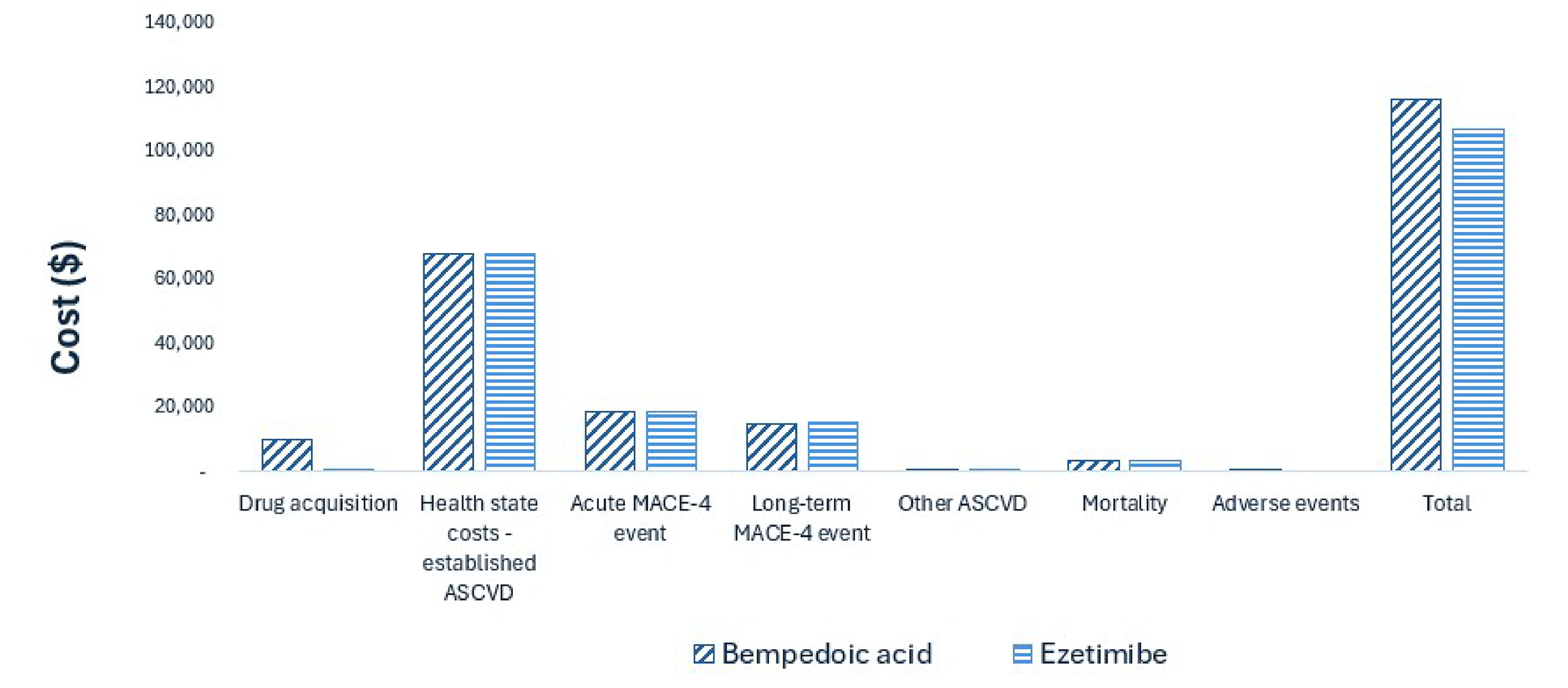
ASCVD = atherosclerotic cardiovascular disease; MACE-4 = 4-component major adverse cardiovascular event; vs. = versus.
Note: Other ASCVD includes costs associated with unstable angina, coronary artery disease, symptomatic peripheral arterial disease, and nonstroke cerebrovascular disease.
Impact on Health
Relative to ezetimibe, bempedoic acid is predicted to produce a slightly greater reduction in LDL-C from baseline at week 12. In the model, this additional LDL-C lowering is translated into a small reduction in MACE-4 events and, in turn, modest gains in life-years and HRQoL (captured as QALYs). As a result, bempedoic acid is predicted to yield approximately 0.01 additional QALYs per patient relative to ezetimibe (refer to the Supplemental Material document, Appendix 11, Table 26).
Overall Results
Based on the CDA-AMC base case for bempedoic acid, ezetimibe and evolocumab are on the cost-effectiveness frontier (that is, they are not dominated by other treatments). Bempedoic acid is extendedly dominated; because evolocumab delivers extra benefits at a lower cost per QALY than bempedoic acid (relative to ezetimibe), bempedoic acid would never be considered optimal among these 3 alternatives at any willingness-to-pay threshold.
Table 8: Summary of CDA-AMC Economic Evaluation Results — Bempedoic Acid
Drug | Total costs ($) | Total QALYs | Sequential ICER ($/QALY) |
|---|---|---|---|
Ezetimibe | 106,831 | 10.43 | Reference |
Evolocumab | 156,216 | 10.94 | $96,448 |
Bempedoic acid | 116,505 | 10.44 | Extendedly dominated through ezetimibe and evolocumab |
CDA-AMC = Canada’s Drug Agency; ICER = incremental cost-effectiveness ratio; QALY = quality-adjusted life-year.
Note: Publicly available list prices were used for all comparators. Other than the drug under review, treatments that were not on the cost-effectiveness frontier (i.e., dominated or extendedly dominated) were not included in this table. Refer to Appendix 11 in the Supplemental Material document for further information.
An alternative analysis of bempedoic acid plus ezetimibe suggests an ICER of $44,304 per QALY gained for bempedoic acid plus ezetimibe compared to ezetimibe alone. Additional details on the CDA-AMC base case for bempedoic acid, and an alternative analysis of bempedoic acid plus ezetimibe, are available in the Supplemental Material document, Appendix 11.
Uncertainty and Sensitivity
Uncertainty was explored in the scenario analyses outlined in Table 7. Assumptions pertaining to caps on maximum risk reductions for MACE-4 events had the largest impact on the cost-effectiveness conclusions (refer to Supplemental Material document, Appendix 11, Table 32). Furthermore, the results of the alternative analysis of bempedoic acid plus ezetimibe are uncertain, owing to limitations with the evidence informing the indirect comparison.
Summary of the Budget Impact
The sponsor submitted a budget impact analysis to estimate the 3-year (2027 to 2029) budget impact of reimbursing bempedoic acid for use in the reimbursement-requested population. The sponsor assumed that the payer would be CDA-AMC–participating public drug plans and derived the size of the eligible population using an epidemiologic approach. The price of bempedoic acid was aligned with the price included in the sponsor’s economic evaluation, while the prices of comparators were based on the publicly available list prices. Additional information pertaining to the sponsor’s submission is provided in Supplemental Material document, Appendix 12.
CDA-AMC identified a number of issues with the sponsor’s estimated budget impact and made changes to model parameters and assumptions in consultation with clinical experts to derive the CDA-AMC base case (Supplemental Material document, Appendix 12). For prevalence-based models, CDA-AMC estimated that by year 3 of reimbursement, 790,429 patients would be eligible for bempedoic acid; of these, 86,157 patients would be expected to receive bempedoic acid. The estimated incremental budget impact of reimbursing bempedoic acid is predicted to be approximately $137 million over the first 3 years, with an expected expenditure of $248 million on bempedoic acid. The actual budget impact will depend on the total eligible patient population, market share and market uptake assumptions, the market displacement of PCSK9 inhibitors, treatment discontinuation, and treatment utilization in the initial year of treatment.
Conclusion
Based on the CDA-AMC base case, bempedoic acid used as monotherapy or in combination with ezetimibe is associated with fewer QALYs than PCSK9is. In patients who are not eligible for PSCK9 inhibitors, bempedoic acid would not be considered cost-effective at any willingness-to-pay threshold when considered alongside both evolocumab and ezetimibe. A price reduction would be required (refer to Figure 2; full details of the impact of price reductions on cost-effectiveness are presented in the Supplemental Material document, Appendix 11, Table 30). The cost-effectiveness of bempedoic acid plus ezetimibe compared with relevant comparators is uncertain, given the limitations with the comparative information.
The budget impact of reimbursing bempedoic acid to the public drug plans in the first 3 years is estimated to be approximately $137 million. The 3-year expenditure on bempedoic acid (i.e., not accounting for the current expenditure on comparators) is estimated to be $248 million. The estimated budget impact is uncertain due to uncertainty in the eligible patient population, market share and market uptake assumptions, the market displacement of PCSK9 inhibitors, treatment discontinuation, and treatment utilization in the initial year of treatment.
Figure 2: Summary of the CDA-AMC Economic Analysis and Price Reduction
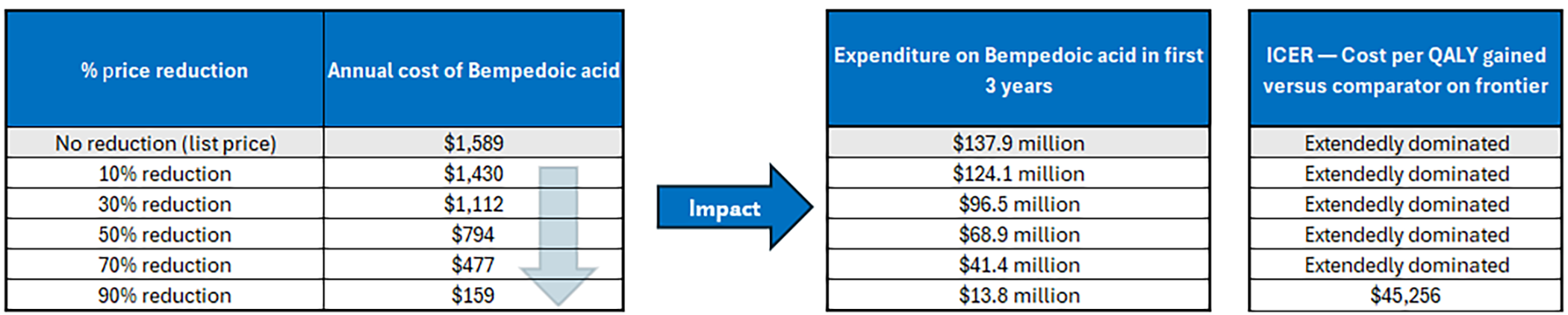
CDA-AMC = Canada’s Drug Agency; ICER = incremental cost-effectiveness ratio; QALY = quality-adjusted life-year.
Note: Expenditure includes only the drug cost of bempedoic acid. The term “extendedly dominated” means the ICER is higher than that of a more effective alternative. At the list price, bempedoic acid is extendedly dominated through ezetimibe and evolocumab; that is, evolocumab delivers extra benefits at a lower cost per QALY than bempedoic acid relative to ezetimibe. The ICER in the last row is for bempedoic acid compared with ezetimibe; evolocumab would still be associated with more QALYs than bempedoic acid.
References
1.HLS Therapeutics Inc. Drug Reimbursement Review sponsor submission: Nilemdo (bempedoic acid), tablets for oral use, 180 mg of bempedoic acid [internal sponsor's package]. December 19, 2025.
2.Brunham LR, Lonn E, Mehta SR. Dyslipidemia and the Current State of Cardiovascular Disease: Epidemiology, Risk Factors, and Effect of Lipid Lowering. Can J Cardiol. 2024;40(8S):S4-S12. doi:10.1016/j.cjca.2024.04.017 PubMed
3.Kaski JC. Libby P, Botkin NF, eds. Overview of atherosclerosis. UpToDate; 2025. Accessed January 28, 2026. https://www.uptodate.com/contents/overview-of-atherosclerosis
4.Pearson GJ, Thanassoulis G, Anderson TJ, et al. 2021 Canadian Cardiovascular Society Guidelines for the Management of Dyslipidemia for the Prevention of Cardiovascular Disease in Adults. Can J Cardiol. 2021;37(8):1129-1150. doi:10.1016/j.cjca.2021.03.016 PubMed
5.Rosenson RS, Hegele RA, Endo C. Freeman MW, Botkin NF, eds. Familial hypercholesterolemia in adults: Treatment. UpToDate; 2025. Accessed January 28, 2026. https://www.uptodate.com/contents/familial-hypercholesterolemia-in-adults-treatment
6.Handelsman Y, Jellinger PS, Guerin CK, et al. Consensus Statement by the American Association of Clinical Endocrinologists and American College of Endocrinology on the Management of Dyslipidemia and Prevention of Cardiovascular Disease Algorithm - 2020 Executive Summary. Endocr Pract. 2020;26(10):1196-1224. doi:10.4158/cs-2020-0490 PubMed
7.Akioyamen LE, Genest J, Shan SD, et al. Estimating the prevalence of heterozygous familial hypercholesterolaemia: a systematic review and meta-analysis. BMJ open. 2017;7(9):e016461. PubMed
8.Hu P, Dharmayat KI, Stevens CA, et al. Prevalence of familial hypercholesterolemia among the general population and patients with atherosclerotic cardiovascular disease: a systematic review and meta-analysis. Circulation. 2020;141(22):1742-1759. PubMed
9.Beheshti SO, Madsen CM, Varbo A, Nordestgaard BG. Worldwide prevalence of familial hypercholesterolemia: meta-analyses of 11 million subjects. J Am Coll Cardiol. 2020;75(20):2553-2566. PubMed
10.Mach F, Koskinas KC, Roeters van Lennep JE, et al. 2025 Focused Update of the 2019 ESC/EAS Guidelines for the management of dyslipidaemias. Eur Heart J. 2025;46(42):4359-4378. doi:10.1093/eurheartj/ehaf190 PubMed
11.Blumenthal RS, Morris PB, Gaudino M, et al. 2026 ACC/AHA/AACVPR/ABC/ACPM/ADA/AGS/APhA/ASPC/NLA/PCNA Guideline on the Management of Dyslipidemia: A Report of the American College of Cardiology/American Heart Association Joint Committee on Clinical Practice Guidelines. Circulation. 2026;doi:10.1161/cir.0000000000001423 PubMed
12.Nissen SE, Lincoff AM, Brennan D, et al. Bempedoic Acid and Cardiovascular Outcomes in Statin-Intolerant Patients. N Engl J Med. 2023;388(15):1353-1364. doi:10.1056/NEJMoa2215024 PubMed
13.Esperion Therapeutics, Inc. Clinical Study Report: 1002-040. A Randomized, Double-Blind, Placebo-Controlled, Multicenter Long-Term Safety and Tolerability Study of ETC-1002 in Patients With Hyperlipidemia at High Cardiovascular Risk Who are not Adequately Controlled by Their Lipid-Modifying Therapy [internal sponsor's report]. December 21, 2018.
14.HLS Therapeutics Inc. Sponsor Summary of Clinical Evidence Template: Nilemdo (bempedoic acid) [internal sponsor's report]. In: Drug Reimbursement Review sponsor submission: Nilemdo (bempedoic acid), tablets for oral use, 180 mg of bempedoic acid. December 19, 2025.
15.Esperion Therapeutics, Inc. Clinical Study Report: 1002-047. A Long-Term, Randomized, Double-Blind, Placebo-Controlled, Multicenter Study to Evaluate the Efficacy of Bempedoic Acid (ETC-1002) in Patients With Hyperlipidemia at High Cardiovascular Risk not Adequately Controlled by Their Lipid-Modifying Therapy [internal sponsor's report]. January 7, 2019.
16.Esperion Therapeutics, Inc. Clinical Study Report: 1002-043. A randomized, double-blind, placebo-controlled study to assess the effects of bempedoic acid (ETC-1002) on the occurrence of major cardiovascular events in patients with, or at high risk for, cardiovascular disease who are statin intolerant [internal sponsor's report]. April 26, 2023.
17.Baigent C, Blackwell L, Emberson J, et al. Efficacy and safety of more intensive lowering of LDL cholesterol: a meta-analysis of data from 170,000 participants in 26 randomised trials. Lancet. 2010;376(9753):1670-81. doi:10.1016/s0140-6736(10)61350-5 PubMed
18.Canada's Drug Agency. Reimbursement Review: evolocumab (Repatha). Can J Health Technol. 2024;4(12):1-137. doi:10.51731/cjht.2024.1040
19.Toth PP, Bray S, Villa G, et al. Network meta‐analysis of randomized trials evaluating the comparative efficacy of lipid‐lowering therapies added to maximally tolerated statins for the reduction of low‐density lipoprotein cholesterol. Journal of the American Heart Association. 2022;11(18):e025551. PubMed
20.HLS Therapeutics Inc. Network meta-analysis: Nilemdo (bempedoic acid) with or without ezetimibe for patients with hypercholesterolemia, with a history of ASCVD or at elevated CV risk, despite taking stable recommended statin therapy, or who are unable to take recommended statin therapy including those taking no statin [internal sponsor's report]. In: Drug Reimbursement Review sponsor submission: Nilemdo (bempedoic acid), tablets for oral use, 180 mg of bempedoic acid. November 26, 2025.
21.Lincoff AM, Ray KK, Sasiela WJ, et al. Comparative Cardiovascular Benefits of Bempedoic Acid and Statin Drugs. J Am Coll Cardiol. 2024;84(2):152-162. doi:10.1016/j.jacc.2024.04.048 PubMed
ISSN: 2563-6596
Canada’s Drug Agency (CDA-AMC) is a pan-Canadian health organization. Created and funded by Canada’s federal, provincial, and territorial governments, we’re responsible for driving better coordination, alignment, and public value within Canada’s drug and health technology landscape. We provide Canada’s health system leaders with independent evidence and advice so they can make informed drug, health technology, and health system decisions, and we collaborate with national and international partners to enhance our collective impact.
Disclaimer: CDA-AMC has taken care to ensure that the information in this document was accurate, complete, and up to date when it was published, but does not make any guarantee to that effect. Your use of this information is subject to this disclaimer and the Terms of Use at cda-amc.ca.
The information in this document is made available for informational and educational purposes only and should not be used as a substitute for professional medical advice, the application of clinical judgment in respect of the care of a particular patient, or other professional judgments in any decision-making process. You assume full responsibility for the use of the information and rely on it at your own risk.
CDA-AMC does not endorse any information, drugs, therapies, treatments, products, processes, or services. The views and opinions of third parties published in this document do not necessarily reflect those of CDA-AMC. The copyright and other intellectual property rights in this document are owned by the Canadian Agency for Drugs and Technologies in Health (operating as CDA-AMC) and its licensors.
Questions or requests for information about this report can be directed to requests@cda-amc.ca.