Drugs, Health Technologies, Health Systems
Reimbursement Review
Inebilizumab (Uplizna)
Sponsor: Amgen Canada Inc.
Therapeutic area: Generalized myasthenia gravis
Summary
What Is Generalized Myasthenia Gravis?
Generalized myasthenia gravis (gMG) is a rare, chronic autoimmune disorder characterized by fluctuating skeletal muscle weakness due to impaired neuromuscular transmission. It most commonly affects the ocular, bulbar, limb, and respiratory muscles, leading to symptoms such as ptosis, diplopia, dysphagia, dysarthria, and exertional fatigue. This condition is mediated by autoantibodies against molecular targets such as AChR and MuSK. These autoantibodies disrupt signal transmission and, in severe cases, can result in myasthenic crisis requiring ventilatory support. gMG markedly reduces quality of life, independence, and functional capacity, often necessitating long-term immunosuppressive therapy. As of 2026, it was estimated that there were 1,078 adult patients living with gMG (including patients with AChR or MuSK antibody–positive gMG) in Canada (excluding Quebec) whose symptoms persist despite conventional therapy.
What Are the Treatment Goals and Current Treatment Options for gMG?
The treatment goals are to achieve rapid and sustained symptom control, restore functional ability, reduce or ultimately discontinue the use of corticosteroids, improve quality of life, and minimize the side effects of current treatments. Outcomes that evaluate symptom relief, health-related quality of life (HRQoL), reductions in corticosteroid use, or safety were deemed important by patients.
Conventional therapies may include AChE inhibitors, corticosteroids, and nonsteroidal immunosuppressant therapies (NSISTs) such as azathioprine, mycophenolate mofetil (MMF), and cyclosporine.
For patients whose disease does not respond adequately to conventional therapies or who are unable to tolerate them, IV immunoglobulin (IVIg) or plasma exchange (PLEX) may be used as a short-term rescue or maintenance therapy.
In recent years, targeted biologics have expanded treatment options — namely, complement inhibitors (e.g., zilucoplan, ravulizumab, eculizumab) and FcRN antagonists (e.g., efgartigimod, rozanolixizumab) — which provide more individualized, mechanism-based approaches for antibody-positive or refractory disease. Rituximab is a B-cell–depleting drug and is 1 of the off-label treatment options for gMG in Canada.
What Is Uplizna and Why Did Canada’s Drug Agency Conduct This Review?
Uplizna is a CD19-directed cytolytic antibody that is administered by IV infusion. Health Canada has approved Uplizna “as an add-on to standard therapy for the treatment of gMG in adult patients who are AChR or MuSK antibody positive.”
Canada’s Drug Agency (CDA-AMC) reviewed Uplizna to inform a recommendation to the participating public drug programs on whether it should be reimbursed for adult patients with gMG. The sponsor is seeking reimbursement for Uplizna as “add-on therapy for adult patients with gMG who are AChR or MuSK antibody–positive” and whose symptoms persist despite conventional therapy with AChE inhibitors, corticosteroids, and/or NSISTs.
How Did CDA-AMC Evaluate Uplizna?
CDA-AMC reviewed the clinical evidence on the beneficial and harmful effects, as well as the economic evidence, of Uplizna versus other treatments used in Canada as add-on therapy for adult patients with AChR or MuSK antibody–positive gMG whose symptoms persist despite conventional therapy with AChE inhibitors, corticosteroids, and/or NSISTs. Efgartigimod, rozanolixizumab, ravulizumab, zilucoplan, rituximab, IVIg, and PLEX were considered relevant treatments to compare with Uplizna when reviewing the clinical evidence.
CDA-AMC identified equity and ethical considerations relevant to Uplizna and gMG.
The review was informed by materials submitted by the sponsor, which included clinical and economic evidence.
The review was also informed by 2 patient group submissions and 1 clinician group submission in response to the call for input by CDA-AMC, and by input from the participating public drug programs regarding issues that may affect their ability to implement a recommendation.
Two clinical experts (neurologists with expertise in neuromuscular disorders) from Ontario and the Prairies were consulted as part of the review process.
What Were the Findings?
Clinical Evidence
CDA-AMC reviewed the following clinical evidence:
1 pivotal phase III randomized, double-blind, placebo-controlled trial (the MINT study; N = 238 in the overall population, including 190 patients with AChR antibody–positive gMG and 48 patients with MuSK antibody–positive gMG) comparing Uplizna to placebo in adult patients with AChR or MuSK antibody–positive gMG whose symptoms persisted despite conventional therapy
1 network meta-analysis (NMA) of Uplizna versus selected active treatments for gMG: rozanolixizumab (7 mg/kg and 10 mg/kg), zilucoplan, ravulizumab, rituximab, efgartigimod, and conventional therapy (tacrolimus and MMF).
For the comparison of Uplizna versus placebo:
Based on 1 randomized controlled trial (MINT), at 26 weeks in the subpopulation of patients with AChR antibody–positive gMG, the addition of Uplizna to conventional therapy likely resulted in a clinically important improvement in functional ability (measured with the Myasthenia Gravis Activities of Daily Living [MG-ADL] scale) and muscle strength (measured with the Quantitative Myasthenia Gravis [QMG] scale) compared with placebo. Treatment with Uplizna may have resulted in little to no clinically important difference in HRQoL (measured with the Myasthenia Gravis Quality of Life 15-item Scale – Revised [MG-QoL15r]). Treatment with Uplizna may have resulted in little to no difference in the incidence of serious adverse events (SAEs) or adverse events of special interest.
Based on 1 randomized controlled trial (MINT), at 26 weeks in the subpopulation of patients with MuSK antibody–positive gMG, the addition of Uplizna to conventional therapy may have resulted in little to no clinically important improvements in functional ability (measured with the MG-ADL scale) or muscle strength (measured with the QMG scale) compared with placebo; the evidence was very uncertain about the effect of Uplizna on HRQoL (measured with the MG-QoL15r) or on the incidence of SAEs or adverse events of special interest.
Findings from the open-label extension phase of the MINT study suggested that treatment benefits with Uplizna may be durable through at least 78 weeks of continued exposure; however, considerable uncertainty existed in the study results during this period due to limitations of the extension phase (e.g., lack of a comparison group and a large amount of missing data).
Overall, no notable safety concerns for Uplizna were identified in adult patients with AChR or MuSK antibody–positive gMG compared with placebo during the study.
For the comparison of Uplizna versus active treatments for gMG based on the NMA:
The results of the base-case analyses suggested that Uplizna is similar to other comparator treatments for gMG in terms of efficacy (assessed by changes from baseline in MG-ADL, QMG, and MG-QoL15r scores). Although the NMA results suggested that Uplizna may be favoured over efgartigimod for change from baseline in MG-ADL score, there was potential for small differences that may not have met the threshold for a clinically meaningful effect.
For patients with AChR antibody–positive gMG, Uplizna may have been favoured over rituximab, efgartigimod, and conventional therapy (MMF) for change from baseline in MG-ADL score, and Uplizna may have been favoured over ravulizumab, efgartigimod, and conventional therapy (MMF) for change from baseline in QMG score.
The results for safety outcomes were generally uncertain, as evidenced by wide credible intervals that suggested that either Uplizna or comparator treatments for gMG could have been favoured. Although the NMA results for patients with AChR antibody–positive gMG suggested that Uplizna may have been associated with fewer SAEs compared with ravulizumab, there was potential for small differences that may not have met the threshold for a clinically meaningful effect.
The ability to draw firm conclusions from the NMA was limited by differences in patient characteristics, uncertainty in the distribution of some effect modifiers, sparse evidence networks, and the inability to assess the consistency assumption.
There was no evidence to inform how Uplizna compares with chronic IVIg or PLEX.
Economic Evidence
Uplizna is available as a 10 mg/mL solution for IV infusion. At the submitted price of $25,623.00 per 100 mg vial, the annual cost of Uplizna is expected to be $230,607 per patient in the first year of treatment and $153,738 in subsequent years, based on the Health Canada–recommended dosage.
Key clinical efficacy data (response and change from baseline in MG-ADL score) used in the economic analysis were derived from a sponsor-submitted indirect treatment comparison (ITC), with the efficacy of Uplizna informed by the MINT study. Indirect evidence submitted by the sponsor suggests that Uplizna may improve change from baseline in MG-ADL score compared with efgartigimod among some patients with gMG. However, there is the potential for small differences that may not have met the threshold for a clinically meaningful effect for this comparison. CDA-AMC identified that the results of the ITC were uncertain due to differences in patient characteristics, uncertainty in the distribution of some effect modifiers, sparse evidence networks, and the inability to assess the consistency assumption, which precludes the ability to draw firm conclusions on comparative effectiveness versus these comparators.
The results of the CDA-AMC base-case analyses, which separated patients with AChR antibody–positive gMG from those with MuSK antibody–positive gMG, suggest the following:
In the subpopulation of patients with AChR antibody–positive gMG, Uplizna plus standard of care (SOC) was predicted to be associated with higher costs to health care systems versus some comparators (range, $498,419 versus PLEX plus SOC to $1,408,439 versus rituximab plus SOC) and cost savings versus others (range, $326,463 versus rozanolixizumab plus SOC to $2,237,751 versus zilucoplan plus SOC). Uplizna plus SOC was also predicted to be associated with more quality-adjusted life-years (QALYs) gained compared to SOC alone, efgartigimod plus SOC, IVIg plus SOC, PLEX plus SOC, and rituximab plus SOC. However, Uplizna plus SOC was predicted to generate fewer QALYs gained compared to rozanolixizumab plus SOC, zilucoplan plus SOC, and ravulizumab plus SOC.
In the subpopulation of patients with MuSK antibody–positive gMG, Uplizna plus SOC was predicted to be associated with higher costs versus some comparators (range, $553,248 versus PLEX plus SOC to $1,467,927 versus rituximab plus SOC) and cost savings versus rozanolixizumab plus SOC ($228,677). Uplizna plus SOC is predicted to produce more QALYs than SOC alone, rituximab plus SOC, PLEX plus SOC, and IVIg plus SOC. However, Uplizna plus SOC is predicted to produce fewer QALYs compared to rozanolixizumab plus SOC.
In the CDA-AMC base-case analyses, Uplizna plus SOC was less effective and more costly than the combination of some patients receiving rituximab plus SOC and others receiving rozanolixizumab plus SOC (i.e., it was extendedly dominated through these comparators) in both subpopulations. Based on these analyses, a price reduction would be required for Uplizna plus SOC to be considered cost-effective at any given willingness-to-pay threshold. However, this finding is uncertain due to limitations in the ITC that informed the relative clinical efficacy of each comparator in the analysis. If Uplizna plus SOC is anticipated to produce similar outcomes as other add-on therapies for gMG, then the total cost of Uplizna should not exceed that of the lowest-cost add-on therapy for gMG.
CDA-AMC estimates that the budget impact of reimbursing Uplizna as an add-on therapy for the treatment of adults with AChR or MuSK antibody–positive gMG whose symptoms persist despite SOC would result in savings of approximately $82.5 million over the first 3 years of reimbursement compared to the amount currently spent on comparators, with an estimated expenditure of $124 million on Uplizna over this period. The actual budget impact of reimbursing Uplizna will depend on the uptake of Uplizna, the comparators it would displace, and the proportion of patients whose symptoms persist despite SOC treatment.
Abbreviations
AE
adverse event
AESI
adverse event of special interest
BIA
budget impact analysis
CDA-AMC
Canada’s Drug Agency
CI
confidence interval
CrI
credible interval
FAS
full analysis set
FE
fixed effect
gMG
generalized myasthenia gravis
HRQoL
health-related quality of life
ITC
indirect treatment comparison
IVIg
IV immunoglobulin
LS
least squares
MDC
Muscular Dystrophy Canada
MG
myasthenia gravis
MG-ADL
Myasthenia Gravis Activities of Daily Living
MGC
Myasthenia Gravis Composite
MGFA
Myasthenia Gravis Foundation of America
MG-QoL15r
Myasthenia Gravis Quality of Life 15-item Scale – Revised
MID
minimal important difference
MMF
mycophenolate mofetil
MSE
minimal symptom expression
NMA
network meta-analysis
NSIST
nonsteroidal immunosuppressive therapy
OLP
open-label period
PLEX
plasma exchange
QALY
quality-adjusted life-year
QMG
Quantitative Myasthenia Gravis
RCP
randomized controlled period
RCT
randomized controlled trial
RE
random effect
SAE
serious adverse event
SAS
safety analysis set
SD
standard deviation
SLR
systematic literature review
SOC
standard of care
TEAE
treatment-emergent adverse event
Background
Introduction
The objectives of this report are as follows:
Review and critically appraise the evidence submitted by the sponsor on the beneficial and harmful effects of inebilizumab 10 mg/mL solution for IV infusion, as an add-on therapy for “adult patients with gMG who are acetylcholine receptor (AChR) or muscle-specific tyrosine kinase (MuSK) antibody positive” and whose symptoms persist despite conventional therapy with AChE inhibitors, systemic corticosteroids, and/or nonsteroidal immunosuppressive therapies (NSISTs). The focus is on comparing inebilizumab to relevant comparators in clinical practice in Canada and identifying gaps in the current evidence, as outlined in Table 1.
Review and critically appraise the economic information submitted by the sponsor, including a cost-effectiveness analysis and budget impact analysis (BIA). The focus of the Economic Review is aligned with the scope of the Clinical Review, unless otherwise stated. For most reviews, a Canada’s Drug Agency (CDA-AMC) base case is developed, informed by clinical expert input, the available clinical evidence, and the best interpretation of the economic evidence based on the information provided by the sponsor.
The application was submitted by the sponsor before receiving a Notice of Compliance from Health Canada. This report reflects the anticipated indication and recommended dosage for inebilizumab during the initial CDA-AMC review period.
Table 1: Information on the Application Submitted for Review and on the CDA-AMC Review
Item | Description |
|---|---|
Information on the application submitted for review | |
Drug | Inebilizumab (Uplizna), 10 mg/mL, single-dose vials containing 100 mg inebilizumab in 10 mL solution for IV infusion |
Sponsor | Amgen Canada Inc. |
Health Canada indication | As an add-on to standard therapy for the treatment of gMG in adult patients who are AChR or MuSK antibody positive |
Health Canada approval status | NOC |
Health Canada review pathway | Standard Review |
NOC date | May 19, 2026 |
Mechanism of action | Inebilizumab binds to CD19, a cell surface antigen present on pre-B and mature B lymphocytes, and results in antibody-dependent cellular cytotoxicity. |
Recommended dosage | Initial dose: 300 mg IV infusion followed 2 weeks later by a second 300 mg IV infusion. Subsequent doses (starting 6 months from the first infusion): single 300 mg IV infusion every 6 months. |
Submission type | Initial |
Sponsor’s reimbursement request | As add-on therapy for adult patients with gMG who are AChR or MuSK antibody positive and whose symptoms persist despite conventional therapy with AChEIs, corticosteroids, and/or NSISTs. |
Submitted price | $25,623.00 per 100 mg vial |
Information on the CDA-AMC review | |
Review type | Standard |
Clinical review focusa | Population: As defined in the reimbursement request Subgroups: Antibody subtype (AChR or MuSK antibody positive) Intervention: Inebilizumab (Uplizna) administered intravenously at a dose of 300 mg Comparators:
Outcomes:
|
AChEI = acetylcholinesterase inhibitor; AESI = adverse event of special interest; CDA-AMC = Canada’s Drug Agency; gMG = generalized myasthenia gravis; IVIg = IV immunoglobulin; MG = myasthenia gravis; MG-ADL = Myasthenia Gravis Activities of Daily Living; MGC = Myasthenia Gravis Composite; MGFA = Myasthenia Gravis Foundation of America; MG-QoL15r = Myasthenia Gravis Quality of Life 15-item Scale – Revised; MSE = minimal symptom expression; Neuro-QoL = Quality of Life in Neurologic Disorders; NOC = Notice of Compliance; NSIST = nonsteroidal immunosuppressive therapy; PGIC = Patient Global Impression of Change; PLEX = plasma exchange; QMG = Quantitative Myasthenia Gravis scale; SAE = serious adverse event; TEAE = treatment-emergent adverse event.
Note: While nipocalimab has been approved by Health Canada for the treatment of gMG, it is not funded by any jurisdictions at the time of this submission.
aThe Economic Review aligns with the scope of the Clinical Review, unless otherwise stated.
Submission History for the Drug Under Review
CDA-AMC previously reviewed inebilizumab through the reimbursement review process for neuromyelitis optica spectrum disorders. Currently, CDA-AMC is reviewing inebilizumab through the reimbursement review process for immunoglobulin G4-related disease.
Sources of Information
The contents of the Reimbursement Review report are informed by materials submitted by the sponsor, input received from interested parties (patient groups, clinician groups, and drug programs), and input from clinical experts consulted for this review.
Calls for patient group and clinician group input are issued for each Reimbursement Review. Two patient group submissions from Muscular Dystrophy Canada (MDC) and the Sumaira Foundation and 1 clinician group submission from the Neuromuscular Disease Network for Canada were received. Input from the MDC was compiled from multiple patient engagement activities conducted across Canada (i.e., surveys, semistructured interviews, round table discussions, and ongoing insights gathered through MDC’s national System Navigation Program). Moreover, MDC conducted a national Myasthenia Gravis (MG) Canadian Journey Mapping project, which included 1-hour patient interviews, virtual round table discussions, national surveys (available in English and French), and health-related quality of life (HRQoL) assessments. Patients were recruited through MDC’s membership network, direct outreach by Neuromuscular Service Support staff, email communications, and MG patient support groups in Canada. For this initiative, a total of 216 individuals living with gMG contributed to the findings reflected in this submission. In addition to the mapping project, MDC gathered input on the potential value of inebilizumab for the treatment of gMG from 24 individuals with confirmed gMG diagnoses. Input from the Sumaira Foundation was compiled from qualitative insights gathered at its Patient Day event held in November 2025, with attendance from more than 200 patients, caregivers, and clinicians. The event included an in-person panel consisting of 4 patients living with gMG. Input gathered from the panellists was supplemented by insights gathered through the Sumaira Foundation’s ongoing engagement with members of the gMG community through patient events, conferences, support group meetings, online forums, and social media. Input from the Neuromuscular Disease Network for Canada was gathered by clinicians with experience in treating MG who were invited to contribute to this submission; a total of 9 clinicians submitted input. The full submissions received are available on the CDA-AMC project landing page in the consolidated input document. The drug programs provide input on each drug being reviewed through the reimbursement review process by identifying issues that may affect their ability to implement a recommendation.
Input from patient and clinician groups is considered throughout the review, including in the selection of outcomes to include in the Clinical Review and in the interpretation of the clinical and economic evidence. Relevant patient and clinician group input is summarized in the Disease Background, Current Management, and Unmet Needs and Existing Challenges sections.
Each review team includes at least 1 clinical expert with expertise regarding the diagnosis and management of the condition for which the drug is indicated. Clinical experts are a critical part of the review team and are involved in all phases of the review process. Two clinical experts from Ontario and the Prairies with expertise in the diagnosis and management of MG participated as part of the review team.
Disease Background
MG is a rare, chronic, B-cell–mediated autoimmune disorder that disrupts neuromuscular communication, causing fluctuating muscle weakness that worsens with repeated use.1,2 An estimated 85% of patients with gMG have AChR antibodies and 6% have MuSK antibodies,3 with MuSK antibody positivity often associated with more severe disease.4,5 As of 2026, it was estimated that there were 1,078 adult patients living with gMG whose symptoms persisted despite conventional therapies in Canada (excluding Quebec), including patients with AChR or MuSK antibody–positive gMG.6-9
The pathogenesis of gMG is primarily driven by the production of autoantibodies that target critical neuromuscular junction proteins.2,10,11 These autoantibodies impair postsynaptic transmission by targeting proteins on the postsynaptic membrane of the neuromuscular junction (i.e., AChRs or related molecules), causing muscle weakness.12 gMG typically affects ocular, limb, bulbar, and respiratory muscles, limiting daily activities such as walking, climbing stairs, and getting up from chairs.4,13,14 The clinical presentation differs between patients with AChR antibody–positive gMG and those with MuSK antibody–positive gMG. In patients with AChR antibody–positive gMG, the disease is usually characterized by fatigable weakness that worsens with exertion, whereas in those with MuSK antibody–positive gMG, it often involves neck extensor, shoulder, and bulbar muscles, with a higher risk of crisis and muscle atrophy.13 If left untreated, gMG symptoms often progress and may peak within the first 2 years, followed by relative stability with fluctuating symptoms (e.g., fatigue and illness).15,16 If gMG is not properly treated over longer periods, it may lead to irreversible damage, associated muscle atrophy, and functional impairment.14,17,18
Patient group input: Patients with MG experience unpredictable, fluctuating muscle weakness that can impair breathing, speech, swallowing, vision, and mobility. Moreover, respiratory muscle weakness can lead to myasthenic crises, which are life-threatening and may require mechanical ventilation and hospital admission. As a result of physical decline, patients with MG also reported losing the ability to work, maintain independence, and participate in activities of daily living. Patients with MG have also reported negative emotional and social impacts such as depression, anxiety, fear of experiencing crises, and feelings of guilt related to burdens on family members who provide support.
Current Management
Treatment Goals
Patient group input: Both patient groups agreed that an important goal of MG treatment was to restore physical function (e.g., improve muscle strength and reduce fatigue). The Sumaira Foundation indicated that important goals of treatment also included reducing symptom burden and achieving disease stability. MDC noted that important goals of treatment also included reducing the severity and frequency of disease exacerbations, preventing respiratory crises and hospitalizations, maintaining independence and daily functioning, reducing reliance on corticosteroids and long-term immunosuppressant use, and improving HRQoL.
Clinician input: Treatment goals for gMG outlined by the Neuromuscular Disease Network for Canada included achieving minimal symptom expression (MSE) or pharmacologic remission; reducing corticosteroid use (defined as less than 7.5 mg of prednisone per day or complete discontinuation) and treatment-emergent adverse events (TEAEs); and improving patients’ quality of life, independence, and ability to work.
The clinical experts consulted for this review similarly noted that new targeted therapies are desired for patients with gMG if they can relieve or eliminate symptoms of gMG, preserve patients’ day-to-day function, reduce corticosteroid use or ultimately discontinue corticosteroids altogether. The new targeted therapies should also minimize the side effects of current treatments and offer improved ease of administration.
Current Treatment Options
Treatment for MG is highly individualized and depends on factors such as the clinical pattern (ocular versus generalized), severity of the disease, symptom progression, respiratory or bulbar involvement, patient age, and the presence of anti-AChR or anti-MuSK antibodies.19-21 According to clinical practice guidelines, expert opinion, and previous research, conventional therapy for gMG may consist of AChE inhibitors (e.g., pyridostigmine), systemic corticosteroids (e.g., prednisone), and NSISTs (e.g., azathioprine, mycophenolate mofetil [MMF], cyclosporine, tacrolimus).20,21 AChE inhibitors can rapidly relieve symptoms of mild MG in patients with AChR antibody–positive gMG and are usually prescribed as the initial therapy in this subpopulation. Most patients, however, require suppression of autoantibody production with immunosuppressive treatment: oral corticosteroids are initially used to induce remission, while long-term maintenance is achieved with either low-dose oral corticosteroids or NSISTs.22 These therapies broadly suppress the immune system and do not selectively target the autoantibodies that contribute to gMG pathophysiology.20 These conventional therapies usually take several months to have a beneficial effect. Many patients with gMG require long-term or even lifelong treatment; however, these conventional immunotherapies are associated with severe side effects. For example, patients treated with prolonged or high-dose corticosteroid therapy have a higher risk of developing high blood pressure, mood changes, and impaired glucose tolerance in the short-term, and osteoporosis, glaucoma, infection, and cardiovascular events in the long term.20,23,24 Rapidly acting but short-lasting therapies such as IV immunoglobulin (IVIg) and plasma exchange (PLEX) are used as rescue therapies in patients with severe or acutely worsening gMG or myasthenic crisis.20,25
Conventional therapies for MG induce remission in 70% to 80% of patients, but very few patients attain sustained stable remission when not receiving therapy.22 This poses a risk of long-term exposure to conventional nonselective immunotherapies with cumulative toxicities, such as opportunistic infections, malignancies, and systemic organ dysfunction.22 Approximately 10% to 15% of patients with gMG have disease that is considered treatment refractory. These patients have recurrent disease exacerbations and may require hospitalization and ventilatory support; they are also prone to having comorbidities (e.g., end-stage organ dysfunction) and poor functional HRQoL.22
Emerging targeted immunotherapies, such as complement inhibitors (e.g., ravulizumab,26 zilucoplan27 and eculizumab28), FcRn blockers (e.g., efgartigimod alfa29 and rozanolixizumab30), B-cell–targeting therapies (e.g., rituximab31), and hematopoietic stem cell transplant have been developed over the past decade. These treatments target the specific pathomechanisms of gMG and are intended to be used as add-on therapies to conventional treatment for patients with refractory AChR antibody–positive gMG.20-22 Furthermore, some of the complement inhibitors and FcRn blockers have received a CDA-AMC recommendation of “to be reimbursed” for the same target patient population as the current review. Although effective in relieving symptoms, these options do not target autoantibody-producing plasmablasts and plasma cells.32,33 Many patients remain dependent on corticosteroids and require frequent dosing (ranging from daily to every 8 weeks), which introduces both inconvenience and cost challenges.26,34-37 Rituximab is an off-label treatment option for gMG in Canada, but access to this treatment varies across jurisdictions. It can also be used for the treatment of patients with MuSK antibody–positive gMG.38
Thus, there is a substantial unmet need for steroid-sparing therapies that address the underlying pathophysiology of gMG and deliver targeted and durable efficacy with good tolerability for patients with AChR or MuSK antibody–positive gMG, while offering a convenient dosing schedule, reduced treatment complexity and burden, and improved patient outcomes.35
Besides drug therapies, thymectomy is indicated for any subtype of MG with evidence of a thymoma. It may also be considered in patients with AChR antibody–positive gMG who have no evidence of a thymoma or in patients whose disease fails to respond to immunotherapy or who have intolerable side effects.21
Treatment strategies differ for patients with AChR antibody–positive gMG and those with MuSK antibody–positive gMG. Anticholinesterase drugs or thymectomy are not recommended for patients with MuSK antibody–positive gMG because of their suboptimal effect in this subpopulation compared with patients with AChR antibody–positive gMG.22,39 While most of the currently available targeted therapies are indicated only for patients with AChR antibody–positive gMG, rozanolixizumab, an FcRn inhibitor, has been approved for patients with AChR or MuSK antibody–positive gMG.30
Key characteristics of inebilizumab are summarized with other treatments available for gMG in Appendix 1 in the Supplemental Material document.
Unmet Needs and Existing Challenges
Patient group input: Both patient groups indicated that despite several treatments available for MG, many patients struggle to achieve disease control and often report treatment-related side effects that affect their quality of life. Both groups also noted that management of MG consists of a trial-and-error process of cycling through treatment options. The Sumaira Foundation indicated that determining whether a treatment is effective can take months and prolong periods of uncontrolled symptoms and treatment-related side effects. The patient groups also expressed that current treatments for MG often do not fully restore patients’ quality of life and do not allow some patients to return to work and daily activities. The Sumaira Foundation highlighted that access to novel targeted therapies approved for MG remains inconsistent, with access challenges including insurance denials, lack of clinician willingness to appeal, and administrative barriers. The patient groups also highlighted several economic impacts related to MG, such as loss of employment, reduced income, out-of-pocket costs for uninsured medications, travel costs related to treatment administration, mobility aids, and nutritional supports. The patient groups further noted that caregivers of patients with MG may also experience lost income, reduced work hours, and increased out-of-pocket costs.
Clinician input: The clinical experts consulted by CDA-AMC indicated that many patients with gMG are currently treated with NSISTs and corticosteroids. NSISTs do not work quickly to produce meaningful clinical benefit and have nontargeted mechanisms of action. The use of corticosteroids is associated with serious long-term side effects and complications. Despite the availability of these standard therapies, up to 15% of patients with gMG have disease that remains refractory. Furthermore, although a few newer therapies (e.g., efgartigimod and ravulizumab) have been recommended by CDA-AMC for the treatment of gMG, they are not readily accessible to patients through public funding, and access to and eligibility criteria for these treatments differ by jurisdiction. The provinces and territories have either not implemented these therapies for patient access or require that patients have gMG that does not respond adequately to multiple NSISTs before approval. Because it is difficult to predict who may respond to 1 medication or another, the clinical experts suggested that having multiple options with different mechanisms of action is crucial for identifying the best treatment strategies for these patients. This is particularly true for patients with MuSK antibody–positive gMG or seronegative gMG; these populations have been included in fewer studies, and therefore fewer treatment options are available to them than to patients with AChR antibody–positive gMG.
The clinical experts noted that many of the newer biologic therapies should be prescribed by a neuromuscular specialist and that therapies administered by IV infusion require access to nursing resources and infusion centres. Patients living in rural and remote areas face the additional treatment burden of travelling to an urban hospital or infusion centre for IV treatment. For the newer subcutaneous injectable medications, patients or their caregivers also need appropriate training and education.
The Neuromuscular Disease Network for Canada highlighted that, despite the availability of modern targeted therapies for gMG, treatment response is still not ideal, with approximately 40% to 50% of patients achieving MSE. The group agreed that approximately 10% to 15% of patients have disease that is resistant to or refractory to standard or advanced treatments and noted that many patients with gMG are dependent on long-term corticosteroids and that there is a need for steroid-sparing treatment options with sustained disease control. Finally, the group was concerned that several approved novel targeted therapies for gMG are not publicly funded, which results in inequitable access to these therapies. The group added that patients with gMG who have public drug plan coverage often spend years receiving standard treatments that may be ineffective or highly toxic before they are eligible for newer treatments.
Considerations for Using the Drug Under Review
The content in this section has been informed by input from the clinical experts consulted for the purpose of this review and from clinician groups, as well as by the reimbursement conditions proposed by the sponsor (refer to Appendix 1 in the Supplemental Material document, available on the CDA-AMC project landing page). The implementation questions from the public drug programs and corresponding responses from the clinical experts consulted for this review are summarized in the Summary of Drug Program Input and Clinical Expert Responses table in Appendix 1 in the Supplemental Material document. The following information has been summarized by the review team.
Place in Therapy
The clinical experts consulted by CDA-AMC noted that inebilizumab is expected to cause a shift in the current treatment paradigm due to its unique mechanism of action as a CD19-directed B-cell–depleting therapy. Although inebilizumab is 1 of the several targeted immunotherapies that address the autoimmune disease process, it is the first CD19-directed B-cell-depleting therapy for patients with AChR or MuSK antibody–positive gMG. According to the clinical experts, patients with gMG should have completed a trial of combination conventional therapies first before inebilizumab is offered, similar to other existing targeted therapies. The clinical experts suggested that inebilizumab could be used with pyridostigmine and other conventional NSISTs, although the risk of infection would be increased. The experts also noted that whether inebilizumab could be used at the same time as complement inhibitors or FcRn antagonists remains unclear; however, the latter can be used as a bridging therapy to induce rapid reduction in disease burden, with a patient then transitioning to an alternate immunosuppressive drug, such as inebilizumab, for longer-term disease control. The clinical experts also noted that complement inhibitors are not typically prescribed for patients with MuSK antibody–positive gMG because complement activation is not expected in these patients. Patients would also benefit from the less frequent administration of inebilizumab compared to the more frequent administration of conventional nonsteroidal therapies and newer biologic agents. The benefit of inebilizumab has been observed in patients with AChR or MuSK antibody–positive gMG.
The Neuromuscular Disease Network for Canada agreed that inebilizumab could cause a shift in the treatment paradigm of gMG in adults as a first-line steroid-sparing drug.
Patient Population
The clinical experts consulted for this review suggested the following treatment strategies for patients with gMG: symptomatic therapy (pyridostigmine), corticosteroids, conventional NSISTs, and targeted biologic therapy (FcRn inhibitors, complement inhibitors, and inebilizumab). The clinical experts indicated that patients who are suitable to receive targeted biologic therapy (including inebilizumab) include those with AChR or MuSK antibody–positive gMG (regardless of disease severity or demographic characteristics), whose disease is refractory despite conventional therapies, who have complications or side effects from these therapies, and who need steroid-sparing treatment. While both clinical experts consulted agreed that corticosteroids and NSISTs are typical prior treatments before considering inebilizumab, it is less clear whether patients should be mandated to have received both corticosteroids and NSIST before moving forward with the next line of therapy with inebilizumab. The clinical experts noted that patients with seronegative gMG would be less suitable for treatment with inebilizumab, given the lack of evidence in this patient population.
The clinical experts also questioned the appropriateness of waiting for an inadequate response to NSISTs, which can take approximately 12 months to observe, before approval of inebilizumab, noting that these patients may have persistent disabling symptoms during that waiting period, require hospital care, continue to receive high daily doses of corticosteroids, and develop adverse effects of ongoing steroid therapy and NSISTs. The clinical experts believed that patients should be treated with high-efficacy targeted therapies early in the disease to reduce symptoms, prevent crises, stop neuromuscular junction damage, and improve long-term prognoses while minimizing adverse events (AEs). The clinical experts suggested that earlier treatment and intervention could reduce costs and strain on health care systems in the long term.
The Neuromuscular Disease Network for Canada indicated that treatment with inebilizumab would be best suited for adult patients with AChR or MuSK antibody–positive gMG.
Assessing the Response to Treatment
The clinical experts consulted by CDA-AMC indicated that, in clinical practice, the patient-reported MG Activities of Daily Living (MG-ADL) scale is used in disease monitoring and treatment assessment. The MG-ADL is also frequently used as a primary outcome measure in most MG clinical trials. The clinical experts stated that most clinicians would consider a reduction of 2 or more points from baseline in the MG-ADL score to be clinically meaningful. An MG-ADL score of 0 or 1 is considered MSE, which is another indicator of a robust response to a particular treatment. The clinical experts noted that another indicator of treatment response commonly used in clinical practice is the ability to reduce daily corticosteroid dose.
Other scores less commonly used in clinical practice include the Quantitative Myasthenia Gravis (QMG) score, the Myasthenia Gravis Composite (MGC) score, the Myasthenia Gravis Impairment Index, and the Myasthenia Gravis Quality of Life 15-item Scale – Revised (MG-QoL15r).
The clinical experts also noted that the intervals for treatment-effect assessment in patients with gMG can vary. For treatment initiation with inebilizumab, the assessment should be performed at least 3 months after initiation or later during the induction dosing and then at 6 months before maintenance dosing, followed by at least every 6 months thereafter in alignment with the maintenance dosing regimen. Subsequent assessment intervals may be further individualized based on the patient’s treatment response.
The Neuromuscular Disease Network for Canada agreed that treatment response for MG is defined by a meaningful reduction in scores across validated measures, such as the MG-ADL, QMG, MGC, and MSE. The group also indicated that treatment response for MG is defined by the patient’s ability to reduce their daily corticosteroid dose without experiencing a flare-up of symptoms. The group indicated that the frequency of assessment depends on the phase of treatment and the drug selected for treatment. During the initiation of inebilizumab, outcome assessments are expected to occur at 2 to 3 months to monitor for early response and to guide steroid tapering. Once the disease becomes stable, assessments usually occur every 6 months, which aligns with the twice-yearly infusion schedule of the drug. This monitoring strategy broadly aligns with the input from the clinical experts.
Discontinuing Treatment
The clinical experts consulted by CDA-AMC noted that treatment with inebilizumab should be discontinued if there is a lack of response to therapy based on the outcome measure chosen (e.g., MG-ADL score) or if there are intolerable side effects (e.g., severe infusion reactions or recurrent infections requiring hospitalization).
The Neuromuscular Disease Network for Canada indicated that factors for discontinuation of inebilizumab include the inability to achieve a treatment response (i.e., meaningful reductions in validated measures such as the MG-ADL, QMG, MGC, and MSE), the inability to reduce corticosteroid burden to a clinically meaningful level, a history of frequent or opportunistic infections while receiving therapy, and the incidence of severe infusion-related reactions. Of note, the group indicated that discontinuation should not be based solely on not achieving complete steroid withdrawal, especially if the patient demonstrates improved disease control and reduced steroid-related toxicity.
Prescribing Considerations
According to the clinical experts consulted for this review, inebilizumab should be prescribed by a neuromuscular specialist. The diagnosis of seropositive gMG could be made by a neurologist or neuromuscular specialist. The clinical experts also noted that there is generally reasonable access to tertiary neuromuscular care or consultation across Canada. The experts indicated that patients living in rural areas would potentially have longer wait times to access specialists and treatments for gMG; in this case, collaboration with a local primary care team may be feasible to support routine care and follow-up.
The Neuromuscular Disease Network for Canada indicated that inebilizumab is expected to be prescribed only by neuromuscular experts who have considerable experience in managing gMG or by a neurologist in collaboration with a local neuromuscular expert.
Clinical Review
Methods
The review team considered studies in the sponsor’s systematic review (pivotal studies and randomized controlled trials [RCTs]) and indirect treatment comparisons (ITCs). Eligible studies for the systematic review included RCTs. Relevant patients and interventions were defined by the reimbursement request and the recommended dosage in the product monograph. Autoantibody subtype (AChR antibody positive or MuSK antibody positive) was considered potentially important for informing the reimbursement recommendation. Relevant comparators were active treatments used in clinical practice in Canada for adult patients with gMG, including conventional therapy alone or conventional therapy in combination with the following: IVIg, PLEX, rituximab, efgartigimod alfa, rozanolixizumab, zilucoplan, and ravulizumab. These treatments are used in clinical practice in Canada to treat patients described in the indication under review. An open-label period (OLP) of the included RCT was also included, regardless of whether there was a comparison group. ITCs submitted by the sponsor were included when they filled an identified gap in the systematic review evidence (e.g., missing comparator, longer follow-up duration).
The review team selected outcomes (and follow-up times) for review considering the sponsor’s Summary of Clinical Evidence, clinical expert input, and patient and clinician group input. Included outcomes are those considered relevant to expert committee deliberations, and they were selected in consultation with committee members. Evidence from the systematic review for the most important outcomes was assessed using the Grading of Recommendations Assessment, Development and Evaluation (GRADE) approach. Outcomes considered critical for decision-making were MG-ADL score (measured with mean change from baseline and responder analyses), QMG score (measured with mean change from baseline and responder analyses), HRQoL (measured with the MG-QoL15r), serious AEs (SAEs), and AEs of special interest (AESIs). These measures were selected because they represent key treatment goals in gMG: improved daily function, reduced symptom burden, enhanced quality of life, and safety.
Methods for data extraction, risk of bias appraisal, and certainty of evidence assessment are in Appendix 2 in the Supplemental Material document.
Clinical Evidence
In this report, the following sources of evidence submitted by the sponsor are reviewed and appraised:
1 phase III RCT in adult patients with gMG (the MINT study)40
1 ITC in the form of a network meta-analysis (NMA).41
Systematic Review
Description of Studies
Study Characteristics
The MINT study is the only study identified in the sponsor’s systematic literature review (SLR).
The MINT study is a phase III, randomized, double-blind, multicentre, placebo-controlled trial with an OLP to evaluate the efficacy and safety of inebilizumab in adults with gMG. A total of 238 patients (190 patients with AChR antibody–positive gMG and 48 patients with MuSK antibody–positive gMG) met the trial eligibility criteria and were enrolled from 126 centres across Asia, Europe, North America (including 6 patients from Canada), and South America. These patients were at least 18 years of age, had a diagnosis of gMG (with a Myasthenia Gravis Foundation of America [MGFA] clinical classification class II, III, or IV), and had AChR or MuSK antibodies. Patients were also required to have a score of 6 to 10 on the MG-ADL scale (scores range from 0 to 24, with higher scores indicating greater disease activity), with more than 50% of the score attributed to nonocular items, or an MG-ADL score of at least 11, in addition to a score of at least 11 on the QMG scale (scores range from 0 to 39, with higher scores indicating greater disease activity) at screening and randomization. Finally, patients had to have been receiving a stable dose of glucocorticoids or an NSIST (or both) at the time of randomization. Patients who were excluded were those with congenital myasthenic syndromes, known immunodeficiencies, thymectomy within the 12 months before the baseline visit, and specific medications. Randomization was stratified by antibody status (AChR antibody positive versus MuSK antibody positive) and region (Japan versus outside Japan).
Randomization and assignment of investigational product kit numbers were managed by the interactive voice and web response system. Among patients enrolled outside of Japan, patients were stratified according to baseline disease severity and baseline corticosteroid use and were randomized 1:1 to receive either inebilizumab or placebo within each stratum. Among patients enrolled in Japan, no stratification was applied due to the small sample size, and patients were randomized 1:1 to receive either inebilizumab or placebo. The study site personnel, the sponsor personnel who were directly associated with the conduct of the study, and the patients were blinded to the treatment assignment until the last patient had completed the study or discontinued early. All patients who completed the randomized controlled period (RCP) were allowed to enrol in a 3-year (156-week) OLP, which is ongoing. The study period was from October 15, 2020, to May 28, 2024, for the RCP (data cut-off date: May 28, 2024) and the OLP (interim data cut-off date: May 28, 2024).
The RCP was 52 weeks for patients with AChR antibody–positive gMG and 26 weeks for patients with MuSK antibody–positive gMG. During the RCP, patients with AChR antibody–positive gMG received IV infusions of either inebilizumab (300 mg) or placebo on days 1 and 15 and at week 26, and patients with MuSK antibody–positive gMG received infusions on days 1 and 15.
In the OLP, patients assigned to the placebo group during the RCP received inebilizumab infusions on OLP days 1, 15, 183 (week 26), 365 (week 52), 547 (week 78), 729 (week 104), and 911 (week 130). Patients assigned to the inebilizumab group during the RCP received an inebilizumab infusion on OLP day 1, a placebo infusion on day 15 (to avoid potential unblinding), and subsequent inebilizumab infusions at weeks 26 (day 183), 52 (day 365), 78 (day 547), 104 (day 729), and 130 (day 911).
A safety follow-up period is 2 years after the last dose of inebilizumab for patients who did not enter the OLP or who discontinued inebilizumab during the OLP.
The primary end point of this trial was the change from baseline in MG-ADL score at week 26 in the overall study population, including patients with AChR or MuSK antibody–positive gMG. During the RCP, other efficacy end points (e.g., change from baseline in QMG score and HRQoL measures) and harms were assessed at week 26 in the overall study population, including patients with AChR or MuSK antibody–positive gMG. For patients with AChR antibody–positive gMG, results for week 52 were also reported.
In the MINT study, premedication with a corticosteroid, an antihistamine, and an antipyretic was administered approximately 30 to 60 minutes before each infusion for prophylaxis of infusion reactions.
Throughout the RCP, the doses of azathioprine, MMF, mycophenolic acid, and AChE inhibitors remained stable. Reduction in corticosteroid use was examined in the study population. Patients who began the trial on prednisone 5 mg per day or more (or an equivalent dose of another glucocorticoid) had their corticosteroid dose tapered according to protocol, beginning at week 4 of the RCP. The taper occurred regardless of patients’ clinical status. The sponsor noted that the rationale for making the taper independent of clinical status was to reduce the risk of confounding the primary outcome if corticosteroids were tapered differentially between the active and placebo groups. Starting at the RCP week 4 visit, patients receiving corticosteroids underwent the protocol-specified taper until they were receiving prednisone 5 mg daily, which was then maintained until the end of the RCP. Corticosteroids were not initiated in patients who were not receiving them at the time of randomization.
During the OLP, the requirement to taper corticosteroids and NSISTs was removed. Tapering of NSISTs was recommended per standard of care (SOC). Further tapering of corticosteroids was left to the discretion of the Investigator.
Characteristics of the included study are summarized in Table 2. Details pertaining to the eligibility criteria, interventions and comparators, and relevant outcome measures are in Appendix 3 in the Supplemental Material document.
Table 2: Characteristics of Studies Included in the Systematic Review
Study name, design, and sample size | Key inclusion criteria | Key exclusion criteria | Intervention and comparator | Relevant end points |
|---|---|---|---|---|
The MINT study Phase III, randomized, DB, placebo- controlled, multicentre study N = 238 |
| Receipt of the following within 4 weeks before day 1:
Current use of:
| Intervention Inebilizumab 300 mg IV was administered during the RCP and OLP. RCP:
OLP:
Comparator Matched placebo IV was administered during the RCP. RCP:
| Primary end point:
Key secondary end points:
Other secondary end points:
Exploratory end points:
|
AESI = adverse event of special interest; DB = double-blind; ECG = electrocardiogram; gMG = generalized myasthenia gravis; MG = myasthenia gravis; MGC = Myasthenia Gravis Composite; MG-ADL = Myasthenia Gravis Activities of Daily Living; MGFA = Myasthenia Gravis Foundation of America; MG-QoL15r = Myasthenia Gravis Quality of Life 15-item Scale – Revised; MSE = minimal symptom expression; Neuro-QoL = Quality of Life in Neurologic Disorders; NSIST = nonsteroidal immunosuppressive therapy; OLP = open-label period; PGIC = Patient Global Impression of Change; PIS = postintervention status; PLEX = plasma exchange; QMG = Quantitative Myasthenia Gravis; RCP = randomized controlled period; SAE = serious adverse event; SC = subcutaneous; TEAE = treatment-emergent adverse event.
Sources: ClinicalTrials.gov 2025,42 Clinical Study Report for the MINT study,40 and Nowak et al. (2025).12 Details included in Table 2 are from the sponsor’s Summary of Clinical Evidence.
Statistical Testing and Analysis Populations
In the MINT study, the sample size was estimated using a 2-sided t test. Approximately 230 patients (188 patients with AChR antibody–positive gMG and 42 patients with MuSK antibody–positive gMG) were needed to be randomized in a 1:1 ratio to either receive inebilizumab or placebo. This sample size provided more than 95% power to detect a true mean (population) treatment difference of 2 points in the MG-ADL score in the overall study population, with a 2-sided alpha level of 0.05, assuming a common standard deviation (SD) of 4.
The sample size of patients with AChR antibody–positive gMG was also estimated using a 2-sided t test, which provided at least 90% power to detect a true mean (population) treatment difference of 2 points in change from baseline in the MG-ADL score with a 2-sided alpha level of 0.05. The sample size of patients with MuSK antibody–positive gMG was estimated based on the feasibility of enrolment. Assuming a common SD of 4 and a 2-sided alpha level of 0.05, the minimum detectable treatment difference in patients with MuSK antibody–positive gMG was a 2.5-point change from baseline in the MG-ADL score.
The primary and secondary end points were all analyzed in the full analysis set (FAS). The end points were analyzed using a mixed-effects model for repeated measures analysis with covariates of treatment group, baseline antibody status (AChR antibody positive or MuSK antibody positive), baseline steroid use (daily prednisone dose ≤ 5 mg versus > 5 mg), baseline QMG score (as a continuous variable for end points based on QMG score and as a binary variable for other end points [< 16 versus ≥ 16]), baseline MG-ADL score, visits, and the interaction between visit and treatment group.
The type I error was controlled across the primary and the key secondary end points at 0.05 (2-sided). A hierarchical approach was used to control for multiplicity. Step 1 included testing the primary end point at a significance level (2-sided) of 0.05; if the P value was less than 0.05, then step 2 could follow. Step 2 consisted of testing the key secondary end points at a significance level (2-sided) of 0.05, starting with the change from baseline in the QMG score at week 26 in the overall study population and ending with the change from baseline in the MG-ADL score at week 26 in patients with AChR antibody–positive gMG.
In this study, to explore the consistency of the treatment effect of inebilizumab, subgroup analyses were performed in the FAS for the primary and key secondary end points in the following subgroups, as appropriate: antibody type (AChR antibody positive versus MuSK antibody positive), gender, MG duration at baseline (< 4 years; ≥ 4 years), baseline steroid use (prednisone ≤ 20 mg/day; prednisone > 20 mg/day), baseline immunosuppressive therapy use (corticosteroid only, NSIST only, corticosteroid plus 1 NSIST), QMG score (QMG ≤ 15; QMG ≥ 16), MGFA class (class II; III; IV), region, country, and racial subgroups.
Analysis populations in the MINT study were defined as follows:
FAS: The FAS included all randomized patients who received at least 1 dose of investigational product in the study, had a baseline MG-ADL assessment, and had at least 1 postbaseline MG-ADL assessment. Patients were analyzed according to the randomized treatment assignment. This was the analysis population for all efficacy analyses for the RCP.
Safety analysis set (SAS) (in the RCP): The SAS included all patients who received any dose of investigational product during the RCP. Patients were analyzed according to the treatments they actually received. A patient who received any dose of inebilizumab during the RCP was included in the inebilizumab treatment group. A patient who received placebo only during the RCP was included in the placebo treatment group. This set was used for all safety evaluations for the RCP.
Open-label analysis set: The open-label analysis set included all patients who received any dose of inebilizumab during the OLP. This was the analysis population for efficacy and safety for the OLP. Patients who received inebilizumab during the OLP were not included in the SAS in the RCP.
Details pertaining to statistical analysis methods, missing data handling strategies, and sensitivity analyses are described in Appendix 3 in the Supplemental Material document.
Patient Disposition
Of the 238 patients randomized to the 2 treatment groups, 190 patients had AChR antibodies and 48 patients had MuSK antibodies. The primary analysis was conducted when the last patient completed the week 26 visit, which represented the complete RCP for patients with MuSK antibody–positive gMG. A total of 9.5% of the patients with AChR antibody–positive gMG discontinued the RCP; 2.1% of patients with MuSK antibody–positive gMG discontinued the RCP. As of September 9, 2024, the RCP was ongoing for patients with AChR antibody–positive gMG (duration of 52 weeks), with 75.3% of patients having completed the RCP.
Overall, 188 patients were included in the FAS for patients with AChR antibody–positive gMG: 95 patients were randomized to the inebilizumab group and 93 patients to the placebo group. A total of 48 patients were included in the FAS for patients with MuSK antibody–positive gMG: 24 patients were randomized to the inebilizumab group and 24 patients to the placebo group.
Among patients with AChR antibody–positive gMG, the most common reason for discontinuing the RCP was withdrawal by the patient (2 patients [2.1%] in the inebilizumab group and 6 patients [6.3%] in the placebo group). Among patients with MuSK antibody–positive gMG, treatment discontinuation was rare: 0 patients in the inebilizumab group and 1 patient (4.2%) in the placebo group. At the data cut-off date, 94 patients (79.0%) in the inebilizumab group and 84 patients (70.6%) in the placebo group enrolled in the OLP.
Patient disposition for the MINT study is summarized in Appendix 4 in the Supplemental Material document.
Baseline Characteristics
Patient demographic and baseline characteristics were generally well matched between the treatment groups across the overall population and among patients with AChR or MuSK antibody–positive gMG.
Among patients with AChR antibody–positive gMG, the mean age at study entry was 46.9 years (SD = 16.3 years) in the inebilizumab group and 48.9 years (SD = 15.4 years) in the placebo group. The mean disease duration was 6.11 years (SD = 7.27 years) in the inebilizumab group and 7.17 years (SD = 7.62 years) in the placebo group. The mean baseline MG-ADL score was 9.1 (SD = 2.7) in the inebilizumab group and 9.3 (SD = 2.8) in the placebo group, and the mean QMG score was 16.9 (SD = 4.1) in the inebilizumab group and 17.4 (SD = 4.3) in the placebo group. Most patients were classified as MGFA class II or III at baseline (class II: 45.3% versus 39.1%; class III: 51.6% versus 53.3%). At baseline, the proportion of patients receiving AChE inhibitors was 88.4% (n = 84) in the inebilizumab group and 86.0% (n = 80) in the placebo group. The proportion of patients who received corticosteroid only was 72.6% (n = 69) in the inebilizumab group and 60.2% (n = 56) in the placebo group. The proportion of patients who received corticosteroids plus 1 NSIST was 22.1% (n = 21) in the inebilizumab group and 30.1% (n = 28) in the placebo group.
Among patients with MuSK antibody–positive gMG, the mean age at study entry was 47.5 years (SD = 13.3 years) in the inebilizumab group and 43.9 years (SD = 12.8 years) in the placebo group. The mean disease duration was 5.27 years (SD = 5.61 years) in the inebilizumab group and 5.05 years (SD = 5.59 years) in the placebo group. The mean baseline MG-ADL score was 8.8 (SD = 3.1) in the inebilizumab group and 8.3 (SD = 2.5) in the placebo group, and the mean QMG score was 16.1 (SD = 4.8) in the inebilizumab group and 17.2 (SD = 3.9) in the placebo group. Most patients were classified as baseline MGFA class II or III disease (class II: 56.5% versus 50.0%; class III: 39.1% versus 50.0%). At baseline, the proportions of patients receiving AChE inhibitors were 41.7% (n = 10) in the inebilizumab group and 54.2% (n = 13) in the placebo group. The proportions of patients who received corticosteroids only were 54.2% (n = 13) in the inebilizumab group and 50.0% (n = 12) in the placebo group. The proportions of patients who received corticosteroids plus 1 NSIST were 33.3% (n = 8) in the inebilizumab group and 45.8% (n = 11) in the placebo group.
Baseline demographic and disease characteristics for patients in the MINT study are summarized in Table 3.
Table 3: Summary of Baseline Characteristics From Studies Included in the Systematic Review
Characteristic | Patients with AChR antibody–positive gMG | Patients with MuSK antibody–positive gMG | ||
|---|---|---|---|---|
Inebilizumab N = 95 | Placebo N = 93 | Inebilizumab N = 24 | Placebo N = 24 | |
Age (years), mean (SD) | 46.9 (16.3) | 48.9 (15.4) | 47.5 (13.3) | 43.9 (12.8) |
BMI (kg/m2), mean (SD) | 27.60 (6.50) | 28.29 (8.95) | 25.08 (4.68) | 25.74 (7.86) |
Antibody status, n (%) | 95 (100) | 93 (100) | 24 (100) | 24 (100) |
MG disease durationa (years), mean (SD) | 6.11 (7.27) | 7.17 (7.62) | 5.27 (5.61) | 5.05 (5.59) |
MG-ADL score, mean (SD) | 9.1 (2.7) | 9.3 (2.8) | 8.8 (3.1) | 8.3 (2.5) |
QMG score, mean (SD) | 16.9 (4.1) | 17.4 (4.3) | 16.1 (4.8) | 17.2 (3.9) |
Baseline MGFA class, n (%) | ||||
II | 43 (45.3) | 36 (39.1) | 13 (56.5) | 12 (50.0) |
III | 49 (51.6) | 49 (53.3) | 9 (39.1) | 12 (50.0) |
IV | 3 (3.2) | 7 (7.6) | 1 (4.3) | 0 (0.0) |
CS and IST use, n (%) | ||||
CS only | 69 (72.6) | 56 (60.2) | 13 (54.2) | 12 (50.0) |
NSIST only | 5 (5.3) | 8 (8.6) | 3 (12.5) | 1 (4.2) |
CS + 1 NSIST | 21 (22.1) | 28 (30.1) | 8 (33.3) | 11 (45.8) |
Types of IST | ||||
Prednisone or equivalent | 90 (94.7) | 84 (90.3) | 21 (87.5) | 23 (95.8) |
Daily dose ≤ 5 mg | 9 (9.5) | 7 (7.5) | 4 (16.7) | 4 (16.7) |
Daily dose > 5 mg | 81 (85.3) | 77 (82.8) | 17 (70.8) | 19 (79.2) |
Daily dose ≤ 20 mg | 63 (66.3) | 54 (58.1) | 19 (79.2) | 13 (54.2) |
Daily dose > 20 mg | 27 (28.4) | 30 (32.3) | 2 (8.3) | 10 (41.7) |
Azathioprine | 20 (21.1) | 22 (23.7) | 8 (33.3) | 7 (29.2) |
Mycophenolate mofetil | 5 (5.3) | 13 (14.0) | 2 (8.3) | 3 (12.5) |
Mycophenolic acid | 1 (1.1) | 0 (0.0) | 0 (0.0) | 0 (0.0) |
Tacrolimus (Japan only) | 0 (0.0) | 1 (1.1) | 1 (4.2) | 2 (8.3) |
Received AChE inhibitor at baseline | 84 (88.4) | 80 (86.0) | 10 (41.7) | 13 (54.2) |
BMI = body mass index; CS = corticosteroid; IST = immunosuppressive therapy; MG = myasthenia gravis; MG-ADL = Myasthenia Gravis Activities of Daily Living; MGFA = Myasthenia Gravis Foundation of America; NSIST = nonsteroidal immunosuppressive therapy; QMG = Quantitative Myasthenia Gravis; RCP = randomized controlled period; SD = standard deviation.
aMG disease duration = (date of first dose in RCP – date of MG diagnosis)/365.25.
Sources: Clinical Study Report for the MINT study.40 Details included in the table are from the sponsor’s Summary of Clinical Evidence.
Treatment Exposure and Concomitant Medications
Details of patients’ treatment exposure and the use of rescue therapies in the MINT study are provided in Appendix 4 in the Supplemental Material document.
Among patients with AChR antibody–positive gMG, during the 52-week RCP, 90.5% (n = 86) of patients in the placebo group and 92.6% (n = 88) of patients in the inebilizumab group received the 3 planned doses of the study drug. Among patients with MuSK antibody–positive gMG, during the 26-week RCP, 100% (n = 24) of patients in both treatment groups received the 2 planned doses of the study drug. The mean inebilizumab dose administered was 819.3 mg (SD = 139.2 mg) in the overall population, 874.7 mg (SD = 94.5 mg) in patients with AChR antibody–positive gMG, and 600.0 mg (SD = 0.0 mg) in patients with MuSK antibody–positive gMG. The median extent of exposure during the RCP for inebilizumab was 272.0 days in the overall population and in patients with AChR antibody–positive gMG, and 104.0 days in patients with MuSK antibody–positive gMG.
By week 26, all patients in the FAS (119 patients [100%] in the inebilizumab group and 117 patients [100%] in the placebo group), including patients with AChR or MuSK antibody–positive gMG, received concomitant medications. In the overall population, the most common concomitant medications in the inebilizumab group were paracetamol (94.1%), methylprednisolone (78.2%), diphenhydramine (55.5%), prednisolone (33.6%), prednisone (30.3%), pyridostigmine bromide (52.9%), pyridostigmine (27.7%), azathioprine (23.5%), dexamethasone (21.8%), and methylprednisolone sodium succinate (21.0%). In the placebo group, the most common concomitant medications were paracetamol (92.3%), methylprednisolone (70.1%), pyridostigmine bromide (56.4%), prednisolone (46.2%), diphenhydramine (37.6%), prednisone (24.8%), pyridostigmine (24.8%), azathioprine (24.8%), dexamethasone (23.1%), methylprednisolone sodium succinate (23.1%), diphenhydramine hydrochloride (22.2%), potassium chloride (21.4%), and immunoglobulin human normal (20.5%). Concomitant medications at week 52 for patients with AChR antibody–positive gMG and at week 26 for patients with MuSK antibody–positive gMG were similar to those in the overall population.
Additionally, compared to placebo, inebilizumab reduced the need for rescue therapy by week 26. Rescue therapy was required by 10.1% of patients in the inebilizumab group versus 24.8% in the placebo group in the overall population, by 10.5% versus 23.7%, respectively, among patients with AChR antibody–positive gMG, and by 8.3% versus 29.2%, respectively, among patients with MuSK antibody–positive gMG. By week 52, among patients with AChR antibody–positive gMG, 14.7% of patients in the inebilizumab group and 36.6% of patients in the placebo group had received rescue therapy.
Treatment exposure and the use of rescue therapy for the MINT study are summarized in Appendix 4 in the Supplemental Material document.
Critical Appraisal
Internal Validity
In the MINT study, the methods of randomization and blinding were considered appropriate; however, there were some imbalances between the 2 treatment groups in patients’ baseline characteristics. For example, among patients with AChR or MuSK antibody–positive gMG, patients in the inebilizumab group were more likely to receive corticosteroids only before study entry, whereas patients in the placebo group were more likely to receive corticosteroids combined with an NSIST. The imbalances may be due to sampling variability related to the small sample size, especially among patients with MuSK antibody–positive gMG. The clinical experts consulted by CDA-AMC suggested that these imbalances were unlikely to affect interpretation of the results. The sample size of the MINT study was adequate for the overall population and patients with AChR antibody–positive gMG according to assumptions stated in the statistical analysis plan. The sample size of patients with MuSK antibody–positive gMG was estimated based on the feasibility of enrolment. Because this subgroup was not formally powered and the number of study participants enrolled in this subgroup was small (N = 48), there is uncertainty regarding the true magnitude of the treatment effect. The estimates in this subpopulation are less precise and lead to difficulties in result interpretation.
In this trial, the RCP was 52 weeks for patients with AChR antibody–positive gMG and 26 weeks for patients with MuSK antibody–positive gMG. The different time points in the 2 groups were based on expected differences in the kinetics of the treatment response between the 2 subpopulations. In general, gMG in patients with MuSK antibody–positive disease is associated with more severe and progressive disease and a poorer prognosis. The clinical experts consulted for this review indicated that the study design and follow-up periods of the MINT study were appropriate for the 2 subpopulations.
In the MINT study, concomitant use of conventional therapies was permitted, which may help relieve symptoms of MG and potentially bias the results. The treatment effect in 1 of the groups could be overestimated if the patients in that group received more concomitant conventional therapies than patients in the other group. As the concomitant therapies used in the MINT study were generally balanced between the 2 treatment groups, it is unlikely that these therapies biased the study findings. In addition, the risk of bias was mitigated by mandating stable doses of concomitant gMG therapies.
Evidence for inebilizumab from the MINT study relies on various MG-specific measures, such as MG-ADL and QMG. According to the clinical experts consulted for this review, the MG-ADL is commonly used in clinical practice; however, a between-group minimal important difference (MID) has not been established. Clinicians may use a 2-point or 3-point improvement (within-patient) as a threshold for treatment-effect assessment, although not all clinicians strictly use these cut-off values to judge in practice. Uncertainty regarding the MID for the MG-ADL questionnaire may contribute to imprecision and make the treatment benefit difficult to interpret. The clinical experts noted that the other measures used in the MINT study are not broadly adopted in clinical practice.
In the MINT study, several strategies were applied to handle missing data. In the inebilizumab group, missing data were imputed using missing at random, partial dropout reason-based multiple imputation, or dropout reason-based multiple imputation. Missing data in the placebo group were imputed using the mean of the nonmissing values in the placebo group. Therefore, different approaches were used to handle missing data in the placebo and the inebilizumab groups. Because multiple imputation is a more advanced method than replacing missing values with the mean of nonmissing values, variability in the placebo group may have been reduced to a greater extent through imputation than in the inebilizumab group. This concern is heightened because the percentage of missing data was higher in the placebo group (4.2% to 13.7%) than in the inebilizumab group (0% to 5.3%). This may increase incomparability between the groups. Furthermore, prespecified sensitivity analyses were conducted to assess the effect of missing data on efficacy outcomes and examine the robustness of the results from the primary analysis. Results were consistent across the sensitivity analyses performed.
Multiplicity was controlled across the primary and key secondary end points using a prespecified hierarchical testing procedure. Change in the MG-ADL and QMG scores in the overall population and among patients with AChR antibody–positive gMG were included in the hierarchy. Other efficacy outcomes (e.g., change in MG-QoL15r score) and harms outcomes were not part of the statistical hierarchy. Therefore, outcomes that were excluded from the multiplicity control should be interpreted with caution due to an inflated type I error rate.
Prespecified subgroup analyses were conducted in the MINT study to examine the treatment effect according to various patient baseline characteristics, including antibody status (AChR antibody positive versus MuSK antibody positive), consistent with the populations in the sponsor’s reimbursement request. Results of these subgroup analyses were generally consistent with the overall direction of effect of inebilizumab compared to placebo; however, the subgroups had small sample sizes, especially the subgroup of patients with MuSK antibody–positive gMG. Uncertainty exists when interpreting these results, as reflected by the wide confidence intervals (CIs) surrounding the point estimates of the treatment effect.
Per the protocol of the MINT study, patients who entered the study receiving prednisone at a dose of more than 5 mg/day (or an equivalent dose of another corticosteroid) were to have their corticosteroid dose tapered starting at week 4 of the RCP. Steroid tapering continued until the patient was receiving prednisone 5 mg/day or less. A prednisone dose of 5 mg/day or less was then maintained until the end of the RCP. The steroid-tapering design may directly address the need to reduce long-term steroid exposure, which is a major source of morbidity in patients with gMG. It could examine whether a treatment can maintain disease control while allowing for a lower steroid dose. However, because patients in the placebo group were also required to undergo corticosteroid tapering, it is difficult to determine whether inebilizumab resulted in a greater reduction in steroid use compared to placebo. Further, variability in tapering schedules, the risk of disease flares, and ethical concerns regarding aggressive tapering in placebo groups can complicate interpretation. Therefore, the reduction in steroid exposure may not be attributable specifically to treatment with inebilizumab. In addition, the results may be less generalizable to steroid-naive patients. In the MINT study, no between-group statistical test of the reduction in steroid use was conducted, and all 95% CIs surrounding the point estimates included 0. Therefore, there was no clear evidence of a statistically significant difference between inebilizumab and placebo at week 26 among patients with AChR or MuSK antibody–positive gMG or at week 52 among patients with AChR antibody–positive gMG. The clinical experts consulted for this review suggested that steroid use would be of greater interest in long-term open-label extension studies (e.g., at least 1 year) to explore whether patients in real-world clinical practice can reduce their steroid doses.
External Validity
Based on the feedback from the clinical experts consulted by CDA-AMC, the eligibility criteria in the MINT study were standard for MG clinical trials but stricter than in clinical practice. The MINT study required that patients have persistent MG symptoms despite a stable regimen of conventional therapies (e.g., AChE inhibitors, corticosteroids, and/or NSISTs) before randomization. For example, in clinical practice, clinicians may consider patients eligible for treatment with inebilizumab even if they have received higher-dose conventional therapies or undergone thymectomy within 12 months. Therefore, the generalizability of the MINT study findings to patients with gMG in clinical practice in Canada is limited.
Based on patients’ characteristics at baseline, the clinical experts indicated that the study population in the MINT study represented patients who would be treated with inebilizumab in clinical practice. Outcome measures in the MINT study were appropriate and aligned with the protocol objectives. The clinical experts also noted that the study duration of the MINT study was sufficient to observe a clinically meaningful treatment effect of inebilizumab and its harms. The outcome of change in the MG-ADL score is commonly used in clinical practice. Overall, the clinical experts indicated that the study findings can be generalized to patients in Canada with AChR or MuSK antibody–positive gMG whose symptoms persist despite conventional therapy with AChE inhibitors, corticosteroids, and/or NSISTs.
The MINT study enrolled patients with AChR or MuSK antibody–positive gMG. Patients with other antibody subtypes were not eligible for the study. It is unknown whether the MINT study results can be generalized to patients with other subtypes of gMG, such as those with seronegative disease or LRP4 or agrin antibodies, even though a small proportion of such patients may have been captured in the overall population with gMG in clinical practice. Analyzing the overall population that combines patients with AChR or MuSK antibody–positive gMG with patients with other disease subtypes may not be appropriate and may produce misleading results because of differences in disease progression and treatment strategies. The Health Canada indication of inebilizumab is “as an add-on to standard therapy for the treatment of gMG in adult patients who are AChR or MuSK antibody positive,” which aligns with the sponsor’s reimbursement request for this review.
Results
The key efficacy and harms results and findings from the Grading of Recommendations Assessment, Development and Evaluation assessment are presented in this section. Detailed efficacy and harms results can be found in Appendix 4 in the Supplemental Material document.
Efficacy
Change from baseline in MG-ADL score — RCP: Change from baseline in the MG-ADL score in the overall population was the primary efficacy outcome in the MINT study.
At week 26 in the overall population, the least squares (LS) mean change from baseline in the MG-ADL score was −4.2 in the inebilizumab group and −2.2 in the placebo group. The adjusted between-group difference was −1.9 (95% CI, −2.9 to −1.0; P < 0.0001). The results of supplementary analyses evaluating the change from baseline in MG-ADL score using the per-protocol analysis set, as well as sensitivity analyses addressing missing data, were consistent with those of the primary analysis in the overall population.
Change from baseline in the MG-ADL score in patients with AChR or MuSK antibody–positive gMG was a key secondary efficacy outcome in the MINT study. Among patients with AChR antibody–positive gMG, the LS mean change from baseline in the MG-ADL score at week 26 was −4.2 in the inebilizumab group and −2.4 in the placebo group. The between-group difference was −1.8 (95% CI, −2.9 to −0.7; P = 0.0015). At week 52, the LS mean change from baseline in the MG-ADL score was −4.8 in the inebilizumab group and −1.8 in the placebo group. The between-group difference was −3.0 (95% CI, −4.1 to −1.8; P < 0.0001).
Among patients with MuSK antibody–positive gMG, the LS mean change from baseline in the MG-ADL score at week 26 was −3.9 in the inebilizumab group and −1.7 in the placebo group. The between-group difference was −2.2 (95% CI, −4.2 to −0.2; P = 0.0297).
At week 26, the between-group differences in the proportion of patients with a 3-point or greater improvement in MG-ADL score with no rescue therapy use (between day 28 and week 26) were 19.8% (nominal P value = 0.0019) for the overall study population, 18.5% (nominal P value = 0.0104) for patients with AChR antibody–positive gMG, and 23.4% (nominal P value = 0.1072) for patients with MuSK antibody–positive gMG, favouring inebilizumab.
Change from baseline in MG-ADL score — combined RCP and OLP: In total, 94 patients (79.0%) in the inebilizumab group and 84 patients (70.6%) in the placebo group received at least 1 dose of inebilizumab during the OLP and were included in the open-label analysis set.
Among patients with AChR antibody–positive gMG who received inebilizumab during both the RCP and the OLP, continued improvement in the MG-ADL score was observed from OLP day 1; the mean change from baseline in the MG-ADL score was −5.4 (SD = 3.0) at OLP day 1 and −6.2 (SD = 2.8) at week 78 of the OLP in patients who remained in the study. Among patients with AChR antibody–positive gMG who received placebo during the RCP and inebilizumab during the OLP, the mean improvement in the MG-ADL score observed in patients who remained in the study was similar to that in the group who received inebilizumab during both the RCP and OLP: −3.1 (SD = 3.5) at OLP day 1 and −5.4 (SD = 4.1) at week 78 of the OLP.
Among patients with MuSK antibody–positive gMG and who received inebilizumab during both the RCP and OLP, continued improvement in the MG-ADL score was observed from OLP day 1: the mean change from baseline in the MG-ADL score was −4.0 (SD = 3.5) at OLP day 1 and −7.9 (SD = 4.4) at week 78 of the OLP in patients who remained in the study. In the group that received placebo during the RCP and inebilizumab during the OLP, the mean improvement in MG-ADL score observed in patients who remained in the study was similar to the group that received inebilizumab during both the RCP and the OLP: −3.1 (SD = 3.3) at OLP day 1 and −7.0 (SD = 2.7) at week 78 of the OLP.
The proportion of patients with a 3-point or greater improvement in the MG-ADL score at OLP week 78 with no rescue therapy use (after day 28) was 88.9% among patients with AChR antibody–positive gMG who received inebilizumab during both the RCP and the OLP and 60.9% among those who received placebo during the RCP and inebilizumab during the OLP. Among patients with MuSK antibody–positive gMG, the proportion was 87.5% among those who received inebilizumab during both the RCP and OLP and 85.7% among those who received placebo during the RCP and inebilizumab during the OLP.
Change from baseline in QMG score — RCP:
At week 26 in the overall population, the LS mean change from baseline in the QMG score was −4.8 in the inebilizumab group versus −2.3 in the placebo group. The adjusted between-group difference was −2.5 (95% CI, −3.8 to −1.2; P = 0.0002).
These results were consistent with those in patients with AChR antibody–positive gMG. The LS mean change from baseline in the QMG score at week 26 was −4.4 in the inebilizumab group and −2.0 in the placebo group. The between-group difference was −2.5 (95% CI, −3.9 to −1.0; P = 0.0011). At week 52, the LS mean change from baseline in the QMG score was −5.7 in the inebilizumab group and −1.4 in the placebo group. The between-group difference was −4.3 (95% CI, −5.9 to −2.7; P < 0.0001).
Among patients with MuSK antibody–positive gMG, the LS mean change from baseline in the QMG score at week 26 was −5.2 in the inebilizumab group and −3.0 in the placebo group. The between-group difference was −2.3 (95% CI, −5.3 to 0.7; P = 0.1326).
Change from baseline in QMG score — combined RCP and OLP:
Among patients with AChR antibody–positive gMG who received inebilizumab during both the RCP and the OLP, the mean change in the QMG score was −6.6 (SD = 5.2) at OLP day 1 and −7.7 (SD = 4.0) at week 78 of the OLP in patients who remained in the study. Among patients with AChR antibody–positive gMG who received placebo during the RCP and inebilizumab during the OLP, the mean improvement in the QMG score observed in patients who remained in the study was similar to that in patients who received inebilizumab during both the RCP and OLP: −3.3 (SD = 4.2) at OLP day 1 and −6.8 (SD = 6.4) at week 78 of the OLP.
Among patients with MuSK antibody–positive gMG and who received inebilizumab during both the RCP and the OLP, the mean change in the QMG score was −5.0 (SD = 4.7) at OLP day 1 and −9.3 (SD = 5.2) at week 78 of the OLP in patients who remained in the study. Among patients with MuSK antibody–positive gMG and who received placebo during the RCP and inebilizumab during the OLP, the mean improvement in the QMG score observed in patients who remained in the study was similar to that in patients who received inebilizumab during both the RCP and OLP: −4.2 (SD = 5.3) at OLP day 1 and −7.4 (SD = 5.7) at week 78 of the OLP.
The proportion of patients with a 3-point or greater improvement in the QMG score at OLP week 78 with no rescue therapy use (after day 28) was 85.2% among patients with AChR antibody–positive gMG who received inebilizumab during both the RCP and OLP and 52.2% among those who received placebo during the RCP and inebilizumab during the OLP. Among patients with MuSK antibody–positive gMG, the proportion was 85.7% among those who received inebilizumab during both the RCP and the OLP and 71.4% among those who received placebo during the RCP and inebilizumab during the OLP.
Change from baseline in MGQoL-15r score:
Among patients with AChR antibody–positive gMG, the LS mean change from baseline in the MG-QoL15r score at week 26 was −4.9 in the inebilizumab group and −3.6 in the placebo group. The between-group difference was −1.2 (95% CI, −3.0 to 0.6; P = 0.1807). At week 52, the LS mean change from baseline in MG-QoL15r score was −5.7 in the inebilizumab group and −1.8 in the placebo group. The between-group difference was −3.8 (95% CI, −5.9 to −1.8; P = 0.0003).
Among patients with MuSK antibody–positive gMG, the LS mean change from baseline in the MG-QoL15r score at week 26 was −6.5 in the inebilizumab group and −5.1 in the placebo group. The between-group difference was −1.4 (95% CI, −5.8 to 3.1; P = 0.5358).
Results of the overall population at week 26 were consistent with those in patients with AChR or MuSK antibody–positive gMG. A statistically significant between-group difference in change in the MG-QoL15r score was not detected.
Reduction in steroid use:
At week 26, the proportions of patients with a daily steroid dose of 5 mg or less were similar between the inebilizumab and placebo groups among patients who had a baseline dose of at least 5 mg: 87.4% versus 84.6% in the overall population, for a between-group difference of 2.7% (95% CI, −8.9% to 14.3%); and 85.9% versus 88.9% among patients with AChR antibody–positive gMG, for a between-group difference of −3.2% (95% CI, −14.0% to 7.6%). At week 52, similar results were observed in the AChR antibody–positive subpopulation: 90.9% in the inebilizumab group versus 93.3% in the placebo group, for a between-group difference of −1.9% (95% CI, −8.3% to 4.5%). At week 26, among patients with MuSK antibody–positive gMG, these proportions were 94.1% versus 68.4%, respectively, for a between-group difference of 22.4% (95% CI, −2.8% to 47.5%).
Harms
Detailed harms results can be found in Appendix 4 in the Supplemental Material document.
Among patients with AChR antibody–positive gMG:
TEAEs occurred in 81.1% of participants receiving inebilizumab and 73.7% of those receiving placebo.
The most frequent TEAEs in the inebilizumab group were COVID-19 (11.6% with inebilizumab versus 9.5% with placebo), nasopharyngitis (8.4% versus 2.1%, respectively), urinary tract infection (8.4% versus 2.1%, respectively), and headache (11.6% versus 6.3%, respectively).
SAEs occurred in 8.4% of participants in the inebilizumab arm and 15.8% in the placebo arm.
AEs leading to permanent treatment discontinuation occurred in 2.1% of participants receiving inebilizumab and 1.1% receiving placebo.
AESIs were reported in 15.8% of patients receiving inebilizumab and 17.9% receiving placebo.
During the double-blind period, 1 participant in the inebilizumab arm and 2 participants in the placebo arm died.
Among patients with MuSK antibody–positive gMG:
TEAEs occurred in 79.2% of participants receiving inebilizumab and 70.8% of those receiving placebo.
The most frequent TEAEs in the inebilizumab group were COVID-19 (8.3% with inebilizumab versus 12.5% with placebo), abdominal pain upper (8.3% vs 0%), arthralgia (8.3% versus 8.3%), cough (8.3% versus 0), and headache (29.2% versus 8.3%).
SAEs occurred in 8.3% of participants in the inebilizumab arm and 4.2% in the placebo arm.
AEs leading to permanent treatment discontinuation occurred in 4.2% of participants receiving inebilizumab and in no patients receiving placebo.
AESIs were reported in 25.0% of patients receiving inebilizumab and 29.2% receiving placebo.
No patients died during the double-blind period.
Summary of Findings and Certainty of the Evidence
Literature-based MID estimates were used as the thresholds for the following outcomes: change from baseline in the MG-ADL score (within-patient MID: a 2-point improvement; between-group MID was not established) and change from baseline in the QMG score (MID: 3-point improvement). Refer to the summary of outcome measures in Appendix 3 in the Supplemental Material document. In the absence of a known threshold, the certainty in the presence of a nonnull effect was rated for change from baseline in the MG-QoL15r score. For the harm outcomes, the clinical experts were unable to suggest a specific threshold for a clinically important effect; however, with their input, the review team judged whether the point estimates and relevant bounds of the CIs represented clinically important effects.
Table 4: Summary of Findings for Inebilizumab vs. Placebo for Patients With gMG
Outcome and follow-up | Patients (studies), N | Relative effect (95% CI) | Absolute effects (95% CI) | Certainty | What happens | ||
|---|---|---|---|---|---|---|---|
Placebo | Inebilizumab | Difference | |||||
Efficacy | |||||||
Patients with AChR antibody–positive gMG: Change from baseline in MG-ADL scores Follow-up: 26 weeks | 188 patients with AChR antibody–positive gMG (1 RCT) | NA | −2.4 (−3.2 to −1.6) | −4.2 (−5.0 to −3.4) | −1.8 (−2.9 to −0.7) | Moderatea (serious imprecision) | Inebilizumab likely results in a clinically important relative improvement in the MG-ADL score in patients with AChR antibody–positive gMG at 26 weeks compared with placebo. |
Patients with MuSK antibody–positive gMG: Change from baseline in MG-ADL scores Follow-up: 26 weeks | 48 patients with MuSK antibody–positive gMG (1 RCT) | NA | −1.7 (−3.1 to −0.2) | −3.9 (−5.3 to −2.4) | −2.2 (−4.2 to −0.2) | Lowb (serious risk of bias and imprecision) | Inebilizumab may result in little to no clinically important difference in the MG-ADL score in patients with MuSK antibody–positive gMG at 26 weeks compared with placebo. |
Patients with AChR antibody–positive gMG: Change from baseline in QMG scores Follow-up: 26 weeks | 188 patients with AChR antibody–positive gMG (1 RCT) | NA | −2.0 (−3.1 to −0.9) | −4.4 (−5.5 to −3.3) | −2.5 (−3.9 to −1.0) | Moderatec (serious imprecision) | Inebilizumab likely results in a clinically important relative improvement in the QMG score in patients with AChR antibody–positive gMG at 26 weeks compared with placebo. |
Patients with MuSK antibody–positive gMG: Change from baseline in QMG scores Follow-up: 26 weeks | 48 patients with MuSK antibody–positive gMG (1 RCT) | NA | −3.0 (−5.2 to −0.7) | −5.2 (−7.4 to −3.0) | −2.3 (−5.3 to 0.7) | Lowd (serious risk of bias and imprecision) | Inebilizumab may result in little to no clinically important difference in the QMG score in patients with MuSK antibody–positive gMG at 26 weeks compared with placebo. |
HRQoL | |||||||
Patients with AChR antibody–positive gMG: Change from baseline in MG-QoL15r scores Follow-up: 26 weeks | 188 patients with AChR antibody–positive gMG (1 RCT) | NA | −3.6 (−5.0 to −2.2) | −4.9 (−6.3 to −3.5) | −1.2 (−3.0 to 0.6) | Lowe (serious risk of bias and imprecision) | Inebilizumab may result in little to no clinically important difference in the MG-QoL15r score in patients with AChR antibody–positive gMG at 26 weeks compared with placebo. |
Patients with MuSK antibody–positive gMG: Change from baseline in MG-QoL15r scores Follow-up: 26 weeks | 48 patients with MuSK antibody–positive gMG (1 RCT) | NA | −5.1 (−8.5 to −1.7) | −6.5 (−9.7 to −3.3) | −1.4 (−5.8 to 3.1) | Very lowf (extremely serious imprecision and risk of bias) | The evidence is very uncertain about the effect of inebilizumab on the MG-QoL15r score in patients with MuSK antibody–positive gMG at 26 weeks compared with placebo. |
Harms | |||||||
Patients with AChR antibody–positive gMG: Incidence of SAEs Follow-up: 26 weeks | 190 patients with AChR antibody–positive gMG (1 RCT) | NA | 158 per 1,000 | 84 per 1,000 (NR) | 74 fewer per 1,000 (171 fewer to 20 more per 1,000) | Lowg (serious risk of bias and imprecision) | Inebilizumab may result in little to no clinically important difference in the incidence of SAEs in patients with AChR antibody–positive gMG at 26 weeks compared with placebo. |
Patients with MuSK antibody–positive gMG: Incidence of SAEs Follow-up: 26 weeks | 48 patients with MuSK antibody–positive gMG (1 RCT) | NA | 42 per 1,000 | 83 per 1,000 (NR) | 42 more per 1,000 (131 fewer to 224 more per 1,000) | Very lowh (extremely serious imprecision and risk of bias) | The evidence is very uncertain about the effect of inebilizumab on the incidence of SAEs at 26 weeks compared with placebo. |
Patients with AChR antibody–positive gMG: Incidence of AESIs Follow-up: 26 weeks | 190 patients with AChR antibody–positive gMG (1 RCT) | NA | 179 per 1,000 | 158 per 1,000 (NR) | 21 fewer per 1,000 (130 fewer to 87 more per 1,000) | Lowg (serious risk of bias and imprecision) | Inebilizumab may result in little to no clinically important difference in the incidence of AESIs in patients with AChR antibody–positive gMG at 26 weeks compared with placebo. |
Patients with MuSK antibody–positive gMG: Incidence of AESIs Follow-up: 26 weeks | 48 patients with MuSK antibody–positive gMG (1 RCT) | NA | 292 per 1,000 | 250 per 1,000 | 42 fewer per 1,000 (289 fewer to 21 more per 1,000) | Very lowh (extremely serious imprecision and risk of bias) | The evidence is very uncertain about the effect of inebilizumab on the incidence of AESIs at 26 weeks compared with placebo. |
AESI = adverse event of special interest; CDA-AMC = Canada’s Drug Agency; CI = confidence interval; gMG = generalized myasthenia gravis; HRQoL = health-related quality of life; MG-ADL = Myasthenia Gravis Activities of Daily Living; MG-QoL15r = Myasthenia Gravis Quality of Life 15-item Scale – Revised; MID = minimal important difference; NA = not applicable; NR = not reported; QMG = Quantitative Myasthenia Gravis; RCT = randomized controlled trial; SAE = serious adverse event; vs. = versus.
Note: Study limitations (which refer to internal validity or risk of bias), inconsistency across studies, indirectness, imprecision of effects, and publication bias were considered when assessing the certainty of the evidence. All serious concerns in these domains that led to the rating down of the level of certainty are documented in the table footnotes.
aRated down 1 level for serious imprecision. There is no established between-group MID for change in the MG-ADL score. However, the clinical experts consulted by CDA-AMC suggested that the reported between-group difference of −1.8 is close to the within-group MID, which is a 2-point reduction from baseline. In addition, in clinical practice, the treating physicians may not strictly use the 2-point improvement in MG-ADL score to determine the treatment effect of a particular drug. The experts considered the between-group difference in MG-ADL score in patients with AChR antibody–positive gMG clinically relevant.
bRated down 1 level for serious imprecision and 1 level for serious risk of bias. There is no established between-group MID for change in the MG-ADL score. Even though the magnitude of the between-group difference in this outcome (−2.2) exceeded the within-group MID (a 2-point reduction from baseline), the 95% CI of the point estimate was wide, and the upper bound of the 95% CI (−0.2) was close to the null. Regardless of the MID threshold, given the small sample size (N = 48, based on feasibility of enrolment without power calculation) in patients with MuSK antibody–positive gMG, the effect estimate is likely unstable.
cRated down 1 level for serious imprecision. The reported between-group difference in the QMG score was −2.5, which did not exceed the MID for a change in the QMG score (3-point improvement). However, the clinical experts consulted by CDA-AMC suggested that the between-group difference is close to the 3-point MID. In addition, in clinical practice, the treating physicians may not strictly use the 3-point improvement in QMG score to determine the treatment effect of a particular drug. The experts considered the between-group difference in QMG score in patients with AChR antibody−positive gMG clinically relevant.
dRated down 1 level for serious imprecision and 1 level for serious risk of bias. The reported between-group difference in the QMG score was −2.3, which did not exceed the MID for change in the QMG score (3-point improvement). In addition, the 95% CI of the point estimate spans the null and extends from improved QMG to worsened QMG. Regardless of the MID threshold, given the small sample size (N = 48, based on feasibility of enrolment without power calculation) in patients with MuSK antibody–positive gMG, the effect estimate is likely unstable.
eRated down 1 level for serious imprecision and 1 level for serious risk of bias. There is no established between-group MID for change in the MG-QoL15r score. The clinical experts consulted by CDA-AMC were not able to suggest a clinically meaningful threshold for this outcome. In addition, the 95% CI of the point estimate spans the null and extends from improved MG-QoL15r score to worsened MG-QoL15r score.
fRated down 2 levels for serious imprecision and 1 level for serious risk of bias. There is no established between-group MID for change in the MG-QoL15r score. The clinical experts consulted by CDA-AMC were not able to suggest a clinically meaningful threshold for this outcome. In addition, the 95% CI of the point estimate spans the null and extends from improved MG-QoL15r score to worsened MG-QoL15r score. Regardless of the MID threshold, given the small sample size (N = 48, based on feasibility of enrolment without power calculation) in patients with MuSK antibody–positive gMG, the effect estimate is likely unstable.
gRated down 1 level for serious imprecision and 1 level for serious risk of bias. There is no established between-group MID for the incidence of SAEs or AESIs in patients with gMG. The clinical experts consulted by CDA-AMC were not able to suggest a clinically meaningful threshold for this outcome. In addition, the 95% CI of the point estimate spans the null and extends from more SAEs to fewer SAEs, or from more AESIs to fewer AESIs.
hRated down 2 levels for serious imprecision and 1 level for serious risk of bias. There is no established between-group MID for the incidence of SAEs or AESIs in patients with gMG. The clinical experts consulted by CDA-AMC were not able to suggest a clinically meaningful threshold for this outcome. In addition, the 95% CI of the point estimate spans the null and extends from more SAEs to fewer SAEs, or from more AESIs to fewer AESIs. Regardless of the MID threshold, given the small sample size (N = 48, based on feasibility of enrolment without power calculation) in patients with MuSK antibody–positive gMG, the effect estimate is likely unstable.
Sources: Clinical Study Report for MINT;40 sponsor-provided additional data (May 4, 2026).43 Details included in the table are from the sponsor’s Summary of Clinical Evidence.44
Long-Term Extension Studies
Findings from the OLP of the MINT study are included as part of the main results; no additional long-term extension studies were submitted by the sponsor.
Indirect Evidence
In the absence of head-to-head comparisons, ITCs were required to assess the comparative efficacy of inebilizumab compared with other existing treatments in patients with gMG.
Description of ITCs
The submission included 1 NMA, which sought to estimate the comparative efficacy and safety of inebilizumab versus relevant comparators for the treatment of patients with gMG in the overall population.41 In addition, the analysis sought to estimate the efficacy and safety of inebilizumab versus relevant comparators among subgroups of patients with AChR antibody–positive gMG and those with MuSK antibody–positive gMG.
Study Selection and Review Methods
The SLR was conducted on June 5 and August 9, 2024, to identify studies (RCTs, single-arm trials, and nonrandomized interventional studies) that investigated the efficacy and safety of existing treatments among adult patients with MG. The SLR was conducted in accordance with the Preferred Reporting Items for Systematic reviews and Meta-Analyses guidelines. Population subgroups of interest included patients with AChR antibody–positive gMG and those with MuSK antibody–positive gMG. There were no restrictions on intervention or comparator. Outcomes included in the SLR included clinical efficacy and safety outcomes, including, but not limited to, time-to-event outcomes, treatment-related outcomes, and mortality. Quality of life or patient-reported outcomes were also included and could include quality of life instruments as reported in the literature and measures of functional disability.
Multiple databases and trial registries were searched for potentially relevant articles published since database inception. Moreover, conference abstracts published from 2021 onward and clinical trial registries were searched to identify additional relevant studies. Study selection was conducted by 2 blinded, independent reviewers. Any discrepancies were resolved by a third reviewer, as needed. Data extraction for all included studies was performed by 1 reviewer using a Microsoft Excel document and quality-checked by a second reviewer. Quality assessments were conducted using the Cochrane Risk of Bias tool for randomized trials (version 2) and the Risk of Bias in Nonrandomized Studies of Interventions tool for interventional nonrandomized trials or single-arm trials.
The full criteria and methods of study selection for the ITC are presented in Appendix 6 in the Supplemental Material document.
Of note, the NMA included many comparators based on the methods of study selection for the ITC. However, only findings for relevant comparators identified for this reimbursement review are presented in this report. These include SOC (placebo), conventional therapies (tacrolimus and MMF), complement inhibitors (zilucoplan and ravulizumab), FcRn antagonists (efgartigimod and rozanolixizumab), and B-cell–depleting therapies (rituximab). Other comparators have been excluded from this report because they were either not funded at the time of this submission (e.g., nipocalimab) or not approved or available in Canada (e.g., iscalimab and batoclimab).
ITC Analysis Methods
The NMAs were conducted within a Bayesian framework. A normal distribution model with an identity link function was used for continuous outcomes, and a binomial distribution model with a logit link function was used for binary outcomes.
For each analysis, both fixed-effect (FE) and random-effect (RE) models were considered; the best-fitting model was selected based on the deviance information criterion. NMAs were performed for the following outcomes of interest to the review: change from baseline in the MG-ADL score, change from baseline in the QMG score, change from baseline in the MG-QoL15r score, MG-ADL response (defined as a ≥ 3-point improvement), AEs, and SAEs.
All included studies in the NMA compared active therapy to placebo plus SOC. Connected networks were formed by pooling the placebo plus SOC arms into a single node. However, it was highlighted that placebo response rates were not consistent across the included studies. In particular, higher rates of placebo response were noted among trials that allowed steroid tapering or enrolled patients with early stages of MG. To partially account for these heterogeneities, sensitivity analyses were conducted to account for steroid tapering.
The base-case analyses for the NMA used the longest RCP time point across the included trials. Moreover, as the definition of MG-ADL response varied across the included trials, the definition of MG-ADL response provided in the MINT study (i.e., a 3-point or greater improvement in the MG-ADL score) was used in the base-case analyses. The NMA aimed to perform subgroup analyses for patients with AChR antibody–positive gMG and those with MuSK antibody–positive gMG. However, due to a paucity of data for patients with MuSK antibody–positive gMG in the evidence base, subgroup analyses for this population could not be conducted. Moreover, scenario analyses were conducted to account for potential sources of heterogeneity identified during the feasibility assessment, including differences in assessment time points, the definition of MG-ADL response, steroid-tapering protocols, and trial design.
In addition to the NMAs, multilevel network meta-regression and area-under-the-curve analyses were conducted as exploratory analyses. Findings of these exploratory analyses are not included in this report.
The full details of the analysis methods for the ITC are presented in Appendix 6 in the Supplemental Material document.
Summary of Included Studies
Of the 86 unique clinical studies identified in the SLR and considered for the feasibility assessment, 14 were ultimately included in the NMA.40,45-57 Of note, the Vivacity-MG3 phase III RCT, which evaluated nipocalimab, was incorporated into the feasibility assessment; the results of this trial had not yet been published at the time of the SLR searches and became publicly available during the time of the analysis.
An overview of all 14 included studies is provided in Table 5.
Table 5: Summary of Studies Included in the NMA
Study | Intervention | Comparator | Dosing schedule of intervention | Presence of steroid tapering |
|---|---|---|---|---|
MINT40 NCT04524273 | Inebilizumab | Placebo | 300 mg IV on day 1 and day 15 of the RCP, followed by a single 300 mg infusion every 6 months thereafter | Yes (mandatory) |
ADAPT47 NCT03669588 | Efgartigimod | Placebo | 10 mg/kg in 4 infusions per cycle (i.e., 1 infusion per week) | No |
BeatMG54 NCT02110706 | Rituximab | Placebo | 2 cycles separated by 6 months; each cycle consisted of 1 weekly infusion of 375 mg/m2 for 4 consecutive weeks; cycle 1 was administered in weeks 0 to 3 and cycle 2 was given in weeks 24 to 27 | Yes (mandatory) |
CHAMPION48 NCT03920293 | Ravulizumab | Placebo | Ravulizumab dosing was based on the patient’s body weight. Patients received an initial loading dose of ravulizumab (2,400 mg, 2,700, mg, or 3,000 mg) or placebo at baseline (day 1), followed by maintenance doses of ravulizumab (3,000 mg, 3,300 mg, or 3,600 mg) or placebo on day 15 (week 2) and every 8 weeks thereafter. | No |
GomezMancilla 202449 NCT02565576 | Iscalimab | Placebo | Patients received a total of 6 doses over 6 months, where each dose was 10 mg/kg | Yes (optional) |
MycarinG46 NCT03971422 | Rozanolixizumab (7 mg and 10 mg) | Placebo | Dose was adjusted based on patient’s body weight and administered via SC infusion q.w. for 6 weeks | No |
RAISE50 NCT04115293 | Zilucoplan | Placebo | 0.3 mg/kg SC | No |
REGAIN51 NCT01997229 | Eculizumab | Placebo | 900 mg on day 1 and weeks 1, 2, and 3; 1,200 mg at week 4; and maintenance dosing 1,200 mg every second week thereafter | No |
RINOMAX45 NCT02950155 | Rituximab | Placebo | 500 mg IV | Yes (optional) |
Sanders 200852 | MMF | Placebo | 1,250 mg b.i.d. (i.e., a total of 2.5 g per day) | No |
Sanders 201553 NCT01268280 | Tirasemtiv | Placebo | A treatment sequence consisted of 3 dosing periods in which patients received single oral doses of 250 mg or 500 mg tirasemtiv or placebo, with a washout period of at least 7 days (up to a maximum of 10 days) between the individual doses. Depending on the assigned treatment sequence, each patient received either 4 capsules of tirasemtiv (125 mg each), 2 capsules containing tirasemtiv and 2 matching placebo capsules, or 4 matching capsules all containing placebo. | No |
Vivacity-MG355 NCT04951622 | Nipocalimab | Placebo | Patients received a loading dose of 30 mg/kg, followed by 15 mg/kg q.2.w. | No (allowed only in OLE phase) |
Yan 202456 NCT05039190 | Batoclimab | Placebo | A treatment cycle consisted of 6 weekly SC injections of 680 mg of batoclimab, followed by 4 weeks of observation without treatment. A second treatment cycle would be initiated no later than week 18 if all the following criteria were met:
| No |
Zhou 201757 NCT01325571 | Tacrolimus | Placebo | 3 mg p.o. q.d. for 24 weeks | Yes (optional) |
b.i.d. = twice daily; MMF = mycophenolate mofetil; NMA = network meta-analysis; OLE = open-label extension; p.o. = orally; q.2.w. = every 2 weeks; q.d. = every day; q.w. = every week; RCP = randomized controlled period; SC = subcutaneous.
Sources: Sponsor-submitted NMA report.41 Details included in the table are from the sponsor’s Summary of Clinical Evidence.
The risk of bias assessment was performed using the Cochrane Risk of Bias tool for randomized studies (version 2). Ten of the included studies were deemed to have a low risk of bias.40,45-51,55,56 Three studies had imbalances in baseline characteristics across treatment arms,50,54,57 whereas 1 study had concerns regarding risk of bias due to its crossover design.53
The sponsor indicated that study design characteristics were generally similar across the included trials. Sample sizes of the included trials ranged from 32 to 236 patients. All 14 trials were double-blind RCTs, and 13 trials randomized patients in a 1:1 or 1:1:1 ratio.40,45-52,54-57 Only 1 trial allowed treatment switching; this trial had a crossover design.53
The sponsor identified several study and patient characteristics as potential effect modifiers for MG. These included age, sex, ethnicity, history of thymectomy, MGFA class, antibody status, time from diagnosis to initiation of biologic treatment, duration of MG, baseline MG-ADL score, steroid use at baseline, NSIST use at baseline, steroid dosage at baseline, previous use of rescue therapy, comorbid autoimmune conditions, history of myasthenic crisis, and gMG-related hospitalizations. Overall, the sponsor indicated that the included studies were similar in terms of eligibility criteria. Most included RCTs reported details on age and sex; the mean age across the trials ranged from 42.4 to 63 years, the proportion of patients who were female ranged from 29.8% to 70.7%, and the proportion of patients who were male ranged from 29.3% to 70.2%. However, there was heterogeneity in patients’ antibody status across the included studies. For instance, some studies included patients with AChR or MuSK antibody–positive gMG,40,46,47,55,56 whereas others enrolled only patients with AChR antibody–positive gMG.45,48-52,54 One study also included patients with seronegative disease,47 whereas another study included patients with LRP4 antibodies.55 Moreover, there were differences in MGFA classification across the included studies. Although most studies enrolled patients classified as MGFA class II to IV, 2 studies did not include patients classified as MGFA class IV (i.e., these studies may have included a population with less severe disease).45,52
All included trials used placebo as their control arm and allowed the use of SOC treatments (e.g., concomitant therapies).40,45-57 However, the sponsor noted that there may be heterogeneity in the types of concomitant therapies used and their dosing and administration schedules. Moreover, the frequency of treatment administration varied greatly across the included trials, ranging from once daily dosing to every 6 months, with most treatments administered weekly or biweekly. The presence of steroid tapering also differed across the included trials. In particular, 6 of the 14 trials included steroid tapering (either as a mandatory protocol,40,54 optional based on clinical judgment or disease status,45,49,57 or as part of an open-label extension phase55), whereas the remaining 8 trials did not include steroid tapering. Moreover, there were large variations in the duration of study follow-up across the included trials, ranging from 12 to 52 weeks.
All but 1 included study reported change from baseline in the MG-ADL score, and definitions of this outcome were consistent across the studies.40,45-52,54-57 However, there was variation in the follow-up time for this outcome (after first treatment cycle to 52 weeks, with most studies reporting at 26 weeks). All 14 studies reported QMG scores, with measurement time points varying from 3 hours postdose to 52 weeks.40,45-57 Eight studies reported MG-ADL response, with heterogeneity in the definition of this outcome across the studies.40,46-48,50,51,55,56 In particular, 5 studies defined response as a 3-point or greater improvement without rescue therapy by week 26,40,48,50,51,56 whereas 1 study used a similar definition but assessed response at week 12.50 Three studies used a threshold of a 2-point improvement to assess MG-ADL response.46,47,55 Ten studies reported change from baseline in the MG-QoL15r score, with measurement time points varying from after the first treatment cycle to 52 weeks.40,45-51,54,56 Finally, AEs and SAEs were reported in 11 studies40,45-50,54-57 and 13 studies,40,45-51,53-57 respectively. However, the definition of an SAE was unclear in 4 studies.49,51,53,57
The diagrams for the network of evidence for the efficacy and safety outcomes in the NMA for both the overall population and patients with AChR antibody–positive gMG are presented in Appendix 6 in the Supplemental Material document. All networks were generally star-shaped, with placebo as the common comparator. Across the networks, most connections between treatment nodes were informed by 1 trial per comparison. For some networks, a closed loop was formed between placebo and different doses of rozanolixizumab (i.e., 7 mg/kg and 10 mg/kg). There were no closed loops formed between inebilizumab and any of the included active comparators.
Across analyses, FE and RE models had similar fit based on the deviance information criterion, and the FE model was prioritized for inference on the basis of parsimony.
Efficacy and Harms Results of ITCs
Base-Case Analyses
Results for efficacy and safety outcomes of the NMA for inebilizumab compared with placebo and active treatments for the base-case analyses are presented in Table 6 and Table 7, respectively. Results that suggest a difference between inebilizumab and each comparator are bolded. Furthermore, results that may favour inebilizumab are bold and italicized. For all other comparisons with inebilizumab and other treatments, the 95% CrI included the null and was wide, which suggested that inebilizumab is not favoured over the comparator treatment. The NMA suggested that inebilizumab may be favoured over efgartigimod for change from baseline in MG-ADL score. However, the upper bound of the 95% CrI approached the null, and therefore there is potential for small differences that may not meet the threshold for a clinically meaningful effect. The results for AEs and SAEs were generally uncertain and suggested that either inebilizumab or the comparator treatments for MG could be favoured.
Table 6: Summary of Sponsor-Submitted NMA Efficacy Results for Inebilizumab vs. Key Comparators (FE Model; Base Case)
Treatment | Change from baseline in MG-ADL score, median posterior difference (95% CrI) | MG-ADL response,a median OR (95% CrI) | Change from baseline in QMG score, median posterior difference (95% CrI) | Change from baseline in MG-QoL15r score, median posterior difference (95% CrI) |
|---|---|---|---|---|
FcRn antagonists | ||||
Efgartigimod | ███ ████ | ██ | ███ ████ | ███ ████ |
Rozanolixizumab 7 mg/kg | ███ ████ | ██ | ███ ████ | ███ ████ |
Complement inhibitors | ||||
Zilucoplan | ███ ████ | ███ ████ | ███ ████ | ███ ████ |
Ravulizumab | ███ ████ | ███ ████ | ███ ████ | ███ ████ |
Conventional therapies | ||||
MMFb | ███ ████ | ██ | ███ ████ | ██ |
Tacrolimusb | ███ ████ | ██ | ███ ████ | ██ |
B-cell–depleting therapies | ||||
Rituximab | █████ ████ | ██ | ████ ████ | ██ |
Standard of care | ||||
Placebo | ███ ████ | ███ ████ | ███ ████ | ███ ████ |
CrI = credible interval; FE = fixed effect; MG = myasthenia gravis; MG-ADL = Myasthenia Gravis Activities of Daily Living; MG-QoL15r = Myasthenia Gravis Quality of Life 15-item Scale – Revised; MMF = mycophenolate mofetil; NMA = network meta-analysis; OR = odds ratio; QMG = Quantitative Myasthenia Gravis; vs. = versus.
aDefined as a 3-point or greater reduction in MG-ADL score.
bTacrolimus and MMF are considered conventional therapies for MG.
Sources: Sponsor-submitted NMA report.41 Details included in the table are from the sponsor’s Summary of Clinical Evidence.
Table 7: Summary of Sponsor-Submitted NMA Harms Results for Inebilizumab vs. Key Comparators (FE Model; Base Case)
Treatment | Incidence of AEs, median OR (95% CrI) | Incidence of SAEs, median OR (95% CrI) |
|---|---|---|
FcRn antagonists | ||
Efgartigimod | ███ ████ | ███ ████ |
Rozanolixizumab 7 mg/kg | ███ ████ | ███ ████ |
Complement inhibitors | ||
Zilucoplan | ███ ████ | ███ ████ |
Ravulizumab | ███ ████ | ███ ████ |
Conventional therapies | ||
MMFa | ██ | ██ |
Tacrolimusa | ███ ████ | ███ ████ |
B-cell–depleting therapies | ||
Rituximab | ███ ████ | ███ ████ |
Standard of care | ||
Placebo | ███ ████ | ███ ████ |
AE = adverse event; CrI = credible interval; FcRn = neonatal Fc receptor; FE = fixed effect; MG = myasthenia gravis; MMF = mycophenolate mofetil; NMA = network meta-analysis; OR = odds ratio; SAE = serious adverse event; vs. = versus.
aTacrolimus and MMF are considered conventional therapies for MG.
Sources: Sponsor-submitted NMA report.41 Details included in the table are from the sponsor’s Summary of Clinical Evidence.
Subgroup Analyses for Patients With AChR Antibody–Positive gMG
Results for efficacy and safety outcomes of the NMA for inebilizumab compared with placebo and active treatments among patients with AChR antibody–positive gMG are presented in Table 8 and Table 9, respectively. Results that suggest a difference between inebilizumab and each comparator are bolded. Furthermore, results that may favour inebilizumab are bold and italicized. For all other comparisons with inebilizumab and other treatments, the 95% CrI included the null and was wide, which suggested that either treatment could be favoured. The results suggested that, for patients with AChR antibody–positive gMG, inebilizumab may be favoured over rituximab, efgartigimod, and conventional therapy (MMF) for change from baselinein the MG-ADL score and over ravulizumab, efgartigimod, and conventional therapy (MMF) for change from baseline in the QMG score. Although the NMA suggested that inebilizumab may be associated with fewer SAEs compared with ravulizumab, there is potential for small differences that may not meet the threshold for a clinically meaningful effect.
Table 8: Summary of Sponsor-Submitted NMA Efficacy Results for Inebilizumab vs. Key Comparators (FE Model; Patients With AChR Antibody–Positive gMG)
Treatment | Change from baseline in MG-ADL score, median posterior difference (95% CrI) | MG-ADL response,a median OR (95% CrI) | Change from baseline in QMG score, median posterior difference (95% CrI) | Change from baseline in MG-QoL15r score, median posterior difference (95% CrI) |
|---|---|---|---|---|
FcRn antagonists | ||||
Efgartigimod | ███ ████ | ███ ████ | ███ ████ | ███ ████ |
Rozanolixizumab 7 mg/kg | ███ ████ | ██ | ██ | ██ |
Complement inhibitors | ||||
Zilucoplan | ███ ████ | ███ ████ | ███ ████ | ███ ████ |
Ravulizumab | ███ ████ | ███ ████ | ███ ████ | ███ ████ |
Conventional therapies | ||||
MMFb | ███ ████ | ██ | ███ ████ | ██ |
Tacrolimusb | ██ | ██ | ██ | ██ |
B-cell–depleting therapies | ||||
Rituximab | ███ ████ | ██ | ███ ████ | ██ |
Standard of care | ||||
Placebo | ███ ████ | ███ ████ | ███ ████ | ███ ████ |
CrI = credible interval; FE = fixed effect; MG = myasthenia gravis; MG-ADL = Myasthenia Gravis Activities of Daily Living; MG-QoL15r = Myasthenia Gravis Quality of Life 15-item Scale – Revised; MMF = mycophenolate mofetil; NMA = network meta-analysis; OR = odds ratio; QMG = Quantitative Myasthenia Gravis; vs. = versus.
aDefined as a 3-point or greater improvement in MG-ADL score.
bTacrolimus and MMF are considered conventional therapies for MG.
Source: NMA supplementary results provided by the sponsor via an information request.58
Table 9: Summary of Sponsor-Submitted NMA Harms Results for Inebilizumab vs. Key Comparators (FE Model; Patients With AChR Antibody–Positive gMG)
Treatment | Incidence of AEs, median OR (95% CrI) | Incidence of SAEs, median OR (95% CrI) |
|---|---|---|
FcRn antagonists | ||
Efgartigimod | ███ ████ | ███ ████ |
Rozanolixizumab 7 mg/kg | ██ | ██ |
Complement inhibitors | ||
Zilucoplan | ███ ████ | ███ ████ |
Ravulizumab | ███ ████ | ███ ████ |
Conventional therapies | ||
MMFa | ██ | ██ |
Tacrolimusa | ██ | ██ |
B-cell–depleting therapies | ||
Rituximab | ███ ████ | ███ ████ |
Standard of care | ||
Placebo | ███ ████ | ███ ████ |
AE = adverse event; CrI = credible interval; FE = fixed effect; MG = myasthenia gravis; MMF = mycophenolate mofetil; NMA = network meta-analysis; OR = odds ratio; SAE = serious adverse event; vs. = versus.
aTacrolimus and MMF are considered conventional therapies for MG.
Source: NMA supplementary results provided by the sponsor via an information request.58
Scenario Analyses
Scenario analyses were conducted to account for potential sources of heterogeneity identified during the feasibility assessment and to assess the robustness of the results from the primary analyses. This NMA included the following 6 scenario analyses: use of MINT 52-week data and data from the longest available RCP follow-up; harmonization of time points at week 26; comparison of trials at their “peak effect” using MG-ADL response defined as “more than 2-point improvement”;41 trials with mandatory steroid tapering; trials allowing steroid tapering (mandatory or optional); and trials with no tapering schedule. A summary of these scenario analyses and the results are included in Appendix 6 of the Supplemental Material document. Overall, results of these scenario analyses were broadly consistent with the base case.
Critical Appraisal of ITCs
The NMAs were conducted according to methodological guidance deemed acceptable by the CDA-AMC review team. The evidence base for the NMAs was an SLR, which was conducted in accordance with Preferred Reporting Items for Systematic reviews and Meta-Analyses guidelines. As the SLR was conducted more than 1 year before this review (August 9, 2024), it is unclear whether more recent studies in gMG would have been included in the NMAs or whether their inclusion would have affected the results. Most of the studies included in the NMA were judged to have a low risk of bias, although a few were noted to have concerns related to study design or imbalances in patient characteristics. No sensitivity analyses were conducted to examine the robustness of the study findings based on the risk of bias assessments.
Across the included trials in the NMA, the sponsor compared several study and patient characteristics that were considered potential effect modifiers for MG. The clinical experts consulted by CDA-AMC agreed with the list of effect modifiers for MG proposed by the sponsor and that no important effect modifiers were omitted. Of the identified effect modifiers, the clinical experts indicated that the most important were antibody status, baseline MG-ADL score, steroid use at baseline, history of myasthenic crisis, and duration of MG. There was substantial heterogeneity in several study and patient characteristics across the included studies, which potentially violates the transitivity assumption underlying the NMA. Moreover, several patient characteristics were underreported across the included studies, which limited the ability to assess the distribution of potential effect modifiers. These included history of myasthenic crisis, gMG-related hospitalizations, and steroid dosage at baseline.
A connected network was formed by pooling the placebo arms from the included trials into 1 single node. However, the sponsor noted that placebo responses differed across the included trials, with higher placebo responses observed among trials that incorporated steroid tapering or enrolled populations with early-stage MG. The clinical experts consulted by CDA-AMC agreed with this approach, although they expressed uncertainty regarding its effect on the results. To partially account for uncertainty stemming from this approach, the sponsor performed scenario analyses to assess the effect of differences in steroid tapering on the results. Despite being consistent with the results of the base-case analyses, the results of these scenario analyses are uncertain due to sparse corresponding evidence networks and wide credible intervals (CrIs) associated with the estimates. Moreover, it is unclear whether there were other unidentified factors contributing to differences in placebo response across the studies. Thus, it is uncertain whether differences in placebo response across studies were adequately adjusted for in the NMA. There were no closed loops formed between inebilizumab and other comparators in the network for any outcome assessed. As a result, the consistency between direct and indirect evidence could not be assessed for these comparisons.
The outcomes assessed in the NMA were considered relevant to patients with gMG and clinicians. Changes from baseline in the MG-ADL and QMG scores were well reported across the included studies, whereas MG-ADL response and change from baseline in the MG-QoL15r score were less commonly reported. As a result, evidence networks for these outcomes were sparse, which may have contributed to wide CrIs and uncertainty in the effect estimates. Similarly, the evidence networks for efficacy outcomes among patients with AChR antibody–positive gMG were sparse, which may have contributed to uncertainty in the related effect estimates. Outcome definitions for changes from baseline in MG-ADL, QMG, and MG-QoL15r scores were largely consistent across the included studies, although differences were noted in the time points used for assessment.
The sponsor conducted scenario analyses that were restricted to studies that reported outcomes measured at time points aligned with the MINT study (i.e., harmonized time points). Although the results of these analyses were consistent with those of the base-case analyses, they were uncertain for change from baseline in the MG-QoL15r score due to the sparse evidence network.
To address heterogeneity in the outcome definitions for MG-ADL response, the sponsor conducted a scenario analysis exploring an alternate definition for this outcome (i.e., a 2-point or greater improvement in the MG-ADL score). The results of this analysis were consistent with those of the base-case analyses, which suggested that differences in the definition of MG-ADL response had little effect on the results.
The incidences of AEs and SAEs were well reported in the included studies, and definitions of these outcomes were generally similar. However, the sponsor noted that the MINT study did not classify MG exacerbations as AEs, whereas other studies may have captured these as AEs. Thus, this discrepancy may have introduced bias in favour of inebilizumab for this outcome. As no scenario analyses were performed to further investigate the effect of this discrepancy, the magnitude of any resulting bias is unknown.
The sponsor performed a scenario analysis that investigated the long-term efficacy and safety of inebilizumab versus comparator treatments for MG. This analysis was conducted similarly to the base-case analyses but incorporated 52-week data from the MINT study and data from the longest available follow-up from the included studies. The results of this analysis suggested that, with longer follow-up, inebilizumab may be superior to additional comparators in terms of changes from baseline in the MG-ADL and QMG scores.
However, the results of this analysis are subject to the same limitations that were highlighted for the base-case analyses, such as heterogeneity in patient characteristics and sparsity of evidence networks. Moreover, the use of 52-week data from the MINT study may not represent a long enough follow-up period to capture long-term outcomes of treatment for MG.
There were several gaps in evidence pertaining to the results of the sponsor-submitted NMA. For instance, there was a paucity of subgroup data pertaining to patients with MuSK antibody–positive gMG across the included studies. Moreover, the proportion of patients with MuSK antibody–positive gMG was generally low across the included studies (range, 0% to 20.3%). Thus, the results of the NMA have limited generalizability to this patient population. Moreover, due to the sparsity of evidence pertaining to patients with AChR antibody–positive gMG, the comparative efficacy and safety of inebilizumab versus selected comparators in this population remain unclear. These comparisons include inebilizumab versus tacrolimus for efficacy and safety outcomes and inebilizumab versus rozanolixizumab and MMF for safety outcomes. Finally, the NMA did not include evidence pertaining to PLEX or IVIg therapies for the treatment of MG. Thus, the comparative efficacy and safety of inebilizumab versus these treatments remain unknown.
Studies Addressing Gaps in the Systematic Review Evidence
No additional studies addressing the gaps in the systematic review evidence were submitted by the sponsor.
Discussion
The current review critically examines the clinical evidence submitted by the sponsor assessing the efficacy and safety of inebilizumab as an add-on therapy for adult patients with AChR or MuSK antibody–positive gMG whose symptoms persist despite conventional therapy with AChE inhibitors, corticosteroids, and/or NSISTs. The evidence package includes a systematic review encompassing 1 pivotal phase III randomized, double-blind, placebo-controlled trial (MINT; N = 238) in adults. Results from an OLP were also available for this trial.
To address the gap in comparative evidence on the efficacy and safety of inebilizumab relative to other available therapies, the sponsor submitted an ITC (NMA). This analysis estimated the comparative clinical efficacy of inebilizumab against relevant comparators, including efgartigimod, ravulizumab, rozanolixizumab, zilucoplan, rituximab, MMF, and tacrolimus, as add-on therapies to conventional therapy in adult patients with AChR antibody–positive gMG.
Unmet Clinical Needs
MG is a rare, chronic, B-cell–mediated autoimmune disorder that disrupts neuromuscular communication, causing fluctuating muscle weakness that worsens with repeated use.1,2 An estimated 85% of patients with gMG have detectable AChR autoantibodies and 6% have detectable MuSK autoantibodies,3 with the latter often associated with more severe disease.4,5
Conventional therapies for gMG induce remission in 70% to 80% of patients, but very few patients attain sustained stable remission while not receiving therapy, resulting in long-term exposure to nonselective immunotherapies and cumulative toxicities. Based on input from patient groups and clinicians, new targeted therapies are desired to relieve or eliminate MG symptoms, preserve patients’ day-to-day function, reduce corticosteroid use, and minimize the side effects of current treatments.
Although several new targeted therapies are now available, including complement inhibitors and FcRn antagonists, therapies with different mechanisms of action may support patients with severe or refractory gMG. Inebilizumab is the first approved CD19-directed B-cell–depleting therapy for antibody-positive gMG in Canada. While rituximab is also a B-cell–depleting therapy, the clinical experts consulted for this review raised concerns regarding inconsistent funding and access across Canada for patients with gMG.
Clinical Value
Efficacy
Evidence from the MINT study demonstrated a treatment effect of inebilizumab on short-term symptom relief compared with placebo, but some uncertainty remains regarding the clinical importance of the effect. A between-group MID for the MG-ADL score has not been defined, although a 2-point improvement on this scale was considered the within-patient MID. A MID of a 3-point improvement in the QMG score was accepted by the researchers and clinicians. Findings from the MINT study suggested that, at 26 weeks, there was a statistically significant relative improvement in the MG-ADL score for patients with AChR or MuSK antibody–positive gMG compared with placebo; however, the clinical importance of this treatment effect was uncertain. The between-group differences in the MG-ADL score (−1.8 for patients with AChR antibody–positive gMG and −2.2 for patients with MuSK antibody–positive gMG) were close to the proposed MID. Also at 26 weeks, treatment with inebilizumab was associated with a statistically significant improvement in the QMG score in patients with AChR antibody–positive gMG compared with placebo (between-group difference = −2.5), although it is uncertain whether the treatment effect was clinically meaningful. For patients with MuSK antibody–positive gMG, inebilizumab may result in little to no clinically important difference in the QMG score (between-group difference = −2.3; 95% CI was wide and included the null). However, the review team acknowledged that these MIDs are estimates of within-group changes, leaving some uncertainty regarding their application to between-group differences. The clinical experts consulted by CDA-AMC believed that the point estimates for these outcomes still likely represent a clinically important benefit in symptom relief in the context of moderate-to-severe disease despite previous conventional therapies. In addition, the effect of inebilizumab on the MG-ADL score was maintained at 52 weeks for patients with AChR antibody–positive gMG.
The study is ongoing. During the OLP, changes from OLP day 1 through week 78 in scores assessing MG symptoms and disease severity (MG-ADL and QMG scores) were generally numerically greater than those during the RCP for patients with AChR or MuSK antibody–positive gMG. However, there is considerable uncertainty regarding interpretation of these results due to the lack of statistical comparisons between patients who received placebo during the RCP and inebilizumab during the OLP and those who received inebilizumab during both periods. Therefore, it is unclear whether the between-group differences for these outcomes were statistically significant in the long term. In addition, a large number of patients withdrew from the study and a large amount of missing data were observed during the OLP over time. Therefore, the results from the OLP should be interpreted with caution.
HRQoL was assessed using MG-QoL15r, a disease-specific scale that is commonly used in clinical trials of gMG. A MID for the MG-QoL15r score has not been established, and the clinical experts were unable to provide a MID estimate because this tool is not commonly used by clinicians in practice. Results showed that the difference between the 2 treatment groups in change from baseline in the MG-QoL15r score at week 26 was not statistically significant in the overall population or among patients with AChR or MuSK antibody–positive gMG. The certainty of evidence for this outcome was low among patients with AChR antibody–positive gMG and very low among patients with MuSK antibody–positive gMG, mainly due to serious or extremely serious imprecision. Therefore, compared to placebo, inebilizumab may result in little to no clinically important difference in the MG-QoL15r score among patients with AChR antibody–positive gMG, and the evidence is very uncertain about the effect of inebilizumab on this outcome among patients with MuSK antibody–positive gMG.
Inebilizumab was assessed as an add-on treatment to conventional therapies in the MINT study, reflecting its anticipated place in therapy, where patients are required to receive conventional therapy (e.g., AChE inhibitors, corticosteroids, and/or NSISTs) first. In consultation with the clinical experts, the review team considered the patient population to be generally representative of adult patients potentially eligible for inebilizumab in clinical practice in Canada. However, patients with mild or very severe gMG were excluded from the trial and the effects of inebilizumab in these patients are unknown. Additionally, the proportion of patients with MuSK antibody–positive gMG (20%) was low. The review team acknowledged that the distribution of antibody status observed in the trial is reflective of clinical practice. The clinical experts expected that patients with MuSK antibody–positive gMG could benefit from inebilizumab treatment; however, results of the MINT study did not show statistically significant improvements in several outcomes related to symptom relief, disease severity, or HRQoL compared to placebo.
The sponsor submitted 1 NMA that aimed to estimate the comparative efficacy and safety of inebilizumab versus relevant treatments for adult patients with gMG in Canada. The NMA assessed efficacy through the proportion of patients who achieved an MG-ADL response and changes from baseline in the MG-ADL, QMG, and MG-QoL15r scores. The evidence base for the NMA consisted of 13 trials. The key comparators of inebilizumab for gMG included in the NMA were FcRn antagonists (rozanolixizumab and efgartigimod), complement inhibitors (zilucoplan and ravulizumab), B-cell–depleting therapies (rituximab), conventional therapies (tacrolimus and MMF), and SOC (placebo). Overall, the results of the base-case analyses did not suggest clear differences between inebilizumab and other comparator treatments for gMG in terms of efficacy outcomes. Although the NMA results suggested that inebilizumab may be favoured over efgartigimod for change from baseline in the MG-ADL score, the upper bound of the 95% CrI for this estimate approached the null. Thus, there is potential for small differences that may not meet the threshold for a clinically meaningful effect. Notably, the results of the NMA did not suggest any major differences between inebilizumab and rituximab in terms of efficacy outcomes for the treatment of patients with MG. For most comparisons between inebilizumab and other included treatments for efficacy outcomes, the CrIs included the null, indicating uncertainty regarding differences between inebilizumab and the treatments. Several limitations precluded the ability to draw firm conclusions from the NMA. These included residual heterogeneity in patient characteristics, uncertainty in the distribution of some effect modifiers, sparse networks for MG-ADL response and change from baseline in the MG-QoL15r score, and the inability to assess the consistency assumption (i.e., no closed loop between inebilizumab and other included treatments).
The NMA subgroup results for patients with AChR antibody–positive gMG suggested that inebilizumab may be favoured over MMF and efgartigimod for changes from baseline in the MG-ADL and QMG scores. Moreover, the results suggested that inebilizumab may be favoured over rituximab for change from baseline in the MG-ADL score and ravulizumab for change from baseline in the QMG score.
Harms
In the MINT study, inebilizumab was generally well tolerated. During the RCP of the study, among patients with AChR or MuSK antibody–positive gMG, the incidences of TEAEs were slightly higher in the inebilizumab group than in the placebo group. The interpretation of AEs is limited by the small sample size, statistically nonsignificant between-group differences, and the lack of a MID for the safety outcomes.
Among patients with AChR antibody–positive gMG, the most frequently reported TEAEs with inebilizumab were COVID-19, nasopharyngitis, urinary tract infection, and headache. Fewer patients in the inebilizumab group (8.4%) reported SAEs compared to the placebo group (15.8%). The evidence suggested little to no difference in the incidence of SAEs or AESIs between the 2 treatment groups in this subpopulation.
Among patients with MuSK antibody–positive gMG, the most frequently reported TEAEs with inebilizumab were COVID-19, upper abdominal pain, arthralgia, cough, and headache. SAEs occurred in 8.3% of participants in the inebilizumab group and 4.2% in the placebo group. The evidence is very uncertain about the effect of inebilizumab on the incidence of SAEs or AESIs at 26 weeks compared with placebo.
During the OLP, no new safety signals were identified in this trial. The overall pattern and type of AEs were consistent with those in the double-blind phase, with no increase in the risks of TEAEs, SAEs, or AESIs during prolonged exposure.
The sponsor-submitted NMA assessed the incidences of TEAEs and SAEs associated with inebilizumab versus relevant comparators for adult patients with gMG in Canada. The results of the base-case analyses did not suggest clear differences between inebilizumab and other included comparators (including rituximab) in the incidences of AEs and SAEs, as the CrIs for the point estimates included the null. However, the results of the NMA for safety outcomes were limited by heterogeneity in patient characteristics, uncertainty in the distribution of some effect modifiers, and the inability to assess the consistency assumption. Moreover, the analysis of the incidence of TEAEs was further limited by differences in outcome definitions across the included studies. The NMA results for patients with AChR antibody–positive gMG suggested that inebilizumab may be associated with a reduction in SAE incidence compared with ravulizumab. However, given that the upper bound of the 95% CrI for this estimate approached the null, there is potential for small differences that may not meet the threshold for a clinically meaningful effect. There were no notable differences between inebilizumab and other key comparators in the incidences of TEAEs and SAEs among patients with AChR antibody–positive gMG. In addition to the limitations noted for the base-case population, the networks for these outcomes were sparse among patients with AChR antibody–positive gMG. For both analyses, many effect estimates were associated with wide CrIs, which suggested uncertainty in the results.
Ethics and Equity Considerations
gMG disproportionately affects people who are Black or African American. In the MINT study and its open-label extension phase, people who were Black or African American and people who were Indigenous were underrepresented, which limits understanding of the safety and efficacy of inebilizumab in these populations.
In addition, patients with MuSK antibody–positive gMG are known to have more severe disease, including respiratory crises leading to admission to intensive care units. These patients also have limited treatment options compared to patients with AChR antibody–positive gMG; according to the clinical experts consulted, AChE inhibitors, complement inhibitors, and thymectomy are generally not suitable treatment options. Because patients with MuSK antibody–positive gMG represent approximately 6% of patients with gMG, evidence generation is especially challenging. Evidence from the MINT study supporting this subpopulation is associated with considerable uncertainty. Due to a paucity of data for patients with MuSK antibody–positive gMG in the evidence base from the NMA, subgroup analyses for this population could not be conducted. While the evidence is limited for this subpopulation, the unmet needs may be greater due to the severity of the disease and limited available treatment options. If patients with MuSK antibody–positive gMG are better supported and treated, there may be theoretical benefits to the health care system through fewer admissions to intensive care units. These are important considerations for this rare disease subpopulation.
This gap in the evidence base reinforces the need for shared decision-making between patients, caregivers, and clinicians when considering treatment with inebilizumab in these populations.
From ethical and equity perspectives, the clinical experts consulted by CDA-AMC emphasized the importance of accessibility and continuity of care. They noted that while rituximab is currently used off-label in Canada for gMG, variability in funding across jurisdictions creates inequity in treatment access. Inebilizumab is the first Health Canada–approved B-cell–depleting therapy available in Canada for patients with AChR or MuSK antibody–positive gMG. They also noted that treatment with inebilizumab will require access to an infusion centre within a hospital or outpatient medical facility and related infrastructure and supporting staff. This may disproportionately affect patients living in rural areas, where access to such centres is limited. Patients living in these areas may benefit from the less frequent dosing schedule of inebilizumab compared to those of conventional NSISTs and newer biologic agents.
Conclusion
Evidence from 1 phase III, randomized, double-blind, placebo-controlled trial in adults with antibody-positive gMG whose disease had not responded adequately to conventional therapies (N = 238) demonstrated that inebilizumab, when added to conventional therapies such as AChE inhibitors, corticosteroids, and/or NSISTs, likely resulted in improvements in daily function and disease severity at week 26 compared to placebo; however, there is uncertainty regarding the clinical importance of these effects. In the absence of literature-based thresholds for clinical importance that can be reliably used to assess between-group differences, clinical expert input was considered, which suggested that inebilizumab appears to have clinically important benefits in MG symptom relief and mitigation of disease severity. The effect size was larger among patients with AChR antibody–positive gMG than among those with MuSK antibody–positive gMG. Among patients with AChR antibody–positive gMG, inebilizumab may result in little to no clinically important difference in HRQoL compared with placebo (low certainty of evidence). Among patients with MuSK antibody–positive gMG, the evidence is very uncertain about the effect of inebilizumab on HRQoL (very low certainty of evidence).
Findings from the open-label extension phase (where all patients received inebilizumab, regardless of their original treatment assignment) suggested that inebilizumab may have a sustained effect on symptom relief and mitigation of gMG severity among patients with AChR or MuSK antibody–positive gMG. No new or cumulative safety concerns were identified. However, considerable uncertainty existed due to the noncomparative study design, lack of statistical comparisons between the treatment groups, and the large number of patients who withdrew from the study during the OLP. Causal interpretation of the results is not possible.
Across the available evidence, no notable safety concerns for inebilizumab were identified in adult patients with AChR or MuSK antibody–positive gMG. The certainty of evidence for harms outcomes was low or very low, suggesting uncertainty about the effect of inebilizumab on these outcomes in both subpopulations.
The sponsor submitted 1 NMA which aimed to estimate the comparative efficacy of inebilizumab compared with relevant treatments for adult patients with gMG in Canada. The NMA did not suggest clear differences between inebilizumab and other comparator treatments for gMG in terms of efficacy (assessed by changes from baseline in the MG-ADL, QMG, and MG-QoL15r scores). Although the NMA results suggested that inebilizumab may be favoured over efgartigimod for change from baseline in the MG-ADL score, there is potential for small differences that may not meet the threshold for a clinically meaningful effect. Among patients with AChR antibody–positive gMG, inebilizumab may be favoured over rituximab, efgartigimod, and conventional therapy (MMF) for changes from baseline in the MG-ADL score and the QMG score, and over ravulizumab, efgartigimod, and conventional therapy (MMF) for change from baseline in the QMG score. The results for safety outcomes were generally uncertain, as indicated by wide CrIs that suggested uncertainty regarding differences between inebilizumab and most comparator treatments for MG. Although the NMA results for patients with AChR antibody–positive gMG suggested that inebilizumab may be associated with fewer SAEs compared with ravulizumab, there is potential for small differences that may not meet the threshold for a clinically meaningful effect. The ability to draw firm conclusions from the NMA was limited by differences in patient characteristics, uncertainty in the distribution of some effect modifiers, sparse evidence networks, and the inability to assess the consistency assumption. No evidence was provided regarding the efficacy and safety of inebilizumab versus PLEX and IVIg therapies; thus, the comparative effectiveness of inebilizumab versus these comparators is unknown.
Economic Review
Methods
The review team appraised the pharmacoeconomic evidence submitted by the sponsor on the cost-effectiveness of inebilizumab plus SOC versus comparators for the requested reimbursement population (i.e., adults with AChR or MuSK antibody–positive gMG whose symptoms persist despite conventional therapy with AChE inhibitors, corticosteroids, and/or NSISTs), which is narrower than the Health Canada indication. The sponsor additionally submitted a BIA assessing the budgetary impact of reimbursing inebilizumab plus SOC for the requested reimbursement population.
Summary of the Submitted Economic Evaluation
The sponsor submitted a cost-utility analysis to estimate the cost-effectiveness of inebilizumab plus SOC from the perspective of a public health care payer in Canada over a lifetime horizon (52.5 years). The modelled population comprised adult patients with AChR or MuSK antibody–positive gMG whose symptoms persisted despite treatment with SOC, which is narrower than the Health Canada population and was based on the participants in the MINT study. The sponsor’s base-case analyses included costs related to drug acquisition, drug administration, disease management and monitoring, exacerbations and myasthenic crises, and end-of-life costs.
In the sponsor’s base case, inebilizumab plus SOC was associated with incremental costs of $1,454,169 and 0.63 incremental quality-adjusted life-years (QALYs) relative to rituximab plus SOC. This resulted in an incremental cost-effectiveness ratio of $2,321,044 per QALY gained. Of the incremental benefit compared to rituximab plus SOC (0.63 incremental QALYs), approximately 88% was predicted to accrue after the observation period of the MINT study (1 year). Additional information about the sponsor’s submission is summarized in Appendix 10 in the Supplemental Material document.
CDA-AMC identified several key issues with the sponsor’s analysis (refer to Table 10; full details are provided in Appendix 11 in the Supplemental Material document).
Table 10: Key Issues With the Sponsor’s Economic Submission
Issue | What evidence is there to inform this issue? | How was this issue addressed by CDA-AMC? | Did CDA-AMC explore uncertainty in a scenario analysis? |
|---|---|---|---|
The full Health Canada indication was not modelled. | The efficacy of inebilizumab in the sponsor’s model was informed by observations in the MINT study, which enrolled adult patients with AChR or MuSK antibody–positive gMG who were classified as MGFA class II to IV, had MG-ADL scores of at least 6, and were required to be receiving a stable dose of corticosteroids, NSISTs, or both. The Health Canada indication is not limited by these criteria. | CDA-AMC could not address this issue in the base cases due to an absence of evidence beyond the population of the MINT study. | No scenario analysis was conducted. |
The relative safety and efficacy of inebilizumab are uncertain. | The sponsor’s model used individual patient data to inform the response rates and the extent of MG-ADL improvement from baseline for inebilizumab plus SOC and SOC alone, whereas those for the other comparators were primarily derived from the sponsor-submitted NMA, which was associated with limitations. | CDA-AMC was unable to adjust for this limitation in the reanalyses due to an absence of alternative estimates. | No scenario analysis was conducted. |
The comparator relevance varies by serotype. | The relevance of individual comparators depends on the serotype of gMG, with some comparators used only for patients with AChR antibody–positive gMG. | CDA-AMC conducted separate analyses for patients with AChR antibody–positive gMG and those with MuSK antibody–positive gMG. | No scenario analysis was conducted. |
CDA-AMC = Canada’s Drug Agency; gMG = generalized myasthenia gravis; MG-ADL = Myasthenia Gravis Activities of Daily Living; MGFA = Myasthenia Gravis Foundation of America; NMA = network meta-analysis; NSIST = nonsteroidal immunosuppressive therapy; SOC = standard of care.
Note: Full details of the issues identified by CDA-AMC are provided in Appendix 11 in the Supplemental Material document.
CDA-AMC Assessment of Cost-Effectiveness
The CDA-AMC base case analyses were derived by making changes to model parameter values and assumptions (refer to Table 20 in Appendix 11 in the Supplemental Material document), in consultation with clinical experts. Detailed information about the CDA-AMC base cases is provided in Appendix 11 in the Supplemental Material document. When considering the subpopulation with AChR antibody–positive gMG, rituximab plus SOC, rozanolixizumab plus SOC, and zilucoplan plus SOC were on the cost-effectiveness frontier. For the subpopulation with AChR antibody–positive gMG, only rituximab plus SOC and rozanolixizumab plus SOC were on the frontier.
Impact on Health Care Costs
When considering the subpopulation with AChR antibody–positive gMG, inebilizumab is predicted to be associated with additional health care costs compared to rituximab (incremental costs = $1,408,439) and lower costs compared to rozanolixizumab (incremental savings = $326,463; refer to Figure 1). Similarly, when considering the subpopulation with AChR antibody–positive gMG, inebilizumab is predicted to be associated with additional health care costs compared to rituximab (incremental costs = $1,467,927) and lower costs compared to rozanolixizumab (incremental savings = $228,677). In both populations, differences in health care spending result primarily from differences in drug acquisition costs.
Figure 1: Impact of Inebilizumab vs. Rituximab or Rozanolixizumab on Health Care Costs — Patients With AChR Antibody–Positive gMG
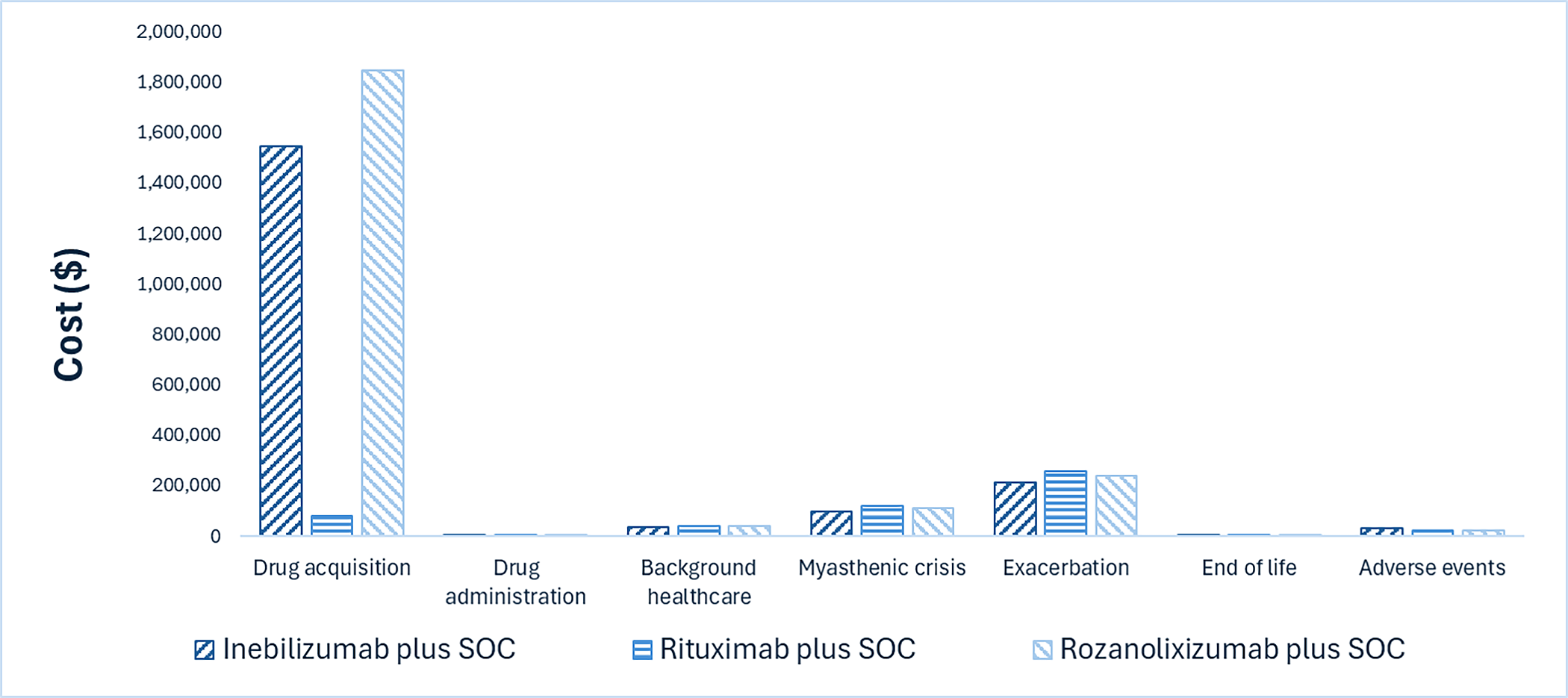
gMG = generalized myasthenia gravis; IVIg = IV immunoglobulin; PLEX = plasma exchange; SOC = standard of care; vs. = versus.
Note: Results for IVIg, zilucoplan, SOC alone, PLEX, ravulizumab, and efgartigimod are not presented in this figure. Refer to Appendix 11 in the Supplemental Material document for full results.
Figure 2: Impact of Inebilizumab vs. Rituximab and Rozanolixizumab on Health Care Costs — Patients With MuSK Antibody–Positive gMG
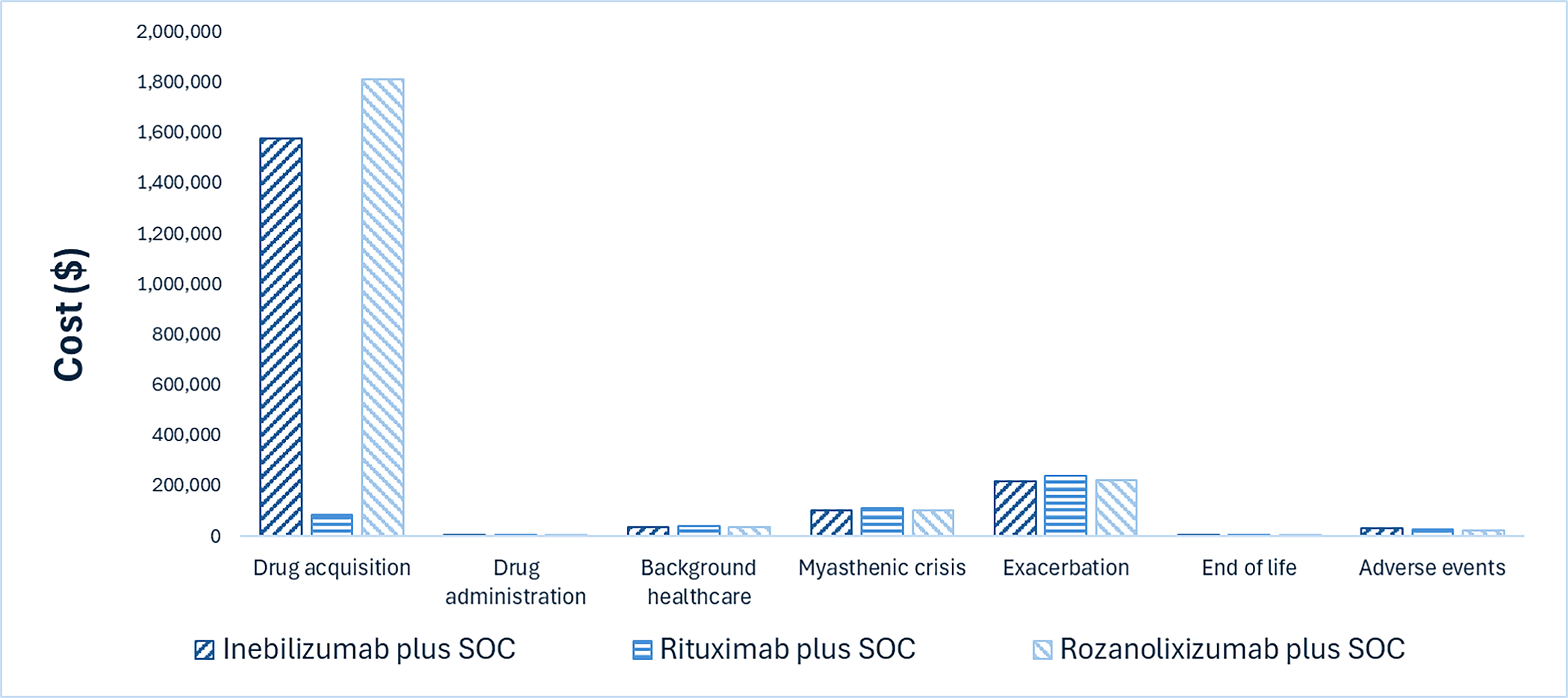
gMG = generalized myasthenia gravis; IVIg = IV immunoglobulin; PLEX = plasma exchange; SOC = standard of care; vs. = versus.
Note: Results for IVIg, zilucoplan, SOC alone, PLEX, ravulizumab, and efgartigimod are not presented in this figure. Refer to Appendix 11 in the Supplemental Material document for full results.
Impact on Health
For patients with AChR antibody–positive gMG, inebilizumab plus SOC was predicted to result in 0.34 additional QALYs per patient compared to rituximab plus SOC but 0.39 fewer QALYs per patient compared to rozanolixizumab plus SOC (refer to Figure 3).
For patients with MuSK antibody–positive gMG, inebilizumab plus SOC was predicted to result in 0.39 additional QALYs per patient compared to rituximab plus SOC but 0.18 fewer QALYs per patient compared to rozanolixizumab plus SOC (refer to Figure 4).
Figure 3: Impact of Inebilizumab vs. Rituximab and Rozanolixizumab on Patient Health — Patients With AChR Antibody–Positive gMG
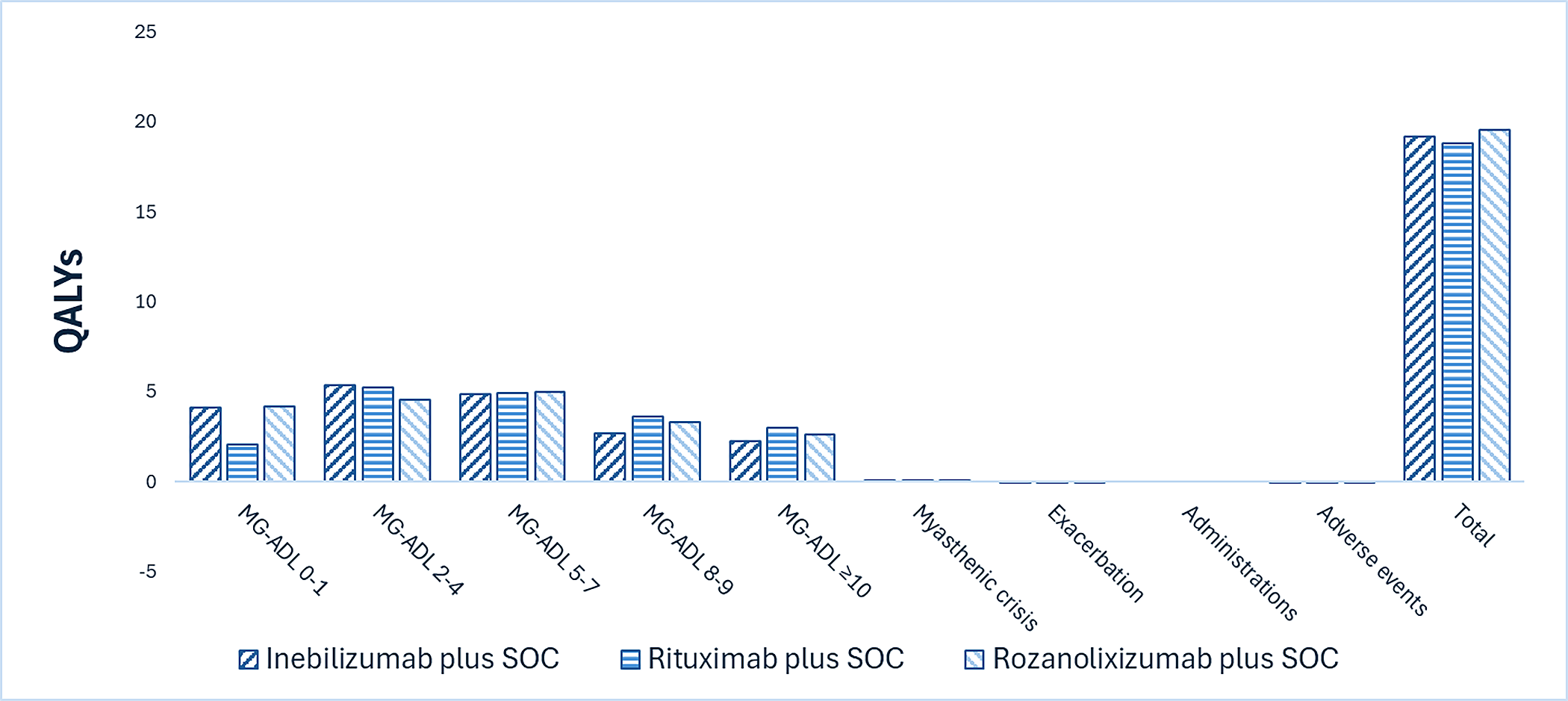
gMG = generalized myasthenia gravis; IVIg = IV immunoglobulin; MG-ADL = Myasthenia Gravis Activities of Daily Living; PLEX = plasma exchange; QALY = quality-adjusted life-year; SOC = standard of care; vs. = versus.
Note: Results for IVIg, zilucoplan, SOC alone, PLEX, ravulizumab, and efgartigimod are not presented in this figure. Refer to Appendix 11 in the Supplemental Material document for full results.
Figure 4: Impact of Inebilizumab vs. Rituximab and Rozanolixizumab on Patient Health — Patients With MuSK Antibody–Positive gMG
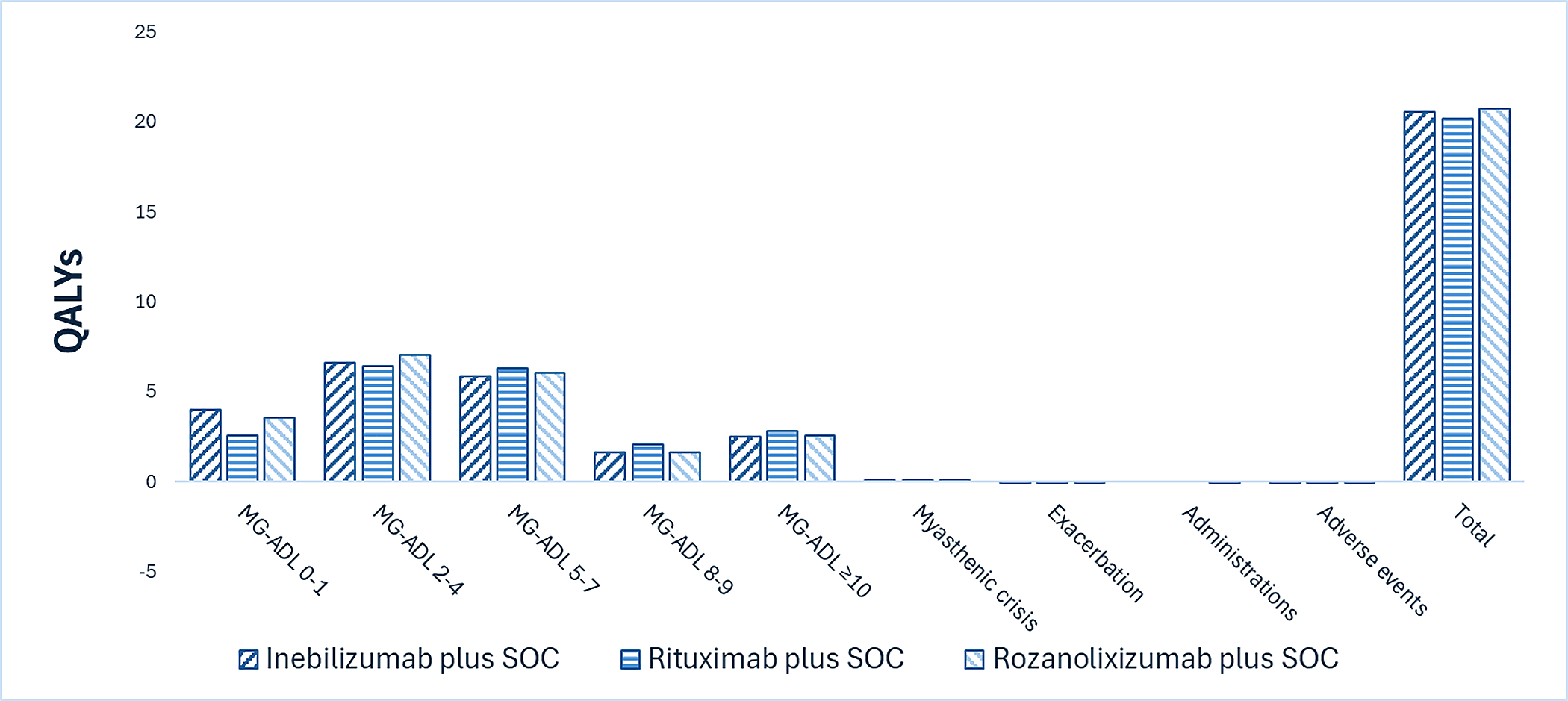
gMG = generalized myasthenia gravis; IVIg = IV immunoglobulin; MG-ADL = Myasthenia Gravis Activities of Daily Living; PLEX = plasma exchange; QALY = quality-adjusted life-year; SOC = standard of care; vs. = versus.
Note: Results for IVIg, zilucoplan, SOC alone, PLEX, ravulizumab, and efgartigimod are not presented in this figure. Refer to Appendix 11 in the Supplemental Material document for full results.
Overall Results
The results of the CDA-AMC base cases suggest that inebilizumab plus SOC is extendedly dominated (more costly and less effective) through the combination of some patients receiving rituximab plus SOC while other patients receive rozanolixizumab plus SOC (refer to Table 11) in both subpopulations (patients with AChR antibody–positive gMG and those with MuSK antibody–positive gMG). Additional details on the CDA-AMC base case are available in Appendix 11 in the Supplemental Material document.
Based on the CDA-AMC analyses, the following treatments are on the cost-effectiveness frontier (that is, they are not dominated by other treatments): rituximab plus SOC, rozanolixizumab plus SOC, and zilucoplan plus SOC for patients with AChR antibody–positive gMG, and rituximab plus SOC and rozanolixizumab plus SOC for patients with MuSK antibody–positive gMG.
Table 11: Summary of CDA-AMC Economic Evaluation Results
Drug | Total costs ($) | Total QALYs | Sequential ICER ($/QALY) |
|---|---|---|---|
Patients with AChR antibody–positive gMG | |||
Rituximab plus SOC | $527,243 | 18.84 | Reference |
Rozanolixizumab plus SOC | $2,262,145 | 19.57 | $2,388,813 |
Zilucoplan plus SOC | $4,173,433 | 19.60 | $61,007,776 |
Inebilizumab plus SOC | $1,935,682 | 19.18 | Extendedly dominated through rituximab and rozanolixizumab |
Patients with MuSK antibody–positive gMG | |||
Rituximab plus SOC | $505,609 | 20.15 | Reference |
Rozanolixizumab plus SOC | $2,202,213 | 20.72 | $2,952,767 |
Inebilizumab plus SOC | $1,973,536 | 20.54 | Extendedly dominated through rituximab and rozanolixizumab |
CDA-AMC = Canada’s Drug Agency; gMG = generalized myasthenia gravis; ICER = incremental cost-effectiveness ratio; QALY = quality-adjusted life-year; SOC = standard of care.
Note: Analyses are reported probabilistically. Publicly available list prices were used for all comparators. Comparators not on the cost-effectiveness frontier are not reported, with the exception of inebilizumab.
Summary of the Budget Impact
The sponsor submitted a BIA to estimate the 3-year (2027–2029) budget impact of reimbursing inebilizumab plus SOC for use in the requested reimbursement population. The sponsor assumed that the payer would be CDA-AMC–participating public drug plans and derived the size of the eligible population using an epidemiologic approach. The price of inebilizumab was aligned with the price included in the sponsor’s economic evaluation, while the prices of comparators were based on the publicly available list prices. Additional information pertaining to the sponsor’s submission is provided in Appendix 12 in the Supplemental Material document.
CDA-AMC identified a number of issues with the sponsor’s estimated budget impact and made changes to model parameters and assumptions in consultation with clinical experts to derive the CDA-AMC base case (refer to Appendix 12 in the Supplemental Material document). CDA-AMC estimated that by year 3 of reimbursement, 1,111 patients would be eligible for inebilizumab; of them, 333 patients would be expected to receive it. The estimated incremental budget impact of reimbursing inebilizumab is predicted to result in savings of approximately $82.5 million over the first 3 years, with an expected expenditure of $124 million on inebilizumab. The actual budgetary impact of reimbursing inebilizumab will depend on its uptake, the comparators displaced, and the proportion of the population whose symptoms persist despite treatment with SOC.
Conclusion
Based on the CDA-AMC base cases, inebilizumab would not be considered cost-effective at the submitted price at any willingness-to-pay threshold for each additional QALY gained, due to being more costly and less effective than a mix of other comparators in the population (i.e., it is extendedly dominated). Based on these analyses, a price reduction would be required (refer to Appendix 11 in the Supplemental Material document; full details of the impact of price reductions on cost-effectiveness are presented in Table 23). However, the estimated cost-effectiveness of inebilizumab compared to other add-on therapies is uncertain due to limitations in the ITC that informed the relative clinical efficacy of each comparator. If equal efficacy and safety are assumed between add-on comparators, then the cost of inebilizumab should not exceed the cost of the least expensive add-on therapy reimbursed for the treatment of gMG inadequately controlled with SOC alone.
The budget impact of reimbursing inebilizumab to the public drug plans in the first 3 years is estimated to result in savings of approximately $82.5 million. The 3-year expenditure on inebilizumab (i.e., not accounting for current expenditure on comparators) is estimated to be $124 million. The estimated budget impact is uncertain due to uncertainty in the uptake of inebilizumab, the comparators it will displace, and the proportion of patients whose symptoms persist despite treatment with SOC.
Figure 5: Summary of the CDA-AMC Economic Analysis and Price Reduction

CDA-AMC = Canada’s Drug Agency; ICER = incremental cost-effectiveness ratio; QALY = quality-adjusted life-year; vs. = versus.
Note: The annual cost of inebilizumab refers to its cost in the first year of treatment. Expenditure includes only the drug cost of inebilizumab. The term extendedly dominated indicates that a drug costs more and provides fewer QALYs than a mix of 2 other comparators used in the population: in this case, rituximab and rozanolixizumab.
References
1.Beloor Suresh A, Asuncion RMD. Myasthenia Gravis. StatPearls. StatPearls Publishing; 2025.
2.Stathopoulos P, Kumar A, Nowak RJ, O'Connor KC. Autoantibody-producing plasmablasts after B cell depletion identified in muscle-specific kinase myasthenia gravis. JCI Insight. 2017;2(17). doi:10.1172/jci.insight.94263 PubMed
3.Lazaridis K, Tzartos SJ. Autoantibody Specificities in Myasthenia Gravis; Implications for Improved Diagnostics and Therapeutics. Front Immunol. 2020;11:212. doi:10.3389/fimmu.2020.00212 PubMed
4.Dresser L, Wlodarski R, Rezania K, Soliven B. Myasthenia Gravis: Epidemiology, Pathophysiology and Clinical Manifestations. J Clin Med. 2021;10(11). doi:10.3390/jcm10112235 PubMed
5.Herbst R. MuSk function during health and disease. Neurosci Lett. 2020;716:134676. doi:10.1016/j.neulet.2019.134676 PubMed
6.Statistics Canada. Table: 17-10-0005-01 (formerly CANSIM 051-0001) Population estimates on July 1, by age and gender [sponsor submitted reference]. 2025. https://www150.statcan.gc.ca/t1/tbl1/en/tv.action?pid=1710000501
7.Statistics Canada. Non-Insured Health Benefits program: First Nations and Inuit Health Branch: Annual report 2023 to 2024. Population Size in March 2024 [sponsor submitted reference]. 2024. https://www.sac-isc.gc.ca/eng/1742411301706/1742411337714
8.Statistics Canada. Projected population, by projection scenario, age and gender, as of July 1 (x 1,000) [sponsor submitted reference]. 2026. https://www150.statcan.gc.ca/t1/tbl1/en/tv.action?pid=1710005701
9.Breiner A, Widdifield J, Katzberg HD, Barnett C, Bril V, Tu K. Epidemiology of myasthenia gravis in Ontario, Canada. Neuromuscul Disord. 2016;26(1):41-6. doi:10.1016/j.nmd.2015.10.009 PubMed
10.Willcox HN, Newsom-Davis J, Calder LR. Cell types required for anti-acetylcholine receptor antibody synthesis by cultured thymocytes and blood lymphocytes in myasthenia gravis. Clin Exp Immunol. 1984;58(1):97-106. PubMed
11.Yi JS, Guptill JT, Stathopoulos P, Nowak RJ, O'Connor KC. B cells in the pathophysiology of myasthenia gravis. Muscle Nerve. 2018;57(2):172-184. doi:10.1002/mus.25973 PubMed
12.Nowak RJ, Benatar M, Ciafaloni E, et al. A Phase 3 Trial of Inebilizumab in Generalized Myasthenia Gravis. N Engl J Med. 2025;392(23):2309-2320. doi:10.1056/NEJMoa2501561 PubMed
13.Rodolico C, Bonanno C, Toscano A, Vita G. MuSK-Associated Myasthenia Gravis: Clinical Features and Management. Front Neurol. 2020;11:660. doi:10.3389/fneur.2020.00660 PubMed
14.Jackson K, Parthan A, Lauher-Charest M, Broderick L, Law N, Barnett C. Understanding the Symptom Burden and Impact of Myasthenia Gravis from the Patient's Perspective: A Qualitative Study. Neurol Ther. 2023;12(1):107-128. doi:10.1007/s40120-022-00408-x PubMed
15.Johns Hopkins Medicine. Myasthenia Gravis [sponsor submitted reference]. 2026. https://www.hopkinsmedicine.org/health/conditions-and-diseases/myasthenia-gravis#:~:text=The%20most%20serious%20complications%20of,may%20become%20shallow%20or%20ineffective.
16.Mayo Clinic. Myasthenia gravis [sponsor submitted reference]. 2026. https://www.mayoclinic.org/diseases-conditions/myasthenia-gravis/symptoms-causes/syc-20352036
17.Juel VC, Massey JM. Myasthenia gravis. Orphanet J Rare Dis. 2007;2:44. doi:10.1186/1750-1172-2-44 PubMed
18.Weng Y, Min Y, Sheng Z, Li J, Huang D. Myasthenia Gravis With Reversible Pyramidal Tract Damage and Pseudo Internuclear Ophthalmoplegia. A Case Report and Literature Review. Front Neurol. 2019;10:957. doi:10.3389/fneur.2019.00957 PubMed
19.Barnett C, Tabasinejad R, Bril V. Current pharmacotherapeutic options for myasthenia gravis. Expert Opin Pharmacother. 2019;20(18):2295-2303. doi:10.1080/14656566.2019.1682548 PubMed
20.CADTH. CADTH Horizon Scan - Emerging Drugs for Generalized Myasthenia Gravis [sponsor submitted reference]. 2022. https://www.cda-amc.ca/sites/default/files/hs-eh/EH0099%20Drugs%20for%20myasthenia%20gravis%20Final.pdf
21.Narayanaswami P, Sanders DB, Wolfe G, et al. International Consensus Guidance for Management of Myasthenia Gravis: 2020 Update. Neurology. 2021;96(3):114-122. doi:10.1212/WNL.0000000000011124 PubMed
22.Nair SS, Jacob S. Novel Immunotherapies for Myasthenia Gravis. Immunotargets Ther. 2023;12:25-45. doi:10.2147/itt.S377056 PubMed
23.Casasnovas CCKVJ. Long-Term Patient Outcomes: The Role of Sustained Treatment Efficacy in Myasthenia Gravis. European Medical Journal Neurology. 2025;13(1):2-7.
24.Koshi EJ, Young K, Mostales JC, Vo KB, Burgess LP. Complications of Corticosteroid Therapy: A Comprehensive Literature Review. J Pharm Technol. 2022;38(6):360-367. doi:10.1177/87551225221116266 PubMed
25.Beloor Suresh A, Asuncion RMD. Myasthenia Gravis. StatPearls. 2026.
26.Alexion Pharma Canada. Ultomiris (ravulizumab for injection) Product Monograph [sponsor submitted reference]. 2023. https://pdf.hres.ca/dpd_pm/00073059.PDF
27.UCB Canada Inc. Zilbrysq (zilucoplan injection) Product Monograph [sponsor submitted reference]. 2024. https://pdf.hres.ca/dpd_pm/00076268.PDF
28.Alexion Pharma Canada. Soliris (eculizumab for injection): 30 mL parenteral solution (10 mg/mL) [Product Monograph]. 2025. Accessed May 19. https://pdf.hres.ca/dpd_pm/00081316.PDF
29.UCB Canada Inc. VYVGART (Efgartigimod alfa for injection) Product Monograph [sponsor submitted reference]. 2025. https://pdf.hres.ca/dpd_pm/00081060.PDF
30.UCB Canada Inc. Rystiggo (rozanolixizumab injection) Product Monograph [sponsor submitted reference]. 2025. https://pdf.hres.ca/dpd_pm/00080069.PDF
31.Hoffmann-La Roche Limited. Rituxan (Rituximab for injection, 10 mg/mL) Product Monograph. 2023. Accessed May 19. https://assets.roche.com/f/173850/x/5af6aeabe9/rituxaniv_pm_e.pdf
32.Fichtner ML, Jiang R, Bourke A, Nowak RJ, O'Connor KC. Autoimmune Pathology in Myasthenia Gravis Disease Subtypes Is Governed by Divergent Mechanisms of Immunopathology. Front Immunol. 2020;11:776. doi:10.3389/fimmu.2020.00776 PubMed
33.Huda R. New Approaches to Targeting B Cells for Myasthenia Gravis Therapy. Front Immunol. 2020;11:240. doi:10.3389/fimmu.2020.00240 PubMed
34.Forsthuber TG, Cimbora DM, Ratchford JN, Katz E, Stuve O. B cell-based therapies in CNS autoimmunity: differentiating CD19 and CD20 as therapeutic targets. Ther Adv Neurol Disord. 2018;11:1756286418761697. doi:10.1177/1756286418761697 PubMed
35.Schneider-Gold C, Hagenacker T, Melzer N, Ruck T. Understanding the burden of refractory myasthenia gravis. Ther Adv Neurol Disord. 2019;12:1756286419832242. doi:10.1177/1756286419832242 PubMed
36.VYVGART (Efgartigimod alfa for injection) Product Monograph. UCB Canada Inc.; 2025.
37.Canada's Drug A. Ultomiris - Patient and Clinician Group Input. 2024. 2024/06/17/. https://www.cda-amc.ca/sites/default/files/DRR/2024/SR0855_Patient_and_Clinician_Group_Input.pdf
38.Amgen Canada Inc. Drug Reimbursement Review sponsor submission: Uplizna (inebilizumab): 100 mg/10 mL (10 mg/mL) solution for intravenous infusion [internal sponsor's package]. March 5, 2026.
39.Bird S. Overview of the treatment of myasthenia gravis. UpToDate. 2025. Accessed May 20. https://www.uptodate.com/contents/overview-of-the-treatment-of-myasthenia-gravis
40.Horizon Therapeutics Ireland DAC. Clinical Study Report: vib0551. A Randomized, Double-Blind, Multicenter, Placebo-Controlled Phase 3 Study with Open-label Period to Evaluate the Efficacy and Safety of Inebilizumab in Adults With Myasthenia Gravis [internal sponsor's report]. January 15, 2025.
41.Amgen I. Comparative Clinical Efficacy and Safety of Inebilizumab in Patients with Generalized Myasthenia Gravis (gMG). 2026.
42.Amgen. NCT04524273: Myasthenia Gravis Inebilizumab Trial (MINT) [sponsor submitted reference]. 2025. https://clinicaltrials.gov/study/NCT04524273
43.Amgen Canada Inc. Amgen Canada Inc. response to Canada's Drug Agency request for additional information regarding Uplizna review on April 27, 2026: between-group differences of study results [internal additional sponsor's information]. May 4, 2026.
44.Amgen Canada Inc. Clinical Evidence Template Uplizna (inebilizumab) for the treatment of generalized myasthenia gravis (gMG) in adult patients. 2026.
45.Piehl F, Eriksson-Dufva A, Budzianowska A, et al. Efficacy and Safety of Rituximab for New-Onset Generalized Myasthenia Gravis: The RINOMAX Randomized Clinical Trial. JAMA Neurol. 2022;79(11):1105-1112. doi:10.1001/jamaneurol.2022.2887 PubMed
46.Bril V, Druzdz A, Grosskreutz J, et al. Safety and efficacy of rozanolixizumab in patients with generalised myasthenia gravis (MycarinG): a randomised, double-blind, placebo-controlled, adaptive phase 3 study. Lancet Neurol. 2023;22(5):383-394. doi:10.1016/S1474-4422(23)00077-7 PubMed
47.Howard JF, Jr., Bril V, Vu T, et al. Safety, efficacy, and tolerability of efgartigimod in patients with generalised myasthenia gravis (ADAPT): a multicentre, randomised, placebo-controlled, phase 3 trial. Lancet Neurol. 2021;20(7):526-536. doi:10.1016/S1474-4422(21)00159-9 PubMed
48.Vu T, Meisel A, Mantegazza R, et al. Terminal Complement Inhibitor Ravulizumab in Generalized Myasthenia Gravis. NEJM Evid. 2022;1(5):EVIDoa2100066. doi:10.1056/EVIDoa2100066
49.GomezMancilla B, Meriggioli MN, Genge A, et al. Efficacy and safety of iscalimab, a novel anti-CD40 monoclonal antibody, in moderate-to-severe myasthenia gravis: A phase 2 randomized study. J Clin Neurosci. 2024;119:76-84. doi:10.1016/j.jocn.2023.11.013 PubMed
50.Howard JF, Jr., Bresch S, Genge A, et al. Safety and efficacy of zilucoplan in patients with generalised myasthenia gravis (RAISE): a randomised, double-blind, placebo-controlled, phase 3 study. Lancet Neurol. 2023;22(5):395-406. doi:10.1016/S1474-4422(23)00080-7 PubMed
51.Howard JF, Jr., Utsugisawa K, Benatar M, et al. Safety and efficacy of eculizumab in anti-acetylcholine receptor antibody-positive refractory generalised myasthenia gravis (REGAIN): a phase 3, randomised, double-blind, placebo-controlled, multicentre study. Lancet Neurol. 2017;16(12):976-986. doi:10.1016/S1474-4422(17)30369-1 PubMed
52.Sanders DB, Hart IK, Mantegazza R, et al. An international, phase III, randomized trial of mycophenolate mofetil in myasthenia gravis. Neurology. 2008;71(6):400-6. doi:10.1212/01.wnl.0000312374.95186.cc PubMed
53.Sanders DB, Rosenfeld J, Dimachkie MM, Meng L, Malik FI, Tirasemtiv in Myasthenia Gravis Study G. A Double-Blinded, Randomized, Placebo-Controlled Trial to Evaluate Efficacy, Safety, and Tolerability of Single Doses of Tirasemtiv in Patients with Acetylcholine Receptor-Binding Antibody-Positive Myasthenia Gravis. Neurotherapeutics. 2015;12(2):455-60. doi:10.1007/s13311-015-0345-y PubMed
54.Nowak RJ, Coffey CS, Goldstein JM, et al. Phase 2 Trial of Rituximab in Acetylcholine Receptor Antibody-Positive Generalized Myasthenia Gravis: The BeatMG Study. Neurology. 2022;98(4):e376-e389. doi:10.1212/WNL.0000000000013121 PubMed
55.Antozzi C, Vu T, Ramchandren S, et al. Safety and efficacy of nipocalimab in adults with generalised myasthenia gravis (Vivacity-MG3): a phase 3, randomised, double-blind, placebo-controlled study. Lancet Neurol. 2025;24(2):105-116. doi:10.1016/S1474-4422(24)00498-8 PubMed
56.Yan C, Yue Y, Guan Y, et al. Batoclimab vs Placebo for Generalized Myasthenia Gravis: A Randomized Clinical Trial. JAMA Neurol. 2024;81(4):336-45. doi:10.1001/jamaneurol.2024.0044 PubMed
57.Zhou L, Liu W, Li W, et al. Tacrolimus in the treatment of myasthenia gravis in patients with an inadequate response to glucocorticoid therapy: randomized, double-blind, placebo-controlled study conducted in China. Ther Adv Neurol Disord. 2017;10(9):315-325. doi:10.1177/1756285617721092 PubMed
58.Amgen I. Supplementary Results from NMA [Comparative Clinical Efficacy and Safety of Inebilizumab in Patients with Generalized Myasthenia Gravis (gMG)] [provided by sponsor upon request] 2026.
ISSN: 2563-6596
Canada’s Drug Agency (CDA-AMC) is a pan-Canadian health organization. Created and funded by Canada’s federal, provincial, and territorial governments, we’re responsible for driving better coordination, alignment, and public value within Canada’s drug and health technology landscape. We provide Canada’s health system leaders with independent evidence and advice so they can make informed drug, health technology, and health system decisions, and we collaborate with national and international partners to enhance our collective impact.
Disclaimer: CDA-AMC has taken care to ensure that the information in this document was accurate, complete, and up to date when it was published, but does not make any guarantee to that effect. Your use of this information is subject to this disclaimer and the Terms of Use at cda-amc.ca.
The information in this document is made available for informational and educational purposes only and should not be used as a substitute for professional medical advice, the application of clinical judgment in respect of the care of a particular patient, or other professional judgments in any decision-making process. You assume full responsibility for the use of the information and rely on it at your own risk.
CDA-AMC does not endorse any information, drugs, therapies, treatments, products, processes, or services. The views and opinions of third parties published in this document do not necessarily reflect those of CDA-AMC. The copyright and other intellectual property rights in this document are owned by the Canadian Agency for Drugs and Technologies in Health (operating as CDA-AMC) and its licensors.
Questions or requests for information about this report can be directed to Requests@CDA-AMC.ca.