Drugs, Health Technologies, Health Systems
Reimbursement Recommendation
Tirzepatide (Zepbound)
Indication: Obstructive sleep apnea
Sponsor: Eli Lilly Canada Inc.
Final Recommendation: Reimburse with conditions
Summary
What Is the Reimbursement Recommendation for Zepbound?
Canada’s Drug Agency (CDA-AMC) recommends that Zepbound be reimbursed by public drug plans for once-weekly administration as an adjunct to a reduced-calorie diet and increased physical activity, to treat moderate to severe obstructive sleep apnea (OSA) in adults with obesity (body mass index [BMI] 30 kg/m2 or greater) if certain conditions are met.
Why Did CDA-AMC Recommend Reimbursement?
The Canadian Drug Expert Committee (CDEC) determined that Zepbound demonstrates acceptable clinical value versus lifestyle modification alone or lifestyle modification and positive airway pressure (PAP) in adult patients with OSA and obesity. This determination was enough for CDEC to recommend that Zepbound be reimbursed. Given that Zepbound is expected to be an additive treatment to these interventions, acceptable clinical value refers to added value versus lifestyle modification with or without concurrent PAP. Evidence from 2 clinical trials showed that Zepbound improved apnea-hypopnea index (AHI) versus placebo in people with OSA and obesity and likely resulted in clinically meaningful reductions in body weight and blood pressure compared with placebo. In addition, a greater proportion of patients achieved OSA remission with tirzepatide than with placebo. CDEC considered OSA remission to be a clinically meaningful outcome because it captures improvements in both OSA severity and daytime sleepiness and represents a more comprehensive treatment target. Remission may also reduce or eliminate the need for PAP therapy, an outcome that is important to patients.
Which Patients Are Eligible for Coverage?
Zepbound should only be reimbursed for adults with obesity (BMI of 30 kg/m2 or greater) who have moderate to severe OSA without diabetes, consistent with the sponsor’s reimbursement request. To be eligible for coverage, OSA must be confirmed by either polysomnography (PSG) or a conventional home sleep apnea test (HSAT), and patients must have had at least 1 unsuccessful attempt at weight loss through dietary changes. Zepbound should not be covered for patients with certain conditions that were not studied in the clinical trials, including central or mixed sleep apnea; obesity-hypoventilation syndrome; obesity caused by certain endocrine or genetic disorders; significant craniofacial abnormalities that affect breathing; or planned surgery for sleep apnea or major ear, nose, or throat conditions. Initial reimbursement should be provided for up to 1 year.
What Are the Conditions for Reimbursement?
Zepbound should only be reimbursed if initial prescribing is limited to, or conducted in conjunction with, clinicians with expertise in treating OSA, and if the cost of Zepbound is reduced. A primary care physician may prescribe and initiate treatment based on a sleep study interpreted by an appropriate specialist; a separate specialist consultation is not required.
Reimbursement should continue beyond the first year only if OSA remission is achieved after 52 weeks of treatment without dependence on PAP therapy. Continued reimbursement should be assessed annually and require evidence that remission has been maintained. Zepbound should be discontinued if PAP or other OSA devices are initiated in patients who were not previously using them; if surgery affecting breathing or obesity is planned or has recently occurred; or if sarcopenia, frailty, or hypersensitivity reactions develop.
Important budget impact considerations and organizational implications must be addressed for health systems to be able to adopt Zepbound.
Review Background
Disease background: OSA is a common sleep disorder in which the upper airways collapse during sleep, leading to hypoxemia (low oxygen in blood) and hypercapnia (high carbon dioxide in the blood). Sleep disruption is common. OSA can significantly impair quality of life and increase the risk of cardiovascular-related mortality and morbidity. It is 7 times more common among people with obesity (BMI of 30 kg/m2 or more). Clinicians noted that OSA is underdiagnosed, largely because symptoms are normalized and the disease may be underrecognized. Data from a multijurisdictional Canadian survey in 2015 estimated the risk of moderate to severe OSA to be 28%. Canadian data from a national survey conducted in 2016 and 2017 showed that 6% were diagnosed with OSA. Clinicians estimate that approximately 40% of patients with OSA have moderate to severe disease.
Indication and reimbursement request: Tirzepatide (Zepbound) has been approved by Health Canada for once-weekly administration, as an adjunct to a reduced-calorie diet and increased physical activity, to treat moderate to severe OSA in adults with obesity (BMI 30 kg/m2 or greater). The sponsor is seeking reimbursement for a narrower population than the indicated population, focused on patients without diabetes.
Drug under review: Tirzepatide is a glucose-dependent insulinotropic polypeptide and a glucagon-like peptide-1 receptor agonist. It is available as 2.5 mg/0.6 mL, 5 mg/0.6 mL, 7.5 mg/0.6 mL, 10 mg/0.6 mL, 12.5 mg/0.6 mL, and 15 mg/0.6 mL solutions in a multidose, prefilled pen for subcutaneous (SC) administration. The product monograph recommends a starting dosage of 2.5 mg once weekly. After 4 weeks, increase the dosage to a 5 mg SC injection once weekly. The dosage may be increased in 2.5 mg increments after at least 4 weeks on the current dose. The recommended maintenance dosages in adults are a 10 mg or 15 mg SC injection once weekly. The maximum dosage is a 15 mg SC injection once weekly.
Treatment costs: At the submitted price of $300.00 per 2.5 mg or 5 mg multidose prefilled pen, $420.00 per 7.5 mg or 10 mg multidose prefilled pen, and $540.00 per 12.5 mg or 15 mg multidose prefilled pen, the annual cost of tirzepatide is expected to be $5,239 to $6,324 per patient in the first year of treatment and $5,479 to $7,044 in subsequent years, based on the Health Canada–recommended dosage for OSA.
Highlights of Input From Interested Parties
The patient groups (Gastrointestinal Society, Obesity Canada, and Obesity Matters) noted the following regarding impacts of the disease, unmet needs, and important outcomes:
OSA is not just a problem with sleep but also reshapes daily life, relationships, self-image, and the ability to function. Common experiences include exhaustion, brain fog, fear of falling asleep while driving, and difficulty participating in the workforce. OSA has a substantial impact on life and on mental and emotional well-being.
The relationship between OSA and obesity is bidirectional, and daytime sleepiness associated with OSA can make it difficult to avoid bingeing and overeating or to have energy to exercise. OSA can also disrupt hormonal balance and lower motivation, cognition, and the ability to exercise.
The impact of OSA on a person’s daily life is important to patients. The most important goals of treatment are improving sleep quality, reducing fatigue and daytime sleepiness, improving quality of life, and reducing reliance on devices or appliances.
Patients would like treatments for OSA that address obesity, which can be a major cause of OSA. They are willing to accept gastrointestinal side effects if they experience meaningful improvements in daily functioning and freedom from dependence on devices like continuous positive airway pressure (CPAP) devices each night.
The clinician groups (an independent group of 5 clinicians, Obesity Canada, The Ottawa Hospital Sleep Centre, Ontario Health Clinics–Brantford, and the Respiratory Medicine Group at the University of British Columbia Hospital Sleep Program) and the clinical experts consulted by CDA-AMC noted the following regarding unmet needs arising from the disease and place in therapy for the drug under review:
Most treatments target the pathophysiological mechanisms of OSA (disease-controlling). This includes PAP devices, mandibular advancement devices and other oral or dental appliances, and upper airway surgery. Many of these treatments are most suitable for mild to moderate disease, and access to these treatments is variable across Canada in terms of coverage and access.
Clinicians note that weight loss treatments like behaviour change, structured weight loss programs, and bariatric surgery are often unfunded, restricted to those with a higher BMI, or associated with access barriers.
Tirzepatide would be the first pharmacological treatment indicated by Health Canada for OSA that targets an underlying cause of OSA (disease-modifying) and that would be used alongside lifestyle modifications (diet and exercise).
The participating public drug programs provided input regarding considerations for initiation, renewal, discontinuation, and prescribing of therapy; health system implementation considerations; and system and economic considerations.

Note: The perspectives shared by people with lived experience who present to the committee reflect their individual experiences and are not necessarily representative of all people with the same condition or course of treatment. Their insights provide valuable context about what a patient, support person, or caregiver might go through with this condition or treatment, helping to inform the committee’s deliberations. These narratives complement other forms of evidence and input and should be considered as 1 element contributing to a broader understanding of the condition and treatment under review.
Recommendation
With a vote of 7 in favour to 6 against, CDEC recommends that tirzepatide be reimbursed for once-weekly administration as an adjunct to a reduced-calorie diet and increased physical activity to treat moderate to severe OSA for adults with obesity (BMI 30 kg/m2 or greater).
Table 1: Reimbursement Conditions and Reasons
Reimbursement condition | Reason | Implementation guidance |
|---|---|---|
Initiation | ||
1. Treatment with tirzepatide should be reimbursed as an adjunct to a reduced-calorie diet and increased physical activity for adults who have all the following: 1.1. moderate to severe OSA (AHI of 15 events per hour or more) as confirmed with either: 1.1.1. PSG 1.1.2. conventional HSAT 1.2. a BMI ≥ 30 kg/m2 1.3. at least 1 self-reported unsuccessful dietary attempt at weight loss. | Evidence from the SURMOUNT-OSA trials demonstrated that treatment with tirzepatide resulted in a clinical benefit in OSA severity in patients with obesity and at least 1 self-reported unsuccessful dietary attempt at weight loss. People with diabetes were excluded from the trials. | In the SURMOUNT-OSA trials, OSA was diagnosed using PSG, but CDEC noted that it is not widely available across Canada. Although there are limitations in the sensitivity of HSAT, CDEC noted that it is more likely to underestimate OSA severity. Consequently, they considered that a negative HSAT could be followed by PSG testing if there is high clinical suspicion of OSA. CDEC suggested that jurisdictions may accept the same OSA diagnostic modalities for initiation of tirzepatide as with initiation of PAP. For patients currently on PAP, AHI should be measured after a 3-day PAP washout period or longer. Alternatively, AHI values from the initial assessment (before PAP initiation) can be accepted. The clinical experts highlighted that the benefits of tirzepatide may take time to emerge. As such, temporary use of PAP therapy or other mechanical treatments for OSA may be required after treatment initiation to manage symptoms until the effects of tirzepatide are realized. This consideration may be particularly relevant for individuals in whom daytime sleepiness poses safety risks, including those who drive professionally, operate heavy machinery, or perform other safety-sensitive occupations. |
2. Treatment should not be reimbursed in patients with: 2.1. diabetes 2.2. planned surgery for sleep apnea or major ear, nose, or throat surgery, including tonsillectomy and adenoidectomy, that may affect breathing 2.3. significant craniofacial abnormalities that may affect breathing 2.4. a diagnosis of central or mixed sleep apnea with a percentage of mixed or central apneas or hypopneas ≥ 50%, or diagnosis of Cheyne-Stokes Respiration 2.5. diagnosis of obesity-hypoventilation syndrome or daytime hypercapnia 2.6. obesity induced by endocrinologic disorders or diagnosed monogenetic or syndromic forms of obesity. | CDEC noted that patients with the listed characteristics were excluded from the SURMOUNT-OSA trials. As such, the committee considered there to be insufficient evidence to support the use of tirzepatide in these populations. | — |
3. The maximum duration of initial authorization is 1 year. | Efficacy of tirzepatide in the SURMOUNT-OSA trials was assessed after 1 year. An initial authorization of 1 year was recommended to allow the patient time to reach a therapeutic dose of tirzepatide (2.5 mg or maximum tolerated dose up to 15 mg) and then evaluate the benefit of continued treatment at that dose, while also providing flexibility based on patient and clinician availability. | — |
Renewal | ||
4. Reimbursement should be renewed only if OSA remission is achieved after 52 weeks of treatment, as defined by AHI < 5, or AHI ≥ 5 and ≤ 14 with ESS ≤ 10, without dependence on PAP. | SURMOUNT-OSA1 and SURMOUNT-OSA2 trials defined OSA remission as per these criteria and demonstrated that remission occurred more frequently with tirzepatide than with placebo. CDEC considered OSA remission to be a clinically meaningful treatment target because it captures improvements in both OSA severity and daytime sleepiness, and patients achieving remission would generally no longer require PAP therapy according to accepted clinical practice. The committee noted that reduction or elimination of dependence on PAP is an important outcome for patients and considered remission to provide a comprehensive measure of clinically meaningful treatment benefit. Although the committee acknowledged that some patients who do not achieve remission may nonetheless experience improvements in individual outcomes, including OSA severity and patient-reported symptoms, uncertainty remained regarding the extent to which these changes translated into broader clinically meaningful benefits. The committee therefore considered remission to be the most appropriate threshold for continued reimbursement because it reflects improvement in both OSA severity and daytime sleepiness and may reduce or eliminate the need for PAP therapy. Annual reassessment helps ensure treatment is reserved for patients who continue to derive benefit from therapy. | Patient should maintain a reduced-calorie diet and increased physical activity while receiving tirzepatide treatment. The AHI assessment technique used for renewal should be the same as employed in the initial assessment, given that sensitivity may vary between testing modalities. CDEC considered the remission criteria to provide a clear, clinically meaningful renewal threshold that can be applied consistently across jurisdictions. |
5. For subsequent renewal, the physician must provide proof that remission achieved after the first year of treatment with tirzepatide has been maintained. Subsequent renewals should be assessed annually. | Annual assessments will help ensure the treatment is used for those benefiting from the therapy and would reduce the risk of unnecessary treatment. | — |
Discontinuation | ||
6. Reimbursement of tirzepatide should be discontinued upon occurrence of any of the following: 6.1. initiation of PAP or other OSA devices in patients previously not using the same 6.2. planned or recent surgery for sleep apnea or major ear, nose, or throat surgery impacting breathing, or for obesity 6.3. development of sarcopenia, frailty, or hypersensitivity reactions. | The need for surgery or a new device may indicate a lack of benefit of tirzepatide. Tirzepatide was not studied in patients who had undergone surgery for OSA or those starting use of devices for OSA. | — |
Prescribing | ||
7. Tirzepatide should not be reimbursed for use in combination with other GLP-1 receptor agonists | Tirzepatide has a shared mechanism of action with GLP-1 receptor agonists. There is no evidence to support whether tirzepatide offers additional benefit when used in combination with other GLP-1 receptor agonists. | — |
8. Initial prescribing should be limited to, or in conjunction with, clinicians with expertise in treating OSA. Subsequent renewals may be performed by general practitioners. | Specialist involvement is required to support appropriate diagnosis and patient selection. Treatment may be prescribed and initiated by a primary care physician, provided that the diagnosis is supported by a sleep study interpreted by an appropriate specialist. A separate specialist consultation is not required. Ongoing monitoring of treatment response and management of adverse effects may be undertaken by the primary care physician. | Clinical experts considered that diagnosis with PSG should be performed by an appropriately trained sleep physician. |
Pricing | ||
9. A reduction in price. | Using the CDA-AMC base-case analysis, the ICER for tirzepatide was $101,581 per QALY gained when compared with lifestyle modification in the requested reimbursement population. A band 2a price reduction would be required to achieve cost-effectiveness at a $50,000 per QALY threshold. A band 1a price reduction would be required to achieve cost-effectiveness at a $100,000 per QALY threshold. Price reductions for any given willingness-to-pay threshold are available in the CDA-AMC Main Report and Supplemental Material document. | The CDA-AMC analysis is based on public list prices for all treatments. Further price reductions may be required if there are price arrangements (discounts) currently in place for any treatment included in the economic analysis. Likewise, further price reductions may be required to address economic feasibility of adoption. |
Feasibility of adoption | ||
10. The economic feasibility of adoption of tirzepatide must be addressed. | At the submitted price, the incremental budget impact of tirzepatide is expected to be greater than $40 million in years 1, 2, and 3. At the submitted price, the magnitude of uncertainty in the budget impact must be addressed to ensure the feasibility of adoption, given the difference between the sponsor’s estimate and the CDA-AMC estimate(s). | — |
11. The organizational feasibility of adoption of tirzepatide must be addressed, including the possibility of sponsor support, so that: 11.1. lifestyle counselling (reduced-calorie diet and increased physical activity) is available to patients for the duration of their treatment 11.2. sleep assessments are available at initiation and renewal. | Clinical experts noted that the provision of lifestyle counselling is not standard practice across Canada. The provision of ongoing counselling could support the indicated positioning of tirzepatide as an adjunct to a reduced-calorie diet and increased physical activity. Clinical experts noted that access to sleep studies varies across Canada in terms of coverage, cost of fee-for-service, wait times (which also vary within jurisdictions), and availability of specialists. The limitations on sleep testing can be a challenge for diagnosis and create barriers in access to treatment with tirzepatide. | As with the initial diagnosis, sleep assessments can be performed by PSG or conventional HSAT as per the implementation guidance noted previously regarding the potential need for PSG if HSAT is negative. |
AHI = apnea-hypopnea index; BMI = body mass index; CDA-AMC = Canada’s Drug Agency; CDEC = Canadian Drug Expert Committee; ESS = Epworth Sleepiness Score; GLP-1 = glucagon-like peptide-1; HSAT = home sleep apnea tests; ICER = incremental cost-effectiveness ratio; OSA = obstructive sleep apnea; PAP = positive airway pressure; PSG = polysomnography; QALY = quality-adjusted life-year.
aFor the statement regarding the size of the price reduction required, band 1 = 1% to 24%, band 2 = 25% to 49%, band 3 = 50% to 74%, and band 4 = 75% or greater.
Rationale for the Recommendation
Clinical Value
Based on the totality of the submitted clinical evidence, CDEC concluded that tirzepatide demonstrates acceptable clinical value compared with lifestyle modification alone or lifestyle modifications and PAP in patients with OSA and obesity. Given that tirzepatide is expected to be an additive treatment to these interventions, acceptable clinical value refers to added value versus lifestyle modification with or without concurrent PAP.
Two randomized controlled trials provided evidence on the efficacy and safety of tirzepatide compared with placebo (both alongside lifestyle modifications) in people with OSA and obesity who were unable or unwilling to use PAP (SURMOUNT-OSA1; N = 234) and people who had used PAP for at least 3 consecutive months and intended to continue during the trial (N = 235) who did not have diabetes. Evidence from the SURMOUNT-OSA trials demonstrated that treatment for 52 weeks with tirzepatide resulted in a reduction in AHI and likely resulted in an increase in the proportion of patients with at least 50% reduction in AHI for patients with OSA and obesity compared with placebo. Tirzepatide also likely resulted in clinically meaningful reductions in body weight and blood pressure compared with placebo. In addition, a greater proportion of patients achieved OSA remission with tirzepatide than with placebo.
CDEC acknowledged that evidence demonstrating improvements in patient-reported outcomes such as sleepiness and functional outcomes was limited and that longer-term effects on cardiovascular morbidity, mortality, and other patient-important outcomes remain uncertain. Evidence demonstrating improvements in patient-reported outcomes, including sleepiness and sleep-related functioning, was limited, and observed improvements did not clearly demonstrate clinically meaningful benefit. Also, uncertainty remains regarding the relationship between changes in AHI and outcomes most important to patients in the context of the use of tirzepatide. However, CDEC also recognized limitations in the interpretation of currently available patient-reported outcome measures, uncertainty regarding clinically meaningful thresholds for the Epworth Sleepiness Scale (ESS) and the Functional Outcomes of Sleep Questionnaire (FOSQ), and that sleepiness does not consistently correlate with OSA severity in clinical practice. The committee also noted uncertainty regarding the impact of tirzepatide when used alongside ongoing PAP therapy and whether treatment may reduce future dependence on PAP or other device-based interventions.
CDEC considered the higher proportion of patients achieving OSA remission with tirzepatide to be clinically meaningful. The definition of remission incorporated improvement in both OSA severity (AHI) and daytime sleepiness. The committee noted that remission may eliminate the need for PAP therapy and reduce treatment burden, which was identified as important by patients. Although improvements in individual outcomes, including AHI and patient-reported symptoms, were considered important, uncertainty remained regarding the extent to which these changes translated into broader clinically meaningful benefits, particularly given the lack of clinically meaningful improvements in ESS and FOSQ. The committee therefore placed greater weight on OSA remission, which captures improvements in both OSA severity and daytime sleepiness and was considered a more comprehensive and clinically meaningful treatment target. However, uncertainty remains regarding the durability of remission and its impact on long-term patient-important outcomes beyond the 52-week trial period.
In light of the observed OSA remission rates, CDEC considered the treatment effects on OSA severity, body weight, and blood pressure, together with the manageable safety profile, to have provided sufficient evidence of added clinical benefit despite the remaining uncertainty regarding longer-term outcomes. Therefore, CDEC concluded that tirzepatide demonstrates acceptable clinical value in adults with OSA and obesity.
Further information on the committee’s discussion around clinical value is provided in the Summary of Deliberation section.
Developing the Recommendation
The determination of acceptable clinical value was sufficient for CDEC to recommend reimbursement of tirzepatide. As part of the deliberation on whether to recommend reimbursement, the committee also considered unmet clinical need, unmet nonclinical need, and health inequity. Information on this discussion is provided in the Unmet Clinical Need and Distinct Social and Ethical Considerations domains in the Summary of Deliberation section.
Because CDEC recommended that tirzepatide be reimbursed, the committee also deliberated on whether reimbursement conditions should be added to address important economic considerations, health system impacts, or social and ethical considerations, or to ensure clinical value is realized. The resulting reimbursement conditions, with accompanying reasons and implementation guidance, are stated in Table 1.
Summary of Deliberation
CDEC considered all domains of value of the deliberative framework before developing its recommendation: clinical value, unmet clinical need, distinct social and ethical considerations, economic considerations, and impacts on health systems. For further information on the domains of value, refer to Expert Committee Deliberation at Canada’s Drug Agency.
The committee considered the following key discussion points, organized by the 5 domains of value.
Clinical Value
Appropriate comparators: CDEC considered appropriate comparators for tirzepatide in the full Health Canada–indicated population to be lifestyle modifications, with or without the use of PAP as an add-on treatment. Interventions for OSA, including PAP devices, mandibular advancement devices and other oral or dental appliances, and upper airway surgery, address the pathophysiology of OSA but may not address the underlying cause in patients with obesity. Also, some of these interventions are more suitable for mild to moderate disease and/or are difficult to access. Clinicians note that weight loss treatments like behaviour change, structured weight loss programs, and bariatric surgery are often unfunded, restricted to those with a higher BMI, or associated with access barriers.
Efficacy versus placebo: Two randomized controlled trials assessed the impact of tirzepatide compared with placebo (both alongside lifestyle modifications) in adults with moderate to severe OSA and obesity (BMI of 30 kg/m2 or more) who did not have diabetes. The SURMOUNT-OSA1 trial included 234 people who were unable or unwilling to use PAP, whereas the SURMOUNT-OSA2 trial included 235 people who had received PAP for at least 3 consecutive months and intended to continue during the trial. The trials reported a statistically significant improvement in most outcomes at 52 weeks compared with lifestyle modifications alone. This included change from baseline in AHI (difference in least squares mean of −20.01 events per hour; 95% confidence interval [CI], −25.82 to −14.20; P < 0.001 in the SURMOUNT OSA1 trial and −23.77 events per hour; 95% CI, −29.61 to −17.93; P < 0.001 in the SURMOUNT OSA2 trial), the proportion with a 50% AHI reduction (43%; 95% CI, 31 to 55; P < 0.001 in the SURMOUNT-OSA1 trial and 49%; 95% CI, 37 to 61; P < 0.001 in the SURMOUNT-OSA2 trial), percent reduction in body weight (−16.09%; 95% CI, −17.99 to −14.19; P < 0.001 in the SURMOUNT-OSA1 trial and −17.28%; 95% CI, −19.29 to −15.28; P < 0.001 in the SURMOUNT-OSA2 trial), sleepiness (measured with ESS: −1.38; 95% CI, −2.51 to −0.25; P = 0.017 in the SURMOUNT-OSA1 trial and −0.93; 95% CI, −2.10 to 0.24; P = 0.118 in the SURMOUNT-OSA2 trial), and function (measured with FOSQ; 0.6; (95% CI, −0.1 to 1.2; P = 0.092 in the SURMOUNT-OSA1 trial and 0.3; 95% CI, −0.1 to 0.8; P = 0.172 in the SURMOUNT-OSA2 trial). There were also statistically significant improvements in systolic blood pressure at 48 weeks (−7.62 mm Hg; 95% CI, −10.48 to −4.77 mm Hg; P < 0.001 in the SURMOUNT-OSA1 trial and −3.70 mm Hg; 95% CI, −6.75 to −0.65 mm Hg; P = 0.017 in the SURMOUNT-OSA2 trial) compared with lifestyle modifications alone.
Higher rates of OSA remission: CDEC noted that OSA remission occurred more frequently with tirzepatide than with placebo (the SURMOUNT-OSA1 trial: 42% [standard error (SE) = 4.8] with tirzepatide compared with 16% [SE = 3.7] with placebo; the SURMOUNT-OSA2 trial: 50% [SE = 4.7] with tirzepatide compared with 14% [SE = 3.7] with placebo). The committee considered remission to be clinically meaningful because such patients would generally no longer require PAP according to accepted clinical practice, and reduction of treatment burden was identified as important by patients. However, the trials were not designed to evaluate long-term PAP discontinuation or the durability of remission beyond 52 weeks.
Clinical importance of treatment effects: Clinically meaningful results were observed for several individual outcomes, including AHI, the proportion of patients achieving at least a 50% reduction in AHI, body weight, and blood pressure, based on thresholds of clinical importance from the literature or clinical expert input. Improvements in sleepiness (ESS) and function (FOSQ), reflecting outcomes identified as important by patients, were not considered clinically meaningful, although there was uncertainty regarding the thresholds of clinical importance for these outcomes. CDEC also noted clinically meaningful improvements in OSA remission, which captures improvements in both OSA severity (AHI) and daytime sleepiness. The committee therefore considered OSA remission to be a comprehensive and clinically meaningful indicator of treatment benefit.
Clinical meaningfulness of individual outcomes: CDEC discussed that although clinically meaningful improvements were observed in several individual outcomes, including AHI, the proportion of patients achieving at least a 50% reduction in AHI, body weight, and blood pressure, these improvements were not accompanied by clearly clinically meaningful improvements in ESS or FOSQ. Some committee members questioned whether the reductions in AHI translated into outcomes most important to patients (e.g., improvements in sleep quality, fatigue and daytime sleepiness, functioning, and quality of life). However, CDEC also noted limitations of available patient-reported outcome measures, uncertainty regarding clinically meaningful thresholds for ESS and FOSQ, and that sleepiness does not consistently correlate with OSA severity in clinical practice. CDEC also noted clinically meaningful improvements in OSA remission, which captures improvements in both OSA severity and daytime sleepiness. Consequently, the committee considered OSA remission to provide a more comprehensive and clinically meaningful indicator of treatment benefit than changes in individual outcomes alone.
Certainty of the evidence: CDEC discussed the Grading of Recommendations Assessment, Development and Evaluation (GRADE) assessment of selected outcomes from the SURMOUNT-OSA trials. The evidence on AHI reduction with tirzepatide compared to placebo was of high certainty. However, the certainty of the evidence was downgraded for all other outcomes because of study limitations and risk of bias arising from missing data due to deviations from the intended interventions and missing outcome data. As a result, there was moderate certainty in the evidence for the proportion of patients with at least 50% AHI reduction, weight loss, improvement in sleepiness and function, and change in blood pressure of people who are unable or unwilling to use PAP therapy. The evidence on the decrease in blood pressure in people who have used PAP therapy for at least 3 months was of low certainty because of imprecision in the results, and the CI suggested the result may not be clinically meaningful. The evidence on the proportion of patients with at least 1 serious treatment-emergent adverse event (TEAE) was of very low certainty because the number of events was very small.
Harms findings versus placebo: CDEC noted that evidence from the SURMOUNT-OSA trials suggested that the harms profile of tirzepatide was consistent with the use of tirzepatide for other conditions. CDEC noted that patients in the tirzepatide groups reported more gastrointestinal TEAEs, particularly nausea and diarrhea, and more treatment discontinuations due to gastrointestinal TEAEs than placebo, although the incidence of serious TEAEs was small and similar between groups. CDEC noted that the safety profile of tirzepatide was generally consistent with the known safety profile of this drug class and that the TEAEs in general are expected to be manageable based on clinical expert input. However, whether more rare or infrequent harms occur over a longer duration (beyond 52 weeks) of treatment is not known.
Unknown impact on important long-term outcomes: Important risks associated with OSA include cardiovascular-related mortality and morbidity. However, the SURMOUNT-OSA trials lasted only 52 weeks and were not designed to address longer-term cardiovascular outcomes. AHI, blood pressure, and weight loss were considered surrogate outcomes for the longer-term cardiovascular impact of tirzepatide, but CDEC noted that the validity of these was not demonstrated by the sponsor. As a result, there was no credible evidence on the longer-term cardiovascular impact of tirzepatide in patients with OSA and obesity.
Unknown impact of combined tirzepatide and CPAP: The 7-day PAP washout in the SURMOUNT-OSA2 trial before baseline and 52-week outcomes were measured meant that the impact of PAP on outcomes was not captured. Although this allowed unmasking of OSA disease burden in patients being treated with PAP and was considered reasonable and appropriate by clinical experts, it means that the combined impact of tirzepatide and PAP on outcomes is unknown.
Unknown impact on the use of PAP or other devices: Clinicians suggested that by reducing AHI, tirzepatide could eliminate the need for PAP. Clinicians also suggested that tirzepatide could help address residual burden for people having PAP that is not adequately controlling their symptoms. However, the SURMOUNT-OSA2 trial was not designed to address impact on PAP or other device use, or to address residual disease from PAP. The SURMOUNT-OSA1 trial was not designed to investigate if tirzepatide enabled PAP use among participants who were unable to use PAP.
Limited access to PAP: CDEC acknowledged that PAP is not widely funded in jurisdictions. They also acknowledged that access to PAP is usually through respiratory therapists or sleep technologists who are unable to help patients address comorbid issues like obesity. CDEC acknowledged that PAP can be highly effective when tolerated; however, access, coverage, and long-term adherence remain challenges for many patients. Due to these factors, CDEC noted that reimbursement of tirzepatide should not be restricted based on prior or current experience with PAP.
Exclusion of diabetes patients: CDEC acknowledged that diabetes is relatively common in people with OSA and obesity. However, the committee noted that the trials excluded people with diabetes and that the sponsor’s reimbursement request was focused on a population without diabetes. It was noted that people with OSA, obesity, and diabetes may be eligible for treatment with tirzepatide or other glucagon-like peptide-1 receptor agonists because of overlapping conditions. However, CDEC is unable to comment on the effect of these drugs on OSA outcomes in patients with diabetes.
Clinical value: Based on the submitted evidence and all the preceding considerations, CDEC determined that tirzepatide has added clinical value versus placebo as an adjunct to a reduced-calorie diet and increased physical activity in patients with OSA and obesity.
Unmet Clinical Need
Input on unmet clinical need: Patients and clinicians noted that current treatments, which are typically focused on physiological mechanisms of OSA, often fall short. Clinicians and patients highlighted that there is an unmet need for effective OSA treatments that address obesity, given that comorbid obesity and OSA can negatively impact each other, and obesity can explain OSA in many patients. For example, patient input highlighted the difficulty in avoiding bingeing and overeating, or in exercising when OSA has caused daytime sleepiness, fatigue, and low energy. Clinicians noted that weight loss treatments like behaviour change and structured weight loss programs have not been shown to independently have a clinically significant impact on OSA.
Availability of treatment options: Patients and clinicians highlighted that CPAP, the main treatment for OSA, can be intrusive and uncomfortable to some patients because of challenges related to masks, hoses, noise, sleep position, and maintaining consistent nightly use. Clinicians highlighted that a third of patients refuse CPAP or discontinue early. Patients highlighted that management of CPAP can require ongoing appointments, equipment replacement or adjustment, transportation, time away from work, and out-of-pocket costs. Other treatments like mandibular advancement devices, oral or dental treatments, and surgery are not effective for severe OSA or in patients with a BMI of more than 35 kg/m2. Access to these treatments can vary across Canada in terms of coverage as well as the appropriate expertise.
Distinct Social and Ethical Considerations
Input on unmet nonclinical need: Patients and clinicians highlighted unmet nonclinical needs that include geographic barriers to diagnosis of OSA, adding that difficulties accessing a diagnosis are exacerbated for people from rural communities. CDEC understood that more out-of-pocket costs for treatments in some jurisdictions may create barriers to diagnosis for people with lower income. Patient groups highlighted that CPAP can create treatment burden in terms of nightly equipment use, maintenance, and adjustments, which can also create barriers to travel, and that CPAP can have a burden on relationships as well because it can impact partners and sleep routines.
Equity considerations: CDEC acknowledged that males have twice the risk of OSA than females and that adults aged 60 to 70 years are 3 times more likely to be diagnosed with OSA. They acknowledged that both OSA and obesity disproportionately impact systematically marginalized groups, including First Nations, Inuit, and Métis Peoples, people with low income, people living in rural communities, and people who have limited mental or physical abilities, and they noted that risk and severity of OSA are linked to social determinants of health. They noted that people in these systematically marginalized groups also have more difficulty obtaining a diagnosis and accessing treatment, which can result in poorer outcomes and disease progression. Patient input highlights that weight stigma and bias can create barriers to appropriate care.
Economic Considerations
Health impacts of tirzepatide versus relevant comparators: Using the sponsor’s submitted approach, tirzepatide may be associated with a gain of 0.06 life-years and may result in a gain of 0.58 quality-adjusted life-years (QALYs) compared to lifestyle modification over a lifetime (49-year) horizon in the CDA-AMC base case.
Cost of tirzepatide versus relevant comparators: Tirzepatide is predicted to be associated with higher costs to the health care system than lifestyle modification (incremental costs = $58,566) over a lifetime (49-year) horizon, primarily driven by increased costs associated with drug acquisition costs associated with tirzepatide.
Key findings of the economic evaluation: Based on the submitted evidence using the sponsor’s cost-utility analysis, the CDA-AMC base case estimated that the incremental cost-effectiveness ratio (ICER) of tirzepatide compared to lifestyle modification was $101,581 per QALY gained (Figure 1).
Figure 1: Estimate of the ICER Used by CDEC to Inform the Price Condition
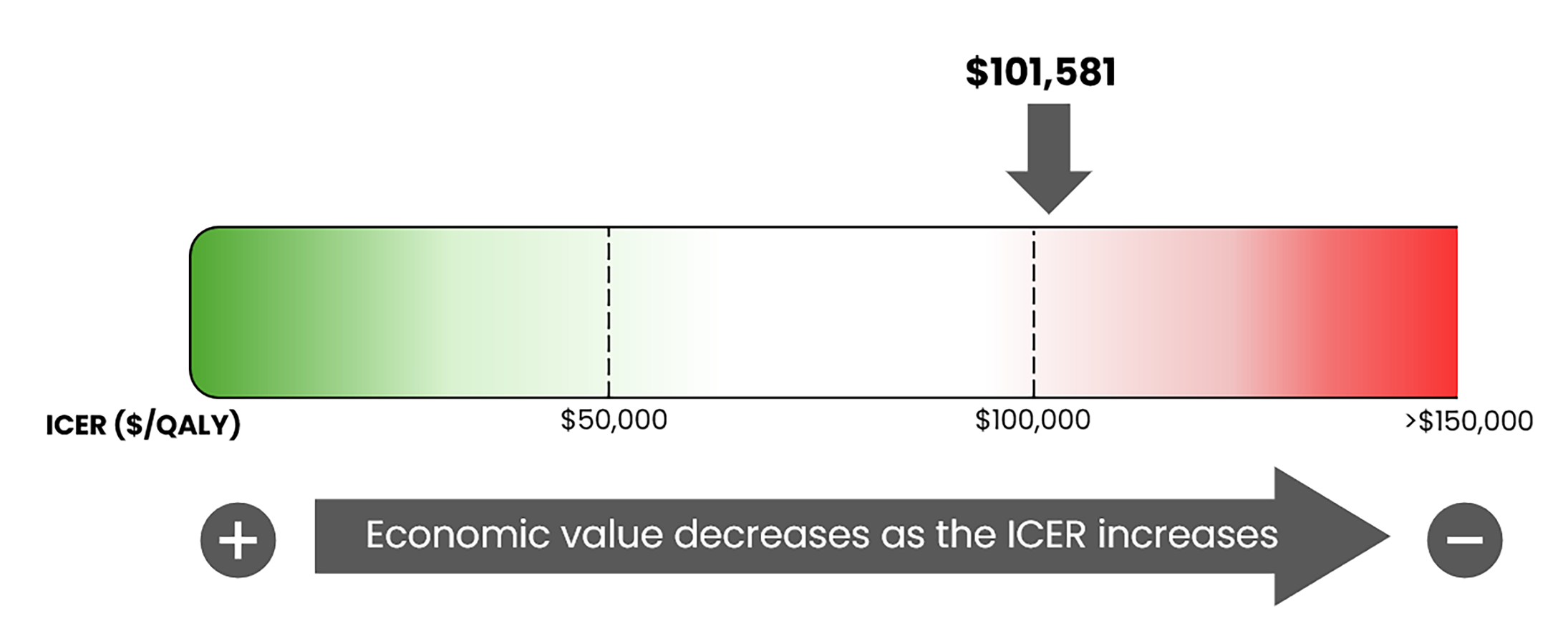
CDEC = Canadian Drug Expert Committee; ICER = incremental cost-effectiveness ratio; QALY = quality-adjusted life-year.
Certainty of the evidence: Tirzepatide’s impact on health is uncertain. Although generic utility preferences were collected in the SURMOUNT-OSA trials, this evidence was not included in the economic submission to inform utilities. Because tirzepatide reduces weight and improves OSA severity (measured by AHI), there are 2 impacts on health that are expected. Based on the sponsor’s modelling approach, health-related quality of life (HRQoL) associated with weight loss is assumed to be minimal, based on the assumption that HRQoL is only impacted when weight decreases to a BMI of 28 kg/m2. The HRQoL benefits associated with OSA severity improvement are based on an analysis that does not adhere to CDA-AMC economic guidelines and is speculative in nature. This limits interpretation of results based on the sponsor’s submitted model. Additionally, CDEC discussed that the estimated ICERs for tirzepatide are highly uncertain due to limitations in the underlying clinical evidence, model structure and assumptions, and unresolved uncertainty regarding treatment pathways in clinical practice. Given the identified limitations and uncertainty in the long-term efficacy data, the economic analysis may not accurately assess the impact of tirzepatide on patient health and health care resources. As a result, the cost-effectiveness estimates are highly uncertain and higher price reductions may be required to achieve a given willingness-to-pay threshold.
Other considerations: The sponsor submitted an additional cost-effectiveness analysis adopting a societal perspective. In this analysis, the sponsor’s estimates of productivity losses were uncertain given that the sponsor’s implementation of data was inconsistent with the submitted source used to inform the model. Although CDA-AMC investigated the feasibility of using alternate sources for productivity given the importance of work productivity outcomes for patients with OSA, data on absenteeism suitable for implementation in the sponsor’s model were limited. The sponsor also used a human capital approach for estimating productivity, which assumes that productivity losses persisted for the patients’ entire lifetime. Given these limitations, CDA-AMC presented the societal perspective as a scenario analysis only and excluded patient productivity losses. The cost-effectiveness results from the CDA-AMC societal perspective scenario analysis were similar to those from the analysis using a health care payer perspective.
Impacts on Health Systems
Anticipated budget impact: CDA-AMC estimates that the budget impact of reimbursing tirzepatide for the treatment of the indicated population will be approximately $912 million over the first 3 years of reimbursement compared to the amount currently spent on comparators, with an estimated expenditure of $912 million on tirzepatide over this period. For the requested reimbursement population, CDA-AMC estimates that the budget impact of reimbursing tirzepatide will be approximately $730 million over the first 3 years. In both populations, the actual budget impact of reimbursing tirzepatide will depend on the prevalence of weight-related comorbidities and distribution of tirzepatide doses used in clinical practice. The actual budget impact of reimbursing tirzepatide will depend on the number of people eligible for tirzepatide and the market uptake.
Organizational implications: CDEC heard that there are 2 main diagnostic tests used in clinical practice to confirm an OSA diagnosis — PSG and HSATs. Clinical experts considered PSG to be the gold standard but noted that there are difficulties accessing this type of test across many jurisdictions. They acknowledged that a requirement for a PSG to diagnose OSA would adversely impact access to treatment for people in some jurisdictions, including those in rural communities. CDEC heard from the clinical experts that HSAT tests could be used as an alternative but that there may be limitations in the sensitivity of HSAT, which may not detect wake periods, and they may underestimate disease severity. CDEC noted that the indication requires adjunct lifestyle modifications but heard from the clinical experts that lifestyle modification interventions are not widely available across Canada.
Sources of Information Used by the Committee
To make its recommendation, the committee considered the following information (links to the full documents for the review can be found on the project webpage):
the CDA-AMC review of the clinical and pharmacoeconomic evidence submitted by the sponsor related to tirzepatide (refer to the Main Report and Supplemental Material document)
the sponsor’s comments on the draft report and the CDA-AMC responses
patients' perspectives gathered by 3 patient groups, Gastrointestinal Society, Obesity Canada, and Obesity Matters (refer to the Patient and Clinician Group Input document)
input from a person with lived experience who delivered a brief presentation and answered questions from the committee (refer to the Person with Lived Experience section earlier in this document)
input from 5 clinician groups — an independent group of 5 clinicians, Obesity Canada, The Ottawa Hospital Sleep Centre, Ontario Health Clinics–Brantford, and the Respiratory Medicine Group at the University of British Columbia Hospital Sleep Program (refer to the Patient and Clinician Group Input document)
input from public drug programs that participate in the reimbursement review process (refer to the Supplemental Material document)
input from 3 clinical experts with expertise in the management of OSA consulted by CDA-AMC.
Special thanks: CDA-AMC extends our special thanks to Olivier Picard, who presented directly to CDEC, and to Obesity Matters Canada, representing the community of those living with OSA and obesity.
General note: CDA-AMC makes every attempt to engage with people with lived experience as closely to the indication under review as possible; however, at times, CDA-AMC is unable to do so and instead engages with individuals with similar treatment journeys to ensure lived experience perspectives are included and considered in Reimbursement Reviews. CDA-AMC is fortunate to be able to engage with individuals who are willing to share their treatment journeys with CDEC.
CDEC Information
Members of the Committee
Dr. Peter Jamieson (Chair), Dr. Kerry Mansell (Vice-Chair), Sally Bean, Daryl Bell, Dan Dunsky, Dr. Ran Goldman, Dr. Trudy Huyghebaert, Dr. Dennis Ko, Dr. Christine Leong, Alicia McCallum, Dr. Srinivas Murthy, Dr. Nicholas Myers, Dr. Krishnan Ramanathan, Dr. Marco Solmi, Carla Velastegui, Dr. Edward Xie, and Dr. Peter Zed.
Meeting date: August 27, 2026
Regrets: Three expert committee members did not attend.
Conflicts of interest: None
ISSN: 2563-6596
Canada’s Drug Agency (CDA-AMC) is a pan-Canadian health organization. Created and funded by Canada’s federal, provincial, and territorial governments, we’re responsible for driving better coordination, alignment, and public value within Canada’s drug and health technology landscape. We provide Canada’s health system leaders with independent evidence and advice so they can make informed drug, health technology, and health system decisions, and we collaborate with national and international partners to enhance our collective impact.
Disclaimer: CDA-AMC has taken care to ensure that the information in this document was accurate, complete, and up to date when it was published, but does not make any guarantee to that effect. Your use of this information is subject to this disclaimer and the Terms of Use at cda-amc.ca.
The information in this document is made available for informational and educational purposes only and should not be used as a substitute for professional medical advice, the application of clinical judgment in respect of the care of a particular patient, or other professional judgments in any decision-making process. You assume full responsibility for the use of the information and rely on it at your own risk.
CDA-AMC does not endorse any information, drugs, therapies, treatments, products, processes, or services. The views and opinions of third parties published in this document do not necessarily reflect those of CDA-AMC. The copyright and other intellectual property rights in this document are owned by the Canadian Agency for Drugs and Technologies in Health (operating as CDA-AMC) and its licensors.
Questions or requests for information about this report can be directed to Requests@CDA-AMC.ca.